
Judge, 1906-06-16 · page 7 of 16
Judge — June 16, 1906 — page 7: what you’re looking at
What you’re looking at
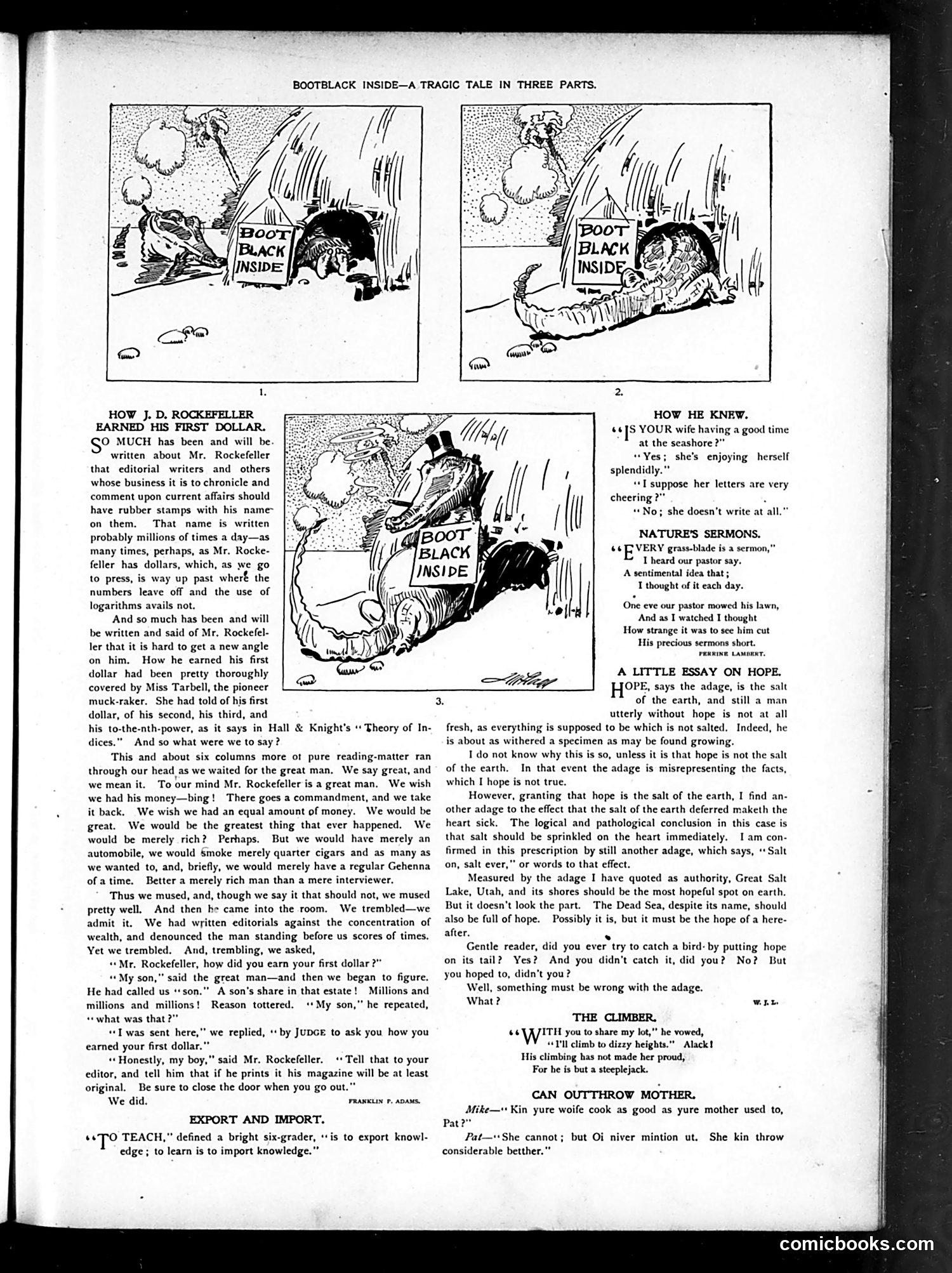
This three-panel cartoon satirizes the gap between J.D. Rockefeller's public image and reality. Panel 1 shows a bootblack outside in rain; Panel 2 reveals him sheltering *inside* a boot labeled "Bootblack Inside"—a visual pun suggesting the bootblack has literally become part of his own business. The accompanying article by Franklin P. Adams mocks the endless writing about Rockefeller's wealth and success. Adams describes an interview where Rockefeller, asked how he earned his first dollar, cryptically replies "Honestly, my boy"—which Adams sardonically notes is utterly unoriginal, yet the editor demands it be printed as such. The satire targets both Rockefeller's fortune (so vast "numbers leave off") and the media's obsession with celebrating his success, while hinting at skepticism about whether such wealth was truly earned honestly. The bootblack cartoon suggests those pursuing Rockefeller-like success end up consumed by their own enterprises.
📄 Transcribed text from this page (OCR, searchable)
Machine-transcribed from the original scan — historical spelling and the odd misread are preserved.
2 HOW HE KNEW. HOW J. D, ROCKEFELLER EARNED HIS FIRST DOLLAR. ‘O MUCH has been and will be. written about Mr. Rockefeller that editorial writers and others whose business it is to chronicle and comment upon current affairs should have rubber stamps with his name~ on them. That name is written probably millions of times a day—as many times, perhaps, as Mr. Rocke- feller has dollars, which, as we go to press, is way up past wheré the numbers leave off and the use of logarithms avails not. And so much has been and will be written and said of Mr. Rockefel- ler that it is hard to get a new angle on him. How he earned his first dollar had been pretty thoroughly 4667S YOUR wife havi at the seashore “Yes; she’s enjoying herself splendidly.” «TI suppose her letters are very cheering 2” 3 “No; she doesn't write at all.” ga good time NATURE'S SERMONS. 662 VERY grass-blade is a sermon,” T heard our pastor say. A sentimental idea that ; T thought of it each day. One eve our pastor mowed his lawn, And as I watched I thought How strange it was to see him cut His precious sermons short. PRRRINE LAMBERT. A LITTLE ESSAY ON HOPE, covered by Miss Tarbell, the pioneer muck-raker. She had told of his first dollar, of his second, his third, and his to-the-nth-power, as it says in Hall & Knight's ‘Theory of In- dices.” And so what were we to say ? This and about six columns more ot pure reading-matter ran through our head_as we waited for the great man, We say great, and we mean it. To our mind Mr. Rockefeller is a great man. We wish we had his money—bing! There goes a commandment, and we take it back. We wish we had an equal amount of money. We would be great. We would be the greatest thing that ever happened. We would be merely rich? Perhaps. But we would have merely an automobile, we would Smoke merely quarter cigars and as many as we wanted to, and, briefly, we would merely have a regular Gehenna of atime. Better a merely rich man than a mere interviewer. ‘Thus we mused, and, though we say it that should not, we mused pretty well, And then he came into the room, We trembled—we admit it. We had written editorials against the concentration of wealth, and denounced the man standing before us scores of times. Yet we trembled, And, trembling, we asked, ««Mr. Rockefeller, how did you earn your first dollar ?” “« My son," said the great man—and then we began to figure. He had called us ‘*son."" A son's share in that estate! illions and millions and millions! Reason tottered. ‘My son,” he repeated, «what was that?” «Twas sent here,” we replied, + by JUDGE to ask you how you earned your first dollar." «Honestly, my boy,” said Mr. Rockefeller. + Tell that to your editor, and tell him that if he prints it his magazine will be at least original. Be sure to close the door when you go out.” We did. FRANKLIN P, ADAMS. EXPORT AND IMPORT. “To TEACH,” defined a bright six-grader, « edge ; to learn is to import knowledge. is to export knowl- HOPE: says the adage, is the salt of the earth, and still a man utterly without hope is not at all fresh, as everything is supposed to be which is not salted. Indeed, he is about as withered a specimen as may be found growing. I do not know why this is so, unless it is that hope is not the salt of the earth. In that event the adage is misrepresenting the facts, which I hope is not true. However, granting that hope is the salt of the earth, I find an- other adage to the effect that the salt of the earth deferred maketh the heart sick. The logical and pathological conclusion in this case is that salt should be sprinkled on the heart immediately. I am con- firmed in this prescription by still another adage, which says, «Salt on, salt ever,” or words to that effect. Measured by the adage I have quoted as authority, Great Salt Lake, Utah, and its shores should be the most hopeful spot on earth. But it doesn't look the part. The Dead Sea, despite its name, should also be full of hope. Possibly it is, but it must be the hope of a here- after. E Gentle reader, did you ever try to catch a bird: by putting hope on its tail? Yes? And you didn’t catch it, did you? No? But you hoped to, didn’t you? Well, something must be wrong with the adage. What? THE CLIMBER, 66 YITH yon to share my lot,” he vowed, “T'll climb to dizzy heights.” Alack! His climbing has not made her proud, For he is but a steeplejack. CAN OUTTHROW MOTHER. Mike—« Kin yure woife cook as good as yure mother used to, Pat?” Pat—'She cannot; but Oi niver mintion ut. considerable betther.” She kin throw comicbooks.com