
Judge, 1906-06-16 · page 4 of 16
Judge — June 16, 1906 — page 4: what you’re looking at
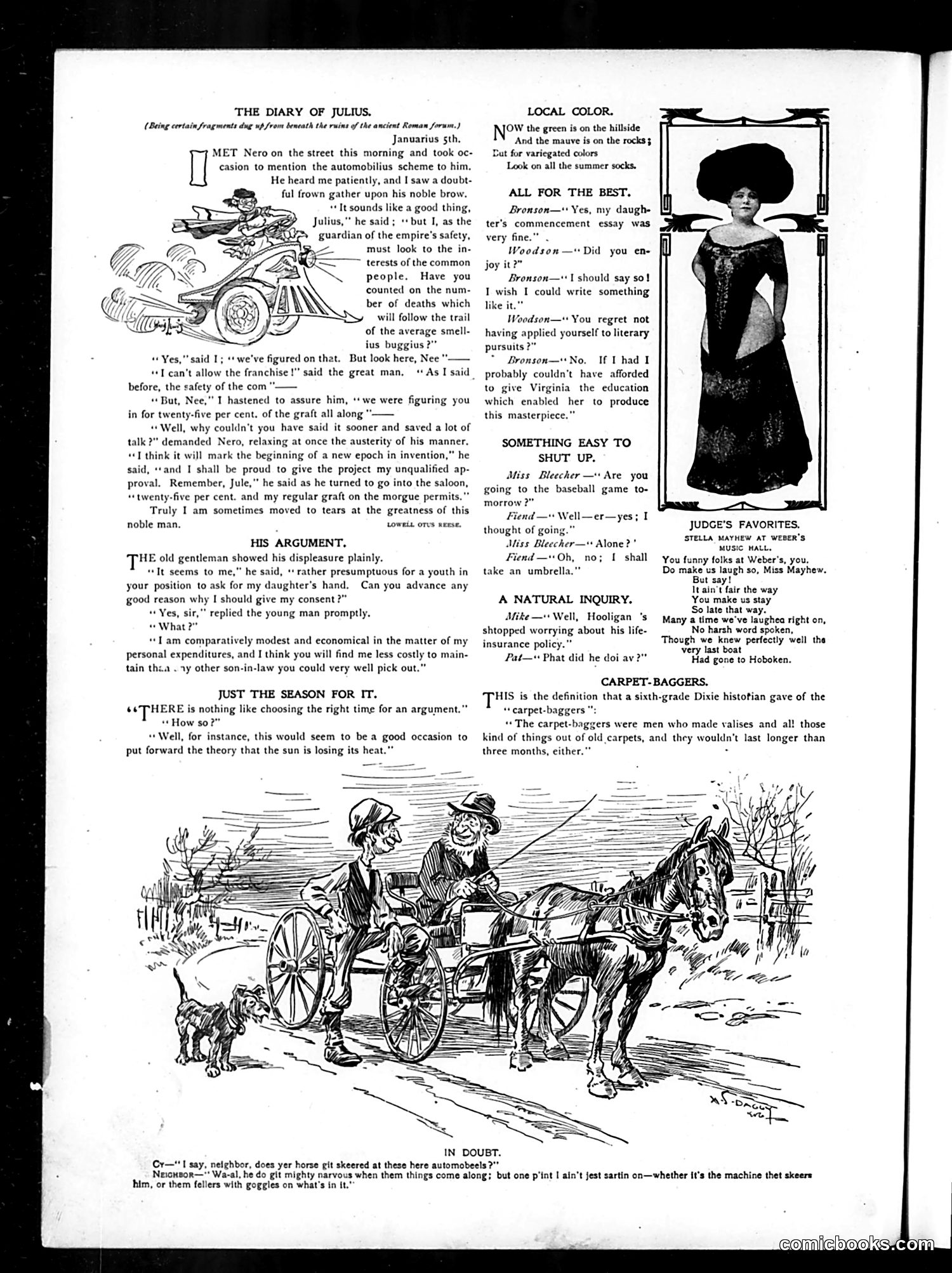
What you’re looking at
This page contains multiple satirical pieces typical of Judge's early 20th-century format. The main cartoon, "In Doubt," depicts two men on a horse-drawn wagon debating whether automobiles spook horses—a genuine contemporary concern as cars became common. The humor lies in the irony: they worry about machine-age technology frightening animals while using outdated transportation themselves. The surrounding text includes diary entries, social commentary pieces, and a portrait labeled "Judge's Favorites" featuring Stella Mayhew at Weber's Music Hall. The content reflects period preoccupations: automobiles, technological change, and entertainment. The overall tone is gently mocking of social anxieties about modernity rather than overtly political.
📄 Transcribed text from this page (OCR, searchable)
Machine-transcribed from the original scan — historical spelling and the odd misread are preserved.
‘THE DIARY OF JULIUS. (Being certain fragments dng up from beneath the ruins of the ancient Roman forum.) Januarius sth. MET Nero on the street this morning and took oc- casion to mention the automobilius scheme to him, He heard me patiently, and I saw a doubt- ful frown gather upon his noble brow. “It sounds like a good thing, Julius,” he said; “but I, as the guardian of the empire's safety, must look to the in- ~ terests of the common people. Have you counted on the num- ber of deaths which will follow the trail of the average smell- ius buggius ?” +-Yes,""said 1; «we've figured on that. But look here, Nee "— ++ T-can’t allow the franchise!" said the great man, “As I said before, the safety of the com "— «But, Nee," I hastened to assure him, “we were figuring you in for twenty-five per cent. of the graft all along ™ “Well, why couldn't you have said it sooner and saved a lot of talk?" demanded Nero, relaxing at once the austerity of his manner. “T think it will mark the beginning of a new epoch in invention,” he said, ‘and I shall be proud to give the project my unqualified ap- proval. Remember, Jule,” he said as he turned to go into the saloon, “twenty-five per cent. and my regular graft on the morgue permits.”” Truly I am sometimes moved to tears at the greatness of this noble man. HIS ARGUMENT. THE old gentleman showed his displeasure plainly. “It seems to me,” he said, “rather presumptuous for a youth in your position to ask for my daughter's hand. Can you advance any good reason why I should give my consent ?” “Yes, sir,” replied the young man promptly, “What?” «Lam comparatively modest and economical in the matter of my personal expenditures, and I think you will find me less costly to main- tain thaa . vy other son-in-law you could very well pick out.” JUST THE SEASON FOR IT. ‘THERE is nothing like choosing the right time for an argument.” + How $02” “Well, for instance, this would seem to be a good occasion to put forward the theory that the sun is losing its heat.” LOCAL COLOR. NOW the green is on the hillside And the mauve is on the rocks 3 Dut for variegated colors Look on all the summer socks. ALL FOR THE BEST. Bronson—* Yes, my daughe ter's commencement essay was very fine.” Woodson —* Did joy it?” Bronson—*'1 should say so! I wish I could write something like it.” Woodson—" You regret not having applied yourself to literary pursuits ?” Bronson No. If I had I probably couldn't have afforded to give Virginia the education which enabled her to produce this masterpiece.” you en- SOMETHING EASY TO SHUT UP. Miss Blecher —" Are you going to the baseball game to- Fiend —" Well—er—yes; I thought of going.” sMliss Bleecher—" Alone?’ Fiend —"Ob, no; 1 shall take an umbrella.” A NATURAL INQUIRY. Mike—" Well, Hooligan ’s shtopped worrying about his life- insurance policy.” Pat— Phat did he doi av?" JUDGE'S FAVORITES. STELLA MAYHEW AT WEBER'S MUSIC HALL. You funny folks at Weber's, you, Do make us laugh so, Miss Mayhew. But say! It ain't fair the way You make us stay So late that way. Many a time we've laughea right on, No harsh word spoken, Though we knew perfectly well the very last boat Had gone to Hoboken. CARPET- BAGGERS. yas is the definition that a sixth-grade Dixie histofian gave of the “ carpet-baggers ": “The carpet-baggers were men who made valises and al! those kind of things out of old carpets, and they wouldn't last longer than three months, either." \ \ IN DOUBT. Cr—"'I say, neighbor, does yer horse git skeered at these here automobeels?” Neicneor—"* Wa-al, he do git mighty narvous when them things come along; but one p'int I ain't jest sartin on—whether it's the machine thet skeers him, or them fellers with goggles on what's in it."