
A complete issue · 16 pages · 1906
Judge — May 12, 1906
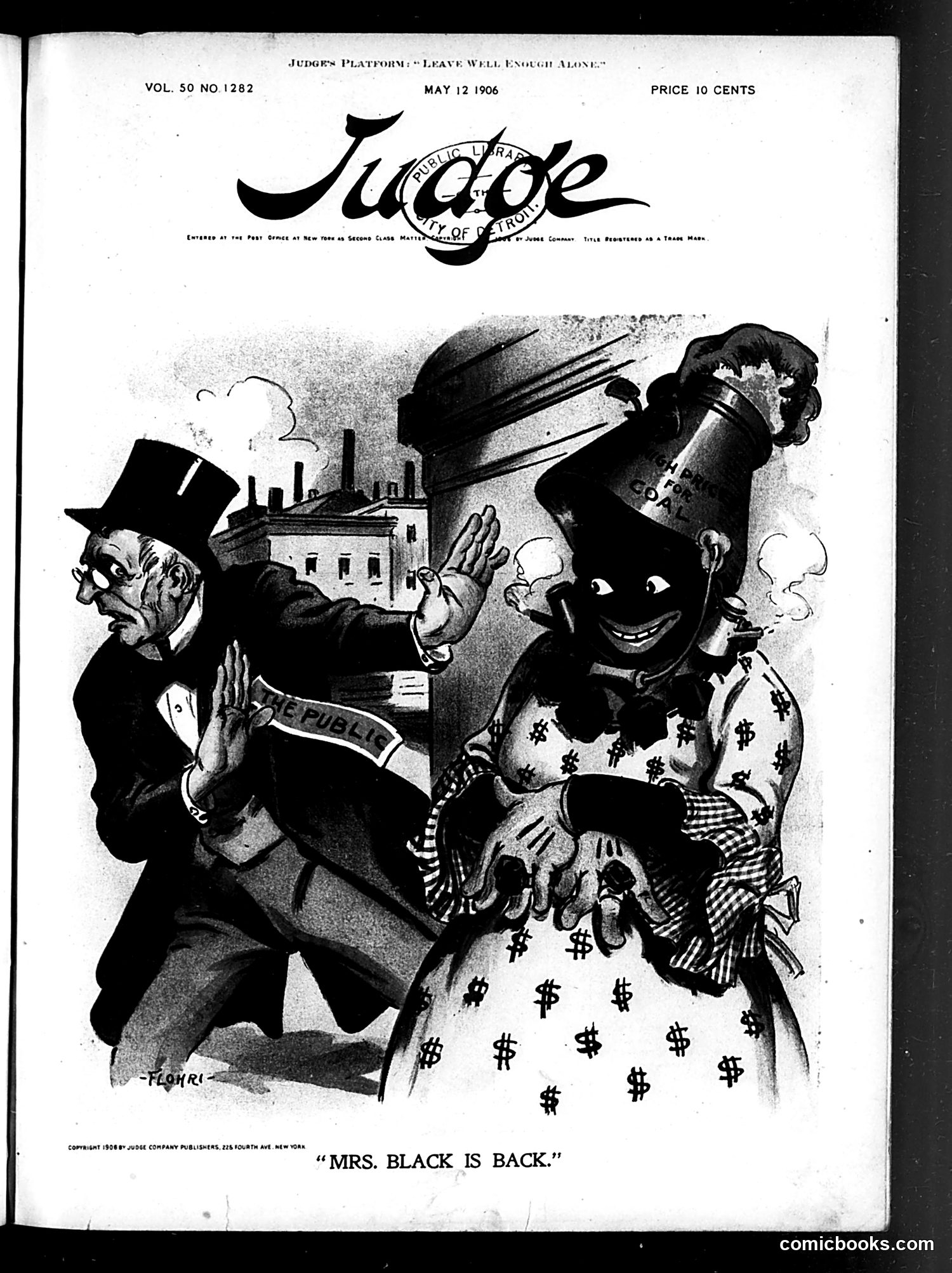
This Judge magazine cover from May 12, 1906 uses caricature and satire concerning wealth and financial excess. The cartoon depicts figures in formal dress (top hat and tails) alongside a large female figure covered in dollar signs. The title "Mrs. Black Is Back" appears to reference a return of significant wealth or financial influence. The industrial cityscape in the background and the exaggerated, almost grotesque styling suggest social commentary on the nouveau riche or corrupt financial dealings of the Gilded Age/Progressive Era. The specific identity of "Mrs. Black" remains unclear without additional historical context, but the satire likely targets contemporary figures associated with questionable wealth accumulation or financial scandal during this period of American economic volatility.
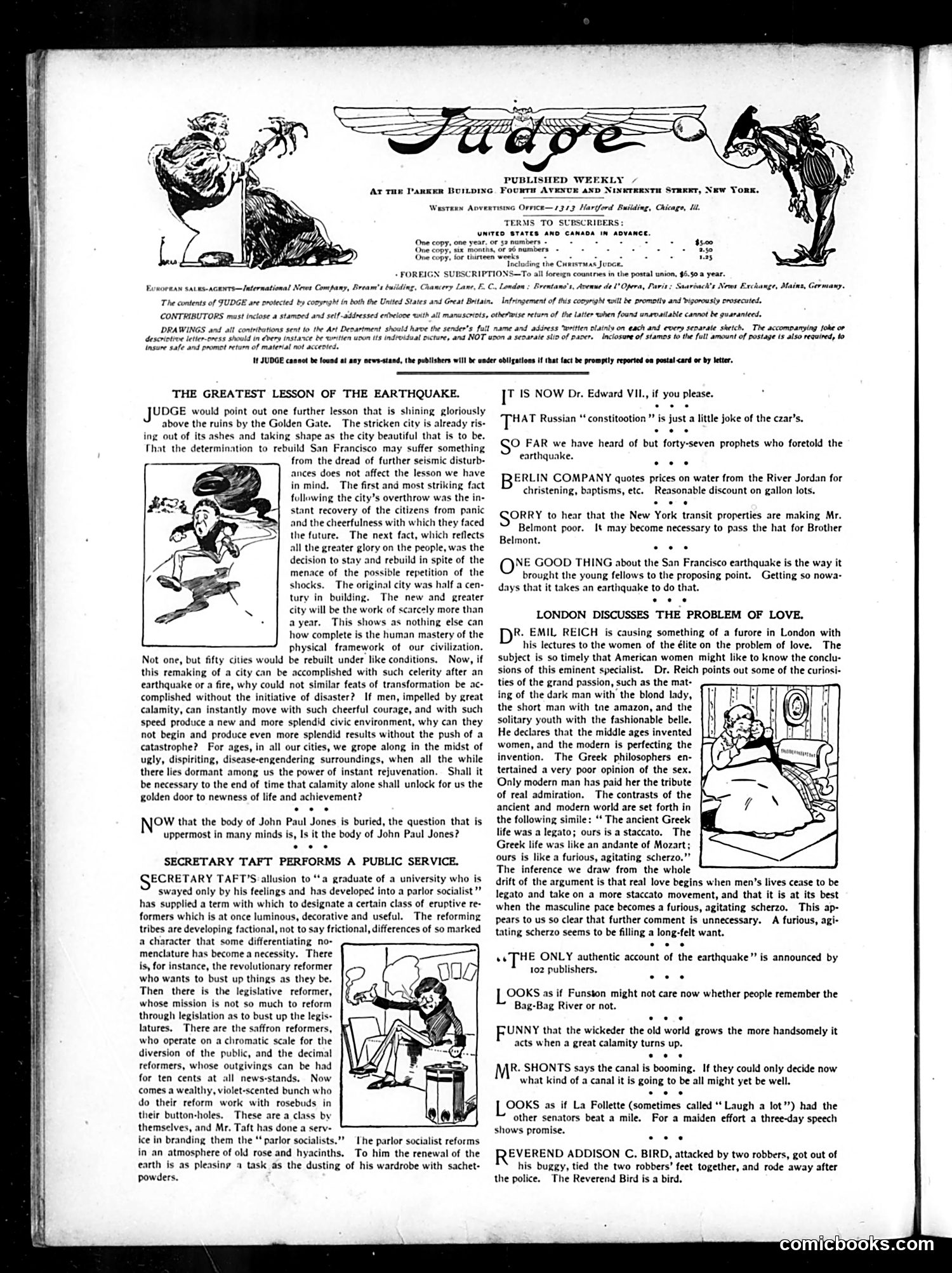
This page from Judge magazine contains several brief satirical commentary pieces rather than traditional political cartoons. The items reference: **The San Francisco Earthquake**: Multiple jokes about the recent disaster, including commentary on reconstruction efforts and cynical observations about how catastrophes reveal human nature. **Secretary Taft**: A longer article praising Taft's legislative reform efforts, describing him as bridging different reform factions and using "cramatic scale" to advance multiple reform types simultaneously. **Various brief quips** about Irish politicians, Russian politics, canal proposals, and social commentary—typical Judge fare mixing political and social satire. The illustrations appear to be generic vignettes rather than specific caricatures. Without clearer identification of specific figures or dates, the exact political targets remain partially unclear, though the tone is characteristic of early 1900s American satirical journalism mocking politicians and contemporary events.
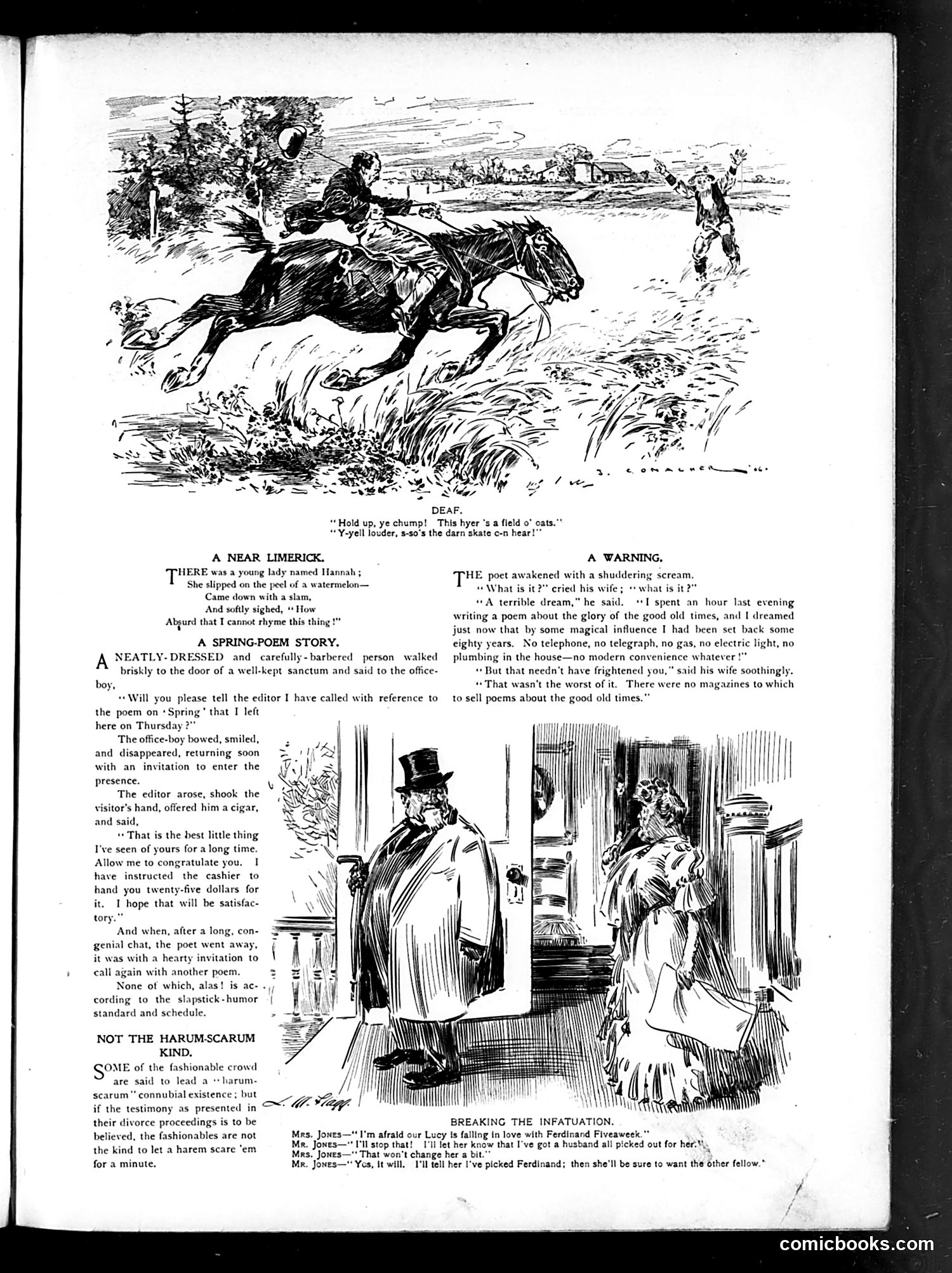
This page contains several independent humor pieces rather than a unified political cartoon. **Top illustration**: A horseman rides frantically across a field while someone shouts warnings. The dialogue references "chump," "field of oats," and a "darn skate"—suggesting physical comedy involving a reckless rider. **Text pieces below** include: "A Near Limerick" (humorous verse), "A Spring-Poem Story" (about an office boy), "A Warning" (a poet's domestic complaint about lost creative time), and "Not the Harum-Scarum Kind" (about fashionable "harum-scarum" divorce proceedings). **Bottom illustration**: Shows "Breaking the Infatuation"—a domestic scene where Mrs. Jones discusses her daughter Lucy's romantic entanglement with "Ferdinand Fitzweasel." The humor involves class-consciousness and matrimonial scheming typical of period satire. These are light social comedies about romance, office life, and domestic affairs rather than serious political commentary.
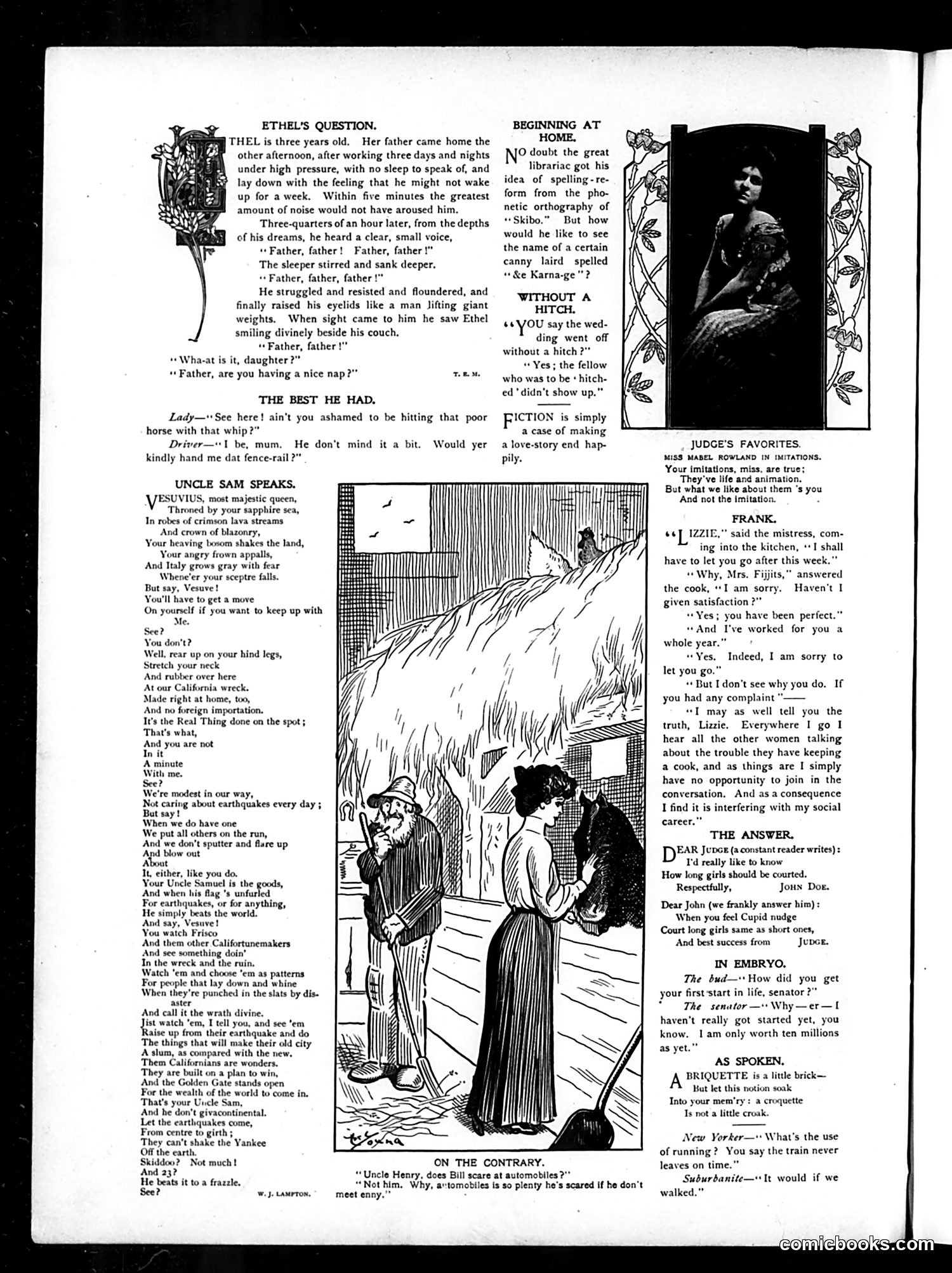
This page contains primarily **humor columns and short pieces** rather than political cartoons. The main illustrated content shows "On the Contrary" — a domestic scene where a woman confronts an old man about automobiles, with the caption suggesting he's fearful of cars ("Uncle Sam speaks" poem appears to be about California earthquakes and natural disasters, not politics). The page includes various humorous anecdotes and reader Q&A sections ("Ethel's Question," "Frank," "The Answer," "In Embryo," "As Spoken"). These focus on **social humor**: courtship advice, servant/employer dynamics, and wordplay rather than political satire. Without clear identification of specific figures or dated political references in the illustrations, this appears to be **general entertainment and social commentary** typical of Judge's satirical but non-partisan humor content.
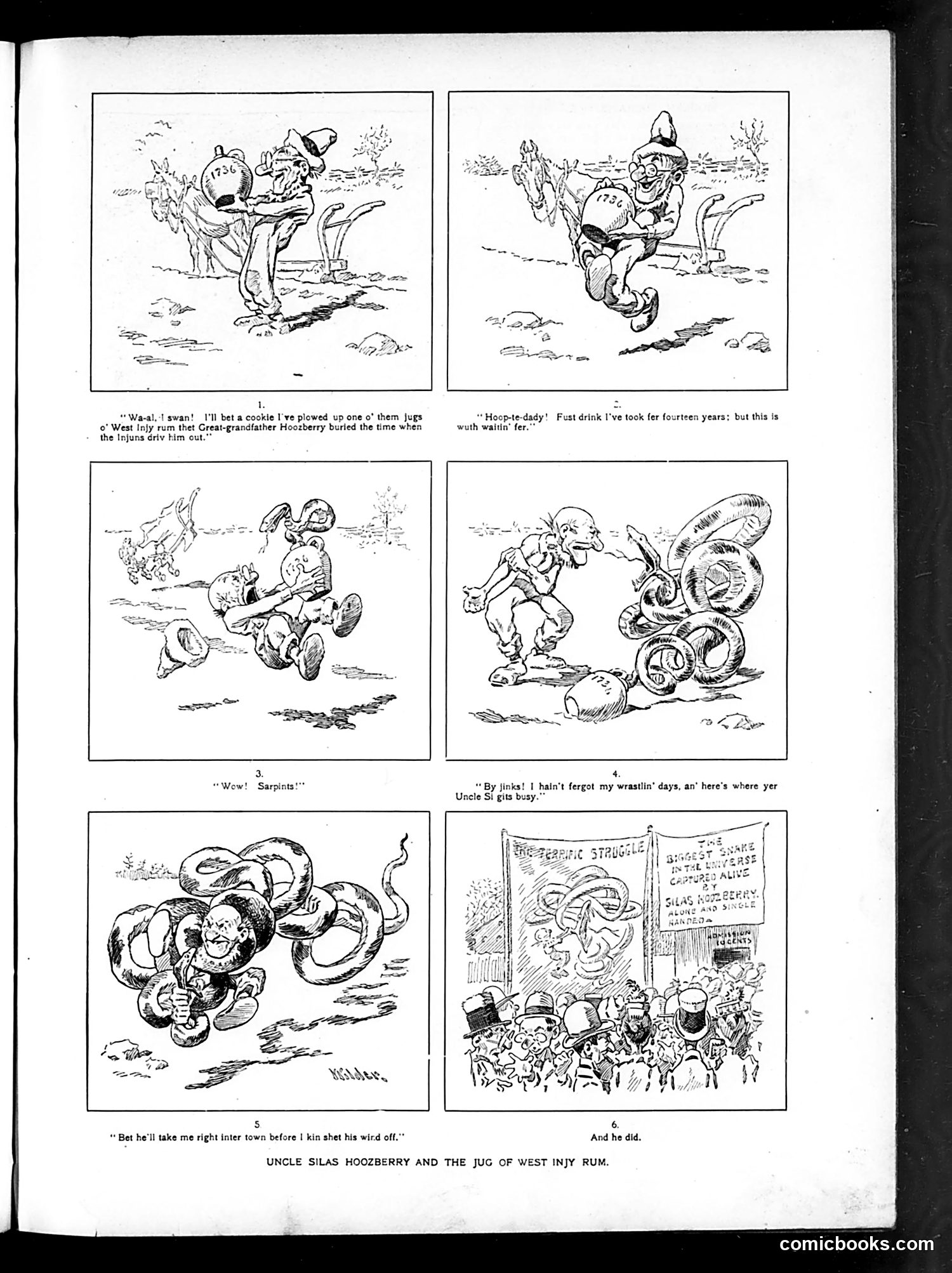
This comic strip appears to be a humorous tall tale about a character named Uncle Silas Hoozberry and his encounter with a magical jug of rum. The narrative follows a classic folk-story structure: Silas claims to have blown up a jug of West Indian rum that his great-grandfather buried, leading to increasingly absurd consequences involving serpents and supernatural wrestling matches. The satire targets frontier tall tales and exaggerated storytelling traditions popular in American folklore. The character's boastful claims about his wrestling prowess and mythical encounters parody the masculine braggadocio common in such narratives. The final panel shows the story becoming a public spectacle, suggesting mockery of how such legends circulate and grow in popular culture.
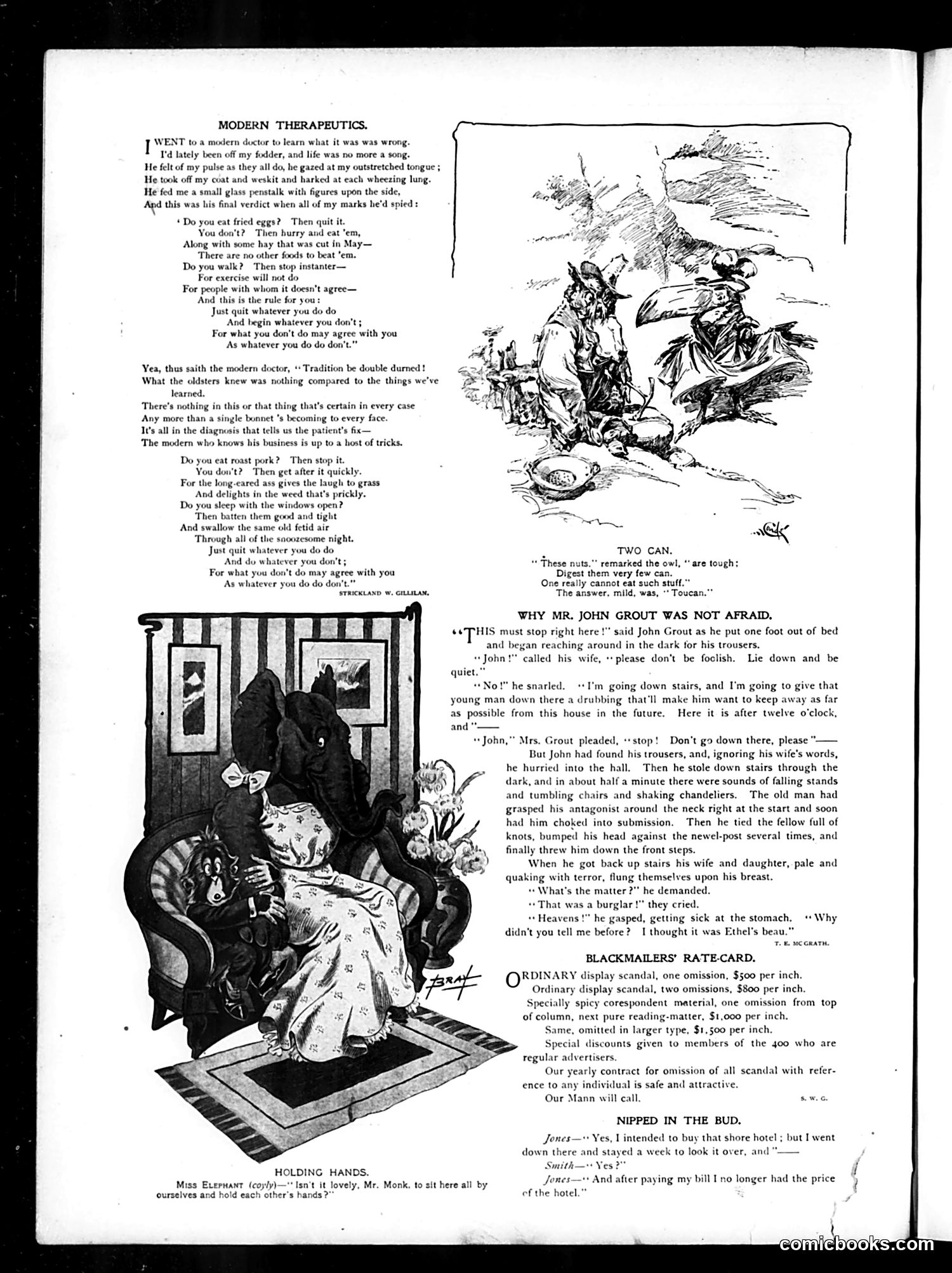
**"Modern Therapeutics"** satirizes contemporary medical practice. The poem mocks doctors who reject traditional treatments in favor of contradictory, individualized advice—eat fried eggs, then don't; exercise, then don't; sleep with windows open, then closed. The satire targets the era's shift toward personalized medicine and diagnosis-based treatment, portraying modern doctors as pretentious charlatans who hide ignorance behind jargon and opposite-seeming prescriptions. **"Why Mr. John Grout Was Not Afraid"** is a domestic humor piece where a homeowner violently attacks an intruder at midnight, later discovering he's beaten his daughter's suitor (presumably "Ethel's beau"). The joke plays on anxious masculinity—he'd have acted differently knowing the victim's identity—and mocks both violent overreaction and the social embarrassment of attacking a romantic rival. **"Blackmailers' Rate-Card"** appears to be an advertisement parody listing scandal-suppression prices, likely satirizing tabloid journalism and pay-for-silence schemes common in the era.
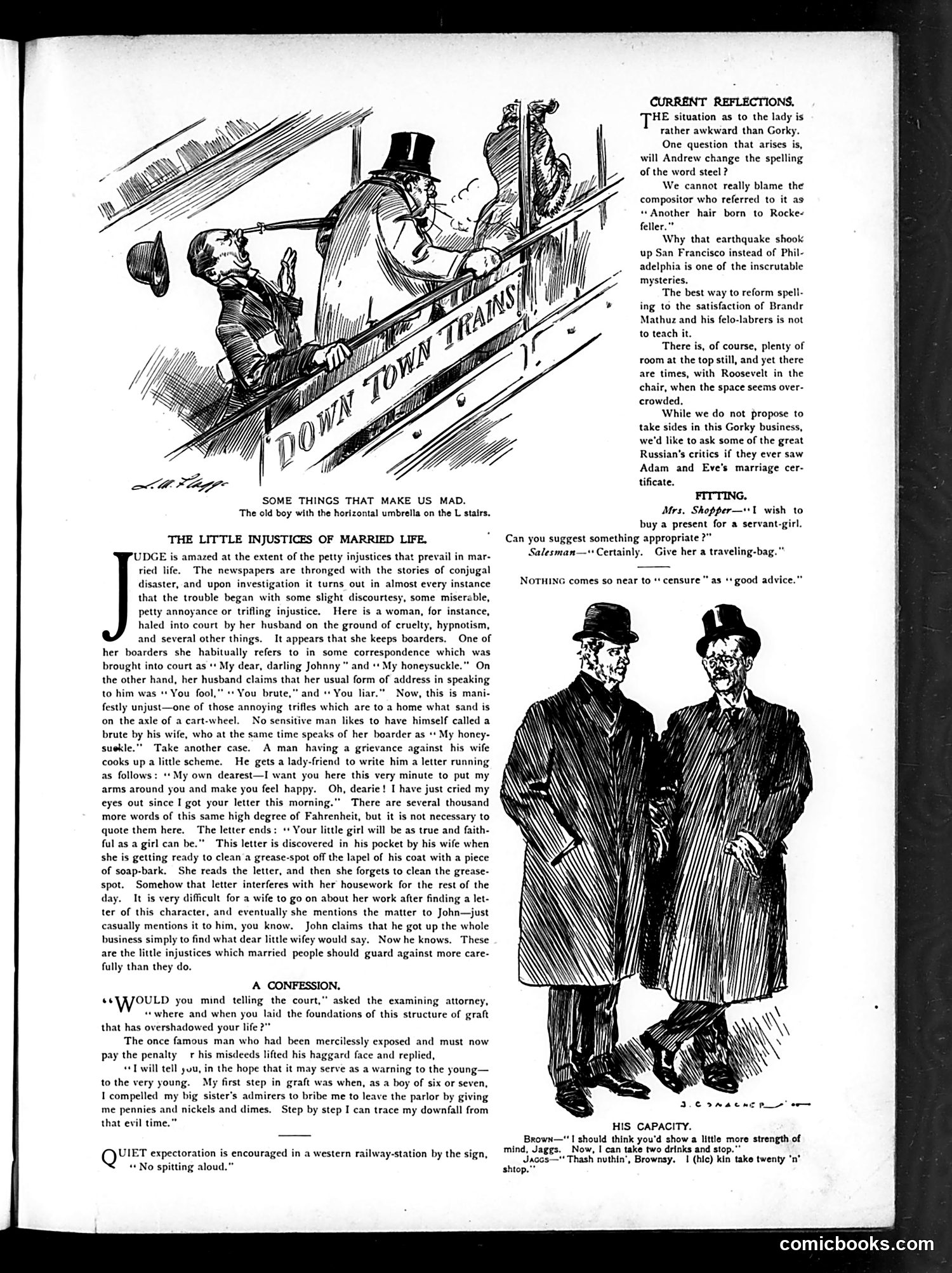
This Judge magazine page satirizes **marital discord and petty domestic grievances**. The main article, "The Little Injustices of Married Life," uses specific case examples to mock how trivial annoyances destroy marriages. One anecdote describes a wife who sweetly calls a male boarder "My honeysuckle" while calling her own husband "You fool" and "You brute"—highlighting the hypocrisy and emotional cruelty of married couples. Another depicts a husband who fabricates a love letter to trap his wife, then acts innocent when discovered. The cartoon "Some Things That Make Us Mad" shows frustration with inconsiderate behavior—specifically a man with a horizontal umbrella on stairs, blocking others' passage. "A Confession" appears to satirize corruption, where a criminal traces his moral decline to childhood bribery schemes at age six or seven. The page reflects early 20th-century concerns about marriage stability, gender dynamics, and societal hypocrisy. The humor targets both spouses equally for their petty, manipulative behaviors.
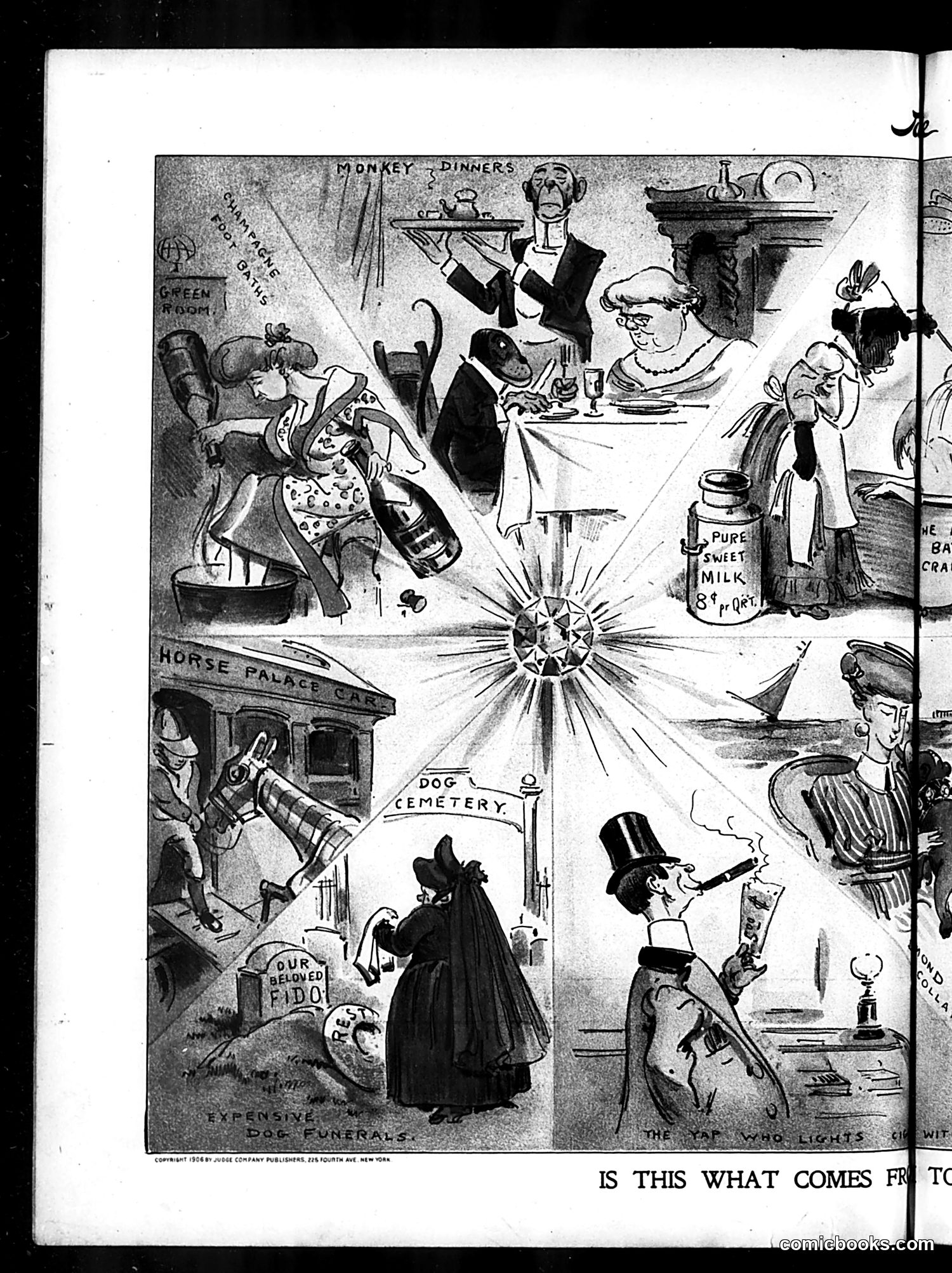
This appears to be a satirical illustration from *Judge* magazine depicting various aspects of urban life and excess. The central image shows "Monkey Dinners" at what appears to be an upscale establishment, with a monkey waiter serving diners. Surrounding vignettes include "Horse Palace," "Dog Cemetery," "Pure Sweet Milk," and "Dog Funerals." The satire likely criticizes wealthy New York society's extravagant and often absurd entertainments and spending habits during the Gilded Age. The monkey serving wealthy patrons mocks the pretentiousness of high society, while references to expensive pet services (dog cemetery, funerals) ridicule the lavish treatment of animals by the rich. The overall message appears to be social commentary on class excess and misplaced priorities among the wealthy elite.
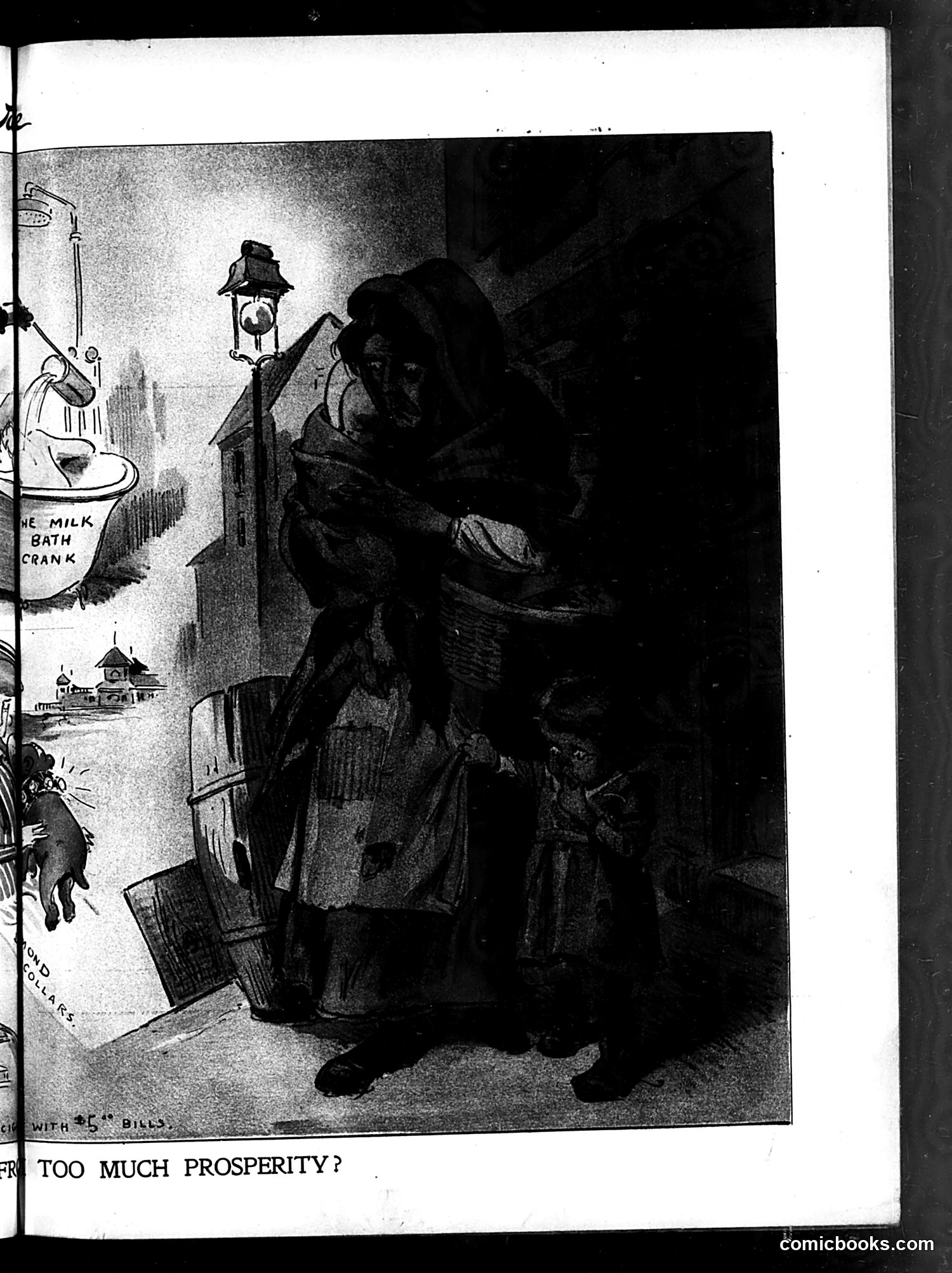
This political cartoon depicts a poorly dressed, thin man surrounded by symbols of wealth and modern conveniences—a milk bath crank, fancy street lamp, and church building visible in the background. The title "Too Much Prosperity?" appears ironic. The satire critiques the disconnect between America's claimed economic prosperity and the actual poverty experienced by working-class citizens. While the wealthy enjoyed luxuries and the nation boasted of economic growth, many ordinary people remained impoverished. The cartoon suggests the absurdity of calling this era "prosperous" when poverty remained visible on the streets. This likely reflects concerns from the early 20th century about unequal wealth distribution during periods of industrial boom.
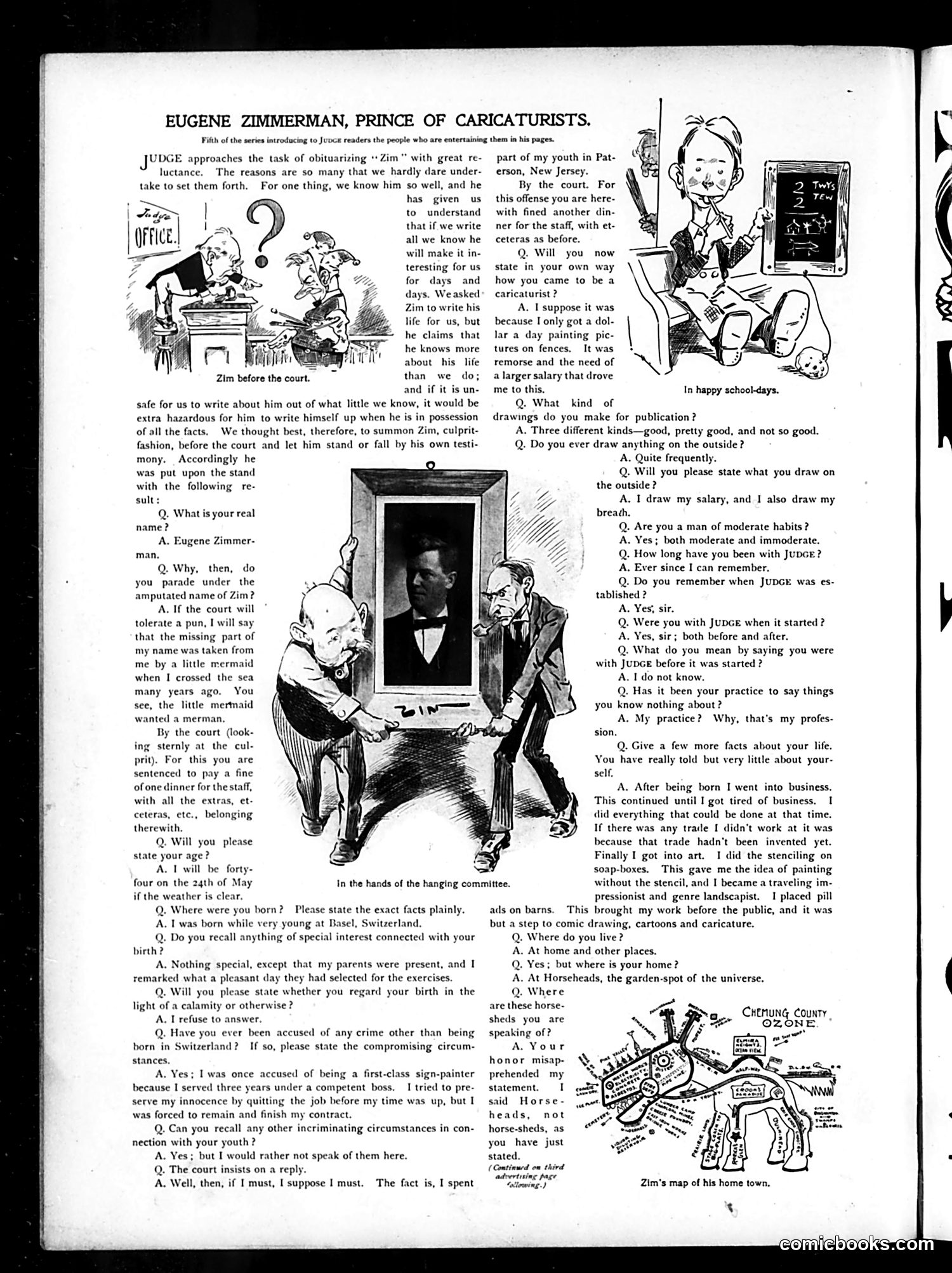
This page features a humorous "trial" interview with **Eugene Zimmerman**, a prominent cartoonist and caricaturist working for *Judge* magazine. The format parodies a court proceeding where Zimmerman is humorously "prosecuted" for his artistic practices. The satire works through absurdist humor: Zimmerman admits to drawing outside the magazine (on his salary), claims to have worked for *Judge* "before it started," and practices speaking about things he knows nothing about—presented as his professional method. The cartoons illustrate the interview, showing Zimmerman at work and the "hanging committee" (judges) evaluating his art. The joke plays on *Judge* magazine's self-referential insider humor, celebrating one of its star contributors while gently mocking artistic pretension and the magazine's own authority. The map of "Zim's home town" (Horsheads, Ohio) at bottom suggests biographical detail within the broader comedic roast.
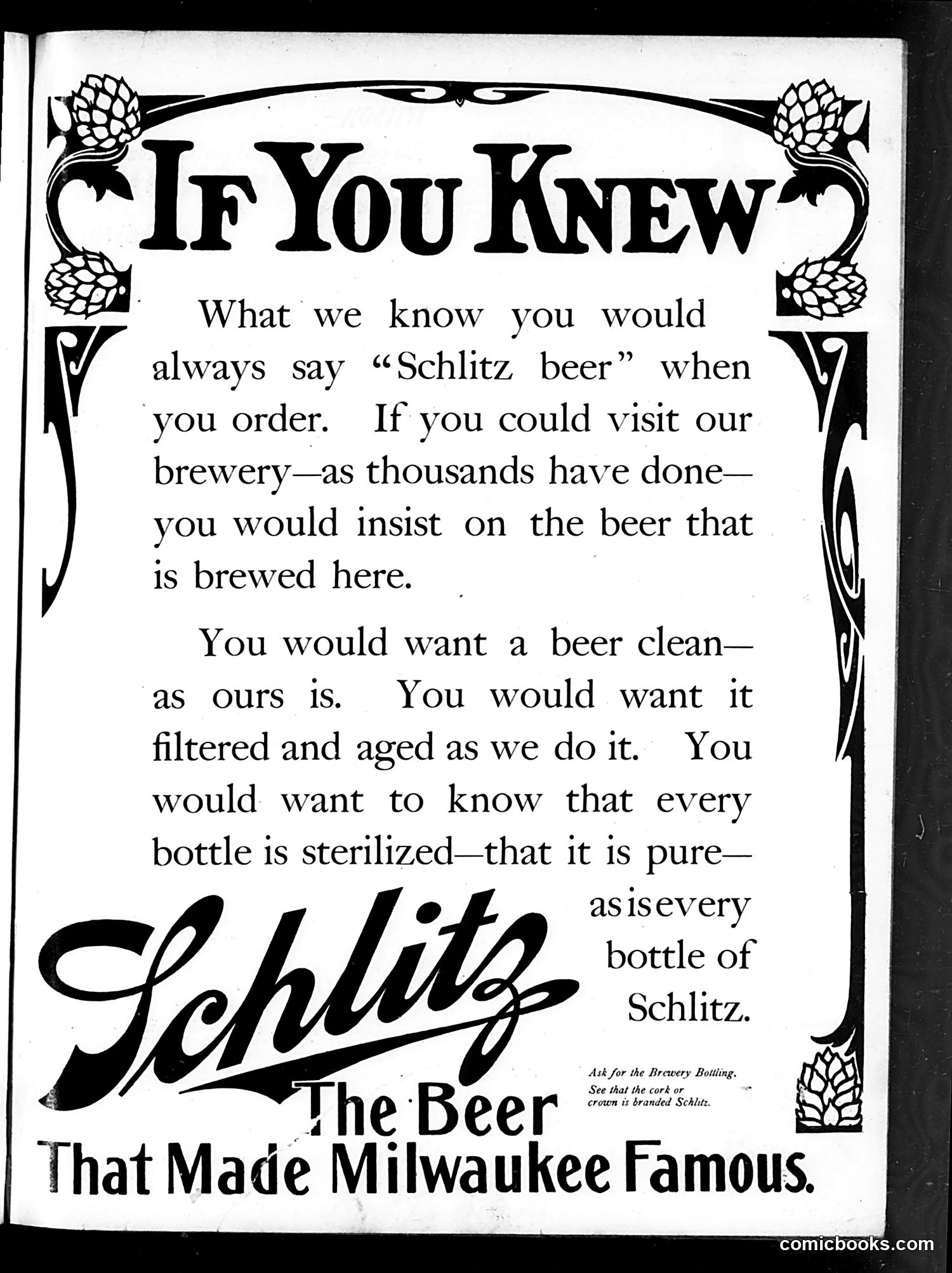
This is a **Schlitz beer advertisement**, not a political cartoon. The page uses the "If You Knew" format to appeal to consumer logic about beer quality. The ad's argument: if readers visited the Schlitz brewery in Milwaukee, they would demand Schlitz specifically because of its superior manufacturing—filtered, aged, and sterilized bottles ensuring purity. This targets consumers concerned with hygiene and quality control, messaging relevant to the early 20th century when food safety standards were newly important to consumers. The decorative hop illustrations frame the text, appropriate for beer advertising. The tagline "The Beer That Made Milwaukee Famous" positions Schlitz as Milwaukee's flagship product, leveraging civic pride and the city's reputation as a brewing center. This is straightforward commercial advertising, not satire.
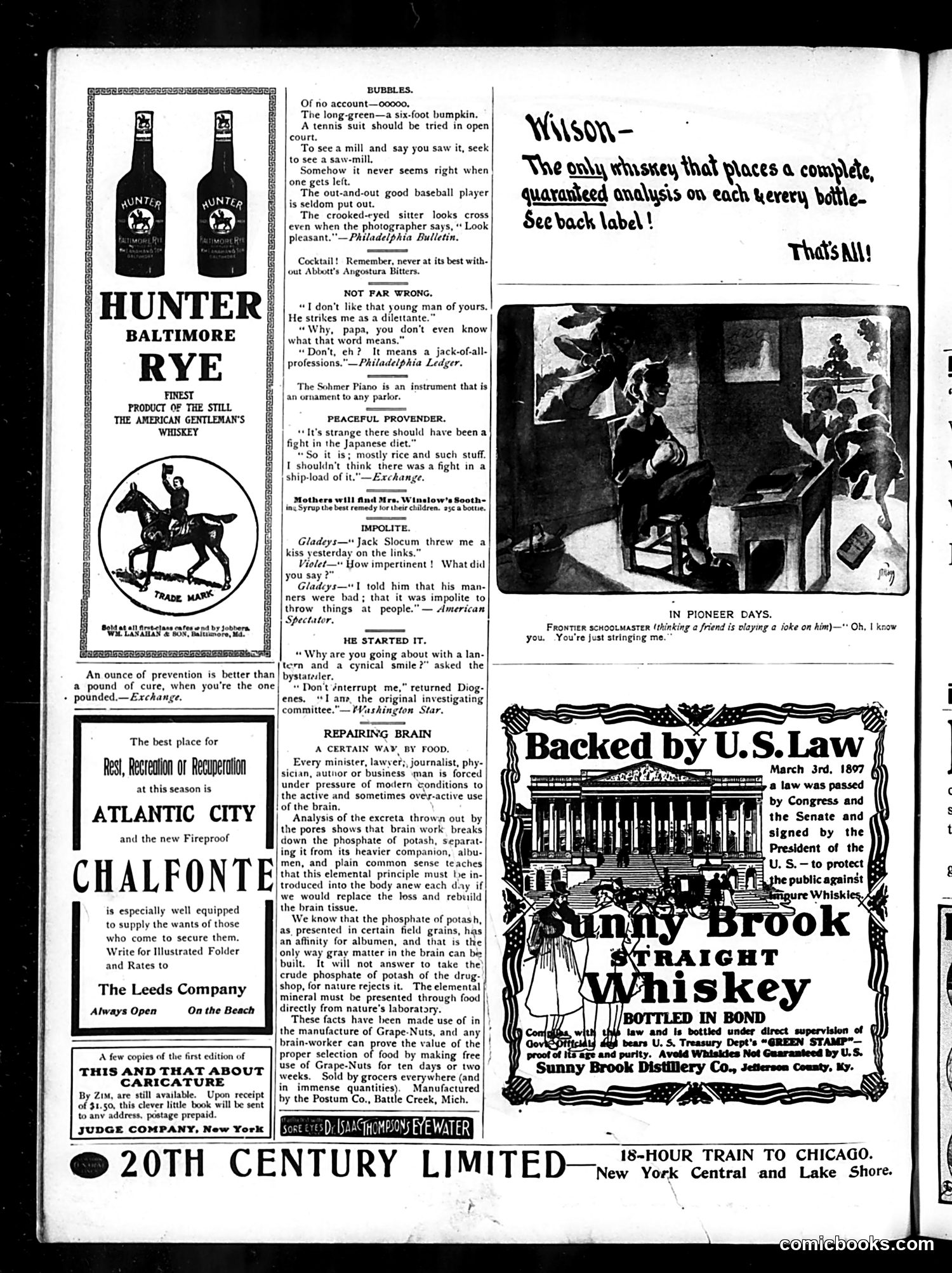
This page is primarily **advertisements and brief humor pieces**, typical of Judge magazine's format. The main content includes: **Humor snippets ("Bubbles")**: Short jokes about wordplay and social observations—a man who "never seems right when one gets left," a crooked-eyed person looking "cross," puns about sawmills and tennis courts. These are gentle satirical observations of daily American life. **Key advertised products**: Hunter Baltimore Rye whiskey, Abbott's Angostura Bitters, Sohmer pianos, and Grape-Nuts cereal. **Notable humor piece "Repairing Brain"**: A pseudo-scientific advertisement for Grape-Nuts cereal that claims brain workers (lawyers, journalists, ministers) lose phosphate of potash through mental exertion and must replenish it through proper food—specifically Grape-Nuts, which supposedly contains this mineral. This is **satirical health-claim marketing**, the type common in early 1900s advertising that blended dubious science with product promotion. The page reflects Judge's dual purpose: satirizing contemporary culture while monetizing through advertisements, many making exaggerated health and social claims.
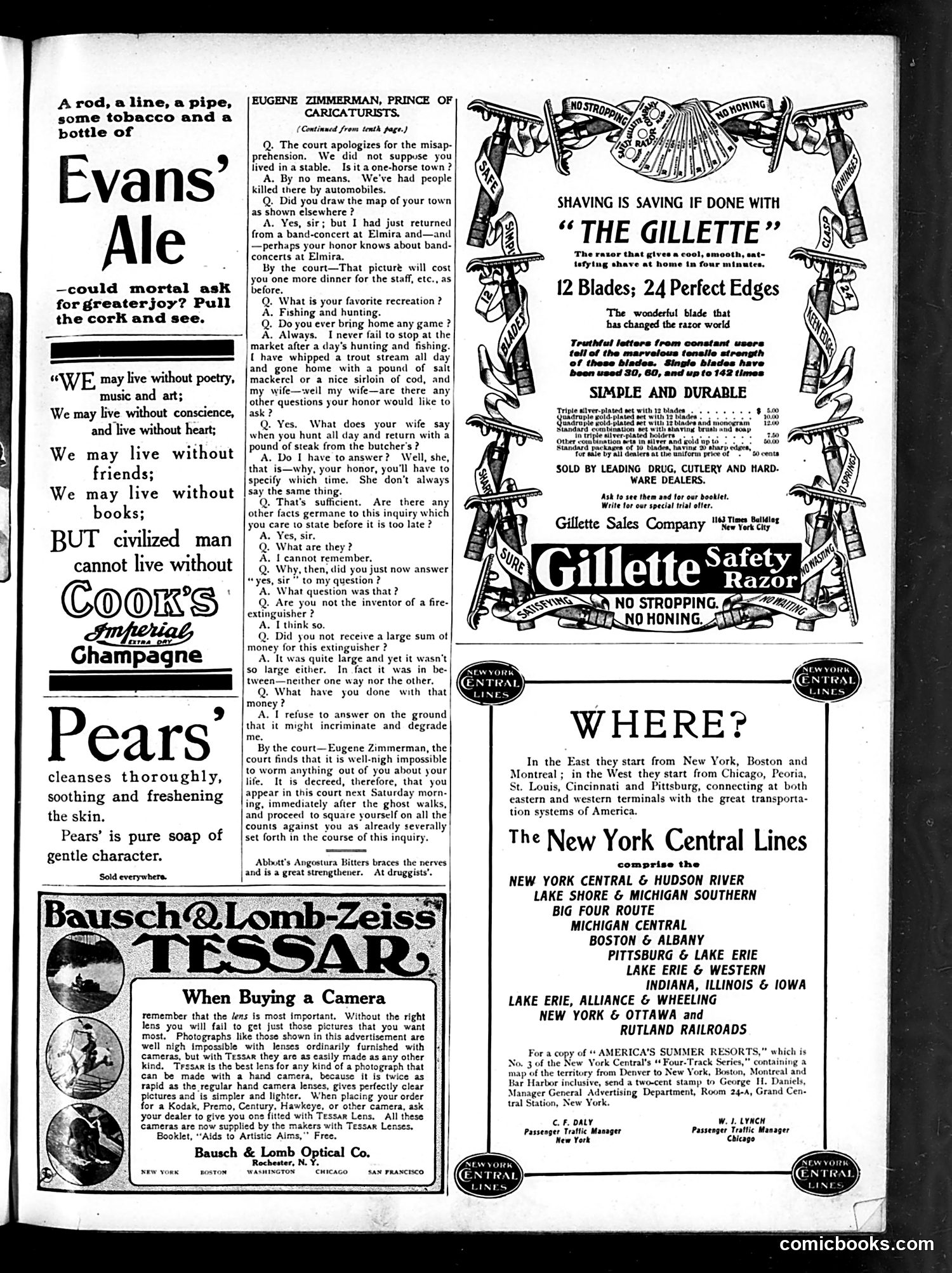
This page is primarily **advertising** rather than editorial cartoon content. However, it does include one satirical piece: ## "Eugene Zimmerman, Prince of Caricaturists" This appears to be a **humorous court testimony** mocking Eugene Zimmerman, a real Judge magazine cartoonist. The satire presents him answering absurd cross-examination questions about his hometown, hunting habits, and a fire-extinguisher invention. **The humor relies on:** - Zimmerman's evasive, contradictory answers (he catches no game despite hunting; he can't remember large sums of money) - The judge's exasperation with nonsensical replies - Self-deprecating mockery of the artist himself The piece likely reflects insider Judge magazine humor—poking fun at one of their own contributors in a playful way that readers familiar with Zimmerman would recognize. **The rest of the page** consists of period advertisements for Evans' Ale, Cook's Champagne, Pears' soap, Bausch & Lomb cameras, and Gillette razors—typical of early 1900s magazine advertising.
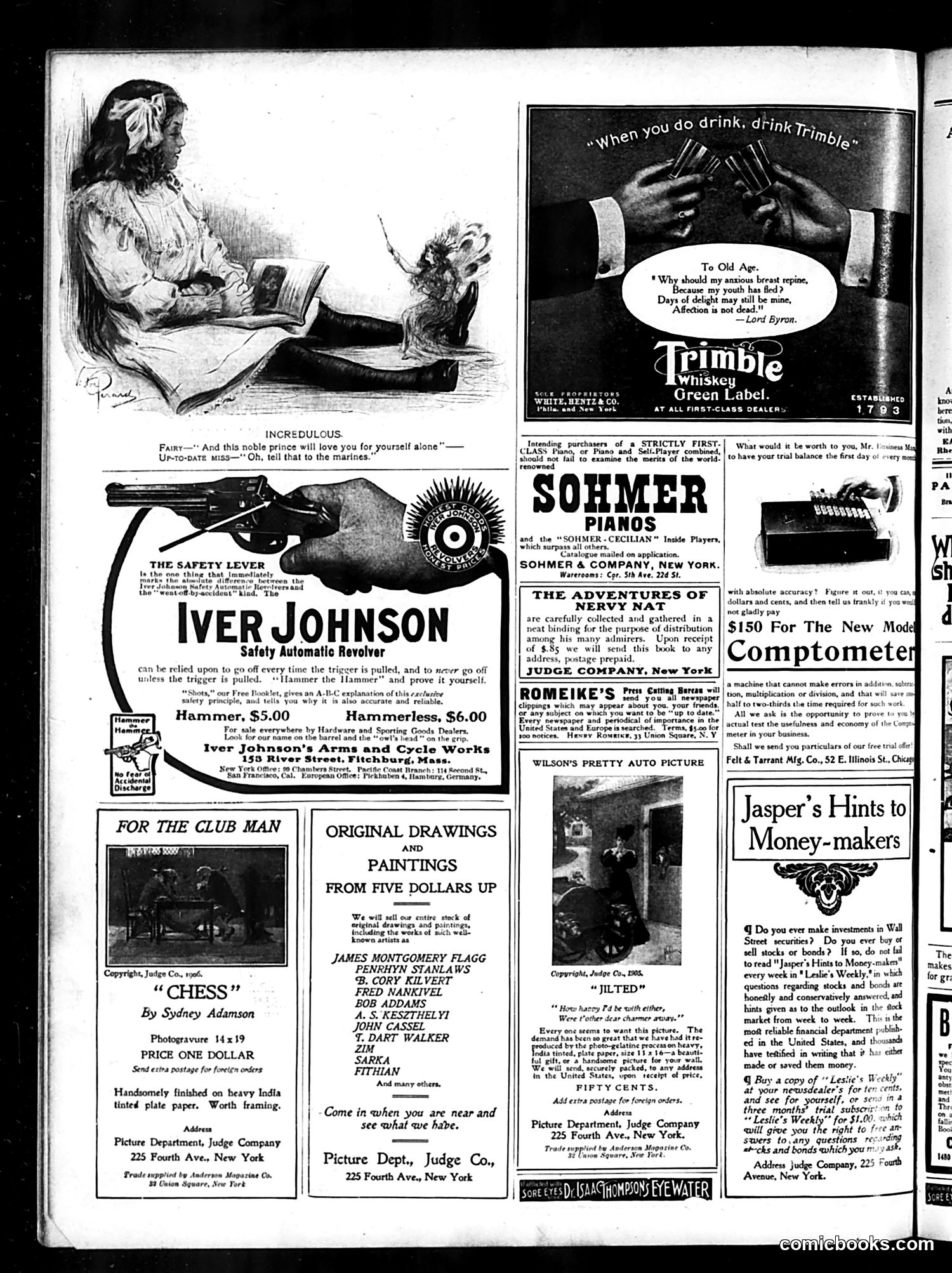
This page is primarily **advertising**, with one small cartoon at the top. The cartoon "Incredulous" depicts a naive young woman being told by a suitor that he loves her "for yourself alone." Her skeptical response—"Oh, tell that to the marines"—was a period phrase meaning "I don't believe you." The satire mocks both romantic platitudes and female gullibility. The bulk of the page consists of product advertisements typical of early 1900s Judge magazine: the **Iver Johnson Safety Automatic Revolver** (emphasizing its reliability), **Sohmer Pianos**, **Trimble Whiskey**, a **Comptometer** (an early adding machine), and various Judge Company offerings (artwork reproductions, the "Adventures of Nervy Nat" book, and auto photographs). These ads reveal the magazine's affluent male readership—targeting businessmen, gentlemen, and those interested in technology, luxury goods, and refined entertainment. The advertising content reflects Edwardian consumer culture and industrial-age optimism.
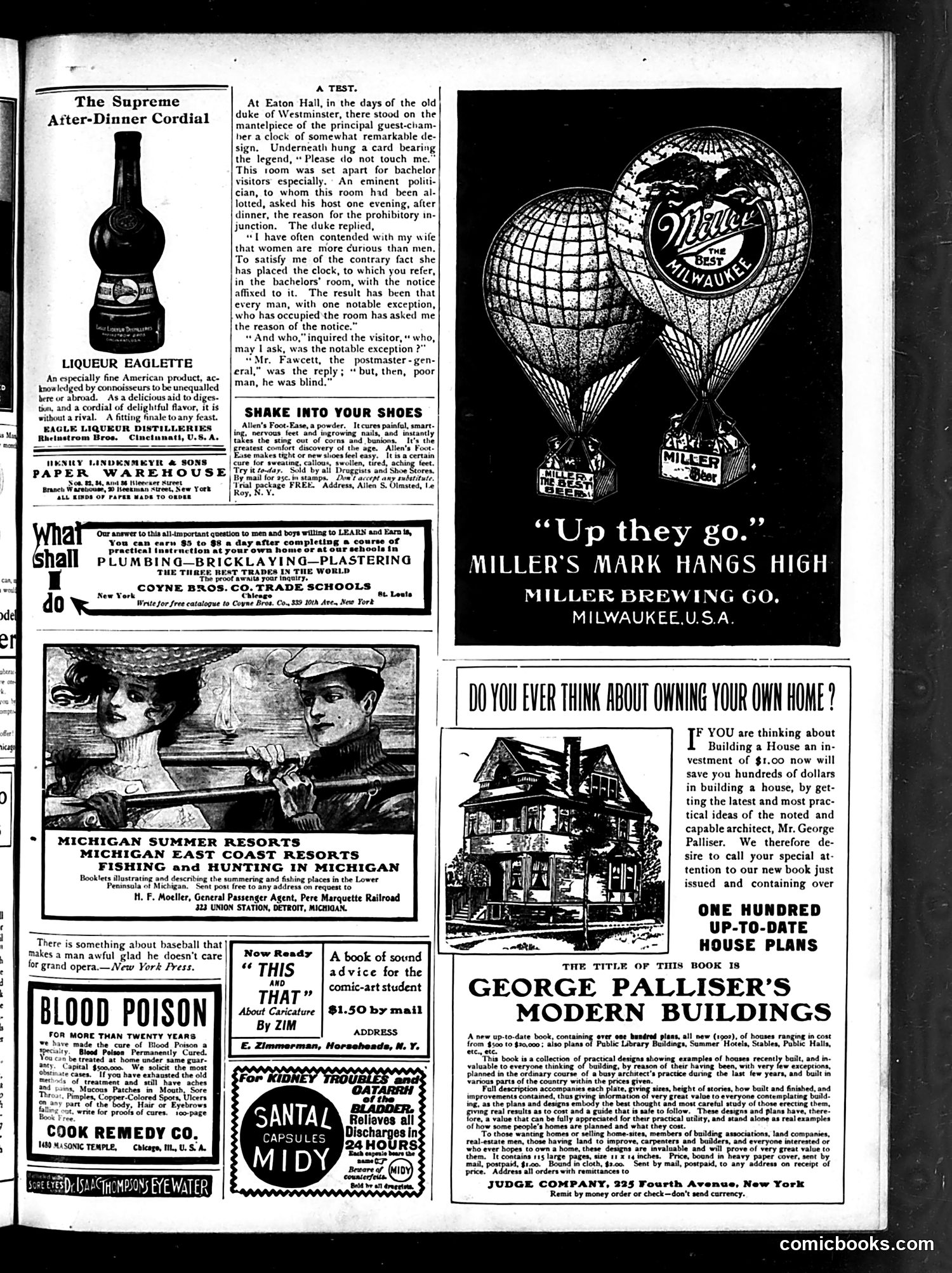
This page is primarily **advertising**, not political satire. Judge magazine mixed editorial content with paid advertisements. The notable content includes: **"A Test"** — A humorous anecdote about a clock at Eaton Hall bearing a "Do not touch me" sign. The duke of Westminster placed it to settle a wager about whether women or men are more curious. The joke: every man asked about it except postmaster-general Fawcett—who was blind and couldn't see the sign. It's a gentle joke about disability rather than satire. **The Miller Brewing advertisement** features a hot-air balloon marked with Miller's logo ascending skyward—a visual pun on their product's rising popularity or quality ("Up they go"). **Other content** includes ads for liqueur, trade schools, Michigan resorts, medical treatments, and architectural plan books—typical of early 1900s magazine advertising. There is **no political cartoon** on this page in the traditional sense.
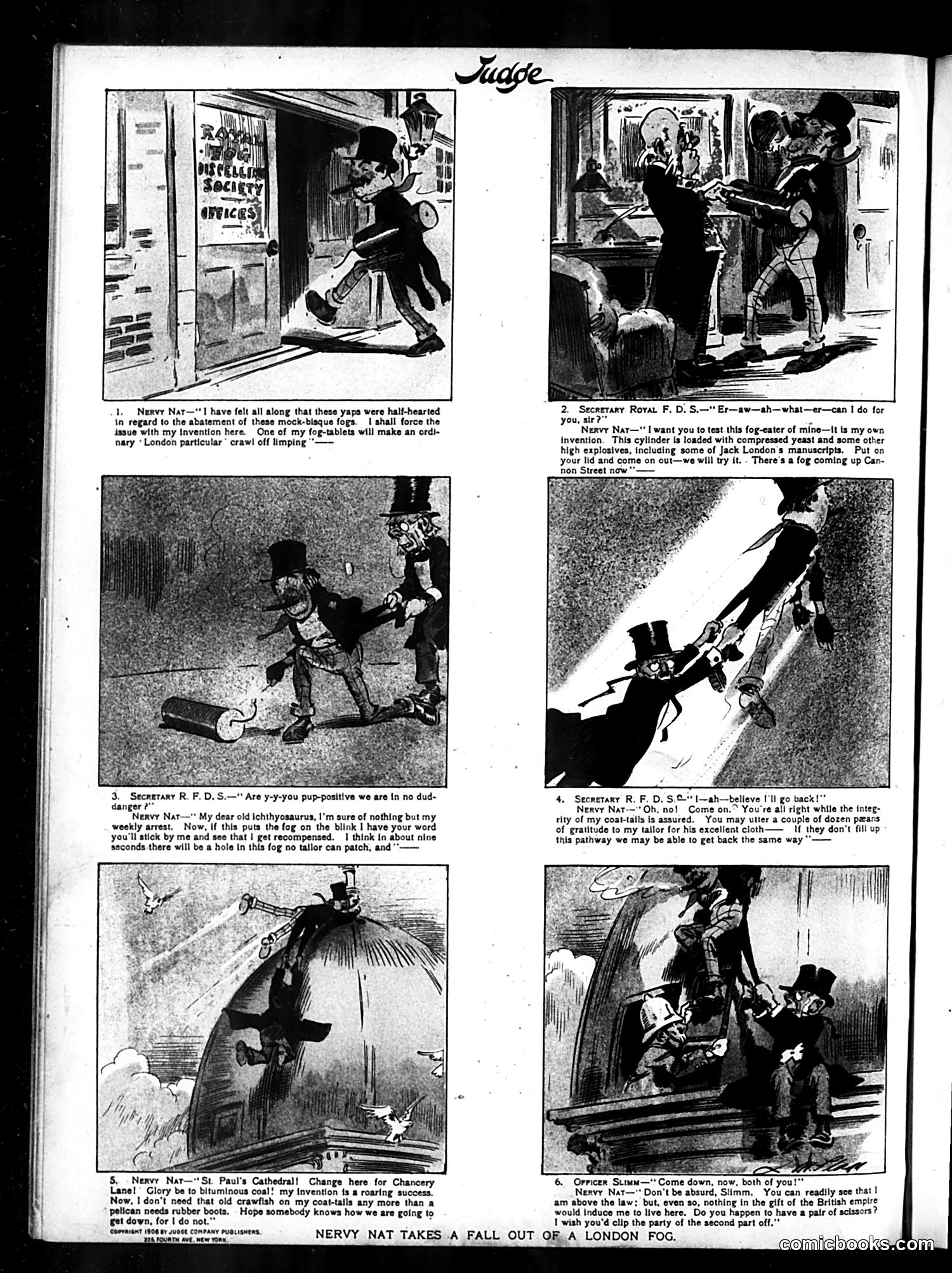
This Judge comic strip satirizes a character called "Nervy Nat" who claims to have invented a fog-dispersal device. The humor pivots on London's notorious fog ("pea-souper"), a genuine public hazard in early 20th-century Britain. Nervy Nat pitches his invention to a government secretary (R.F.D.S.), claiming it will solve London's fog problem. His cylinder contains "compressed yeast" and "Jack London's manuscripts"—the latter a joke at the American author's expense, perhaps mocking his pretentiousness or relevance. The satire targets pseudo-inventors and their grandiose schemes. Nervy Nat repeatedly abandons his secretary ally whenever convenient, promising rewards he won't deliver. By the strip's end, both men are stranded in the fog anyway, with Nat asking to borrow scissors—the invention having failed utterly. The joke: fraudulent con-artists confidently peddle useless solutions to real problems, then disappear when reality proves them wrong.