
Judge, 1906-05-12 · page 3 of 16
Judge — May 12, 1906 — page 3: what you’re looking at
What you’re looking at
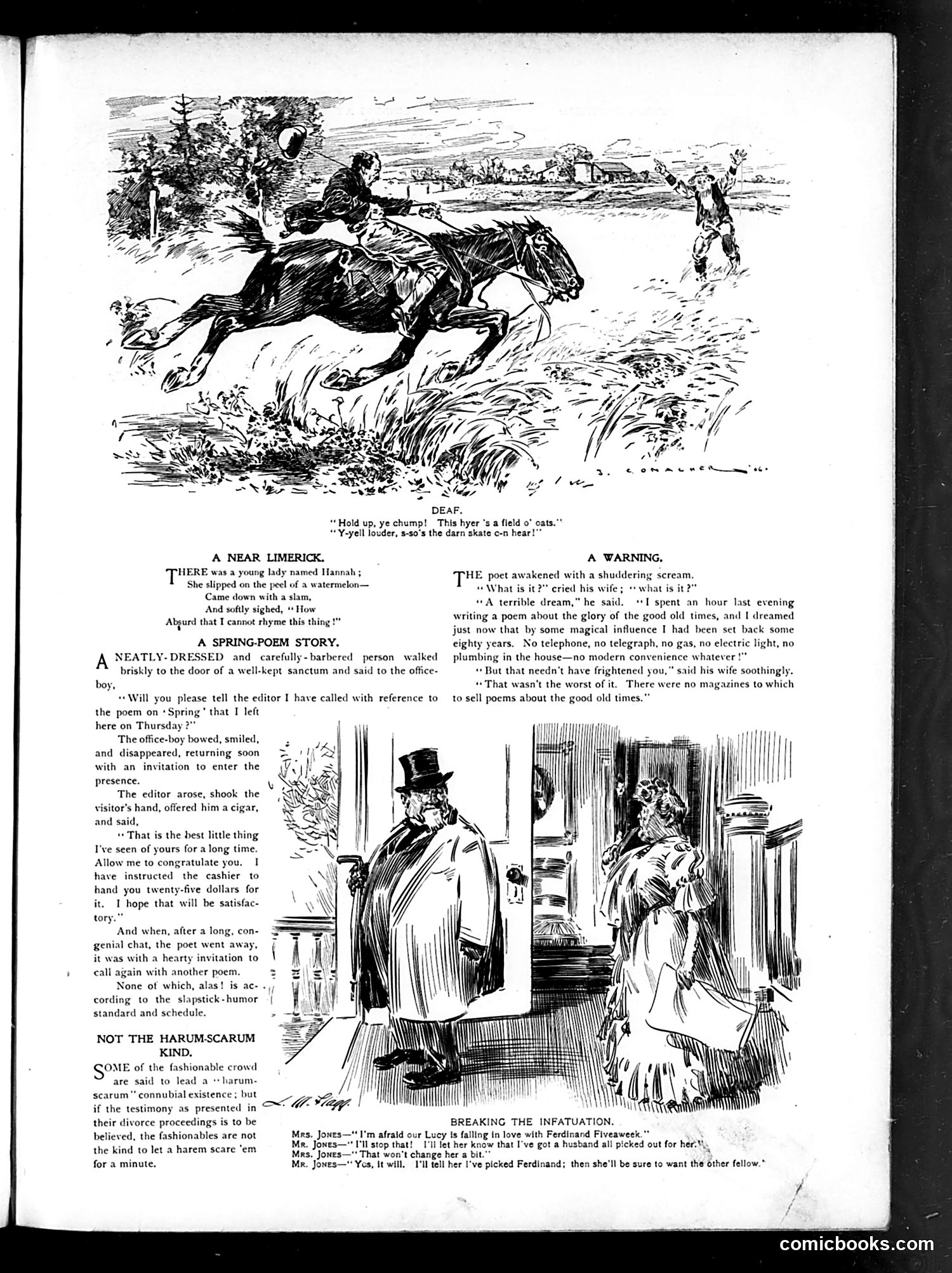
This page contains several independent humor pieces rather than a unified political cartoon. **Top illustration**: A horseman rides frantically across a field while someone shouts warnings. The dialogue references "chump," "field of oats," and a "darn skate"—suggesting physical comedy involving a reckless rider. **Text pieces below** include: "A Near Limerick" (humorous verse), "A Spring-Poem Story" (about an office boy), "A Warning" (a poet's domestic complaint about lost creative time), and "Not the Harum-Scarum Kind" (about fashionable "harum-scarum" divorce proceedings). **Bottom illustration**: Shows "Breaking the Infatuation"—a domestic scene where Mrs. Jones discusses her daughter Lucy's romantic entanglement with "Ferdinand Fitzweasel." The humor involves class-consciousness and matrimonial scheming typical of period satire. These are light social comedies about romance, office life, and domestic affairs rather than serious political commentary.
📄 Transcribed text from this page (OCR, searchable)
Machine-transcribed from the original scan — historical spelling and the odd misread are preserved.
“Hold up, ye chump! Ss Ge “_ /f ane o2, ” , 3. . ™ “ss 7 ote mew OR eke This hyer 's a field o° oats.”* “Yzyell louder, s-so’s the darn skate c-n hear!” A NEAR LIMERICK, HERE was a young lady named Hannah ; She slipped on the peel of a watermelon— Came down with a slam, And sofily sighed, “How Abgurd that I cannot rhyme this thing !" A SPRING-POEM STORY. A NEATLY: DRE and carefully-barbered person walked briskly to the door of a well-kept sanctum and said to the office- boy, “Will you please tell the editor I have called with reference to the poem on ‘Spring’ that I left here on Thursday 2” The office-boy bowed, smiled, and disappeared, returning soon with an invitation to enter the presence. The editor arose, shook the visitor's hand, offered him a cigar, and said, «That is the best little thing I've seen of yours for along time. Allow me to congratulate you. I have instructed the cashier to hand you twenty-five dollars for it. I hope that will be satisfac- tory.” And when, after a long, con- genial chat, the poet went away, it was with a hearty invitation to call again with another poem. None of which, alas! is ac: cording to the slapstick-humor standard and schedule. NOT THE HARUM-SCARUM KIND. SOME of the fashionable crowd are said to lead a + harum- scarum" connubial existence; but if the testimony as presented in their divorce proceedings is to be believed, the fashionables are not A WARNING. THE poet awakened with a shuddering seream. “What is it?” cried his wife; + what is it?” “A terrible dream,” he said, “1 spent an hour last evening writing a poem about the glory of the good old times, and I dreamed just now that by some magical influence I had been set back some cighty years. No telephone, no telegraph, no gas, no electric light, no plumbing in the house—no modern convenience whatever !” “+ But that needn't have frightened you,” said his wife soothingly. “That wasn’t the worst of it. There were no magazines to which to sell poems about the good old times.”” RN \\e4 i : STA TRG Ra BREAKING THE INFATUATION. 'm afraid our Lucy Is falling in love with Ferdinand Fiveaweek.”* stop that! Ill let her know that I've got a husband all picked out for her."\, “That won't change her a bit."" ; Mr. Jones—'" Yes, it will. I'll tell her I've picked Ferdinand; then she'll be sure to want the other fellow." the kind to let a harem scare ‘em for a minute. comicbooks.com