
A complete issue · 16 pages · 1906
Judge — March 31, 1906
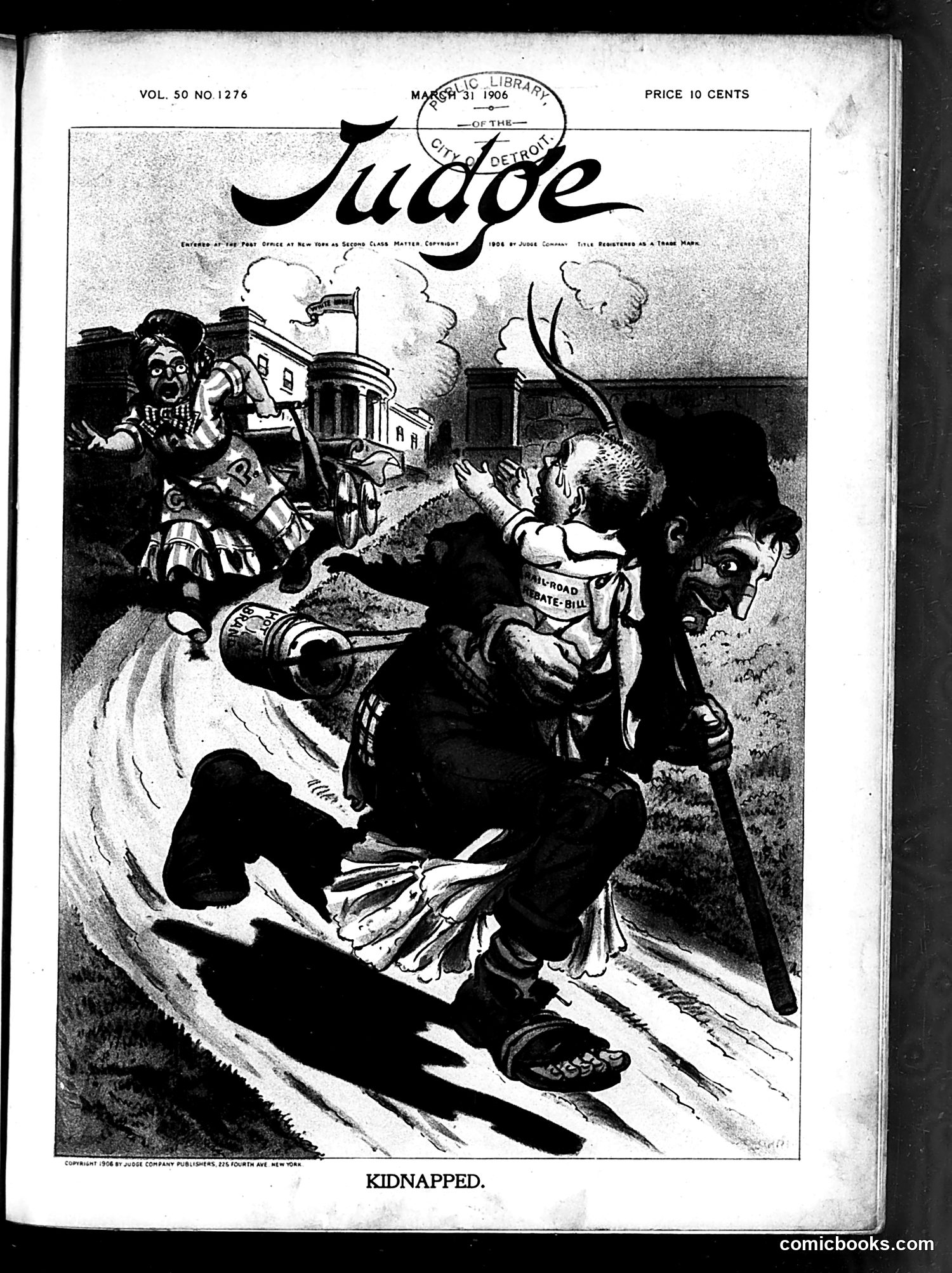
This political cartoon depicts a figure labeled "RAILROAD REBATE BILL" being forcibly abducted. The assailant appears to be a caricatured politician or government official wielding a large weapon, while a judge's building is visible in the background. The satire likely references early-1900s railroad regulation debates. The "rebate bill" refers to legislation addressing illegal railroad rebates—secret discounts railroads gave to favored shippers, which reformers sought to eliminate. The cartoon's title "Kidnapped" suggests the bill is being stolen or removed from legitimate process, possibly criticizing either reformers removing the bill or politicians obstructing regulation. Without identifying the specific assailant or legislative moment, the cartoon clearly satirizes railroad industry politics and regulatory conflict during the Progressive Era.
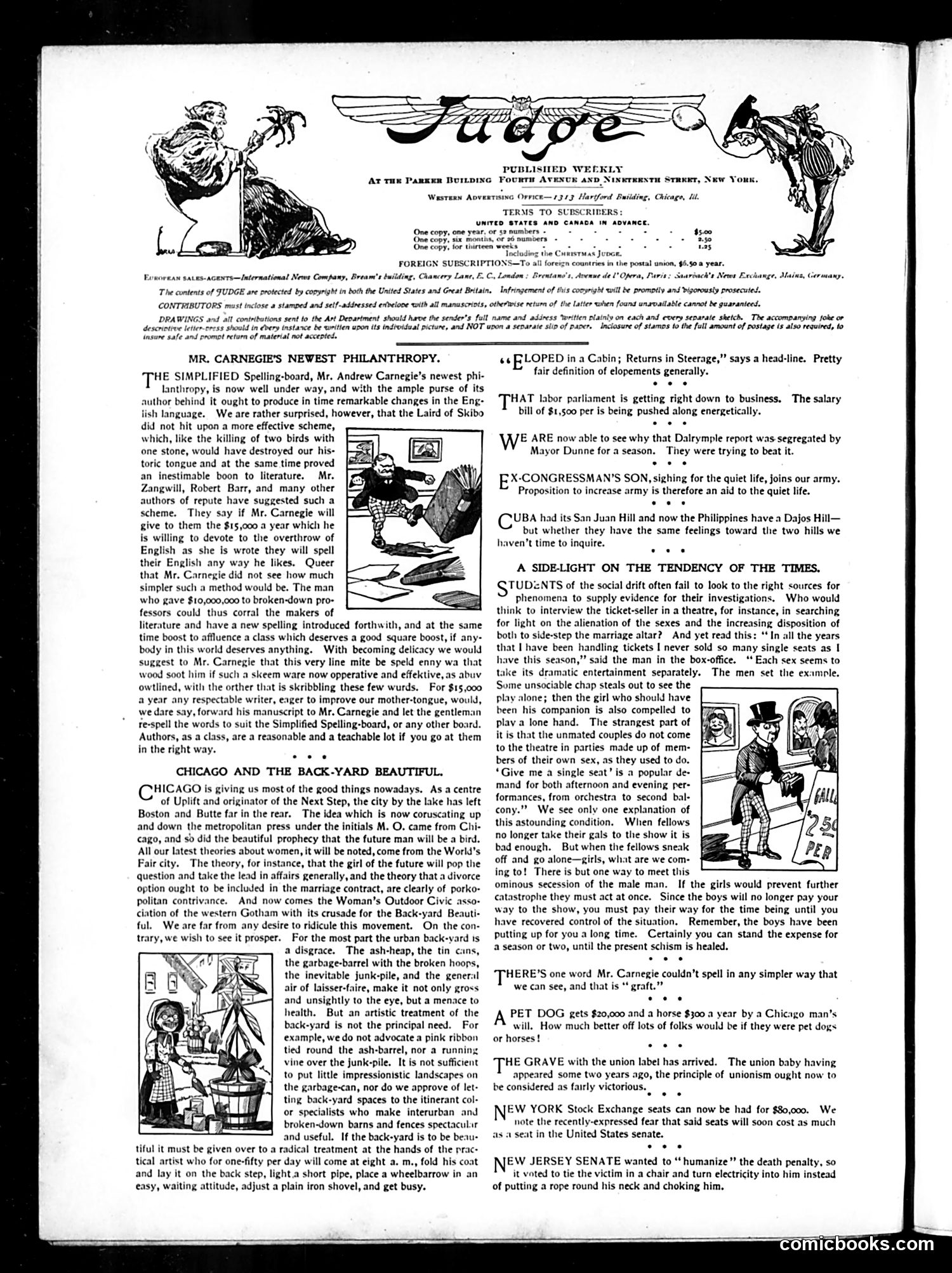
This satirical page from Judge magazine contains several brief editorial commentaries on contemporary issues: **Main cartoon (top left):** Depicts a man with a large nose labeled as representing "Mr. Carnegie's Newest Philanthropy." The article criticizes Andrew Carnegie's spelling reform proposal, mocking the idea as pretentious. **Other brief items** address: labor parliament business, a congressman's son enlisting, and Philippine colonial politics (referencing San Juan Hill and the Dajos). **"A Side-Light on the Tendency of the Times"** is the longest piece, satirizing theatrical ticket speculation and unmarried couples attending shows together—suggesting social anxieties about changing gender relations and commercialization of entertainment. **Lower sections** critique Chicago's urban beautification efforts and discuss Stock Exchange seat prices and New Jersey's death penalty debates. The overall tone is characteristic of Judge: irreverent commentary on wealthy philanthropists, social change, and contemporary politics.
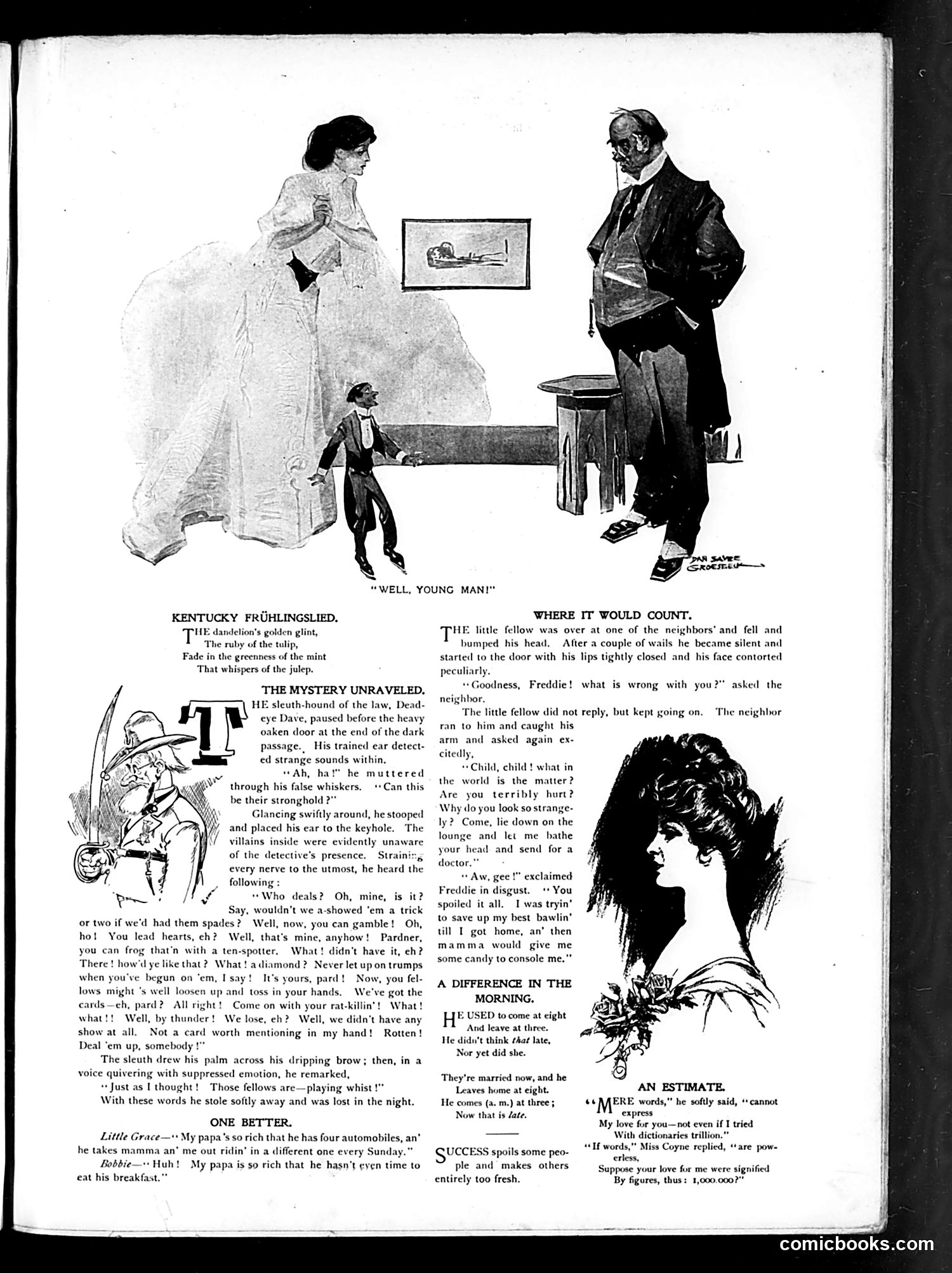
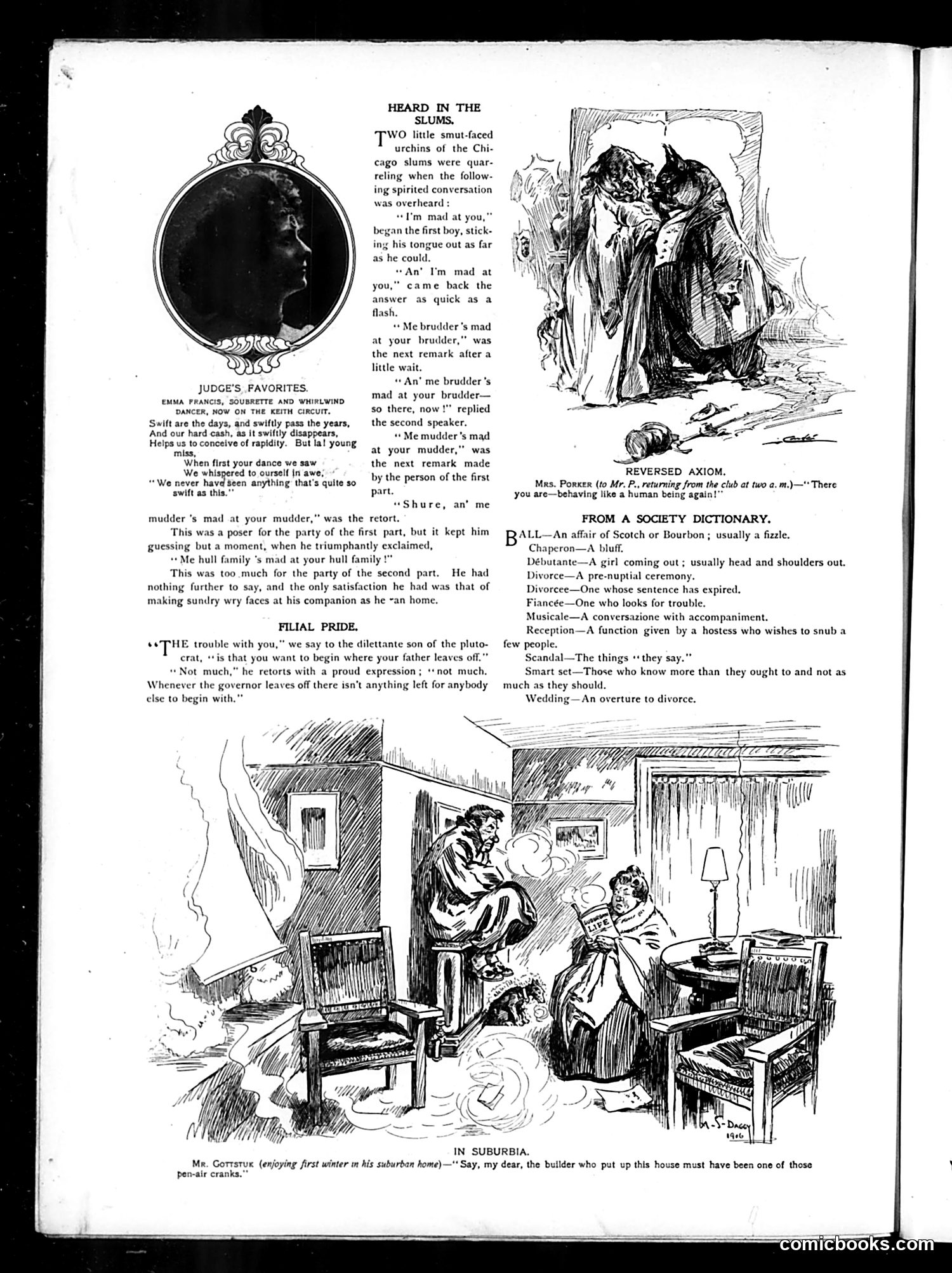
This page contains three distinct satirical pieces: 1. **"Heard in the Slums"** features two Chicago slum boys in a rapid-fire verbal sparring match about whose family member is "maddest." The humor relies on working-class dialect and the absurdity of competitive insult-trading. 2. **"Reversed Axiom"** shows a woman returning from a club, humorously suggesting she's "behaving like a human being again"—satirizing contemporary attitudes about women's social activities. 3. **"Filial Pride"** mocks a dilettante's son who boasts about his father's minimal inheritance, with the joke being his pride in having virtually nothing. 4. **"In Suburbia"** depicts a homeowner blaming the builder for shoddy construction, using the phrase "pen-sis cranks" (likely a period slang term). The page uses social class commentary and domestic humor typical of early-20th-century American satire.
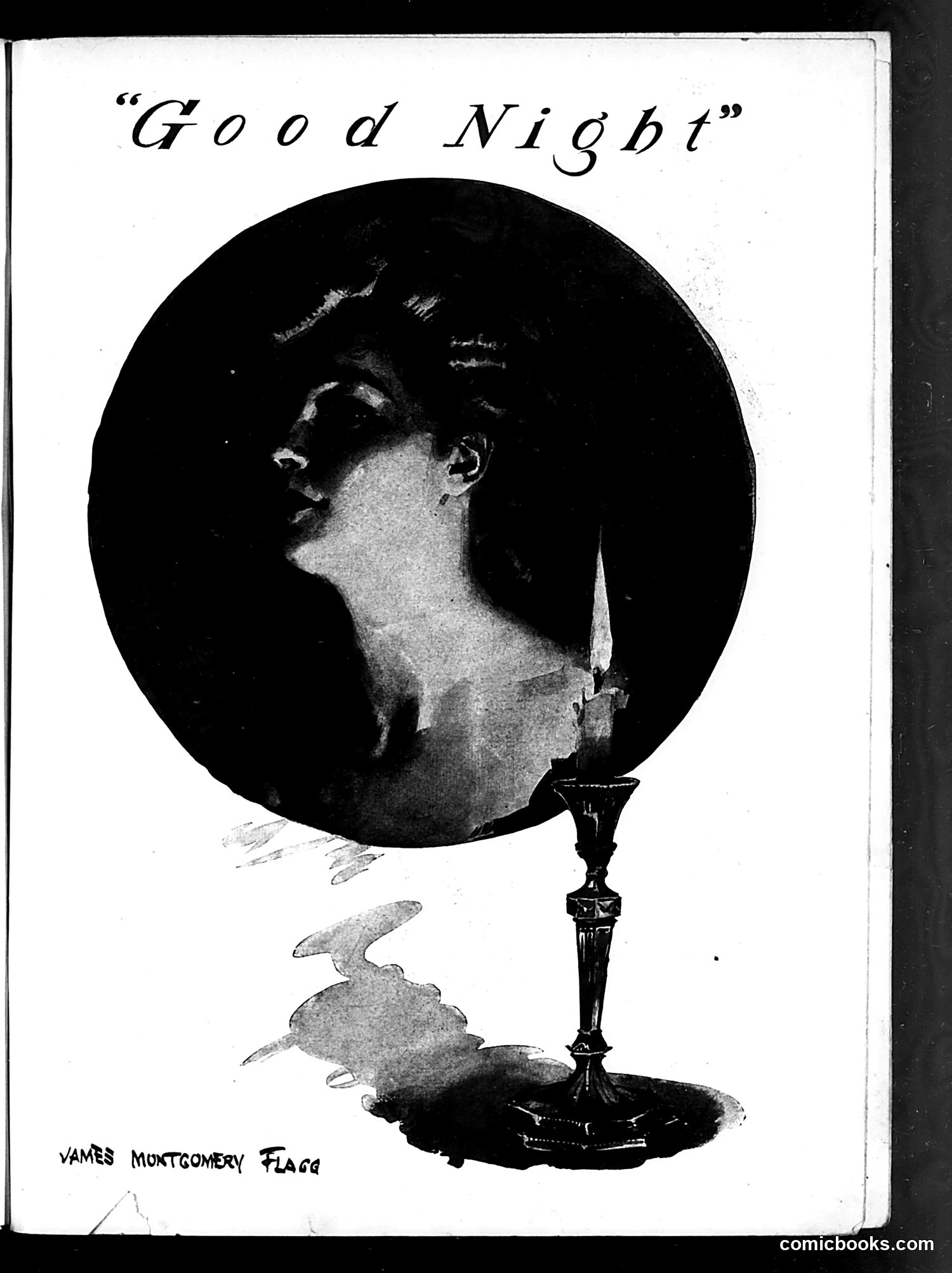
This artwork by the renowned illustrator James Montgomery Flagg depicts a man in profile gazing upward, framed within a circular dark background that suggests the moon or night sky. Below him burns a single candle on an ornate candlestick, with smoke rising upward. The piece appears to be a romantic or sentimental illustration rather than political satire. The "Good Night" caption and nighttime imagery suggest themes of bedtime, rest, or perhaps farewell. Without additional context from surrounding Judge magazine content, the specific satirical target remains unclear, though Flagg's elegant art style and the melancholic composition suggest it may comment on contemporary social or cultural sentiment during the magazine's publication period.
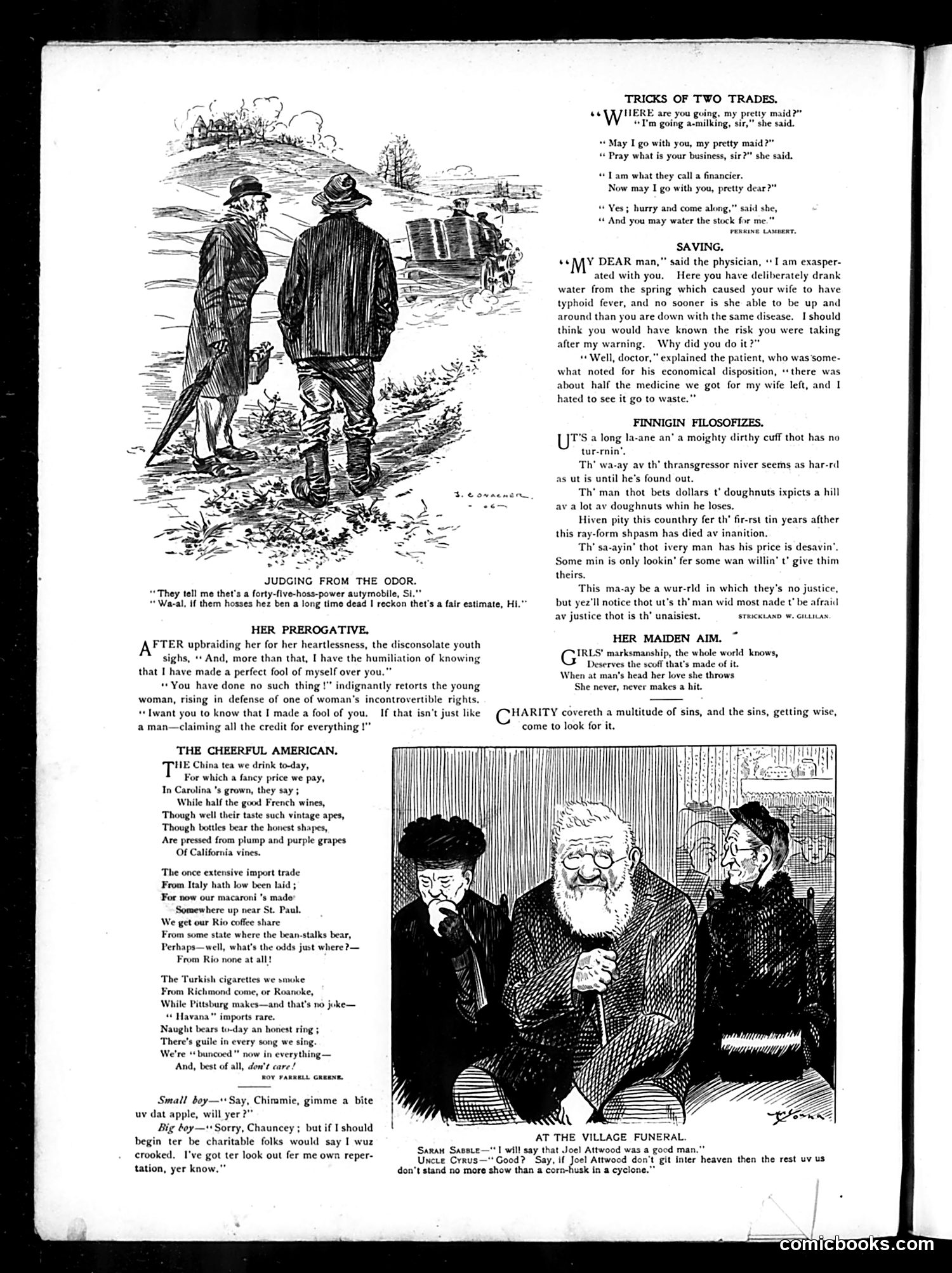
This page contains several satirical pieces rather than a single unified cartoon. **"Tricks of Two Trades"** (top illustration) depicts two men in conversation, likely contrasting a financier with another profession—the dialogue suggests commentary on financial manipulation versus honest work. **"Saving"** mocks a patient who used only half his medicine to avoid waste, risking his wife's health. It's satire on excessive frugality during illness. **"Finnegan Philosophizes"** uses Irish-dialect humor (typical for the era) to critique economic inequality and injustice, with working-class commentary on the unfair distribution of wealth. The remaining pieces include poetry about wine imports and a funeral scene. The overall page exemplifies Judge's approach: mixing social commentary on class, profession, and human folly through humor and caricature.
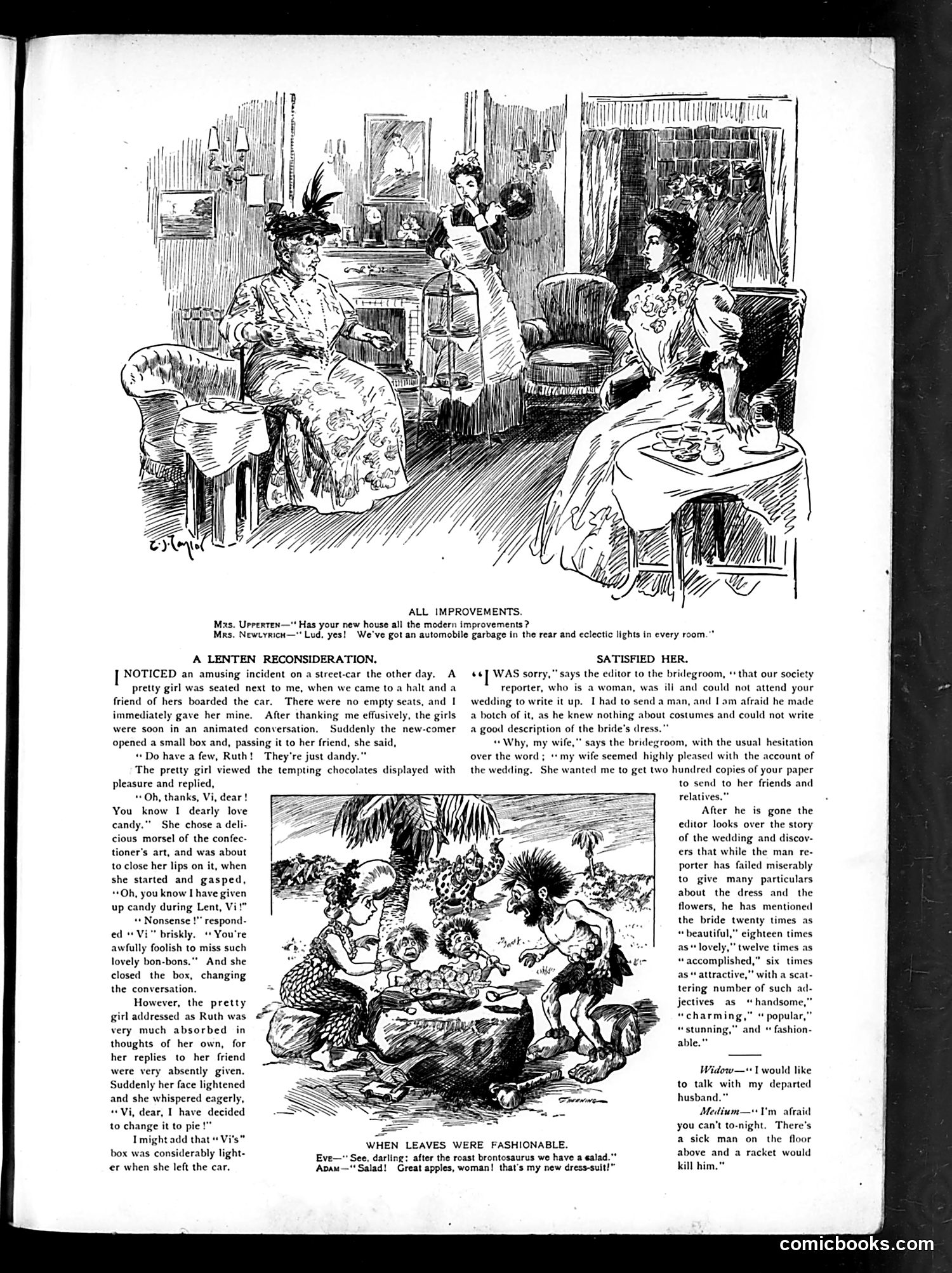
This page contains three satirical pieces reflecting early 20th-century social attitudes: **"All Improvements"** mocks nouveau riche pretension. Mrs. Newtyrich brags about her modern house's "automobile garbage" (likely a disposal) and "eclectic lights"—absurd exaggerations of technological status symbols meant to ridicule the newly wealthy's superficial adoption of gadgetry. **"A Lenten Reconsideration"** plays on Catholic Lenten sacrifice. A girl Ruth claims to have given up candy for Lent but, tempted by friend Vi's chocolates, decides to give up *pie* instead—a humorous commentary on the hypocrisy of religious observance, where believers rationalize their way around genuine sacrifice. **"When Leaves Were Fashionable"** uses a prehistoric couple as stand-ins for contemporary concerns. The husband prioritizes his "new dress-suit" over the salad course—satirizing male vanity and materialism overshadowing domestic life. **"Satisfied Her"** mocks gender stereotyping: a wedding reporter, knowing nothing of fashion, simply calls the bride "beautiful" repeatedly—which paradoxically satisfies the bride more than actual dress descriptions would have.
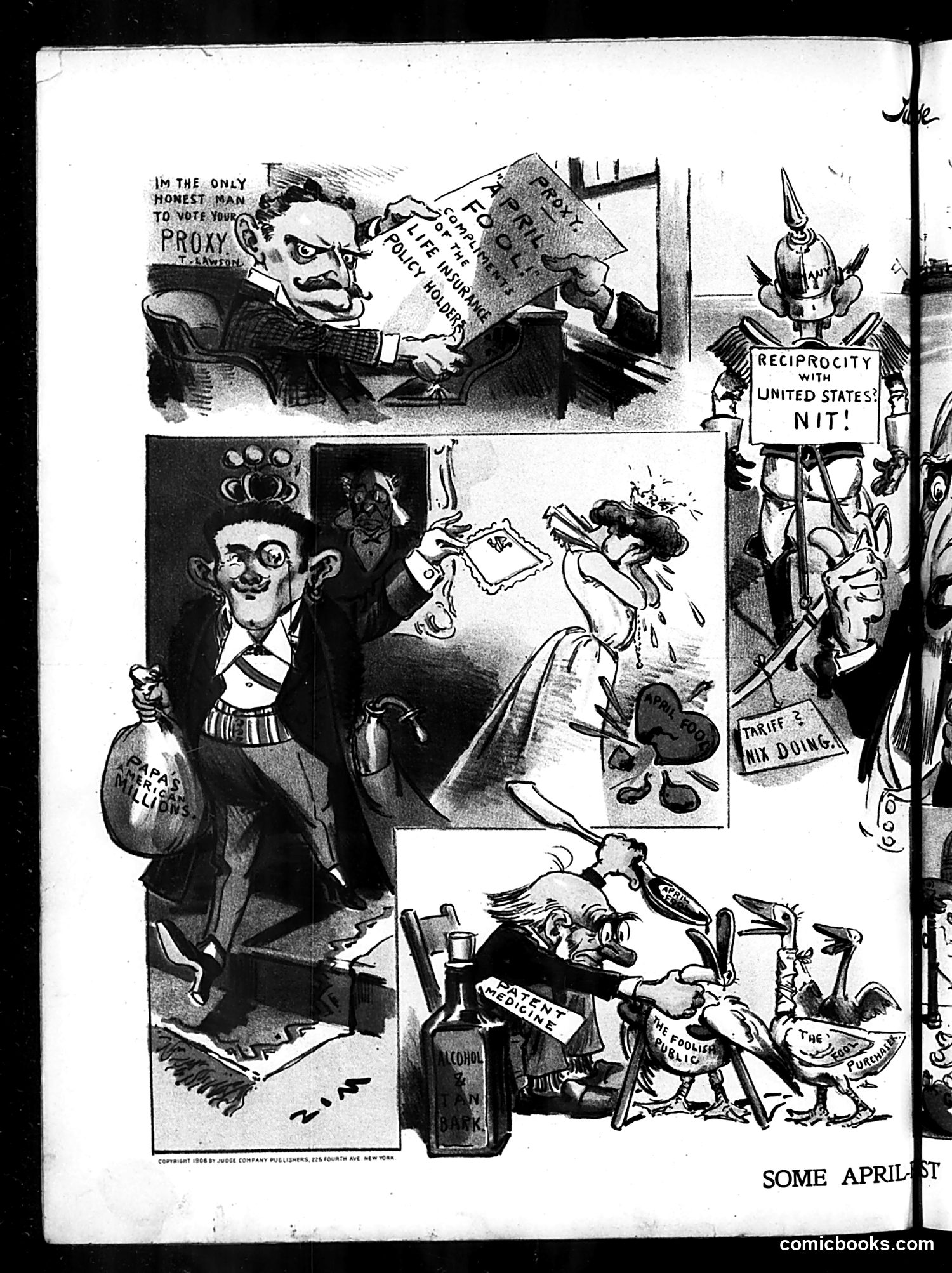
This page appears to satirize early 20th-century trade politics, specifically American reciprocity agreements. The top panel shows a man labeled with "PROXY" being manipulated—likely representing a politician controlled by special interests. The central figure holding a bag labeled "TARIFF ILLS" appears to be a caricatured foreign leader (possibly German, suggested by the spiked helmet), opposing U.S. trade reciprocity. The right panel depicts a German militaristic figure asking "RECIPROCITY WITH UNITED STATES? NIT!" (rejecting the idea), while armed figures below engage in conflict. The satire criticizes how foreign nations and domestic special interests obstruct fair trade policies, with the cartoon suggesting that opposition to reciprocity serves only warmongers and those profiting from tariffs and conflict rather than ordinary citizens.
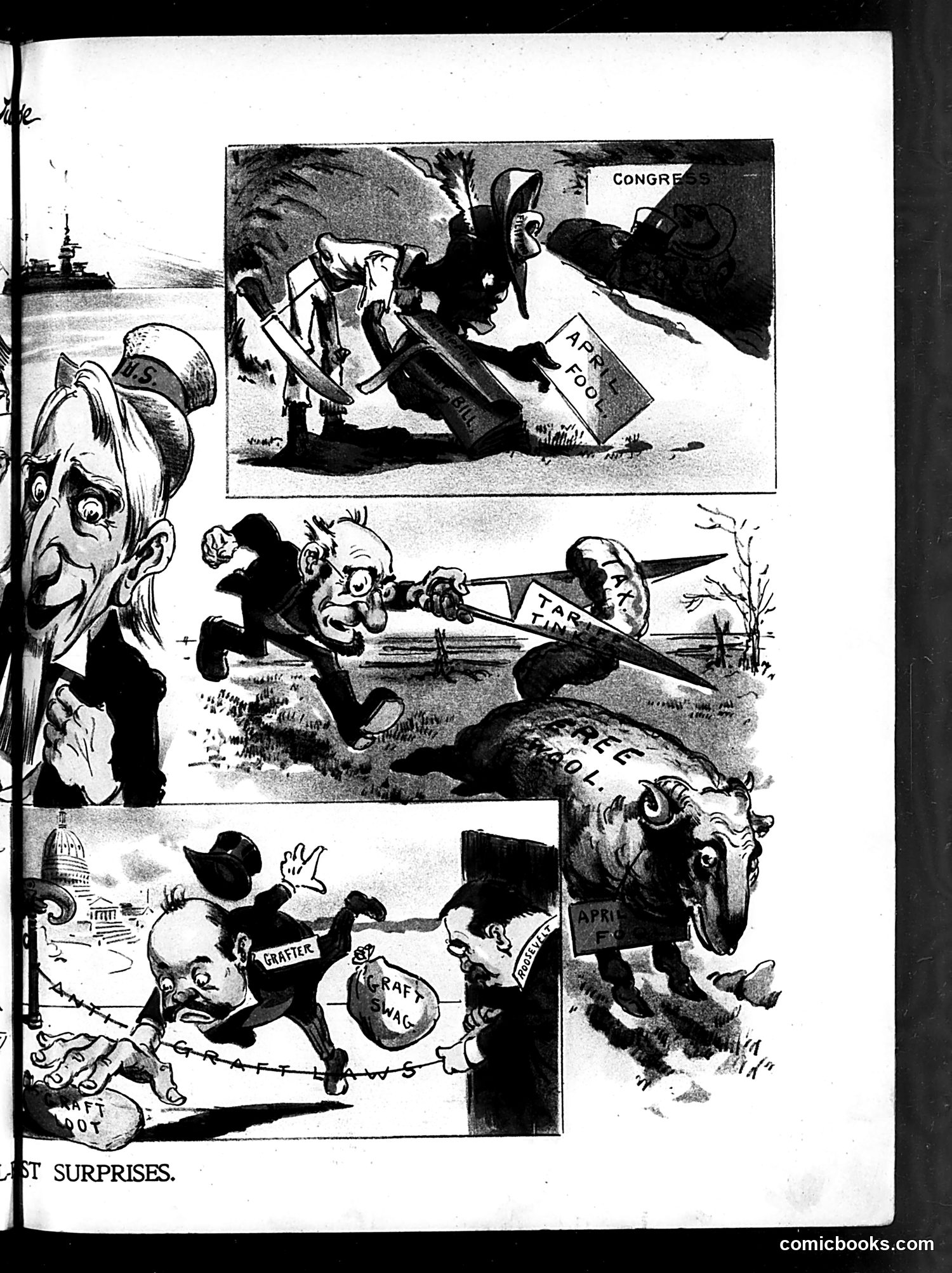
This Judge magazine page presents a sequential political narrative using exaggerated caricature. The top panel labeled "CONGRESS" shows figures struggling with "ARMY FOOD" and "APPROPRIATIONS" - likely satirizing Congressional debates over military budget allocations and food supply issues. The middle and bottom panels depict what appears to be conflict or competition over "TARIFF" and "GRAFT" issues, with figures labeled similarly. The cartoon suggests surprise political reversals or unexpected outcomes in legislative matters. The large caricatured face on the left likely represents a prominent political figure of the era, though specific identity remains unclear from the image alone. The overall theme critiques governmental inefficiency, corruption through "graft," and contentious tariff disputes—common Judge magazine targets during the Progressive Era.
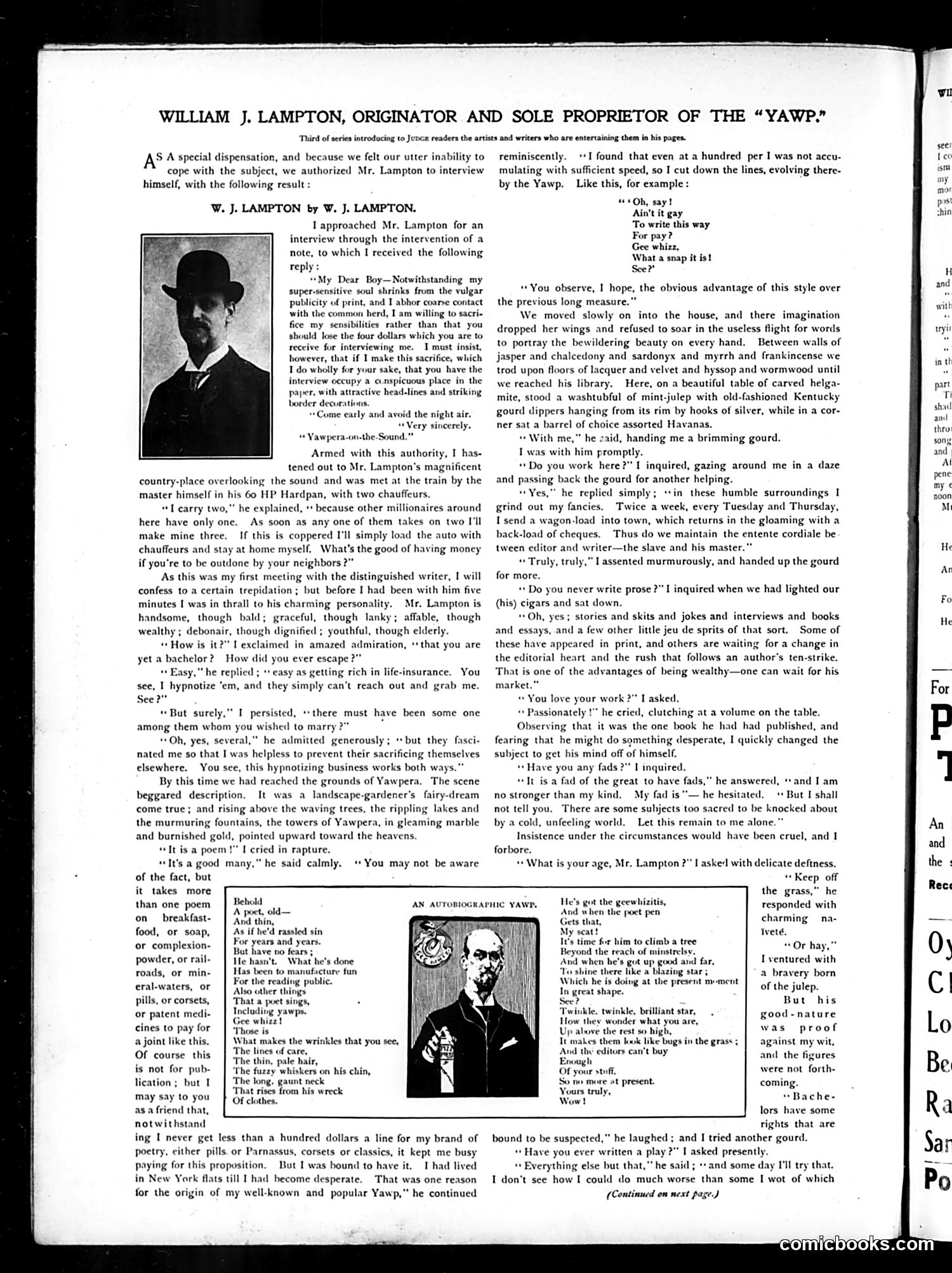
This is a **self-satirizing profile** of William J. Lampton, a writer/humorist who created a column called "The Yawp" for Judge magazine. The humor lies in Lampton interviewing *himself*, which allows him to present an exaggerated, absurdly boastful self-portrait. The satire targets **Gilded Age excess and vanity**: Lampton claims to own a palatial estate called "Yawpera," travels in a 60-horsepower automobile with multiple chauffeurs (outdoing wealthy neighbors), and comically insists his interview receive prominent placement. He boasts of hypnotizing women and living a life of leisure supported by his literary output. The accompanying caricature and verse ("An Autobiographic Yawp") mock his pretensions further—depicting him as vain while acknowledging his actual talent for writing humorous pieces for the reading public. The whole piece is self-aware satire: Lampton pokes fun at his own ego and material ambitions, which was likely entertaining to Judge's educated, upper-class readership.
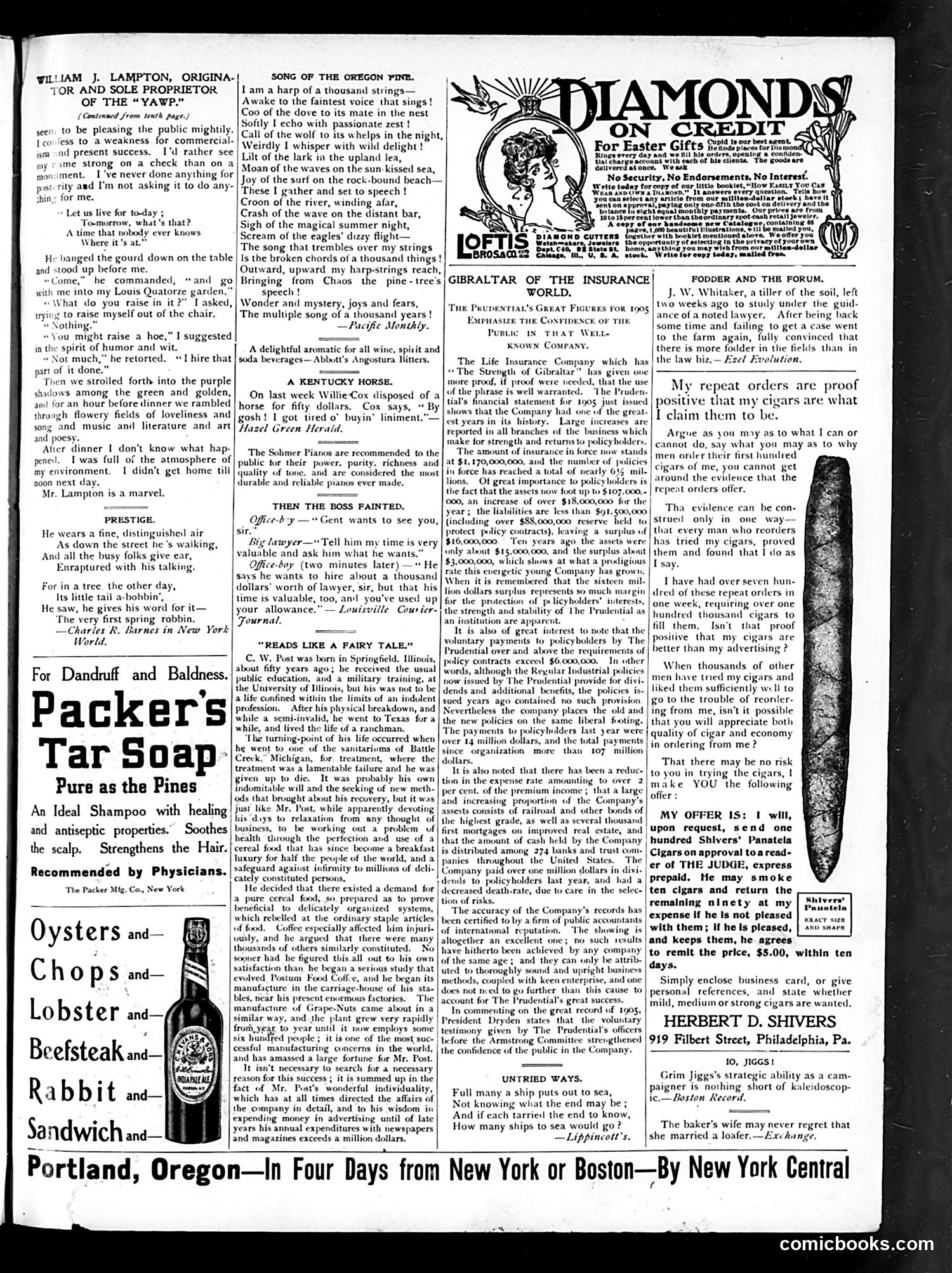
This page is primarily **advertising and miscellaneous content**, not political satire. The main elements are: 1. **"Song of the Oregon Pine"** — A sentimental poem personifying a pine tree as a musical harp, reflecting turn-of-the-century romanticism about nature and natural resources. 2. **"Prestige"** — A light humor piece about a man claiming to have seen the "first spring robin" — gentle comedic observation of human vanity. 3. **Joke items** ("Then the Boss Fainted," "A Kentucky Horse") — Brief, mildly humorous anecdotes typical of Judge's filler content. 4. **William J. Lampton profile** — Appears to be an interview excerpt with a writer/humorist about his commercial philosophy and garden. 5. **Substantial advertising** — For Packer's Tar Soap, Sohmer Pianos, diamonds on credit, and food service in Portland, Oregon. The page contains no significant political cartoon or satirical commentary. It's characteristic of Judge's typical mixed format: author profiles, light verse, mild humor, and commercial advertisements.
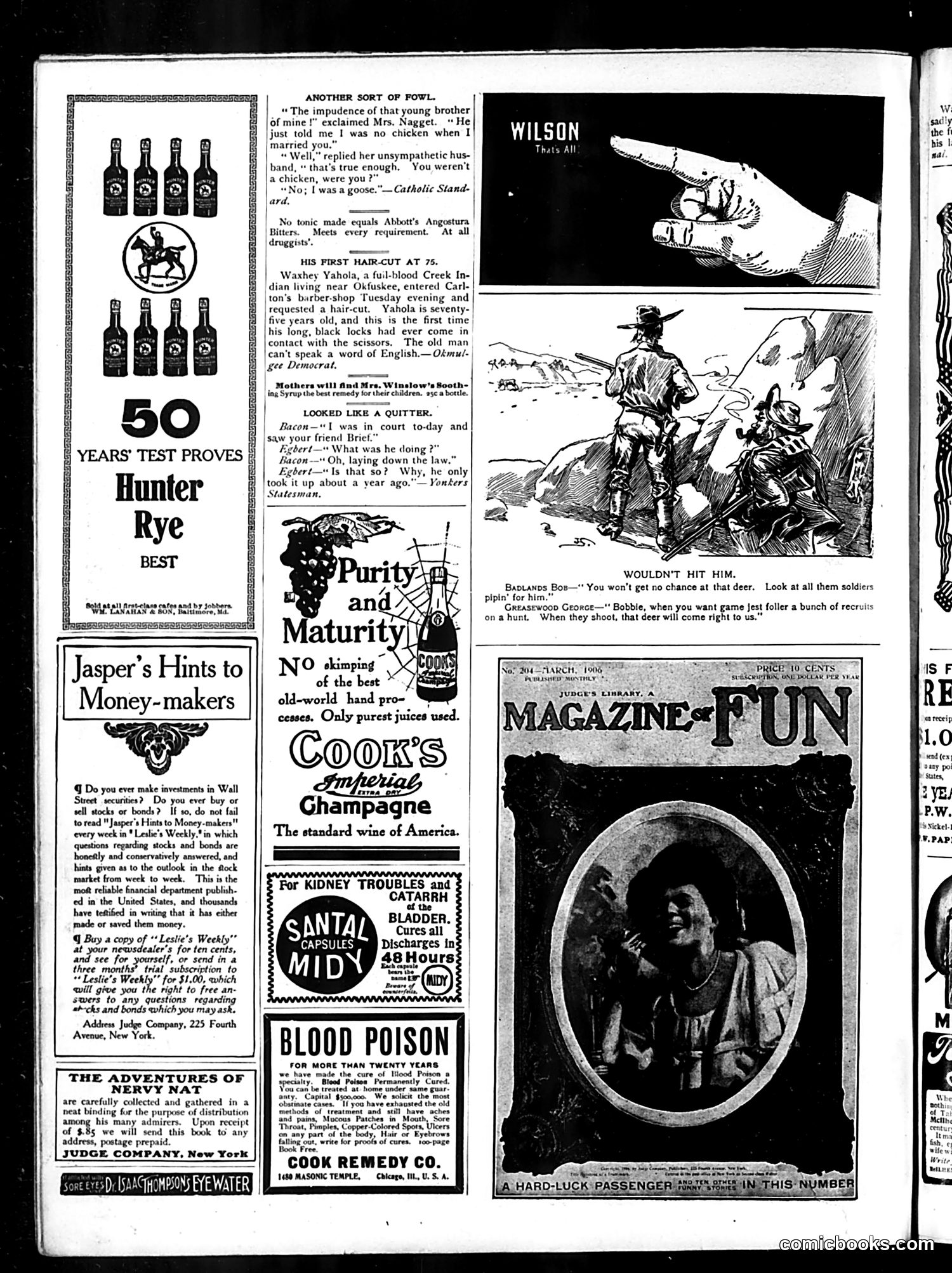
This page from *Judge* magazine (appears to be early 1900s based on context clues) is primarily a collection of advertisements and short humorous anecdotes rather than political satire. The main comic content includes brief joke exchanges: one about a wife no longer being young, another about a lawyer who recently took up his profession, and a hunting joke playing on recruit incompetence. The central illustration shows what appears to be hunters or outdoorsmen in a frontier scene. The page is dominated by period advertisements for patent medicines (blood poison cures, kidney remedies), alcohol (Cook's Champagne, Hunter Rye), and financial advice columns. These ads reflect common turn-of-the-century commercial interests. The "Nervy Nat" adventure series is mentioned but not shown. Overall, this appears to be a standard magazine interior page mixing light humor with contemporary commercial messaging rather than sharp political commentary.
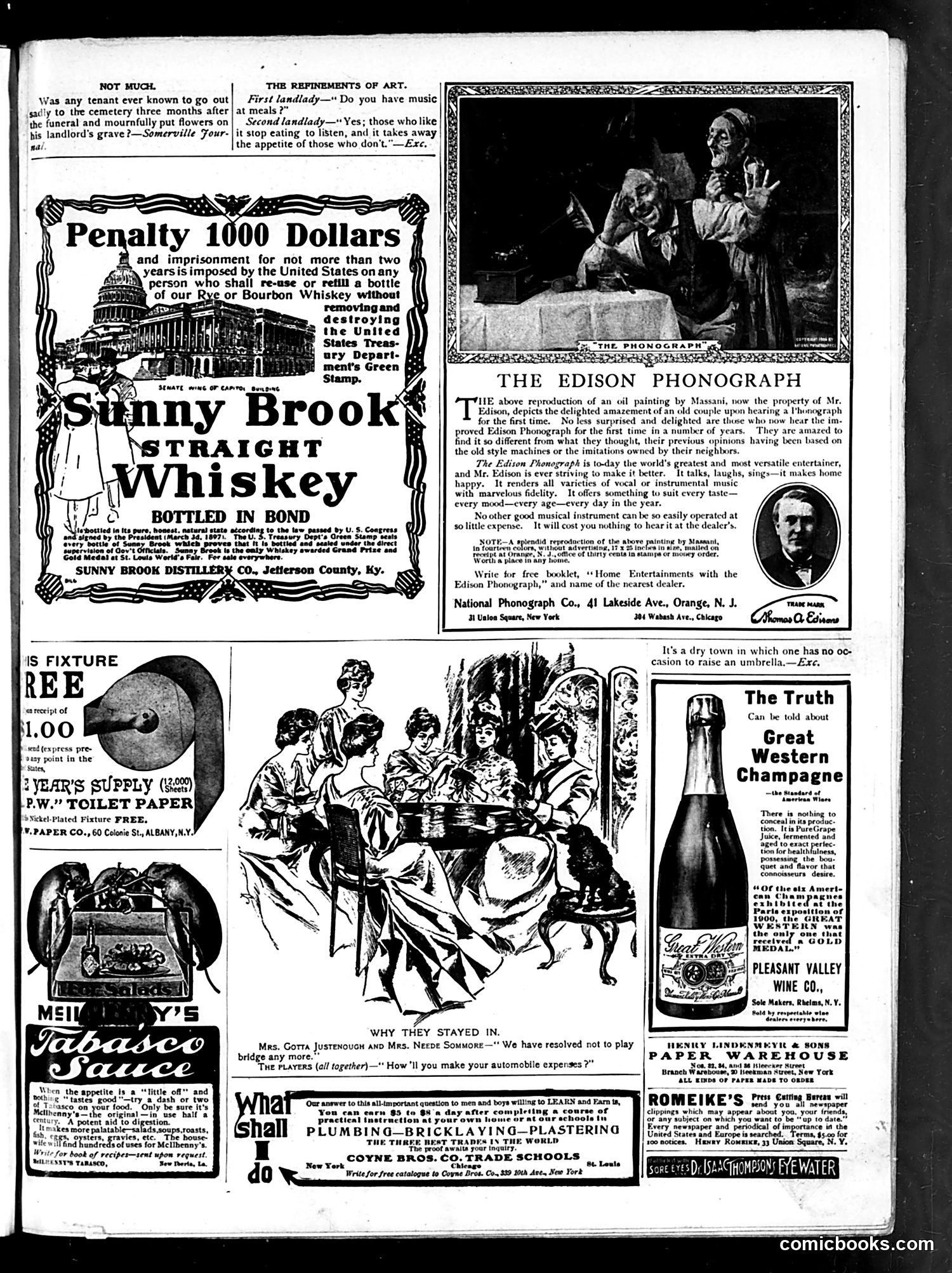
This page is primarily **advertising with minimal editorial content**. The few humorous pieces present are brief: **"NOT MUCH"** and **"THE REFINEMENTS OF ART"** are short, cynical one-liners about landlords and boarding house meals—typical of Judge's lighthearted social commentary. **"WHY THEY STAYED IN"** depicts society women who've resolved to stop playing bridge, only to be reminded by other players that bridge funds their automobile expenses. The joke satirizes the economic reality underlying leisure activities for wealthy women during the early automobile era. The page is dominated by period advertisements: Sunny Brook Whiskey (emphasizing government-sealed bottles), the Edison Phonograph (positioning it as superior to competitors), toiletries, and wine. These ads reflect early 1900s consumer culture and regulatory concerns (the whiskey ad references federal Treasury Department stamp requirements). The Edison Phonograph ad includes Massani's painting of an elderly couple's wonder at hearing recorded music—nostalgia marketing highlighting the technology's novelty.
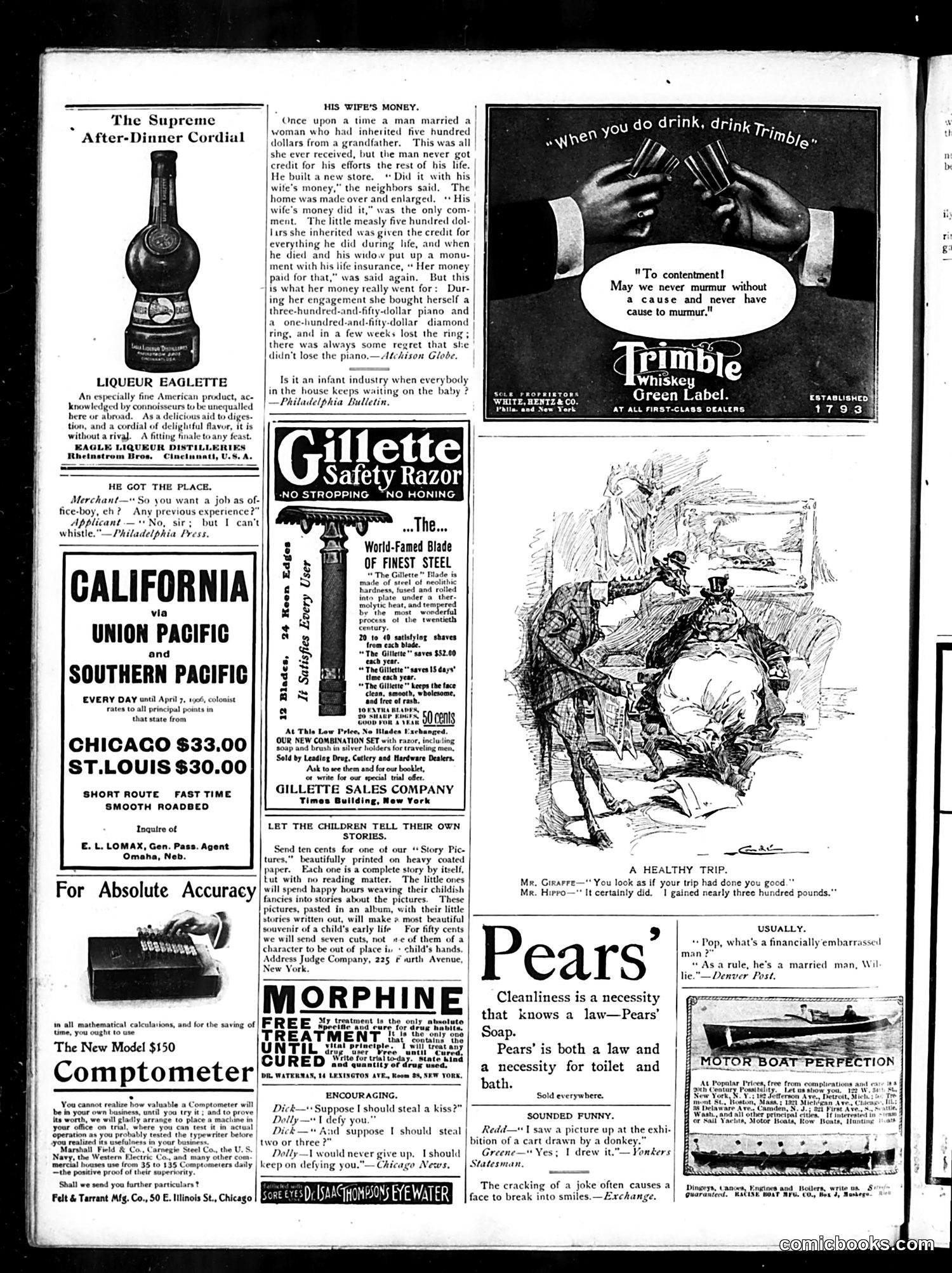
This page is primarily **advertisements with minimal editorial cartoons**. The main satirical content includes: **"He Got the Place"** (top left): A brief joke about a job applicant who claims he can't whistle—implying office boys were expected to whistle while working, a mundane commentary on labor expectations. **"His Wife's Money"** (upper center): A satirical story about a man whose achievements are perpetually credited to his wife's modest $500 inheritance. The satire targets both marital dynamics and how society unfairly diminishes men's accomplishments through dismissive assumptions about inherited wealth. **"A Healthy Trip"** (lower right): A cartoon showing someone who gained 300 pounds, satirizing the health benefits claimed for certain destinations or activities—likely mocking exaggerated travel advertising. The page is dominated by product advertisements (safety razors, liqueur, railroads, calculators, morphine treatments) typical of Judge's revenue model. No political figures or major events are referenced.
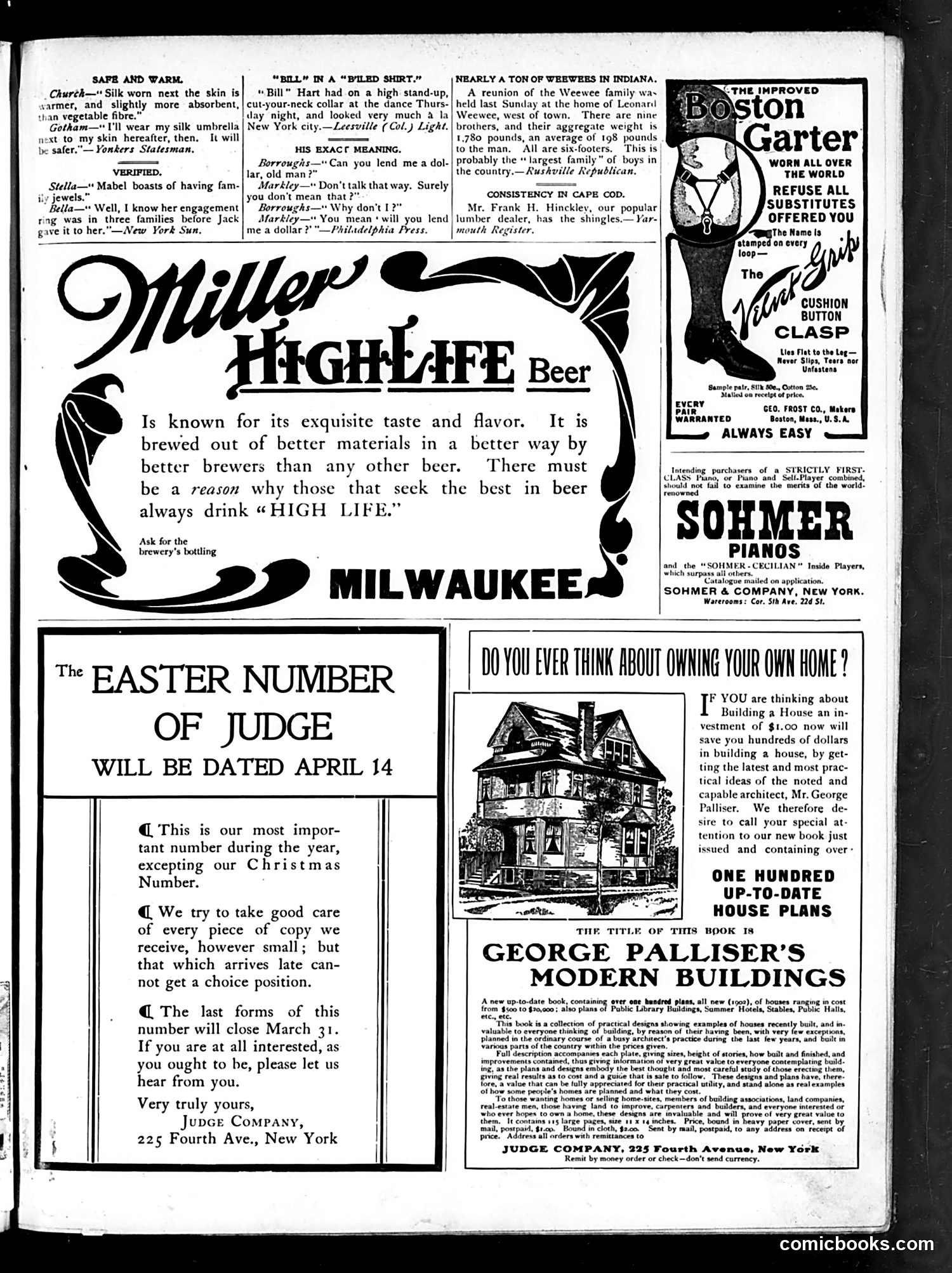
This page from *Judge* magazine consists primarily of **advertisements and brief humorous items**, not political cartoons. The content includes: **Humorous short jokes** ("Safe and Warm," "Bill in a Boiled Shirt," etc.) — typical *Judge* filler material poking fun at everyday situations and wordplay. **Commercial advertisements** dominating the page: Miller High Life beer, Victor cushion button clasps, Sohmer pianos, and George Palliser's architecture book on house plans. **Announcement** that the Easter issue will be dated April 14 — *Judge* Company's plea for timely submissions. The page reflects *Judge's* era (early 1900s based on dates mentioned) when satirical magazines relied heavily on advertising revenue. The "jokes" are mild domestic humor rather than pointed political satire. Modern readers would primarily notice the vintage ads and product claims (beer's "exquisite taste," buttons that "never slip") that now seem quaint or dubious by contemporary standards.
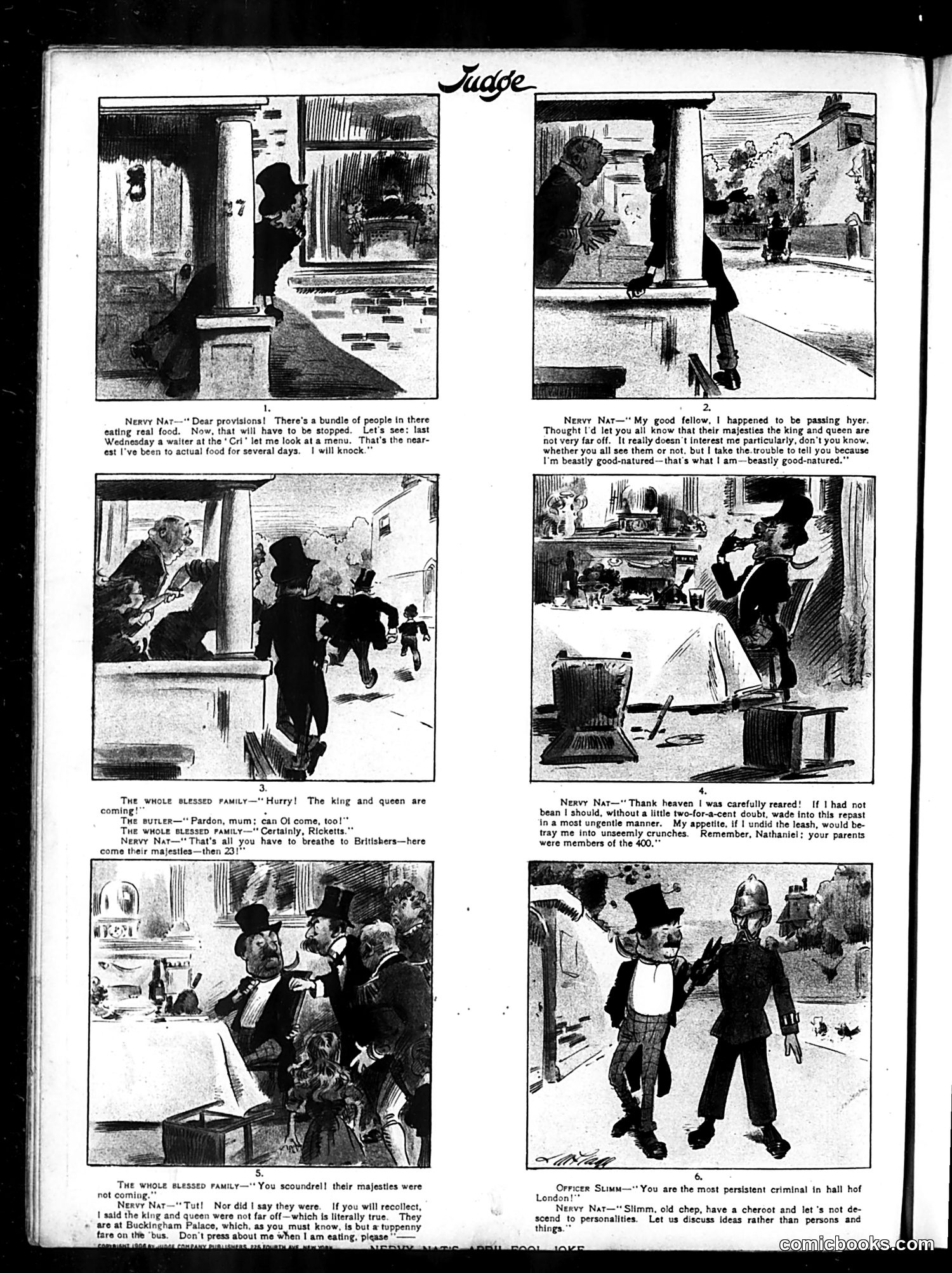
This is a comic strip titled "Nervy Nat" satirizing a character who is clearly poor or homeless but maintains absurdly pretentious behavior and speech. The humor derives from the contradiction between his actual circumstances and his affected superiority. **The Setup**: Nat crashes a fancy dinner where the King and Queen are expected, announces their imminent arrival (falsely), creates panic, then eats the food while the family flees. When confronted, he justifies himself with elaborate excuses about being "beastly good-natured." **The Satire**: The strip mocks working-class affectation—Nat's constant references to his "careful rearing," his parents being "members of the 400" (American high society), his refined speech ("old chep," "tuppenny fare"), and his philosophical deflections to Officer Slimm. He's portrayed as a con artist and beggar who uses performative gentility as a social weapon. The joke is that Nat's elaborate pretense makes his actual poverty and criminality more ridiculous, not less. Judge's audience would recognize this as satire of social climbing and class performativity.