
A complete issue · 16 pages · 1905
Judge — November 11, 1905
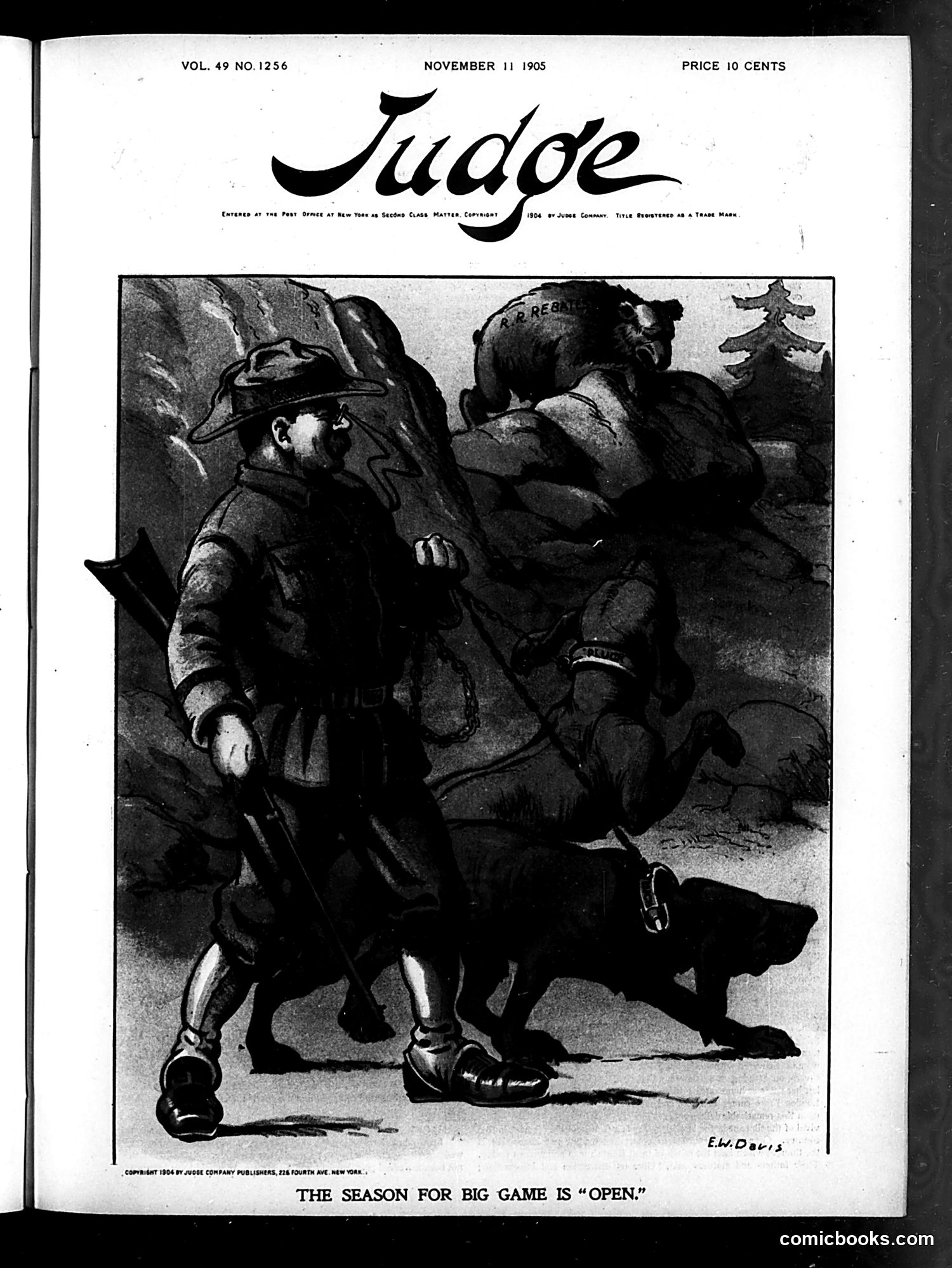
**"The Season for Big Game is 'Open'"** This political cartoon depicts a hunter in period military dress confronting what appears to be a large bear, with armed figures visible in the background. The "big game" reference is metaphorical—likely alluding to contemporary political or military conflicts rather than literal hunting. The 1905 date suggests this relates to the Russo-Japanese War (1904-1905) or its aftermath, as international tensions were high during this period. The cartoon appears to satirize aggressive political or military expansion by depicting it as sport-hunting, suggesting the casual or opportunistic nature of the era's imperial conflicts. The specific political figures or nations referenced are unclear without additional context, though the military imagery indicates commentary on contemporary geopolitical "hunting."
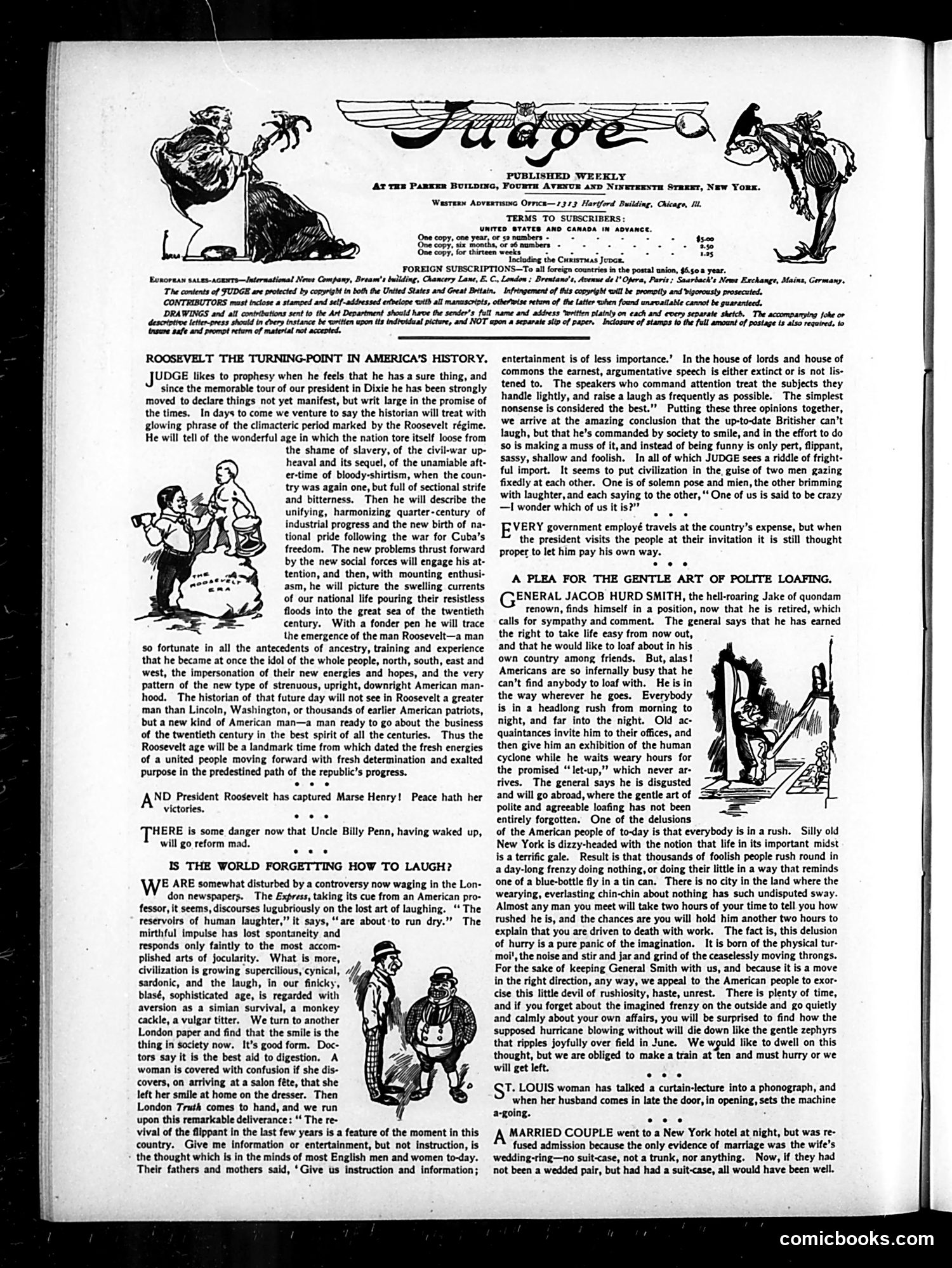
This page from Judge magazine contains several satirical pieces targeting early 20th-century American politics and society. **Main Article:** "Roosevelt the Turning-Point in America's History" praises President Roosevelt's leadership, suggesting he represents a break from America's past struggles (slavery, civil war) toward national unity and progress. **"A Plea for the Gentile Art of Polite Loafing":** This piece satirizes General Jacob Hurd Smith, a military figure known for harsh conduct. It mocks Americans' obsession with constant activity and productivity, arguing that leisurely loafing—once considered gentlemanly—has been forgotten in the rush of modern life. **"Is the World Forgetting How to Laugh?":** This satirizes declining humor and levity in society, blaming newspapers and modern anxieties for suppressing laughter and joy. The cartoons use caricature and ironic commentary typical of Judge's political humor.
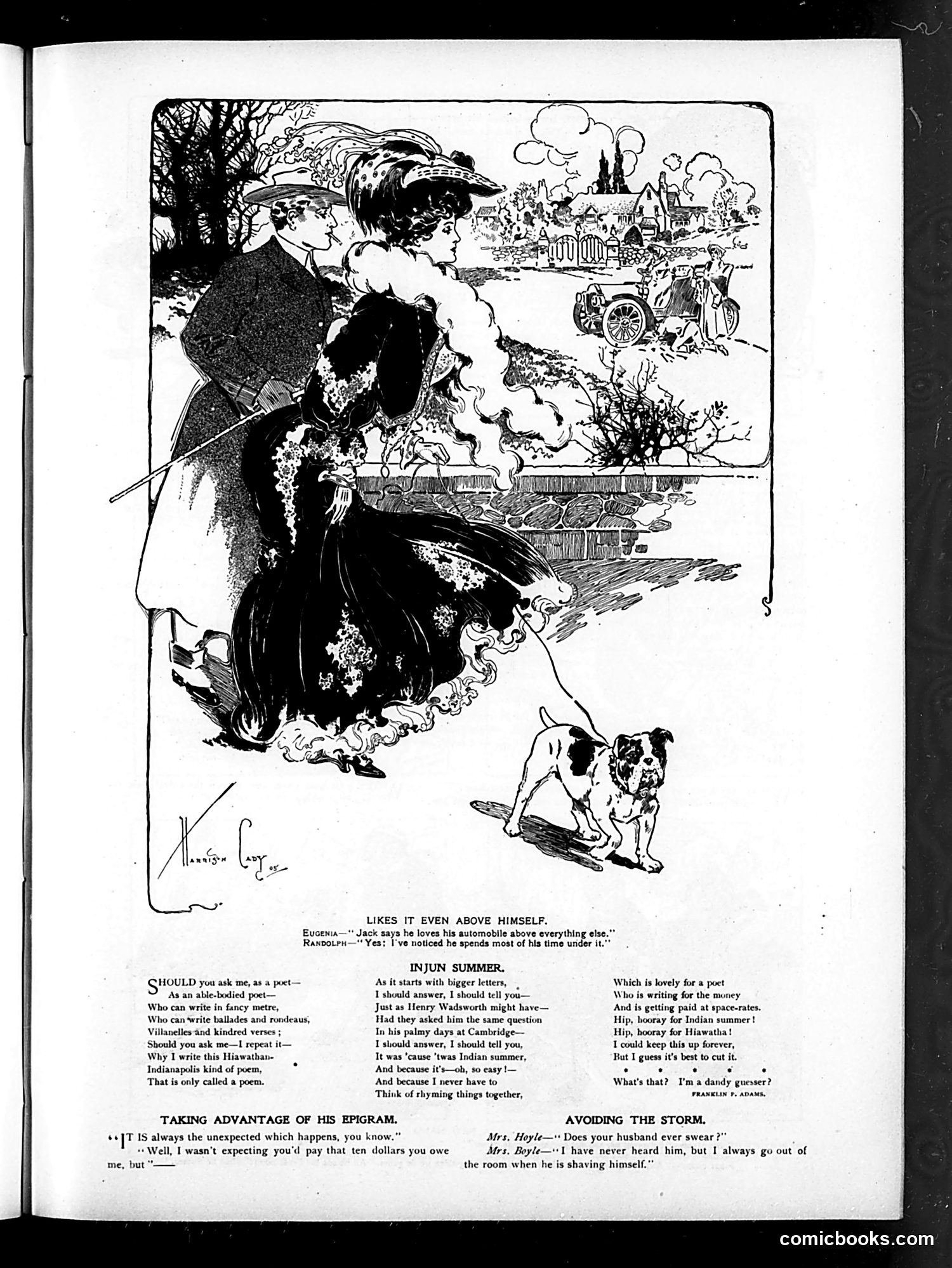
The main cartoon shows a fashionable couple admiring an automobile, with dialogue revealing the woman's priorities: "Jack says he loves his automobile above everything else" / "Yes; I've noticed he spends most of his time under it." The satire mocks early automobile enthusiasm—specifically, men's obsession with cars at the expense of their relationships. The joke is that while Jack claims to love his wife most, his actions (constantly tinkering under the vehicle) prove otherwise. The dog below seems to understand the irony better than Jack does. This reflects early 1900s anxiety about new technology disrupting traditional domestic life, with the automobile portrayed as a rival for a husband's affection and attention.
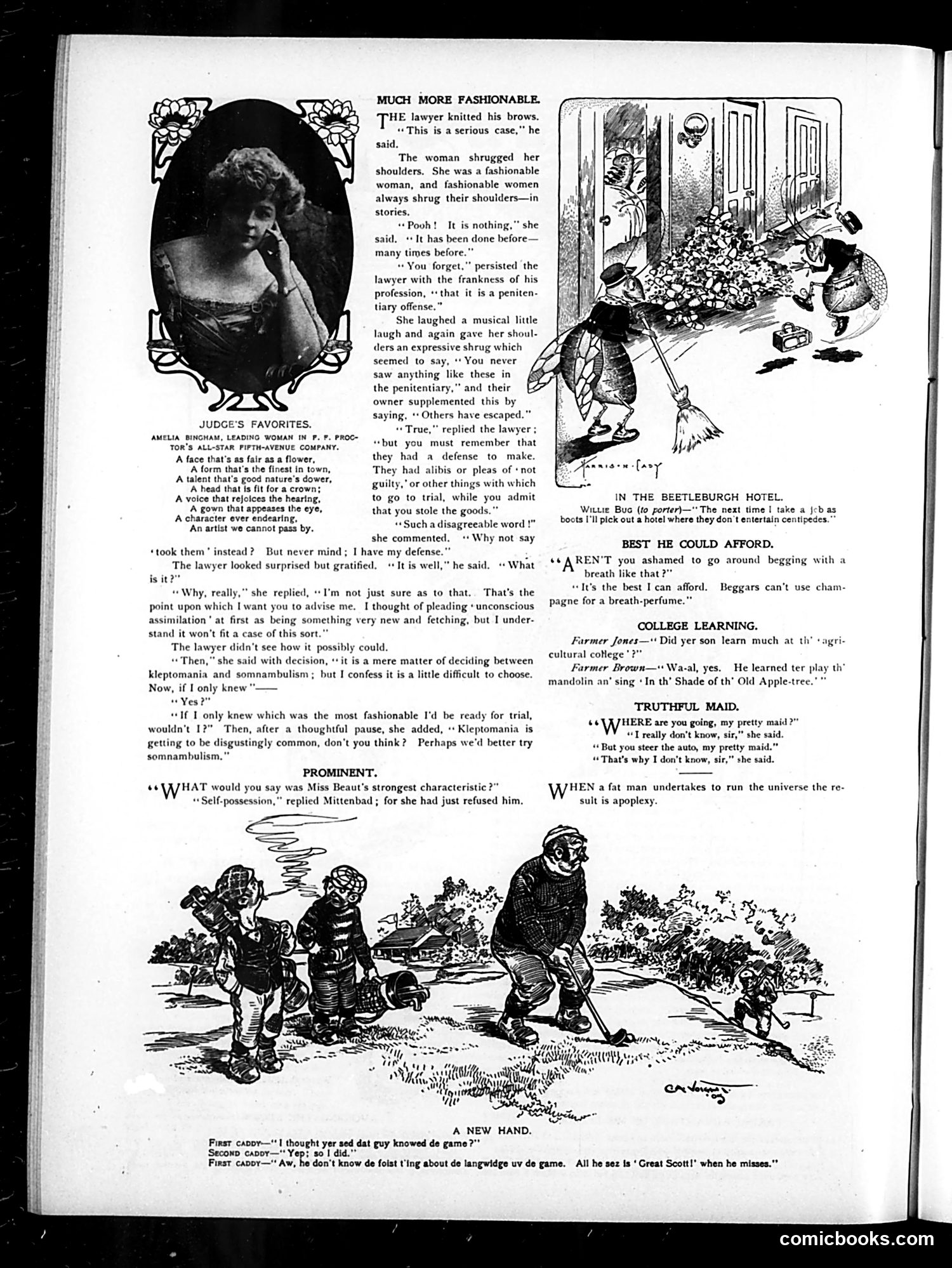
This page contains several short humorous pieces typical of early-20th-century satirical magazines. The main content includes: **"Judge's Favorites"** - A portrait and poem about Amelia Bingham, a fashionable woman, praising her appearance and social status. **"Much More Fashionable"** - A dialogue between a lawyer and fashionable woman about a legal defense, satirizing how wealthy women casually dismiss serious matters ("it has been done before"). **"A New Hand"** - A cartoon showing golfers, with dialogue joking about a newcomer's ignorance of golf terminology and etiquette. The humor relies on class-based mockery of someone unfamiliar with elite sports culture. The other sections ("Best He Could Afford," "College Learning," "Truthful Maid," "Prominent") are brief joke items typical of the magazine's format. Overall, the page satirizes upper-class pretension and social hierarchies rather than specific political events.
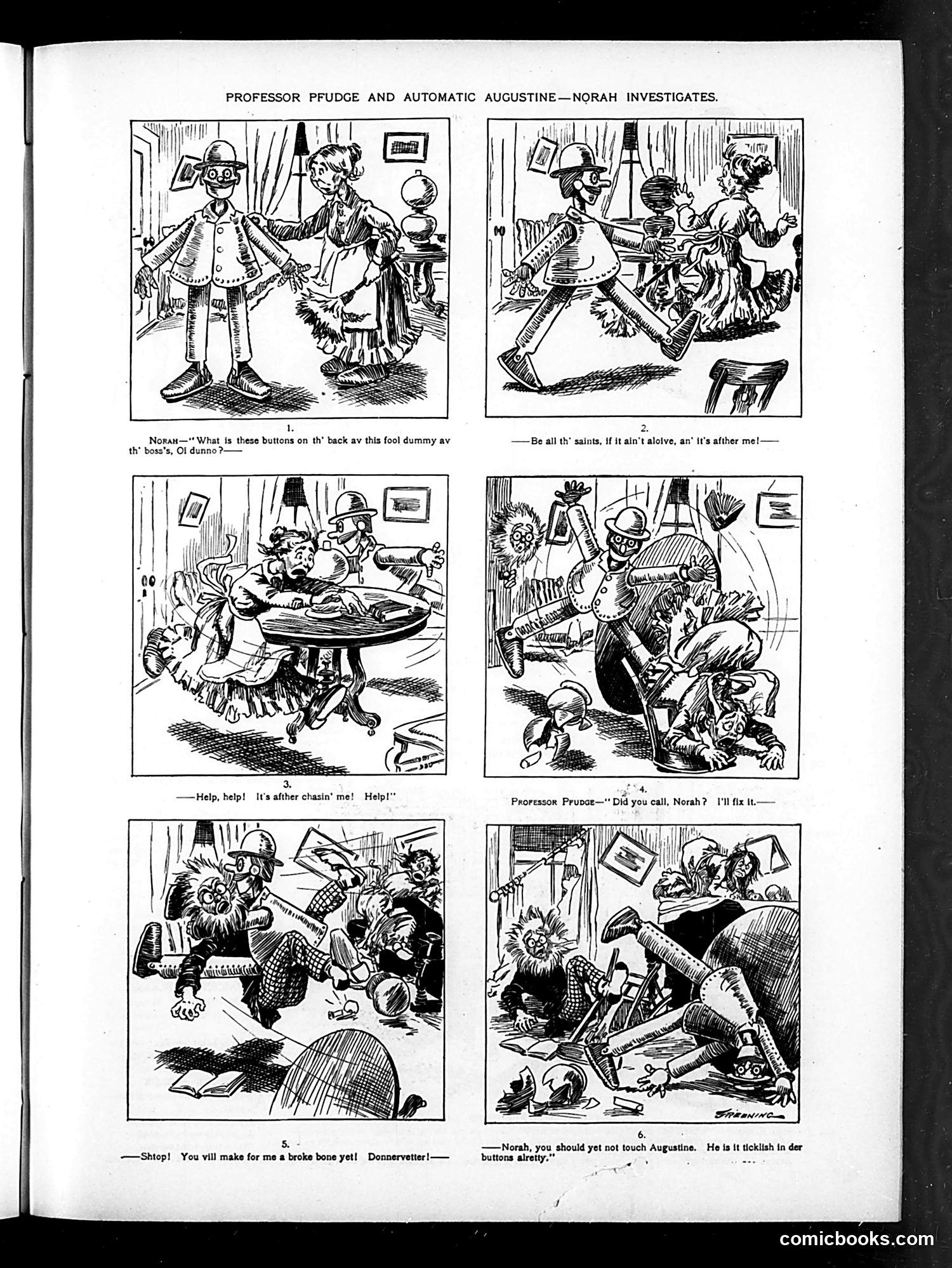
This comic strip follows a young woman named Norah investigating Professor Pfudge's mechanical creation, "Automatic Augustine." The panels depict Augustine as a malfunctioning automaton—a wind-up or spring-powered dummy—that goes haywire during demonstrations. The satire targets contemporary fascination with mechanical automation and labor-saving devices. Augustine repeatedly fails catastrophically, causing chaos in the professor's home: destroying furniture, creating mayhem at a table, and generally wreaking havoc despite Pfudge's attempts to control it. The joke reflects early 20th-century skepticism about whether machines could reliably replace human workers or servants. Norah's investigation exposes the absurdity of such "automatic" solutions to domestic labor—they're dangerous, unpredictable disasters.
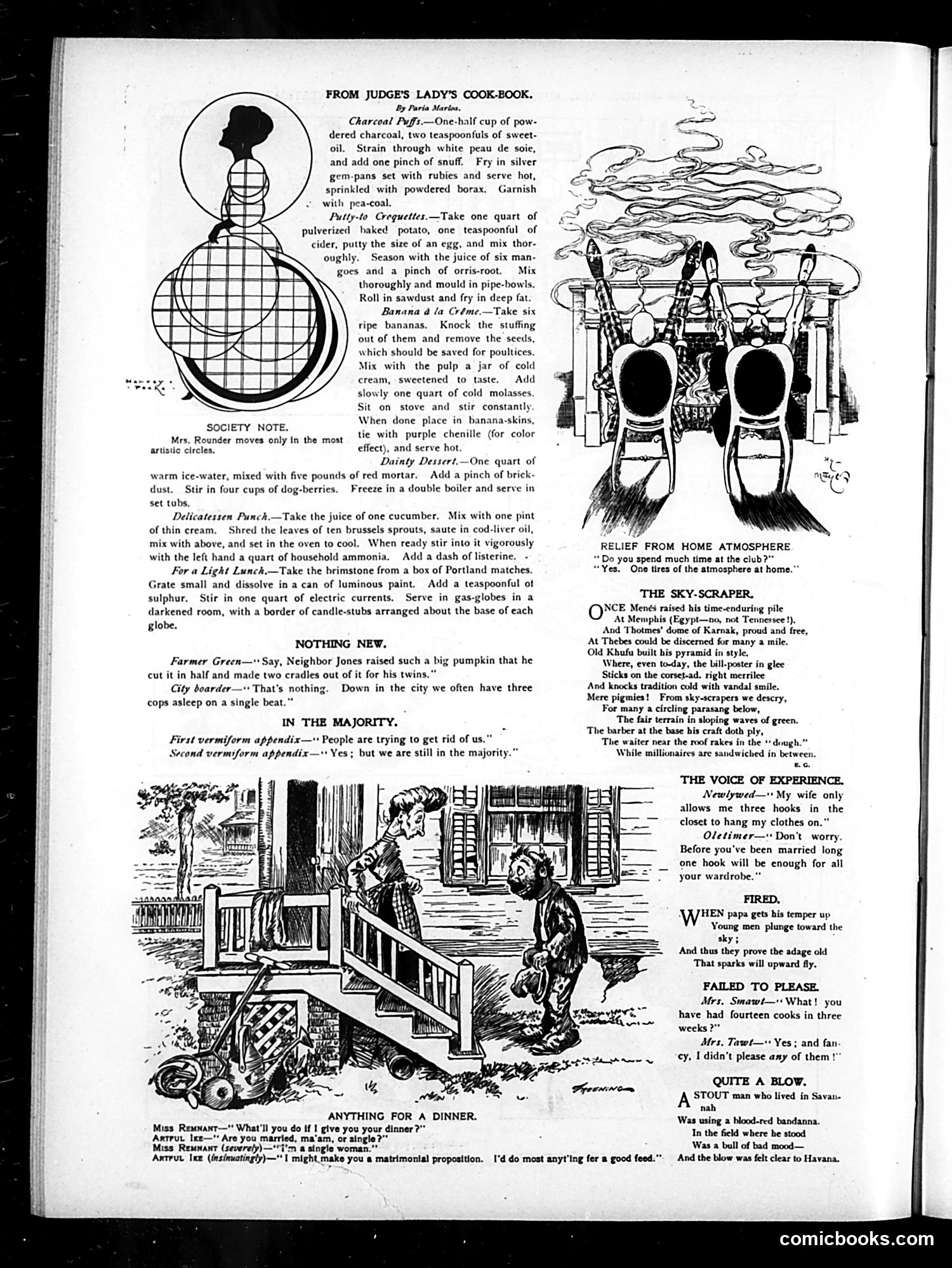
This page from *Judge* magazine is primarily **satirical humor content**, not political commentary. The main satire targets **absurd high-society pretension and gender dynamics of the Gilded Age**. **Key content:** 1. **"Judge's Lady's Cook-Book"** mocks wealthy women's frivolous tastes by presenting deliberately inedible "recipes" using toxic materials (charcoal, borax, ammonia, brimstone) and ridiculous ingredients (putty, sawdust, dog-berries). The joke: fashionable society recipes are so pretentious they're literally poisonous. 2. **Domestic humor sketches** satirize marriage and gender roles—wives controlling husbands' clothing space, men escaping to clubs to avoid "home atmosphere," newlyweds losing wardrobe over time. 3. The **poem "The Sky-Scraper"** humorously compares modern American buildings to ancient Egyptian monuments, noting that even grand structures get defaced by commercial advertisements and populated by working-class employees. The overall theme: mockery of wealthy affectation, marital inequality, and American materialism. Typical *Judge* magazine content of the era.
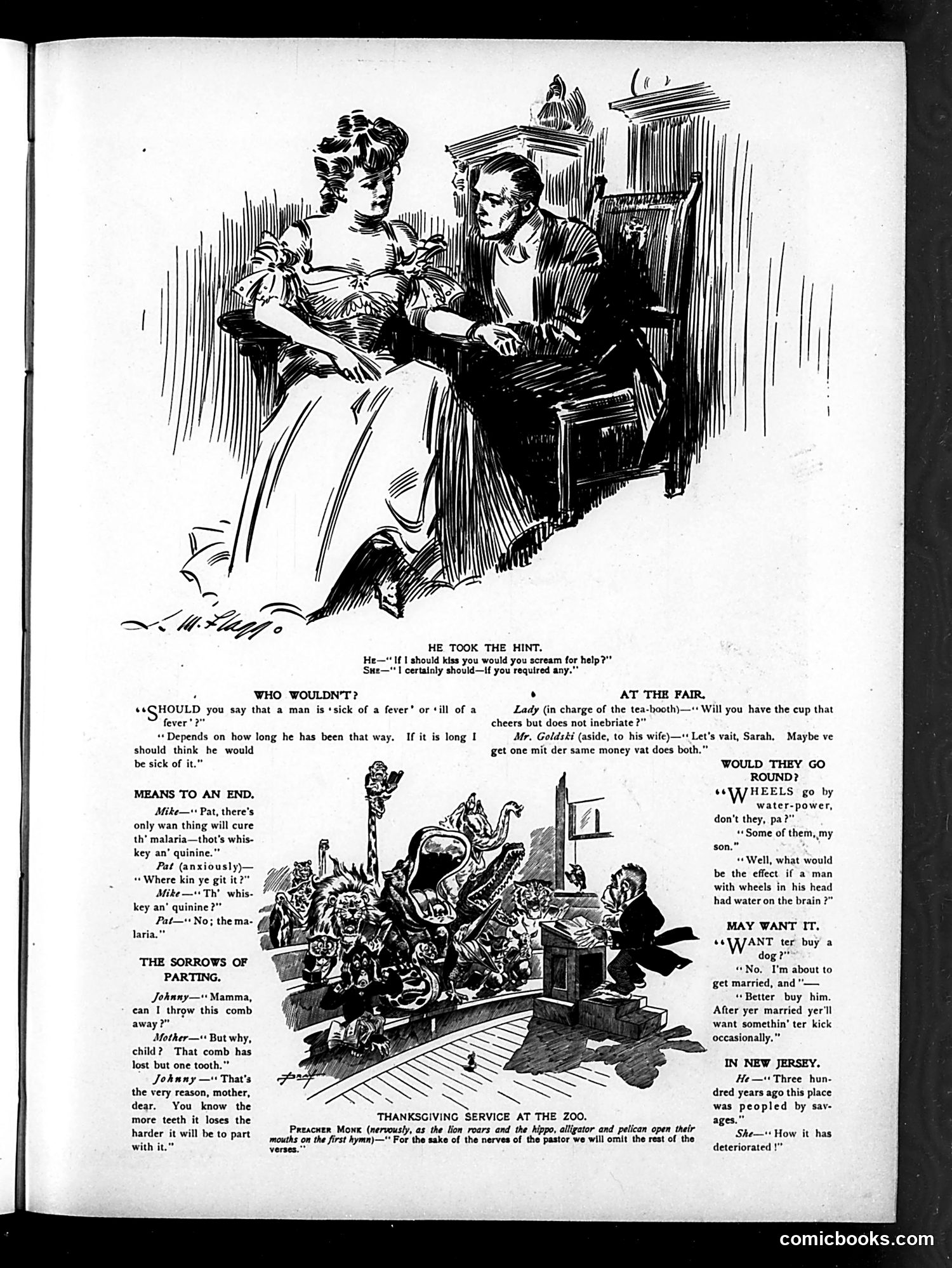
This page contains several brief satirical humor pieces typical of early 20th-century American comedy: **"He Took the Hint"**: A flirtation joke where a woman cleverly rebuffs a man's advance by saying she'd scream—*if he needed encouragement*—implying he wouldn't. **"At the Fair"**: Ethnic humor featuring "Mr. Goldski," a Jewish character, discussing fair prices in exaggerated dialect, a common stereotype in period humor. **"Means to an End"**: Irish immigrant characters (Mike and Pat) discuss using whiskey and quinine to treat malaria—satirizing period medical misconceptions and immigrant speech patterns. **"Thanksgiving Service at the Zoo"**: A preacher nervously leads service while zoo animals roar during hymns, suggesting both the absurdity of holding religious services in such settings and potential irreverence. The remaining items are brief joke exchanges. The overall tone reflects Judge's characteristic blend of class-based, ethnic, and observational humor popular in this era—much relying on stereotyped dialects and immigrant caricatures now considered offensive.
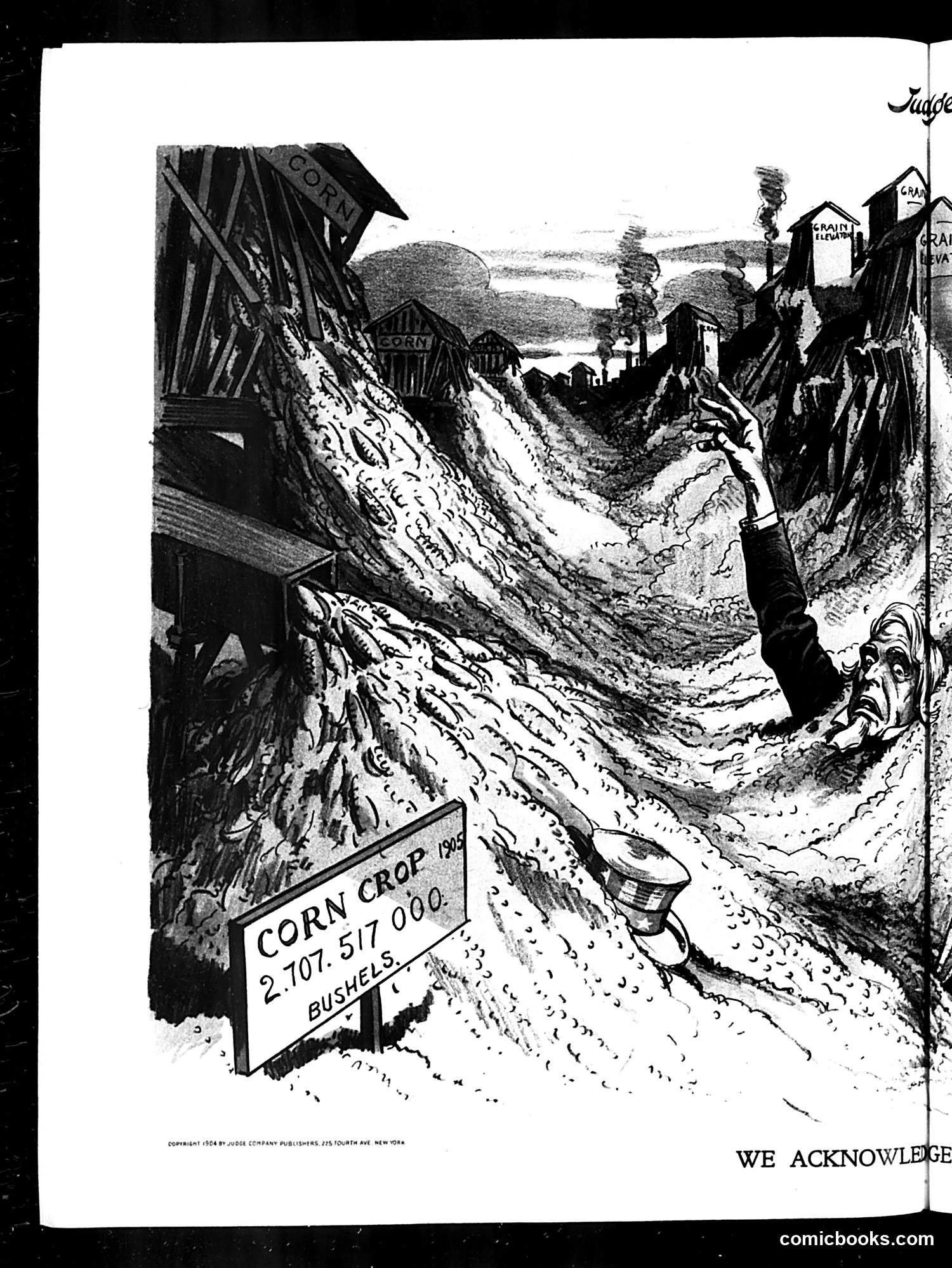
This appears to be a satirical illustration from *Judge* magazine depicting an agricultural/economic scene. The central image shows a dramatically carved-out ravine or erosion pattern labeled "CORN CROP 1902" with a measurement of "2,107,517,000 BUSHELS." The cartoon likely critiques either the **massive corn overproduction** of 1902 or the **severe crop failure/loss** that year—the exaggerated geological damage suggests catastrophic agricultural impact. The caricatured face on the right appears distressed or concerned, possibly representing a farmer or agricultural official reacting to this crisis. The grain elevator buildings visible in the background reinforce the agricultural setting. Without additional context, the exact satirical target—whether mocking abundance, shortage, or related economic consequences—remains somewhat unclear, though the visual emphasis on the enormous scale suggests commentary on a significant agricultural problem affecting the nation.
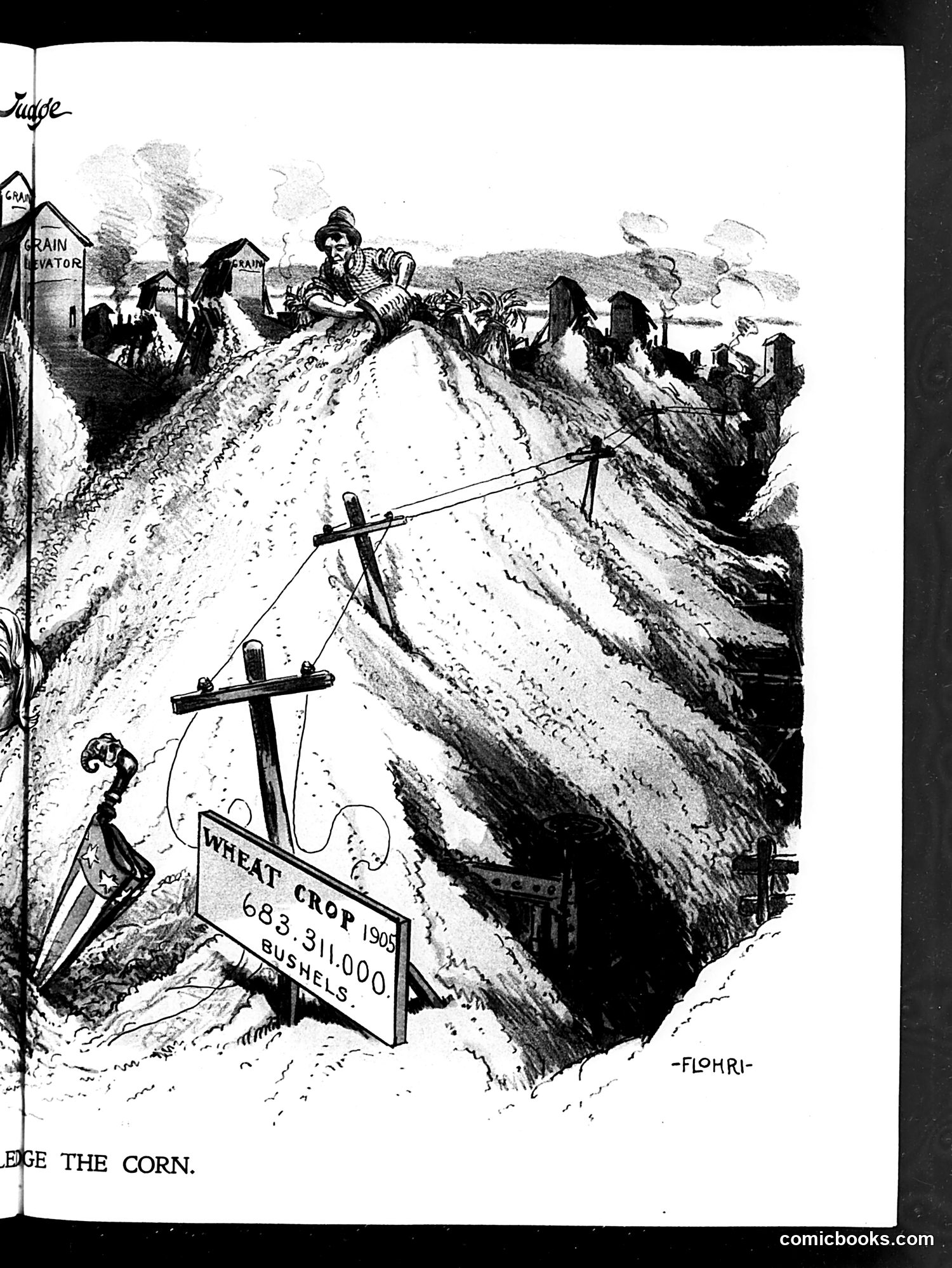
This political cartoon satirizes the 1908 wheat crop crisis. The image shows a massive grain elevator and industrial agricultural infrastructure dominating a landscape filled with crosses—a cemetery metaphor suggesting widespread death or disaster. A sign reading "WHEAT CROP 1908 / 683,311,000 BUSHELS" marks the grave. The figure at top appears to be a judge or authority figure presiding over this "burial." The visual pun conflates agricultural abundance with mortality: despite record grain production (683+ million bushels), the cartoon suggests this prosperity brought catastrophe—likely referencing economic hardship, farmer debt, or market collapse affecting rural America despite bumper crops. The satire critiques how statistical success masked genuine human suffering in early 20th-century American agriculture.
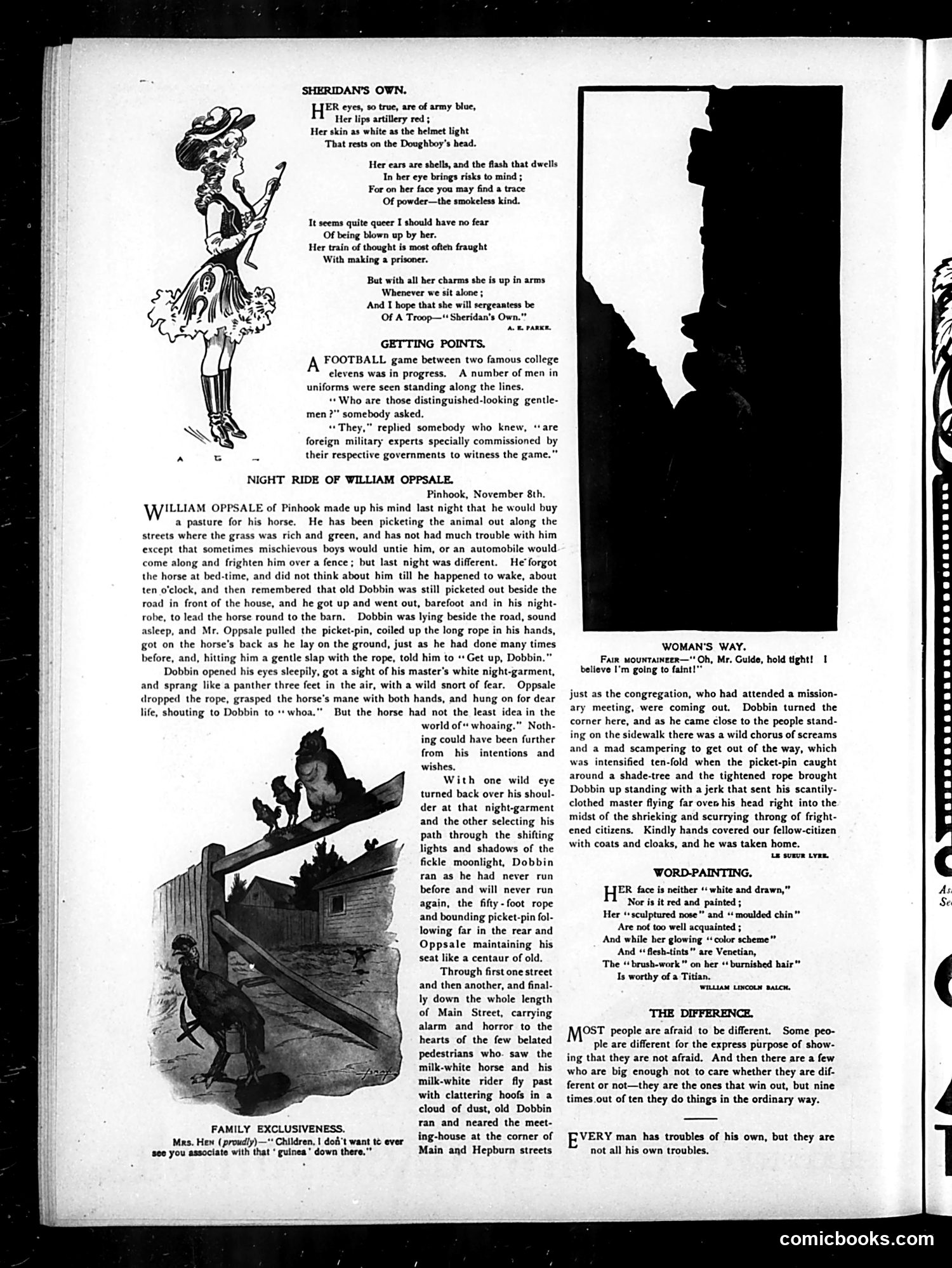
This page from *Judge* contains several satirical pieces reflecting early 20th-century American life: **"Sheridan's Own"** is a humorous poem about a woman soldier (likely a WWI-era reference, given "Doughboy" references), portraying her with militaristic metaphors—her lips "artillery red," ears like "shells." The satire celebrates a woman in military service while maintaining romantic interest. **"Getting Points"** briefly mocks college football's importance by showing foreign military observers attending a game, satirizing how Americans treat sports with near-diplomatic significance. **"Night Ride of William Oppsale"** is the page's main narrative: a comic tale of a man in white nightclothes accidentally frightening his horse, causing a chaotic midnight ride through town. The humor derives from the absurd panic this creates among townspeople—playing on small-town fears and the growing presence of automobiles. Minor pieces include "Word-Painting," "The Difference," and "Family Exclusiveness"—brief quips on social pretension and human nature. The overall tone reflects *Judge's* satirical approach to American society, mixing social commentary with everyday absurdism.
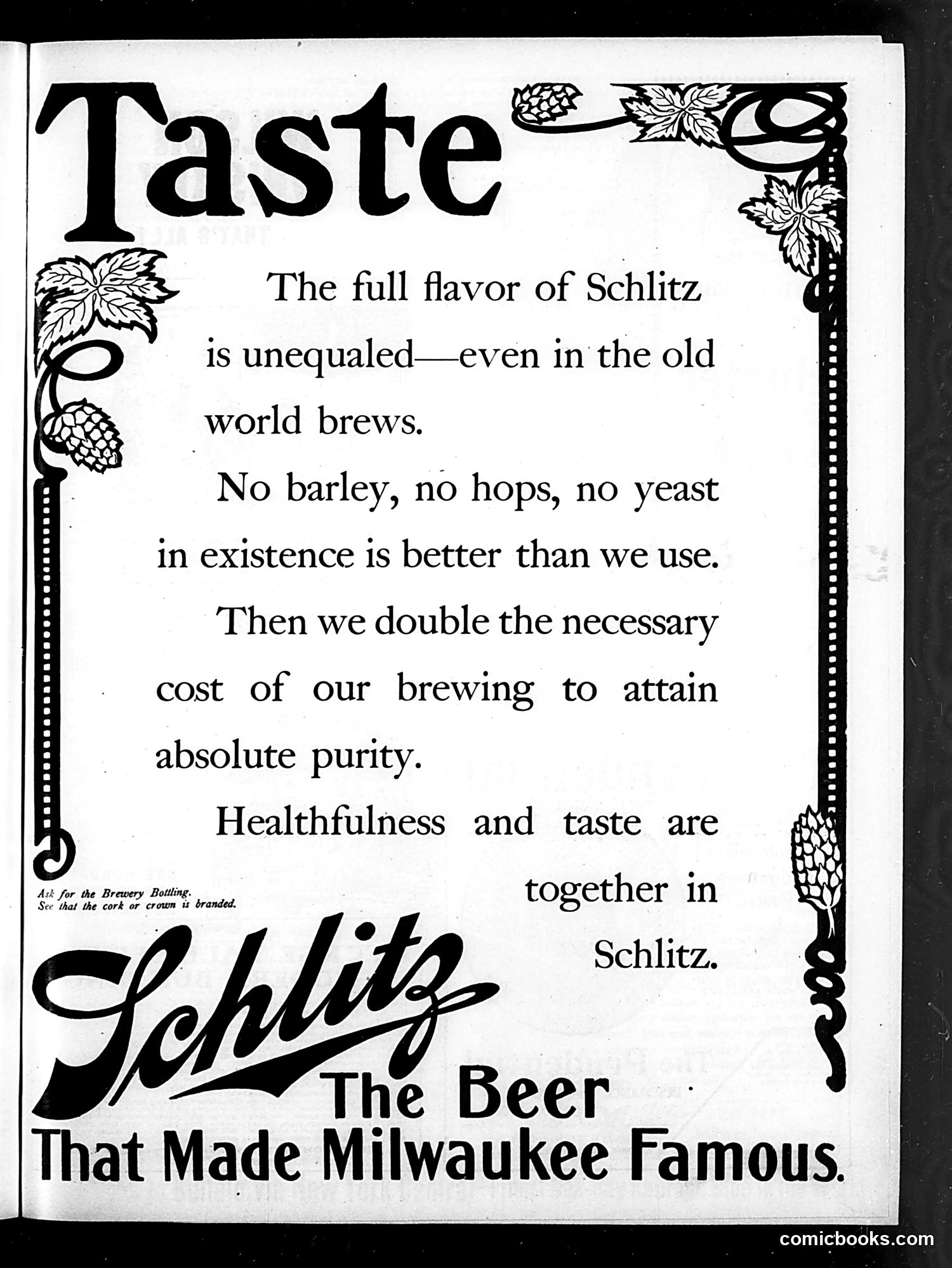
This is a **beer advertisement**, not political satire. It promotes Schlitz, a Milwaukee brewery, emphasizing quality and purity as selling points. The ad claims Schlitz uses superior ingredients (barley, hops, yeast) and doubles production costs to ensure "absolute purity"—a significant marketing message for the era. The emphasis on "healthfulness" alongside taste suggests brewers were marketing beer as a wholesome beverage, not merely an intoxicant. The decorative hop and grain illustrations frame the text, reinforcing the product's natural ingredients. The tagline "The Beer That Made Milwaukee Famous" positions Schlitz as synonymous with the city's brewing reputation. This reflects early 20th-century advertising strategy: quality assurance and health benefits were key sales appeals before modern food/beverage regulation.
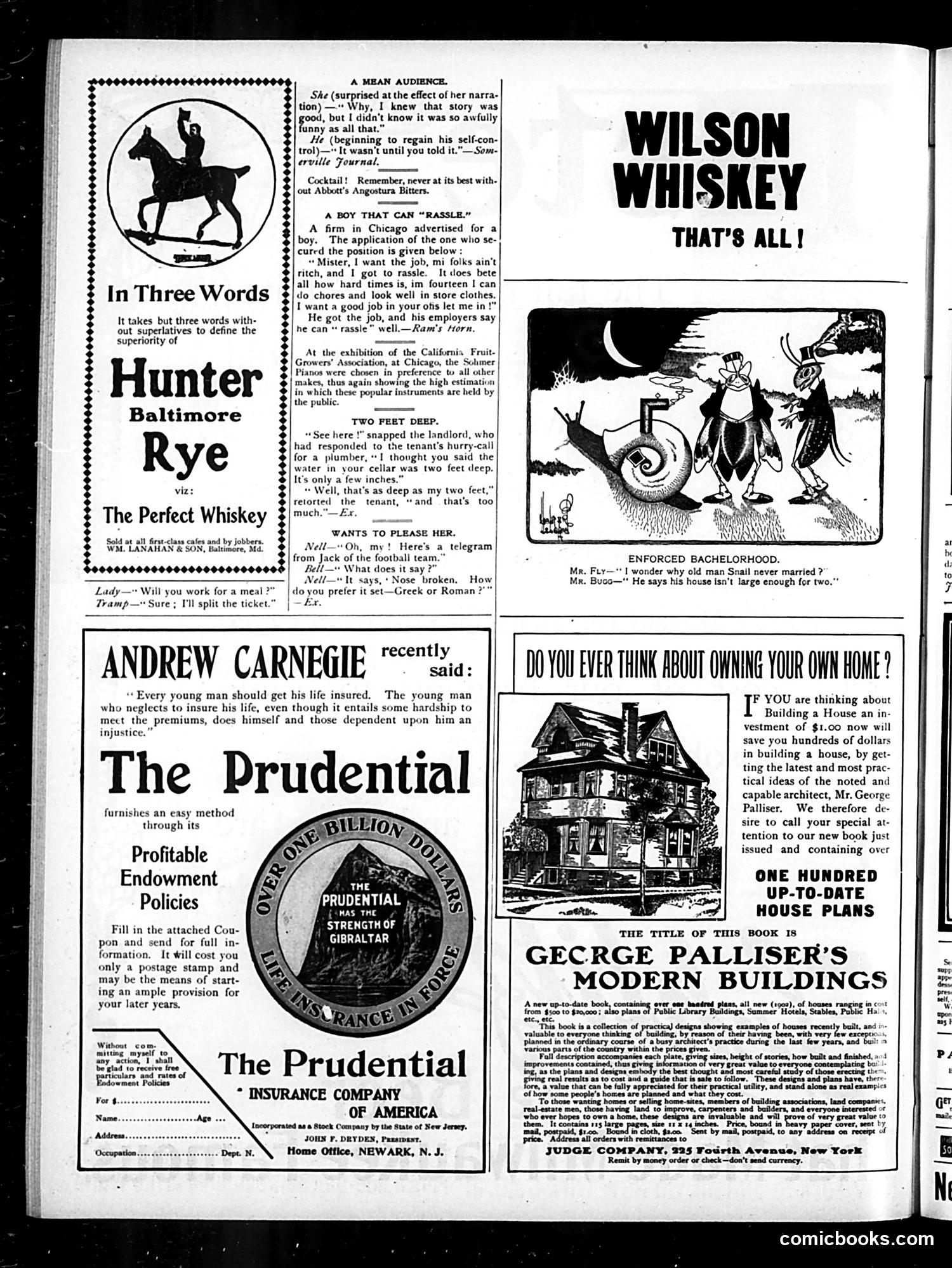
This page mixes advertisements with brief humorous items typical of early 1900s satirical magazines. The main cartoons are joke vignettes: "A Mean Audience" mocks a woman's poor storytelling; "A Boy That Can 'Rassle'" celebrates working-class gumption (a teenager gets a job by emphasizing his willingness to work hard); "Two Feet Deep" plays on literal versus figurative measurement. The substantial advertising includes life insurance pitches from The Prudential (featuring Andrew Carnegie's endorsement of life insurance for young men) and architectural services promoting George Palliser's house-plan book. The "Enforced Bachelorhood" joke plays on the snail's small shell as metaphor for inadequate housing for a spouse—a comment on housing costs and marriage economics. The Wilson Whiskey ad and Abbott's Bitters advertisements indicate alcohol marketing was common in mainstream publications of this era. Overall, this represents Judge's blend of light satirical humor, class commentary, and commercial content typical of early-1900s American magazines.
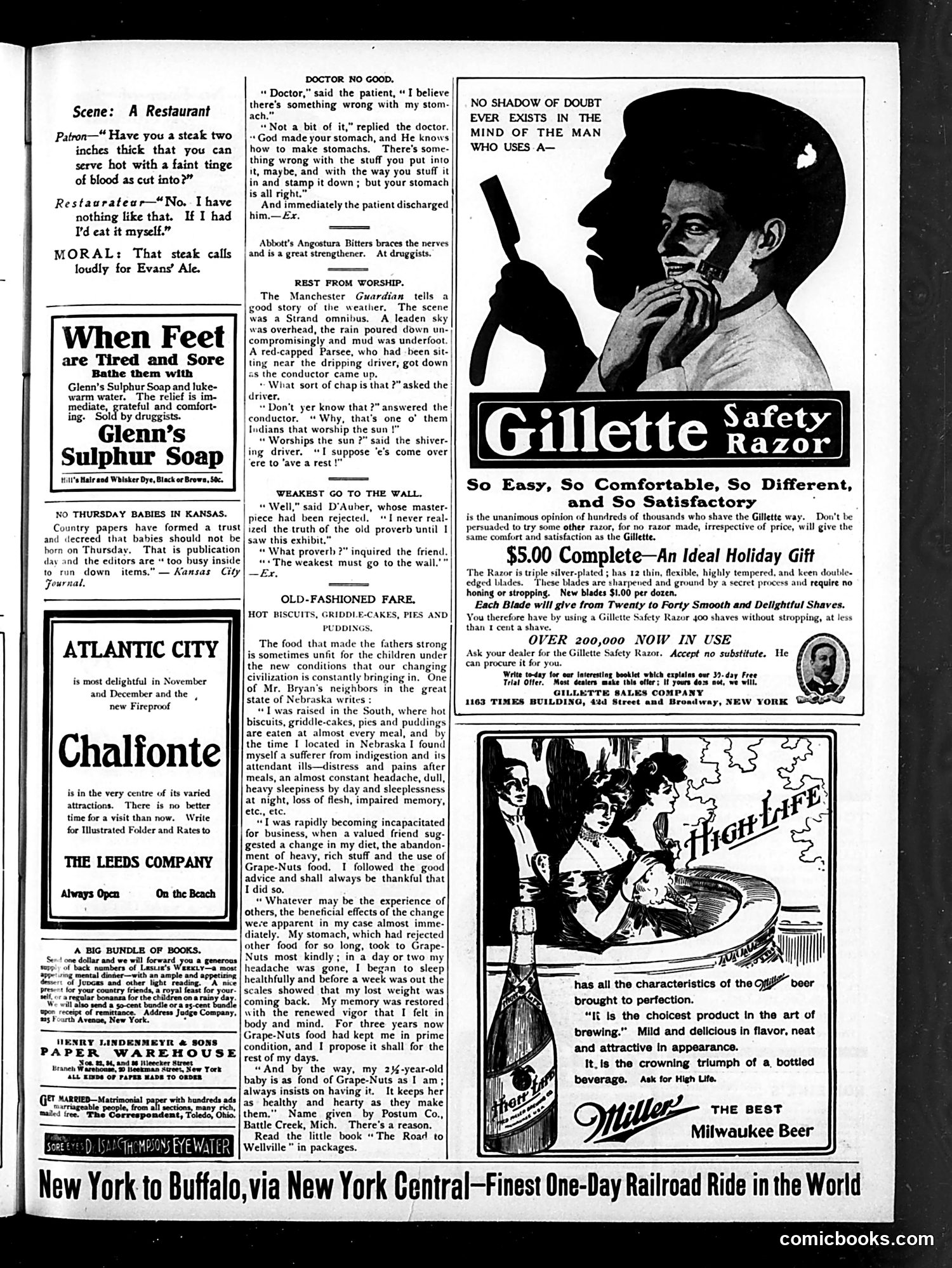
This page contains several short humorous anecdotes typical of Judge magazine's satirical style, plus period advertisements. **Main cartoon/joke**: A restaurant patron asks for a thick steak served hot with blood. The restaurateur refuses, claiming he'd eat such a steak himself—implying good steaks are too rare/valuable. The "moral" connects this to Evans' Ale, suggesting ale pairs with quality meat. **"Rest from Worship"**: Satirizes religious stereotypes. A Parsee (Zoroastrian, sun-worshipping) man gets rained on in London; a conductor jokes the man came to England for "rest" from sun-worship—mockingly suggesting the rainy weather prevents him worshipping outdoors. **"Old-Fashioned Fare"**: Criticizes outdated Southern diet (biscuits, heavy foods) as unhealthy by modern standards, promoting Grape-Nuts cereal as progressive nutrition. **"Doctor No Good"**: A doctor dismisses stomach complaints, blaming diet rather than medicine—satirizing either medical ignorance or religious fatalism about God's design. The page is primarily **advertisements** (Gillette razors, Miller beer, railroad travel, hotels).
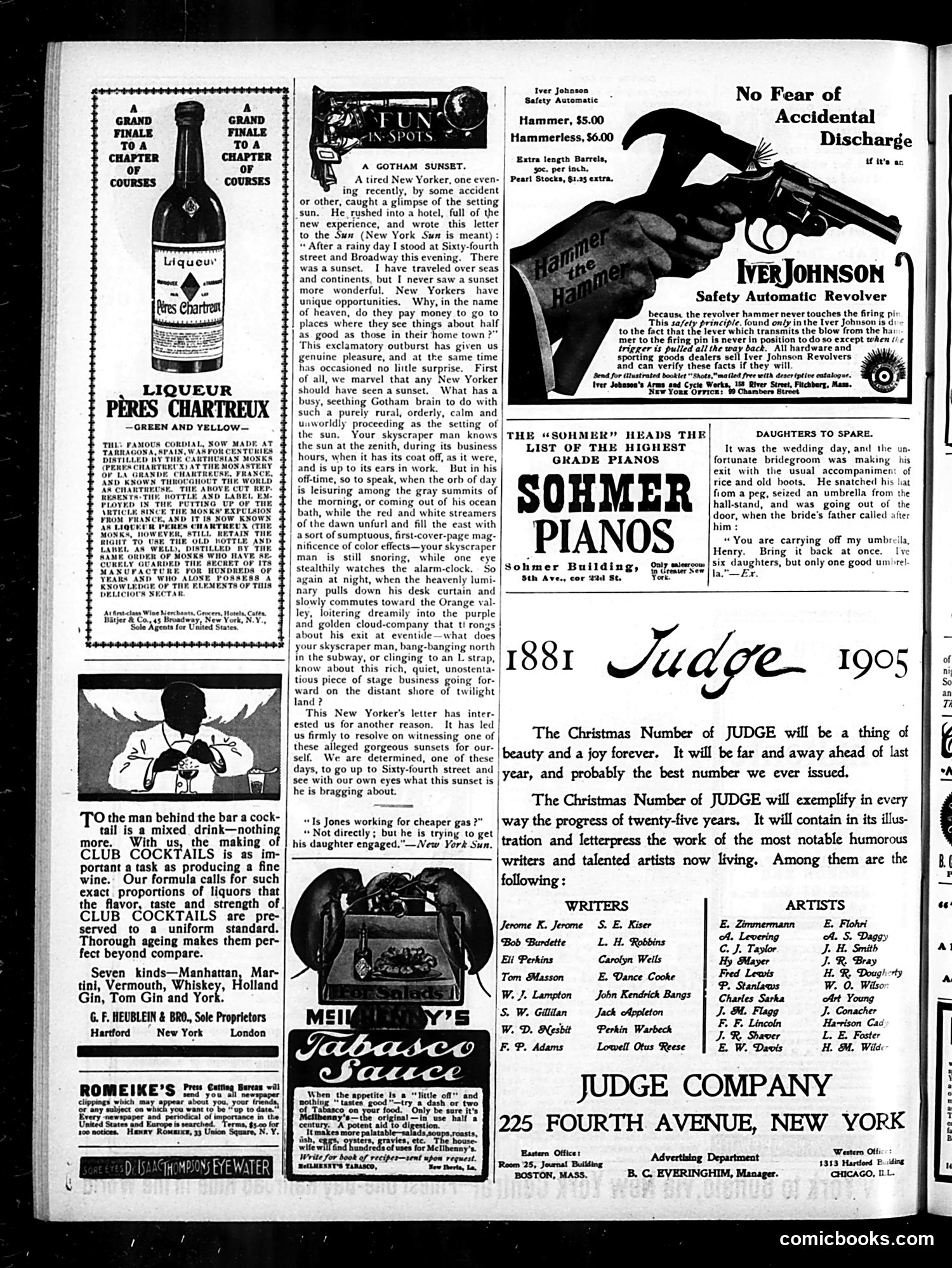
This page contains primarily **advertisements** with one satirical article. The main satire is "A Gotham Sunset," which mocks wealthy New Yorkers' obliviousness to natural beauty. The piece describes how busy Manhattan businessmen are so consumed with work that they never notice sunsets—they work during daylight hours and commute via subway/elevated train at dusk, missing the sky's spectacular displays. The satire critiques urban workaholism and materialism: New Yorkers travel abroad to see wonders while ignoring superior natural beauty at home. The accompanying ads promote cordials, cocktails, pianos, and notably an **Iver Johnson Safety Automatic Revolver**—marketed with the selling point "No Fear of Accidental Discharge," emphasizing its safety mechanism. This reflects early 1900s consumer culture where firearms were advertised as household products. The page serves as a window into Edwardian-era concerns: urban congestion, leisure commerce, and technological/consumer product promotion.
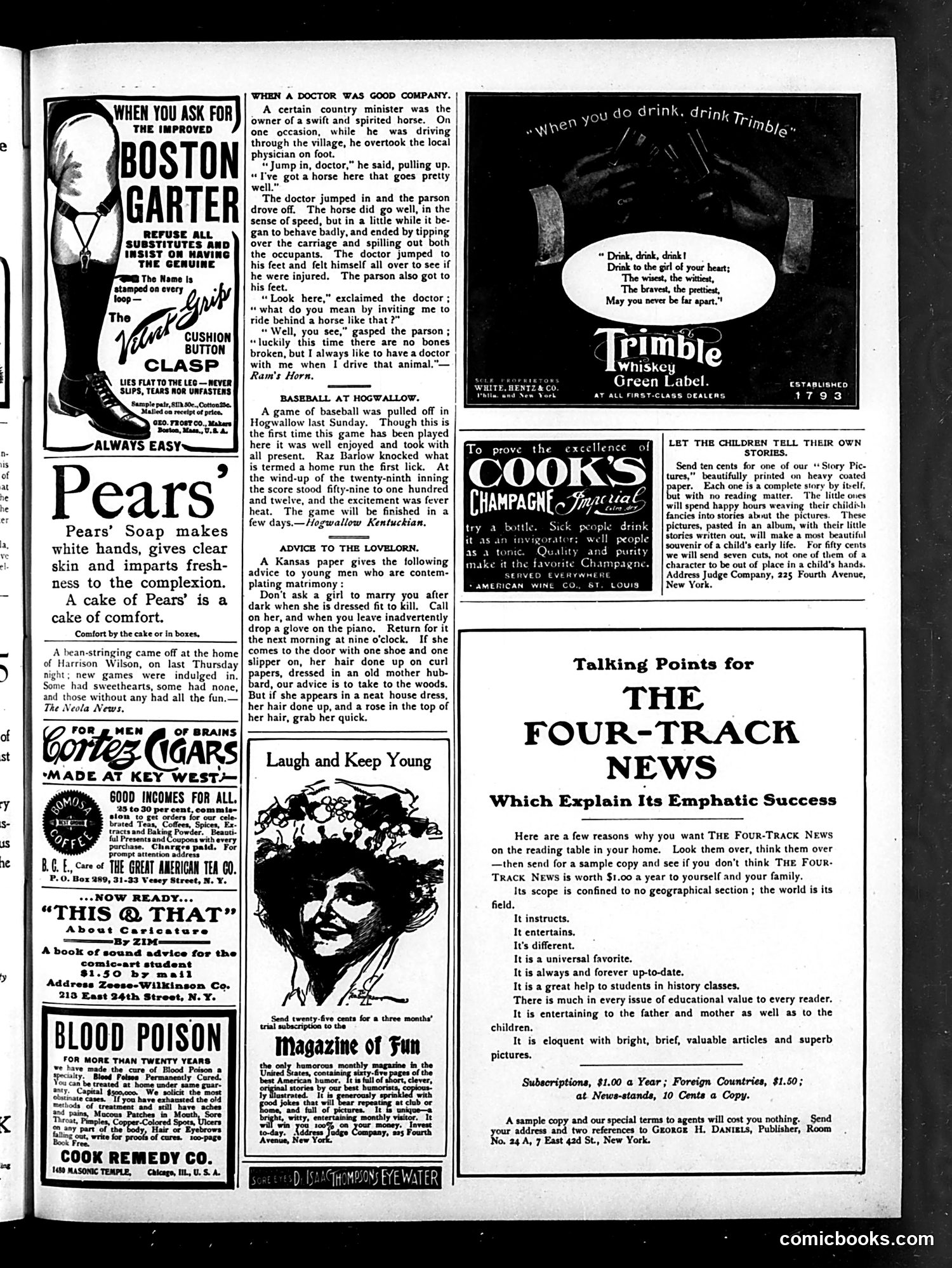
This page is primarily **advertisements and filler content** typical of early 1900s satirical magazines, with minimal political cartoon commentary. The main items are: **Advertisements:** Boston Garter (men's hosiery), Pears' Soap, Cortez Cigars, Cook's Champagne, Trimble Whiskey, and various patent medicines (Blood Poison remedy, Cook Remedy Co.). **Humor/Filler Anecdotes:** Short jokes and stories, including: - A tale of a minister inviting a doctor to ride in his carriage, which crashes—the doctor appreciates having medical expertise nearby - Rural baseball game reporting ("Hogwallow") - Dating advice (assess a girl's character by her morning appearance) - A children's picture-story product **The Four-Track News subscription promotion:** Advertising an educational magazine for families. There are **no identifiable political cartoons or caricatures** on this page. The content reflects period attitudes (gender expectations in courtship, rural humor) but lacks satirical commentary on specific political figures or events.
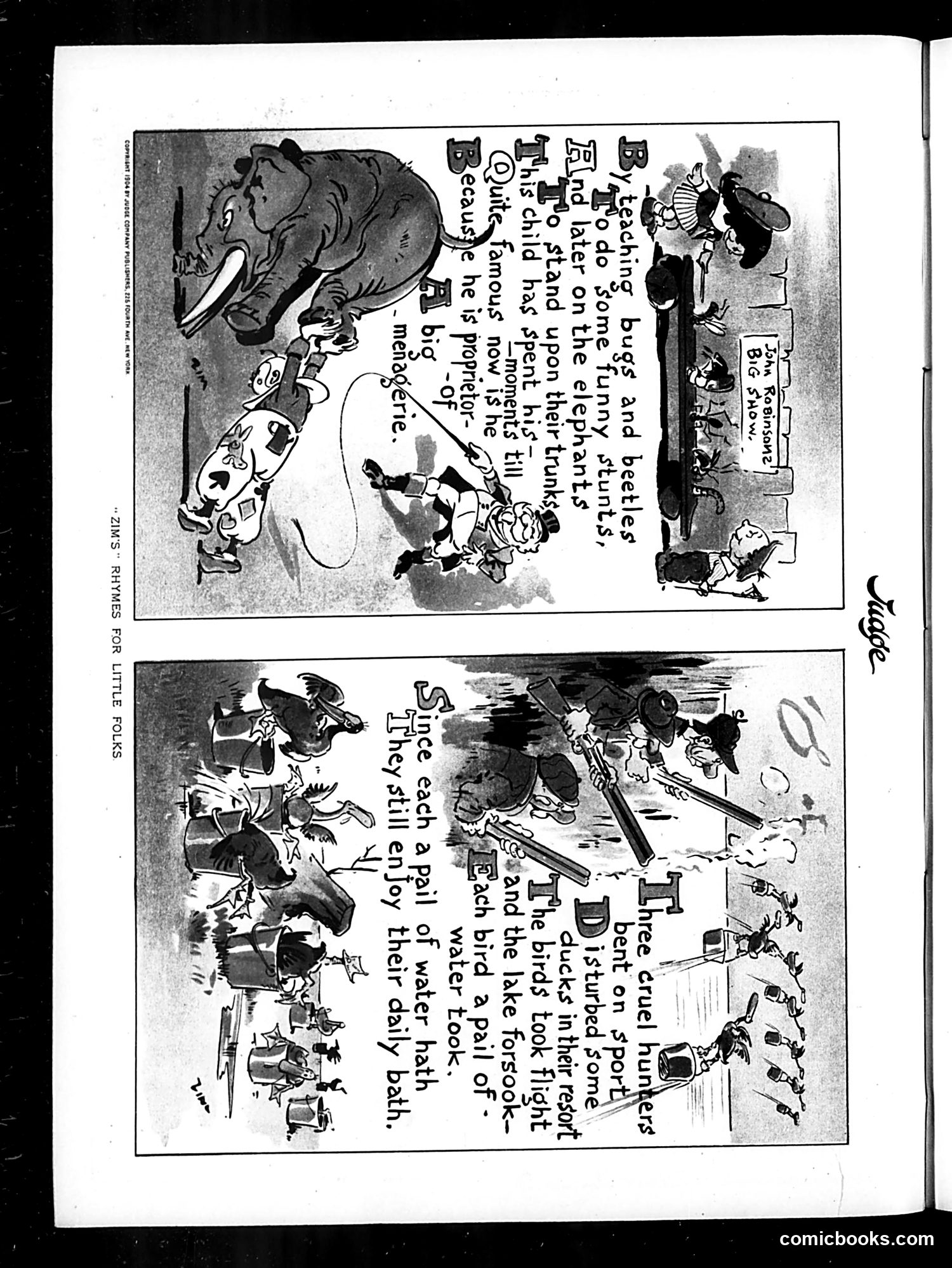
This page contains **"Rhymes for Little Folks,"** a children's verse section of *Judge* magazine. The OCR'd text is largely illegible, but the visible content depicts: **Top cartoon**: An elephant performing tricks for children, with text describing the elephant as "famous" and a "proprietor" of some kind of performance or establishment. **Bottom cartoon**: Animated birds and animals in a water scene, accompanying verses about creatures enjoying water baths and carrying pails. These appear to be **humorous illustrated nursery rhymes**—typical light entertainment content for children that *Judge* regularly featured alongside its political satire. The cartoons use exaggerated animal characters and whimsical scenarios common to early-20th-century children's literature. Without clearer text or publication date, specific satirical intent is unclear, though the anthropomorphized animals suggest gentle moral lessons or simply amusing nonsense verse for young readers.