
Judge, 1905-11-11 · page 10 of 16
Judge — November 11, 1905 — page 10: what you’re looking at
What you’re looking at
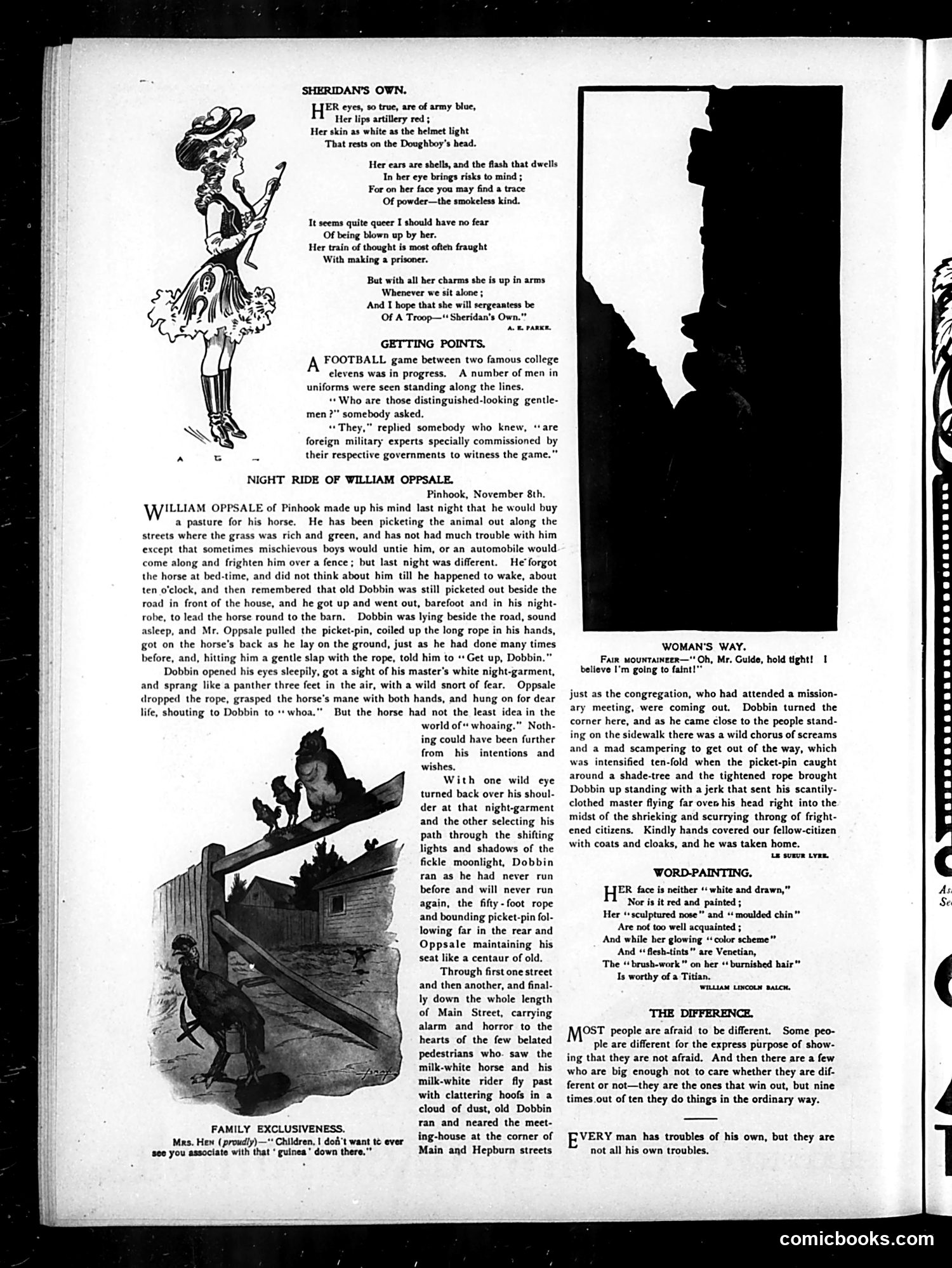
This page from *Judge* contains several satirical pieces reflecting early 20th-century American life: **"Sheridan's Own"** is a humorous poem about a woman soldier (likely a WWI-era reference, given "Doughboy" references), portraying her with militaristic metaphors—her lips "artillery red," ears like "shells." The satire celebrates a woman in military service while maintaining romantic interest. **"Getting Points"** briefly mocks college football's importance by showing foreign military observers attending a game, satirizing how Americans treat sports with near-diplomatic significance. **"Night Ride of William Oppsale"** is the page's main narrative: a comic tale of a man in white nightclothes accidentally frightening his horse, causing a chaotic midnight ride through town. The humor derives from the absurd panic this creates among townspeople—playing on small-town fears and the growing presence of automobiles. Minor pieces include "Word-Painting," "The Difference," and "Family Exclusiveness"—brief quips on social pretension and human nature. The overall tone reflects *Judge's* satirical approach to American society, mixing social commentary with everyday absurdism.
📄 Transcribed text from this page (OCR, searchable)
Machine-transcribed from the original scan — historical spelling and the odd misread are preserved.
SHERIDAN’S OWN. HER res 20 true, are of army bloc, Her lips artillery red ; Her skin as white as the helmet light That rests on the Doughboy’s head. Her ears are shells, and the flash that dwells In her eye brings risks to mind ; For on her face you may find a trace Of powder—the smokeless kind. It seems quite queer I should have no fear Of being blown up by her. Her train of thought is most often fraught With making a prisoner. Bat with all her charms she is up in arms Whenever we sit alone ; And I hope that she will sergeantess be Of A Troop—* Sheridan's Own.” AB PARKER. GETTING POINTS. A FOOTBALL game between two famous college elevens was in progress. A number of men in uniforms were seen standing along the lines. “Who are those distinguished-looking gentle- men ?” somebody asked. “They,” replied somebody who knew, “are foreign military experts specially commissioned by their respective governments to witness the game.” NIGHT RIDE OF WILLIAM OPPSALE. Pinhook, November 8th. Witla OPPSALE of Pinhook made up his mind last night that he would buy a pasture for his horse. He has been picketing the animal out along the streets where the grass was rich and green, and has not had much trouble with him except that sometimes mischievous boys would untie him, or an automobile would come along and frighten him over a fence; but last night was different. He forgot the horse at bed-time, and did not think about him till he happened to wake, about ten o'clock, and then remembered that old Dobbin was still picketed out beside the road in front of the house, and he got up and went out, barefoot and in his night- robe, to lead the horse round to the barn. Dobbin was lying beside the road, sound asleep, and Mr. Oppsale pulled the picket-pin, coiled up the long rope in his hands, got on the horse's back as he lay on the ground, just as he had done many times before, and, hitting him a gentle slap with the rope, told him to «Get up, Dobbin.” Dobbin opened his eyes sleepily, got a sight of his master’s white night-garment, and sprang like a panther three feet in the air, with a wild snort of fear. Oppsale dropped the rope, grasped the horse’s mane with both hands, and hung on for dear life, shouting to Dobbin to *« whoa." But the horse had not the least idea in the world of whoaing.” Noth- ing could have been further from his intentions and wishes, With one wild eye turned back over his shoul- der at that night-garment and the other selecting his path through the shifting lights and shadows of the fickle moonlight, Dobbin ran as he had never run before and will never run again, the fifty-foot rope and bounding picket-pin fol- lowing far in the rear and Oppsale maintaining his seat like a centaur of old. Through first one street and then another, and final- ly down the whole length of Main Street, carrying alarm and horror to the hearts of the few belated pedestrians who. saw the milk-white horse and his milk-white rider fly past clattering hoofs in a cloud of dust, old Dobbin ran and neared the meet- ing-house at the corner of Main and Hepburn streets FAMILY EXCLUSIVENESS. Mrs. Hen ( proudly)—* Children, | doai't want t¢ ever see you associate with that ‘ guinea’ down there.” WOMAN'S WAY. FAIR MOUNTAINEER—"‘ Oh, Mr. Guide, hold tight! 1 believe I'm going to faint!"” just as the congregation, who had attended a mission- ary meeting, were coming out. Dobbin turned the corner here, and as he came close to the people stand- ing on the sidewalk there was a wild chorus of screams and a mad scampering to get out of the way, which was intensified ten-fold when the picket-pin caught around a shade-tree and the tightened rope brought Dobbin up standing with a jerk that sent his scantily- clothed master flying far oven his head right into the midst of the shrieking and scurrying throng of fright- ened citizens. Kindly hands covered our fellow-citizen with coats and cloaks, and he was taken home. te sunve tyes. WORD-PAINTING. H"=®. face is neither ‘‘ white and drawn,” Nor is it red and painted ; Her “sculptured nose” and “ moulded chin” Are not too well acquainted ; And while her glowing ‘‘ color scheme” And «flesh-tints” are Venetian, The “brush-work" on her “burnished hair" Is worthy of a Titian. WILLIAM LINCOLN BALCH. THE DIFFERENCE. MOST people are afraid to be different. Some peo- ple are different for the express purpose of show- ing that they are not afraid. And then there are a few who are big enough not to care whether they are dif- ferent or not—they are the ones that win out, but nine times.out of ten they do things in the ordinary way. VERY man has troubles of his own, but they are not all his own troubles. comicbooks.com