
Judge, 1905-11-11 · page 2 of 16
Judge — November 11, 1905 — page 2: what you’re looking at
What you’re looking at
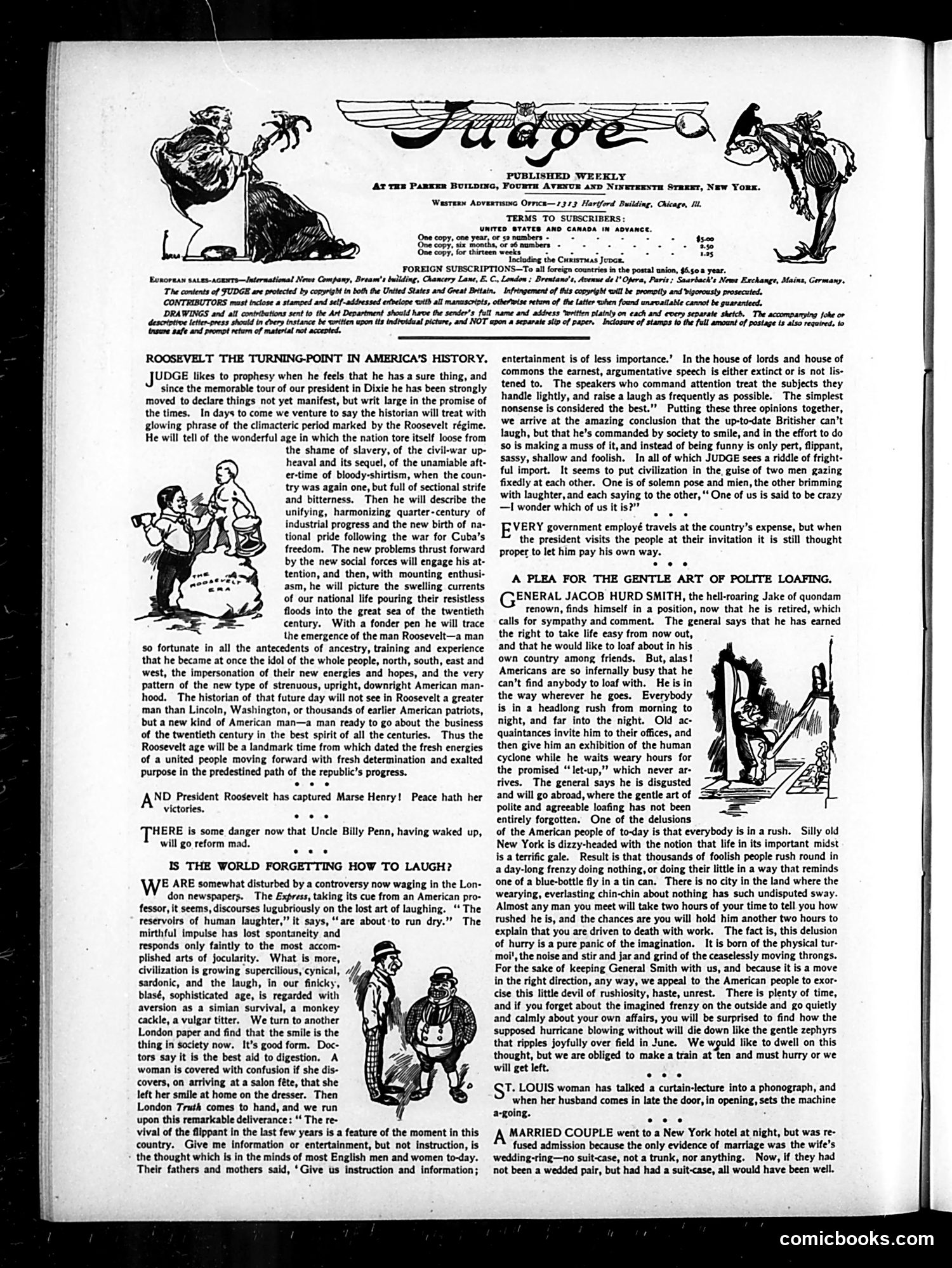
This page from Judge magazine contains several satirical pieces targeting early 20th-century American politics and society. **Main Article:** "Roosevelt the Turning-Point in America's History" praises President Roosevelt's leadership, suggesting he represents a break from America's past struggles (slavery, civil war) toward national unity and progress. **"A Plea for the Gentile Art of Polite Loafing":** This piece satirizes General Jacob Hurd Smith, a military figure known for harsh conduct. It mocks Americans' obsession with constant activity and productivity, arguing that leisurely loafing—once considered gentlemanly—has been forgotten in the rush of modern life. **"Is the World Forgetting How to Laugh?":** This satirizes declining humor and levity in society, blaming newspapers and modern anxieties for suppressing laughter and joy. The cartoons use caricature and ironic commentary typical of Judge's political humor.
📄 Transcribed text from this page (OCR, searchable)
Machine-transcribed from the original scan — historical spelling and the odd misread are preserved.
PUBLISHED WEEKLY Av re Paxxee Burtpivc, Fourrm AVENUE axp Nrvergexrm Steer, New York. Wastexx Apvantisinc Orrica—1313 Hartford Building, Ohicage, I. UNITED STATES AND CANADA IN ADVANCE. One copy, one year, or so =a months, oF 26 Ove ‘copy, six ‘One copy, for thirteen weeks TERMS TO SUBSCRIBERS: Tnclading the Cusistuas Jeocs. FOREIGN SUBSCRIPTIONS—To all foreign countries in the postal union, $5.50. year. Eonornan sates-acunts—Jnternational News Company, Bream's building, Chancery Lane, E.C, London: Brentane’t, Avenue del" Opera, Paris ; Saarbach's News Exchange, Mains, Germany. The contents of FUDGE are protected by copyright tn both the United States and Great Britain. Infringement of this copyright wll be prometty and bigorously prosecuted, mast inclose a stamped and self-addressed erfvelope with all manuscripts, othefwise retarn of the Latter when found unavailable cannot be guarantecd. CONTRIBUTORS DRAWINGS and all contribations sent to the Art Department shoald have the sender's fall name and address Yoritten plainly on each and every separate sketch. The accompanying Jobe or 133 should in ébery instance be written upon tts indotdual picture, and NOT upon a separate sito of paper. Inclosure of stamps 10 the full amount of postage (s also required, 10 descriptive tnsare safe and prompt retarn of material not ROOSEVELT THE TURNING-POINT IN AMERICA’S HISTORY. JUDGE likes to prophesy when he feels that he has a sure thing, and since the memorable tour of our president in Dixie he has been strongly moved to declare things not yet manifest, but writ large in the promise of the times. In days to come we venture to say the historian will treat with glowing phrase of the climacteric period marked by the Roosevelt régime. He will tell of the wonderful age in which the nation tore itself loose from the shame of slavery, of the civil-war up- heaval and its sequel, of the unamiable aft- er-time of bloody-shirtism, when the coun- try was again one, but full of sectional strife and bitterness. Then he will describe the unifying, harmonizing quarter-century of industrial progress and the new birth of na- tional pride following the war for Cuba’s freedom. The new problems thrust forward by the new social forces will engage his at- tention, and then, with mounting enthusi- asm, he will picture the swelling currents of our national life pouring their resistless floods into the great sea of the twentieth century. With a fonder pen he will trace the emergence of the man Roosevelt—a man so fortunate in all the antecedents of ancestry, training and experience that he became at once the idol of the whole people, north, south, east and west, the impersonation of their new energies and hopes, and the very pattern of the new type of strenuous, upright, downright American man- hood. The historian of that future day will not see in Roosevelt a greater man than Lincoln, Washington, or thousands of earlier American patriots, but a new kind of American man—a man ready to go about the business of the twentieth century in the best spirit of all the centuries. Thus the Roosevelt age will be a landmark time from which dated the fresh energies of a united people moving forward with fresh determination and exalted purpose in the predestined path of the republic’s progress. eee AND President Roosevelt has captured Marse Henry! Peace hath her victories. ‘THERE is some danger now that Uncle Billy Penn, having waked up, will go reform mad. IS THE WORLD FORGETTING HOW TO LAUGH? WE ARE somewhat disturbed by a controversy now waging in the Lon- don newspapers. The Express, taking its cue from an American pro- fessor, it seems, discourses lugubriously on the lost art of laughing. ‘‘ The reservoirs of human laughter,” it says, “‘are about:to run dry.” The mirthful impulse has lost spontaneity and responds only faintly to the most accom- plished arts of jocularity. What is more, civilization is growing supercilious, cynical, sardonic, and the laugh, in our finicky, blasé, sophisticated age, is regarded with aversion as a simian survival, a monkey cackle, a vulgar titter. We turn to another London paper and find that the smile is the thing in society now. It’s good form. Doc- tors say it is the best aid to digestion. A woman is covered with confusion if she dis- covers, on arriving at a salon féte, that she left her smile at home on the dresser. Then London Truth comes to hand, and we run upon this remarkable deliverance: “‘ The re- vival of the flippant in the last few years is a feature of the moment in this country. Give me information or entertainment, but not instruction, is the thought which is in the minds of most English men and women to-day. Their fathers and mothers said, ‘Give us instruction and information ; entertainment is of less importance.’ In the house of lords and house of commons the earnest, argumentative speech is either extinct or is not lis- tened to. The speakers who command attention treat the subjects they handle lightly, and raise a laugh as frequently as possible. The simplest nonsense is considered the best.”” Putting these three opinions together, we arrive at the amazing conclusion that the up-to-date Britisher can’t laugh, but that he’s commanded by society to smile, and in the effort to do so is making a muss of it, and instead of being funny is only pert, flippant, sassy, shallow and foolish. In all of which JUDGE sees a riddle of fright- ful import. It seems to put civilization in the, guise of two men gazing fixedly at each other. One is of solemn pose and mien, the other brimming with laughter, and each saying to the other, “ One of us is said to be crazy —I wonder which of us it is?” EVERY government employé travels at the country’s expense, but when the president visits the people at their invitation it is still thought proper to let him pay his own way. A PLEA FOR THE GENTLE ART OF POLITE LOAFING. ENERAL JACOB HURD SMITH, the hell-roaring Jake of quondam renown, finds himself in a position, now that he is retired, which calls for sympathy and comment. The general says that he has earned the right to take life easy from now out, and that he would like to loaf about in his own country among friends. But, alas! Americans are so infernally busy that he can’t find anybody to loaf with. He is in the way wherever he goes. Everybody is in a headlong rush from morning to night, and far into the night. Old ac- quaintances invite him to their offices, and then give him an exhibition of the human cyclone while he waits weary hours for the promised ‘let-up,”” which never ar- rives. The general says he is disgusted and will go abroad, where the gentle art of polite and agreeable loafing has not been entirely forgotten. One of the delusions of the American people of to-day is that everybody is in a rush. Silly old New York is dizzy-headed with the notion that life in its important midst is a terrific gale. Result is that thousands of foolish people rush round in a day-long frenzy doing nothing, or doing their little in a way that reminds ‘one of a blue-bottle fly in a tin can. There is no city in the land where the wearying, everlasting chin-chin about nothing has such undisputed sway. Almost any man you meet will take two hours of your time to tell you how rushed he is, and the chances are you will hold him another two hours to explain that you are driven to death with work. The fact is, this delusion of hurry is a pure panic of the imagination. It is born of the physical tur- moit, the noise and stir and jar and grind of the ceaselessly moving throngs. For the sake of keeping General Smith with us, and because it is a move in the right direction, any way, we appeal to the American people to exor- cise this little devil of rushiosity, haste, unrest. There is plenty of time, and if you forget about the imagined frenzy on the outside and go quietly and calmly about your own affairs, you will be surprised to find how the supposed hurricane blowing without will die down like the gentle zephyrs that ripples joyfully over field in June. We would like to dwell on this thought, but we are obliged to make a train at ten and must hurry or we will get left. eee T. LOUIS woman has talked a curtain-lecture into a phonograph, and when her husband comes in late the door, in opening, sets the machine a-going. z eee A MARRIED COUPLE went to a New York hotel at night, but was re- fused admission because the only evidence of marriage was the wife’s wedding-ring—no suit-case, not a trunk, nor anything. Now, if they had not been a wedded pair, but had had a suitcase, all would have been well. comicbooks.com