
A complete issue · 16 pages · 1905
Judge — May 6, 1905
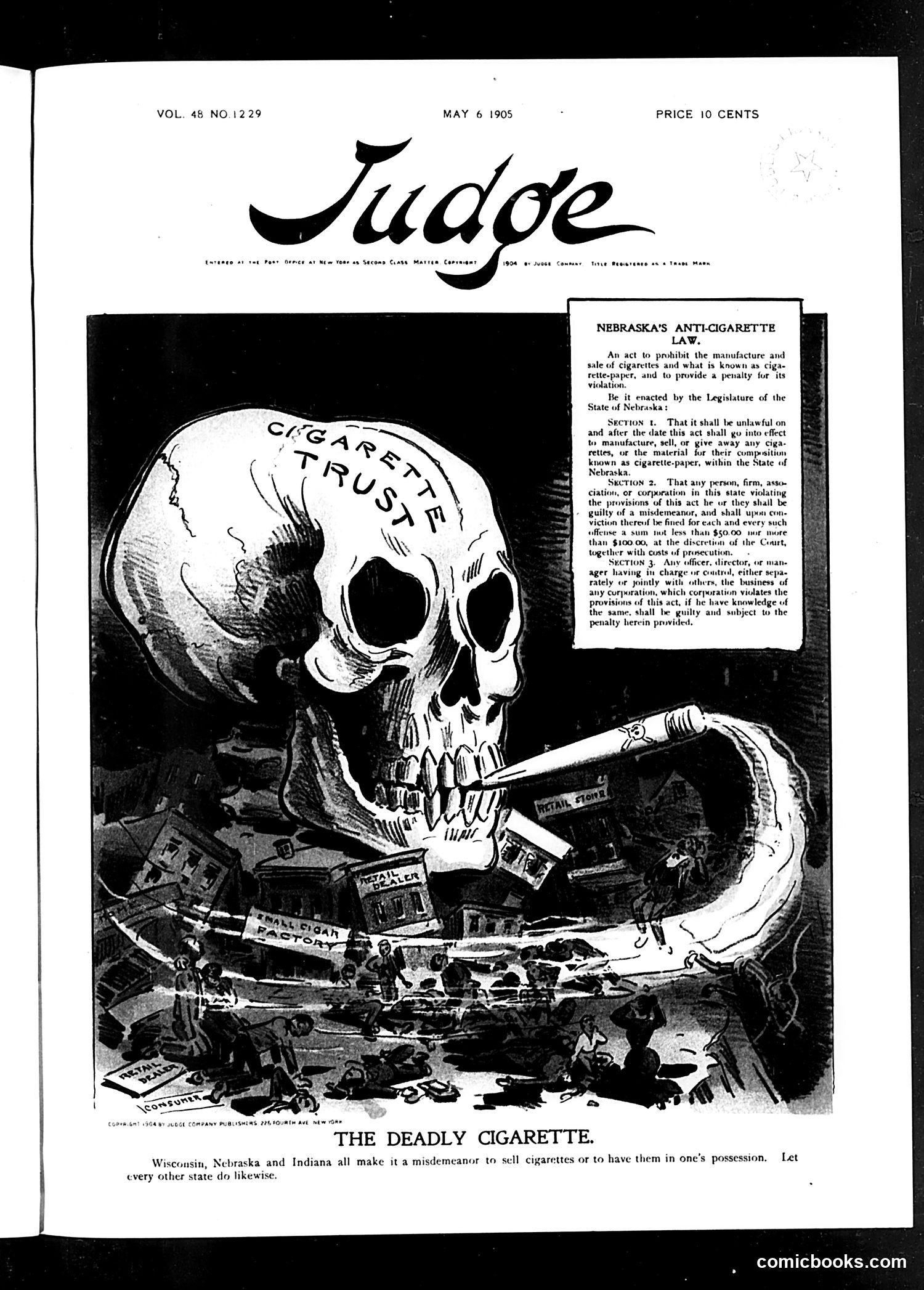
This anti-smoking propaganda cartoon depicts a skull labeled "CIGARETTE TRUST" pouring cigarettes into an open grave filled with dead bodies and cigarette packages. The accompanying text box reproduces Nebraska's anti-cigarette law, which criminalized manufacture and sale of cigarettes within the state, imposing fines up to $100 and potential jail time. The satire mocks cigarettes as lethal products—literally deadly poison. The "trust" reference suggests corporate monopolies controlling tobacco. The caption calls on other states to adopt similar legislation, making this both political advocacy and social commentary on the emerging public health awareness about tobacco dangers in the early 1900s.
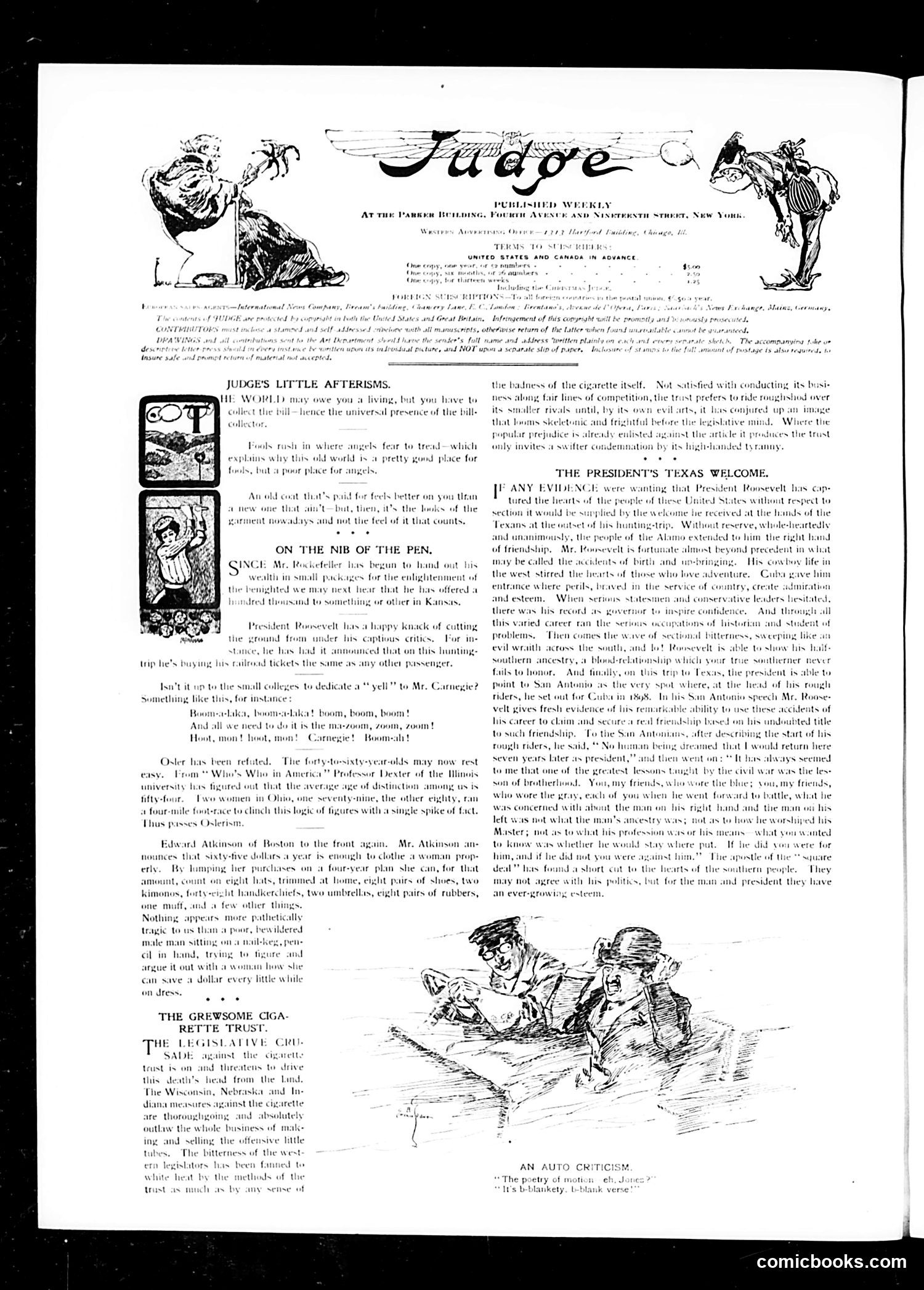
This page contains several satirical pieces about early 1900s American politics and society: **"Judge's Little Arteries"** mocks the wealthy, suggesting they're disconnected from ordinary people's struggles. **"The President's Texas Welcome"** appears to reference President Roosevelt's travels, praising his character and democratic principles while contrasting him with southern politicians. The text suggests Roosevelt maintained integrity despite regional prejudices. **"On the Nib of the Pen"** discusses Roosevelt's hunting and personal qualities, presenting him favorably. **"The Gruesome Cigarette Trust"** critiques monopolistic business practices in tobacco manufacturing, supporting legislative action against trusts. **"An Auto Criticism"** (bottom illustration) satirizes early automobile culture, likely mocking either the vehicles' unreliability or drivers' pretensions. The overall tone favors progressive reform and Roosevelt while attacking corporate monopolies and regional prejudice.
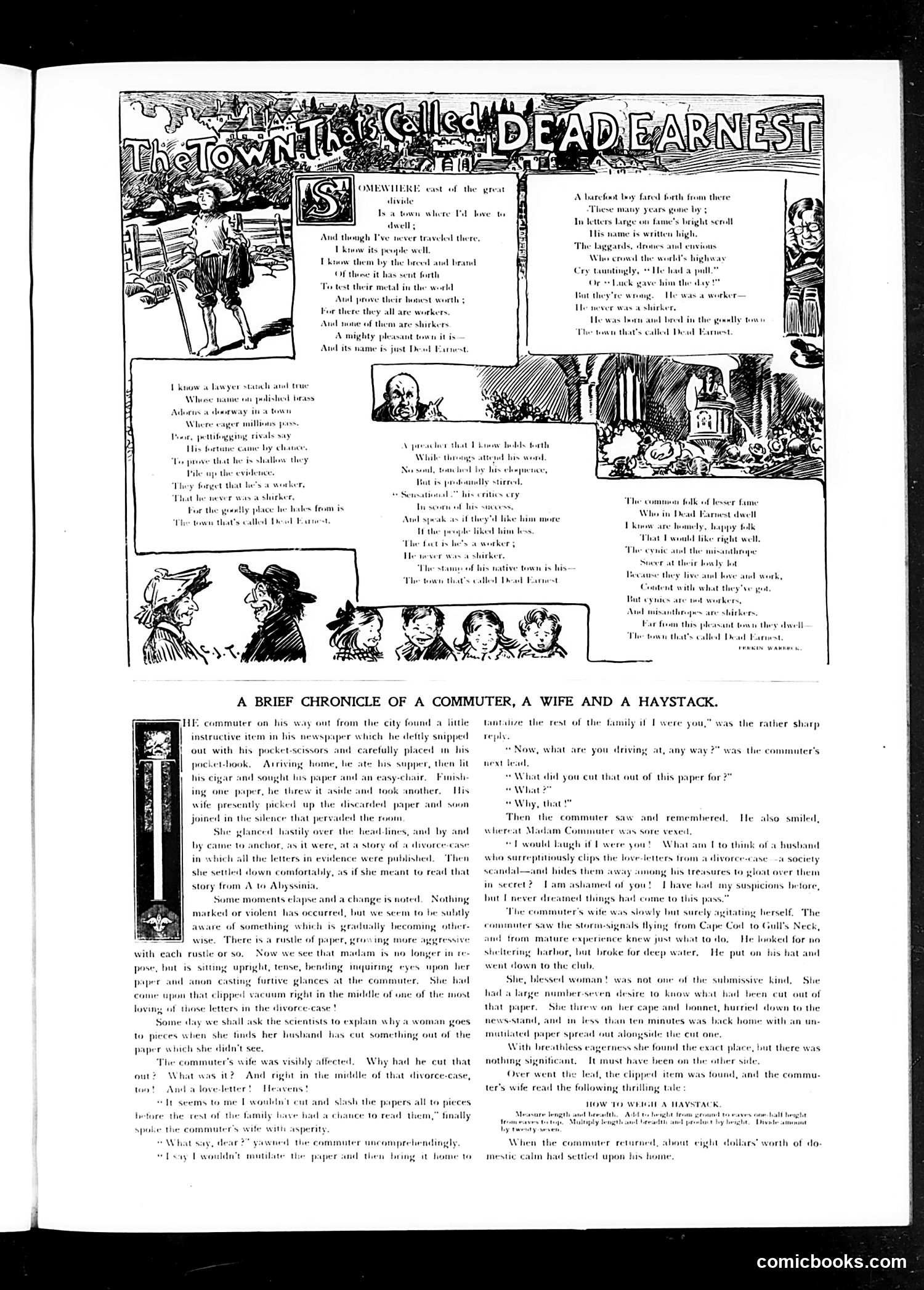
This page contains a poem and illustrations satirizing a working-class town whose residents are all laborers—"workers" with no shirkers. The narrative celebrates the town's virtue through the character "Dead Earnest," a hardscrabble boy who rises through honest work rather than inherited privilege. The satire targets *Gilded Age* class divisions: the poem contrasts this idealized, earnest working town against wealthy elites who gain status through "polished brass" and family connections rather than merit. The accompanying story "A Brief Chronicle of a Commuter, a Wife and a Haystack" humorously depicts domestic life and marital miscommunication. The overall message appears to praise working-class virtue and industriousness over aristocratic privilege—a populist sentiment common in Judge magazine.
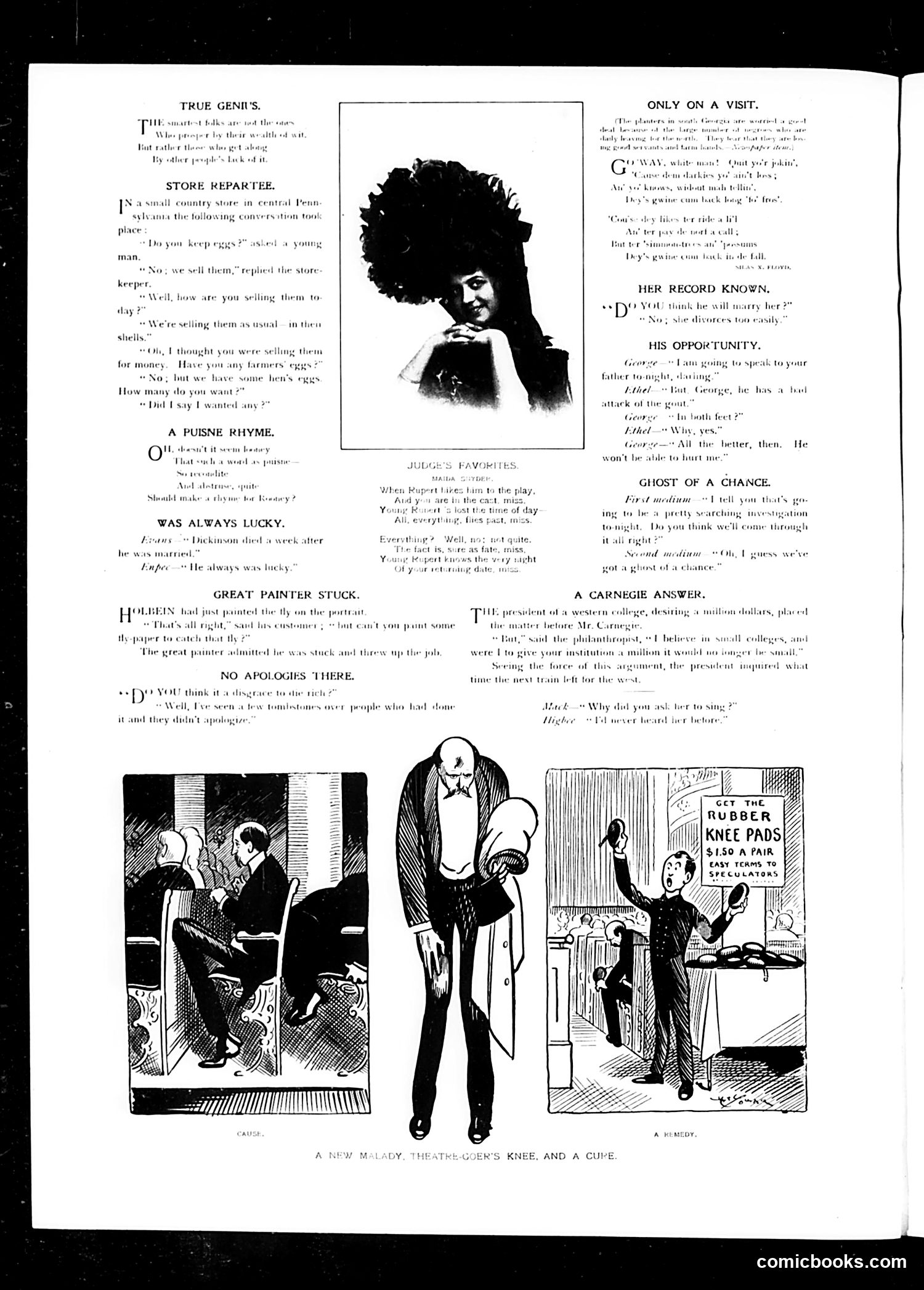
This page contains satirical short stories and jokes rather than political cartoons. The pieces include: **"Store Repiarter"** - A humorous dialogue about selling eggs, poking fun at small-town commerce and rural life. **"A Pursne Rhyme"** and other brief comedic sketches mocking everyday situations and human behavior. **The illustrations** show domestic and social scenes: a woman's portrait (labeled "Judge's Favorites"), a theater scene, and an advertisement for rubber knee pads marketed to speculators. The content reflects early-20th-century American humor—gentle satire of small-town life, courtship, and social pretension rather than partisan politics. The rubber knee pads ad satirizes financial speculation (speculators "kneeling" to success or failure). The magazine functioned primarily as humor and light social commentary for middle-class readers, not hard-hitting political critique.
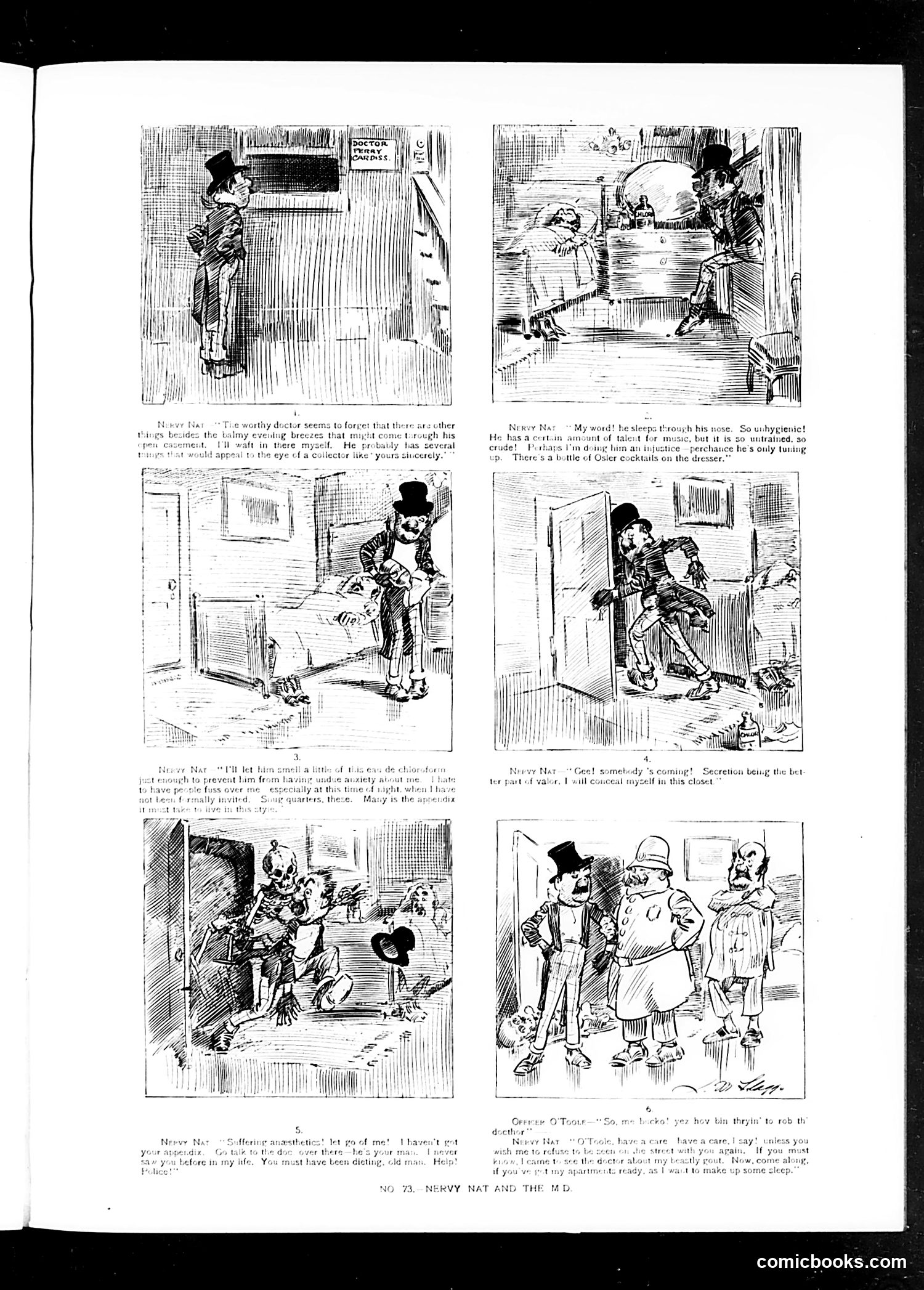
This six-panel comic strip features "Newsy Nat," a gossipy character in a top hat who visits a doctor. The satire mocks both sensationalist journalism and medical quackery of the era. Nat attempts to trade gossip and scandal for medical services, claiming his "news" is valuable currency. The doctor repeatedly refuses, ultimately threatening to throw him out. The joke targets: 1. **Yellow journalism**: Nat treats rumors and social gossip as legitimate "news" 2. **Medical charlatans**: The doctor's exasperation suggests doctors were sometimes compensated with favors rather than fees 3. **Social climbing through scandal**: Nat's assumption that salacious stories have real worth The humor relies on the doctor's professional indignation at being offered gossip instead of payment—a recognizable type in Gilded Age America.
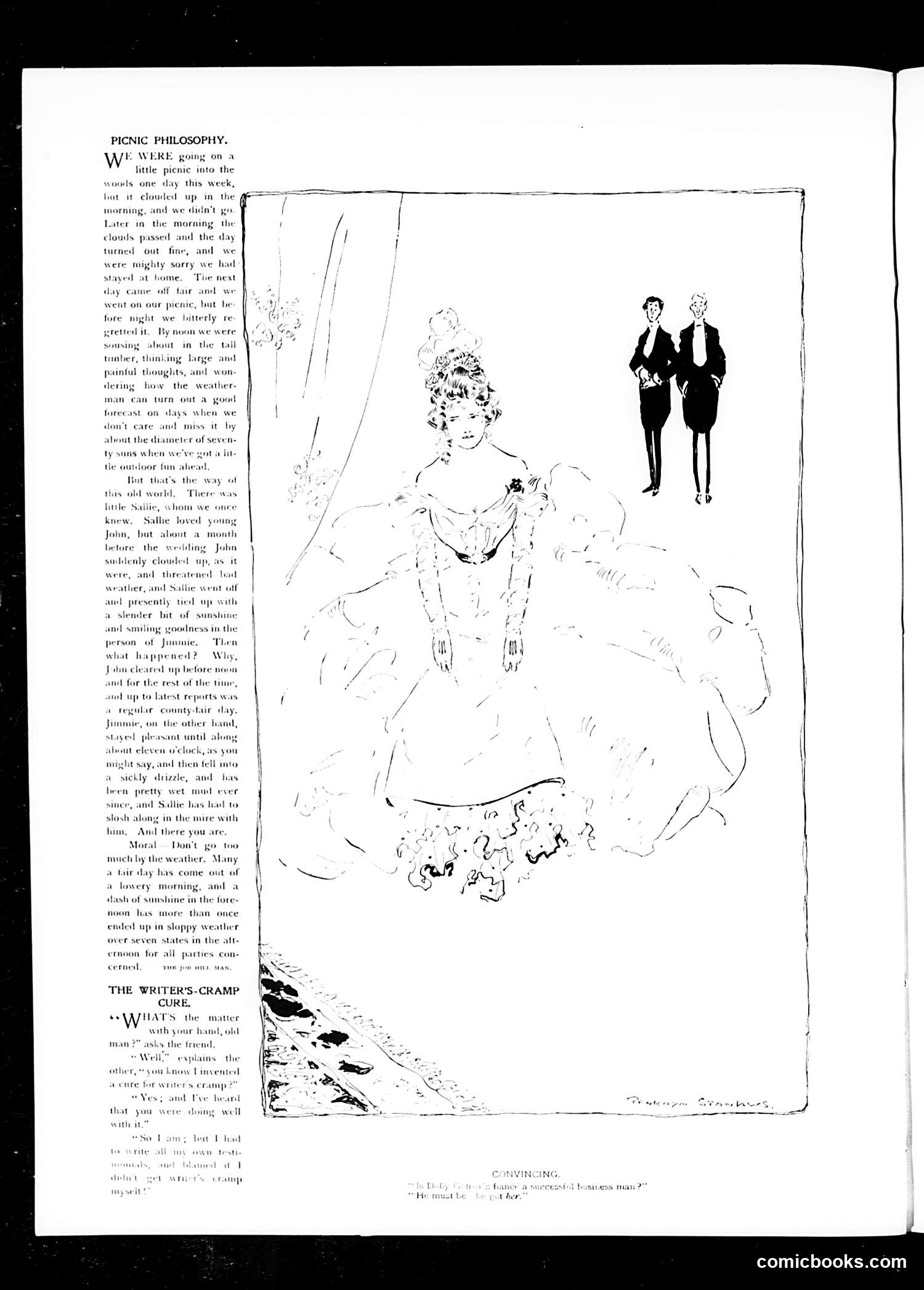
**Picnic Philosophy** is a humorous essay about weather unpredictability ruining outdoor plans. The author describes planning a picnic that got rained out, then going the next day only to regret it. The piece uses anecdotes—including a couple named Sallie and John whose romantic outing was spoiled by weather—to illustrate life's frustrations when plans depend on forecasts we can't control. The "moral" advises not trusting weather predictions too much, since unexpected sunshine or storms constantly disrupt seven states' worth of events. **The Writer's Cramp Cure** is a brief joke fragment. A friend asks another man about his injured hand. The man claims he invented a cure for writer's cramp (hand cramping from excessive writing). The joke's punchline appears cut off, but the setup likely satirizes dubious "cure-all" remedies—a common target of Judge's humor. Both pieces are light, observational humor typical of the magazine's satirical style.
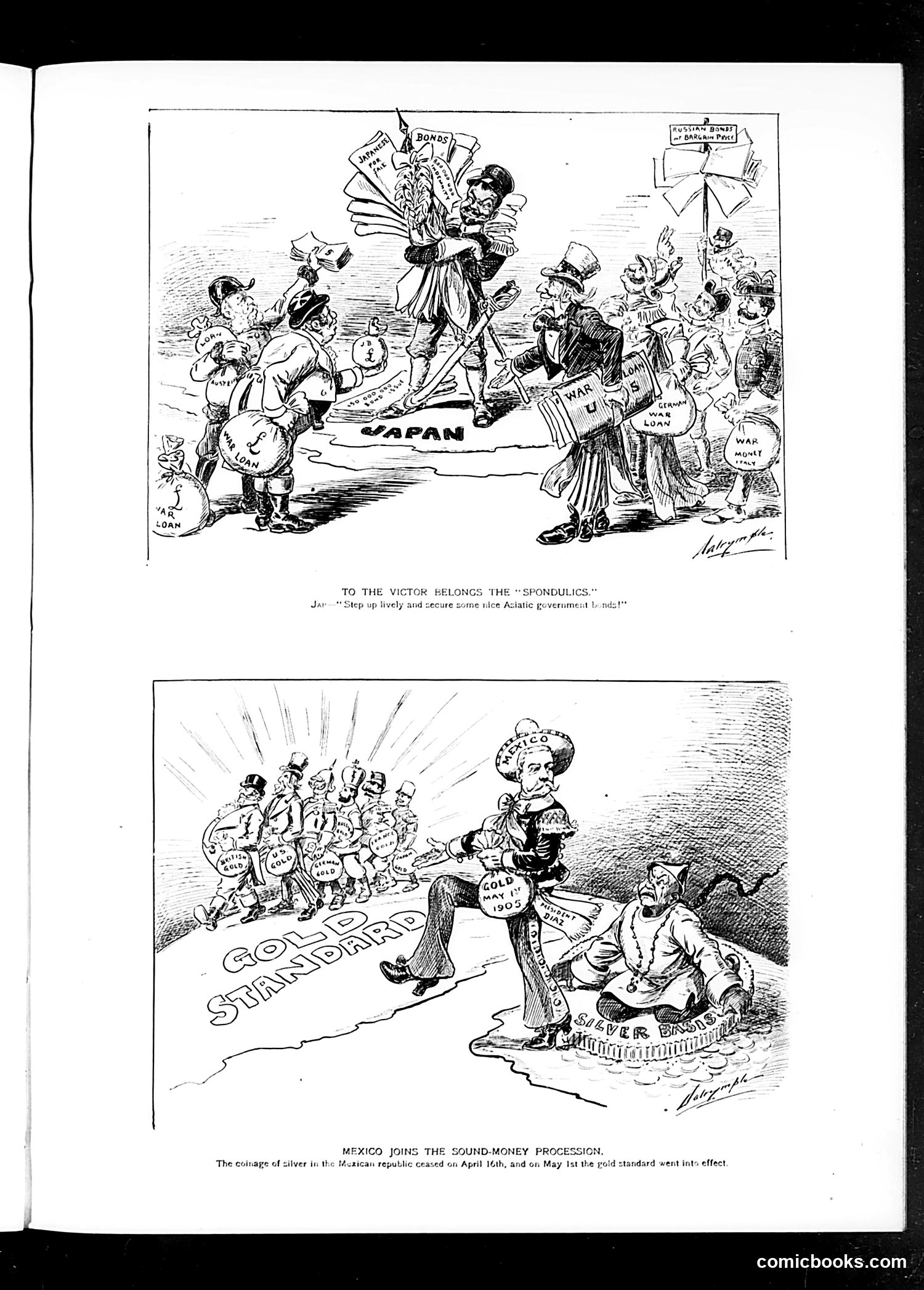
This page contains two related satirical cartoons about monetary policy and imperialism circa early 1900s. **Top cartoon**: Depicts a tall figure (likely Uncle Sam or a Western power) distributing "government bonds" to various Asian nations and Japan. The satire mocks Western financial exploitation—the "spondulics" (slang for money) represent predatory lending dressed as opportunity. Asian governments are caricatured as eager but foolish purchasers. **Bottom cartoon**: Shows Mexico joining the "sound-money procession" (gold standard adoption). A wealthy figure labeled "Mexico" follows European powers, while a smaller figure (possibly representing Mexican citizens or silver interests) is left behind or struggles. The satire criticizes Mexico's monetary policy shift on May 1st as forced compliance with Western financial systems, abandoning silver coinage. Both cartoons critique American/Western financial imperialism during the era of expanding global markets and monetary standardization.
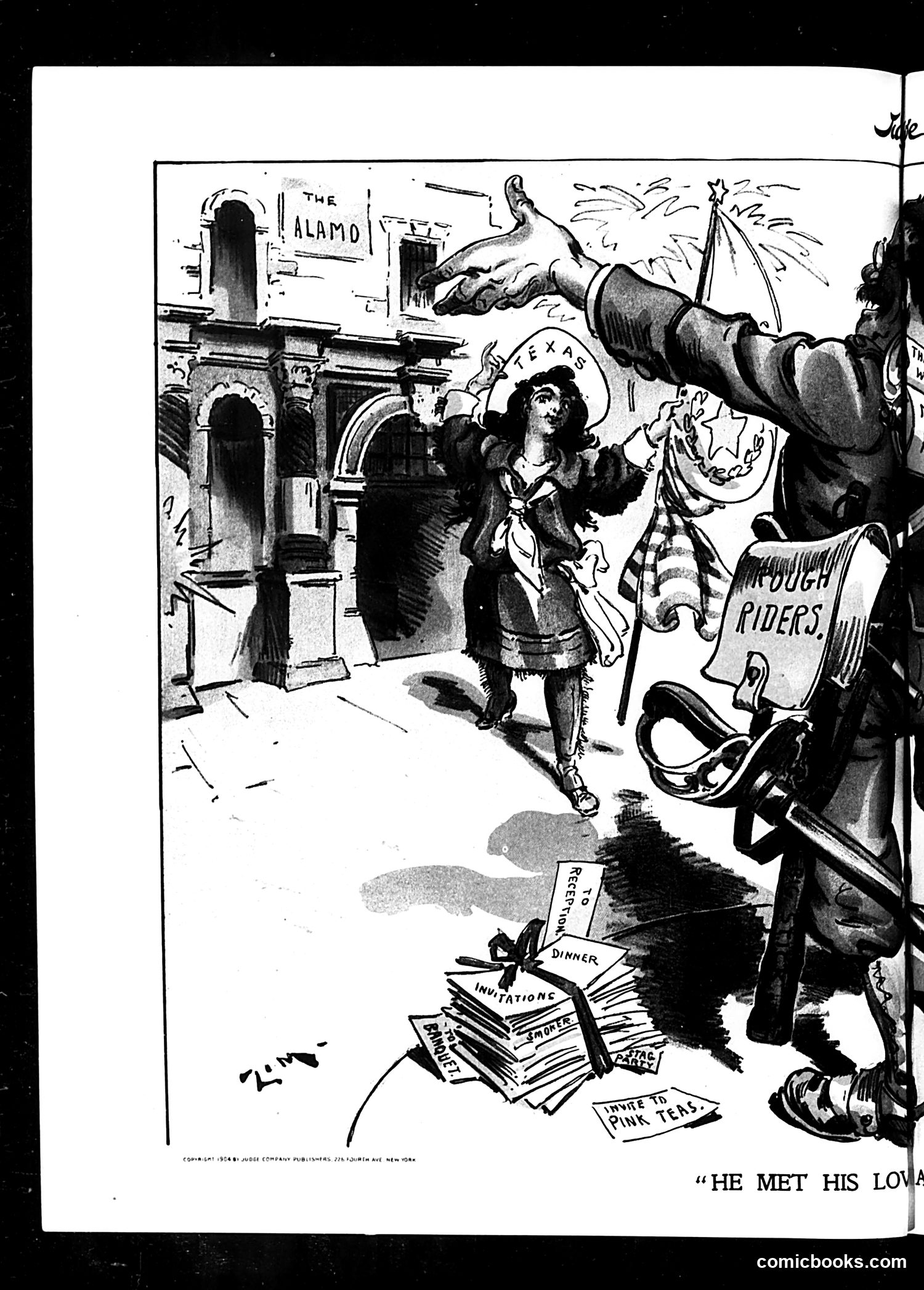
This appears to be a satirical cartoon from *Judge* magazine depicting a scene at the Alamo in Texas. A female figure (likely representing Texas or a Texas-related entity) stands before the historic mission building, surrounded by various objects including papers labeled "Rough Riders," "Dinner Invitations," and "Sports" scattered at her feet. The cartoon likely satirizes political or social attention directed toward Texas during the Spanish-American War era (suggested by "Rough Riders" reference). The scattered invitations and social ephemera suggest the state or a Texas figure is being overwhelmed by social demands and publicity. The incomplete caption "HE MET HIS LOW" suggests the full meaning is cut off, making complete interpretation difficult without additional context.
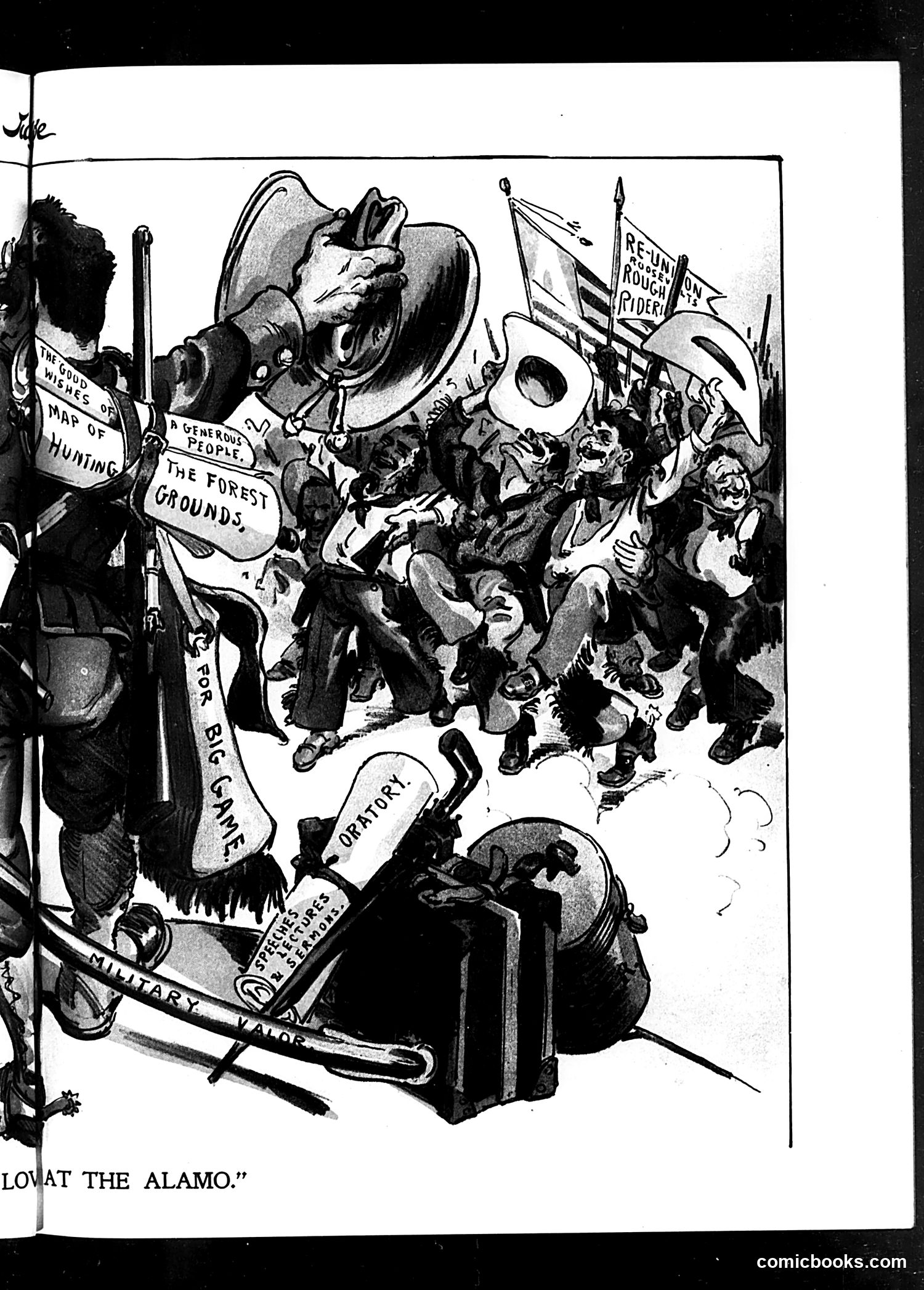
This appears to be a satirical cartoon from Judge magazine depicting a chaotic scene labeled "LOVAT THE ALAMO." The cartoon shows a large military or political figure (identifiable by a prominent hat) towering over a crowd of smaller figures engaged in what appears to be conflict or disorder. Visible text banners reference "ROUGH RIDERS," "HUNTING," and "FOREST GROUNDS," along with references to "MILITARY AFFAIRS" and "BIG GAME" at the bottom. The satire appears to mock political or military leadership—possibly Theodore Roosevelt era politics, given the "Rough Riders" reference. The crowded, chaotic composition suggests criticism of governmental mismanagement or reckless adventurism. However, **without the full publication date or clearer identification of the central figure, the specific political targets remain unclear**. The Alamo reference may invoke militaristic nostalgia being exploited for political purposes.
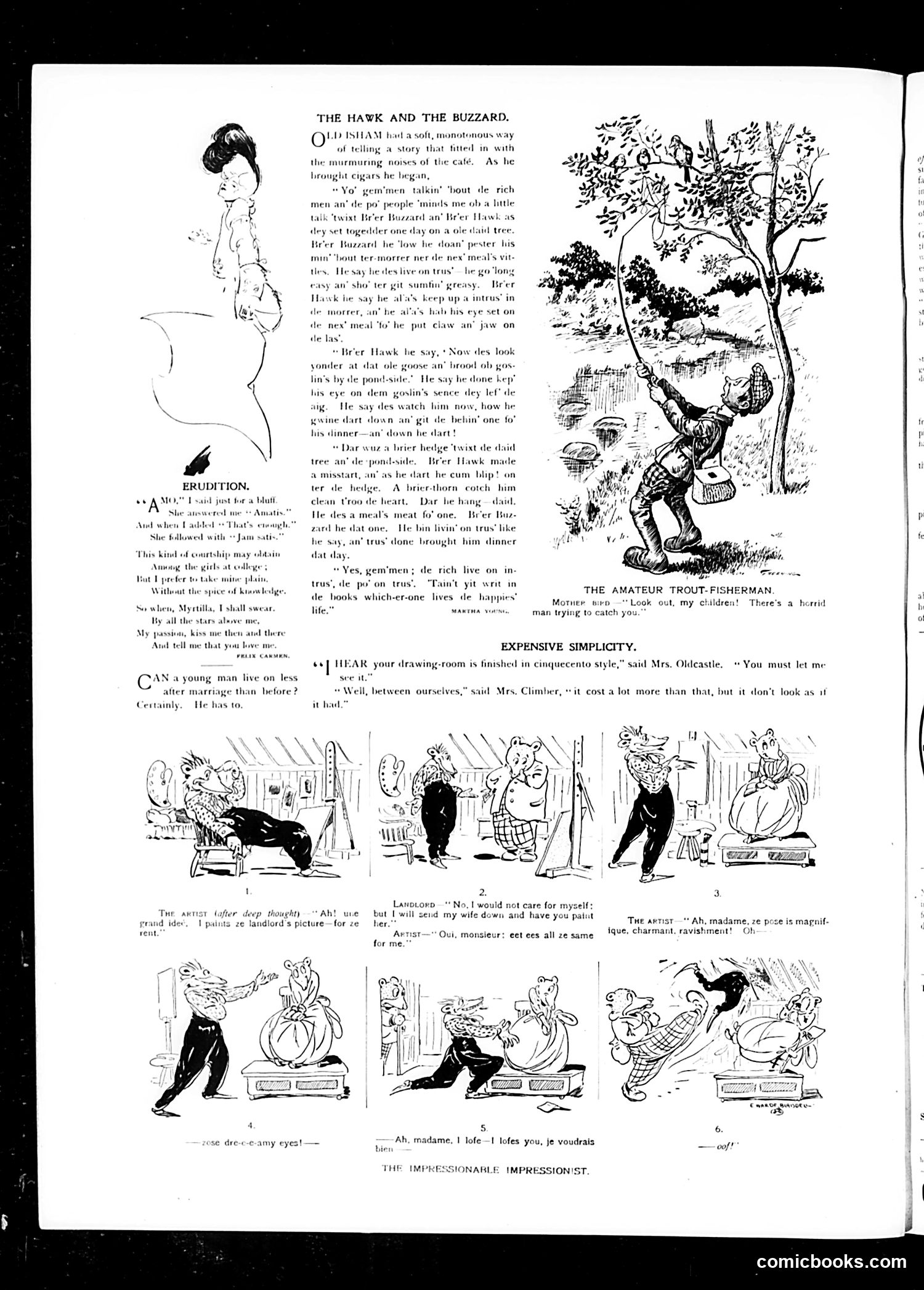
This page contains three distinct satirical pieces: **"The Hawk and the Buzzard"** is a fable-style story (rendered in dialect) contrasting two birds' philosophies: the hawk lives by immediate action and risk-taking, while the buzzard trusts in providence. The hawk's aggressive approach kills him; the moral warns that the wealthy who live on "trust" (inherited security) fare better than the poor who must rely on "trust" (faith/luck). This critiques wealth inequality. **"Expensive Simplicity"** mocks wealthy pretension—specifically Mrs. Climber's drawing room decorated in expensive "cinquecento style" (Renaissance) that deliberately *looks* cheap and simple. The joke: she spent substantial money to appear economical, satirizing nouveau-riche affectation and conspicuous anti-consumption. **"The Impressionist"** (bottom) depicts an artist and wealthy patrons in a series of comedic vignettes, likely ridiculing Impressionist art as incomprehensible or pretentious, with exaggerated French phrases suggesting artistic pretension. All three target class anxiety, wealth display, and aspirational behavior among the American middle/upper classes.
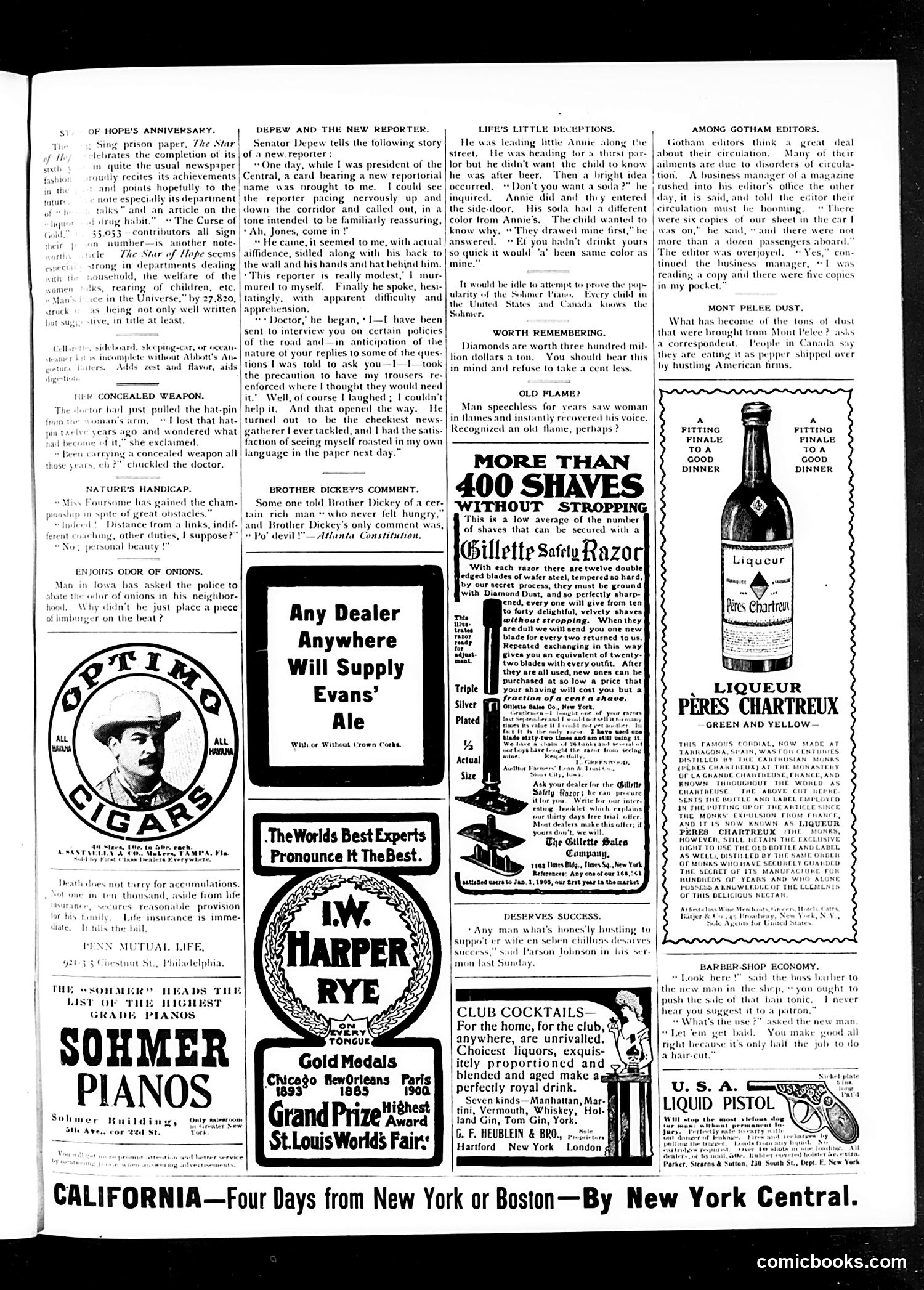
This page is primarily **advertisements and short humorous anecdotes** rather than political cartoons. The main content includes: 1. **"Depew and the New Reporter"** — A humorous story told by Senator Chauncey Depew about a nervous young reporter who reinforced his trousers before interviewing him, anticipating being kicked out. The joke plays on the reporter's anxious expectations versus his actual boldness. 2. **"Life's Little Deceptions"** — A brief anecdote about a man taking a child to a bar under the pretense of getting her a soda, while he orders beer. It satirizes parental deception and hypocrisy. 3. **"Nature's Handicap"** — A golf joke about a female champion overcoming obstacles. The rest of the page consists of period advertisements for cigars, pianos, razor blades, liqueur, and other products typical of early 20th-century magazines. There is **no significant political satire** on this particular page.
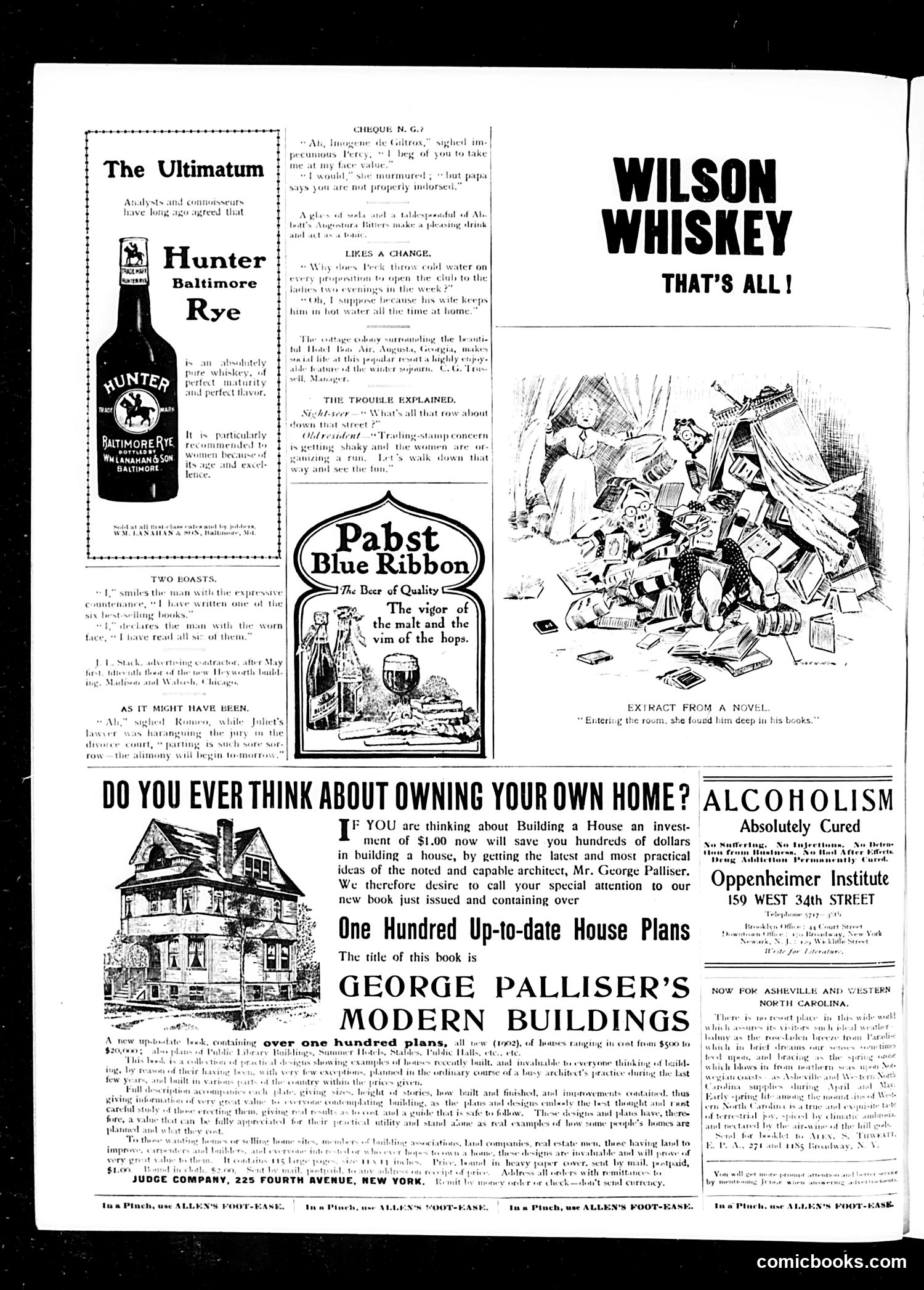
This page mixes satirical content with period advertising (circa early 1900s). The main cartoon shows a man surrounded by scattered books and papers, captioned "Extract from a Novel: 'Entering the room, she found him deep in his books.'" The joke appears to mock intellectual pretension—the visual chaos suggests disorder masquerading as scholarly pursuit, a common Judge satirical target. The "Two Toasts" section uses contrasting character types: the successful man versus the worn-out man, implying different life outcomes. The whiskey and real-estate advertisements are typical of the era's commercial integration into magazines. The prominent "Alcoholism Absolutely Cured" ad from the Oppenheimer Institute reflects turn-of-the-century medical quackery—ironically placed alongside liquor advertisements on the same page, satirizing the period's contradictory approaches to social problems. The overall page reflects Judge's mix of social satire and commercial opportunism.
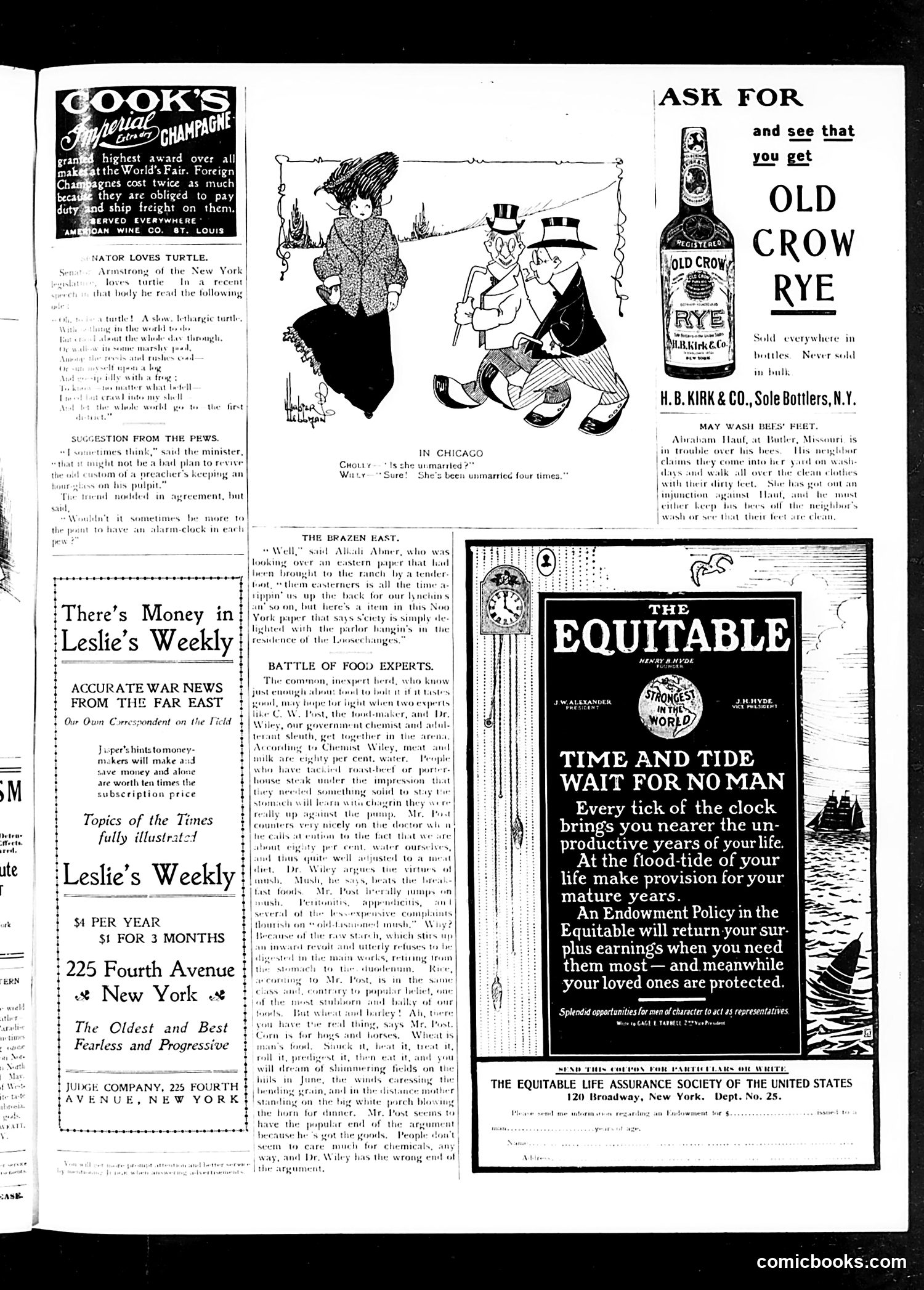
This page contains multiple unrelated sections typical of early 1900s Judge magazine: **Main Cartoon ("In Chicago")**: A simple domestic joke about a married couple. The wife asks if he's been unfaithful; he claims four times. The humor relies on the wife's presumed shock at infidelity admissions. **Text Sections**: Include satirical pieces about: - A senator's fondness for turtle soup - A minister's question about alarm clocks in church - "The Brazen East" and "Battle of Food Experts"—commentary on food safety and Dr. Wiley (likely Harvey Wiley, the USDA's chief chemist fighting food adulteration), appearing to mock overcautious food regulation **Advertisements**: The page is largely advertising—Cook's Champagne, Old Crow Rye whiskey, Leslie's Weekly magazine, and Equitable Life Insurance. These ads are period-typical appeals to middle-class readers. **Context**: Without identifying specific cartoonists or exact dates, this reflects Judge's format: satirizing contemporary social issues (food safety debates, domestic life) alongside commercial advertising aimed at prosperous readers.
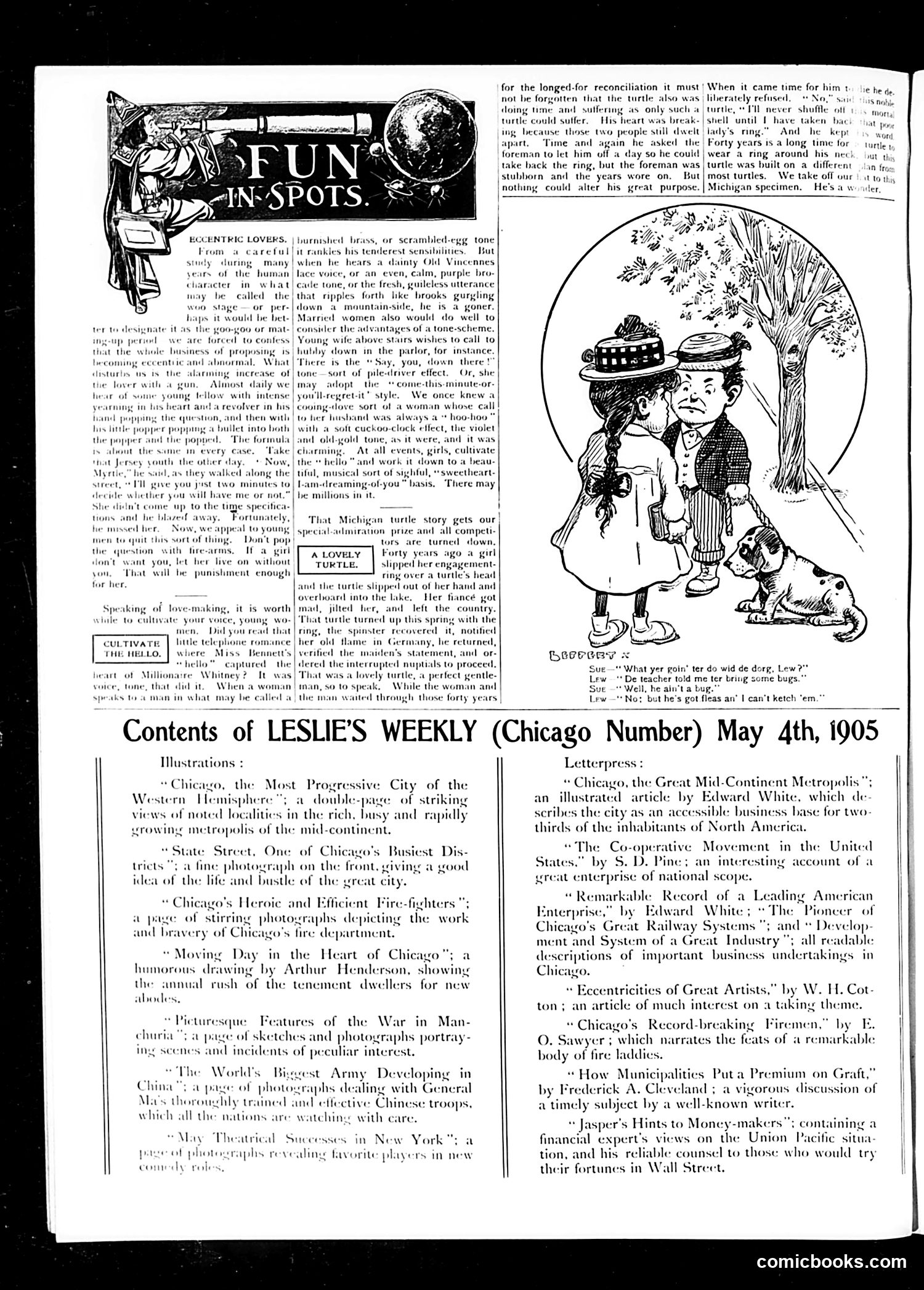
This page from Judge (May 4, 1905) contains two distinct pieces: **"Eccentric Lovers"** (left column): A satirical advice column on romantic courtship. It mocks overly-sentimental suitors who make theatrical marriage proposals, suggesting young women cultivate their voices and use tactical "tone schemes" to attract husbands. The humor lies in treating love as a calculated business transaction rather than genuine emotion. **"A Lonely Turtle"** (right side): A humorous narrative-cartoon about a Michigan woman who dropped her engagement ring off a bridge into a lake. The ring landed inside a turtle that eventually returned—forty years later—allowing the broken couple to reunite and finally marry. The cartoon satirizes romantic persistence and the supposed nobility of waiting. The accompanying illustration shows an uncle advising a child, mocking rural/working-class dialect and parental concerns about practical matters (bugs for school) rather than sentimental ones. The overall theme mocks both excessive Victorian sentimentality and its opposite—treating romance as mere transaction.
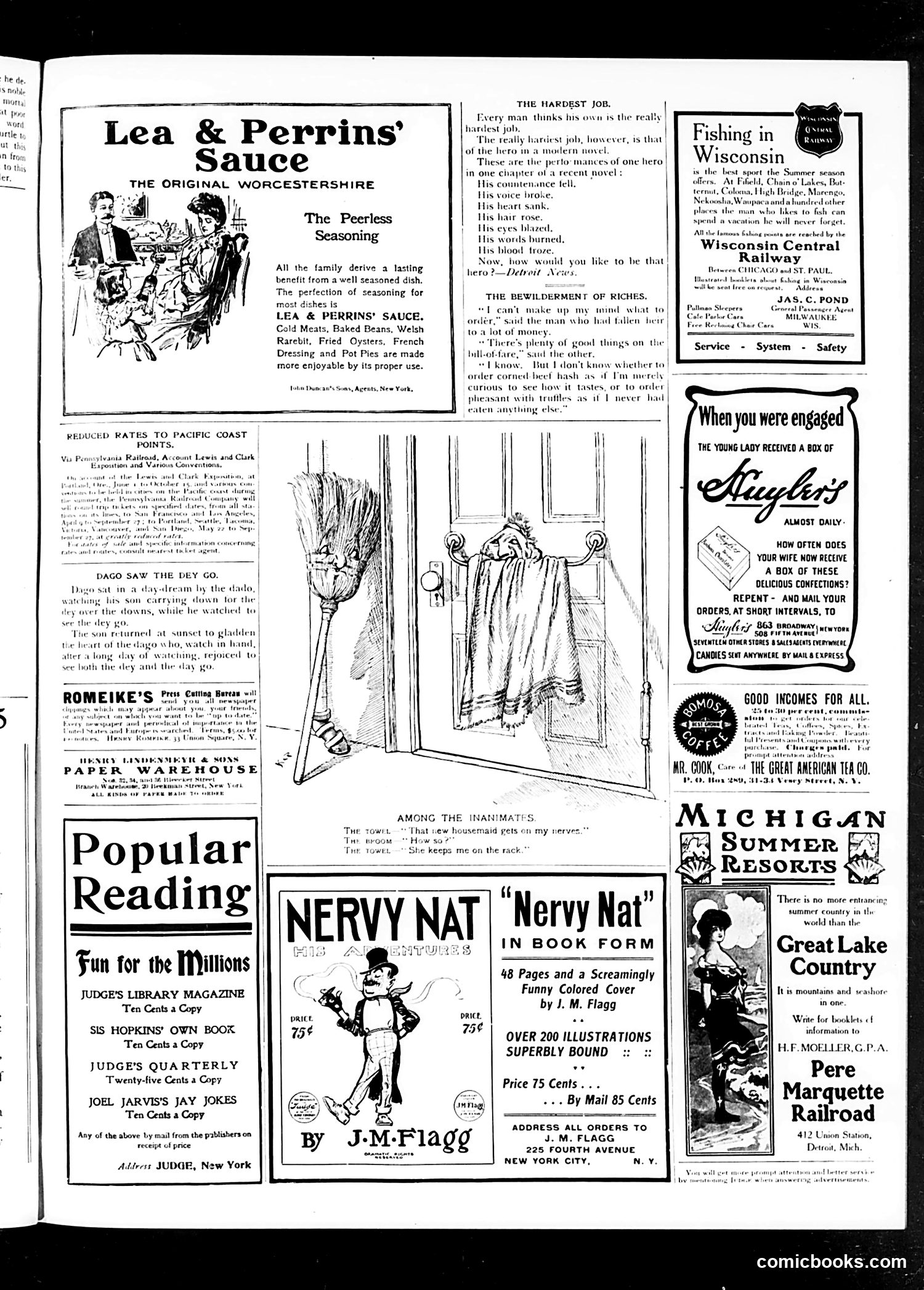
This page is primarily **advertisements** with one notable satirical piece: "The Hardest Job." The satire mocks the literary convention of the overwrought romantic hero in contemporary novels. It catalogs the melodramatic physical reactions demanded of fictional protagonists—their countenance failing, voice breaking, heart sinking, hair rising, eyes blazing, words burning, blood freezing—all within a single chapter. The joke's point: **modern novelists make impossible demands on their heroes**, requiring them to embody contradictory emotional states simultaneously. The closing question—"Now, how would you like to be that hero?"—invites readers to recognize the absurdity of these stock literary gestures. This reflects early-20th-century satirical criticism of popular fiction's overwrought emotionalism and formulaic characterization. Judge magazine regularly mocked contemporary literary trends for educated, sophisticated readers. The remainder of the page consists of period product advertisements (Lea & Perrins sauce, Skyler's candy, Wisconsin tourism) and small humor pieces with minimal satirical content.
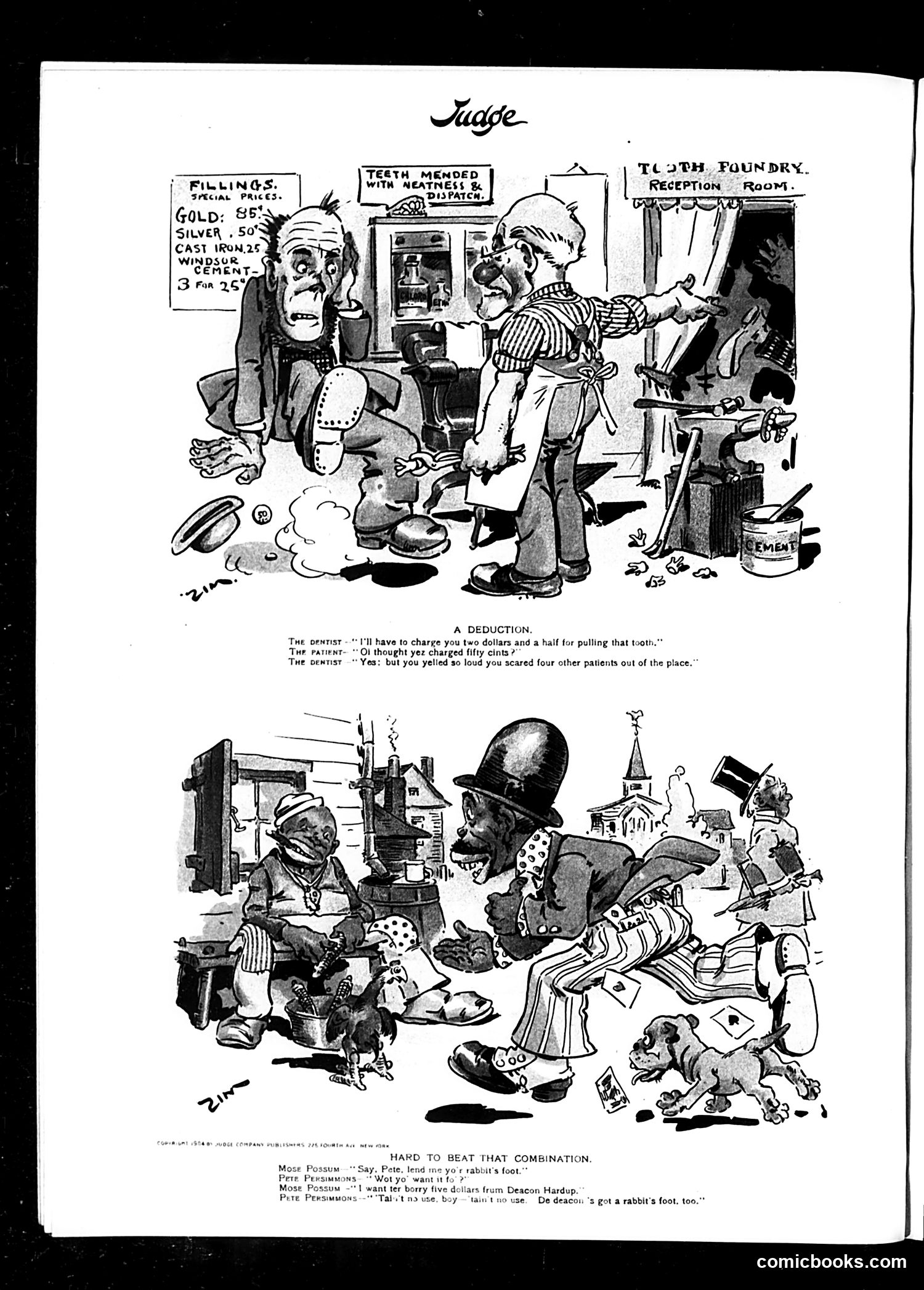
**Top Cartoon ("A Deduction"):** A dentist charges a patient extra for a tooth extraction—not for the procedure, but because the patient's loud screaming frightened away four other paying customers. The humor relies on the dentist's logic: lost business = higher individual prices. This satirizes both dental practices of the era and the absurdity of "creative" fee-justification. **Bottom Cartoon ("Hard to Beat That Combination"):** Two working-class men (appearing to be African American, using period dialect) discuss borrowing money. One asks to borrow a "rabbit's foot" (a folk luck charm) to help convince "Deacon Hardup" (a generic name suggesting a poor/stingy person) to lend five dollars. The punchline: the Deacon already has a rabbit's foot too, making luck irrelevant—he simply won't lend money. Both cartoons mock superstition and human nature: people seeking irrational solutions to practical problems (overcharging, luck charms) while ignoring actual obstacles (patient fear, creditor stinginess).