
Judge, 1905-05-06 · page 3 of 16
Judge — May 6, 1905 — page 3: what you’re looking at
What you’re looking at
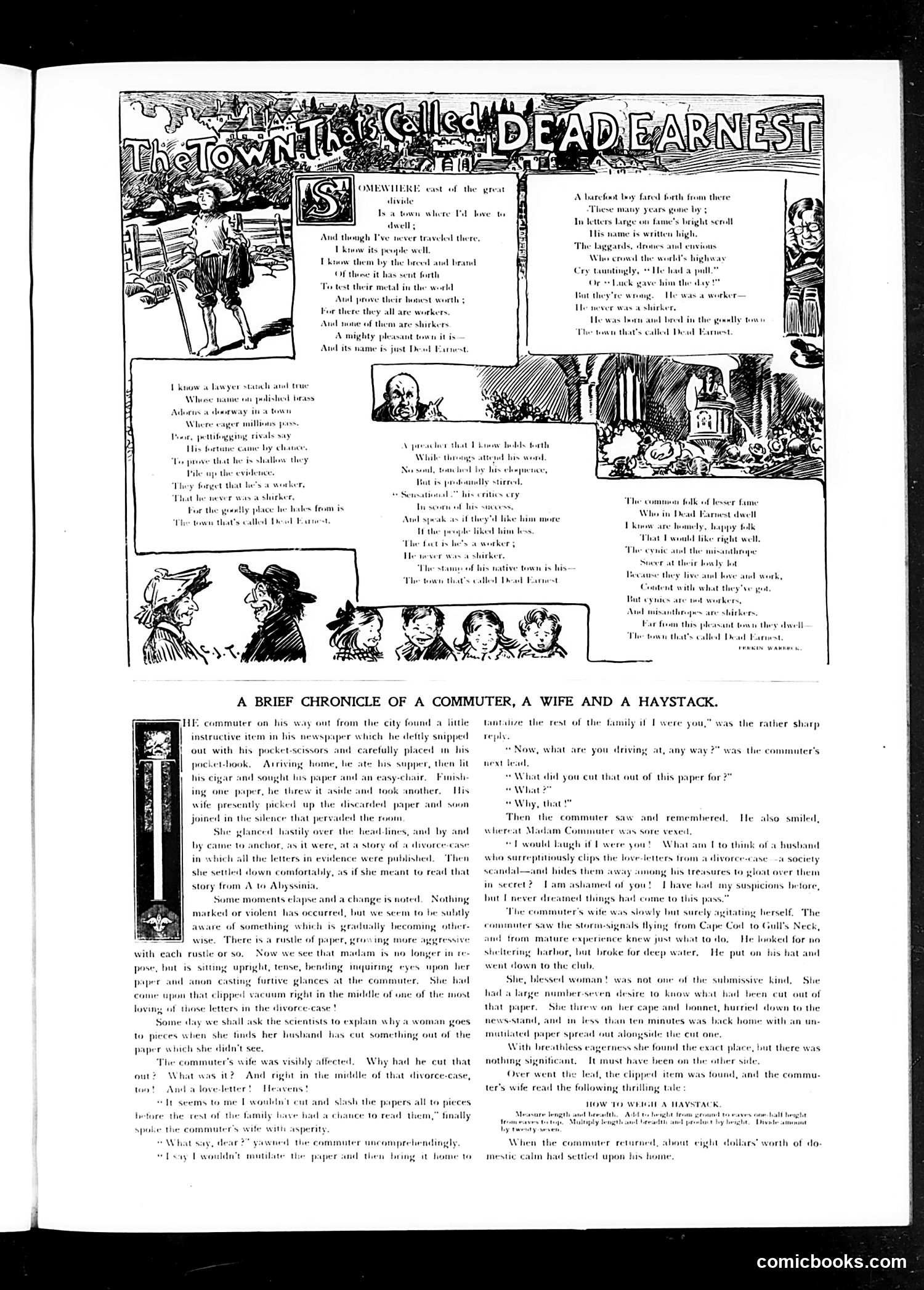
This page contains a poem and illustrations satirizing a working-class town whose residents are all laborers—"workers" with no shirkers. The narrative celebrates the town's virtue through the character "Dead Earnest," a hardscrabble boy who rises through honest work rather than inherited privilege. The satire targets *Gilded Age* class divisions: the poem contrasts this idealized, earnest working town against wealthy elites who gain status through "polished brass" and family connections rather than merit. The accompanying story "A Brief Chronicle of a Commuter, a Wife and a Haystack" humorously depicts domestic life and marital miscommunication. The overall message appears to praise working-class virtue and industriousness over aristocratic privilege—a populist sentiment common in Judge magazine.
📄 Transcribed text from this page (OCR, searchable)
Machine-transcribed from the original scan — historical spelling and the odd misread are preserved.
OMEWIE] dlivie Is a town where Pah dwell ; by the breed and brand Of these it has sent forth To test their metal inn the world Aud ps For there they all are workers. And none of th ve their honest worth ; re shirkers. <hawyer stanels anal try naine on polished be 24 towns it ing rivals say wrway < petite His fort feast of the h Tye never traveled there, great A barefoot boy fared forth from there ‘The by; In letters Large on fame's brig! bvewiie ny Years gon serull His name is wri hig ul Ww add a pull” The laggards, Whe crowd th vies hay Lack gave him the day ! Kat they’ te wrong. He was a worker never way a shirkers Me was bern and bred in the town that’s called Deal Vos prove that he is shallow they Vile aps the evidence. pacnee, They forget that he's a worker, sunally stiered Phat he never way a shirker, critics ory scarnaBieo awe co For the yantly place Ire Tuakes from is Ins scorn of his success sak Cet Bi The tawene that’s called Devel Barnet Awl speak as if they'd like him more i Dest Earnest de 1 ade: sib HN A now are homely, happy fk “Ve fact is That F would like eight well, - Heivierwas The eynie ane thy nithrope The stamy of town that’s ¢ The A BRIEF CHRONICLE HE commuter on his way out from the city found a litte instructive item in his newspaper which he leftly snipped out with his pocket-scissors and carefully placed in his pocketbook, Arriving home, he ate bis supper, then lit his cigar and sought lus paper and an easy-chair, Finish ing one paper, he threw it aside and took another, His wife presently picked up the diycarded paper and soon joined in the silence that pervaded the room 1 Lae story of a divoreesease Then ant to read that She ylanced hastily over the headlines, and by hy came to anchor h ay it wer in wh the letters in evidence were published she s down comfortably, as if she m story from A to Abyssini Some moments elapse and a change is noted, Nothing marked or violent has occurred, hut we seem to be subtly aware of somet ng which is gradually becoming other. wise cis 4 rustle of paper Now w upright, tens DIN More aggressive with each rustle or so. e see that madam is no longer in qu 4 bending i ingg eyes upon her She had of the most pose, but is. sitti Paper and anon casting furtive glances at the commuter, come upon that chpped yum right in the middle of « loving of those letters in the divorce-case ! Some day we shall ask the scientists to explain why a woman goes to pieces when she tinds her husband has cut something out of the paper which she didn’t see, The commuters wife was visibly affec What was it? Why had he cut that And ight in the ani ow je of that divorce-case, toot Anda love-letter! Heavens! Slt seems to me E wouldn't cut and slash the papers all to pi betore the restot the family have had a ehance to read: them,” fh Spoke the commuter’s wite with asperity. “What say, dear?” yawned the commuter uncomprehendin sLsay Pywouldn’t mutilate the paper and then bring it home te Sueer at their how ly bot hey live and hove his we led Dead Earnest town is his ol work, Content with what they? But ey Stre pat work hikers tow they dwell Nv misanthe Far fi this pleas scaled De Ve Hl Barnest OF A COMMUTER, A WIFE AND A HAYSTACK. tantalize the rest of the family if L were you," was the rather sharp reply. + Now, what are you driving at, any way 2" was the commuter's next led, “What did you cut that out of this paper for 2” What? © Why, that!" Then the commuter saw and remembered, He also. smiled, whereat Madam Commuter was sore vexed TD would laugh if Fwere you! Wh: TH to think of a husband who surreptitiously clips the love-tetters Irom a divoree-case 1 society scandal—and hides them away canong his treasures to gloat over them in secret? Lam ashamed of you! [have b ons betor al tny sus but Tf never dream The commu F things had come to this pass.” nmuter’s wife was slowly but surely saw the storm-signals flying from Cape Cod to ¢ and trom mature experience knew just what todo, He looked for no sheltering harbor, but broke for deep went down to the club. Sh or. He put on his hat blessed woman! was not one of the submissive kind, She had a large numberseven desire to know what had been cut out of 1 bo that paper. She threw on her cape et, hurried down to the ! Ie the cut one, ten minu Swa k home with an un mutilated paper spread out alon With breathless nothing si ness she found the exact place, but there was It must have been on the other side le ter’s wife read the following thrilling tale iticant, t the Over we 1, the clipped item was found, and the commu: HOW TO WEIGH A HAYSTACK AW te loenght tesa Vaeactth ant fa lth Thay henshe When the commuter returned, about eight dollars’ worth of do: mestic m had se Lupon his home: comicbooks.com