
A complete issue · 16 pages · 1905
Judge — March 11, 1905
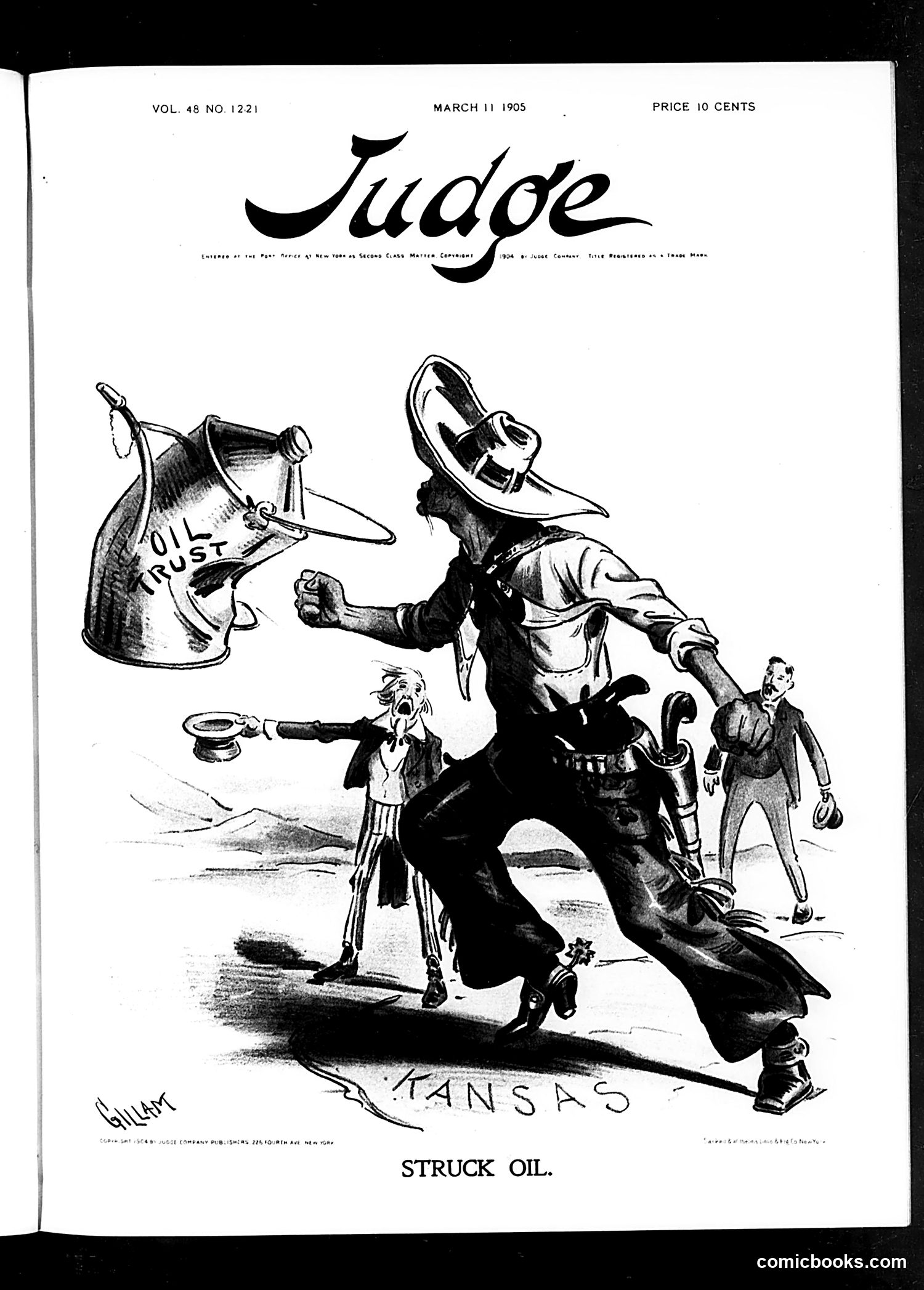
This political cartoon depicts Kansas as a figure being struck by oil wealth. A large, aggressive character (likely representing oil interests or corporate power) punches a smaller figure labeled "KANSAS" while holding an oil can marked "TRUST." Two smaller men in the background appear to be opportunistic observers. The satire critiques the sudden arrival of oil extraction in Kansas and the threatening dominance of oil trusts—monopolistic corporate entities that controlled petroleum production. The cartoon suggests that while oil discovery might seem fortunate, the aggressive trusts controlling it pose danger to the state and its citizens. This reflects early 1900s anxieties about monopolistic corporate power, particularly following Theodore Roosevelt's trust-busting initiatives. The "trust" is portrayed as predatory rather than beneficial.
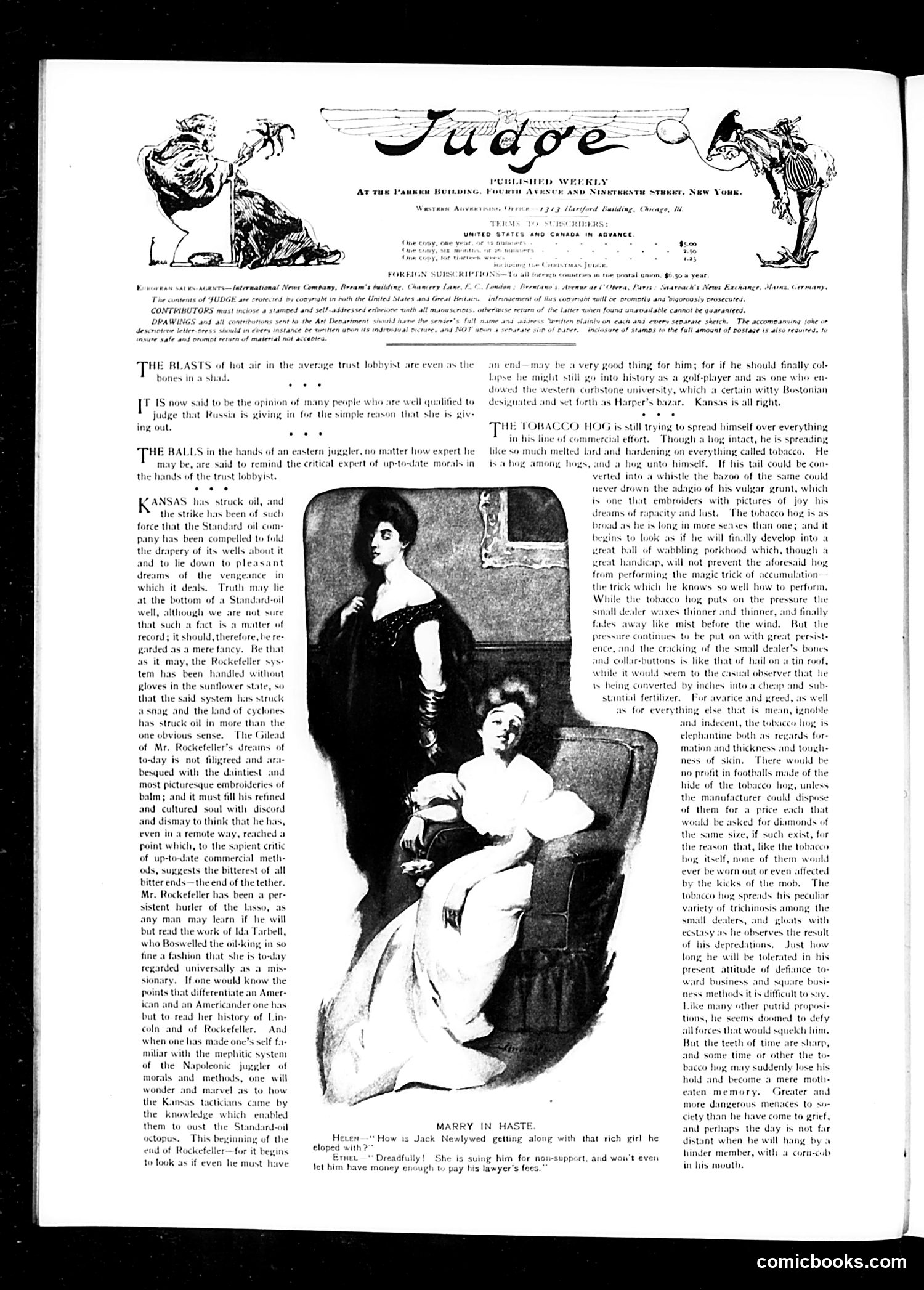
This appears to be a satirical commentary on **standardized testing and educational assessment**. The main illustration, captioned "MARKEY IN HASTE," depicts two figures in what seems to be an examination or judgment scenario. The article text critiques the "Standardized test" as an unreliable measure of actual competence. It argues that such tests have become fashionable despite their flaws, comparing them to the work of Ida Tarbell (famous muckraker journalist) and the "Kansas jackass" (likely referencing populist politicians from Kansas). The satire suggests that standardized testing reduces complex human qualities to simple metrics, and that reliance on these tests represents intellectual laziness rather than genuine educational assessment. The piece ridicules both the tests themselves and those who uncritically accept them.
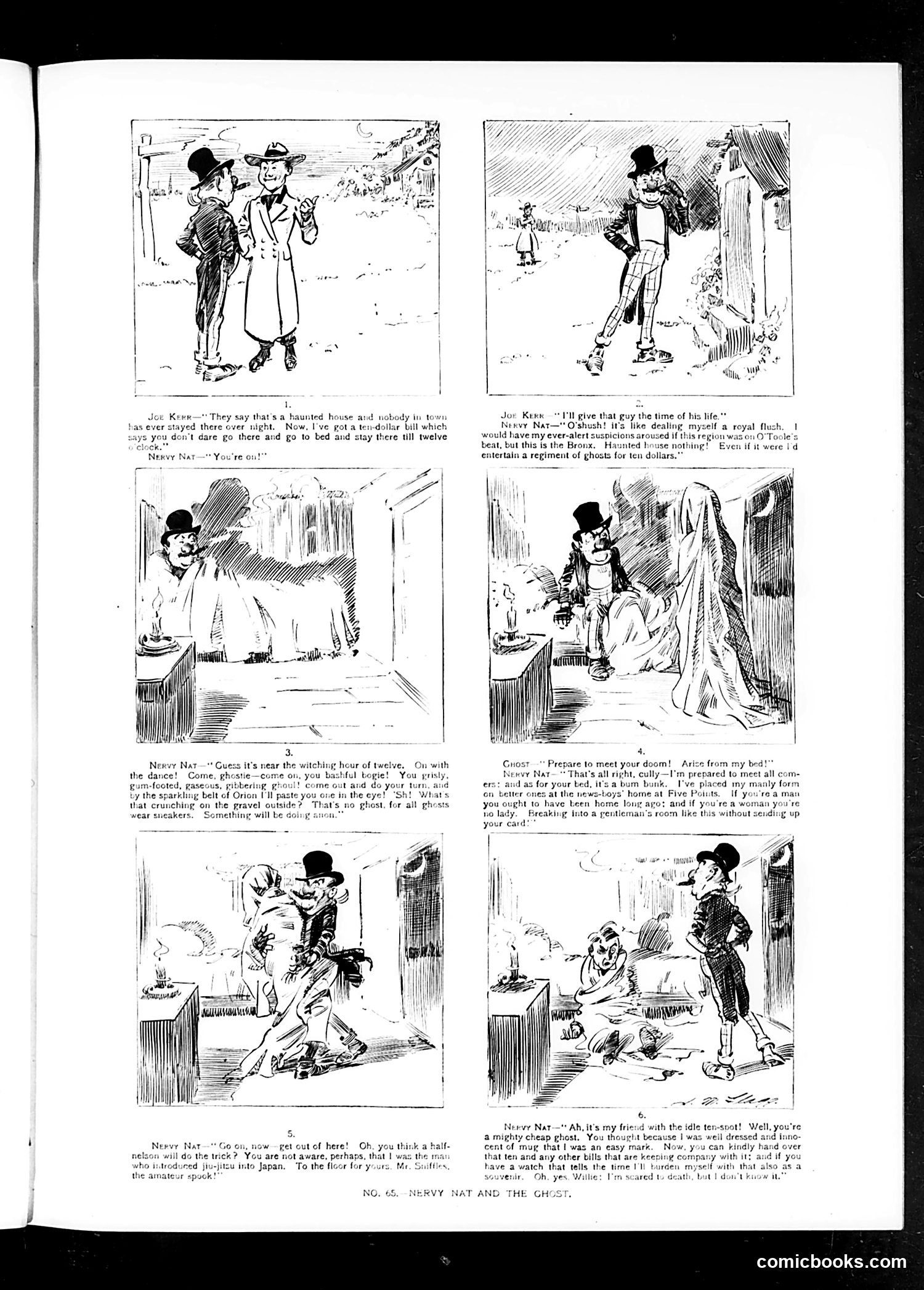
This appears to be a humorous serial story illustrated across six panels, featuring characters named "Nervy Nat" and "Nervy Nat's" companion. The narrative involves a wager about spending the night in a haunted house. Nat accepts a bet to stay overnight despite warnings about supernatural activity and a previous death there. The satire targets Victorian-era superstitions and ghost stories. The joke centers on Nat's cocky bravado deflating when confronted with an actual ghost—representing the gap between boastful talk and actual courage. The ghost's appearance and Nat's frantic response drive the comedic payoff across the sequential panels. This reflects Judge magazine's typical format: mixing visual humor with serialized comic narratives aimed at educated, urban audiences.
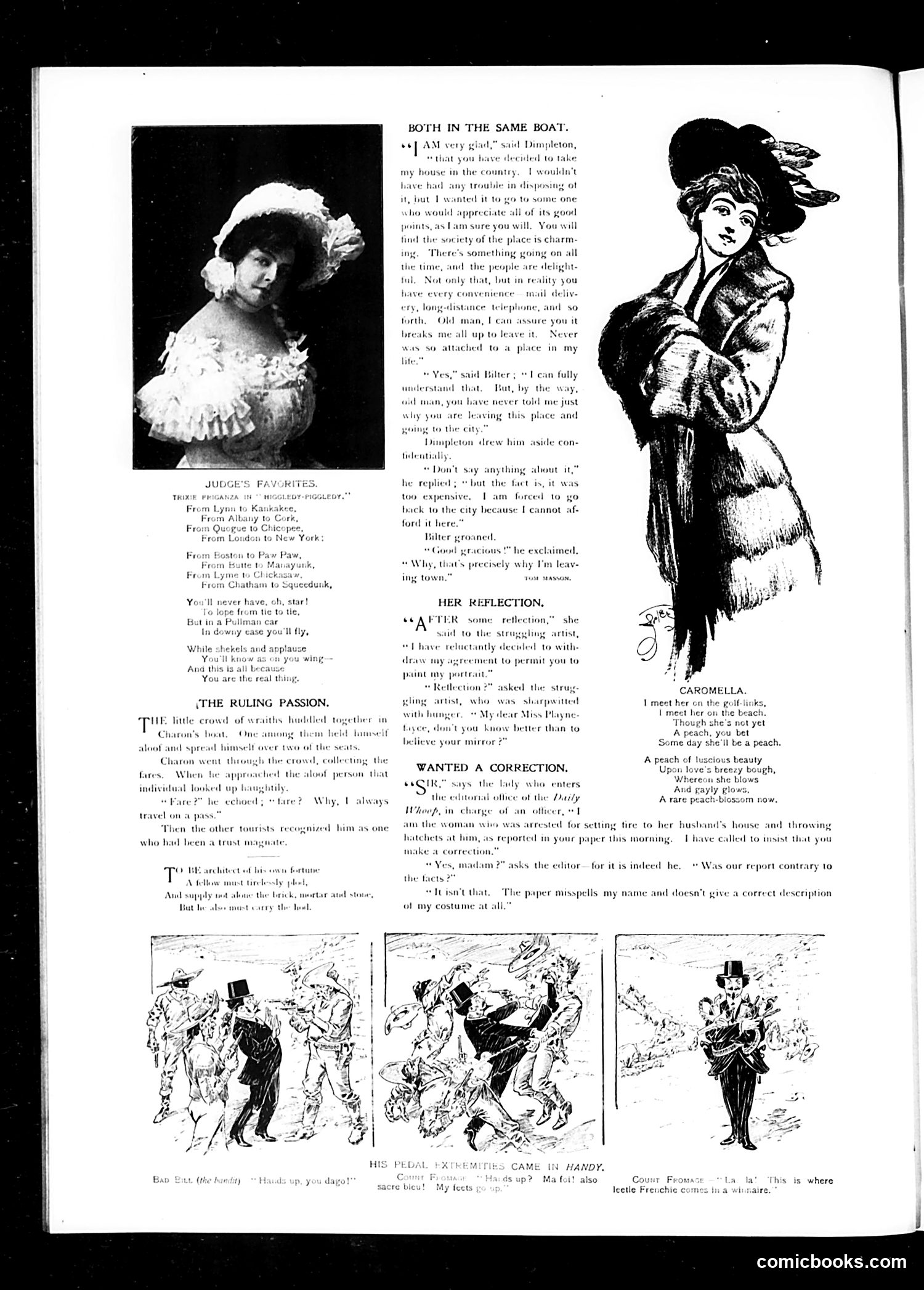
This page contains several humorous stories and illustrations typical of early 20th-century Judge magazine satirical content. **"Both in the Same Boat"** depicts Dumpleton and Ritter discussing country versus city living—a common satirical contrast of the era, mocking urban pretensions and rural simplicity. **"Her Reflection"** appears to satirize an artist and patron discussing portraiture, possibly critiquing artistic vanity or misrepresentation. **"Wanted a Correction"** involves a lady complaining about a newspaper's inaccurate reporting of her costume—likely mocking both journalistic carelessness and society women's vanity. The bottom illustrations labeled **"His Final Extremities Came in Handy"** and similar captions appear to be visual gags, though without clearer context, their specific satirical targets remain unclear. The overall tone reflects Judge's characteristic mockery of social pretension and everyday absurdities.
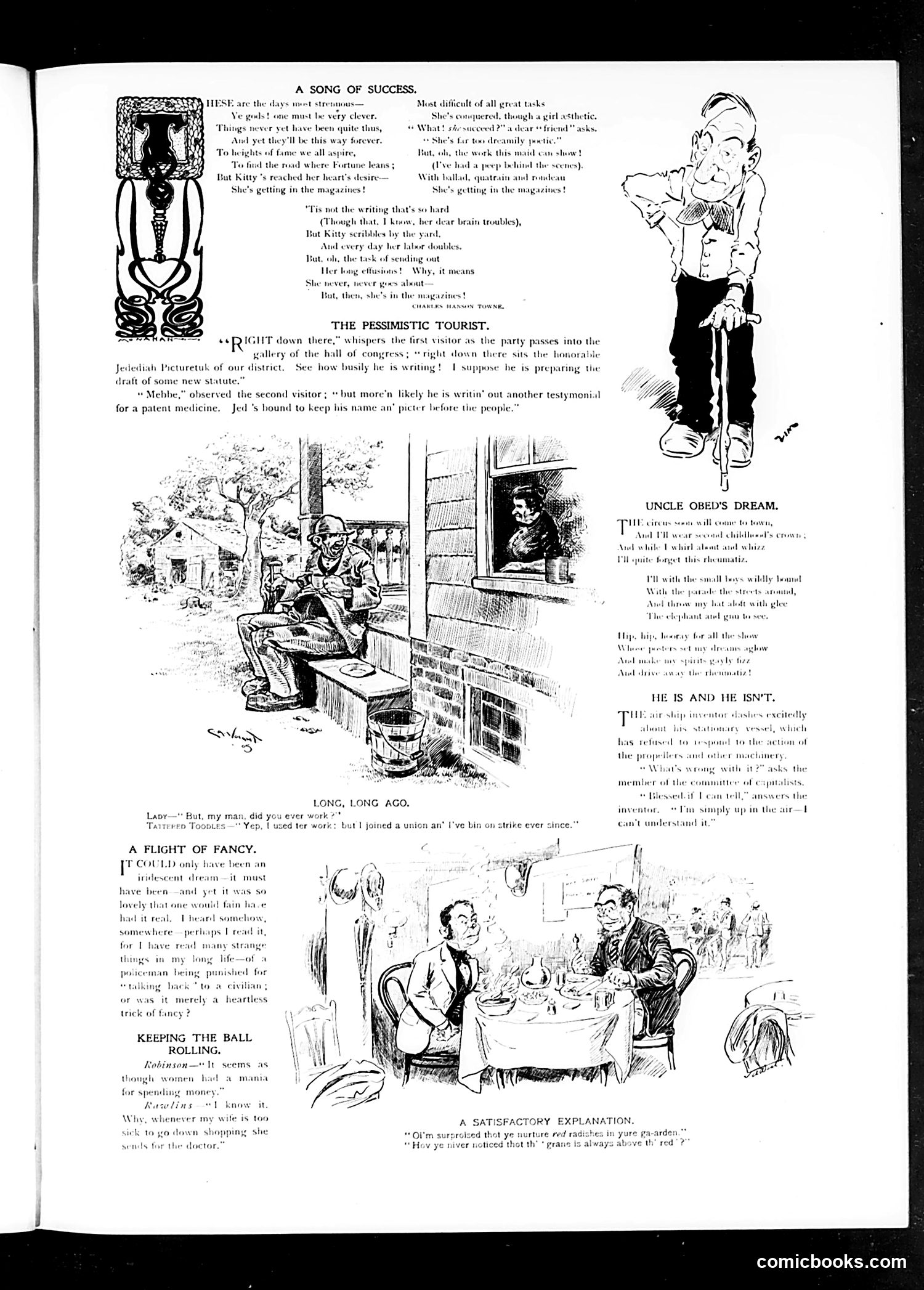
This page collects brief humorous sketches mocking American social types circa early 1900s: **"A Song of Success"** ridicules aspiring female writers. "Kitty" works tirelessly trying to get published in magazines, embodying the era's skepticism toward women's literary ambitions. **"The Pessimistic Tourist"** satirizes Congress and patronage. A visitor assumes Congressman Jedediah Picturetuk is writing legislation, but a cynic suggests he's actually penning testimonials for patent medicines—mocking politicians' commercial endorsements and vanity. **"Long, Long Ago"** jokes about labor unions: a worker joined a strike decades ago and has remained striking ever since, suggesting unions trap workers in permanent grievance. **Other sketches** humorously depict various character types—an old man's carnival fantasy, a wife who uses shopping as an excuse to summon the doctor, and an inventor baffled by his own contraption. The overall tone reflects Gilded Age attitudes: skepticism toward women's ambitions, distrust of politicians and unions, and gentle mockery of working-class pretensions.
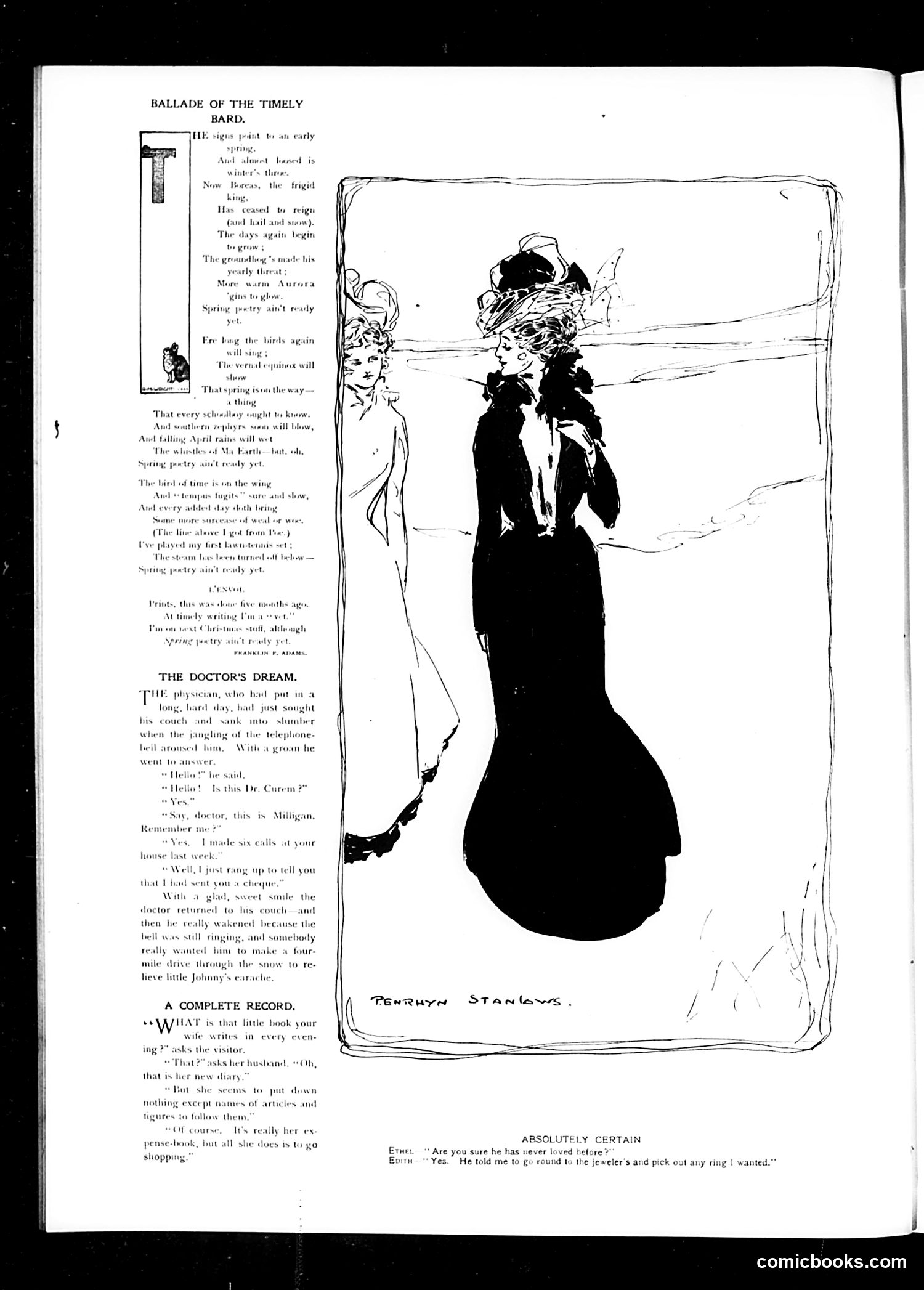
This page contains two pieces of satirical content: **"Ballade of the Timely Bard"** is a humorous poem mocking overwrought spring poetry—a common literary genre. It satirizes predictable seasonal verses about birds returning, rain falling, and Aurora (the goddess of dawn) appearing. The joke targets how spring poetry relies on clichéd imagery and forced rhymes, suggesting such verses are perpetually "not ready yet." **"The Doctor's Dream"** humorously depicts a tired physician's fantasy of being called by a satisfied patient thanking him for a cure, only to wake to an actual emergency call about a child's earache—requiring a difficult house call. The satire mocks the gap between doctors' hopes for easy, appreciative cases and the reality of their demanding work. The bottom section, **"Absolutely Certain,"** is a brief joke about a husband confirming his wife received an expensive ring from him—establishing proof of his devotion to counter any doubts about his fidelity. These are lighthearted social comedies typical of Judge magazine's approach.
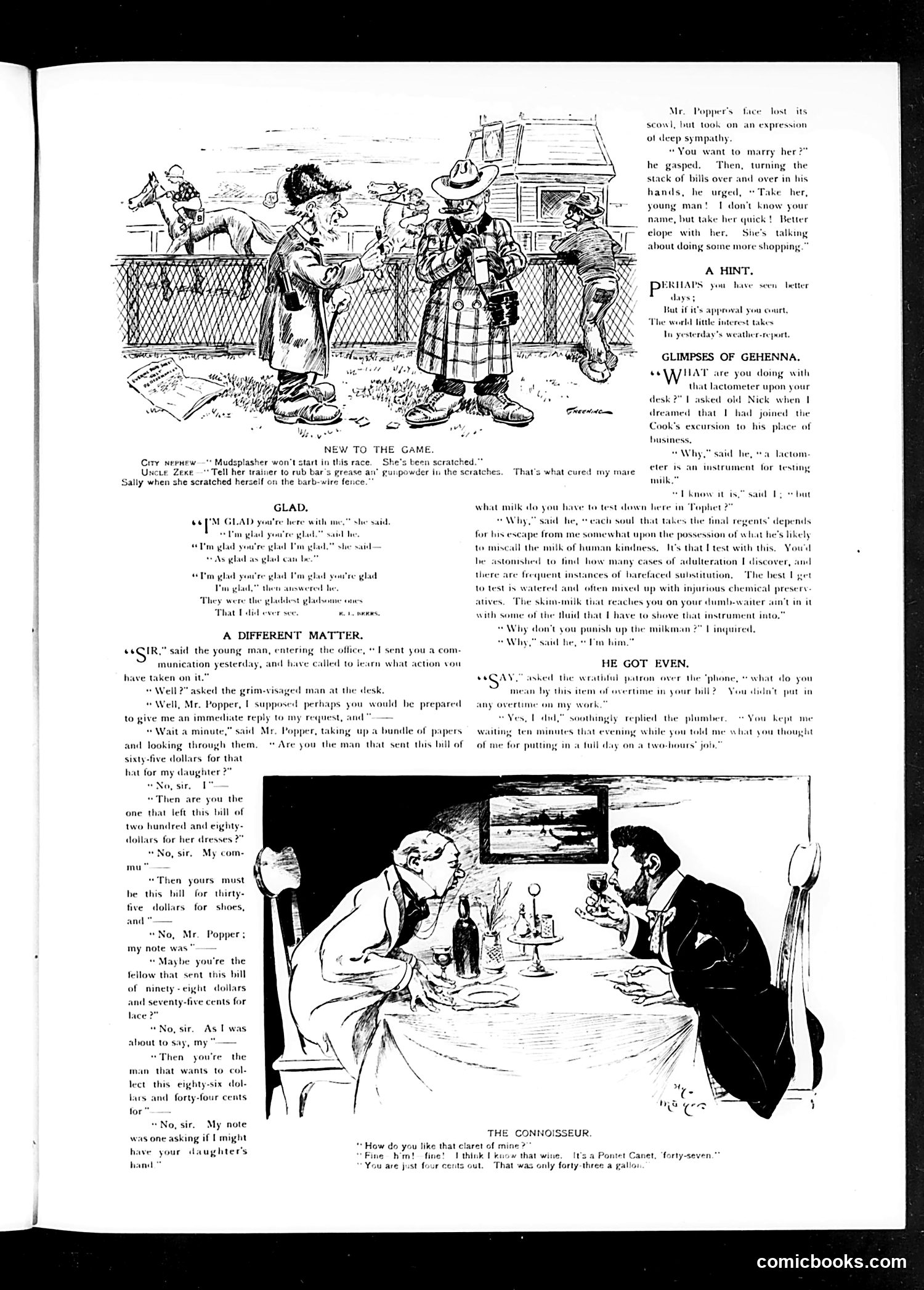
This page from *Judge* magazine contains several satirical vignettes about domestic finances and class tensions circa early 1900s. **"New to the Game"** mocks inexperienced horse-racing enthusiasts offering absurd advice about conditioning racehorses. **"Glad"** is wordplay depicting a couple repetitively declaring mutual gladness—satire of sentimental conversation. **"A Different Matter"** shows a young man calling on Mr. Popper to discuss a serious business matter, but Popper repeatedly interrupts, assuming he's a bill collector for his daughter's excessive spending (dresses, shoes, lace). The joke: Popper is so drowning in his daughter's debts that any visitor seems like a creditor. This reflects anxiety about women's consumer spending and paternal financial burden—common satirical targets of the era. **"The Connoisseur"** and **"He Got Even"** offer quick humorous exchanges about wine snobbery and a tradesman who retaliates against a customer's complaint by billing for the time wasted. These reflect early 20th-century concerns: marriage finances, daughters' independence through consumption, and working-class assertiveness.
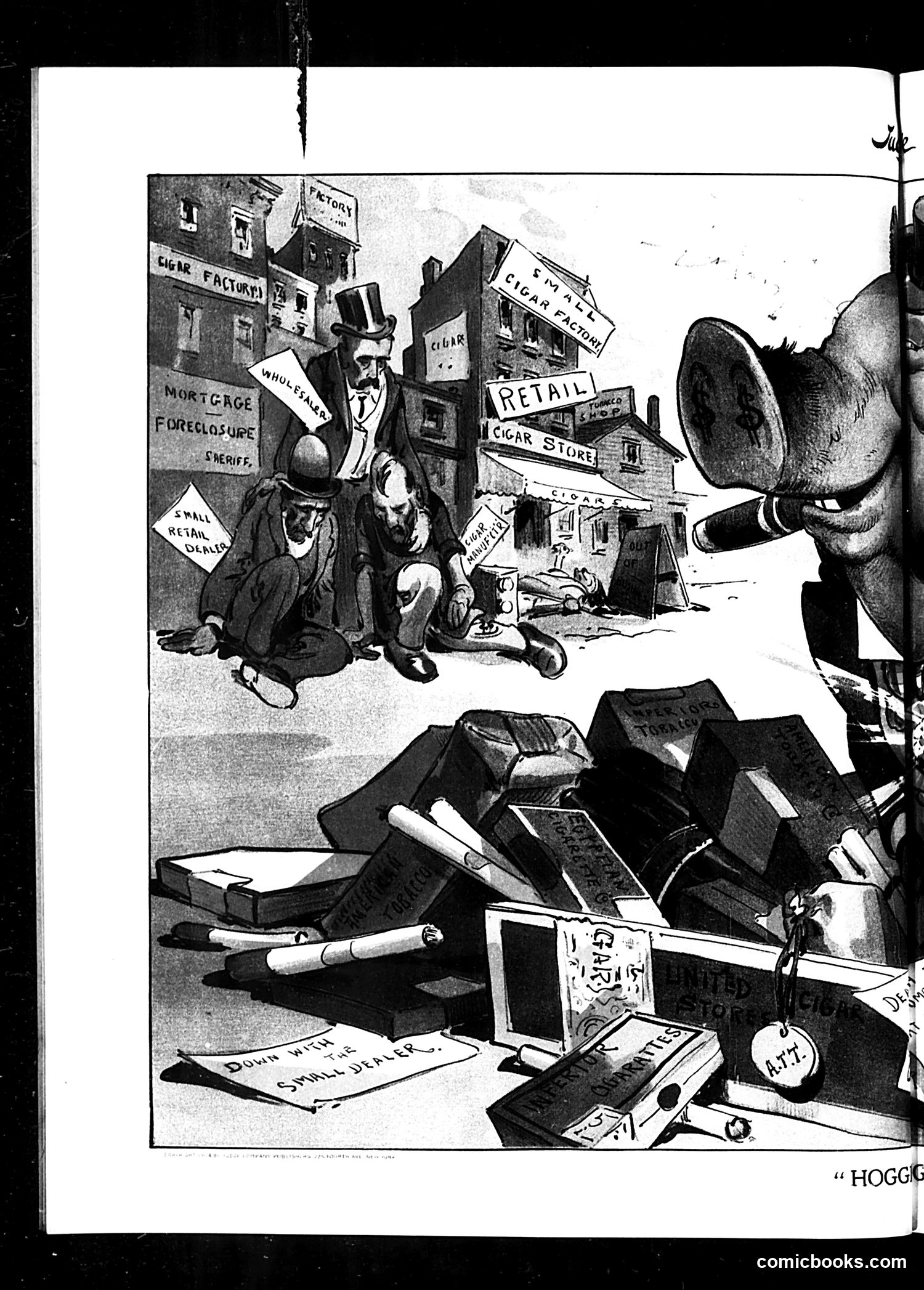
This appears to be an early 20th-century satirical cartoon about the cigar industry, likely critiquing monopolistic practices or retail consolidation. The central figure—a wealthy man in a top hat labeled with various corporate entities—towers over smaller businessmen and storefronts marked "Retail Cigar Store," "Small Retail Dealer," and "Wholesale." Signs reference "Mortgage" and "Foreclosure" by the "Sheriff." In the foreground, scattered cigars, boxes, and business documents suggest financial collapse or industry disruption. The composition depicts large corporate interests literally crushing small independent cigar retailers through foreclosure and consolidation. The satire critiques how big business was displacing small merchants during this era of industrial expansion and corporate consolidation—a major public concern in American politics during the Progressive Era.
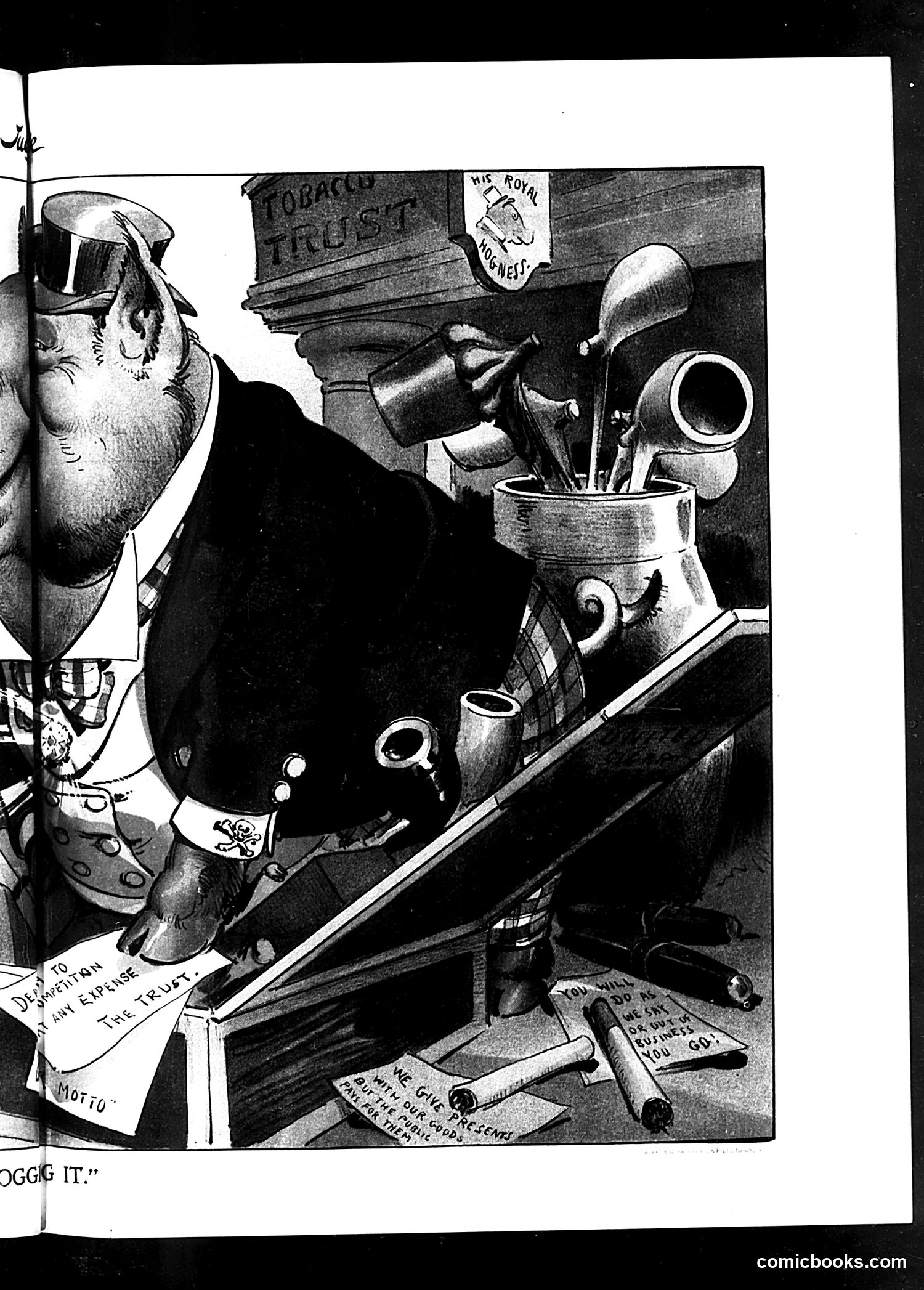
This political cartoon satirizes corporate monopolies and corrupt business practices, likely from the early 20th century. A bearded industrialist (representing "The Trust") pours various business tools and practices into a large vessel labeled with "TOBACCO TRUST" signage visible above. The figure appears to be manufacturing or combining questionable business methods. Labels on scattered items at the bottom reference deceptive practices and cost-cutting measures. On the left, another caricatured figure with exaggerated features watches disapprovingly, suggesting public or regulatory concern. The cartoon critiques how trusts consolidated power by combining predatory practices—obscuring quality, inflating prices, and exploiting consumers—all while appearing respectable through the veneer of legitimate business. This reflects Progressive Era anxieties about monopolistic corporations.
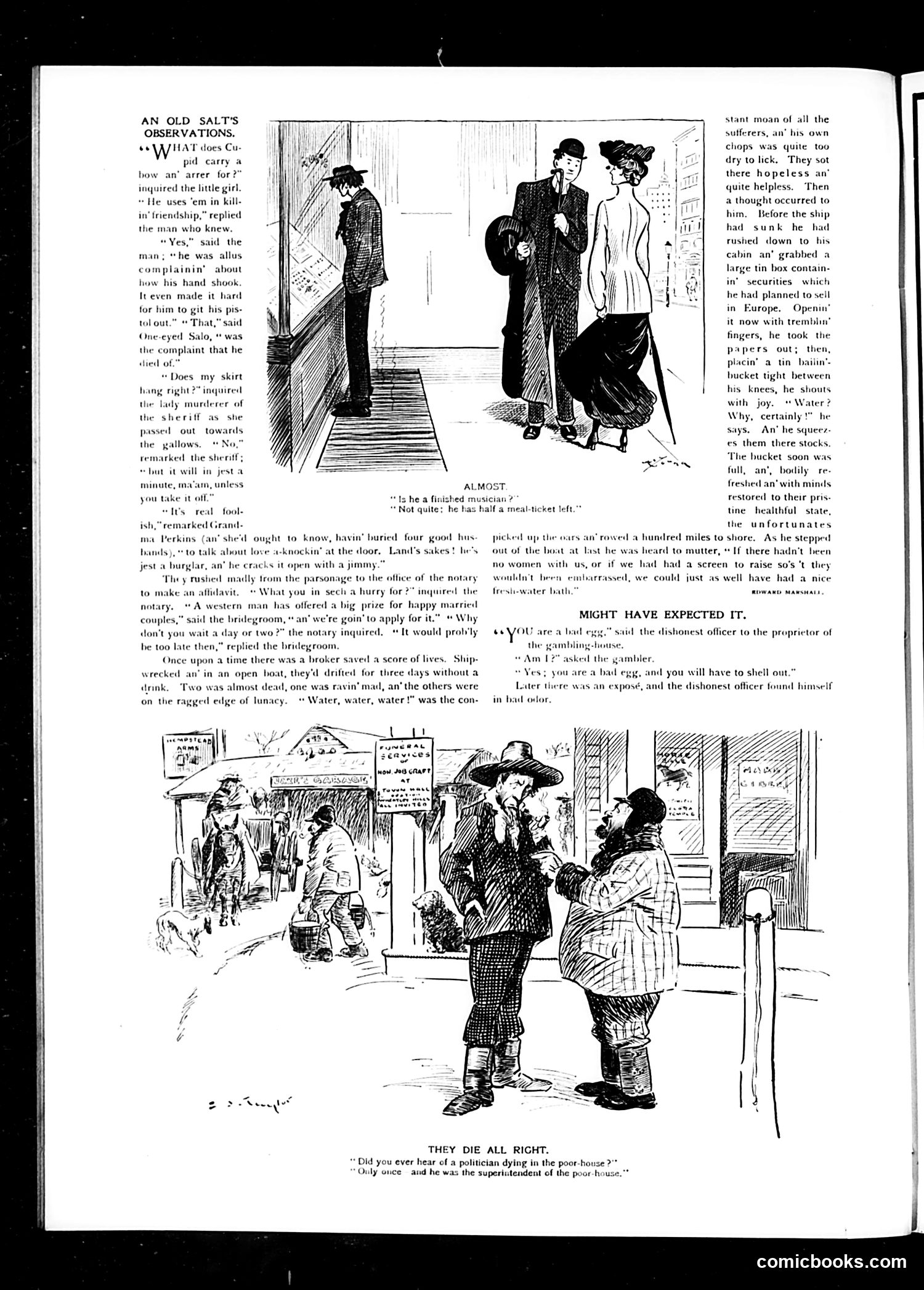
This page from *Judge* magazine contains several satirical short stories illustrated with cartoons, typical of the publication's humor format. **"An Old Salt's Observations"**: A folksy sailor shares anecdotes about complaining, death, and human nature. The humor relies on period vernacular and ironic moral lessons—e.g., a broker survives shipwreck by squeezing stocks for water, then complains about lacking freshwater bathing without women present. This mocks both financial obsession and social hypocrisy. **"Might Have Expected It"**: A corrupt police officer extorts money from a gambling-house proprietor, calling him dishonest while engaging in bribery himself. The irony is straightforward: the officer's hypocrisy is unsurprising. **"They Die All Right"**: A final gag about a politician dying in a poorhouse, with the punchline implying this is exceptional—satirizing the assumption that politicians enrich themselves and never face poverty. The cartoons use exaggerated features typical of early 20th-century illustration. Overall, the page satirizes greed, corruption, hypocrisy, and self-interest among various social classes.
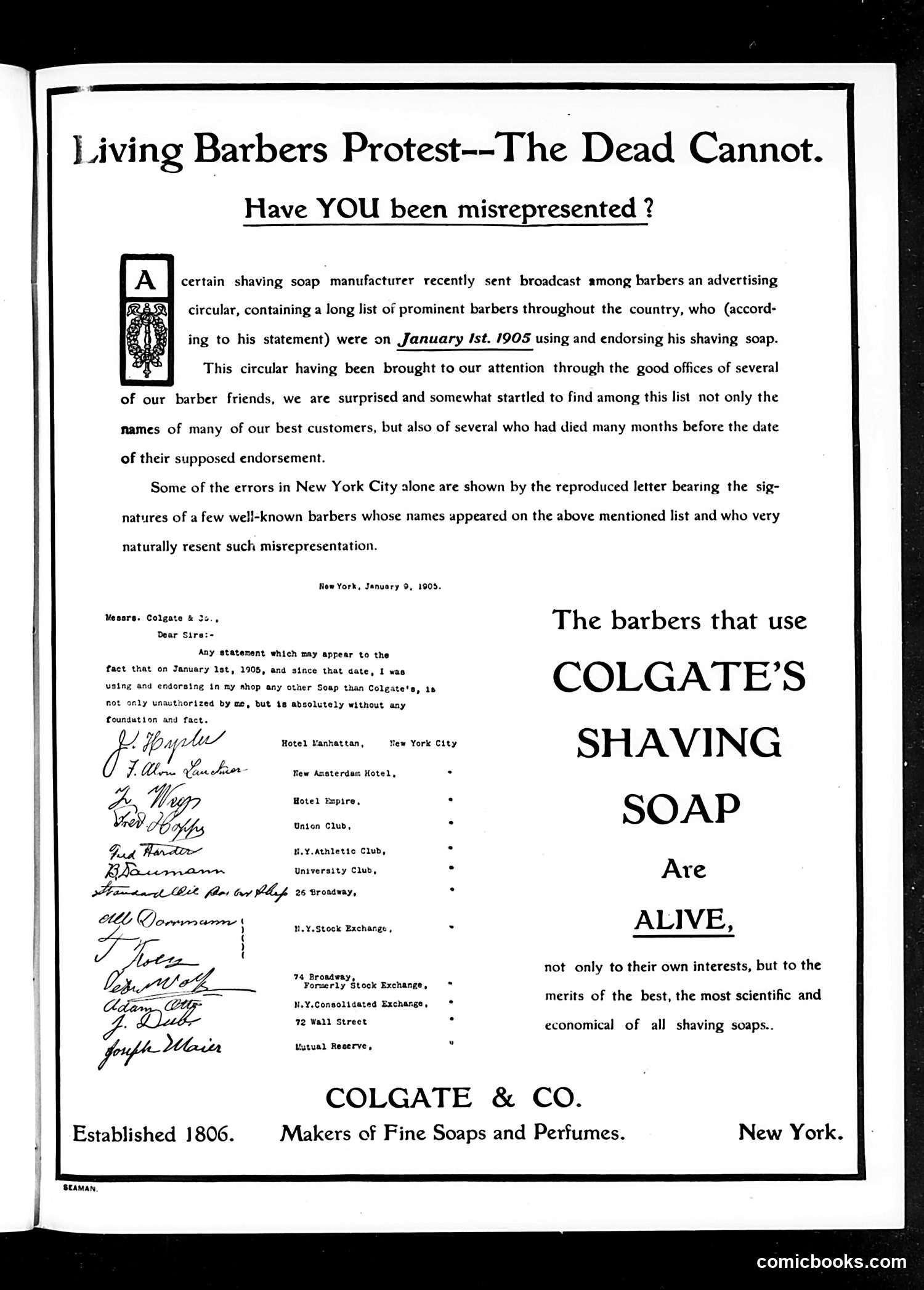
This is a **consumer fraud exposé disguised as advertising**. Judge magazine is calling out Colgate & Co. for deceptive marketing. The scandal: Colgate sent circulars claiming prominent barbers endorsed their shaving soap as of January 1, 1905. However, several named barbers had **died months before that date**—making their endorsements impossible and fraudulent. The page reproduces angry letters from actual New York barbers (signatures shown) denying authorization and protesting misrepresentation. They're furious their names were used to falsely promote the product. The ironic headline "The Dead Cannot" protest underscores the absurdity: Colgate exploited deceased barbers who couldn't defend themselves or deny the endorsement claims. This page functions as both satire and public warning—Judge exposes corporate dishonesty while Colgate's rebuttal advertisement ironically appears on the same page, attempting damage control by emphasizing their product's quality and legitimacy.
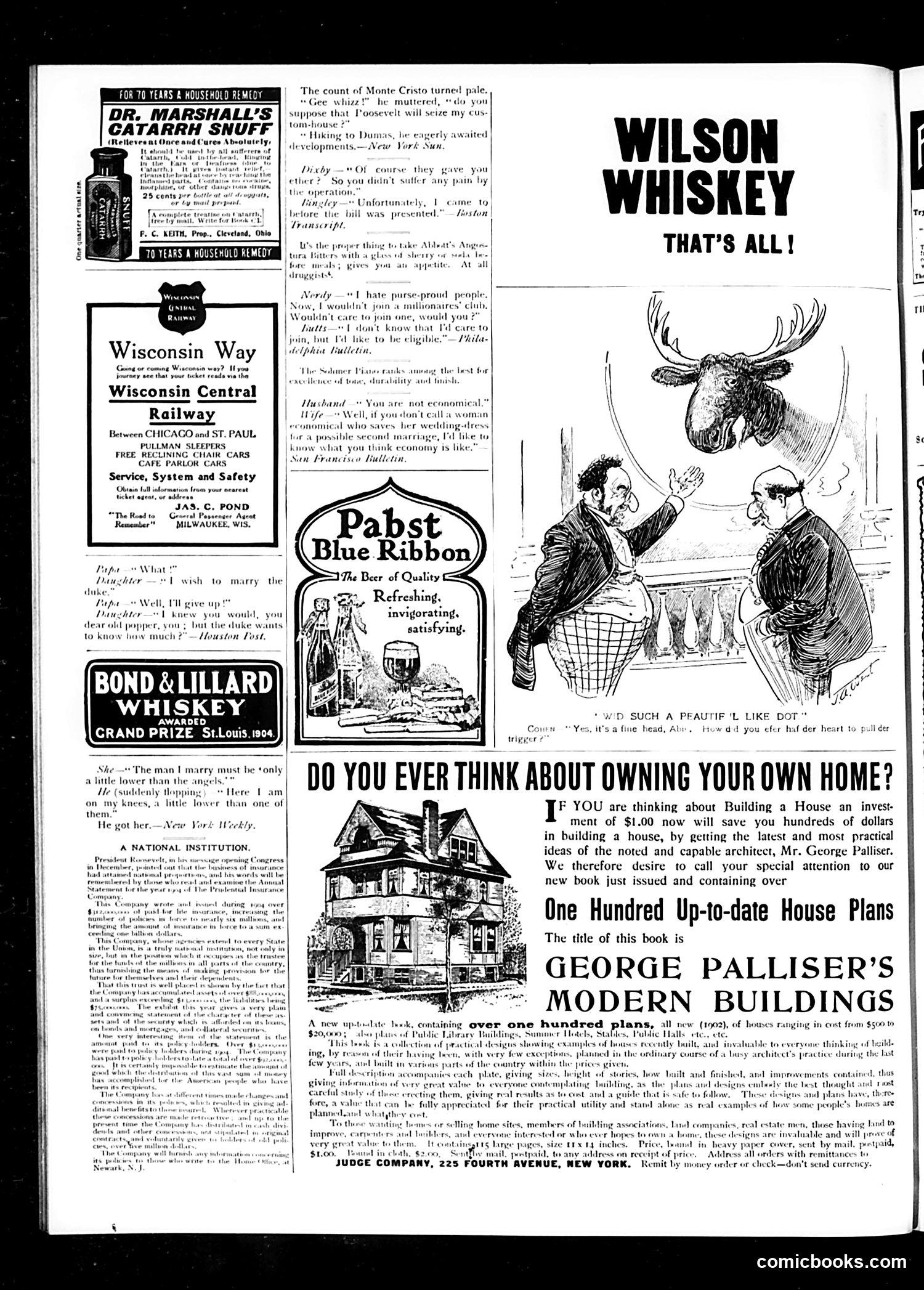
This page is primarily **advertising and miscellaneous content** rather than coherent political satire. The main visual cartoon shows two men in what appears to be a casual conversation, with one exclaiming "What a beautiful like dot!" — likely ethnic dialect humor typical of early 1900s publications. The page includes several unrelated joke exchanges (between Papa/daughter about marriage; between husband/wife about economy) that trade in conventional gender stereotypes of the era. Most significantly, there's a reference to **President Roosevelt** seizing a character's custom-house, suggesting contemporary anxieties about Roosevelt's anti-corruption and trust-busting policies during his presidency. The bulk of the page is devoted to **advertisements** for whiskey (Wilson, Bond & Lillard, Pabst Blue Ribbon), railroad services, medicinal products, and most prominently, **George Palliser's house-plan book** — a practical guide for home construction marketed to middle-class Americans contemplating homeownership. The page reflects early 1900s consumer culture and Progressive Era politics rather than sustained satirical commentary.
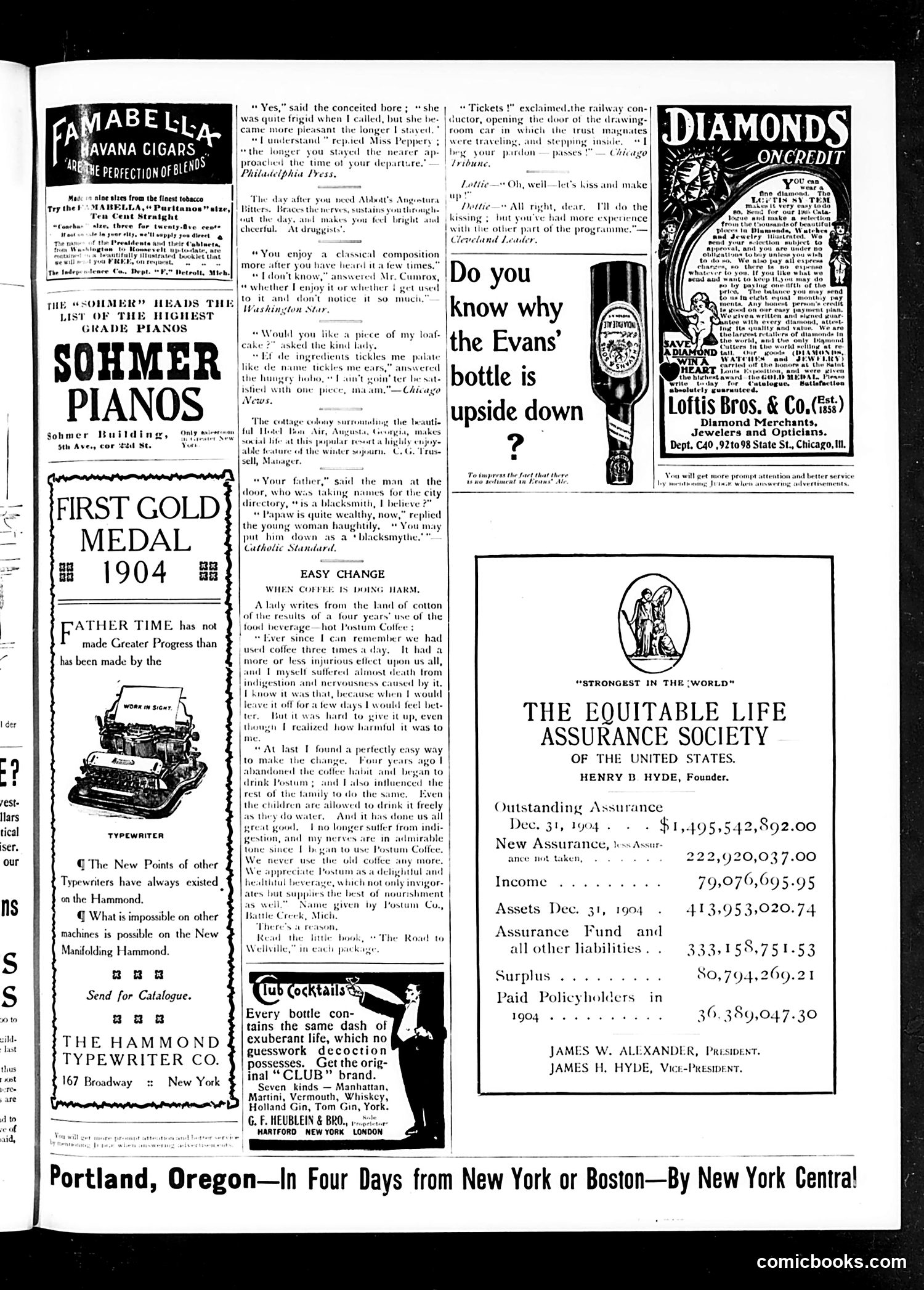
This page is primarily **advertising**, with scattered brief joke items typical of Judge magazine. The "cartoons" are minimal—mostly visual ads for products (pianos, typewriters, coffee, life insurance). The Evans' bottle advertisement poses a visual riddle ("Do you know why the Evans' bottle is upside down?") but the answer isn't visible on this page. The text fragments are short jokes from various newspapers, typically punning or playing on class differences and contemporary attitudes. For instance, one joke about a blacksmith plays on mispronunciations and social pretension; another about coffee-to-Postum conversion emphasizes health concerns popular in the early 1900s (caffeine's "nervousness"). The **political/satirical content is minimal**—this appears to be a typical mixed page of early-20th-century magazine advertising and filler humor, likely from around 1904 based on the Equitable Life Assurance Society financial data. The jokes reflect period attitudes about wealth, health, and propriety rather than sharp political commentary.
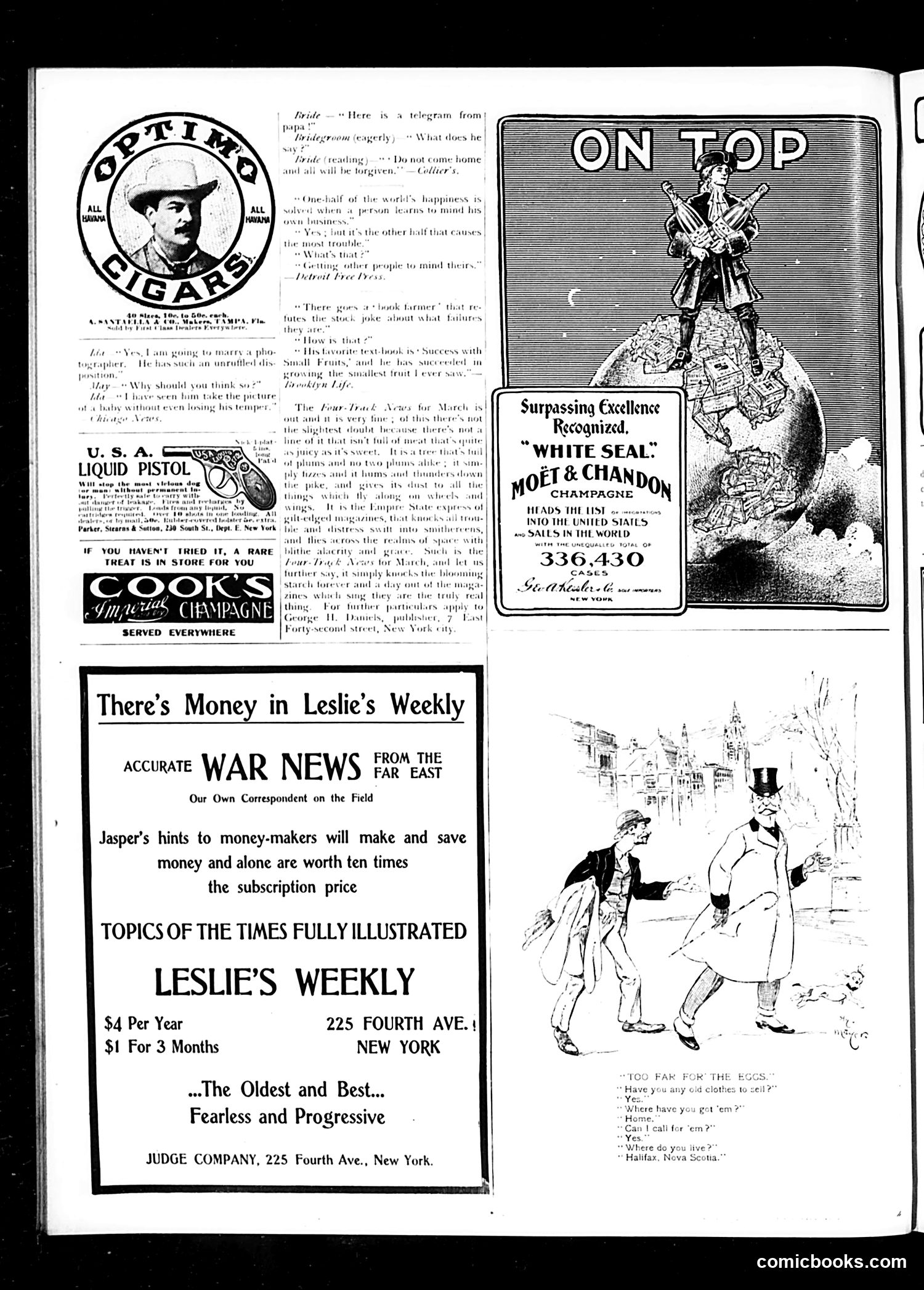
This page is primarily **advertising**, not satire or political commentary. It contains: 1. **Optimo Cigars ad** (left): Features a man in a cowboy hat in a circular logo—standard product branding of the era. 2. **Cook's Champagne ad**: Promotes the beverage as "served everywhere." 3. **Moët & Chandon ad** (top right): Advertises French champagne as the leading imported brand in America, with an illustration of a figure standing atop a globe. 4. **Leslie's Weekly promotion** (center): The magazine solicits subscriptions, emphasizing "war news from the far east" with a correspondent in the field, plus "Jasper's hints to money-makers." This suggests the publication targeted business-minded readers during what appears to be a war period (likely the Spanish-American War or Boxer Rebellion era, given the "far east" reference). 5. **Illustration** (bottom right): Shows two men discussing eggs—appears to be a humorous filler sketch unrelated to the advertisements. The page reflects early 1900s magazine culture and advertising conventions rather than political satire.
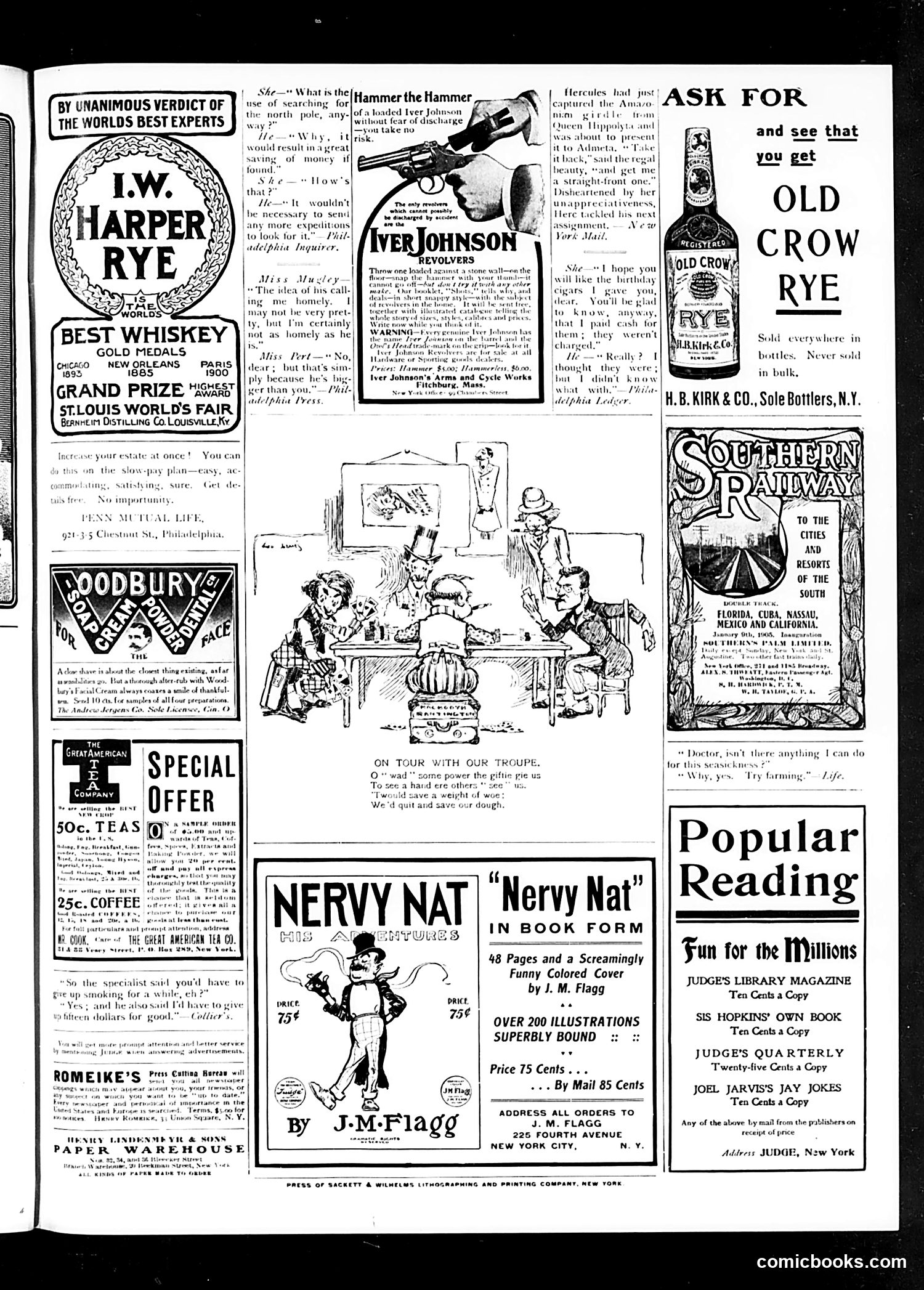
This is primarily an **advertising page** from Judge magazine, featuring product promotions typical of early 1900s publications. The main content includes: **Notable Advertisement:** I.W. Harper Rye whiskey, promoting awards from Chicago (1893), New Orleans (1888), Paris (1900), and the St. Louis World's Fair—standard quality claims of the era. **Cartoon Content:** A small comic strip titled "On Tour with Our Troupe" by J.M. Flagg depicts characters in what appears to be a seasickness conversation, with weak humor about farming as a cure. **Book Promotion:** "Nervy Nat" in book form by J.M. Flagg, advertised with over 200 illustrations. **Other Ads:** Life insurance, tea, coffee, paper warehouses, and Southern Railway travel promotions fill the page. **Historical Context:** This reflects pre-Prohibition America's open alcohol advertising and period advertising conventions mixing editorial content with commerce. The "troupe" cartoon and Flagg illustrations were typical Judge filler entertainment.
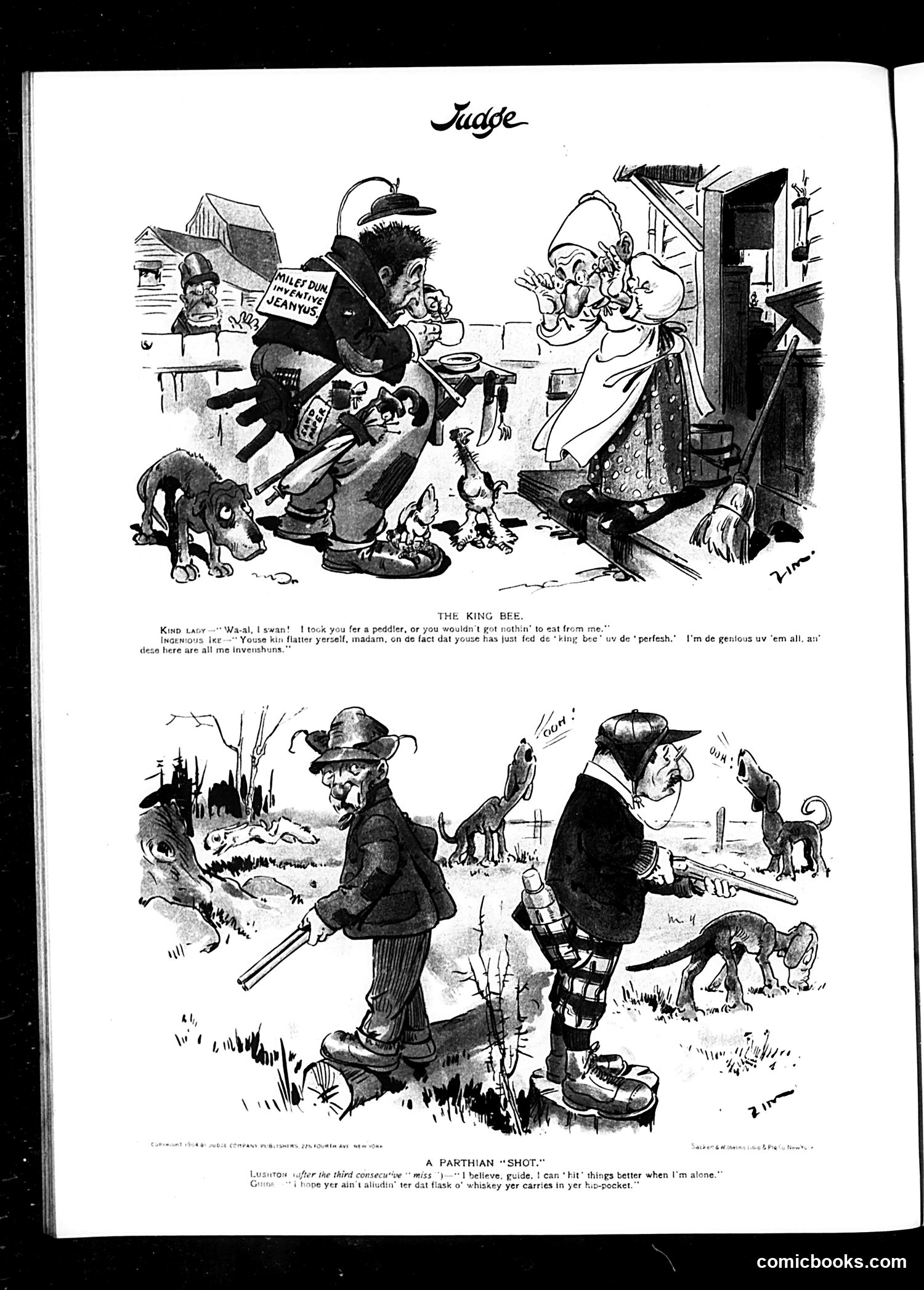
**Top cartoon ("The King Bee"):** Shows a well-dressed man labeled "Honest Abe" (likely a con artist or charlatan) with a sign reading "SWINDLE POOR SAINTS," pitching to gullible people. He claims superiority and demands obedience while appearing to exploit religious faith. The satire mocks fraudsters who prey on the credulous, particularly in religious contexts. **Bottom cartoon ("A Parthian Shot"):** Depicts two hunters with dogs in a field. One suggests he shoots better alone, implying he drinks whiskey from a hip-flask. The other sardonically notes this "Parthian shot" (a parting insult)—referencing the ancient tactic of shooting while retreating. The joke satirizes someone's transparent excuse-making for poor performance while under the influence. Both cartoons use caricature and wordplay to mock dishonesty and self-deception in everyday life.