
A complete issue · 16 pages · 1905
Judge — February 4, 1905
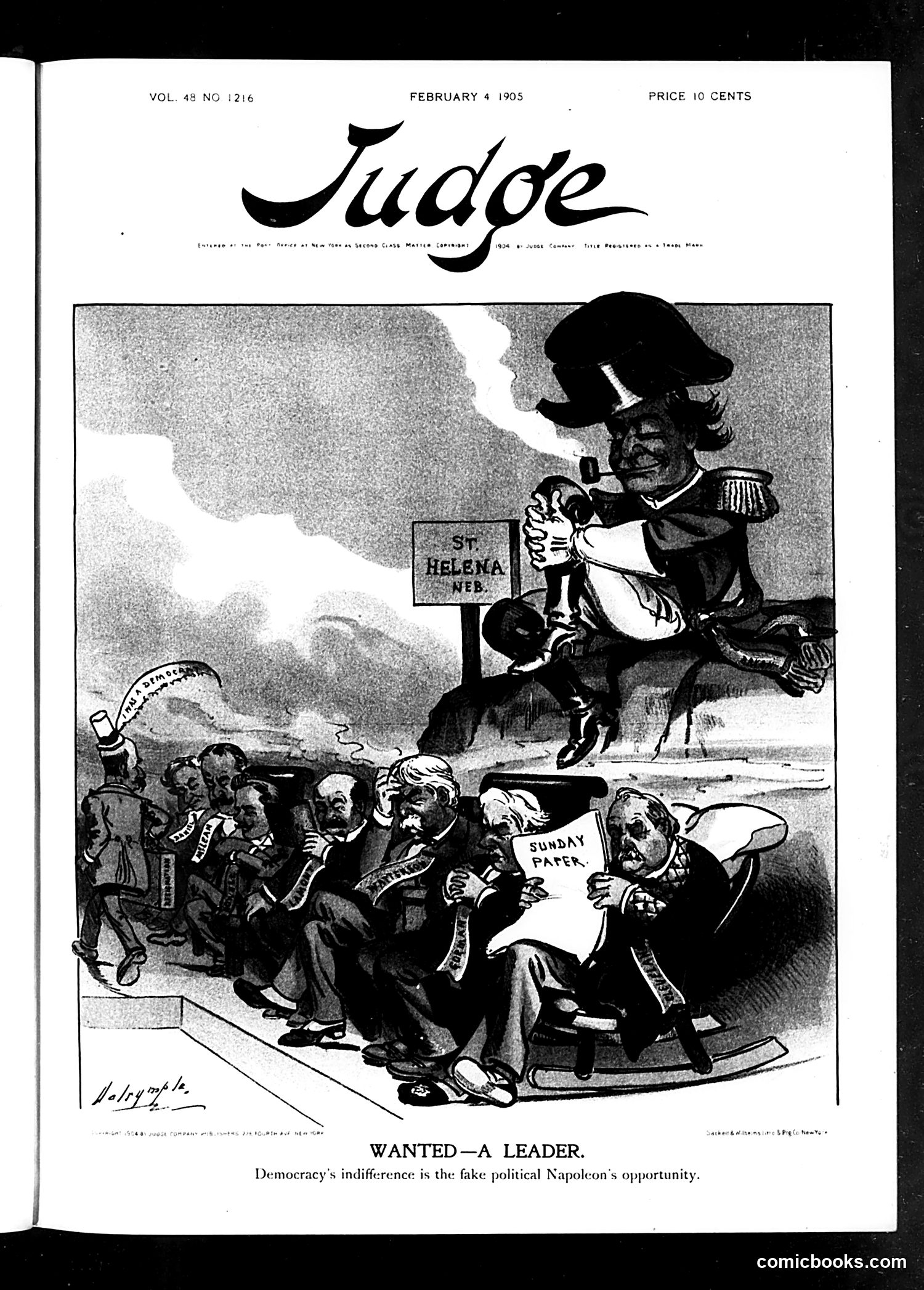
This February 4, 1905 *Judge* cartoon satirizes Democratic Party leadership. A caricatured Napoleon figure stands triumphantly over St. Helena, Nebraska—likely representing an aspirational or satirical depiction of political ambition. Below, a group of Democratic politicians huddle together, one holding a "Sunday Paper," appearing confused and leaderless. The caption states: "Democracy's indifference is the fake political Napoleon's opportunity." The satire suggests that the Democratic Party's lack of strong direction creates an opening for demagogues or would-be autocrats. The Napoleon reference implies fears that ineffective democratic leadership could enable authoritarian figures. The politicians appear hapless and directionless, supporting the cartoon's critique of Democratic organizational weakness during this Progressive Era period.
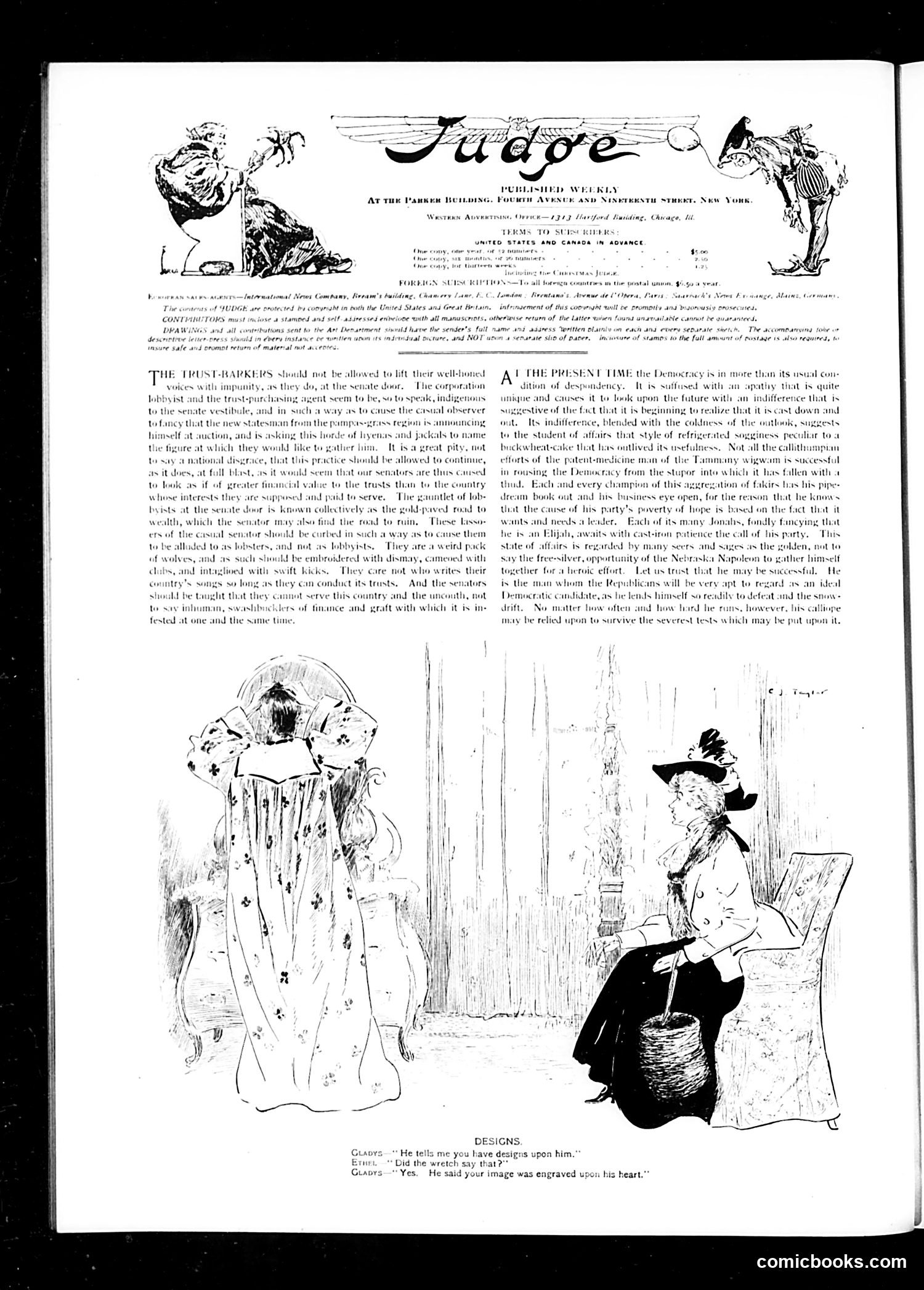
This page contains two distinct political cartoons addressing early 20th-century Democratic Party concerns. The upper section criticizes Democratic leadership's apparent lack of direction and vision, arguing the party needs stronger organization and clearer principles to succeed electorally. The lower cartoon, titled "Designs," depicts two figures in conversation. The caption reads: "Gladys: 'He tells me you have designs upon him.' Ethel: 'Did the wretch say that?' Gladys: 'Yes. He said your image was engraved upon his heart.'" This is a romantic satire playing on the double meaning of "designs"—both political schemes and romantic intentions. The humor relies on the female character's defensive response to accusations of romantic pursuit, suggesting contemporary anxieties about women's agency and courtship conventions of that era.
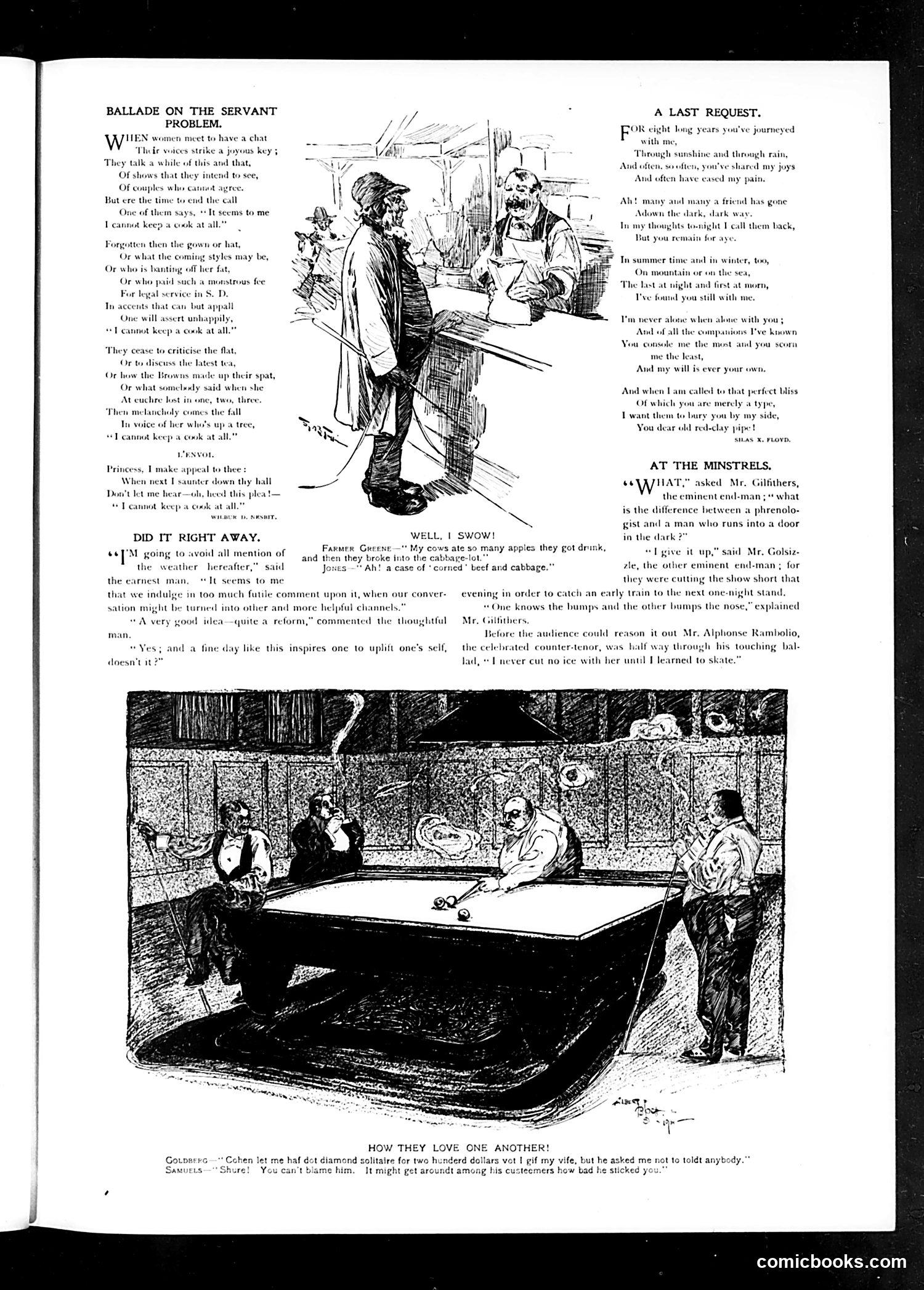
This page contains three distinct pieces: 1. **"Ballade on the Servant"** — A poem satirizing domestic servants' behavior and attitudes, suggesting they're difficult to manage and prone to complaint. 2. **"A Last Request"** — A sentimental poem about lost friendship and unrequited affection. 3. **"At the Minstrels"** — A brief dialogue joking about the difference between a phenologist (skull-shape scientist) and a man who "runs into a door in the dark," with a setup for absurdist humor. 4. **"How They Love One Another"** — A cartoon showing men at a billiards table, with a caption about a husband asking a friend not to mention his wife's diamond solitaire theft. The humor generally targets servants' insubordination, sentimental romance, pseudo-scientific pretension, and marital deception—typical early-20th-century Judge magazine fare.
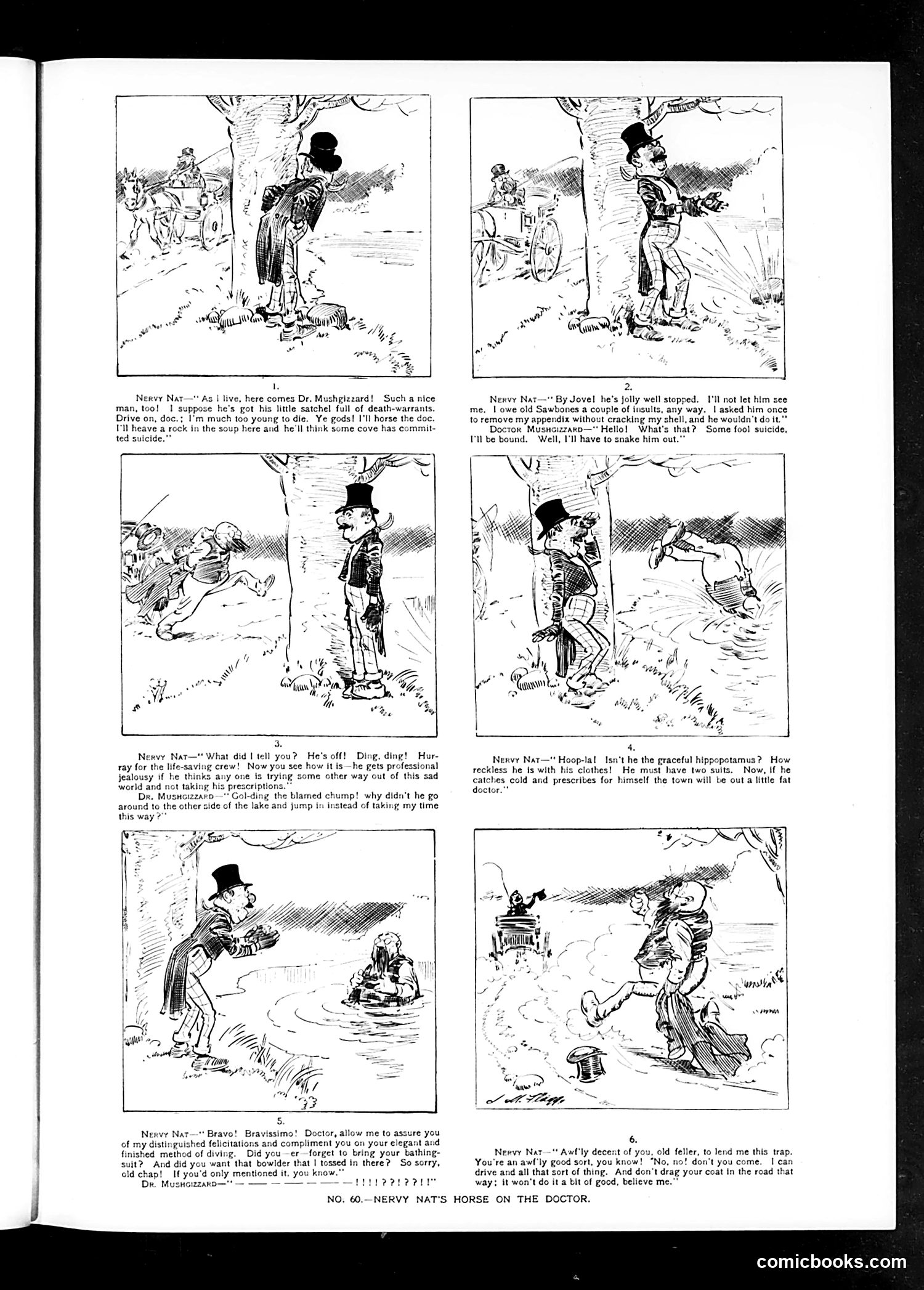
This six-panel comic depicts a recurring character, Nervy Nat, systematically tormenting a physician (Dr. Mushgizzard). The satire targets both the antagonist's recklessness and, implicitly, contemporary attitudes toward doctors. Nat repeatedly endangers the doctor through pranks: hiding to ambush him, throwing rocks into the soup, tossing a boulder into a lake to cause the doctor to dive fully clothed, and finally driving away in the doctor's own horse and carriage. Throughout, Nat maintains exaggerated politeness ("Awf'ly decent of you"), a satirical contrast to his hostile actions. The humor relies on class dynamics—Nat treats the pompous professional with calculated disrespect—and period-specific medical skepticism (references to appendix removal and self-prescription). The comic suggests public wariness of doctors' authority and competence, portraying the physician as both ridiculous and deserving of comeuppance.
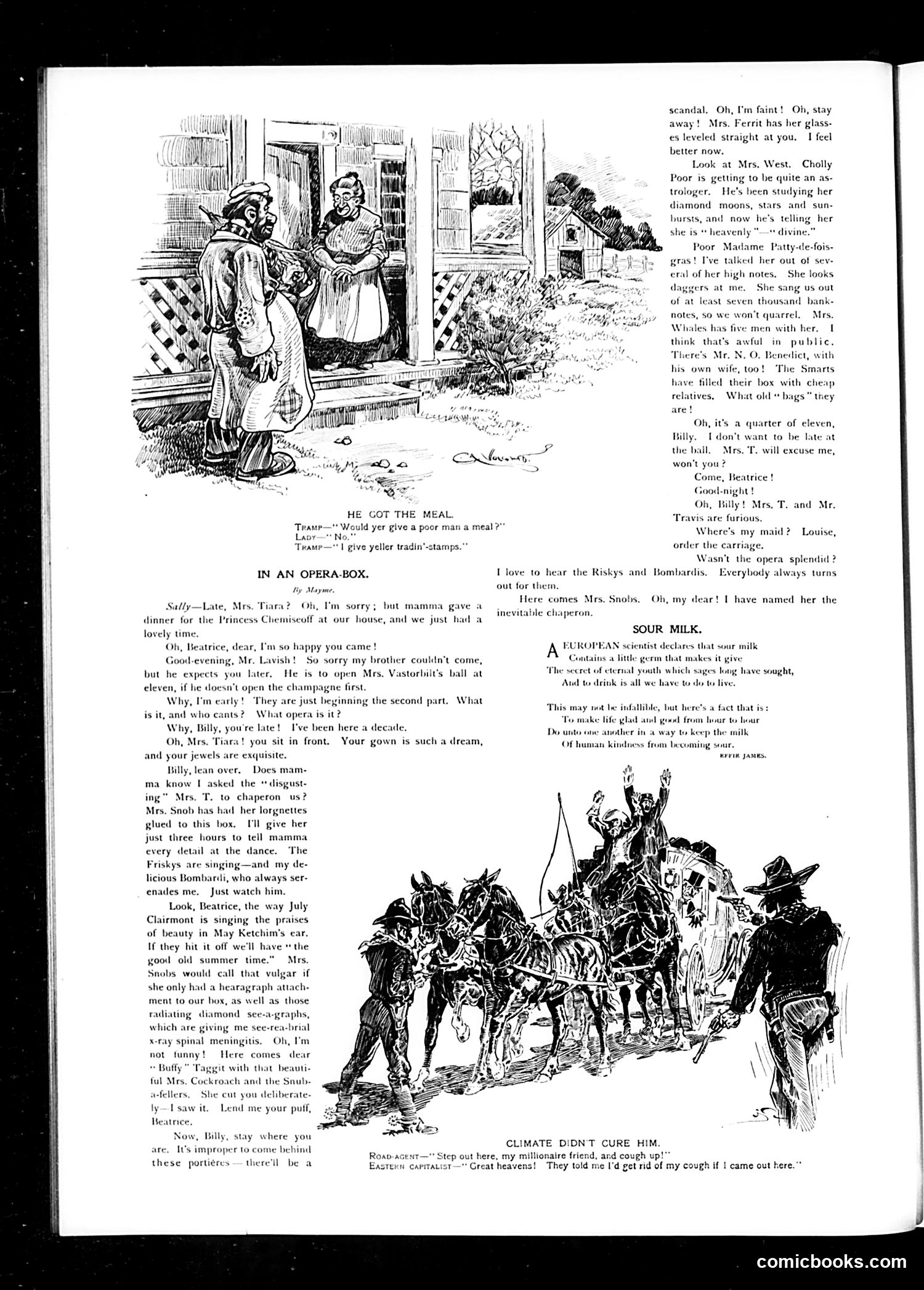
This page contains multiple satirical pieces mocking upper-class social pretension in early 20th-century America. **"He Got the Meal"** depicts a tramp asking for food; the lady offers "yeller tradin'-stamps" (trading stamps, a cheap substitute)—mocking both the tramp's desperation and the wealthy's stinginess disguised as practicality. **"In an Opera-Box"** satirizes high-society opera attendance. Characters obsess over jewelry, gossip, romantic intrigue, and social climbing rather than the performance itself. References to "Mrs. Vastorbilt's ball" parody the Vanderbilt family's extravagant events. The humor targets the vapidity of wealthy socialites who use the opera as a display of status and jewelry rather than cultural appreciation. **"Sour Milk"** is a humorous poem about keeping milk fresh—likely a filler piece. **"Climate Didn't Cure Him"** shows a wealthy man sent to a resort for his health, complaining he still coughs despite the expense—mocking both quack health treatments and the wealthy's assumption that money solves everything. Overall, the page ridicules Gilded Age excess, social climbing, and superficiality.
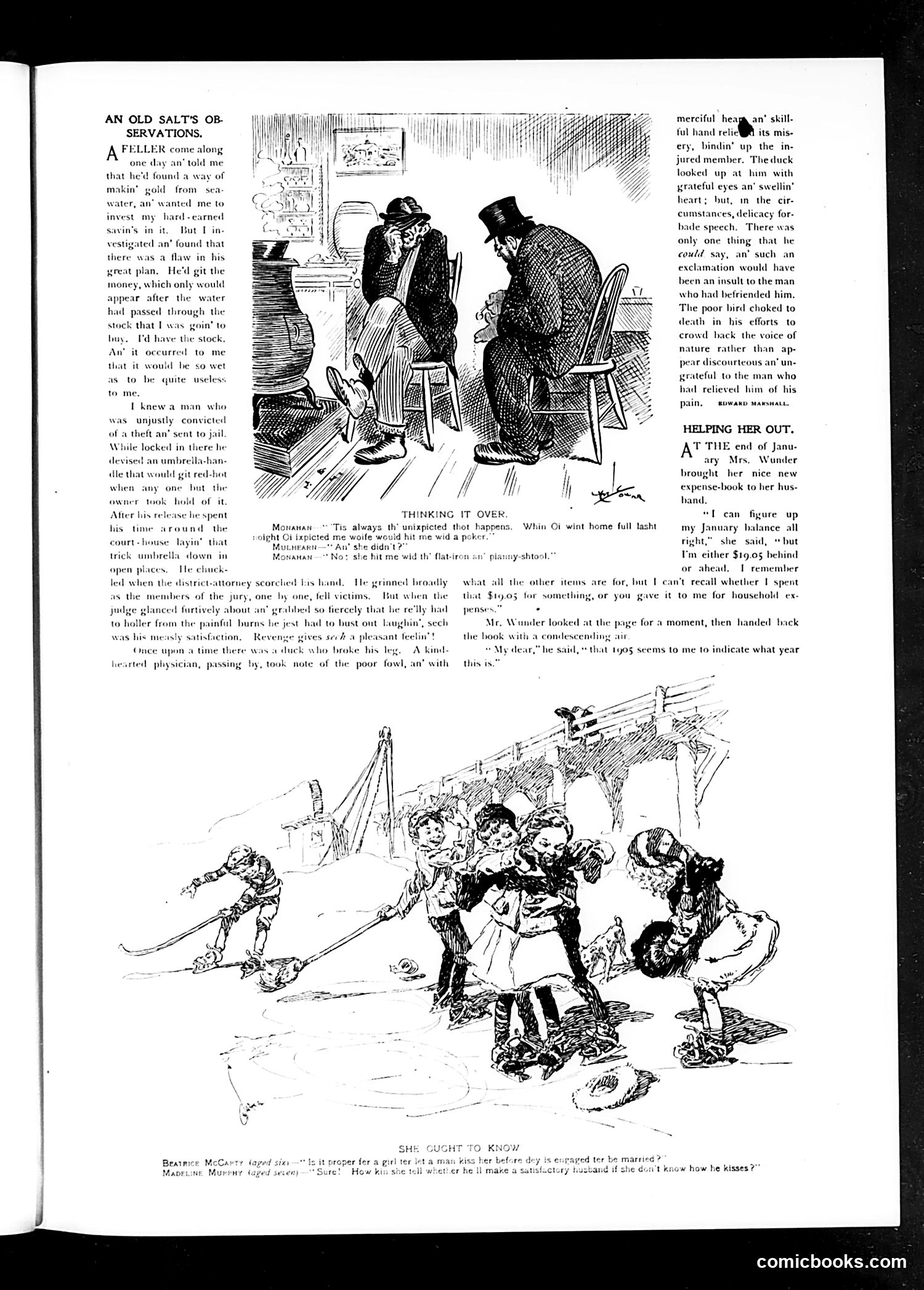
This page contains three separate humorous anecdotes in the "Old Salt's Observations" column, plus a brief joke at bottom. **Top cartoon** ("Thinking It Over"): An old sailor recounts failed get-rich-quick schemes—a con artist's promise to extract gold from seawater, and a revenge device (a hot umbrella handle). The satire targets naive investors and con men exploiting gullible people. **Middle illustration** ("She Ought to Know"): A brief joke about a girl questioning whether a suitor truly loves her before marriage, playing on romantic uncertainty and courtship conventions. **Bottom cartoon** ("Helping Her Out"): A wife presents her husband with a household account book showing a $19.05 discrepancy she cannot reconcile. The husband vaguely attributes it to unremembered expenses or gifts, offering non-answer deflection—satirizing both poor record-keeping and husbands avoiding financial scrutiny. The page satirizes common anxieties: financial fraud, romantic deception, and domestic money management—typical concerns for Judge's early-20th-century middle-class readership.
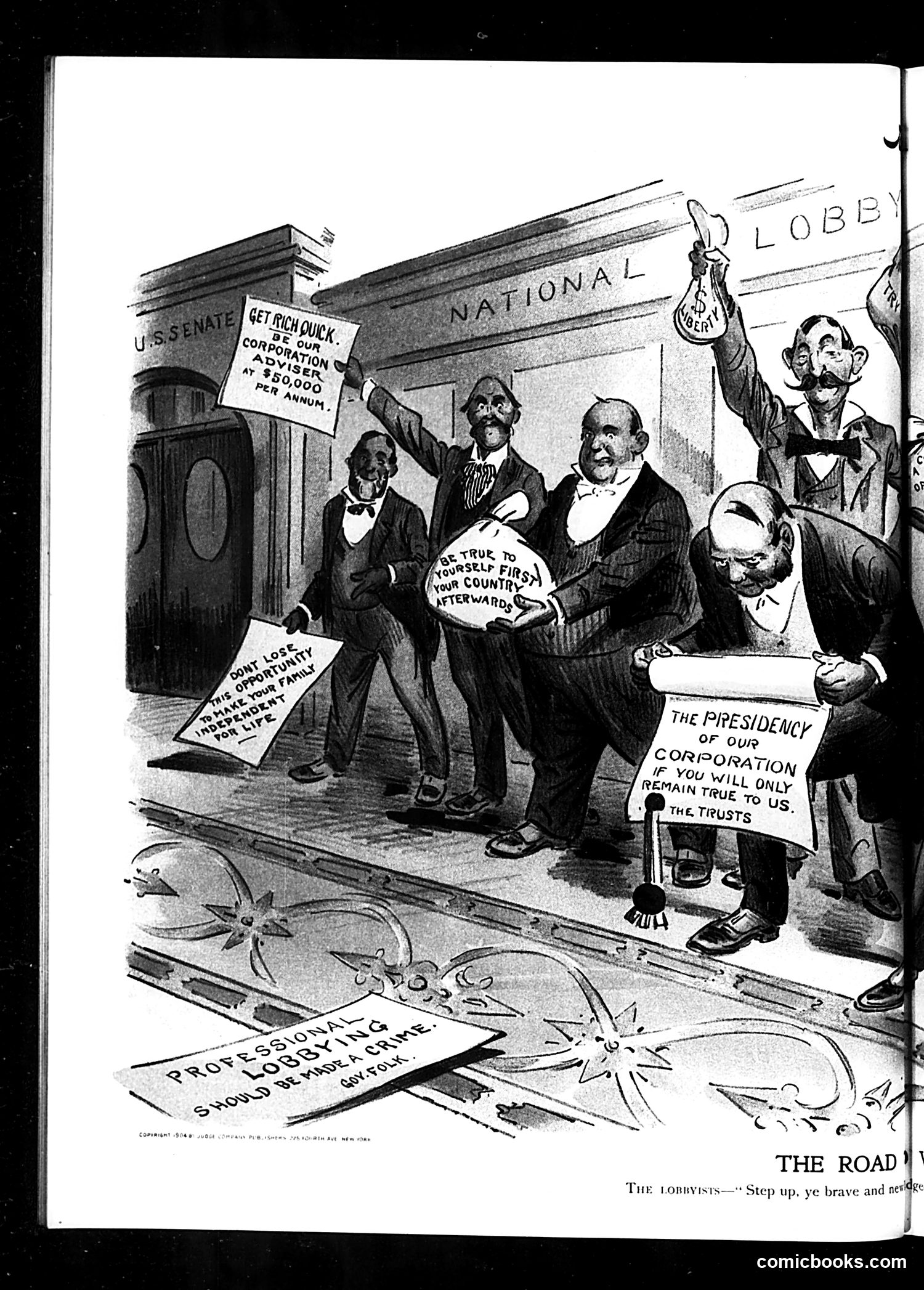
This cartoon satirizes corporate influence over the U.S. Senate and presidency during the Progressive Era (likely early 1900s). The "Senate" building and "National Lobby" setting depict wealthy businessmen—caricatured as grotesque figures—controlling politicians through bribes and promises. Signs read: "Get Rich Quick—Our Corporation pays $250,000 per annum" and "The Presidency of our Corporation...if you will only remain true to us, the Trusts." The satire attacks how large corporate trusts manipulated government officials. The lobbyists openly negotiate with senators as if purchasing loyalty, while explosive devices labeled "Professionalizing Lobbying should be made a crime" and "Guy Fawkes" lie in the foreground—suggesting such corruption requires revolutionary action. The caption "Lobbyists—Step up, ye brave and ne'er do well" mocks the shameless nature of this influence-peddling.
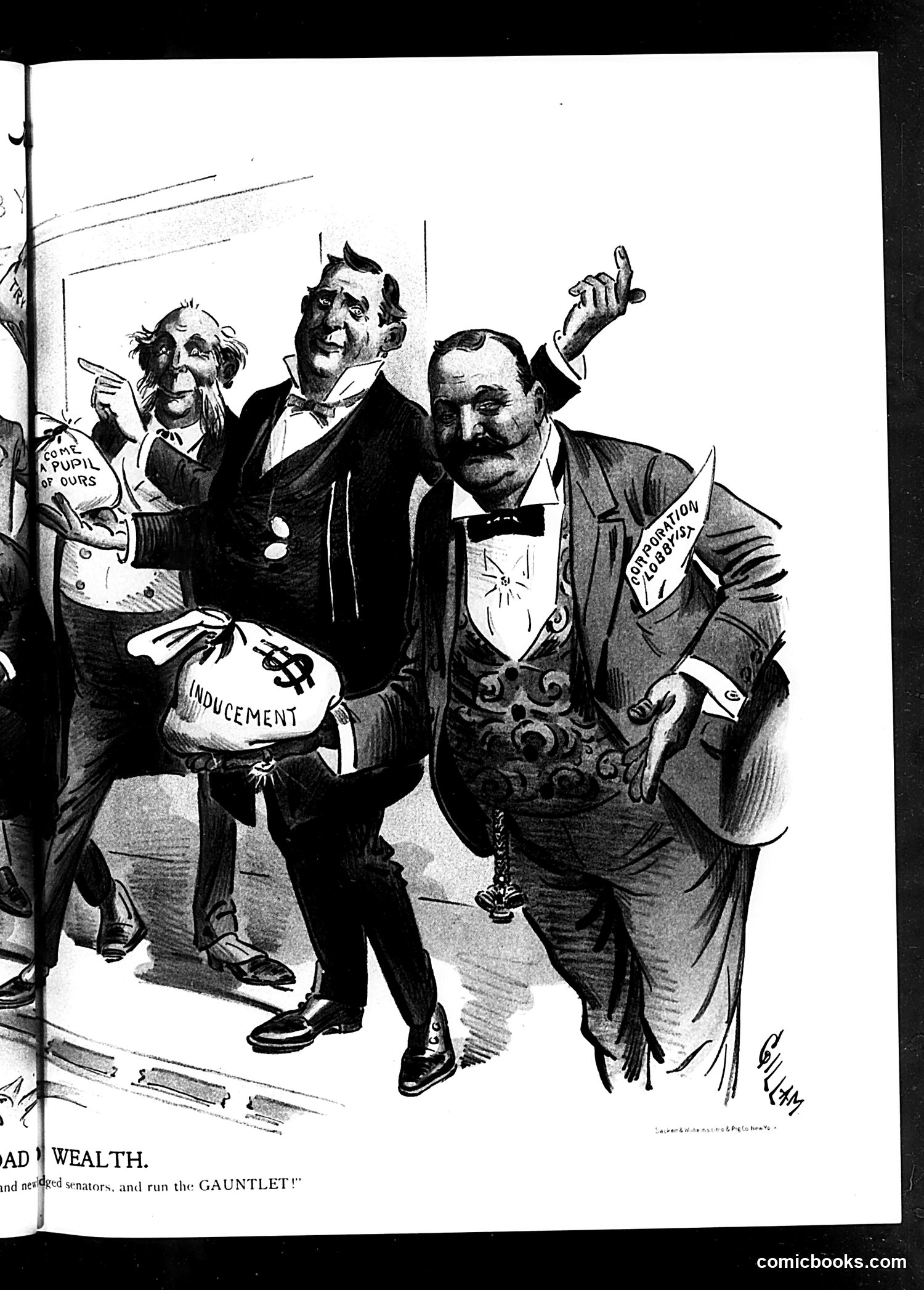
This Judge magazine cartoon satirizes political corruption and bribery in the late 19th or early 20th century. Three well-dressed men appear to be politicians or wealthy industrialists, with labels visible including "INDUCEMENT," "CORPORATION FAVOR," and what appears to be "COME PLUNDER OF OURS." The text references "registered senators" and "running the gauntlet," suggesting the cartoon criticizes how wealthy interests use money and favors to influence senators. The caricatures with exaggerated features were typical period satire style. The cartoon mocks the cozy relationship between big business and political office—showing how corporations literally hand out inducements to corrupt senators. This reflects Progressive Era concerns about monopolies and political reform, common Judge magazine themes attacking Gilded Age corruption.
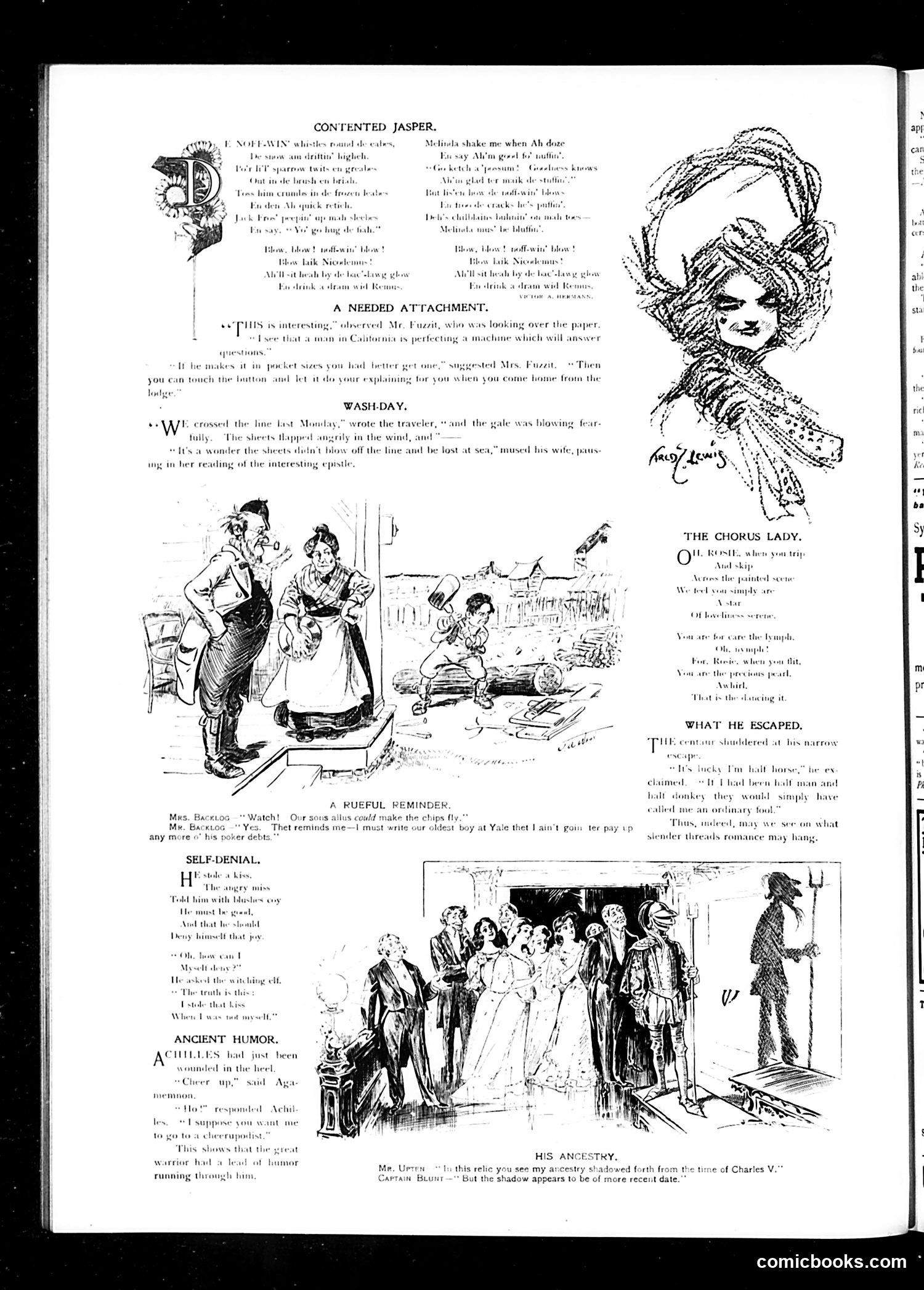
This page contains several unrelated humorous sketches typical of Judge's satirical format: **"Contented Jasper"** appears to be a dialect-heavy poem about an African American character, reflecting the period's racist entertainment conventions. **"A Needed Attachment"** jokes about a Californian inventing a machine that answers questions—Mrs. Fuzzi suggests a "pocket-sized" version for husbands, satirizing marital dynamics and male unavailability. **"Wash-Day"** is a domestic anecdote about sheets blowing away during laundry, playing on everyday household mishaps. **"The Chorus Lady"** and **"What He Escaped"** appear to reference theatrical/romantic situations, though details are unclear from the OCR. **"Ancient Humor"** presents Achilles and Agamemnon making jokes about war wounds, suggesting classical figures possessed modern sensibilities. The page's overall tone emphasizes domestic comedy, class humor, and period-specific social observations rather than direct political satire.
This page is primarily **advertisements** with incidental humor pieces, typical of early 20th-century American magazines. The notable satirical content includes: **"A Fellow Feeling"** (center-left): A temperance anecdote where a woman who judges drunks harshly becomes sympathetic after discovering her own coffee addiction parallels alcoholism. The joke ironically equates the two vices—suggesting middle-class coffee dependency is as compelling as working-class drinking, thus humanizing the "drunkard." **Legal humor** (top): A married man discusses his wife's throat surgery being "almost fatal" because she couldn't talk for six months. The joke relies on the period's domestic humor trope mocking wives' chattiness. **Farm humor** (bottom): A visitor from the city complains about deep snow; the farmer replies the oldest residents exaggerate past snowstorms. Standard rural-versus-urban comedy. The remaining content is straightforward product advertising (Postum, Packer's Tar Soap, Sohmer Pianos, champagne, ginseng tonics)—no political satire is evident on this particular page.
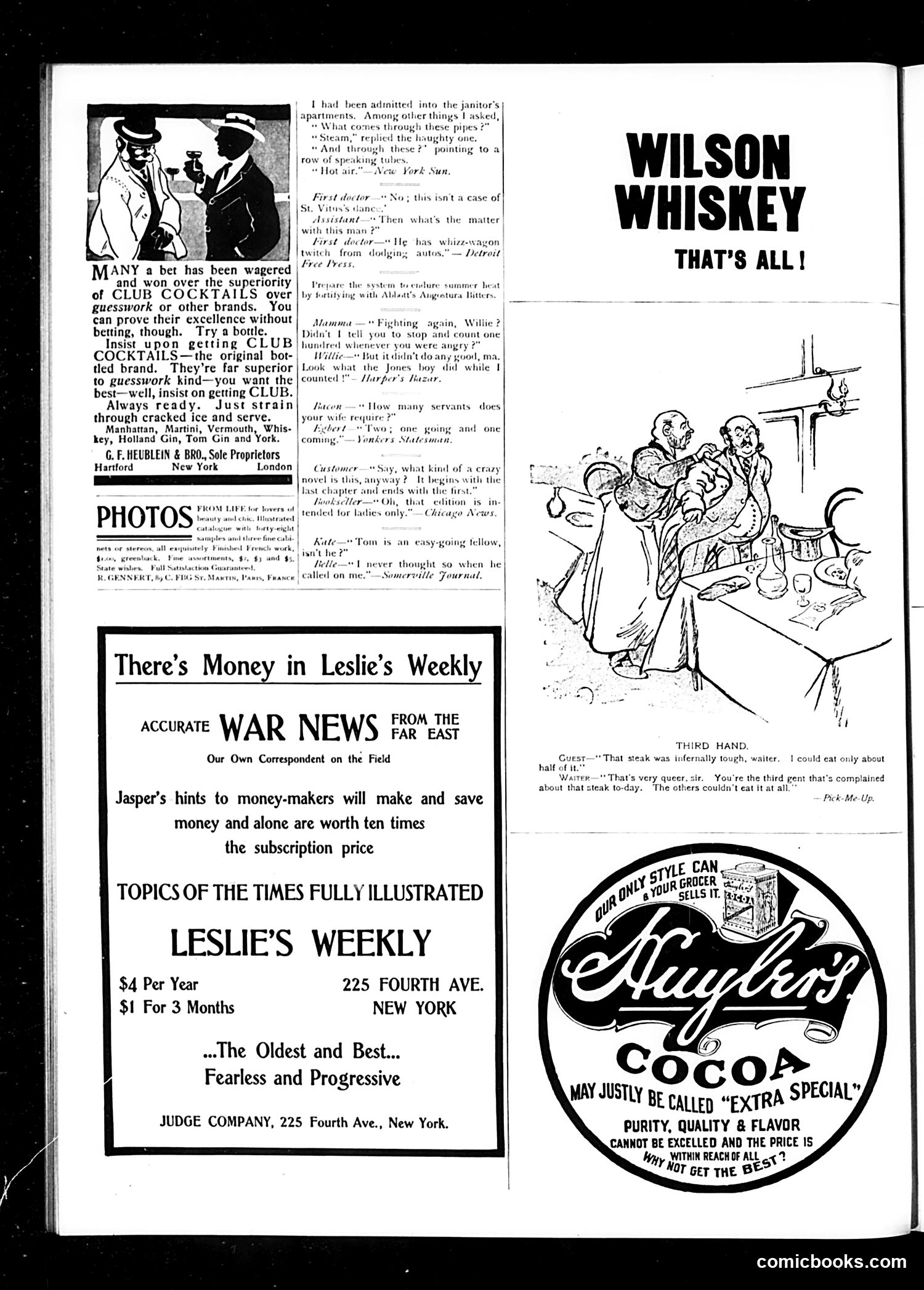
This page from *Judge* magazine contains several joke cartoons and advertisements typical of early 20th-century American humor. **Main Cartoon ("Third Hand"):** Shows three men at a table discussing a tough steak. The joke's humor relies on class commentary—a waiter reveals two previous wealthy diners also complained about the same steak but "couldn't eat it at all," implying they were too socially conscious to admit dissatisfaction, unlike this guest. It satirizes pretentious dining etiquette and social performance. **Smaller Jokes:** Include medical humor (a doctor dismissing a patient's complaint as "hot air"), domestic satire (a wife's servants constantly coming and going), and literary criticism (mocking confusing novels). **Advertisements:** The page is dominated by ads for Club Cocktails (emphasizing superiority over homemade versions), Wilson Whiskey, Leslie's Weekly (promoting war coverage), and Stayley's Cocoa. The content reflects early 20th-century preoccupations: class anxiety, urban sophistication, and consumer brand loyalty.
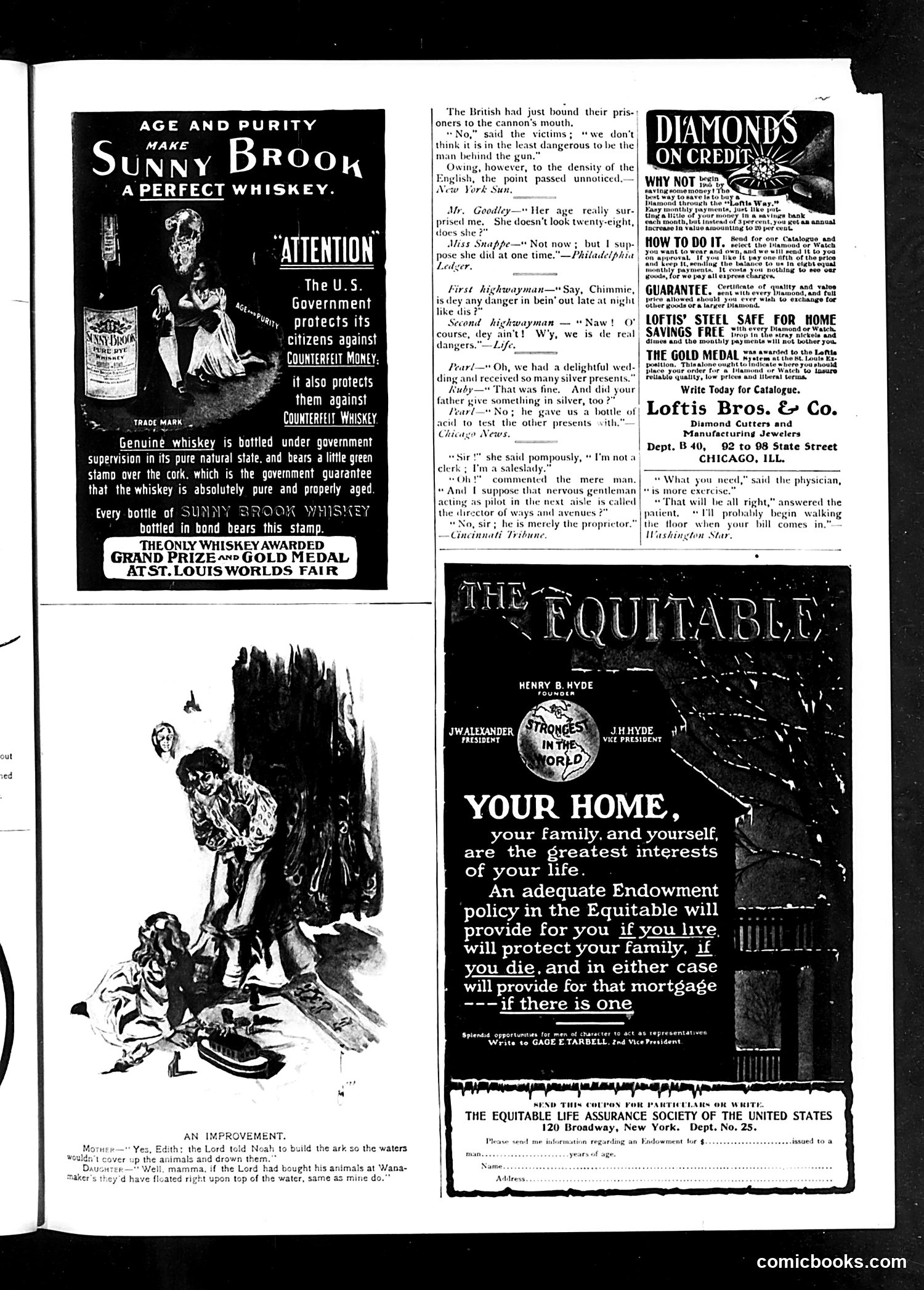
This page contains **primarily advertisements** with minimal editorial cartoon content. The **Sunny Brook whiskey ad** (left) uses government authority as a sales pitch, claiming the U.S. Government protects citizens against counterfeit whiskey just as it does counterfeit money. The "green stamp" serves as a guarantee of purity—a regulatory assurance that would have been novel and persuasive to early-1900s readers concerned about adulterated products. The **small humor pieces** (center) are brief jokes: one about a woman's age, another about late-night danger for "highwaymen" (criminals), and observations about church weddings and doctors' bills. These are gentle, disconnected gags typical of *Judge* magazine's satirical humor section. The **Equitable Life Insurance ad** (right) emphasizes that home, family, and financial security are life's greatest interests, promoting endowment policies as protection against mortgage debt—addressing middle-class anxieties about financial stability. The page reflects early-1900s concerns: product safety, class anxieties, and mortality/financial security.
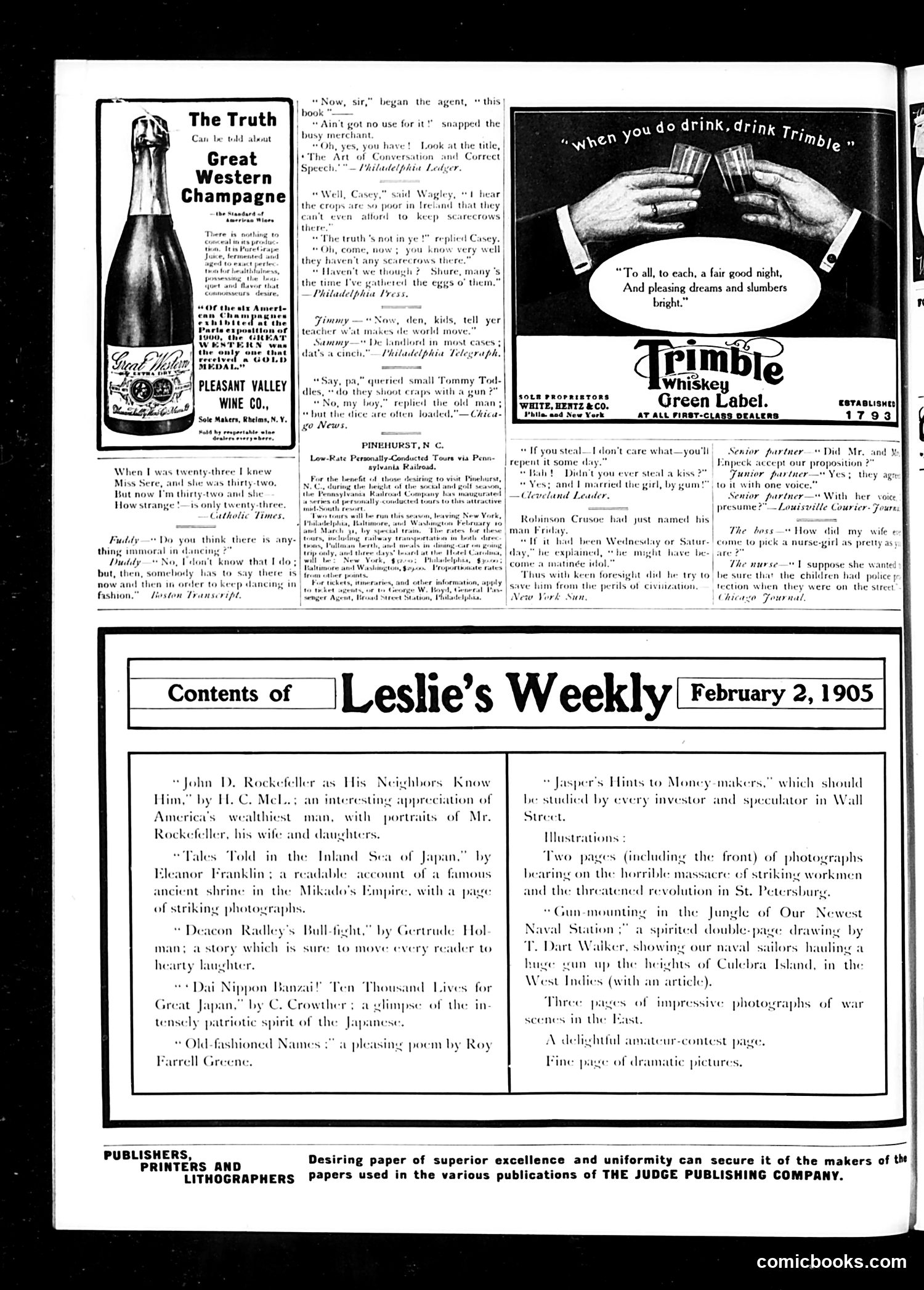
This page from Judge (February 2, 1905) is primarily a contents page and advertisements rather than a political cartoon. The main visual elements are ads for **Great Western Champagne** and **Trimble Green Label whiskey**. The page promotes Judge's upcoming articles, including pieces on **John D. Rockefeller**, Japanese patriotism, and coverage of the **Russian Revolution in St. Petersburg** (the "horrible massacre of striking workmen" mentioned). This references the 1905 Russian Revolution, a contemporary major event. Small humorous dialogues scattered throughout joke about dancing, stealing kisses, and Irish immigrant dialects—typical of the era's popular humor, though the Irish stereotypes now read as offensive. The Trimble whiskey ad uses the slogan "When you do drink, drink Trimble"—standard turn-of-the-century liquor marketing that would later be restricted by Prohibition (1920). Nothing here represents explicit political satire; it's rather a snapshot of Judge's interests and advertising practices in early 1905.
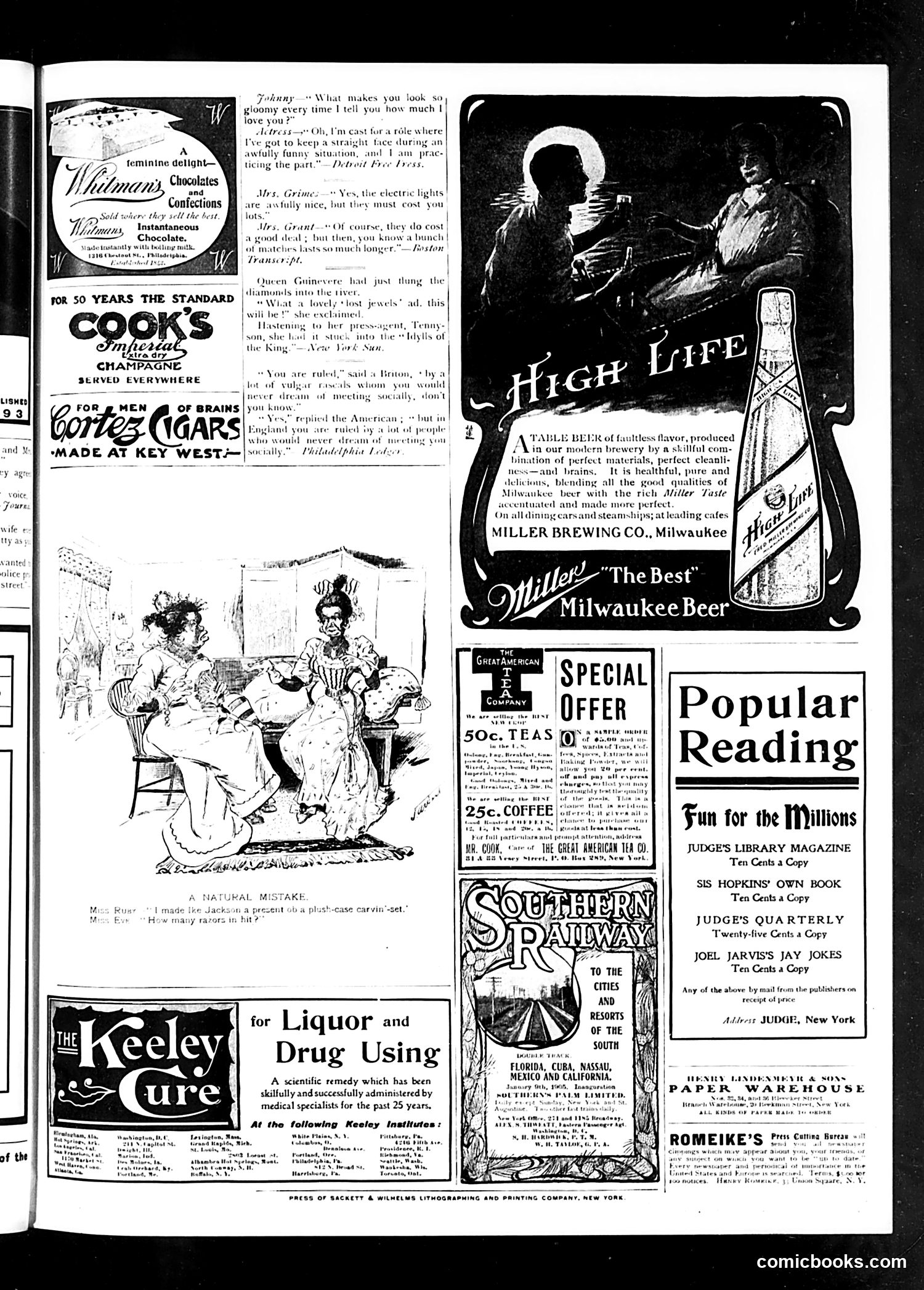
This page is primarily **advertising**, typical of Judge magazine's revenue model. The cartoons present brief romantic/domestic humor: The opening cartoon shows a couple where the woman appears melancholy despite professions of love—she's an actress "practicing" to keep a straight face during funny scenes, so she can't authentically react to her boyfriend's sentiments. It's mild observational humor about theatrical training conflicting with real emotion. The page is dominated by period advertisements for **Whitman's Chocolates, Cook's Champagne, Cortes Cigars, Miller Beer, The Keeley Cure** (a controversial addiction treatment), and various Judge publications and books. One notable ad promotes **The Keeley Cure**, a "scientific remedy" for "Liquor and Drug Using"—reflecting early 20th-century attitudes toward addiction treatment, now recognized as dubious. The **Miller Beer ad** emphasizes modern brewery science and "perfect materials," marketing industrial brewing as superior. Overall, this reflects Judge's dual function: satirical commentary mixed with advertisements targeting affluent, educated readers interested in entertainment, spirits, and self-improvement products.
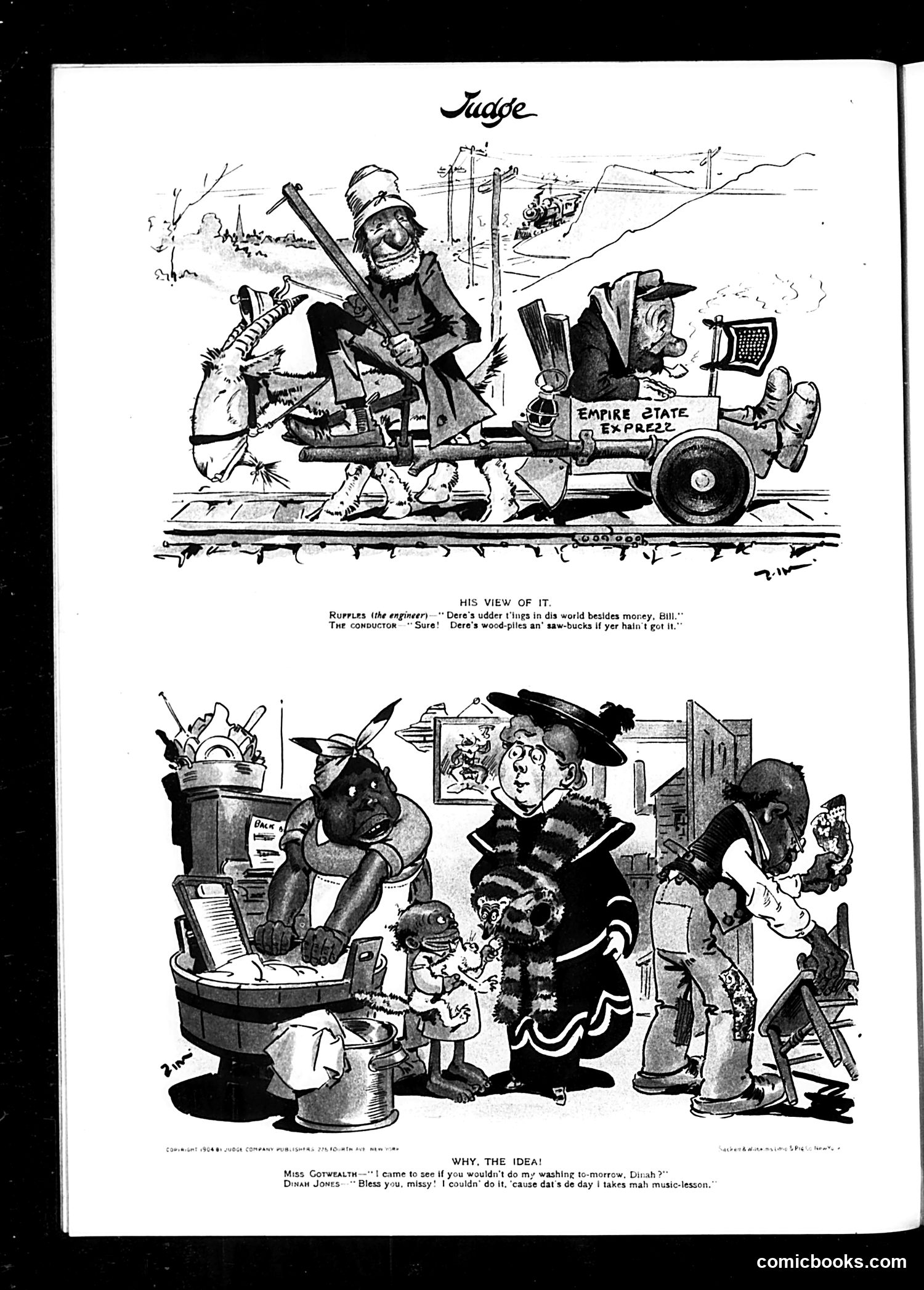
This page contains two satirical cartoons mocking labor and social hierarchies of the era. **Top cartoon ("His View of It"):** Shows an "Empire State Express" train operated by working-class characters (Ruffles the engineer and a conductor). The joke satirizes workers' priorities—the conductor suggests that without money, one must resort to manual labor like cutting wood or building sawbucks, reducing human worth to economic survival. **Bottom cartoon ("Why, the Idea!"):** Depicts a wealthy white woman (Miss Gorwealth) asking a Black domestic worker (Dinah Jones) to do her laundry. The satire critiques entitlement: Dinah refuses because she has a music lesson—inverting expected social deference. The "idea!" expresses the employer's shock that her employee won't accommodate her demands, suggesting Judge's satirical commentary on class presumption and servant exploitation during this period. Both cartoons employ period-typical dialect and caricature to highlight social inequality.