
A complete issue · 16 pages · 1904
Judge — December 3, 1904
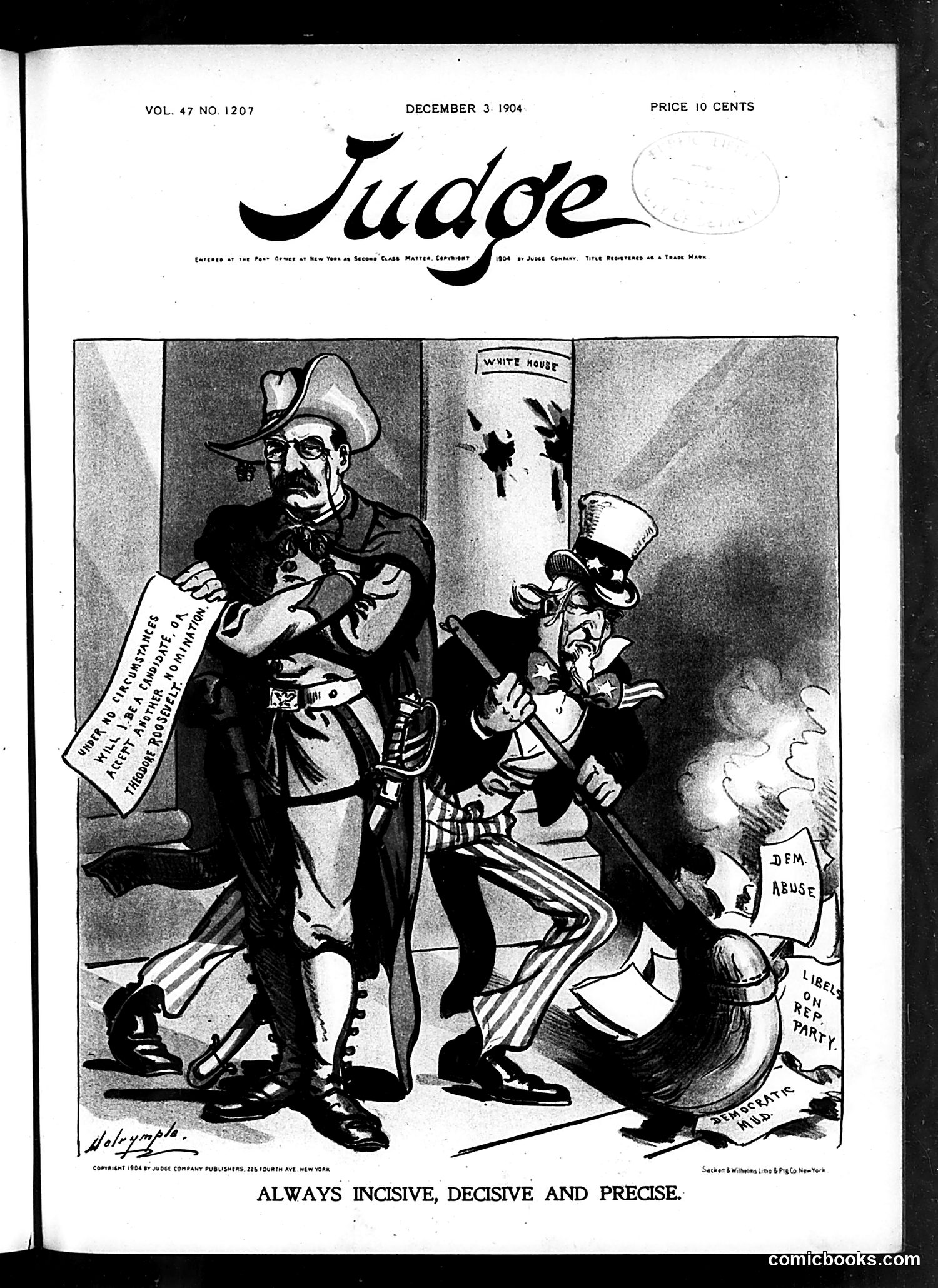
This *Judge* magazine cover from December 3, 1904 depicts a confrontation at the White House between a military or imperialist figure (left, wearing a wide-brimmed hat and holding documents labeled "QUERY TO SECRETARY" and what appears to be policy papers) and Uncle Sam (right, recognizable by his starred top hat and striped pants). The cartoon appears to criticize American foreign or military policy during Theodore Roosevelt's presidency. The figure on the left likely represents an aggressive military or imperial interest, while Uncle Sam's defiant posture suggests resistance. The title "Always Incisive, Decisive and Precise" seems ironic—mocking the administration's approach to governance or international affairs. The exact policy being satirized requires additional historical context to confirm.
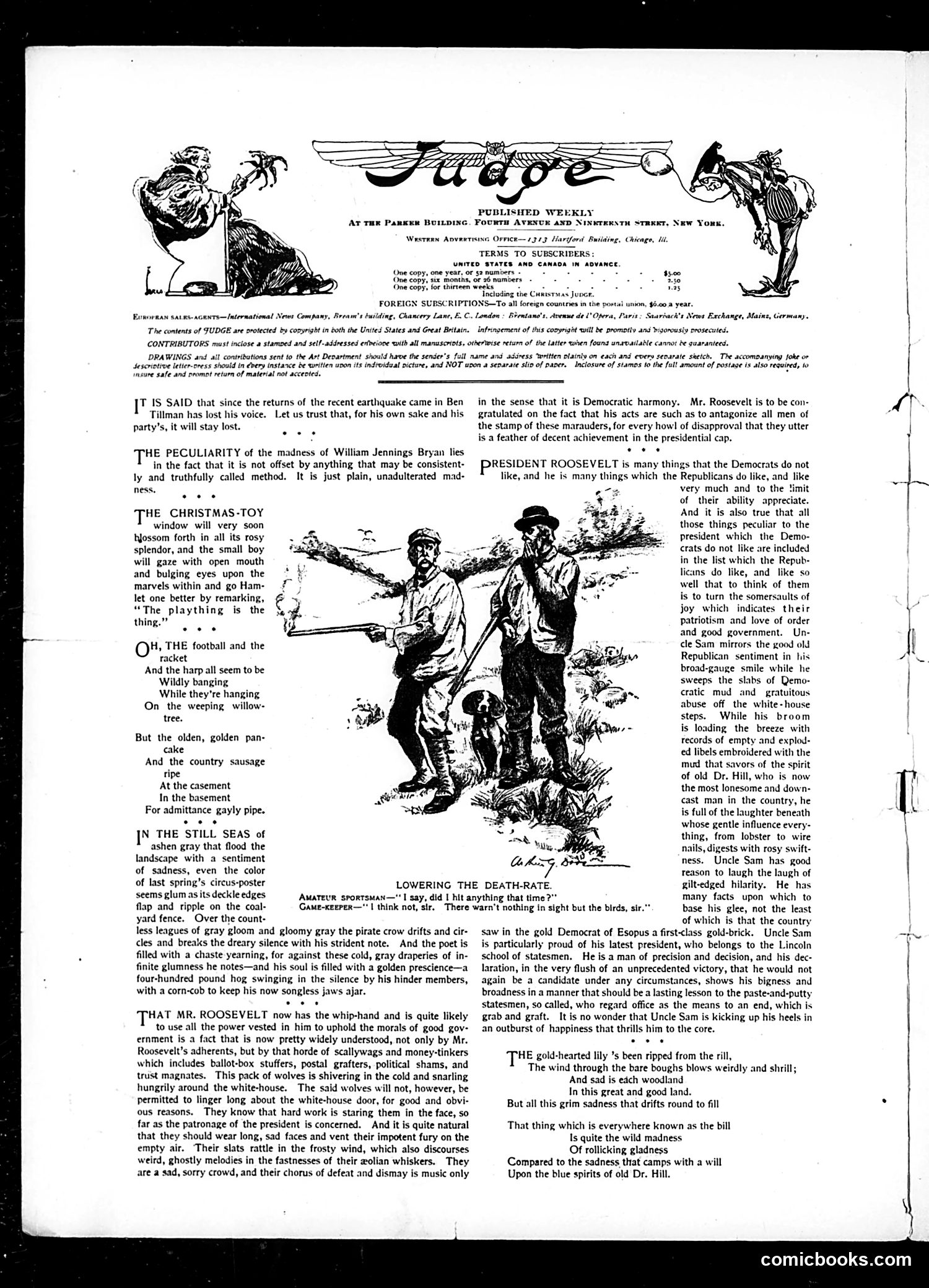
This page contains political commentary about President Roosevelt and the Democratic Party, alongside poetry and a central illustration titled "Lowering the Death-Rate." The main cartoon depicts two men (appearing to be sportsmen or laborers) with a dog, illustrating a humorous exchange about hunting—one asks "did I hit anything that time?" and the other responds about birds, not hitting anything. The accompanying text criticizes Roosevelt for his inconsistency, noting he embodies traits both Democrats and Republicans dislike. It praises "Uncle Sam" as a steadying patriotic force clearing away "Democratic mud and giftless abuse." The poetry celebrates traditional American values—Christmas, football, and rural life—contrasting them with urban political corruption. Overall, the page satirizes Democratic governance while positioning Republican/patriotic values as morally superior.
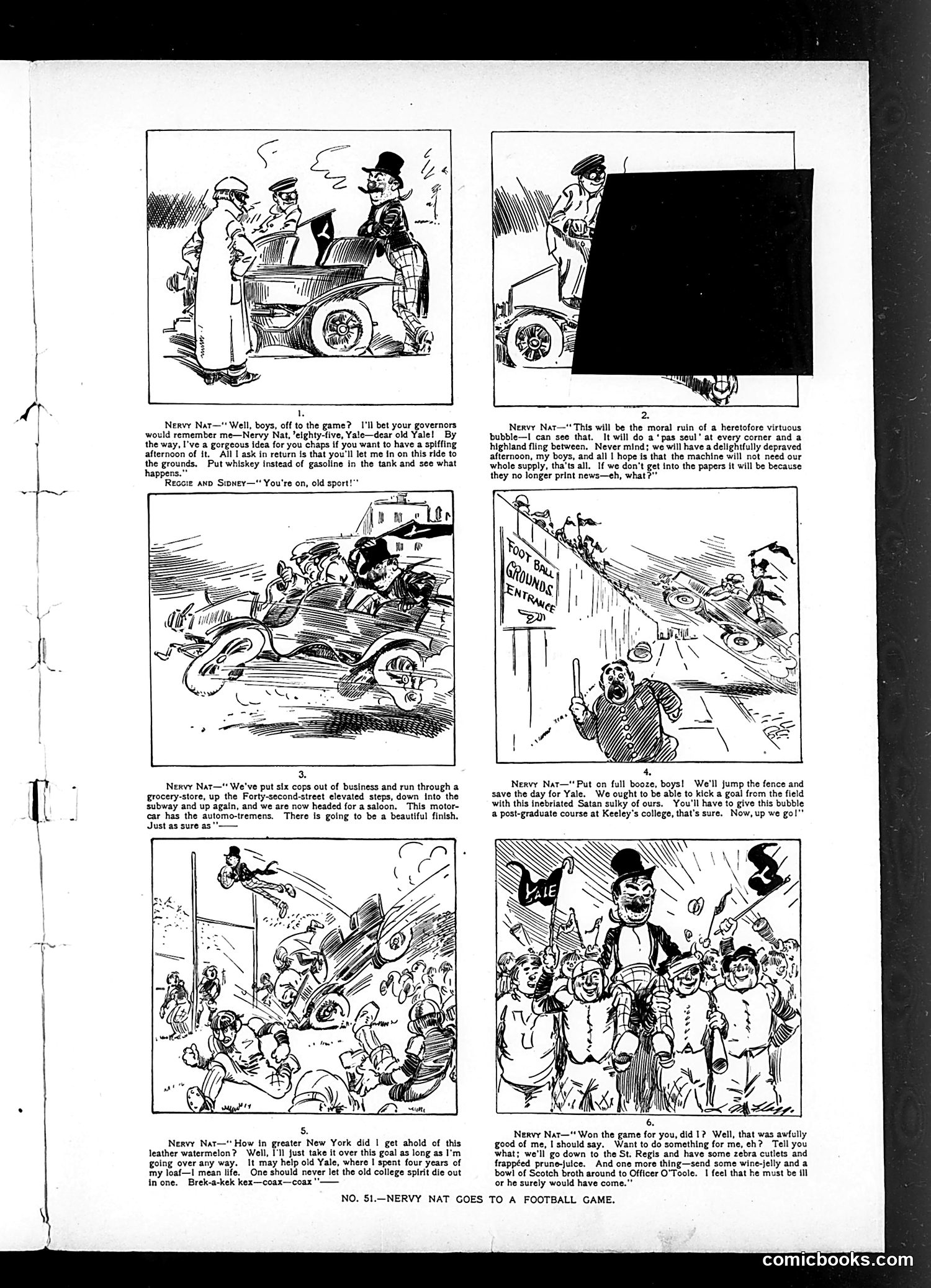
This is a comic strip featuring "Nervy Nat," a recurring character in Judge magazine. The narrative follows Nat as he attends a football game, apparently attempting an elaborate scheme involving a car and obtaining money from wealthy individuals ("governors" and "Yale" are mentioned). The strip satirizes early 1900s automobile culture—depicting cars as novel, unreliable contraptions prone to breakdown. Nat's scheme involves using the vehicle to impress or swindle people, promising rides and collecting payment. The final panels show him at the football game itself, where the joke culminates in typical slapstick fashion with chaos ensuing. The satire targets both automotive technology's infancy and con-artist schemes that exploited public fascination with new inventions during this era.
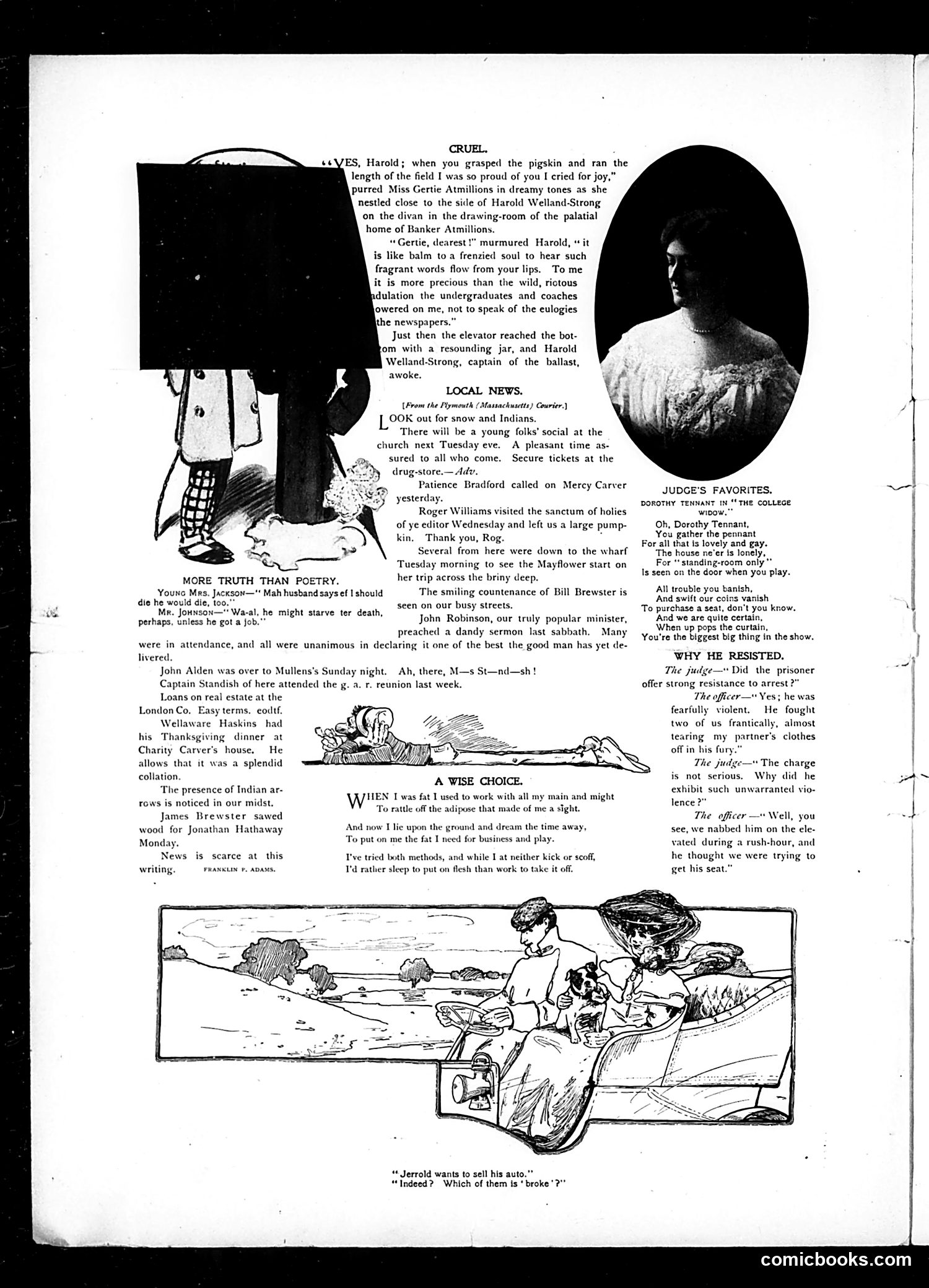
This page contains mixed editorial content rather than explicit political satire. The main sections include: **"Judge's Favorites"** features Dorothy Tremaine with a poem about college life—typical light social commentary. **"Why He Resisted"** presents a courtroom dialogue where a judge questions an officer about arresting someone during a "rush-hour" arrest. The humor hinges on the officer's admission that the arrested person "fearfully violent" and fought them—suggesting the arrest itself may have been unnecessarily rough. It's social criticism of police conduct, albeit gentle. **"More Truth Than Poetry"** offers brief humorous anecdotes about everyday life. The bottom illustration shows children playing, captioned about selling a car—simple domestic humor. Overall, this appears to be a lighter entertainment-focused issue without major political targets, emphasizing social observation and domestic comedy typical of early 20th-century Judge magazine.
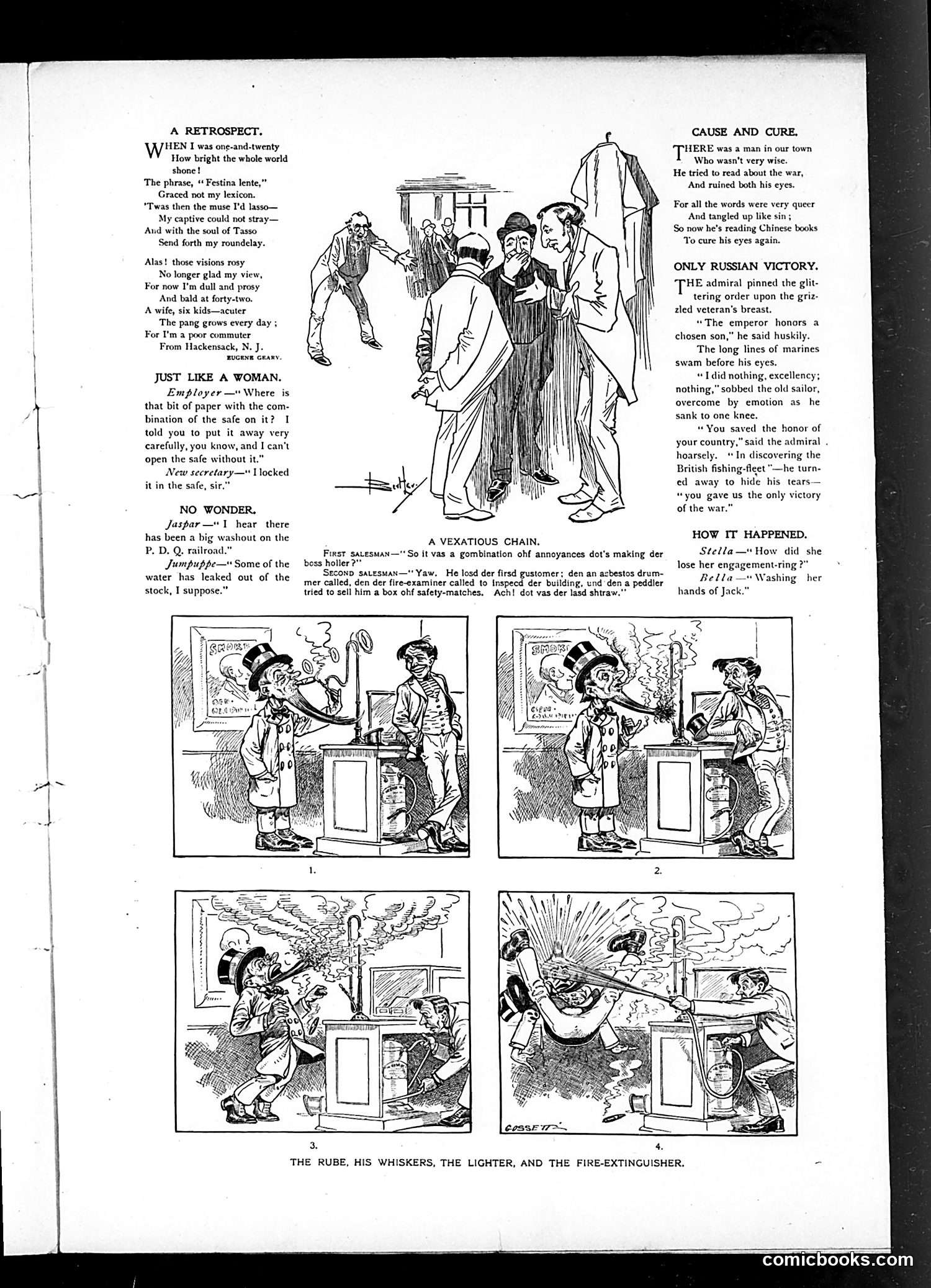
This is a 1915-era satirical magazine page containing humor pieces reflecting WWI anxieties and period social commentary. **Main cartoons:** The four-panel "Rube, His Whiskers, the Lighter, and the Fire-Extinguisher" depicts slapstick chaos—a man's magic tricks with these items gone spectacularly wrong, ending in explosion. This is purely comedic visual humor, typical of early-20th-century illustrated gags. **Text pieces** include: - "Retrospect": A poet lamenting lost youth and artistic dreams, now reduced to commuting from New Jersey—satirizing the mundane reality crushing artistic ambition - "Only Russian Victory": Dark WWI satire. An admiral awards a veteran for discovering the British fishing fleet (the war's only Russian "victory"?), mocking Russia's military failures - Various short jokes playing on ethnic accents (Yiddish/German dialects), period stereotypes, and domestic situations **Overall tone:** The page reflects wartime disillusionment, class anxiety, and casual ethnic humor characteristic of 1910s American satire—points now dated or offensive to modern readers.
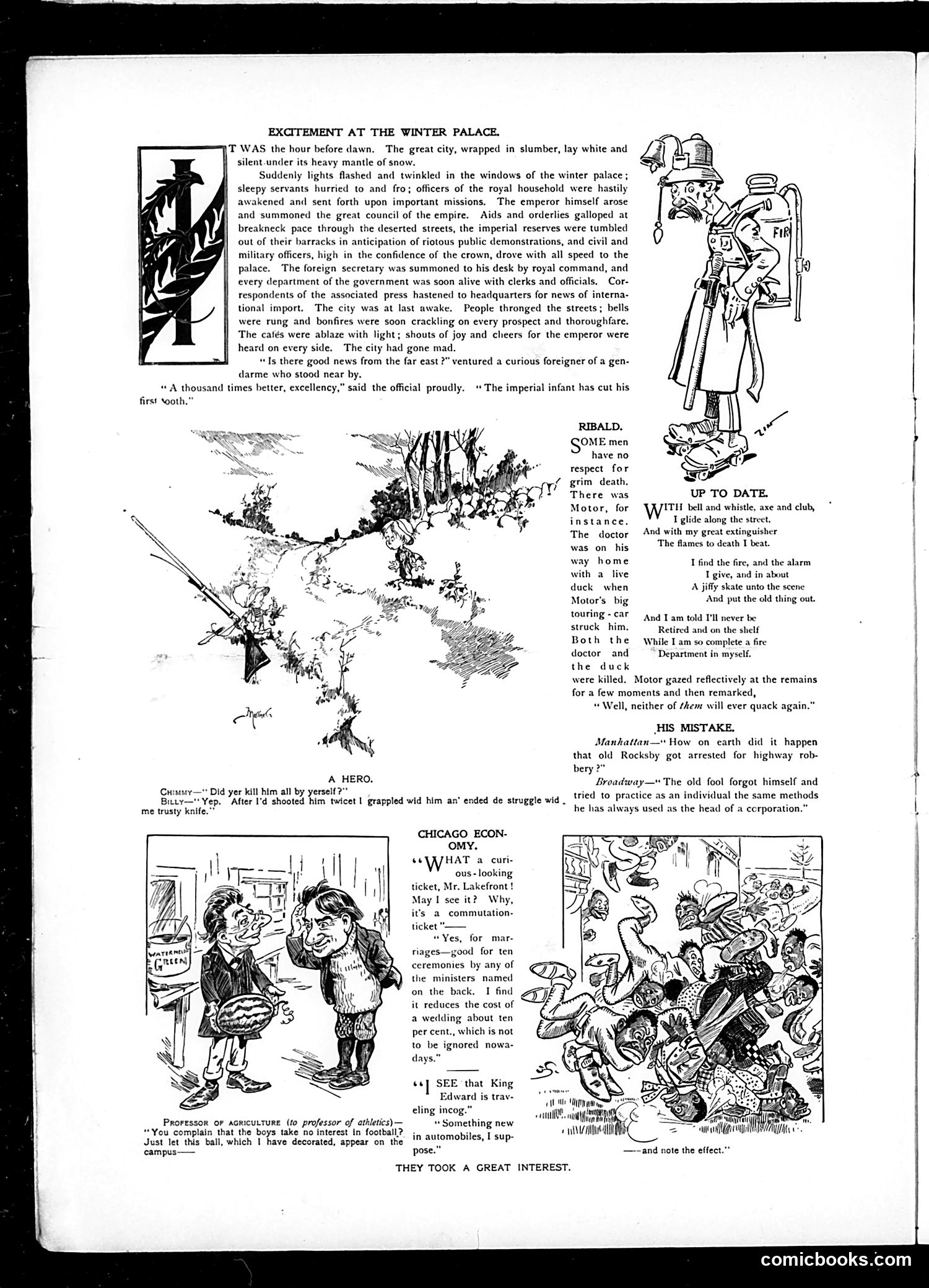
This page contains multiple satirical cartoons and jokes typical of early 20th-century American humor: **"Excitement at the Winter Palace"** mocks Russian imperial bureaucracy, likely referencing the Russian court's dramatic reactions to minor events (the "imperial infant has cut his first tooth"). The satire criticizes overblown governmental responses and courtly pageantry. **"Ribald" and other short jokes** are crude Victorian-era humor about death, automobiles, and social situations—typical filler content of the era. **"Chicago Economy"** satirizes working-class frugality, depicting a man using a commutation ticket (valid for multiple train rides) as a "marriage ticket" for ten ceremonies, reducing wedding costs by 10%. It mocks both penny-pinching and casual attitudes toward matrimony. **"They Took a Great Interest"** appears to criticize a businessman who applied corporate practices to personal life, suggesting the absurdity of treating individual matters with corporate methodology. The page reflects Judge's focus on lampooning social pretension, bureaucratic excess, and contemporary urban life.
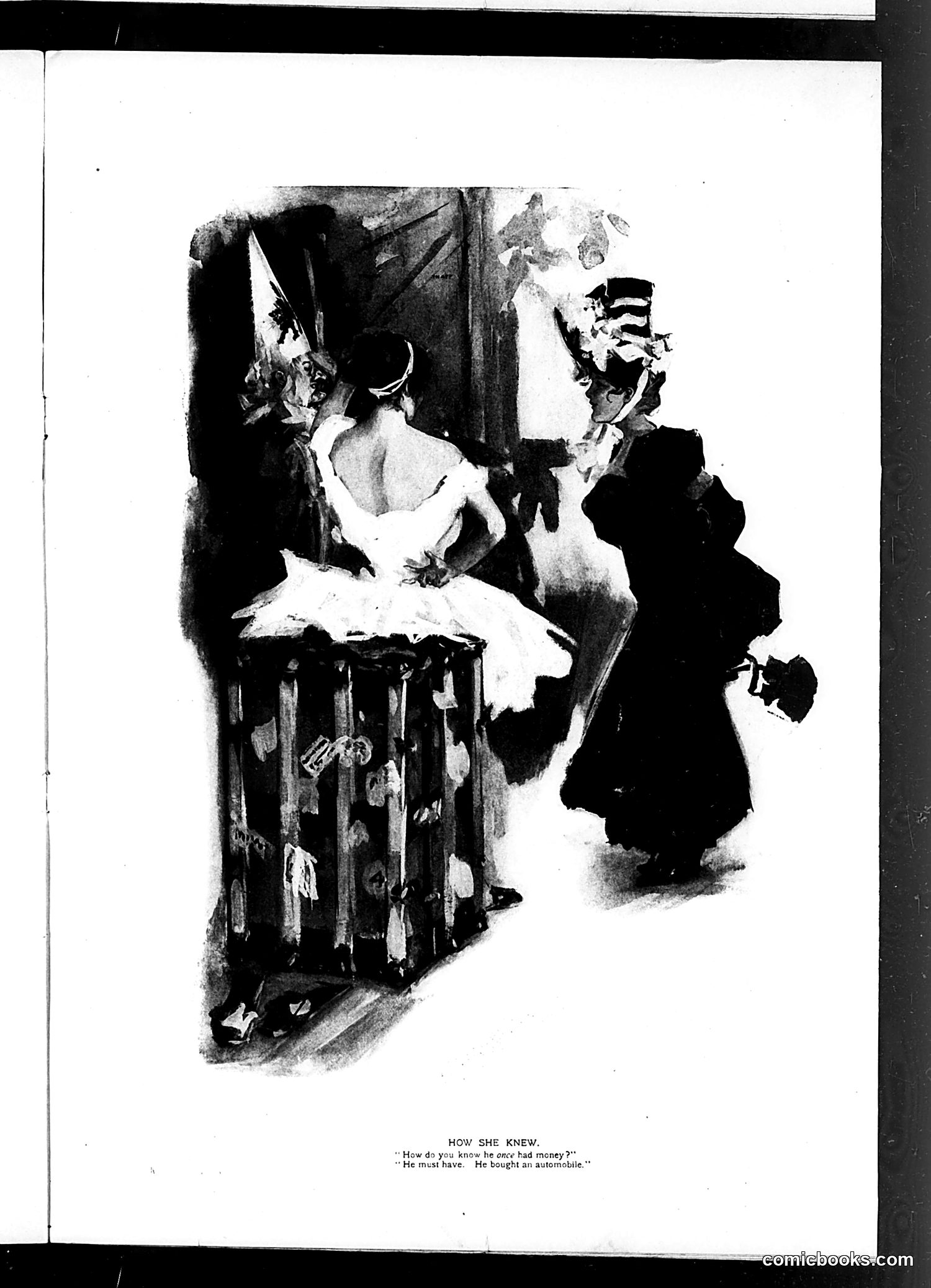
This satirical cartoon mocks the ostentatious spending habits of the newly wealthy or those pretending to wealth. A fashionably dressed woman in a white ball gown observes a man in formal attire, deducing from his automobile purchase that he must have once possessed considerable money—implying he has since squandered it. The joke targets the era's automobile enthusiasm as a marker of wealth and poor financial judgment. By the early 1900s, cars were expensive luxury items. The cartoon suggests that buying an automobile was such an extravagant, status-conscious expenditure that it could only indicate someone had previously accumulated significant wealth, now likely depleted through frivolous spending. It's social satire on class pretensions and financial irresponsibility among the wealthy.
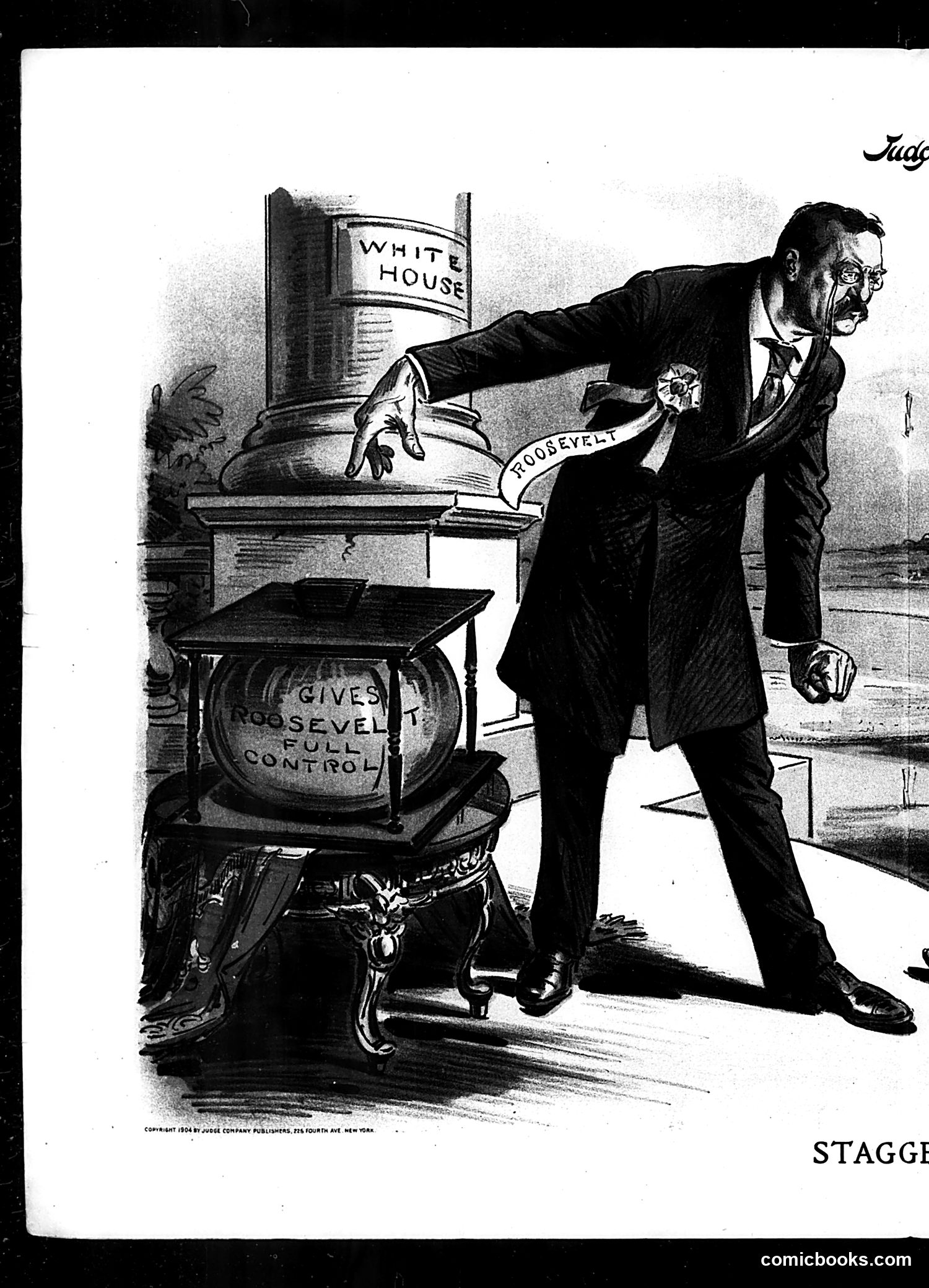
This 1904 Judge magazine cartoon depicts a man in formal dress at the White House, juggling what appears to be spheres labeled "Roosevelt" and "gives Roosevelt control." The man appears caricatured with exaggerated facial features typical of early-20th-century political satire. The cartoon likely satirizes Theodore Roosevelt's expanding executive power during his presidency. The "White House" sign and juggling imagery suggest commentary on Roosevelt's manipulation of political control or his balancing act between competing interests. The title "STAGGI" (possibly "Stage") reinforces the theatrical/performative nature of the critique. Without clearer labeling identifying the main figure, I cannot definitively state who is being satirized alongside or instead of Roosevelt, though the cartoon clearly critiques power dynamics in his administration.
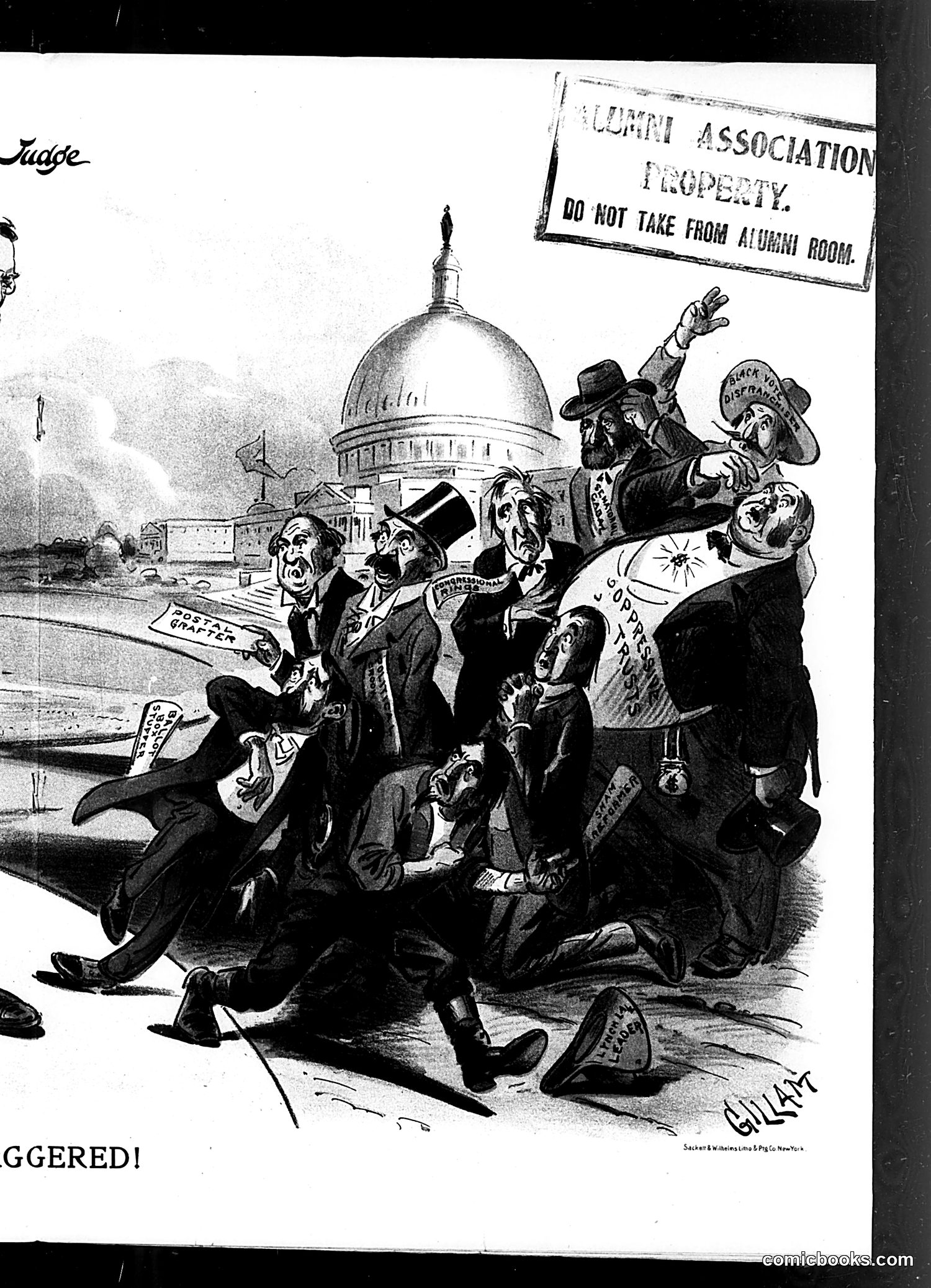
This Judge magazine cartoon depicts a group of men in formal attire scrambling near the U.S. Capitol building. The sign reads "ALUMNI ASSOCIATION PROPERTY. DO NOT TAKE FROM ALUMNI ROOM," suggesting these figures are being caught stealing or misappropriating something belonging to an alumni organization. The caricatured figures appear to be politicians or public officials engaged in corrupt behavior—the cartoon's title "GGERED!" (likely "triggered" or suggesting they've been caught) reinforces this. Their exaggerated facial expressions and body language convey panic and guilt. The satire critiques political corruption and theft of public/organizational property, a common Judge magazine theme. Without specific dates or clearer identifying labels, the exact political figures or scandal referenced remain unclear, though the cartoon clearly mocks government malfeasance and dishonesty.
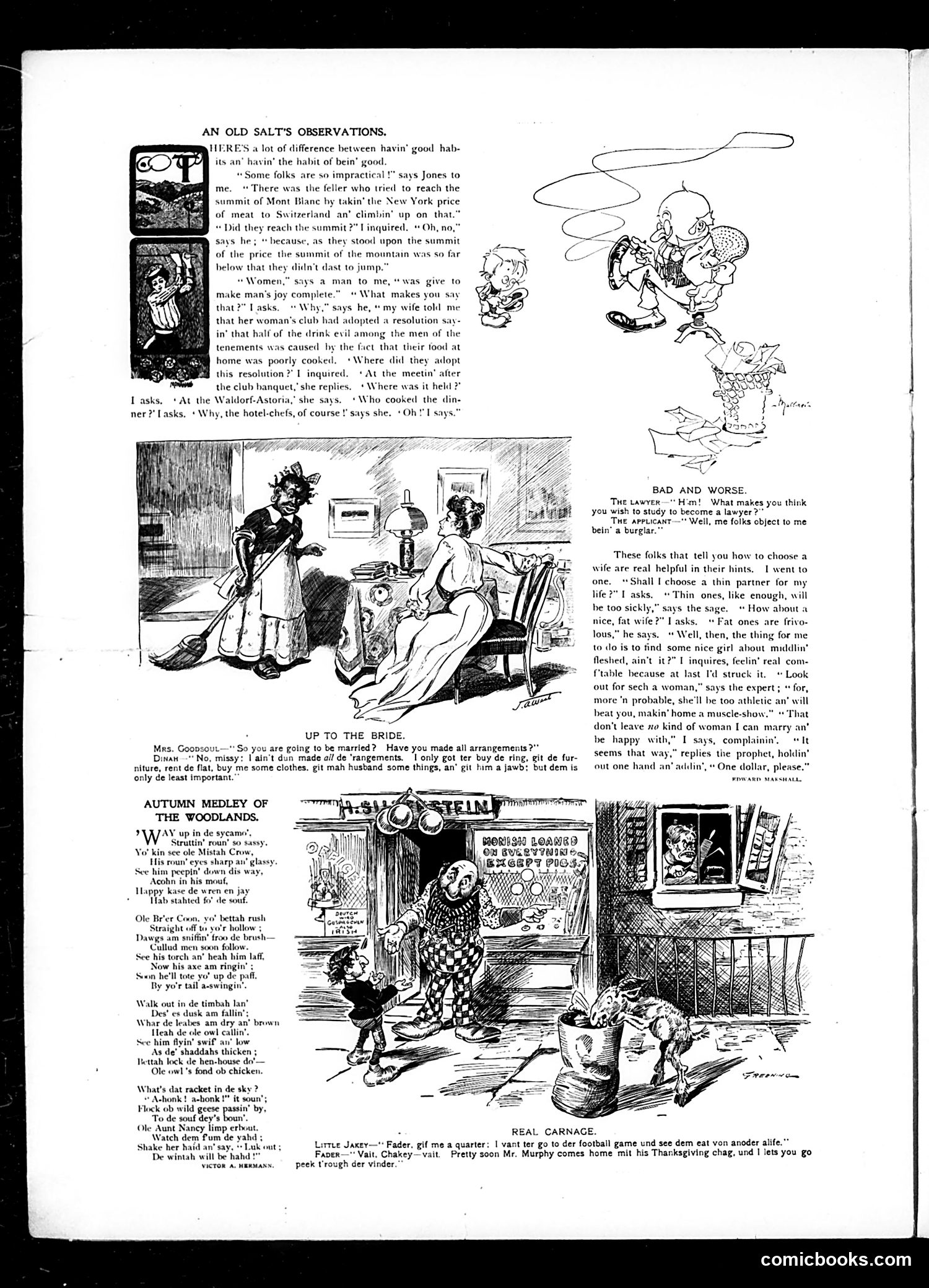
This 1910s *Judge* magazine page contains humorous observations and cartoons satirizing American social life: **"An Old Salt's Observations"** features a seasoned narrator offering cynical wisdom about impracticality, marriage, and hypocrisy. The Mont Blanc anecdote mocks absurd logic; the women's club story ridicules reformers—a ladies' group condemns working-class drinking while meeting at the luxury Waldorf-Astoria hotel, oblivious to their own privilege. **"Bad and Worse"** and **"Up to the Bride"** joke about marriage and career choices, reflecting period anxieties about choosing spouses and professions. **"Autumn Medley of the Woodlands"** is dialect verse in African American vernacular—typical of era magazines—depicting rural nature scenes with animals. **"Real Carnage"** shows a working-class immigrant father (German accent evident) promising his son a quarter for a football game; he'll soon let him watch violence when the neighbor returns from Thanksgiving, suggesting domestic violence was treated as comedic fodder. The page reflects early 20th-century satirical humor: class commentary, ethnic stereotyping, and casual treatment of social problems as punchlines.
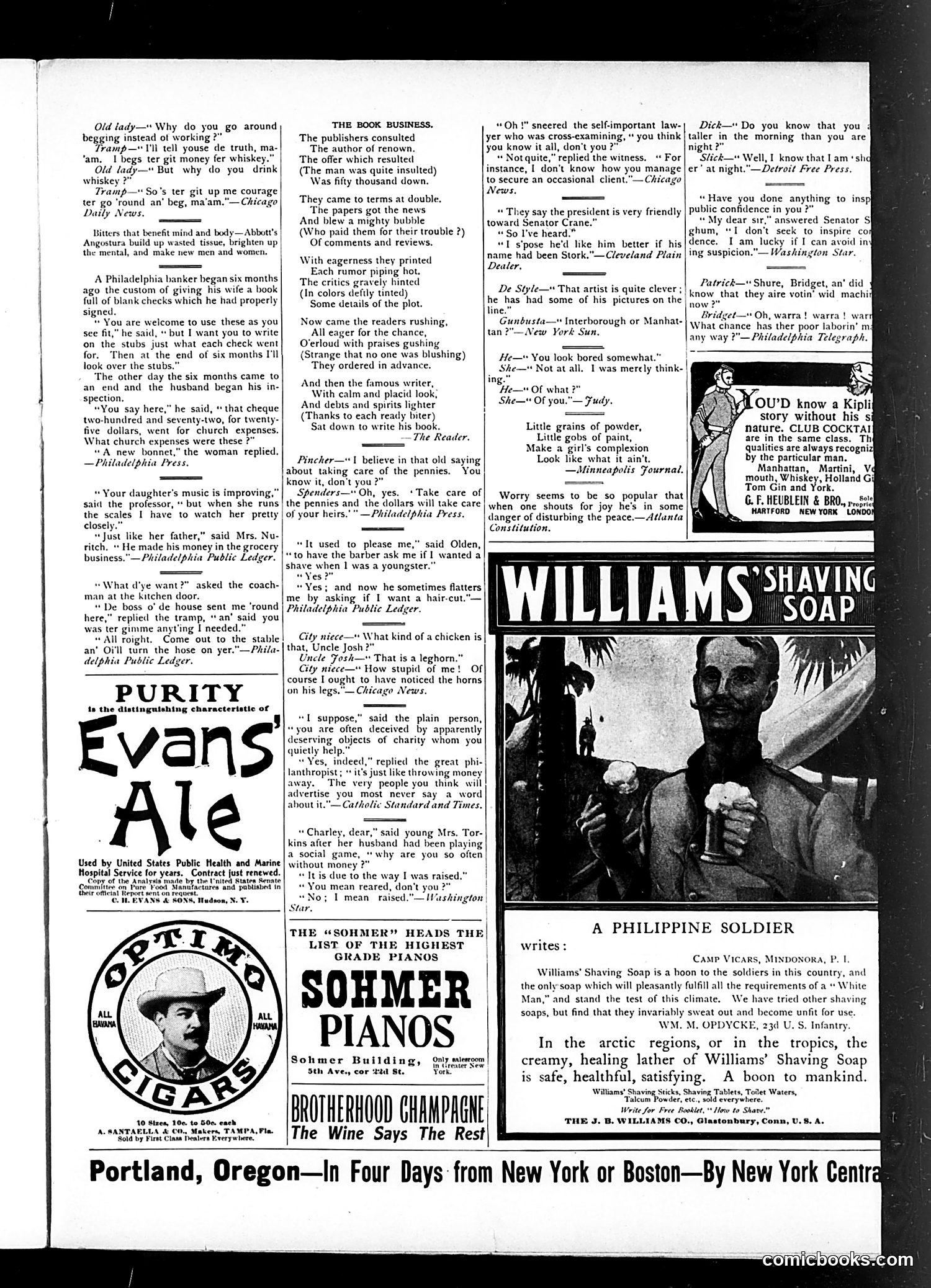
This page is primarily **advertising with interspersed short humor pieces** rather than political cartoons. The content includes: **Main Features:** - Multiple joke exchanges on various topics (begging, publishing, presidential politics, law testimony) - A Williams' Shaving Soap advertisement featuring a photograph of "A Philippine Soldier," promoting the product as suitable for tropical climates - Ads for Evans Ale, Sohmer Pianos, Optimo Cigars, and Brotherhood Champagne **Social Context:** The Philippine Soldier reference reflects American imperialist interests following the Spanish-American War (1898) and subsequent Philippine-American War. Marketing to soldiers in colonial settings was contemporary advertising strategy. **Humor Style:** The jokes use dialect humor (Irish and working-class characters), legal/marital satire, and publishing industry mockery—typical Judge magazine fare. No specific political figures appear identifiable in these particular pieces. The page demonstrates how advertising and entertainment mixed in early 20th-century American magazines.
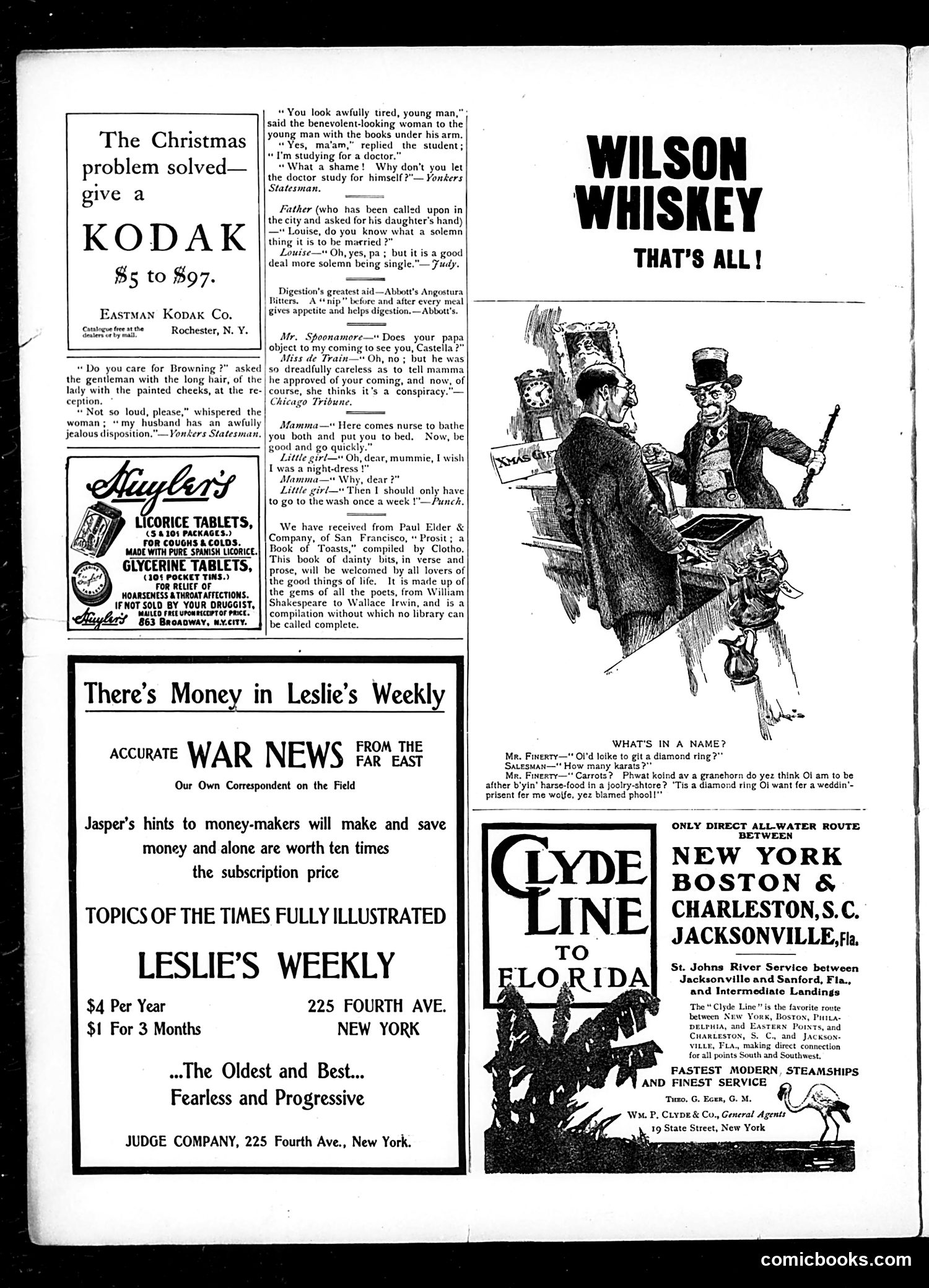
This page from *Judge* magazine (a satirical publication) contains primarily **advertisements and humor columns**, not political cartoons with specific figures. The content includes: **Humor pieces**: Brief jokes on domestic and social themes—a student studying medicine, a father's disapproval of his daughter's engagement, a woman worried her husband is jealous. These are gentle satirical observations of everyday life rather than political commentary. **"What's in a Name?" cartoon**: Shows an Irish immigrant (indicated by dialect: "karats"/"carrots," "wolfe"/"wife") comically misunderstanding "carats" as horse food when shopping for a diamond ring. The joke plays on ethnic stereotypes and language barriers common in early 20th-century American humor. **Advertisements**: The page is dominated by ads for Kodak cameras, patent medicines (licorice tablets, Angostura bitters), Leslie's Weekly magazine, Clyde Line steamships, and Wilson Whiskey. This appears to be a typical *Judge* interior page mixing light social satire with commercial advertising, rather than focusing on political issues or identifiable public figures.
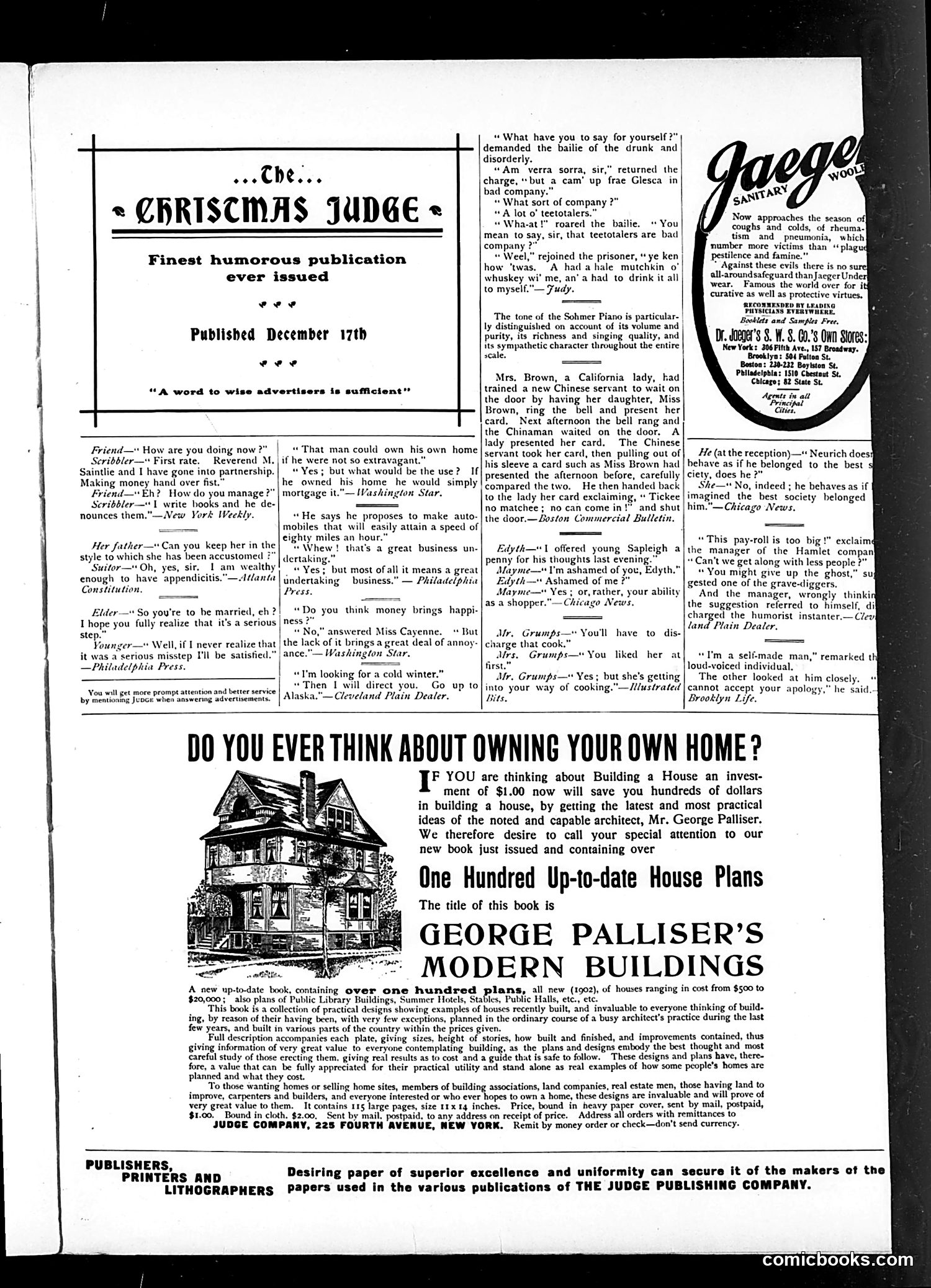
This is primarily a **title/contents page** from Judge magazine's Christmas 1918 issue, showcasing humorous short jokes rather than political cartoons. The jokes satirize everyday American life: a writer and clergyman's profitable partnership (mocking mutual hypocrisy), a suitor's wealth through appendicitis (gallows humor about medical expenses), marriage anxieties, extravagance and mortgages, automobile speed claims, Scottish drunkenness versus teetotalers, a Chinese servant's literal-minded card-matching, and domestic cooking complaints. One anecdote mocks a newly-trained Chinese servant who rigidly applies instructions—comparing a visitor's card to the training example and refusing entry because it doesn't match. This reflects period attitudes toward Chinese immigrants as mechanical or literal-minded. The page also advertises **Sohmer pianos** and **Jaeger underwear** (claiming health benefits against winter illness), plus a book of house plans by architect George Palliser. These are mild, domestic-focused jokes typical of Judge's era—no overtly political content is visible on this particular page.
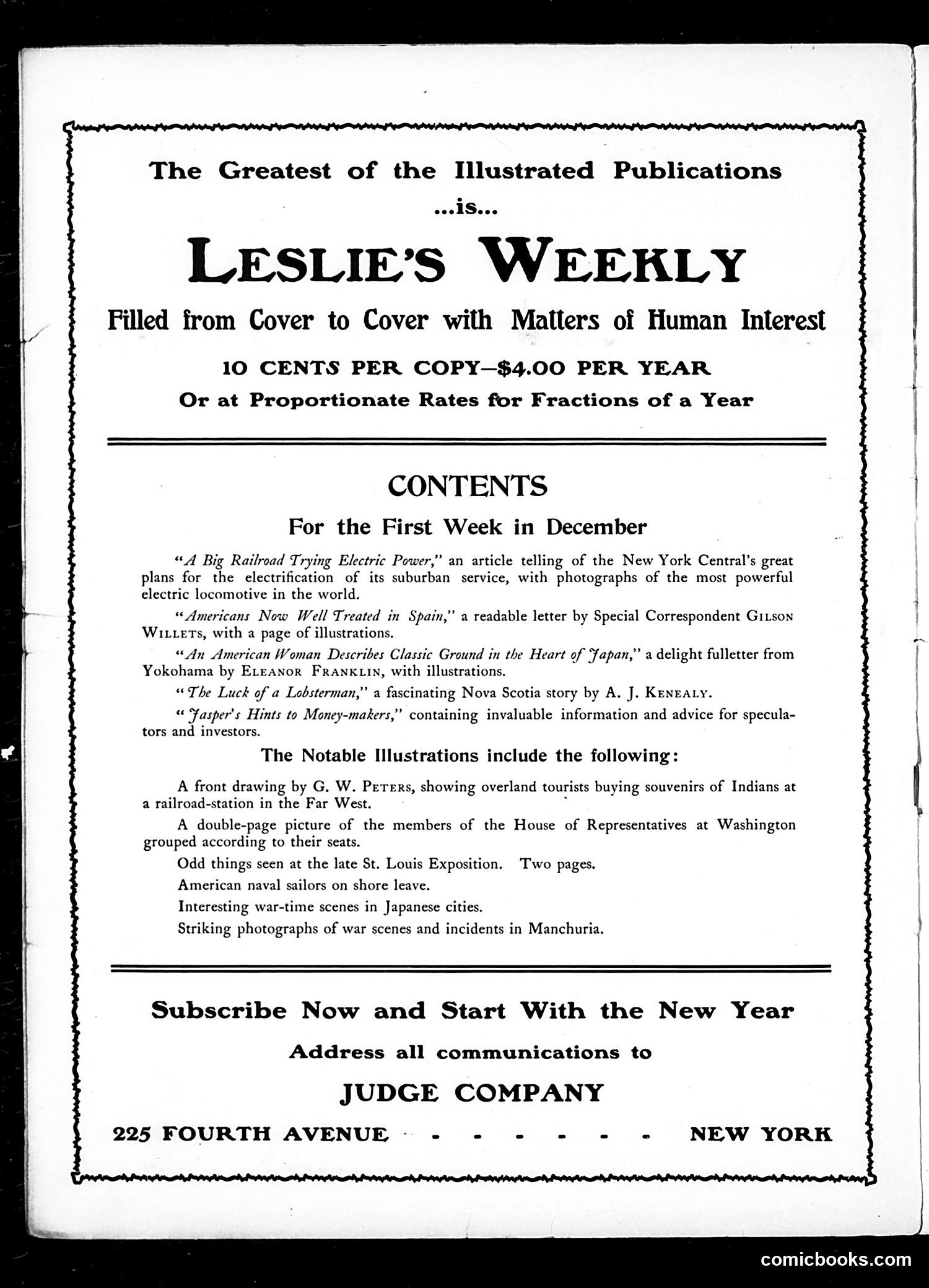
This is a title/contents page advertising **Leslie's Weekly**, a rival illustrated magazine to Judge itself. It's not a cartoon but rather a competitive advertisement highlighting Leslie's editorial offerings for early December. The content reflects turn-of-the-century American interests: railroad modernization (New York Central's electric locomotives), imperial tourism (Americans abroad in Spain and Japan), and contemporary geopolitics (the Russo-Japanese War in Manchuria). The inclusion of a "House of Representatives" diagram and "Money-makers' Hints" suggests middle-class, civically-engaged readership. The Native American souvenir illustration at a railroad station represents the era's commodification of indigenous culture as exotic "Americana" for tourists. Notably, Judge is advertising a competitor—likely because Leslie's Weekly purchased this advertising space, or Judge reprinted ads as content. The $4/year subscription price positioned it as accessible popular journalism.
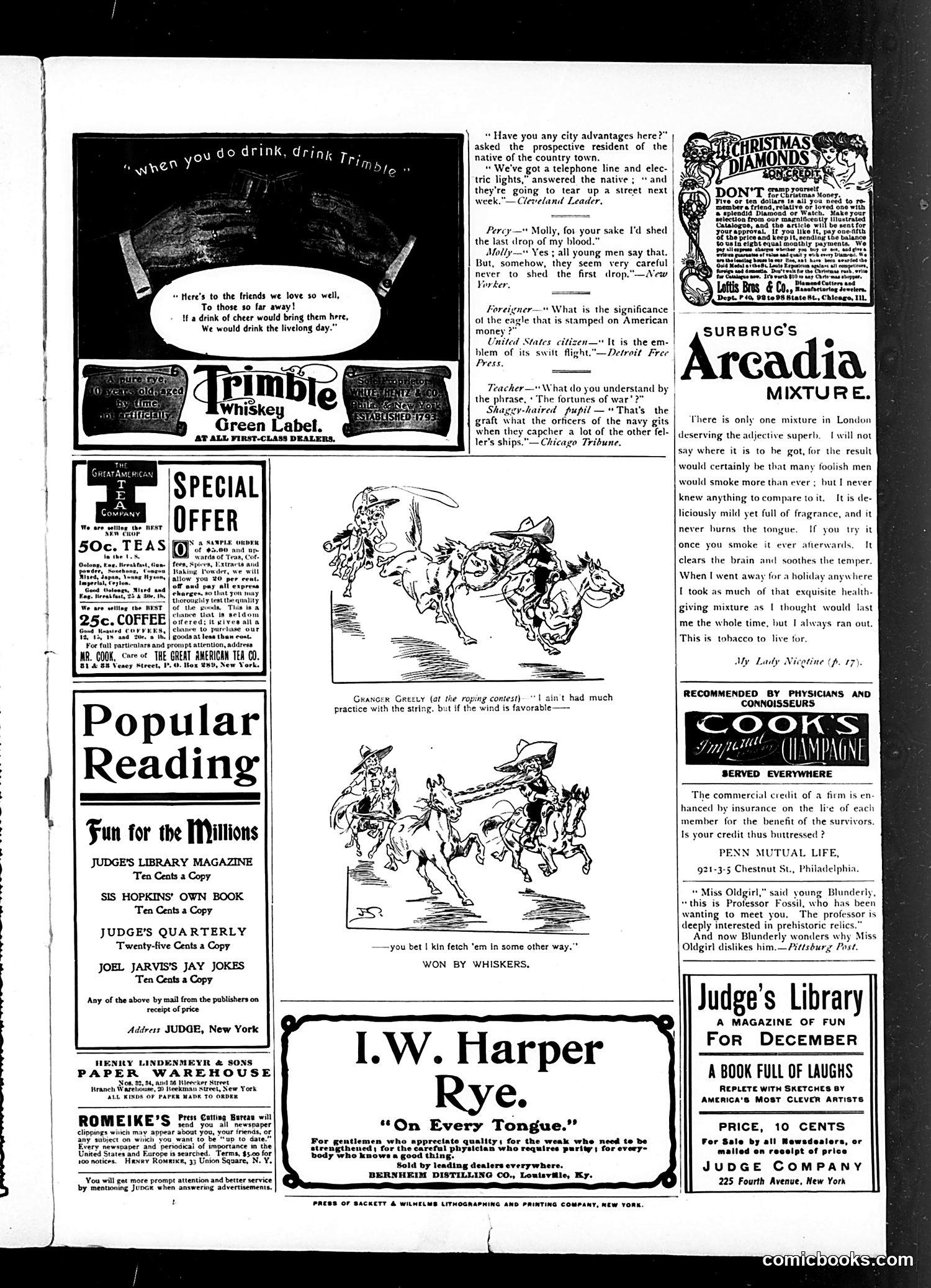
This page is primarily **advertisements and filler content** rather than satirical commentary. However, it contains several jokes reflecting period attitudes: **The cartoons** (showing horses with riders) illustrate rural/Western humor about horsemanship—one captioned "Won by Whiskers" jokes about a rider controlling a horse using whiskers as reins, playing on rural stereotypes about country folk lacking sophistication. **The text jokes** mock romantic pretense ("young men say they'd shed blood for love, but never actually do"), ethnic stereotypes (a foreigner misunderstanding American currency), and apparent corruption in the Navy (officers taking "graft" from captured ships). **The advertisements** push whiskey, tobacco, insurance, and tea—typical of early 1900s magazines. The "Christmas Diamonds" ad and repeated alcohol pitches reflect Judge's target audience: urban, male, middle-to-upper-class readers. The overall tone treats rural Americans, foreigners, and sailors as subjects of mild ridicule—mainstream attitudes for the era that modern readers would recognize as stereotyping.
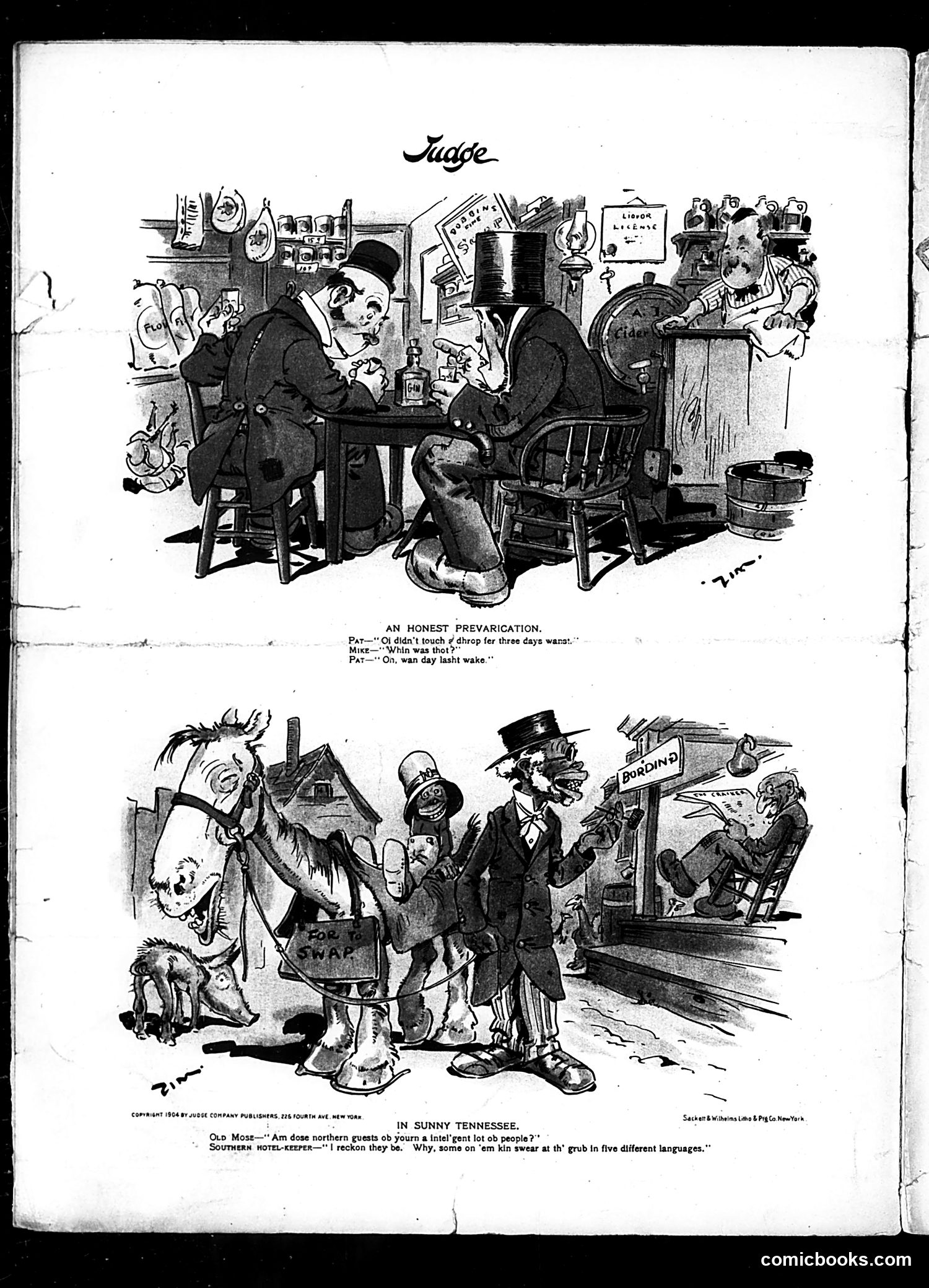
This page contains two ethnic stereotype cartoons typical of early 1900s American humor. **Top cartoon ("An Honest Prevarication"):** Two Irish characters (identified by dialect spelling: "Oi," "thot," "lasht") discuss drinking. Pat claims he didn't touch alcohol for three days—but admits that was only "wan day lasht wake," making his boast dishonest. The joke plays on Irish stereotypes as heavy drinkers prone to exaggeration. **Bottom cartoon ("In Sunny Tennessee"):** A Southern hotel keeper discusses Northern guests with an older Black man ("Old Mose"). The keeper's compliment—that these Yankees can curse about the food in five languages—is backhanded: it praises their linguistic ability while insulting both the food quality and implying these "refined" visitors are crude. The dialect and imagery reflect period racial caricature conventions. Both cartoons rely on ethnic/regional stereotypes for humor, reflecting Judge magazine's satirical approach to American social types.