
A complete issue · 16 pages · 1904
Judge — November 19, 1904
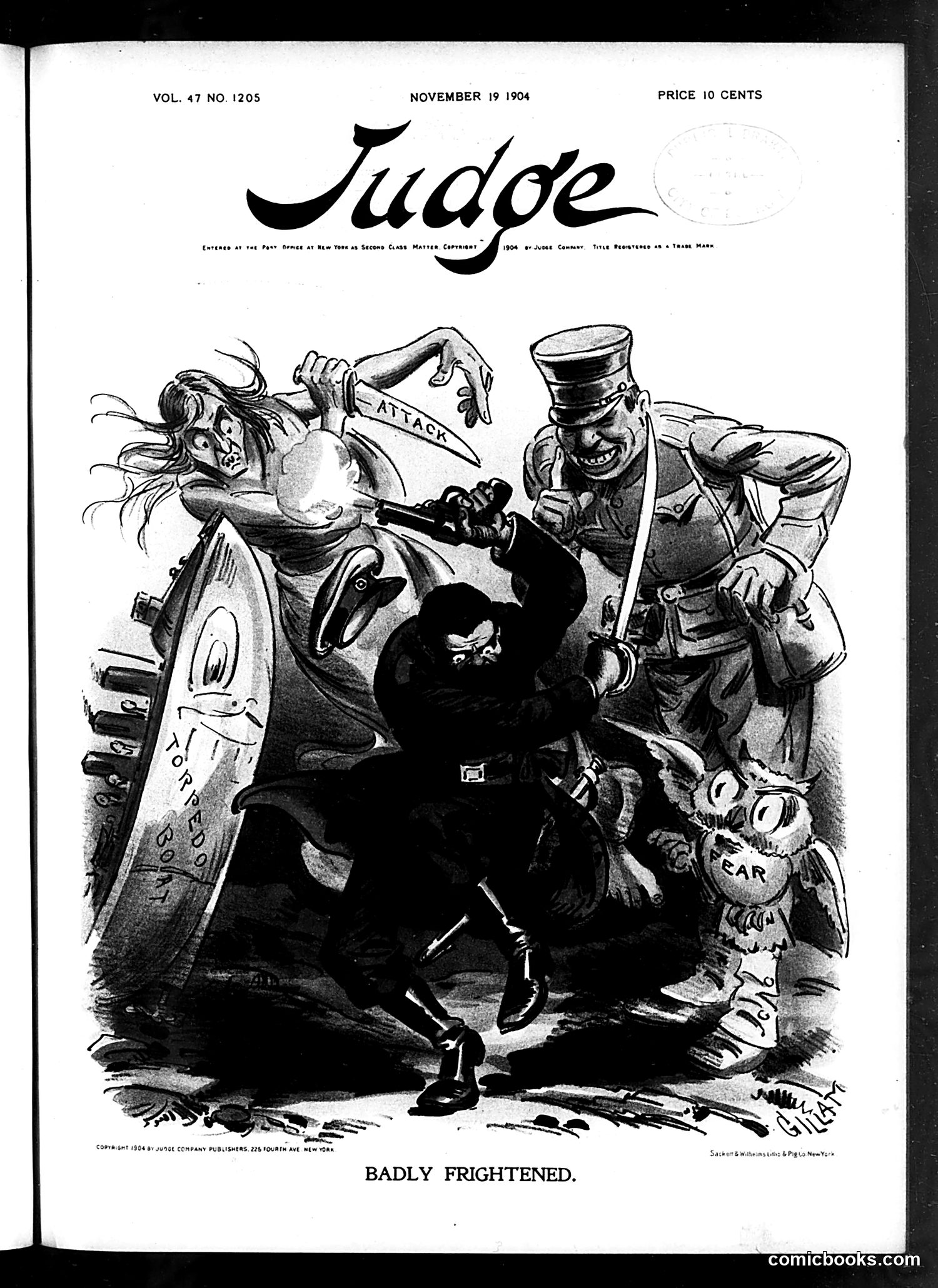
This political cartoon depicts a cowering, well-dressed figure in the center being menaced by three aggressive characters. The figure on the left appears to represent a corporate entity or monopoly (labeled "ATTACK"), while the military figure on the right and another character labeled "FEAR" surround the frightened man. The cartoon likely comments on Theodore Roosevelt's presidency and his aggressive "trust-busting" policies against large corporations. The frightened central figure probably represents either a specific corporate leader or industrial interests broadly, while Roosevelt—known for his combative style—appears represented as the threatening military figure. The satire suggests that big business feared Roosevelt's regulatory assault, depicting their terror at his anti-monopoly campaign during his 1904 re-election campaign.
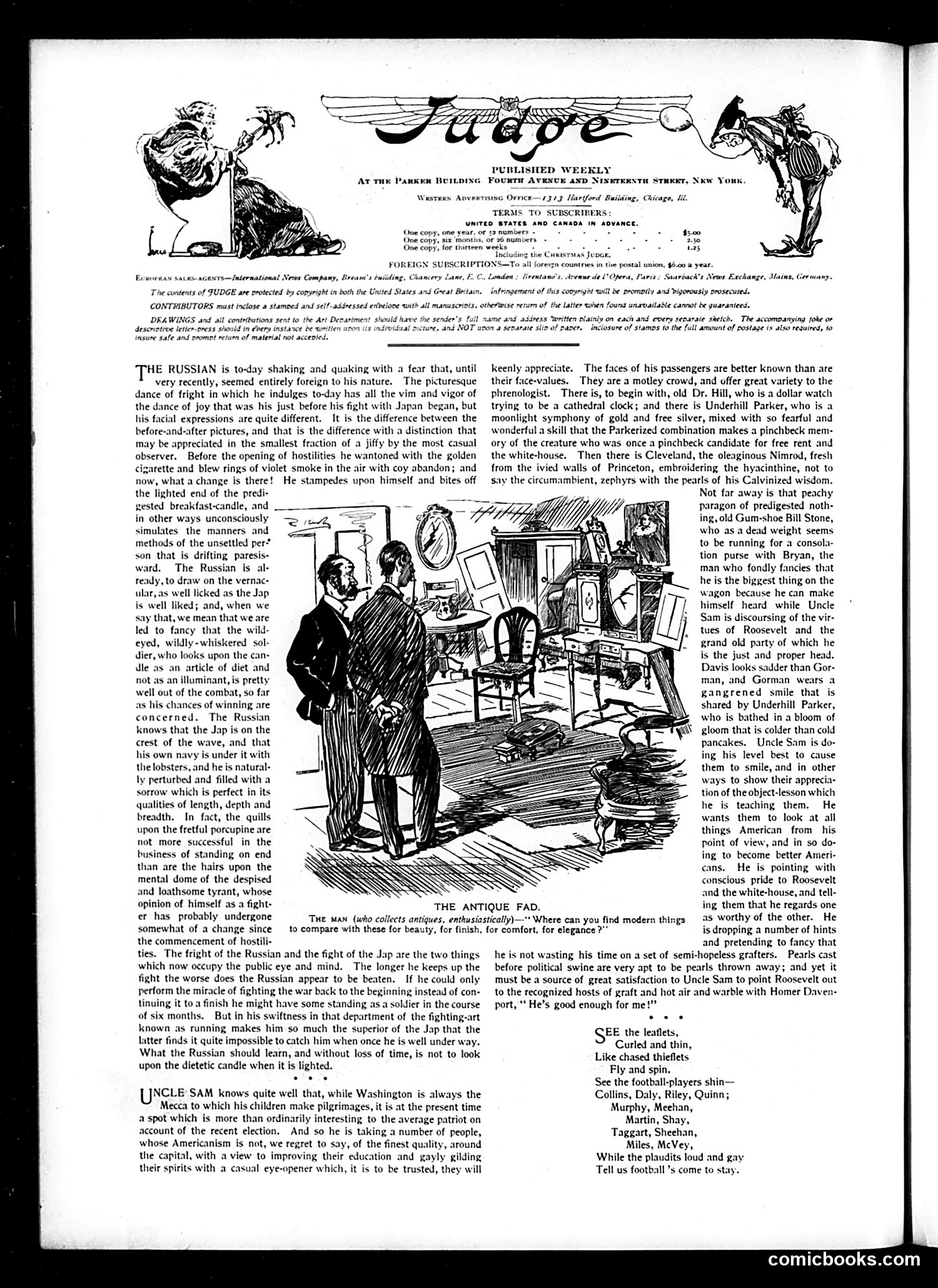
This cartoon satirizes the early 1900s craze for collecting antiques. The illustration shows a man enthusiastically examining old furniture and objects, comparing modern manufactured items unfavorably to these "beautiful" antiques. The satire targets wealthy Americans' snobbish fascination with European antiquities—they're positioned as pretentious collectors willing to pay inflated prices for secondhand goods simply because they're old. The caption's rhetorical question—"Where can you find modern things to compare with these for beauty, finish, comfort, elegance?"—is ironic, suggesting such collectors value age and European provenance over actual quality or practicality. The accompanying text references political figures and social commentary typical of Judge's era, but the main cartoon mocks consumerism and class pretension around collecting.
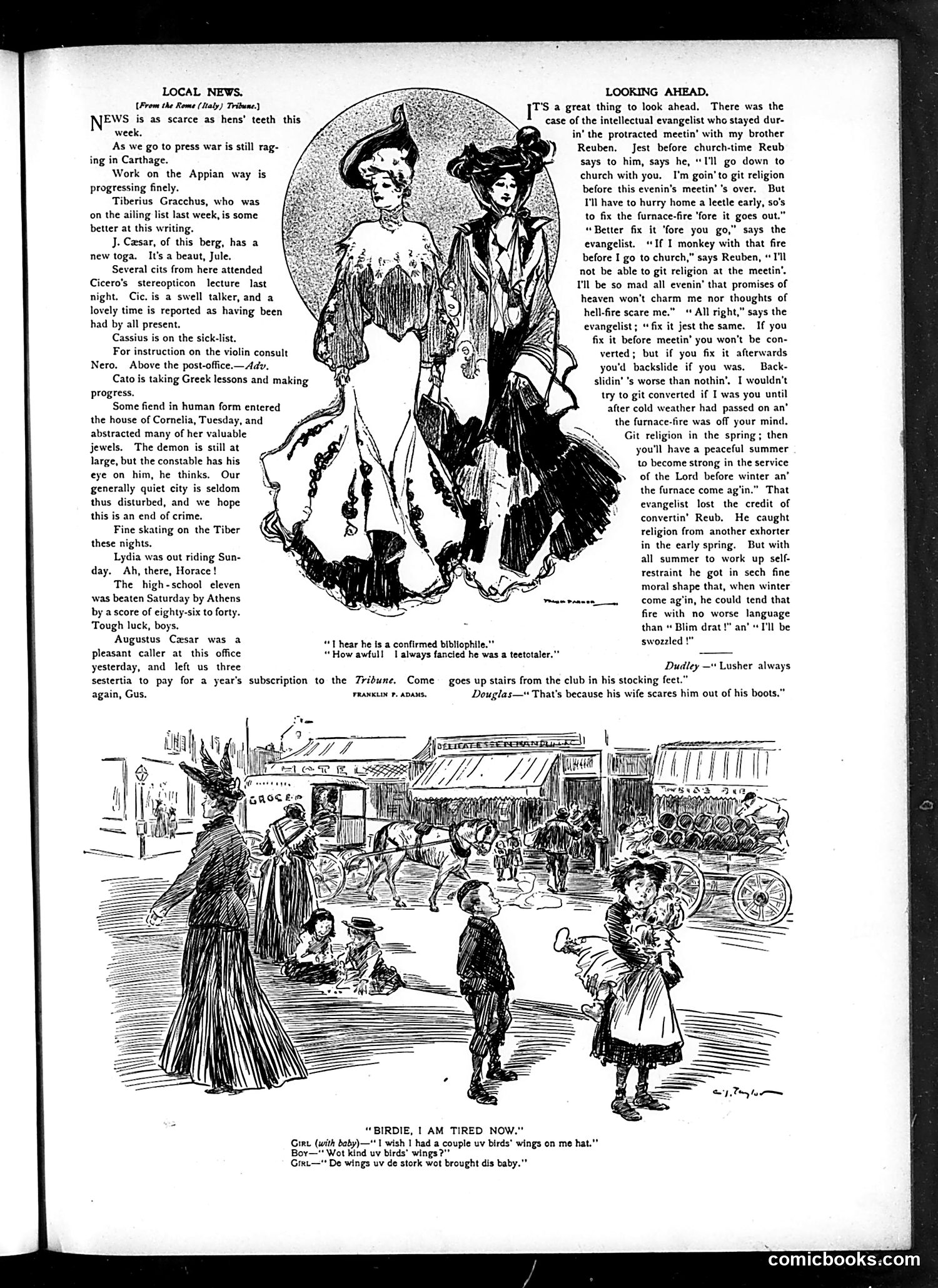
This page combines humor columns with two illustrations. The "LOCAL NEWS" section reports trivial happenings (a fight over hens' teeth, work on an Appian way, a demon in human form). The "LOOKING AHEAD" piece satirizes religious conversion—an evangelist pressures "Reuben" to get religion before winter, suggesting he'll delay until spring when the furnace isn't needed. The humor mocks both superficial faith and the evangelist's transparent tactics. The lower cartoon depicts street children, with dialogue about "birds' wings"—likely wordplay on class differences or immigrant dialect humor common in early-1900s Judge. The illustration style and casual social cruelty are typical of the era's humor targeting working-class children.
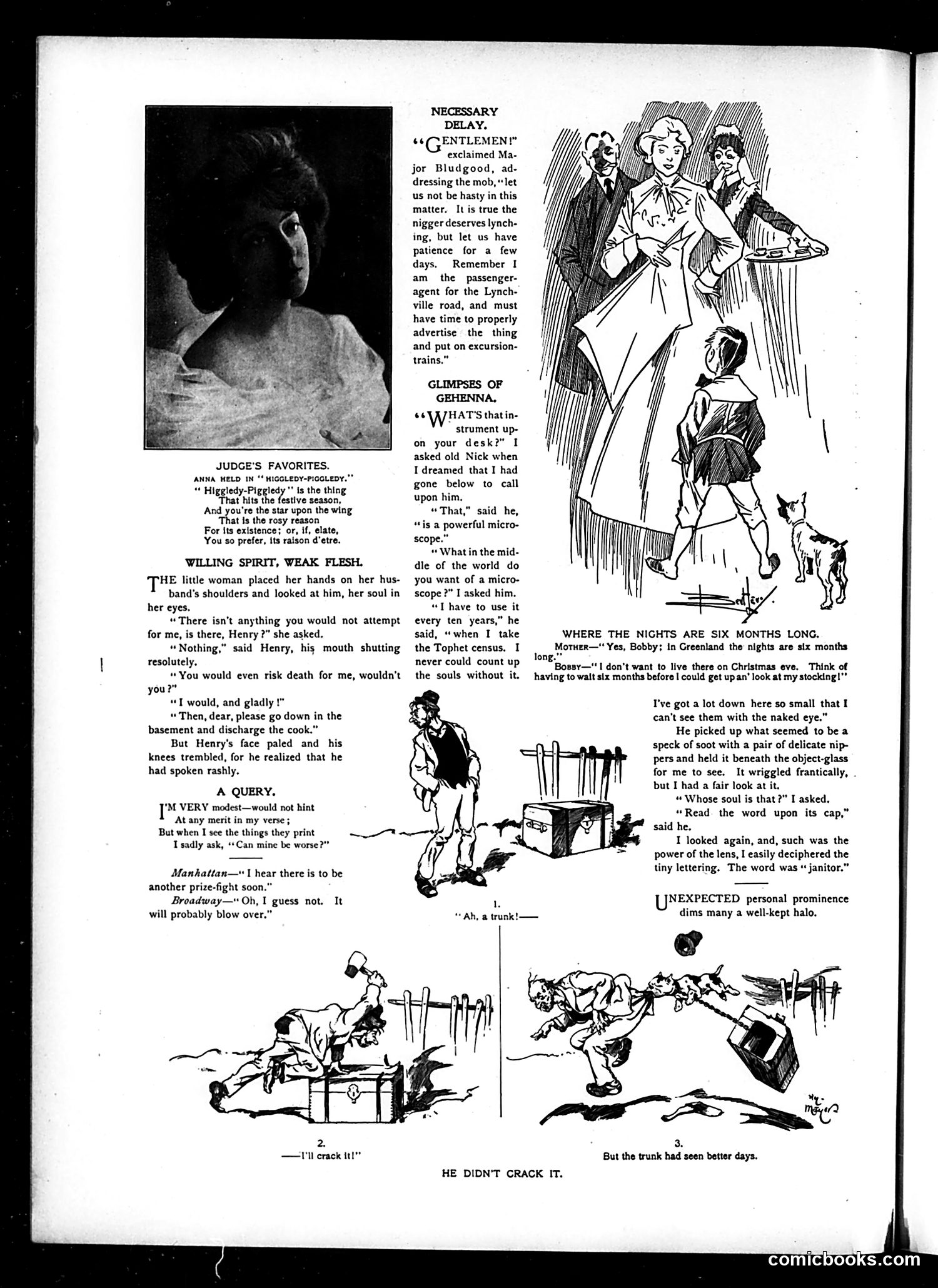
This page appears to be from an early 20th-century issue of Judge magazine, containing short fiction and humorous illustrations rather than political cartoons. The main content includes: - **"Judge's Favorites"**: A theatrical piece titled "Highest-Pitched" featuring character Anna Held, likely referencing the popular stage actress of that era. - **Short stories** with titles like "A Query" (featuring dialogue about Broadway and Manhattan) and "Where the Nights Are Six Months Long" (an Greenland-set narrative). - **Accompanying comic illustrations** showing slapstick humor: a man attempting to crack open a trunk, characters in exaggerated physical situations. The humor is primarily **situational comedy and wordplay** rather than political satire. The page demonstrates Judge's focus on entertainment, theater references, and physical comedy for its readership.
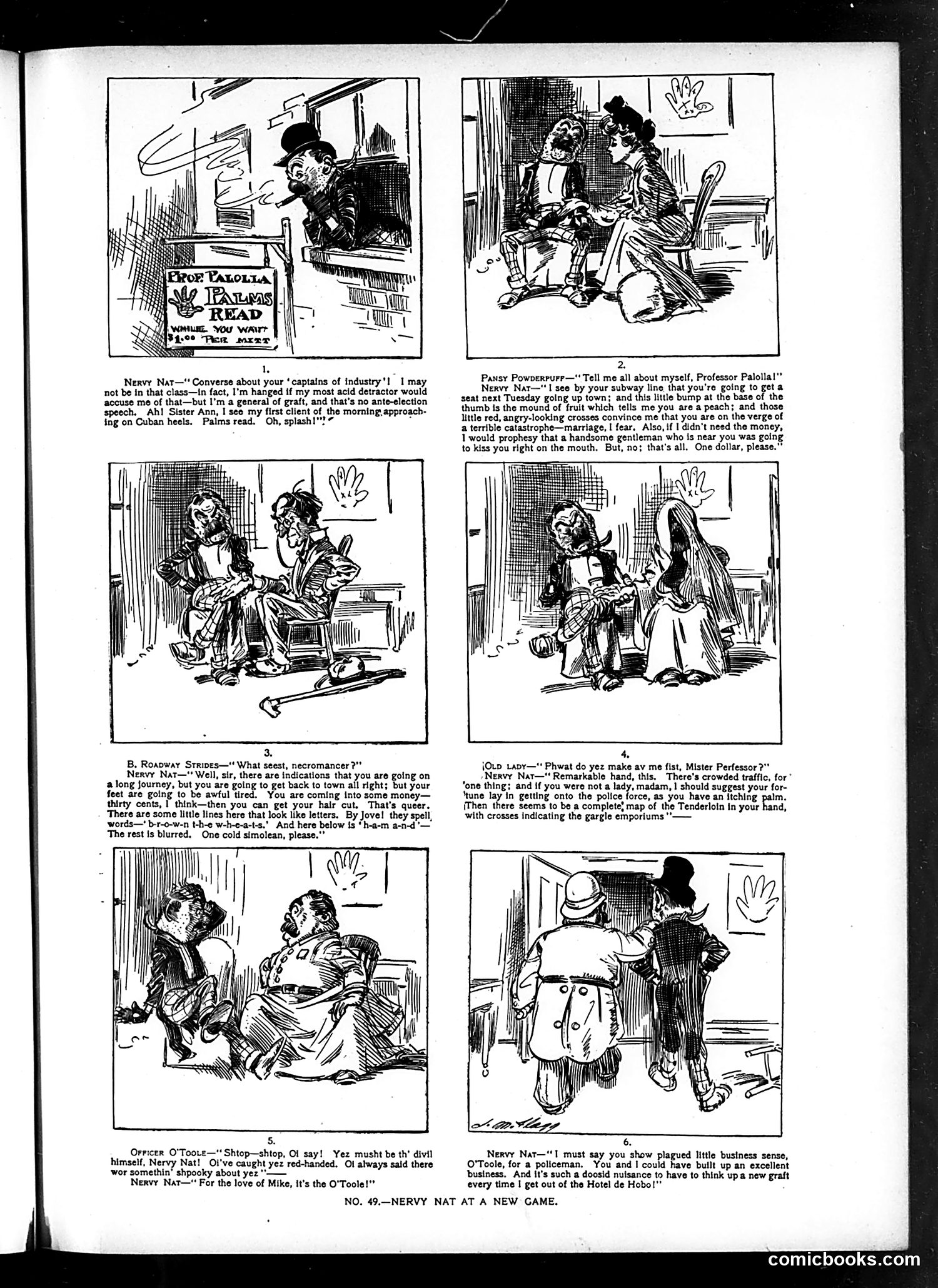
This Judge comic strip satirizes "Nervy Nat," a fake palm reader who operates as a common con artist. The humor lies in his brazen admissions of his fraudulent scheme—he explicitly calls himself "a general of graft" while posing as "Professor Palolla." The satirical targets are twofold: First, the prevalence of fortune-telling scams preying on gullible New Yorkers of various classes (working girls, society women, police officers). Second, the broader corruption of the era—Nat's casual criminality and his attempt to recruit a cop into a "business" partnership mock systemic graft that permeated urban institutions. The comic's appeal derives from Nat's unapologetic candor about his con while his clients remain oblivious or complicit. The "New Game" title suggests this fraud was familiar enough to readers to recognize as contemporary social commentary rather than mere fantasy.
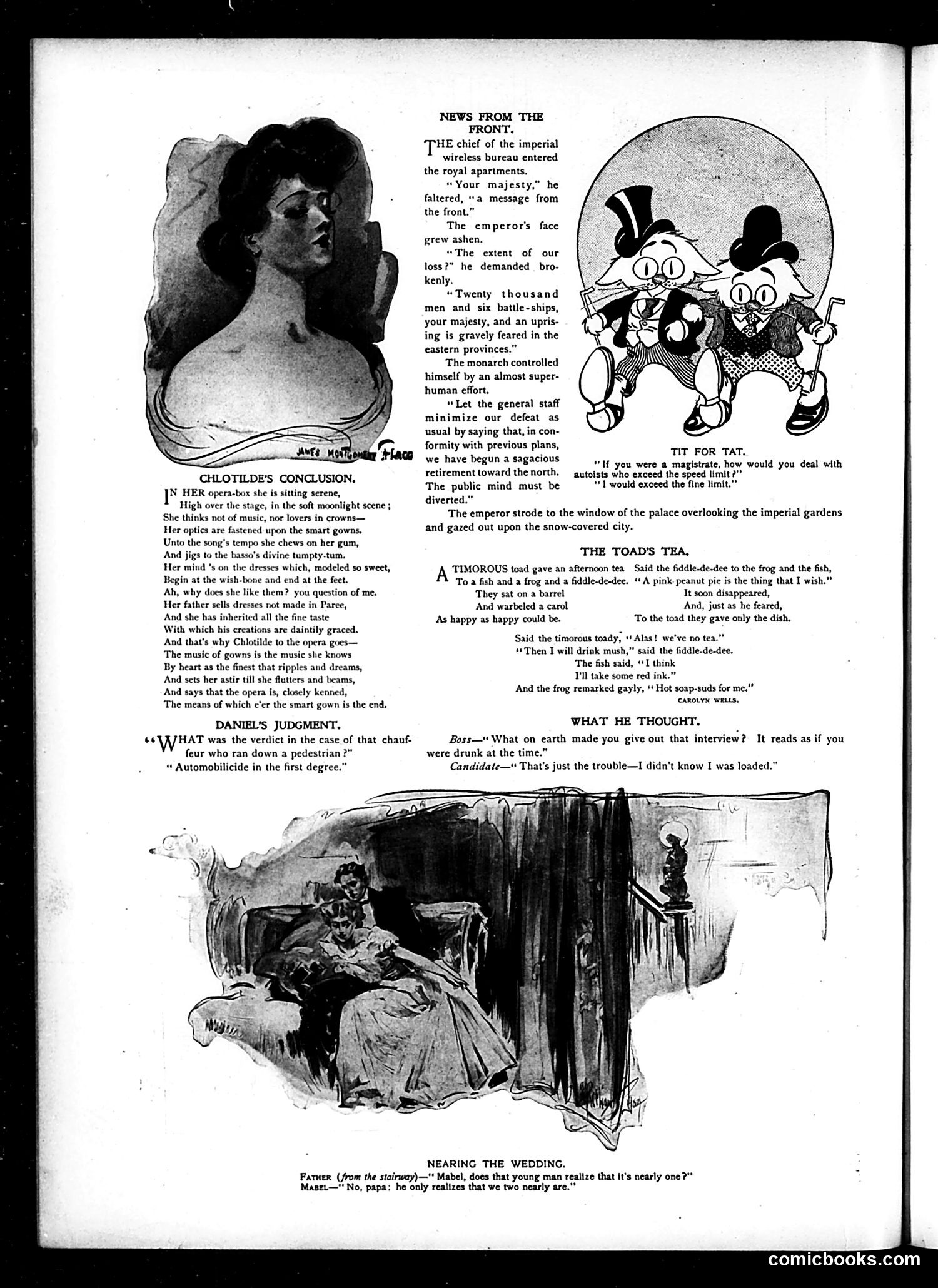
This page from the satirical magazine *Judge* contains several distinct humor pieces: **"Chlotilde's Conclusion"** mocks a wealthy woman attending opera solely to view fashionable gowns rather than appreciate the music. The satire targets upper-class materialism and vanity—she chews gum and ignores the performance, caring only about dresses "modeled so sweet." **"News from the Front"** appears to satirize military propaganda, showing an emperor minimizing catastrophic losses (20,000 men, six ships) by ordering his staff to frame it as a planned "sagacious retirement." This likely references early 20th-century war reporting and governmental spin. **"Daniel's Judgment"** is a brief wordplay joke coining "automobilicide" for a car-pedestrian fatality—reflecting anxieties about new automobile technology. The remaining pieces are light humor: "Toad's Tea" is whimsical nonsense verse; "What He Thought" plays on a politician's gaffe; "Nearing the Wedding" uses double entendre about a suitor's awareness. The page emphasizes *Judge's* formula: social mockery of wealth/pretension alongside topical commentary and wordplay.
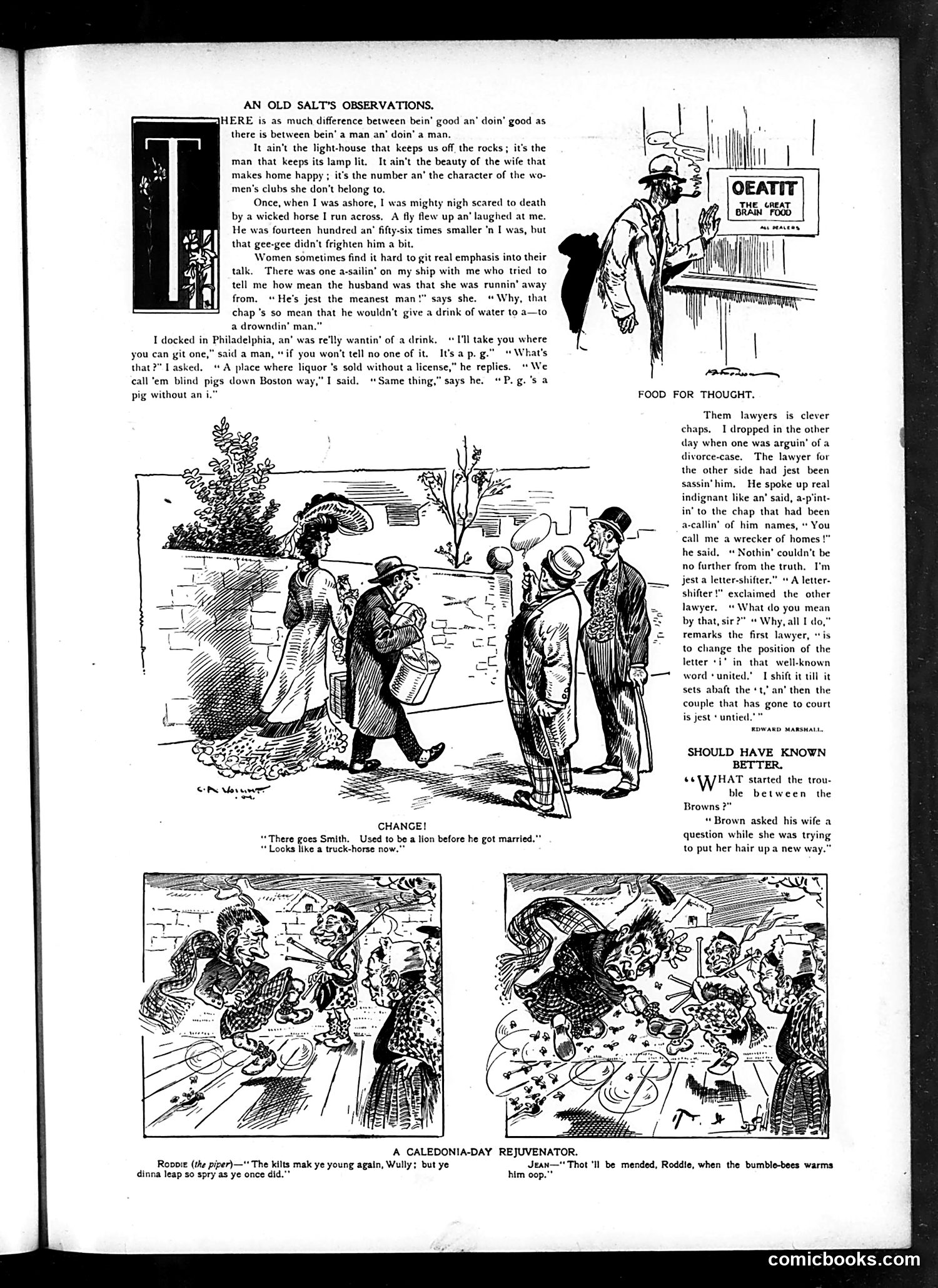
This page collects humorous anecdotes and cartoons centered on folk wisdom and domestic comedy. The "Old Salt" (a weathered sailor) offers observations on life's contradictions—the difference between being good and doing good, or how a wife's character matters more than her beauty. The main cartoons mock marital discord and legal absurdity. One depicts a divorce proceeding where a clever lawyer, accused of "wrecking homes," defends himself by claiming he's merely a "letter-shifter"—changing the 'i' in "united" to make it "untied." Another cartoon jokes about a husband asking his wife a question while she's styling her hair, starting marital trouble. A Scottish segment features a piper noting that kilts keep men young, though one woman suggests they need "bumble-bees" warming to be fully rejuvenated. The humor relies on wordplay, domestic stereotypes, and working-class dialect typical of early-20th-century American humor magazines.
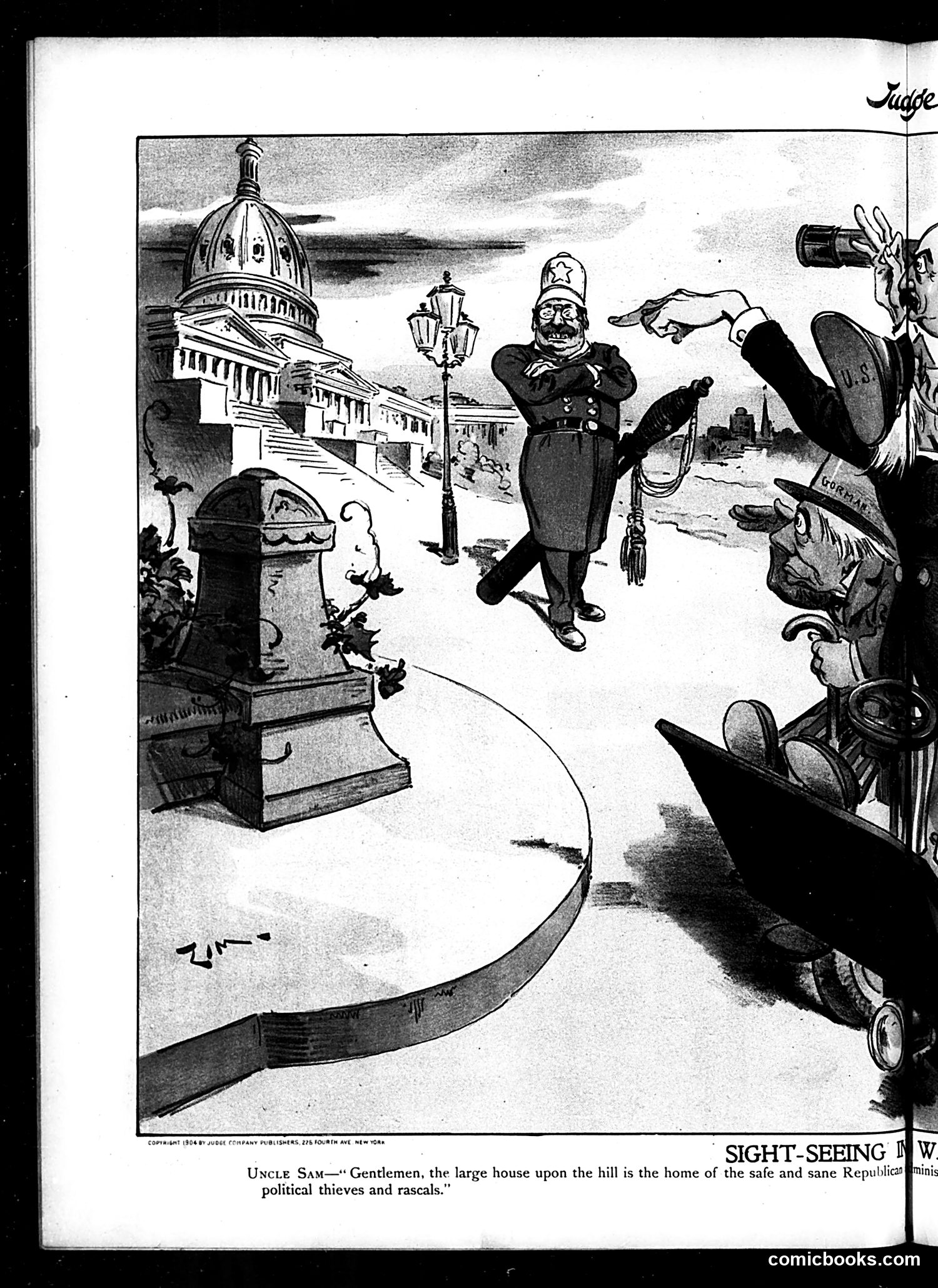
This is a political cartoon from Judge magazine satirizing the Republican Party. Uncle Sam (representing America) points to the Capitol building, sarcastically calling it "the home of the safe and sane Republican" politicians—while labeling them "political thieves and rascals." The cartoon's humor relies on ironic contrast: Republicans promoted themselves as the "safe and sane" party, yet the artist depicts them as corrupt. The caricatured figures on the right (appearing to be Republican politicians or corporate interests) are drawn as grotesque, suggesting dishonesty and moral corruption. The timing appears early 20th century, during an era of significant political corruption scandals and muckraking journalism. The satire attacks Republican claims of respectability and integrity.
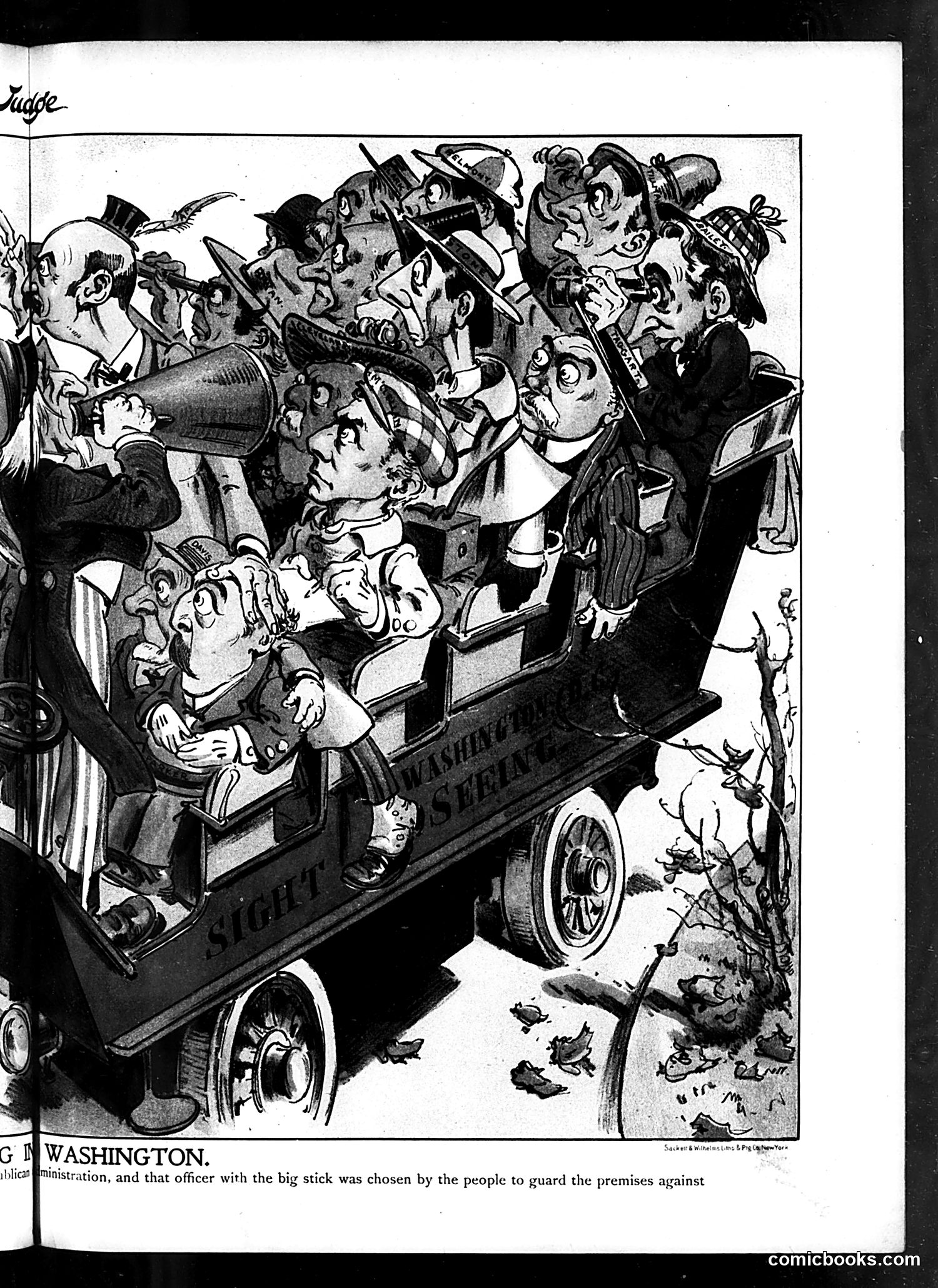
This Judge magazine cartoon satirizes Washington D.C. politics. A vehicle labeled "Secret Service" and "Washington" overflows with caricatured politicians and bureaucrats, depicted as grotesque, exaggerated figures crowded together in chaos. The text references "that officer with the big stick" chosen "to guard the premises," likely alluding to Theodore Roosevelt and his "Big Stick" policy approach to presidential authority. The satire appears to mock the bloated, dysfunctional nature of the federal administration and bureaucracy—suggesting that despite Roosevelt's aggressive leadership style, the government remains chaotic and overstuffed with incompetent officials. The vehicle careening forward suggests things are out of control, despite claims of strong executive oversight.
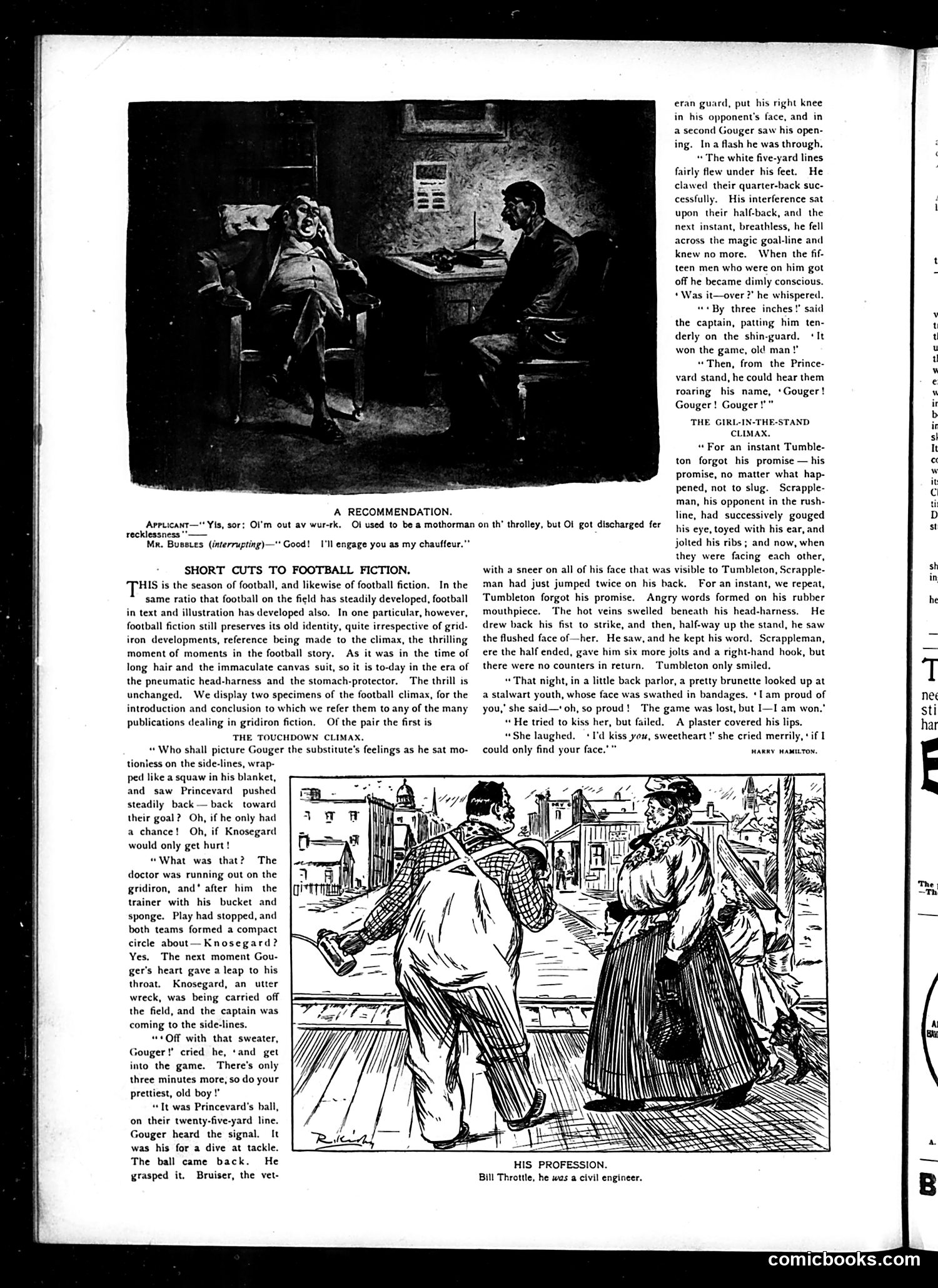
This page satirizes football fiction's predictable conventions rather than current politics. **"A Recommendation"** (top): A crude joke about Irish immigrant unemployment. An out-of-work man boasts he drove a trolley recklessly; an employer immediately hires him as a chauffeur, implying such recklessness suits that dangerous job. **"Short Cuts to Football Fiction"** (main text): The article mocks formulaic football stories, which despite evolving gameplay, still rely on identical dramatic climaxes. Two examples are provided: 1. **The Touchdown Climax**: A substitute gets his chance, delivers a game-winning play through aggressive (even dirty) tackling, and becomes a hero. 2. **The Girl-in-the-Stand Climax**: A player restrains himself from retaliating against dirty play *because* a pretty girl watches from the stands—implying romantic approval motivates masculine restraint. The satire targets how sports fiction endlessly recycles these sentimental, violent tropes regardless of actual game evolution.
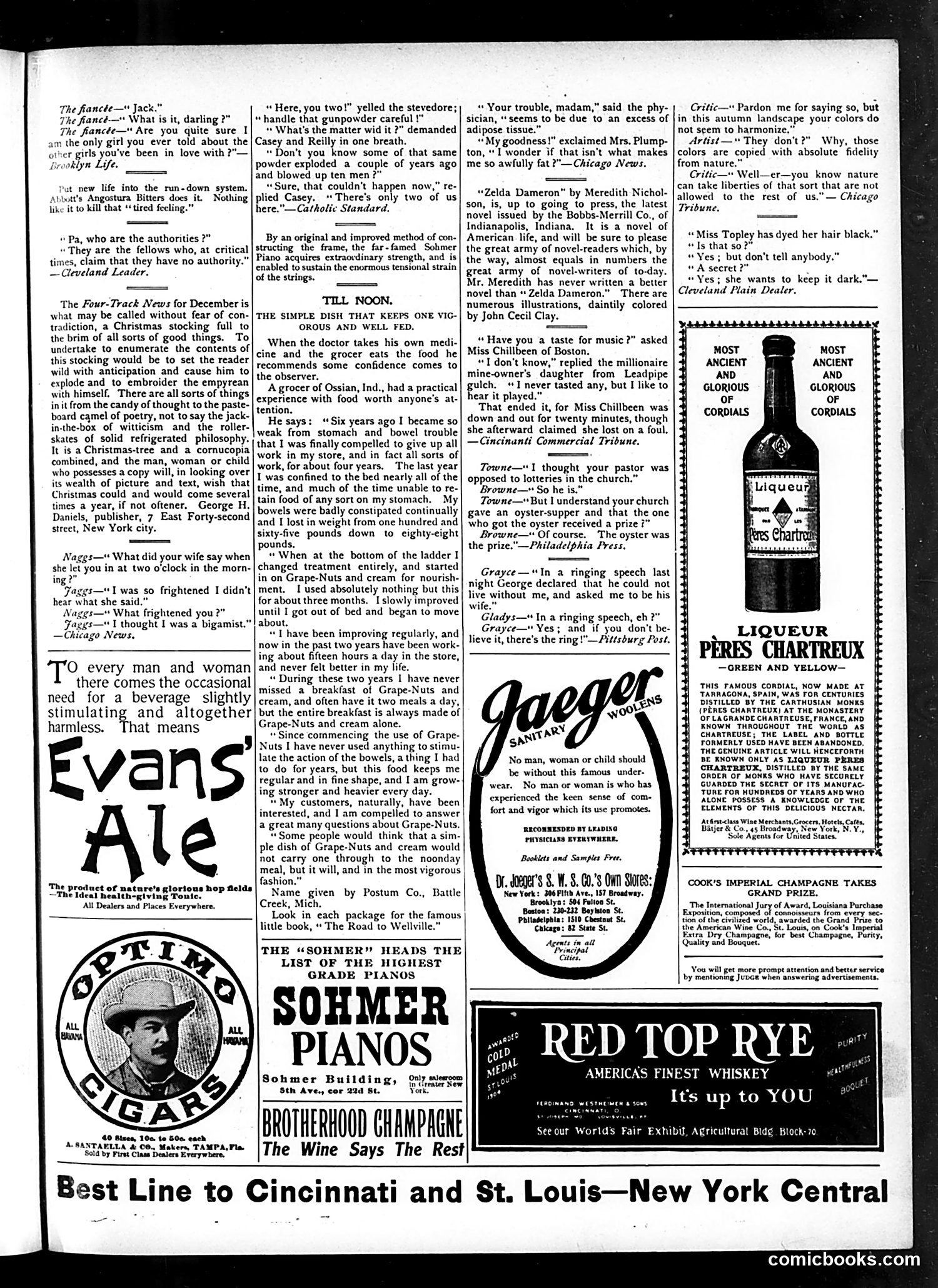
This page is primarily **advertising and humor content** rather than political satire. The main elements include: **Humor Pieces:** Short jokes about relationships and workplace mishaps, including a dated Irish-immigrant stereotype joke about dock workers Casey and Reilly who dismiss gunpowder danger because there are only two of them (implying if it killed ten men before, two survivors seems safe—absurdist humor). **Advertisements:** The page is dominated by product ads including Evans Ale, Sohmer Pianos, Jaeger (sanitary clothing), Liqueur Péris Chartreux, Ottengo Cigars, Red Top Rye whiskey, and various patent medicines (Abbott's Angostura Bitters, Grape-Nuts). **Notable Context:** The ads reflect early 1900s consumer culture—patent medicines heavily promoted, whiskey advertised openly (pre-Prohibition), and emphasis on health tonics. The Grape-Nuts testimonial exemplifies common advertising rhetoric of the era using "real customer" stories. **No significant political cartoon** is visible on this page.
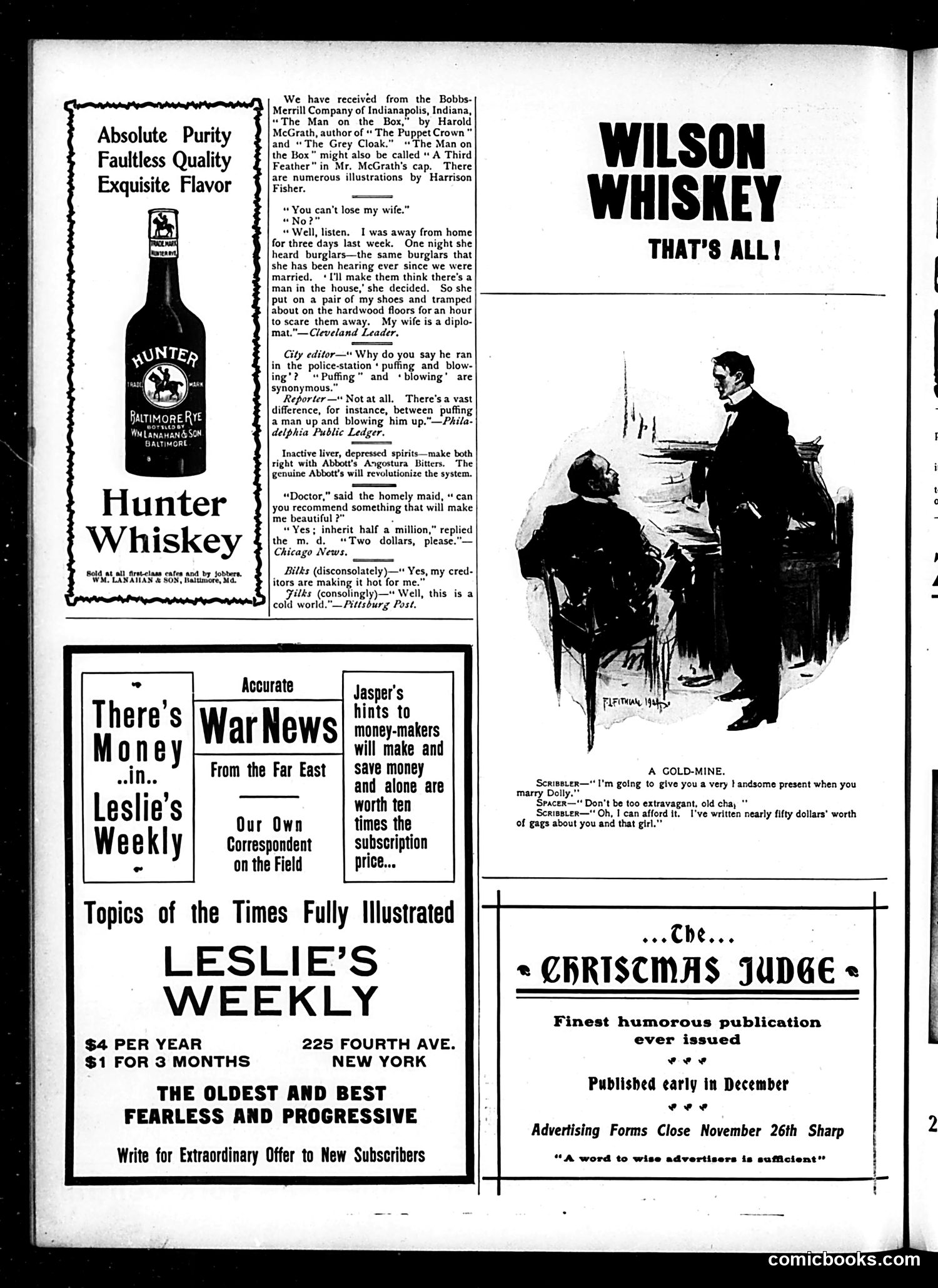
This is primarily an **advertising and humor compilation page** rather than a unified political cartoon. The page contains: **Main Content:** - A satirical cartoon titled "A Gold-Mine" depicting a man proposing to a woman named Dolly, with a friend warning him not to be extravagant because he's already written "nearly fifty dollars' worth of poetry" about her—mocking the notion that romantic gestures are expensive investments. **Multiple Brief Jokes** scattered throughout on topics like: - A wife who scares away burglars by wearing her husband's shoes (satirizing marital dynamics) - Wordplay about "puffing" versus "blowing" someone up - A homely maid asking a doctor how to become beautiful (he suggests inheriting wealth) **Advertisements:** The page is dominated by ads for Hunter Whiskey, Leslie's Weekly magazine, and The Christmas Judge publication. The humor reflects early 20th-century sensibilities around marriage, class anxiety, and domestic life, with gentle satirical jabs rather than sharp political commentary.
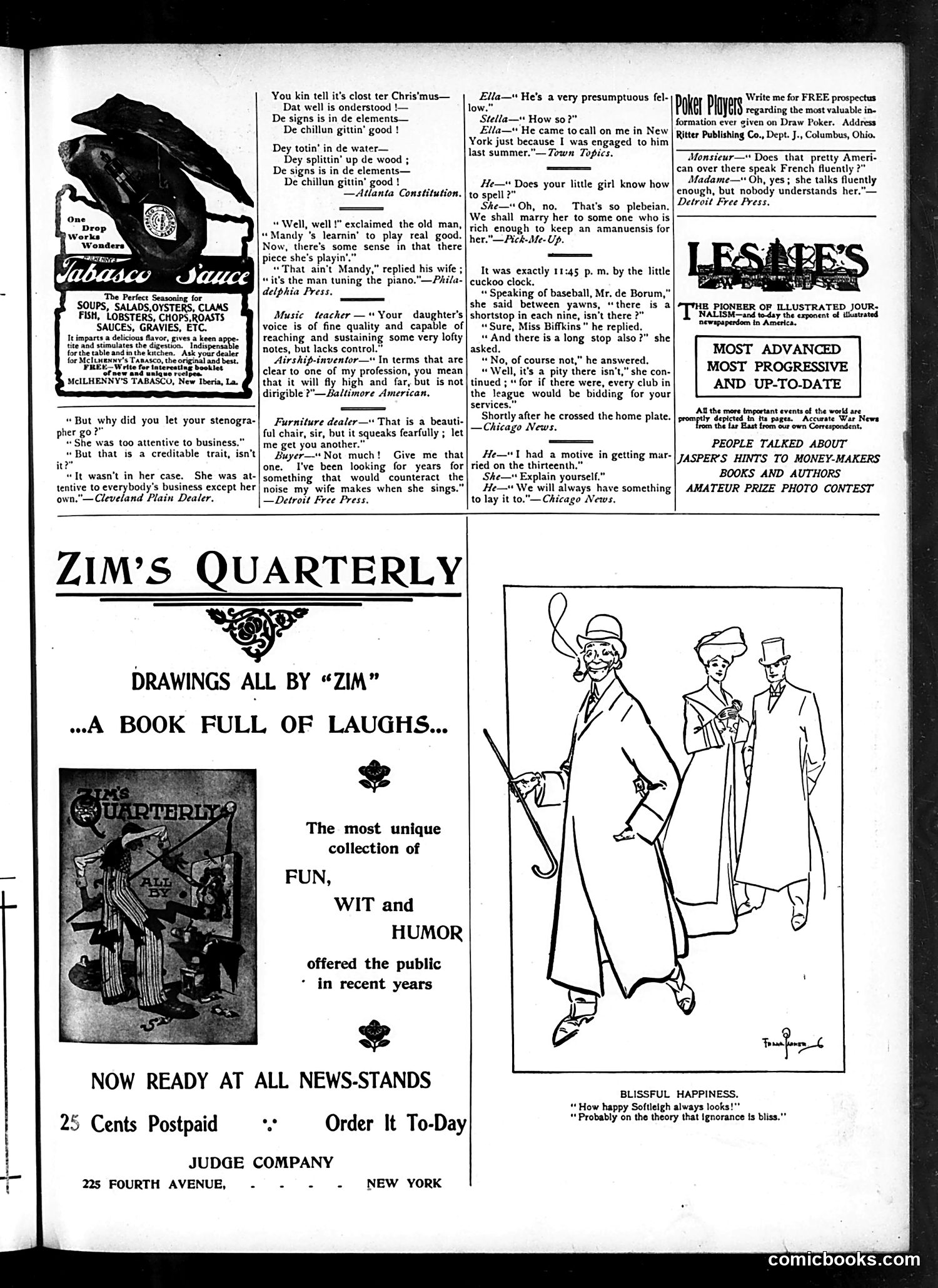
This is primarily an **advertising and humor page** from Judge magazine, not a political cartoon page. The content consists of: **Main Features:** - Multiple short jokes and anecdotes (likely from various sources), mostly playing on gender stereotypes and social awkwardness—a stenographer too nosy, a woman who doesn't understand baseball, newlyweds joking about marital discord - A dialect poem about Christmas preparations (appears to use African American vernacular common in early 20th-century humor) - Advertisement for **Tabasco sauce** and Zim's Quarterly (a humor book) **The Cartoon:** The only illustration shows three well-dressed men in overcoats and hats—their identities are unclear from the image alone. The caption reads: "How happy Scotland always looks! / Probably on the theory that ignorance is bliss." This appears to be gentle ethnic/regional humor about Scottish people, common in period publications. **Context:** This page reflects early 1900s American magazine humor—largely domestic, class-conscious, and reliant on now-outdated stereotypes.
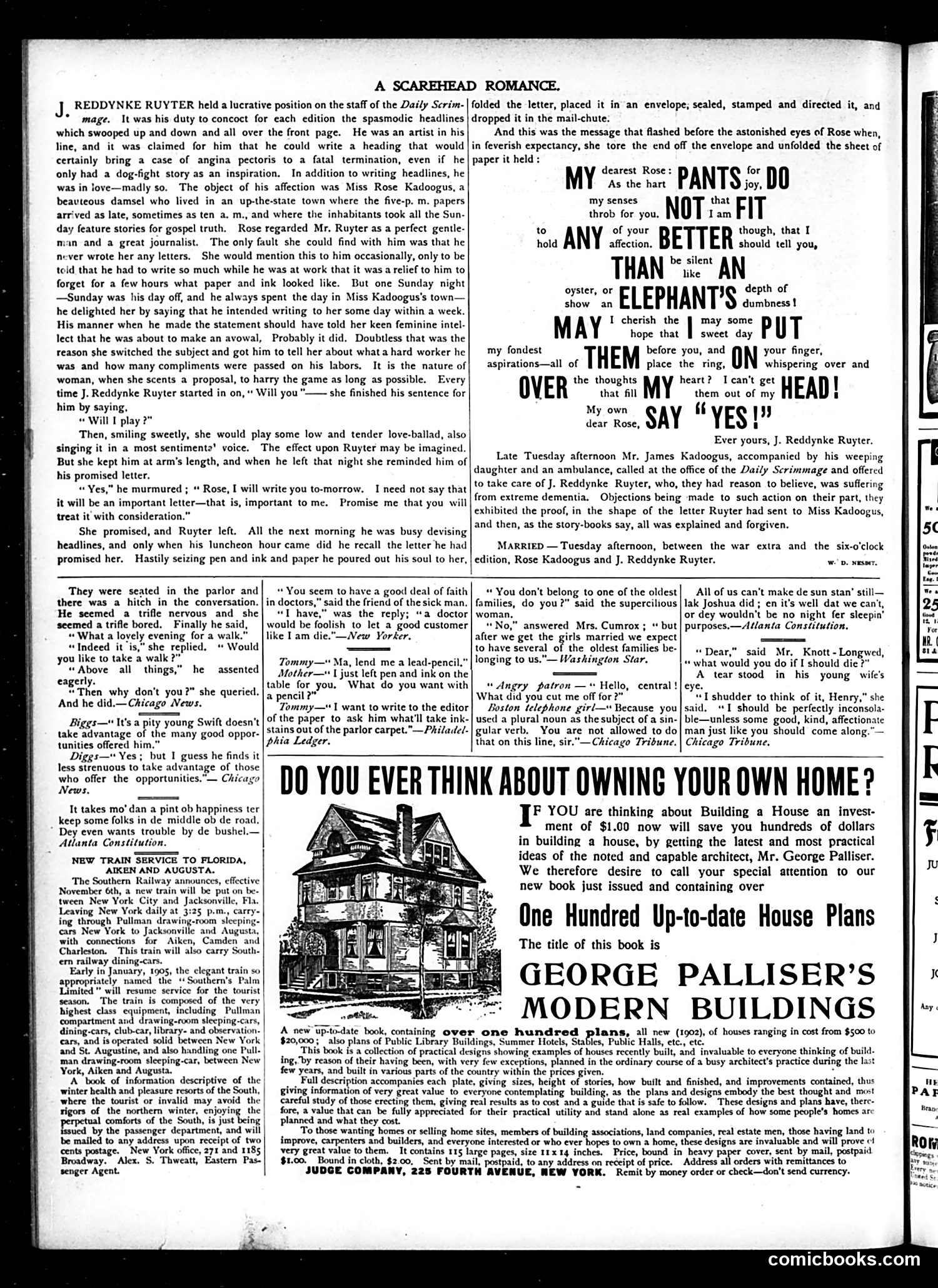
This is a humorous short story satirizing newspaper headline writers and romantic incompetence. J. Reddynke Ruyter, a talented but harried headline writer for the *Daily Scrimmage*, finally attempts to propose to Miss Rose Kadoogus via letter during his lunch break. The joke: His rushed love letter arrives at Rose's home with the lines so badly broken across the page that it reads as nonsensical headline fragments—"PANTS FOR DO NOT FIT / ANY ELEPHANT'S PUT"—rather than a coherent proposal. The satirical point mocks both the mechanical fragmentation caused by newspaper typography and Ruyter's inability to shift from crafting sensational headlines to composing genuine romantic prose. The story ending cryptically references her father arriving with an ambulance, implying Ruyter faces violence for his garbled proposal. The humor targets journalistic rushed work-culture and the absurdity of conducting romance through hastily-written newspaper-office communications.
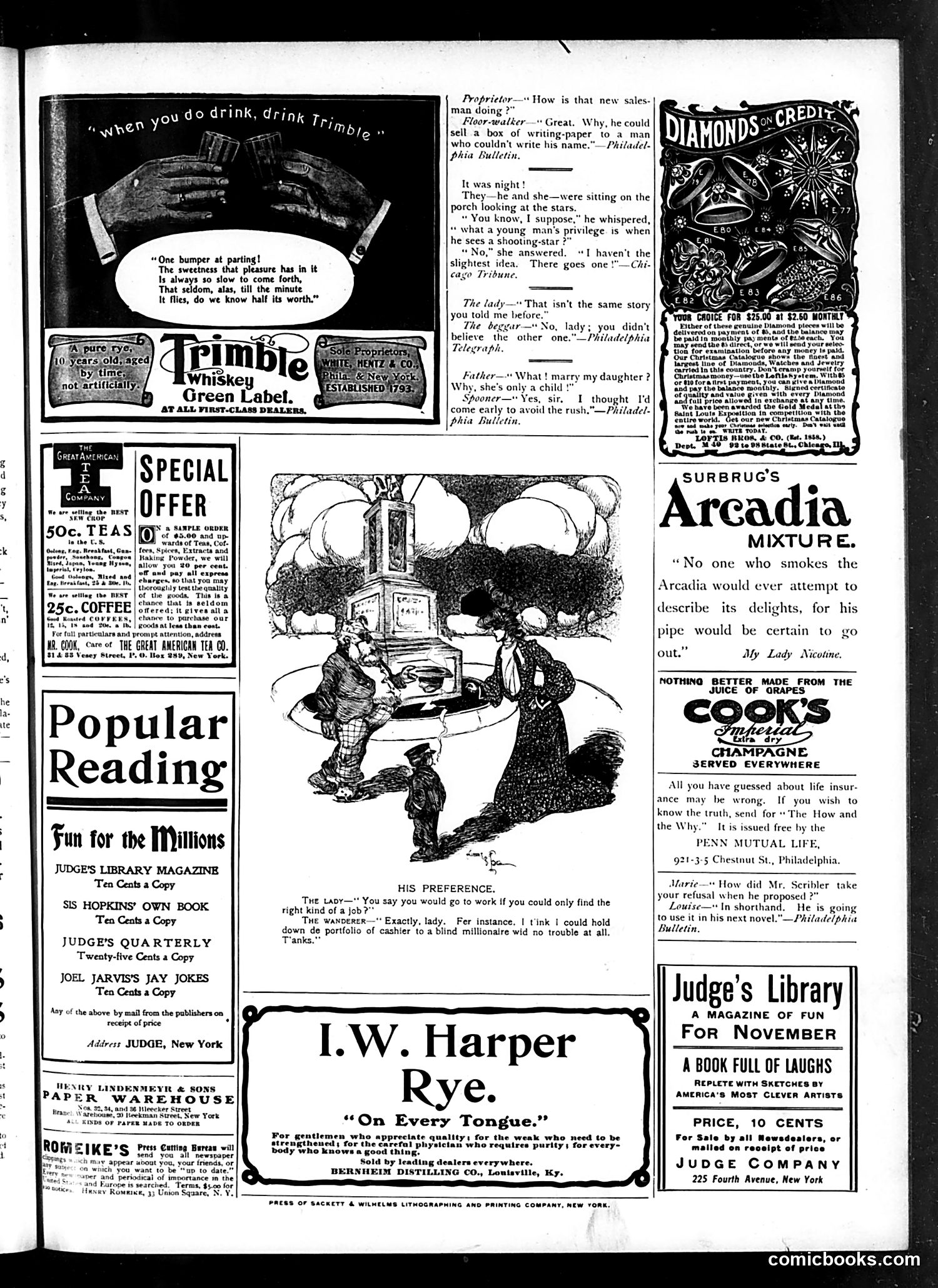
This page is primarily **advertising with scattered short joke snippets**, typical of Judge's format. The main cartoon ("His Preference") depicts a wealthy lady conversing with a vagrant who seeks employment—specifically desiring a cashier position with a blind millionaire, joking he'd face "no trouble at all." The humor relies on the implicit suggestion of theft: a dishonest worker assumes a blind employer couldn't detect embezzlement. The scattered jokes address contemporary concerns: a salesman's pitch to an illiterate customer, a young couple's romantic misunderstanding about "shooting stars," and a suitor arriving early to propose to a child (playing on the word "rush"). The rest comprises period advertisements for **whiskey, tea, coffee, rye, champagne, and tobacco**—standard consumer goods. One ad quotes "My Lady Nicotine," anthropomorphizing tobacco addiction as genteel. **Context for modern readers**: This reflects Gilded Age assumptions about class, gender relations, and "acceptable" vices, presenting alcohol and tobacco as sophisticated pleasures while depicting poor people as inherently untrustworthy.
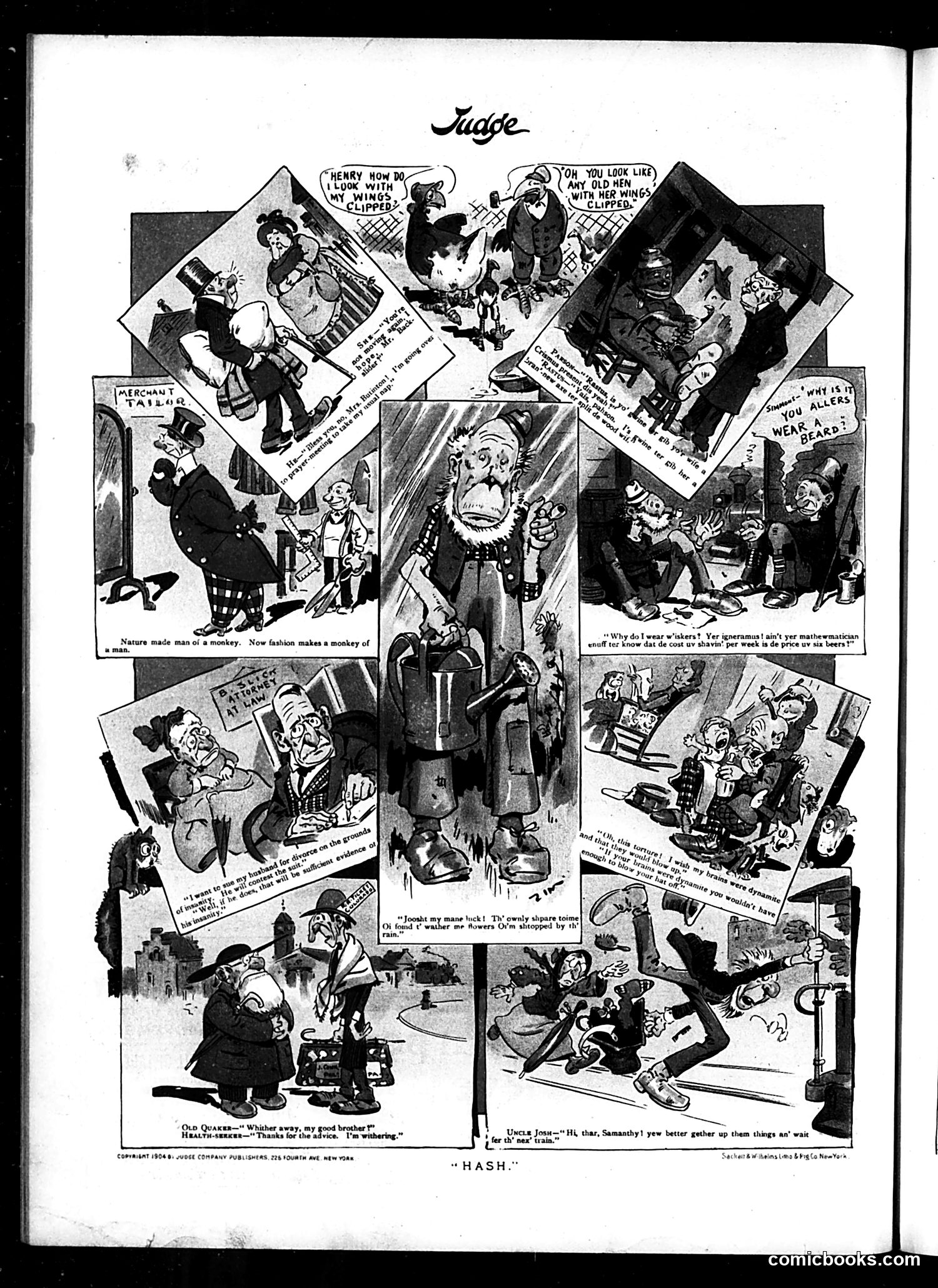
This page presents multiple interconnected satirical vignettes unified by the title "Hash"—a visual pun on both the dish and the jumbled nature of the content itself. The cartoons mock working-class immigrants and rural Americans through exaggerated dialect and caricature. One panel ridicules economic desperation: a man justifies not shaving by claiming the weekly cost equals six beers' worth—suggesting poverty-driven priorities. Another features an Irishman (indicated by phonetic brogue: "Oi'm shtopped") discussing flower-watering, while "Old Quaker" and "Uncle Josie" represent stereotypical rural/backwoods characters speaking in dialectal speech. The comic uses physical caricature—exaggerated features, worn clothing—alongside linguistic mockery to present these figures as comic subjects. References to clipped wings, whiskers, and economic hardship suggest themes of diminishment and survival during the economically challenging early 1900s. The satire targets working-poor immigrants and rural Americans as objects of middle-class ridicule, common in Judge's editorial approach during this period.