
Judge, 1904-11-19 · page 14 of 16
Judge — November 19, 1904 — page 14: what you’re looking at
What you’re looking at
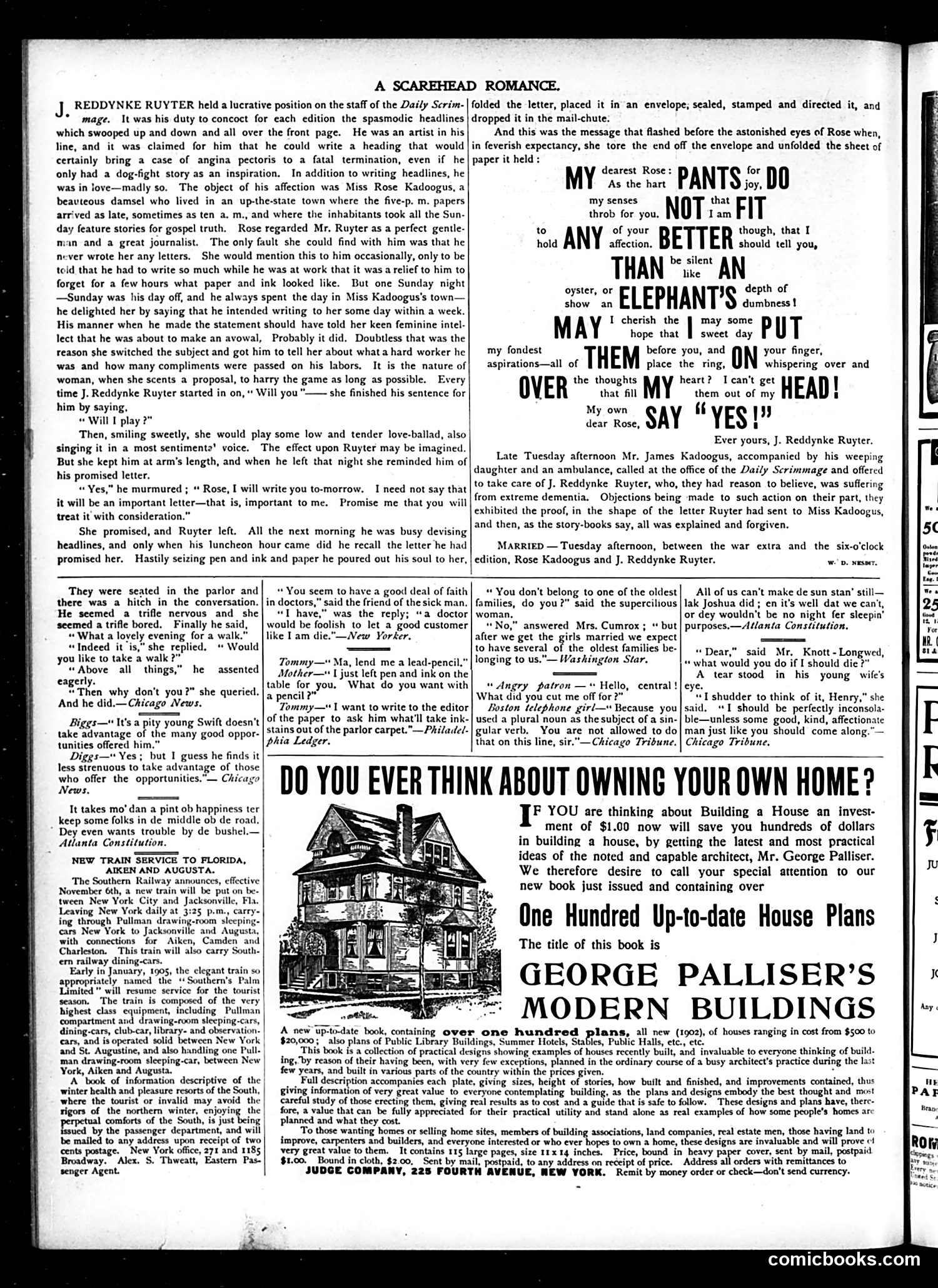
This is a humorous short story satirizing newspaper headline writers and romantic incompetence. J. Reddynke Ruyter, a talented but harried headline writer for the *Daily Scrimmage*, finally attempts to propose to Miss Rose Kadoogus via letter during his lunch break. The joke: His rushed love letter arrives at Rose's home with the lines so badly broken across the page that it reads as nonsensical headline fragments—"PANTS FOR DO NOT FIT / ANY ELEPHANT'S PUT"—rather than a coherent proposal. The satirical point mocks both the mechanical fragmentation caused by newspaper typography and Ruyter's inability to shift from crafting sensational headlines to composing genuine romantic prose. The story ending cryptically references her father arriving with an ambulance, implying Ruyter faces violence for his garbled proposal. The humor targets journalistic rushed work-culture and the absurdity of conducting romance through hastily-written newspaper-office communications.
📄 Transcribed text from this page (OCR, searchable)
Machine-transcribed from the original scan — historical spelling and the odd misread are preserved.
A SCAREHEAD ROMANCE. J REDDYNKE RUYTER held a lucrative position on the staff of the Daily Scrim- * mage. It was his duty to concoct for each edition the spasmodic headlines which swooped up and down and all over the front page. He was an artist in his line, and it was claimed for him that he could write a heading that would certainly bring a case of angina pectoris to a fatal termination, even if he only had a dog-fight story as an inspiration. In addition to writing headlines, he was in love—madly so. The object of his affection was Miss Rose Kadoogus, a beavteous damsel who lived in an up-the-state town where the five-p. m. papers arrived as late, sometimes as ten a. m., and where the inhabitants took all the Sun- day feature stories for gospel truth. Rose regarded Mr, Ruyter as a perfect gentle- man and a great journalist. The only fault she could find with him was that he never wrote her any letters. She would mention this to him occasionally, only to be told that he had to write so much while he was at work that it was a relief to him to forget for a few hours what paper and ink looked like. But one Sunday night —Sunday was his day off, and he always spent the day in Miss Kadoogus’s town— he delighted her by saying that he intended writing to her some day within a week. His manner when he made the statement should have told her keen feminine intel- lect that he was about to make an avowal, Probably it did. Doubtless that was the reason she switched the subject and got him to tell her about what a hard worker he was and how many compliments were passed on his labors. It is the nature of woman, when she scents a proposal, to harry the game as long as possible. Every time J. Reddynke Ruyter started in on, “ Will you "—— she finished his sentence for him by saying, «Will I play 2” Then, smiling sweetly, she would play some low and tender love-ballad, also singing it in a most sentimente' voice. The effect upon Ruyter may be imagined. But she kept him at arm's length, and when he left that night she reminded him of his promised letter. “Yes,” he murmured ; “ Rose, I will write you to-morrow. it will be an important letter—that is, important to me. treat it with consideration.” She promised, and Ruyter left. All the next morning he was busy devising headlines, and only when his luncheon hour came did he recall the letter he had promised her. Hastily seizing pen and ink and paper he poured out his soul to her, TI need not say that Promise me that you will dearest Rose: As the hart to hold depth of dumbness ! PUT your finger, whispering over and HEAD! my fondest aspirations—all of OVER folded the letter, placed it in’an envelope; sealed, stamped and directed it, and dropped it in the mail-chute: And this was the message that flashed before the astonished eyes of Rose when, in feverish expectancy, she tore the end off the envelope and unfolded the sheet of paper it held; M PANTS DO Joy, my senses that throb for you. NOT Iam FIT of your though, that I ANY affection. BETTER should tell you, be silent THAN *.-" AN stow ax ELEPHANT’S show an M I cherish the J} may some AY hope that § sweet day before you, and THEM pisce ste ins, ON the thoughts heart? I can’t get that fill them out of my My own SAY i“ YES yy dear Rose, ' Ever yours, J. Reddynke Ruyter. Late Tuesday afternoon Mr. James Kadoogus, accompanied by his weeping daughter and an ambulance, called at the office of the Daily Scrimmage and offered to take care of J. Reddynke Ruyter, who, they had reason to believe, was suffering from extreme dementia. Objections being ‘made to such action on their part, they exhibited the proof, in the shape of the letter Ruyter had sent to Miss Kadoogus, and then, as the story-books say, all was explained and forgiven. MARRIED — Tuesday afternoon, between the war extra and the six-o'clock edition, Rose Kadoogus and J. Reddynke Ruyter. wD. Esper, They were seated in the parlor and there was a hitch in the conversation. He seemed a trifle nervous and she seemed a trifle bored. Finally he said, “What a lovely evening for a walk.” “Indeed it is,” she replied. Would you like to take a walk 2” “Above all things,” he eagerly. “Then why don’t you?” she queried. And he did.—Chicago News. assented Biggs—« It’s a pity young Swift doesn’t take advantage of the many good oppor- tunities offered him.” “You seem to have a good deal of faith in doctors,” said the friend of the sick man. “I have,” was the reply; “a doctor would be foolish to let a good customer like I am die."—New Yorker, Tommy—* Ma, lend me a lead-pencil.” Mother—* I just left pen and ink on the table for you, What do you want with a pencil ?” Tommy—* | want to write to the editor of the paper to ask him what'll take ink- stains out of the parlor carpet."—Philade/- phia Ledger. “ You don’t belong to one of the oldest families, do you?” said the supercilious woma “No,” answered Mrs. Cumrox ; “ but after we get the girls married we expect to have several of the oldest families be- longing to us."— Washington Star. “Angry patron —“ Hello, central ! What did you cut me off for?” Boston telephone girl— Because you used a plural noun as the subject of a sin- gular verb, You are not allowed to do that on this line, sir."—Chicago Tribune. All of us can’t make de sun stan’ still— lak Joshua did; en it’s well dat we can't, or dey wouldn't be no night fer sleepin’ purposes.—Allanta Constitution. “Dear,” said Mr. Knott - Longwed, «what would you do if I should die?” A tear stood in his young wife's eye. “I shudder to think of it, Henry,” she said. “I should be perfectly inconsola- ble—unless some good, kind, affectionate man just like you should come along.” Chicago Tribune. Diggs—" Yes; but I guess he finds it less strenuous to take advantage of those who offer the opportunities." Chicago News. It takes mo’ dan a pint ob happiness ter keep some folks in de middle ob de road. Dey even wants trouble by de bushel.— Allanta Constitution. NEW TRAIN SERVICE TO FLORIDA, AIKEN AND AUGUSTA. ‘The Southern Railway announces, effective November 6th, a new train will be put on be- tween New York City and Jacksonville, Fla. Leaving New York daily at 3:25 p.m., carry ing through Pullman drawing-room sleeping- cars New York to Jacksonville and Augusta, with connections ‘for Aiken, Camden and Charleston. This train will also carry South- em railway dining-cars. Early in January, 1905, the elegant train so appropriately named the ‘Southern's Palm Limited" will resume service for the tourist season, The train is composed of the very highest class equipment, including Pullman compartment and drawing-room sleeping-cars, dining-cars, club-car, library- and observation: cars, and is operated solid between New York and St. Augustine, and also handling one Pull. man drawing-room sleeping-car, between New York, Aiken and Augusta. A book of information descriptive of the winter health and pleasure resorts of the South, | where the tourist or invalid may avoid the | rigors of the northern winter, enjoying the 1 comforts of the South, is just being ued by the passenger department, and will be mailed to any address upon receipt of two cents postage. New York office, 271 and 1185 Broadway. Alex. S. Thweatt, Eastern Pas- senger Agent. planned and what they cost. very great value to them. JUDGE COMPA p-date book, containing over one hundred also plans of Public Library Buildings, Summer Hotels, Stables, Public Halls, etc. This book is a collection of practical designs showing examples of houses recently buil ing,“by reason of their having been, with very few exce few years, and built in various parts of the country within the prices given. , Full description accompanies each plate, giving sizes, height of stories, how built and finished, and improvements contained, thus giving information of very great value to everyone contemplating building, as the plans and designs embody the best thought and most careful study of those erecting them, giving real results as to cost and a guide that is safe to follow. These designs and plans have, there- fore, a value that can be fully appreciated for their practical utility and stand alone as real examples of how some people's homes arc DO YOU EVER THINK ABOUT OWNING YOUR OWN HOME? F YOU are thinking about Building a House an invest- ment of $1.00 now will save you hundreds of dollars in building a house, by getting the latest and most practical ideas of the noted and capable architect, Mr. George Palliser. We therefore desire to call your special attention to our new book just issued and containing over One Hundred Up-to-date House Plans The title of this book is GEORGE PALLISER’S MODERN BUILDINGS lans, all new (1902), of houses ranging in cost from $500 to etc. ind invaluable to everyone thinking of build. of a busy architect's practice during the last ions, planned in the ordinary course To those wanting homes or selling home sites, members of building associations, land companies, real estate men, those having land to improve, carpenters and builders, and everyone interested or who ever hopes to own a home, these designs are invaluable and will prove ct It contains 115 large pages, size 11x14 inches. Price, bound in heavy paper cover, sent by mail, postpaid. $1.00. Bound in cloth, $2.00, Sent by mail, postpaid, to any address on receipt of price. Address all orders with remittances to , 225 FOURTH AVENUE, REW YORK. Remit by money order or check—don't send currency. comicbooks.com