
A complete issue · 16 pages · 1904
Judge — September 10, 1904
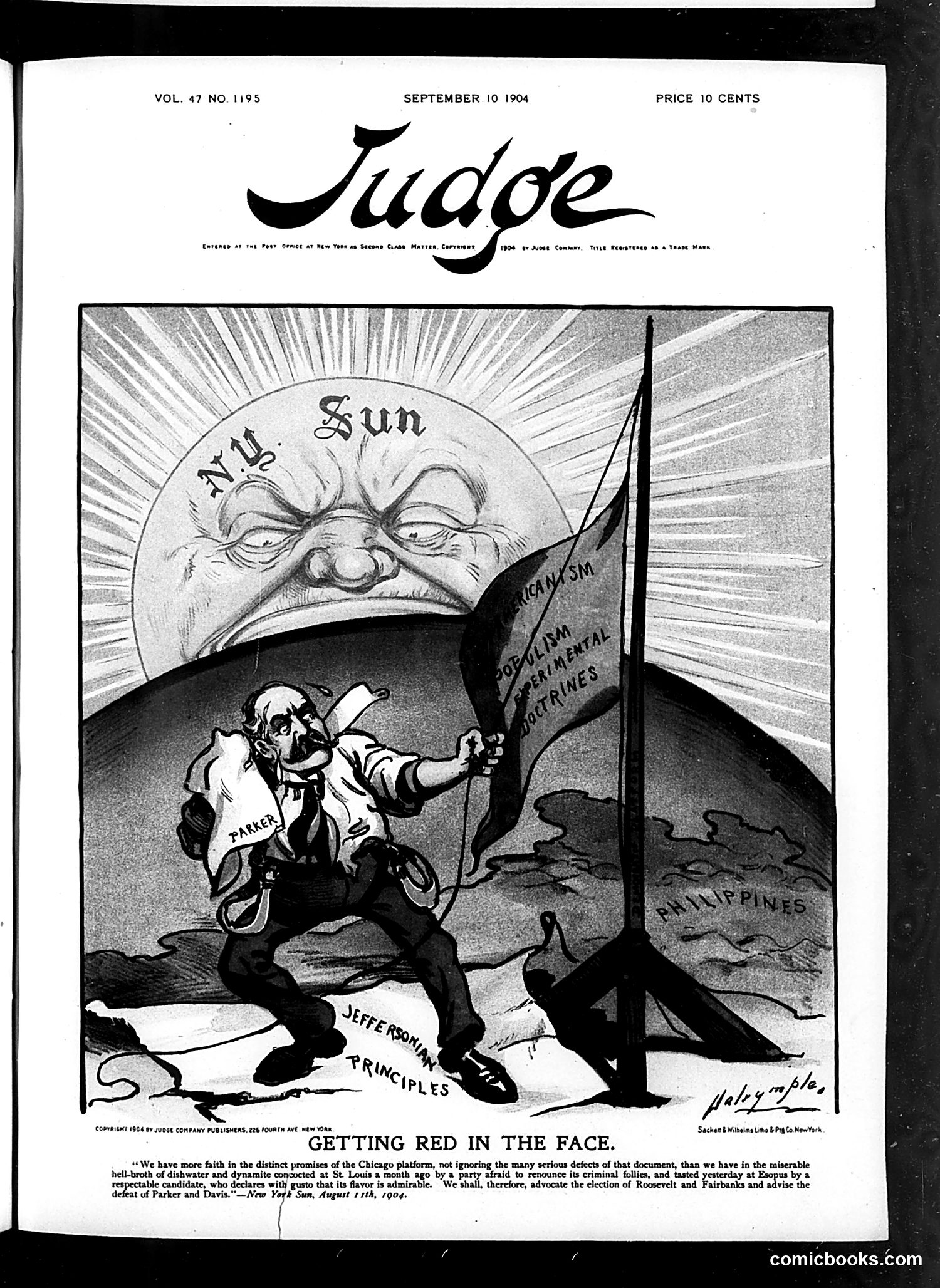
This 1904 *Judge* cartoon satirizes the Republican Party's internal conflict over the 1904 presidential election. The figure labeled "Parker" (likely Alton B. Parker, the Democratic nominee) waves a flag labeled "Populism, Socialism, & Other Isms" while standing on "Jeffersonian Principles." A caricatured man labeled "Parker" appears flustered beneath an anthropomorphized "Sun" (suggesting President Theodore Roosevelt's dominance). The accompanying text mentions "the distinct promises of the Chicago platform" and references defects in "that document," criticizing Parker's campaign positions. The cartoon mocks Parker for allegedly adopting radical positions while claiming to represent traditional Democratic principles—hence "getting red in the face" from embarrassment or anger over this apparent contradiction.
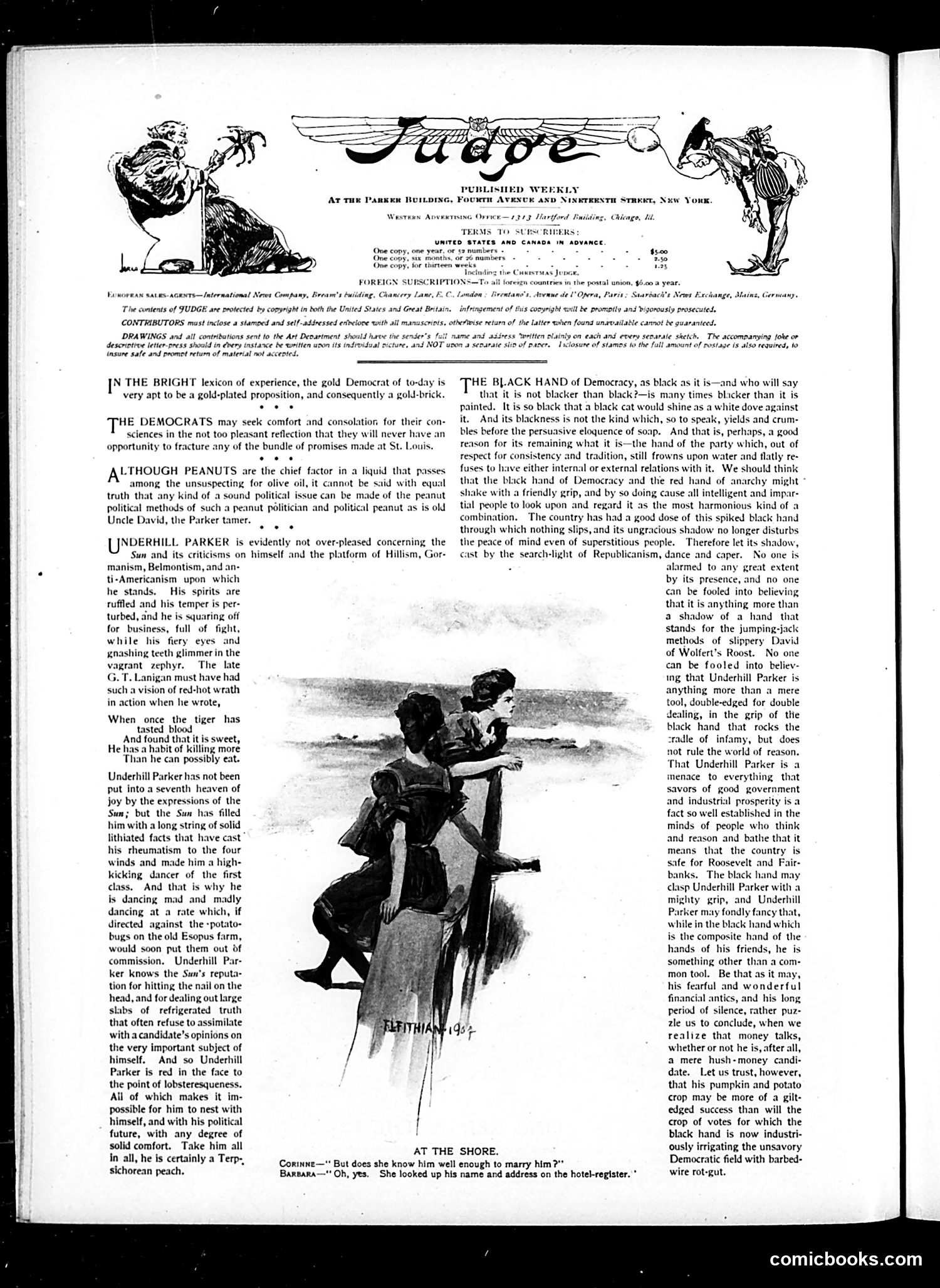
This page contains editorial commentary on early 20th-century American politics. The left column attacks the "gold Democrat" platform, ridiculing gold-standard economics as outdated ("gold-plated proposition"). The right column's main piece, "The Black Hand of Democracy," appears to critique Democratic Party politics as corrupt and threatening, using the "black hand" as metaphor for hidden corruption—likely referencing anarchist or criminal imagery popular in contemporary discourse. The central illustration titled "At the Shore" depicts a couple, with dialogue suggesting a woman checking a hotel register. The satirical point appears social rather than strictly political, possibly mocking courtship or marital customs. The specific political figures referenced remain unclear from OCR alone, though context suggests debates over monetary policy and party governance circa 1900-1912.
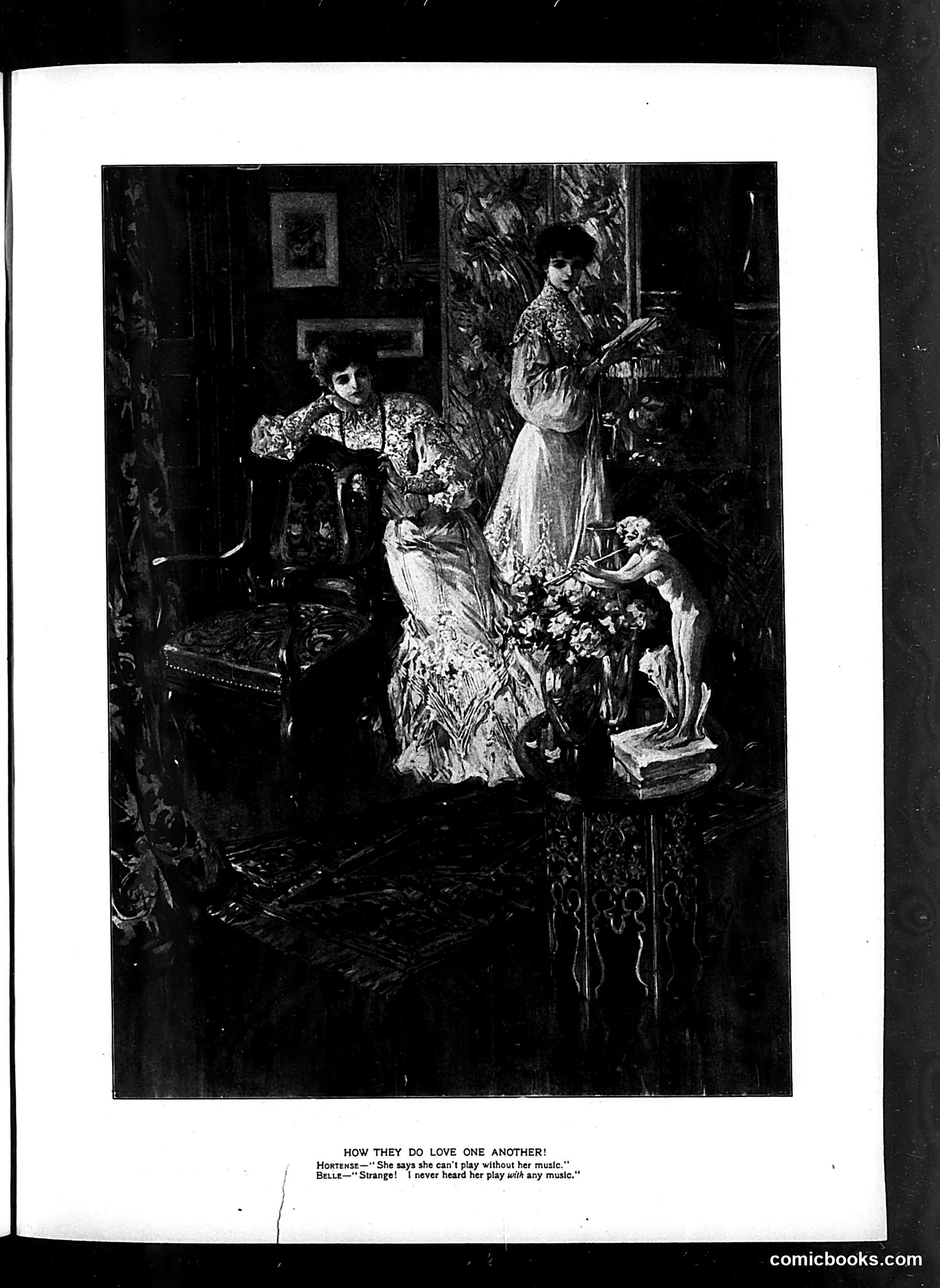
This appears to be a scene from a theatrical or film production rather than a political cartoon. The image shows elegantly dressed figures in an ornate interior setting, with decorative elements and period costuming suggesting early 20th-century aesthetics. The caption "HOW THEY DO LOVE ONE ANOTHER!" presents dialogue between characters named "Hostess" and "Belle": - Hostess: "She says she can't play without her music." - Belle: "Strange! I never heard her play with any music." The humor appears to be social satire—mocking someone who makes excuses about requiring music to perform, while implying they don't actually play at all. This likely satirizes pretentiousness or affectation among society figures. Without additional context about the specific theatrical production or the personalities being referenced, the exact targets remain unclear.
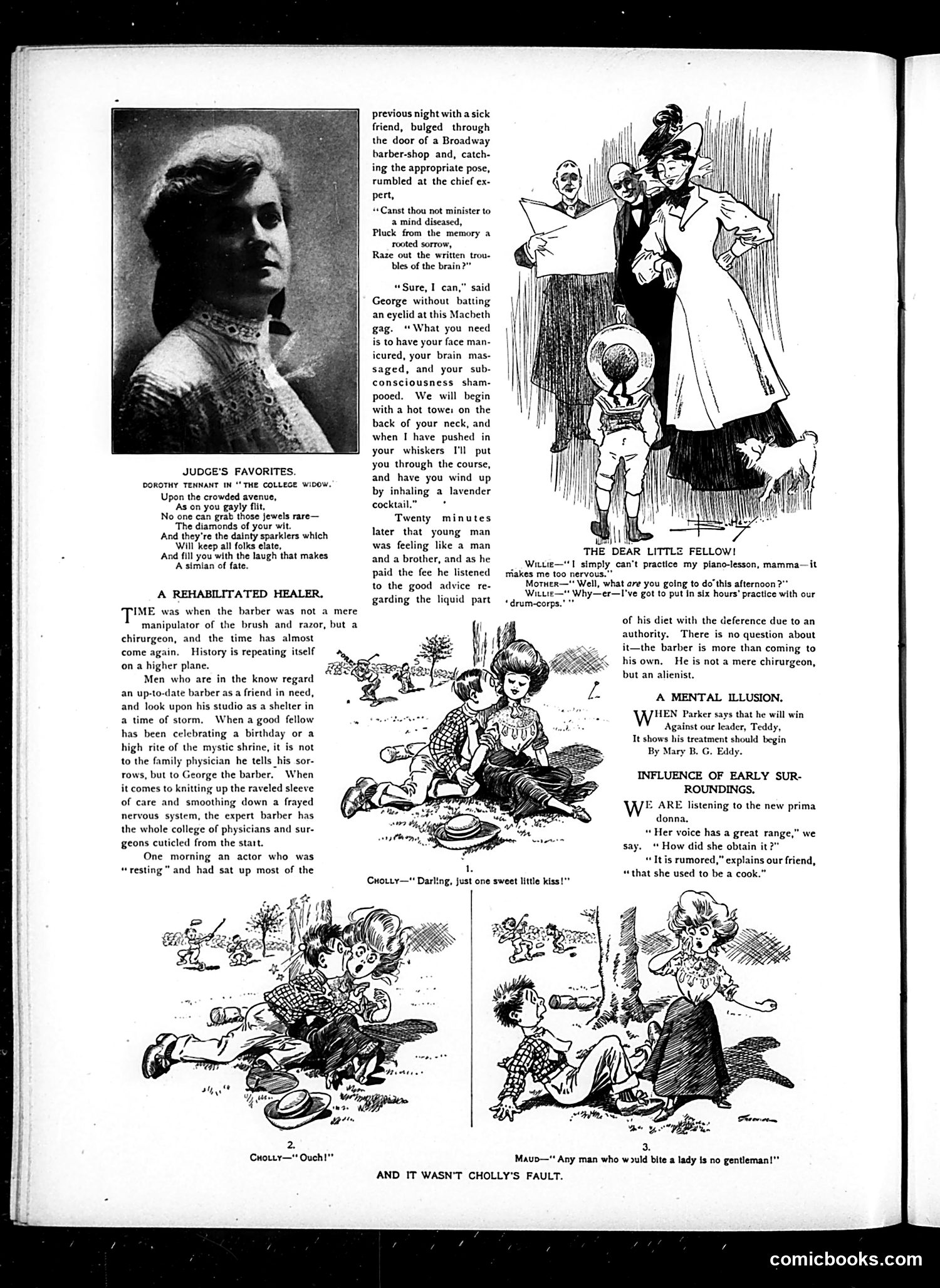
This page contains humor pieces and illustrations rather than political cartoons. The content includes: **"Judge's Favorites"** - A poem about Dorothy Tennant in "The College Widow," praising her jewelry and appearance. **"A Rehabilitated Healer"** - A satirical story mocking a barber who poses as a doctor, using dubious treatments (hot towels, lavender cocktails) to treat illness. The joke targets quack medical practitioners and charlatan healers who exploited patients before modern medical regulation. **"The Dear Little Fellow"** and other domestic humor pieces mock marital and family life through dialogue and cartoon illustrations of children misbehaving. **"Mental Illusion," "Influence of Early Surroundings"** - Brief humorous observations about women, class, and social pretension (a former cook becoming a prima donna). The page reflects early 20th-century American attitudes toward medicine, gender, and class through lighthearted satire.
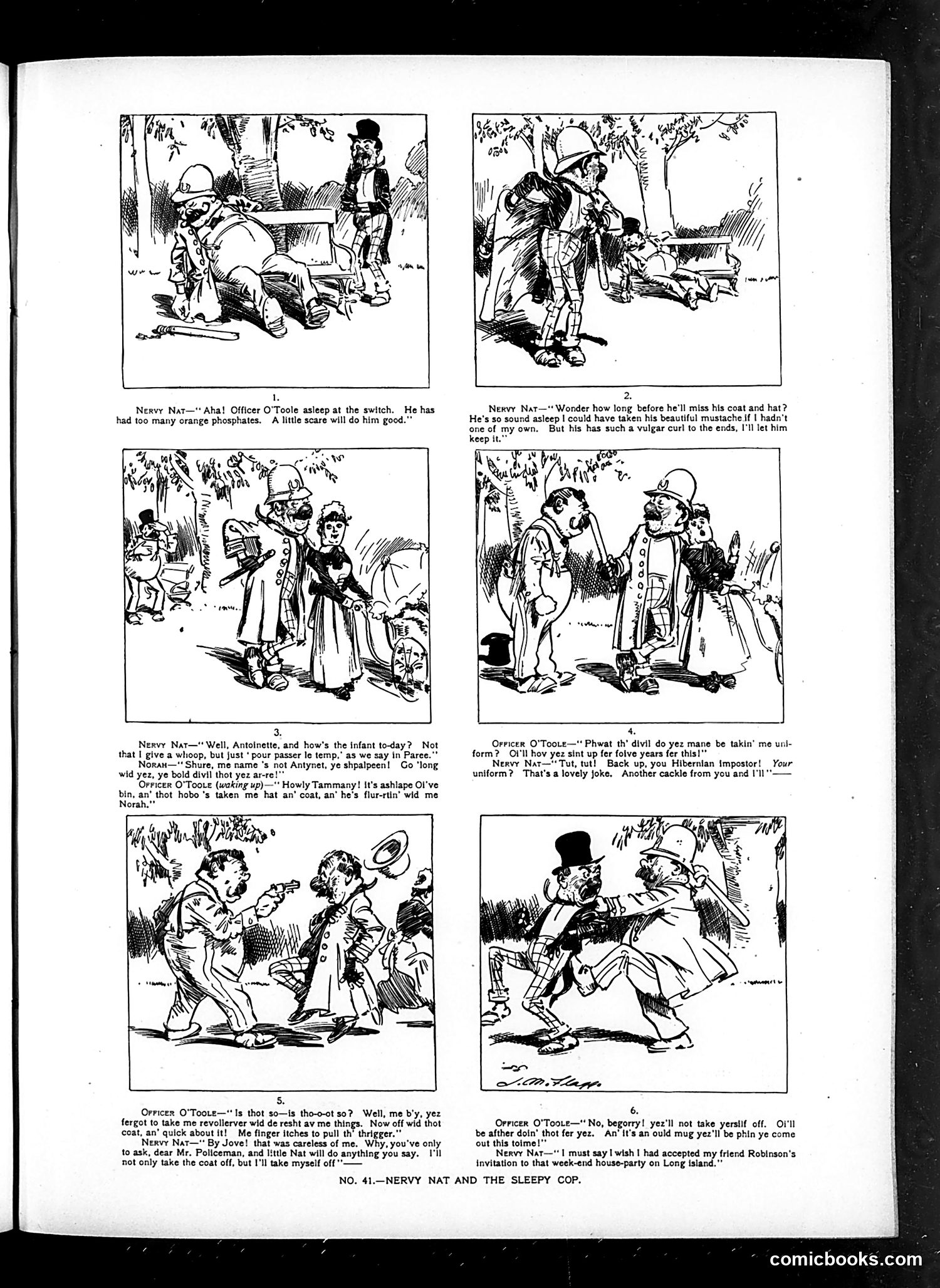
This is a six-panel comic strip satirizing Irish-American police officers and urban petty crime. "Nervy Nat" is a street hustler who spots Officer O'Toole sleeping on duty after consuming too many "orange phosphates" (a popular soda fountain drink). Nat steals the officer's coat, hat, and flirts with O'Toole's girlfriend Norah, mocking his Irish accent and appearance. When O'Toole wakes, he discovers the theft but realizes he's left his revolver behind. Nat, suddenly obsequious, agrees to return everything—until O'Toole threatens him with the gun, causing Nat to flee in panic, regretting he'd declined a weekend invitation to Long Island. The humor relies on ethnic stereotyping (exaggerated Irish dialect, the "Tammany" reference to corrupt New York politics), class mockery of working-class cops, and slapstick consequences. It reflects early 1900s American attitudes toward Irish immigrants and urban crime.
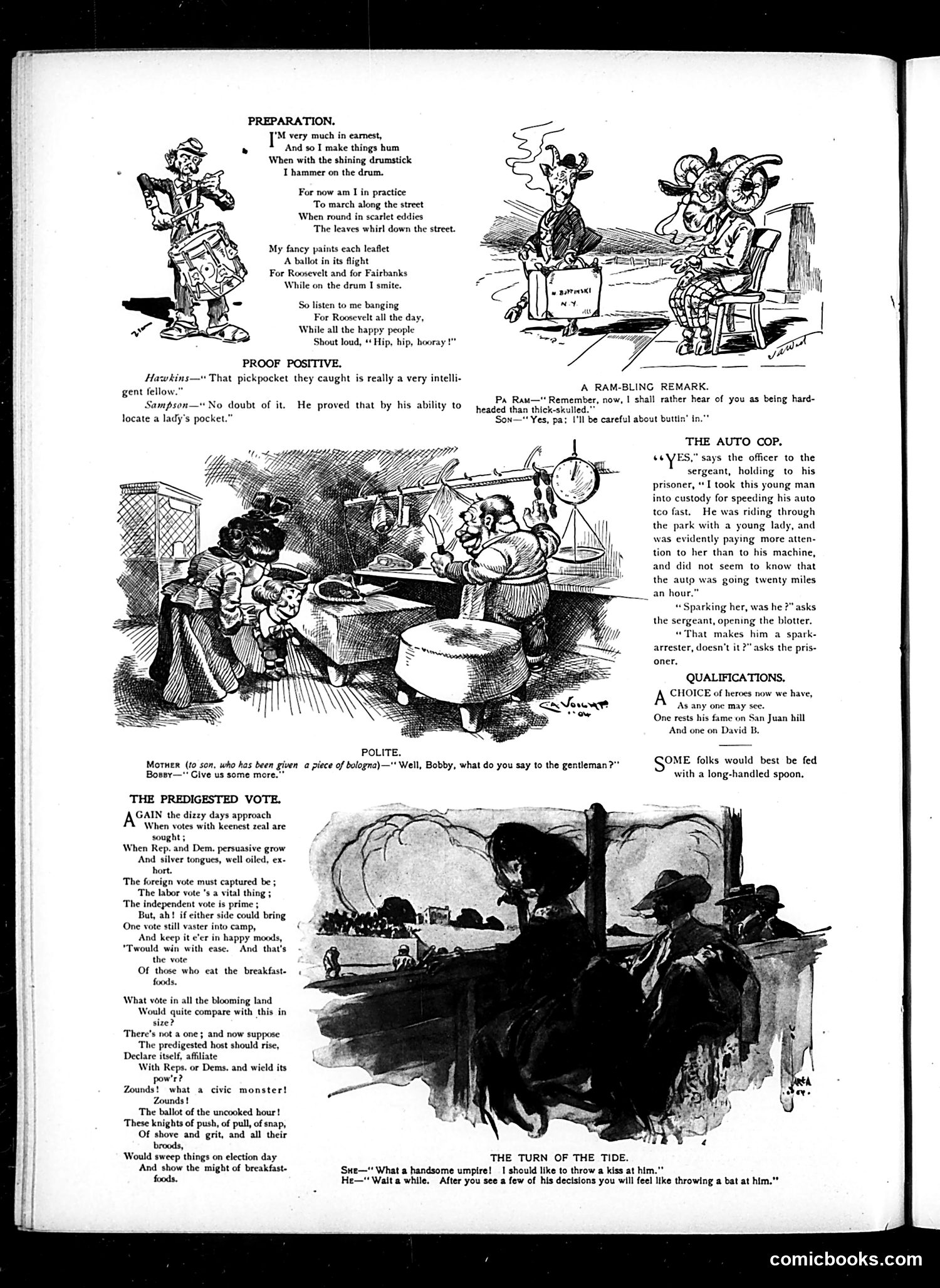
This page from Judge (early 1900s) contains political satire centered on the 1904 presidential election between Republican Theodore Roosevelt and Democrat opponent. **"Preparation"** celebrates Roosevelt's campaign through a child's drum-playing fantasy—leaves become ballots for "Roosevelt and Fairbanks" (the Republican ticket). It's cheerful propaganda. **"The Predigested Vote"** mocks the importance placed on "special interest" voting blocs—particularly breakfast-food consumers. The satire suggests politicians obsess over capturing predetermined voter groups rather than appealing to independent thought. **Other humor** includes standard period jokes: a pickpocket's "intelligence" shown by locating a lady's pocket; a child's impolite response to receiving bologna; baseball umpire humor; automobile speeding jokes; and a pun about "spark-arrester." **"The Turn of the Tide"** (bottom illustration, text unclear in OCR) appears unrelated to the election theme. The page primarily ridicules electoral pandering and special-interest politics—concerns that remain relevant today.
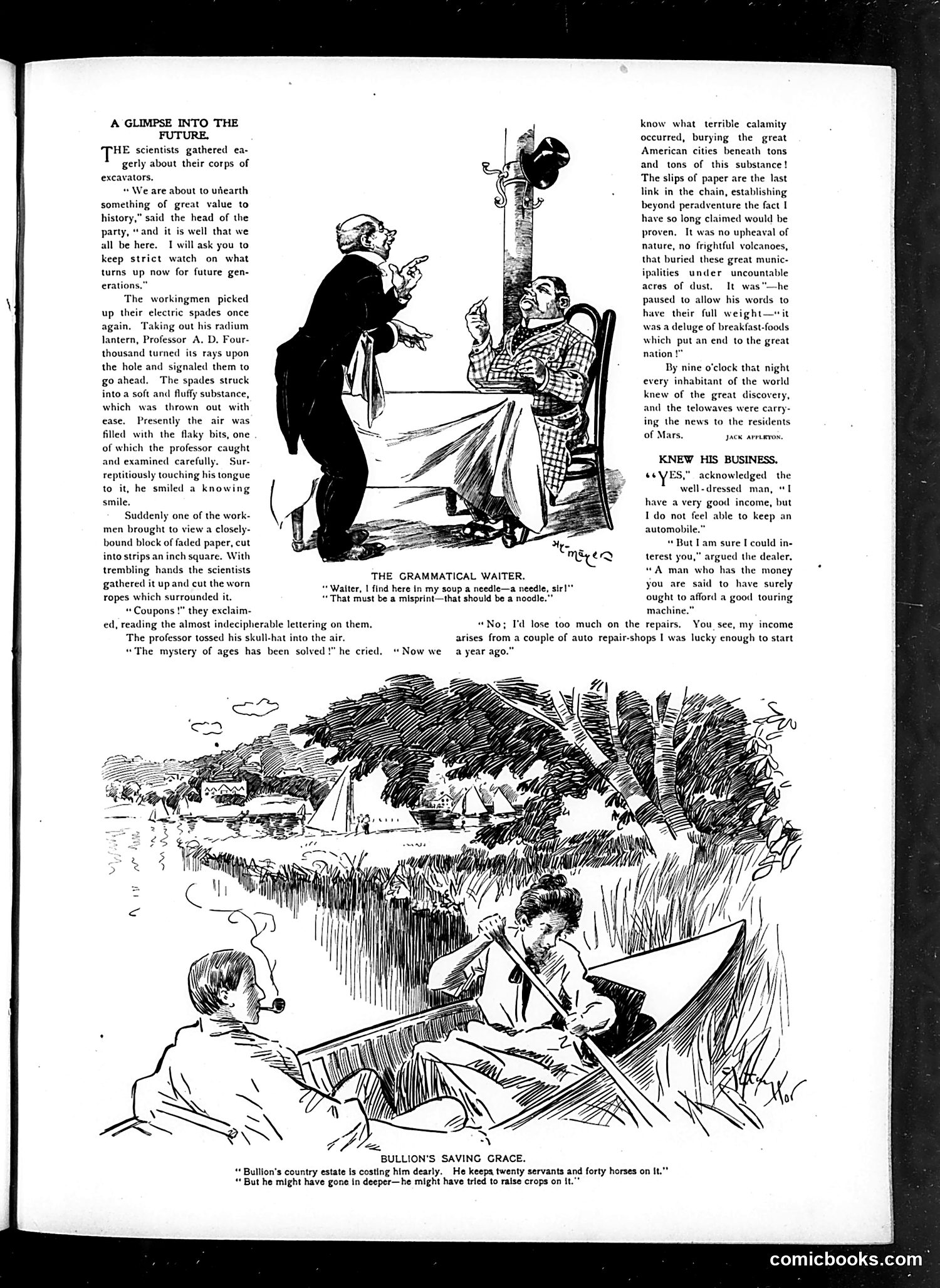
This page contains three separate satirical pieces: **"A Glimpse Into the Future"** imagines archaeologists excavating buried American cities centuries hence. They discover coupons and deduce that civilization collapsed from a catastrophic "deluge of breakfast-foods"—satirizing the era's proliferation of mass-marketed breakfast cereals and processed foods, treating commercial products as absurdly civilization-threatening. **"The Grammatical Waiter"** is a simple pun: a diner complains of finding a needle in soup; the waiter suggests it's a misprint for "noodle." **"Bullion's Saving Grace"** mocks wealthy industrialists' wasteful spending. A man ruining himself maintaining a country estate with servants and horses is presented as fortunate—he could have gone "deeper in debt" by attempting farming. The satire targets the conspicuous consumption and financial recklessness of the wealthy. All three pieces reflect early 20th-century middle-class anxieties: consumer culture excess, linguistic pretension, and aristocratic wastefulness.
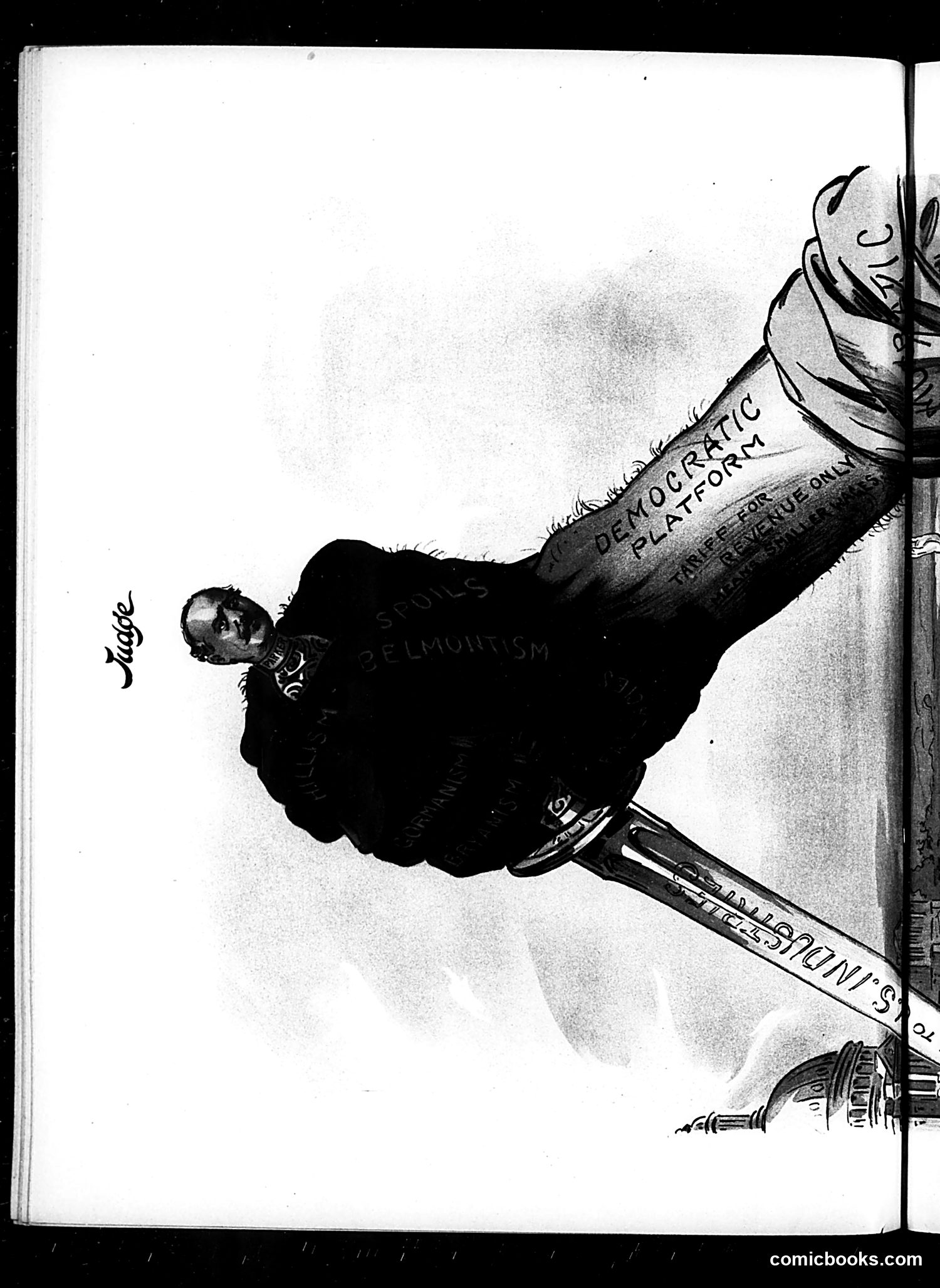
This appears to be a political cartoon from *Judge* magazine featuring a caricatured figure in dark clothing positioned upside-down or inverted on the page. Visible text on the figure's arm or body includes phrases like "DEMOCRATIC PLATFORM" and what appears to be references to political positions or policies. The inversion of the figure—shown literally upside-down—suggests satirical commentary on the instability, contradiction, or absurdity of Democratic Party positions or leadership during the period this was published. The OCR text is largely illegible, making it difficult to identify the specific political figure or precise historical event being mocked. Without clearer text or additional context, the exact satirical target remains unclear, though the inversion device clearly signals ridicule of political inconsistency or chaos.
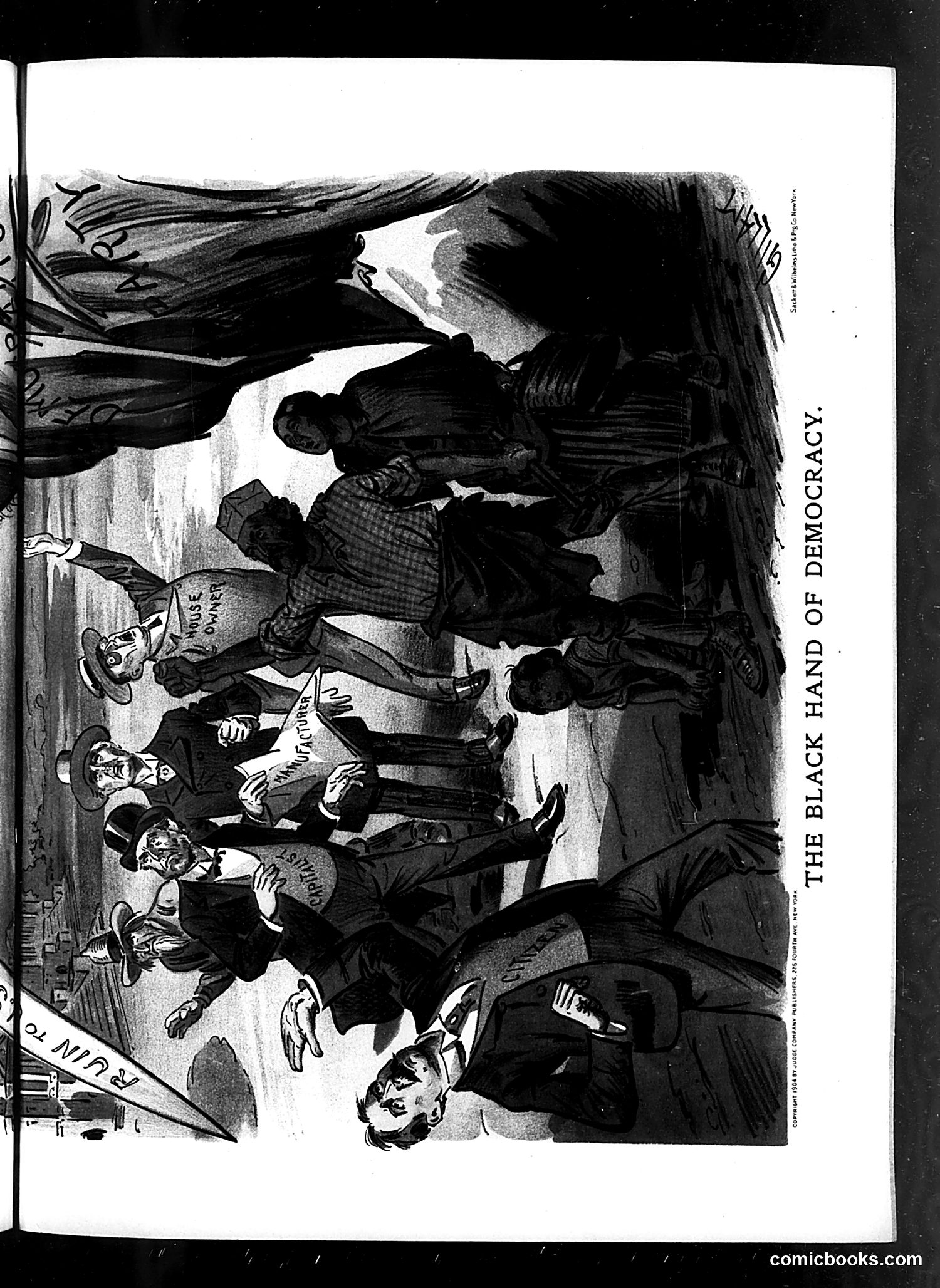
This political cartoon depicts a large threatening hand (labeled "The Black Hand") looming over a group of figures representing democratic institutions or leaders. The hand appears to symbolize an external authoritarian or criminal threat—likely referencing the "Black Hand," a historical term for anarchist or terrorist organizations operating in early 20th-century Europe and America. The cartoon satirizes anxieties about threats to American democracy from radical political movements. The figures below seem to represent government or civic authorities appearing vulnerable or helpless against this shadowy force. This reflects contemporary concerns about anarchism, labor radicalism, or foreign political conspiracies during the Progressive Era.
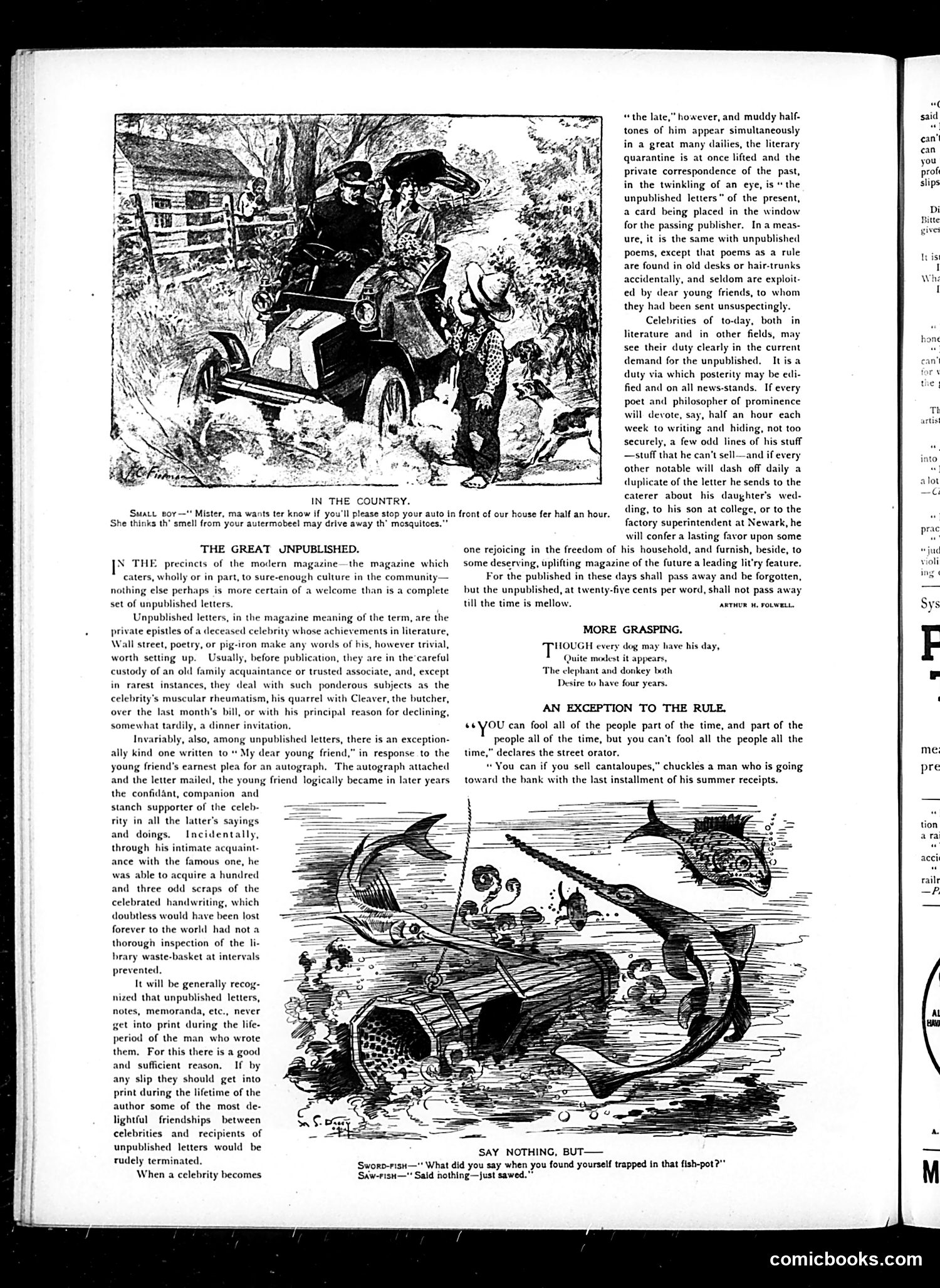
This page satirizes the publishing industry's obsession with unpublished letters and manuscripts from deceased celebrities. The article mocks how magazines eagerly publish trivial private correspondence—complaints about butchers' bills, dinner refusals, muscular rheumatism—simply because a famous person wrote them. The top cartoon shows an automobile in a rural setting, illustrating the article's theme about how even mundane modern details become publishable "content" when attached to a notable figure. The satire suggests that publishers will pay premium rates (twenty-five cents per word) for this mediocre material while ignoring quality contemporary work. The piece advocates that living celebrities should deliberately write and hide unpublished pieces to ensure their trivial words profit them posthumously—a jab at both publishers' greed and celebrity vanity. The lower cartoons offer unrelated jokes about street oracles and cantaloupe salesmen.
This is mostly **advertising and comedic short jokes** rather than political cartoons. The page contains product ads (Evans Ale, Packer's Tar Soap, Sohmer Pianos, Optimo Cigars, Famabella Cigars, Prudential Insurance) interspersed with brief humorous anecdotes. The jokes satirize contemporary social foibles: a professor's pretentious grammar, senatorial corruption (a politician admitting votes are "purchased" but not "delivered"), a wealthy man's hope that railroad dividends provide vacation, and class dynamics (the vice-president's wife going unnoticed). One recurring theme mocks **affectation and hypocrisy**—pretentious speech, phony wealth, and social climbing. The "Building Food" section discusses infant nutrition, reflecting early 1900s concerns about child health. The page lacks prominent political figures or specific dated events—it's representative Judge content: light satire of American manners and mores rather than hard-hitting political commentary.
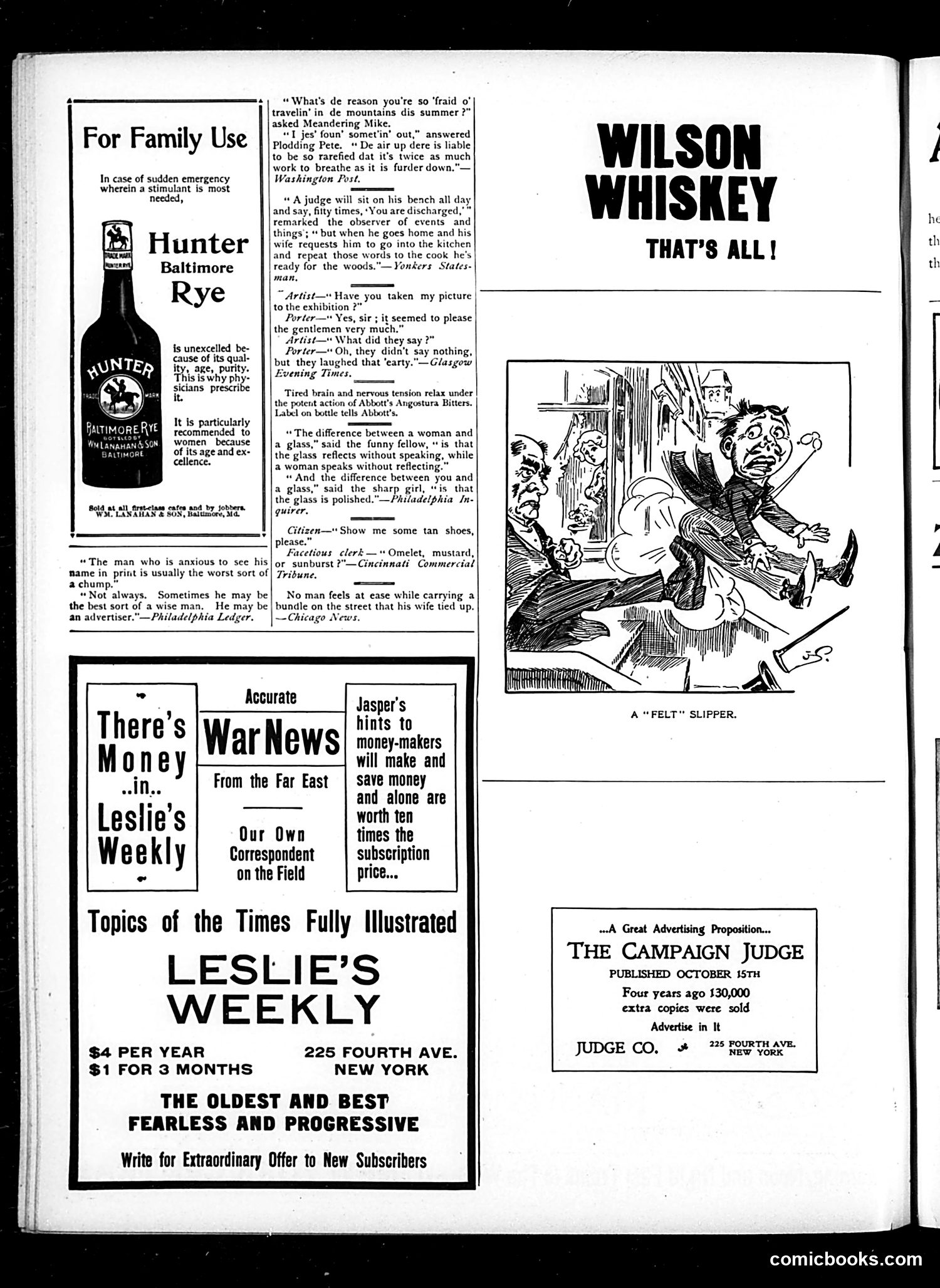
This is primarily an **advertising and humor page** from Judge magazine, not a political cartoon. The page contains: **Main Content:** - Multiple short humorous anecdotes (jokes) on various topics—mountain air, judges, artists, gender differences, shoe shopping, and domestic life - These appear to be generic social commentary rather than political satire **The Cartoon:** A single illustrated joke titled "A 'Felt' Slipper" shows a man slipping on what appears to be a felt slipper, depicted in exaggerated physical distress. The visual gag likely plays on the pun of "felt" (the fabric) versus "felt" (past tense of feel), though the exact joke is unclear from the image alone. **Advertisements:** - Hunter Baltimore Rye whiskey (marketed as a medicinal stimulant for emergencies) - Leslie's Weekly magazine - The Campaign Judge publication The page reflects early 20th-century advertising practices, including the normalization of alcohol as medicinal, and demonstrates Judge's format of brief jokes combined with commercial content.
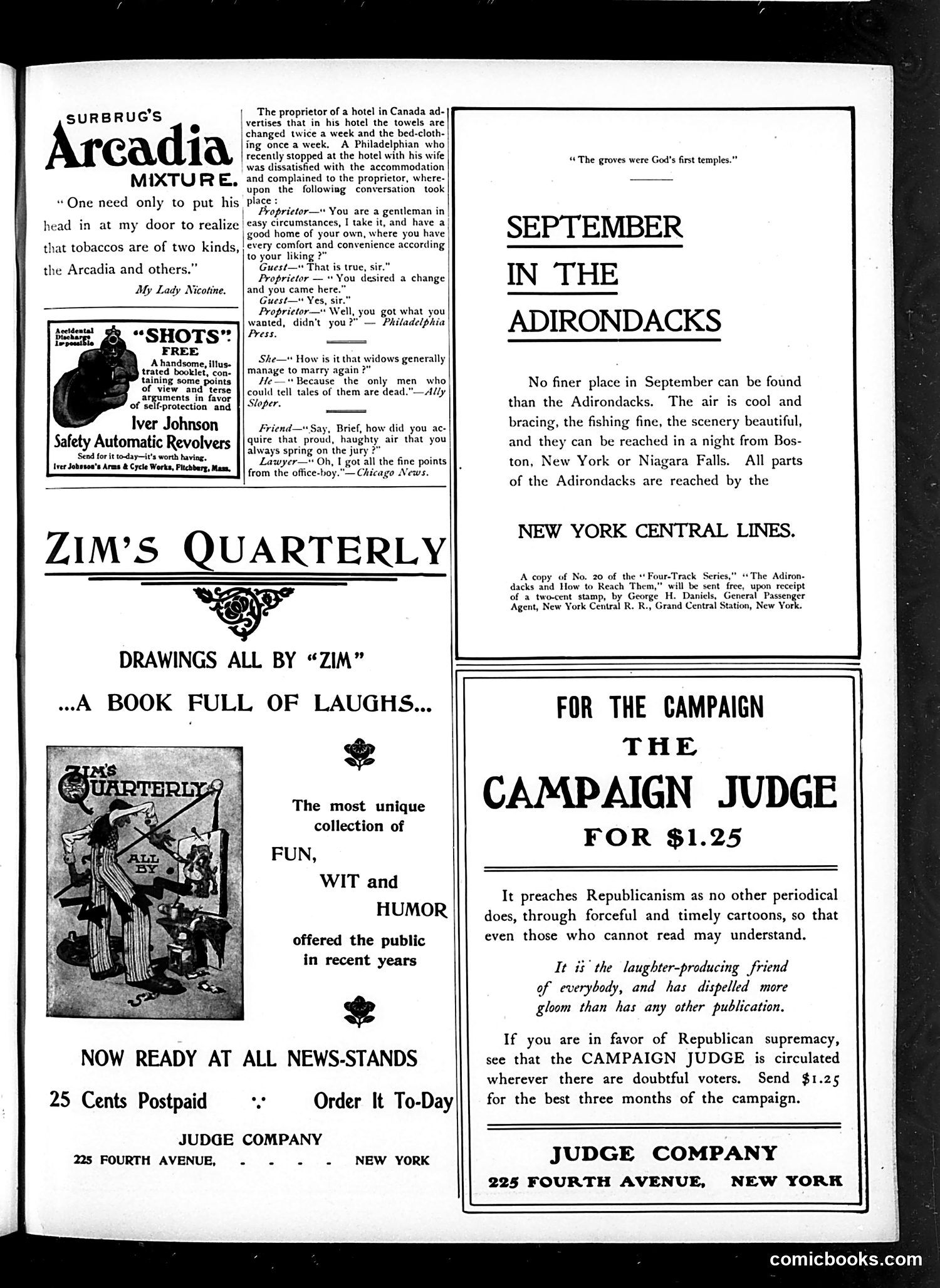
This page is primarily **advertising and promotional content**, not satirical cartoons. The main elements are: **Advertisements:** - Surbrug's Arcadia tobacco mixture - Iver Johnson Safety Automatic Revolvers (promoting self-protection) - Zim's Quarterly (a humor book by cartoonist "Zim") - New York Central Lines (Adirondacks travel promotion) **Political Content:** The "Campaign Judge" advertisement promotes Judge magazine's Republican partisan mission during an election campaign (likely early 1900s, based on style). It explicitly states the publication "preaches Republicanism" through "forceful and timely cartoons" aimed at converting "doubtful voters." The ad emphasizes Judge reaches readers who "cannot read" through visual humor—a significant claim about the magazine's populist reach. **Humor Snippets:** Several brief jokes appear, including exchanges about hotel accommodations and widow remarriage—typical period humor. The page demonstrates how Judge functioned as both satirical publication and partisan Republican campaign tool, selling political messaging alongside consumer goods.
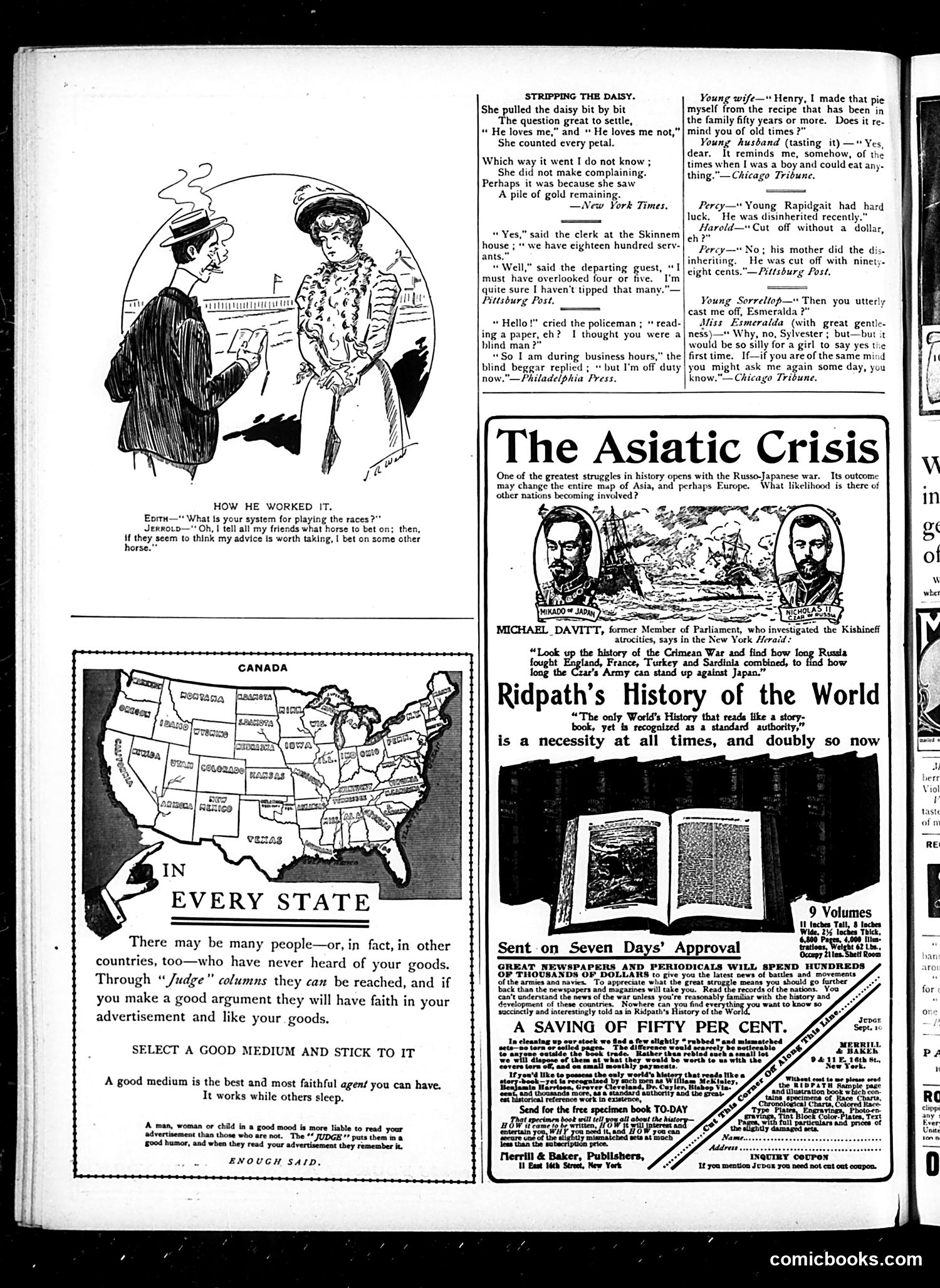
This page from *Judge* magazine contains several humor pieces and advertisements, likely from around 1904 (given the "Asiatic Crisis" reference to the Russo-Japanese War). **Top cartoon "Stripping the Daisy"**: A woman plucks daisy petals saying "he loves me/loves me not" while counting a pile of gold coins. The joke: she's indifferent to the romantic outcome because she's wealthy—suggesting a satirical comment on mercenary marriage or that money trumps love. **"How He Worked It"**: A man admits his system for horse racing is telling friends his picks, then betting against his own advice—mocking overconfident tipsters. **Other brief jokes** mock newlyweds, inheritance disputes, and con artists posing as blind beggars during working hours. **"The Asiatic Crisis" section**: Promotes *Ridpath's History of the World* as necessary reading to understand the developing Russo-Japanese War and its potential global implications—contemporary advertising tied to breaking news. The page is primarily **advertising and light humor** rather than serious political satire.
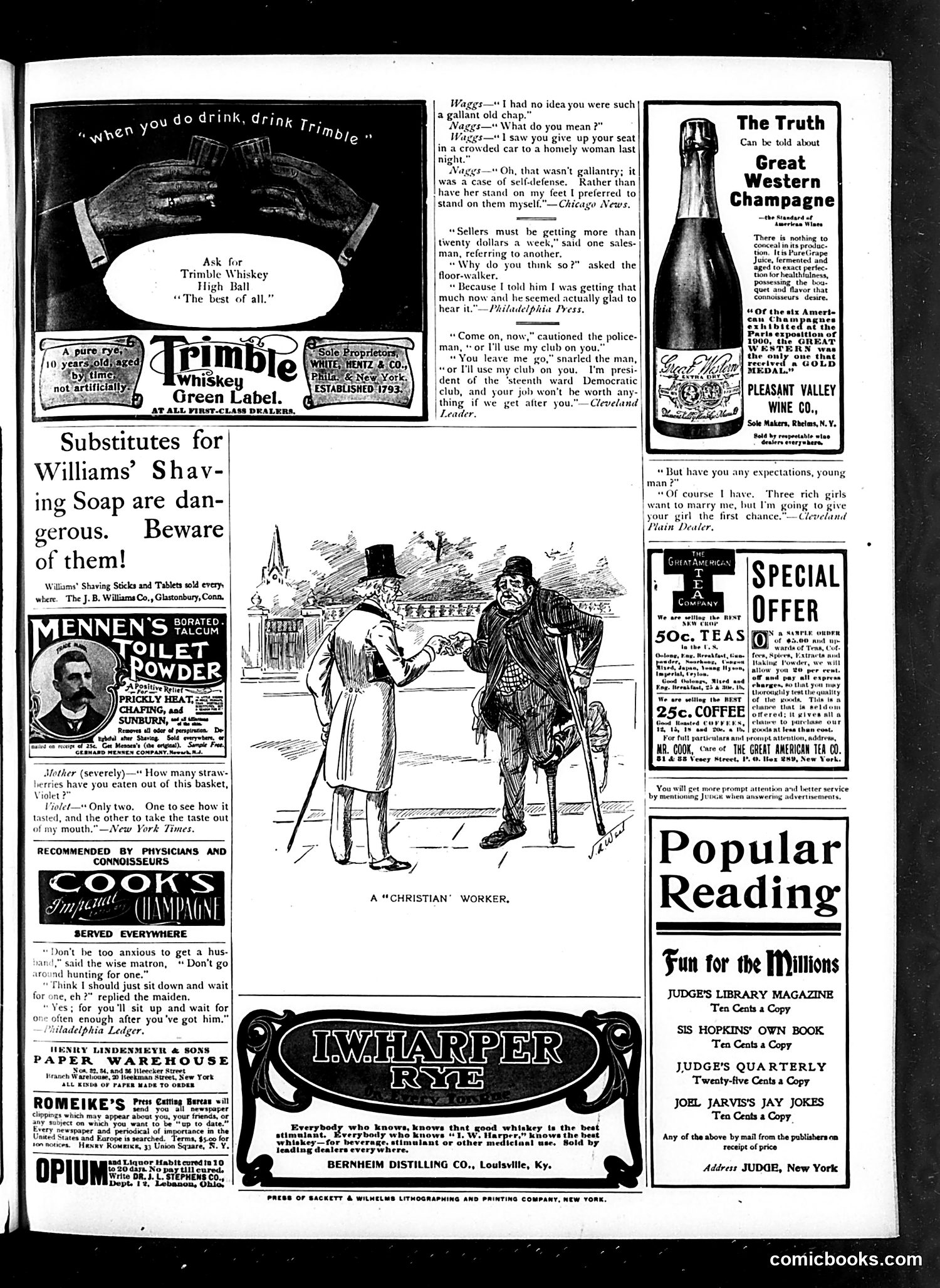
This page is primarily **advertising** for alcohol and consumer products, interspersed with brief humorous anecdotes typical of Judge magazine's satirical content. ## The Main Cartoon The central illustration labeled "A 'CHRISTIAN' WORKER" depicts a well-dressed man (appearing to be a religious or charity worker) confronting a poorly-dressed vagrant or beggar. The accompanying text jokes about a policeman threatening a man with his club, until the man reveals he's the "president of the 'steenth ward' Democratic club"—satirizing how political connections provided protection from police enforcement. The humor targets corruption and the hypocrisy of political "charity workers." ## Advertisements The page features whiskey (Trimble, I.W. Harper Rye), champagne, coffee, tea, and toilet powder ads—typical of early-1900s Judge content. Notable is the warning against "Substitutes for Williams' Shaving Soap," suggesting counterfeit products were a consumer concern. The brief jokes scattered throughout mock social pretension, romantic expectations, and workplace dynamics of the era.
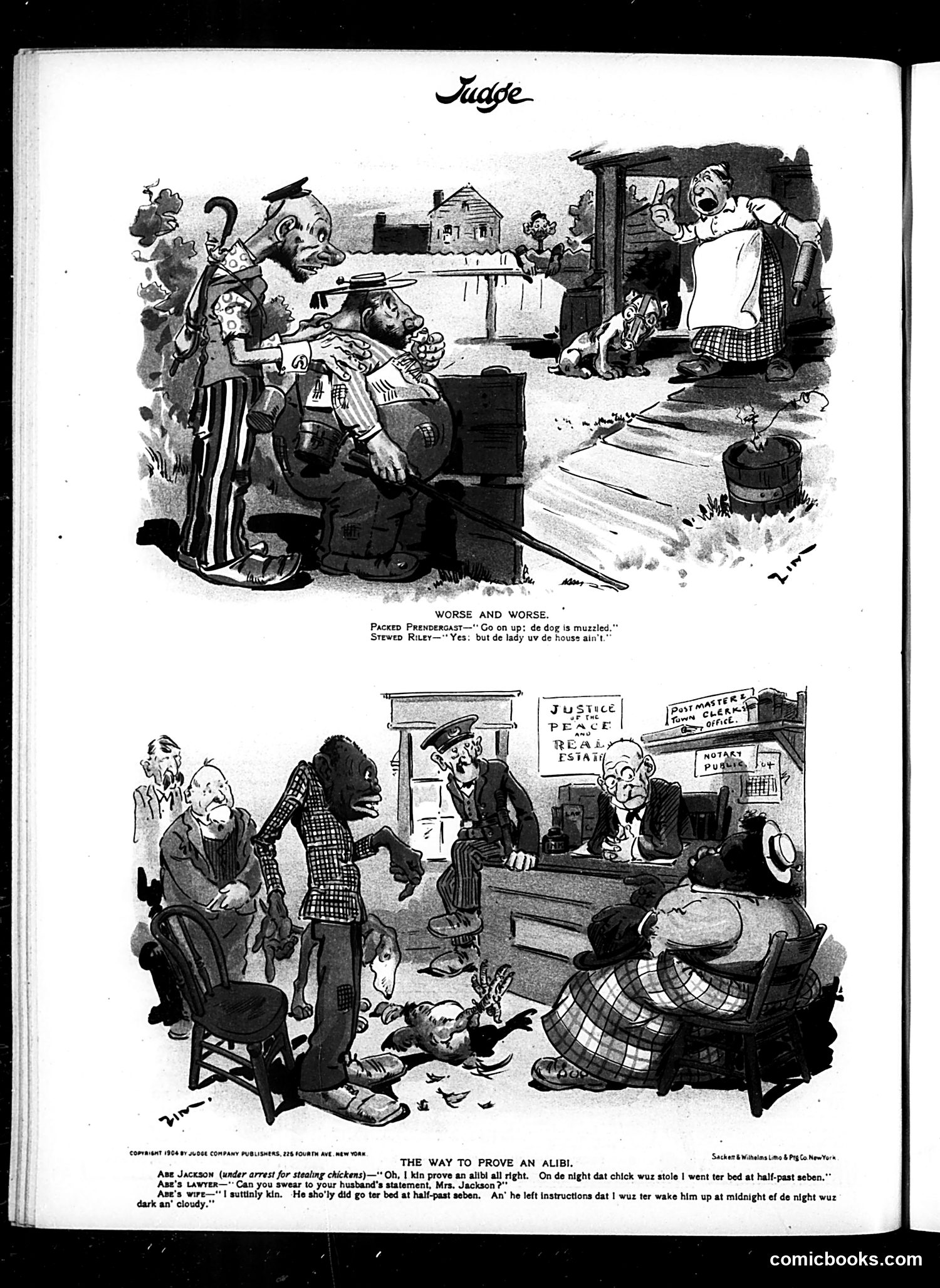
This page contains two separate cartoons using racist caricature and dialect to mock African American subjects. The **top cartoon** ("Worse and Worse") depicts a peddler warning a colleague about a dangerous dog, only to be told the homeowner's wife is worse—a domestic violence joke relying on offensive stereotypes. The **bottom cartoon** ("The Way to Prove an Alibi") satirizes a man accused of chicken theft who claims an alibi: he went to bed at 7:30 PM. His wife corroborates this, but then reveals he instructed her to wake him at midnight if it was dark—obviously contradicting his alibi. The humor relies on depicting the defendant and his wife as foolishly incompetent liars who don't understand they've incriminated themselves. Both use exaggerated caricature, misspelled dialect, and stereotypical behavior to present African Americans as criminals, dim-witted, or morally questionable—typical of early-20th-century American satirical magazines' racist content.