
Judge, 1904-09-10 · page 10 of 16
Judge — September 10, 1904 — page 10: what you’re looking at
What you’re looking at
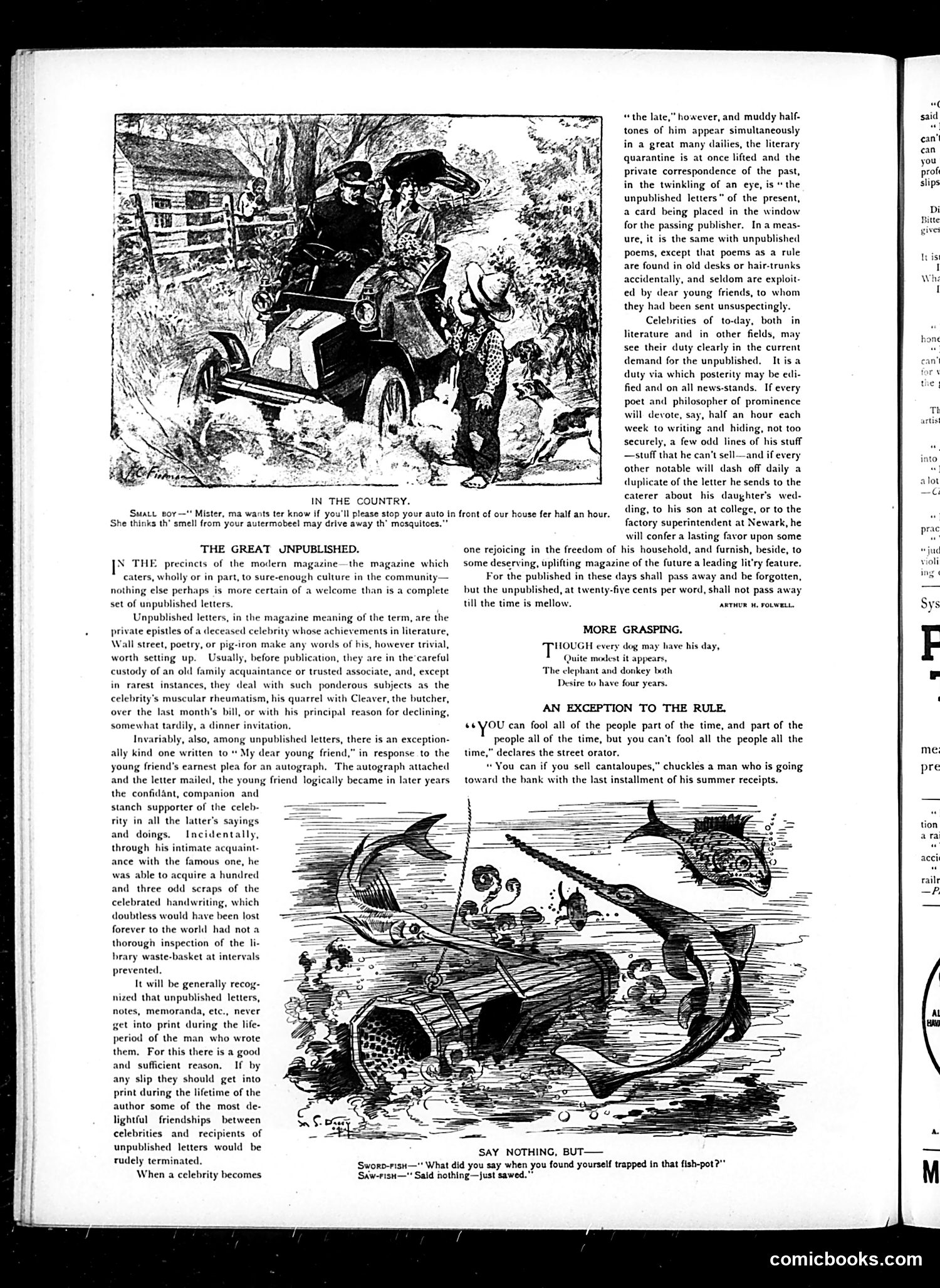
This page satirizes the publishing industry's obsession with unpublished letters and manuscripts from deceased celebrities. The article mocks how magazines eagerly publish trivial private correspondence—complaints about butchers' bills, dinner refusals, muscular rheumatism—simply because a famous person wrote them. The top cartoon shows an automobile in a rural setting, illustrating the article's theme about how even mundane modern details become publishable "content" when attached to a notable figure. The satire suggests that publishers will pay premium rates (twenty-five cents per word) for this mediocre material while ignoring quality contemporary work. The piece advocates that living celebrities should deliberately write and hide unpublished pieces to ensure their trivial words profit them posthumously—a jab at both publishers' greed and celebrity vanity. The lower cartoons offer unrelated jokes about street oracles and cantaloupe salesmen.
📄 Transcribed text from this page (OCR, searchable)
Machine-transcribed from the original scan — historical spelling and the odd misread are preserved.
IN THE COUNTRY. «the late,” however, and muddy half tones of him appear simultaneously in a great many dailies, the literary quarantine is at once lifted and the private correspondence of the past, in the twinkling of an eye, is “the unpublished letters” of the present, a card being placed in the window for the passing publisher. Ina meas- ure, it is the same with unpublished poems, except that poems as a rule are found in old desks or hair-trunks accidentally, and seldom are exploit- ed by dear young friends, to whom they had been sent unsuspectingly. Celebrities of to-day, both in literature and in other fields, may see their duty clearly in the current demand for the unpublished, It is a duty via which posterity may be edi- fied and on all news-stands. If every poet and philosopher of prominence will devote, say, half an hour each week to writing and hiding, not too securely, a few odd lines of his stuff —stuff that he can't sell—and if every other notable will dash off daily a duplicate of the letter he sends to the caterer about his daughter's wed- SuaLt eor—" Mister, ma wants ter know if you'll please stop your auto in front of our house fer half an hour. ‘ling, to his son at college, or to the She thinks th’ smell from your autermobeel may drive away th’ mosquitoes.”” THE GREAT JNPUBLISHED. N THE precincts of the modern magazine—the magazine which caters, wholly or in part, to sure-enough culture in the community— nothing else perhaps is more certain of a welcome than is a complete set of unpublished letters. Unpublished letters, in the magazine meaning of the term, are the private epistles of a deceased celebrity whose achievements in literatu Wall street, poetry, or pig-iron make any words of his, however tri worth setting up. Usually, before publication, they are in the'c custody of an oli! family acq ce or trusted associate, and, except in rarest instances, they deal with such ponderous subjects as the celebrity’s muscular rheumatism, his quarrel with Cleaver, the butcher, over the last month's bill, or with his principal reason for declining, somewhat tardily, a dinner invitation, y, also, among unpublished letters, there is an exception- ally kind one written to“ My dear young friend,” in response to the young friend’s earnest plea for an autograph, The autograph attached and the letter mailed, the young friend logically became in later years the confidant, companion and stanch supporter of the celeb- factory superintendent at Newark, he will confer a lasting favor upon some one rejoicing in the freedom of his household, and furnish, beside, to some deserving, uplifting magazine of the future a leading lit'ry feature. For the published in these days shall pass away and be forgotten, but the unpublished, at twenty-five cents per word, shall not pass away till the time is mellow. ARTHUR Mt FoLWELL, MORE GRASPING. Thovcn every dog may have his day, Quite modest it appears, ‘The clephant and donkey both Desire to have four years. AN EXCEPTION TO THE RULE. 6 YOU can fool all of the people part of the time, and part of the people all of the time, but you can’t fool all the people all the time,” declares the street orator. “You can if you sell cantaloupes,” chuckles a man who is going toward the hank with the last installment of his summer receipts. rity in all the latter's sayings and doings. Incidentally, through his intimate acquaint- ance with the famous one, he was able to acquire a hundred and three odd scraps of the celebrated handwriting, which doubtless would have been lost forever to the worl had not a thorough inspection of the li brary waste-basket at interv: prevented. It will be generally recog- nized that unpublished letters, notes, memoranda, etc., never get into print during the life- period of the man who wrote them. For this there is a good and sufficient reason, If by any slip they should get into print during the lifetime of the author some of the most de- lightful friendships between celebrities and recipients of unpublished letters would be rudely terminated. When a celebrity becomes SAY NOTHING, BUT—— ‘Sworo-risn—" What did you say when you found yourself trapped in that fish-pot?"" ‘Saw-rish—"' Said hothing—just sawed.” A comicbooks.com