
A complete issue · 16 pages · 1904
Judge — August 13, 1904
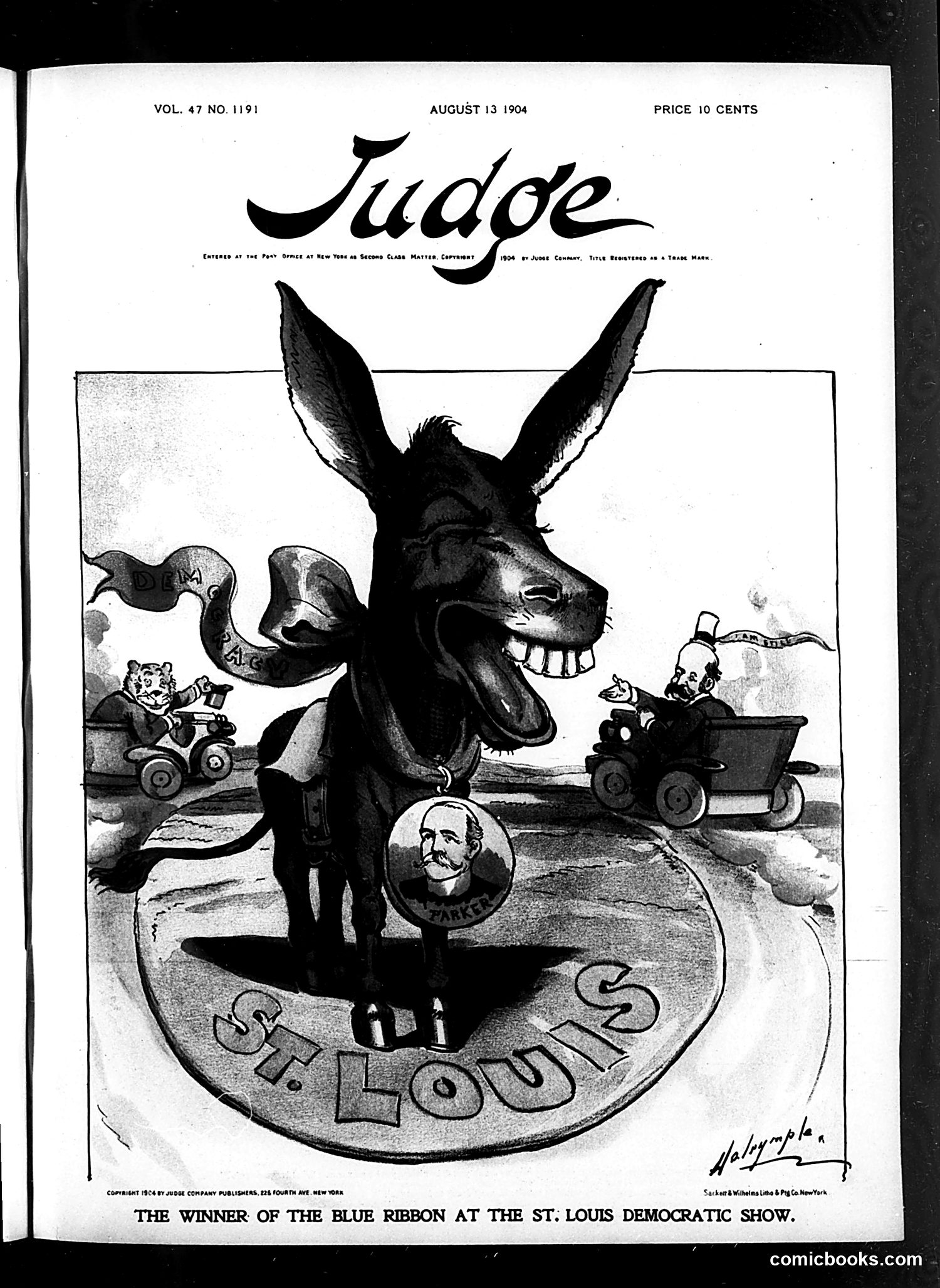
This August 1904 *Judge* cover satirizes the Democratic National Convention at St. Louis. The central figure is a donkey (symbol of the Democratic Party) wearing a grotesque grin, labeled "St. Louis" on its platform base. The donkey displays a circular portrait of what appears to be a political figure (likely a candidate or party leader being ridiculed). Flanking the donkey are caricatured figures in small vehicles, possibly representing rival factions or candidates competing for party control. The "Blue Ribbon" reference in the caption suggests the cartoon mocks the Democrats' selection process at their convention. The overall message ridicules the Democratic Party's nomination proceedings as chaotic or absurd—the donkey's exaggerated features and the circus-like scene emphasize this mockery of the convention itself.
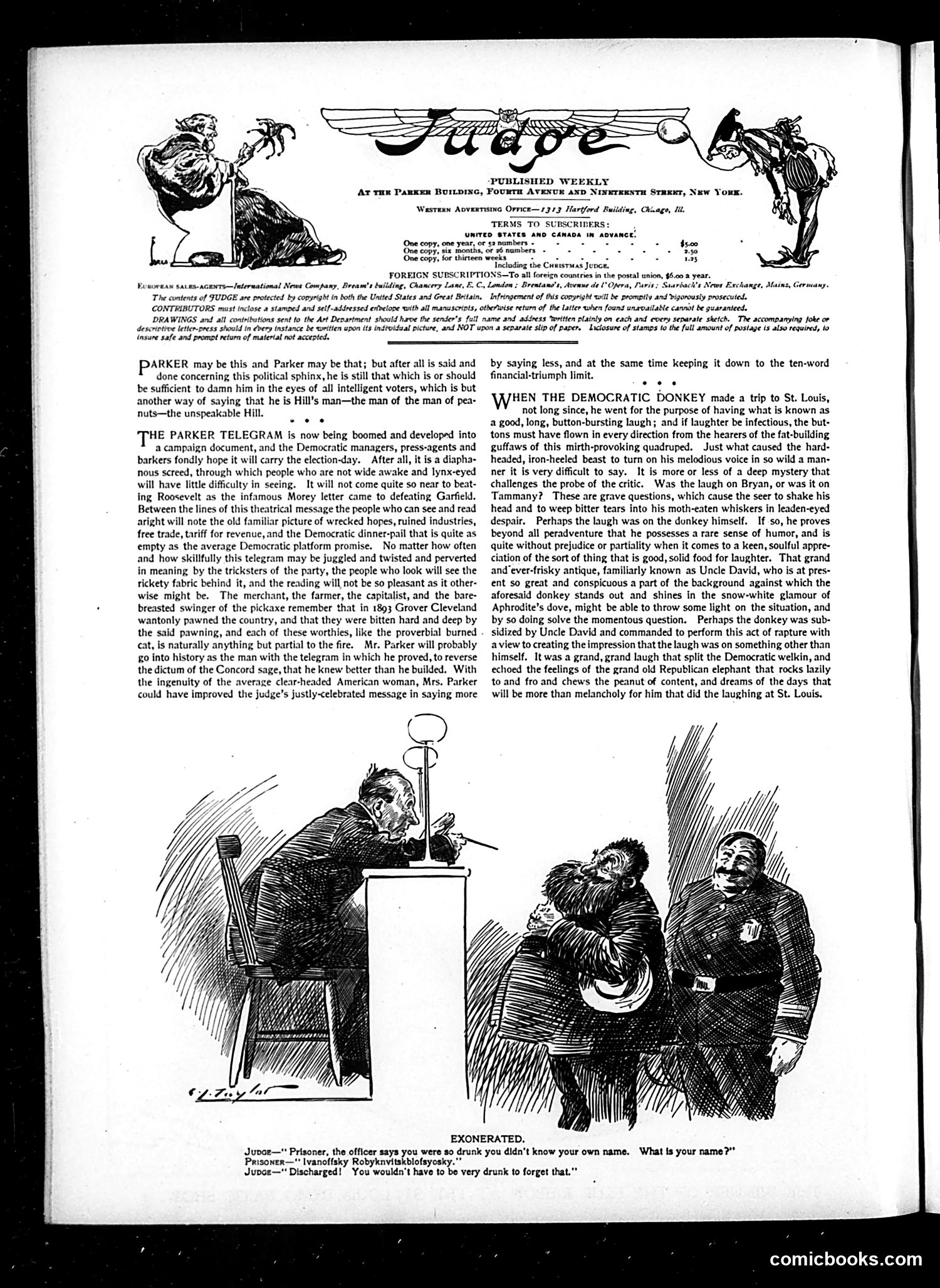
This page satirizes the Democratic Party's internal conflicts during what appears to be the early 20th century. The main article critiques Democratic leadership, particularly regarding a "Parker Telegram"—likely referencing Judge Parker, a Democratic presidential candidate. The satire suggests Democratic managers were using theatrical stagecraft to manipulate public perception rather than addressing genuine political substance. The cartoon captioned "EXONERATED" depicts a courtroom scene where a judge questions a drunk prisoner about his identity, and the prisoner claims drunkenness excuses forgetting his name. This appears to be political commentary—possibly suggesting Democratic leadership was using similar dubious excuses to evade accountability for their political positions or actions. The overall tone is sharply critical of Democratic party management and integrity.
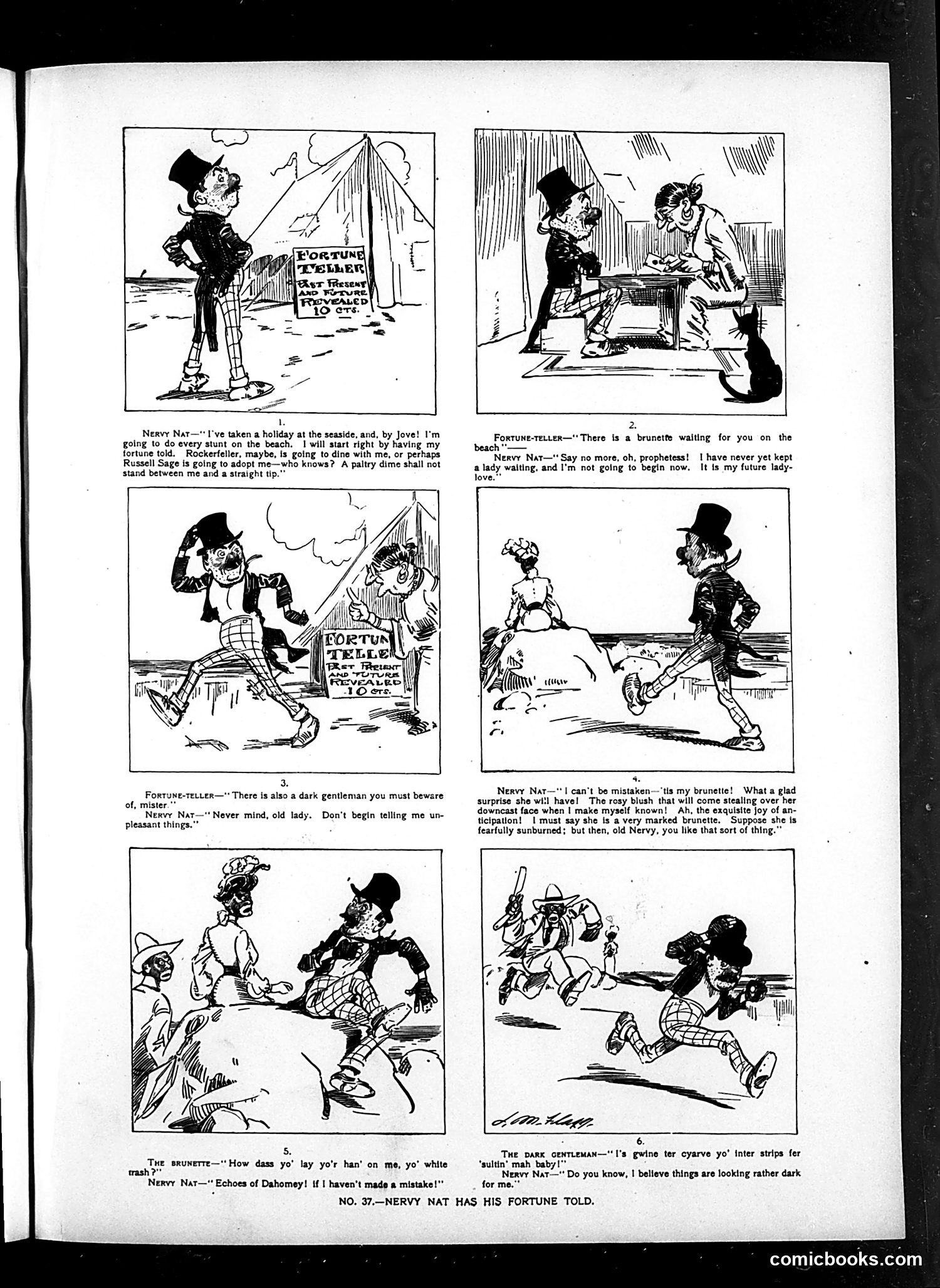
This is a comic strip titled "Nervy Nat Has His Fortune Told" (No. 27). The narrative follows Nervy Nat, a working-class character in a top hat and plaid pants, visiting a fortune-teller at the seaside. The fortune-teller warns him of a waiting brunette, a dark gentleman to beware, and a bruise coming from a woman's jealousy. The comic plays these warnings for comedic effect as Nervy Nat encounters various characters—women and men—who progressively fulfill the prophecies through romantic entanglements and physical altercations. The satire appears to mock both fortune-telling superstitions and the romantic misadventures of ordinary men, using slapstick humor and exaggerated consequences to create the joke.
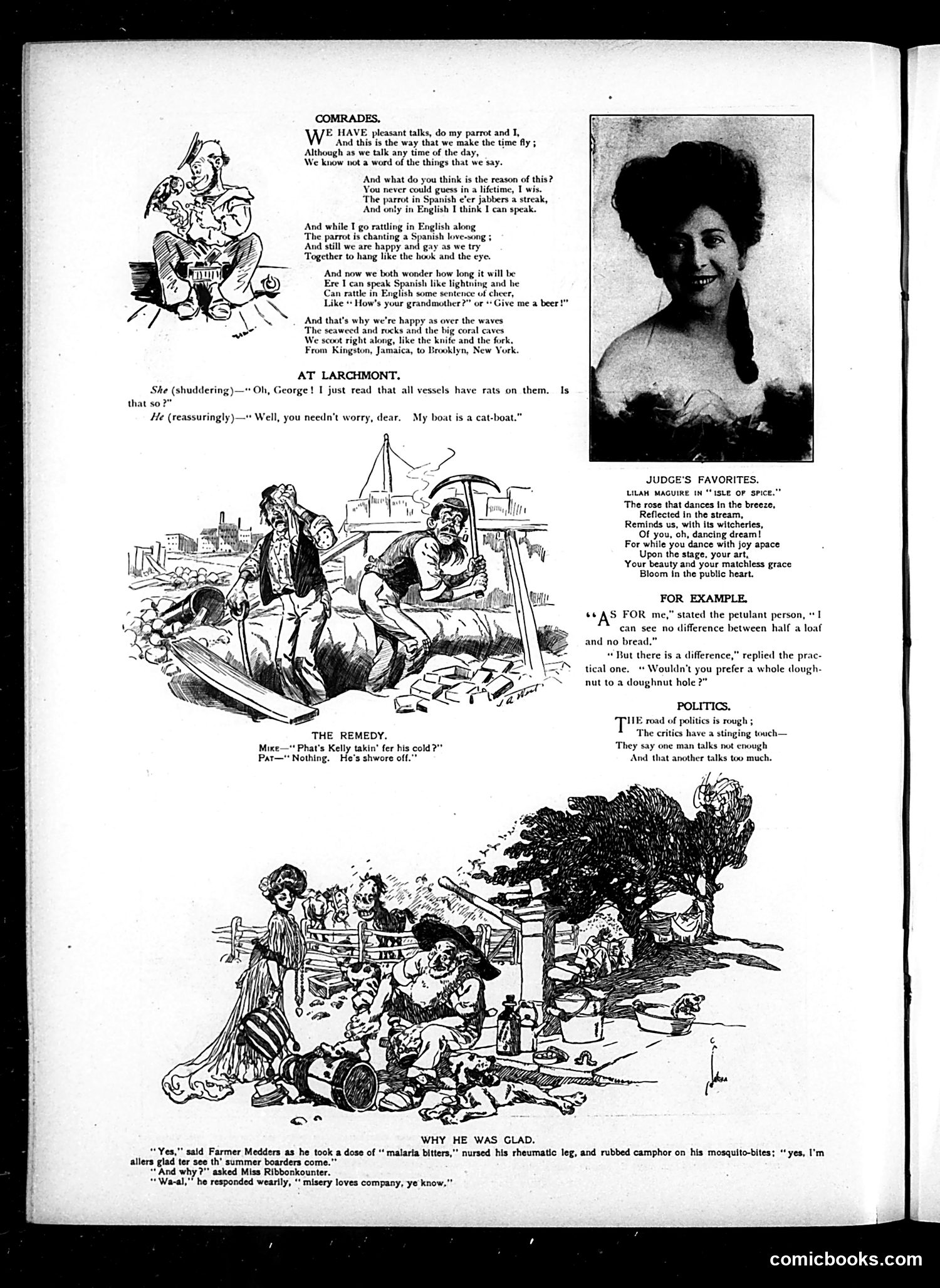
This page contains several humorous sketches and poems typical of early 20th-century satirical humor. **"At Larchmont"** depicts a domestic scene where a husband reassures his worried wife about rats on their boat—claiming his "boat is a cat-boat" (a play on words). **"Judge's Favorites"** features a portrait labeled "Lilian Maguire in 'Isle of Spice'" with accompanying verse praising an actress's beauty and grace. **"The Remedy"** and **"Why He Was Glad"** are brief joke-caption illustrations about folk remedies and rural humor, featuring stock characters common to period humor. **"Politics"** offers cynical commentary on political discourse, suggesting critics talk too much and politicians talk too little. The page reflects Judge magazine's typical mix of social satire, domestic humor, and entertainment industry commentary from the early 1900s.
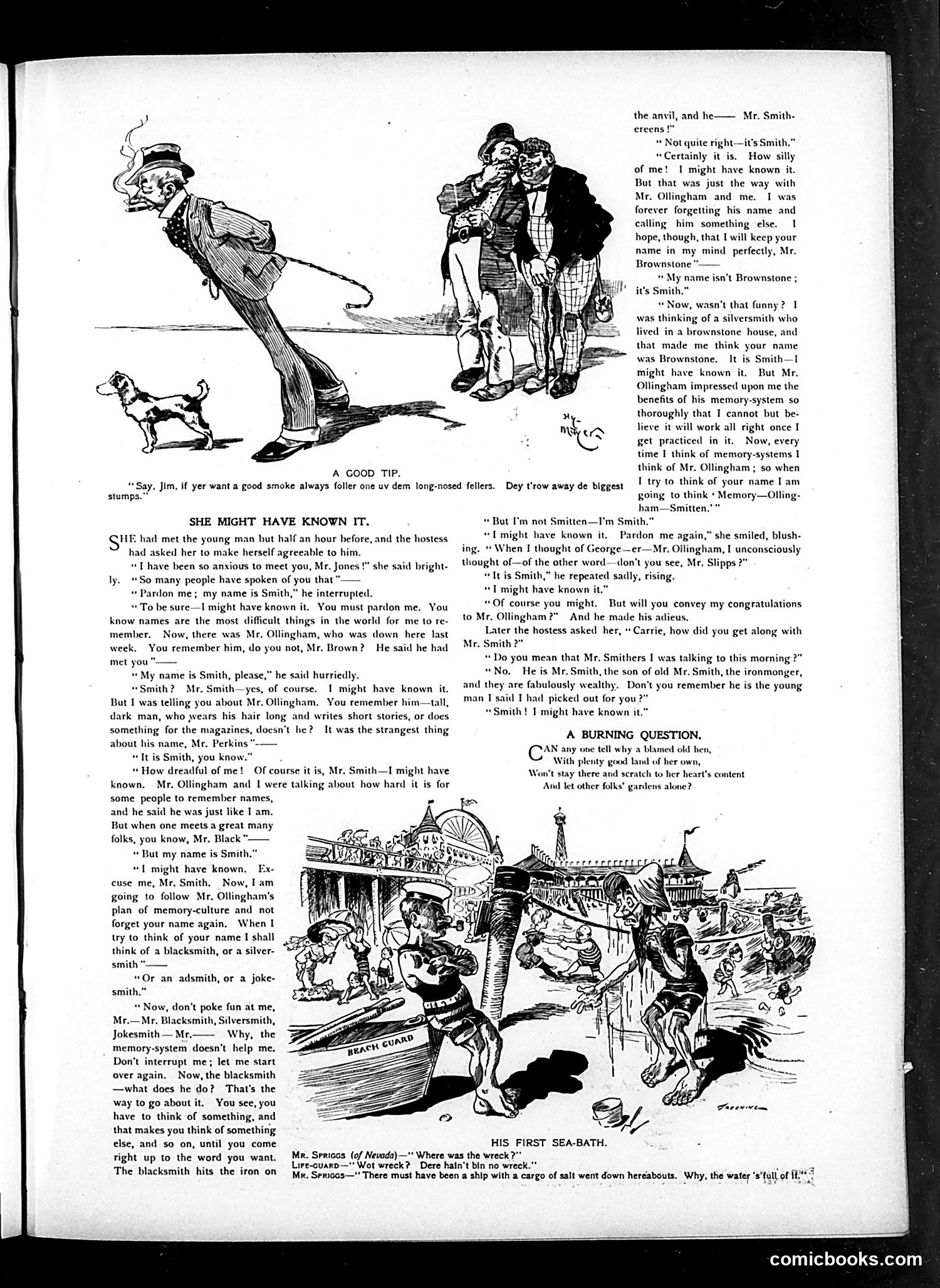
This page from *Judge* magazine satirizes a common social awkwardness: a hostess who consistently forgets people's names. The humor relies on her repeated failure to remember "Mr. Smith," despite his patient corrections. She keeps substituting wrong names (Jones, Brown, Perkins, Black) and elaborately justifies each mistake through tangential anecdotes about "Mr. Ollingham" and his "memory-system." The satire targets two things: the hostess's rudeness and vanity (she's more interested in demonstrating her memory techniques than actually listening), and the social pretense that characterizes upper-class gatherings. The cartoons above illustrate the absurdity—one shows a beggar tipping his hat, the other a coastal scene titled "His First Sea-Bath," unrelated to the main story but typical of *Judge's* mixed content format. The joke's effectiveness depends on recognizing this as relatable social behavior—the etiquette violation of forgetting a guest's name—rather than referencing specific contemporary figures.
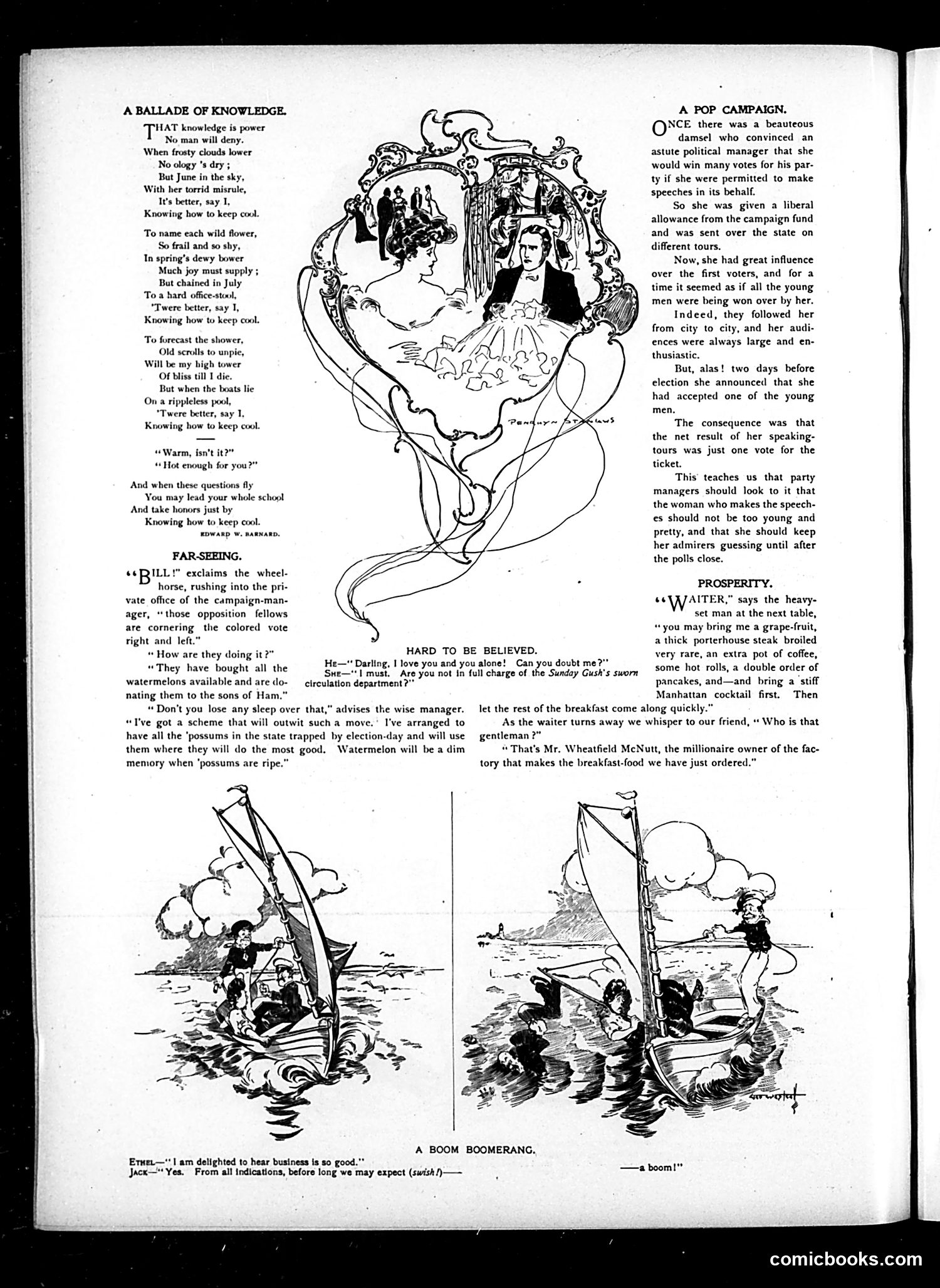
This page contains three satirical pieces mocking early 20th-century American politics and society: **"Far-Seeing"** ridicules racial stereotyping in campaign tactics. Campaign managers discuss "cornering the colored vote" by buying watermelons and possums—offensive caricatures reducing Black voters to crude stereotypes. The satire exposes how cynically politicians exploited racial prejudices. **"A Pop Campaign"** mocks campaign managers deploying an attractive young woman as a speaker. She draws large crowds of admirers, but when she announces an engagement two days before election, her influence evaporates—netting only one vote. The joke satirizes both the superficiality of political campaigning and managers' shortsighted exploitation of women. **"Prosperity"** shows a wealthy breakfast-food factory owner ordering an elaborate, expensive meal. The irony: he owns the factory producing the very "breakfast-food" being served, suggesting self-serving capitalism and the absurdity of manufactured "prosperity." These pieces mock political corruption, racial exploitation, and commercialism characteristic of the Gilded Age/Progressive Era.
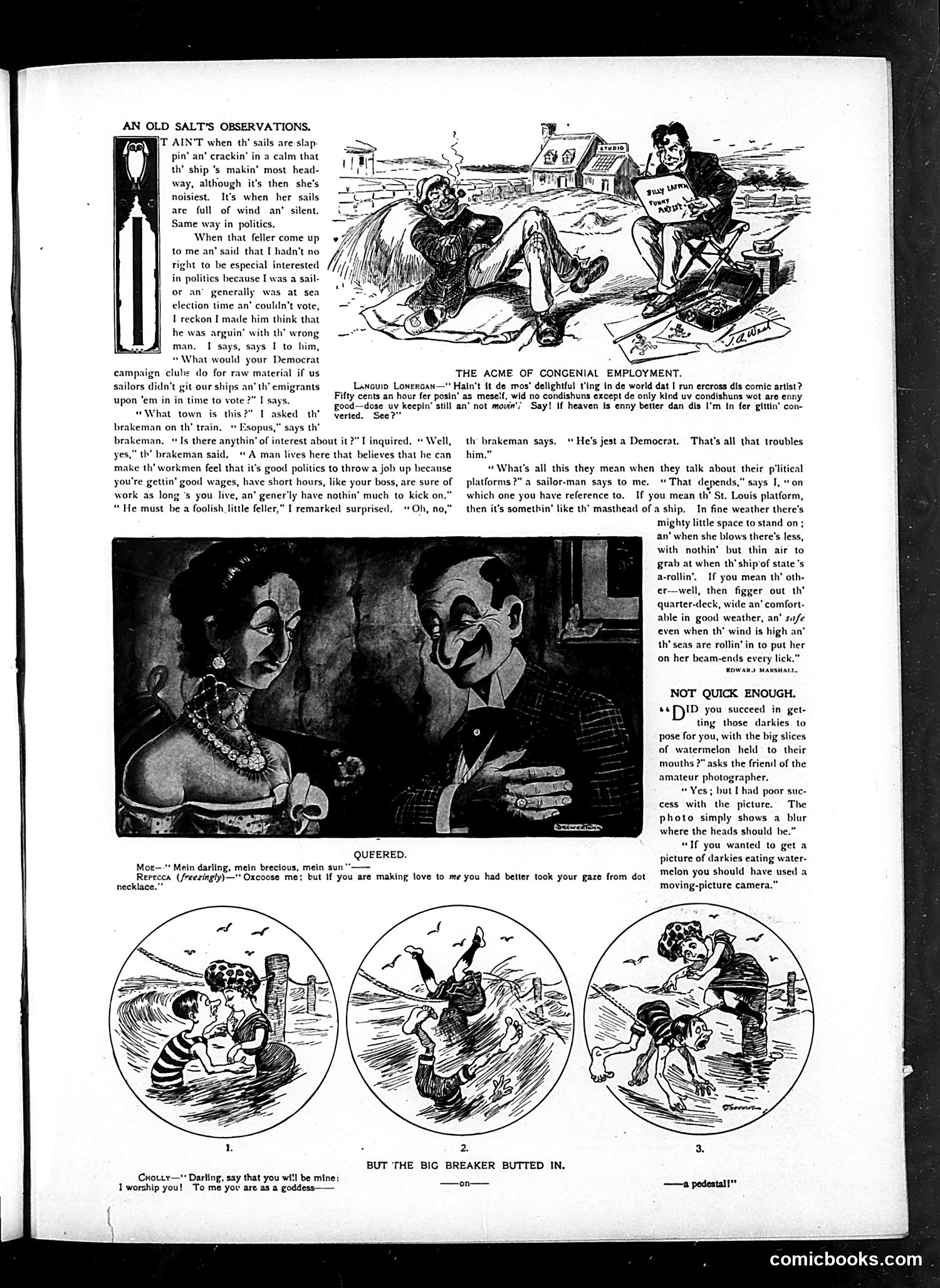
This page contains satirical commentary on early 20th-century American politics and social attitudes, primarily through an "old salt's" (experienced sailor's) observations. **Main Content:** - The sailor argues that workers—including sailors—have legitimate political interests despite not always being present to vote - He criticizes a local Democrat operative who discourages workers from supporting good wages and conditions, framing it as "good politics" - A separate section uses nautical metaphors to mock political "platforms," suggesting Democrats offer unstable footing while Republicans (implied) provide safer ground **Notable Elements:** - A racist cartoon ("Not Quick Enough") jokes about photographing Black Americans eating watermelon—relying on crude ethnic stereotypes - Other comics feature romantic/domestic humor unrelated to politics **Historical Context:** The page reflects Progressive Era concerns about labor politics and worker exploitation, while simultaneously revealing the era's casual, offensive racial attitudes. The sailor represents working-class political agency against elite manipulation.
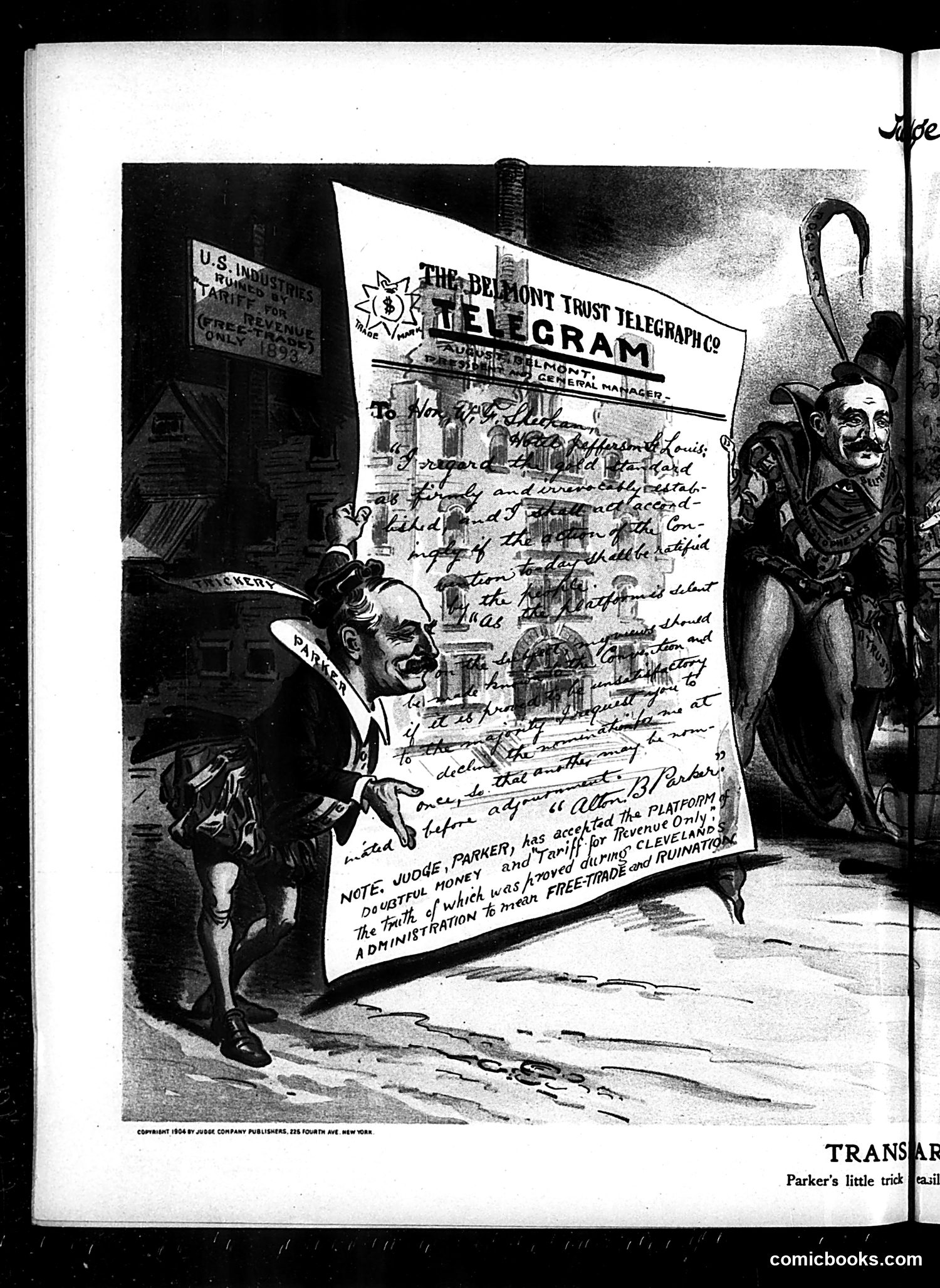
This appears to be a satirical cartoon from **Judge** magazine depicting a scandal involving **Judge Parker** (referenced in the note at bottom). The central image shows a large telegram from "The Delmont Trust Telegraph Co." with handwritten text, suggesting evidence of some impropriety. The cartoon uses demonic or devilish caricatures—figures with exaggerated features suggesting corruption or moral turpitude—examining the telegram. The note mentions Parker accepting a "platform" and "tariff" arrangements, likely referencing **political patronage or bribery** during the Progressive Era when such scandals were common. The satire mocks Parker's apparent deception, with the "trick" being exposed through the telegram as evidence. Without the publication date visible, the specific context remains unclear, but this reflects contemporary concerns about judicial and political corruption.
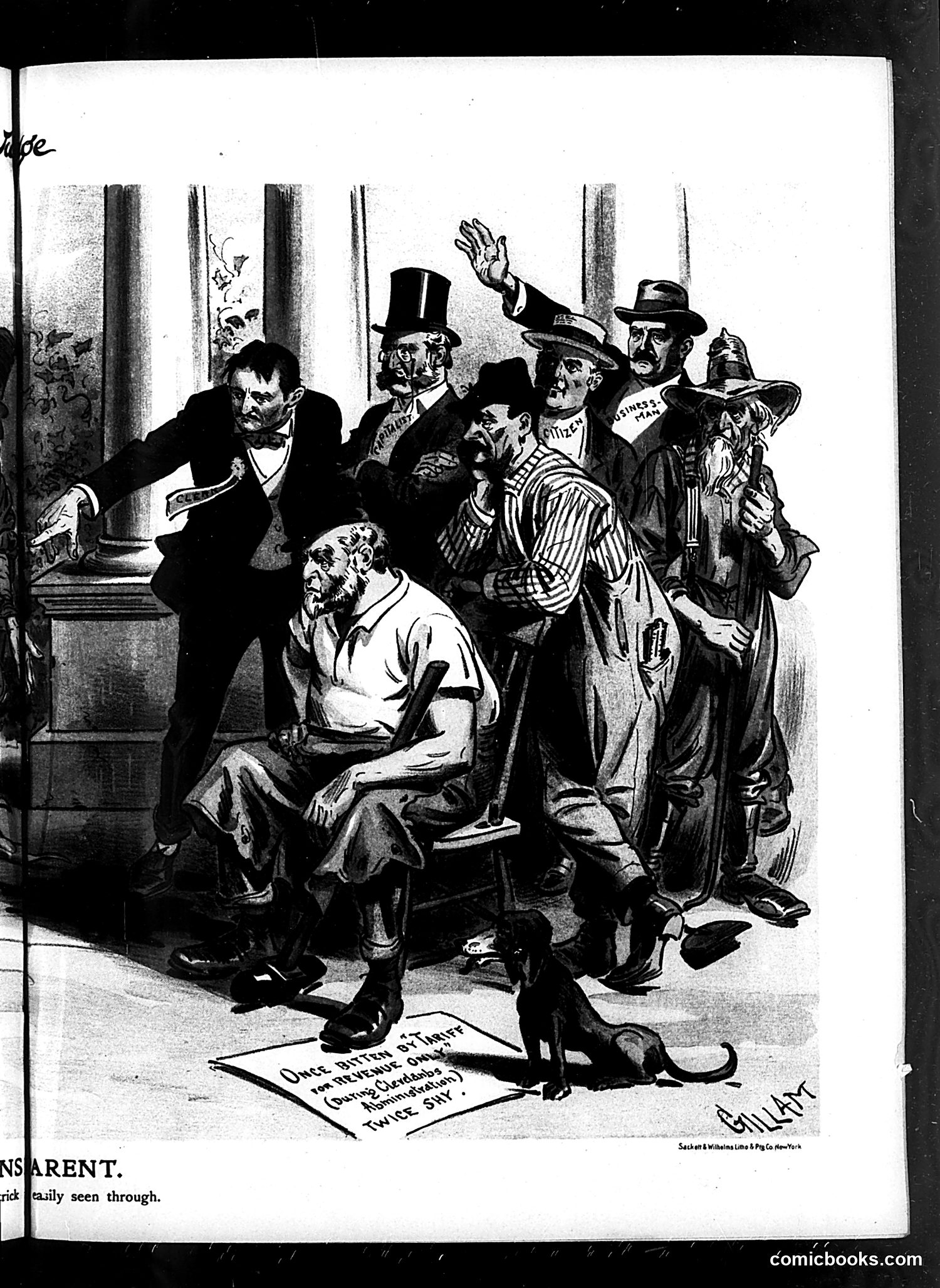
This is a satirical cartoon by Gillam depicting what appears to be a criminal interrogation or trial scene. A working-class man sits on a stool while well-dressed officials and authority figures (wearing top hats and formal clothing) surround and question him. The caption at the bottom, though partially illegible in the OCR, suggests the satire concerns how easily deception or guilt can be "seen through." The cartoon likely critiques either: - Corrupt judicial proceedings where powerful figures manipulate proceedings against the poor - The exposure of fraud or crime among the establishment - Class disparity in legal justice The exaggerated facial features and caricatured poses are typical of Judge magazine's satirical style, though without a clear date or full caption, the specific political/legal scandal referenced remains unclear.
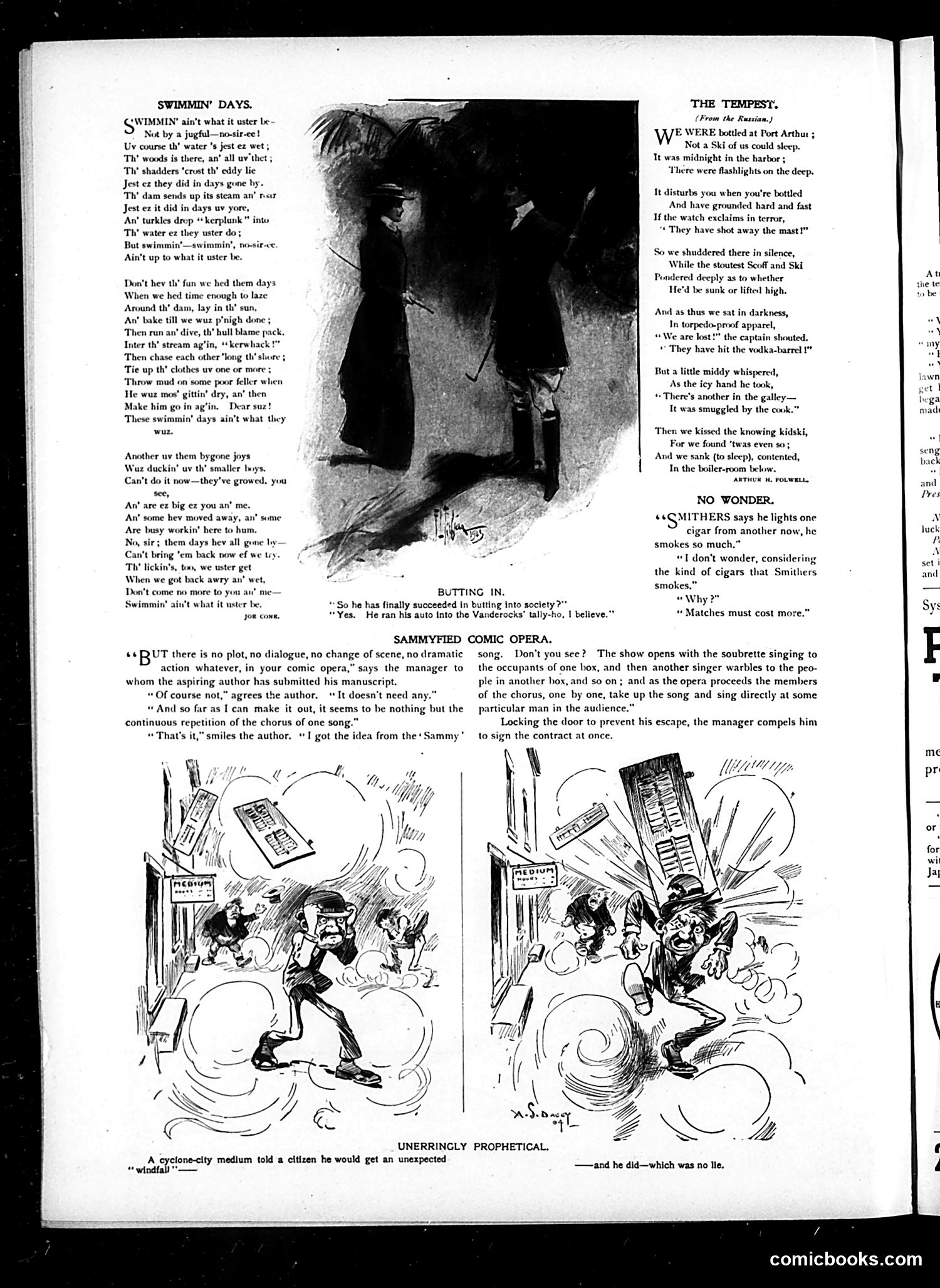
This page from Judge contains several satirical pieces: **"Swimmin' Days"** and **"No Wonder"** are nostalgic/humorous poems about lost pleasures of childhood swimming and cigar smoking—common light fare in magazines of this era. **"The Tempest"** parodies Russian literature (likely Tolstoy, given the "From the Russian" attribution), satirizing dramatic war narratives. It describes Russian naval officers at Port Arthur during the Russo-Japanese War (1904-05), drinking vodka in the boiler room while their ship is supposedly under attack—mocking both Russian naval incompetence in that conflict and the overwrought emotionalism of Russian literary style. **"Sammyfied Comic Opera"** ridicules a new theatrical trend where performers sing directly at audience members rather than to each other, treating it as absurd modernism. The two cartoons at bottom ("Butting In" and "Unerringly Prophetical") are simple sight-gags about social climbing and fortunetelling. The page reflects Judge's typical mix: gentle nostalgia, literary mockery, and topical satire about recent events (the Russo-Japanese War).
This page is primarily **advertisements and filler content** rather than political cartoons. The notable exception is the poem "His Happy Land" at top-left, which uses **racist dialect and imagery** to depict an African American man celebrating watermelons and freedom from labor constraints. The poem reflects the **deeply racist "happy slave" stereotype** common in early 20th-century American media—portraying Black contentment with rural, agricultural life through exaggerated dialect ("Ain't," "Des," "suh"). It sanitizes post-slavery conditions by romanticizing watermelon patches as superior to "rich folks' money." The rest of the page consists of **product advertisements** (Packer's Tar Soap, Abbott's Bitters, Sohmer Pianos) and brief humorous anecdotes about domestic life, train travel, and dyspepsia—typical Judge magazine filler content unrelated to satire or social commentary. The Sohmer Pianos ad features a cowboy figure, likely promotional imagery unconnected to editorial commentary.
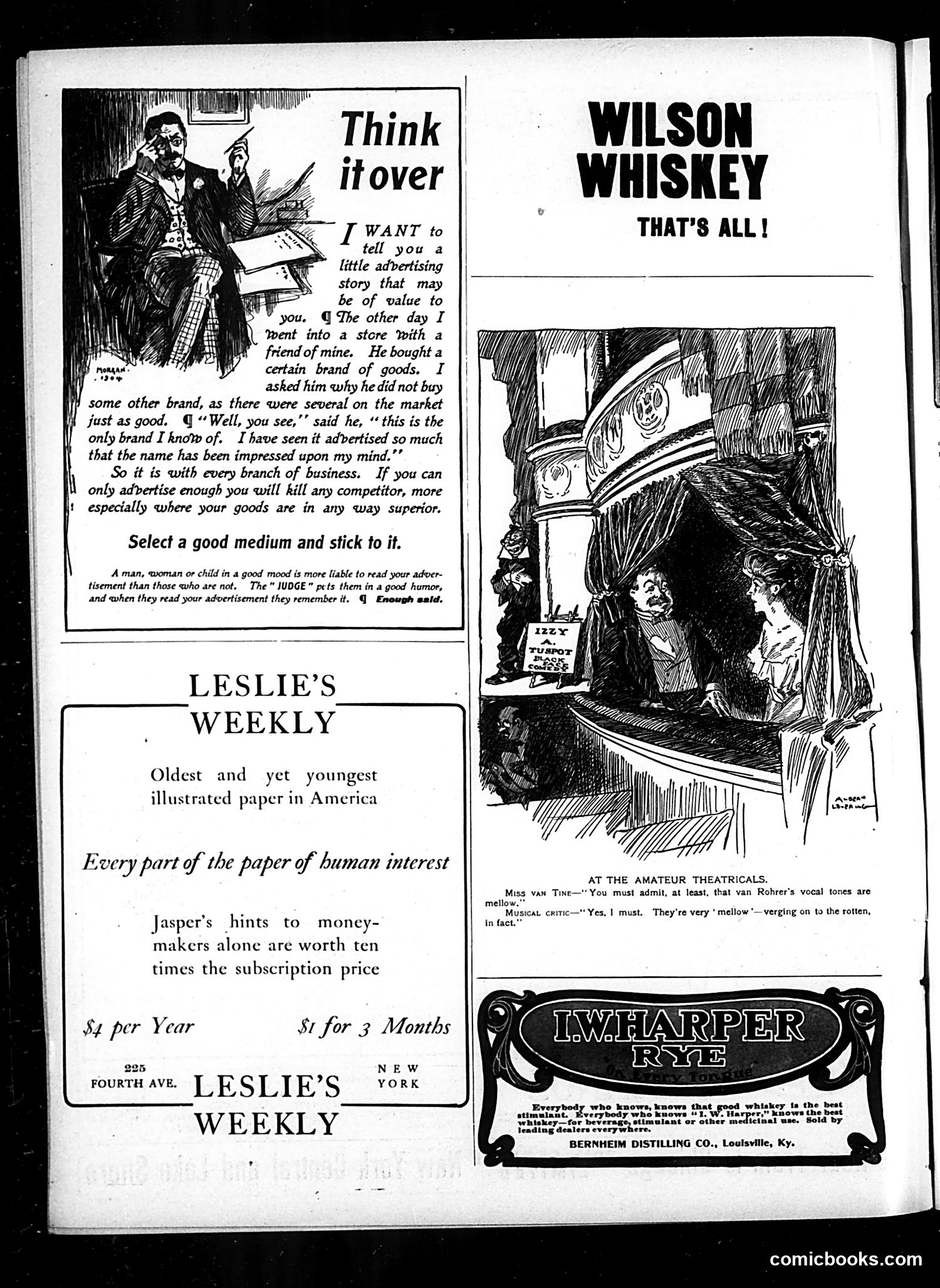
This page mixes advertising with satirical content typical of Judge magazine. **Left side:** A business philosophy piece (disguised as editorial) argues that aggressive advertising kills competition—the anecdote shows a man bought a product solely because he'd seen it advertised repeatedly, not because it was superior. This advocates for advertising saturation as a business strategy. **Right side:** A Wilson Whiskey advertisement features an illustration of what appears to be a tavern or bar scene, with the tagline "That's All!" The fine print claims the whiskey is "the best attainable" and references medicinal use—common marketing language for alcohol during this era (pre-Prohibition or early Prohibition period). The Bernheim Distilling Co. footer indicates Louisville, Kentucky origin. **Bottom:** A brief joke contrasts "mellow" vocal tones favorably versus unfavorably—a pun on the word's dual meaning. The page essentially demonstrates Judge's dual function: satirizing advertising excess while simultaneously carrying paid advertisements that employ the very tactics being mocked.
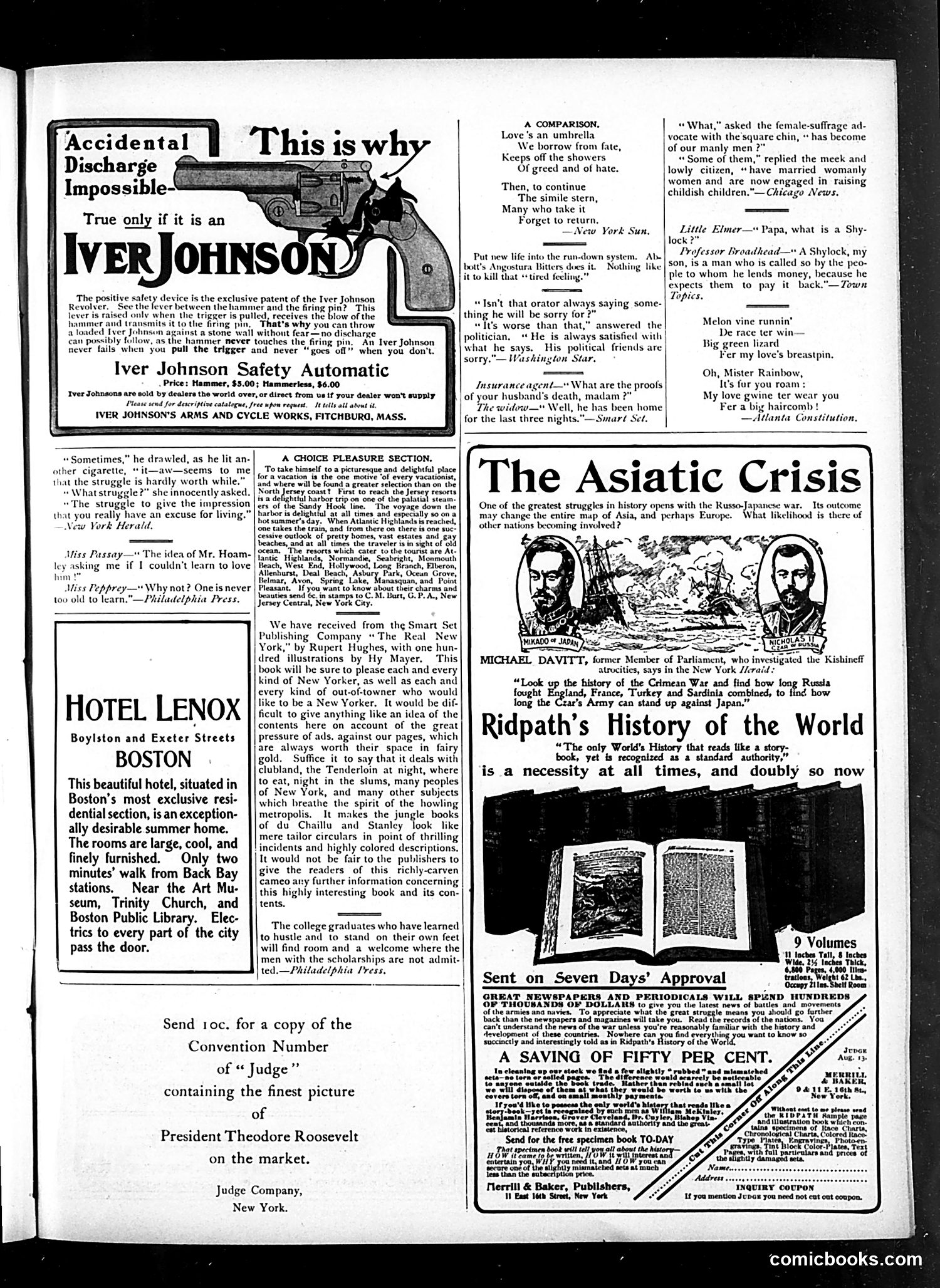
This page is primarily **advertising and miscellaneous content** rather than political satire. The dominant feature is an advertisement for the **Iver Johnson Safety Automatic revolver**, emphasizing its "accidental discharge impossible" safety mechanism—a selling point highlighting the weapon's design feature preventing the hammer from touching the firing pin. The page includes several brief jokes and social commentary typical of Judge magazine's lighter content: one mocking a man's lack of life purpose, another playing on an elderly woman learning to love. These are generic comedic observations rather than pointed political satire. Additional advertisements promote the Hotel Lenox in Boston and Ridpath's History of the World, a popular reference work. A brief book review discusses Rupert Hughes' "The Real New York." **There are no identifiable political cartoons or caricatures of public figures on this page.** The content reflects early 20th-century consumer advertising and mild social humor typical of Judge's miscellaneous pages between major satirical pieces.
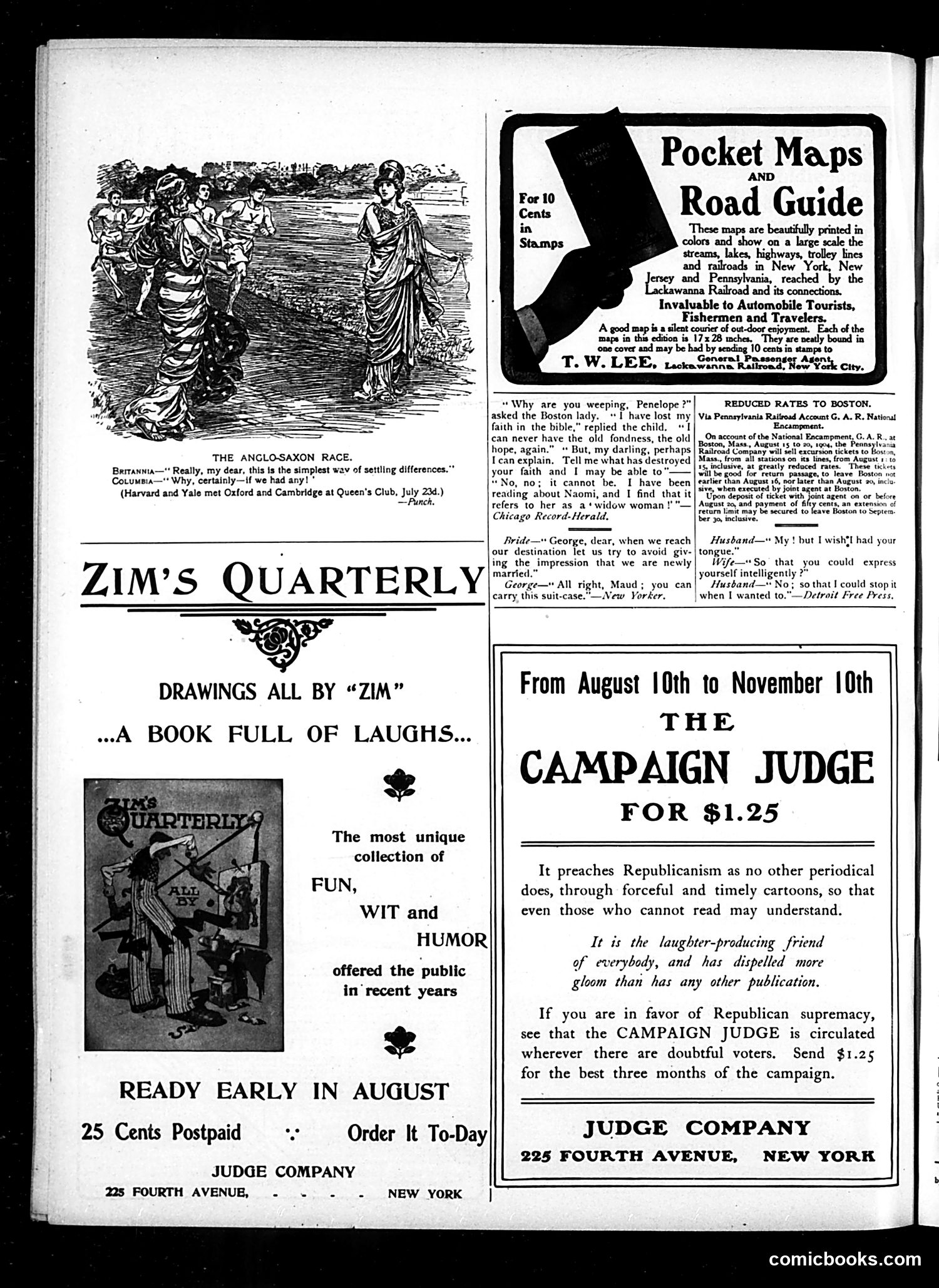
This page is primarily **advertising and filler content** rather than substantive political satire. The notable cartoon is "The Anglo-Saxon Race," depicting Britannia and Columbia (personifications of Britain and America) discussing settling international differences through sports competition. The joke references a cricket match between Harvard/Yale and Oxford/Cambridge at Queen's Club, London—suggesting Anglo-American friendship and shared cultural values could replace military conflict. The caption's humor relies on Columbia claiming America has no differences with Britain to resolve. The remaining content consists of ads for maps, Zim's humor book, and the Republican "Campaign Judge" magazine (promoting GOP politics during an election season, likely 1904 based on the G.A.R. encampment reference). The page's scattered domestic humor snippets (weeping child, newlyweds) are disconnected from political commentary and serve mainly as filler between advertisements.
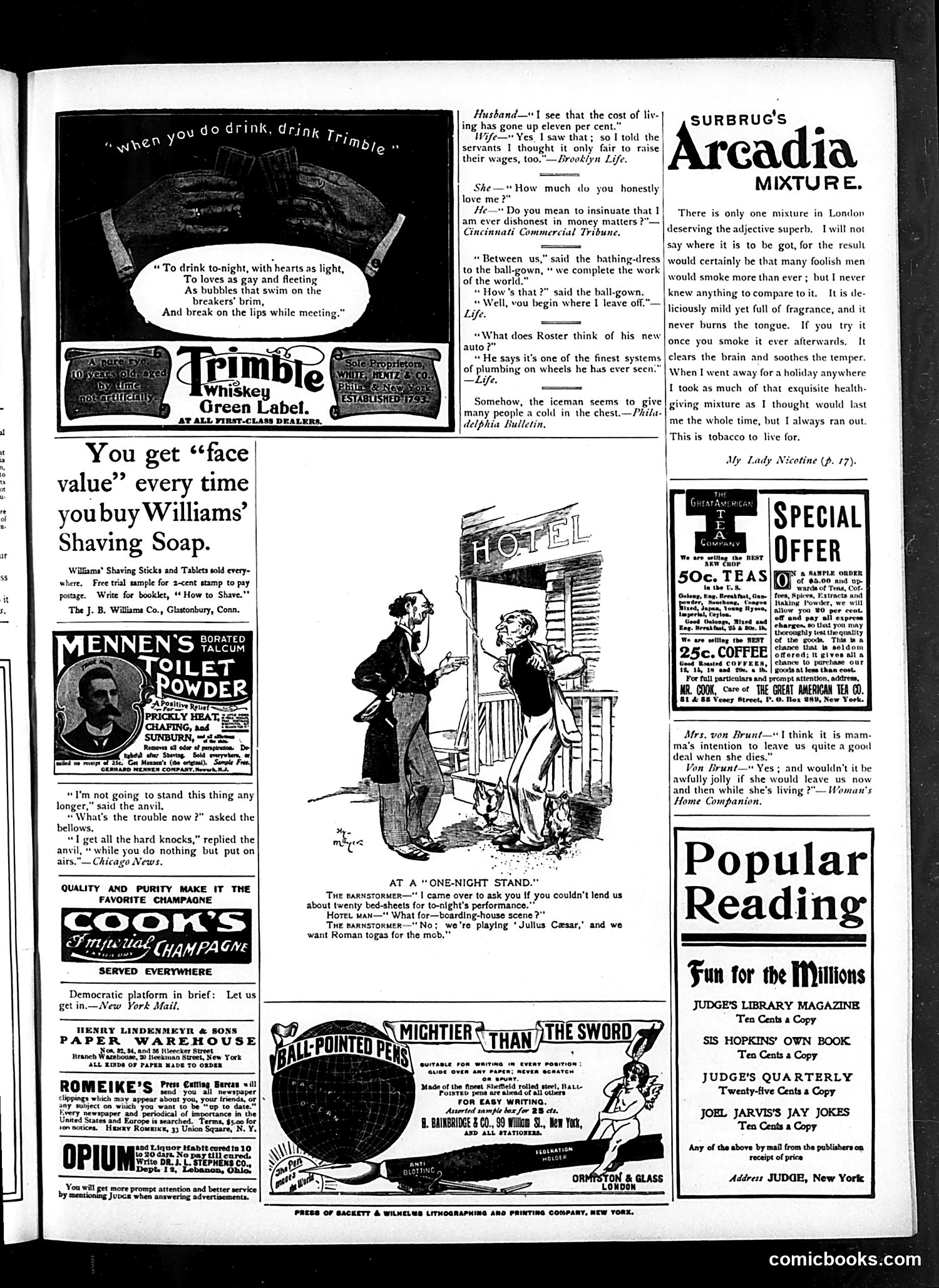
This page from *Judge* magazine contains mostly **advertisements and short humorous anecdotes** rather than political cartoons. The cartoons present are brief satirical jokes: 1. **"At a One-Night Stand"** depicts a theatrical troupe asking a boarding-house keeper for Roman togas for a mob scene in *Julius Caesar*—the humor lies in the absurdity of a struggling theater company needing authentic costumes for a minor scene. 2. **The Anvil and Bellows dialogue** is a personification joke: the anvil complains it receives "hard knocks" while the bellows merely "put on airs"—social commentary about labor and idleness. 3. Various one-liners mock marital dynamics (wives raising servant wages when living costs rise), automobile absurdity, and fashion pretensions. The page is primarily filled with **period advertising** for whiskey, shaving soap, talcum powder, champagne, and tobacco, reflecting early 20th-century consumer culture.
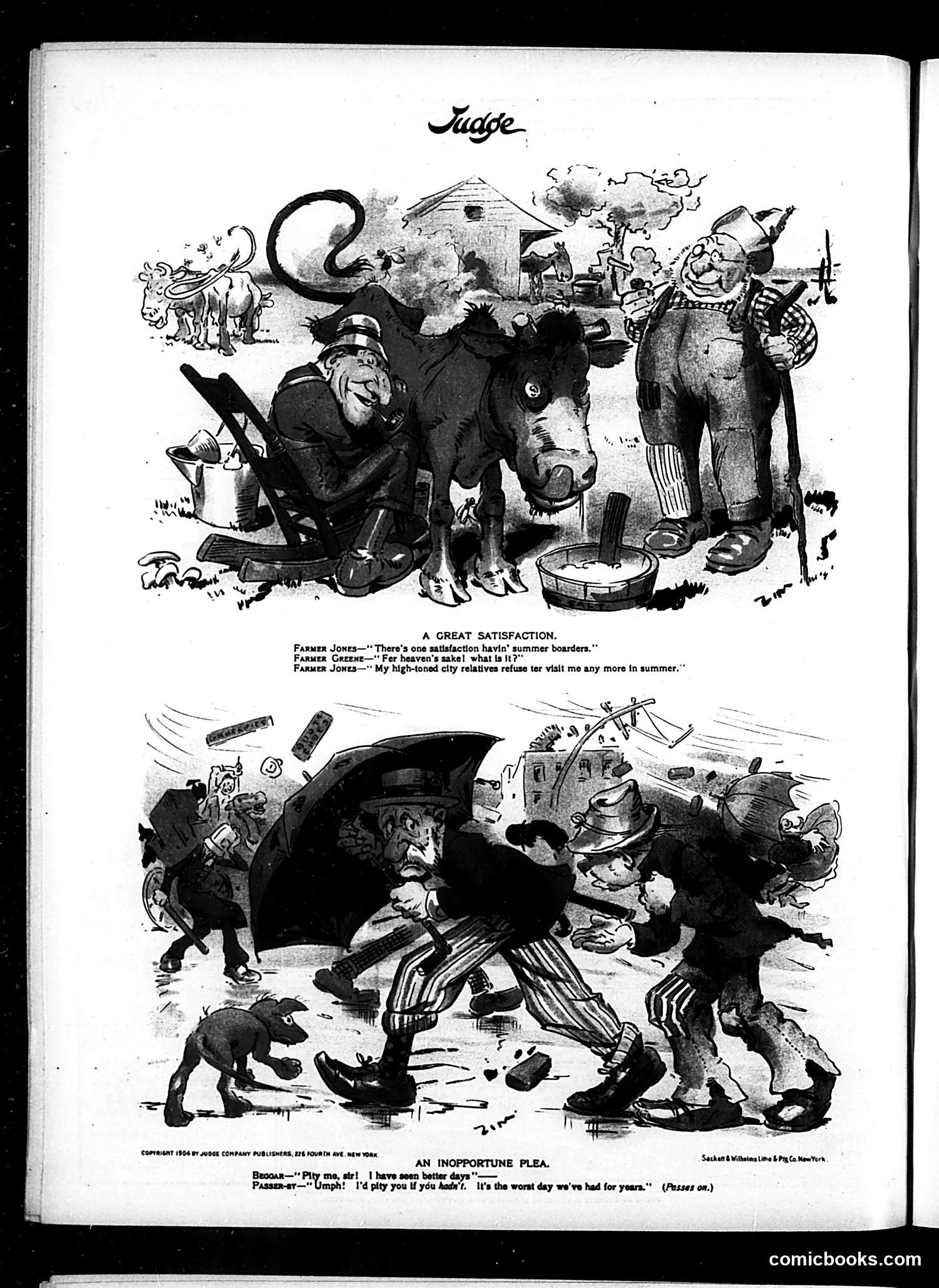
**Top Cartoon ("A Great Satisfaction"):** Two rural farmers discuss summer boarders—wealthy city relatives who visit farms for leisure. Farmer Jones expresses relief that his "high-toned city relatives" now refuse to visit because the farm experience has become unpleasant for them. The satire mocks the tension between rural and urban classes: city dwellers' expectations of rustic charm clash with farm reality, while farmers resent the burden of hosting pretentious guests. **Bottom Cartoon ("An Importunate Plea"):** A beggar claims to have "seen better days," appealing for sympathy. A passing pedestrian dismisses him, saying he'd only pity the beggar if he *hadn't* experienced better times—implying the worst weather in years makes everyone's circumstances equally miserable. The joke satirizes both begging excuses and social indifference during hardship. Both cartoons reflect early 1900s class tensions and social attitudes toward poverty and leisure.