
A complete issue · 16 pages · 1904
Judge — July 23, 1904
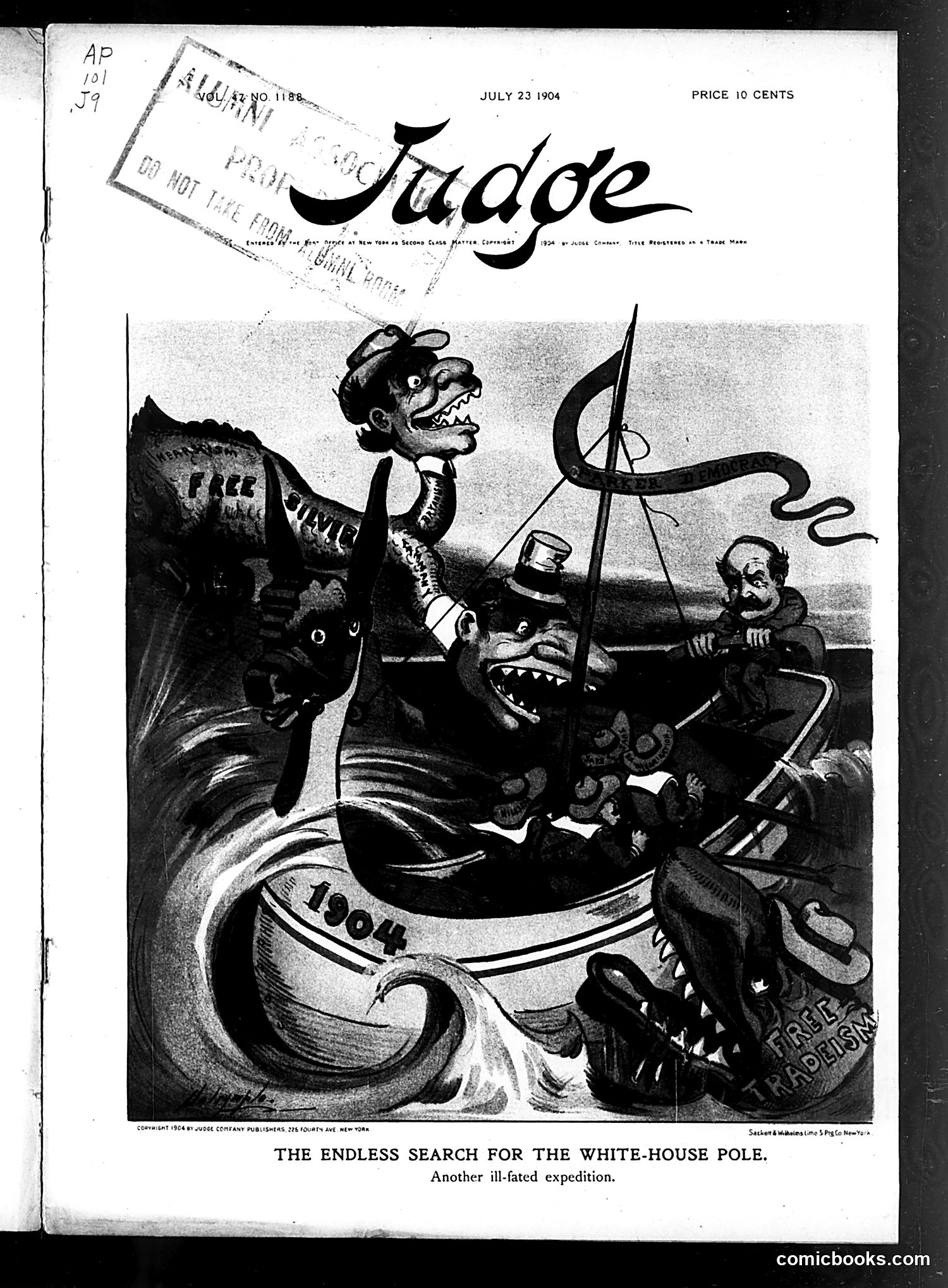
This July 23, 1904 *Judge* cartoon satirizes what the caption calls "Another ill-fated expedition" seeking the "White-House Pole." The imagery depicts demonic or grotesque creatures in a chaotic vessel labeled "1904," suggesting a tumultuous journey or political campaign. The "White-House Pole" likely references the presidency itself—a metaphorical goal that proves elusive or dangerous. The nightmarish quality of the figures and the vessel suggests the cartoon critiques a particular political effort or candidate's campaign as doomed, absurd, or morally questionable. Without clearer identification of the specific figures' faces or additional context about 1904 electoral politics, the precise targets remain unclear, though the satire unmistakably mocks a political pursuit as chaotic and ultimately futile.
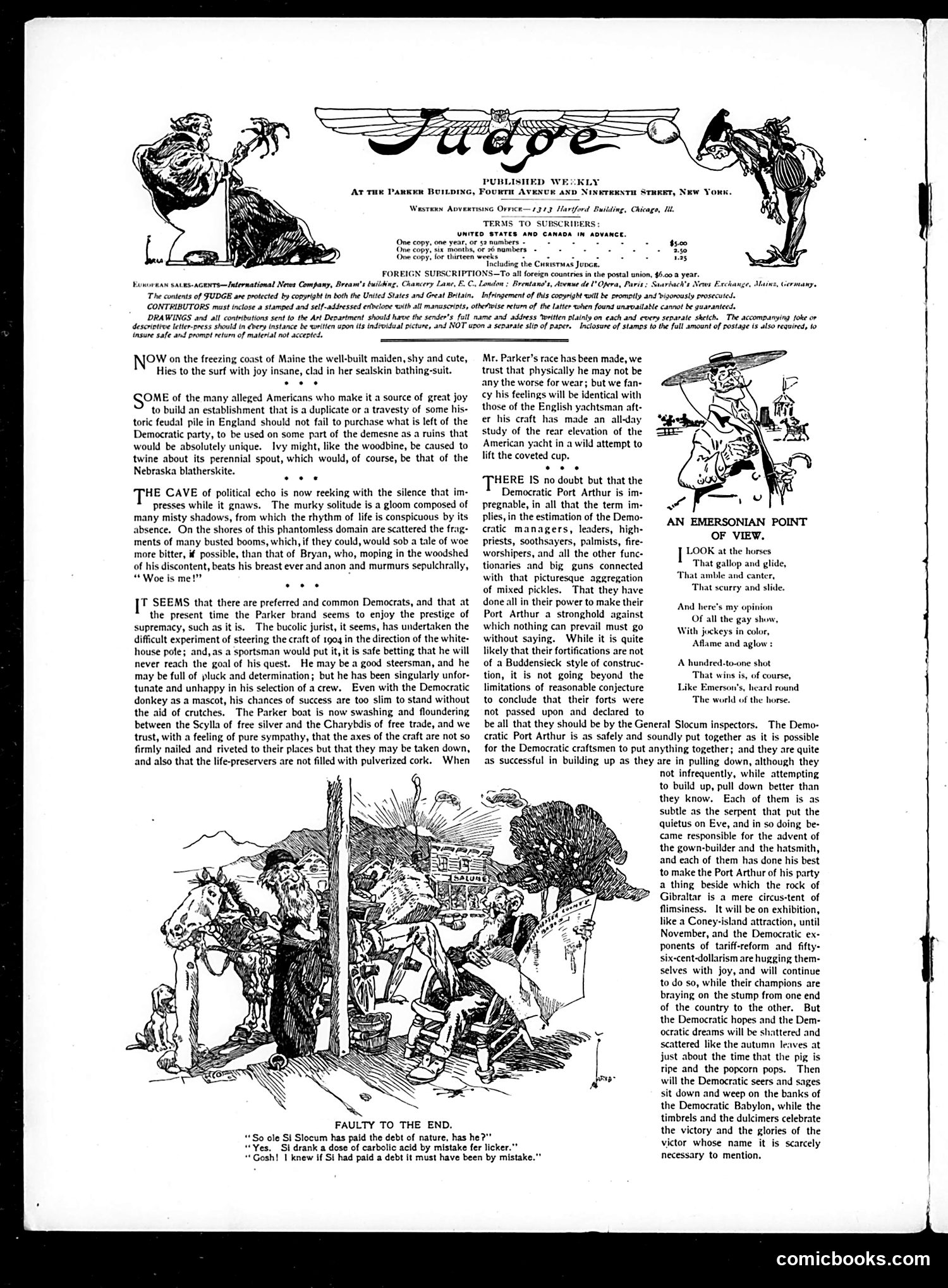
This *Judge* page primarily contains political commentary attacking Democratic positions, particularly regarding Port Arthur (a strategic fortress then contested between Russia and Japan during the Russo-Japanese War era). The main cartoon, titled "Faulty to the End," depicts Democrats as incompetent builders. The text criticizes Democratic claims about fortifying Port Arthur, sarcastically suggesting Democrats couldn't build anything correctly—"pull down better than they know." The surrounding editorial argues that General Slocum (apparently a Democratic figure) has bungled Port Arthur's defenses as badly as Democrats bungle everything. The satire equates Democratic political incompetence with military/engineering failure, using Port Arthur as a contemporary news hook to mock the Democratic Party's broader credibility. The rhetoric is typical of partisan *Judge* content: scathing, dismissive, and designed to entertain Republican readers.
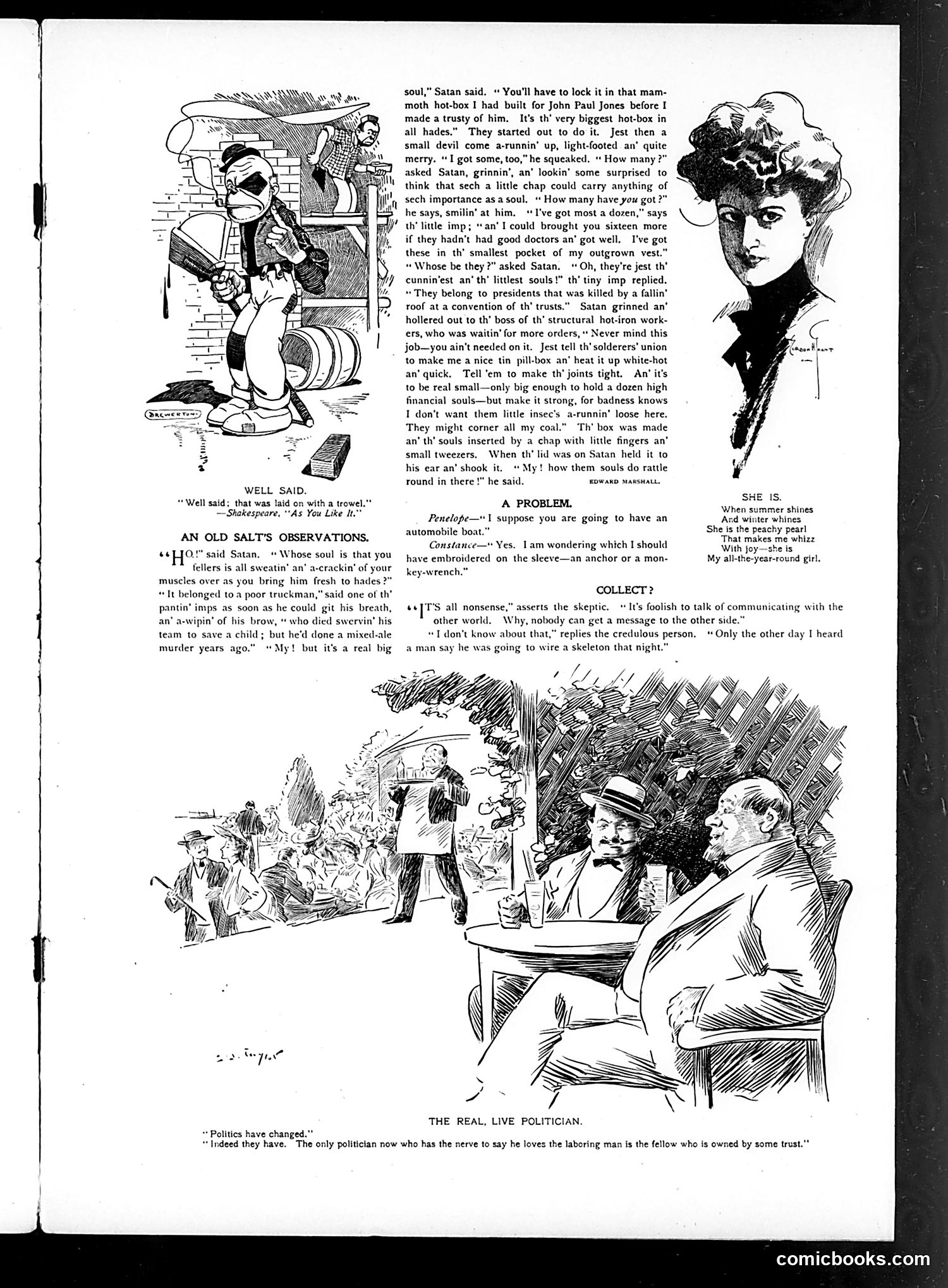
This page contains three distinct satirical pieces: 1. **"Well Said"** (top left): A cartoon mocking a character's boast about acquiring souls, with Shakespeare's "All's Well" referenced ironically. 2. **"An Old Salt's Observations"** (upper middle): A dialog between Satan and a sailor debating whether souls are valuable, with cynical commentary on human worth and corruption. 3. **"The Real, Live Politician"** (bottom): A political cartoon depicting a well-dressed politician addressing working-class laborers. The caption criticizes politicians, asserting that only those "owned by some trust" claim to love working people—a clear critique of political hypocrisy and corporate influence in early 20th-century American politics. The page's overall theme satirizes moral corruption, commercialism, and dishonest political rhetoric of the era.
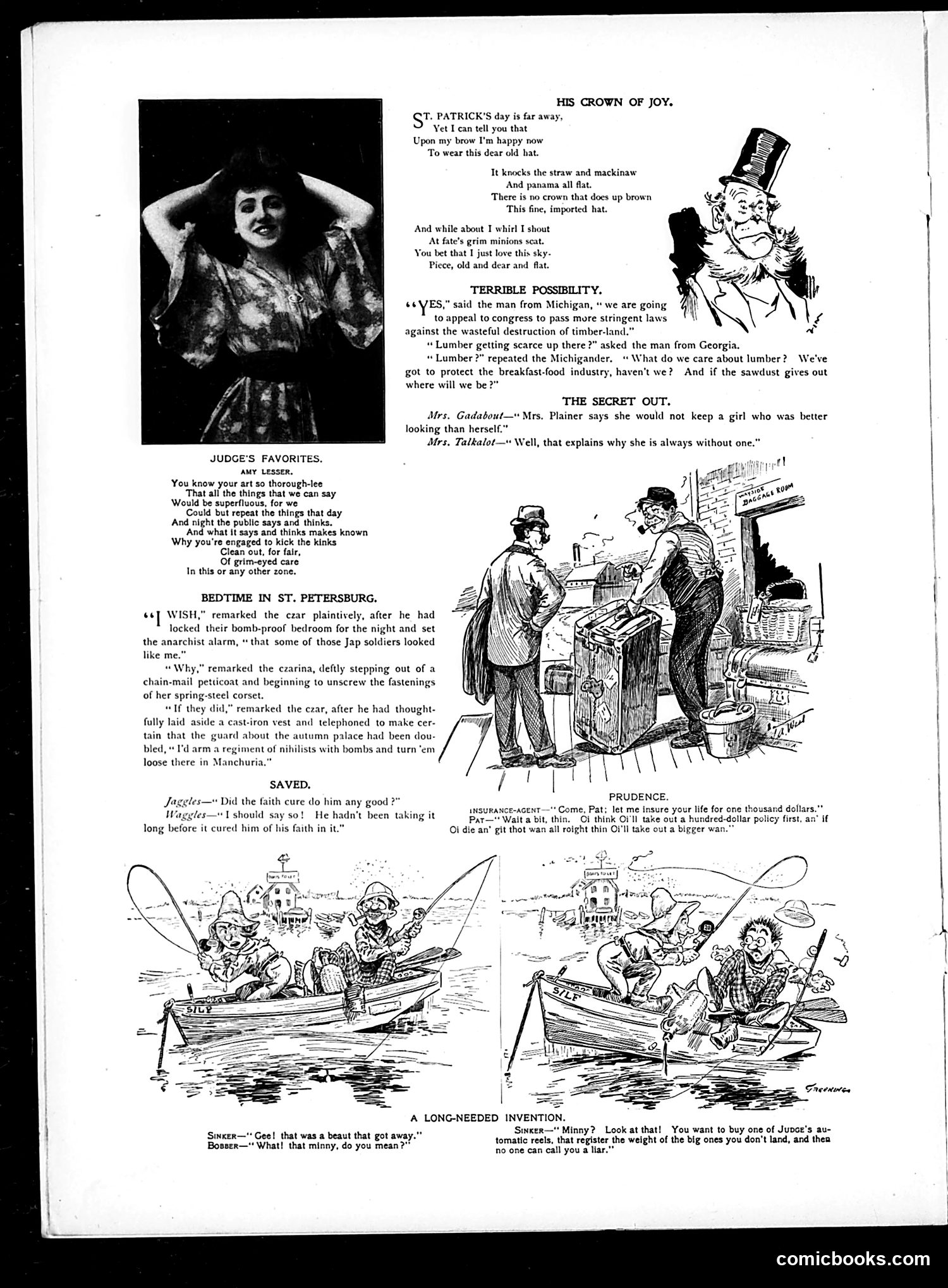
This page contains several satirical pieces and cartoons typical of early 20th-century American humor: **"His Crown of Joy"** mocks an imported hat, suggesting American-made goods are superior. **"Terrible Possibility"** satirizes protectionist politicians debating lumber tariffs—poking fun at political self-interest disguised as economic policy. **"Judge's Favorites"** and other text pieces are light social humor about courtship and domestic life. **The fishing cartoons** ("Saved," "Long-Needed Invention," "Prudence") feature recurring Judge characters in comic situations involving fishing and romantic mishaps—standard comedic fare without specific political reference. The page emphasizes domestic humor, consumer culture satire, and gentle political mockery rather than addressing major contemporary events. The overall tone is lighthearted rather than hard-hitting commentary.
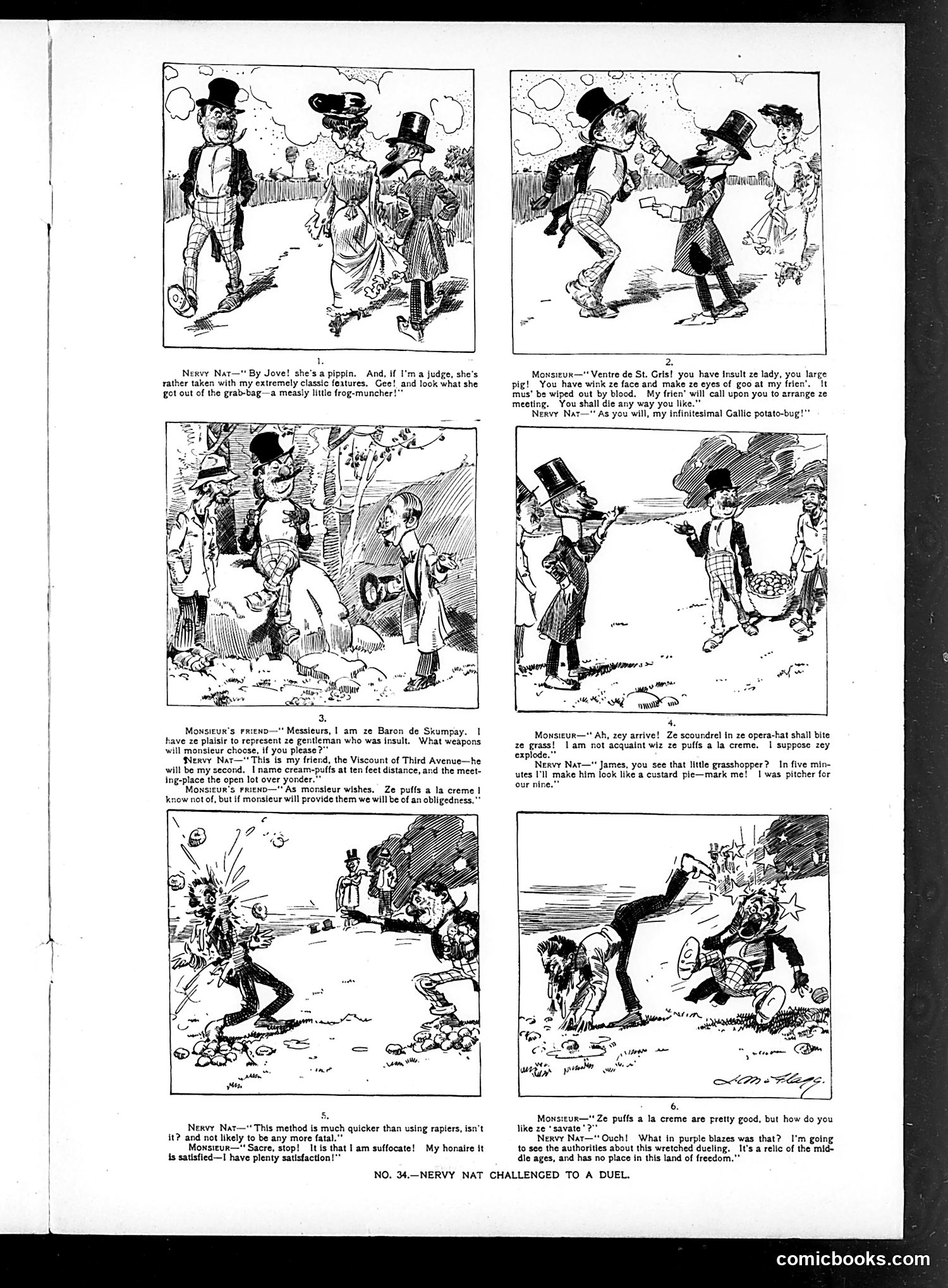
This six-panel comic satirizes the absurdity of European (specifically French) dueling culture when confronted with American practicality and irreverence. **The setup:** A working-class American ("Nervy Nat") insults a Frenchman over a woman. The offended Frenchman's friend challenges Nat to a formal duel, expecting swords. Nat instead proposes cream puffs as weapons—a ridiculous substitution the French accept. **The satire:** The joke mocks both French honor-culture (taking insults so seriously) and their inability to recognize American humor and mockery. Nat's casual dismissal of dueling as medieval ("relic of the middle ages") represents the modern American viewpoint. The Frenchman, depicted with exaggerated accent and mannerisms, is portrayed as both pompous and gullible, outmaneuvered by Nat's working-class wit. By the final panel, Nat has thrown actual cream puffs, and the Frenchman also employs *savate* (French kickboxing), turning the "duel" into pure slapstick chaos—suggesting American common sense defeats European pretension.
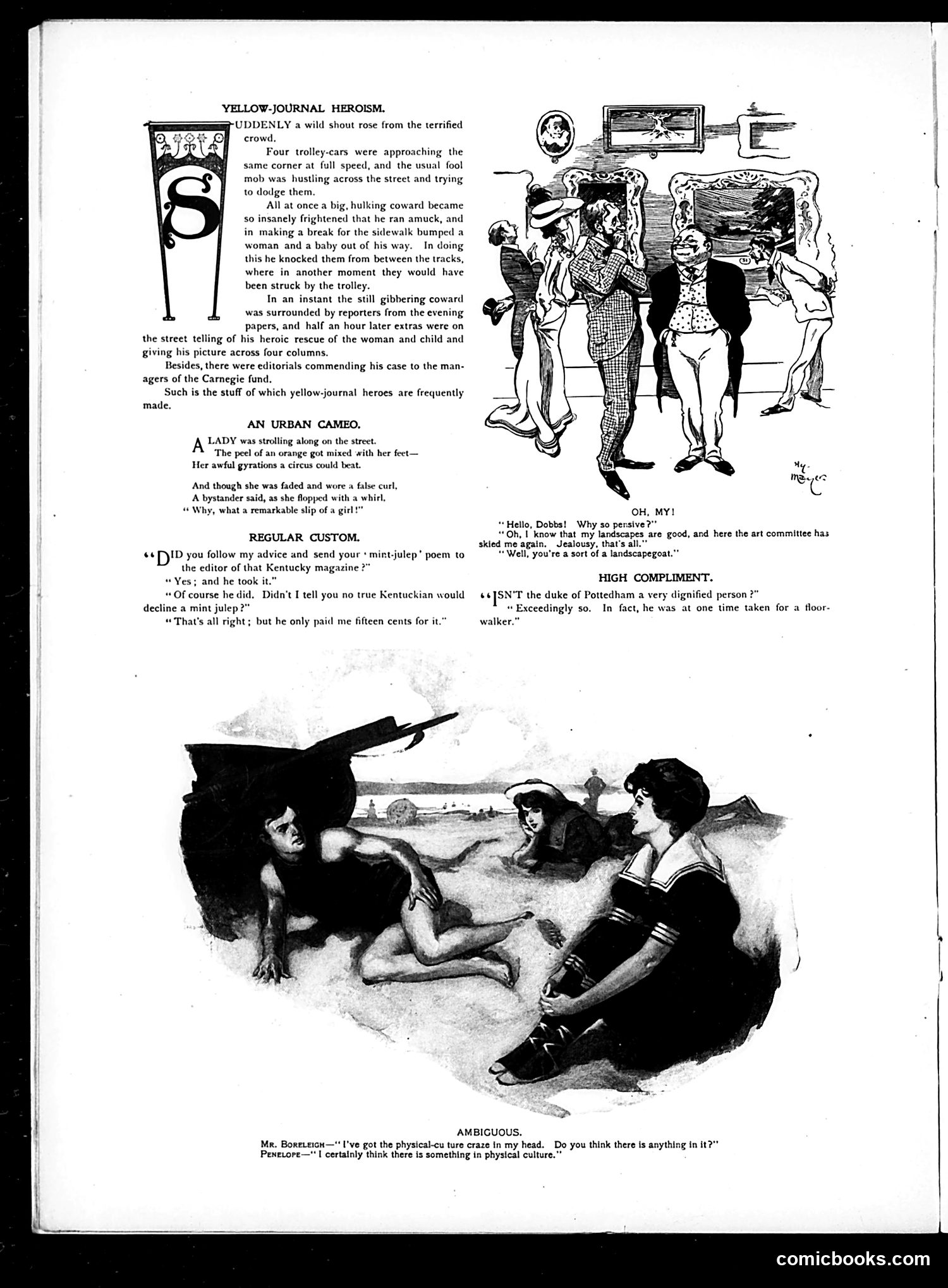
This page satirizes sensationalist newspaper practices of the era. The main cartoon mocks "yellow journalism"—the practice of exaggerating stories for dramatic effect. A cowardly man, fleeing from trolleys in panic, accidentally knocks a woman and child to safety. Rather than reporting this as a minor accident, evening papers transform him into a hero, surrounding him with reporters, printing his picture across four columns, and editorializing about his worthiness for the Carnegie Hero Fund (a real institution that rewarded brave acts). The satire targets how tabloid newspapers fabricated or distorted mundane incidents into heroic narratives to sell papers. The irony is sharp: a "gibbering coward" becomes celebrated through journalistic spin. This was a common criticism of yellow journalism in the period—its sensationalism and disregard for truth. The page also includes brief humorous snippets about art rejection, Kentucky poetry, and physical culture, typical of Judge's mixed-content format.
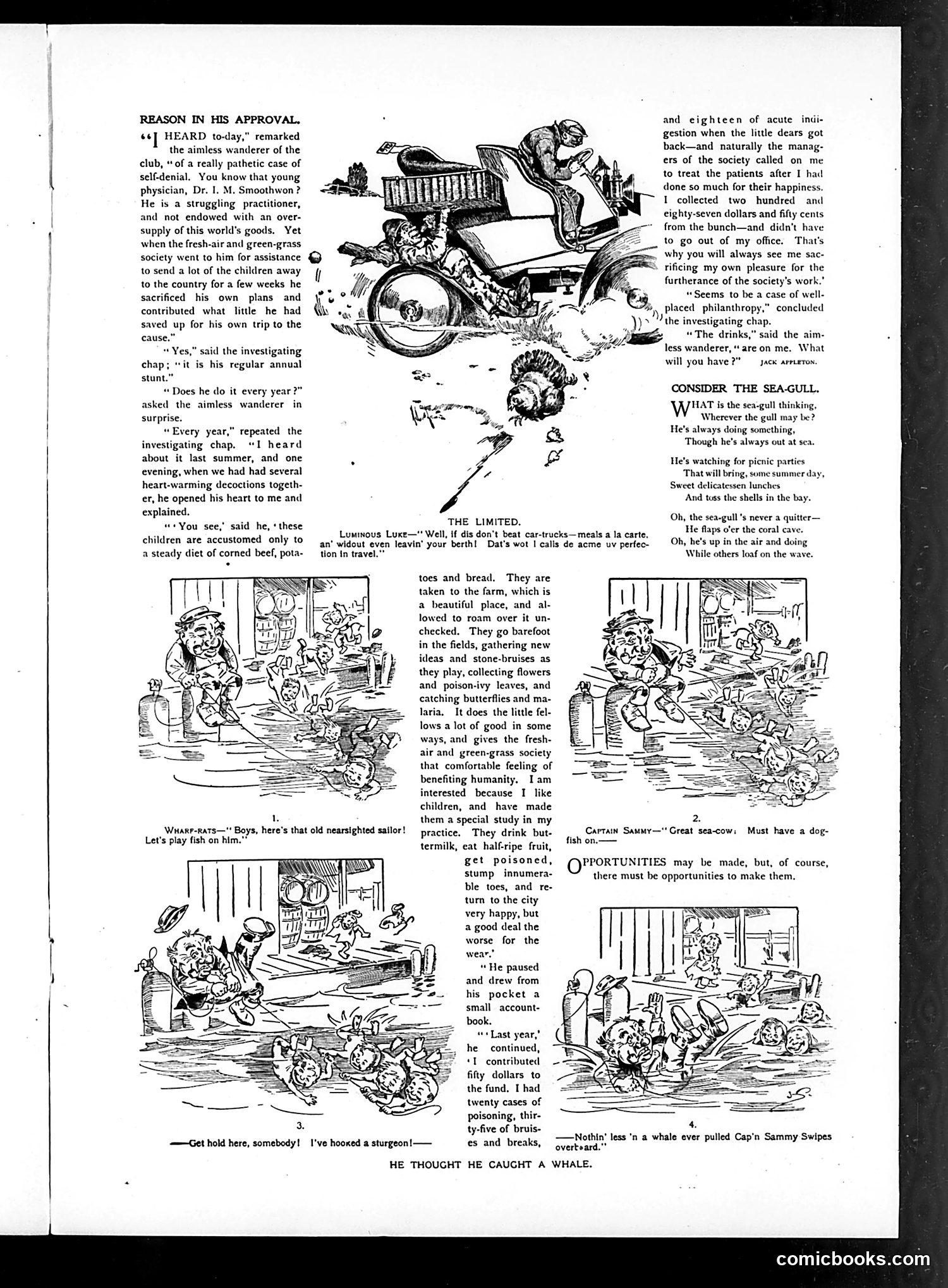
This Judge magazine page contains satirical commentary on charitable hypocrisy. The main story mocks a physician, Dr. I.M. Smoothwon, who donates small amounts to a "fresh-air and green-grass society" sending poor urban children to farms—ostensibly altruistic. However, the joke reveals his real motivation: the children return sick and injured (poisoning, bruises, malaria, indigestion), and he profits by treating them, collecting $287.50 in medical fees against his $50 donation. The satire exposes how "well-placed philanthropy" can mask self-interested schemes. The surrounding illustrations appear to be unrelated humorous vignettes about fishing and sailor mishaps, typical filler content for such magazines. The piece critiques both middle-class charitable pretense and the exploitation of vulnerable populations under the guise of social improvement—common Progressive Era satirical targets.
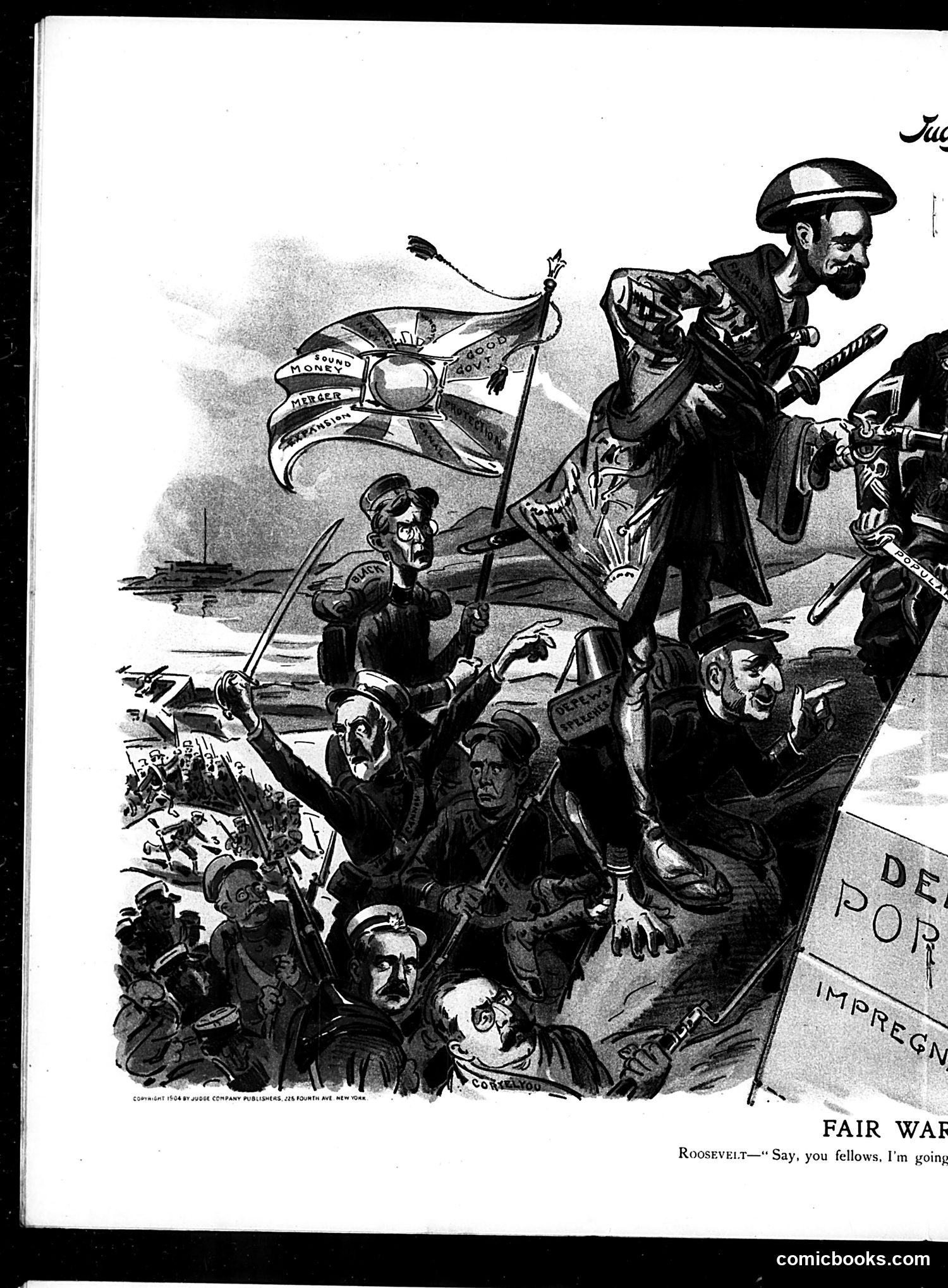
This political cartoon depicts President Roosevelt addressing a group of figures aboard what appears to be a ship. The banner held aloft contains words including "HONEY," "MERGER," and "GOOD GOVERNMENT" — likely satirizing Roosevelt's political promises and policies. The cartoon's title "Fair Wake" and Roosevelt's incomplete statement ("Say, you fellows, I'm going...") suggest he's rousing his supporters or the nation to action. The caricatured figures below him appear to represent various political allies or interest groups. The imagery invokes maritime/naval themes, possibly referencing American naval power or Roosevelt's expansionist foreign policy. The satire likely critiques the gap between Roosevelt's rhetorical promises and actual implementation, or mocks his coalition's motivations. Without the complete text, the specific political target remains unclear.
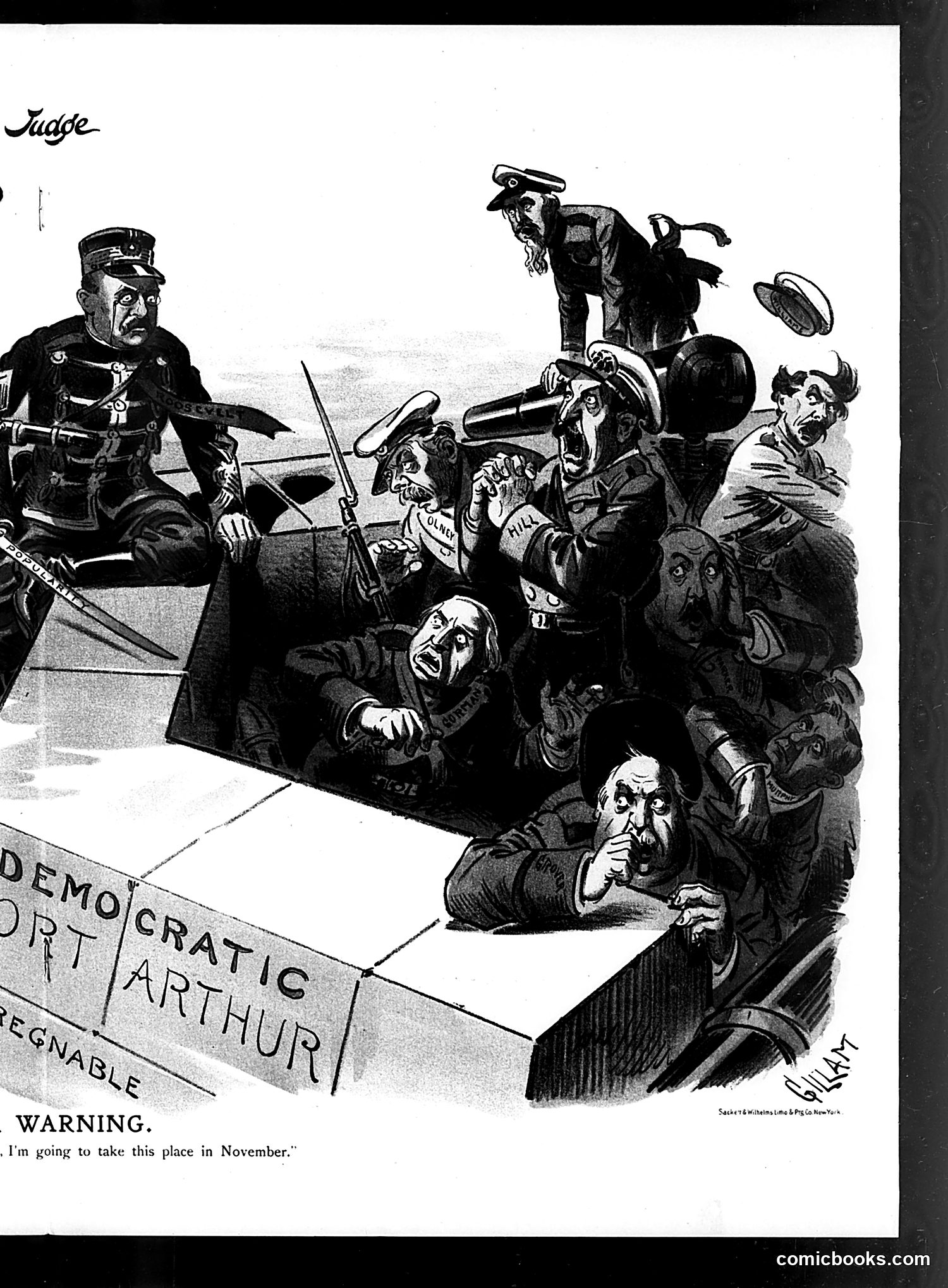
This Judge magazine cartoon depicts a military or authority figure (left) confronting a chaotic group of armed soldiers or revolutionaries crowded into what appears to be a vessel or confined space labeled "DEMOCRATIC PARTY ARTHUR" (partially visible). The warning text—"I'm going to take this place in November"—suggests an election threat. The cartoon satirizes internal chaos within the Democratic Party, likely referencing Arthur's political ambitions or control. The caricatured figures appear anarchic and poorly organized, contrasting with the composed authority figure. The "November" reference likely points to an upcoming election cycle, though the specific date and historical context remain unclear from the image alone. The satire criticizes Democratic Party dysfunction or leadership instability.
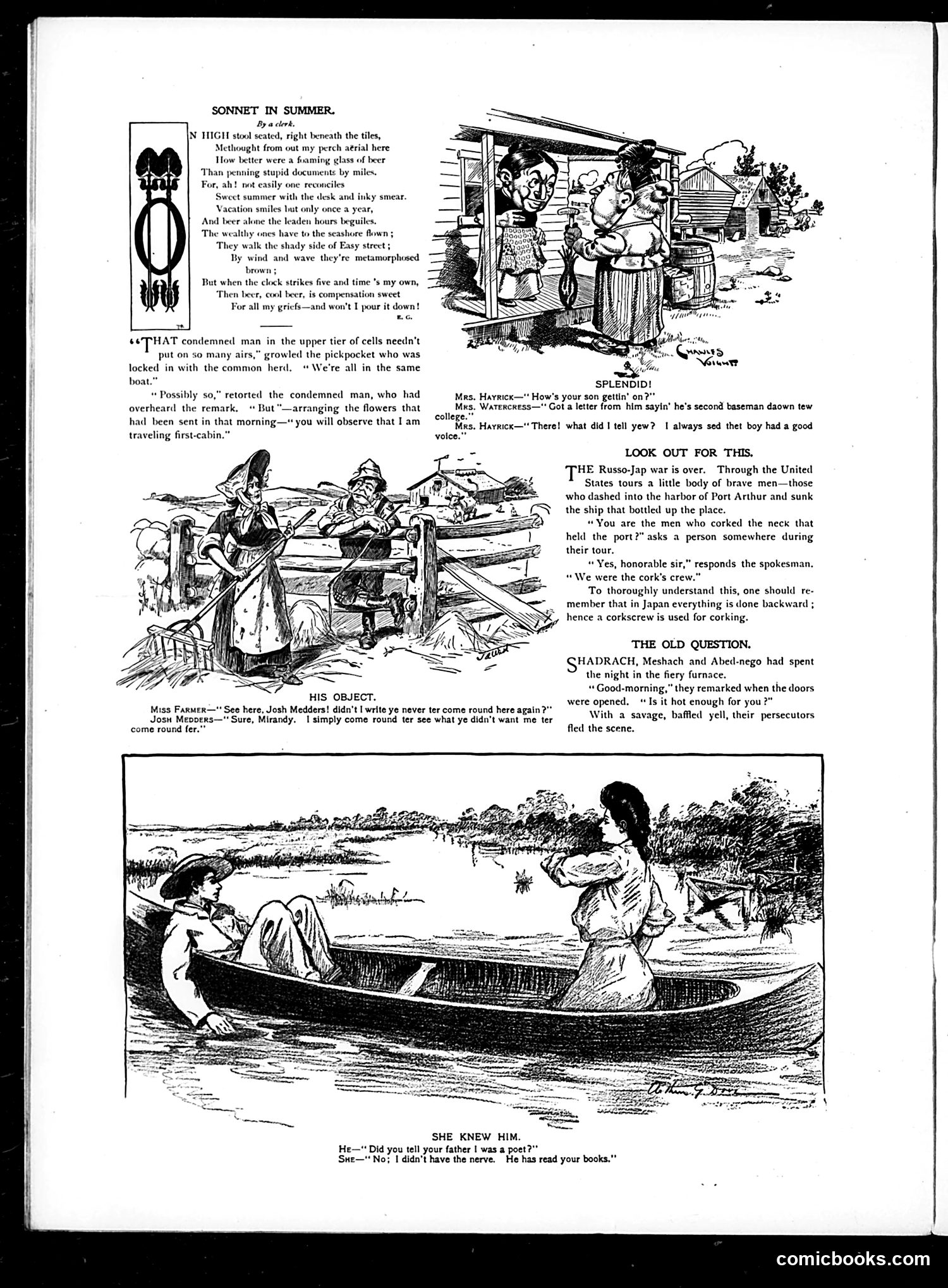
This page contains several satirical pieces reflecting early 1900s American life: **"Sonnet in Summer"** mocks a clerk stuck at his desk during hot weather, envying wealthy people's seaside vacations while consoling himself with beer—satire on class inequality and working-class frustration. **Prison dialogue** jokes about criminals' pretense to dignity, suggesting all social classes are equally corrupt—cynical social commentary. **Baseball reference** makes light fun of a boy becoming a second baseman, treating it as an unlikely success—period humor about baseball's social status. **"Look Out For This"** satirizes post-Russo-Japanese War military tours, making a crude pun: American sailors who "corked" Port Arthur's harbor are called the "cork's crew," with an explanation that Japan does everything backwards (including using corkscrews for corking). This mocks both Japanese customs and American military pride. **"The Old Question"** references the Biblical story of Shadrach, Meshach, and Abednego surviving a fiery furnace, twisting it into a joke about summer heat. Overall: working-class complaints, military satire, and subversive social commentary typical of Judge's satirical approach.
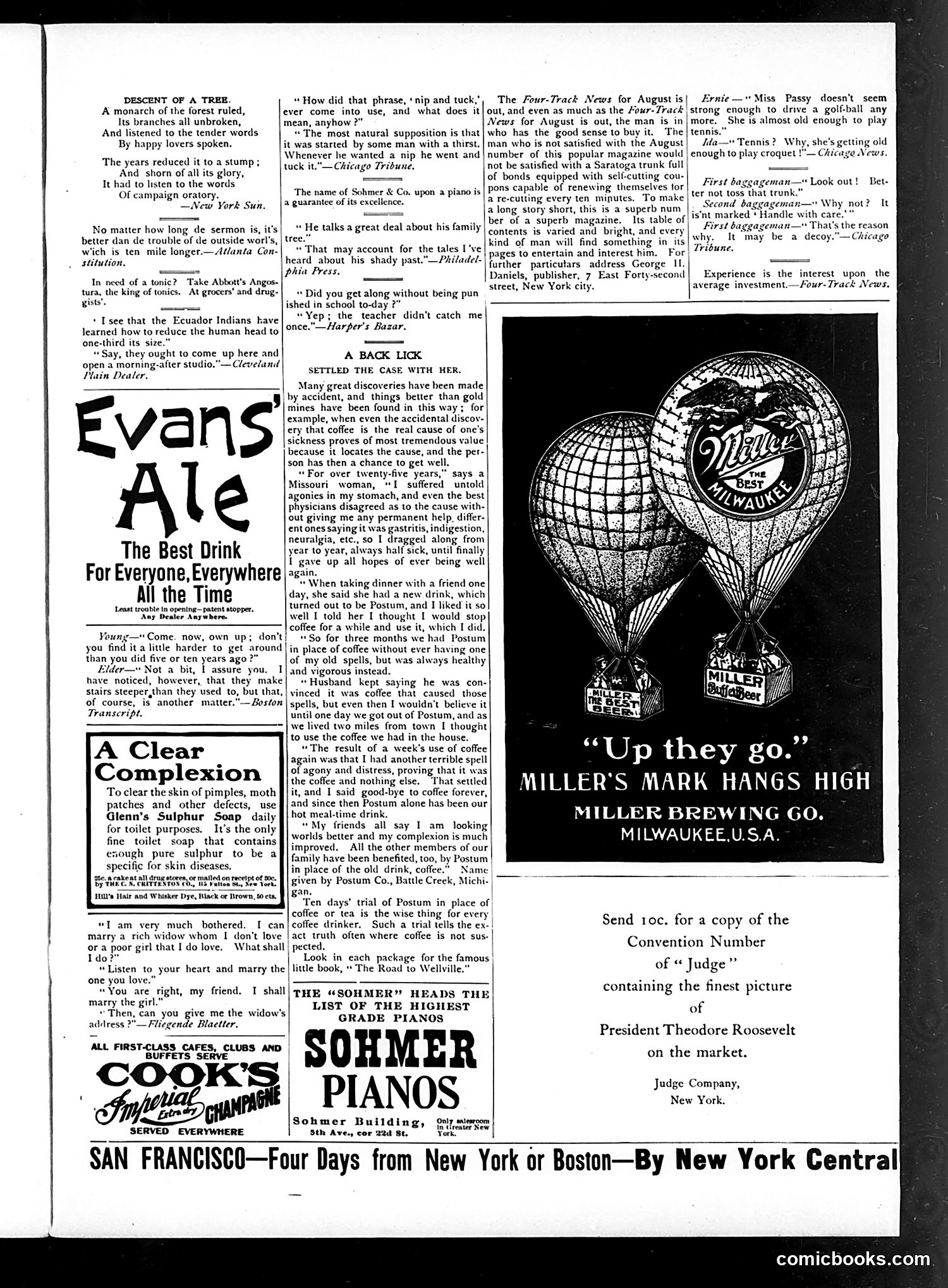
This page from Judge magazine (a satirical publication) contains mostly **short humor pieces and advertisements** rather than political cartoons. The humor consists of brief jokes about contemporary life: a tree overhearing lovers, the phrase "nip and tuck" explained through a man stealing liquor, Ecuador's indigenous head-shrinking practices referenced as absurdist humor, and quips about school punishment and tennis. **Key substantive content:** A lengthy testimonial (labeled "A BACK LICK") promoting Postum, a coffee substitute, where a Missouri woman describes suffering decades of stomach ailments attributed to coffee. She credits switching to Postum with resolving her health problems. This reflects early 20th-century wellness marketing and the anti-caffeine health movement of that era. The page also advertises Evans Ale, Sohmer Pianos, Cook's Champagne, and a Judge Company publication featuring Theodore Roosevelt. **For modern readers:** The humor is largely mild observational comedy about daily life; the Postum ad reveals period anxieties about food safety and health that differ markedly from today's understanding of nutrition.
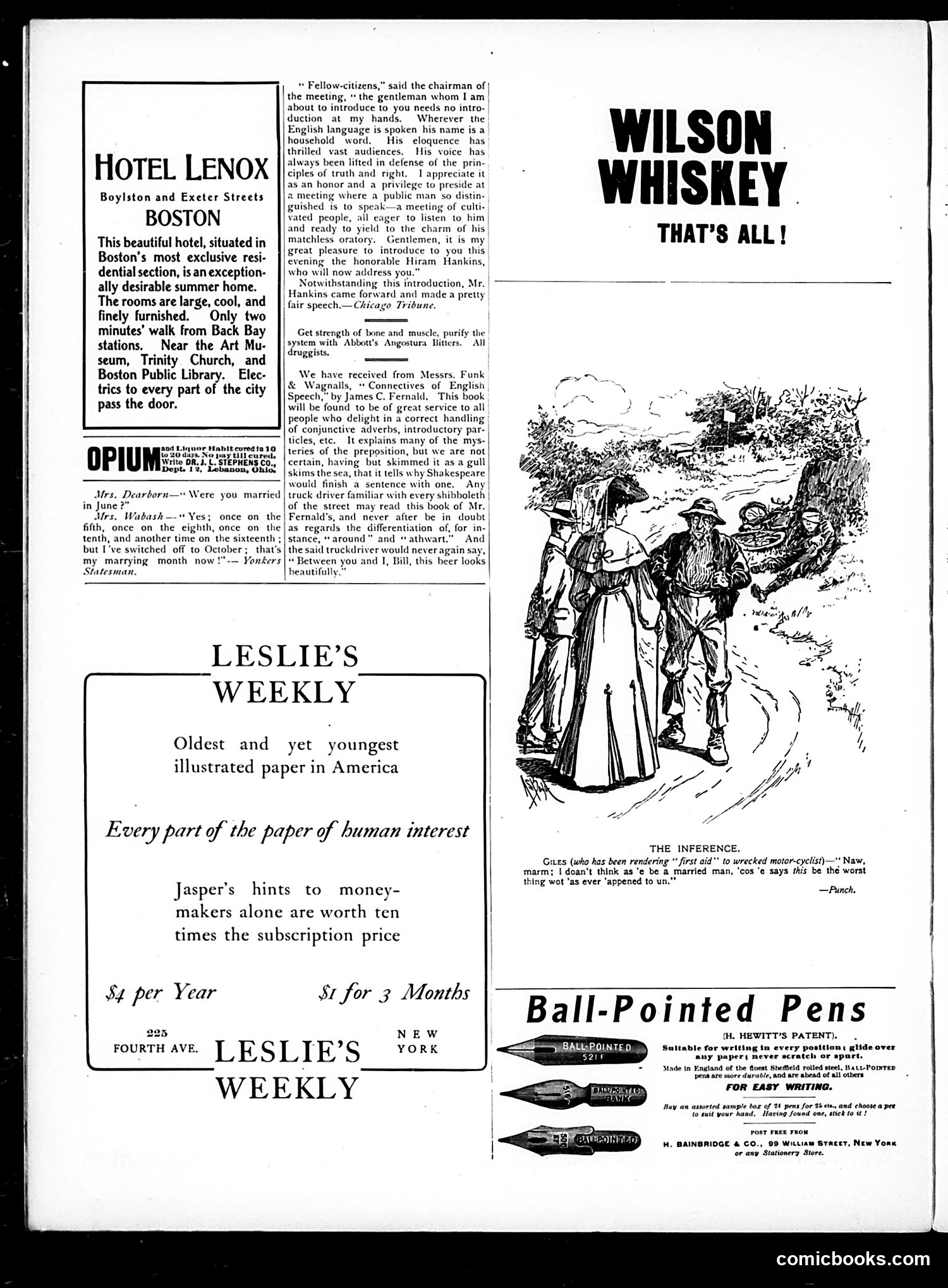
This page is primarily **advertising and filler content**, not political satire. The dominant elements are ads for Hotel Lenox, Leslie's Weekly, Wilson Whiskey, and Ball-Pointed Pens. The only cartoon is "The Inference" (credited to *Punch* magazine), a brief visual gag: a working-class man assists an injured motorcyclist, then remarks the victim can't be married because he called the accident "the worst thing" to happen to him—implying married life is worse. The joke relies on the period's common misogynistic humor about marriage being an undesirable state. The page also includes two brief jokes about remarriage and a chairman's verbose introduction, both playing on verbal humor rather than topical satire. The page represents typical Judge/Punch content: light humor and advertising rather than sharp political commentary.
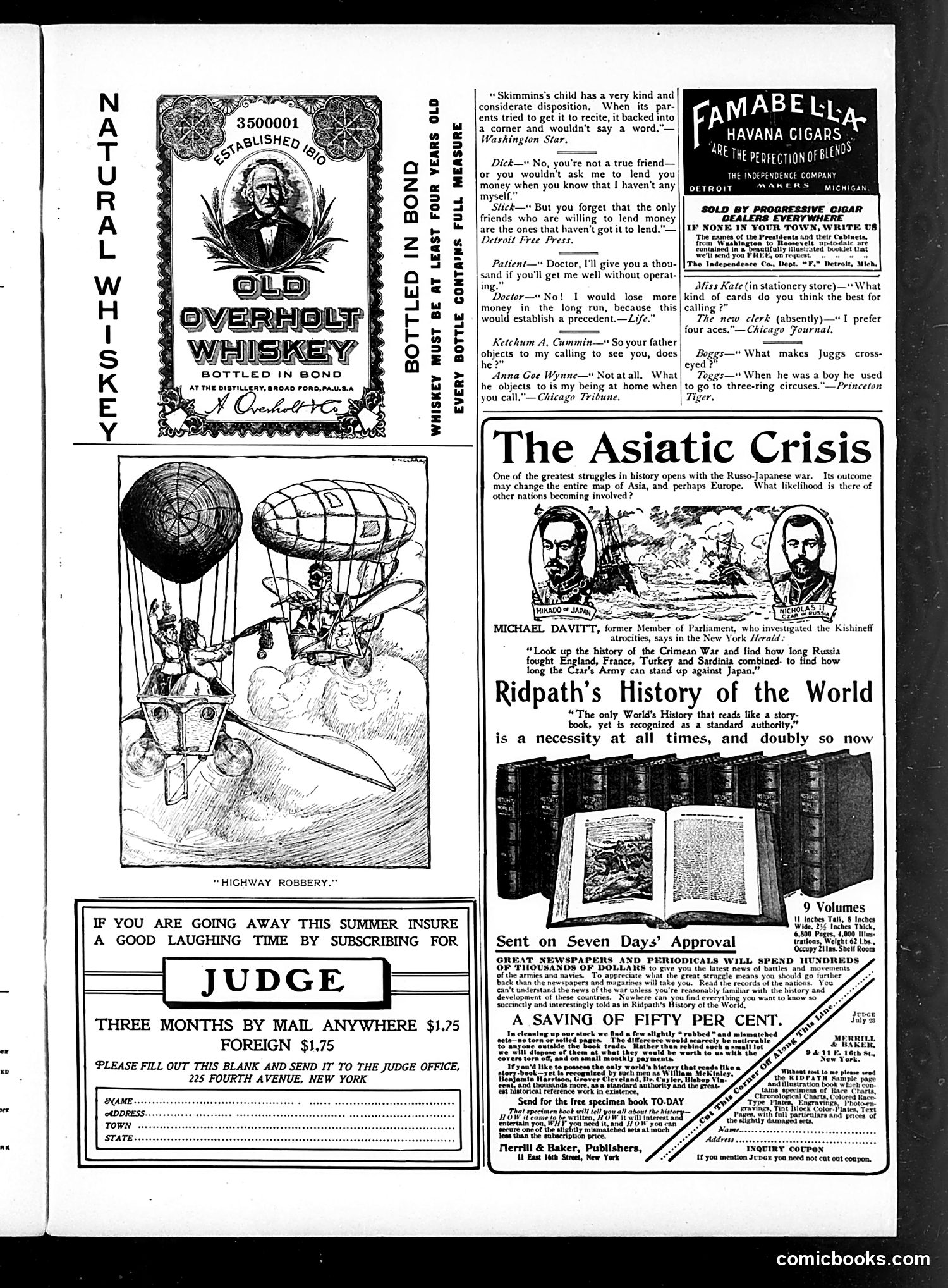
This page is primarily **advertising**, not political satire. The dominant content is commercial: **Major advertisements:** - **Overholt Whiskey** (top left): A spirits company promoting their bonded whiskey product - **Ridpath's History of the World** (center-right): A 9-volume history set marketed as essential reading given the Russo-Japanese War crisis - **Judge subscription offer** (bottom left): Promoting 3-month magazine subscriptions - **Marabella Cigars** (top right): Tobacco product advertisement **Content note:** The page includes a brief editorial section titled "The Asiatic Crisis" discussing the Russo-Japanese War's potential global impact, featuring a quote from Michael Davitt (former Parliament member) comparing it to the Crimean War. **Humor elements:** Small joke snippets appear throughout (about lending money, doctors, calling cards, cross-eyed vision), typical of Judge's humor column format. The page reflects early 1900s print culture: advertisements disguised as news/content, and commercial tie-ins to current events (the Russo-Japanese War driving Ridpath's History sales).
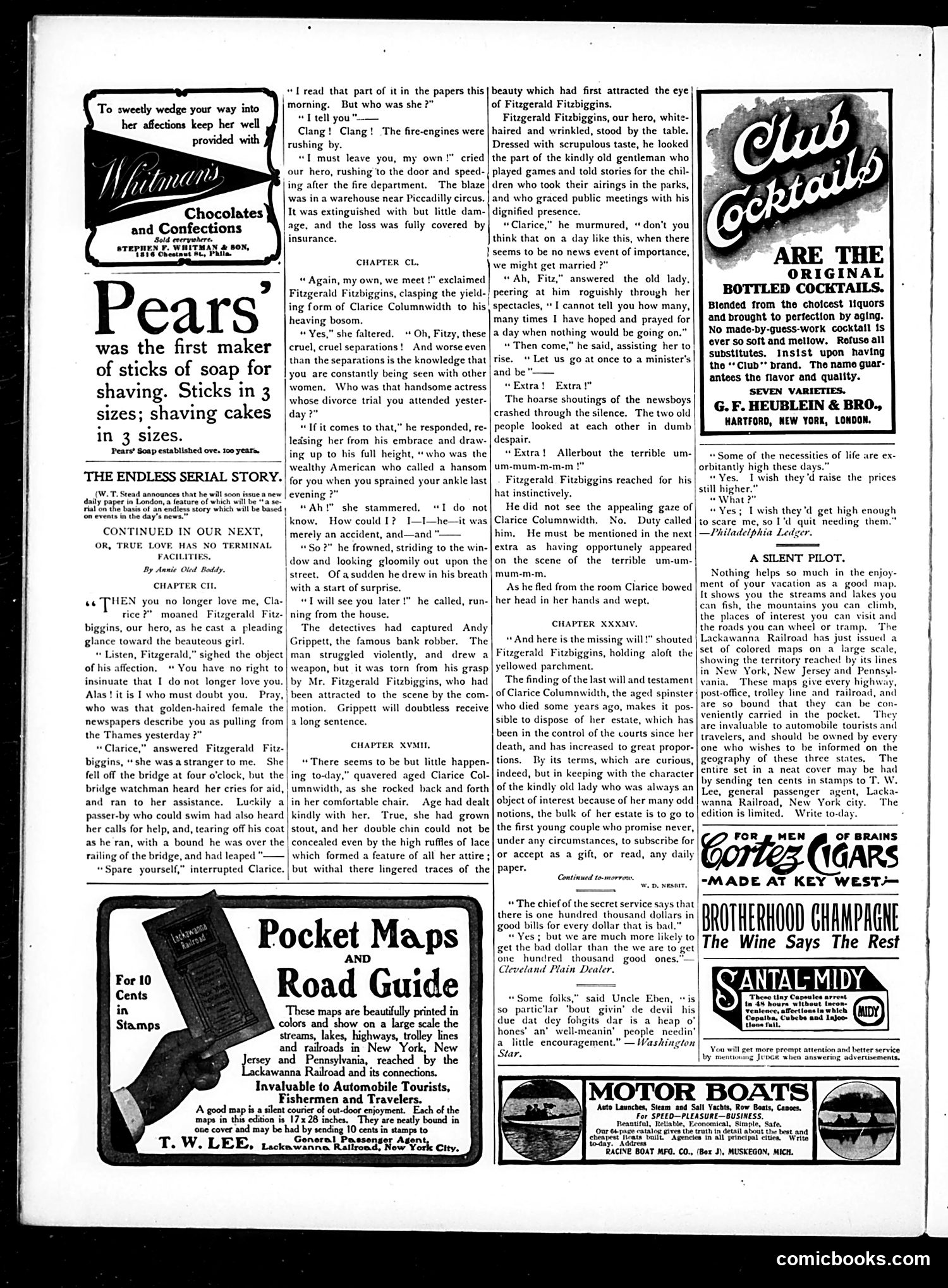
This page primarily contains **advertising with embedded satire** rather than standalone cartoons. The main satirical piece is "The Endless Serial Story," mocking W.T. Stead's announcement of a London daily newspaper featuring serials based on current events. The joke is that the serialized narrative becomes absurdly convoluted: protagonist Fitzgerald Fitzbiggins constantly abandons romantic scenes with Clarice Columnsworth to chase unrelated interruptions—fire engines, bank robberies—that he happens upon. Each interruption conveniently provides new "plot developments" to extend the story endlessly. The satire targets two things: (1) the artificial contrivance of serialized fiction, and (2) the attempt to build narratives from random daily news, creating implausible coincidences where one man continuously encounters major events. The rest of the page features period advertisements (Pears' Soap, Whitman's Chocolates, pocket maps, motor boats, champagne) typical of Judge magazine's revenue model.
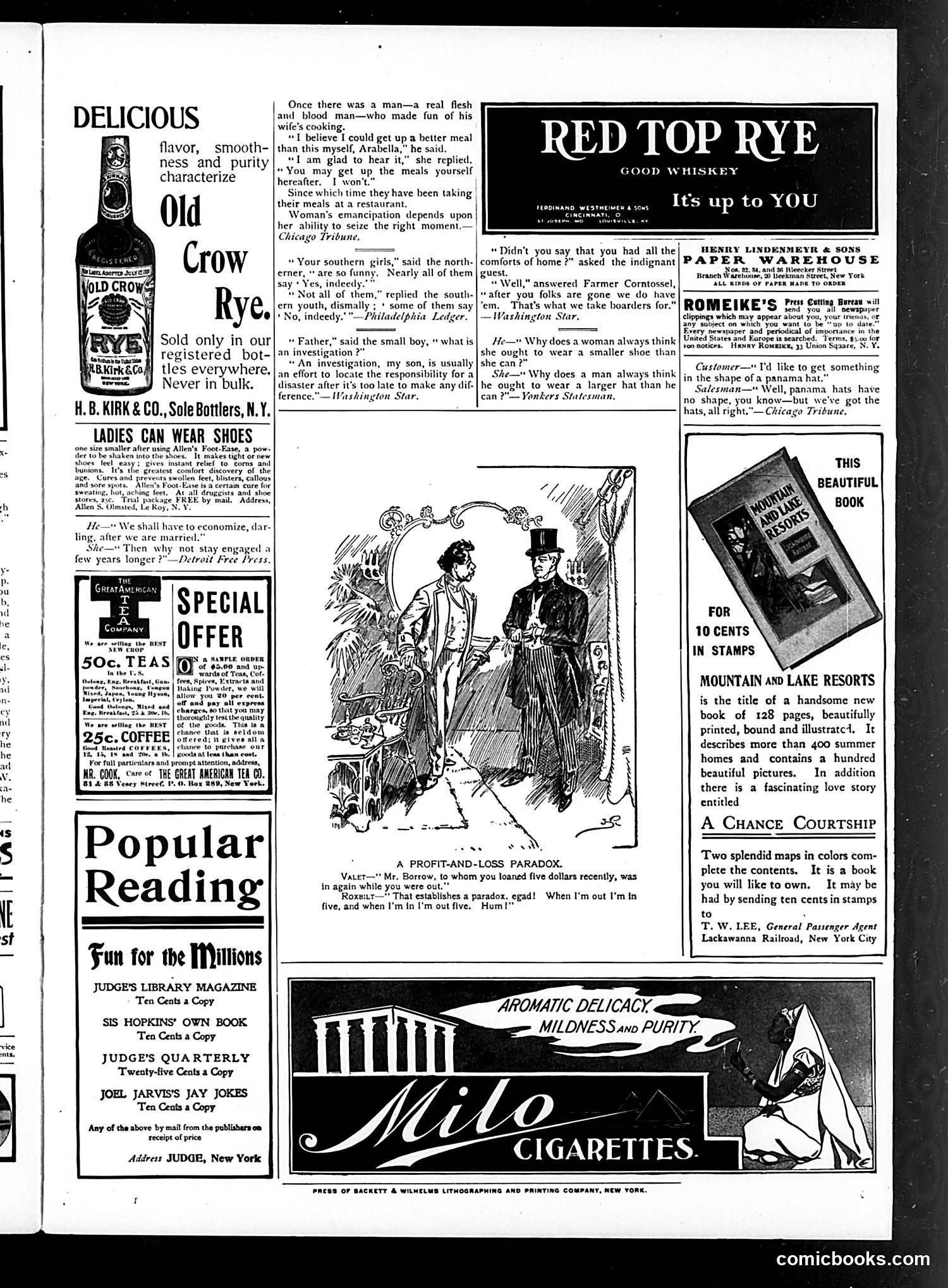
This page from Judge magazine features primarily **advertisements and humorous anecdotes** rather than political cartoons. The central cartoon illustrates a domestic joke: a husband mocks his wife's cooking, she responds by refusing to cook, and they now eat at restaurants. The caption's point is that "woman's emancipation depends upon her ability to seize the right moment"—satirizing both gender relations and women's growing independence in the early 20th century. The surrounding brief jokes touch on period social topics: Southern women's propriety, marital disappointment with boarders, and gender stereotypes about clothing sizes. One anecdote contains wordplay about a man who's paradoxically "in" when out and "out" when in. The advertisements dominate—Old Crow Rye whiskey, Allen's Foot-Ease powder, tea, and books about mountain resorts and romance. The humor overall reflects genteel domestic comedy typical of Judge's middle-class readership, with gentle jabs at marriage, regional differences, and evolving gender roles.
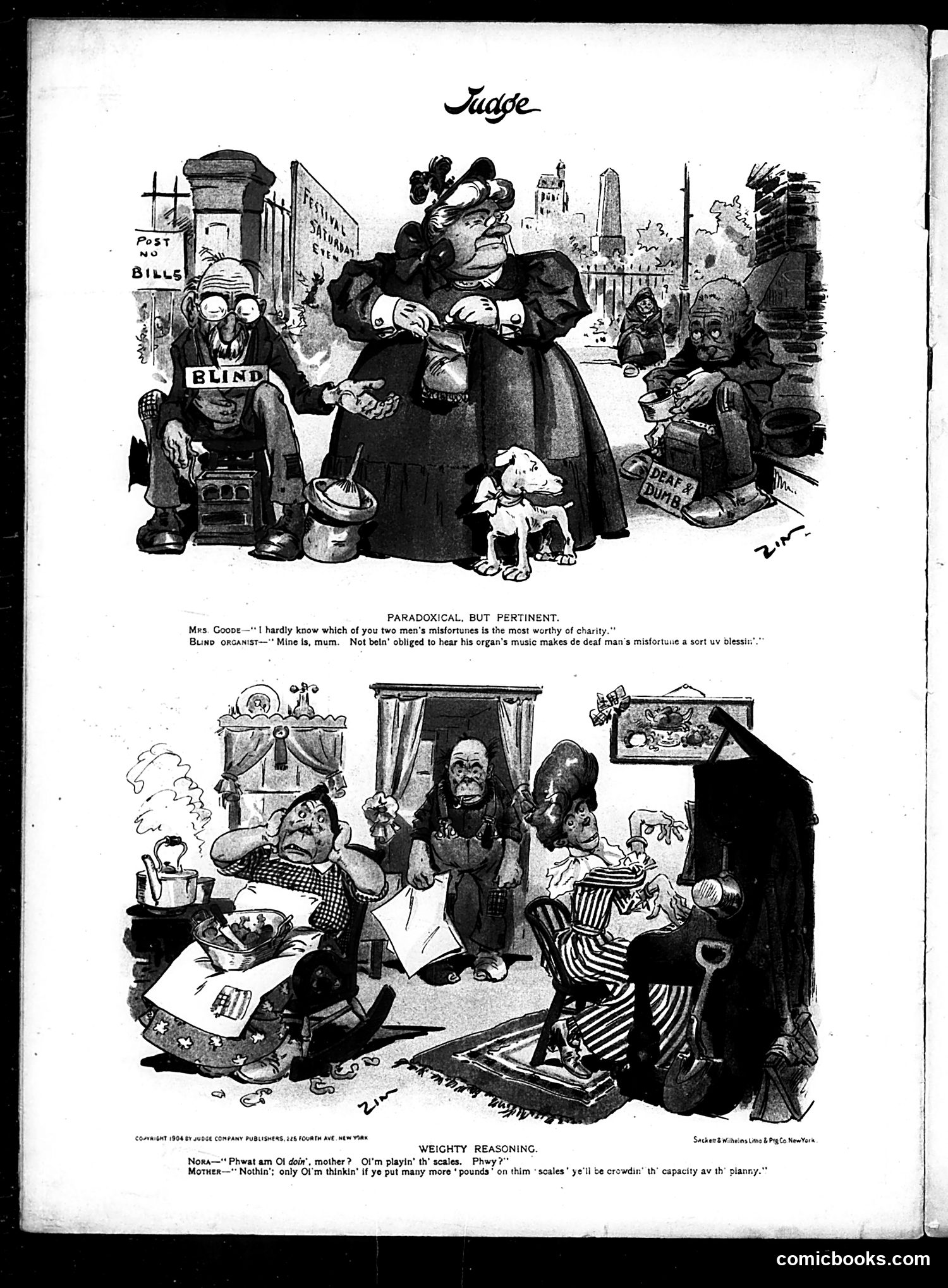
**Top cartoon ("Paradoxical, But Pertinent"):** A blind street musician and a deaf man both seek charity from Mrs. Goode. The joke's dark humor: the blind organist argues *he* deserves charity most because the deaf man's "misfortune" of not hearing his terrible organ music is actually a blessing. This satirizes both professional begging and the presumed awfulness of street musicians. **Bottom cartoon ("Weighty Reasoning"):** A mother watches her daughter practice piano scales, making a pun-based joke: she's concerned that if the girl puts more "pounds" (weight) on the piano keys while practicing scales (musical exercises), she'll exceed the piano's weight capacity. The humor relies on conflating musical "pounds" of pressure with literal body weight, mocking the girl's presumed heaviness. Both cartoons use physical disability/appearance and crude stereotypes (Irish dialect "Phwat," "Ol") typical of early 1900s American humor.