
Judge, 1904-07-23 · page 6 of 16
Judge — July 23, 1904 — page 6: what you’re looking at
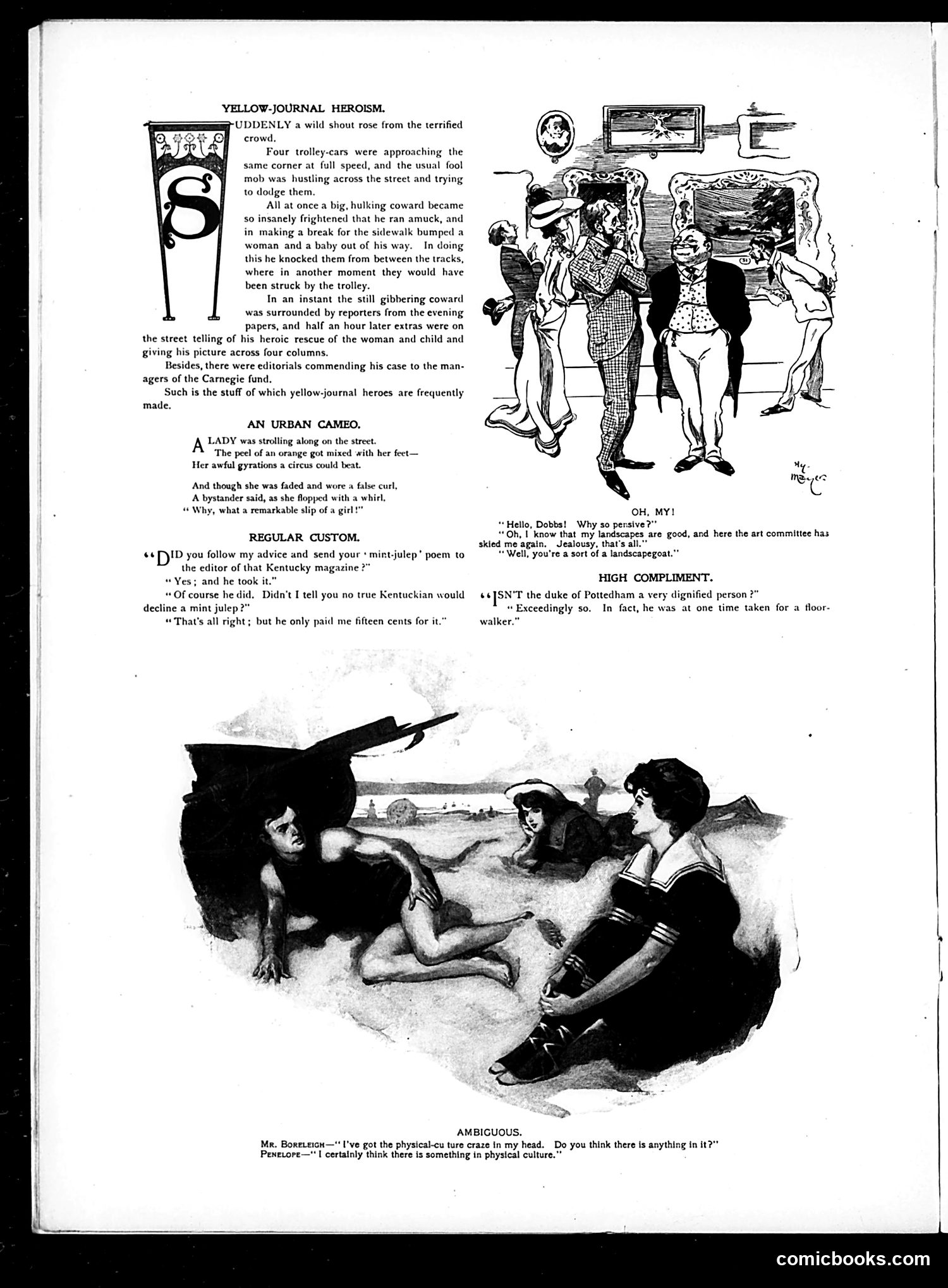
What you’re looking at
This page satirizes sensationalist newspaper practices of the era. The main cartoon mocks "yellow journalism"—the practice of exaggerating stories for dramatic effect. A cowardly man, fleeing from trolleys in panic, accidentally knocks a woman and child to safety. Rather than reporting this as a minor accident, evening papers transform him into a hero, surrounding him with reporters, printing his picture across four columns, and editorializing about his worthiness for the Carnegie Hero Fund (a real institution that rewarded brave acts). The satire targets how tabloid newspapers fabricated or distorted mundane incidents into heroic narratives to sell papers. The irony is sharp: a "gibbering coward" becomes celebrated through journalistic spin. This was a common criticism of yellow journalism in the period—its sensationalism and disregard for truth. The page also includes brief humorous snippets about art rejection, Kentucky poetry, and physical culture, typical of Judge's mixed-content format.
📄 Transcribed text from this page (OCR, searchable)
Machine-transcribed from the original scan — historical spelling and the odd misread are preserved.
YELLOW-JOURNAL HEROISM. UDDENLY a wild shout rose from the terrified crowd. Four trolley-cars were approaching the same corner at full speed, and the usual fool mob was hustling across the street and trying to dodge them. Alll at once a big, hulking coward became so insanely frightened that he ran amuck, and in making a break for the sidewalk bumped a woman and a baby out of his way. In doing this he knocked them from between the tracks, where in another moment they would have been struck by the trolley. In an instant the still gibbering coward was surrounded by reporters from the evening papers, and half an hour later extras were on the street telling of his heroic rescue of the woman and child and giving his picture across four columns. Besides, there were editorials commending his case to the man- agers of the Carnegie fund. Such is the stuff of which yellow-journal heroes are frequently made. AN URBAN CAMEO. LADY was strolling along on the street. ‘The peel of an orange got mixed with her feet— Her awful gyrations a circus could beat. And though she was faded and wore a false curl, A bystander said, as she flopped with a whirl, “Why, what a remarkable slip of a girl OH, MY! “Hello, Dobbs! Why so persive?”” REGULAR CUSTOM. “Oh, I know that my landscapes are good, and here the art committee has i skied me again, Jealousy, that's all."" 44 [)ID you follow my advice and send your * miet-julep* poem to “Well, you're a sort of a landscapegoat.”* the editor of that Kentucky magazine ?" “Yes; and he took it.” HIGH COMPLIMENT. “Of course he did. Didn't I tell you no true Kentuckian would ¢¢]SN"T the duke of Pottedham a very dignified person 2" decline a mint julep 2” « Exceedingly so, In fact, he was at one time taken for a floor- “That's all right; but he only paid me fifteen cents for it.” walker.” | AMBIGUOUS. Mr. Boreteicn—"* I've got the physical-cu ture craze in my head. Do you think there is anything in it?” Penevore—"'I certainly think there is something in physical culture.”” comicbooks.com