
A complete issue · 16 pages · 1904
Judge — June 4, 1904
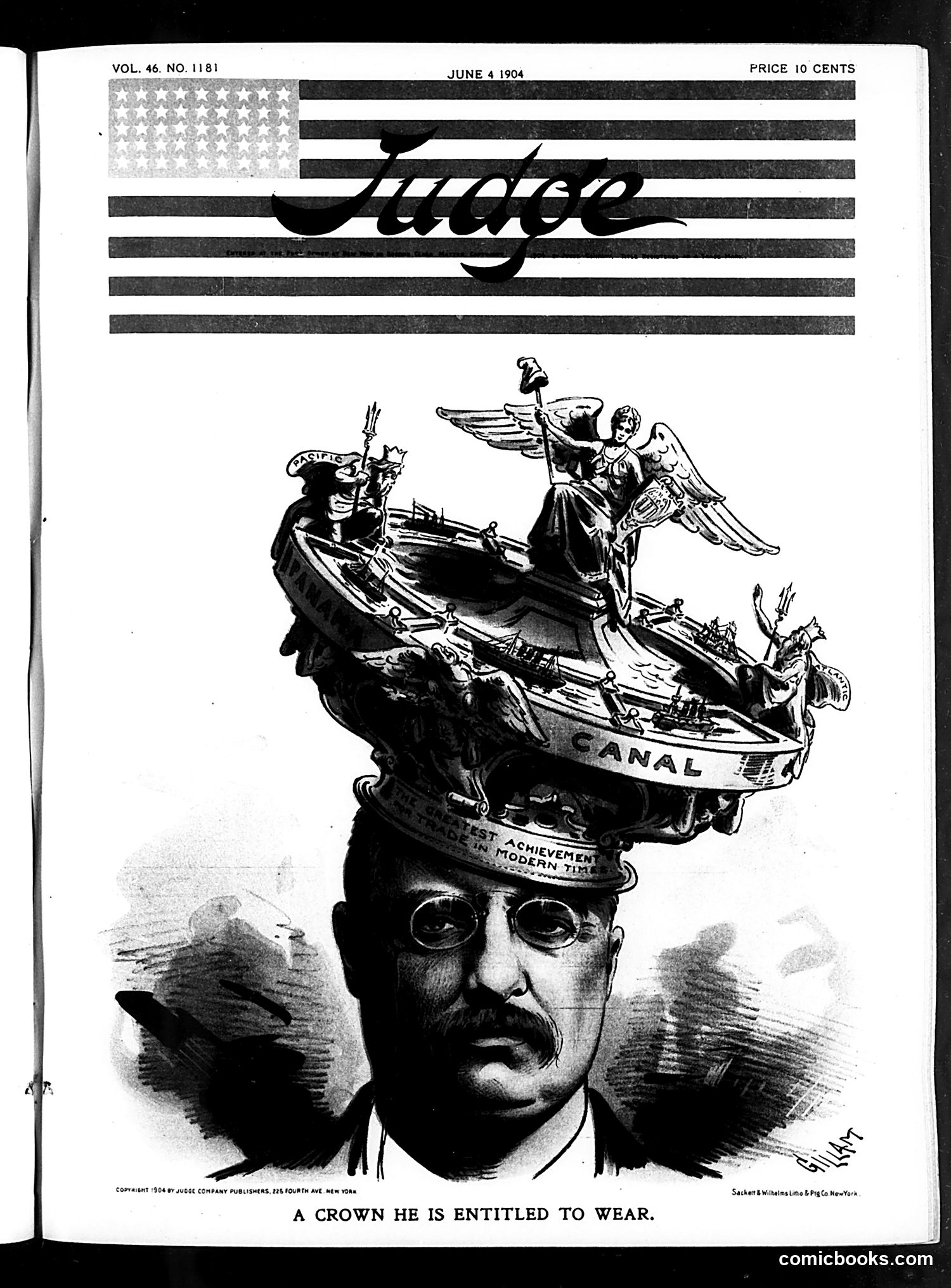
This is a political cartoon satirizing a prominent figure—likely President Theodore Roosevelt, given the era and style. The image depicts a man's head topped with an elaborate sculptural crown featuring a canal, ships, angels, and classical figures labeled "CANAL" and "ACHIEVEMENT IN MODERN TIME." The caption reads: "A Crown He Is Entitled to Wear." The satire mocks Roosevelt's obsession with the Panama Canal project, a major achievement of his presidency (construction began 1904). The exaggerated, ornate "crown" symbolizes how Roosevelt—or supporters—viewed this engineering feat as a monumental personal accomplishment worthy of elevated status or glory. The cartoon's tone appears gently mocking, suggesting excessive self-congratulation about the canal's significance.
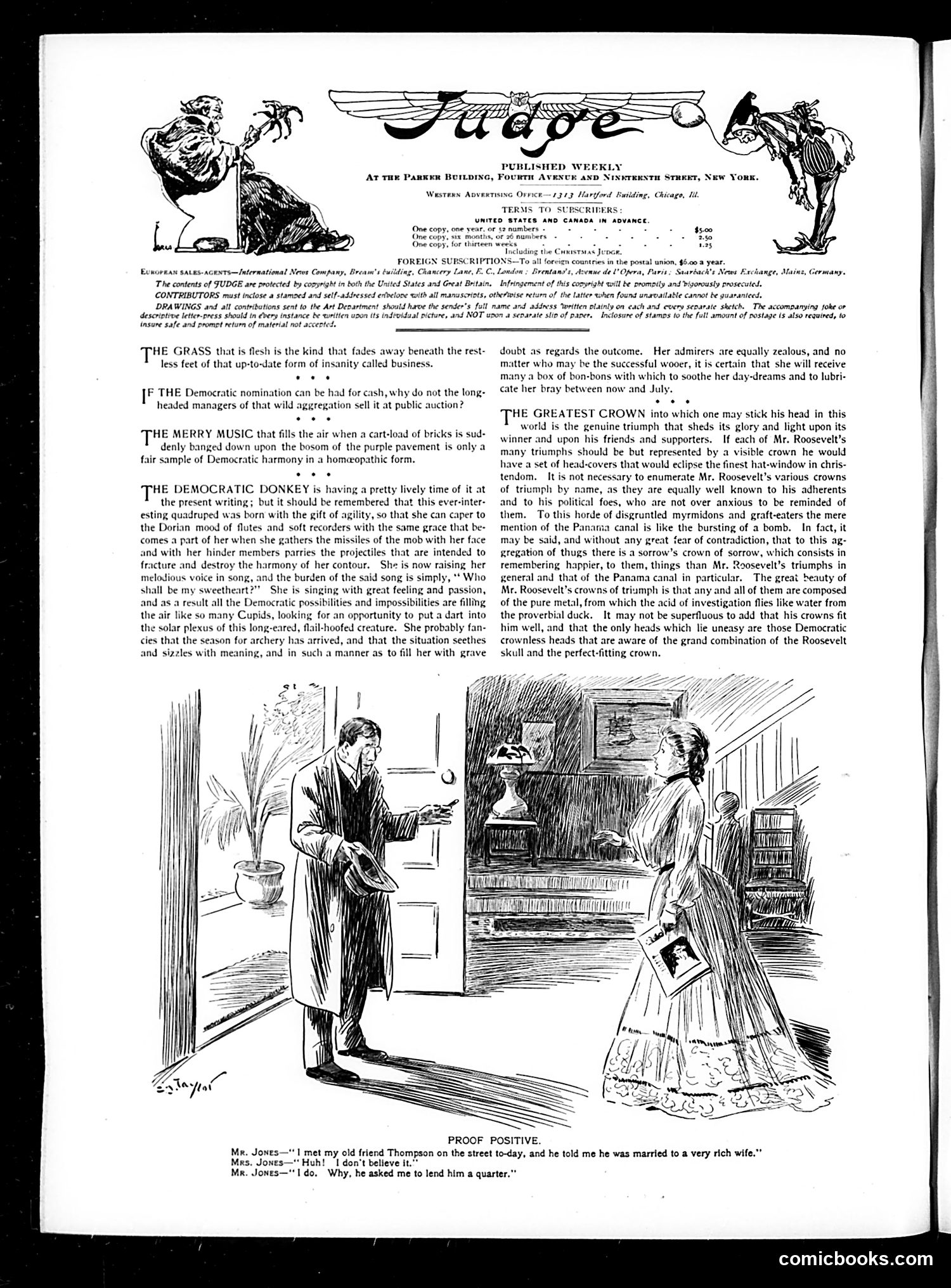
This page contains political commentary and satirical text pieces typical of Judge magazine's style. The upper section discusses contemporary political figures and events through short, pointed paragraphs—including references to Democratic nominations, "the Democratic Donkey," and Mr. Roosevelt's "crowns of triumph." The cartoon at bottom, titled "Proof Positive," depicts a domestic scene where Mr. Jones encounters an old friend Thompson, now married to "a very rich wife." When Thompson asks Jones for a quarter loan, Jones uses this as "proof" that Thompson's wife is indeed wealthy—since Thompson must be poor despite the marriage. The humor relies on the ironic logic that a genuinely rich spouse would provide adequate funds, making Thompson's financial request evidence against his wife's wealth. The cartoon satirizes nouveau riche marriages and financial pretense of the era.
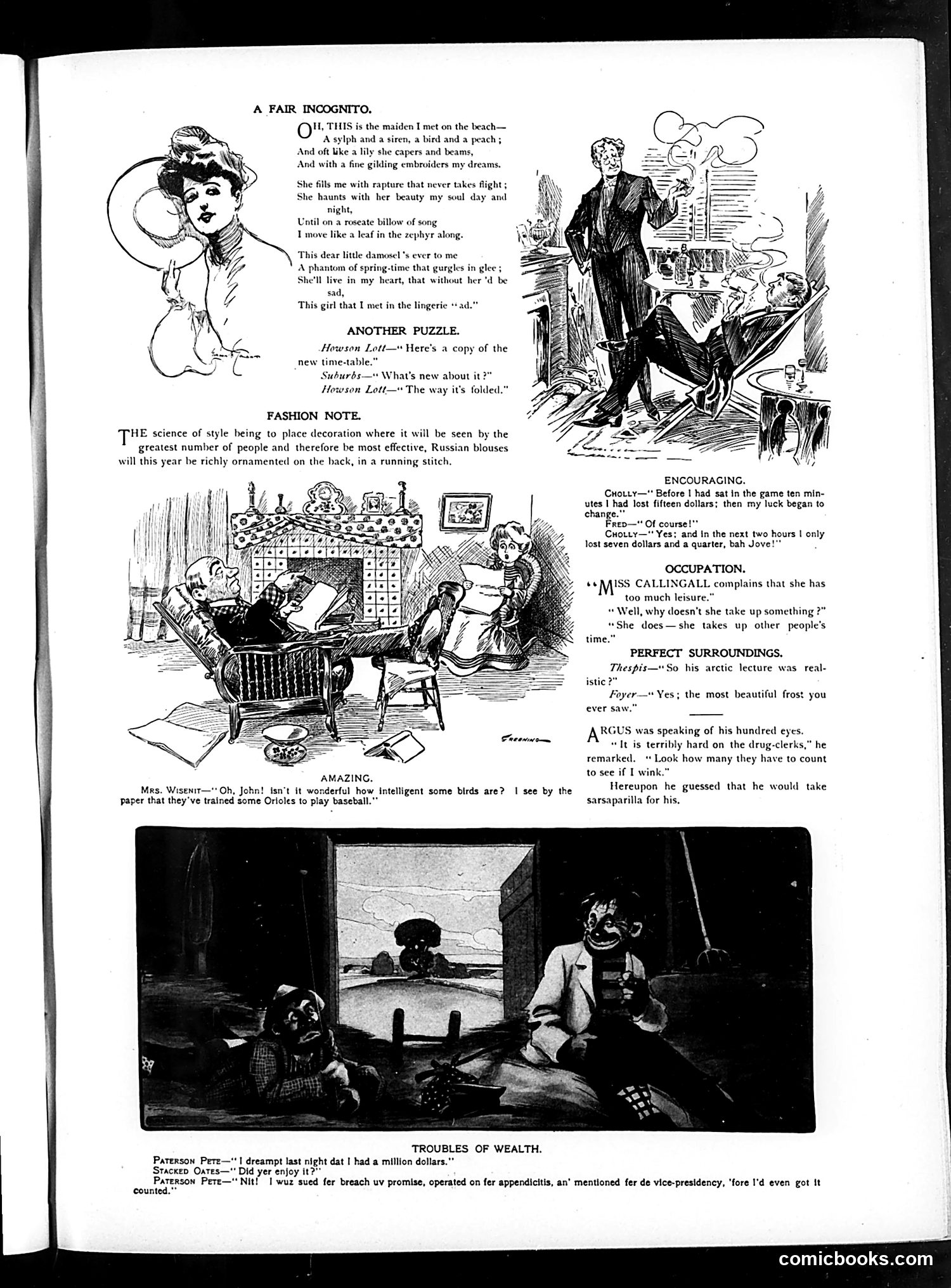
This page contains several short humorous pieces rather than political cartoons. The main items include: **"A Fair Incognito"**: A romantic poem about meeting a maiden on a beach, illustrated with period sketches. **"Another Puzzle"** and **"Fashion Note"**: Brief joke exchanges about new timetables and decorative stitching on Russian blouses. **"Encouraging," "Occupation," "Perfect Surroundings," and "Argus"**: Short satirical quips about leisure, fortune-hunting in card games, Arctic scenery, and a character with many eyes. **Bottom section**: A dramatic photograph titled "Troubles of Wealth" showing what appears to be a scene about lawsuits and financial disputes, with dialogue between characters named Paterson Pete and Stacked Oates. The page reflects early 20th-century concerns about wealth, leisure, fashion, and social pretension through light humor rather than serious political commentary.
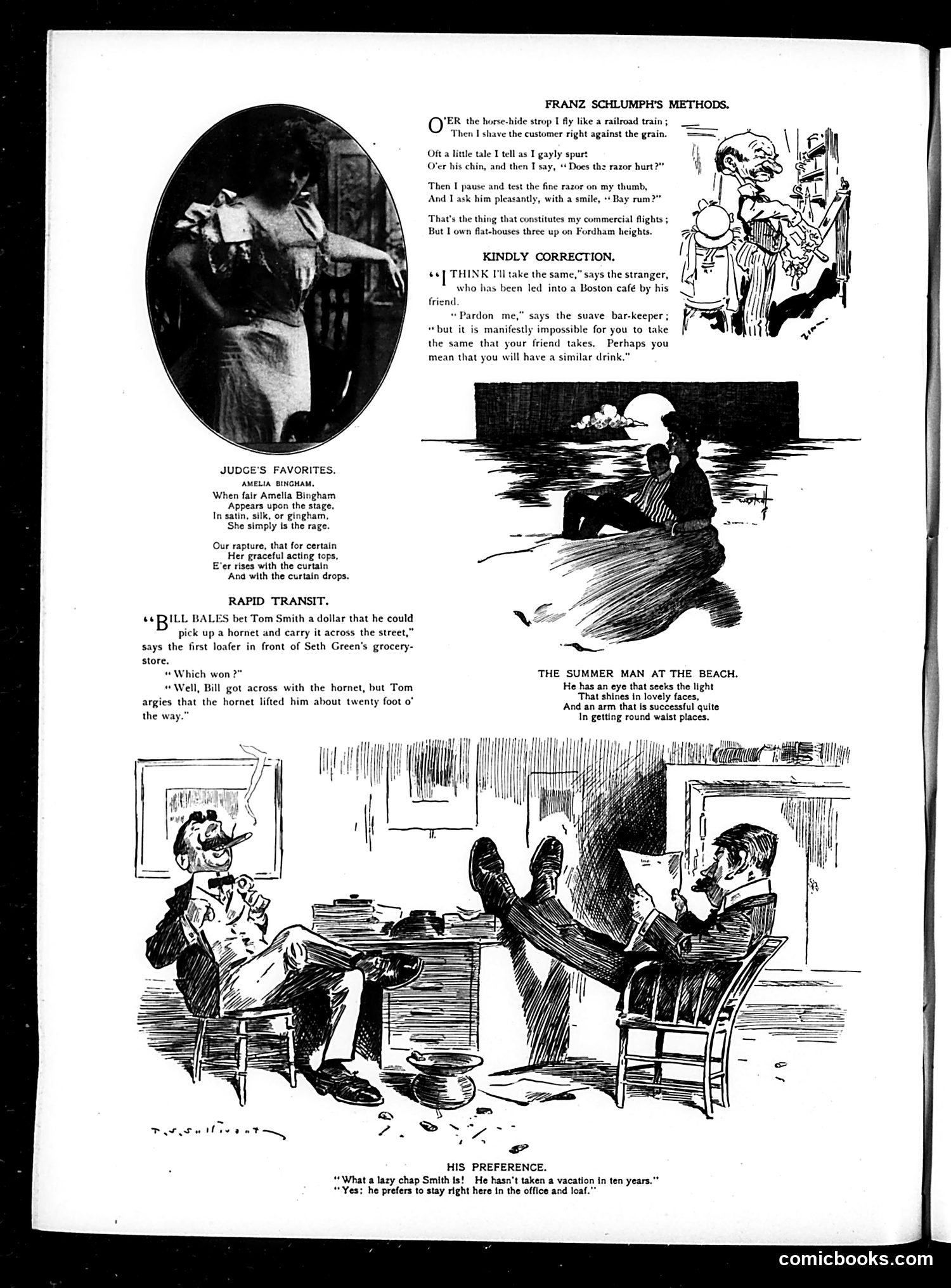
This page contains four separate humor pieces typical of Judge's early 20th-century format: 1. **"Franz Schlumph's Methods"**: A barber's technique involving aggressive razor-stropping, humorously compared to a "railroad train." 2. **"Judge's Favorites"**: Celebrates actress Amelia Bingham's theatrical talent and graceful stage presence. 3. **"Rapid Transit"**: Anecdotal humor about Bill Bales winning a bet by using a hornet to transport Tom Smith across a street—absurdist humor based on unexpected solutions. 4. **"His Preference"**: Office humor about a lazy employee (Smith) preferring to loaf at work rather than vacation elsewhere. The cartoons satirize everyday urban life, workplace laziness, and social behavior without obvious political content. The humor relies on exaggeration and incongruity typical of period American comedy magazines.
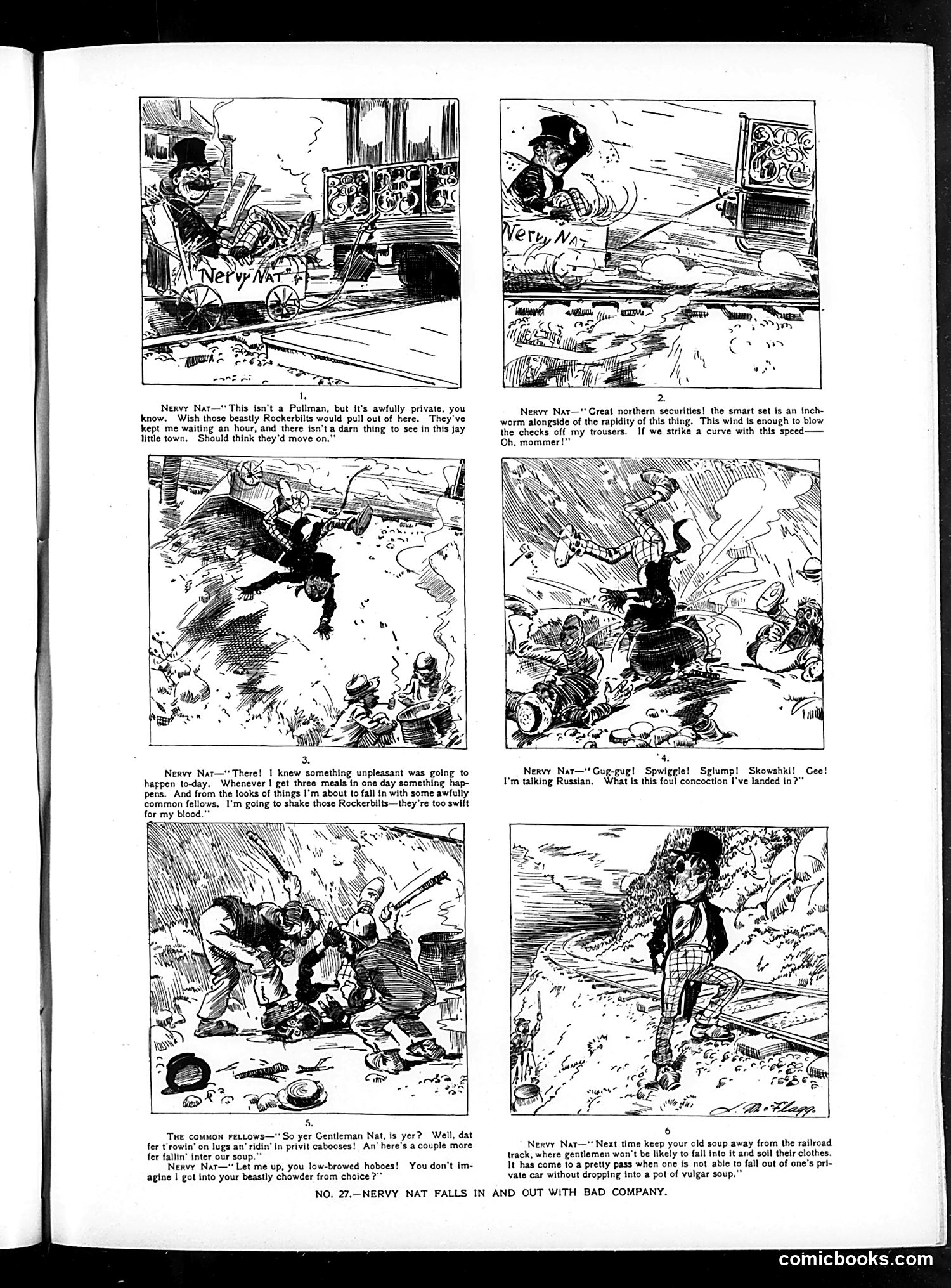
This Judge comic strip satirizes class anxiety through slapstick. "Nervy Nat" is an upper-class dandy who repeatedly falls into the company of working-class men—first hobos, then railroad workers—and is horrified by their vulgarity and rough manners. The humor targets Nat's snobbish pretension: he complains about riding in a "private" train car, worries about wind messing his clothes, and is disgusted when he falls into the workers' soup pot. The working men, in turn, mock his affected speech and fancy appearance. The satire cuts both ways—mocking both Nat's absurd class consciousness and the workers' coarse behavior. The title's "bad company" suggests that crossing class lines, in either direction, is inherently comic chaos. This reflects Gilded Age anxieties about social hierarchy and the comic potential of class collision.
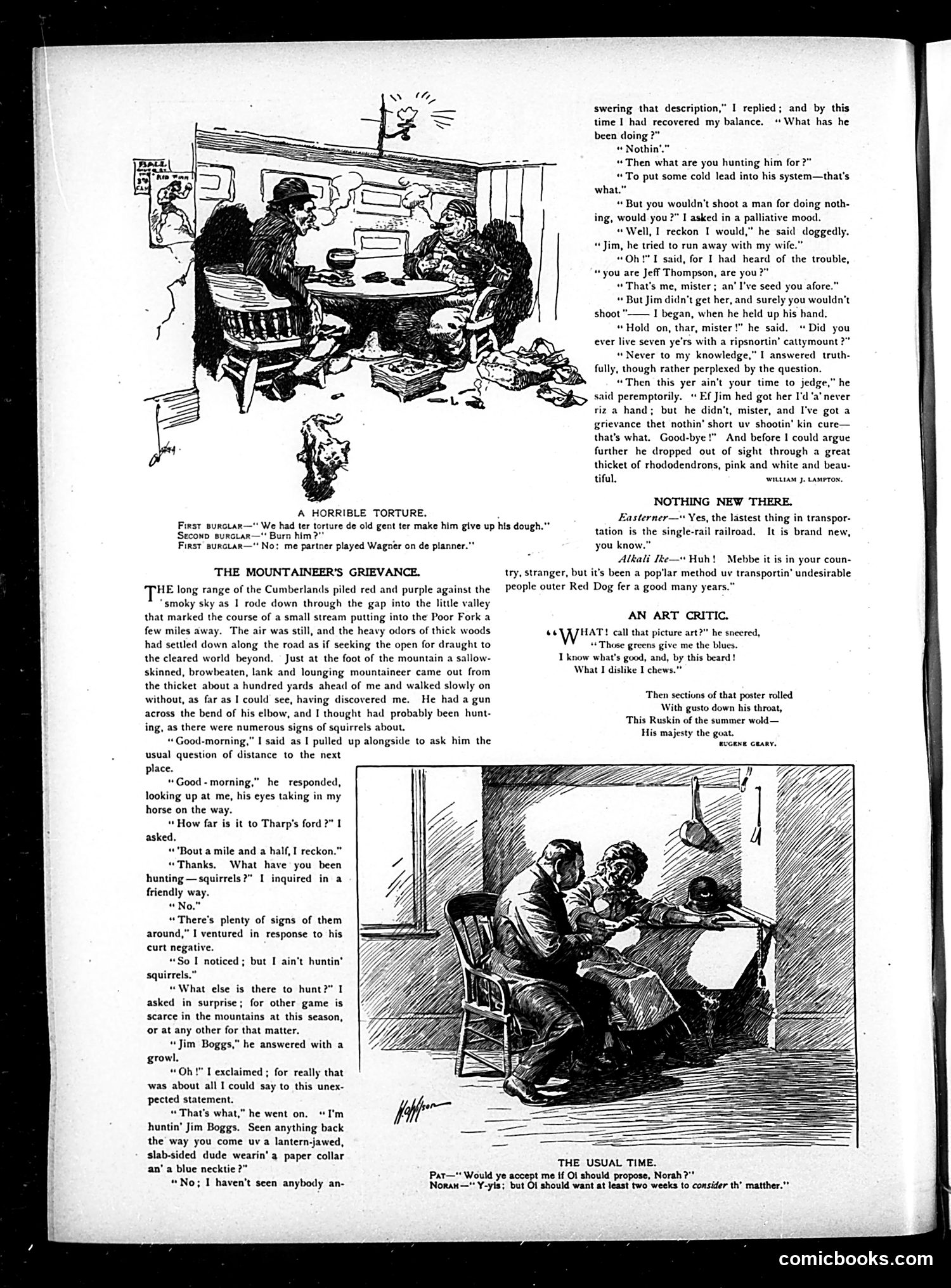
This page contains three satirical pieces typical of early 20th-century American humor: **"A Horrible Torture"** depicts criminals debating torture methods—the "joke" being that Wagner piano music is worse than violence, reflecting contemporary mockery of classical music as unbearably tedious. **"The Mountaineer's Grievance"** is a dialect story about a poor Appalachian man (Jeff Thompson) hunting Jim Boggs, who attempted to seduce Thompson's wife. Though Boggs failed and fled, Thompson seeks lethal revenge anyway—the satire highlighting rural "honor culture" as absurdly disproportionate and the mountaineer's stubborn irrationality. **"Nothing New There"** features "Alkali Ike," a Western character who dismissively tells an Easterner that single-rail railroads aren't new—implying the West has long used them to remove "undesirable people," a dark joke about frontier justice. **"An Art Critic"** mocks an uncultured person who literally eats a poster while criticizing its artistic merit, satirizing philistinism and fake aesthetic judgment. All reflect Judge's urbane East Coast perspective mocking rural Americans, foreigners, and the uncultured.
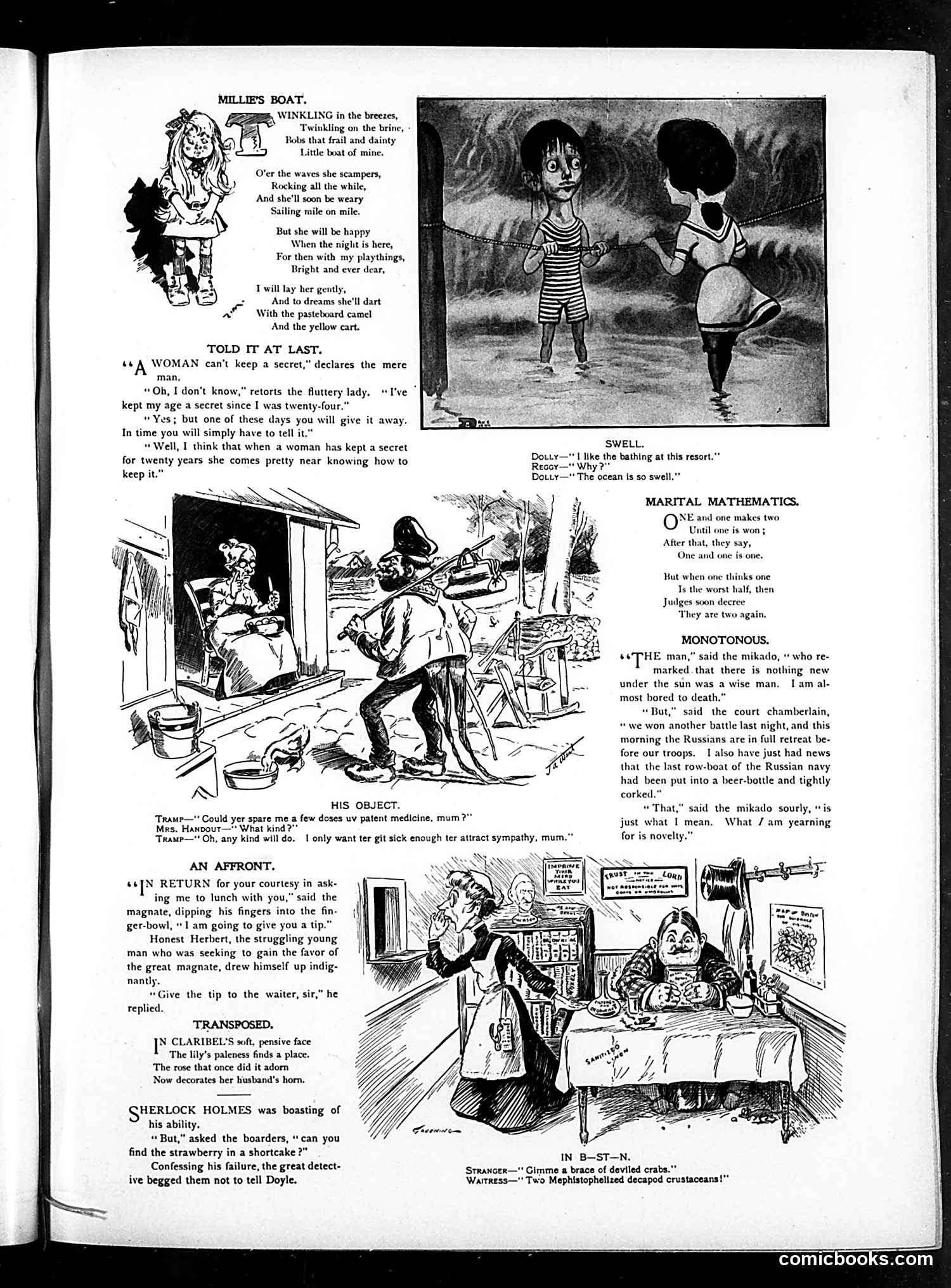
This page contains several separate satirical pieces typical of late-19th/early-20th century American humor: **"Millie's Boat"** is sentimental children's verse about a toy boat—straightforward, not political. **"Told It at Last"** satirizes the stereotype that women cannot keep secrets, with a witty retort about a woman keeping her age secret for decades. **"Marital Mathematics"** jokes that marriage arithmetic changes after divorce—"one and one" becomes "two again" when judges decree separation. **"Monotonous"** appears to reference the Russo-Japanese War, with a mikado (Japanese emperor) bored by military victories, finding novelty only in absurdist humor about a Russian boat compressed into a beer bottle. **Other sketches** include domestic humor ("His Object," "An Affront") and literary jokes mocking Sherlock Holmes author Arthur Conan Doyle. The Boston dialect piece at bottom uses exaggerated speech ("deviled crabs") for ethnic humor typical of the era. Overall: light social satire with no deep political content—mostly domestic, marital, and literary comedy.
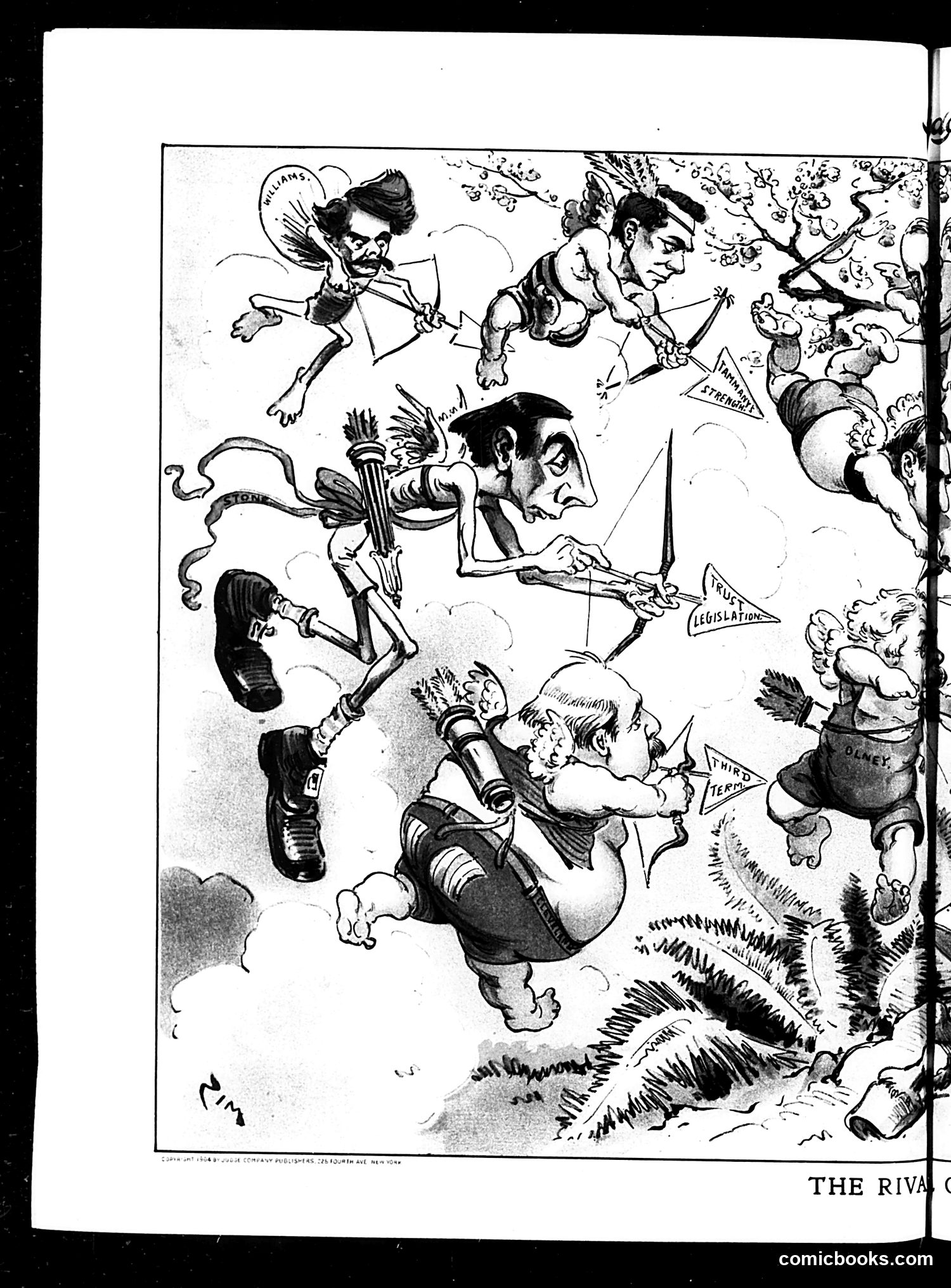
This is a political cartoon from Judge magazine titled "The Rival" (partially visible). The image depicts several figures in clouds engaged in conflict with weapons—swords, bows and arrows, and other implements. The cartoon appears to satirize political or legislative rivalries. Visible labels include "PURE LEGISLATION" and "THIRD TERM," suggesting this concerns debates over legislative purity and presidential term limits, likely from the early 20th century. The figures are caricatured in exaggerated style typical of Judge's satirical approach. The chaotic aerial battle suggests competing political factions or ideologies fighting for dominance. Without clearer labels or date information, the specific politicians or parties involved remain unclear, though the satire clearly mocks infighting among political rivals.
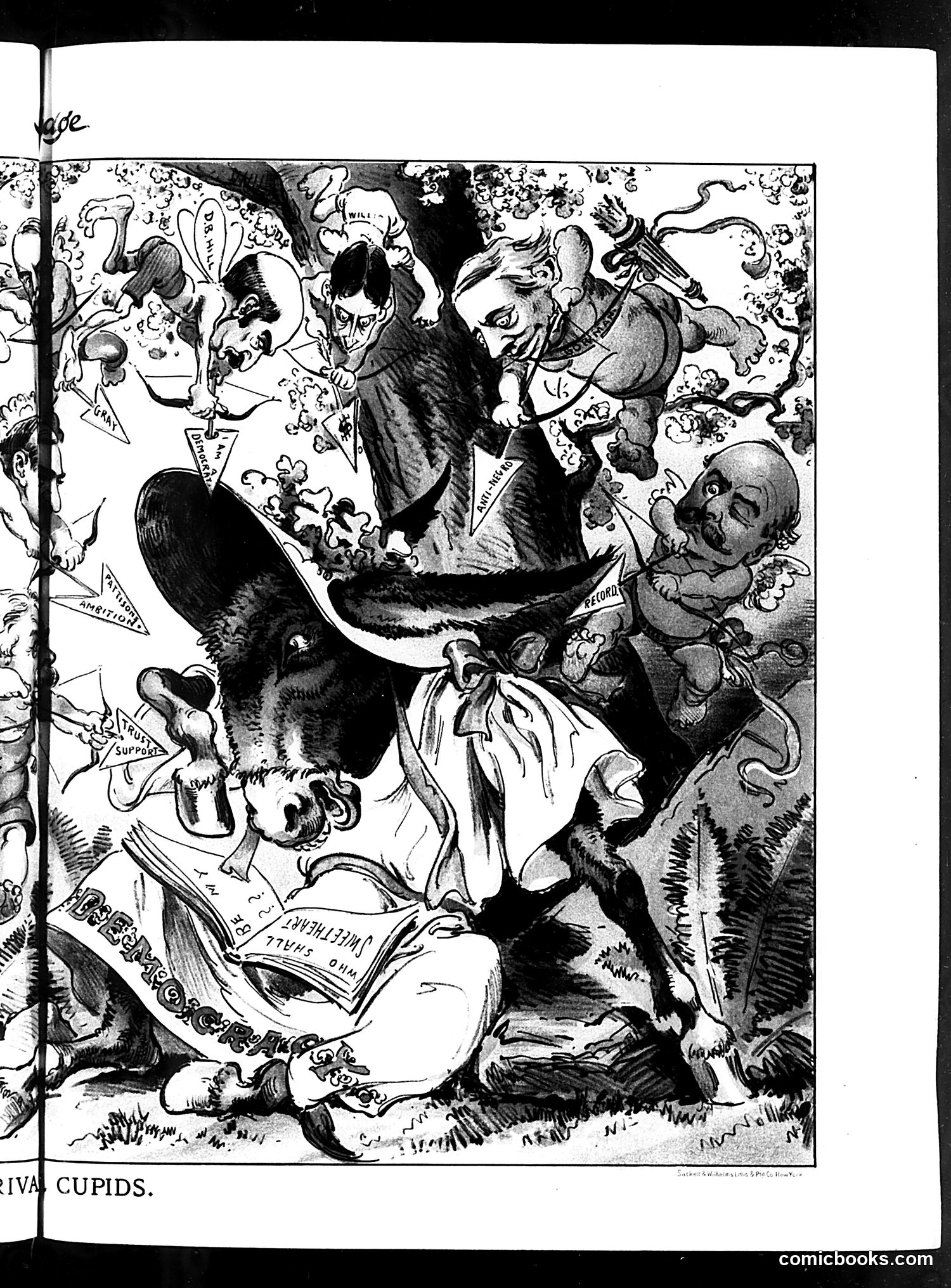
This Judge magazine cartoon, titled "Ivar Cupids," appears to be a satirical commentary on political or social figures of its era. The image depicts exaggerated caricatured faces with grotesque features—likely representing specific public figures—alongside cherubic cupid figures in a chaotic, ornate scene. The style and composition suggest commentary on romance, marriage, or courtship among the wealthy or politically prominent. The juxtaposition of crude caricatures with classical cupid imagery creates ironic contrast, mocking the subjects' pretensions to refinement or romantic appeal. However, without additional context identifying the specific individuals caricatured or the historical moment referenced, I cannot definitively explain which figures are targeted or what particular scandal or social situation prompted this satire. The OCR title provides limited interpretive guidance.
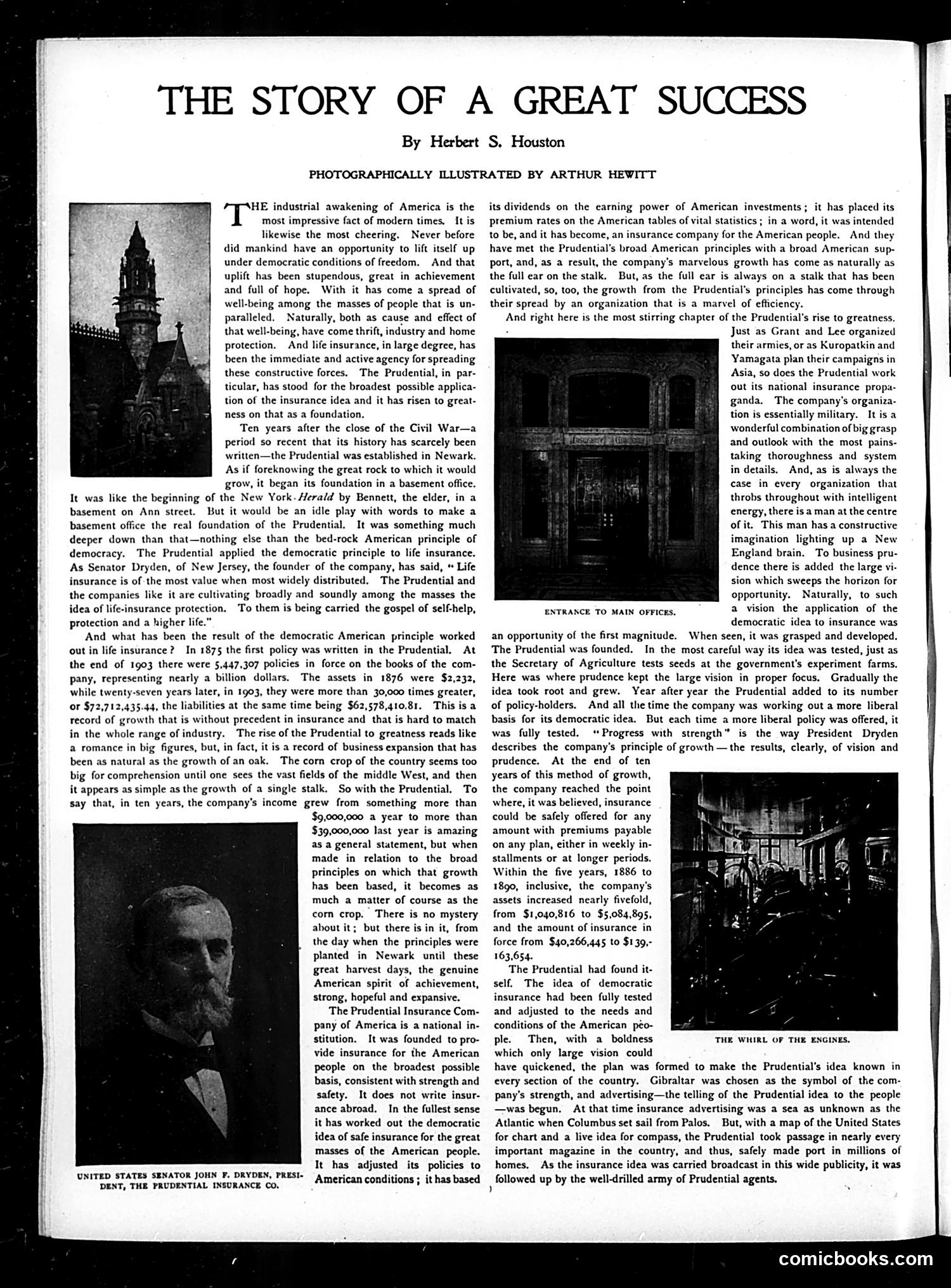
This is **not a cartoon or satire**, but rather **advertorial content** — a promotional article for the Prudential Insurance Company disguised as journalism. The piece, authored by Herbert S. Houston with photographs by Arthur Hewitt, celebrates the Prudential's founding by Senator John F. Dryden (shown in portrait) in 1875. It frames life insurance as a democratic American principle, tracing the company's remarkable growth: from basement office to $72 million in assets by 1903, with over 5.4 million policies. The accompanying photographs show the company's impressive offices and operations ("The Wheel of the Engines"), visually reinforcing the narrative of American industrial success. This represents **late-19th-century corporate propaganda** — using Judge's editorial platform to legitimate a commercial enterprise by wrapping it in patriotic rhetoric about democracy, thrift, and national progress. The approach was common in this era's business magazines.
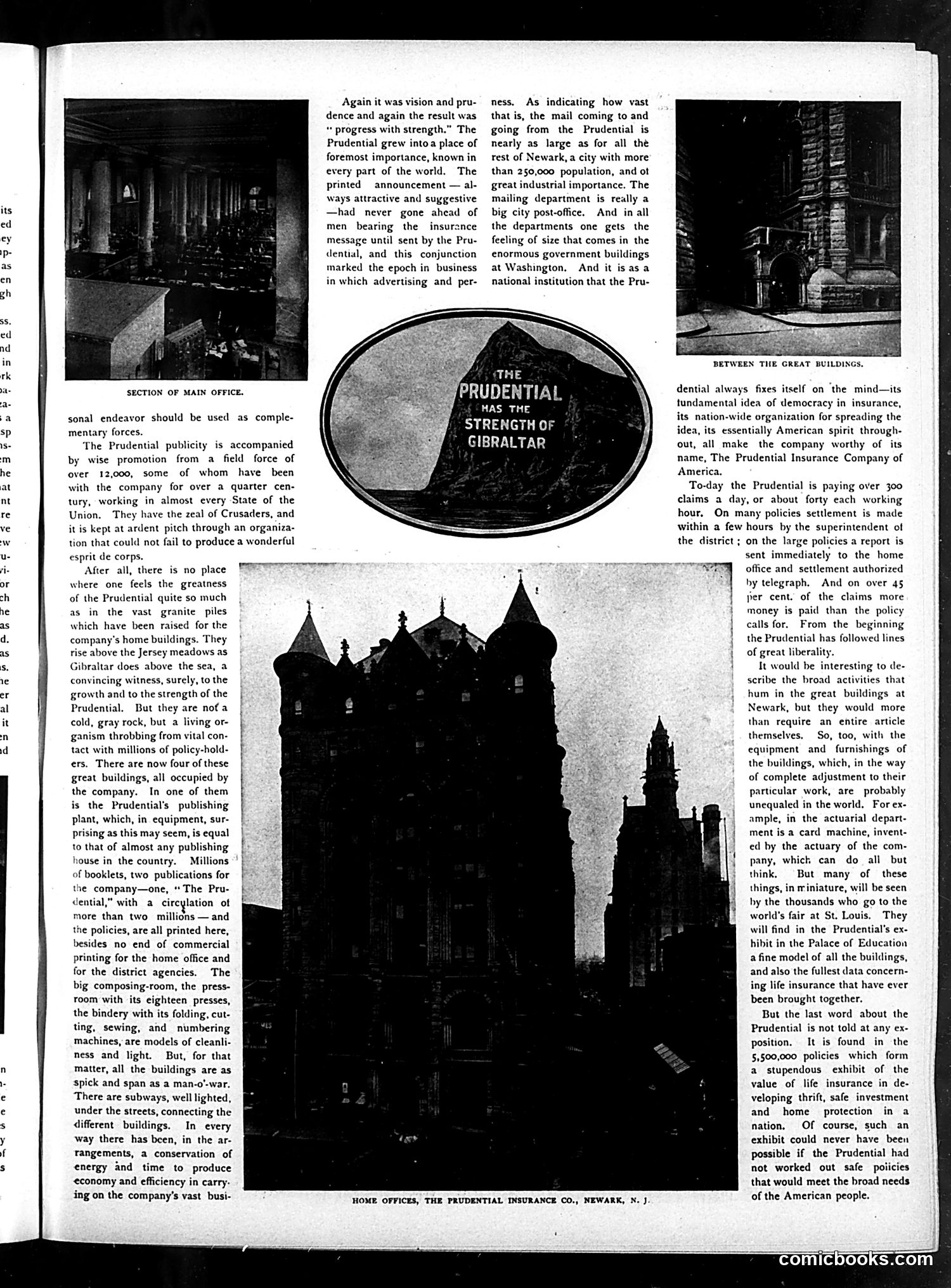
This is **not a political cartoon or satire**—it's a corporate **advertisement/promotional article** for the Prudential Insurance Company, appearing in *Judge* magazine. The page celebrates Prudential's Newark headquarters through photos and laudatory text, emphasizing the company's size, efficiency, and trustworthiness. The oval logo reading "THE PRUDENTIAL HAS THE STRENGTH OF GIBRALTAR" is the key visual, comparing the insurance giant to an impregnable fortress. The text highlights Prudential's scale: 12,000 field agents, four massive "granite" office buildings, a printing operation rivaling major publishers, and processing 300+ insurance claims daily. The phrase "living organism throbbing from vital contact with millions of policy-holders" personifies the corporation. This represents **early 20th-century corporate image-making**—using a magazine known for satire to present earnest corporate propaganda. The juxtaposition is itself somewhat ironic, though whether intentional remains unclear. The message: Prudential is rock-solid, American, democratic, and worthy of public trust.
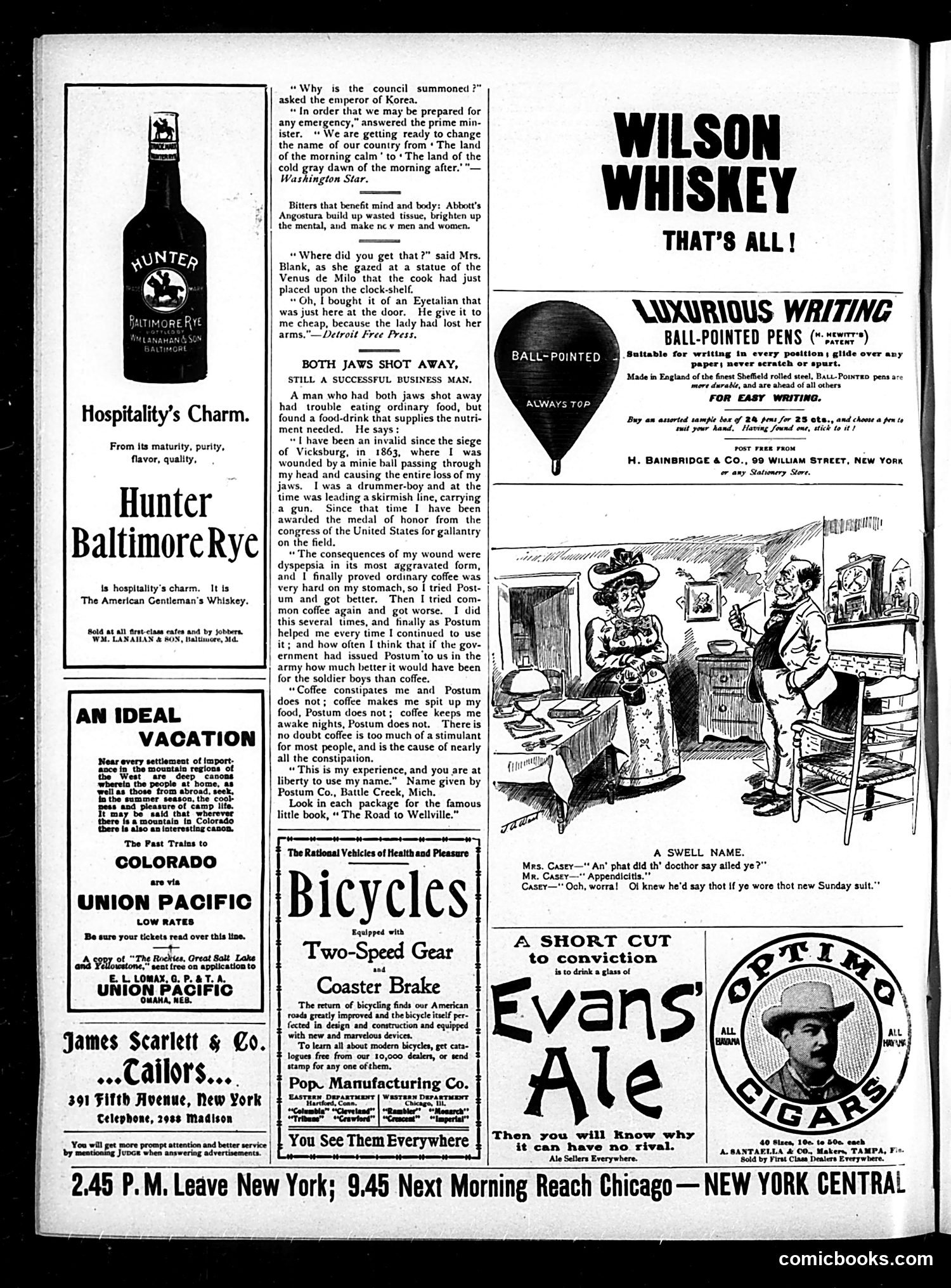
This is primarily an **advertising page** from Judge magazine, with one political joke. **The Political Content:** The single satirical piece references Korea's emperor considering renaming the country from "The land of the morning calm" to "The land of the cold gray dawn of the morning after." This mocks Korea's political instability and troubled governance around the early 1900s, when Korea faced internal crises and external pressures from imperial powers. **The Advertisements:** The page is dominated by product ads typical of the era: Hunter Baltimore Rye whiskey, Union Pacific railroad, bicycles, Postum (a coffee substitute), Evans' Ale, and Ball-Pointed pens. One ad features a humorous testimonial from a Civil War veteran (wounded at Vicksburg, 1863) praising Postum as superior to coffee for digestive health—reflecting early 20th-century patent-medicine marketing and health claims. The Venus de Milo joke references an Italian street vendor selling cheap statuary.
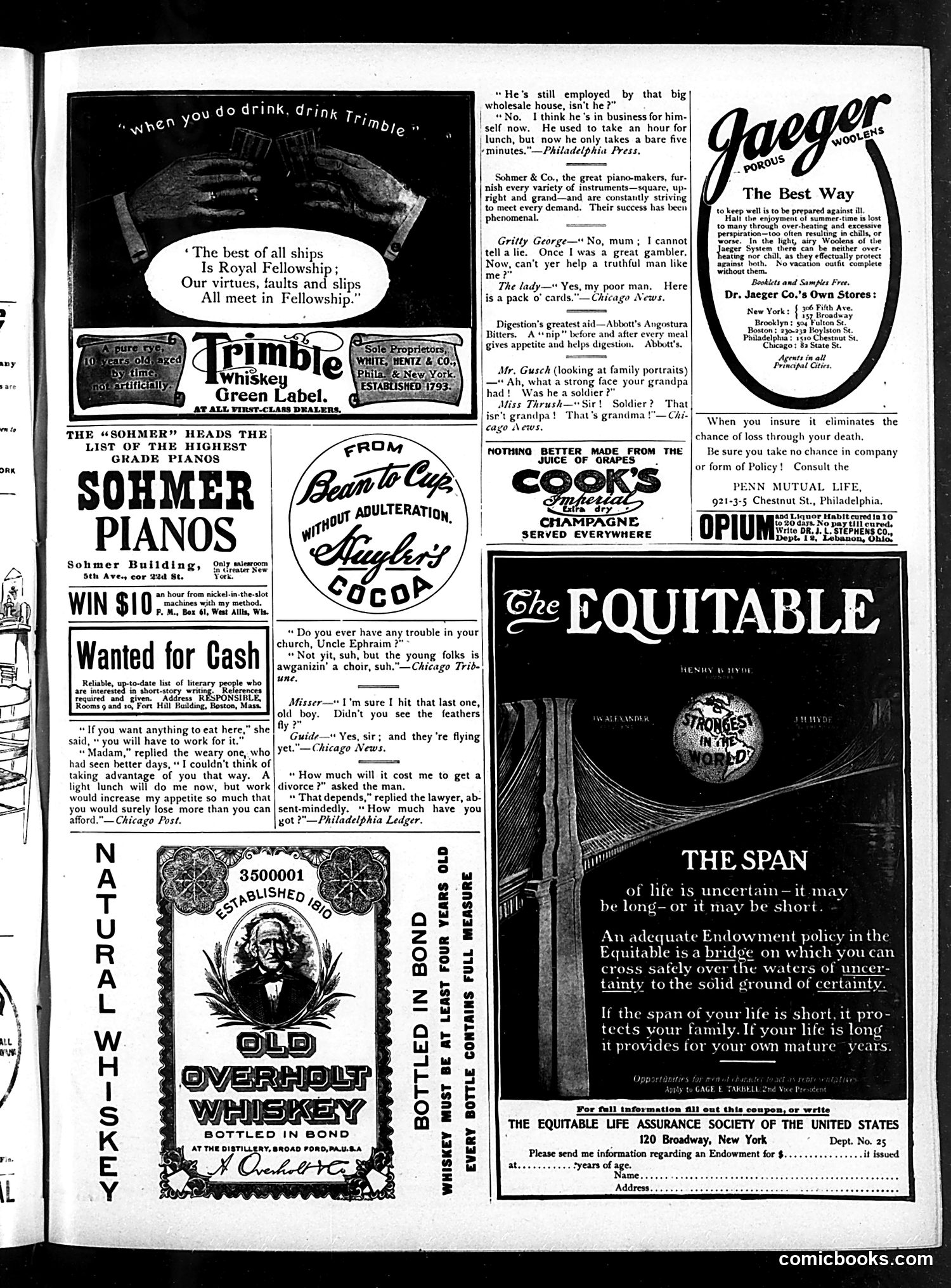
This page is primarily **advertising**, with small satirical dialogue snippets interspersed. The main content includes ads for whiskey (Trimble), pianos (Sohmer), cocoa (Huyler's), life insurance (Equitable, Penn Mutual), and other products typical of early 20th-century periodicals. The scattered comic dialogues mock contemporary social types: a formerly wealthy vagrant seeking work, a church-going Uncle Ephraim dealing with young people organizing a choir, and a divorce-seeking man. These represent mild social satire on poverty, generational conflict, and matrimonial complications—common Judge themes. The advertisements themselves reflect period concerns: life insurance (uncertain lifespans), digestive aids, and quality goods. There's no identifiable political cartoon or caricature of a specific historical figure on this page. It's a typical advertising-heavy issue rather than primarily satirical content.
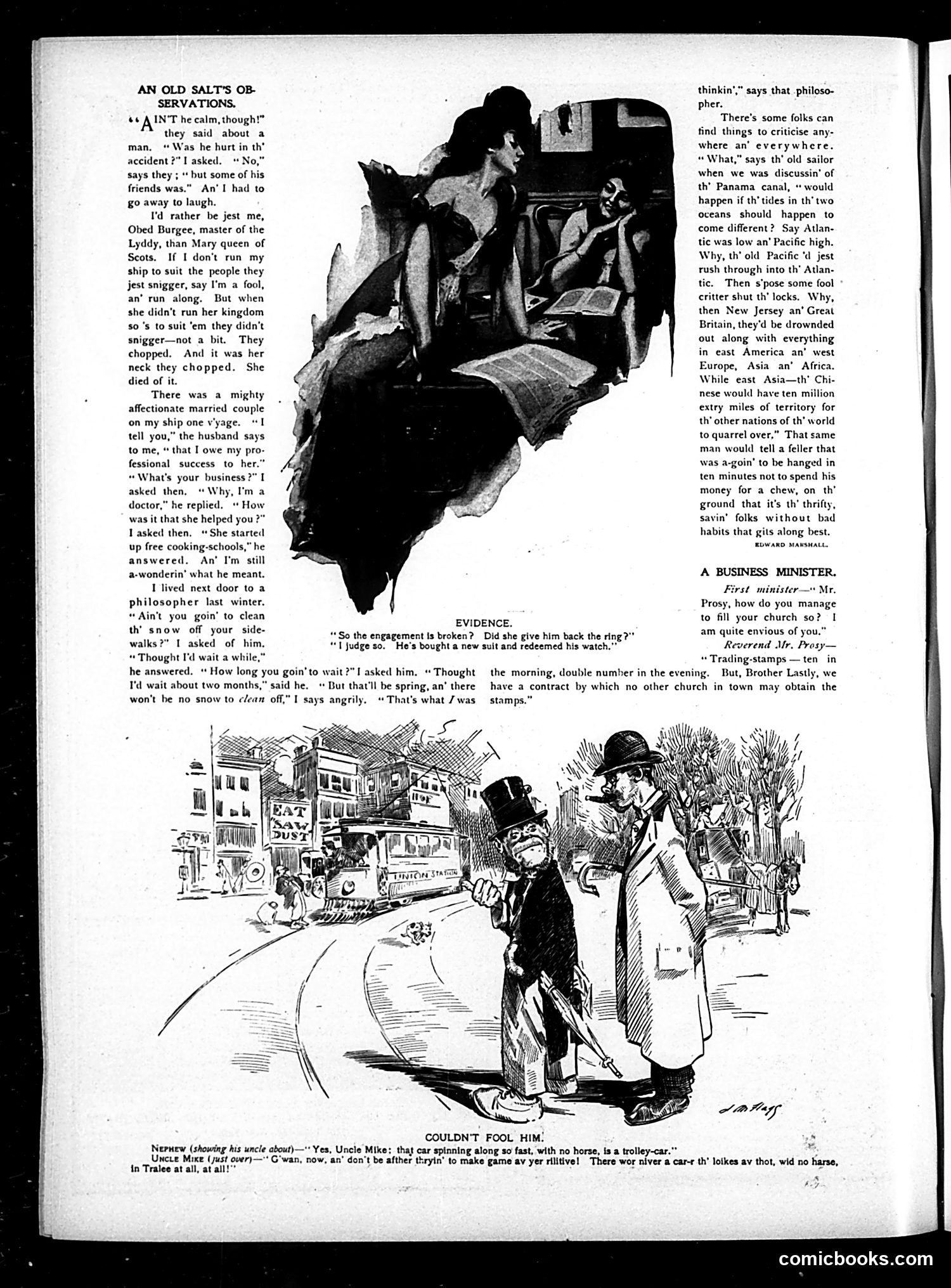
This page contains satirical sketches and anecdotes reflecting early 20th-century American humor and social commentary. **"An Old Salt's Observations"** features a ship captain (Obed Burgee) sharing witty observations about human nature—comparing his freedom to criticize him with how Mary Queen of Scots was executed for displeasing her subjects, and mocking a doctor whose wife's "free cooking-schools" supposedly created his success. **"Couldn't Fool Him"** depicts an Irish immigrant (Uncle Mike, recently arrived) being shown a trolley car. He dismisses it as impossible, insisting he never saw such a thing "in Tralee"—satirizing immigrant skepticism toward modern American technology. **"A Business Minister"** jokes that a reverend fills his church using "trading-stamps" (promotional vouchers)—mocking commercialization of religion. The cartoons ridicule old-world thinking, immigrant unfamiliarity with modern inventions, and materialism creeping into institutions. The Irish dialect ("G'wan," "wid no harse") reflects period stereotyping common in Judge's humor.
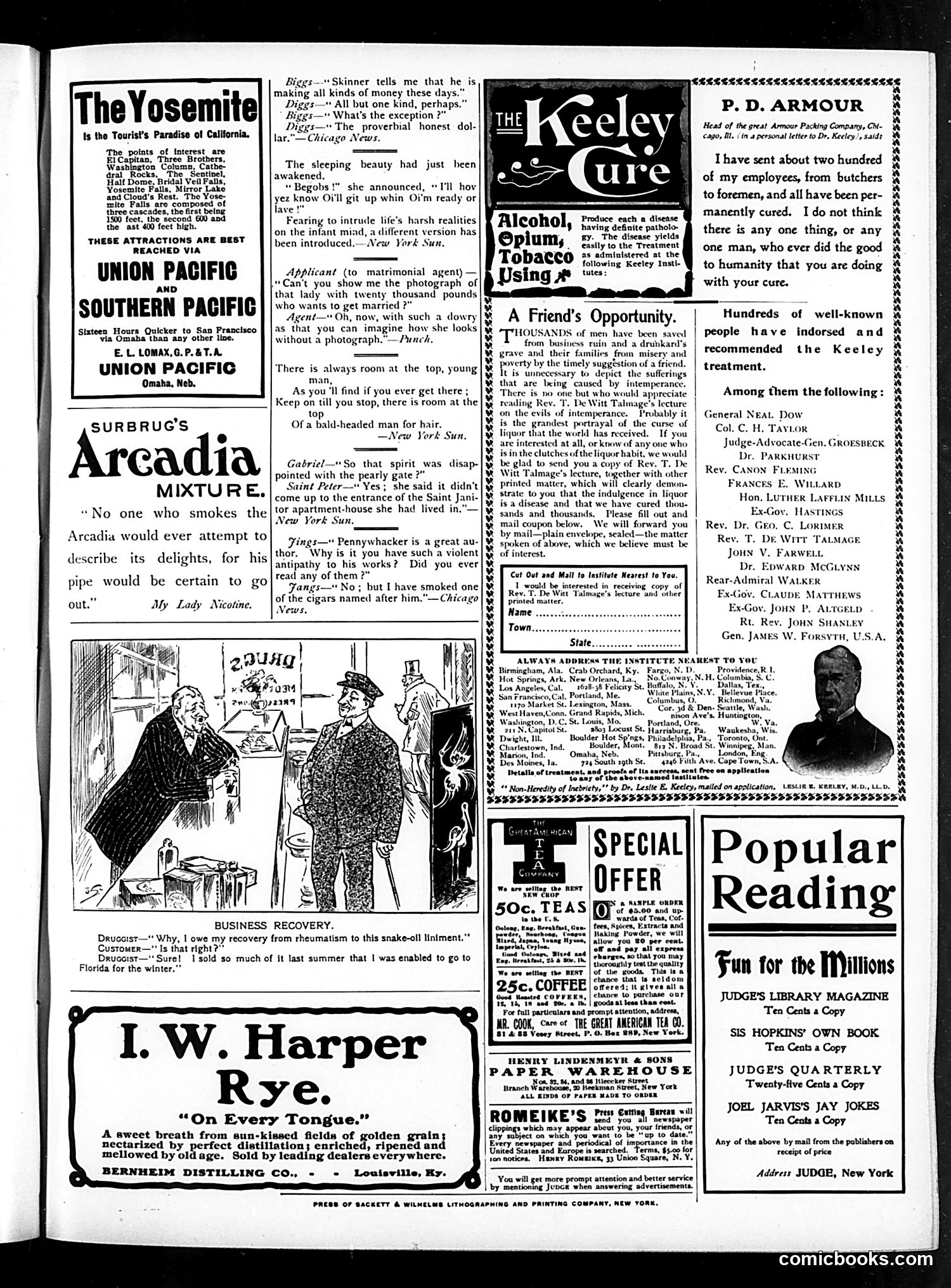
This page is primarily advertising, with several joke items interspersed. The main illustrated cartoon shows "Business Recovery": a druggist and customer discuss how the druggist sold so much "snake-oil liniment" last summer that he could afford a winter vacation in Florida. The satire targets quack medical remedies and the gullibility of buyers—the druggist profited handsomely from selling fraudulent treatments, implying both the product's ineffectiveness and the absurdity of the customer believing it cured his rheumatism. Other short jokes include commentary on dishonest money-making and marital prospects. The page otherwise features advertisements for railroad travel (Union Pacific), tobacco (Arcadia Mixture), whiskey (I.W. Harper Rye), and notably the Keeley Institute, a treatment center for alcohol and drug addiction that claims endorsement from Rev. T. De Witt Talmage. The page reflects Progressive-era concerns about addiction, quackery, and social reform movements.
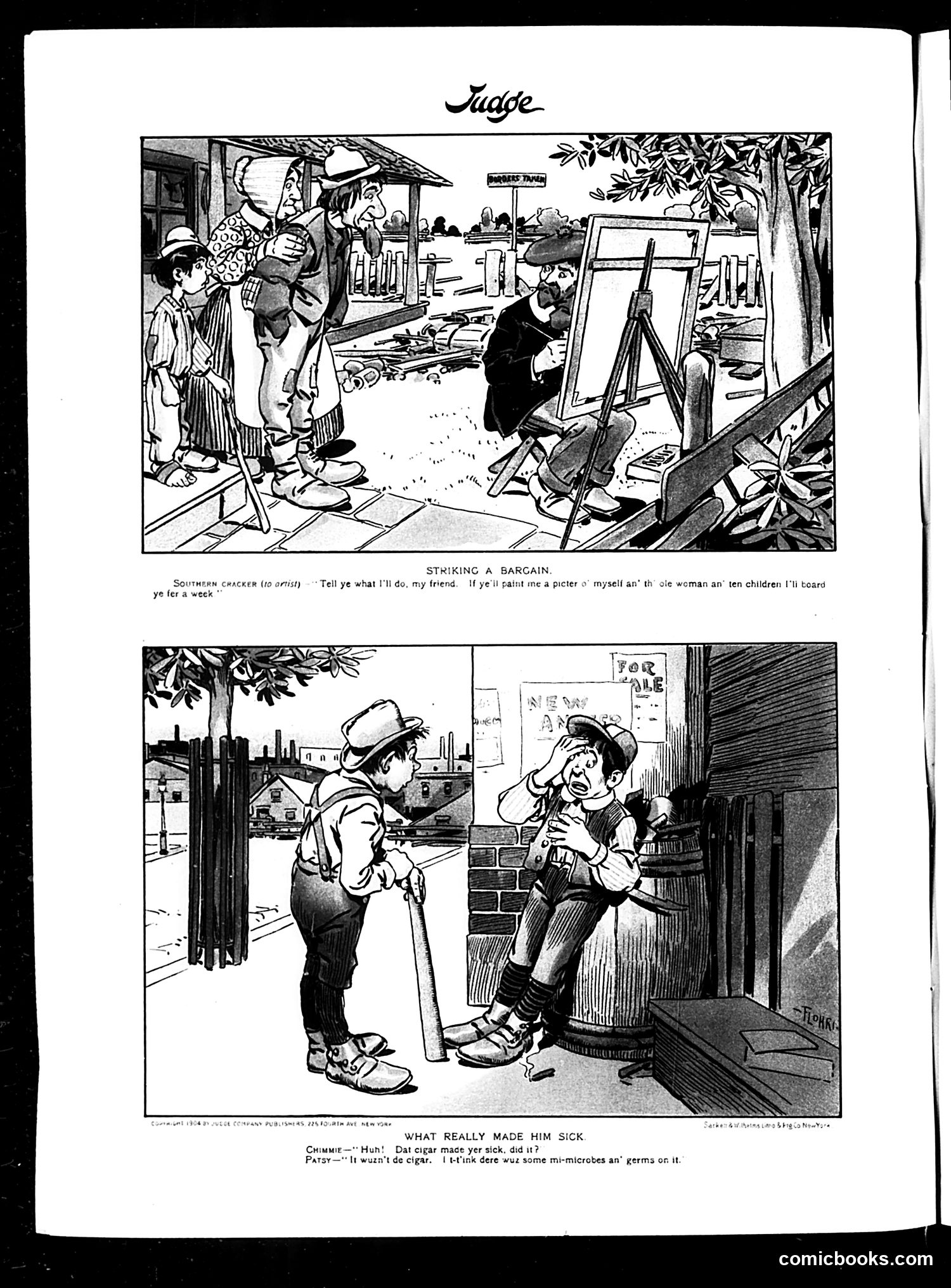
This page contains two satirical cartoons about class and social pretension. **Top cartoon ("Striking a Bargain"):** A Southern cracker (rural poor white man) approaches an artist at work, proposing a deal: if the artist paints his portrait with his wife and ten children, he'll loan the artist money for a week. The satire mocks both the man's assumption that portrait-painting is a quick transaction and his inflated sense of his own importance—thinking his family is worth significant artistic effort. **Bottom cartoon ("What Really Made Him Sick"):** Two boys discuss illness. One claims a cigar made him sick; the other suggests it wasn't the cigar itself but "mi-crobes an' germs on it," implying the cigar's poor quality or unsanitary condition. This satirizes contemporary anxiety about germs and hygiene while poking fun at working-class attempts to appear health-conscious. Both cartoons use dialect and working-class characters for comedic effect typical of early 20th-century American humor.