
Judge, 1904-06-04 · page 10 of 16
Judge — June 4, 1904 — page 10: what you’re looking at
What you’re looking at
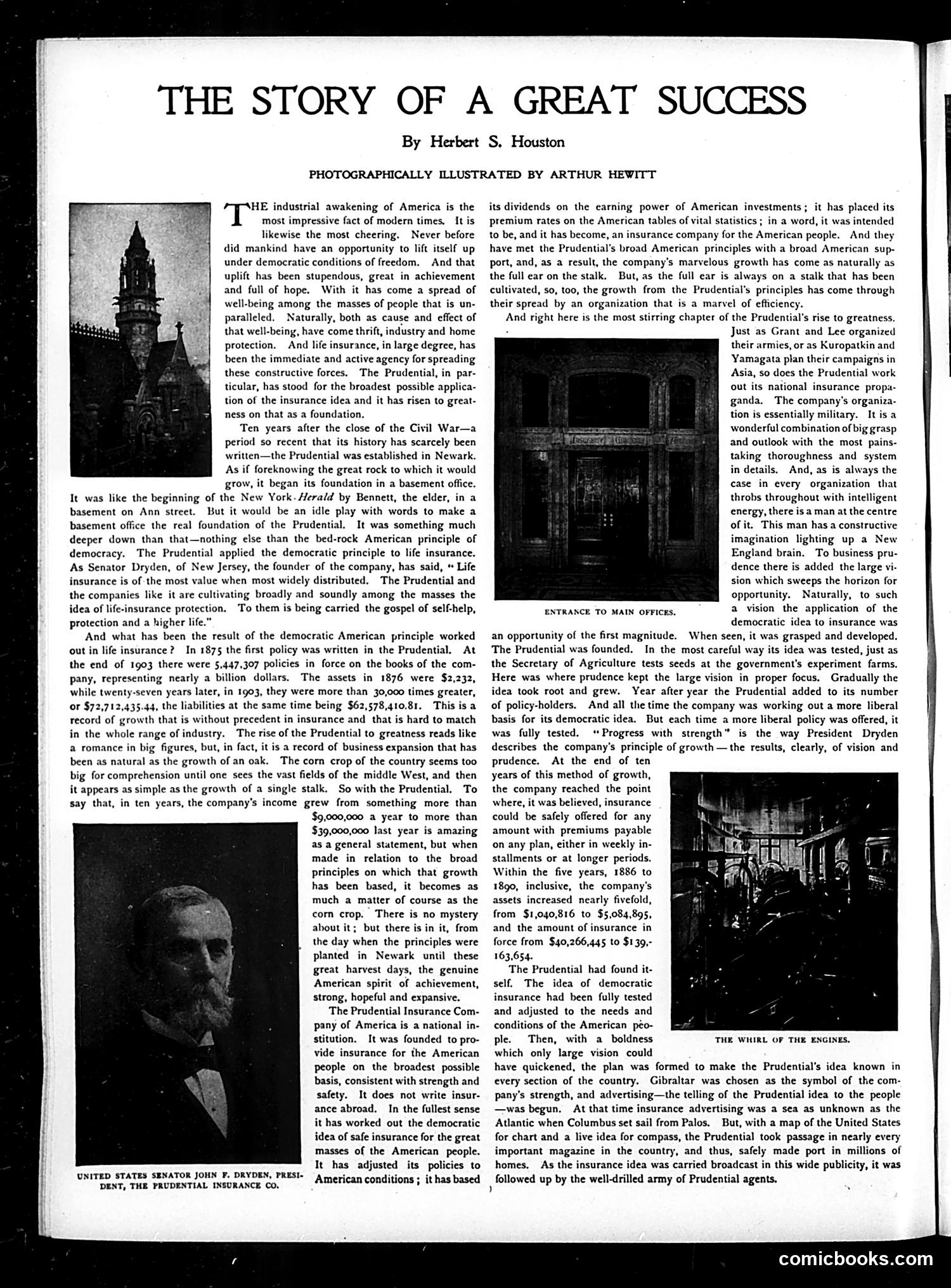
This is **not a cartoon or satire**, but rather **advertorial content** — a promotional article for the Prudential Insurance Company disguised as journalism. The piece, authored by Herbert S. Houston with photographs by Arthur Hewitt, celebrates the Prudential's founding by Senator John F. Dryden (shown in portrait) in 1875. It frames life insurance as a democratic American principle, tracing the company's remarkable growth: from basement office to $72 million in assets by 1903, with over 5.4 million policies. The accompanying photographs show the company's impressive offices and operations ("The Wheel of the Engines"), visually reinforcing the narrative of American industrial success. This represents **late-19th-century corporate propaganda** — using Judge's editorial platform to legitimate a commercial enterprise by wrapping it in patriotic rhetoric about democracy, thrift, and national progress. The approach was common in this era's business magazines.
📄 Transcribed text from this page (OCR, searchable)
Machine-transcribed from the original scan — historical spelling and the odd misread are preserved.
THE STORY OF A GREAT SUCCESS By Herbert S. Houston PHOTOGRAPHICALLY ILLUSTRATED BY ARTHUR HEWITT HE industrial awakening of America is the most impressive fact of modern times. It is likewise the most cheering. Never before did mankind have an opportunity to lift itself up under democratic conditions of freedom. And that uplift has been stupendous, great in achievement and full of hope. With it has come a spread of well-being among the masses of people that is un- paralleled. Naturally, both as cause and effect of that well-being, have come thrift, industry and home protection. And life insurance, in large degree, has been the immediate and active agency for spreading these constructive forces. The Prudential, in par- ticular, has stood for the broadest possible applica- tion of the insurance idea and it has risen to great- ness on that as a foundation. Ten years after the close of the Civil War—a period so recent that its history has scarcely been written—the Prudential was established in Newark. As if foreknowing the great rock to which it would grow, it began its foundation in a basement office. It was like the beginning of the New York. Herald by Bennett, the elder, in a basement on Ann street. But it would be an idle play with words to make a basement office the real foundation of the Prudential. It was something much deeper down than that—nothing else than the bed-rock American principle of democracy. The Prudential applied the democratic principle to life insurance. As Senator Dryden, of New Jersey, the founder of the company, has said, “ Life insurance is of the most value when most widely distributed. The Prudential and the companies like it are cultivating broadly and soundly among the masses the idea of life-insurance protection. To them is being carried the gospel of self-help, protection and a higher life.” And what has been the result of the democratic American principle worked out in life insurance? In 1875 the first policy was written in the Prudential. At the end of 1903 there were 5,447,307 policies in force on the books of the com- pany, representing nearly a billion dollars. The assets in 1876 were $2,232, while twenty-seven years later, in 1903, they were more than 30,000 times greater, or $72,712,435.44, the liabilities at the same time being $62,578,410.81. This is a record of growth that is without precedent in insurance and that is hard to match in the whole range of industry. The rise of the Prudential to greatness reads like a romance in big figures, but, in fact, it is a record of business expansion that has been as natural as the growth of an oak. The corn crop of the country seems too big for comprehension until one sees the vast fields of the middle West, and then it appears as simple as the growth of a single stalk. So with the Prudential. To say that, in ten years, the company’s income grew from something more than $9,000,000 a year to more than $39,000,000 last year is amazing as a general statement, but when made in relation to the broad principles on which that growth has been based, it becomes as much a matter of course as the corn crop. There is no mystery about it; but there is in it, from the day when the principles were planted in Newark until these great harvest days, the genuine American spirit of achievement, strong, hopeful and expansive. The Prudential Insurance Com- pany of America is a national in- stitution. It was founded to pro- vide insurance for the American people on the broadest possible basis, consistent with strength and safety. It does not write insur- ance abroad. In the fullest sense it has worked out the democratic idea of safe insurance for the great masses of the American people. It has adjusted its policies to UNITED STATES SENATOR JOHN F. DRYDEN, PRESI- A merican conditions ; it has based DENT, THE PRUDENTIAL INSURANCE CO, its dividends on the earning power of American investments; it has placed its premium rates on the American tables of vital statistics ; in a word, it was intended to be, and it has become, an insurance company for the American people. And they have met the Prudential’s broad American principles with a broad American sup- port, and, as a result, the company's marvelous growth has come as naturally as the full ear on the stalk. But, as the full ear is always on a stalk that has been cultivated, so, too, the growth from the Prudential’s principles has come through their spread by an organization that is a marvel of efficiency. And right here is the most stirring chapter of the Prudential’s rise to greatness. : Just as Grant and Lee organized their armies, or as Kuropatkin and Yamagata plan their campaigns in Asia, so does the Prudential work out its national insurance propa ganda, The company's organiza- tion is essentially military. It is a wonderful combination of big grasp and outlook with the most pains- taking thoroughness and system in details. And, as is always the case in every organization that throbs throughout with intelligent energy, there is a man at the centre of it. This man has a constructive imagination lighting up a New England brain. To business pru- dence there is added the large vi- sion which sweeps the horizon for opportunity. Naturally, to such a vision the application of the democratic idea to insurance was an opportunity of the first magnitude. When seen, it was grasped and developed. ‘The Prudential was founded. In the most careful way its idea was tested, just as the Secretary of Agriculture tests seeds at the government's experiment farms. Here was where prudence kept the large vision in proper focus, Gradually the idea took root and grew. Year after year the Prudential added to its number of policy-holders. And all the time the company was working out a more liberal basis for its democratic idea. But each time a more liberal policy was offered, it was fully tested. “Progress with strength” is the way President Dryden describes the company's principle of growth —the results, clearly, of vision and prudence. At the end of ten years of this method of growth, the company reached the point where, it was believed, insurance could be safely offered for any amount with premiums payable on any plan, either in weekly in- stallments or at longer periods. Within the five years, 1886 to 1890, inclusive, the company’s assets increased nearly fivefold, from $1,040,816 to $5,084,895, and the amount of insurance in force from $40,266,445 to $139,- 163,654. The Prudential had found it- self. The idea of democratic insurance had been fully tested and adjusted to the needs and conditions of the American péo- ple. Then, with a boldness which only large vision could have quickened, the plan was formed to make the Prudential’s idea known in every section of the country. Gibraltar was chosen as the symbol of the com- pany’s strength, and advertising—the telling of the Prudential idea to the people —was begun. At that time insurance advertising was a sea as unknown as the Atlantic when Columbus set sail from Palos. But, with a map of the United States for chart and a live idea for compass, the Prudential took passage in nearly every important magazine in the country, and thus, safely made port in millions of homes. As the insurance idea was carried broadcast in this wide publicity, it was ENTRANCE TO MAIN OFFICES. THE WHIRL OF THE EN followed up by the well-drilled army of Prudential agents. ) comicbooks.com