
A complete issue · 16 pages · 1904
Judge — March 19, 1904
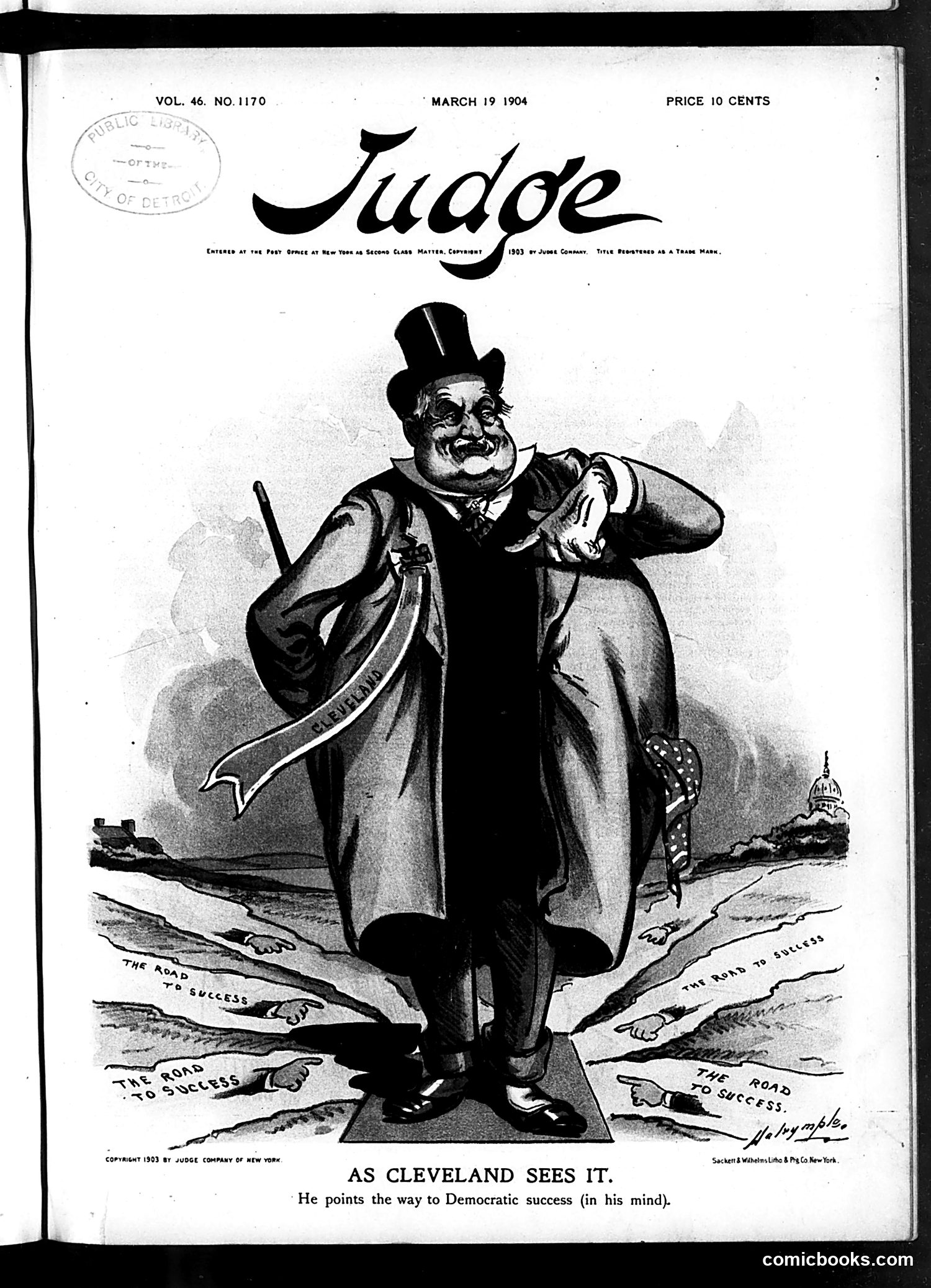
This 1904 *Judge* magazine cover satirizes President Grover Cleveland's vision of Democratic electoral success. The caricatured figure (identified by the caption as Cleveland) stands at a crossroads labeled "The Road to Success," pointing confidently in multiple directions simultaneously—a visual joke about the contradiction in his political strategy. The satire suggests Cleveland's confused or contradictory approach to achieving Democratic victory. By pointing down several different paths at once, the cartoon mocks the idea that he has a clear, unified plan. The caption's parenthetical "(in his mind)" reinforces this: Cleveland imagines success, but his strategy lacks coherence. This reflects real 1904 political divisions within the Democratic Party regarding policy direction and electoral strategy.
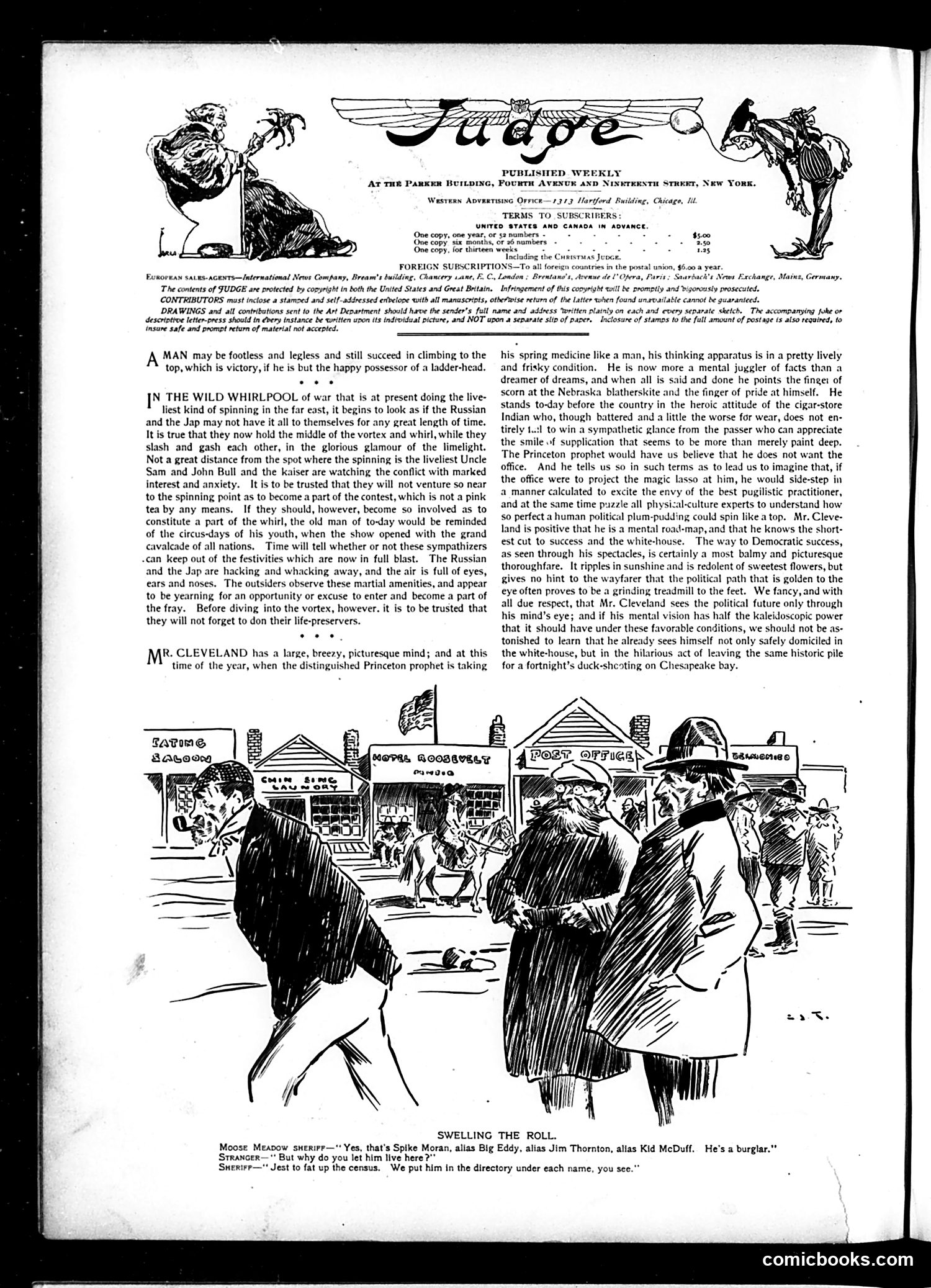
This page contains three distinct sections: **Top Editorial Content**: Two opinion pieces discuss political figures. The first critiques someone with a "ladder-head" (foolish) who nonetheless succeeded through climbing. The second discusses Mr. Cleveland, describing his "large, very picturesque mind" and his current status as a "Princeton prophet," making sardonic observations about his political future and mental capacities. **Bottom Cartoon ("Swelling the Roll")**: A street scene shows two figures discussing a man with multiple aliases—"Big Eddy," "Jim Thornton," "Kid McDuff"—identified as a burglar. The joke plays on "swelling the roll" (expanding a census/directory) by noting this criminal is listed multiple times under different names, thereby artificially inflating official records. The overall tone is satirical commentary on politics and urban crime.
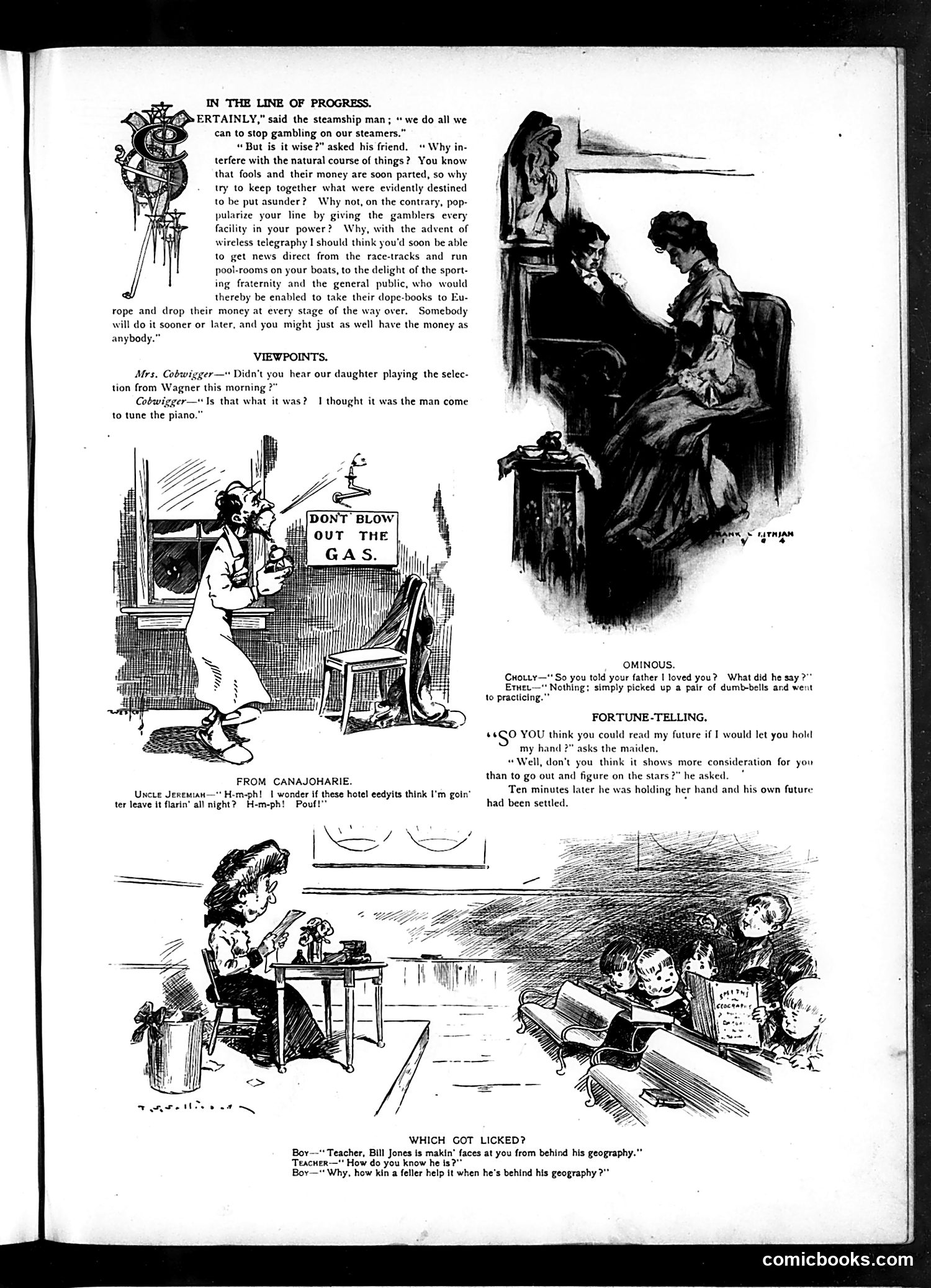
This page contains several unrelated humorous sketches typical of Judge magazine's satirical format: **"In the Line of Progress"** depicts a steamship captain arguing that gambling should be allowed on ships, claiming it's natural and inevitable—satirizing technological progress being used to justify morally questionable practices. **"Viewpoints"** shows a domestic misunderstanding about Wagner music versus a piano tuner. **"Canajohharie"** features Uncle Jeremiah making a joke about hotel edicts and flirting. **"Fortune-Telling"** satirizes romantic couples consulting fortune-tellers, with the punchline about holding hands settling their future together. **"Which Got Licked?"** is a schoolroom joke about a student making faces at the teacher from behind geography books. The page is primarily humor-focused rather than politically charged, reflecting Judge's blend of domestic comedy, social observation, and light satire.
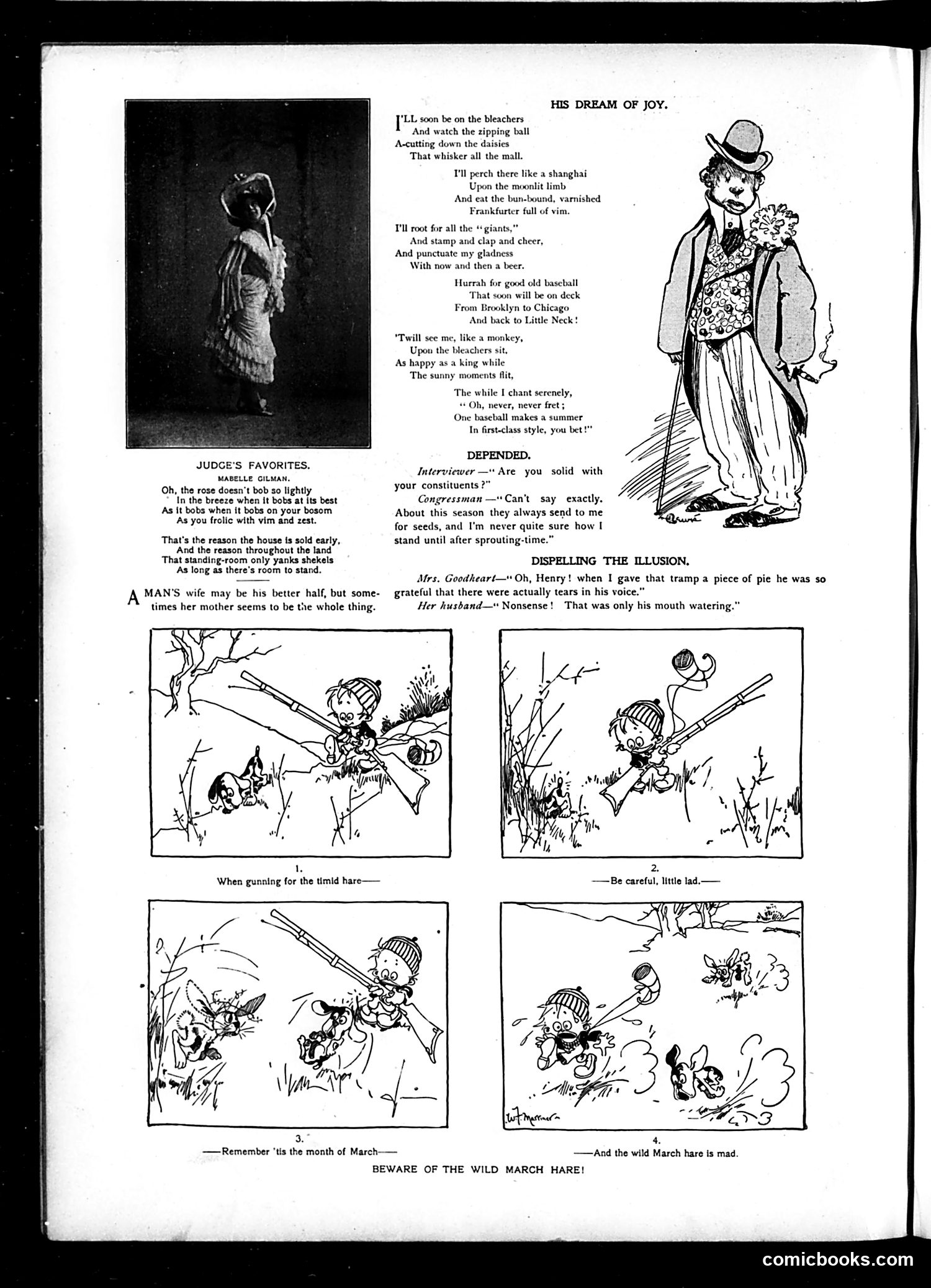
This page contains three distinct pieces of humor content from *Judge* magazine: 1. **"Judge's Favorites"** — A poem by Isabelle Gilman praising roses, comparing their beauty to "frolic with vim and zest." 2. **"His Dream of Joy"** — A cartoon figure (appearing to be a working-class man) fantasizing about attending baseball games, drinking beer, and watching teams play from Brooklyn to Chicago—reflecting early 20th-century urban leisure culture. 3. **"Beware of the Wild March Hare"** — A four-panel comic strip showing a child hunter pursuing rabbits with a gun. The humor plays on the phrase "mad as a March hare" (spring mating season makes hares erratic), with escalating chaos as the child chases increasingly aggressive rabbits. The content reflects period humor about baseball fandom, drinking culture, and anthropomorphic animal comedy—typical *Judge* magazine satire of its era.
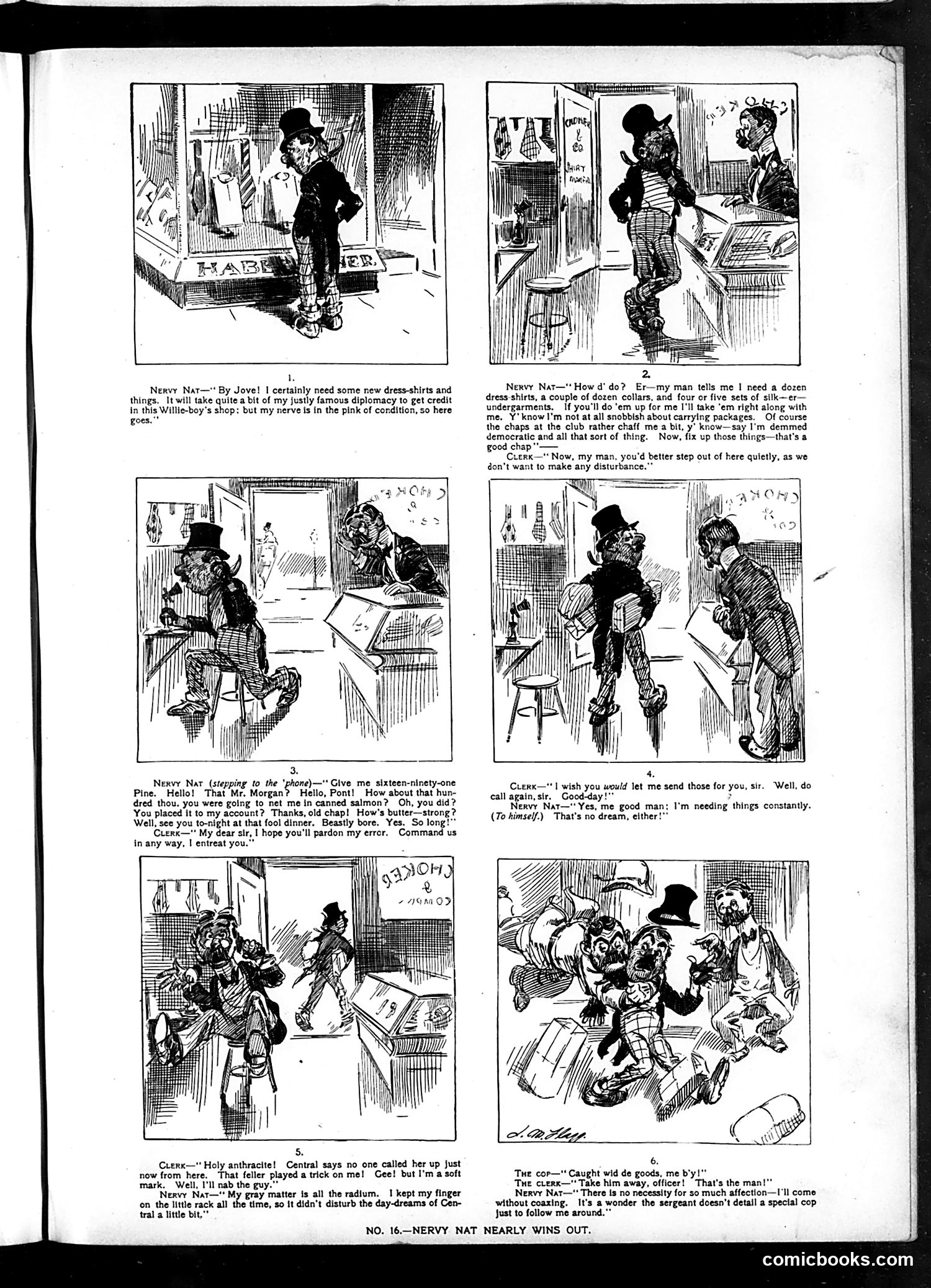
This Judge comic satirizes a confident con artist who uses charm and bluffing to obtain goods without payment. "Nervy Nat" enters a shop claiming he needs clothing, confident his "diplomacy" will secure credit. When the clerk grows suspicious, Nat performs an elaborate phone trick—pretending to call J.P. Morgan (the famous banker) about a financial transaction while secretly keeping the phone disconnected, fooling the clerk into believing he's wealthy. The satire targets both Nat's audacious social climbing and the clerk's gullibility. Nat's references to the "club" and casual name-dropping mock aspirational con men of the era. The final panels reveal the scheme's inevitable collapse when caught with unpaid goods. The humor derives from the absurdity of using mere nerve and pretense to circumvent honest commerce—a commentary on Gilded Age social mobility and class deception.
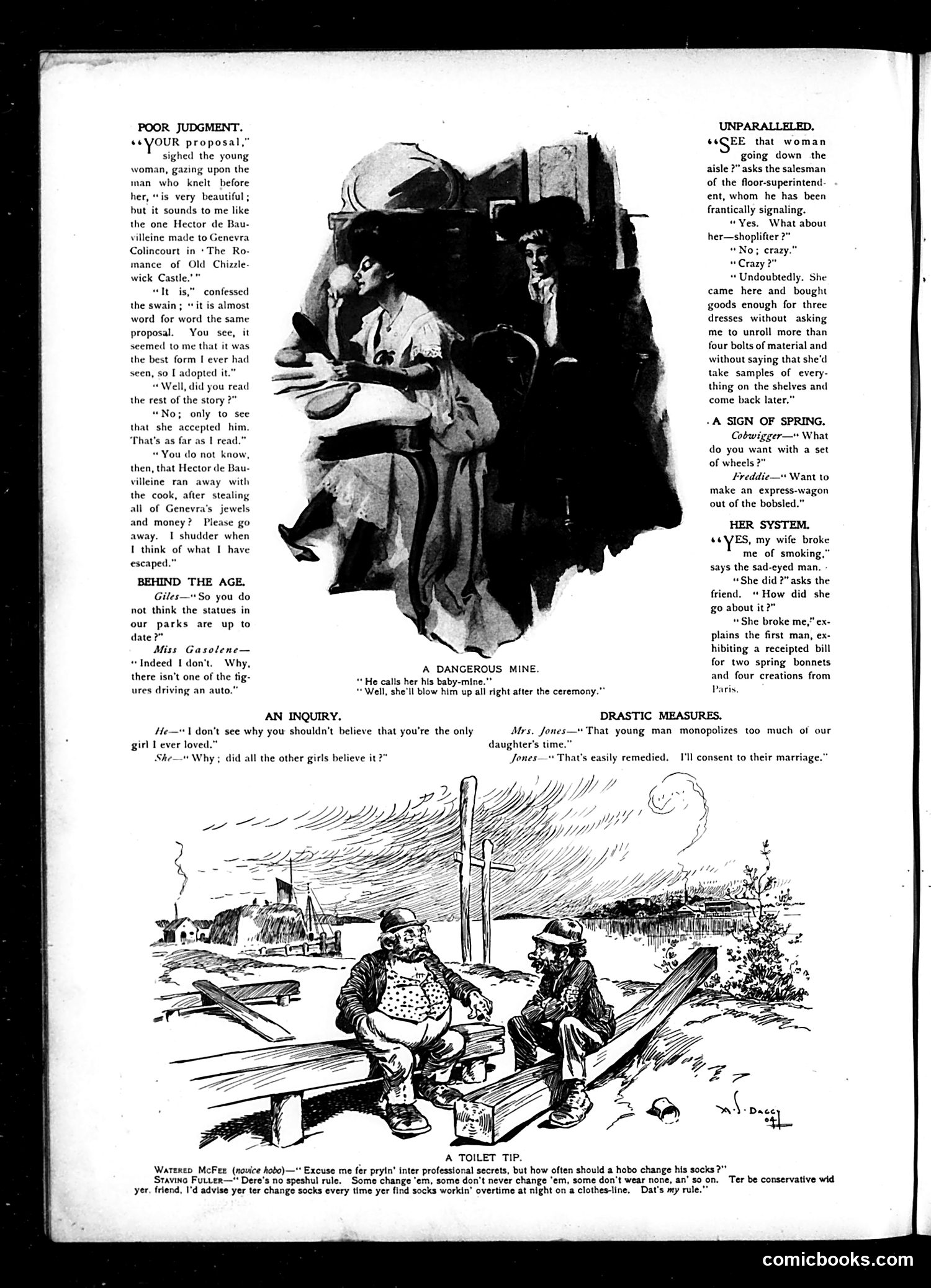
This page contains multiple brief satirical humor pieces typical of early-20th-century Judge magazine: **"Poor Judgment"** mocks a young woman who accepts a marriage proposal copied word-for-word from a romantic novel, unaware the literary character it's based on ends disastrously (the man elopes with the cook and steals the woman's jewels). **"Behind the Age"** jokes that modern women want automobile-driving statues in parks rather than traditional sculptures. **"An Inquiry"** presents a cynical exchange suggesting the man's claim to love only her contradicts other women believing the same lie. **"A Dangerous Mine"** uses "baby-mine" (a term of endearment) as dark wordplay—the woman will literally explode after the wedding ceremony. The remaining pieces ("Unparalleled," "A Sign of Spring," "Her System," "Drastic Measures," "A Toilet Tip") are quick gags about shoplifting, children's toys, wives breaking husbands' habits through expense, forcing daughters into marriage, and hobo hygiene. The humor relies on period stereotypes and cynical takes on courtship, marriage, and consumer culture.
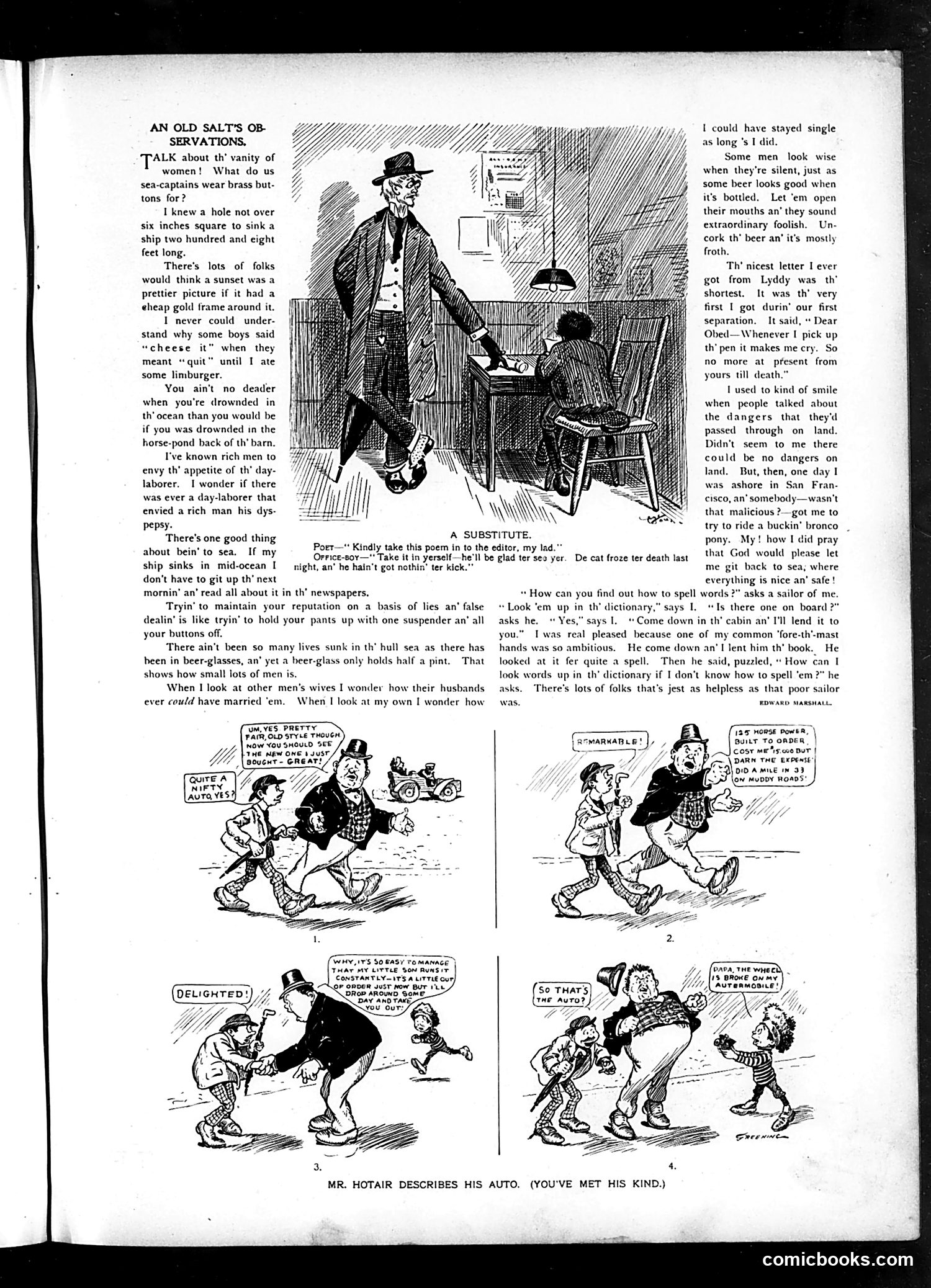
This page from *Judge* magazine contains two distinct pieces: **"An Old Salt's Observations"** is a humorous essay by Edward Marshall featuring a sea captain dispensing folksy wisdom about vanity, reputation, marriage, and life's ironies. The observations mix genuine nautical insight with commentary on human nature—notably, how small choices (like maintaining false reputations) eventually fail, much like a ship with a tiny hull breach. **"Mr. Hotair Describes His Auto"** is a four-panel comic strip satirizing early automobile owners who boast excessively about their vehicles. The humor derives from the gap between the enthusiastic descriptions ("nifty," "great") and the reality: a comical-looking car that breaks down or malfunctions. This mocks the nouveau-riche bragging about new automotive technology—a timely subject when automobiles were still novel and status symbols. Both pieces target pretension and vanity through plainspoken characters. The cartoonist's style is typical of early 20th-century American humor: exaggerated caricatures and slapstick situations emphasizing foolishness.
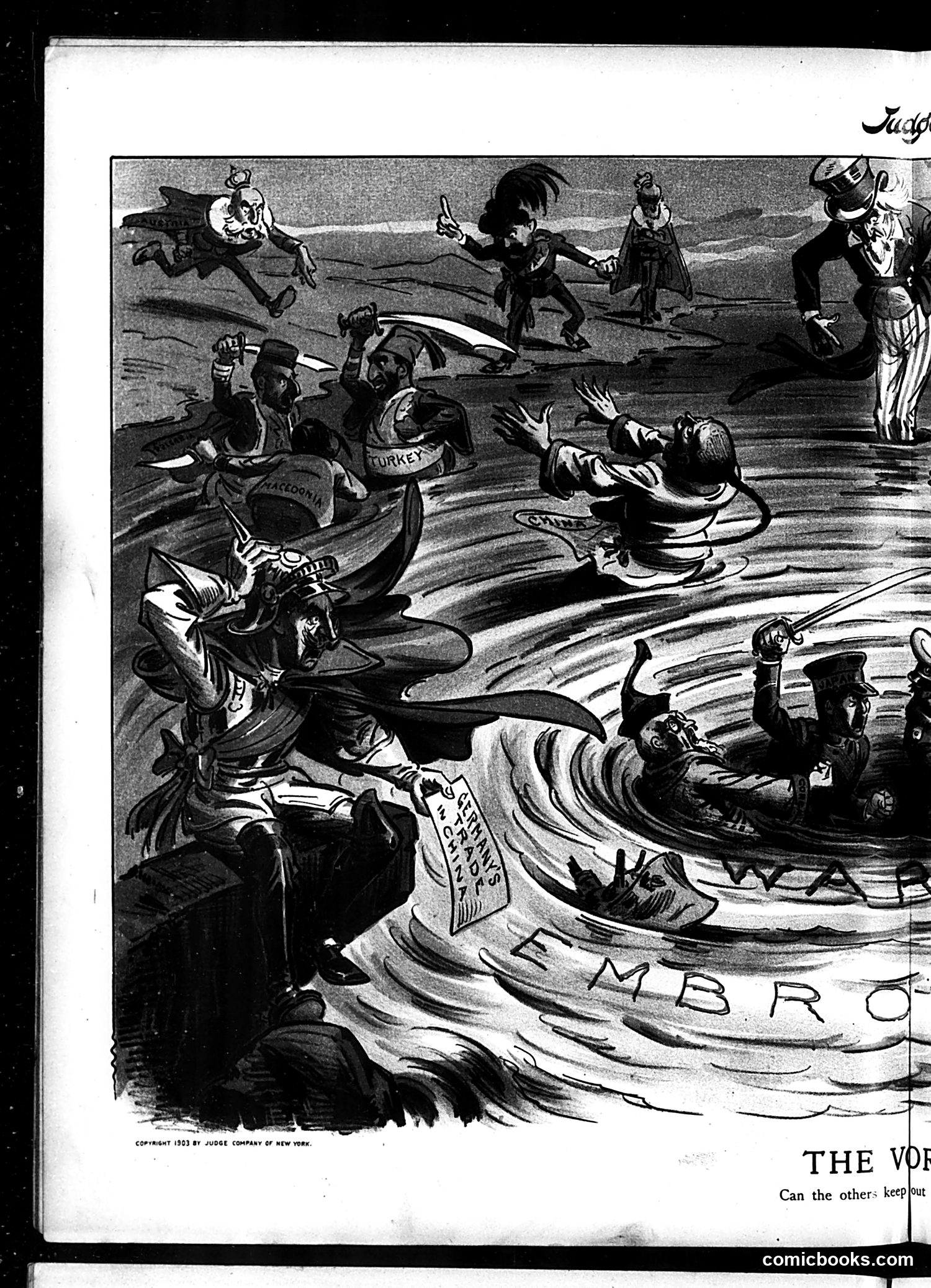
This appears to be a satirical cartoon from *Judge* magazine depicting a chaotic scene in what looks like a legislative or political body of water—possibly Congress or a similar deliberative body represented metaphorically as a boat or stream. Multiple figures labeled with what appear to be country names (visible: "TURKEY," "MACARONI") are shown in disarray, some falling or struggling. The scene suggests political turmoil or international conflict, likely referencing early 20th-century diplomatic crises. The caption "Can the others keep [out]" (text appears cut off) implies commentary on whether other nations can maintain neutrality or control during some international crisis. Without the complete caption and publication date visible, the specific historical reference remains unclear, though the style and presentation suggest pre-WWI international tensions.
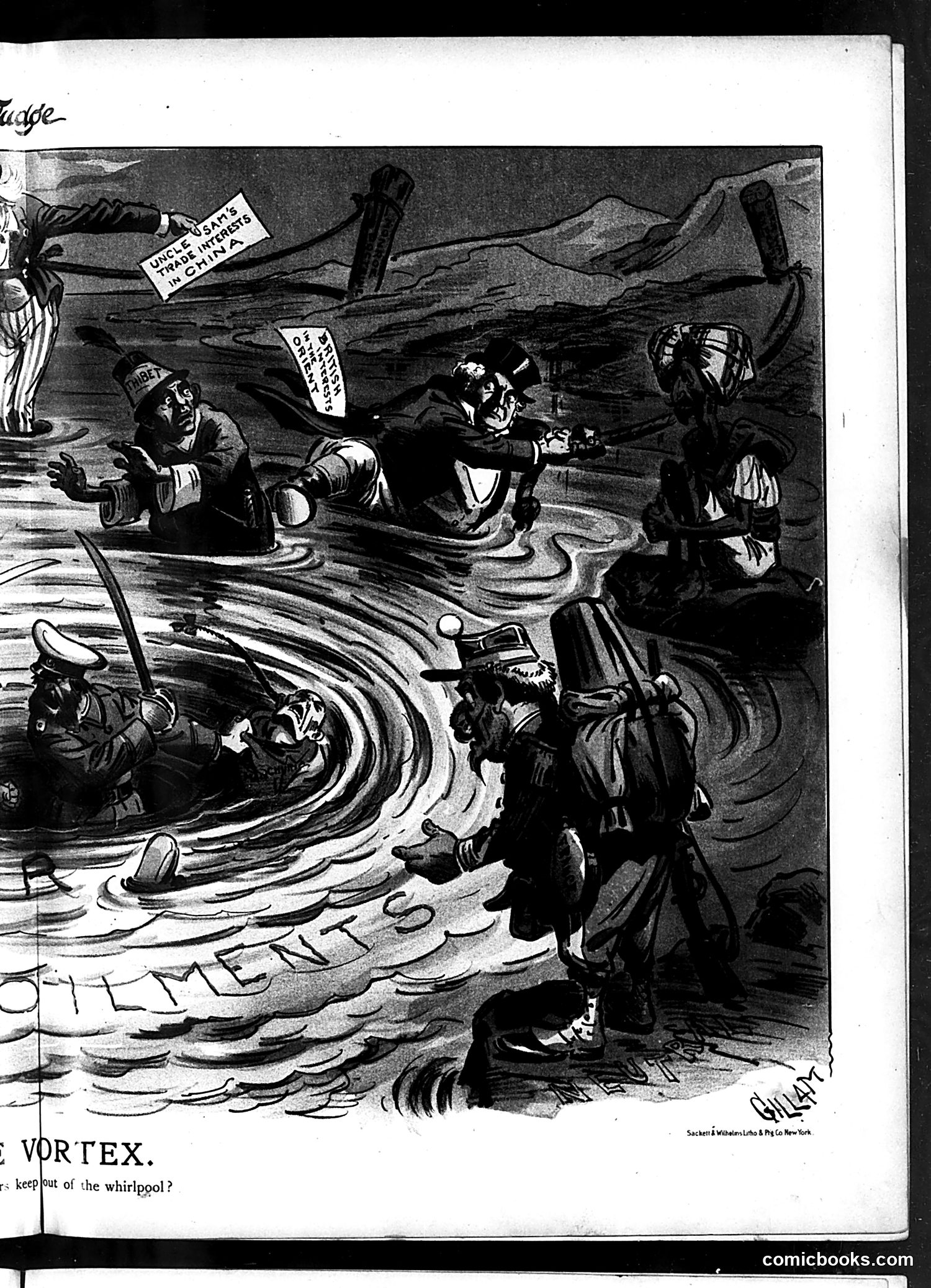
This appears to be a satirical cartoon titled "The Vortex" depicting several figures caught in swirling water or a whirlpool. The caricatured men in formal dress and hats seem to represent political or business figures struggling against a chaotic force, suggesting they're caught in some kind of scandal, economic crisis, or political upheaval. One visible label references "UNITED STATES TRADE INTERESTS IN CHINA," indicating this cartoon comments on American foreign policy or economic competition regarding China—likely from the late 19th or early 20th century when such issues were prominent. The swirling vortex metaphor suggests these figures are being pulled into an inescapable, dangerous situation beyond their control. The specific identities of individual figures remain unclear from the visible text, but the cartoon clearly mocks powerful men's helplessness against larger political or economic forces.
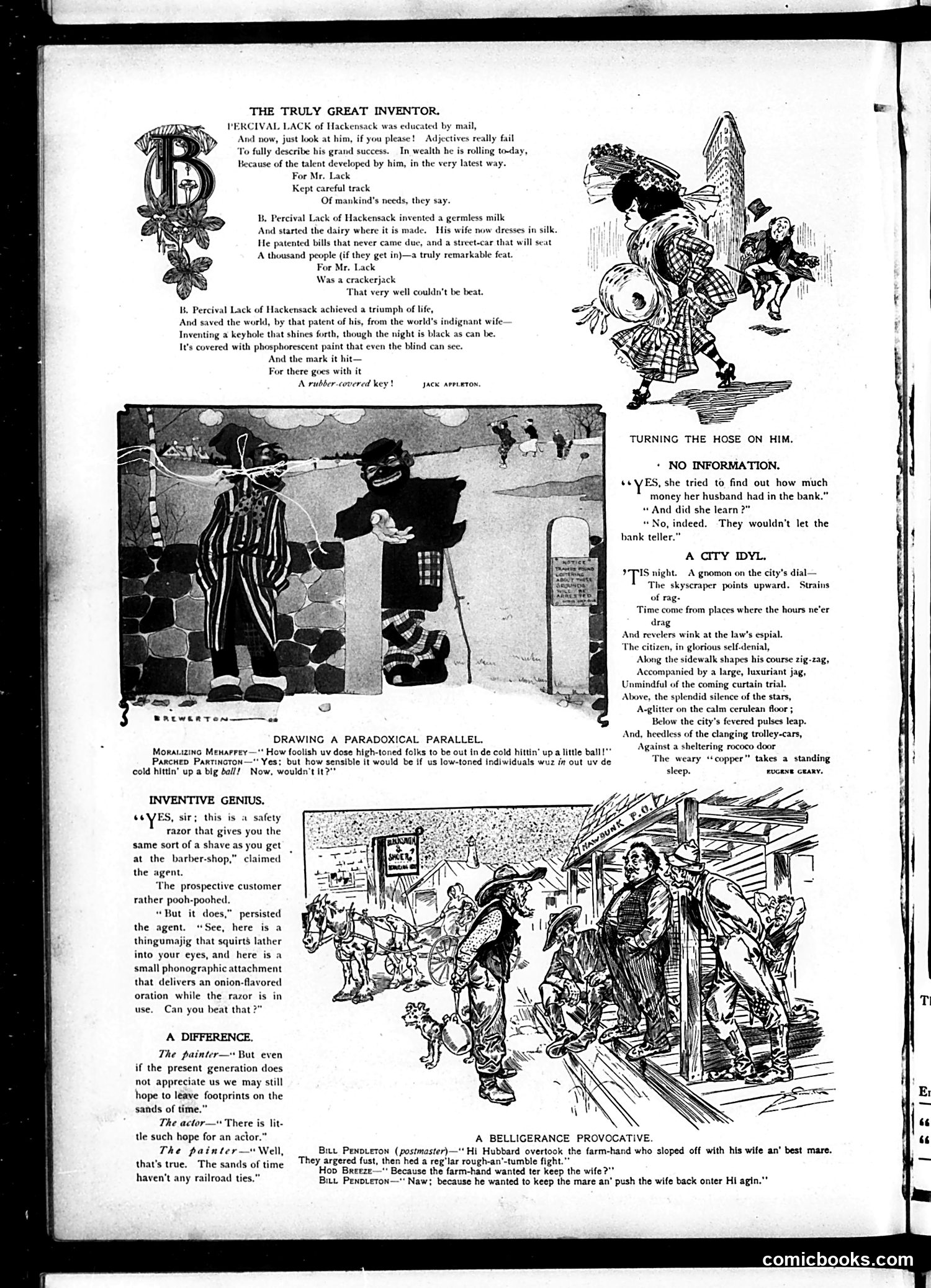
This satirical page from Judge magazine contains several unrelated humor pieces: **"The Truly Great Inventor"** mocks get-rich-quick schemes and absurd patents. Percival Lack of Hackensack becomes wealthy through ridiculous inventions (germless milk, bills that never arrive, a phosphorescent keyhole). The satire targets both naive inventors and Americans' obsession with "the latest way" to success. **"Turning the Hose on Him"** is a brief joke about banking secrecy—wives couldn't access information about husbands' finances. **"A City Idyl"** uses mock-poetic language to satirize urban excess: drunk citizens, nightlife, and moral decay alongside starlit skies. **"Drawing a Paradoxical Parallel"** and **"Inventive Genius"** are short jokes about class differences and absurd products (a safety razor with lather-squirting and onion-flavored narration). **"A Belligerance Provocative"** depicts rural working-class characters in dialect, joking about a farmhand fighting over a horse rather than a wife. The page reflects Judge's typical satirical approach to American life, wealth-seeking, urban versus rural culture, and technological change.
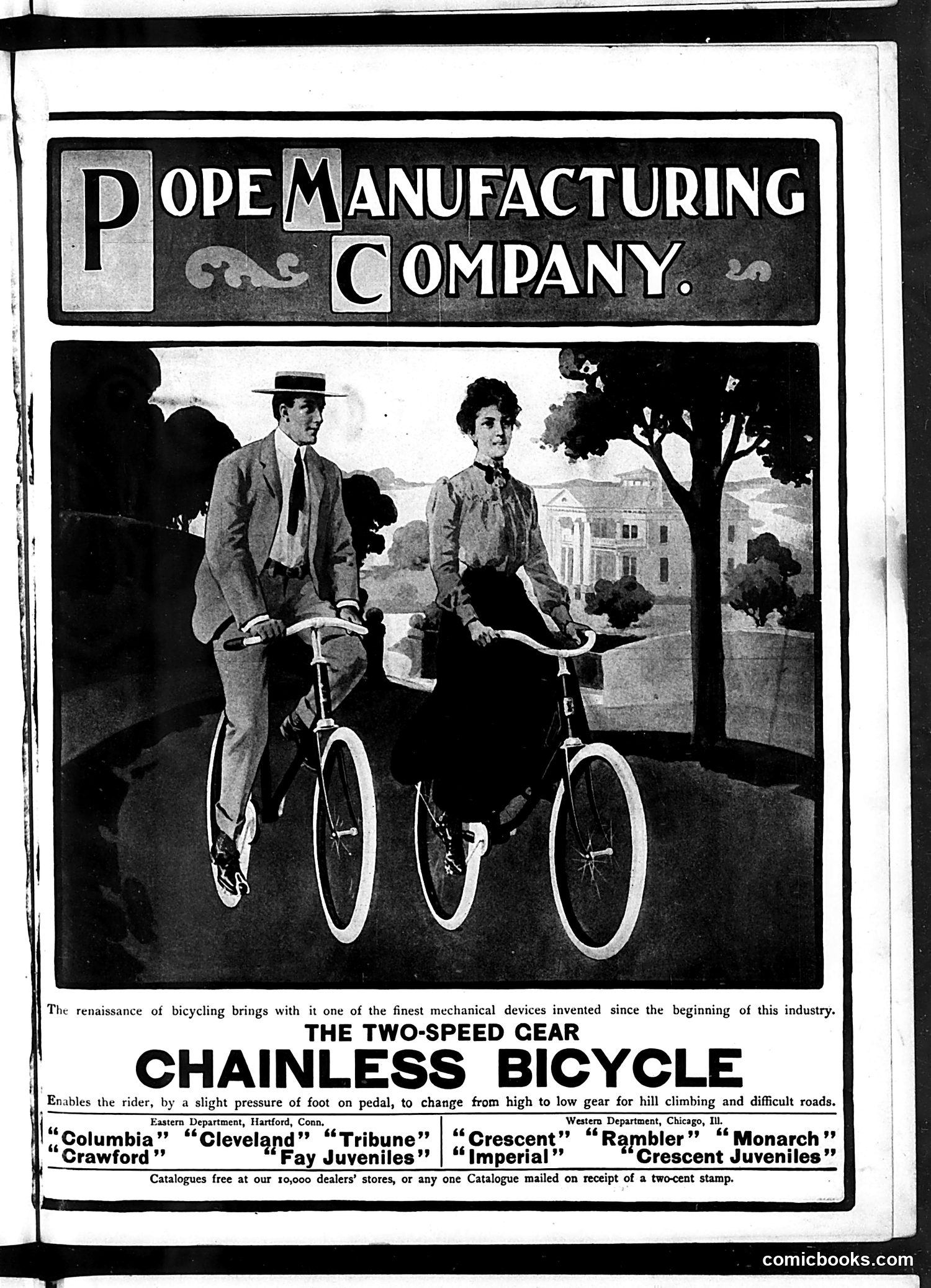
This is a full-page advertisement, not a political cartoon. It promotes Pope Manufacturing's "chainless bicycle" with a two-speed gear system—presented as a major technological innovation enabling riders to shift between high and low gears for hills and rough terrain. The image shows two well-dressed cyclists (a man and woman) riding these bicycles in an idealized suburban landscape, emphasizing the bicycle's appeal to genteel society during the cycling "renaissance" of the late 1800s. The ad lists multiple brand names (Columbia, Cleveland, Tribune, Crescent, Rambler, Monarch, Crawford, Imperial, and juvenile models), indicating Pope's dominant market position. The availability through 10,000 dealers underscores the era's bicycle boom—a genuine craze in American popular culture before automobiles displaced them.
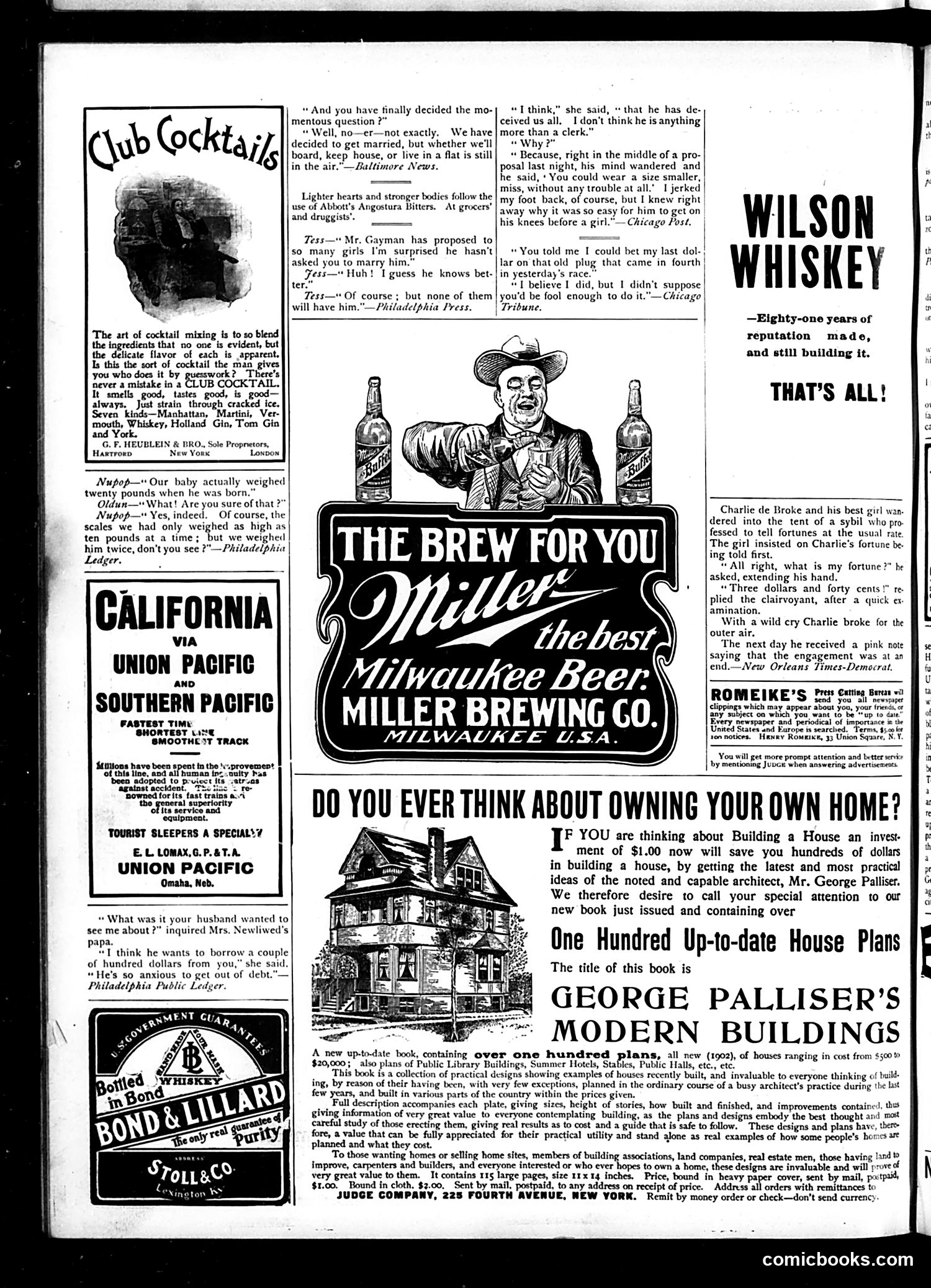
This page is primarily **advertising** mixed with brief humor items typical of Judge magazine. The main content includes: **Advertisements:** Wilson Whiskey (emphasizing 81 years of reputation), Miller Brewing Company beer, railroad travel via Union Pacific/Southern Pacific, and a book of house plans by George Palliser. **Short jokes/humor pieces:** These are brief, conversational anecdotes about everyday situations—a couple debating whether to marry and keep house, a new parent exaggerating their baby's weight, and a fortune teller's punchline about finding only "$3.40" in someone's future. **Social context:** The jokes reflect early-20th-century concerns (marriage logistics, household management, financial anxiety) with gentle, relatable humor rather than political satire. The fortunes joke contains mild class commentary—suggesting a young man without money prospects. There is **no obvious political cartoon** on this page. It represents Judge as a general humor magazine mixing satire with advertisements, rather than focused political commentary.
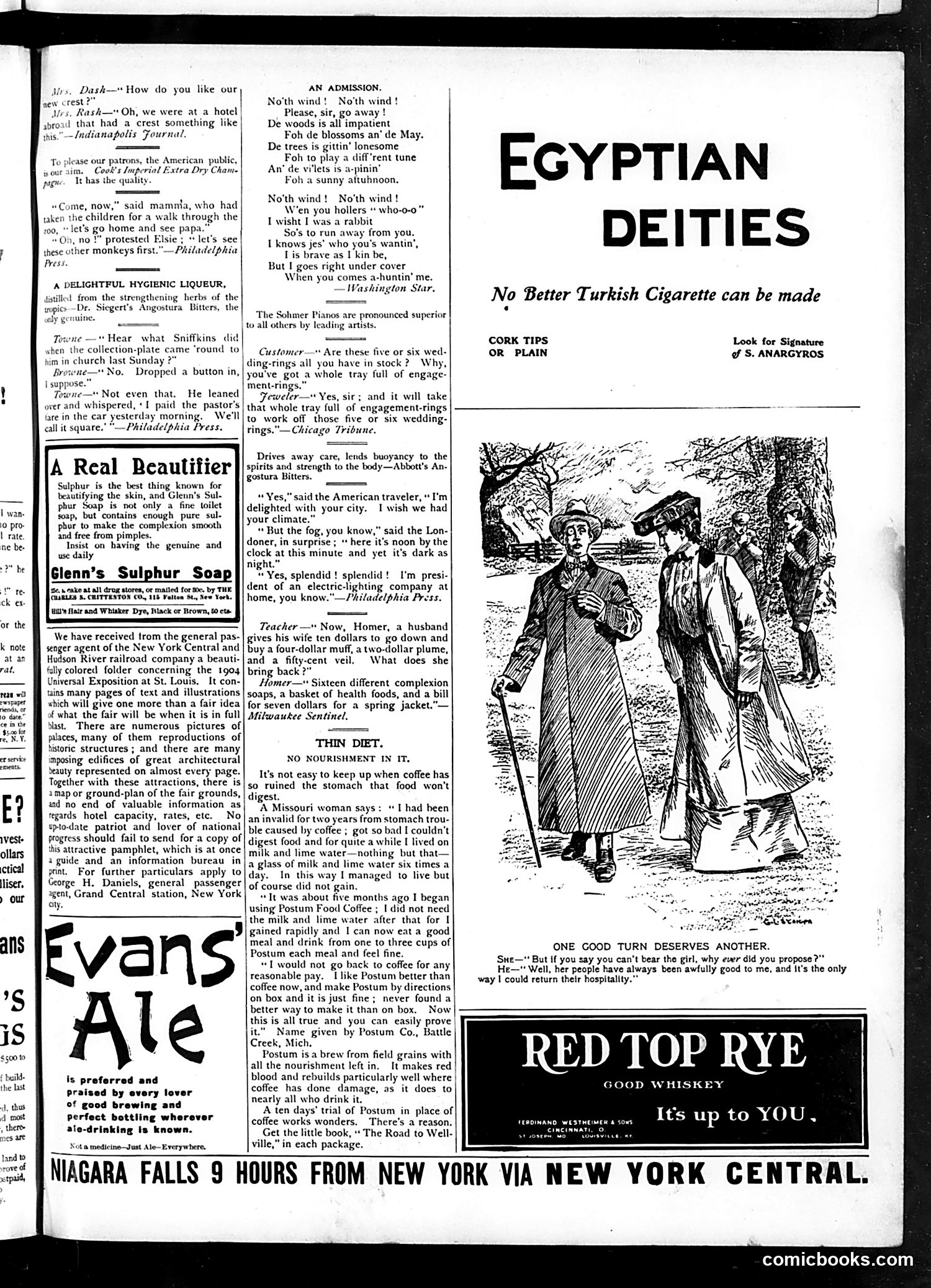
This appears to be primarily an **advertising and humor page** from Judge magazine, not a political cartoon. The main content is a large **cigarette advertisement for "Egyptian Deities"** brand Turkish cigarettes, featuring an illustration of two figures in Egyptian-style dress. The page also contains several **short humorous anecdotes** (jokes), including exchanges about hotel crests, zoo visits, church donations, and British fog—typical light humor of the era. These are interspersed with advertisements for products like Glenn's Sulphur Soap, Evans Ale, and Red Top Rye whiskey. A poem titled "An Admission" (credited to Washington Star) appears to be a dialectal piece about the North wind, using African American Vernacular English common in period publications. The page is **primarily commercial rather than satirical**—it's essentially a magazine page combining paid advertising with filler humor content typical of Judge's format during this era.
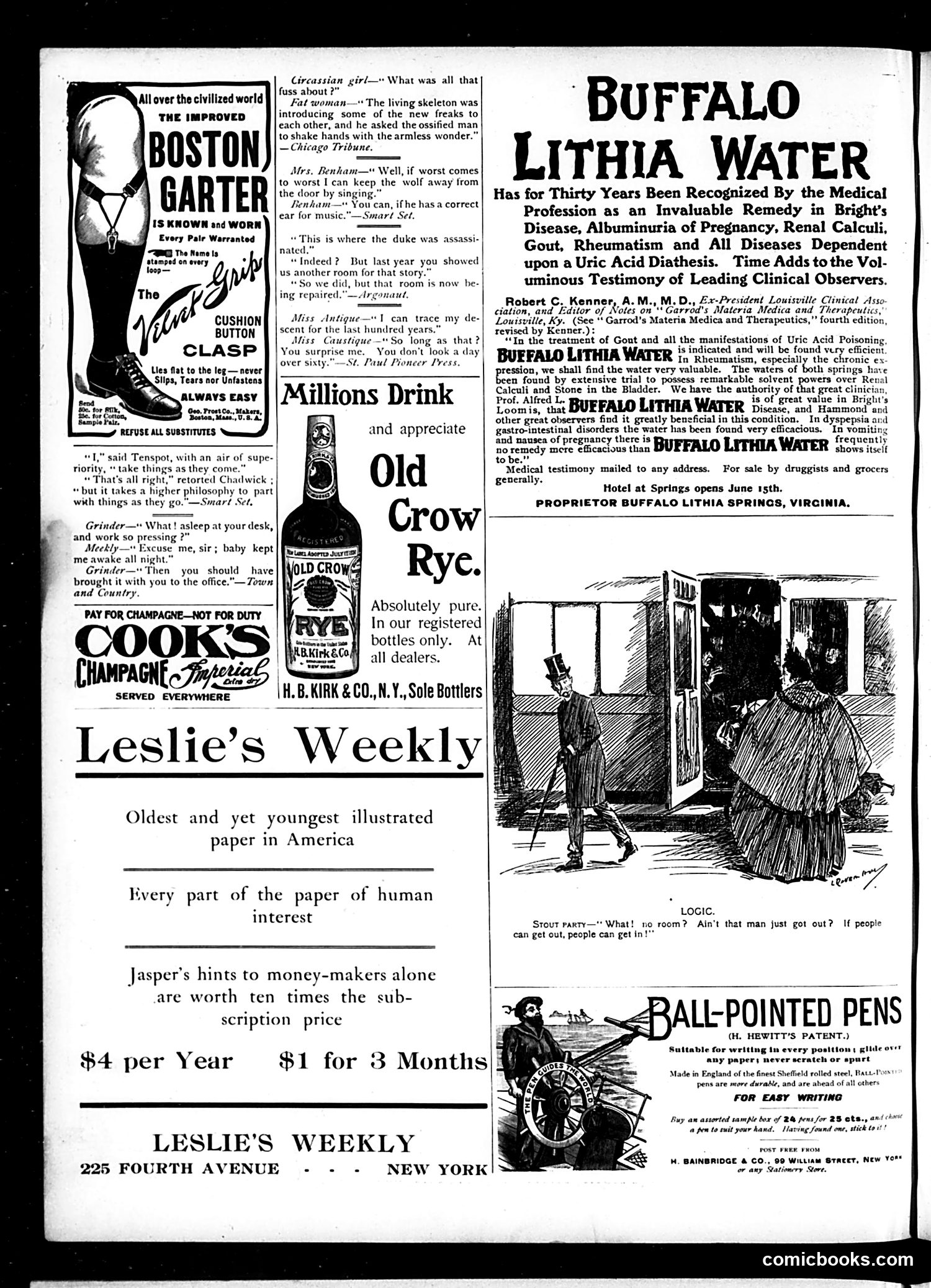
This page combines short satirical jokes with period advertisements. The cartoons mock social pretensions and marital dynamics: **"Circassian Girl"**: References circus sideshows ("living skeleton," "armless wonder," "ossified man"), satirizing how carnival attractions introduce freaks to each other. **Mrs. Benham**: A wife jokes about singing to keep poverty away; her husband dismisses her talent, suggesting she'd do better elsewhere. The satire targets marital discord and female artistic ambitions being dismissed. **Miss Antique/Caustigue**: Mocks aristocratic pretension—a woman boasting 100-year lineage is told she doesn't look it, implying either her ancestry claim is false or she's aged poorly. **The "Logic" cartoon**: A stout woman complains about crowding; a bystander sarcastically notes if people left, others could enter—absurdist logic about occupancy. The remainder is **advertising** for products (garters, rye whiskey, Buffalo Lithia Water for kidney/gout treatment, pens) typical of early-1900s magazine content, reflecting period medical claims and consumer culture.
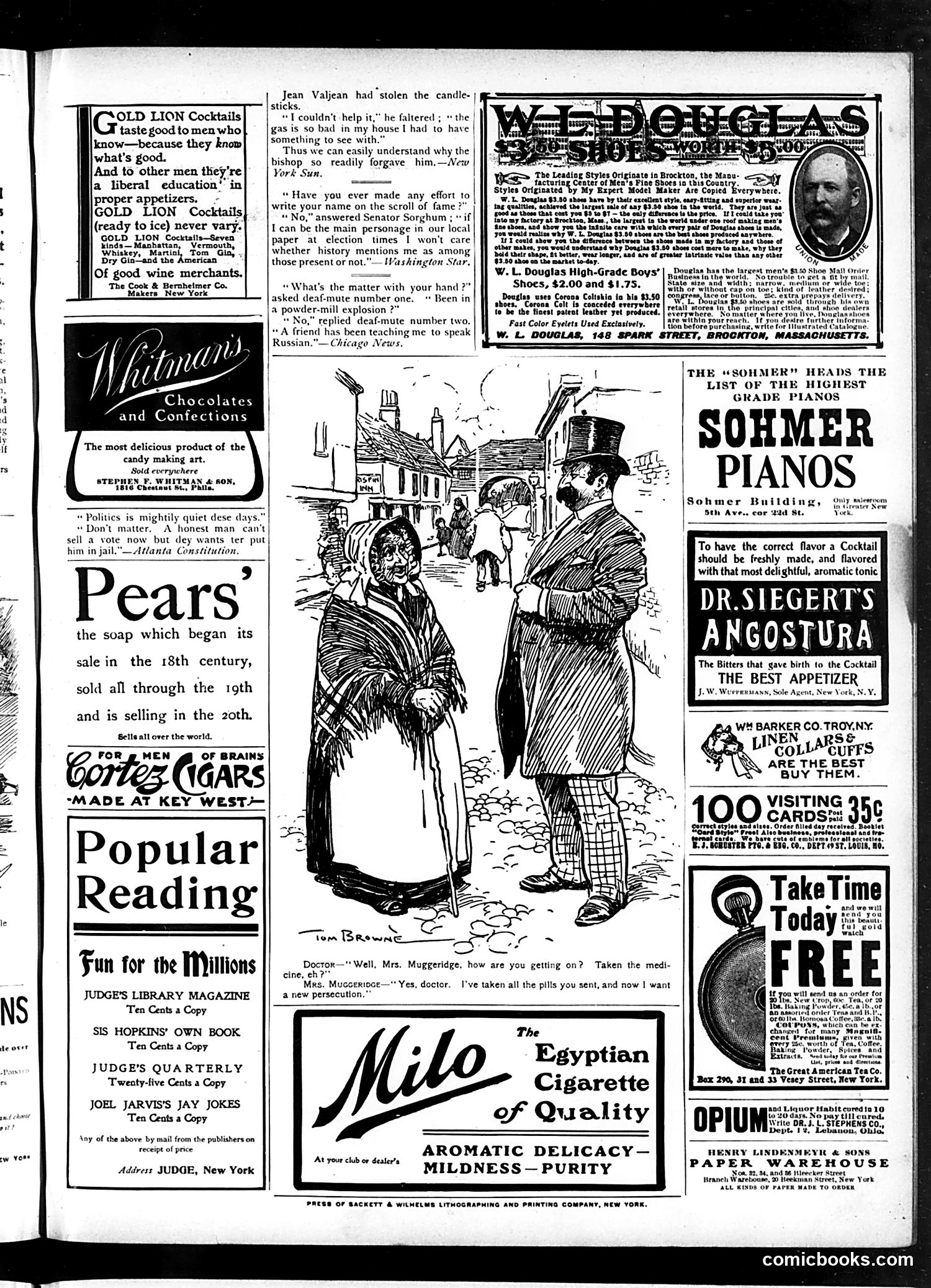
This page is primarily **advertisements and filler content** rather than substantive political satire. The main cartoon depicts a doctor and Mrs. Muggeridge on a street. She reports taking all the pills he prescribed and now wants "a new persecution" — she means "prescription," but her malapropism suggests she views medical treatment as persecution. This is mild humor about patient-doctor relations and linguistic confusion, not political commentary. The page is dominated by product advertisements (Gold Lion Cocktails, Whitman's Chocolates, Pears soap, W.L. Douglas shoes, Sohmer pianos, Egyptian cigarettes, etc.) and promotional material for Judge's own publications. Brief quoted quips appear throughout—one about corrupt politics (from Atlanta Constitution), another referencing Victor Hugo's *Les Misérables*—but these are generic jokes rather than commentary on specific contemporary events or figures. The page reflects Judge's business model: satirical magazine content interspersed with commercial advertising to generate revenue.
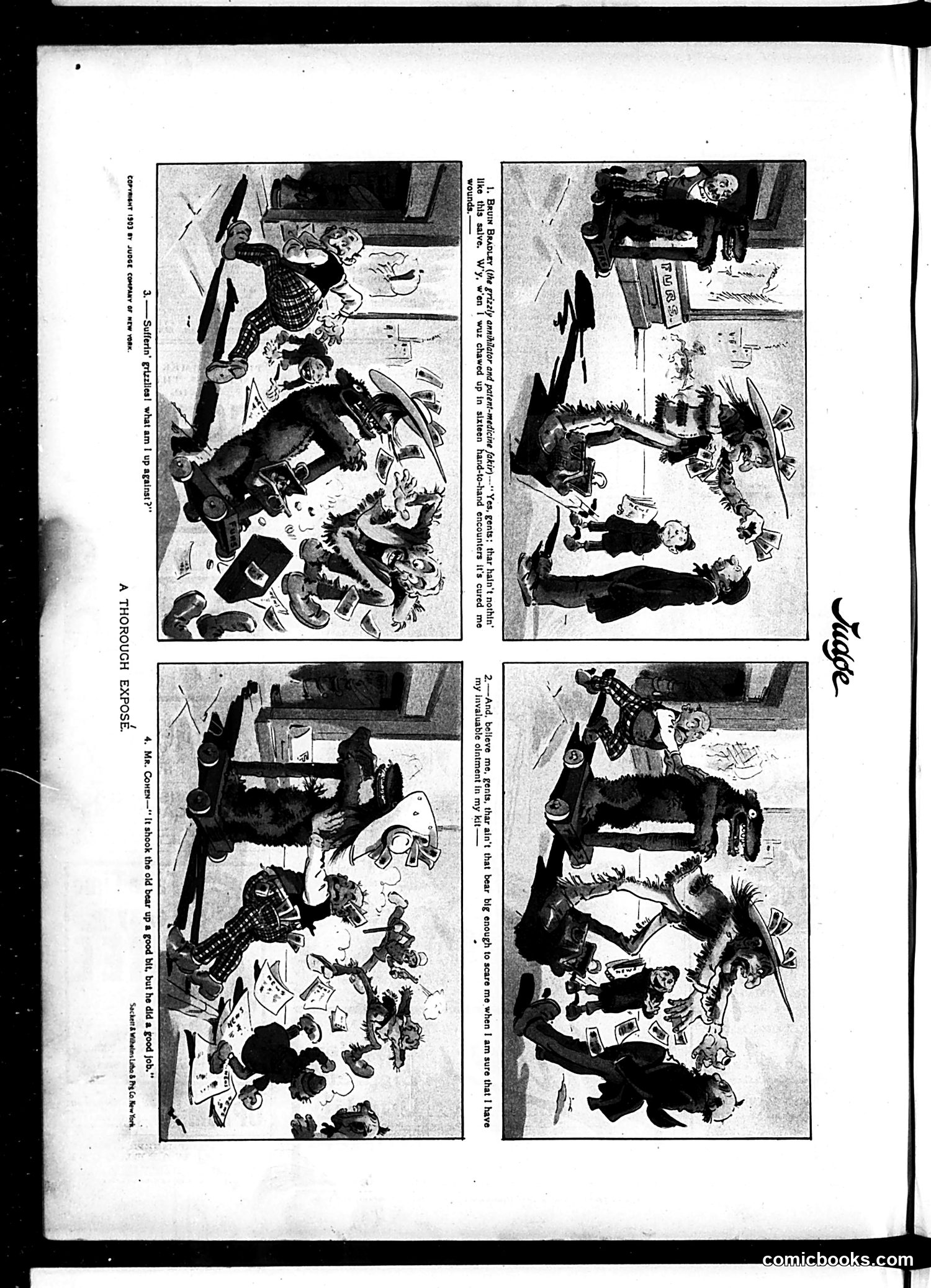
This 1903 Judge cartoon satirizes patent medicine advertising through a fictional "Bruin Brapey" (a grizzly bear character) endorsing a miraculous salve. The four-panel sequence shows the bear claiming the product cured him after violent bear encounters, with increasingly exaggerated testimonials. The satire targets two contemporary issues: the widespread fraud of patent medicines making impossible health claims, and the use of celebrity endorsements to market dubious products. The absurdity of a bear as spokesperson underscores how ridiculous these testimonials were in reality. "A Thorough Expose" suggests Judge is mocking the deceptive advertising tactics of the era, when unregulated medicines commonly made outlandish curative claims without scientific evidence. The bear's folksy dialect adds comedic effect while emphasizing the con-artist nature of such marketing schemes.