
A complete issue · 16 pages · 1904
Judge — February 20, 1904
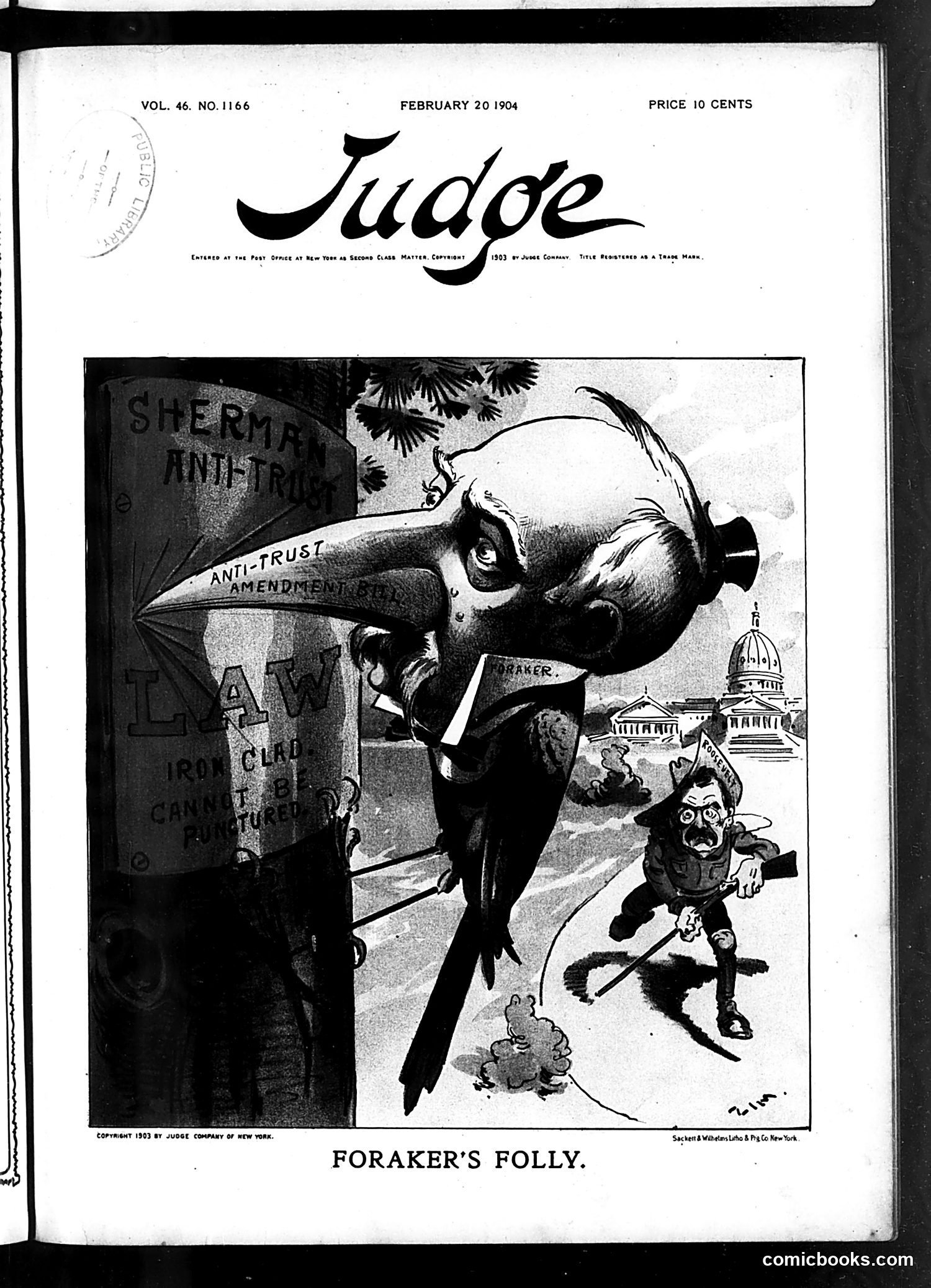
This political cartoon satirizes Senator Joseph B. Foraker regarding the **Sherman Antitrust Amendment** and related legislation. The central figure (appearing to be Foraker) is depicted as a bird with an enormously inflated head, spouting the anti-trust amendment like a cannon. The satire suggests Foraker is engaged in foolish or ineffectual political posturing—his oversized head implies inflated rhetoric or empty bluster. The small figure at right appears to be mocking or undermining his efforts, while the Capitol building in the background grounds this in Washington politics. The cartoon's message: Foraker's legislative efforts on antitrust matters were perceived as grandiose but ultimately hollow or counterproductive—hence "folly."
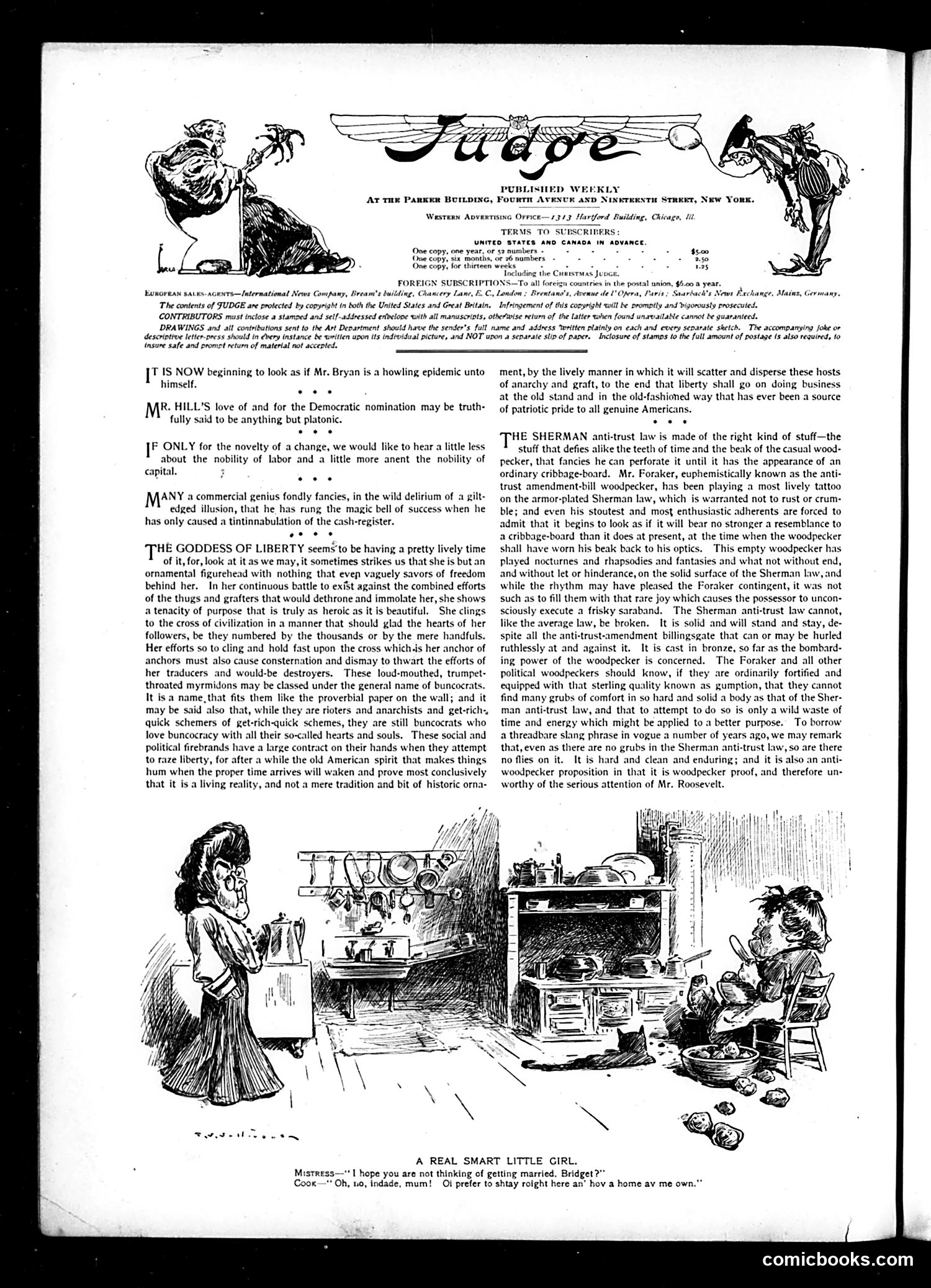
This page contains political commentary and social satire typical of Judge magazine. The main articles critique William Jennings Bryan's candidacy ("Mr. Bryan is a howling epidemic unto himself"), mock the Sherman anti-trust law as ineffective against monopolies, and satirize the "Goddess of Liberty" as having failed to deliver genuine freedom. The bottom cartoon, "A Real Smart Little Girl," depicts a domestic scene where a cook rejects marriage to a wealthy suitor, preferring independence and owning her own home. This reflects early 20th-century debates about women's economic autonomy and marriage. The decorative illustrations throughout feature caricatured figures engaging in political or social commentary—typical of Judge's visual style. Without clear dates or specific names visible, the exact historical moment remains somewhat unclear, though the content suggests early 1900s American politics.
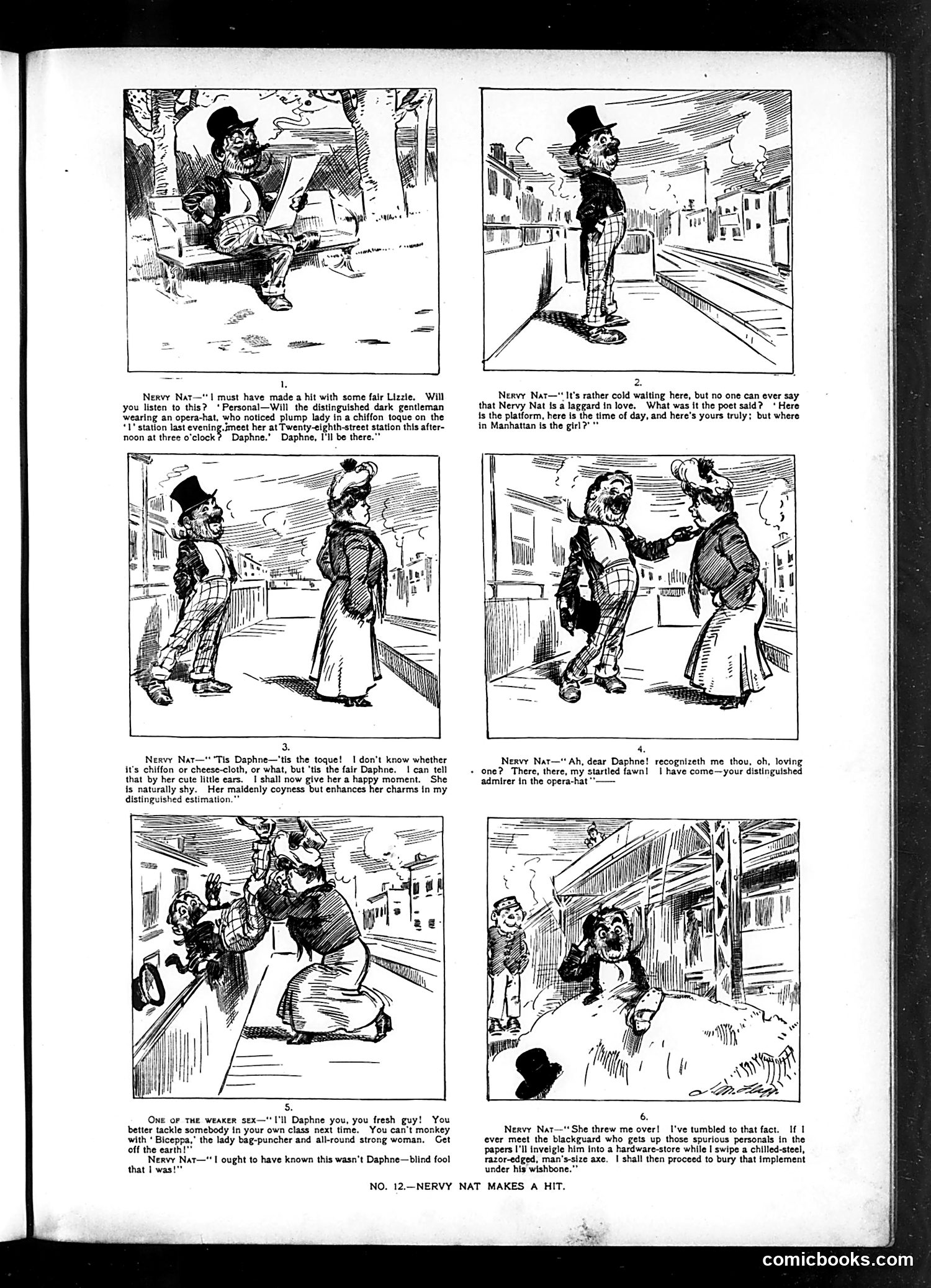
This is a six-panel comic strip featuring "Nervy Nat," a character in checkered clothing and a top hat who appears to be a con artist or small-time scoundrel. The narrative follows him attempting to seduce or romance a woman named Daphne by fabricating a story about meeting her at the opera in Manhattan. When she doesn't recognize him, Nat improvises, claiming she was "blind fool" at the time. The strip depicts classic turn-of-the-century urban humor: a scheming male character using flattery and false stories to impress a woman. The humor relies on the gap between Nat's transparent deceptions and his confidence in delivering them. This represents period-typical romantic comedy based on gender dynamics and social deception.
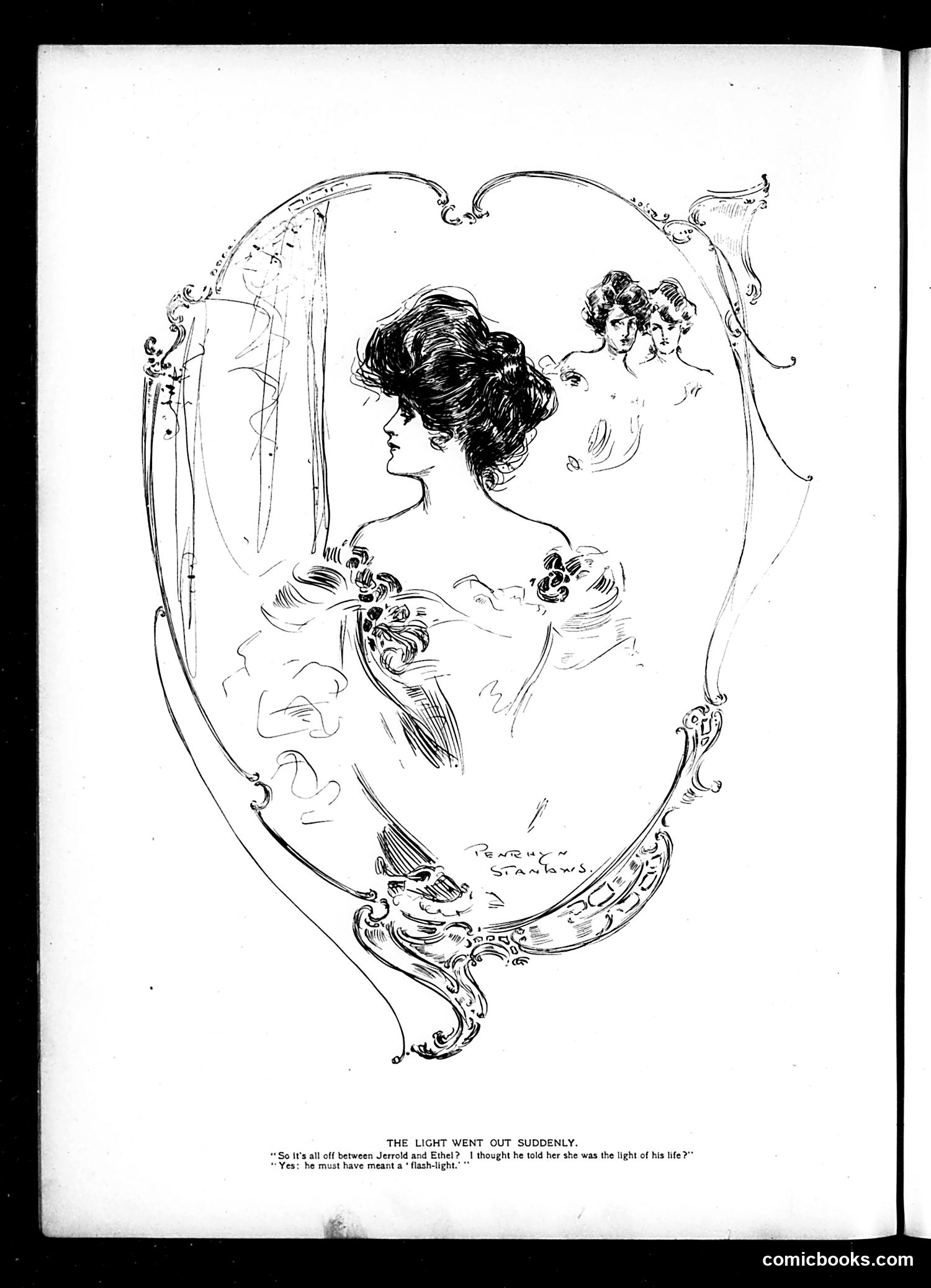
This illustration from *Judge* magazine presents a romantic scene framed in an ornate mirror or portrait frame. The central image shows a woman in profile with elaborate upswept hair, wearing an off-shoulder dress with decorative elements. The caption reads: "THE LIGHT WENT OUT SUDDENLY" followed by dialogue: "So it's all off between Jerrold and Ethel? I thought he held her she was the light of his life?" / "Yes; he must have meant a 'flash-light.'" The satire mocks sentimental romantic language. The joke depends on a pun: a man who calls his beloved "the light of his life" is reinterpreted literally—he meant merely a temporary "flashlight" rather than a permanent beacon. This playfully deflates earnest Victorian romance rhetoric as insincere or disposable. The elaborate frame emphasizes the pretension being satirized.
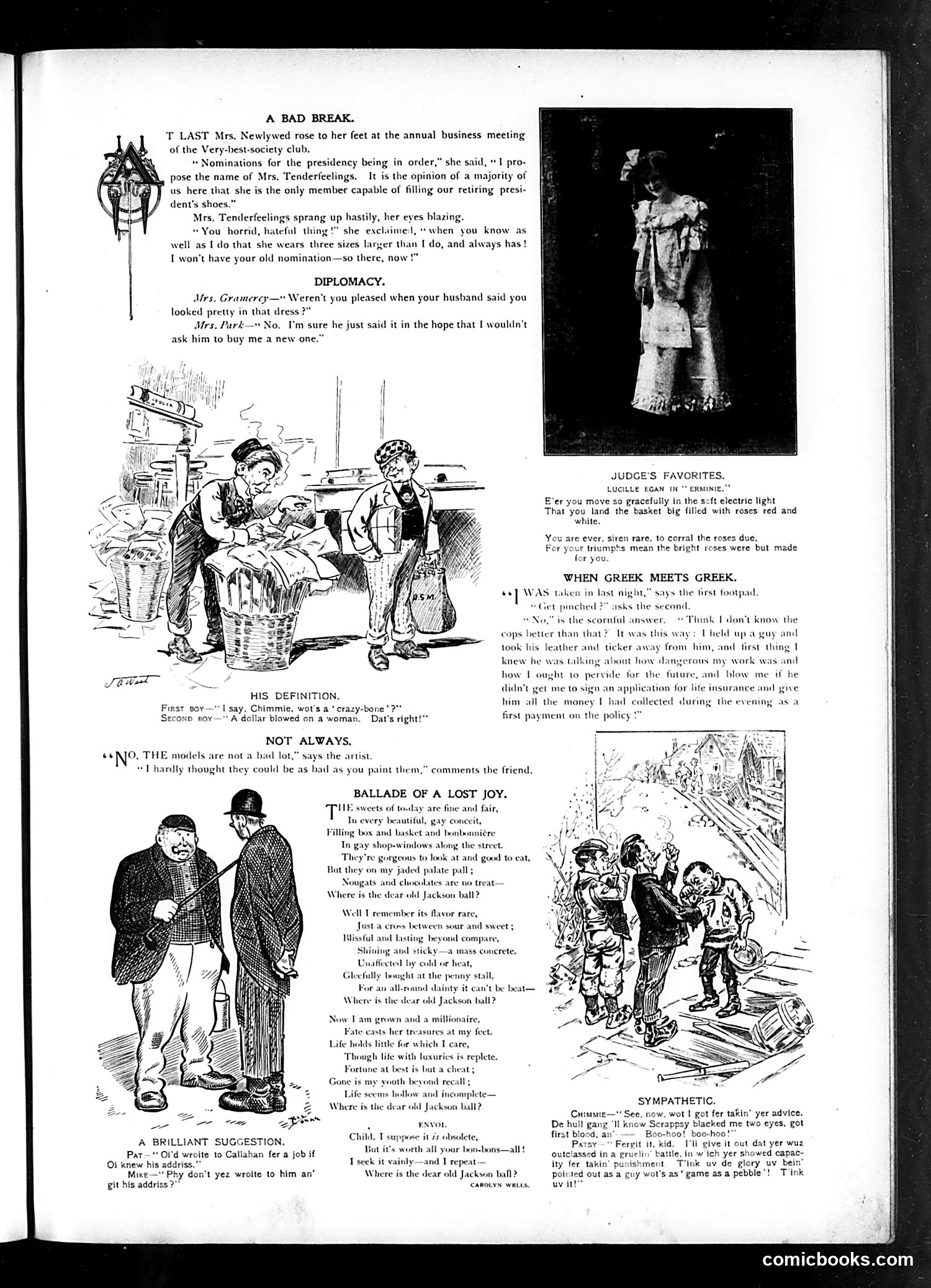
This page contains several short humorous pieces mocking early 20th-century social conventions: **"A Bad Break"** satirizes wealthy women's society clubs. Mrs. Newlywed tactlessly nominates Mrs. Tenderfeelings for president while insulting her size—a social gaffe revealing the cattiness beneath polite society. **"Diplomacy"** jokes about marital manipulation: a wife interprets her husband's compliment about her dress as a calculated attempt to avoid buying her a new one. **"When Greek Meets Greek"** presents a footpad (street robber) outwitted by his victim, who emotionally manipulates the criminal into signing up for life insurance—the joke being that even criminals can fall for confidence schemes. Other pieces mock models, lost childhood candies, and working-class Irish characters. The cartoons and verses collectively satirize class pretensions, marital dynamics, and urban con-artistry typical of Judge's satirical humor targeting upper and middle-class readers.
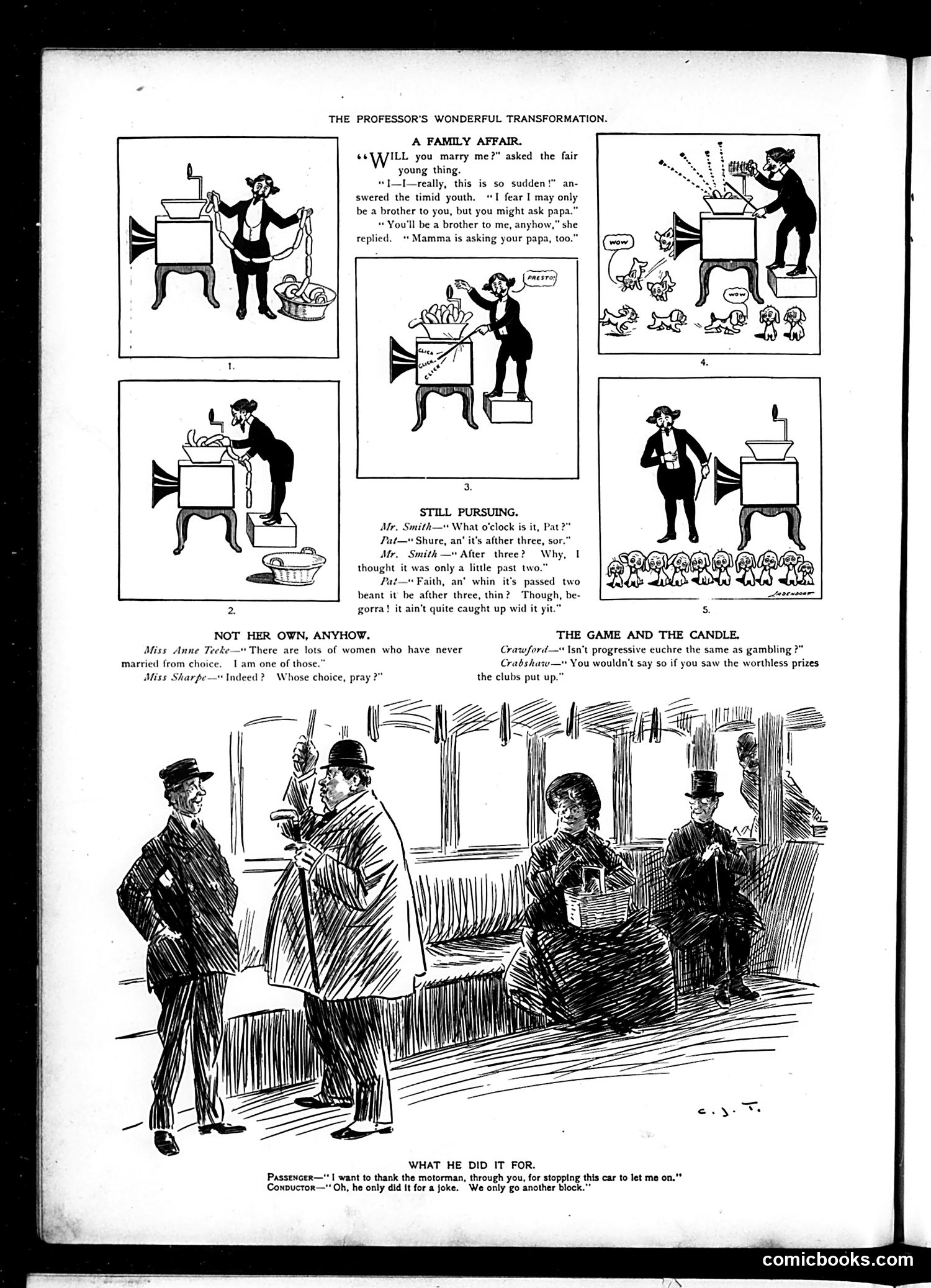
This page contains four separate humorous vignettes typical of early 20th-century satirical humor: **"A Family Affair"** mocks Victorian courtship formality through a young woman's matter-of-fact acceptance of marriage—her mother is simultaneously proposing to his father, reducing romance to family business. **"Still Pursuing"** features an Irish laborer ("Pat") whose comic dialect and illogical reasoning about time passing create ethnic humor common to the era. The joke relies on stereotypical Irish characterization. **"Not Her Own, Anyhow"** is a mild jab at women's marriage prospects, with Miss Sharpe sardonically implying Miss Tecke never had a choice in remaining unmarried. **"The Game and the Candle"** and **"What He Did It For"** are brief quips about gambling/euchre and streetcar courtesy, respectively. The cartoons above these jokes appear to illustrate similar domestic and romantic scenarios. The humor is gentle, relying on wordplay, ethnic stereotypes, and observations about contemporary courtship customs and urban life rather than political satire.
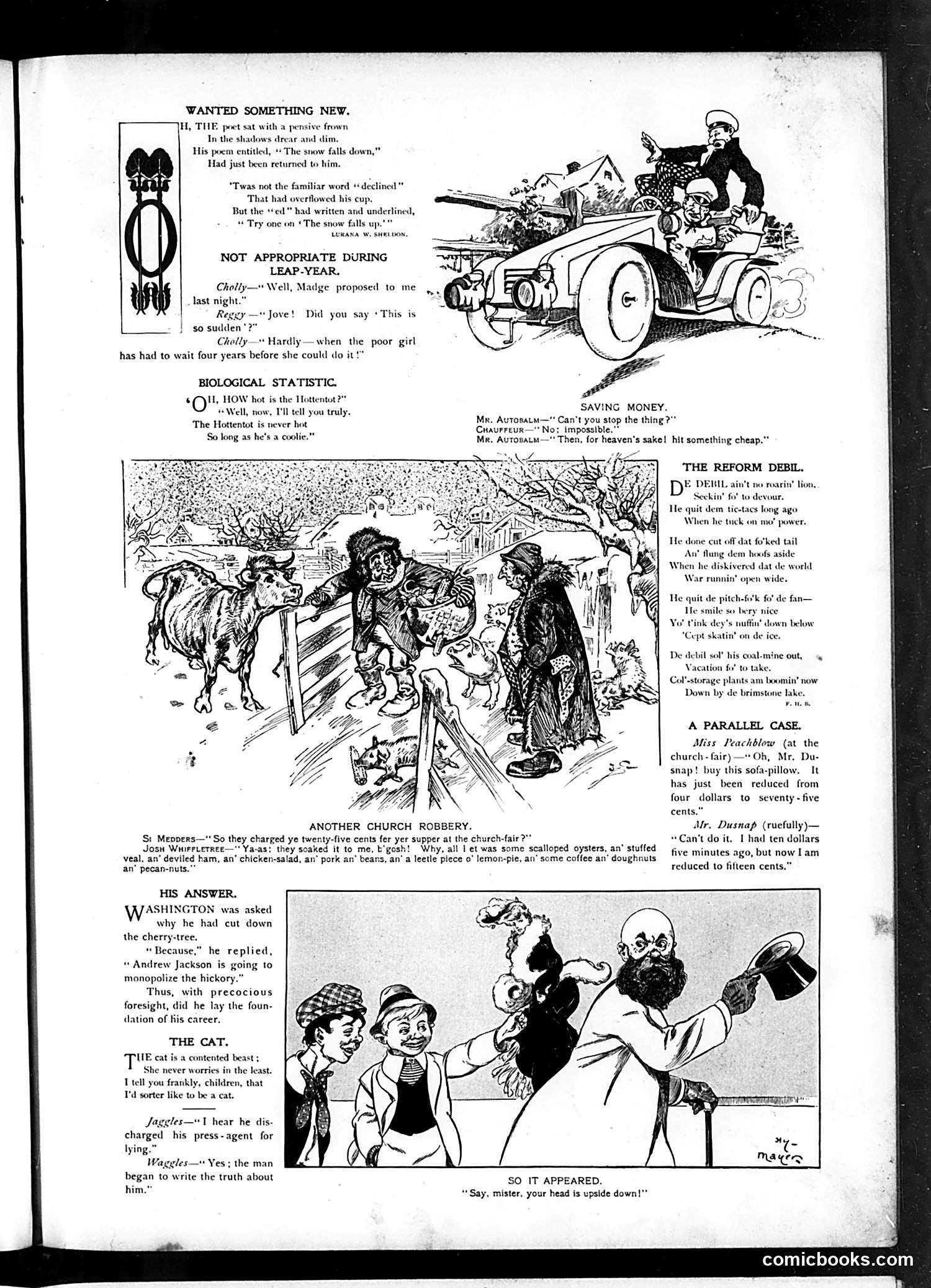
This page contains multiple satirical pieces from early 20th-century America: **"Wanted Something New"**: A poet receives rejection of his work "The Snow Falls Down" with an editor's suggestion to try "The Snow Falls Up"—mocking literary pretension and absurdist trends. **"Not Appropriate During Leap Year"**: A joke about a woman proposing to a man during leap year (when traditional gender roles were humorously inverted), suggesting she's had to wait four years for the chance—satirizing both gender expectations and leap-year customs. **"The Reform Devil"**: A dialect poem portraying the Devil modernizing his image, trading pitchfork for fan and adopting respectability—mocking superficial social reform and moral hypocrisy dressed in fashionable clothing. **"Biological Statistic" and "Another Church Robbery"**: Short humorous pieces about overpriced church suppers and absurd dialogue. **"A Parallel Case"**: Satirizes inflation/devaluation, comparing a sofa pillow's price reduction to a man's shrinking finances. The overall tone reflects Judge's satirical approach to American social pretense, gender relations, and commercialism.
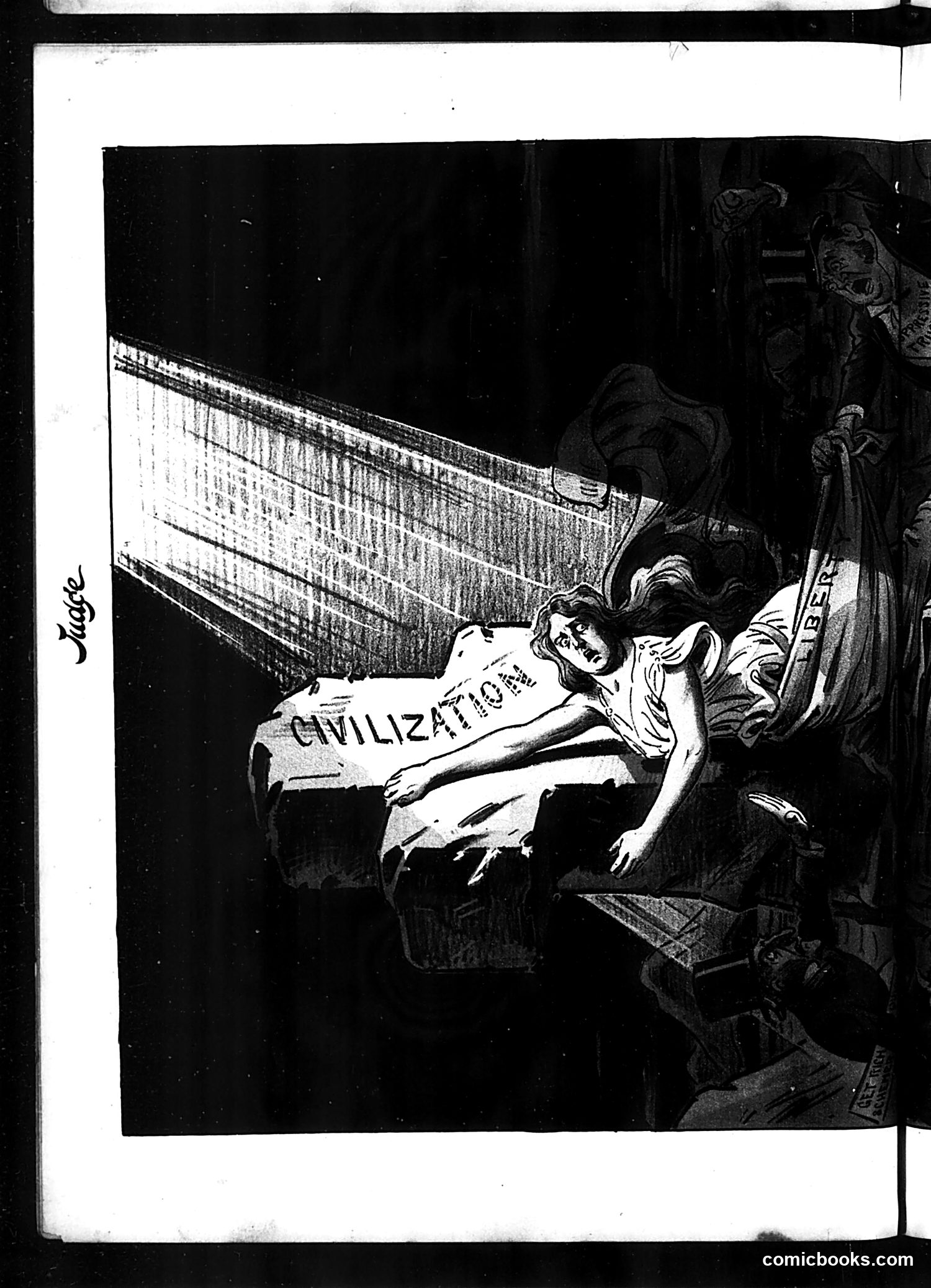
This political cartoon depicts a reclining female figure labeled "Civilization" in a weakened or distressed state. She appears to be attended to by several shadowy figures in the background, suggesting concern or intervention. The satire critiques the state of civilization itself—likely commenting on social decay, moral decline, or political instability during the period Judge was published (late 19th or early 20th century). The personification of "Civilization" as a vulnerable woman was common in political art of this era. The background figures' poses and gestures suggest they represent various social forces or institutions attempting to address or exploit civilization's apparent ailment. Without additional context or caption text, the specific political event or social condition being critiqued remains unclear, though the overall message appears pessimistic about contemporary society's health.
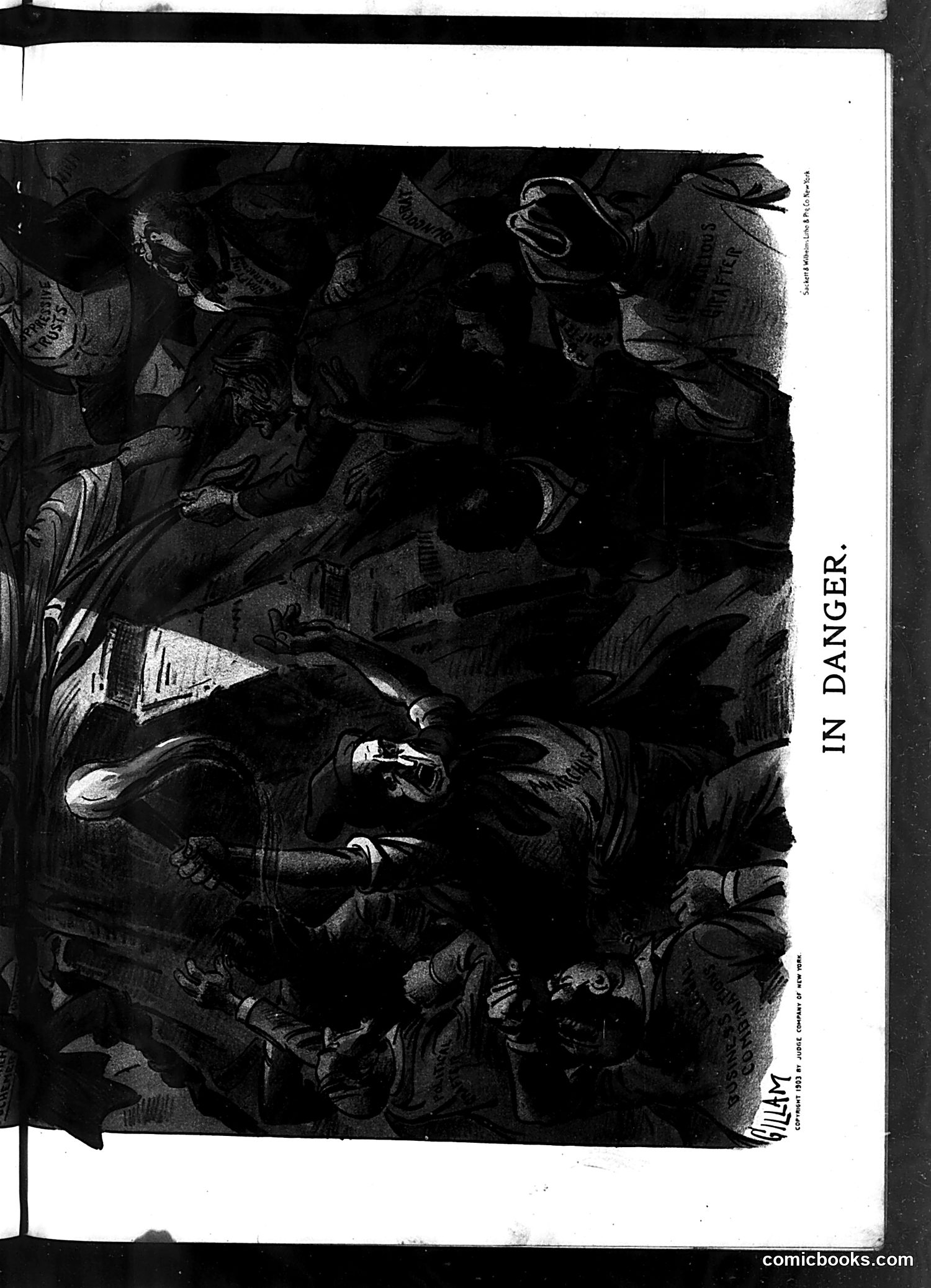
This page from *Judge* magazine contains a political cartoon titled "IN DANGER," though the OCR text is corrupted and unhelpful for understanding specifics. The image depicts a chaotic scene with multiple figures in period dress (appearing to be 19th-century attire) in what looks like a dangerous or dramatic situation. The composition suggests crisis or peril—figures appear to be struggling or in distress. Without legible text or clearer context, I cannot definitively identify the specific political figures, events, or social commentary being satirized. The title "In Danger" suggests the cartoon warns about some threat to American institutions, society, or political figures of the era, but determining exactly which threat requires additional context I cannot reliably extract from this image alone.
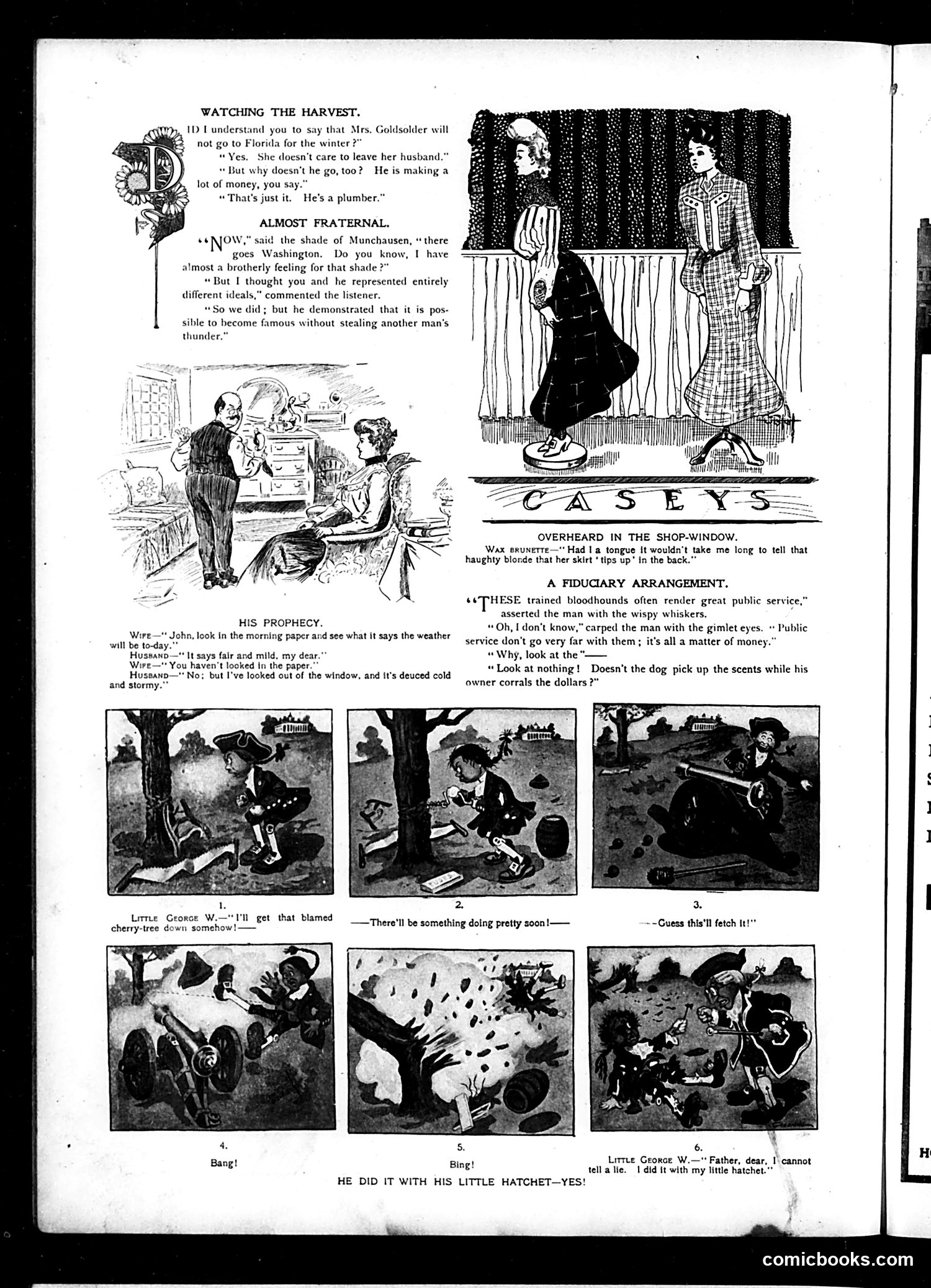
This page contains several satirical pieces mocking social pretense and dishonesty: **"Watching the Harvest"** jokes that a plumber's wife won't leave him despite his wealth—because he's actively *making* money, suggesting she's monitoring him. **"Almost Fraternal"** references the shade of Munchausen (the legendary liar) meeting Washington's ghost. The joke: Munchausen respects Washington because Washington became famous *without lying*—unlike Munchausen, who stole credit from others ("stealing another man's thunder"). **"His Prophecy"** satirizes someone confidently predicting weather without checking the paper—foolish optimism. **"Overheard in the Shop-Window"** mocks vanity in fashion advertising. **"A Fiduciary Arrangement"** criticizes bloodhounds' owners for taking credit (and money) for the dogs' public service work. **"He Did It With His Little Hatchet"** features "Little George W." (likely George Washington, referencing the cherry-tree legend) claiming innocence despite obvious guilt—mocking the mythologized honesty of historical figures. The page's recurring theme: **exposure of false claims to virtue and honesty.**
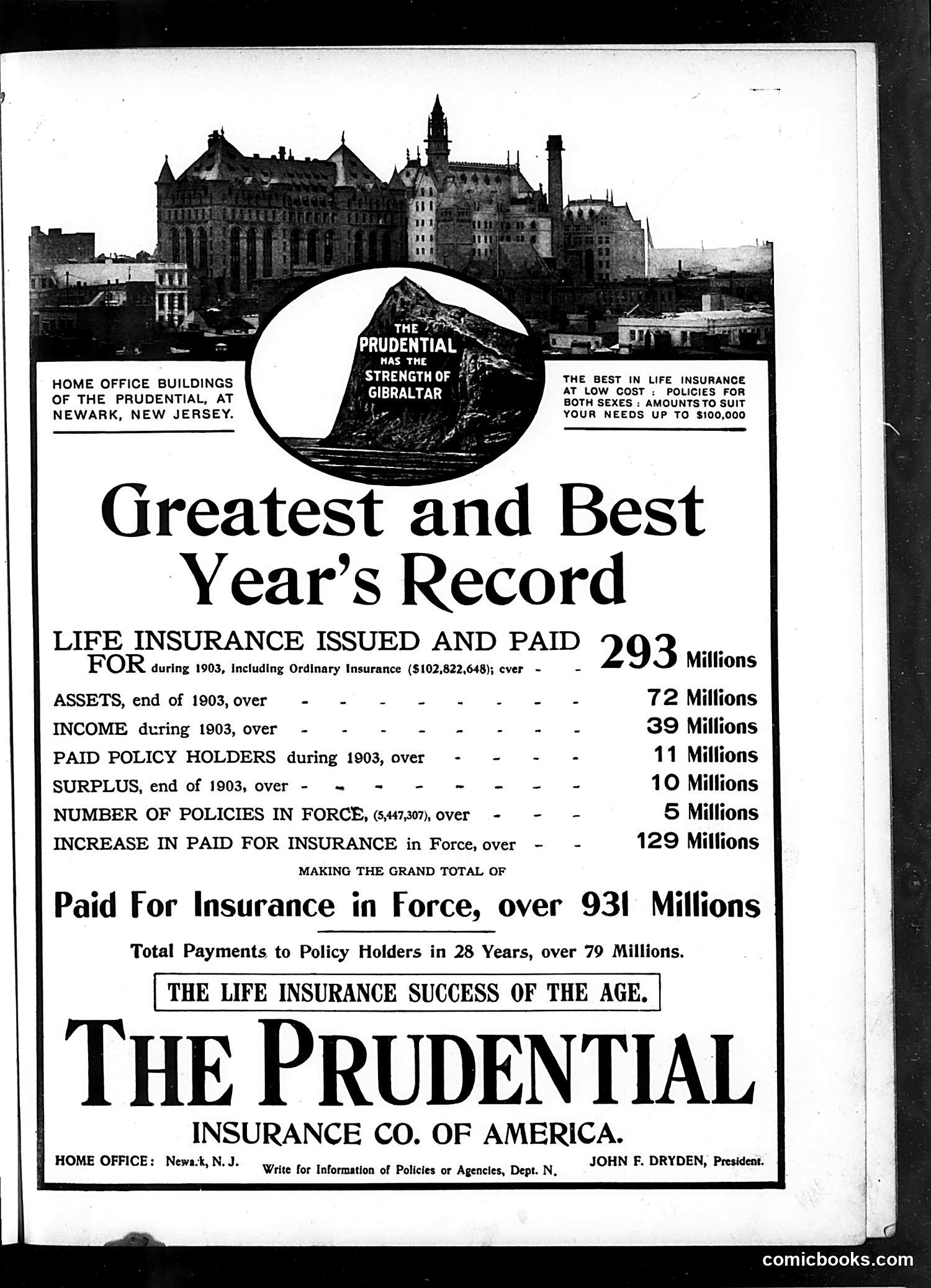
This is **not a satirical cartoon** but a **full-page advertisement** for The Prudential Insurance Company of America, appearing in *Judge* magazine around 1903-1904. The ad showcases Prudential's financial performance and growth, featuring their Newark, New Jersey headquarters building at the top. The Gibraltar rock image reinforces their marketing slogan about strength and stability—a common insurance industry metaphor of the era. Key figures cited: 293 million in life insurance issued, 72 million in assets, 931 million in total insurance in force. The ad emphasizes affordability ("low cost") and accessibility ("both sexes, amounts to suit your needs up to $100,000"). President John F. Dryden is named. This represents late-Gilded Age corporate advertising—companies bought prominent magazine space to display financial metrics and build consumer confidence during a period of rapid industrial growth and insurance industry expansion. There is **no satire or political commentary** on this page.
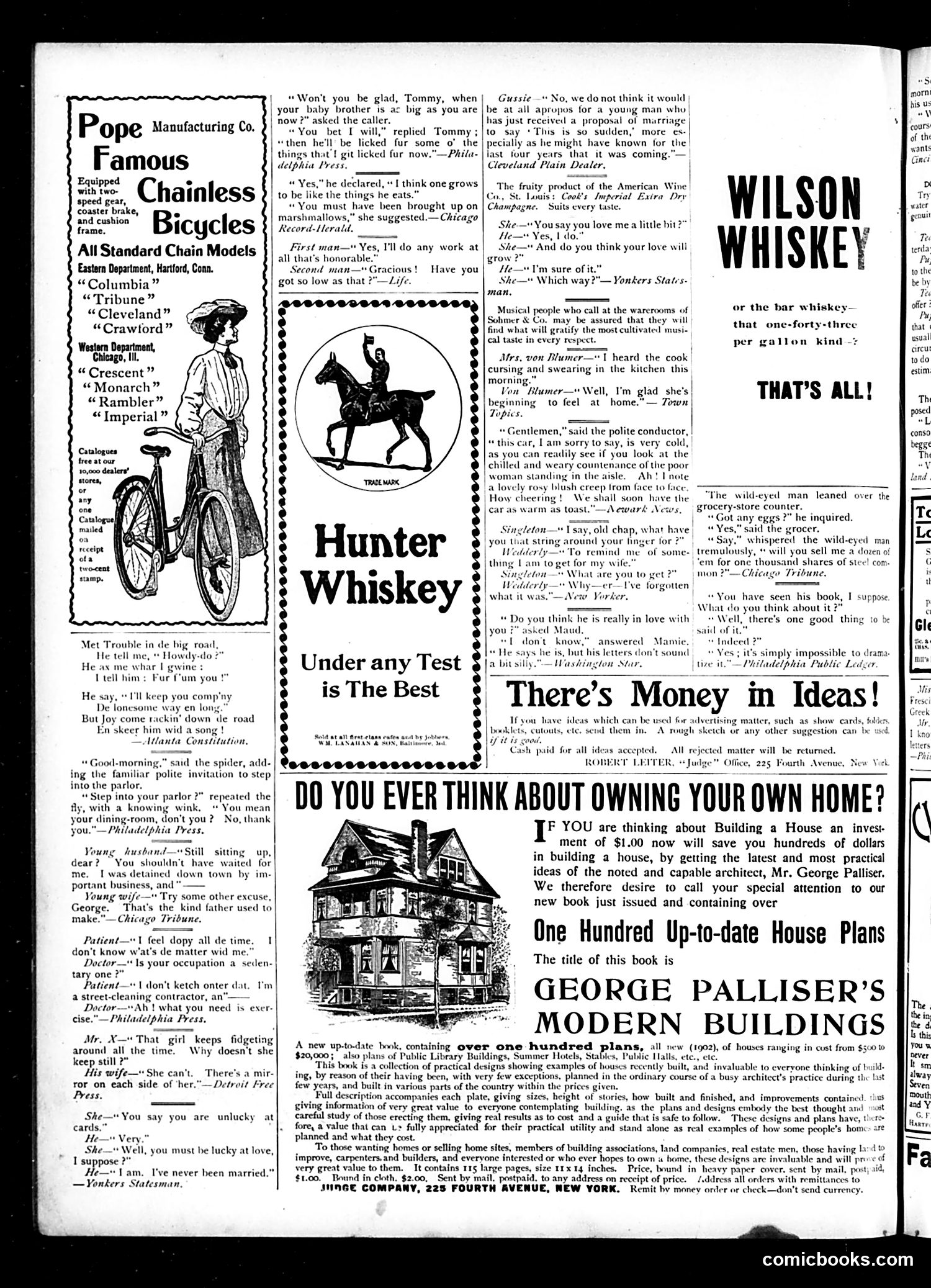
This page is primarily **advertising and humor content** rather than political satire. The main elements are: **Advertisements:** Pope Manufacturing bicycles dominate the left side, featuring various model names ("Columbia," "Cleveland," "Rambler"). A house-building book by George Palliser and Wilson Whiskey ads occupy the right. **Humor Pieces:** The page contains numerous short jokes and comic dialogues typical of the era, including: - A child's innocent remark about his baby brother getting "licked" - A doctor's diagnosis involving exercise - Romantic misunderstandings between husbands and wives - A conductor's ironic observation about warming a cold railway car through embarrassment **The Central Cartoon:** A small circular illustration labeled "TRADE MARK" shows a figure on horseback—likely a trademark or brand emblem, possibly for Hunter Whiskey. The humor reflects early 1900s domestic/social concerns (courtship etiquette, urban transportation, marital dynamics) but contains no identifiable political figures or substantive satirical commentary. It's essentially a period advertisement and joke compilation page.
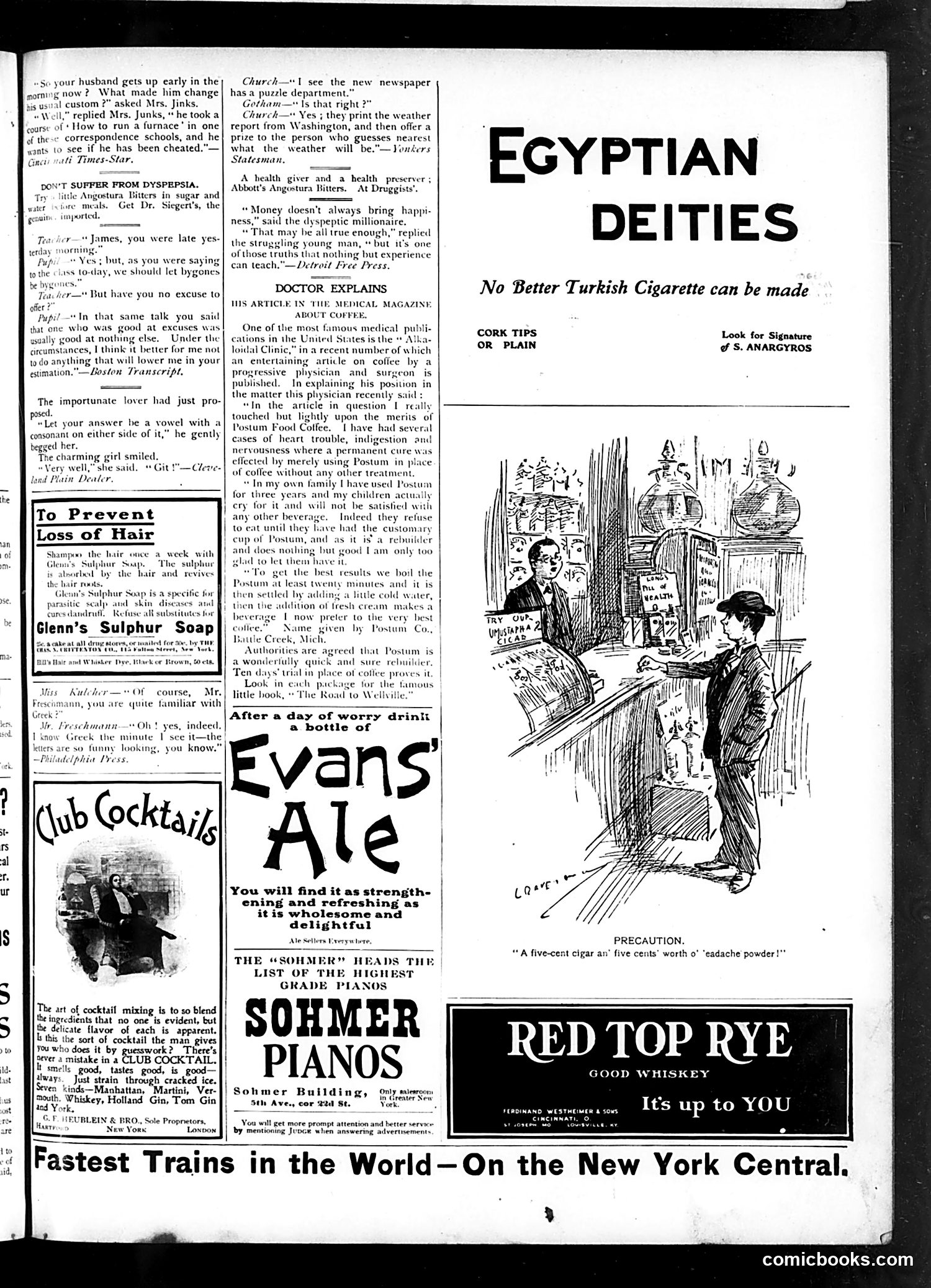
This page from *Judge* magazine is primarily an **advertising page** disguised as editorial content, typical of early 20th-century publications. The main cartoon ("Precaution") depicts a figure in what appears to be an Egyptian-themed setting, with the caption about a "five-cent cigar" and "sadache powder"—likely a visual pun about Egyptian deities and patent medicine remedies. The humor relies on visual absurdism: treating products as sacred artifacts. The text snippets are brief satirical dialogues mocking: - Husbands obsessing over home-improvement courses - Weather prediction as a "puzzle" (implying Washington's unreliability) - Dyspeptic millionaires (suggesting wealth can't buy health) The bulk of the page consists of **paid advertisements** for Postum coffee, Evans Ale, Red Top Rye whiskey, Sohmer Pianos, and other products, with fake "doctor endorsements" and health claims—common deceptive advertising tactics of the era before FDA regulation.
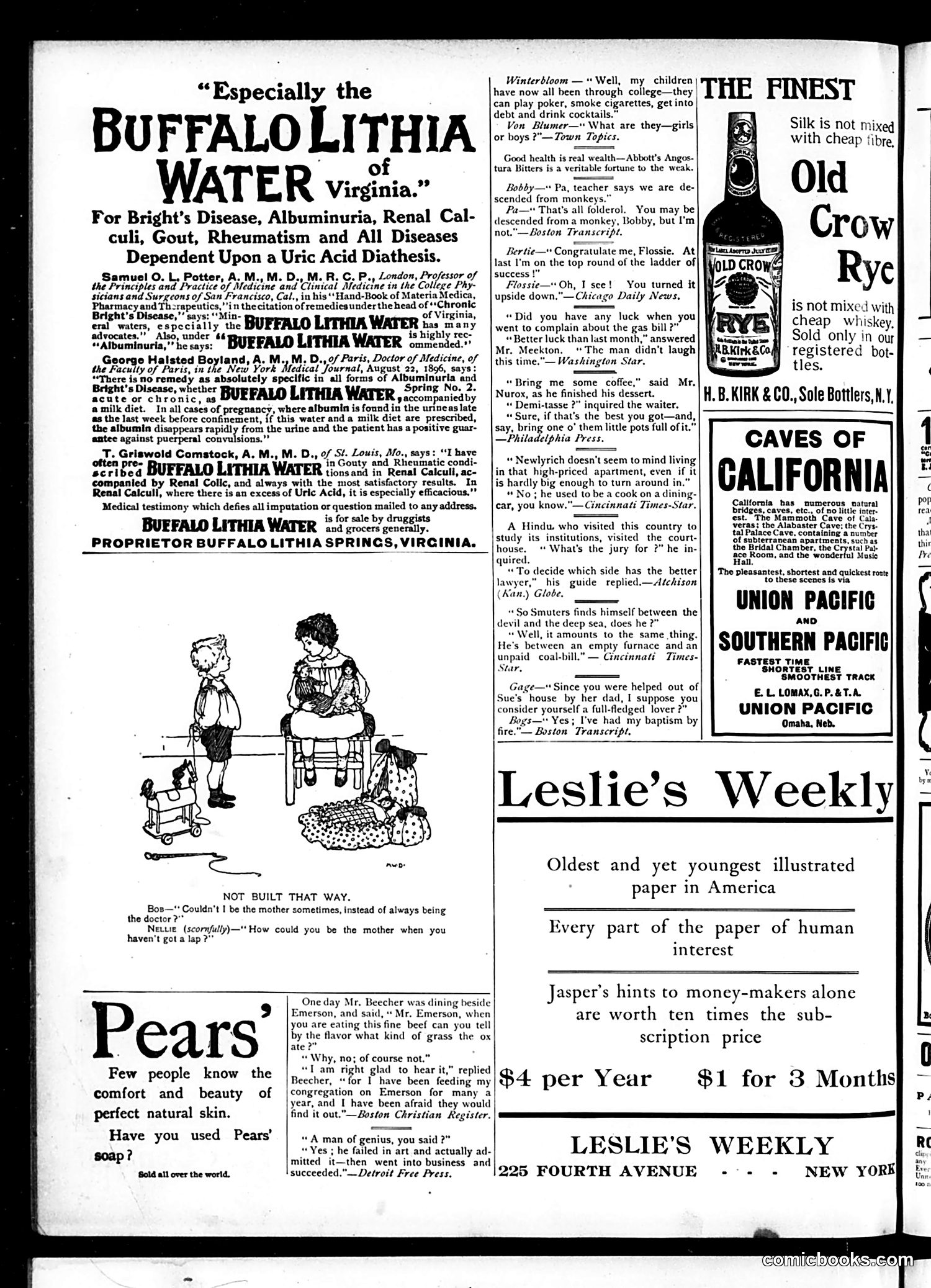
This small domestic comedy cartoon depicts two children playing—a boy and girl engaged in role-playing a doctor-patient game. The boy asks if he can be "the mother sometimes, instead of always being the doctor," and the girl responds scornfully: "How could you be the mother when you haven't got a lap?" The joke relies on early 20th-century gender stereotypes: mothers are defined by their physical capacity to hold children in their laps—a distinctly maternal function. The girl's dismissive response suggests that certain roles are biologically determined and gender-specific. By modern standards, this reflects rigid gender expectations of the era, where motherhood was literally understood as a woman's primary defining characteristic, unsuitable for boys to emulate.
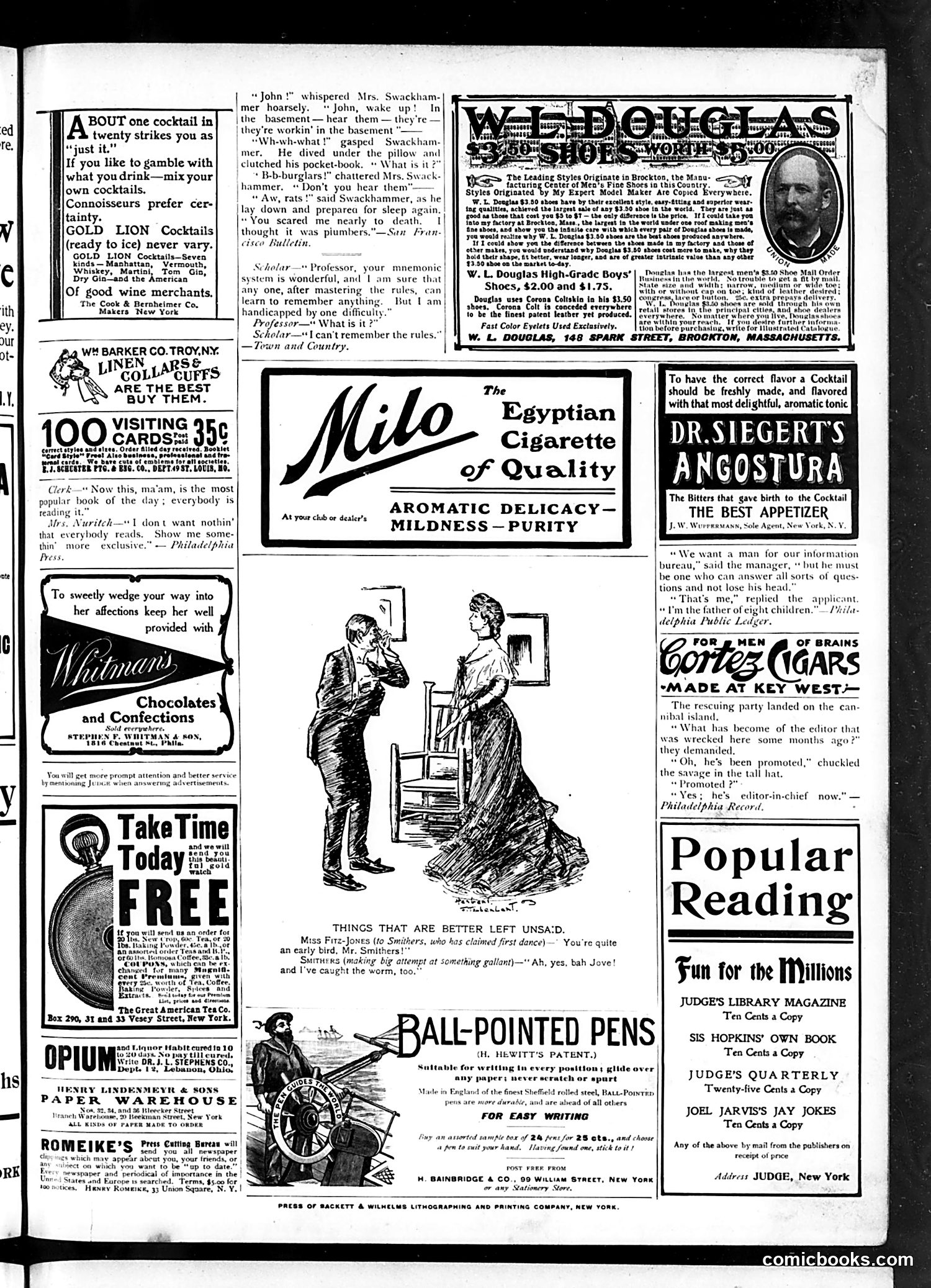
This page from Judge magazine contains primarily **advertisements and brief humor pieces** rather than political cartoons. The main cartoon depicts a domestic scene titled "Things That Are Better Left Unsaid," showing a woman confronting a man about his tardiness for a dance. The humor relies on the man's awkward attempt at flattery ("Ah, yes, bah Jove!") backfiring—he's admitted to being an "early bird," implying he wasn't specifically eager to see her. The surrounding content is mostly **commercial advertising** for period products: cocktail recipes, chocolates, visiting cards, pens, and notably, W.L. Douglas shoes. There are also small humor snippets about professors and memory systems, and hotel/restaurant references. The page reflects early 20th-century social conventions around courtship etiquette and gender relations, where a gentleman's flattery is expected but easily exposed as insincere. The satirical intent is gentle—poking fun at awkward romantic interactions rather than addressing serious political issues.
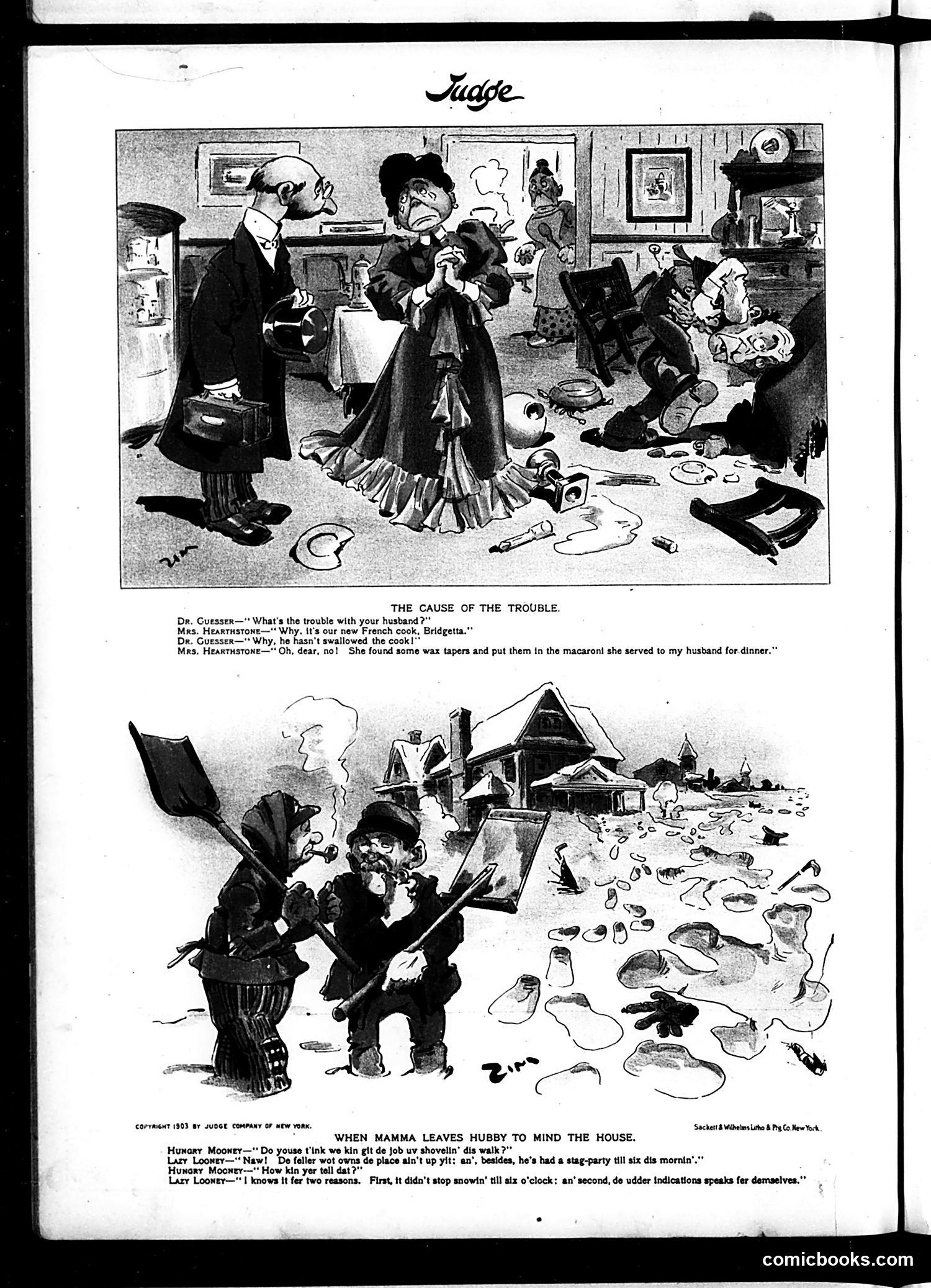
**Top cartoon**: A French cook has accidentally poisoned her employer by mixing wax candles into his macaroni dinner, creating domestic chaos. The satire mocks both nouveau-riche households employing fashionable French servants and the assumption that imported cooks represent sophistication—here with literally indigestible consequences. **Bottom cartoon**: Two unemployed laborers assess a snow-covered property, deducing the wealthy homeowner hosted an all-night drinking party ("stag-party") because: 1) snow continued falling until 6 a.m., and 2) visible disorder outside. The dialect-heavy speech represents working-class immigrants; the satire targets wealthy idleness and excess while laborers struggle for work. Both comics employ slapstick and working-class perspectives to mock upper-class pretension and incompetence—typical Judge magazine fare satirizing the Gilded Age leisure class.