
A complete issue · 16 pages · 1904
Judge — January 9, 1904
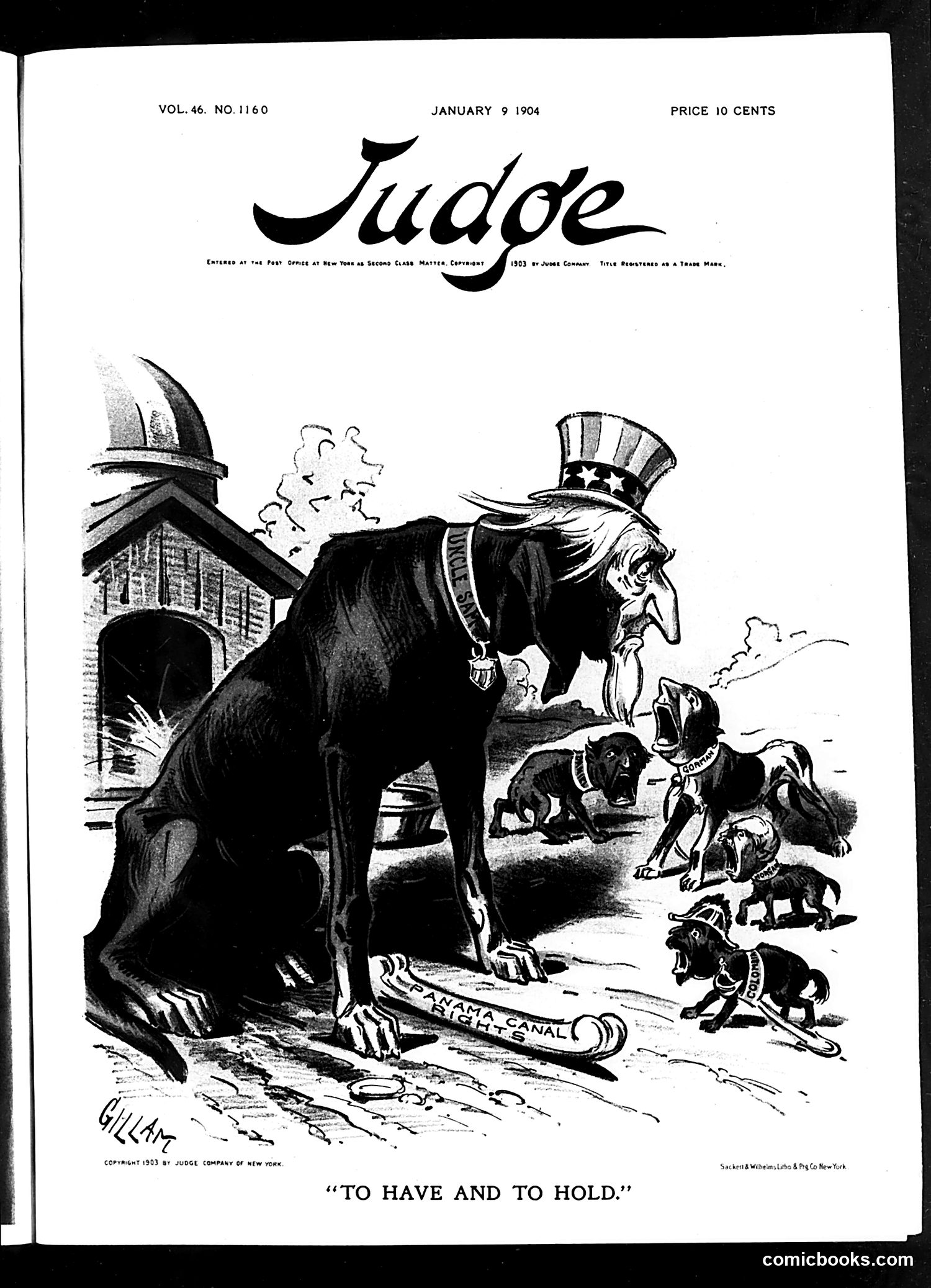
This political cartoon satirizes American imperial ambitions, specifically regarding the Panama Canal. The large Uncle Sam figure (identifiable by his characteristic top hat and goatee) stands possessively over smaller figures representing the "Panama Canal" project, which lies at his feet like a captured prize or possession. The smaller dog-like figures appear to represent other nations or rival powers competing for control of the canal. Uncle Sam's dominant posture and the title "To Have and to Hold" mockingly reference marriage vows, suggesting America's aggressive determination to maintain exclusive control over the canal—a crucial strategic and commercial asset. The cartoon critiques American imperialism during the Theodore Roosevelt era.
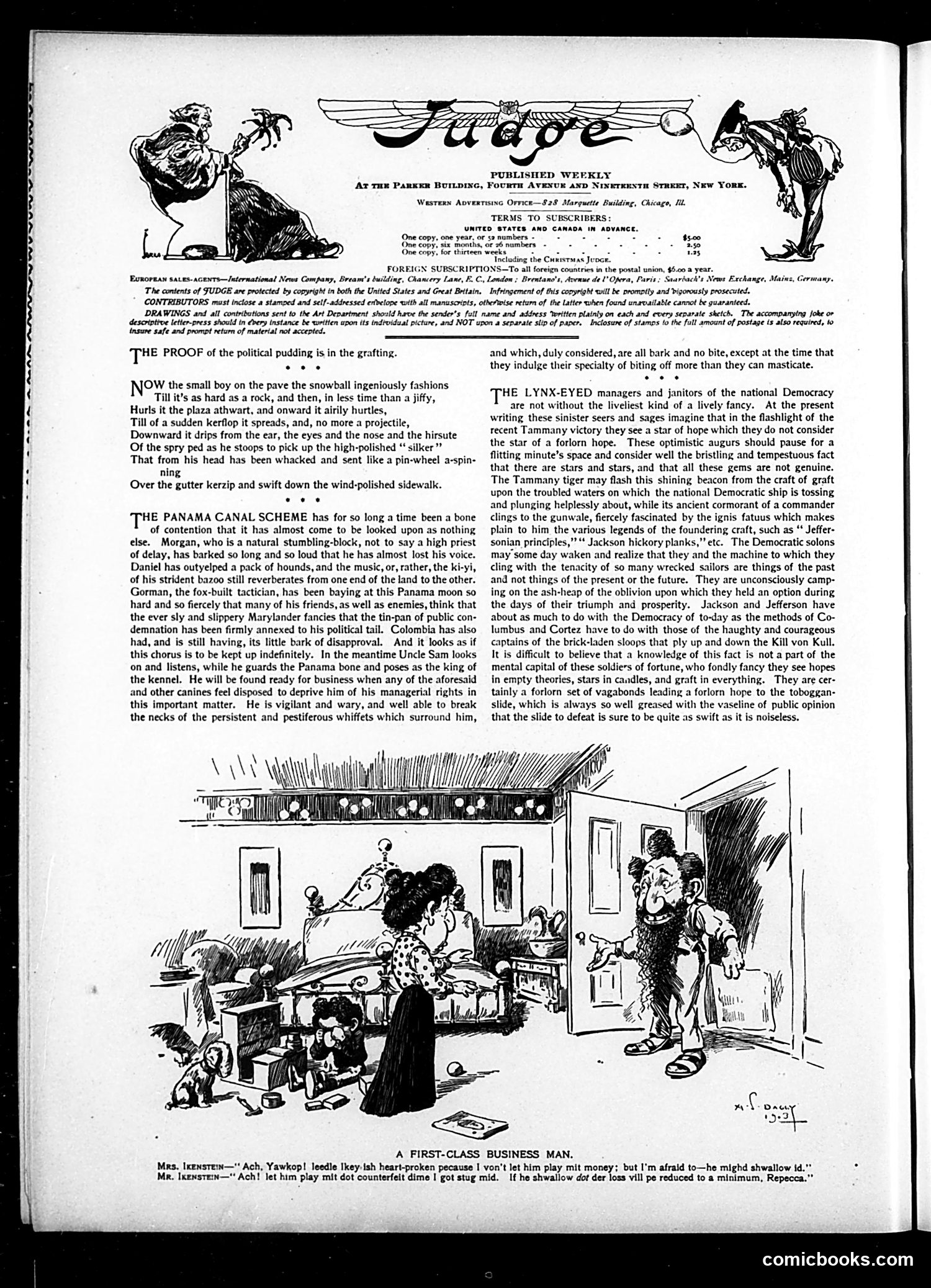
This page contains three distinct political commentaries: 1. **"The Proof of the Political Pudding"** satirizes political promises versus reality—politicians make grandiose claims that prove insubstantial. 2. **"The Panama Canal Scheme"** criticizes the Panama Canal project as mismanaged. It mocks figures like Morgan (likely J.P. Morgan, the financier) and Uncle Sam for their involvement, suggesting the project is plagued by incompetence, financial waste, and persistent problems that remain unresolved despite years of effort. 3. **"A First-Class Business Man"** (cartoon below) depicts a businessman negotiating with his wife about counterfeiting money—she refuses to let him use counterfeit bills, warning him to use genuine currency or face consequences. This satirizes corrupt business practices of the era. The overall theme criticizes American political and business corruption and broken promises.
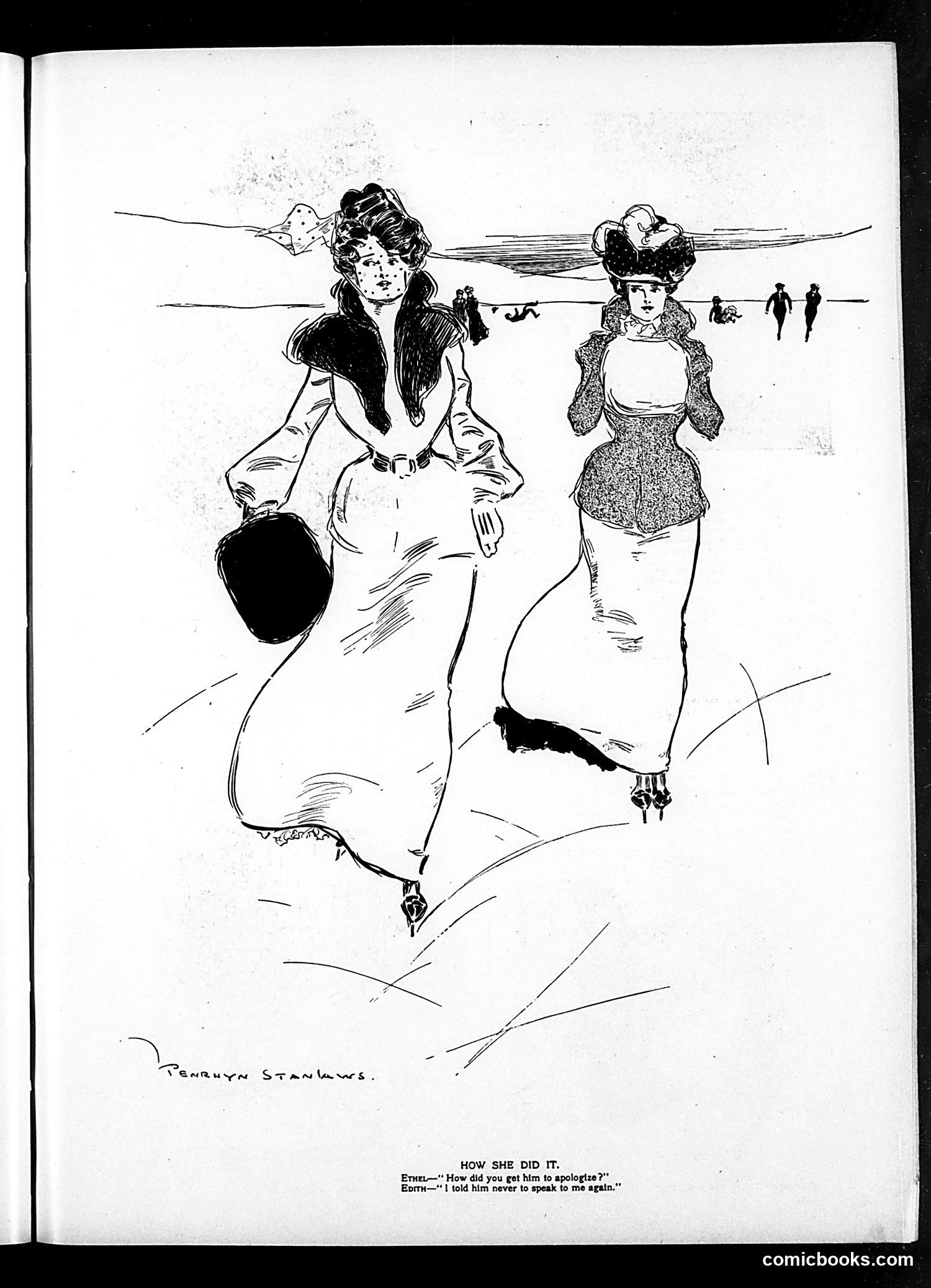
This illustration by Penrhyn Stanlaws depicts two fashionable women skating or moving across ice. The caption reads: "Ethel—'How did you get him to apologize?' Edith—'I told him never to speak to me again.'" The cartoon satirizes early 20th-century courtship dynamics and female strategy in relationships. It suggests that women could manipulate men through calculated indifference or ultimatums—specifically, that threatening silence would prompt an apology. The joke targets both the portrayed "Ethel" character's cunning and the implied foolishness of men who capitulate to such tactics. The stylish clothing and leisure setting (ice-skating) indicate these are privileged women, typical of Judge's upper-class audience and satirical scope.
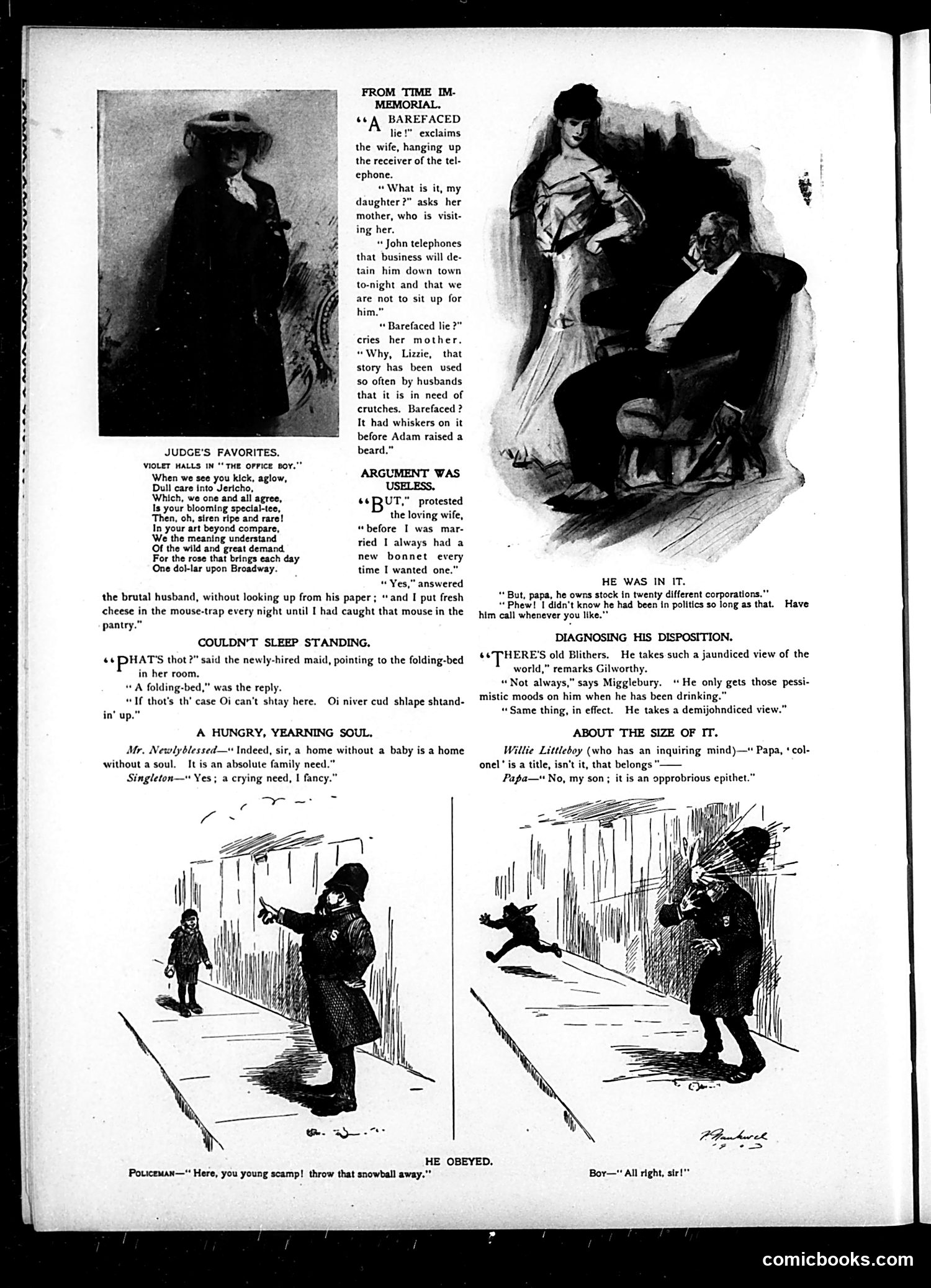
This page contains several domestic humor sketches typical of early 20th-century Judge magazine. The cartoons satirize marital dynamics and household authority: **"From Time Immemorial"** depicts a husband's excuse ("barefaced lie") about telephoning business keeping him downtown—a common evasion about infidelity or leisure time that wives supposedly shouldn't question. **"He Obeyed"** and **"About the Size of It"** show a child's obedience to a policeman versus resistance to parental authority, and a child calling his father "Colonel" (a title he doesn't possess)—gentle satire on paternal pretension and household hierarchy. The scattered anecdotes mock masculine pretense, wives' skepticism of husbands' excuses, and the gap between men's self-importance and family reality. The humor targets familiar domestic friction points of the era.
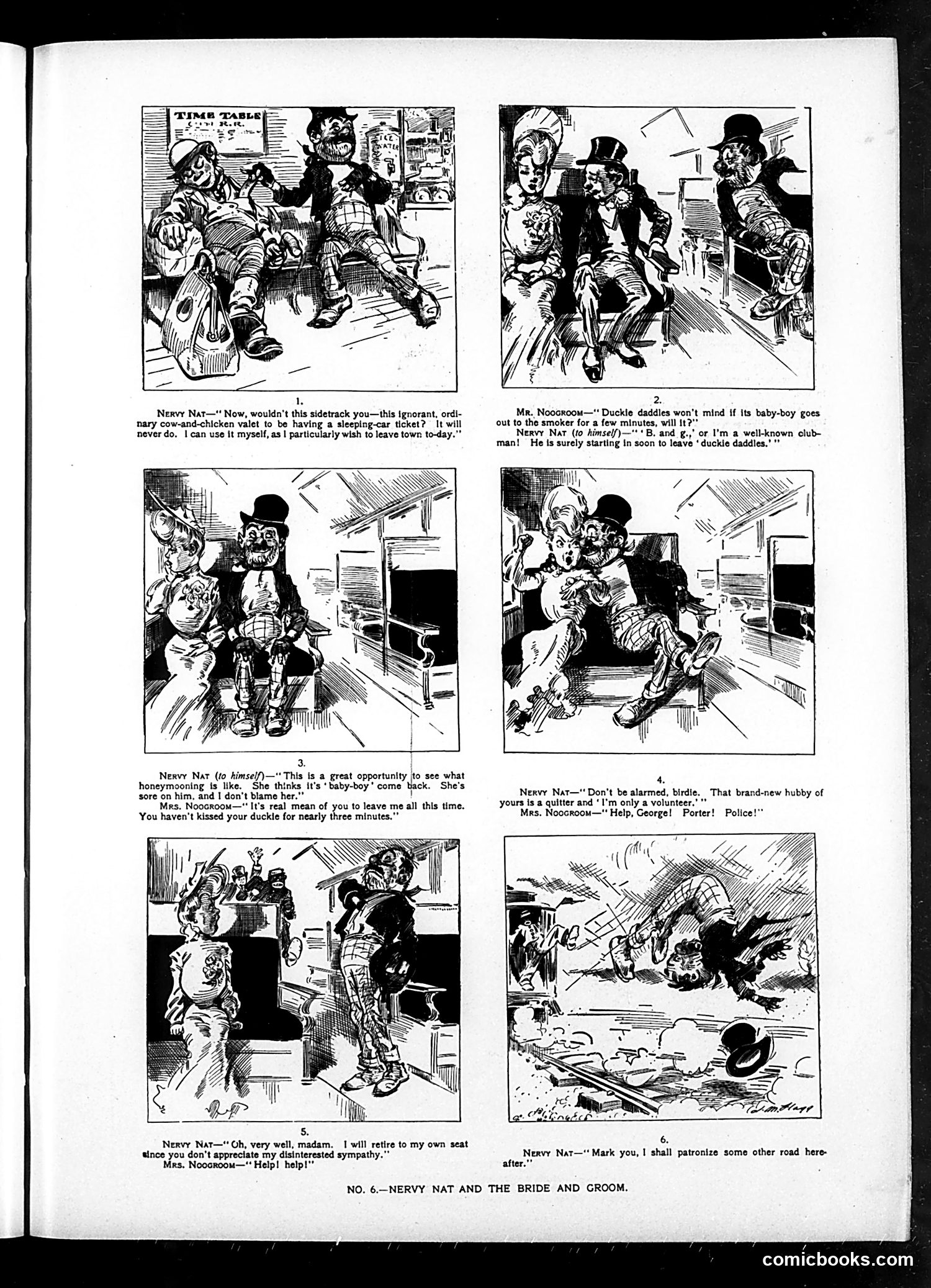
This six-panel comic strip satirizes a con artist character named "Nervy Nat" who exploits a newlywed couple on a train. The groom, "Mr. Noocroom," and his bride represent affluent but naive honeymooners. Nat systematically manipulates them—first stealing the groom's sleeping-car ticket by flattering him as a "well-known clubman," then exploiting the bride's sentimentality about newlyweds and babies to insert himself into their intimate moments. The satire targets both Nat's shameless social climbing and fraud, and the couple's gullible materialism and sentimental affectation. The final panel, where Nat indignantly threatens to patronize "some other road," inverts victimhood—he plays the insulted party despite his obvious con. The humor relies on recognizing turn-of-the-century train travel as a common setting for such petty swindles and social pretense.
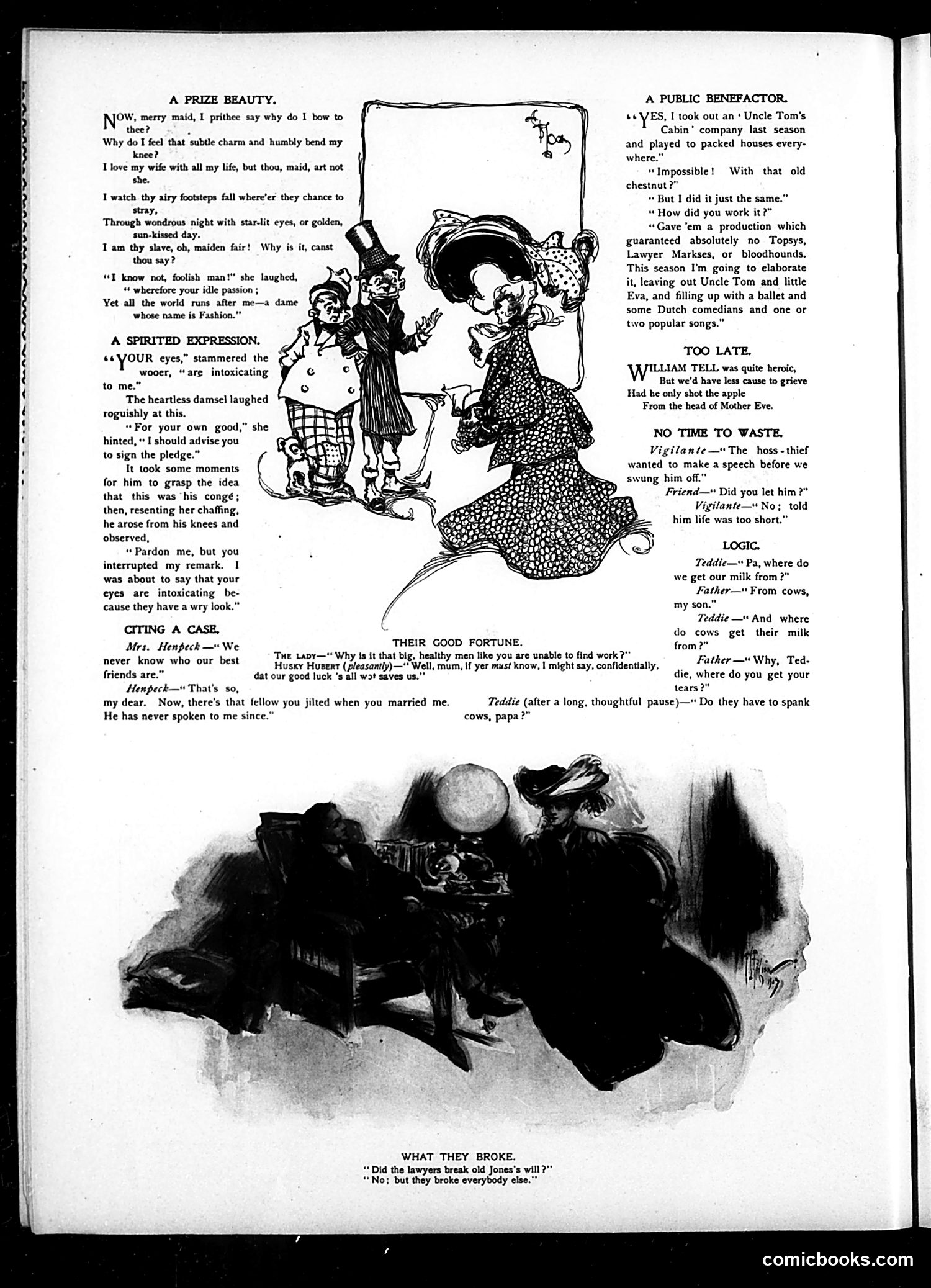
This page from the satirical magazine *Judge* contains multiple short humorous pieces mocking Victorian courtship conventions and social absurdities. **Main cartoons:** - **"A Prize Beauty"**: Satirizes how men irrationally pursue fashion and trends (personified as a woman) over genuine relationships. - **"A Spirited Expression"**: A suitor's flowery compliment about intoxicating eyes backfires when the woman interprets "intoxicating" literally, suggesting he drinks—a cutting rejection. - **"Citing a Case"**: Dark humor about a jilted suitor who won't acknowledge his rival even years later. **Lower section**: Includes jokes about theater impresarios removing controversial elements from *Uncle Tom's Cabin* for audiences, vigilante justice, and a child's innocent logic about where milk comes from. The satire targets pretense, materialism, social climbing, and the gap between romantic ideals and reality—typical *Judge* themes mocking Gilded Age society.
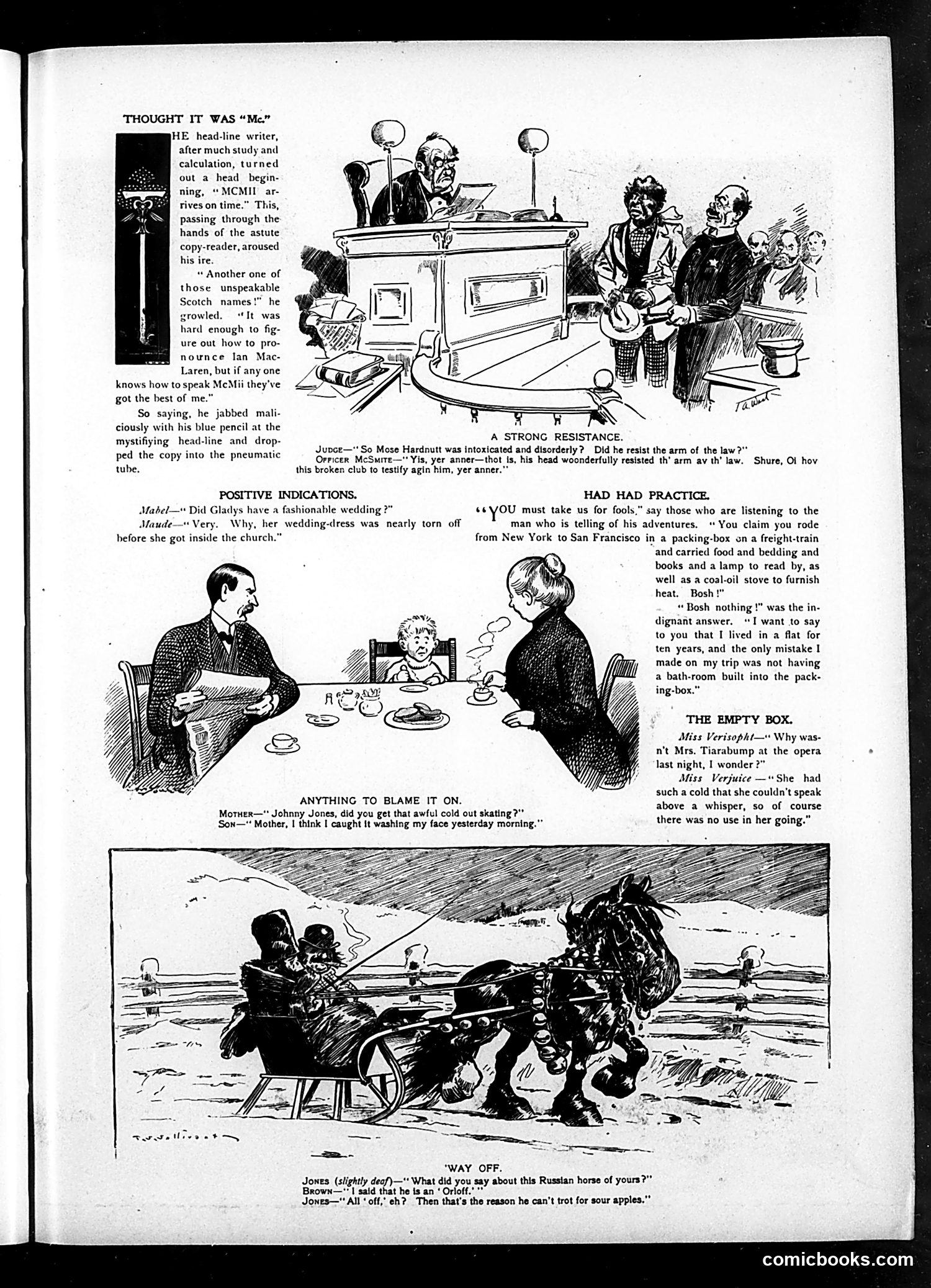
This page contains multiple short humor pieces typical of early 20th-century satirical magazines: **"Thought It Was 'Mc'"**: Mocks Scottish names and the difficulty newspaper editors had pronouncing them. A headline writer creates "McMII arrives on time," but the copy-reader, exasperated by "unspeakable Scotch names," complains—referencing the common Irish and Scottish immigration that made such surnames frequent in American papers. **"Positive Indications" and other brief jokes**: Standard domestic humor about weddings, colds, and exaggeration in storytelling—timeless comedy requiring no specific historical context. **"A Strong Resistance"**: Officer McSmire (Irish stereotype) describes a drunk resisting arrest; the humor lies in his broken English dialect and the implication that the suspect's head broke the policeman's club rather than vice versa. **"The Empty Box"** and **"Way Off"**: Puns and wordplay (the opera-goer's silence as a "feature," the horse mishearing "Orloff" as "all off"). Overall, this page reflects Judge's reliance on ethnic stereotypes, domestic situations, and verbal wit typical of American humor circa 1900-1920.
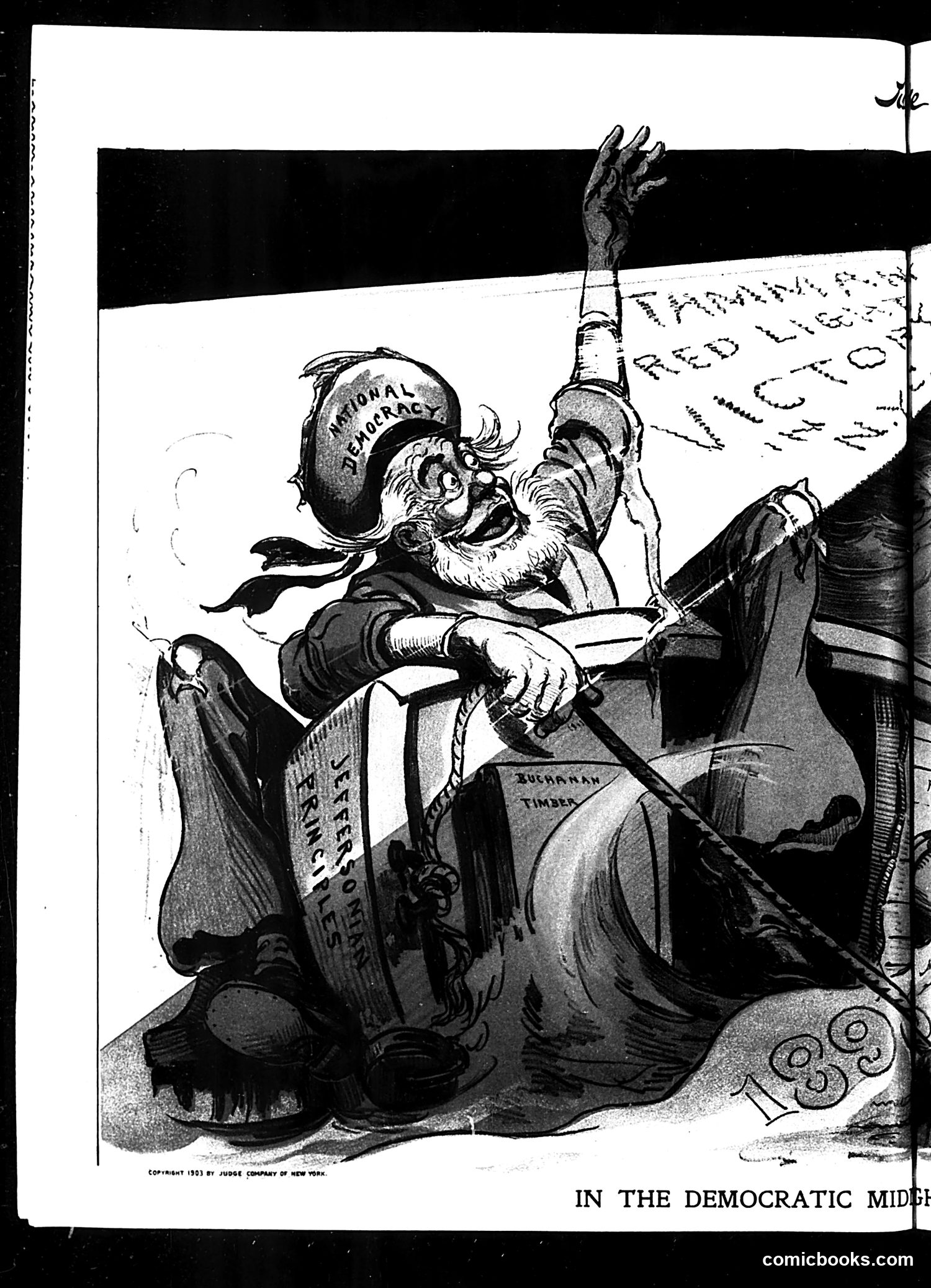
This 1903 Judge magazine cartoon, titled "In the Democratic Midst," depicts a bearded figure labeled "National Democracy" wearing a spherical helmet. The character appears to be struggling or drowning, with one arm raised desperately. Various labels on the figure's body reference what appear to be internal Democratic Party conflicts or issues of that era. The cartoon satirizes chaos within the Democratic Party around the turn of the 20th century. The drowning/struggling pose suggests the party was in disarray or unable to maintain coherence amid competing internal factions. Without clearer visibility of all labels, the specific conflicts referenced remain unclear, but the overall message critiques Democratic Party dysfunction during this period.
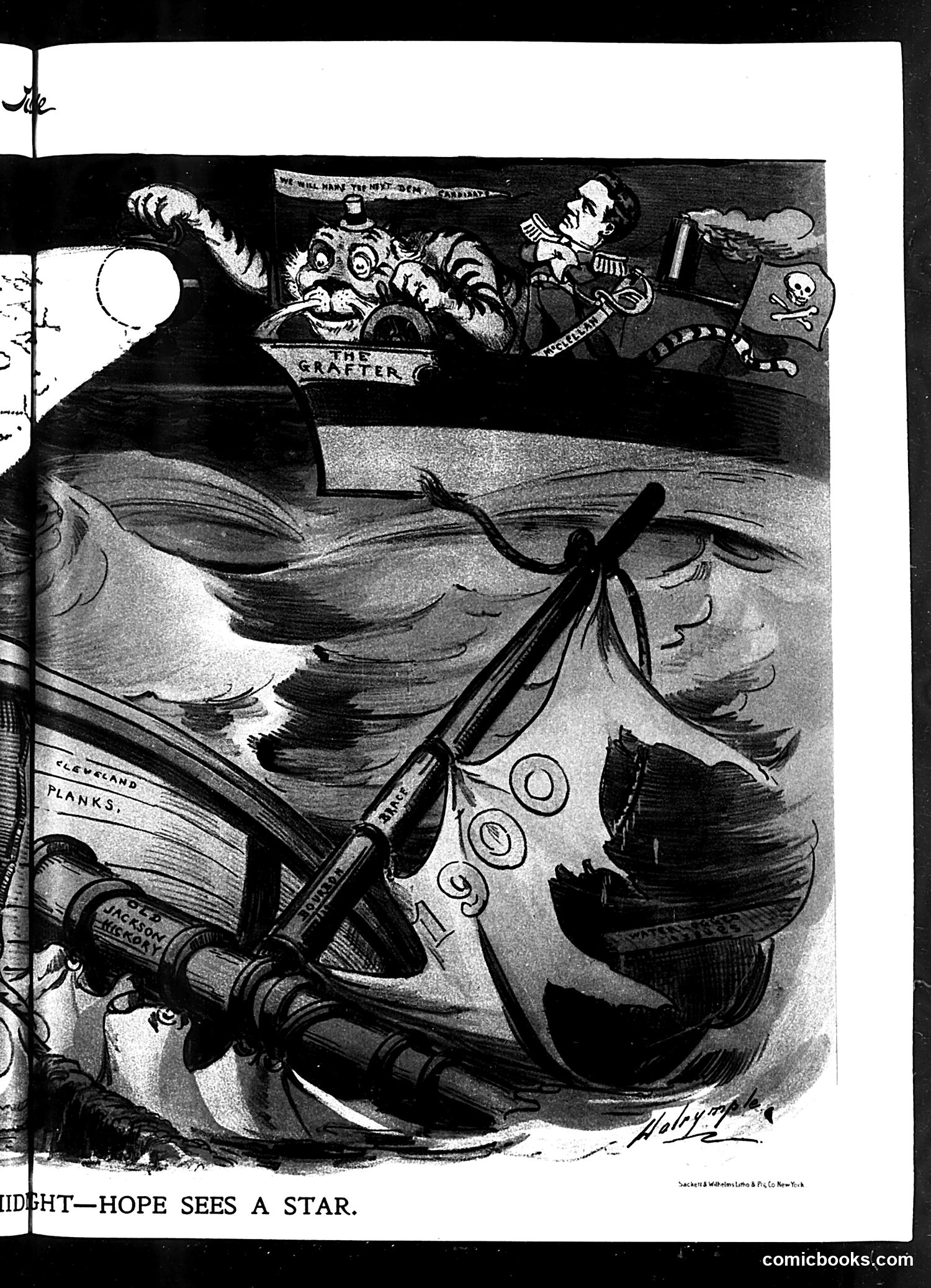
This political cartoon depicts a nighttime naval scene. A large warship labeled "The Grafter" dominates the composition, with a grotesque figure at its helm. A military officer stands aboard holding what appears to be a pirate flag (skull and crossbones), suggesting corruption or lawlessness in naval command. The title "Midnight—Hope Sees a Star" indicates that despite darkness (metaphorical corruption), hope persists. The "star" likely refers to a beacon of reform or honest leadership. The cartoon appears to criticize naval graft and corruption—a common Progressive Era concern. "The Grafter" personification and pirate imagery suggest that those controlling the navy are essentially thieves or corrupt officials. The specific figures remain unclear without additional historical context, but the satire targets corruption in military administration circa Judge magazine's publication period.
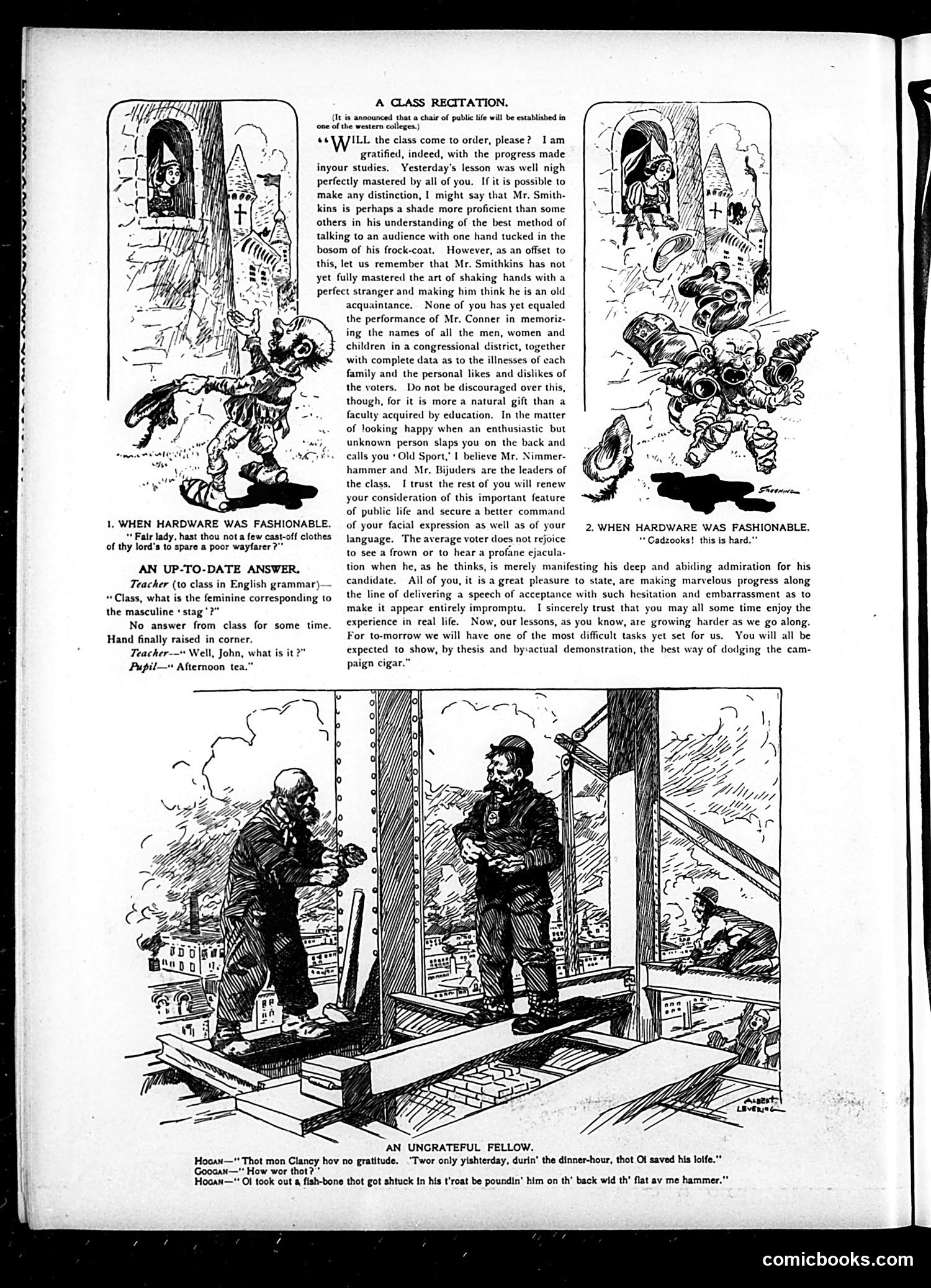
This page satirizes American political corruption and machine politics circa early 1900s. **"A Class Recitation"** mocks the proposed establishment of a "chair of public life" at a western college. The teacher praises students' mastery of corrupt political tactics: hand-gestures for oratory, memorizing voters' personal details and ailments, faking spontaneous friendliness ("Old Sport"), and delivering acceptance speeches with calculated false hesitation. The satire suggests these manipulative skills—not ethics or genuine leadership—comprise actual "public life" education. **"An Up-to-Date Answer"** is a brief joke: asked the feminine form of "stag," a student answers "afternoon tea," mocking women's social triviality. **"An Ungrateful Fellow"** shows working-class Irish dialect humor (common in Judge), depicting a man brutally saving a coworker's life by pounding his back to dislodge a fishbone, only to receive ingratitude. The top cartoons titled "When Hardware Was Fashionable" appear unrelated period pieces.
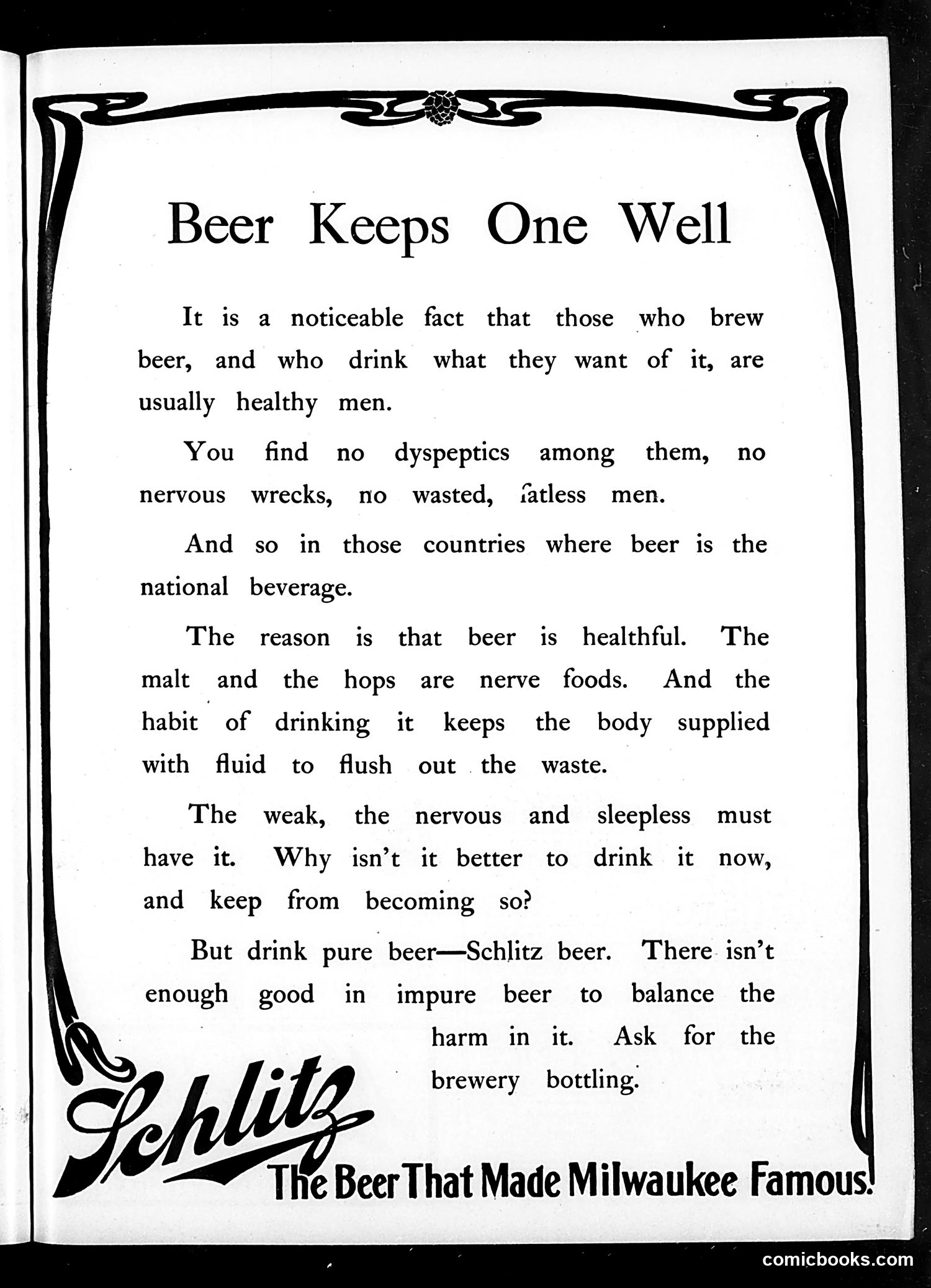
This is a **beer advertisement**, not satirical content. It's a Schlitz beer ad making health claims common in early 20th-century advertising. The page argues that beer drinkers are healthier than non-drinkers, claiming malt and hops are "nerve foods" that prevent dyspepsia, nervousness, and insomnia. It suggests people should drink beer *preventatively* to avoid becoming weak or nervous. The pitch concludes by endorsing specifically **Schlitz brand** as "pure beer," implying competitors' products contain harmful impurities. **Historical context**: Before modern food/drug regulation, alcohol was routinely marketed as medicinal. These claims about nerve foods and digestive health would be illegal today. The ad reflects pre-FDA attitudes when such therapeutic advertising was standard commercial practice.
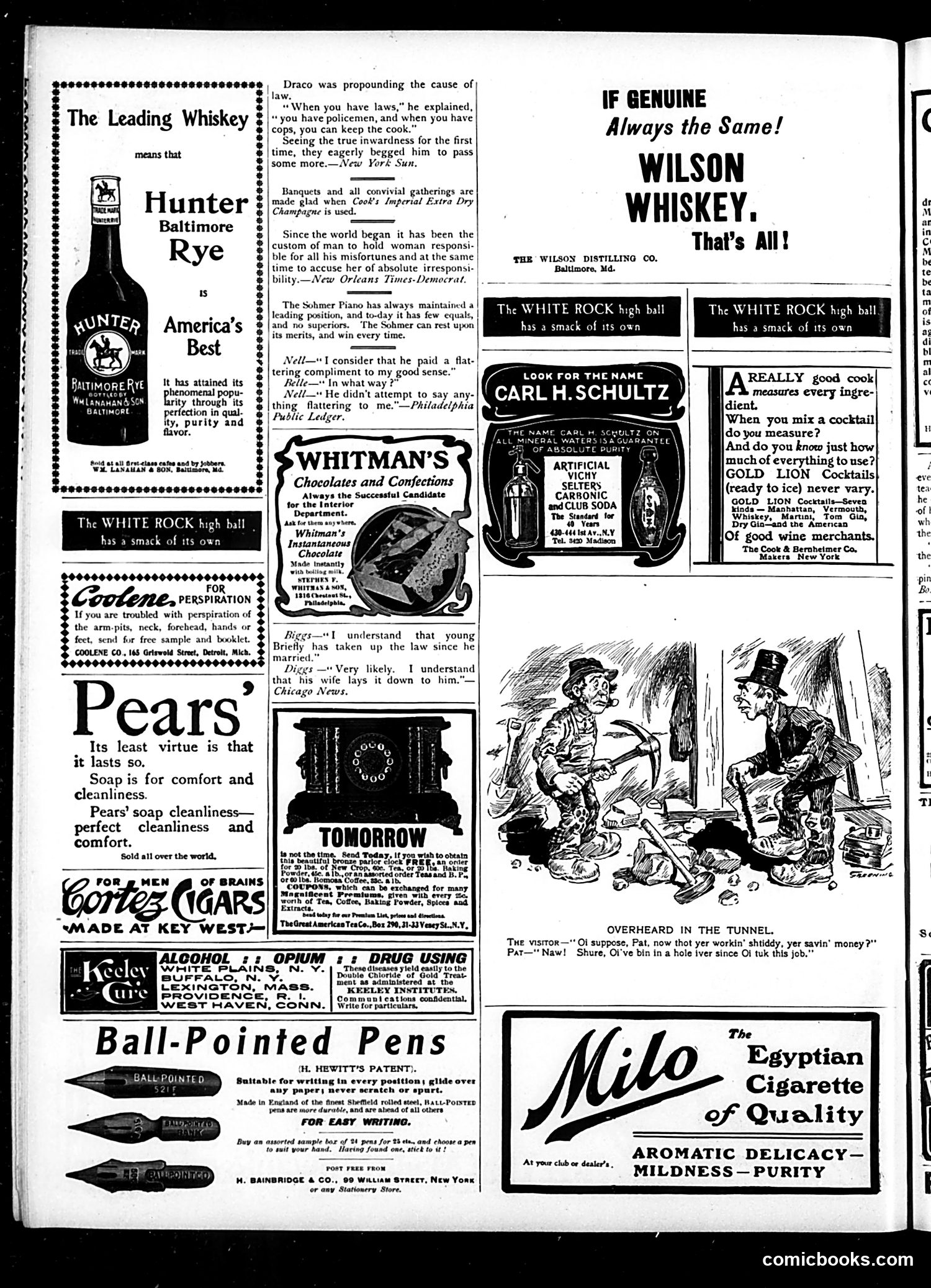
This single-panel cartoon depicts two working-class Irish immigrants (identifiable by their exaggerated accents rendered in dialect). The visitor asks the tunnel worker Pat if he's saving money now that he's employed steadily. Pat responds that he's actually been "in a hole" financially since taking the job. The humor operates on multiple levels: a literal pun ("hole" referring both to his financial troubles and the tunnel he works in), and social commentary on working-class poverty. Despite steady employment, Pat cannot escape debt—likely reflecting the precarious economic position of Irish laborers in early 20th-century America, who faced low wages, poor conditions, and high living costs. The cartoon satirizes the gap between the promise of stable work and actual economic mobility for immigrant laborers.
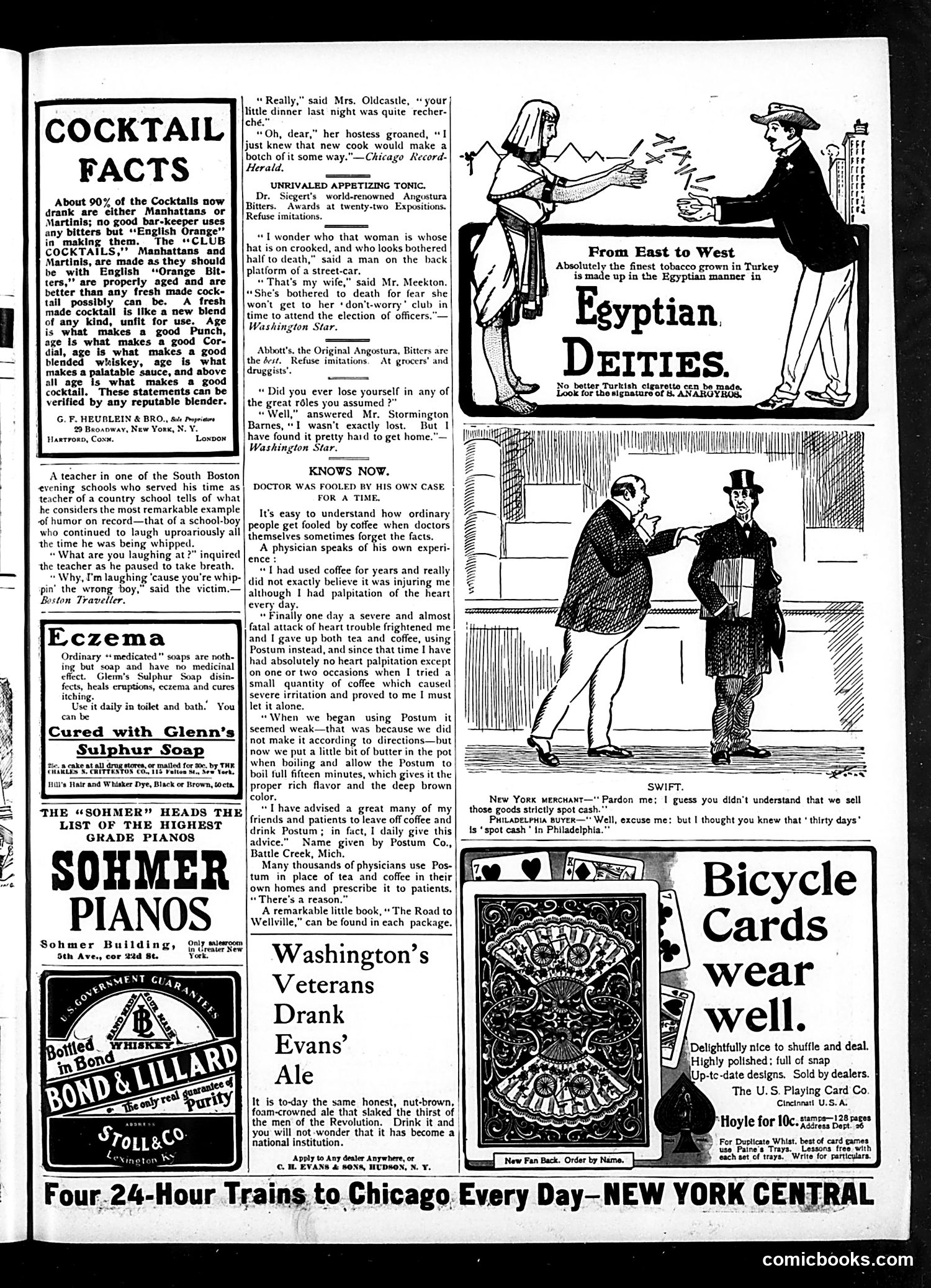
This page from the satirical magazine *Judge* is primarily an **advertising compilation** rather than a cohesive editorial or cartoon commentary. The main content includes: 1. **"Cocktail Facts"** advertisement promoting proper cocktail preparation and English Orange Bitters—a commentary on American drinking culture's supposed need for instruction. 2. **Brief humor anecdotes** (teacher being beaten by wrong student; wife at "don't-worry" club) that serve as filler content typical of period magazines. 3. **The central cartoon "From East to West"** depicts an interaction between a Turkish tobacco merchant and an American businessman, advertising Egyptian cigarettes—reflecting early 20th-century colonial-era marketing and Western fascination with "exotic" Eastern products. 4. **"Doctor Fooled by Coffee"** is a product testimonial for Postum (caffeine-free coffee substitute), framed as medical advice—reflecting contemporary health anxieties about coffee's effects. The page reflects advertising-driven magazine economics and period attitudes toward foreign goods, health, and consumption rather than sharp political satire.
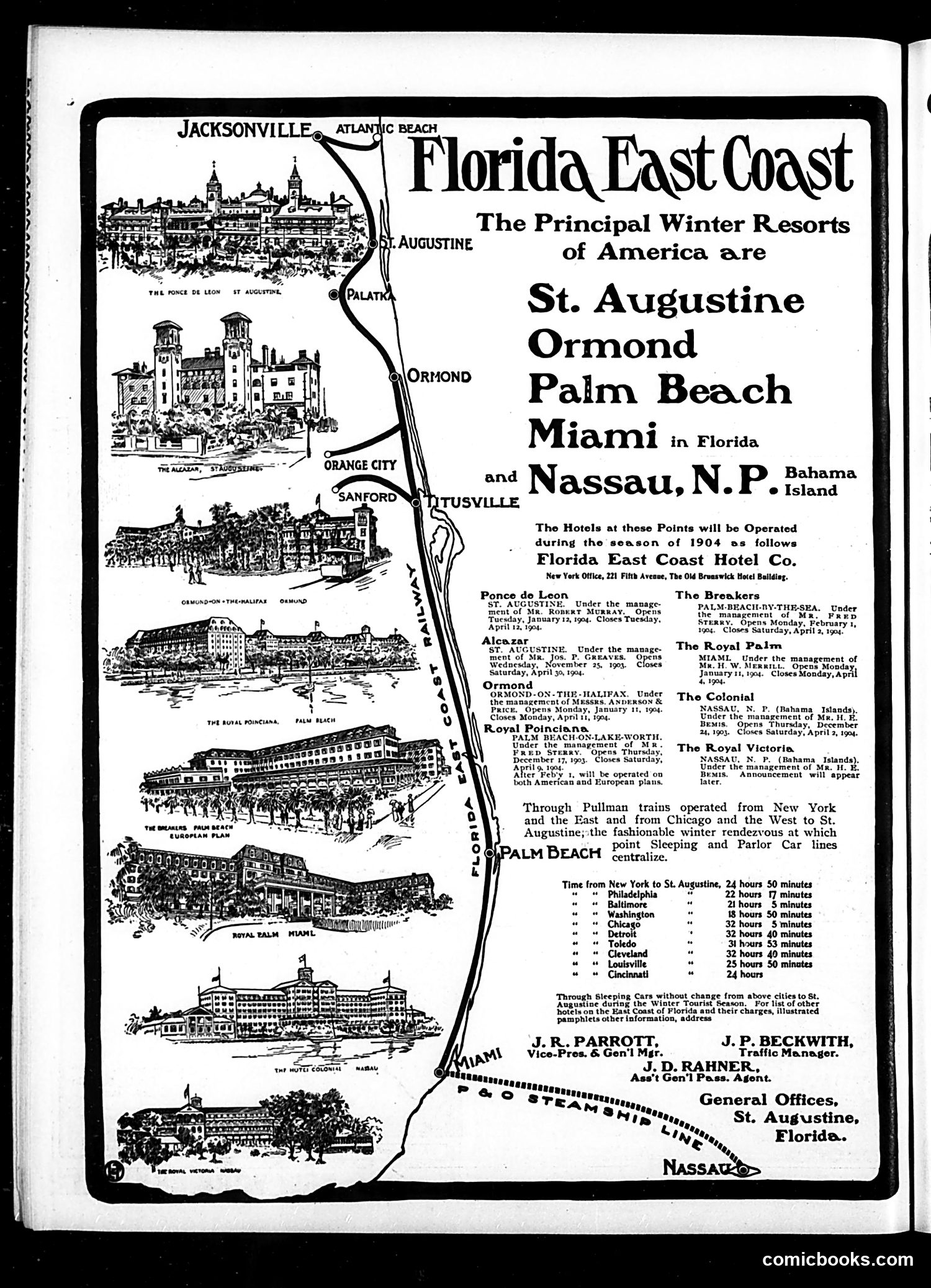
This is **not a cartoon or satire page**, but rather a **full-page advertisement** for Florida East Coast winter resorts from the 1904 season. The page promotes luxury hotels operated by the Florida East Coast Hotel Company across five destinations: St. Augustine, Ormond, Palm Beach, Miami, and Nassau (Bahamas). Each location features an architectural illustration of its principal hotel—the Ponce de Leon, Royal Poinciana, Breakers, Royal Palm, and Colonial/Royal Victoria. The text provides practical travel information: opening/closing dates for the 1904 season and train travel times from major northeastern cities (New York to St. Augustine takes 24 hours 50 minutes). This reflects the historical reality that Florida's east coast, developed by railroad magnate Henry Flagler, had become America's premier winter destination for wealthy Americans seeking warm weather and luxurious accommodations. The advertisement targets affluent northeastern travelers with Pullman sleeping car service.
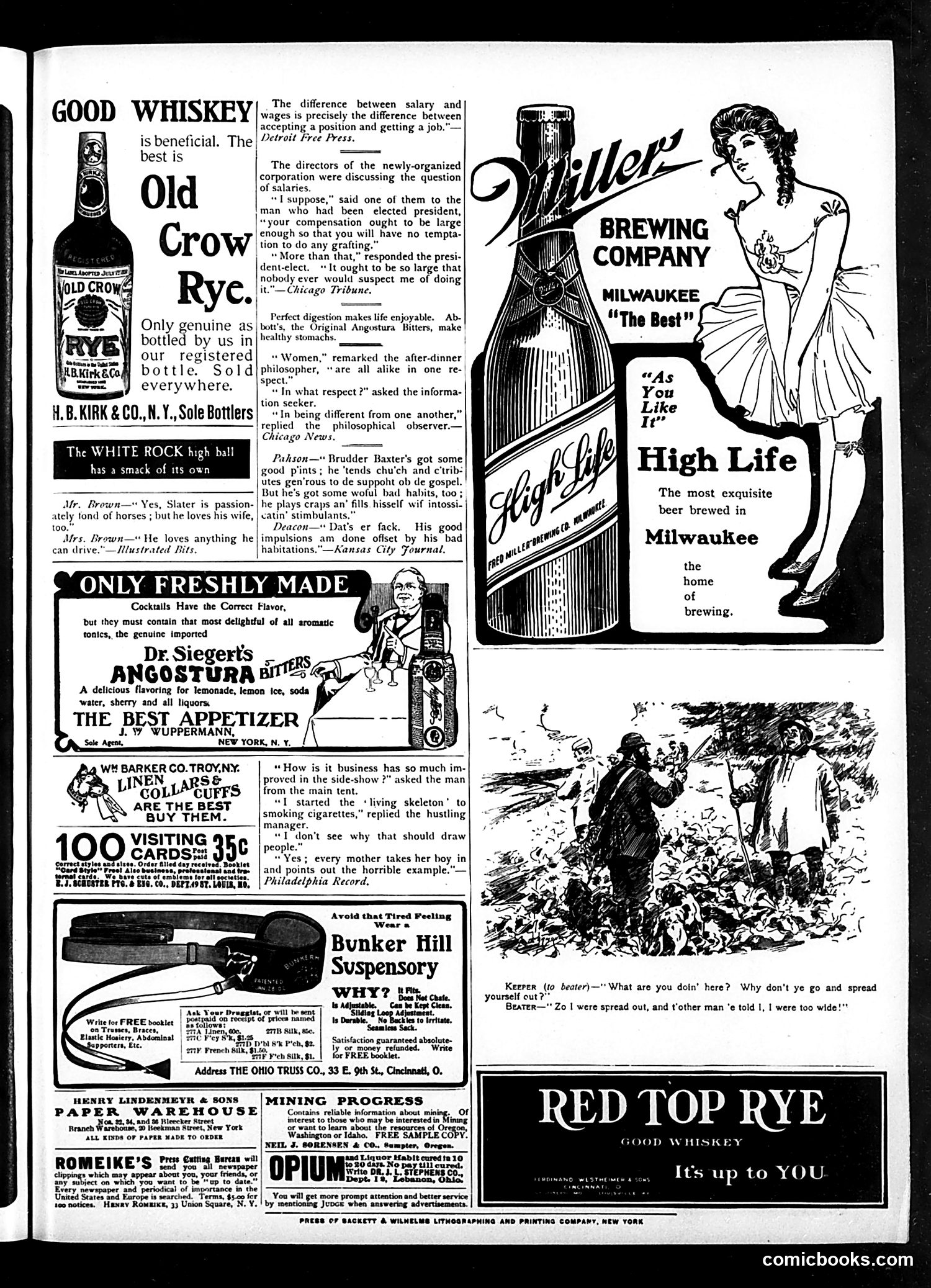
This page is primarily **advertising**, typical of early 20th-century magazines. The main content consists of liquor and patent medicine ads (whiskey, beer, bitters) interspersed with brief humorous anecdotes. The cartoons/jokes include: 1. **"The Living Skeleton" joke**: A sideshow manager increases attendance by having his skeletal performer smoke cigarettes—mothers bring boys to see "the horrible example" of smoking's effects. This reflects contemporary anti-smoking sentiment. 2. **Various one-liners** about marriage, digestion, and philosophy that were typical Judge humor—mild observations on gender differences and human nature. 3. A **bottom illustration** (captioned with "Keerer" and "Beater") appears to show a work-related scene, though the joke's context is unclear from the visible text. The page reflects the era's attitudes: casual sexism, promotion of alcohol as medicinal, and anti-smoking moralism coexisting with whiskey advertising. Most humor relies on wordplay and gentle social observation rather than sharp satire.
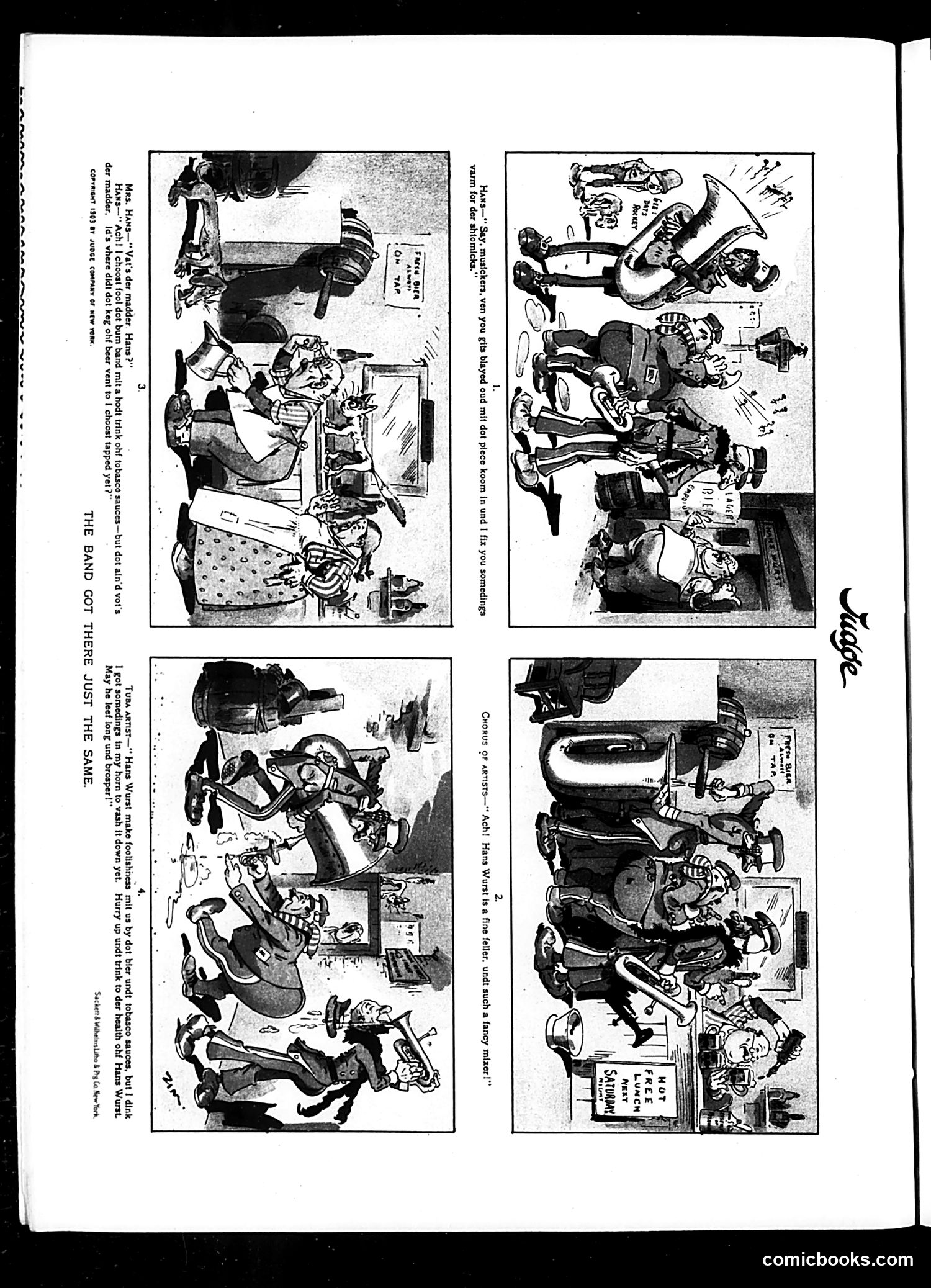
This 1903 Judge cartoon satirizes German-American stereotypes through a four-panel narrative. "Hans Wurst" (a stereotypical German character name meaning "Hans Sausage") plays a practical joke on a musical band by serving them drinks laced with hot sauce and tobasco instead of proper refreshment. The satire hinges on ethnic caricature: Hans and other German characters speak in exaggerated, broken English with German phrases ("ven," "choost," "undt"). The joke's premise—a working-class German bartender/tradesman outwitting "fancy" musicians—reflects period class anxieties and immigrant humor. The punchline appears to be that despite Hans's trick, the band recovers and toasts his health anyway, suggesting good-natured resilience. The title ironically implies the musicians achieved their goal (performing) despite the disruption. This type of ethnic humor was mainstream magazine fare in early 1900s America.