
A complete issue · 18 pages · 1904
Judge — January 2, 1904
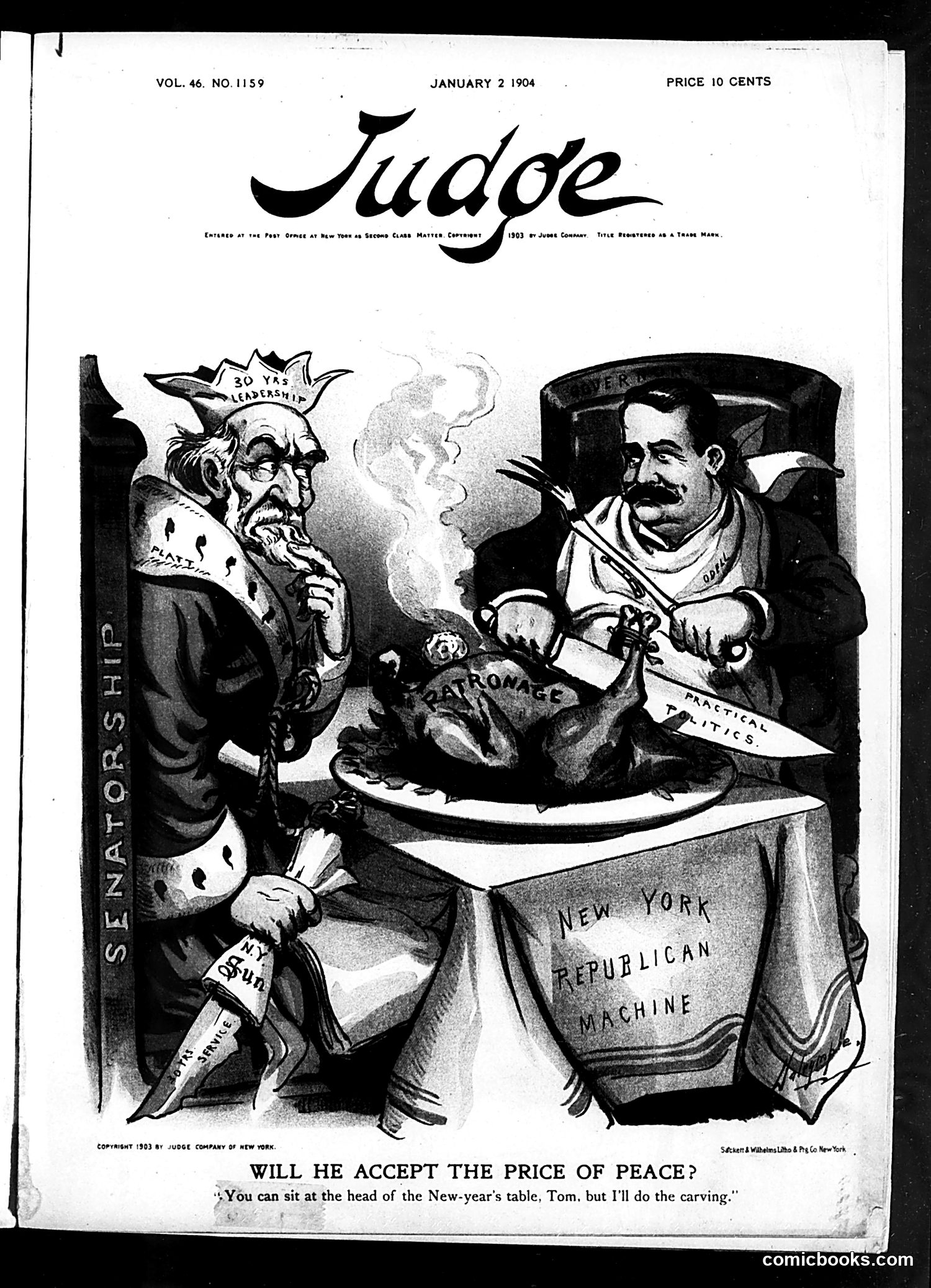
This *Judge* magazine cover from January 2, 1904 depicts a political negotiation. The left figure, labeled "Senator's Ship" with a "50 Years Leadership" badge, appears to be an elderly Republican senator. He confronts a man emerging from the "New York Republican Machine" pot, holding a knife labeled "Practical Politics." The caption quotes dialogue about accepting "the price of peace" at the New Year's table. The satire suggests tension within New York Republican politics—likely depicting a conflict between an old-guard Republican senator and the machine politicians controlling the state party apparatus. The cartoon criticizes how political "practical considerations" corrupt idealistic leadership, questioning whether the senator will compromise his principles for party unity.
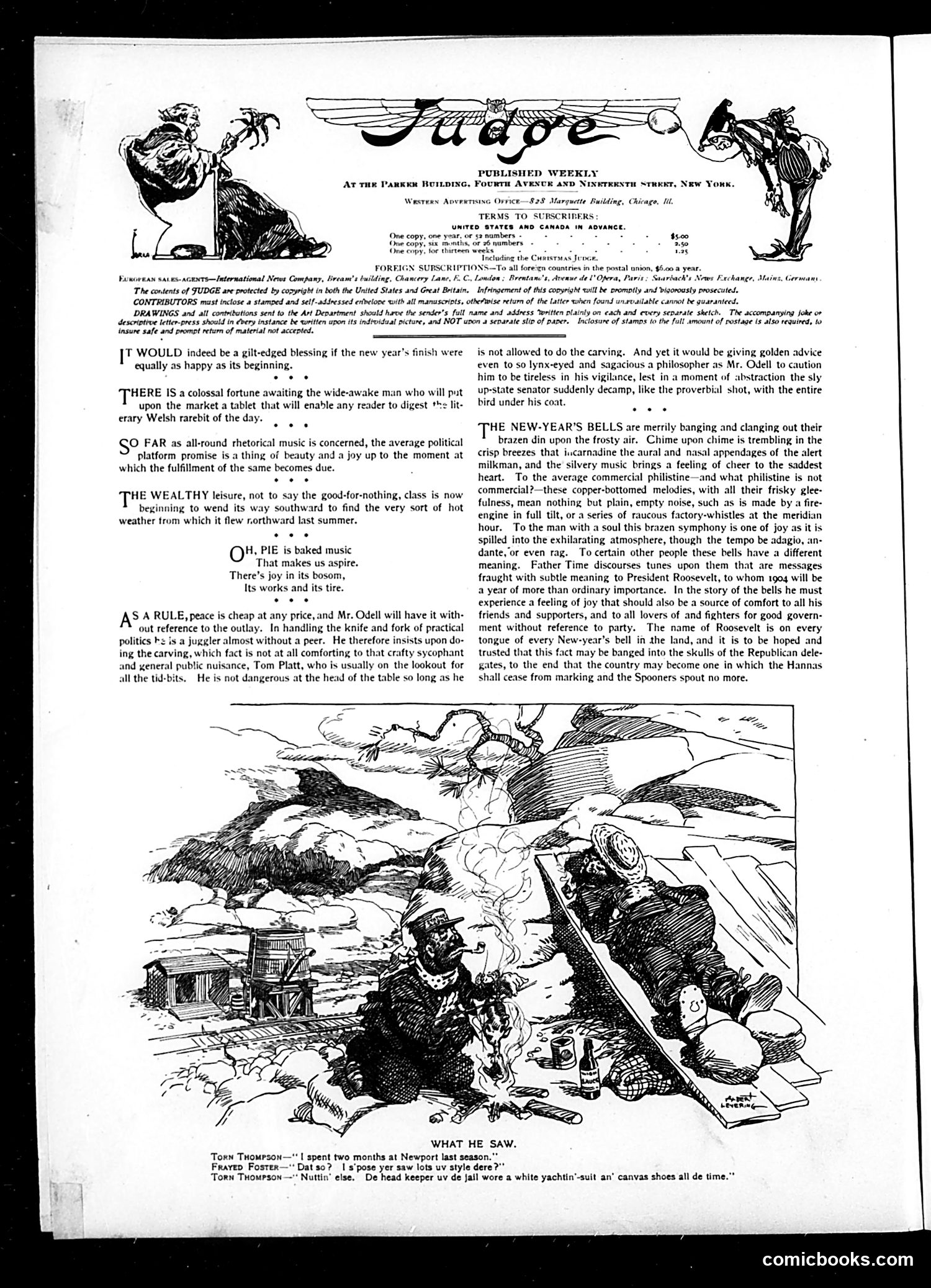
This page contains New Year's commentary with a cartoon titled "What He Saw." The sketch depicts two men (identified in dialogue as Tom Thompson and Prayed Foster) discussing Newport's social season. Tom brags about spending time there, while Foster asks sarcastically if he "saw lots uv style dere?"—to which Tom replies the only notable sight was a jailkeeper in a white yacht suit and canvas shoes. The satire targets wealthy Newport society's pretensions. By contrasting a prisoner's keeper with the elite resort's fashionable inhabitants, the cartoon suggests that Newport's upper class are morally or socially equivalent to jailers—implying hypocrisy or corruption among the wealthy. The joke relies on readers' familiarity with Newport's reputation as an exclusive playground for America's richest families.
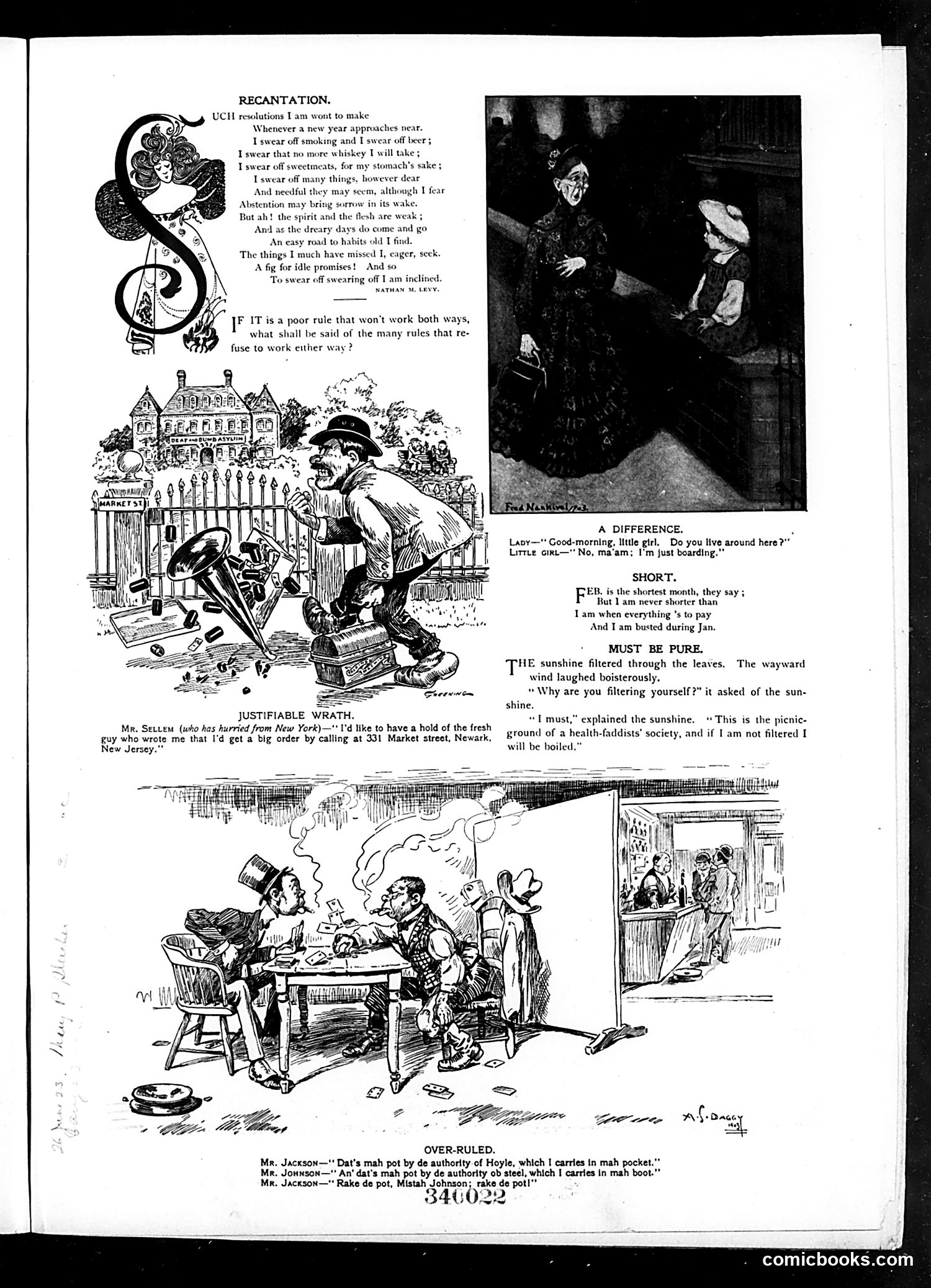
This page contains several satirical pieces from Judge magazine: **"Recantation"** presents a humorous poem about New Year's resolutions—swearing off smoking, drinking, and vice—though the author doubts he'll succeed. The accompanying illustration shows a man in a yard surrounded by broken resolutions and debris. **"Justifiable Wrath"** depicts a man from Newark, New Jersey angry about a letter he wrote being published in a newspaper, now drawing unwanted attention from the public. **"Must Be Pure"** uses a dialogue between sunshine and a filter to satirize health-faddists' obsessive behavior. **"Over-Ruled"** shows men arguing about authority—likely Hoyle's rules (card games) versus pocket authority. The cartoons mock common human foibles: broken promises, embarrassing publicity, health obsession, and petty disputes over rules. The humor relies on exaggerated character types familiar to Judge's contemporary audience.
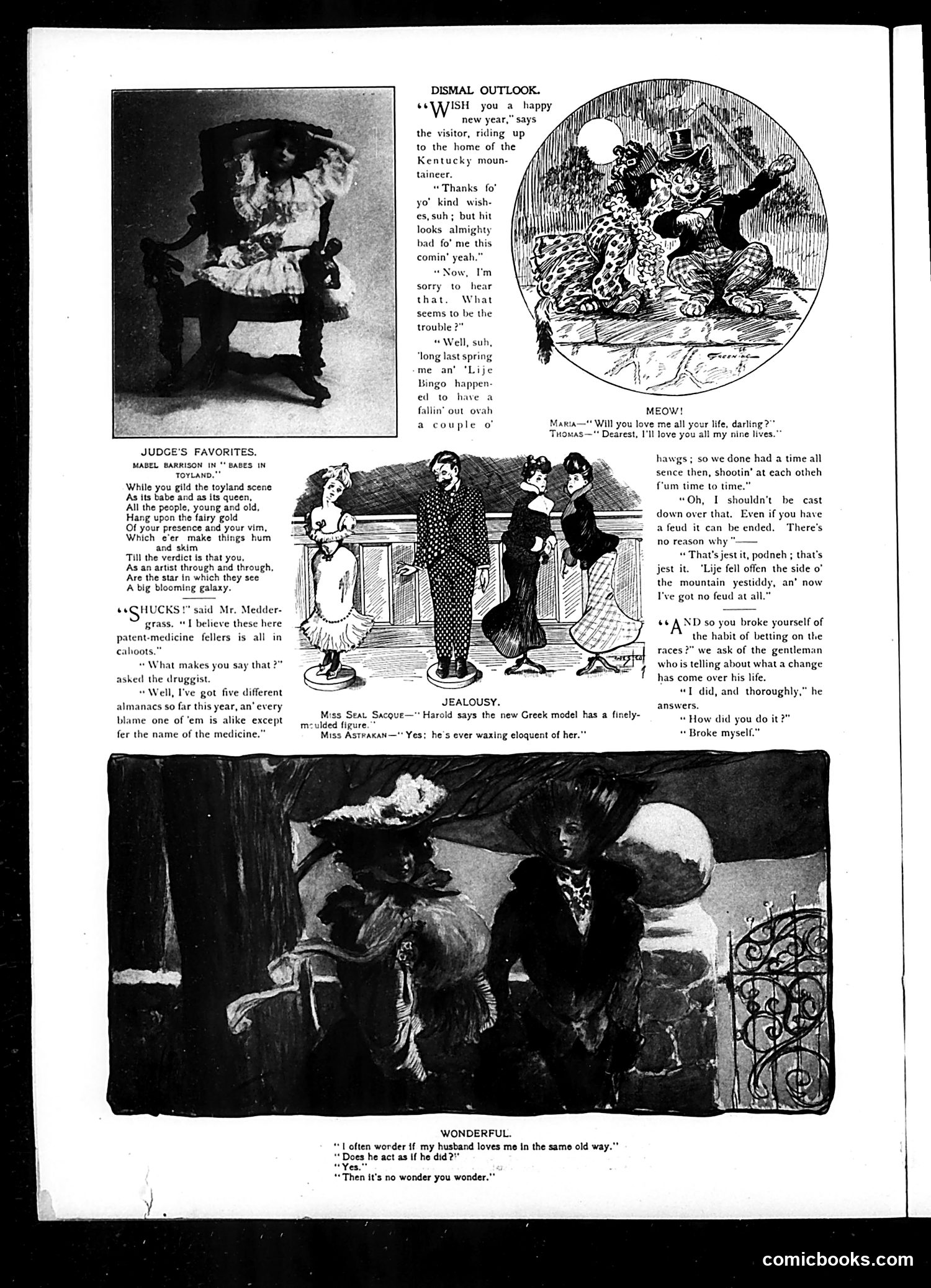
This page contains several unrelated humorous sketches typical of Judge magazine's satirical format: **"Dismal Outlook"** depicts a dialogue between a Kentucky mountaineer and a visitor about New Year's prospects, playing on rural dialect humor. **"Judge's Favorites"** is a poem about theatrical scenes and artistic merit, likely referencing contemporary stage productions. **"Meow!"** shows cats in conversation—anthropomorphic animal humor common to the era. **"Jealousy"** depicts society women gossiping about a new Greek model, satirizing upper-class pettiness and pretension. **"Wonderful"** shows a domestic conversation questioning whether a husband's affections have changed. The page lacks obvious political content, instead offering social satire targeting class distinctions, domestic relationships, and theatrical culture. Without date information visible, the specific references remain unclear, though the humor targets recognizable social types of early 20th-century America.
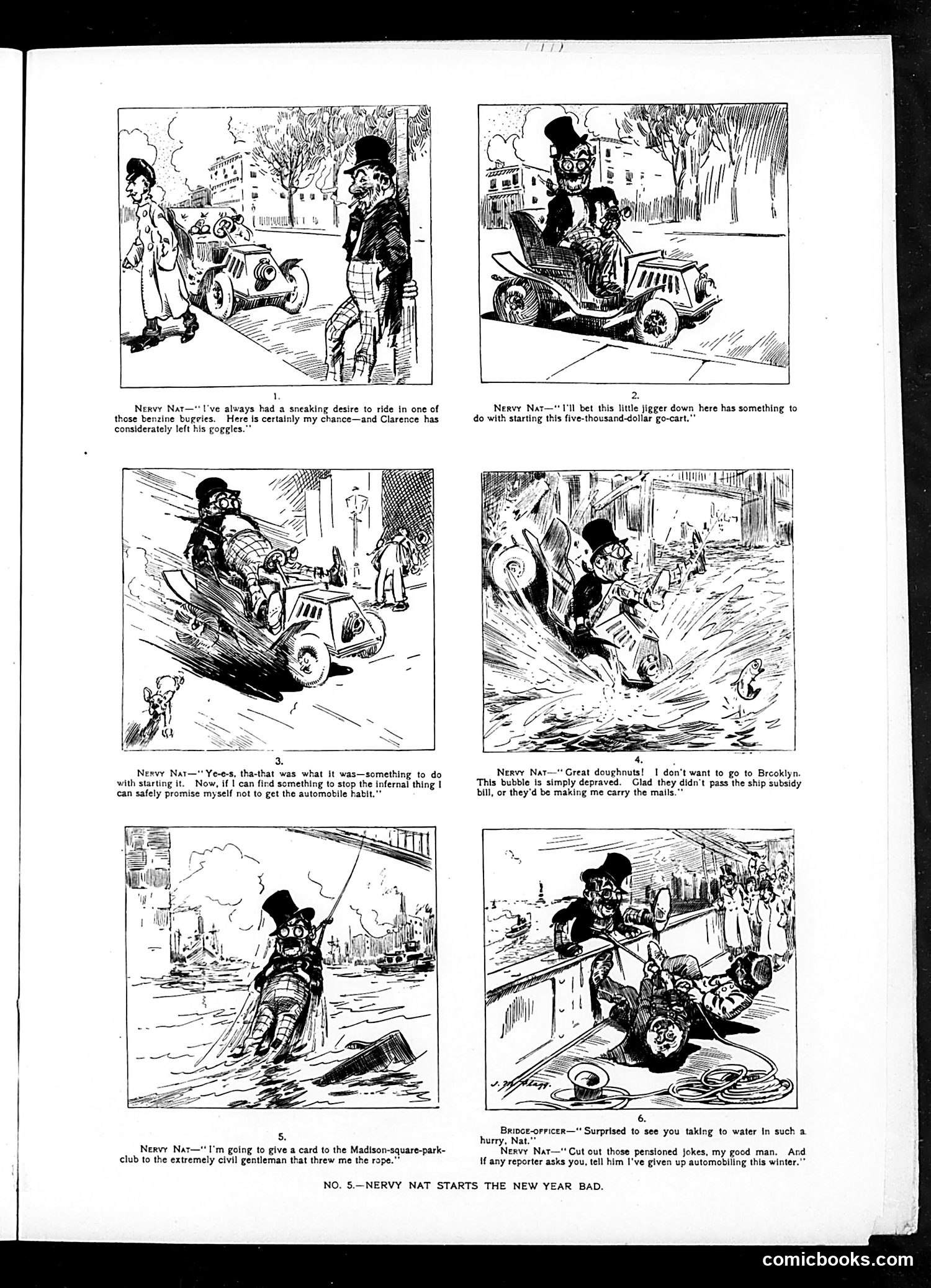
This Judge comic strip satirizes the early automobile craze through the misadventures of "Nervy Nat," a recurring character known for audacious stunts. The narrative follows Nat stealing a wealthy man's (Clarence's) expensive motorcar and losing complete control of the vehicle—unable to start or stop it. The humor hinges on the novelty and danger of early automobiles: Nat mistakes the starter mechanism, the car launches uncontrollably through the streets, crashes into water, and nearly drowns. The satire mocks both the recklessness of early motorists and the unreliability of primitive automobiles themselves. The final panel's joke about the "ship subsidy bill" and mail-carrying is a topical reference to contemporary political debates. Throughout, the strip presents automobiles as chaotic, unmanageable novelties—a comic warning about the automobile age's hazards and the foolishness of joy-riding in untested machines.
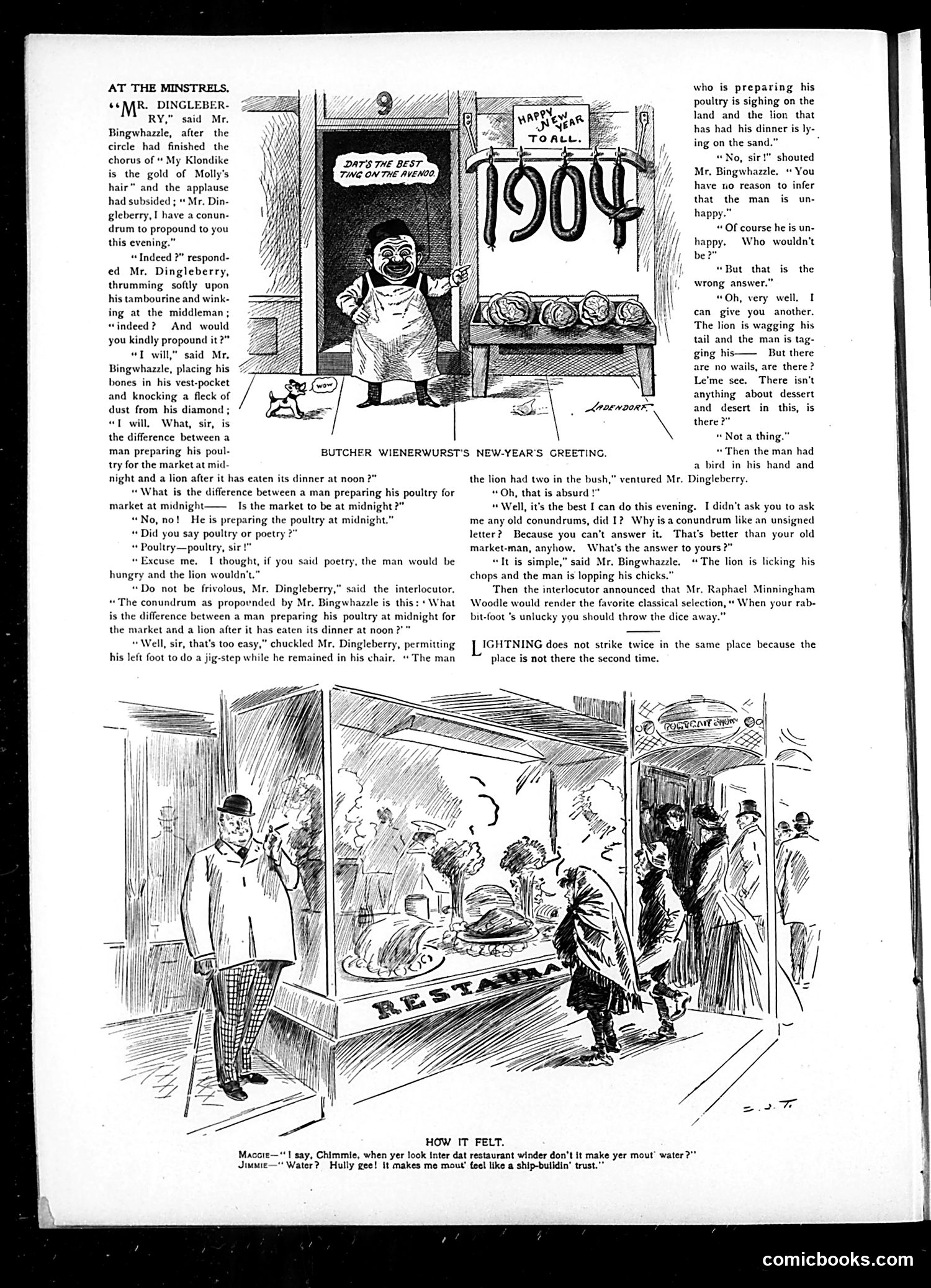
This page contains two separate pieces of satire from *Judge* magazine: **"At the Minstrels"** (top): A dialogue joke mimicking minstrel show banter. Two characters engage in a nonsensical riddle about a man preparing poultry at midnight versus a lion after eating—the "answer" involves wordplay on "wails" vs. "wagging tails" and obscure logic. The humor relies on the deadpan absurdity typical of minstrel comedy routines. **"How It Felt"** (bottom): A brief cartoon depicting two working-class men (depicted with period ethnic stereotyping) looking at a restaurant window. One comments that seeing food makes his mouth water; the other says it makes his mouth feel like a "ship-building trust"—contemporary slang suggesting financial strain or economic pressure. The satire mocks economic anxiety during the trust/monopoly era. Both pieces employ the broad, pun-heavy humor characteristic of early-1900s American comic entertainment.
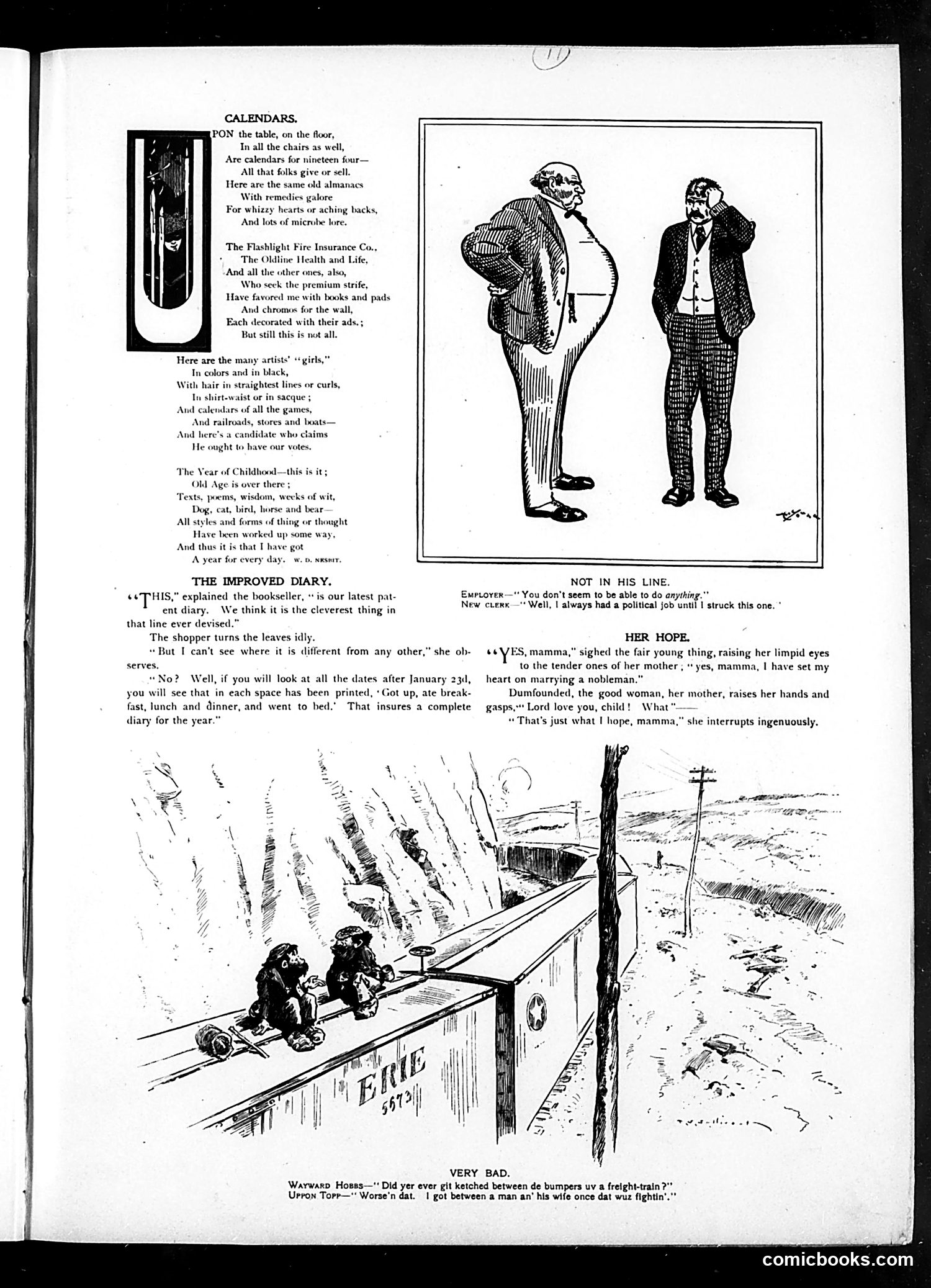
This page contains four separate humorous pieces satirizing early 1900s American life: **"Calendars"** — A poem mocking the glut of free promotional calendars businesses distributed. Companies like insurance firms and health products literally papered homes with almanacs and decorative prints advertising their services. **"The Improved Diary"** — A joke about a patent diary that pre-prints identical daily entries ("Got up, ate breakfast, lunch and dinner, and went to bed") for every date, eliminating the need to actually write anything—satirizing both lazy modern life and advertising's overblown claims. **"Not in His Line"** — A new clerk admits he previously held a political patronage job (unmeritorious government position) and can't adapt to real work—mocking the spoils system where political connections trumped actual ability. **"Her Hope"** and **"Very Bad"** — Brief jokes about social aspiration and marital discord, respectively. The page reflects Gilded Age anxieties: commercialism's invasion of homes, political corruption, and evolving social expectations.
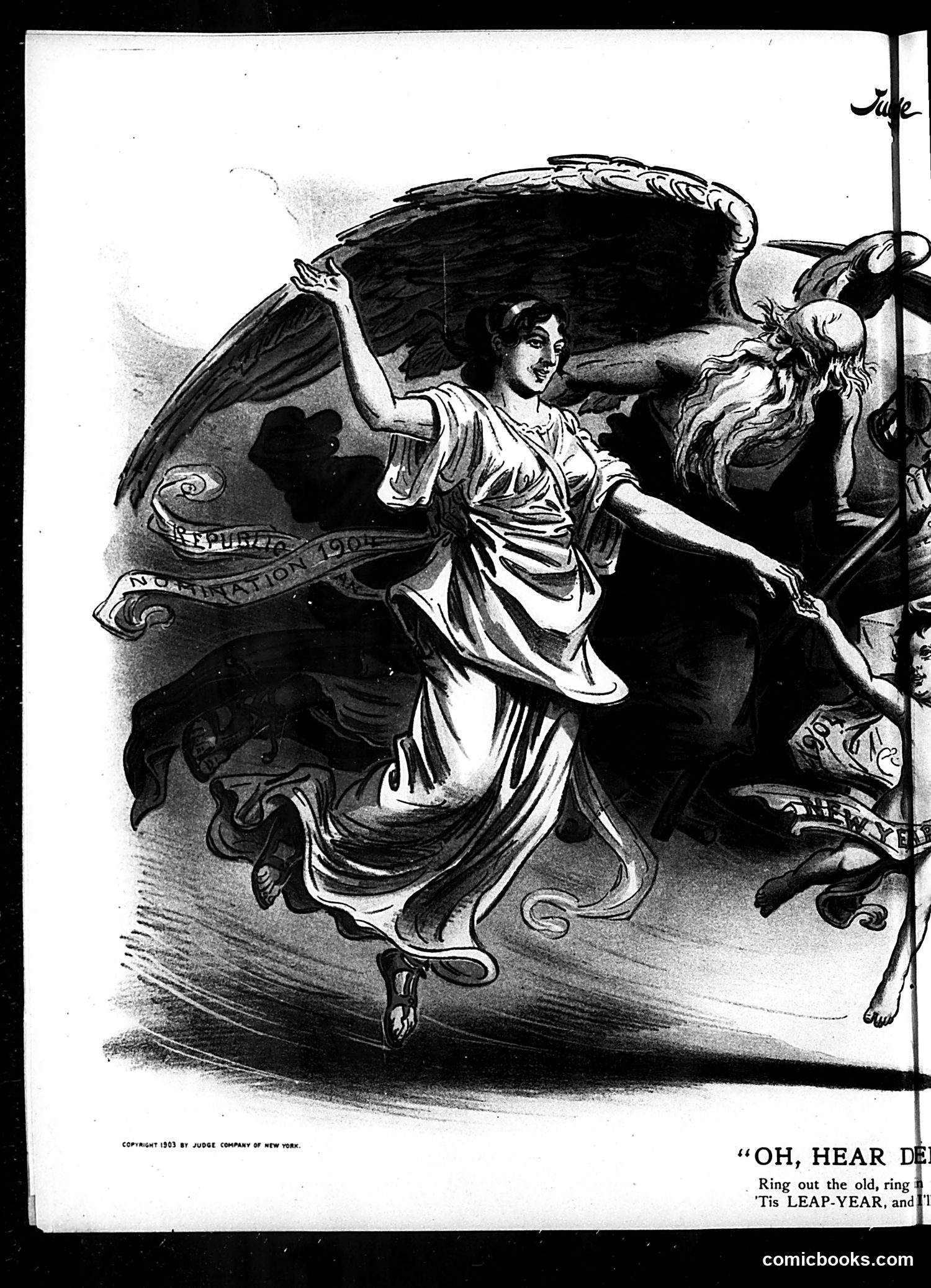
This 1903 Judge magazine illustration depicts a classical allegorical figure (likely Liberty or Columbia, identifiable by her winged form and flowing robes) ringing in the New Year. The cartoon references the leap year tradition where women were permitted to propose to men—a reversal of social convention. The figure's dynamic pose and the text "OH, HEAR DE[...]/ Ring out the old, ring [...] / 'Tis LEAP-YEAR, and [...]" suggest the cartoon satirizes this quirky custom. The classical artistic style was typical of Judge's approach to social commentary during the Gilded Age. The specific satire appears to address gender roles and courtship customs of the era, using the leap-year convention as its focal point. However, without seeing the complete caption, the cartoon's precise point remains partially unclear.
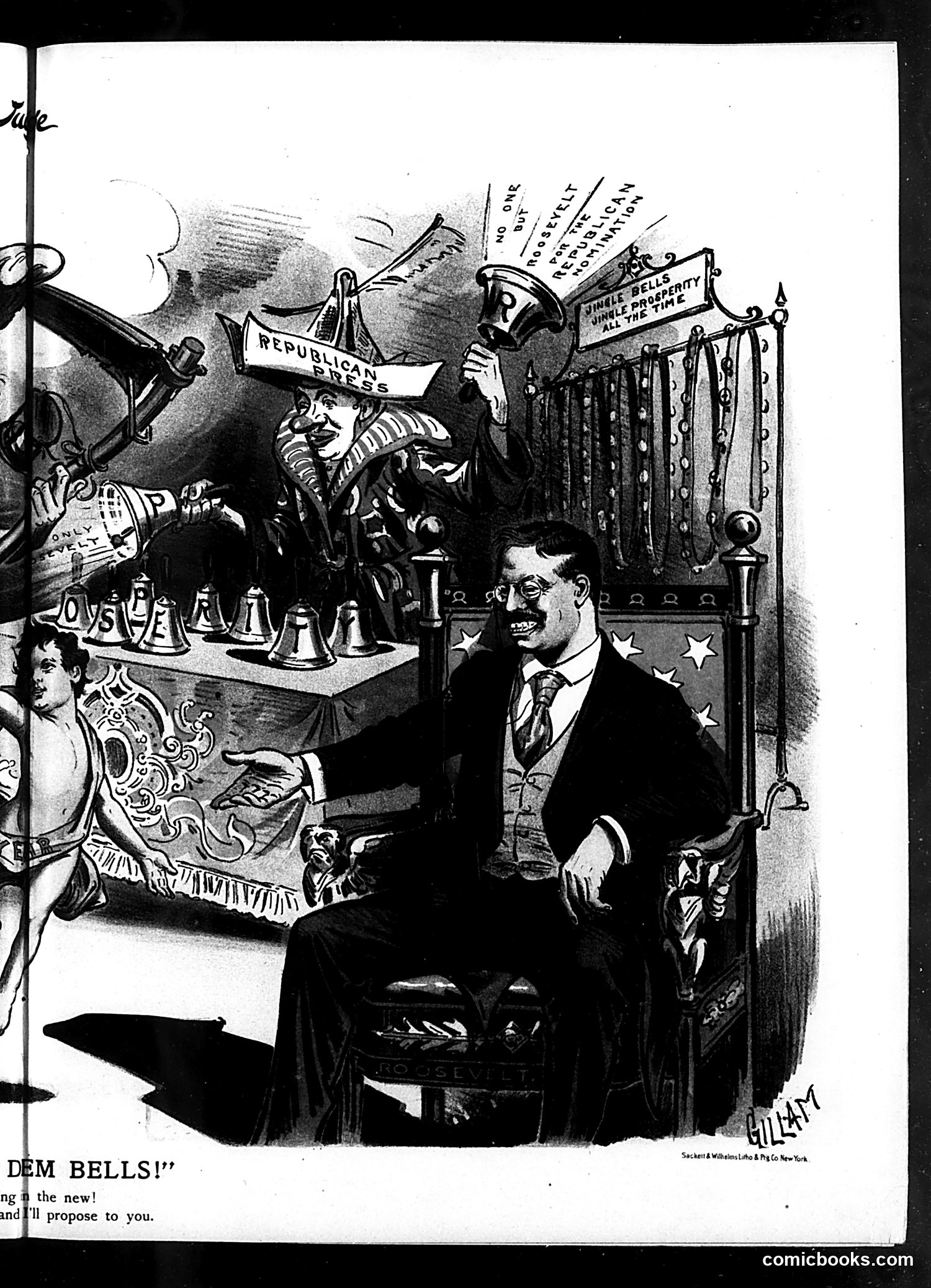
This cartoon depicts a well-dressed man in formal attire sitting contentedly while observing an ornate Republican carnival or celebration. The scene shows a "Republican Press" figure operating what appears to be bells or noisemakers labeled "Dem Bells" — a visual pun suggesting the Republican press is making noise about Democratic issues. The caricatured Republican figure operates the mechanism with text references to "Jungle Bells" and other bell-related phrases visible above. The man in the foreground appears to be a political figure enjoying or approving of this Republican press activity. The satire likely critiques how Republican media manipulates or sensationalizes Democratic activities for political advantage, presenting controlled spectacle as news. The carnival setting emphasizes artifice and entertainment over substantive journalism.
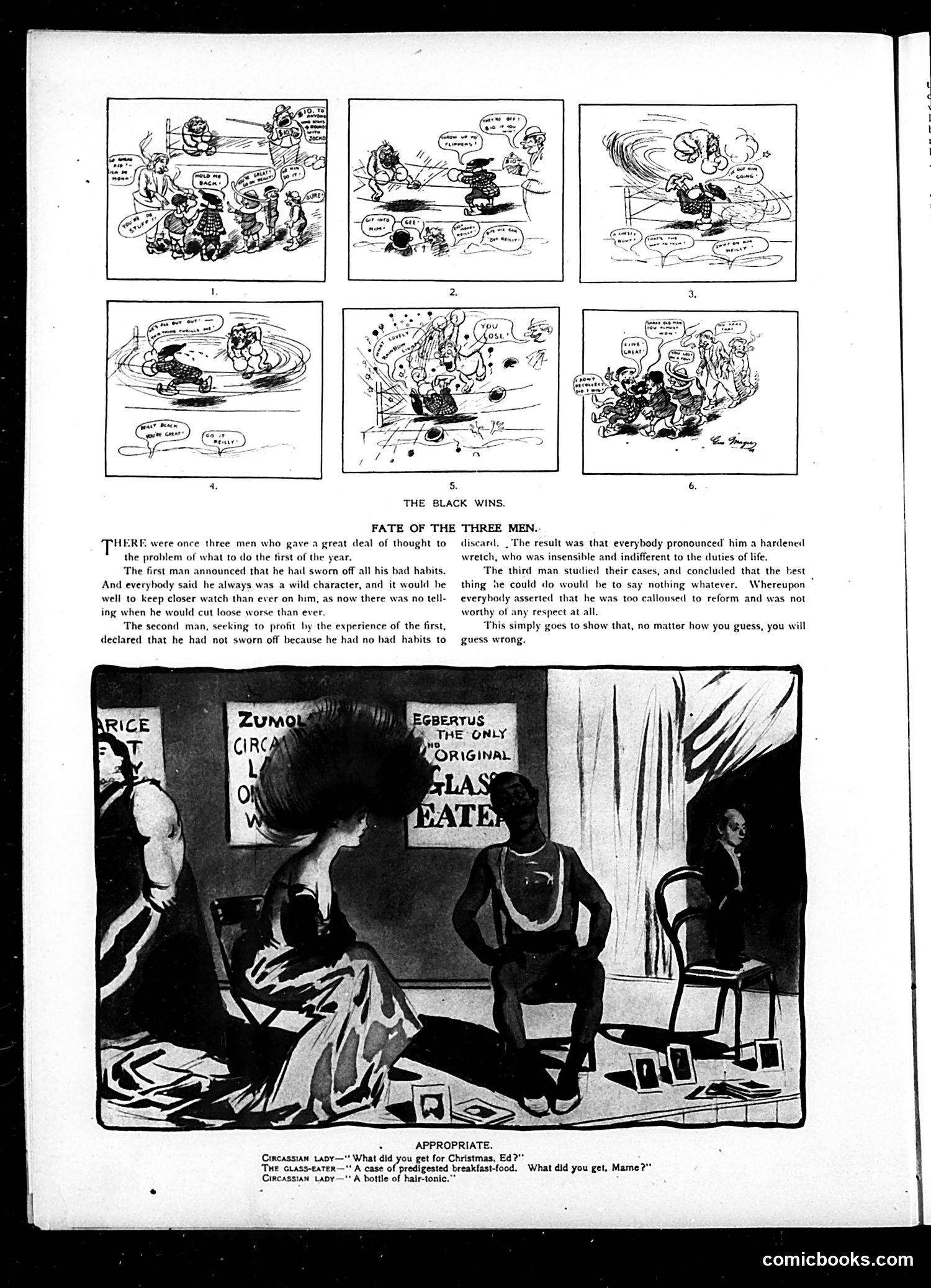
This page contains two distinct satirical pieces from Judge magazine. **Top Section ("The Black Wins"):** A moral fable mocking New Year's resolutions and human judgment. Three men approach self-improvement differently—one swears off bad habits, one claims to have none, one says nothing—yet all are condemned regardless. The satire targets society's hypocrisy: people will criticize any choice you make, making genuine reform impossible. The accompanying comic strips (panels 1-6) likely illustrate these scenarios humorously. **Bottom Section ("Appropriate"):** A single-panel cartoon set in what appears to be a modest home, showing adults and children exchanging Christmas gifts. The joke turns on ironic, underwhelming presents: someone received "predigested breakfast-food" and another a "bottle of hair-tonic"—mundane, vaguely insulting gifts rather than genuine luxuries. This satirizes the gap between Christmas expectations and disappointing reality, particularly targeting commercial consumer culture and class disparities during the holiday season.
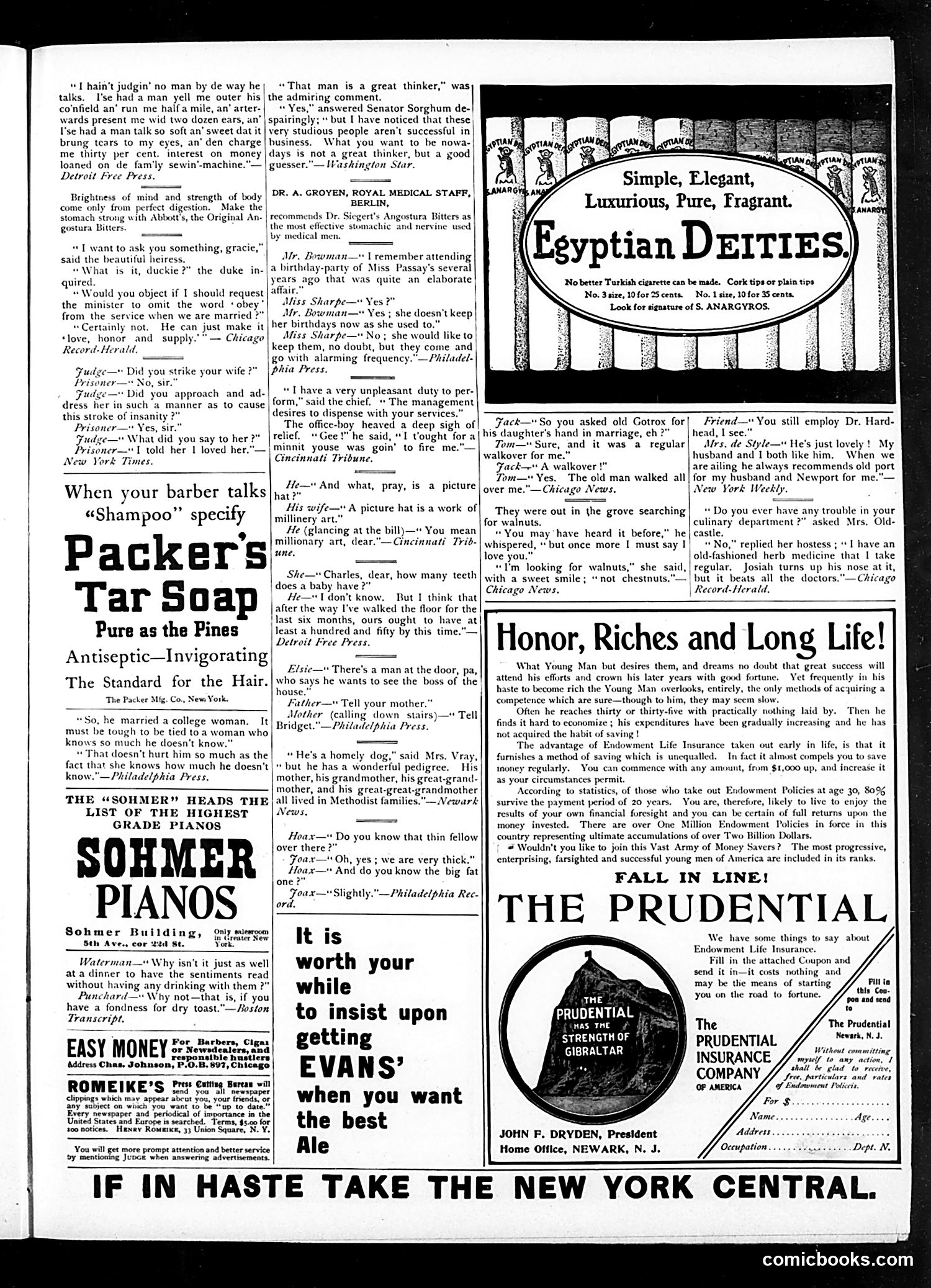
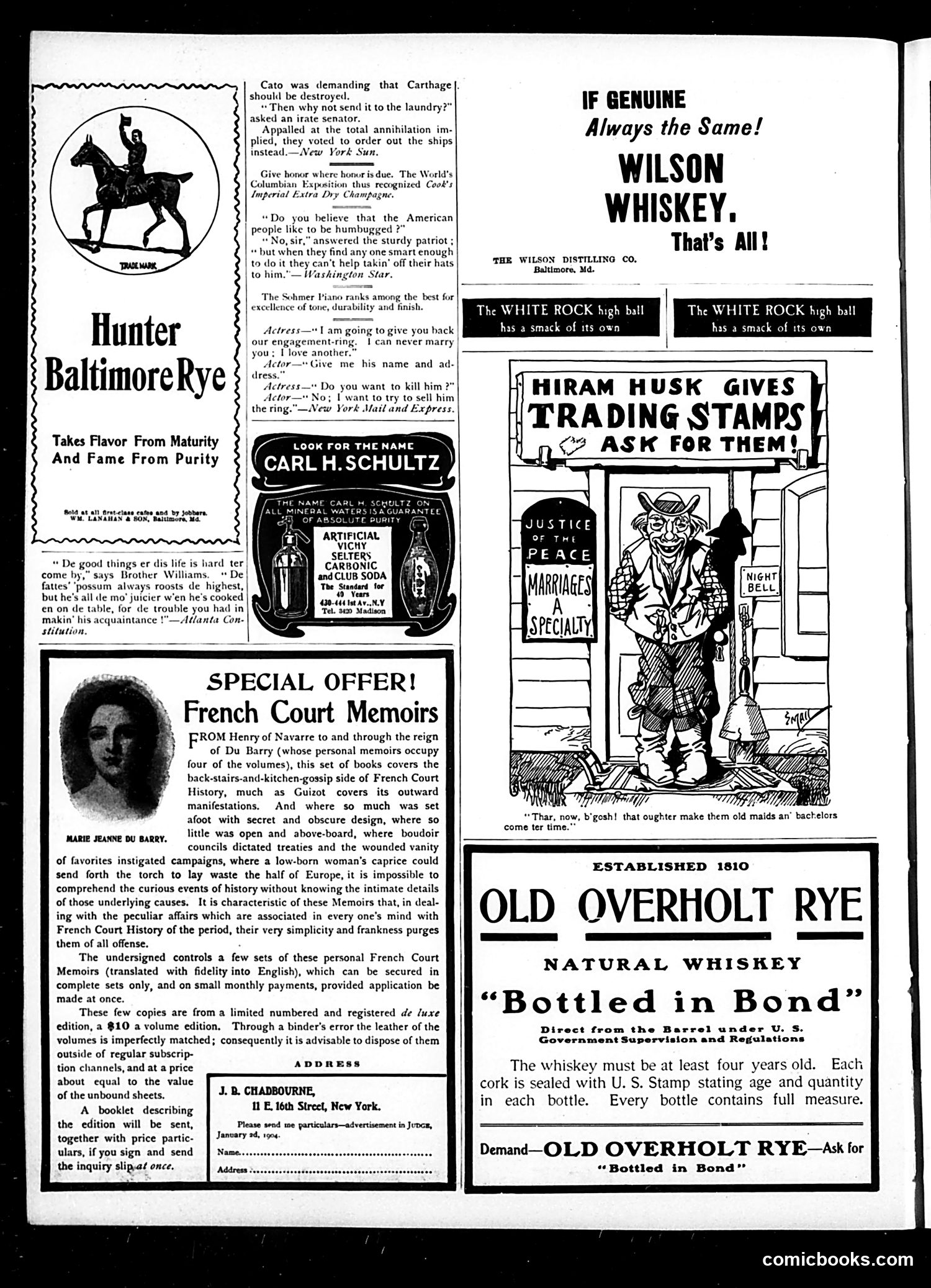
This page is primarily **advertisements and filler content** rather than political satire. It contains: **The actual cartoon**: A small illustration labeled "Hunter Baltimore Rye" showing a figure on horseback, accompanying whiskey advertising copy about the product taking "flavor from maturity and fame from purity." **Other content**: - Several humorous short anecdotes (about Carthage, American patriotism, theatrical romance) that appear to be reprinted from other newspapers - Multiple whiskey and spirits advertisements (Wilson Whiskey, Old Overholt Rye, White Rock beverages) - A book advertisement for French Court Memoirs - A comic advertisement for "Hiram Husk" trading stamps **Context**: The "Hunter" cartoon itself is generic product advertising rather than political commentary. The page reflects Judge magazine's business model: mixing light humor with paid advertisements. The anecdotes suggest early 1900s attitudes about patriotism and romance, but they're not original to this publication. This appears to be a typical **commercial page** from the magazine rather than its satirical editorial content.
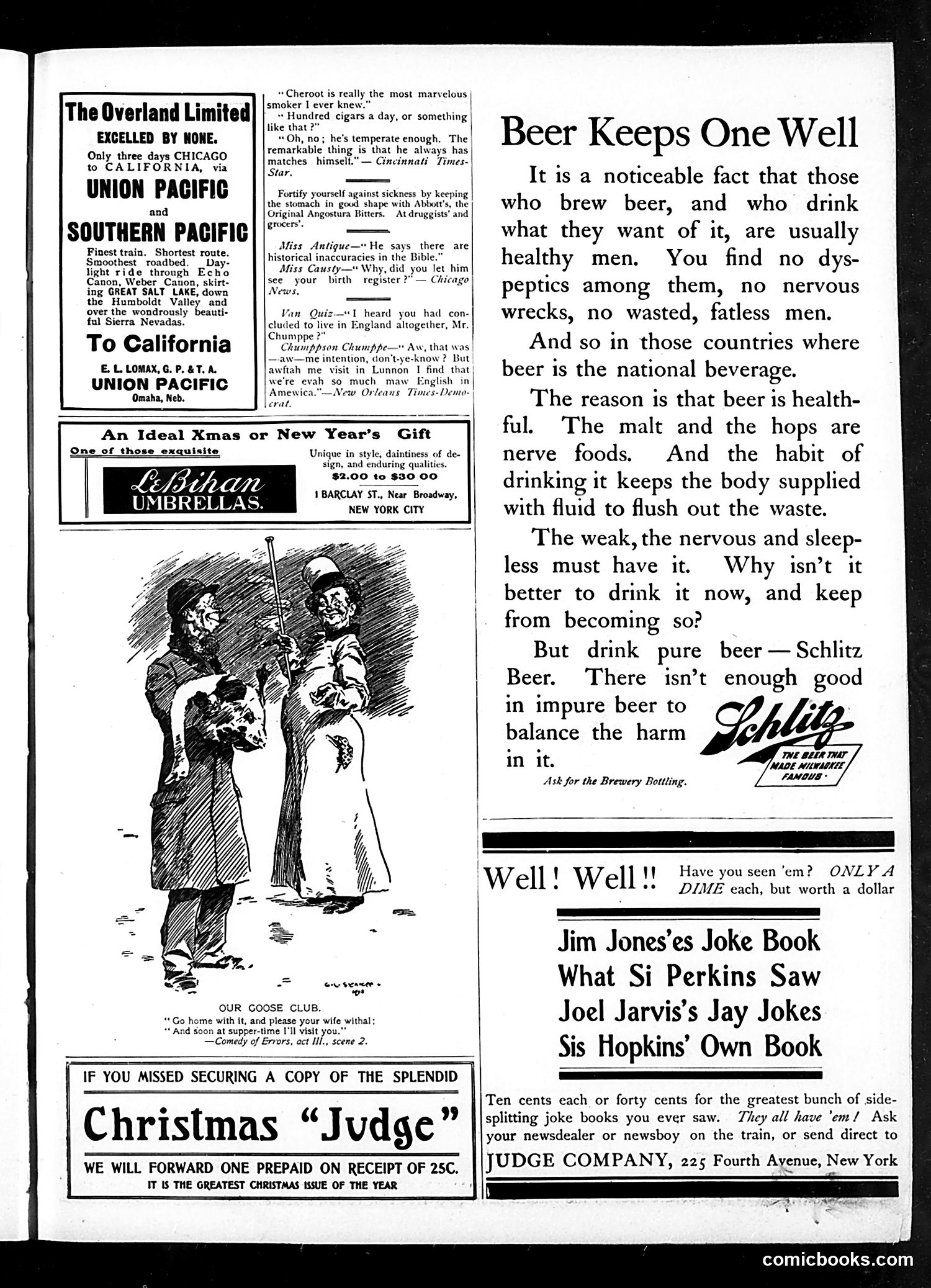
This page is primarily **advertising and filler content** rather than satirical editorial material. The main cartoon depicts two figures in what appears to be a winter scene (referenced in "Our Goose Club"), likely illustrating a classical theater quote about bringing home a goose as a gift. The page contains: 1. **Railroad advertisements** (Union Pacific, Southern Pacific) promoting routes to California 2. **A Schlitz Beer advertisement** presenting a health claim—that beer drinkers are healthier because malt and hops are "nerve foods" that help flush bodily waste. This reflects early-20th-century attitudes about beer's medicinal properties, before prohibition concerns dominated. 3. **Miscellaneous jokes** (about Bible accuracy, English accents, etc.)—typical Judge filler 4. **Joke book advertisements** at modest prices The Schlitz ad is notable for its **proto-advertising health claims**—common before modern FDA regulations—positioning beer as beneficial for the "weak, nervous and sleepless." This represents period attitudes toward alcohol as therapeutic rather than problematic.
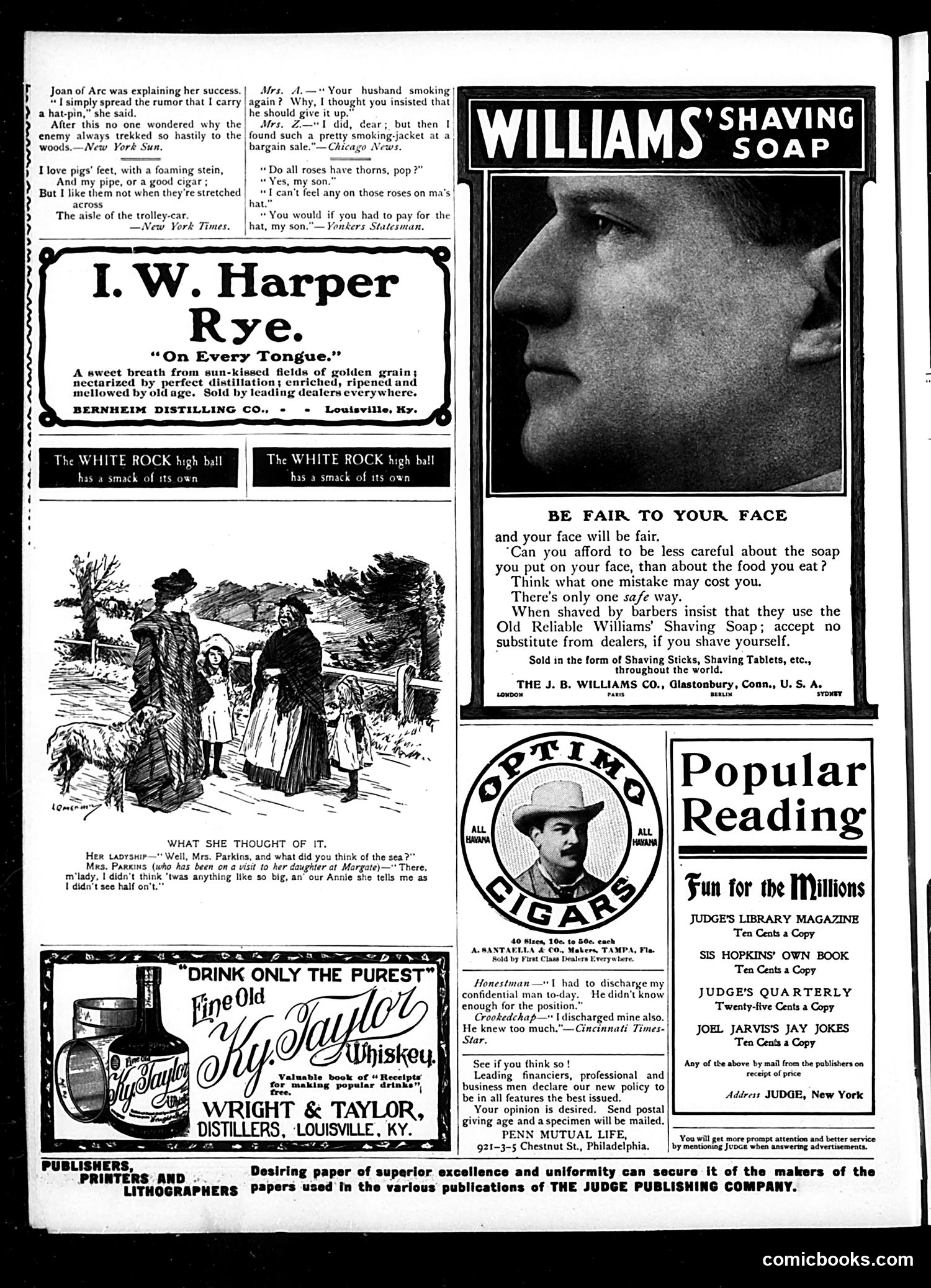
This page is primarily **advertising with brief comedic snippets**, typical of Judge's format. The small cartoons and jokes satirize domestic life and consumer anxieties: - **Hat-pin joke**: References the early 1900s "hat-pin panic"—women's long decorative pins were blamed for urban dangers, making them both a fashion statement and a symbol of female power/threat. - **Smoking jacket anecdote**: Social satire on wives managing husbands' habits; the wife accepts continued smoking if dressed fashionably, poking fun at consumer compromise and marital negotiation. - **Sea/Annie anecdote**: Working-class humor about provincial perspectives and comparative experience. The **Williams' Shaving Soap ad** uses health/safety messaging ("be fair to your face") common to early 20th-century advertising, equating product quality with personal care standards. Other ads (whiskey, cigars, publications) reflect Judge's male-oriented, affluent readership. The overall page reflects Edwardian-era domestic comedy and consumer culture rather than political satire.
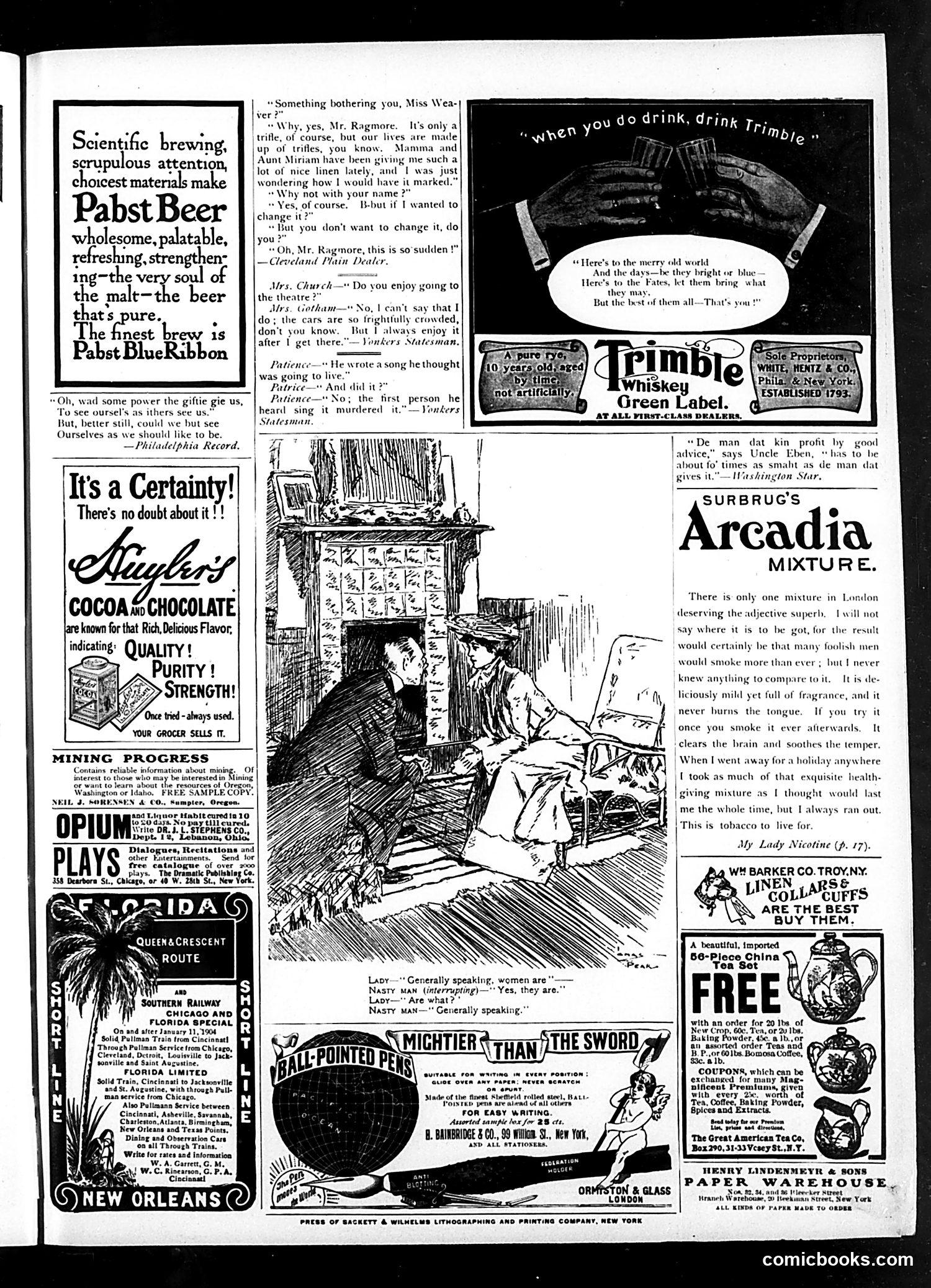
This page is primarily **advertising** with brief comedic snippets interspersed. The main content includes: **Central Cartoon**: A domestic scene showing a young woman and man in conversation. The caption reveals a marriage proposal joke: she's troubled about monogramming linens she received as gifts, then responds "Oh, Mr. Ragmore, this is so sudden!" when he suggests she could change her name—implying he's proposing marriage. **Surrounding Humor**: Brief joke exchanges, including: - A woman complaining theater crowds are "frightfully crowded" but enjoys it afterward (ironic commentary on complaints) - Wordplay about song-singing and "murder" - A "Nasty Man" interrupting to correct someone's statement **Advertisements**: The bulk of the page—Pabst Beer, Stayler's Cocoa, mining information, train routes to Florida, Trimble Whiskey, Sturbrug's tobacco mixture, and various household products. The satire is genteel rather than political—poking fun at courtship conventions, pretension, and social etiquette typical of Judge's humor during this era (appears to be early 1900s).
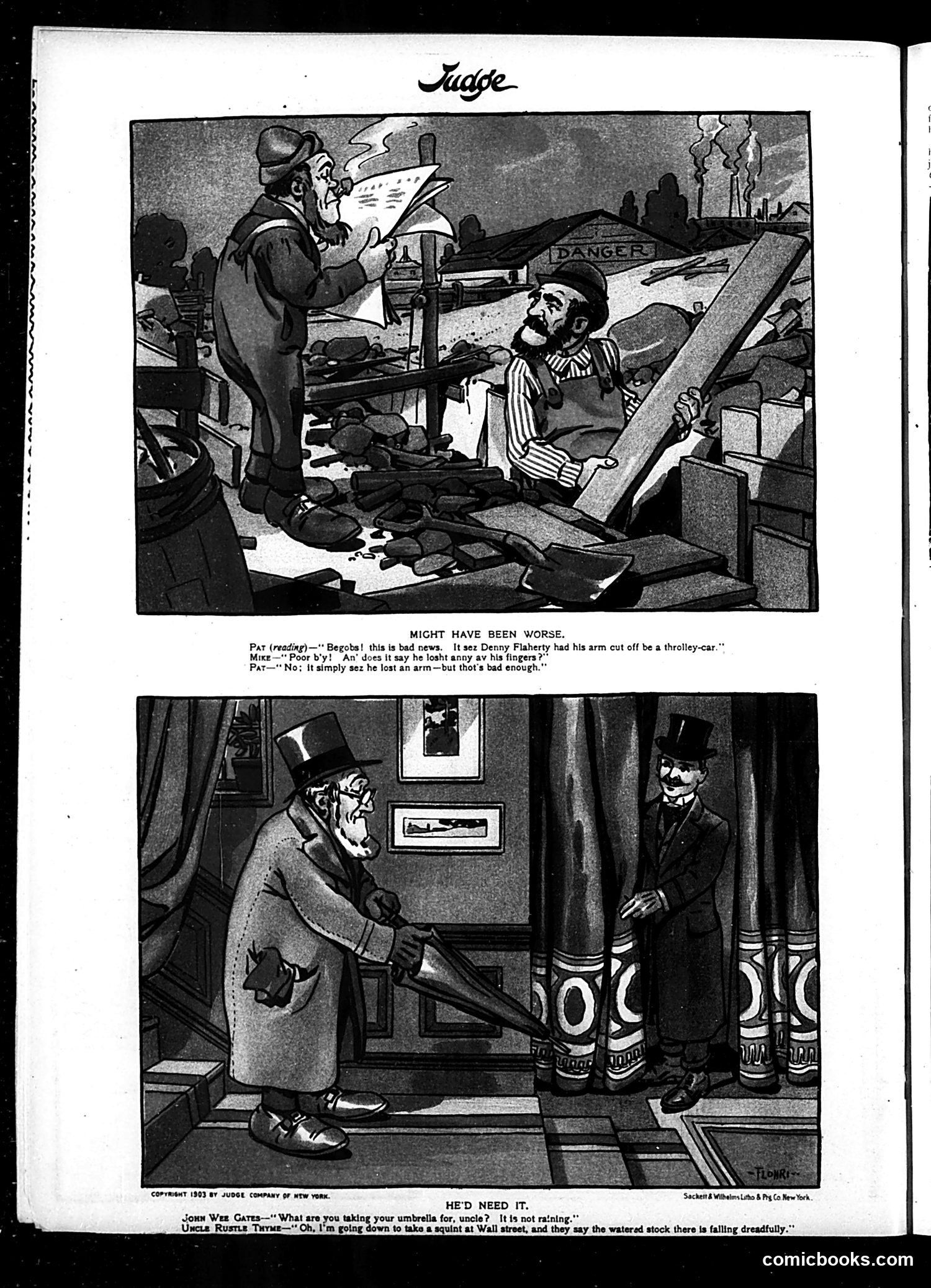
This page contains two separate satirical cartoons: **Top cartoon ("Might Have Been Worse"):** Two Irish working-class men discuss a trolley-car accident where their acquaintance Denny Flaherty lost his arm. The humor relies on ethnic stereotype (Irish brogue spelling) and dark comedy—they're relieved he "only" lost an arm rather than fingers, suggesting fingers would be worse for manual laborers. **Bottom cartoon ("He'd Need It"):** A wealthy man (Uncle Rustus Turwe) takes an umbrella to Wall Street "because watered stock is falling dreadfully." This is financial satire: "watered stock" refers to fraudulent corporate shares artificially inflated in value. The joke plays on the double meaning of "falling"—stocks declining in value, humorously treated as literal rain requiring umbrella protection. This reflects early-1900s concern about stock market manipulation and financial fraud. Both cartoons use wordplay and visual puns typical of Judge's satirical style.
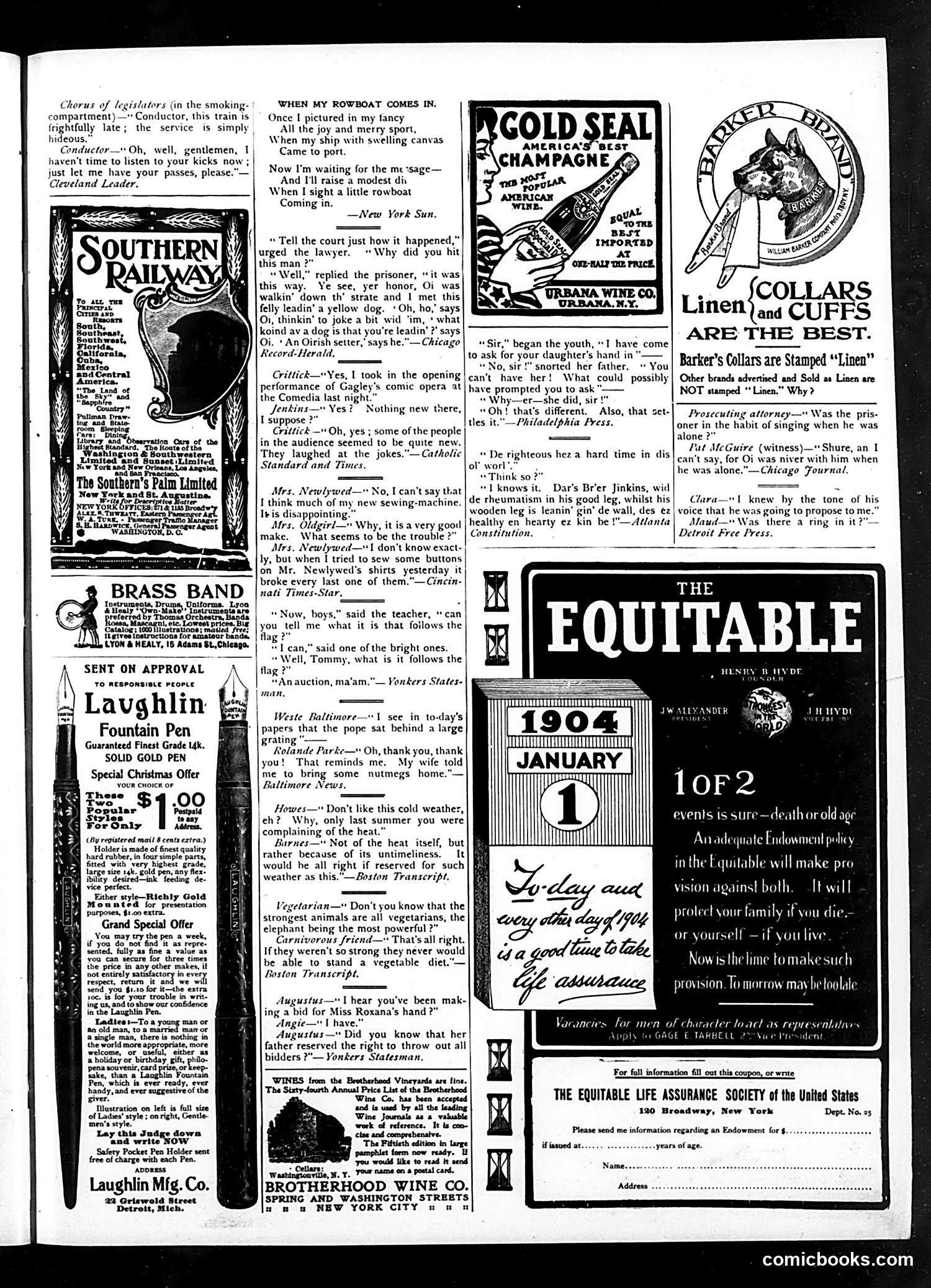
This page consists primarily of **advertising and humorous short anecdotes** rather than political cartoons. The main illustrated content includes: 1. **Southern Railway advertisement** (left): A vintage railroad ad promoting "The Southern's Train Limited" 2. **Short joke cartoons** throughout: Brief, untitled satirical quips on everyday life—a conductor dismissing legislators' complaints, a prisoner explaining why he hit someone, theater critics, newlyweds, and schoolchildren. These are gentle social humor rather than pointed political satire. 3. **Product advertisements**: Laughlin fountain pens, Gold Seal champagne, Barker collars, and The Equitable life insurance dominate the page. The humor targets minor social pretensions and domestic mishaps rather than major political figures or events. The jokes rely on wordplay and situational comedy accessible to general audiences. This appears to be a typical Judge issue page: **advertising-heavy with light satirical filler** rather than serious political commentary.
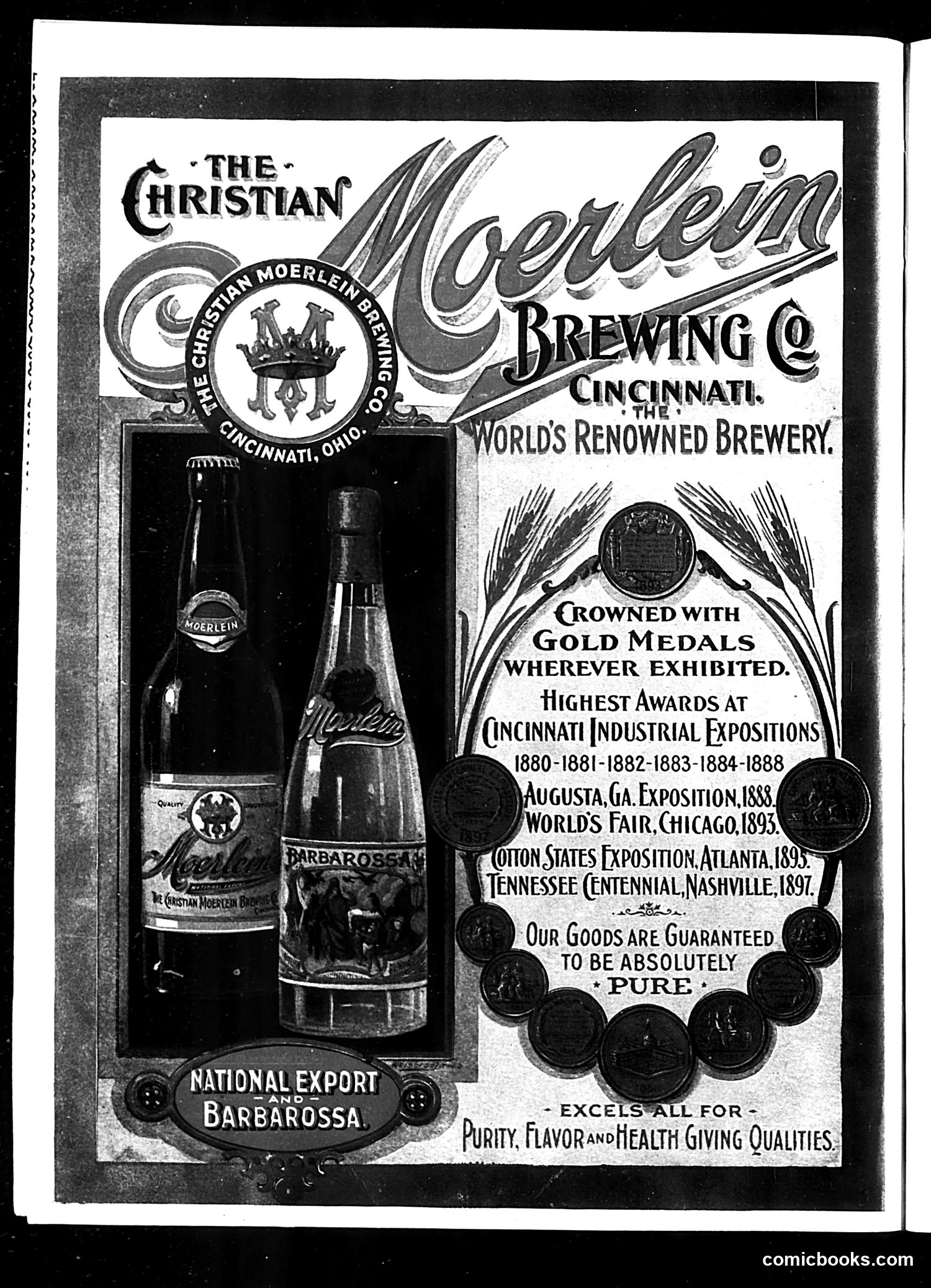
This page is **not a cartoon or satirical content** — it's a full-page **advertisement** for The Christian Moerlein Brewing Company of Cincinnati, Ohio. The ad promotes their beer products ("National Export" and "Barbarossa") by emphasizing their awards and purity. It lists gold medals won at various late-19th-century expositions (Cincinnati Industrial Expositions 1880-1888, World's Fair Chicago 1893, Cotton States Exposition Atlanta 1895, Tennessee Centennial Nashville 1897). The ornate design features two beer bottles and claims the products "excels all for Purity, Flavor and Health Giving Qualities" — a common marketing appeal of the era when brewers positioned beer as wholesome and medicinal. There is no political satire or social commentary here; this appears to be a Judge magazine advertiser taking out premium advertising space.