
Judge, 1904-01-02 · page 2 of 18
Judge — January 2, 1904 — page 2: what you’re looking at
What you’re looking at
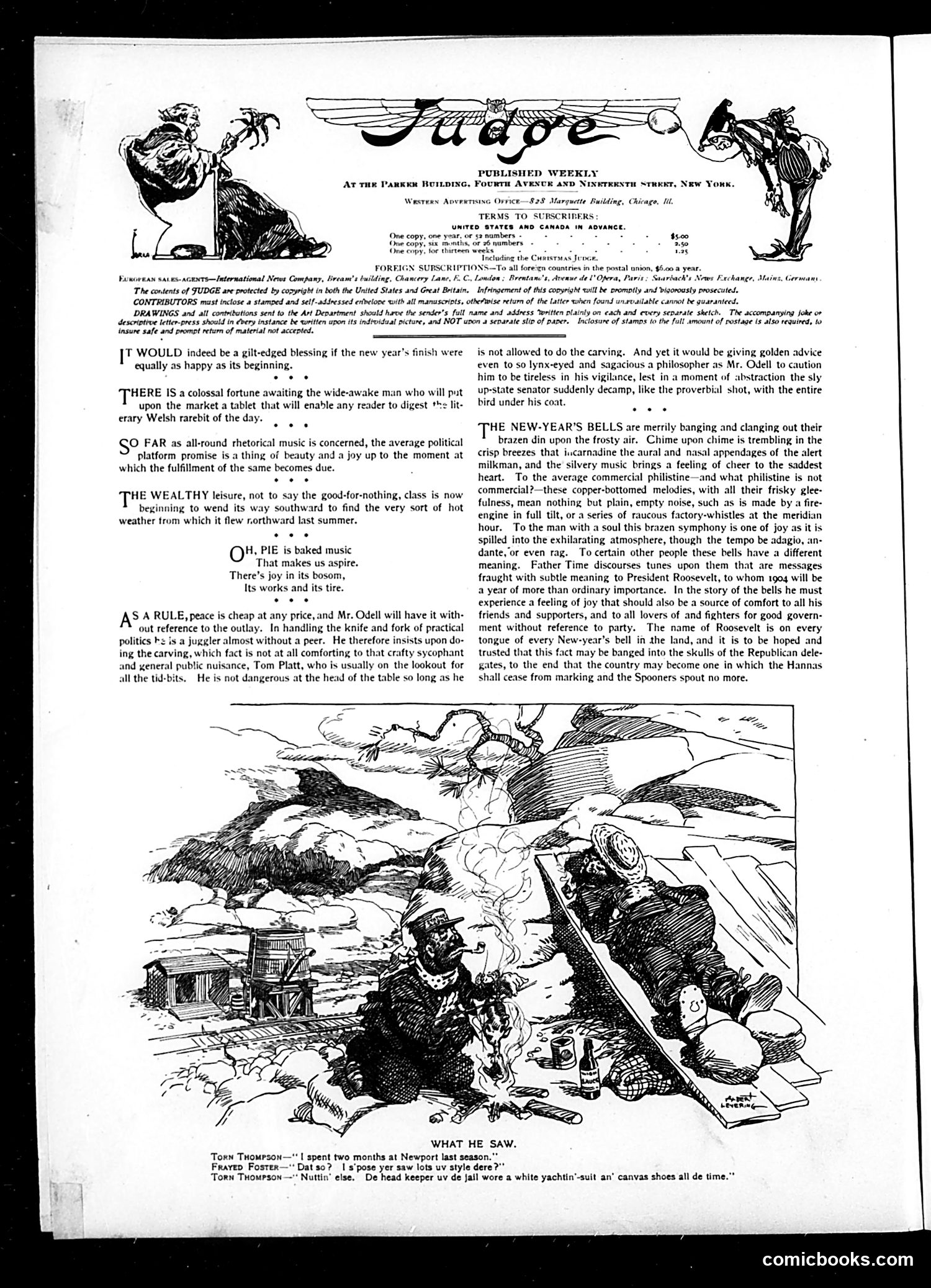
This page contains New Year's commentary with a cartoon titled "What He Saw." The sketch depicts two men (identified in dialogue as Tom Thompson and Prayed Foster) discussing Newport's social season. Tom brags about spending time there, while Foster asks sarcastically if he "saw lots uv style dere?"—to which Tom replies the only notable sight was a jailkeeper in a white yacht suit and canvas shoes. The satire targets wealthy Newport society's pretensions. By contrasting a prisoner's keeper with the elite resort's fashionable inhabitants, the cartoon suggests that Newport's upper class are morally or socially equivalent to jailers—implying hypocrisy or corruption among the wealthy. The joke relies on readers' familiarity with Newport's reputation as an exclusive playground for America's richest families.
📄 Transcribed text from this page (OCR, searchable)
Machine-transcribed from the original scan — historical spelling and the odd misread are preserved.
At Tue Parke Boripinc, Fourtm AVENUE 4xD AS One cop One € Fumorean sates-acents—/aternational News Company, liream's building, Chancery Lane, F.C, London; Brentame's, Avenue de l' Opera, Paris The contents of FUDGE are protected by cozyright in both the United States and Great Britain. NY . Wastees Anvewnisine Orrice PUBLISHED WEEKLY RTRRNTH STRERT, NEW YORK. S29 Marquette ing, Chicago, Il Suardach's News Fechange, Mains, Germans Infringement of this copyright will be promplly and vigorously prosecuted. CONTRIBUTORS must inclose a stamped and self-addressed ertoelope with all manuscripts, otherwise return of the Latter when found unavailable cannot be guaranteed. DRAWINGS and all contributions sent to the Art Department should have the sender's full name and address Written plainly on each and every separate sketch. descriptive letter-press should in every instance be written upon its indtoidaal picture, and NOT upon a separate slip of paper. insure safe and prompt return of material not accepted. T WOULD indeed be a gilt-edged blessing if the new year’s finish were equally as happy as its beginning. THERE IS a colossal fortune awaiting the wide-awake man who will put upon the market a tablet that will enable any reader to digest ths lit- erary Welsh rarebit of the day. ‘O FAR as all-round rhetorical music is concerned, the average political platform promise is a thing of beauty and a joy up to the moment at which the fulfillment of the same becomes due. 'HE WEALTHY leisure, not to say the good-for-nothing, class is now beginning to wend its way southward to find the very sort of hot weather from which it flew northward last summer. H, PIE is baked music That makes us aspire. joy in its bosom, Its works and its tire. S A RULE, peace is cheap at any price, and Mr. Odell will have it with- out reference to the outlay. In handling the knife and fork of practical politics hs is a juggler almost without a peer. He therefore insists upon do- ing the carving, which fact is not at all comforting to that crafty sycophant and general public nuisance, Tom Platt, who is usually on the lookout for all the tid-bits. He is not dangerous at the head of the table so long as he The accompanying joke or Inclosure of stamps to the full amount of postage 1s also required, to is not allowed to do the carving. And yet it would be giving golden advice even to so lynx-eyed and sagacious a philosopher as Mr. Odell to caution him to be tireless in his vigilance, lest in a moment of abstraction the sly up-state senator suddenly decamp, like the proverbial shot, with the entire bird under his coat. wee THE NEW-YEAR’S BELLS are merrily banging and clanging out their brazen din upon the frosty air. Chime upon chime is trembling in the crisp breezes that incarnadine the aural and nasal appendages of the alert milkman, and the silvery music brings a feeling of cheer to the saddest heart. To the average commercial philistine—and what philistine is not commercial?—these copper-bottomed melodies, with all their frisky glee- fulness, mean nothing but plain, empty noise, such as is made by a fire- engine in full tilt, or a series of raucous factory-whistles at the meridian hour. To the man with a soul this brazen symphony is one of joy as it is spilled into the exhilarating atmosphere, though the tempo be adagio, an- dante, or even rag. To certain other people these bells have a different meaning. Father Time discourses tunes upon them that are messages fraught with subtle meaning to President Roosevelt, to whom 1904 will be a year of more than ordinary importance. In the story of the bells he must experience a feeling of joy that should also be a source of comfort to all his friends and supporters, and to all lovers of and fighters for good govern- ment without reference to party. The name of Roosevelt is on every tongue of every New-year’s bell in the land, and it is to be hoped and trusted that this fact may be banged into the skulls of the Republican dele- gates, to the end that the country may become one in which the Hannas shall cease from marking and the Spooners spout no more. et eRe WHAT HE SAW. ** | spent two months at Newport last season."* Fravep Foster—"' Dat so? I s‘pose yer saw lots uv style dere?" Torn THompson—' Nuttin’ else. De head keeper uv de Jail wore a white yachtin’-suit an’ canvas shoes all de time.” comicbooks.com