
A complete issue · 20 pages · 1903
Judge — 1903
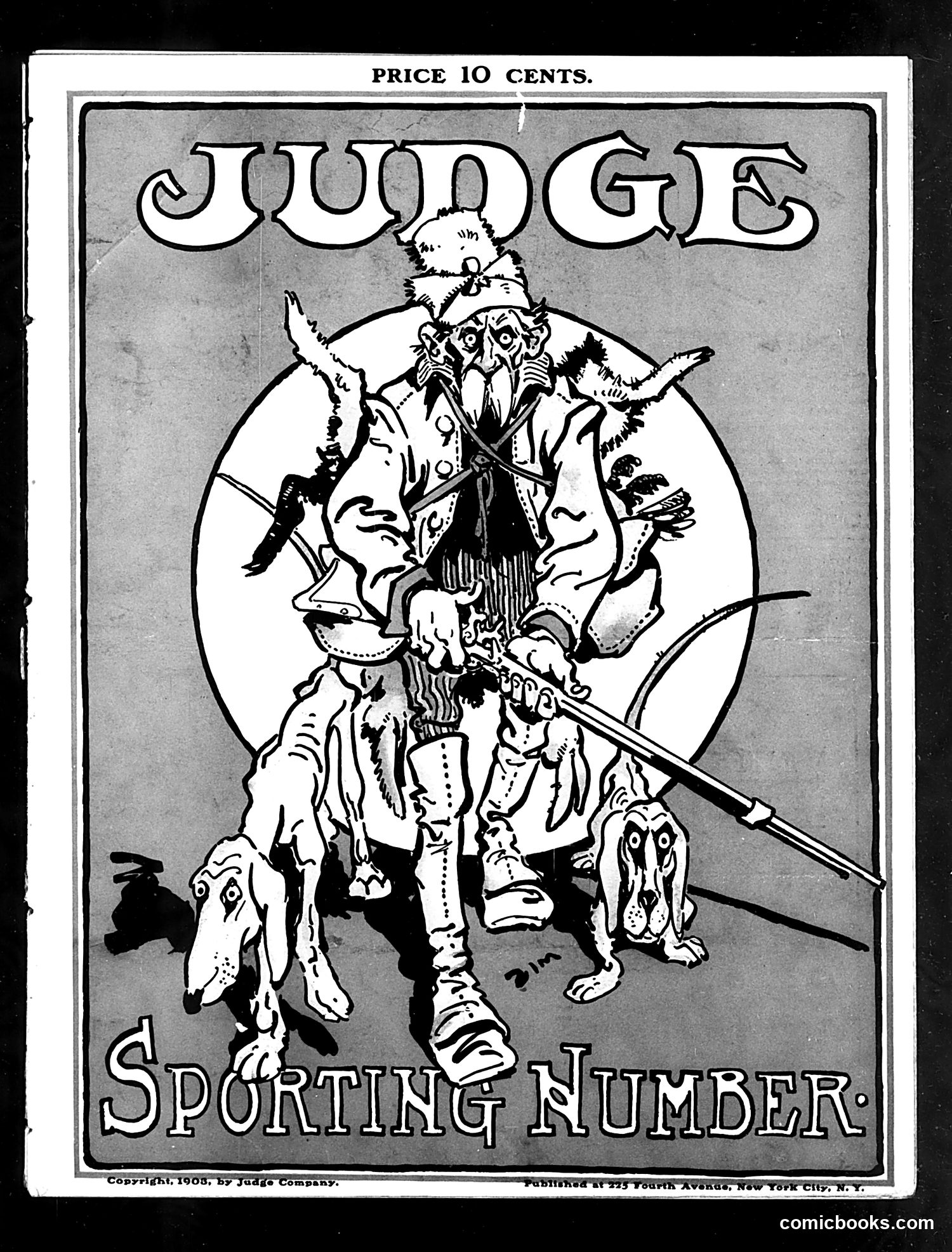
This is the cover of Judge's "Sporting Number" from 1908, priced at 10 cents. The central illustration depicts a grotesque caricatured hunter or sportsman surrounded by hunting dogs, wielding a rifle and what appears to be a sword or large knife. The figure is exaggerated in a grotesque style typical of early 20th-century satirical art. The "sporting" theme likely refers to hunting or field sports popular among wealthy Americans of the era. The caricature's exaggerated features and chaotic composition—with multiple dogs and weapons—suggest satire of upper-class sporting culture or hunting enthusiasts. However, without additional context or text identifying specific individuals or events, the precise satirical target remains unclear from the image alone.
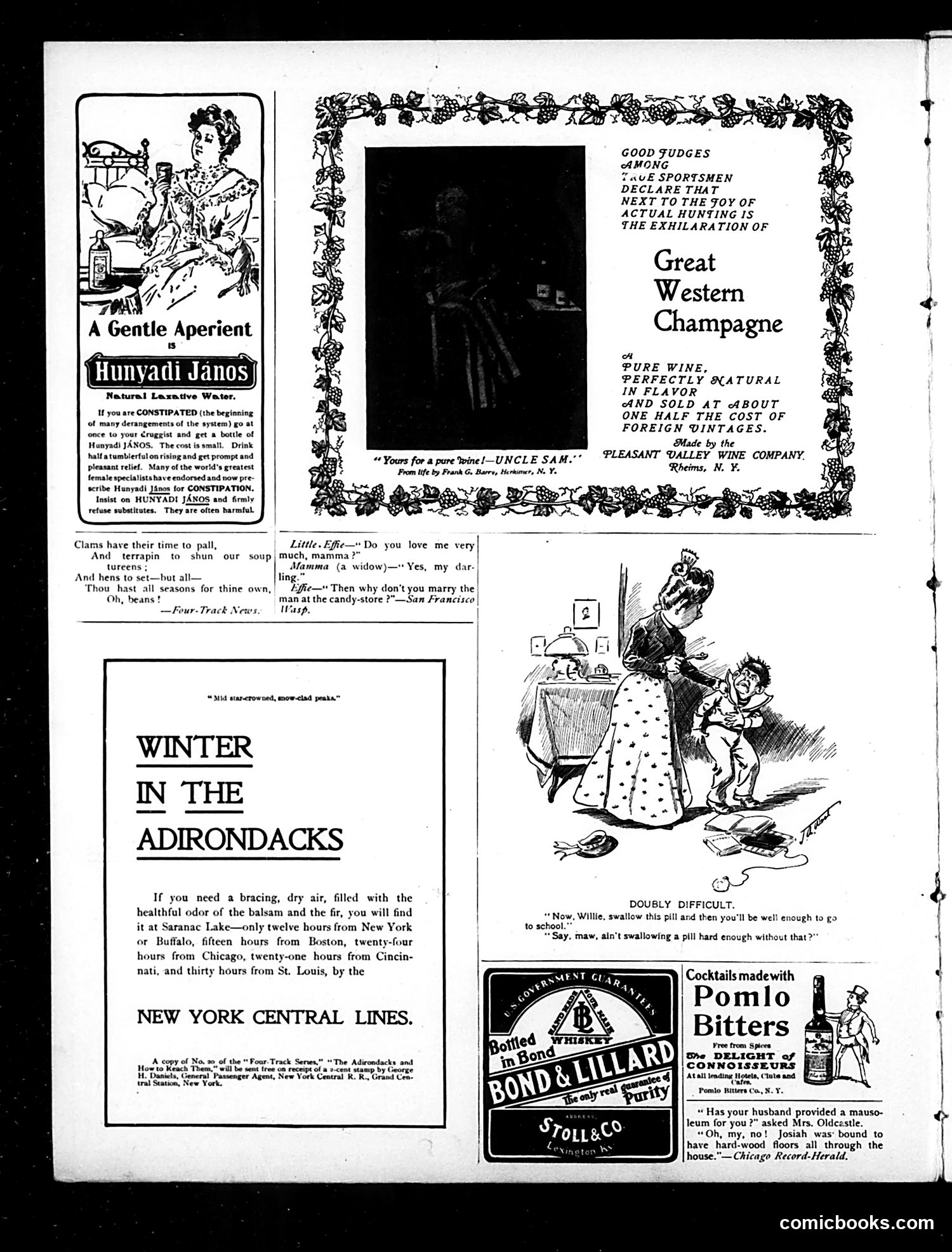
This Judge magazine page is primarily **advertisements and filler content** rather than political satire. The main items are: 1. **Hunyadi János** water advertisement (top left) - a laxative marketed as a "natural laxative water" for digestive issues 2. **"Winter in the Adirondacks"** travel promotion (center-left) for the New York Central Lines railroad 3. **Great Western Champagne** advertisement (top right) - wine marketing to hunters and sportsmen 4. **Pomlo Bitters** cocktail advertisement (bottom right) - an alcoholic digestive tonic 5. **"Doubly Difficult"** cartoon (right) - a domestic humor joke about a child negotiating bedtime The page lacks political commentary; it's typical early 20th-century magazine content mixing light humor with commercial advertisements.
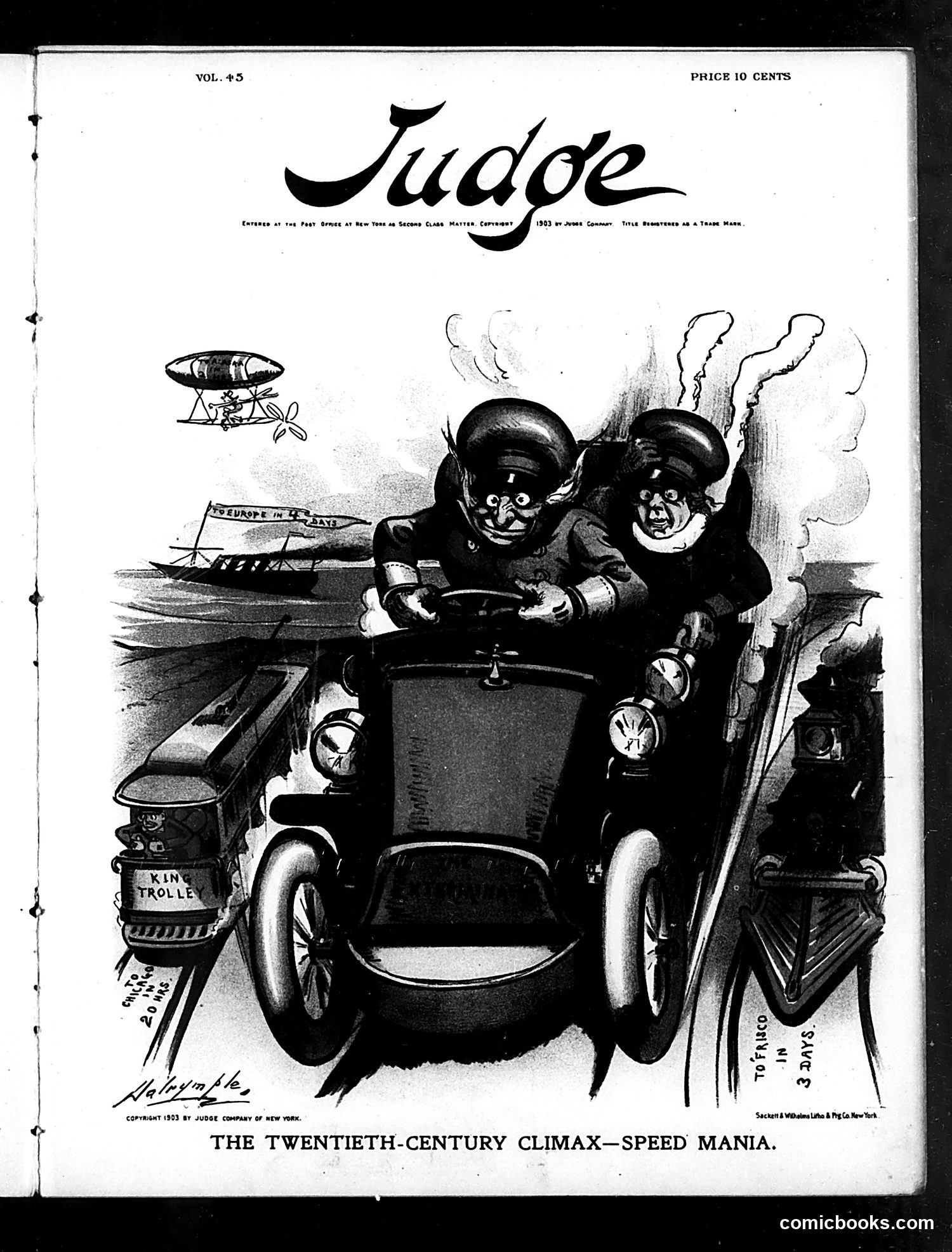
This Judge magazine cartoon satirizes early 20th-century obsession with speed and modern technology. Two wild-eyed, demonic-looking figures operate a high-speed automobile on railroad tracks, their expressions exaggerated to convey reckless abandon. The vehicle appears to be speeding dangerously, with smoke and exhaust billowing behind. In the background, a small airship or zeppelin appears, further emphasizing the era's fascination with cutting-edge transportation. The "King Trolley" reference suggests street cars were also part of this speed culture. The satire mocks contemporary society's dangerous obsession with velocity—the cartoon implies this speed obsession has driven people mad ("climax"). It's social commentary on how new technologies were outpacing public safety awareness and rational behavior during the industrial boom.
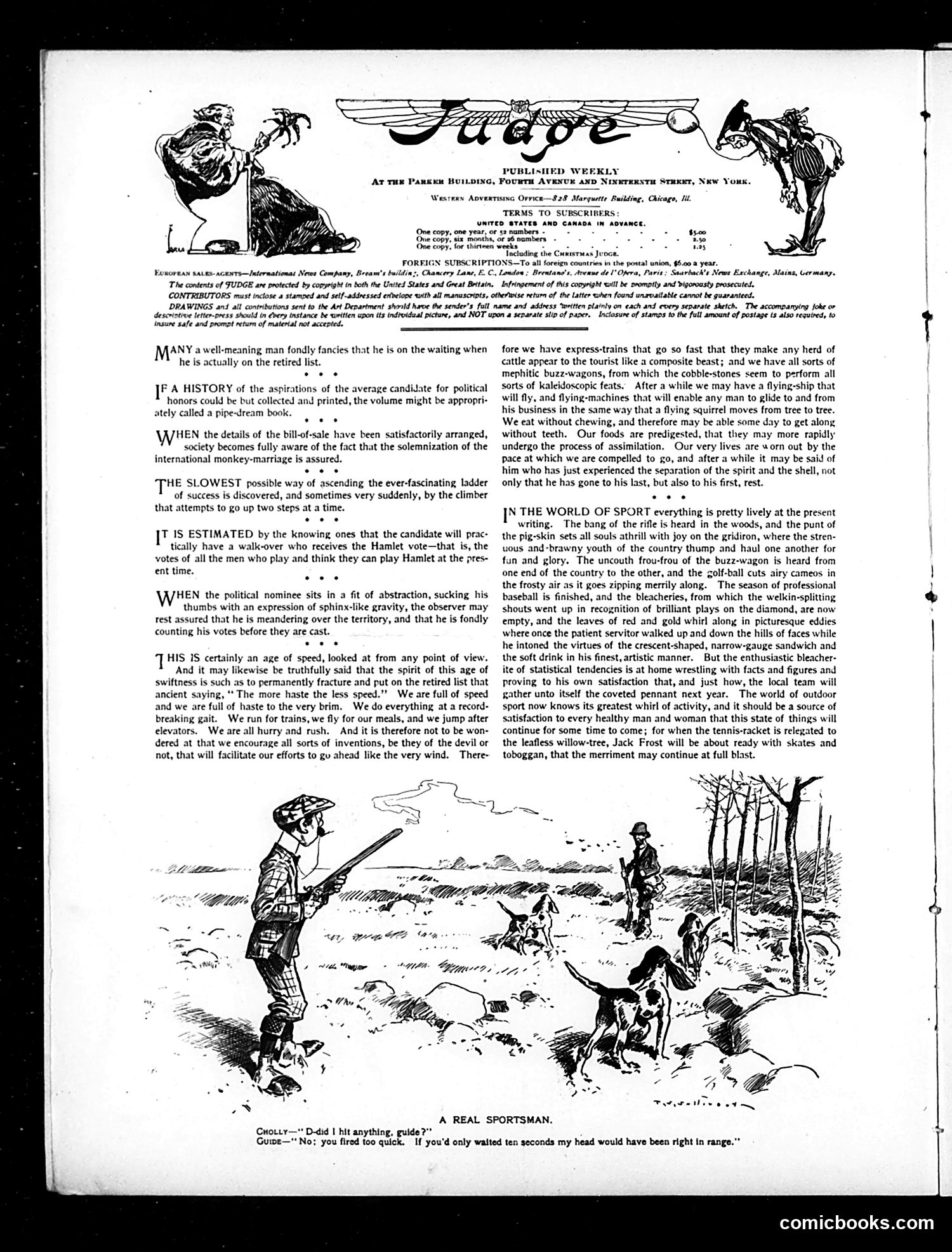
This page contains several editorial essays about contemporary American life rather than political cartoons. The text discusses topics like vacation habits, political candidates' preparation, speed culture, and outdoor sports. The one cartoon at the bottom titled "A Real Sportsman" depicts hunting or shooting instruction. A guide criticizes a shooter's marksmanship, saying the hunter "fired too quick" and should have waited longer to aim properly—missing by "ten seconds." The joke mocks impatient sportsmen who prioritize speed over accuracy, reflecting the page's broader theme (visible in essays above) about modern Americans' obsession with haste and rushing through activities. The cartoon's message: true sportsmanship requires patience and skill, not just quick reflexes.
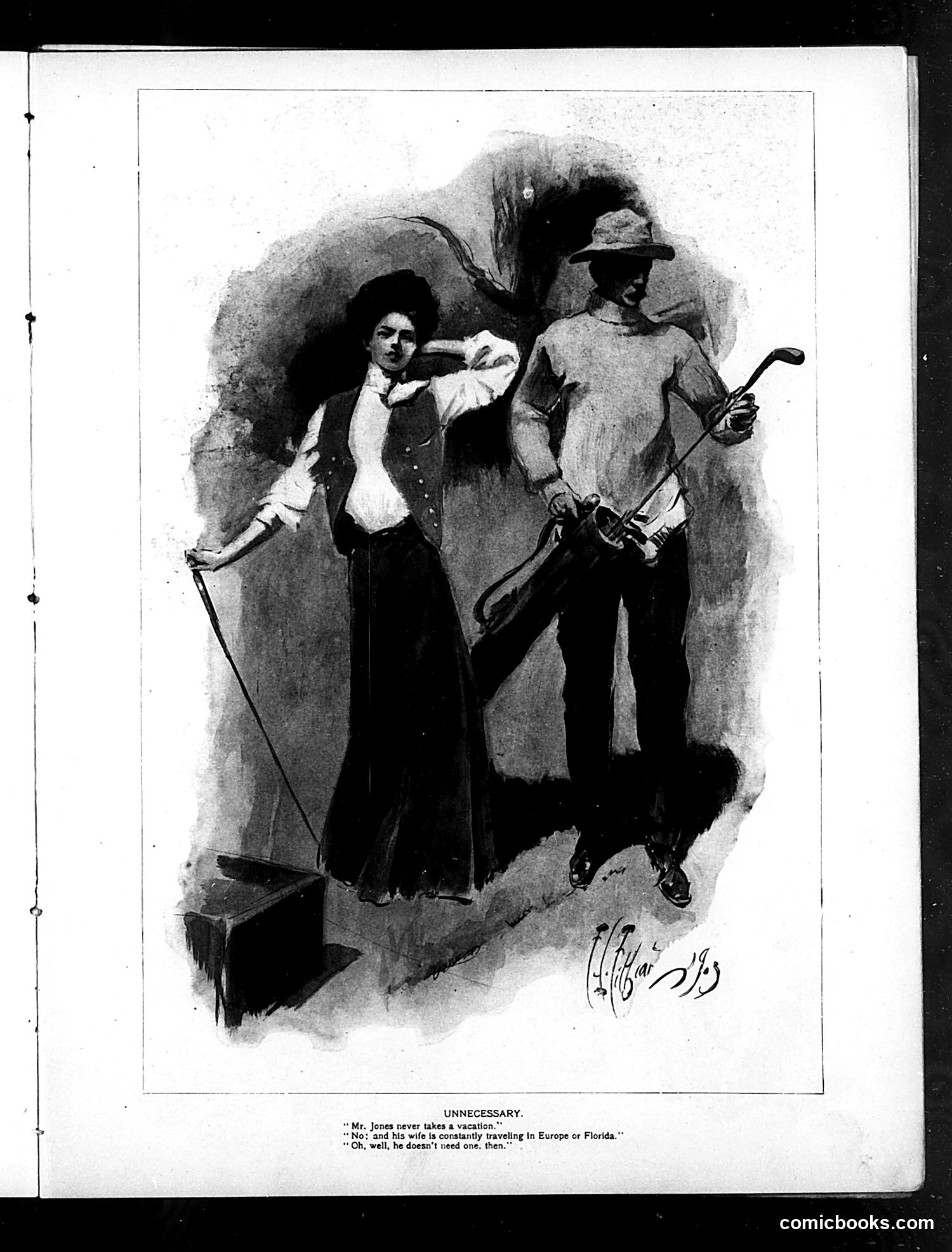
This cartoon satirizes a husband whose wife constantly travels abroad while he remains at home working. The joke hinges on the irony that Mr. Jones needs no vacation because his wife's perpetual absence from home *is* his vacation. The humor targets the common social dynamic of the era where wives with leisure time would travel extensively for pleasure, while husbands worked. The cartoon suggests that marital separation—even when self-imposed through the wife's travel—provides the husband welcome relief from domestic life. The three figures appear to be gossiping acquaintances discussing Jones's situation, with the punchline implying that constant spousal absence serves as his de facto rest and relaxation.
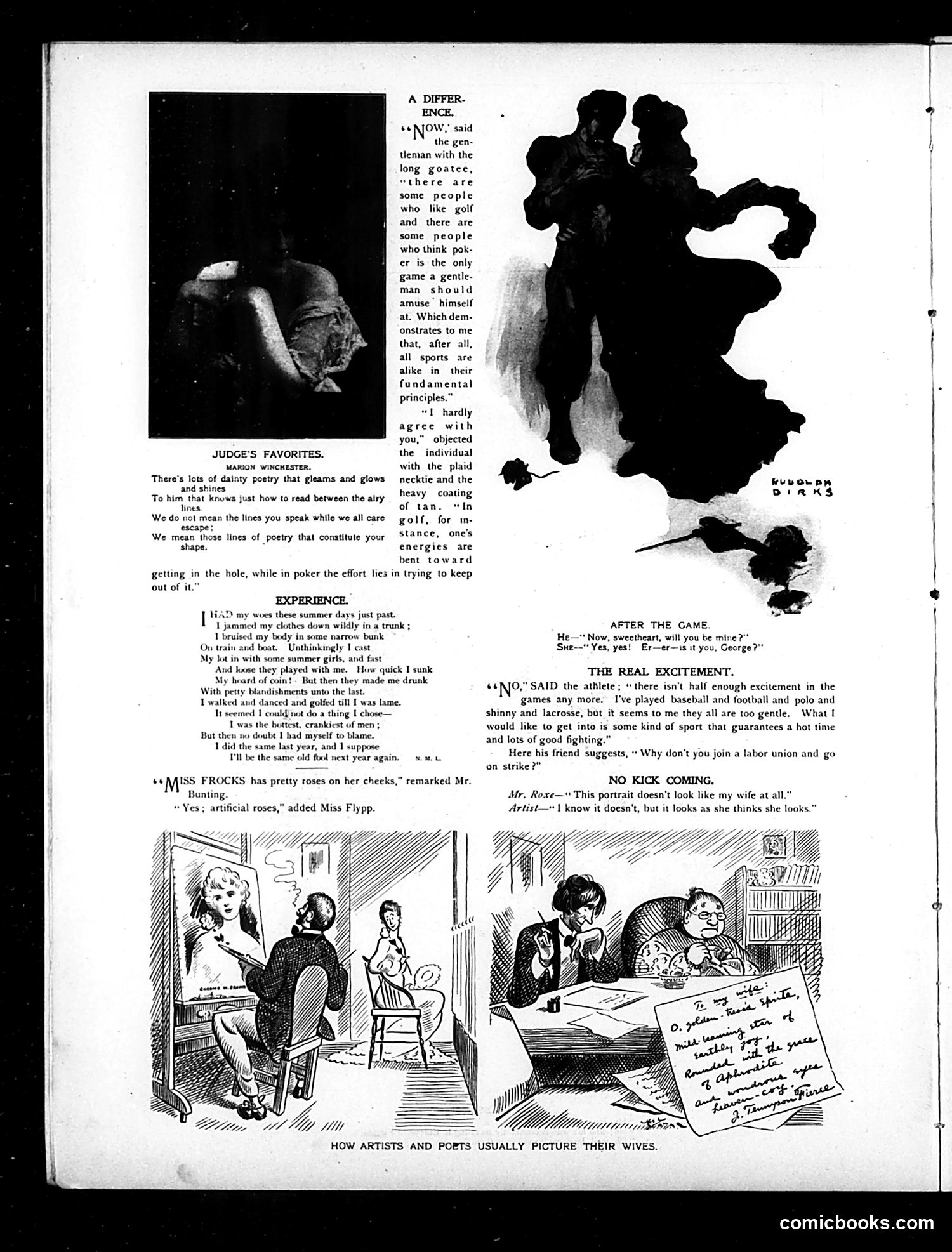
This page contains several short humorous pieces typical of early 20th-century satirical magazines: **"A Difference"** contrasts golf and poker players' philosophies, joking that in golf one tries to "get in the hole" while in poker one tries to "keep out of it"—a double entendre about avoiding debt or trouble. **"Experience"** and **"After the Game"** are light romantic verses about summer romance and proposals. **"The Real Excitement"** satirizes an athlete who finds all mainstream sports too genteel and desires something more violent—his friend's suggestion to join a labor union and strike is the punchline, implying labor disputes were notoriously combative. **"No Kick Coming"** jokes that an artist painted his wife as she *thinks* she looks rather than as she actually appears—satirizing both artistic flattery and female vanity. The bottom illustrations humorously depict how artists and poets idealize their wives versus reality, a common Judge theme mocking romantic excess and domestic dynamics.
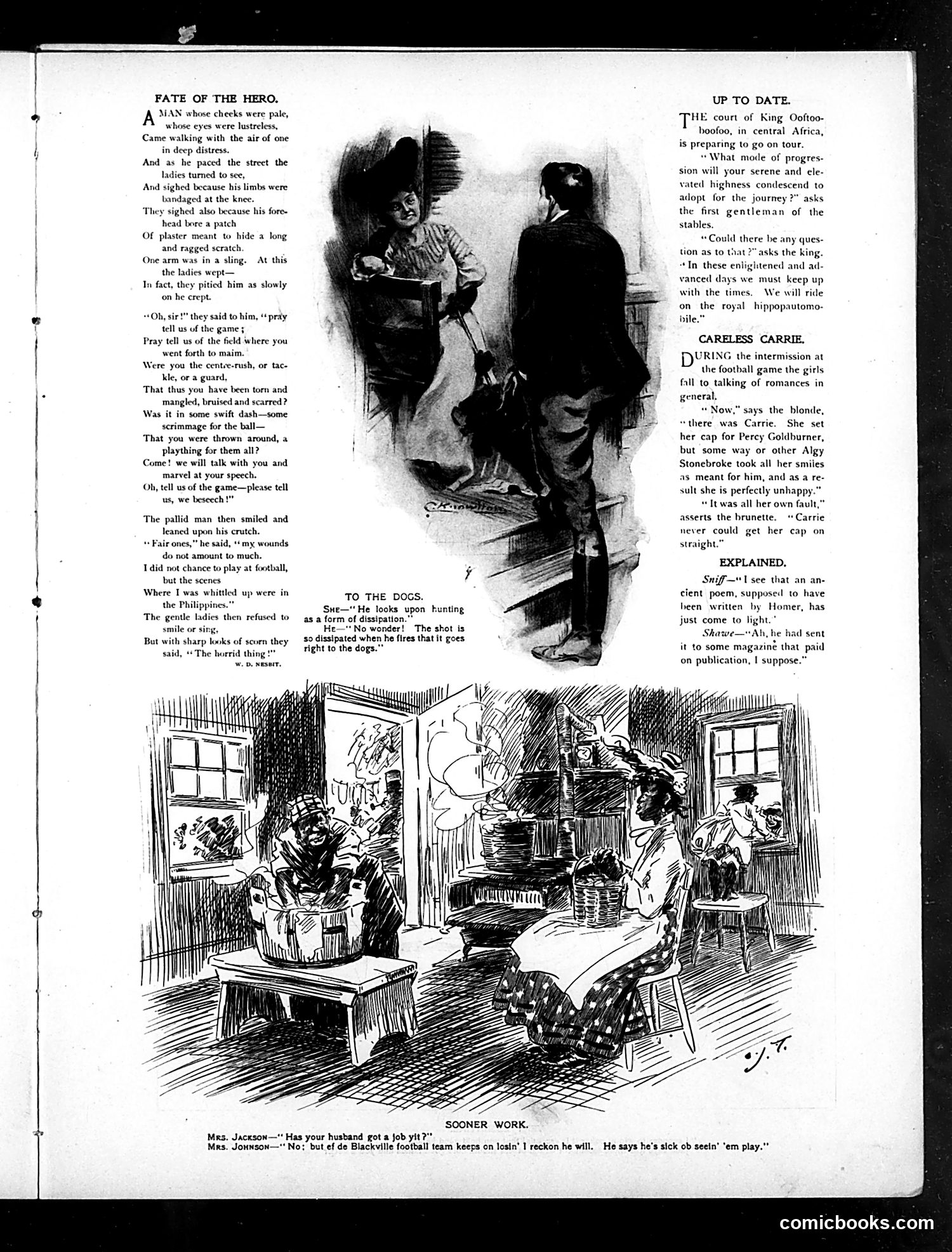
**Main Cartoon ("Fate of the Hero"):** This satirizes American attitudes toward the Spanish-American War, particularly the Philippines conflict. A wounded soldier receives sympathy from ladies who assume his injuries came from football—a popular American sport. When he reveals his wounds are actually from fighting in the Philippines, they react with disgust ("The horrid thing!"). The joke mocks both the triviality Americans assigned to football injuries versus combat wounds, and perhaps public indifference to the actual cost of imperial warfare. **"Up to Date":** A brief scene depicting an African king adopting modern transportation (a hippopotamus), satirizing either colonial stereotypes or the absurdity of applying "progress" to non-Western cultures. **"Careless Carrie":** A romantic comedy bit about a girl who loses a suitor through carelessness—the punchline playing on "getting her cap on straight" as both literal and metaphorical. **"Sooner Work":** A brief joke about a husband preferring football employment to watching his losing team play.
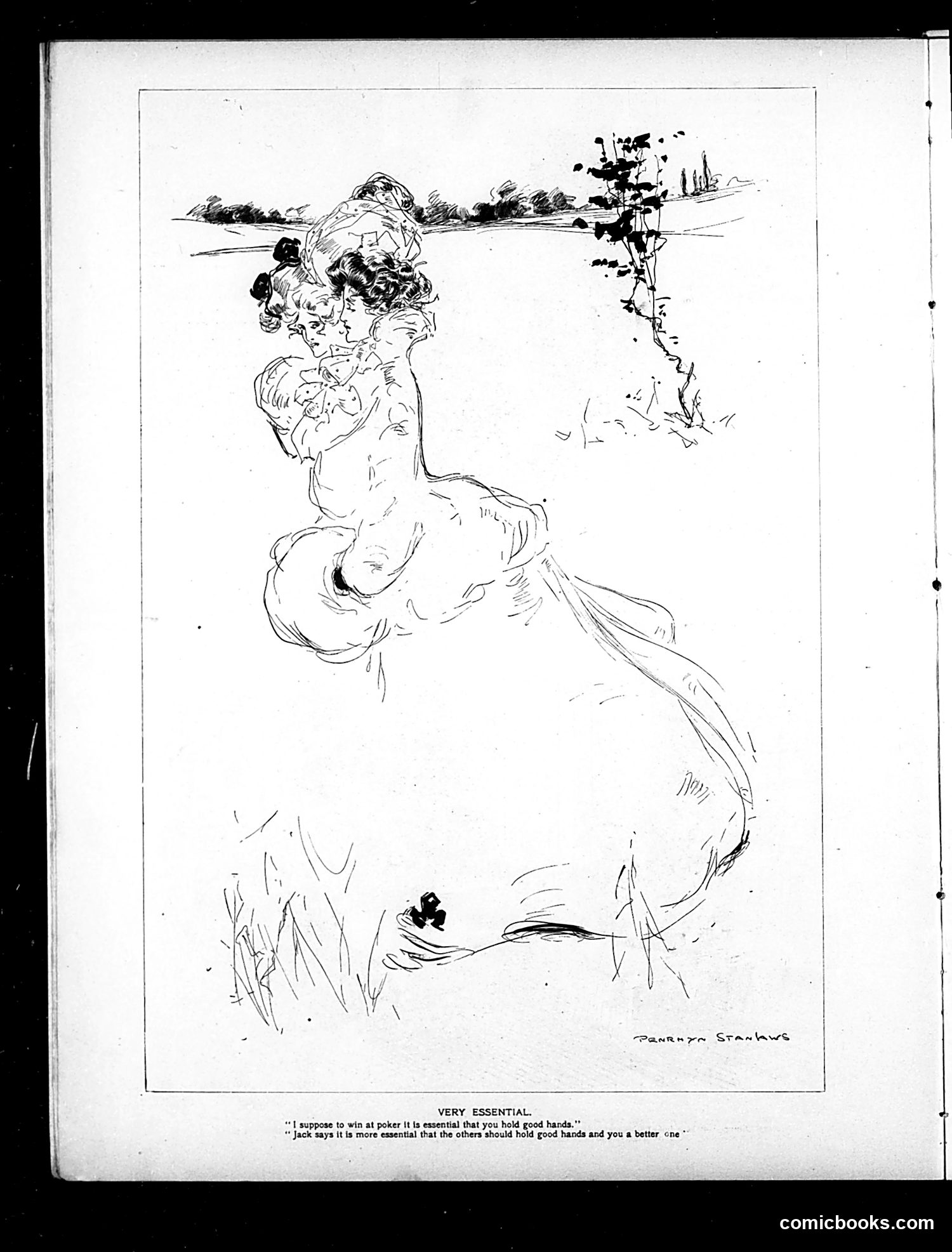
This is a single-panel cartoon titled "Very Essential" depicting a stylized woman in an elegant pose. The caption presents a poker joke contrasting two philosophies: one person claims winning requires holding good cards yourself; "Jack" counters that it's more essential that *others* hold good hands while you hold better ones. The humor relies on the distinction between luck (getting dealt good cards) versus skill (reading opponents and playing strategically). "Jack" represents the skilled player who profits from understanding others' hands rather than depending on chance. The illustration's flowing, elegant style is credited to "Pawtrere Staskus" (or similar signature). The cartoon satirizes poker as a game of psychology and deception rather than pure chance—a commentary on human nature and competitive advantage during an era when poker was prominent American entertainment.
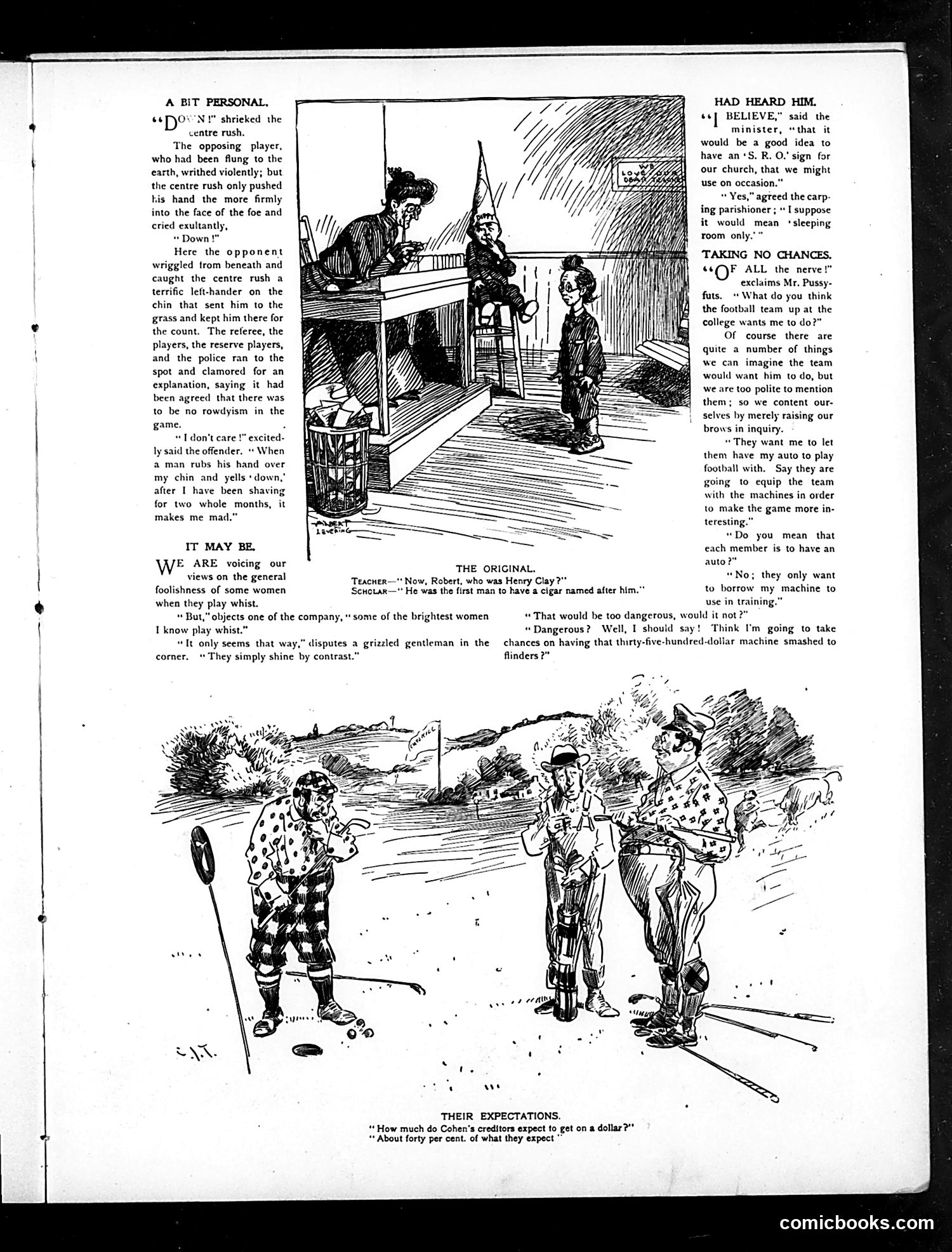
This Judge magazine page contains several satirical items mocking early 20th-century social absurdities: **"A Bit Personal"** satirizes overly aggressive football players who justify violence by claiming they were merely following the agreed-upon rough play of the game. **"It May Be"** jokes that women who play whist (a card game) only *appear* intelligent—they simply "shine by contrast" with duller company. **"The Original"** is a schoolroom joke implying Henry Clay was historically insignificant, memorable only for a cigar brand named after him. **"Their Expectations"** uses Jewish wordplay to mock Cohen's creditors' unrealistic financial hopes (a period-typical ethnic stereotype). **"Taking No Chances"** satirizes college football teams' supposed plan to use wealthy student automobiles for "training"—implying their request is absurdly dangerous and obviously a scheme to destroy expensive property. The cartoons target foolishness across social classes and institutions through exaggeration and ironic humor typical of early Judge satire.
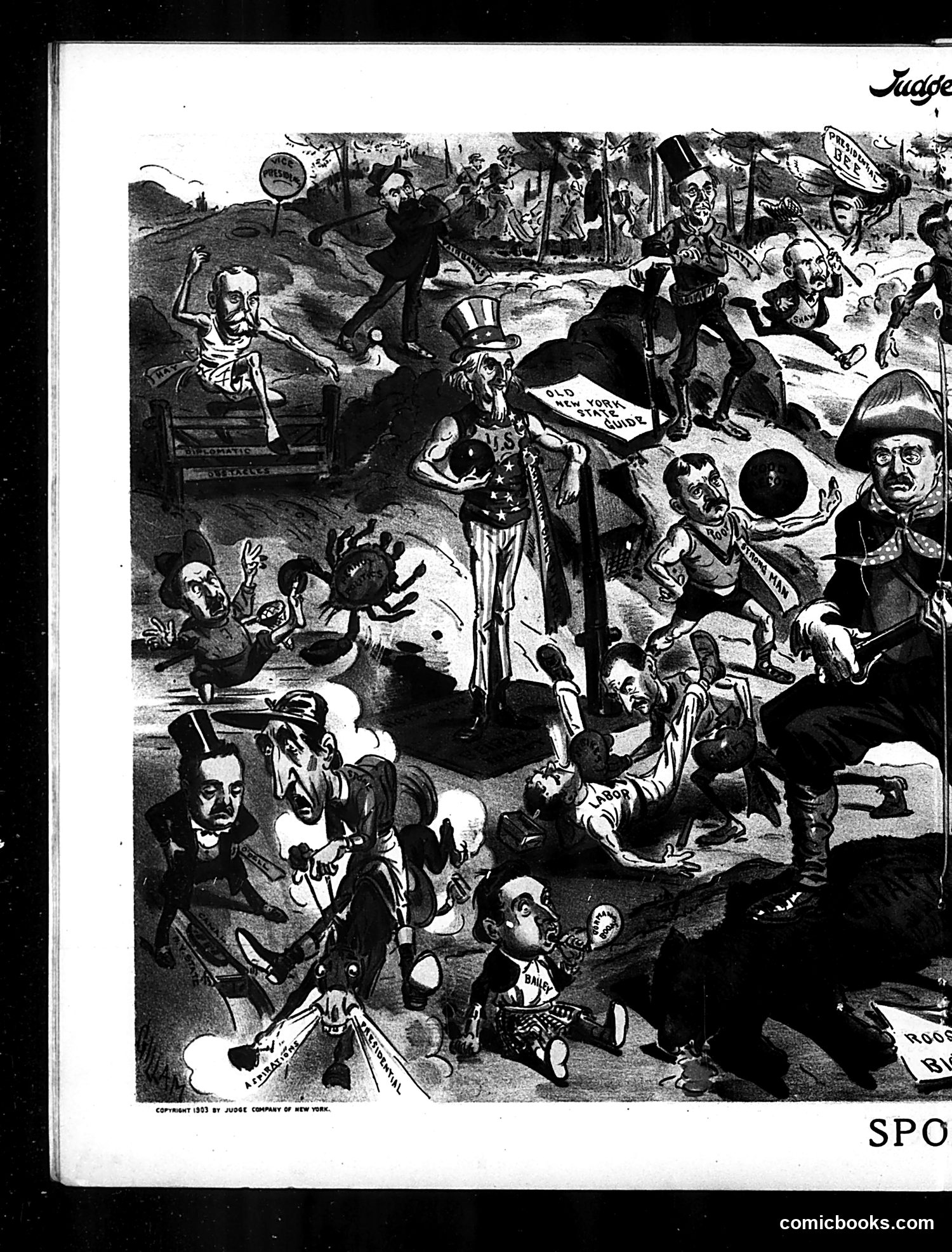
This is a complex political satire cartoon from Judge magazine (copyright 1933, per the footer). The central figure appears to be Uncle Sam or Lady Liberty, surrounded by various caricatured figures representing different political and social forces of the era—likely depicting competing interests or ideologies during the Great Depression and early New Deal period. The cartoon seems to satirize the chaos of American politics, with multiple figures jostling around the central allegorical figure. References to "Old York Guide" and other partial text visible suggest specific contemporary political targets, though the exact identities remain unclear from the image alone. The satirical point appears critical of the competing demands and confusion surrounding American governance during this turbulent period, though precise interpretation requires additional historical context.
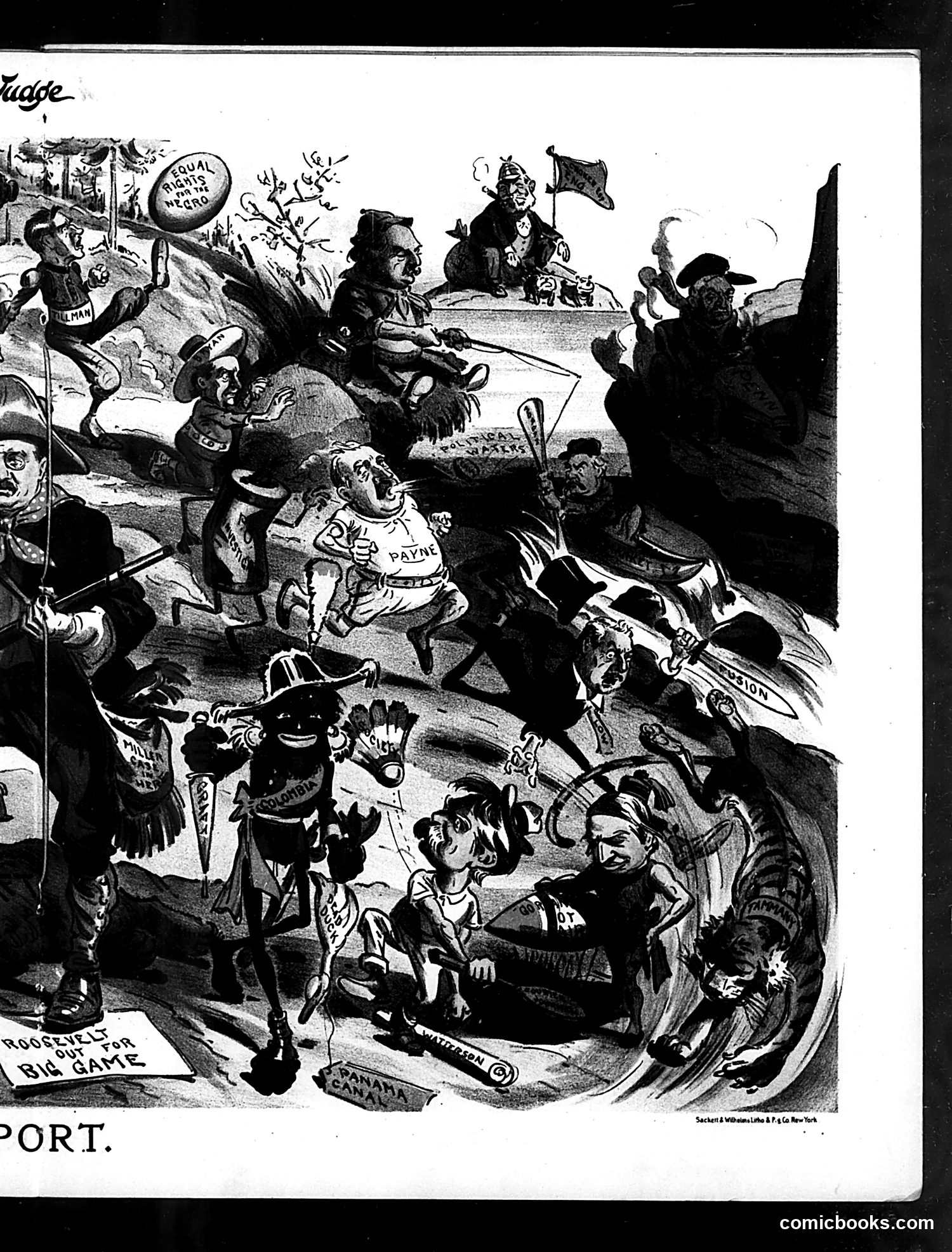
This satirical cartoon depicts various figures engaged in what appears to be a chaotic "big game" hunt or competition. A sphere labeled "Equal Rights for the Negro" sits prominently, suggesting the cartoon addresses racial politics. The composition shows multiple caricatured figures—some appearing to represent different political or national interests—pursuing this objective with varying degrees of effort and sincerity. The "Roosevelt's Big Game" notation suggests this relates to Theodore Roosevelt's policies. The cartoon appears to satirize the competing interests and hypocritical approaches various political actors took toward civil rights, presenting the pursuit of equal rights as a chaotic, poorly-coordinated spectacle rather than a genuine commitment. The style and content are consistent with early 20th-century American political commentary in *Judge* magazine.
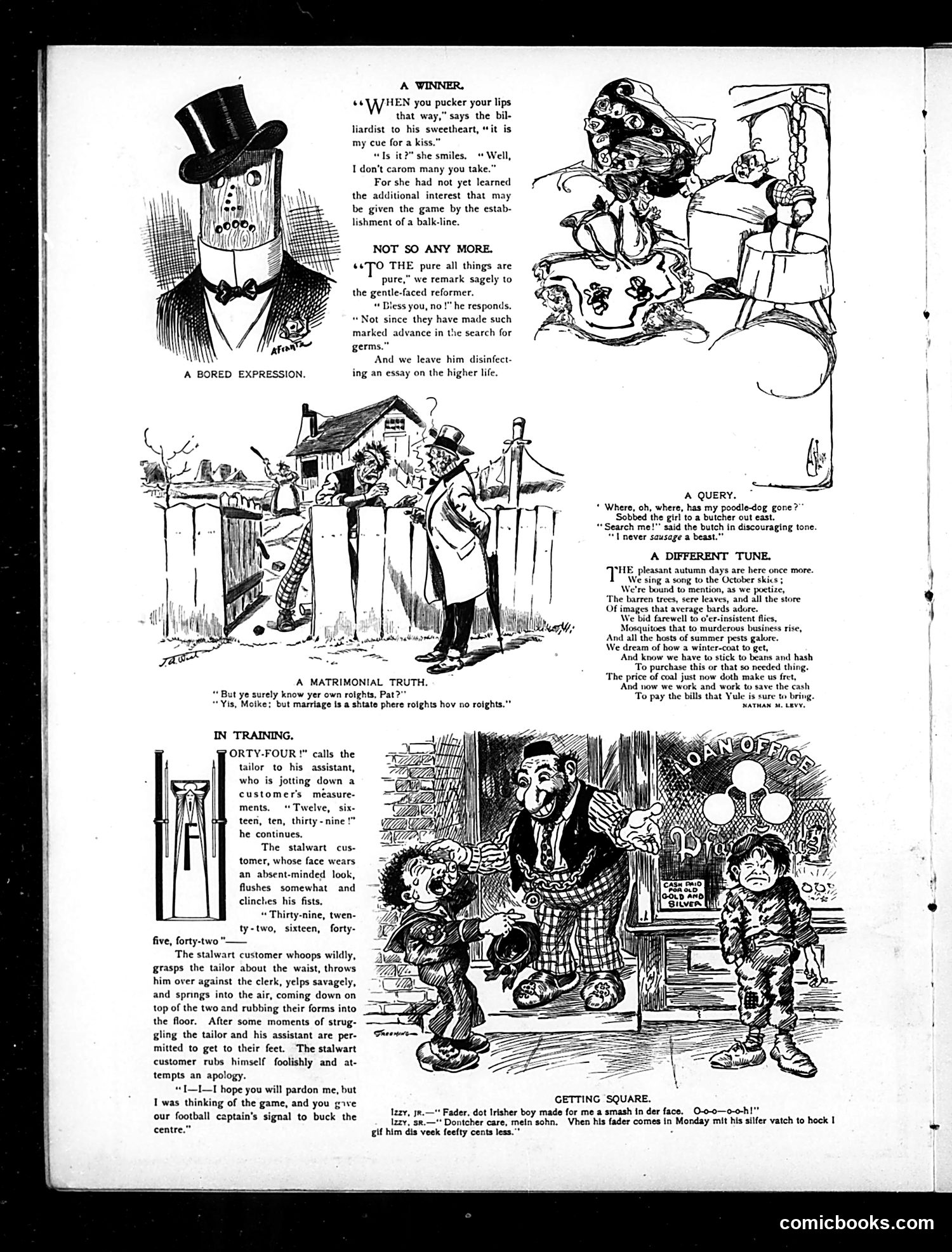
This page contains multiple satirical cartoons mocking social conventions and contemporary concerns of the era (appears to be early 1900s): **"A Winner"** jokes about billiards terminology as courtship code—the woman hasn't learned the "balk-line" (pool rules) apply to romance. **"Not So Any More"** satirizes overzealous reformers obsessed with germ theory, now seeing contamination in everything, even intellectual pursuits. **"A Query"** is a pun: a girl asks a butcher about her missing poodle-dog; he responds "I never sausage a beast"—wordplay on "saw such." **"In Training"** depicts a man violently misinterpreting tailor measurements (44, 12, 16, 10, 39) as football signals to "buck the centre," attacking everyone. **"Getting Square"** shows an Irish immigrant boy hitting an Irish opponent, then later his father threatening reduced payment if the boy retaliates—dark humor about ethnic violence and economic desperation. The humor relies on puns, malapropisms, and stereotypes common to period American satire.
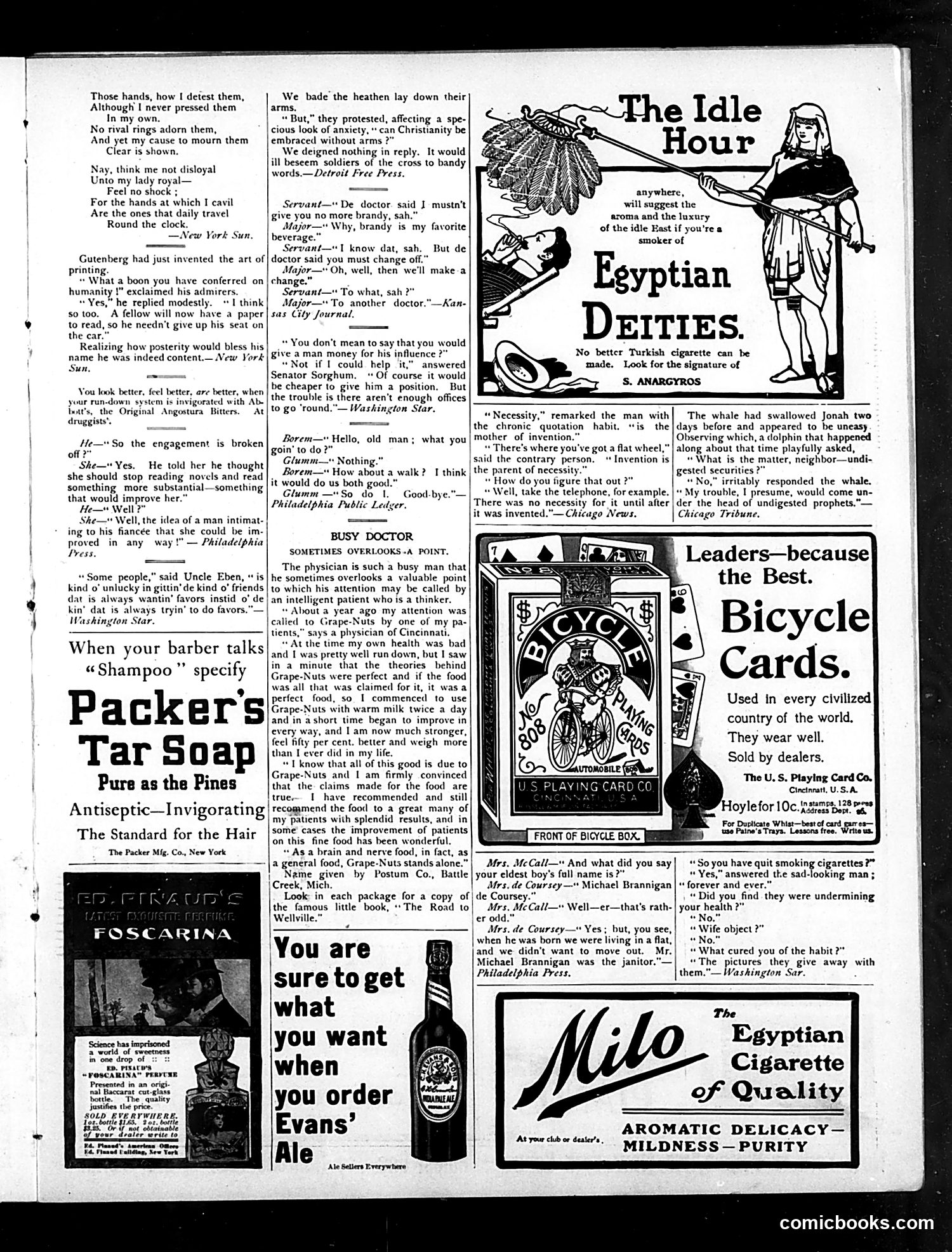
This is primarily an **advertising and humor page** from Judge magazine, with several unrelated satirical pieces and commercial ads. The main content includes: **"The Idle Hour" section** (top right): A poem lamenting hands that "daily travel round the clock"—likely satirizing the relentless pace of modern labor or factory work, contrasting with romantic ideals. **"Busy Doctor" joke**: Satirizes physicians who overlook practical solutions, featuring a doctor who resists patient advice until switching doctors rather than changing his brandy habit—mocking professional stubbornness. **Brief satirical pieces**: Including jabs at political corruption (Senator Sorghum bribing with positions), marriage dynamics, and social pretension (the broken engagement over "self-improvement"). **Colonial/missionary satire** (upper left): Critiques Christian missionary work, suggesting hypocrisy in demanding non-Christians disarm while Christian soldiers keep weapons. The page is dominated by **period advertisements** for Packer's Tar Soap, Bicycle Cards, Egyptian cigarettes, and other products—standard for Judge's era.
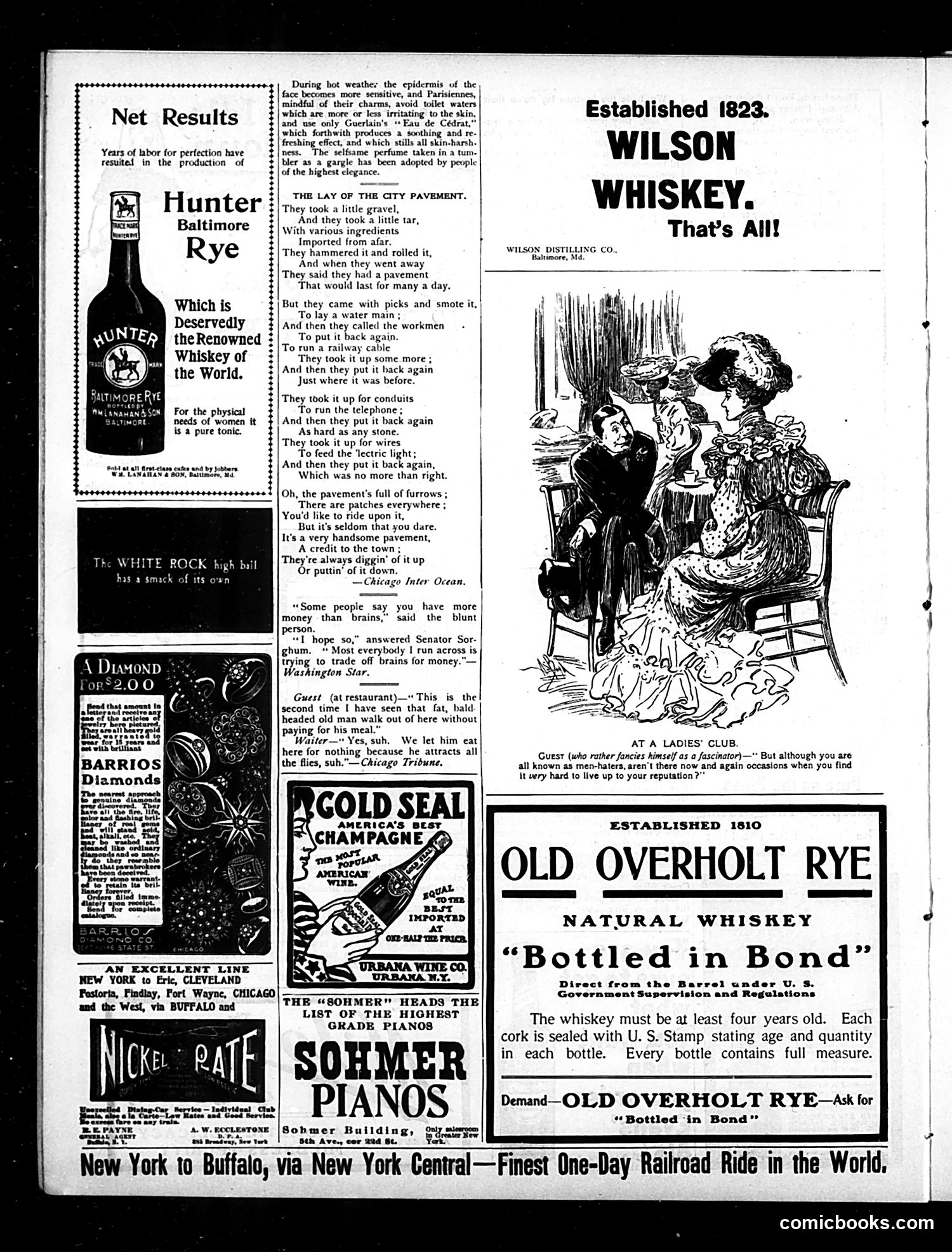
This page mixes advertisements with satirical humor pieces typical of Judge magazine's format. The main cartoon, "The Lay of the City Pavement," satirizes urban infrastructure management. The poem mocks how city workers constantly excavate streets to install utilities (water mains, railways, telephone lines, electric wires), then repave them, only to dig them up again shortly after. The satire targets the inefficiency and poor coordination of municipal services—the pavement becomes a metaphor for government incompetence and the endless cycle of disruption to city life. The smaller "Ladies' Club" cartoon plays on contemporary attitudes about women: a man assumes that women who publicly claim to dislike men ("men-haters") must privately make exceptions. It's a sexist joke suggesting women's stated independence is merely performance. The page is otherwise dominated by period whiskey and product advertisements (Hunter Rye, Wilson Whiskey, Old Overholt Rye, Sohmer Pianos, etc.), reflecting the magazine's revenue model.
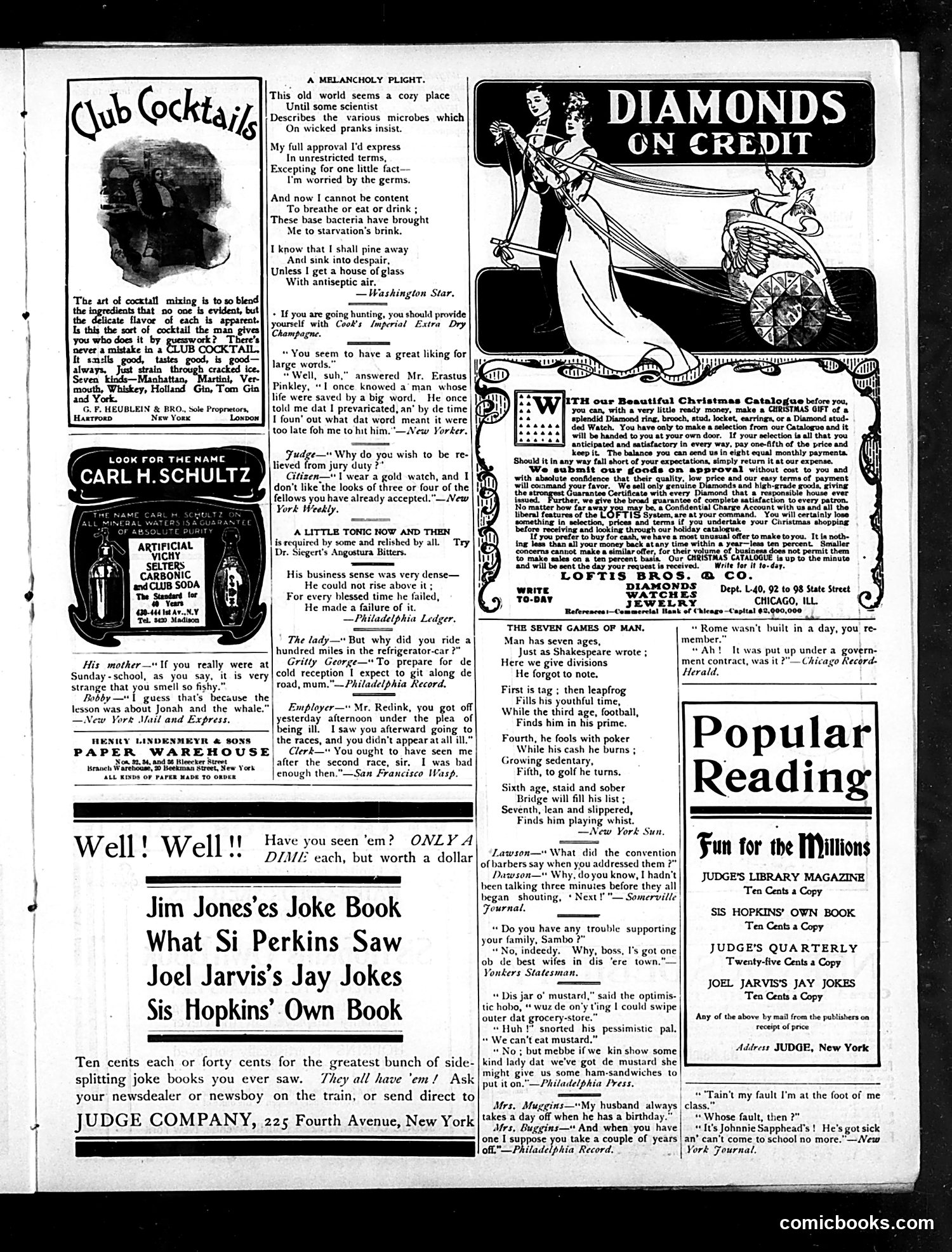
This page satirizes **germ theory anxiety**—a genuine cultural phenomenon of the early 1900s. The poem "A Melancholy Plight" mocks how scientific discoveries about microbes had created widespread hypochondria. The speaker claims he's so worried about germs that he's essentially starving himself, unable to eat or drink without fear—a exaggerated but recognizable response to new medical knowledge. The page also includes joke advertisements and humor pieces typical of *Judge* magazine's satirical format. The "Diamonds on Credit" ad represents period consumer culture, while various anecdotes mock employment absurdities and linguistic pretension. The overall theme: **modern science, while beneficial, had triggered irrational panic among the public**—a critique of how people sometimes overcorrect when learning about health hazards.
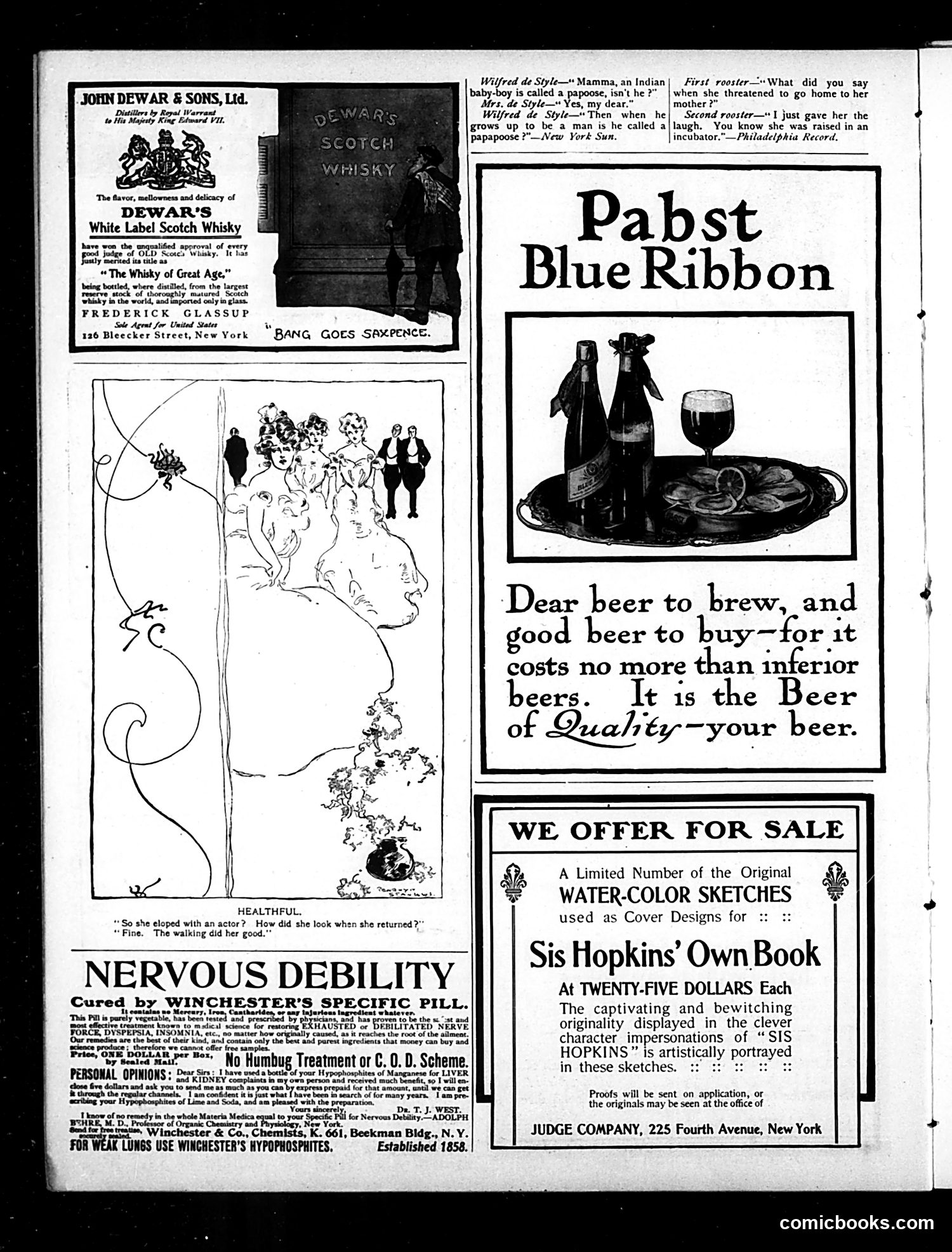
This is primarily an **advertising page** from Judge magazine, not a political cartoon. It contains multiple product advertisements typical of early 1900s publications: **Main advertisements:** - Dewar's Scotch Whisky (top left) - Winchester's Specific Pill for "Nervous Debility" (center) — a patent medicine claiming to cure various ailments - Pabst Blue Ribbon beer (right side) - Water-color sketches from "Sis Hopkins' Own Book" for sale (bottom right) **Minor comedic content:** Two brief jokes appear: one about an actress eloping with an actor, and another about roosters discussing a hen raised in an incubator. These are lightweight domestic humor typical of the era. **Historical context:** The patent medicine ad is notable — such dubious remedies were common before FDA regulation (1906). The products advertised reflect Edwardian consumer culture and leisure pursuits of affluent readers.
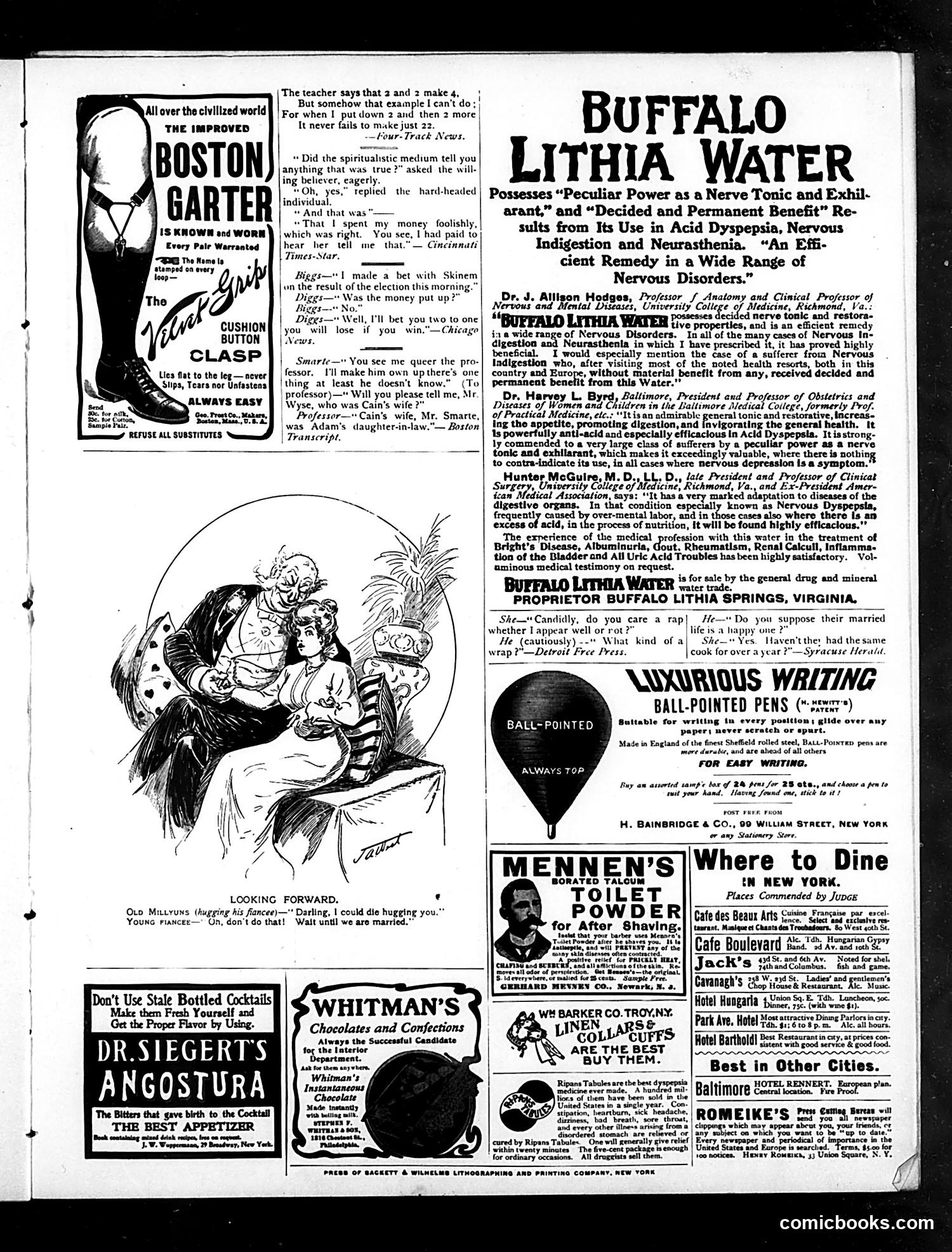
This page contains **mostly period advertisements** with brief comedic snippets. The main editorial content is short humor pieces: **The Cartoons/Jokes:** - A teacher illustrates faulty logic: 2+2 should equal 4, but the student gets 22 (concatenation, not addition) — mocking poor math reasoning - Election betting joke playing on wordplay ("lose if you win") - Professor stumped by student asking "Who was Cain's wife?" (biblical trivia) - A courting couple joke about physical restraint before marriage - Final cartoon shows children literally hugging an older man to death, darkly joking about their affection **The Advertisements:** The page is dominated by period product pitches: Boston garters, Buffalo Lithia Water (sold as a nerve tonic for dyspepsia and "neurasthenia"), Whitman's chocolates, ball-point pens, various dining establishments, and Angostura bitters for cocktails. The content reflects early 20th-century concerns: mathematical literacy, patent medicine cures for vague "nervous" ailments, and social propriety regarding courtship.
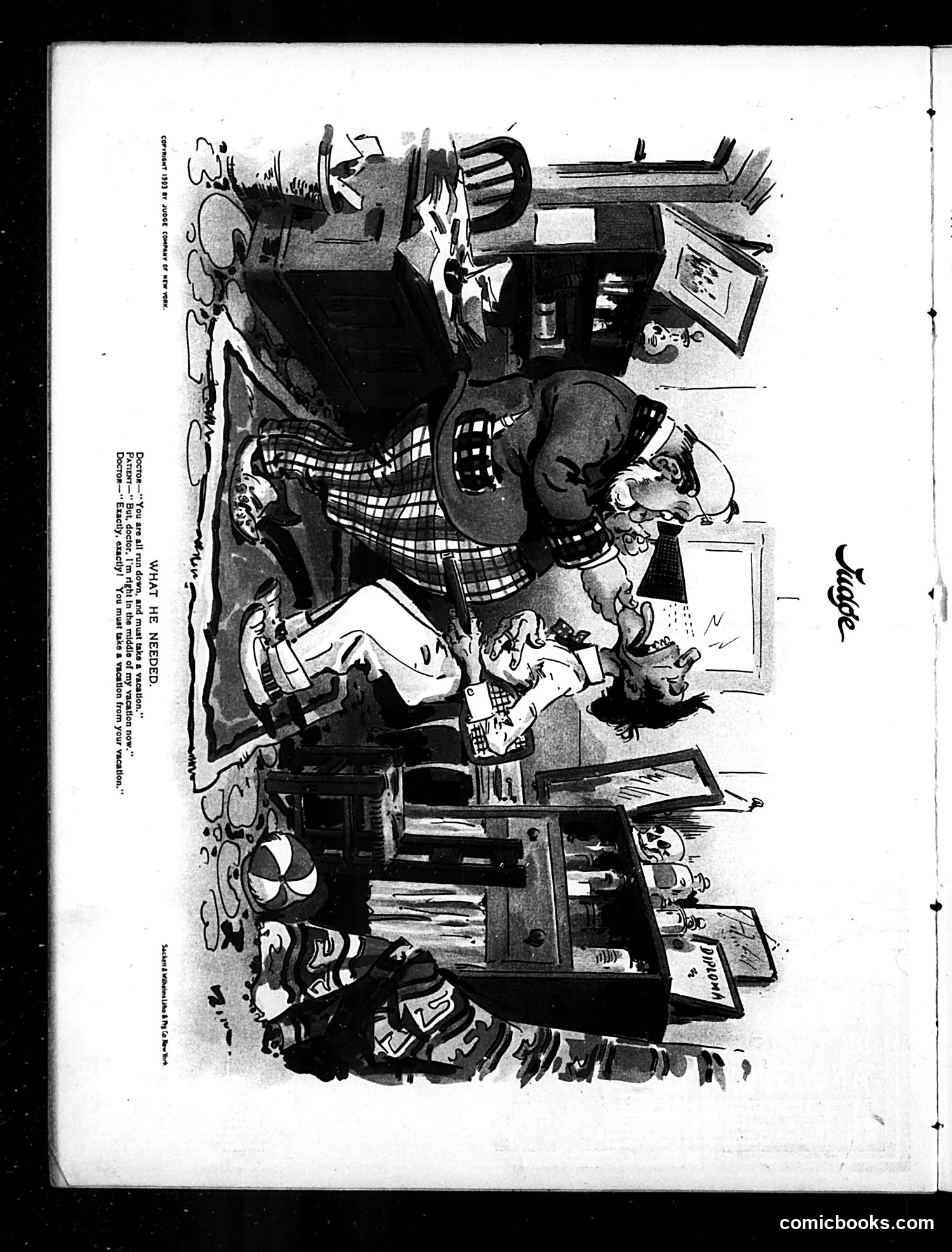
This is a simple comedic cartoon from 1903 satirizing the exhaustion of leisure itself. A doctor prescribes a tired patient a vacation, only to learn the patient is *already on vacation*. The doctor's absurd solution—"a vacation from your vacation"—mocks the modern predicament of overbooked, stressful leisure time. The joke targets turn-of-the-century anxieties about rest becoming as demanding as work. Rather than relaxation restoring energy, the patient's vacation has itself become exhausting (likely due to overscheduled activities, social obligations, or travel fatigue). The cartoon suggests that even time off cannot escape the era's relentless pace. It's straightforward satire about work-life balance and the ironic impossibility of true rest—issues that remain surprisingly contemporary.
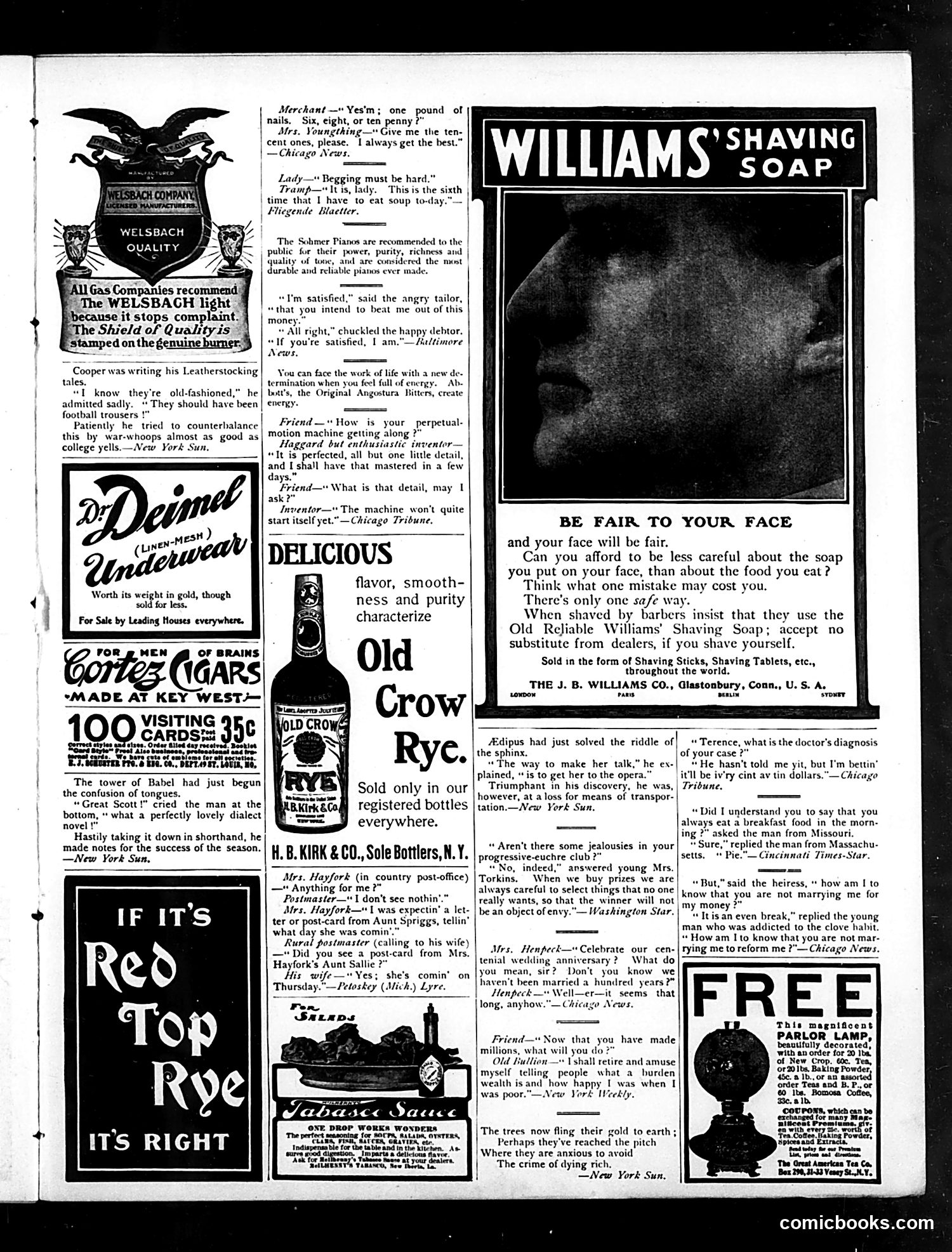
This page is primarily **advertising** interspersed with brief jokes and humorous anecdotes typical of Judge magazine's satirical content. The advertisements promote products like Welsbach gas lights, Dr. Deimel underwear, Cortes cigars, Old Crow Rye whiskey, and Williams' Shaving Soap. The Williams' ad uses the social message "Be Fair to Your Face," encouraging readers to use quality soap. The scattered jokes reflect early-20th-century humor: - A quip about James Fenimore Cooper's outdated writing style - Wordplay about the Tower of Babel creating a "lovely dialect novel" - Domestic humor about marriages and penny-pinching wives - A perpetual motion machine inventor's ironic problem The page contains **no apparent political cartoons or caricatures** of named public figures. Instead, it features generic satirical vignettes mocking common social types (rural postmasters, nagging wives, inventors) typical of Judge's lighthearted approach to American life during this era.
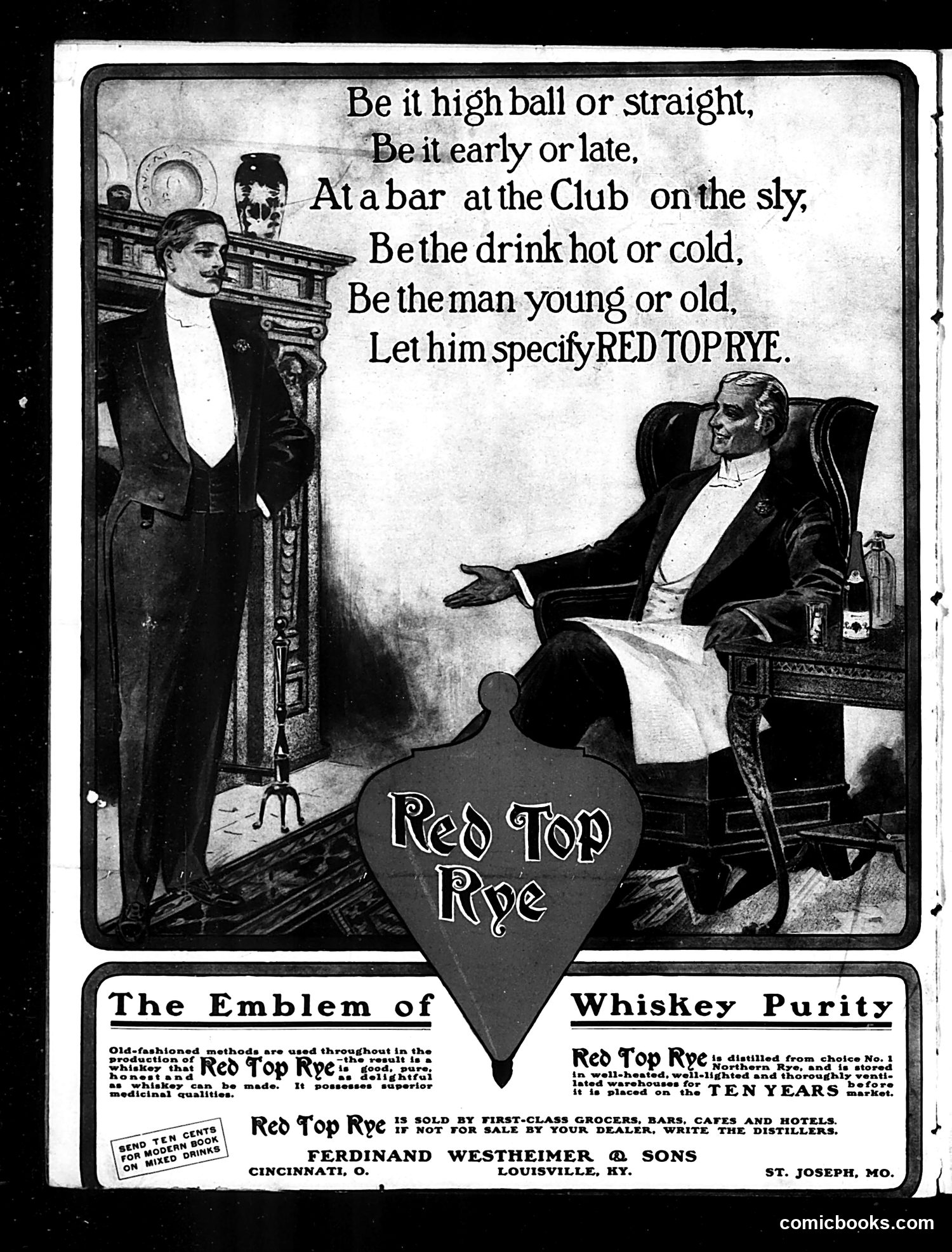
This is primarily a **whiskey advertisement**, not political satire. It depicts two well-dressed men in formal attire at an exclusive club, advertising Red Top Rye whiskey. The ad's message is straightforward: regardless of circumstances (high ball or straight, early or late, hot or cold, young or old drinker), one should specify Red Top Rye at bars and clubs. The heart-shaped emblem emphasizes "Whiskey Purity"—a selling point claiming the product was distilled using "old-fashioned methods" and possessed medicinal qualities. The imagery reflects early 20th-century upper-class consumption: gentlemen in formal wear in private club settings. The verse uses casual rhyming to make the brand memorable. This is marketing content exploiting pre-Prohibition attitudes about whiskey's universal appropriateness and presumed health benefits—claims that would become illegal after 1920.