
A complete issue · 16 pages · 1903
Judge — December 5, 1903
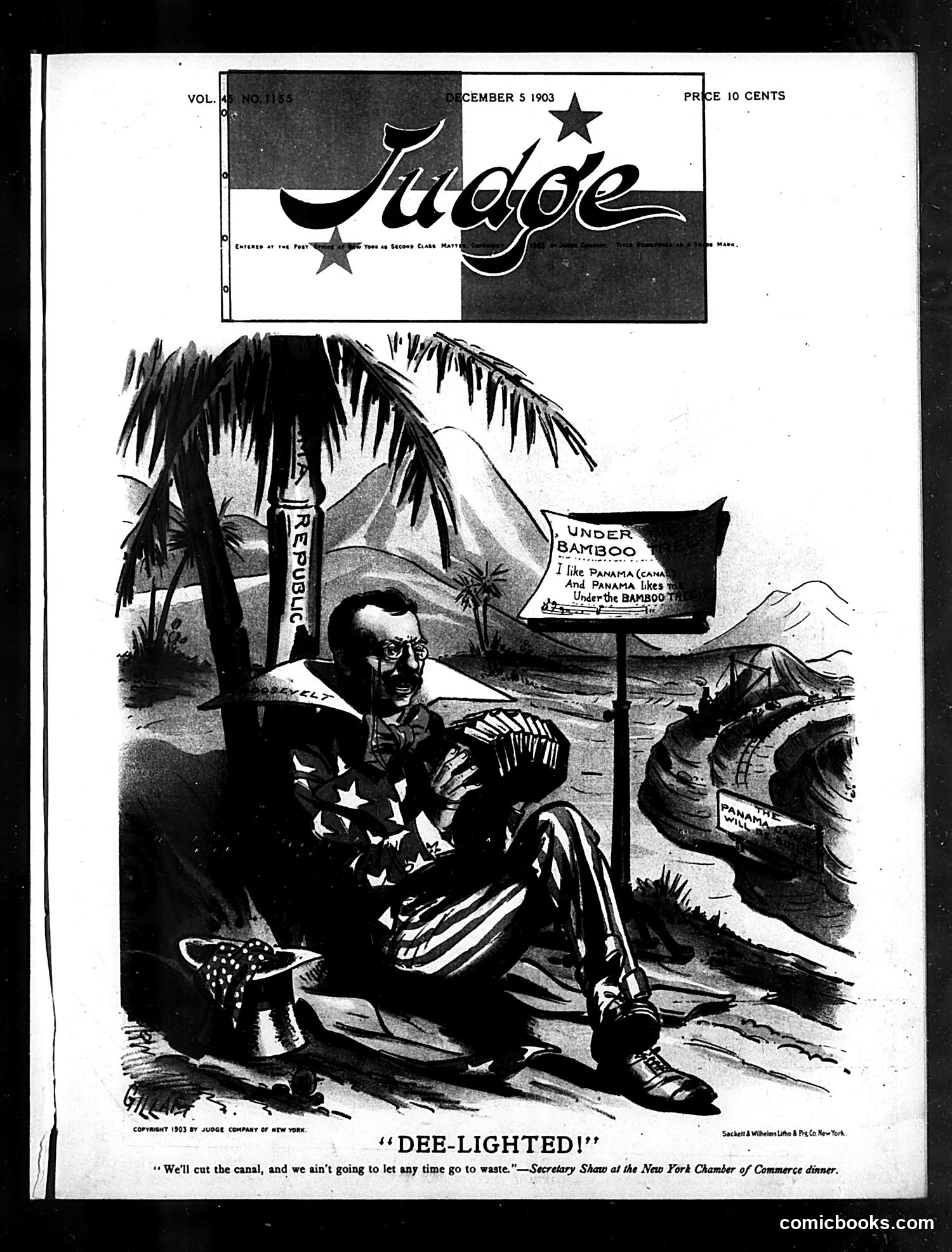
This cartoon satirizes the Panama Canal project under President Theodore Roosevelt's administration. The central figure appears to be Secretary of State John Hay or a State Department official, depicted as a military officer relaxing "Under Bamboo" in Panama, seemingly indifferent to construction challenges. The sign reading "I like Panama (canal) And I like the scenery Under the BAMBOO" mocks the administration's optimistic public stance while suggesting complacency about the canal's actual difficulties. The caption—"We'll cut the canal, and we ain't going to let any time go to waste"—attributes this quote to "Secretary Shaw at the New York Chamber of Commerce dinner," indicating this references a specific recent speech promoting the canal project. The satire criticizes overconfidence in the ambitious engineering endeavor.
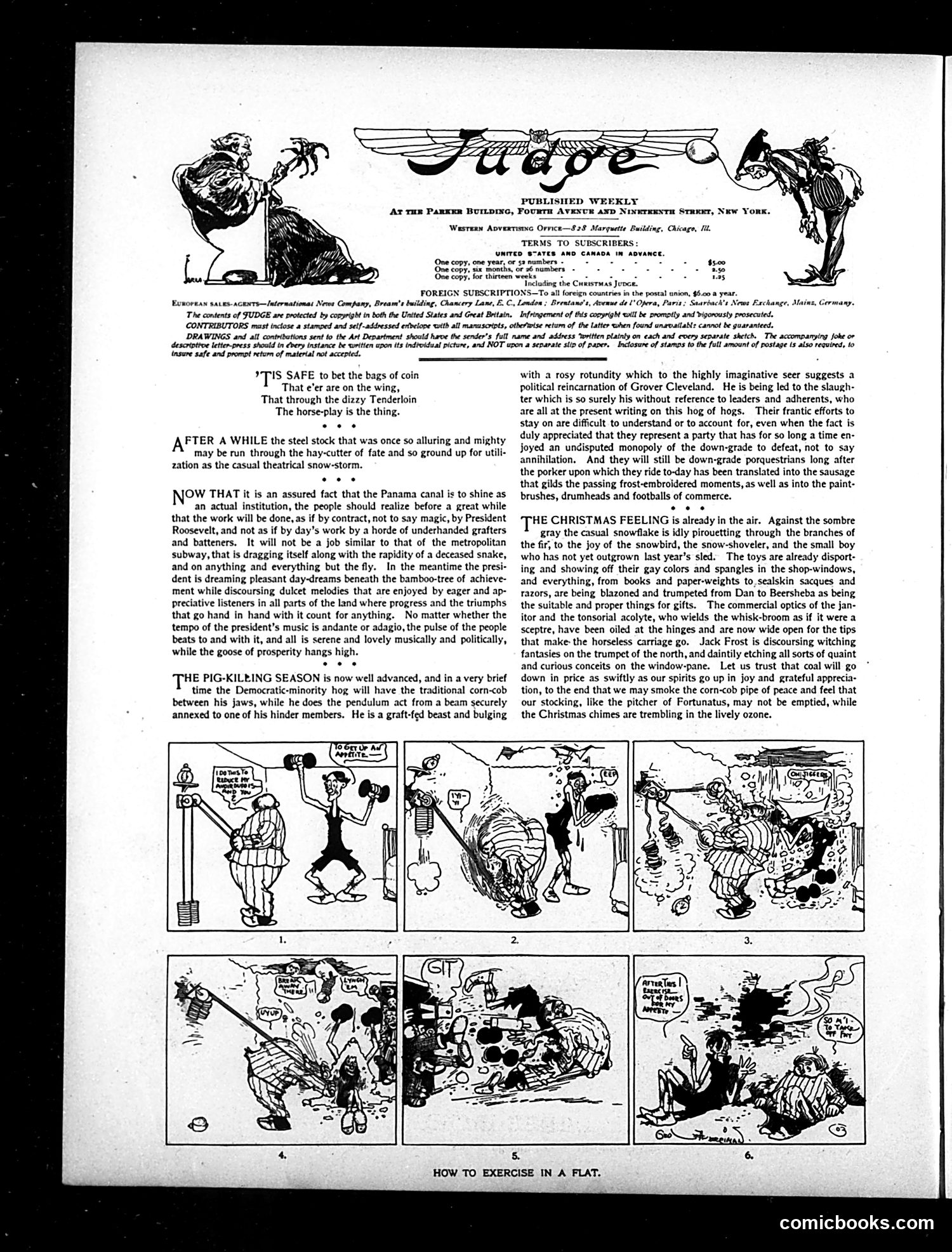
This page from *Judge* contains political commentary and a comic strip titled "How to Exercise in a Flat." **Political Content:** The upper text discusses the Panama Canal as a national institution and references President Cleveland (likely Grover Cleveland). The passage critiques how people underestimate the canal's importance and suggests political figures lack genuine understanding of its significance. There's also commentary on the Christmas shopping season and consumer culture. **Comic Strip:** The six-panel strip satirizes apartment living and exercise, showing residents attempting various physical activities in cramped quarters—jumping, stretching, and moving furniture—resulting in chaos and collisions with neighbors. The humor derives from the impracticality of exercising in confined urban spaces. The overall tone mixes political observation with gentle social satire about modern city life.
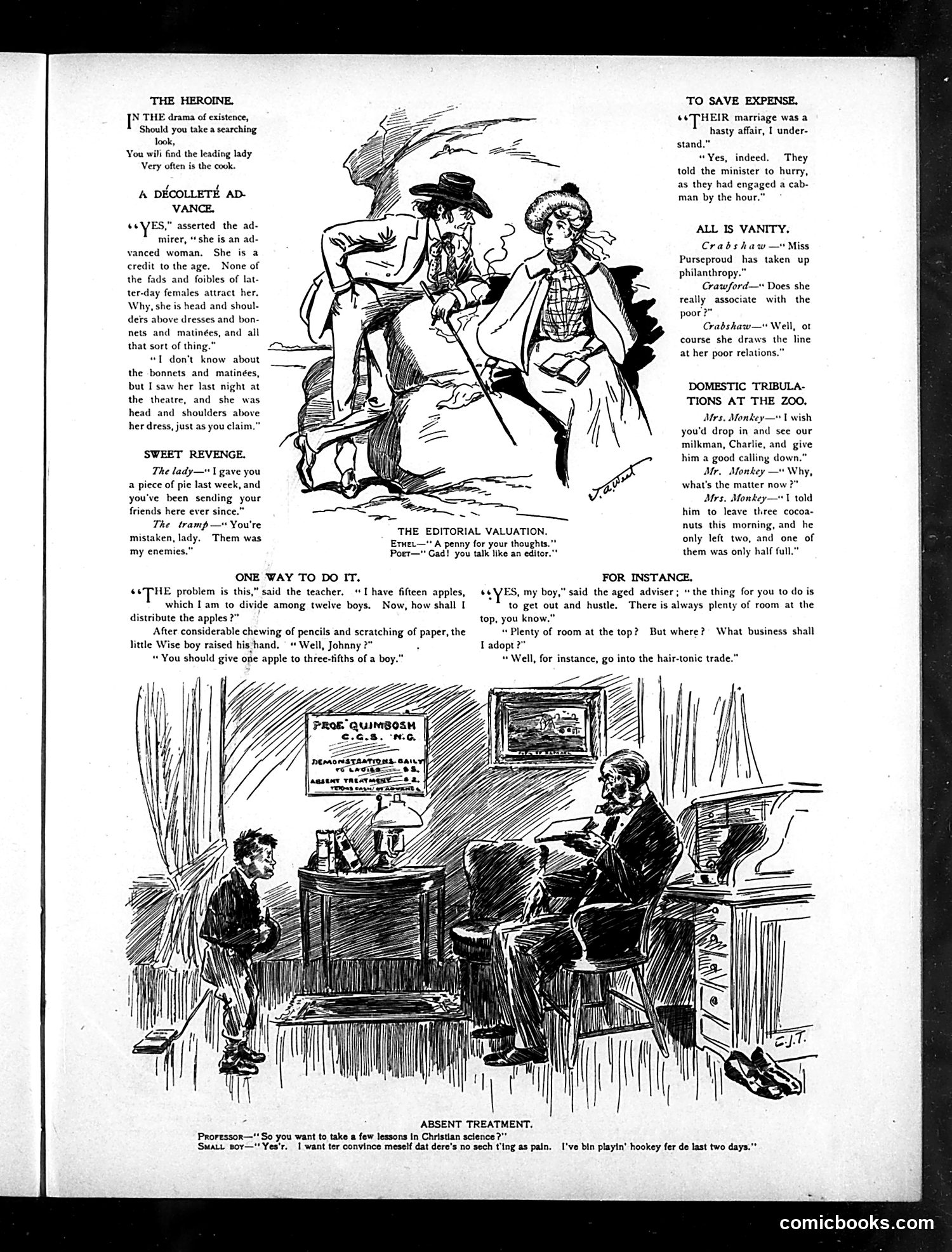
This page contains several short humorous pieces typical of early 20th-century satirical magazines: **"The Heroine"** and **"A Décolleté Advance"** mock society women obsessed with fashion and theater, portraying them as vapid. **"Sweet Revenge"** presents a domestic quarrel joke about a husband's infidelity. **"One Way to Do It"** shows a teacher distributing apples to students—a commentary on classroom methods. **"All Is Vanity"** satirizes wealthy philanthropists who maintain social distance from poor relations. **"Domestic Tribulations at the Zoo"** and **"For Instance"** offer workplace/domestic humor. **"Absent Treatment"** depicts a boy seeking to skip Christian Science lessons to play hockey—satirizing both the religious practice and adolescent priorities. The cartoons reflect common Judge targets: pretentious society, weak pedagogy, hypocrisy, and class distinctions. The humor relies on observational satire of contemporary American middle-class life.
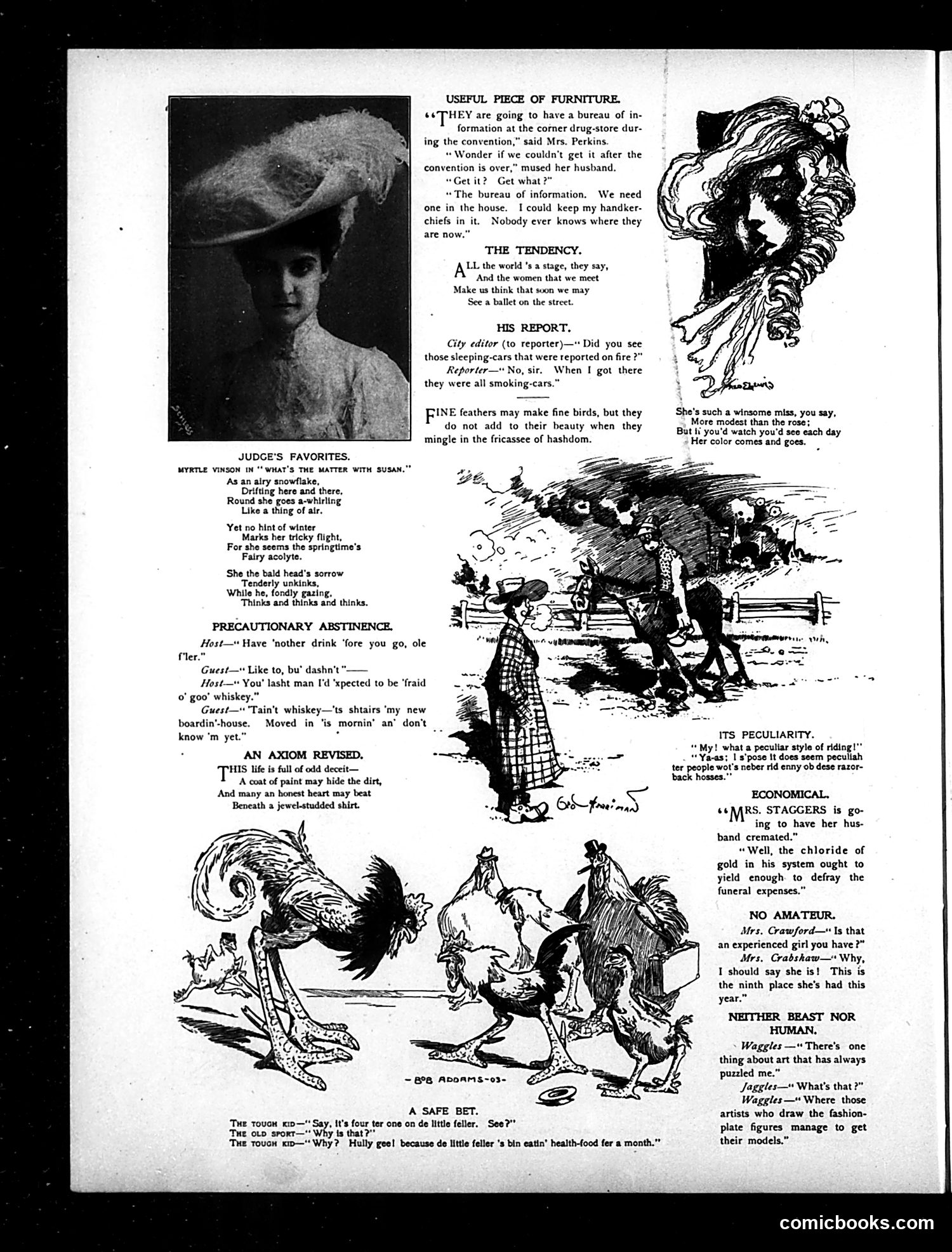
This page contains humorous social commentary and satirical sketches typical of early 20th-century Judge magazine. **"Judge's Favorites"** mocks sentimentality in poetry, parodying flowery romantic verse with deliberately clumsy language. **"The Tendency"** satirizes society's theatrical nature—the idea that life itself becomes performative spectacle. **"His Report"** jokes about a reporter confusing "sleeping cars" with "smoking cars" on a train, playing on similar terminology. **"Precautionary Abstinence"** presents a humorous dialogue about whiskey and moving, using wordplay ("don't know 'ye yet"). **The illustrated sketches** (roosters, figures) appear to be generic comic vignettes rather than political cartoons, featuring everyday situations with exaggerated drawings for comedic effect. **"A Safe Bet"** presents a joke about a small animal's diet and health. Overall, the page emphasizes humor over political commentary.
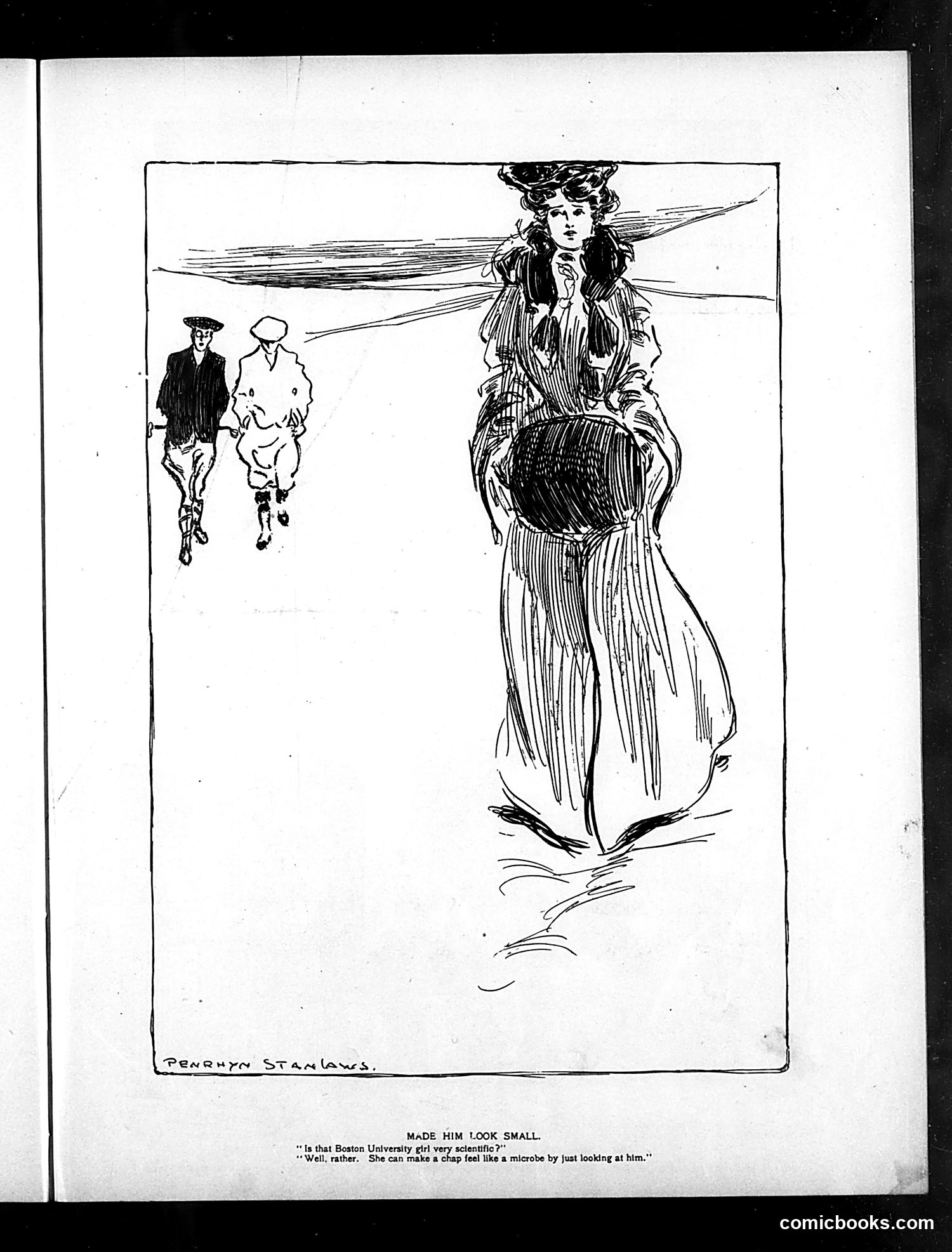
This cartoon satirizes the intellectual pretensions of a Boston University woman. The drawing shows an elegantly dressed woman with exaggerated proportions towering over two small male figures in the background, illustrating the caption's joke. The humor relies on early-1900s gender anxiety: a woman's education and confident demeanor make men feel diminished and insignificant. The dialogue mocks both the woman's "scientific" affectations and the male observer's insecurity about her superiority. The microbe reference adds another layer—she reduces men to microscopic organisms through sheer intellectual presence. The cartoon reflects common satirical targets of *Judge* magazine: women's higher education, changing gender dynamics, and the threat educated women posed to traditional masculinity during the Progressive Era.
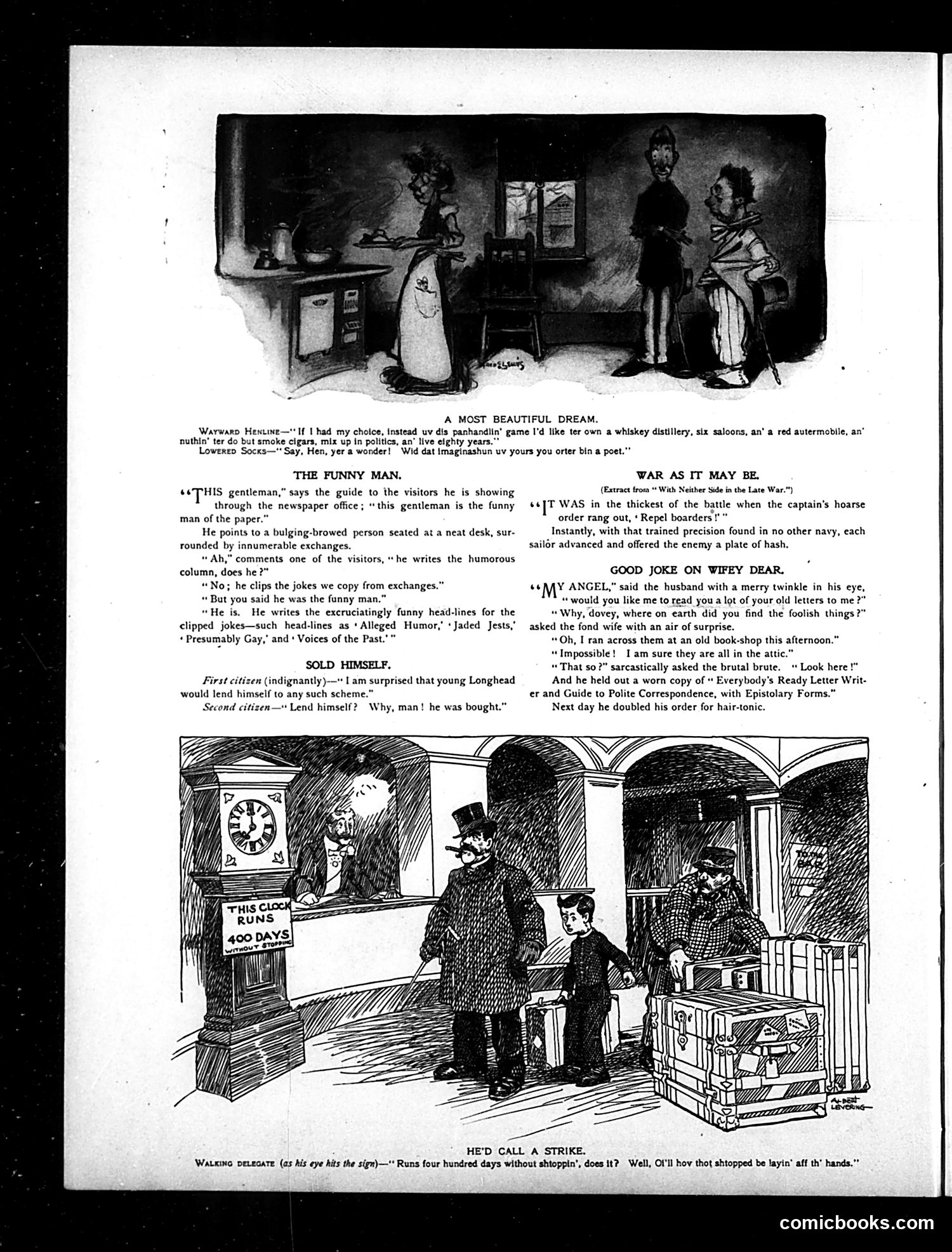
This page contains multiple satirical pieces typical of early 20th-century American humor: **"A Most Beautiful Dream"** mocks working-class aspiration through an Irish immigrant ("Warwaro Henline") daydreaming about wealth—owning distilleries, saloons, and automobiles while avoiding labor. The stereotype reinforces period prejudices about Irish-Americans and their association with alcohol. **"The Funny Man"** satirizes newspaper humor departments, suggesting the "funny man" merely copies jokes from other publications and writes formulaic headlines rather than creating original comedy—a critique of journalistic quality. **"War as It May Be"** appears to mock military incompetence or satirize a specific naval engagement, though the specific reference is unclear without fuller context. **"Good Joke on Wifey Dear"** uses standard marital comedy: a husband tricks his wife by pretending her old love letters came from a used bookshop, when they're actually from a generic letter-writing guide—humiliating the couple's romance. **"He'd Call a Strike"** depicts an Irish immigrant (identified by dialect) threatening to halt a clock factory's operations, apparently commenting on labor disputes and immigrant workers' attitudes toward industrial management.
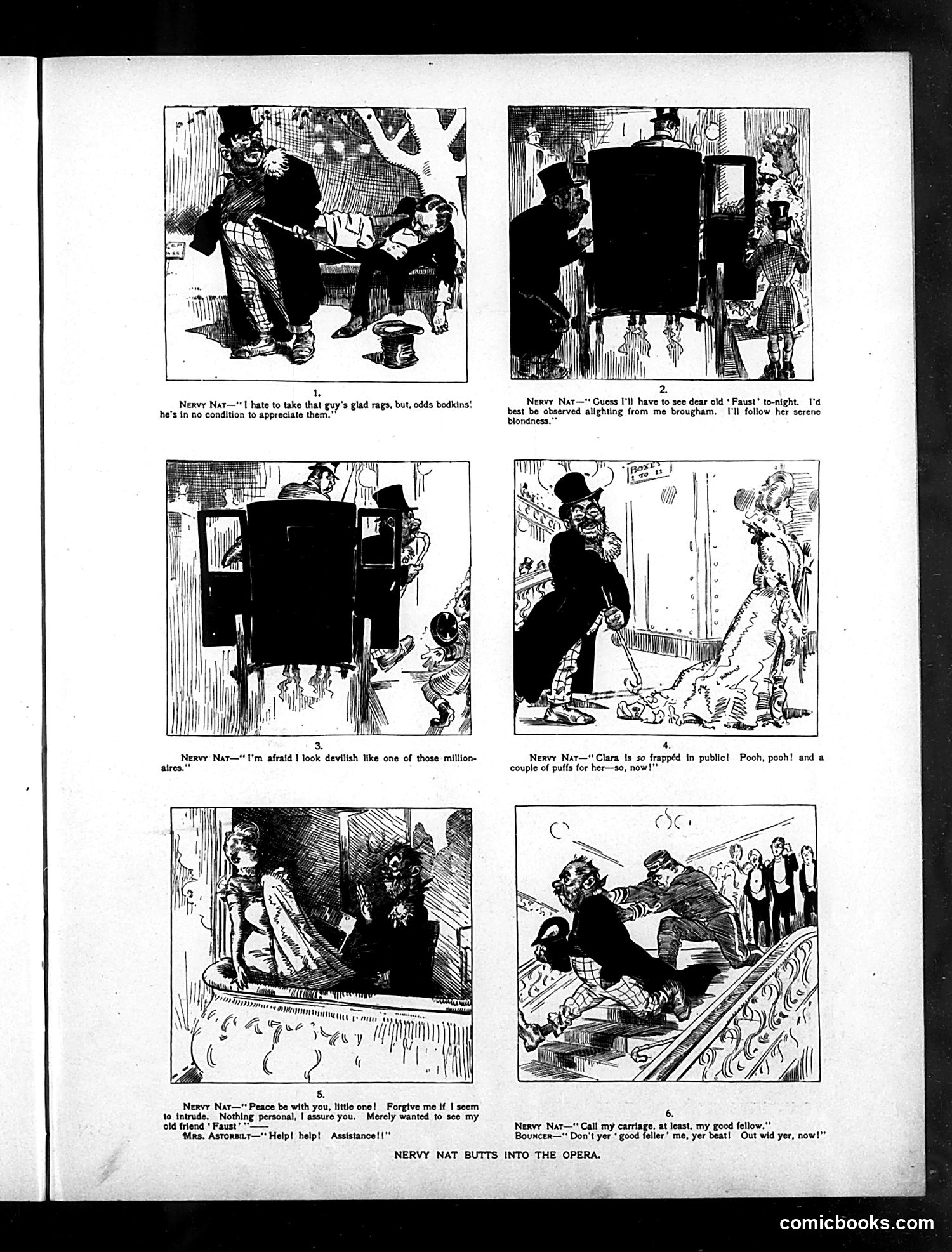
This is a satirical comic strip about a character named "Nervy Nat," a social climber attempting to infiltrate high-society spaces where he doesn't belong. The humor centers on his audacious rudeness and class pretensions. In the opera house scenes, Nat disrupts patrons—interrupting a woman's carriage ride, accosting an elegantly dressed woman named Clara in public, and generally behaving with entitled obliviousness. He references "Faust," suggesting cultural pretense. The strip's joke is that despite his affected manner and attempts to appear refined ("me brougham," "good fellow"), he's exposed as a fraud. The final panels show consequences: a bouncer violently ejects him, with Nat calling for "his carriage" while being literally thrown out. The satire mocks social climbers who ape upper-class mannerisms while lacking genuine breeding or self-awareness—a common Judge magazine target during the Gilded Age.
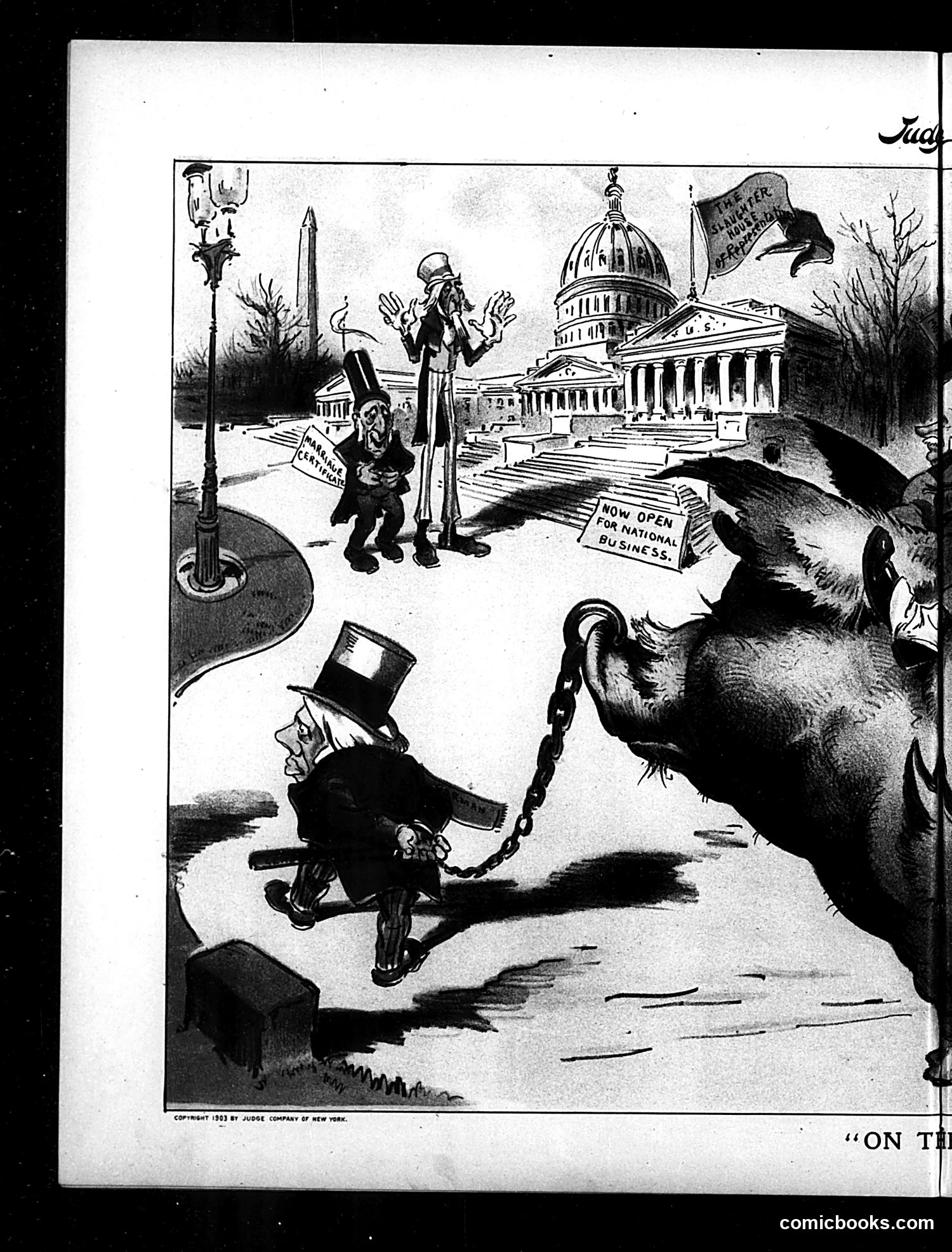
This Judge magazine cartoon depicts a large bear (representing Russia) chained near the U.S. Capitol building. A figure in a top hat—likely representing American business or political interests—holds the chain while gesturing toward an open door labeled "NOW OPEN FOR NATIONAL BUSINESS." The satire suggests anxiety about Russian involvement in American commerce or politics. The bear, traditionally symbolizing Russia in political cartoons, is portrayed as a threat that must be restrained. The Capitol dome and "national business" signage indicate this concerns domestic economic or political affairs. The cartoon likely reflects Cold War-era (or possibly earlier 20th-century) American concerns about Soviet influence on the U.S. economy or government, presenting Russia as a dangerous force requiring vigilant control by American leadership.
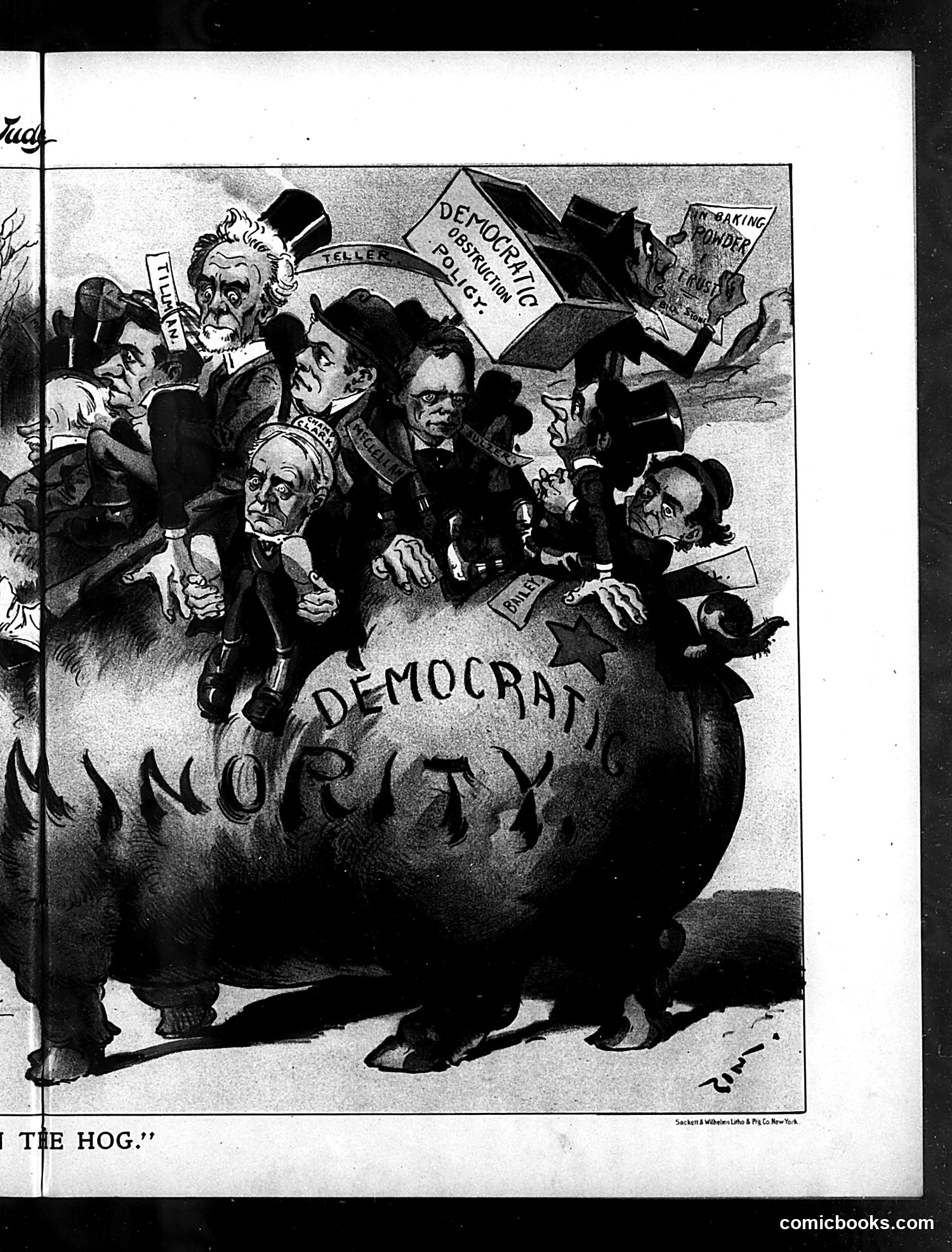
This is a satirical cartoon depicting multiple political figures crowded onto a large hog labeled "Democracy" and "Morality." The figures appear to be quarreling politicians or party leaders, some wearing top hats and formal dress, fighting over control of the beast. Visible banners reference "Democratic" concerns and "Teller" (likely Senator Henry M. Teller). The cartoon satirizes how competing political factions exploit democratic principles for personal gain—they're literally riding and fighting atop "Democracy" itself, treating it like a prize to be seized rather than a system to serve. The work critiques political corruption and infighting, suggesting politicians care more about power than actual democratic values. The hog metaphor suggests degradation and greed among the nation's leadership.
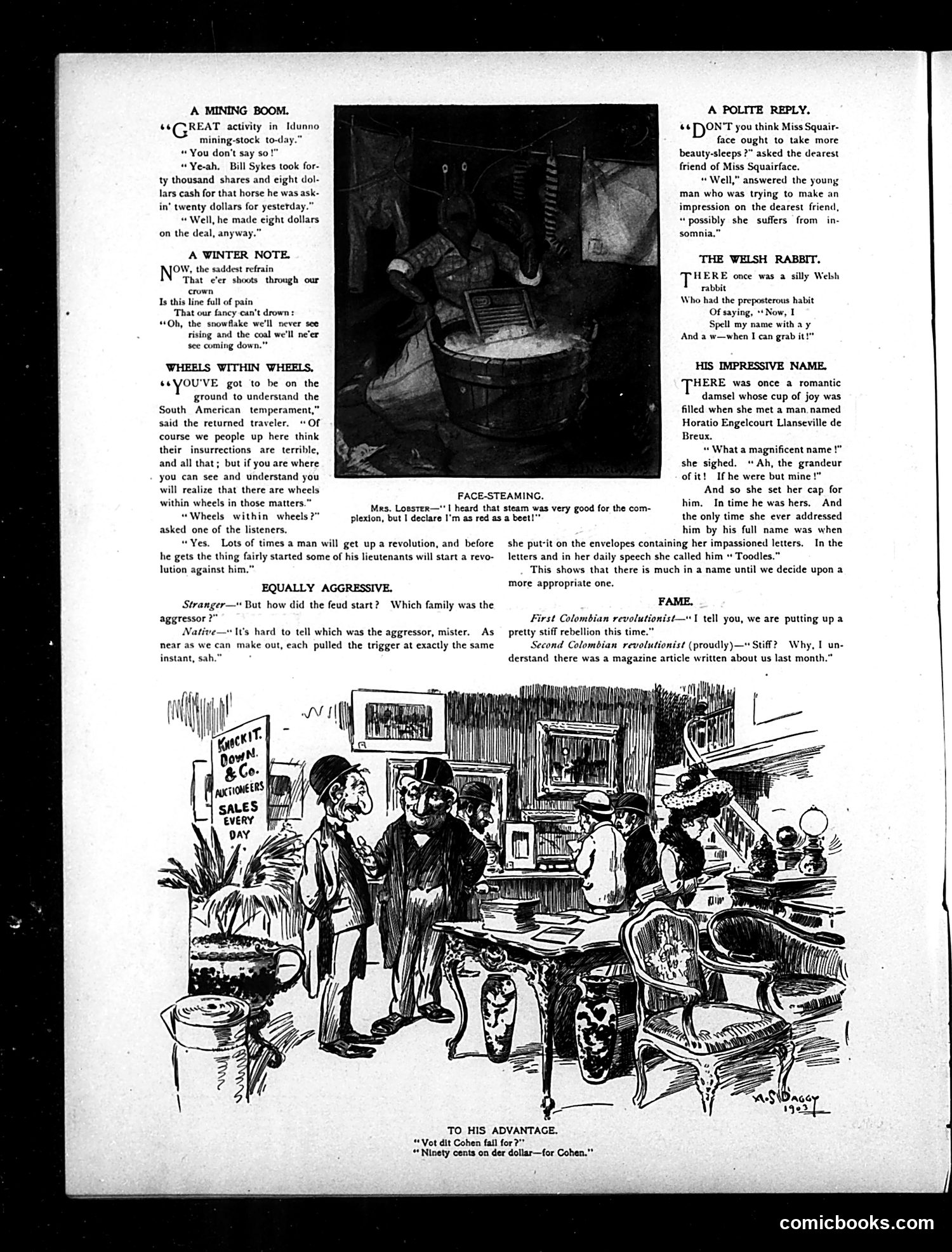
This page contains multiple short humor pieces typical of Judge's satirical style: **"A Mining Boom"** mocks speculative stock fever, where worthless mining shares are traded eagerly—Bill Sykes trades a horse worth $20 for stock and $8, calling it a profit. **"Wheels Within Wheels"** satirizes South American political instability, suggesting revolutions spawn counter-revolutions among lieutenants—a commentary on endemic Latin American political chaos. **"Equally Aggressive"** jokes about feuding Southerners so trigger-happy they shoot simultaneously, making it impossible to assign blame—stereotyping Southern violence and honor-culture. **"Face-Steaming"** is a light domestic joke about beauty treatments backfiring. **The Welsh Rabbit, His Impressive Name, and Fame** are whimsical puns about names and pretension. **"To His Advantage"** is an ethnic joke playing on "Cohen" (Jewish name) and bankruptcy—reflecting period anti-Semitic humor common in publications like Judge. The large illustration depicts an auction house or shop scene with well-dressed men bidding, likely accompanying one of these pieces.
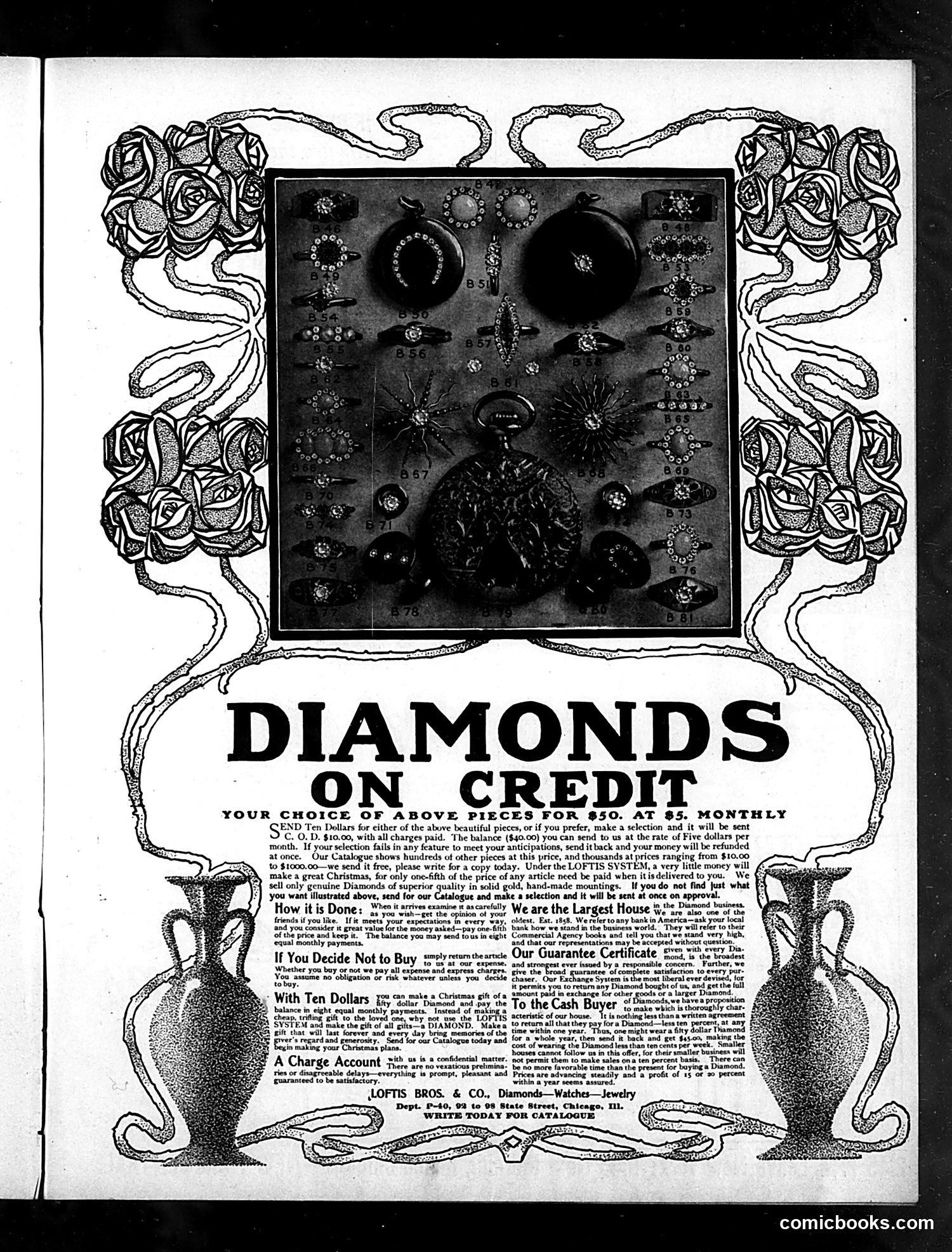
This is primarily a **full-page advertisement**, not political satire. It's a mail-order jewelry advertisement from Loftis Bros. & Co. in Chicago, promoting diamond purchases on an installment plan ($50 total, $5 monthly). The decorative border features **ornamental snakes and classical designs**—typical of early 20th-century advertising aesthetics. The central photograph displays various diamond pieces and settings. **The sales pitch targets middle-class consumers** by emphasizing: - Affordability through credit ($5/month) - Trust (references to banks, established 1858) - A "Loftis System" allowing minimal down payment - A satisfaction guarantee and buyback clause **The satire (if any)** is subtle: the ad appears in *Judge*, a humor magazine, suggesting readers would find irony in aggressive credit sales tactics and promises of "great Christmas" gifts requiring monthly payments—a gentle critique of consumer culture and debt-driven holiday spending. However, the page functions primarily as a straightforward commercial pitch to the magazine's affluent readership.
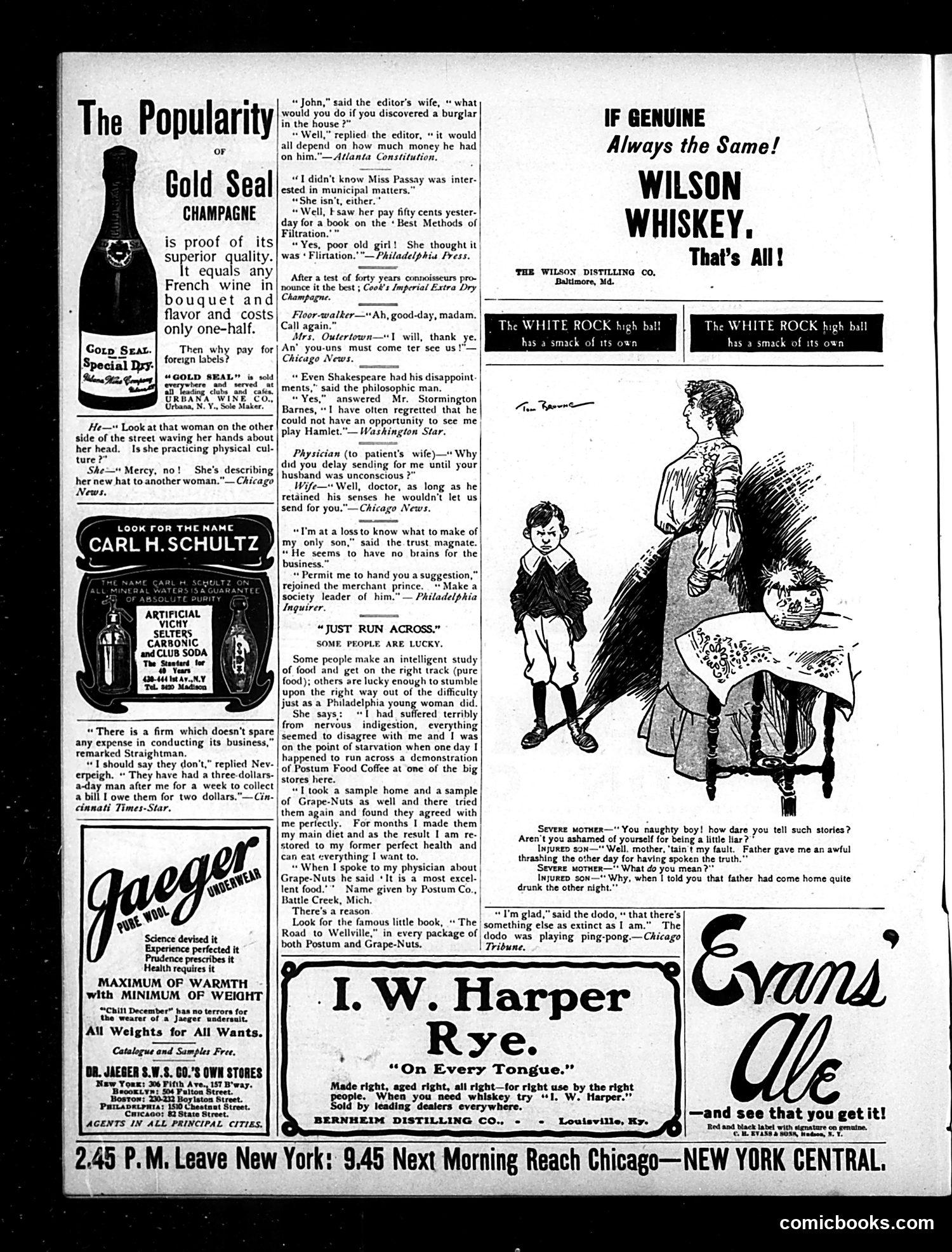
This is primarily a **humor and advertising page** from Judge magazine, not a political cartoon. The page contains short joke items, product advertisements, and illustrated gags typical of early 20th-century humor magazines. The main illustrated cartoon shows a **mother scolding a young boy** who has been telling tall tales. The humor relies on the period's fascination with exaggerated stories—the boy claims his father came home drunk (a common social concern of the era). The mother's stern reaction reflects Victorian-era values about propriety and honesty. The surrounding jokes mock contemporary social types: pompous actors, clueless businessmen, and the newly wealthy "trust magnate" whose son lacks business sense. Much advertising (Gold Seal Champagne, Wilson Whiskey) reflects the pre-Prohibition era when alcohol marketing was legal and prominent. The humor is gentle and moralistic rather than biting—typical of Judge's middle-class audience in this period.
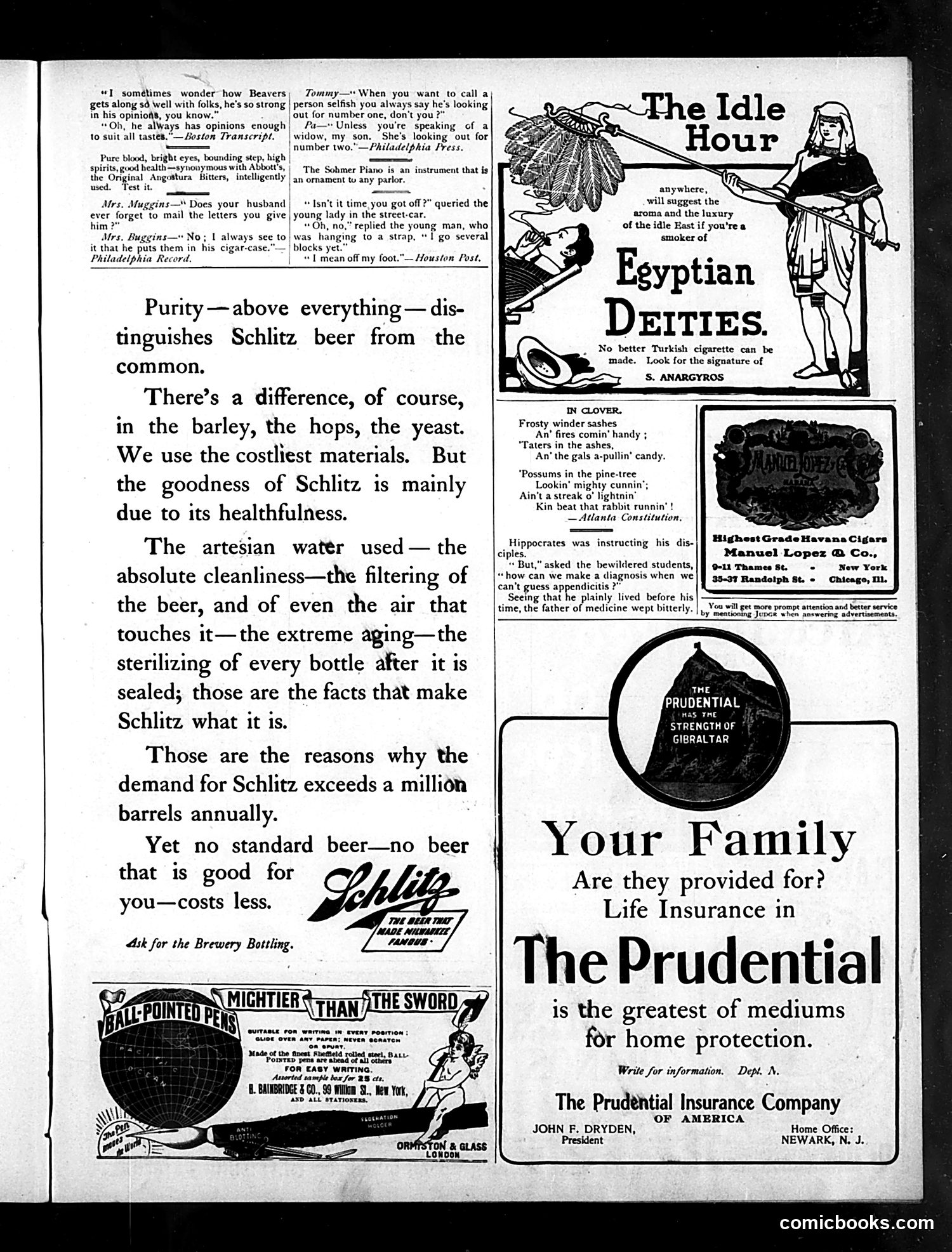
This Judge magazine page is primarily **advertising**, with several short humorous anecdotes interspersed. The main satirical content appears minimal. The brief jokes mock everyday situations: a man's habit of putting letters in his cigar case instead of mailing them; a young woman's complaint about a man "hanging on a strap" being misunderstood as a foot problem; and a reference to "number two" widows (implying remarriage for financial gain). The dominant content comprises period product advertisements: Schlitz beer emphasizing "purity," Egyptian Deities cigarettes evoking exotic luxury, Prudential Life Insurance promoting family protection, and various writing instruments and medicines. The only clear visual element is an illustrated woman in classical Egyptian dress promoting cigarettes—reflecting early 20th-century orientalist marketing that equated foreign imagery with sophistication and leisure. The page reflects Judge's dual purpose: satirizing social pretensions while monetizing reader attention through premium product ads.
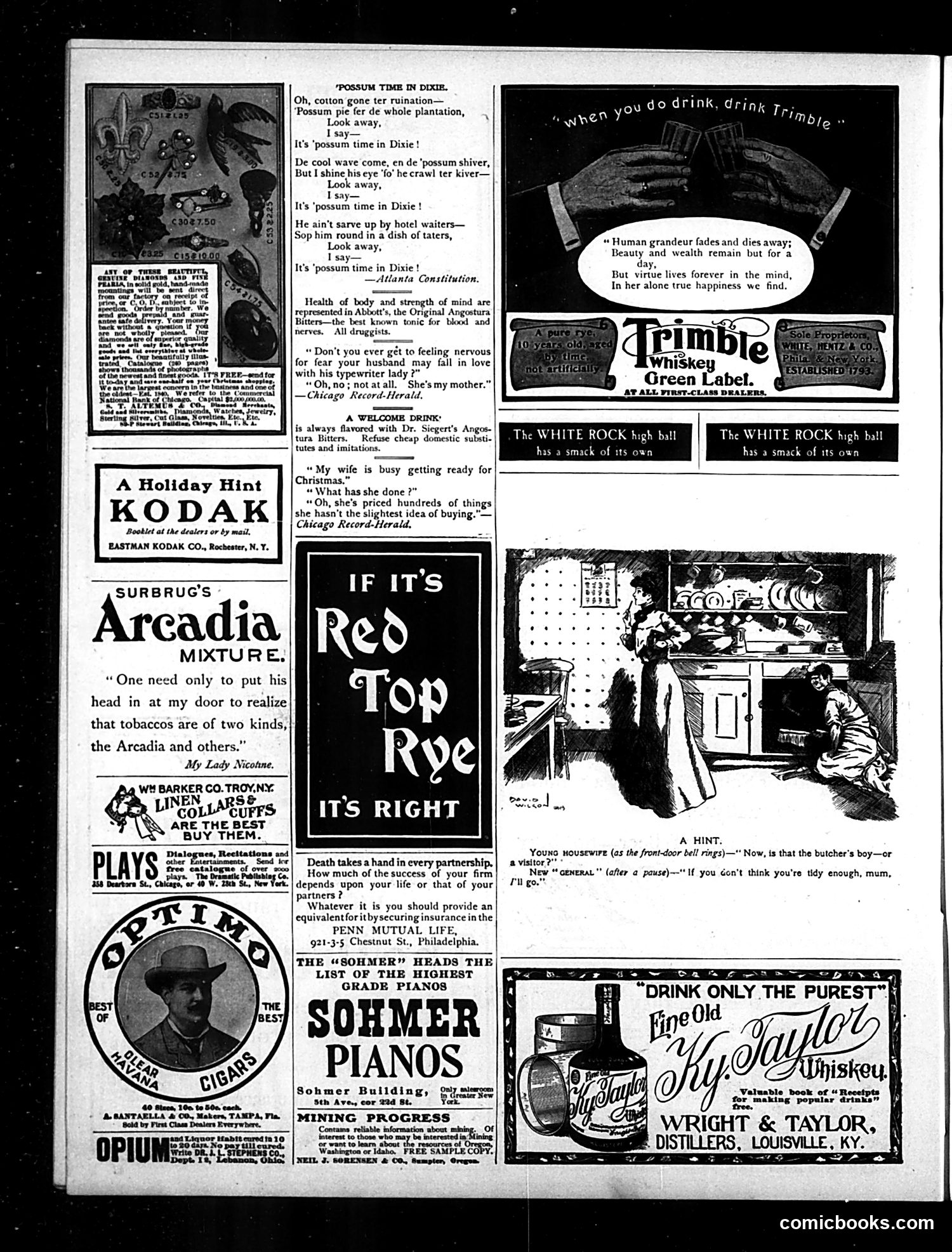
This page is primarily **advertising**, with one satirical cartoon. The main content includes ads for Kodak cameras, tobacco products, pianos, whiskey, and insurance. The sole cartoon is **"Possum Time in Dixie,"** a racist minstrel-style piece using a mock-dialect song. It stereotypes Southern Black life through exaggerated dialect ("de" for "the," "sarve" for "serve") and depicts enslaved or impoverished conditions where possum-hunting represents subsistence survival. The "Look away, I say" refrain invokes *Dixie*, the Confederate anthem. This reflects Judge magazine's era—likely early 1900s—when such caricatures were considered acceptable entertainment. The piece perpetuates demeaning stereotypes about the South and Black Americans, presenting poverty and rural life as quaint or comic rather than examining actual conditions. The accompanying advertisements focus on luxury goods (Kodak, pianos, whiskey), creating stark contrast with the cartoon's depiction of bare subsistence, though this juxtaposition appears unintentional rather than satirical commentary.
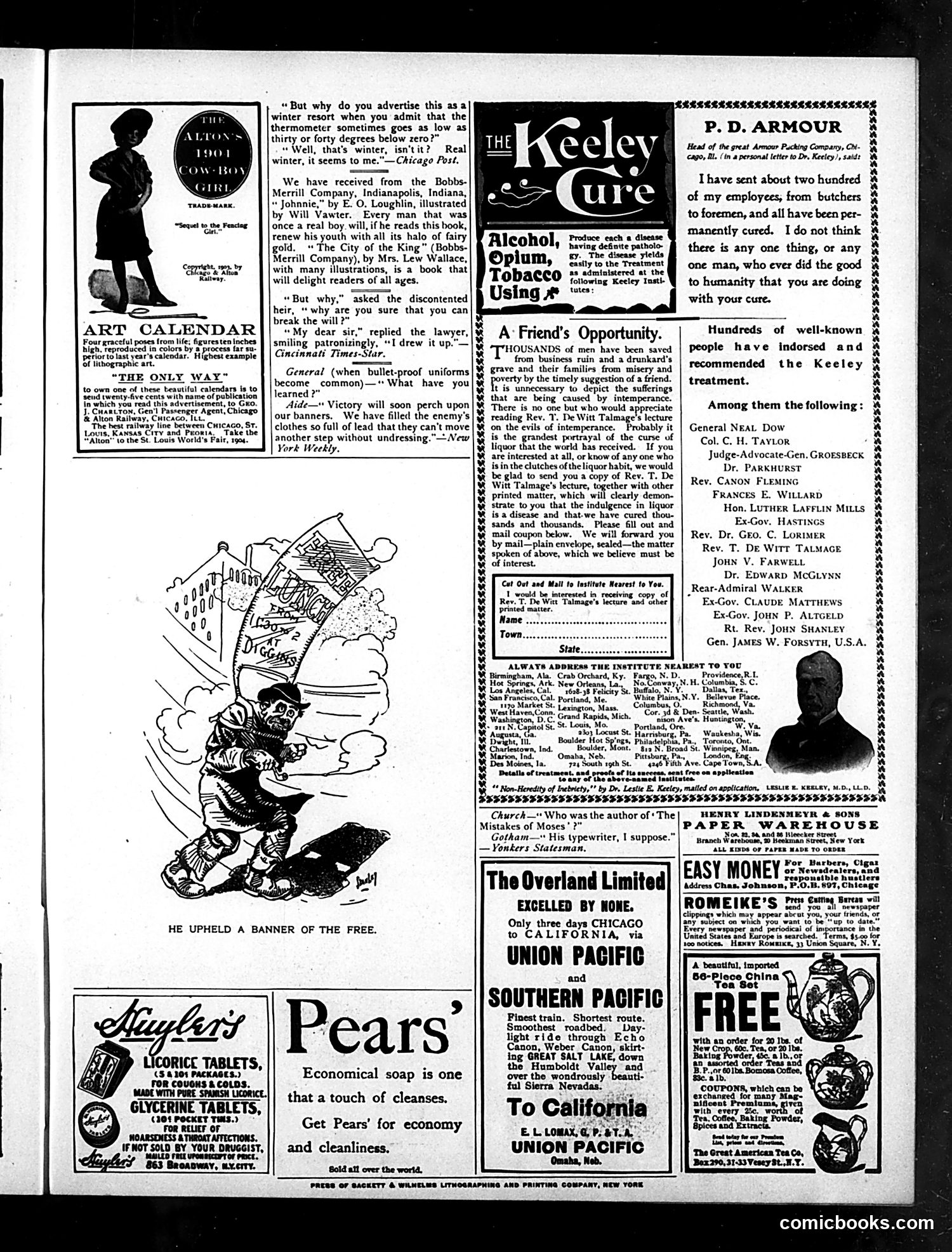
This page is primarily **advertising**, with one notable political cartoon and several commercial advertisements typical of early 1900s publications. ## The Main Cartoon The large illustration showing a figure "upholding a banner of the free" appears to reference American patriotism or democracy, though the specific political context is unclear without additional dating or caption information visible in the image. ## Key Content The page heavily promotes the **Keeley Institute**, a famous (and now historically notorious) treatment facility claiming to cure alcoholism, drug addiction, and tobacco use. The testimonial from P.D. Armour, head of the Armour Packing Company, lends credibility to their cure claims. The institute advertises Rev. T. DeWitt Talmage's lecture on "evils of intemperance," framing alcoholism as a disease rather than moral failing—a progressive stance for the era. ## Other Advertisements The page includes ads for Pears' soap, railway services, and patent medicines—standard early-1900s advertising fare. The overall tone reflects period attitudes toward addiction as treatable medical conditions while promoting various commercial solutions.
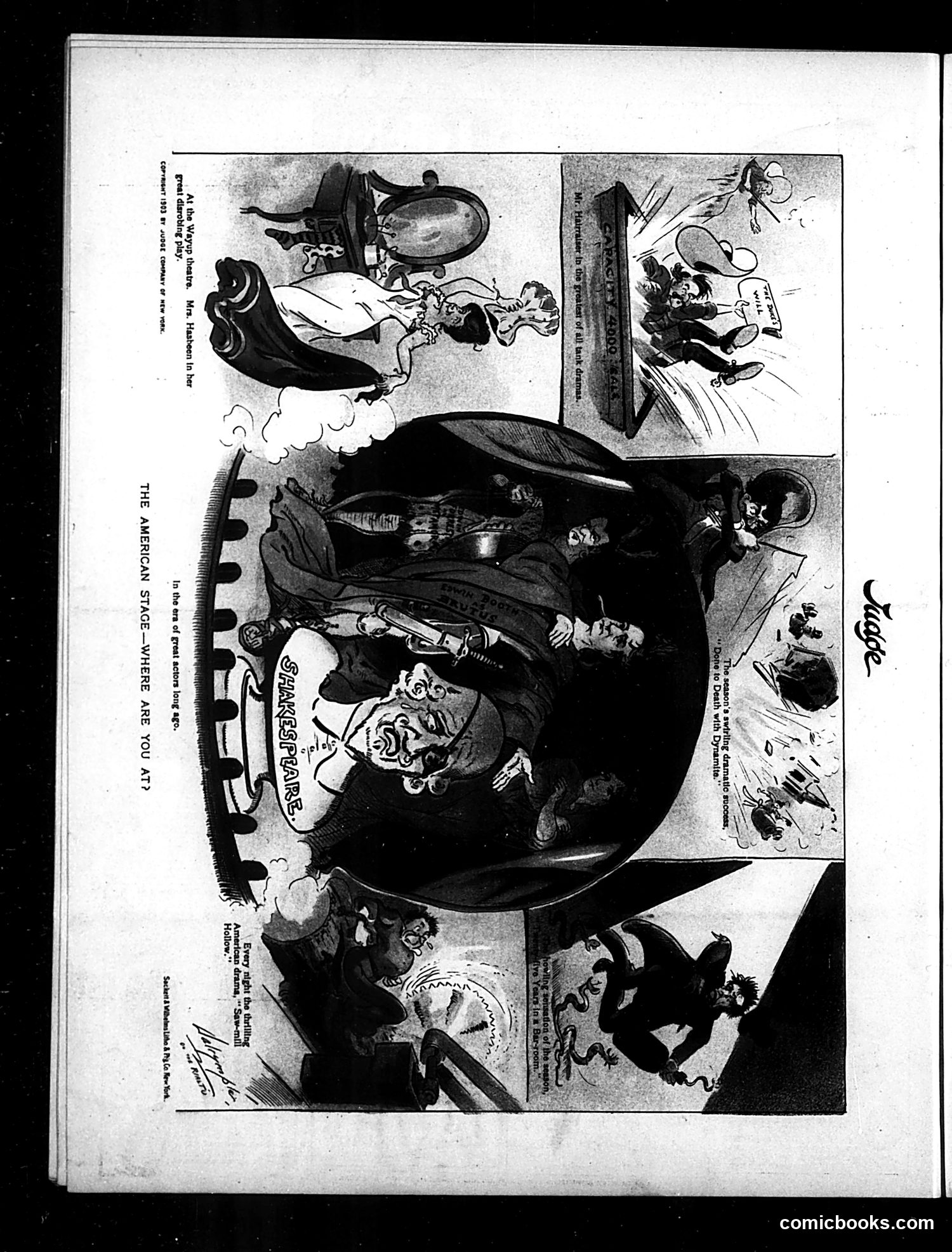
This page satirizes the decline of American theater quality. The central circular illustration shows theatrical performers in exaggerated poses, with text referencing contemporary plays like "Death with Dynamite" and productions featuring "Mrs. Hasbeen" in a "great disrobing play." The cartoon's title—"The American Stage—Where Are You At?"—poses a rhetorical question lamenting theater's degradation. The satire contrasts "the era of great actors long ago" with current sensationalist productions emphasizing spectacle and undressing over dramatic substance. The OCR'd text mentions "the season's swirling dramatic success," though sarcastically. The overall message critiques how American theater has abandoned artistic merit for cheap thrills and physical display to attract audiences—a common complaint in early 20th-century cultural criticism about popular entertainment's supposed lowering of standards.