
Judge, 1903-12-05 · page 6 of 16
Judge — December 5, 1903 — page 6: what you’re looking at
What you’re looking at
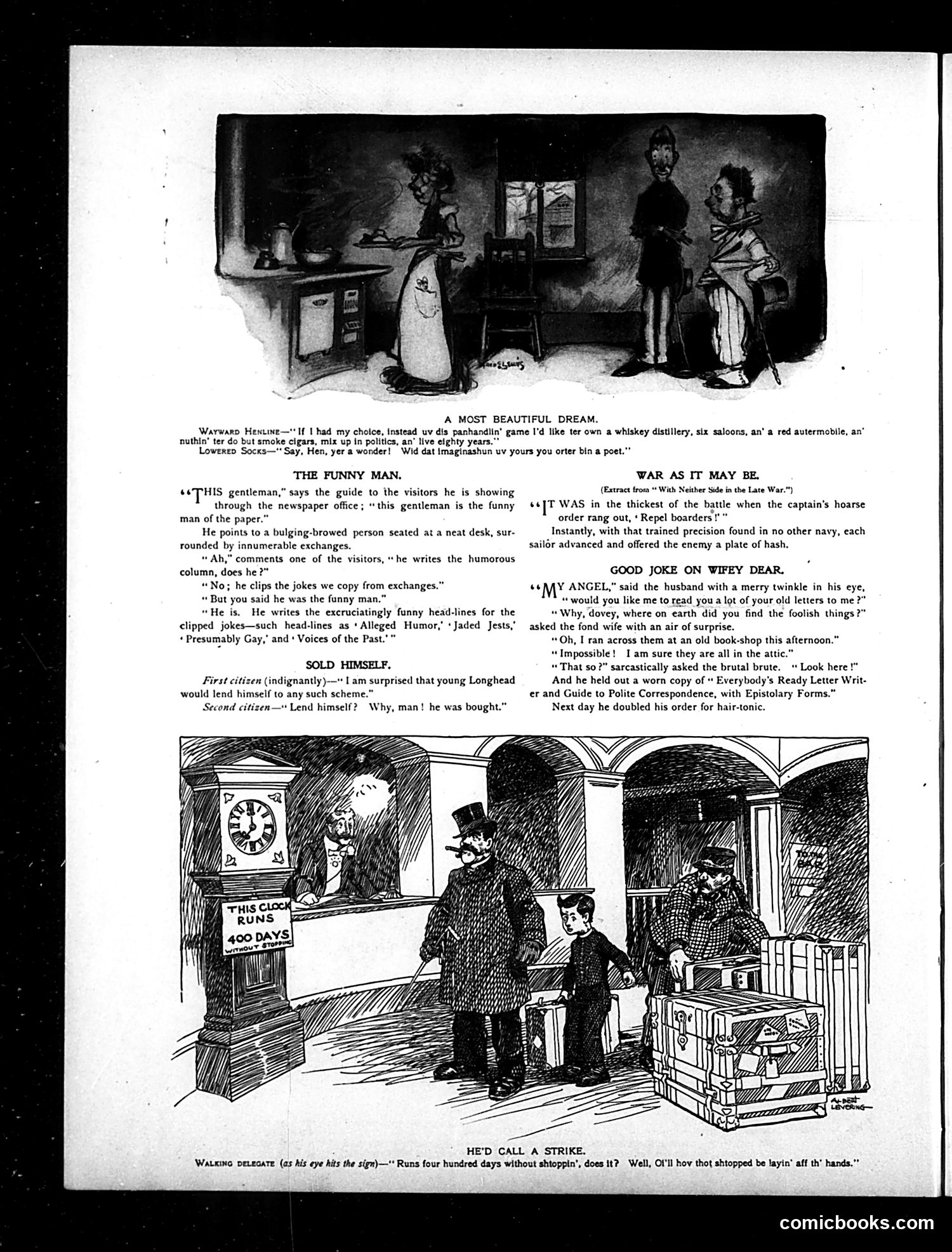
This page contains multiple satirical pieces typical of early 20th-century American humor: **"A Most Beautiful Dream"** mocks working-class aspiration through an Irish immigrant ("Warwaro Henline") daydreaming about wealth—owning distilleries, saloons, and automobiles while avoiding labor. The stereotype reinforces period prejudices about Irish-Americans and their association with alcohol. **"The Funny Man"** satirizes newspaper humor departments, suggesting the "funny man" merely copies jokes from other publications and writes formulaic headlines rather than creating original comedy—a critique of journalistic quality. **"War as It May Be"** appears to mock military incompetence or satirize a specific naval engagement, though the specific reference is unclear without fuller context. **"Good Joke on Wifey Dear"** uses standard marital comedy: a husband tricks his wife by pretending her old love letters came from a used bookshop, when they're actually from a generic letter-writing guide—humiliating the couple's romance. **"He'd Call a Strike"** depicts an Irish immigrant (identified by dialect) threatening to halt a clock factory's operations, apparently commenting on labor disputes and immigrant workers' attitudes toward industrial management.
📄 Transcribed text from this page (OCR, searchable)
Machine-transcribed from the original scan — historical spelling and the odd misread are preserved.
A MOST BEAUTIFUL DREAM. Warwaro Henuine—"'If Uhad my choice, instead uv dis panhandlin’ game I'd like ter own a whiskey distillery, six saloons, an’ a red autermobile, an’ nuthin’ ter do but smoke cigars, mix up in politics, an’ live elghty years.”* Lowerep Socxs—"* Say, Hen, yer a wonder! ‘THE FUNNY MAN. seTTHIS gentleman,” says the guide to the visitors he is showing through the newspaper office; “this gentleman is the funny man of the paper.” He points to a bulging-browed person seated at a neat desk, sur- rounded by innumerable exchanges. “Ah,” comments one of the visitors, “he writes the humorous column, does he ?” “No; he clips the jokes we copy from exchanges.” “ But you said he was the funny man.” “He is. He writes the excruciatingly funny head-lines for the clipped jokes—such head-lines as ‘Alleged Humor,’ ‘Jaded Jests,” «Presumably Gay,’ and * Voices of the Past.’” SOLD HIMSELF. First citizen (indignantly)—“ | am surprised that young Longhead would lend himself to any such scheme.” Second citizen—" Lend himself? Why, man! he was bought.” Wid dat imaginashun uv yours you orter bin a poet.”” WAR AS IT MAY BE. (Extract from “ With Neither Side in the Late War.”) s4]T WAS jin the thickest of the battle when the captain's hoarse order rang out, ‘ Repel boarders !"” Instantly, with that trained precision found in no other navy, each sailr advanced and offered the enemy a plate of hash. GOOD JOKE ON WIFEY DEAR. $6 MY ANGEL,” said the husband with a merry twinkle in his eye, «would you like me to read you a lot of your old letters to me?” “Why, dovey, where on earth did you find the foolish things?" asked the fond wife with an air of surprise. “Oh, I ran across them at an old book-shop this afternoon.” “Impossible! Iam sure they are all in the attic.” “That so?” sarcastically asked the brutal brute. Look here !” And he held out a worn copy of « Everybody's Ready Letter Writ- er and Guide to Polite Correspondence, with Epistolary Forms.” Next day he doubled his order for hair-tonic. Vs U7 Y V “EE WG Z KY Y SURG YES Vtg [AY miZ WZ, HE'D CALL A STRIKE. ‘Watxinc petecate (as his eye hits the sign)—'* Runs four hundred days without shtoppin’, does it? Well, Ot'll hov thot shtopped be layin’ aff th’ hands."* comicbooks.com