
A complete issue · 16 pages · 1903
Judge — November 21, 1903
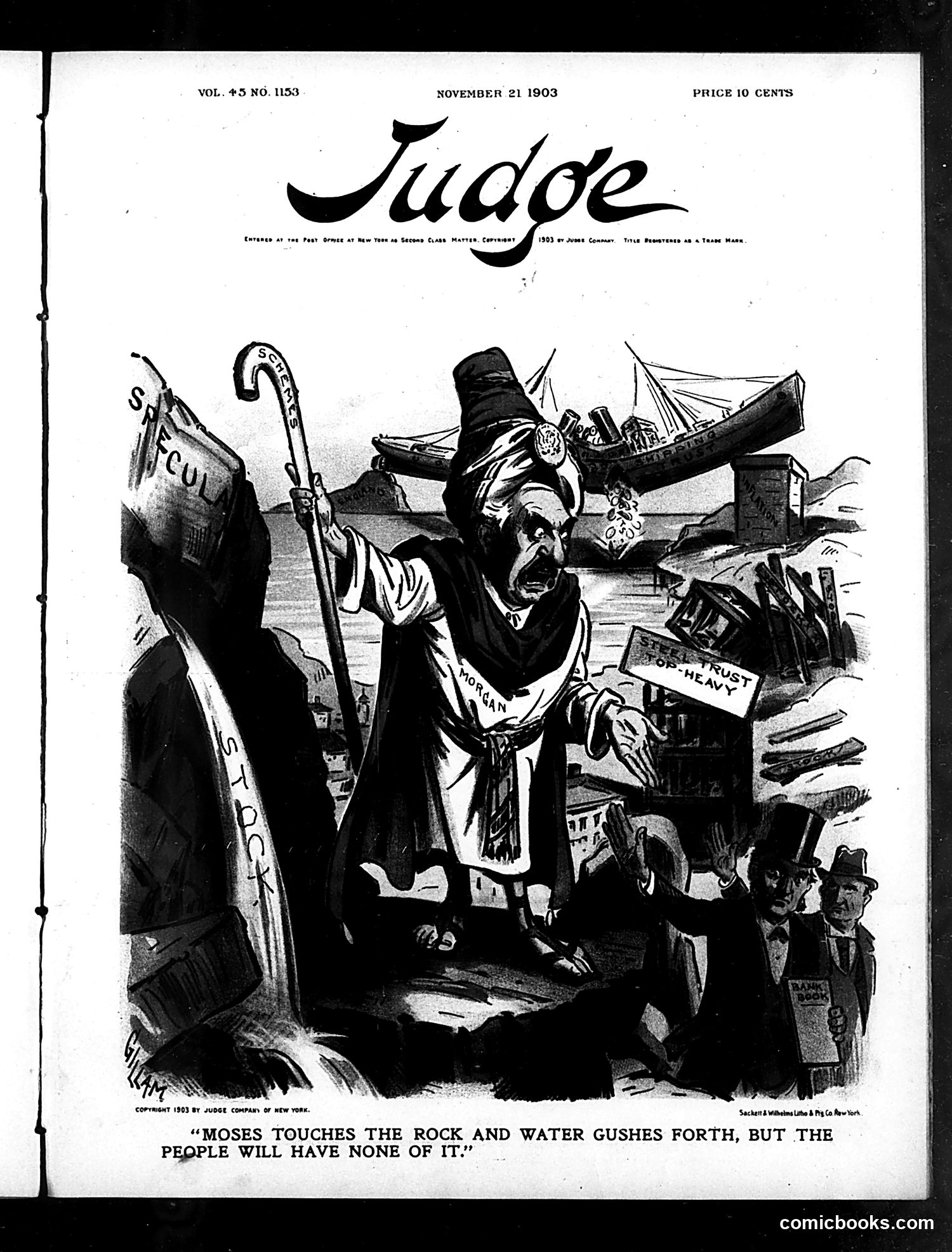
This political cartoon satirizes Theodore Roosevelt's handling of labor disputes or resource distribution during his presidency. The central figure, depicted as a biblical Moses in robes and turban, represents Roosevelt. He "touches the rock" (strikes with his staff) expecting water to flow forth for "the people," but they receive nothing—a visual pun on his failure to deliver promised benefits despite dramatic action. The scattered figures and industrial debris in the background suggest labor unrest or economic hardship. The satire criticizes Roosevelt's rhetoric versus results: his interventions appear grand and biblical in scope, but the common people remain unsatisfied and empty-handed. This reflects contemporary criticism that Roosevelt's progressive policies didn't adequately address workers' needs.
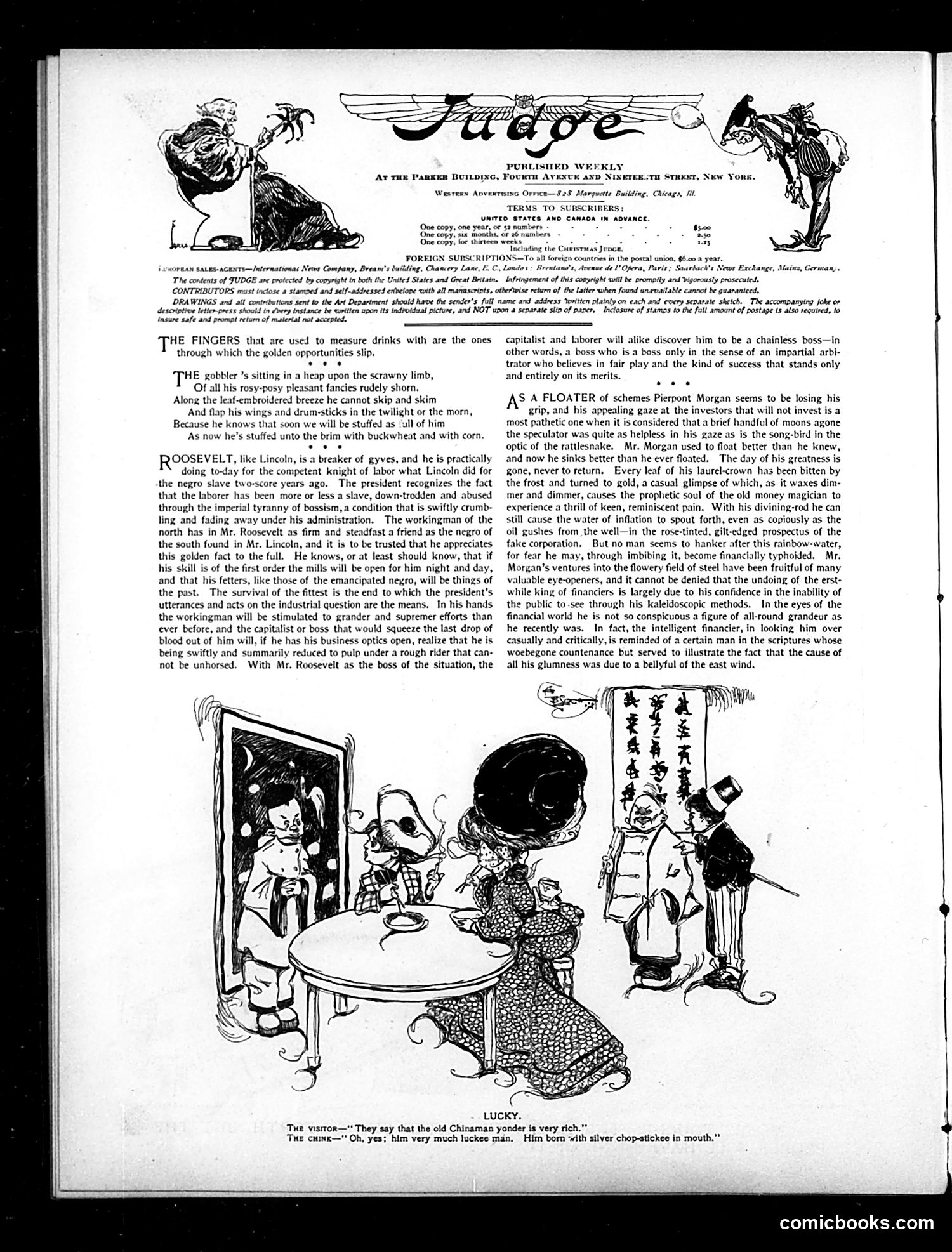
This page contains two distinct sections: **Upper section:** Political commentary addressing Roosevelt's labor policies and Pierpoint Morgan's financial schemes. The text criticizes a "chainless boss" (likely a wealthy industrialist) and discusses Roosevelt's efforts to regulate big business and protect workers' rights. It suggests Morgan's financial ventures have become less profitable and questions his confidence in speculative schemes. **Lower cartoon ("Lucky"):** Shows a wealthy Chinese visitor being complimented on his riches. The joke plays on racial stereotypes—the visitor is described as "very rich" because he was "born with silver chop-sticks in mouth," a mocking reference to both Chinese culture and the phrase about being born wealthy. The page satirizes both capitalist excess and contains period-typical ethnic stereotyping common to early 20th-century American humor magazines.
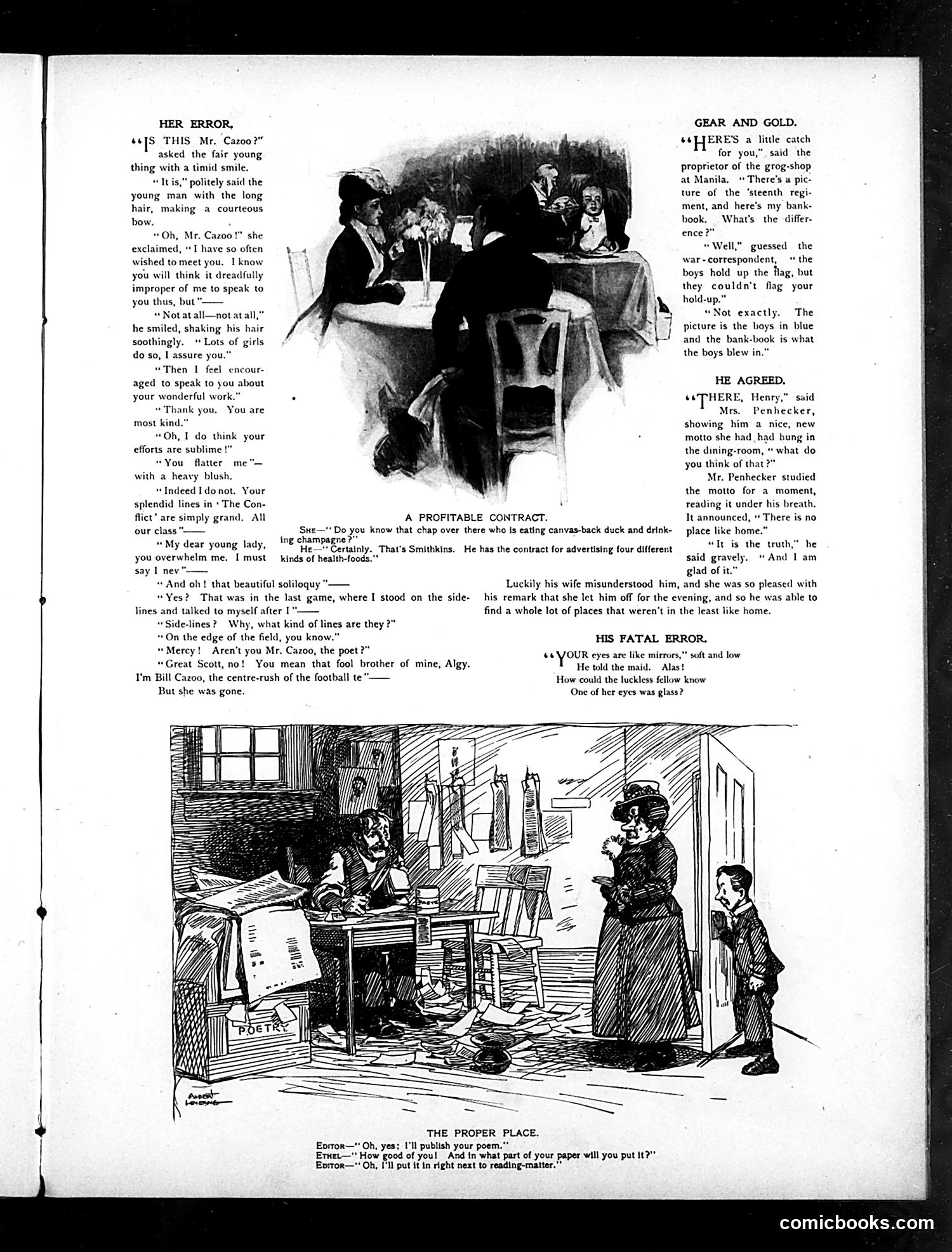
This page contains three separate satirical pieces about early 20th-century American social life: **"Her Error"** mocks a young woman who mistakenly addresses a man as "Mr. Caroo" (unclear reference), causing social embarrassment. **"A Profitable Contract"** depicts a conversation about advertising champagne and canvas-back duck, satirizing commercial contracts and product endorsements of that era. **"Gear and Gold"** features a war correspondent and Mrs. Penhecker discussing a motto and bankbook, likely satirizing wealth disparities and materialism. **"The Proper Place"** (bottom illustration) shows a domestic scene where someone presents their poetry, with humor about where literary work belongs—apparently "next to reading-matter" rather than as serious publication. These pieces target social pretension, commercial excess, and amateur literary ambitions typical of Judge's satirical approach.
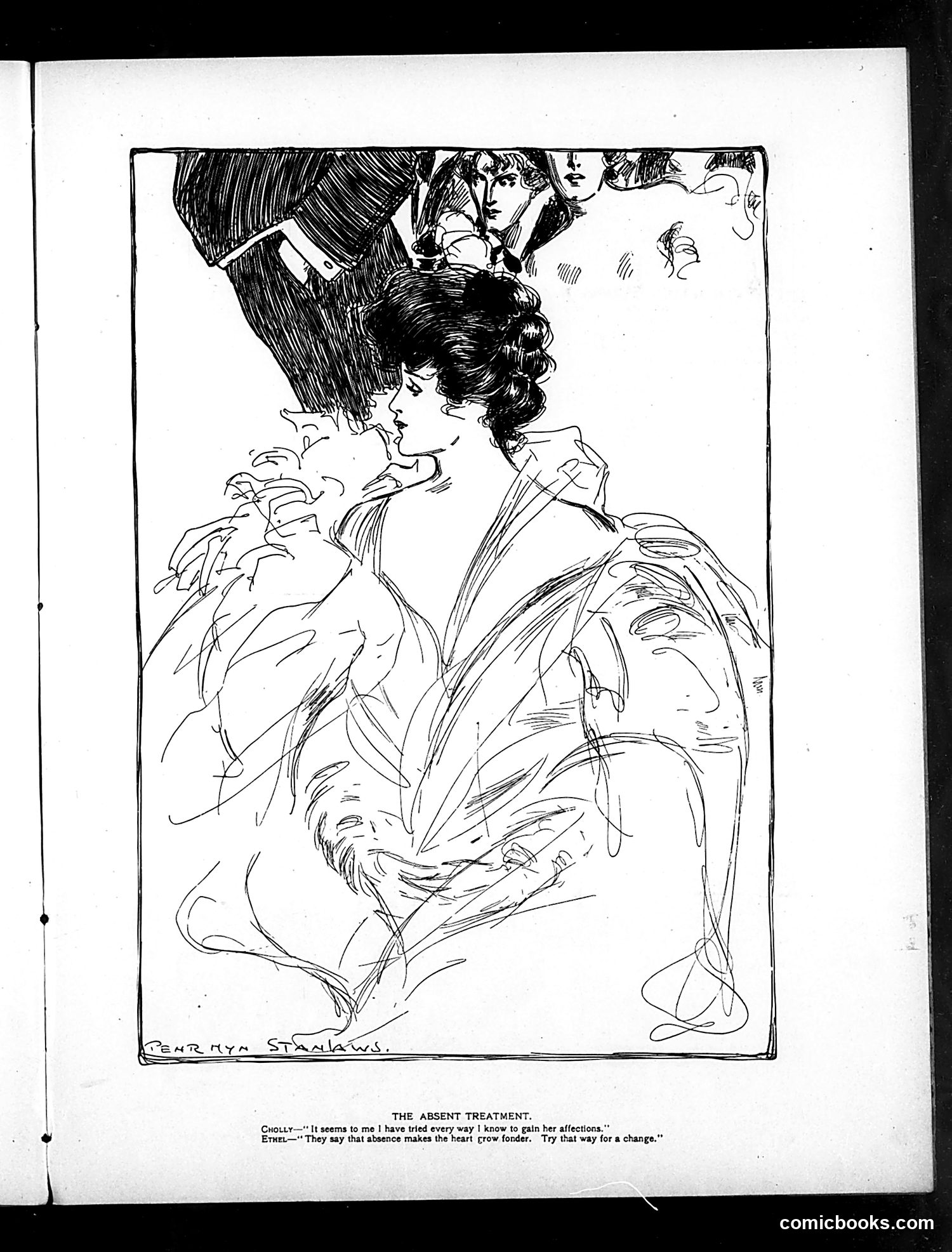
This is a romantic comedy cartoon depicting two men discussing courting strategy. The main figure, shown in profile with fashionable early 1900s styling, has apparently exhausted conventional methods to win a woman's affections. His friend advises applying the proverb "absence makes the heart grow fonder"—suggesting that deliberately staying away might paradoxically increase her romantic interest. The satire gently mocks courtship conventions of the era, implying that persistence and constant attention don't necessarily work in romance. The "absent treatment" was a recognized (if cynical) romantic tactic of the period. The cartoon's humor lies in the ironic suggestion that doing *nothing* might prove more effective than active pursuit.
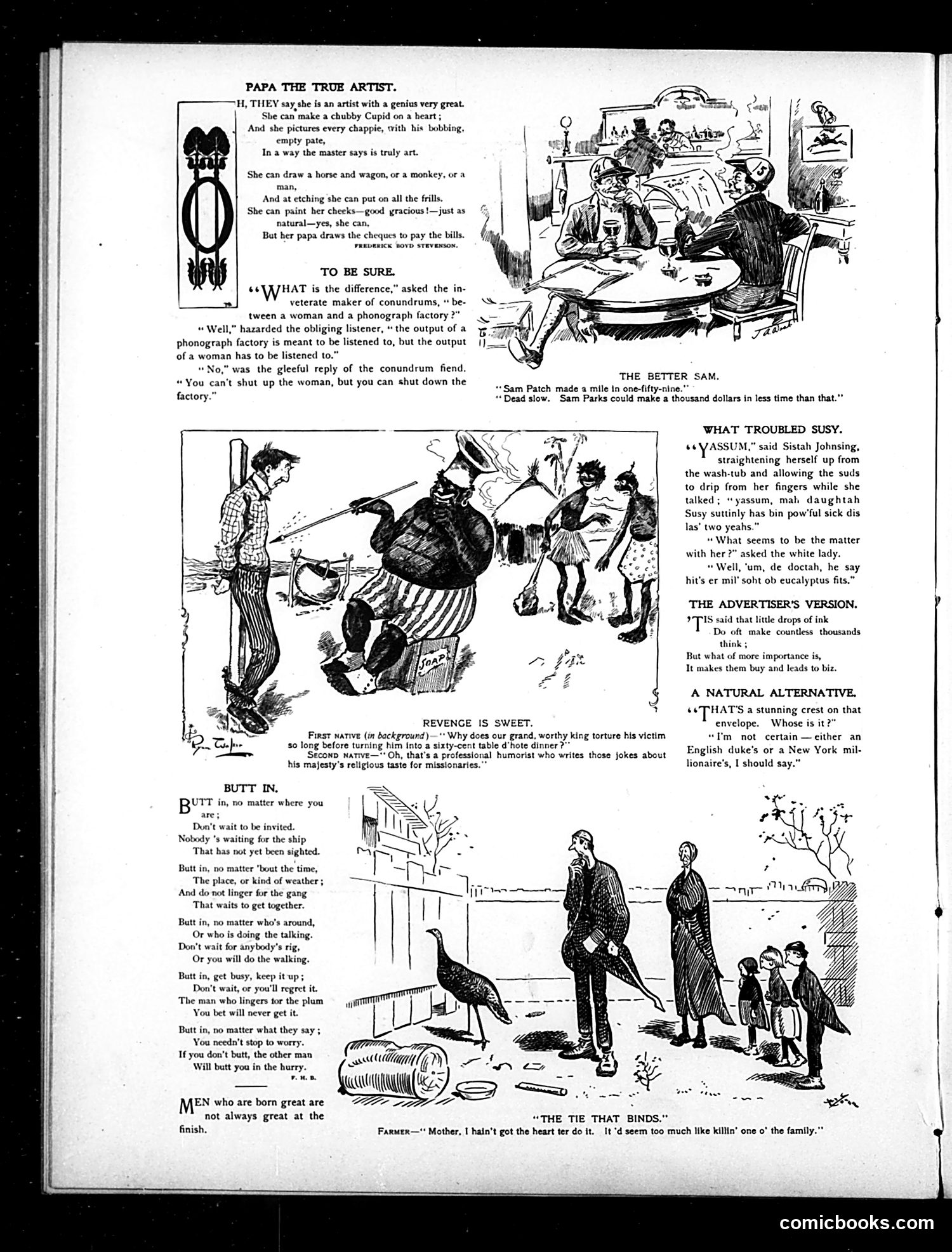
This page contains multiple satirical pieces mocking contemporary American society: **"Papa the True Artist"** ridicules women artists, suggesting their creative talents are irrelevant since their fathers/husbands control finances—the real "art" is drawing paychecks. **"To Be Sure"** presents a misogynistic joke: women are worse than phonograph factories because you can't silence them (a common complaint about women's newfound public voice in the early 1900s). **"The Better Sam"** likely references Sam Patch, a famous 19th-century daredevil, contrasting him with "Sam Parks" (appears to reference a labor/political figure), mocking both. **"What Troubled Susy"** uses stereotyped dialect to portray an African American woman discussing her daughter's illness, employing racist caricature typical of the era. **"Butt In"** satirizes American hustle culture, advising aggressive self-promotion. **"The Tie That Binds"** shows a farmer unwilling to slaughter livestock he's emotionally attached to—gentle satire on rural sentimentality. Throughout, Judge uses ethnic stereotyping and gender mockery standard for early-1900s American humor.
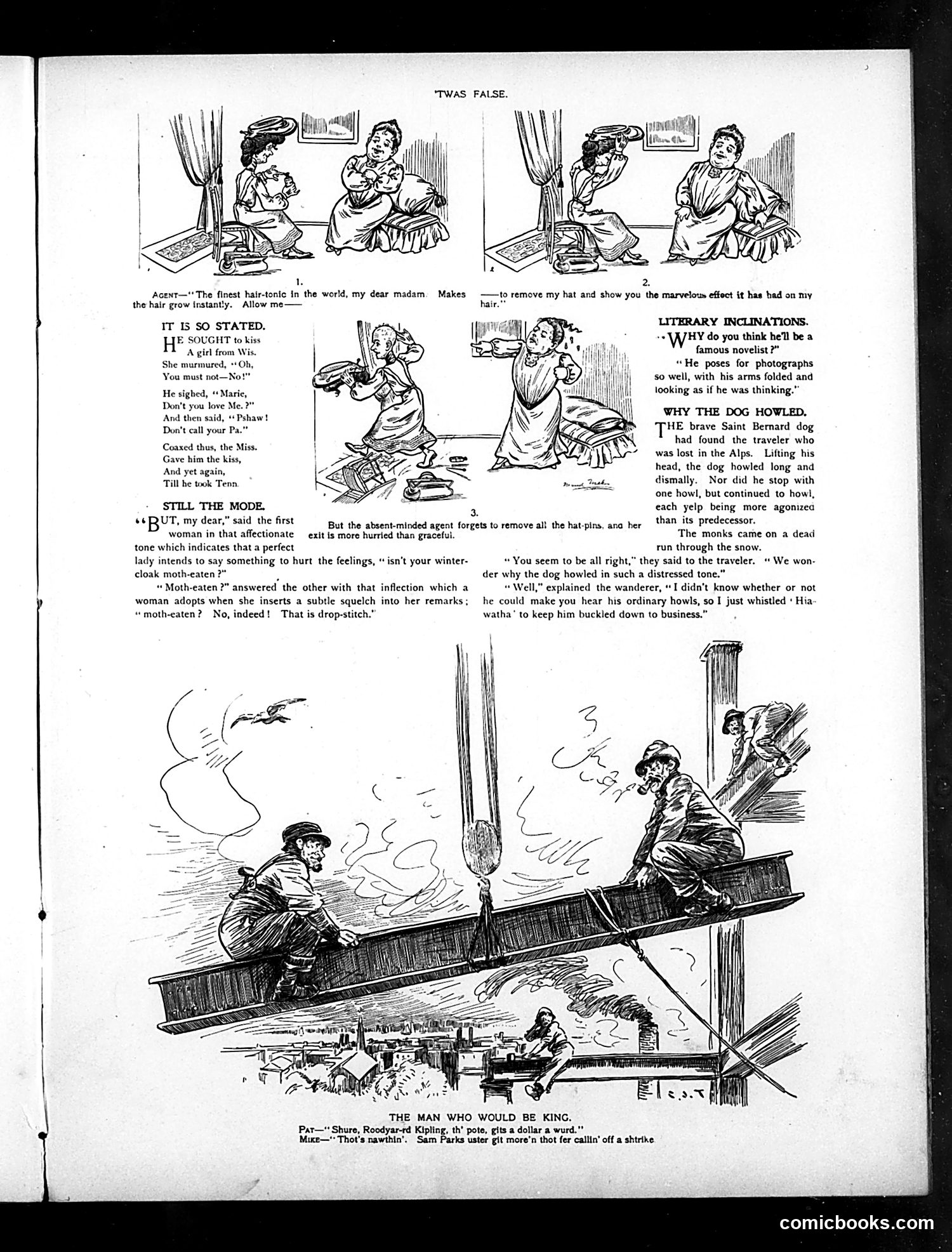
This page contains several satirical pieces typical of early 20th-century American humor: **"It Is So Stated"** and **"Still the Mode"** are brief romantic/social comedies playing on period courtship conventions and women's cattiness about fashion. **The hair-tonic advertisement satire** mocks fraudulent patent medicine claims—a common Judge target—showing an absent-minded agent who forgets to remove hat-pins before demonstrating a bogus product. **"The Man Who Would Be King"** references Rudyard Kipling, the famous poet and writer. The joke compares his dollar-per-word literary rate to Sam Parks (likely a labor organizer), suggesting the latter commanded higher fees for "calling off a strike"—contemporary satirical commentary on labor disputes versus artistic compensation. **"Why the Dog Howled"** is gentler humor about a Saint Bernard rescue dog whose excessive howling is explained as the traveler whistling "Hiawatha" to amplify the signal—absurdist humor common to the era. The page blends social satire with contemporary references accessible to Judge's educated, middle-class readership.
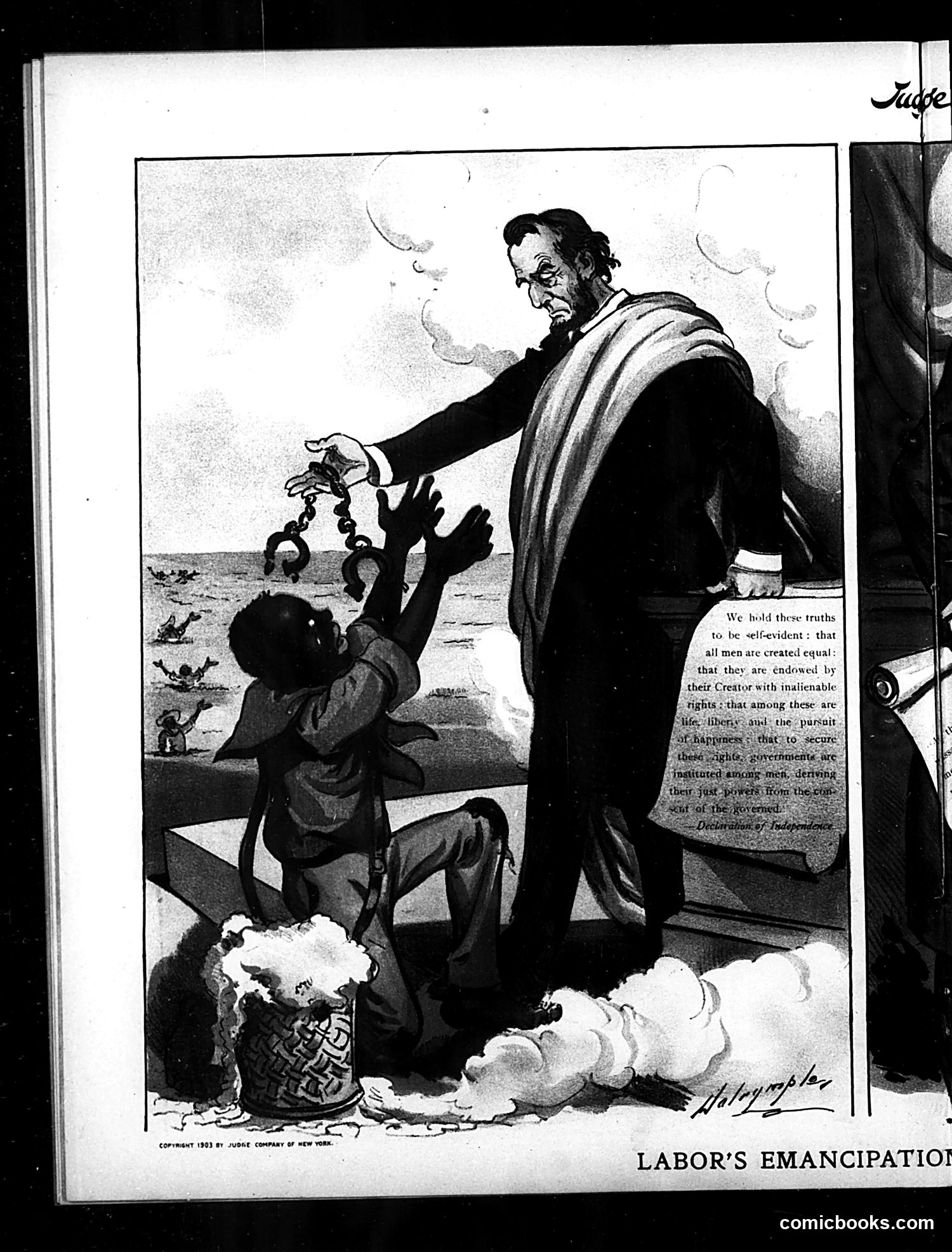
This 1903 Judge magazine cartoon depicts a tall, thin figure (likely representing capital, wealth, or industrial power) holding chains above a kneeling worker. The worker reaches upward desperately while bound. The irony is sharp: the text quotes the Declaration of Independence's promise of equality and inalienable rights, yet the image shows labor literally enslaved by economic chains. The cartoon satirizes the gap between America's founding ideals and industrial-era working conditions—workers claimed to be "free" citizens yet remained economically bound and powerless. The title "Labor's Emancipation" suggests the cartoon advocates for workers' rights, critiquing how industrial capitalists effectively enslaved laborers despite constitutional guarantees of freedom. This reflects early 1900s labor movement frustrations.
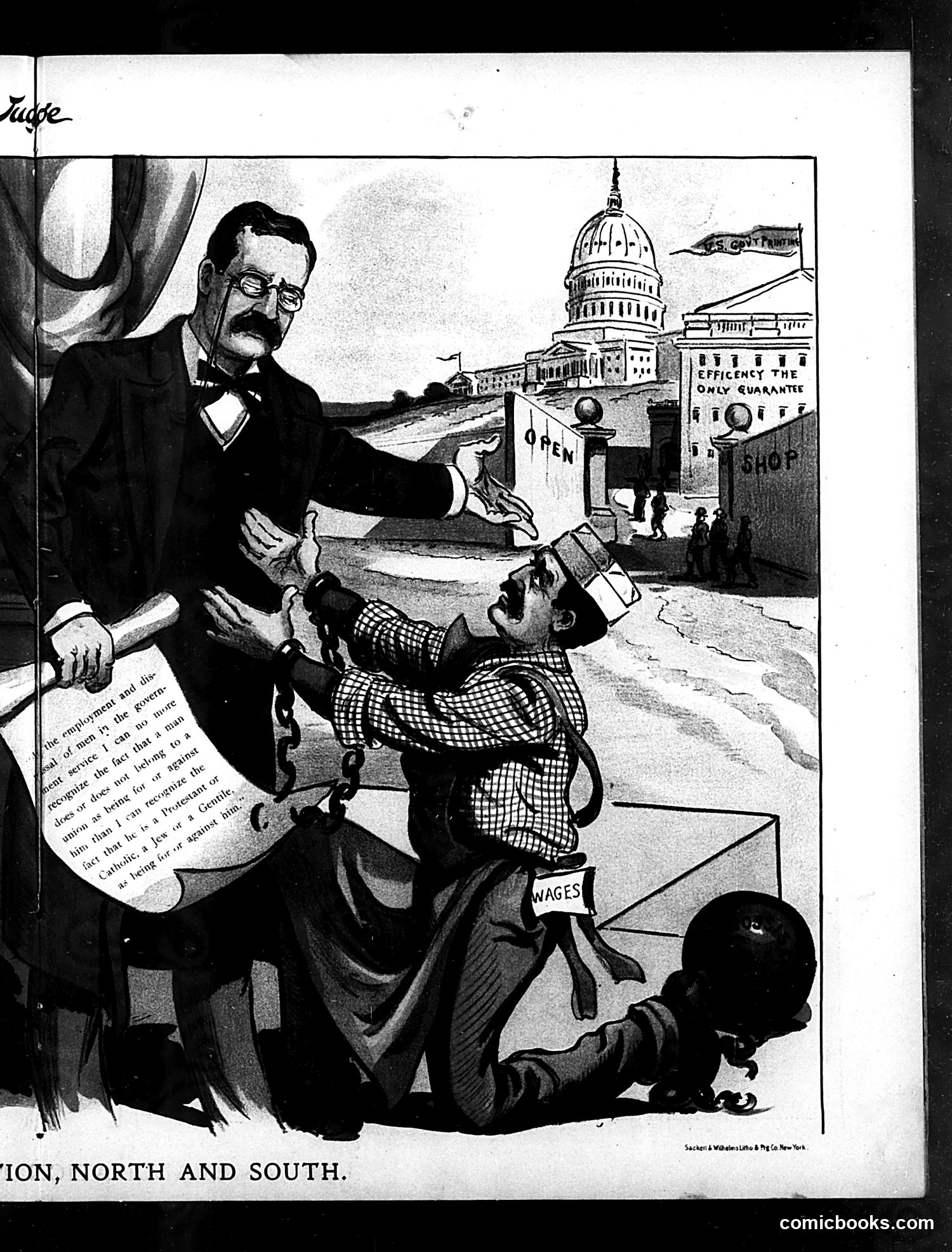
This Judge magazine cartoon satirizes labor disputes and government involvement in worker treatment. A well-dressed man (likely representing government authority or management) holds chains labeled "WAGES" connected to a chained worker. The Capitol building appears in the background, suggesting federal government context. The scroll the official holds contains text about "the employment" and conditions—though partially illegible, it appears to critique labor agreements or regulations. The shop sign reading "EFFICIENCY THE ONLY GUARANTEE" suggests corporate efficiency rhetoric used to justify poor wages or conditions. The cartoon's title references "North and South," implying these labor conflicts span the entire country. The satire targets the gap between official promises of efficiency and actual worker treatment, with the chains visually emphasizing workers' lack of freedom despite government oversight.
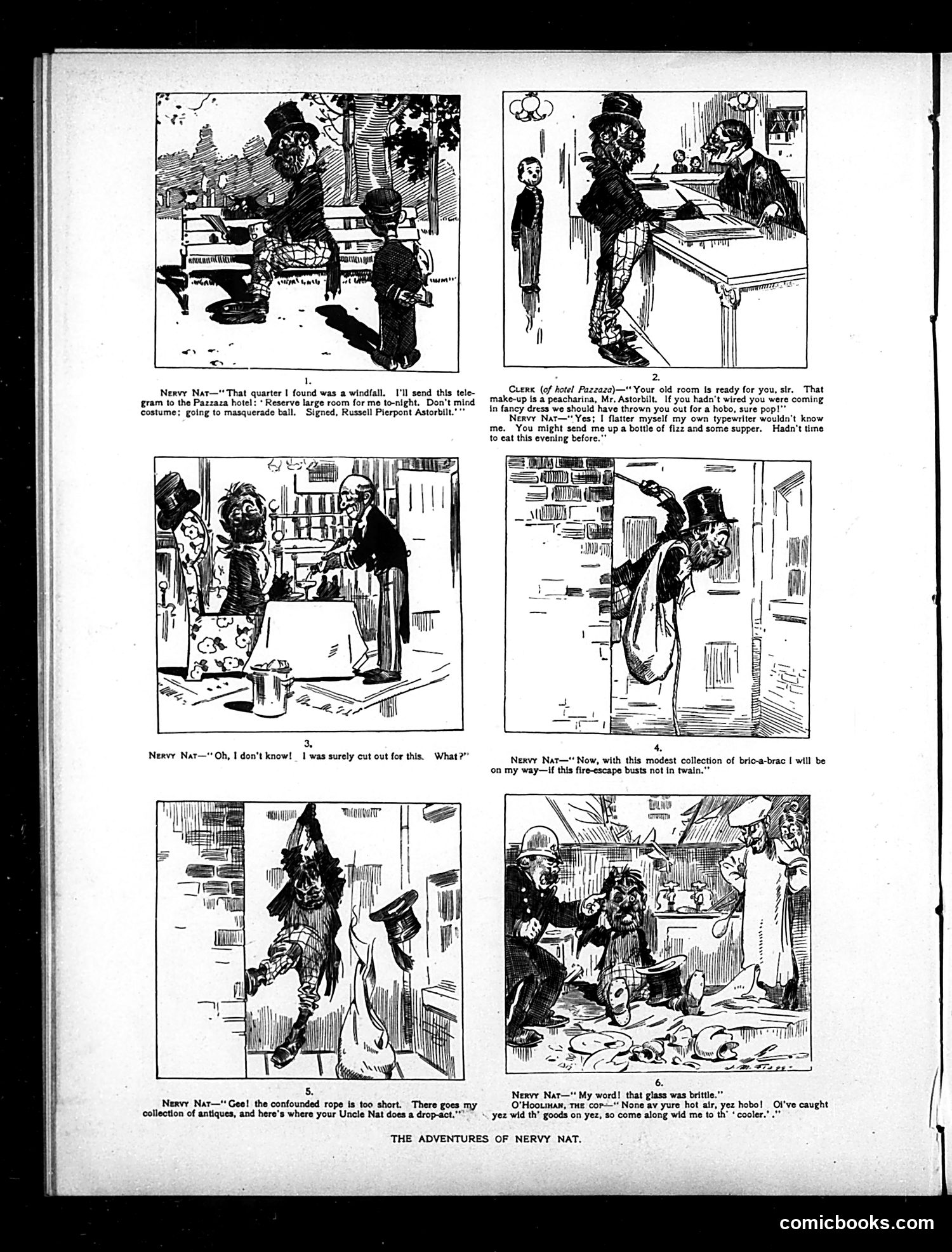
This is a comic strip following "Nervy Nat," an apparent con artist or scoundrel. The humor derives from his schemes constantly backfiring through his own incompetence or bad luck. The plot: Nat finds a quarter and impersonates a wealthy man ("Russell Pierpont Astorbilt") to secure a fancy hotel room, arriving in costume for a masquerade ball. The clerk nearly ejects him as a hobo before the telegram arrives. Once in the room, Nat attempts to steal the hotel's "collection of bric-a-brac" (decorative items) via fire escape, but the rope breaks, sending him plummeting into a policeman's arms below. The satire mocks lower-class opportunists attempting to "pass" as wealthy through deception and costume—a common theme in early 20th-century American comedy. The physical comedy and Nat's repeated failures suggest the futility of such schemes. The Irish-accented cop ("cooler" = jail) provides period-typical ethnic humor.
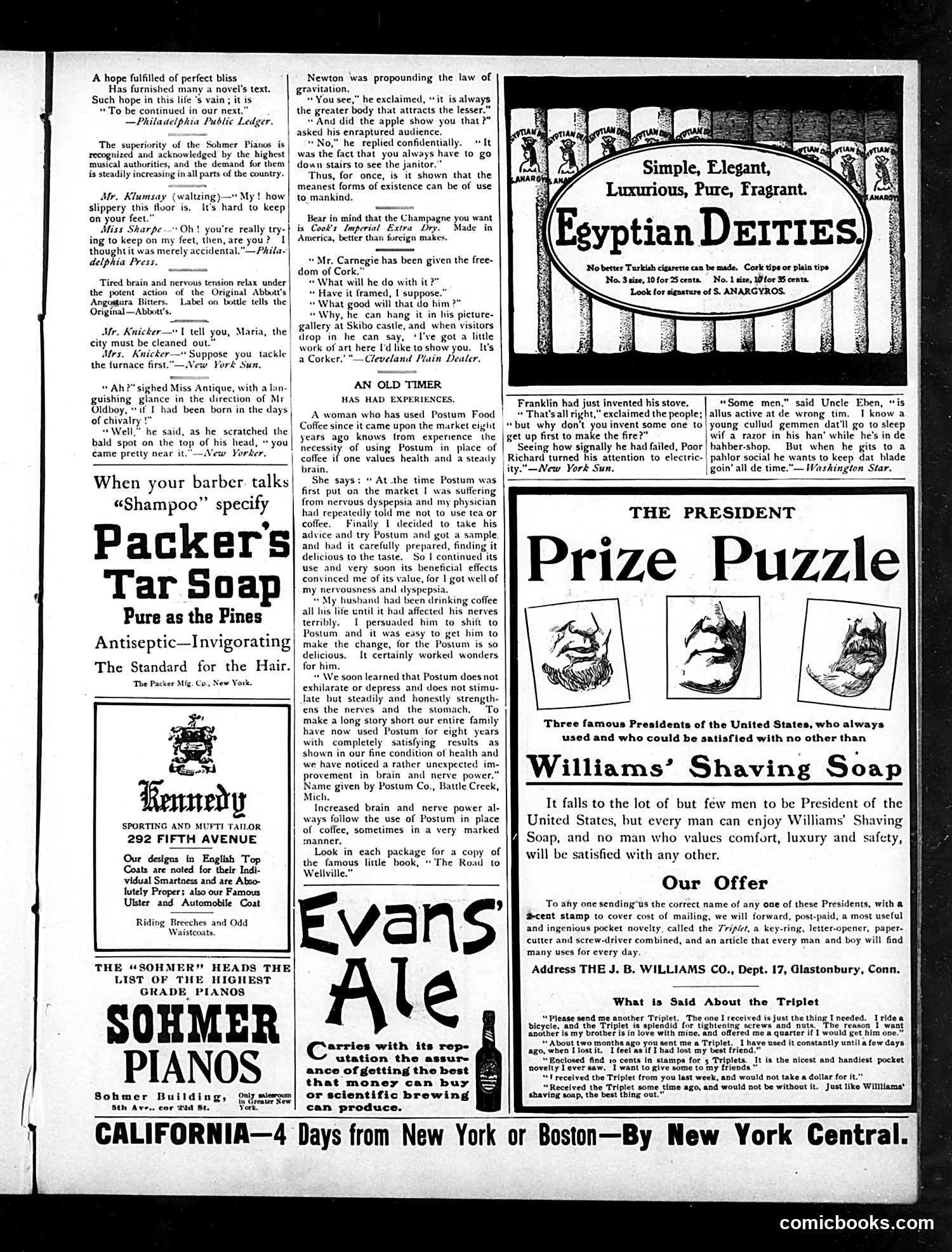
This page is primarily **advertising and light humor** rather than political satire. The content includes: **Main Cartoon/Feature**: "The President Prize Puzzle" shows three bearded presidential faces (likely Lincoln, Grant, and another 19th-century president based on the styling) with text promoting **Williams' Shaving Soap**. The advertisement claims these presidents "always used and...could be satisfied with no other than Williams' Shaving Soap." **Point**: This is straightforward product advertising leveraging presidential endorsement (or implied historical preference) for credibility—a common marketing tactic of the era. **Other Content**: The page consists mostly of: - Short humorous anecdotes (about slippery floors, janitors, Carnegie) - Product advertisements (Sohmer Pianos, Packer's Tar Soap, Evans Ale, Postum) - Light domestic comedy **Context for Modern Readers**: There's no substantive political commentary here. It's a typical Judge magazine page mixing satirical short jokes with paid advertisements, demonstrating how publications funded themselves in this period.
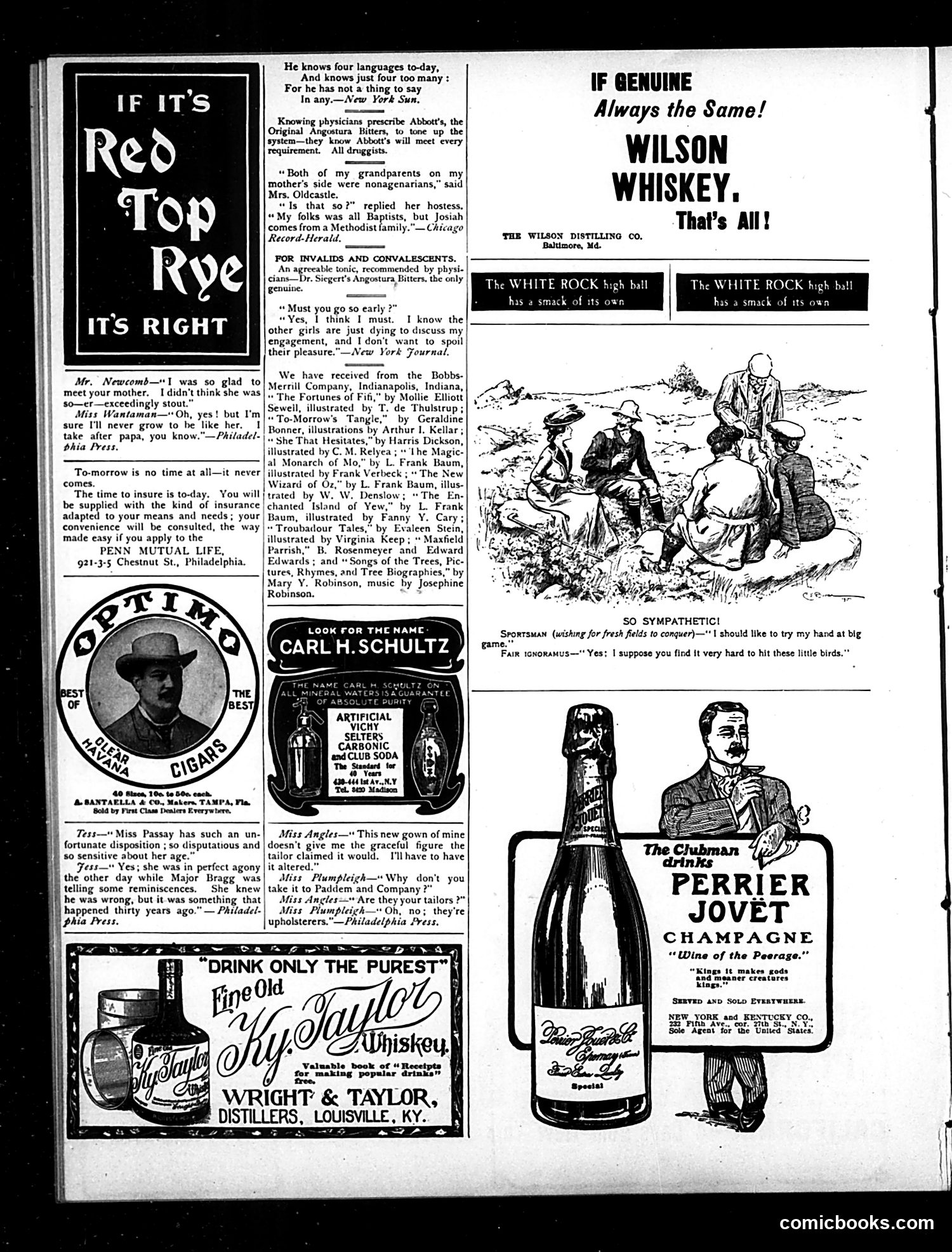
This is primarily an **advertising page** from Judge magazine, with several brief comic anecdotes interspersed. The main cartoons are social humor pieces: 1. **"So Sympathetic!"** depicts a sportsman seeking "fresh fields to conquer" in hunting, while a fair but ignorant woman sympathetically suggests he must find it "hard to hit these little birds"—the joke being her oblivious misunderstanding of his ambitions. 2. Several short **dialogue jokes** mock social pretension and miscommunication: a woman assures a man she won't grow stout like her mother; a guest leaves early so others can gossip about her engagement; a woman complains her dress doesn't flatter her figure, and is told to visit upholsterers instead of tailors (implying she needs structural support, not tailoring). **Advertisements dominate**, promoting whiskeys (Wilson, Sly Taylor), champagne (Perrier-Jouvet), cigars, and life insurance—typical of Judge's era. The page reflects early 1900s consumer culture and genteel social anxieties about appearance, class, and propriety.
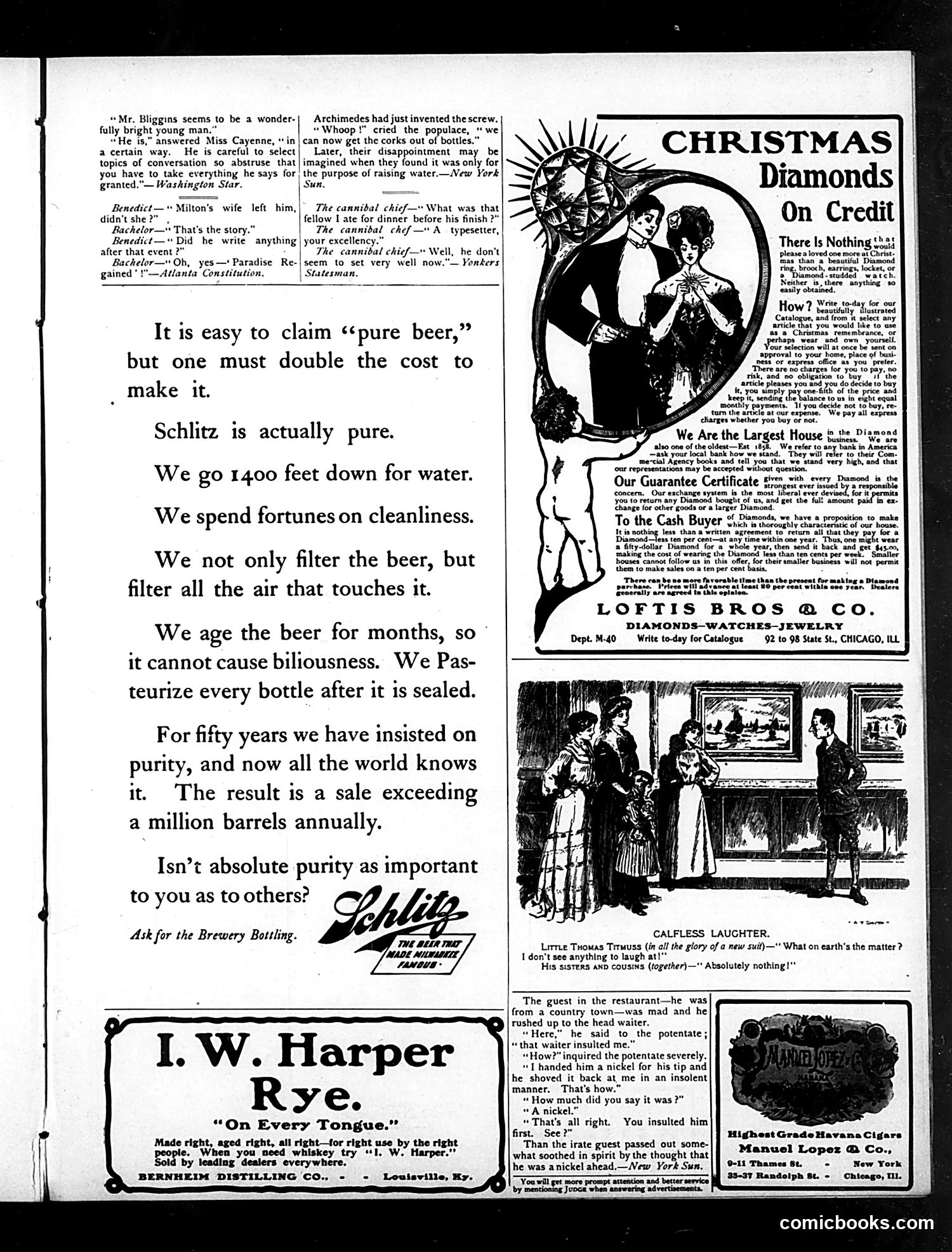
This page combines humor pieces with period advertisements. The **cartoons and jokes** are brief, disconnected vignettes satirizing everyday social situations: - A young man impresses by discussing obscure topics people must take "on faith" - Archimedes' screw invention disappoints because it raises water, not removes bottle corks - A cannibal chef complains that a typesetter "doesn't set very well"—wordplay on typesetting The **advertisements** reveal early 1900s consumer culture: Schlitz beer emphasizes purity through expensive filtration (defending against contamination concerns); Loftis Bros. diamonds offer installment credit for Christmas gifts; I.W. Harper whiskey and Manuel Lopez cigars target affluent buyers. **"Calfless Laughter"** mocks a country visitor who mistakes a waiter's rejection of a nickel tip as an insult—satirizing rural ignorance of proper tipping etiquette in urban restaurants. The page reflects consumer anxieties (product purity), class distinctions (city versus country manners), and emerging credit-based purchasing for luxury goods.
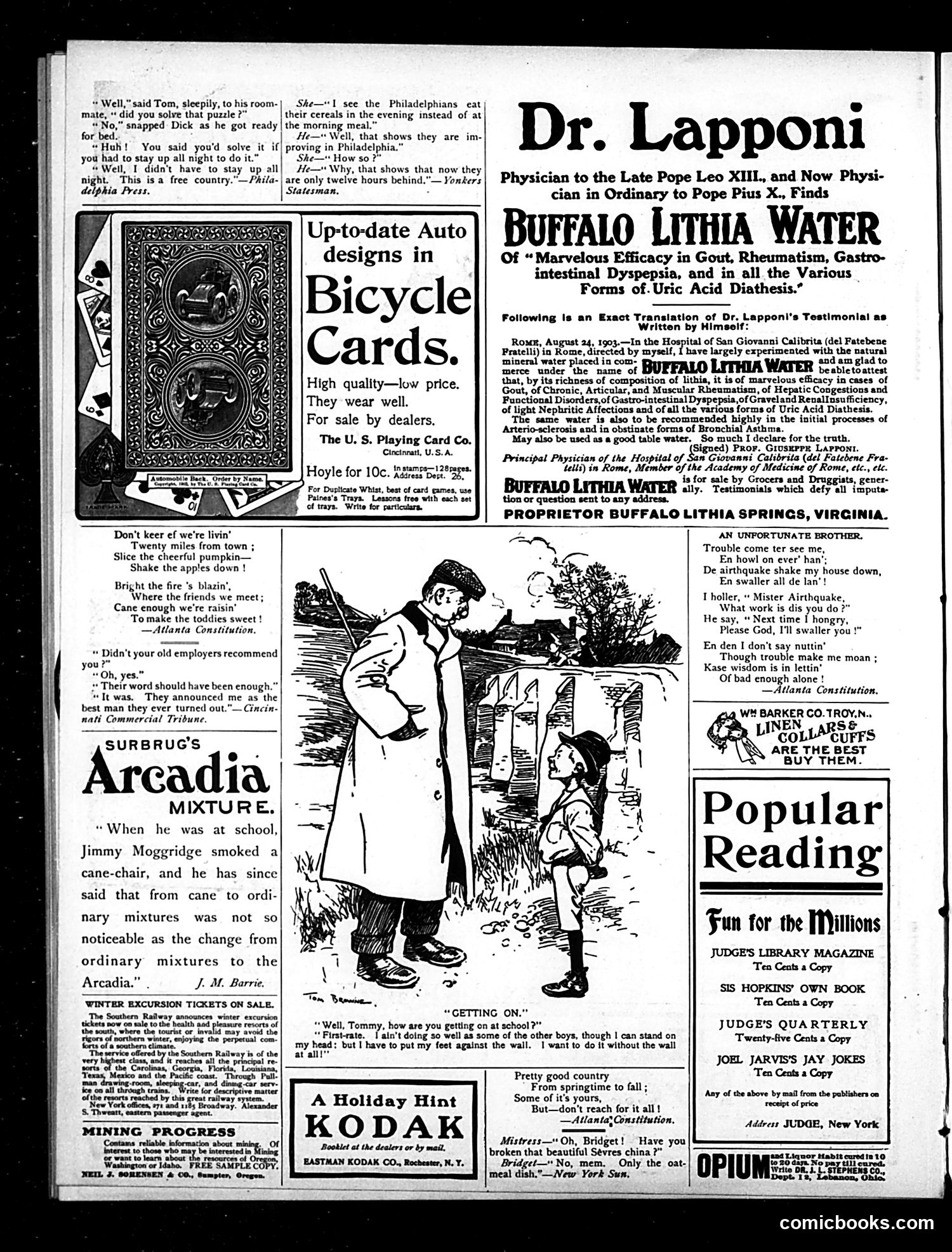
This page from *Judge* magazine contains several distinct elements: **Main Cartoon**: The large illustration depicts a man and boy in a rural setting. The caption "Getting On" presents a humorous exchange where Tommy brags about standing on his head despite poor school performance—a joke about misplaced priorities and childish logic. **Sidebar Jokes**: Three brief humor pieces play on wordplay and social assumptions: one about solving puzzles in a "free country," another about Philadelphia's dinner timing implying they're "twelve hours behind" (less civilized), and a third where an employee's recommendation backfires. **Advertisements**: The bulk of the page is patent medicine and product ads typical of early 1900s publications—bicycle cards, Kodak cameras, Surbrug's tobacco mixture, and prominently, "Buffalo Lithia Water," claiming medical efficacy for gout and rheumatism, endorsed by the Pope's physician. **Poetry**: Rural nostalgia verses celebrate small-town life and apple-picking. The satire is gentle, the ads reflect period attitudes toward unregulated health claims, and the overall tone is lighthearted entertainment for middle-class readers.
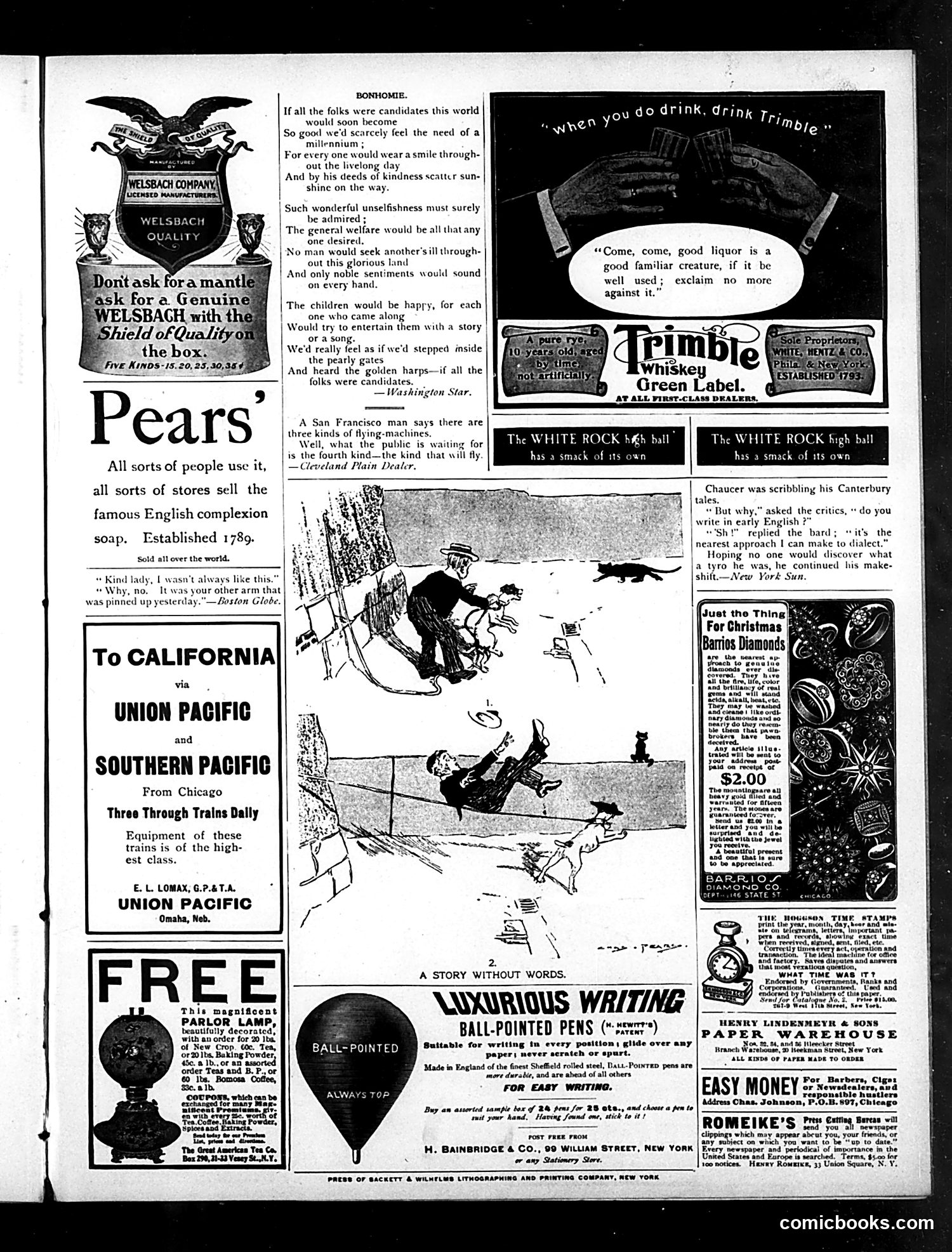
The central cartoon depicts a slapstick scene of physical comedy: a man in formal attire appears to be falling or tumbling, with various objects scattered around him—suggesting he's lost his balance or dignity in an embarrassing mishap. The humor is purely visual and physical, requiring no text or explanation. The page's title, "A Story Without Words," suggests this was a common cartoon format in Judge magazine—visual gags that relied on sight humor rather than dialogue or captions. This reflects early 20th-century magazine traditions where illustrated humor didn't always require narrative explanation. The surrounding advertisements (for pens, diamonds, railroad travel, soap) and various short jokes and poems fill the remainder of the page, which was typical Judge layout: mixing editorial cartoons with advertising and miscellaneous humor content.
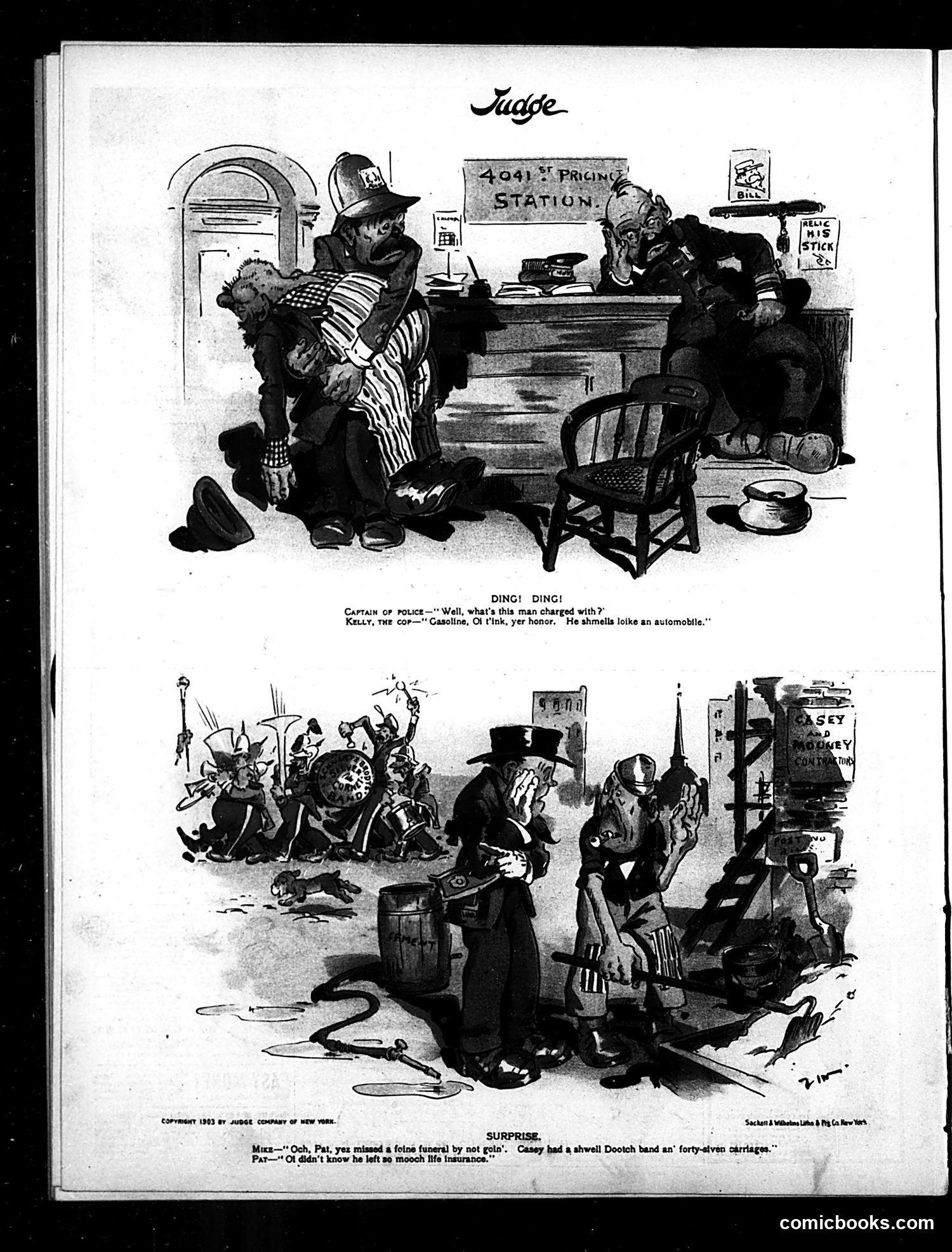
This 1903 satirical page contains two cartoons mocking Irish immigrants through ethnic stereotypes common to the era. **"Ding! Ding!"** depicts a police station scene where an officer (Kelly, identified by dialect) charges a man with "gasoline"—he "smells like an automobile." The joke plays on the novelty of automobiles and suggests Irish immigrants are unfamiliar with this new technology, mistaking gasoline smell for criminal behavior. **"Surprise"** shows two Irish characters (Mize and Pat, identified by names and accents) discussing a funeral. Pat missed Casey's funeral, which featured "a swell Dootch band" and forty-seven carriages. Pat regrets missing it because Casey left him money in insurance—the dark humor suggests attending funerals of the wealthy was economically advantageous. Both cartoons use exaggerated Irish dialect and caricature to ridicule Irish-American working-class culture, a common editorial approach in early 1900s American humor magazines.