
A complete issue · 16 pages · 1903
Judge — October 17, 1903
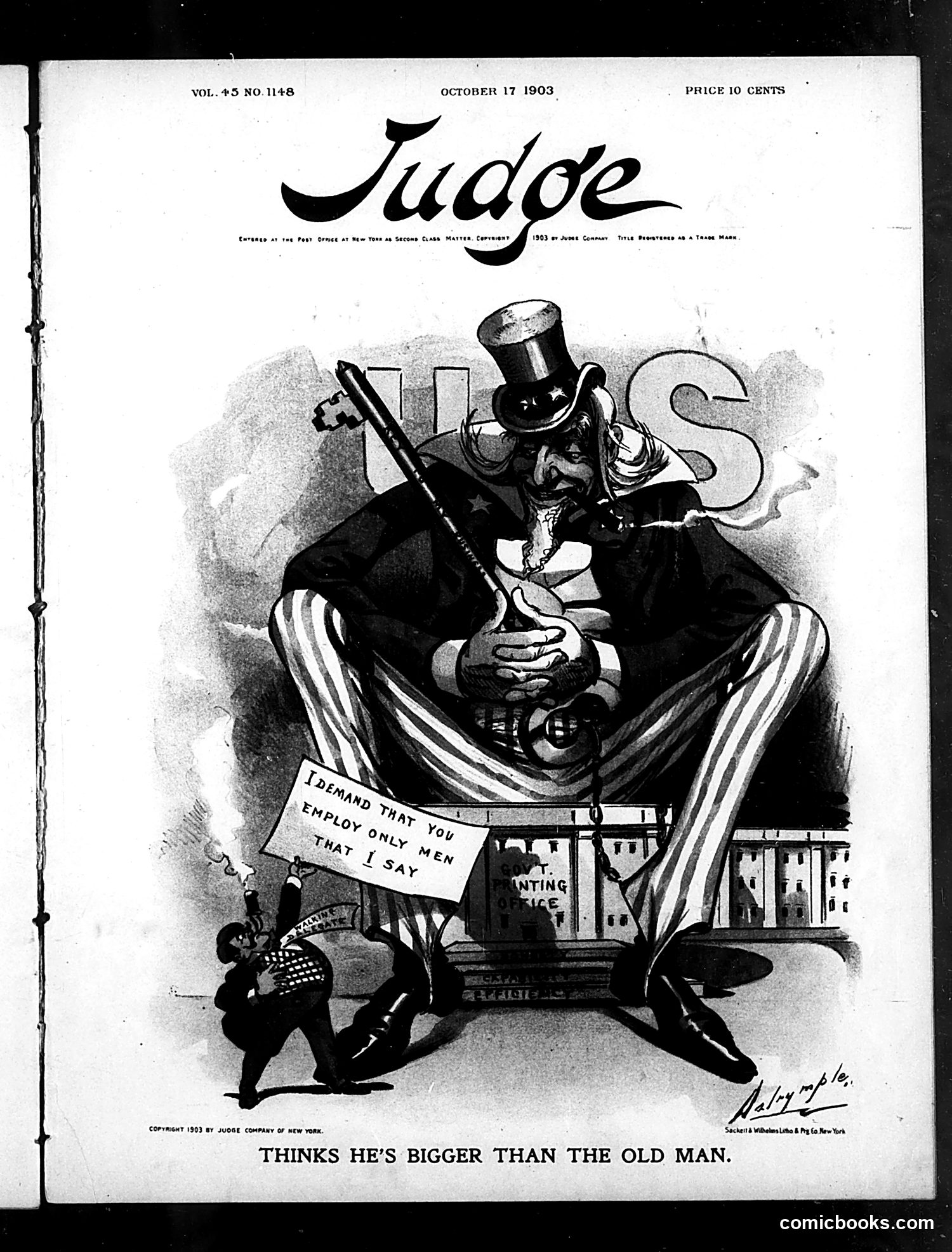
This political cartoon satirizes labor union demands for exclusive hiring practices. Uncle Sam sits atop the Capitol building, holding a club and appearing aggressive or domineering. A small figure below holds a banner reading "I DEMAND THAT YOU EMPLOY ONLY MEN THAT I SAY." The caption "THINKS HE'S BIGGER THAN THE OLD MAN" suggests a labor leader or union representative challenging federal authority. The cartoon mocks what Judge viewed as overreaching union power—specifically the demand for closed-shop employment (hiring only union-approved workers). The satire positions Uncle Sam as the legitimate authority being threatened by what appears to be a presumptuous labor organizer attempting to dictate hiring practices, portraying unions as dangerously ambitious and insolent toward government authority.
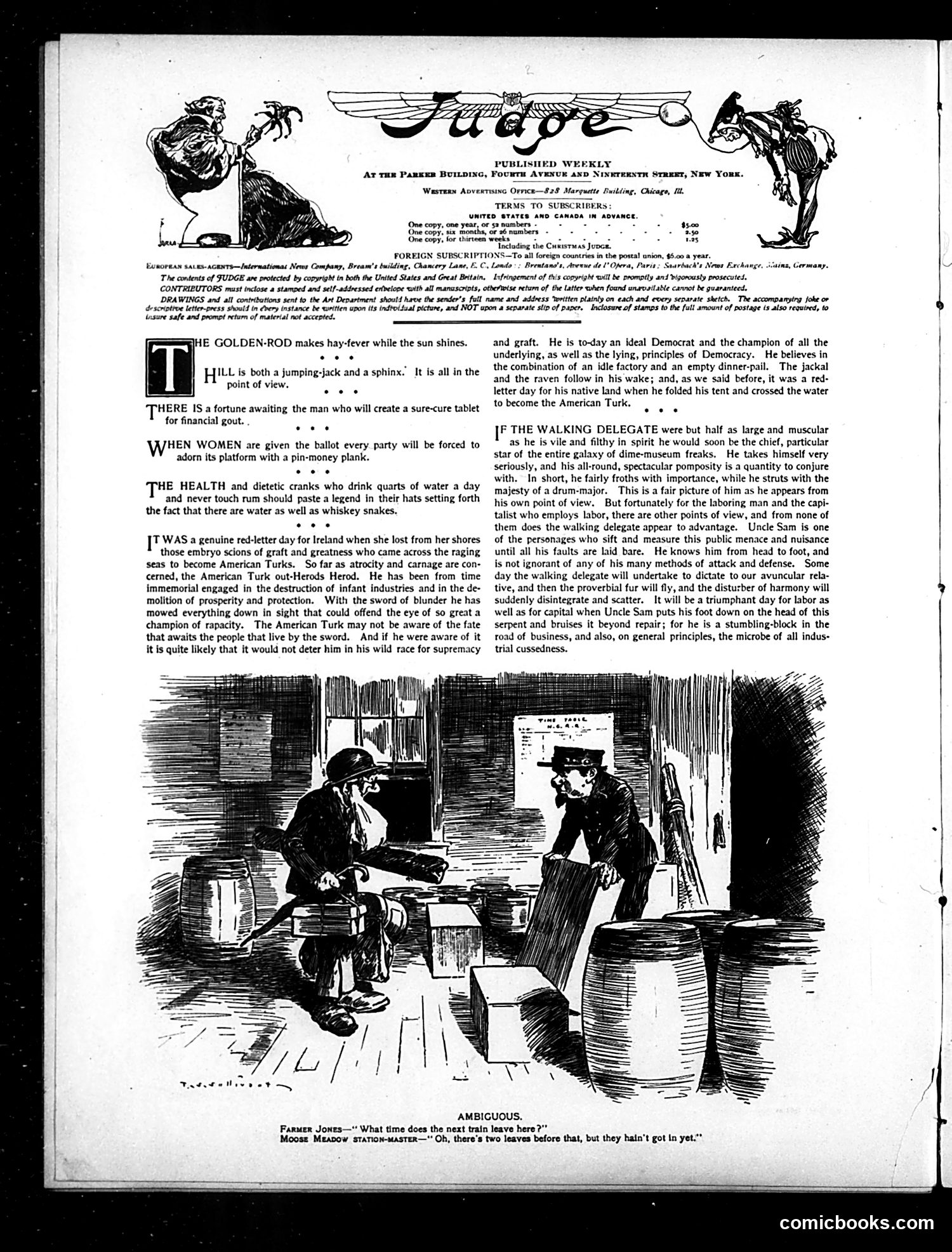
This page contains satirical commentary on American politics and society. The text sections mock various figures—including references to an "ideal Democrat," "walking delegate" (labor organizer), and implicit criticism of American industrial practices and labor disputes. The bottom cartoon titled "AMBIGUOUS" depicts two men in an industrial setting (barrels visible) discussing train schedules. Farmer Jones asks when the next train leaves; station-master Moody replies there are "two leaves before that, but they hain't got in yet"—a pun playing on "leaves" (departure times) versus leaves (foliage), likely satirizing delayed trains or incompetent management. The page's tone suggests early 20th-century concerns about labor organizing, industrial capitalism, and Irish-American stereotypes (the dialect humor).
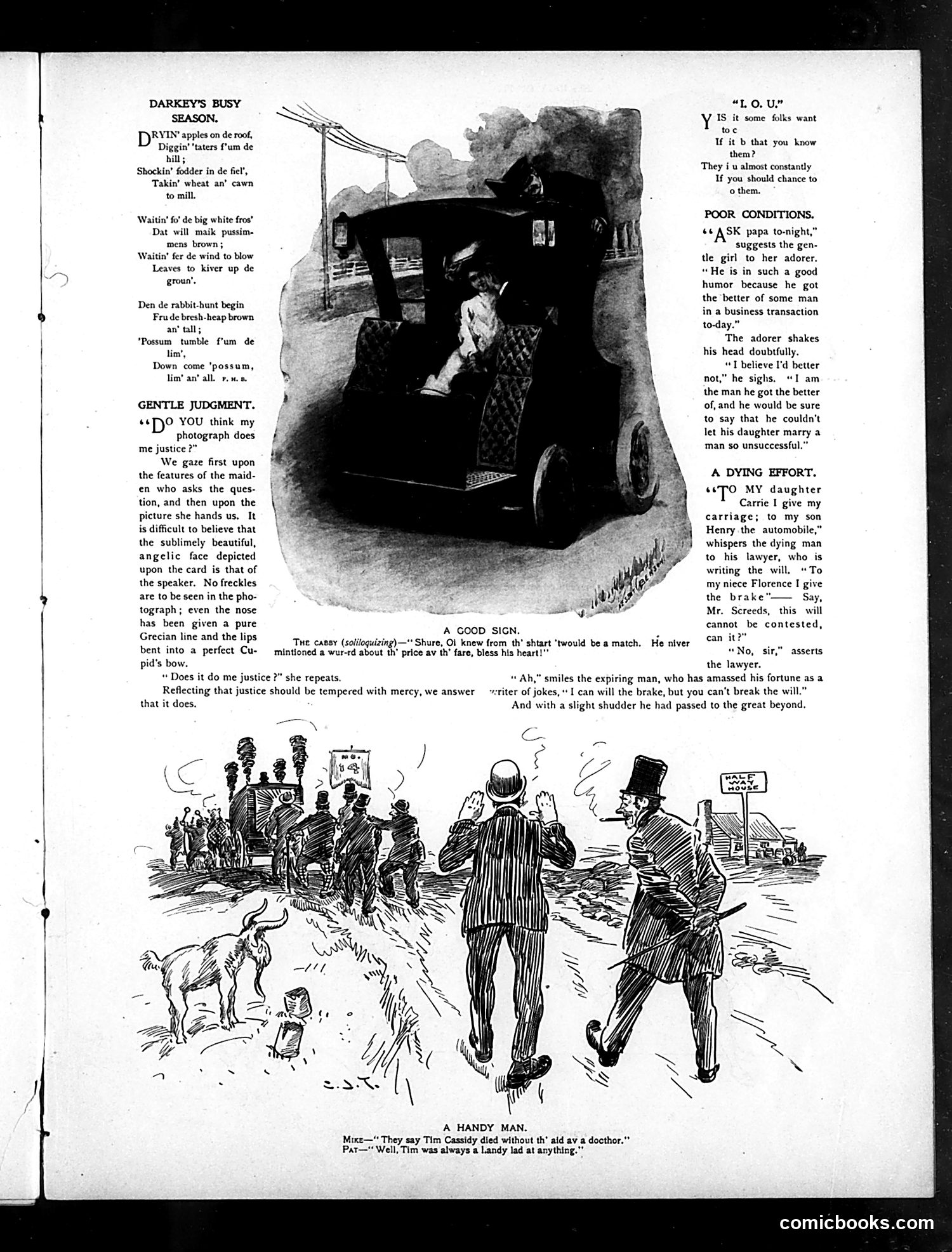
This page contains several unrelated satirical pieces typical of Judge magazine's format: **"Darkey's Busy Season"** is a dialectal poem about agricultural work, reflecting the magazine's casual use of racist terminology common to that era. **"Gentle Judgment"** discusses a photograph's artistic merit, debating whether physical beauty or character matters more in portraiture. **"A Good Sign"** shows a dying man's final act—willing his automobile and brake to others—presented as darkly humorous. **"A Loving Effort"** depicts someone leaving detailed instructions in a will. **"A Handy Man"** (bottom) contains a brief joke about someone named Tim Cassidy who was apparently useful at various tasks. The cartoons use satirical humor typical of early-20th-century American magazines, though the racial content reflects outdated, offensive language of that period.
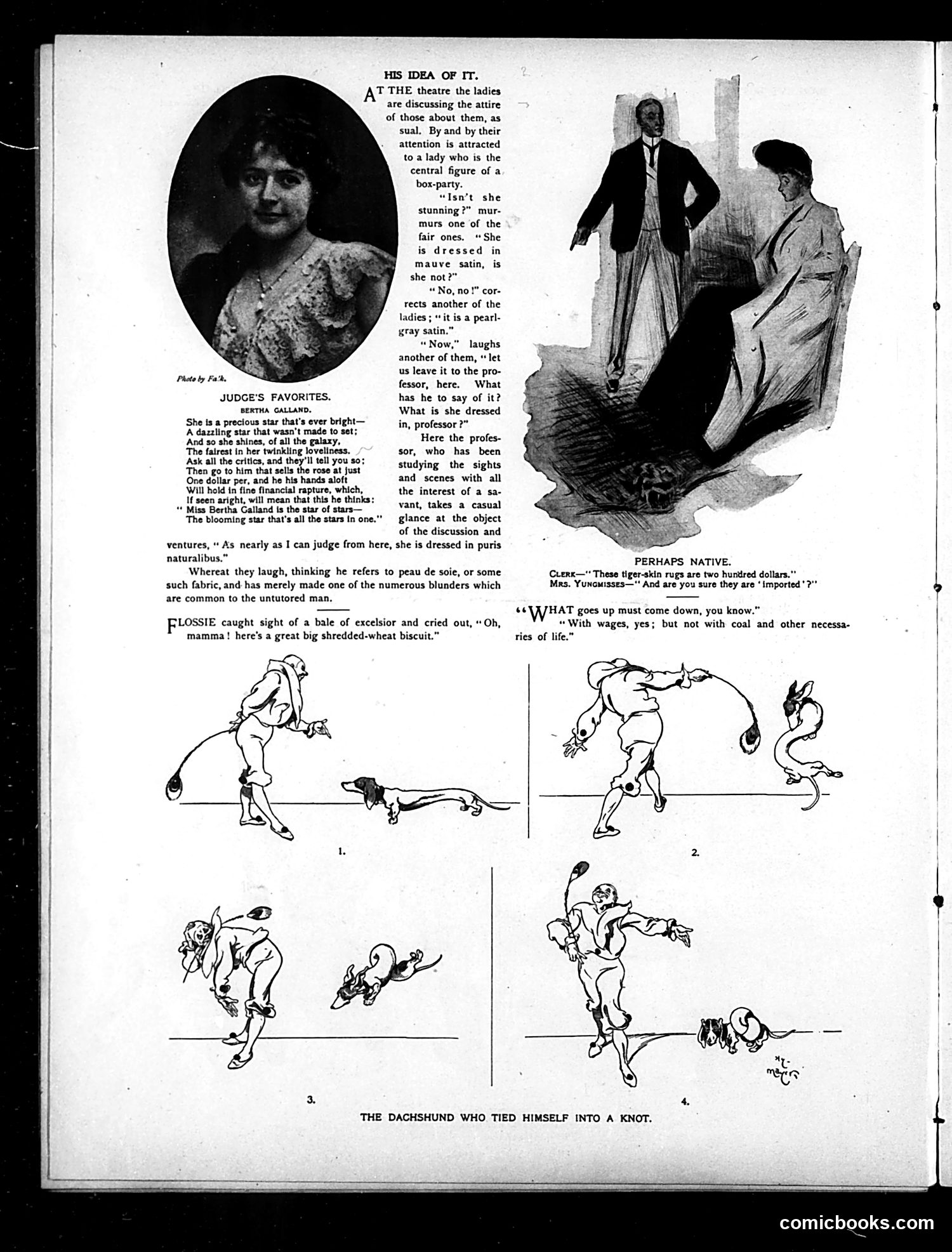
**Top Section - "Judge's Favorites":** This features actress Bertha Gallard with a poetic tribute calling her "the star of stars." The accompanying sketch shows a theater scene where a professor evaluates a woman's dress as "Paris natural"—suggesting debate about whether her fashionable attire is genuinely Parisian or merely an imitation. The satire mocks both theater-goers' obsession with fashion details and pretensions about continental sophistication. **Bottom Section - "The Dachshund Who Tied Himself Into a Knot":** Four sequential cartoons depict a dachshund's increasingly contorted positions, playing on the breed's characteristically long body. The accompanying dialogue about wages and necessities suggests this is satirizing economic concerns or labor disputes of the era, using the dog's physical mishaps as visual metaphor for social entanglement.
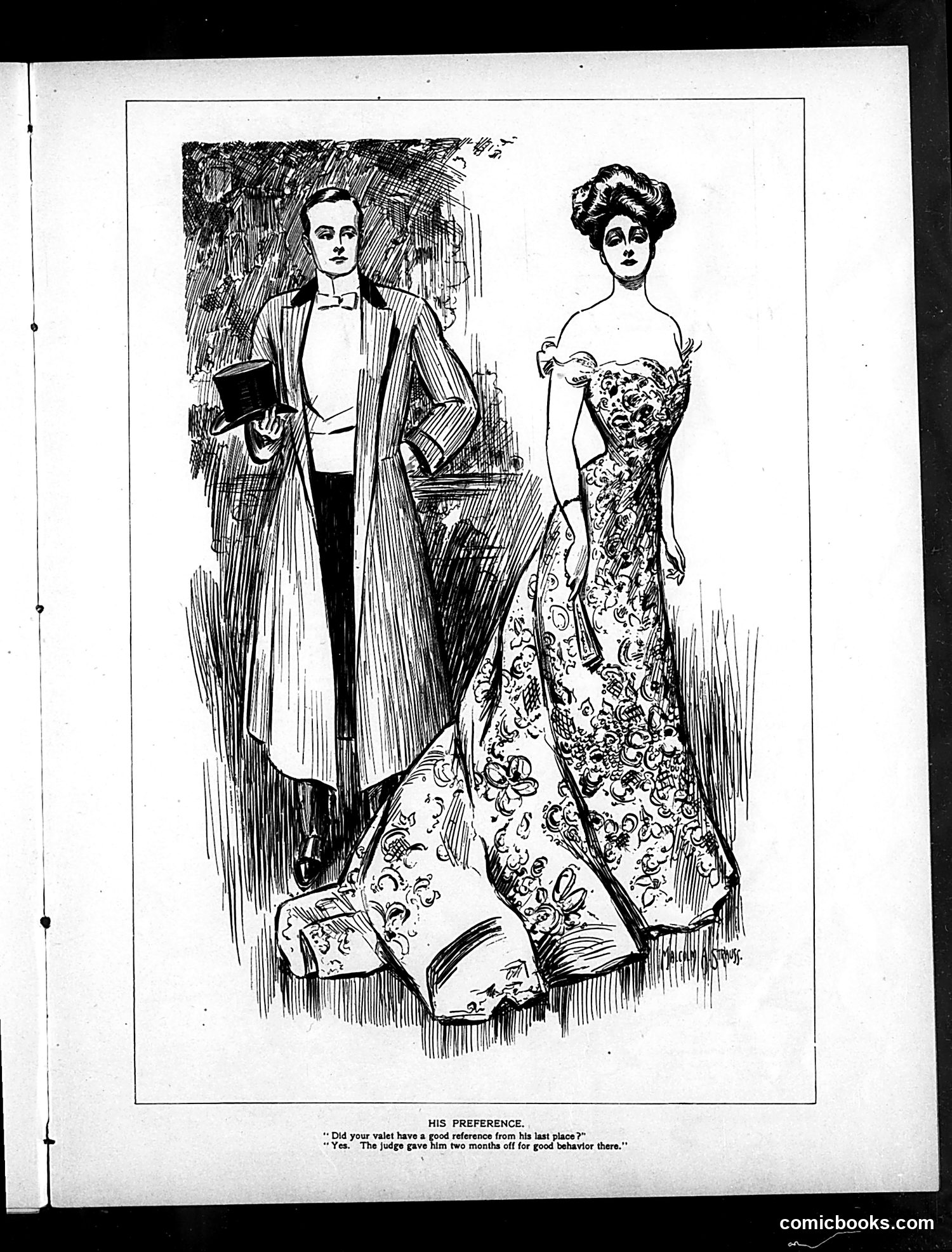
This cartoon satirizes the hiring of domestic servants by playing on a joke about criminal records. A well-dressed man and woman are depicted—apparently interviewing or discussing a valet's qualifications. The humor hinges on the caption: when asked if the valet had a good reference from his previous employer, the response is that "the judge gave him two months off for good behavior"—implying the valet served jail time. The joke inverts expectations: instead of a traditional employment reference, the "reference" is actually a prison sentence reduction for good conduct. This mocks both the desperation of wealthy households to find reliable servants and the casual acceptance of hiring those with criminal pasts, suggesting such practices were common enough to warrant satirical commentary in early 20th-century America.
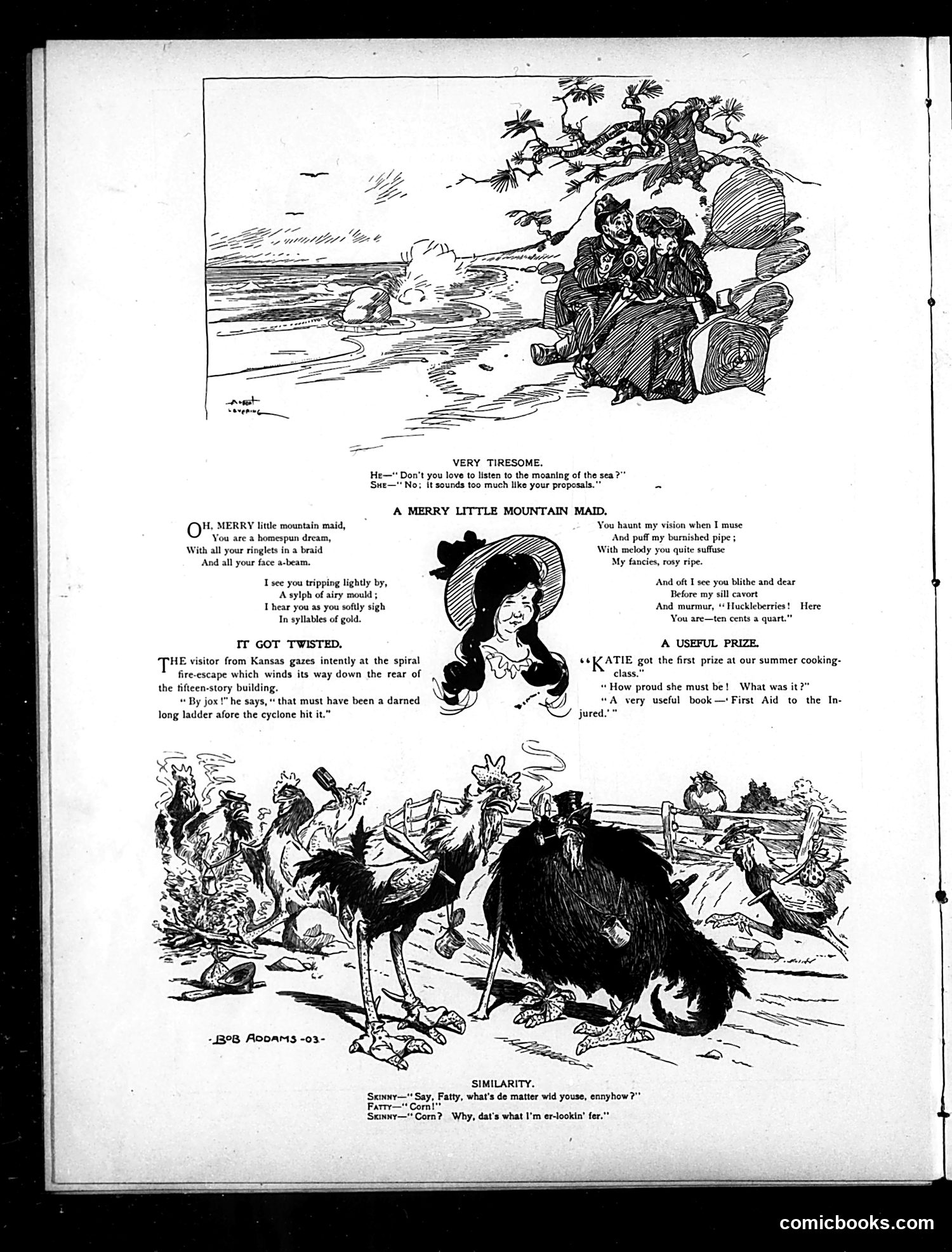
This page contains four separate humorous items typical of early 1900s Judge magazine: 1. **"Very Tiresome"**: A brief romantic dialogue where a man's sea-themed proposal echoes the "moaning" of ocean waves—the woman dismisses both as equally tedious. 2. **"A Merry Little Mountain Maid"**: A sentimental poem about an idealized rural girl, undercut by the final stanza's punchline: she's actually a huckleberry vendor hawking berries for ten cents. 3. **"It Got Twisted"**: A Kansas visitor observes a building's spiral fire escape and jokes it must have been a straight ladder before a cyclone twisted it—poking fun at Midwestern tornado stereotypes and rural naïveté. 4. **"A Useful Prize"**: Katie wins a cooking-class prize—not cookware but a "First Aid to the Injured" manual, implying her cooking is dangerously inedible. 5. **"Similarity"**: A brief animal joke where characters confuse similar-sounding words ("Fatty," "Corn"). These are light, pun-based humor typical of the era's mass-market satire magazine.
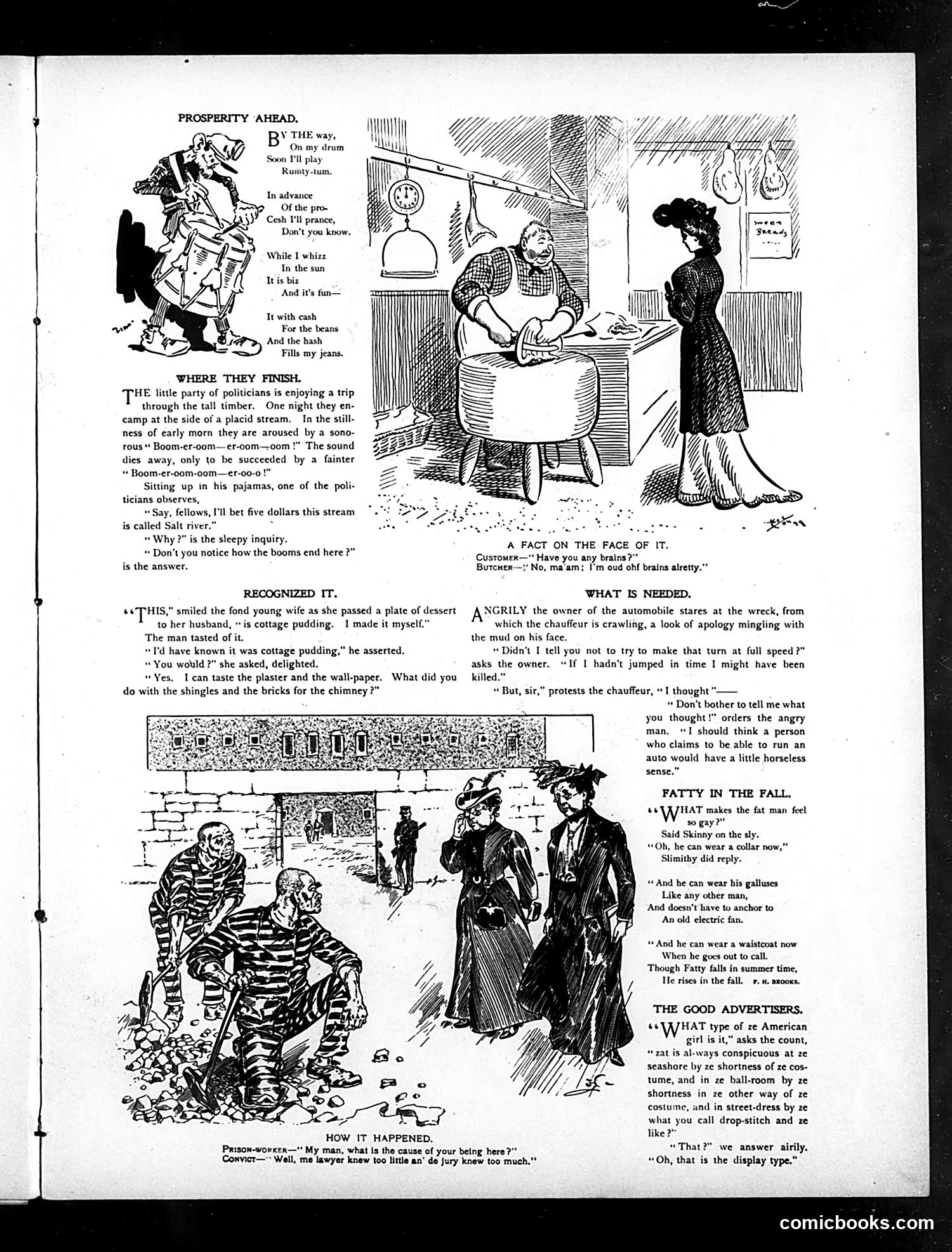
This page contains multiple satirical pieces typical of early 20th-century American humor: **"Prosperity Ahead"** depicts a politician confidently drumming about good times ahead—satirizing politicians' optimistic campaign rhetoric disconnected from reality. **"Where They Finish"** uses the phrase "Salt river" as a punchline. In period slang, being sent "up Salt river" meant electoral defeat. Politicians camping in nature hear booming sounds they mistake for the river's name—a joke about politicians being sent to political oblivion (defeat). **"Recognized It"** mocks a wife's poor cooking; the husband "recognizes" her pudding because it tastes like the house materials (plaster, wallpaper, shingles)—dark humor about domestic incompetence. **"What Is Needed"** satirizes automobile culture; an angry car owner rebukes his chauffeur for reckless driving, coining "horseless sense" (pun on "horse sense"). **"Fatty in the Fall"** contains crude fat-shaming humor about overweight people. The page satirizes politicians, marriage, automobiles, and social types—typical Judge content mocking American society.
The OCR text is too corrupted to read clearly. However, the image shows a political cartoon featuring a figure in period dress being struck or buffeted by multiple small winged figures (appearing to be cherubs or allegorical spirits) swirling around them. There's a banner or scroll visible on the right side, though its text is not fully legible in this reproduction. The style and technique are consistent with late 19th or early 20th-century Judge magazine satirical work. Without readable text identifying the central figure or the specific allegorical meanings of the surrounding elements, I cannot confidently identify who is being lampooned or what political/social situation is being critiqued. The dynamic, chaotic composition suggests ridicule of the subject, but the specific target and message remain unclear from this image alone.
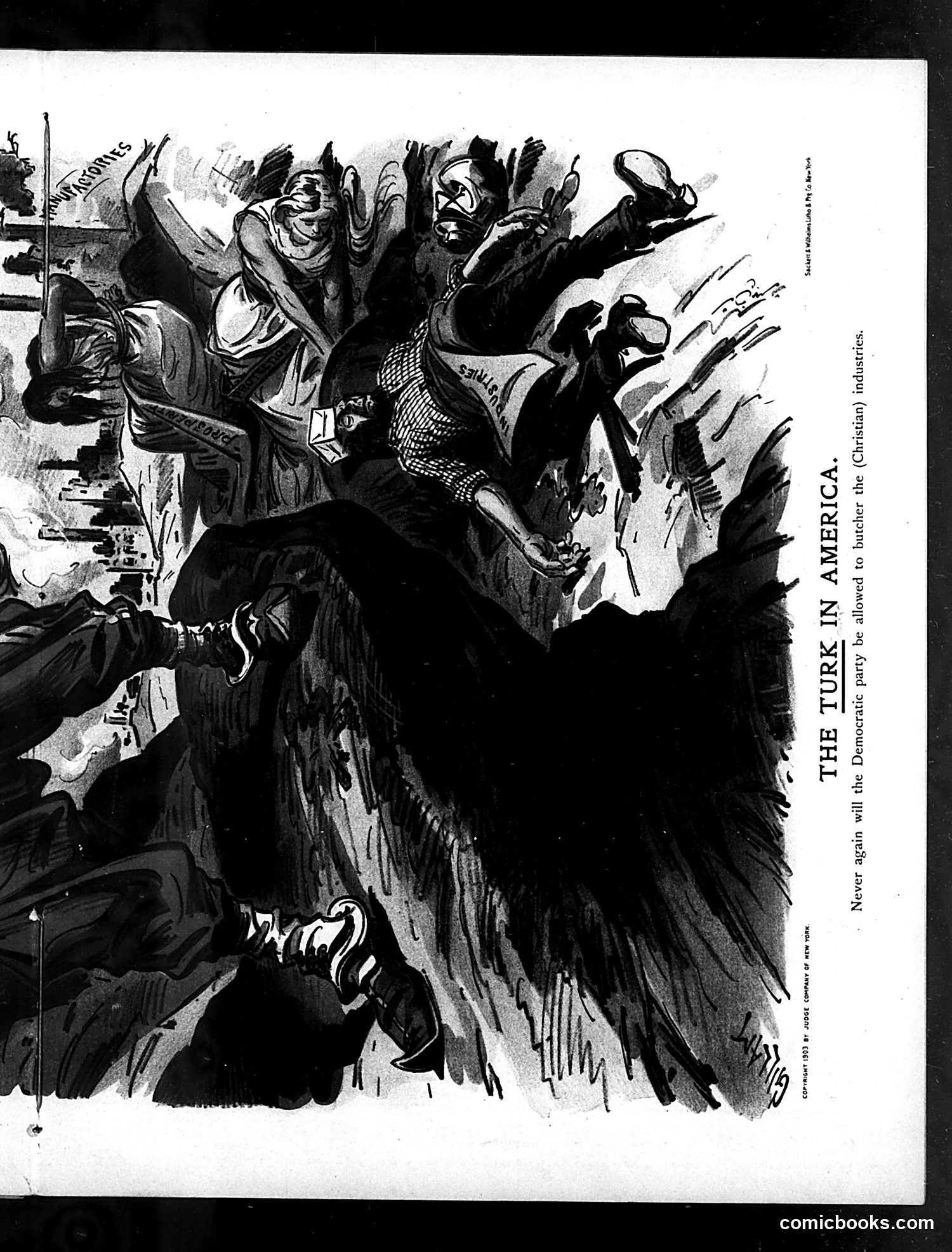
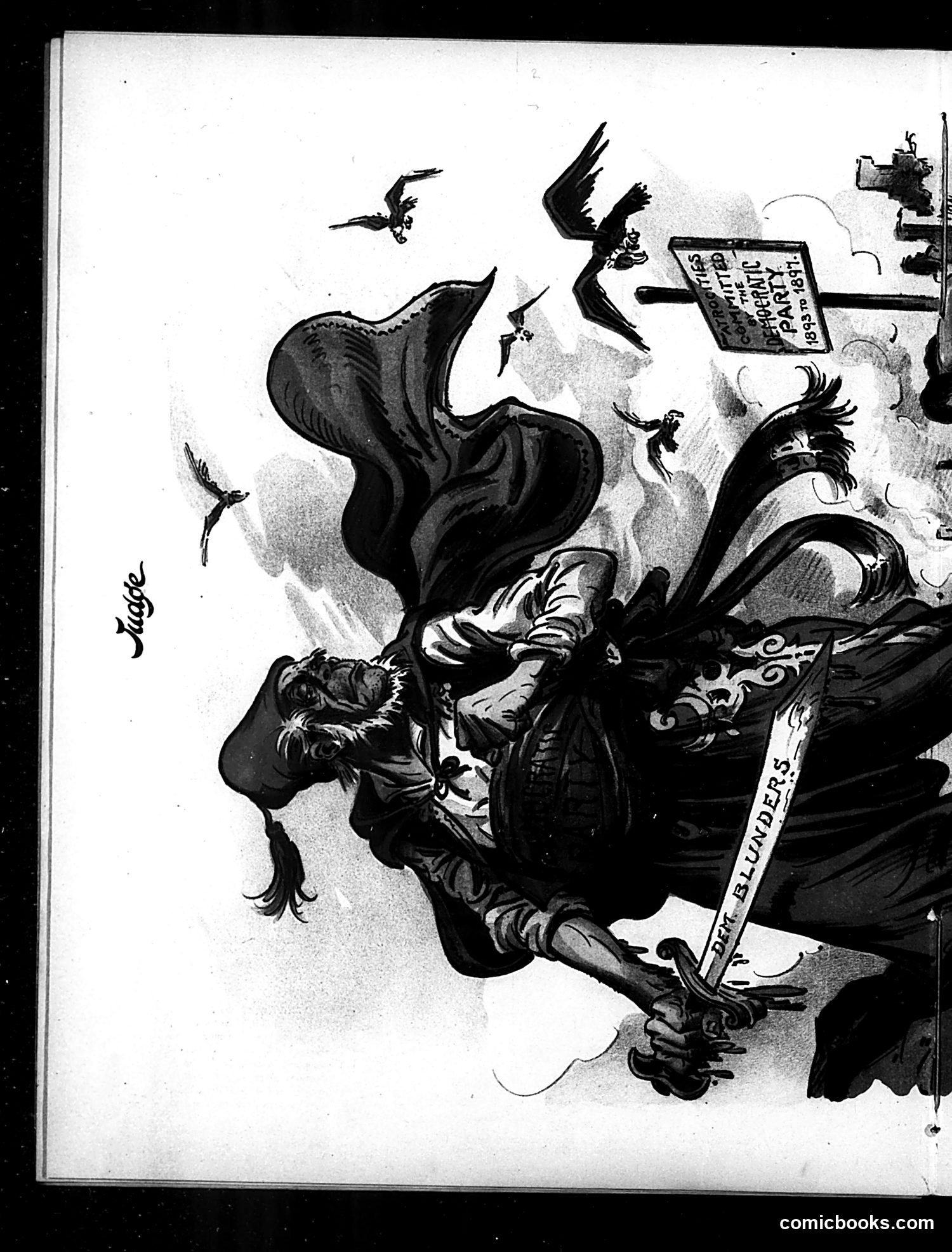
This political cartoon depicts a menacing figure labeled "The Turk" confronting American political figures. The title states: "Never again will the Democratic party be allowed to butcher the Christian industries." The satire appears to reference American anxieties about Ottoman Turkey, likely during a period of U.S.-Turkey tensions or immigration concerns. The cartoon presents Turkey as a threatening force to American Christian interests and industries. The caricatured American figures (appearing distressed or defensive) represent the Democratic Party's alleged failure to protect American economic and religious interests. The cartoon reflects late 19th/early 20th-century American nativism and religious prejudice, positioning Christian America against a foreign "Other." The specific historical context—which Turkish incident or policy this references—is unclear from the image alone.
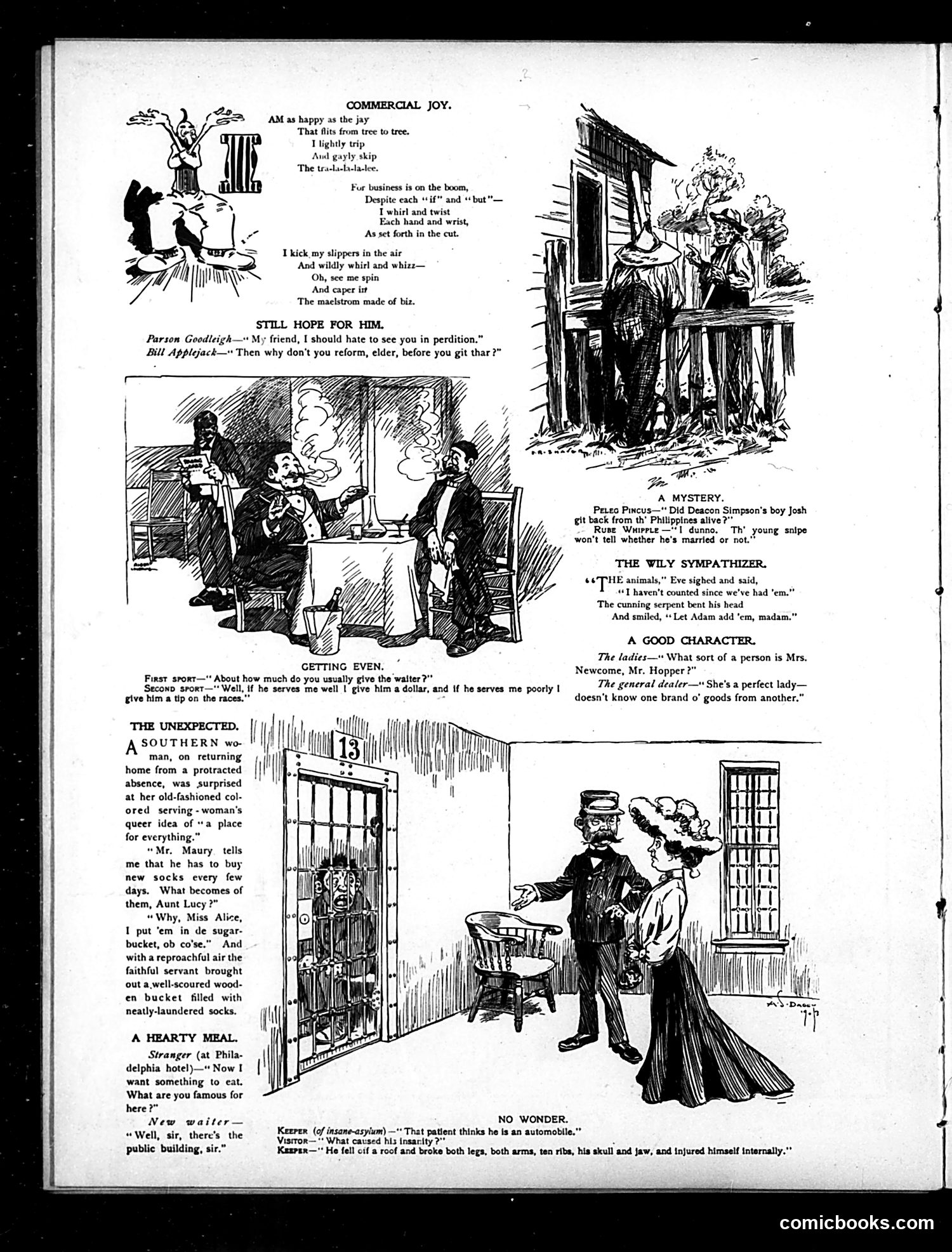
This page collects brief humorous sketches typical of Judge's satirical format. Key items include: **"Still Hope for Him"**: A preacher warns a man (Bill Applejack) about damnation, but the man sarcastically asks why the preacher doesn't reform first—mocking religious hypocrisy. **"The Wily Sympathizer"**: A biblical-era joke where the serpent tricks Eve into having Adam count the animals, shifting responsibility—commentary on cunning manipulation. **"Getting Even"**: Two men discuss tipping waiters; the second gives dollar tips but bets on horse races with the waiter—satirizing working-class gambling habits. **"A Southern Woman"**: A Black servant stores her employer's socks in a sugar bucket, having misunderstood "a place for everything"—a racist caricature joke playing on stereotypes of Black domestic workers. **"No Wonder"**: A man claims to be an automobile; the punchline is he survived catastrophic injuries—dark humor about early automobiles' danger. These represent Judge's mix of social commentary, class satire, and period stereotypes, including deeply offensive racial humor standard to the era.
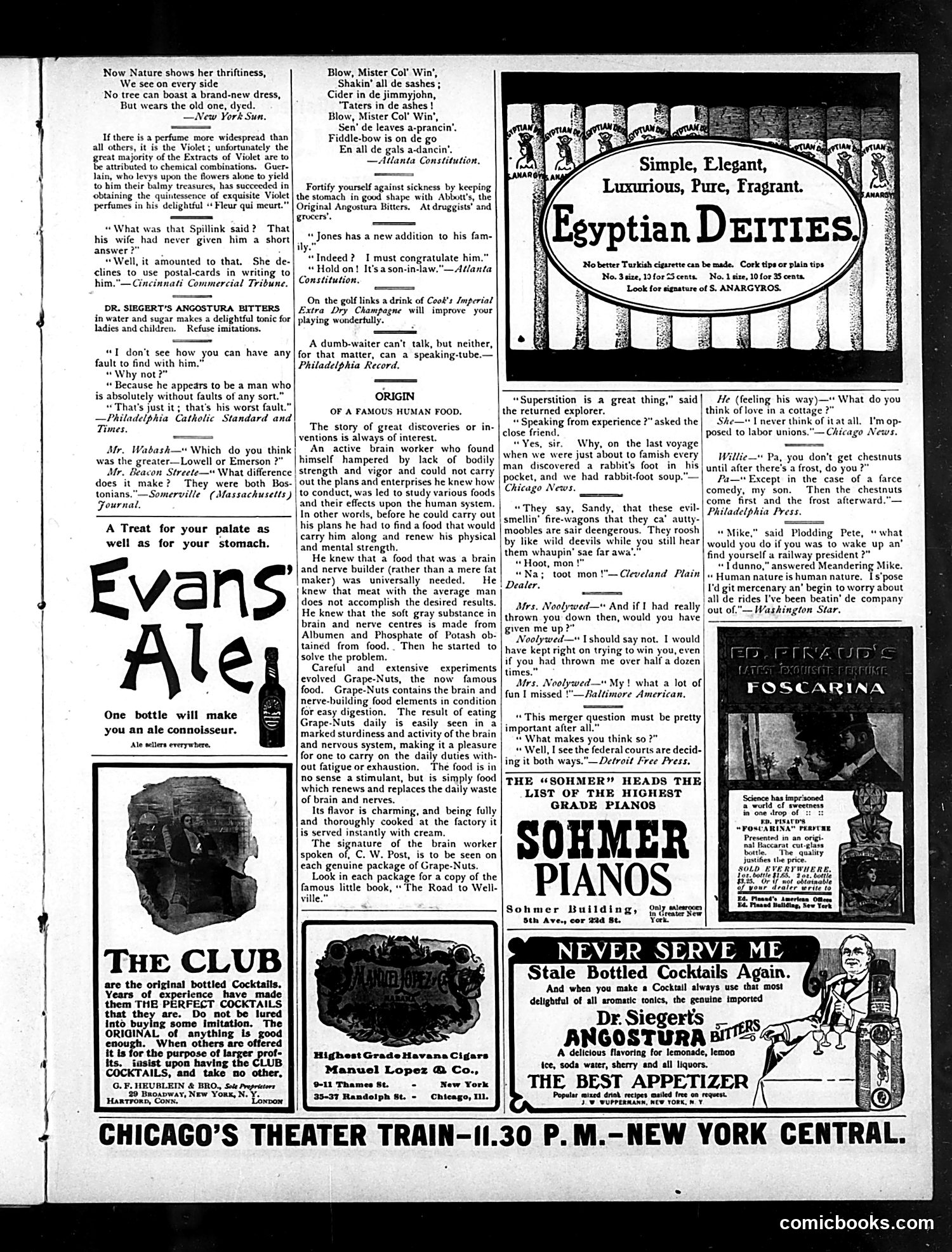
This page is primarily **advertisements and humor pieces** rather than political cartoons. The content reflects early 20th-century American consumer culture and social humor. **Key elements:** **Advertisements dominate**: Evans Ale, The Club cocktails, Sohmer Pianos, Egyptian Cigarettes, Dr. Siegert's Angostura Bitters, and Grape-Nuts cereal. The Grape-Nuts ad includes pseudo-scientific claims about brain food and nutrition—typical of era marketing. **Humor snippets**: Brief jokes about marriage, Boston intellectuals, and family life using stereotypical situations common to the period. **Notable piece**: A poem titled "Blow, Mister Col' Win'" with dialect spelling ("de," "en") appears to be minstrel-style verse, reflecting period entertainment conventions that modern readers would recognize as racially offensive caricature. **Overall**: This page shows Judge as a vehicle for advertising luxury goods to affluent readers while filling space with light social humor and period prejudices. No specific political figures or events are referenced—it's a lifestyle/consumer-focused publication page.
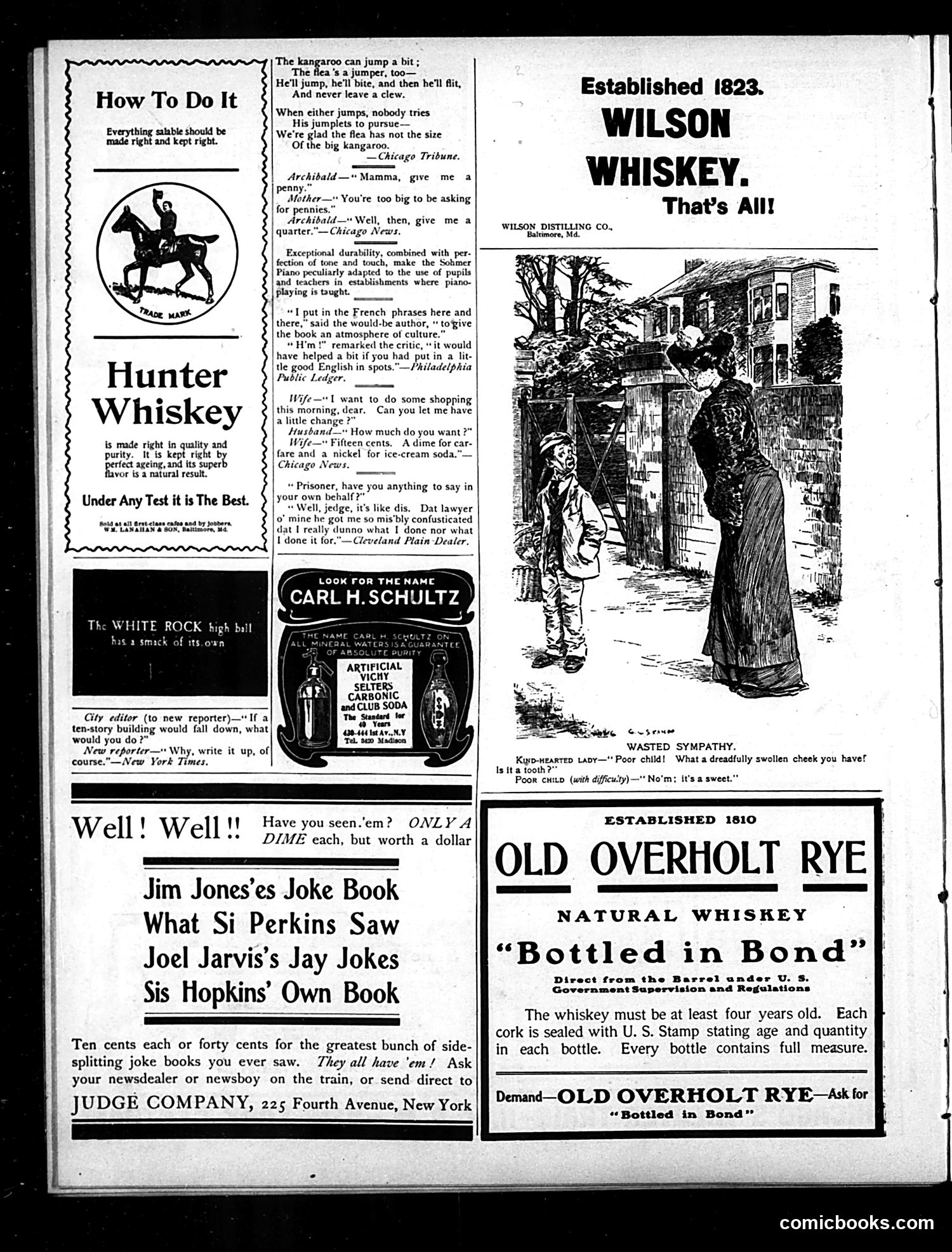
This page is primarily **advertising** with some humor content typical of Judge magazine's satirical style. The "How To Do It" section contains brief humorous exchanges about everyday situations—a wife asking for shopping money, a prisoner defending himself in court, a city editor testing a new reporter. These are gentle, observational jokes rather than political satire. The cartoons and illustrations support whiskey and other product advertisements dominating the page: Hunter Whiskey, Wilson Whiskey (established 1823), Old Overholt Rye (established 1810), and Carl H. Schultz beverages. The "Wasted Sympathy" illustration shows a woman sympathizing with a child's swollen cheek, only to learn it's from eating sweets—a light domestic joke. Below are advertisements for joke books by Jim Jones, Si Perkins, and Joel Jarvis, sold through Judge Company. **Context**: This reflects Prohibition-era advertising (such products would be banned soon after), humor focused on domestic/workplace situations rather than politics, and Judge's reliance on paid advertising for revenue.
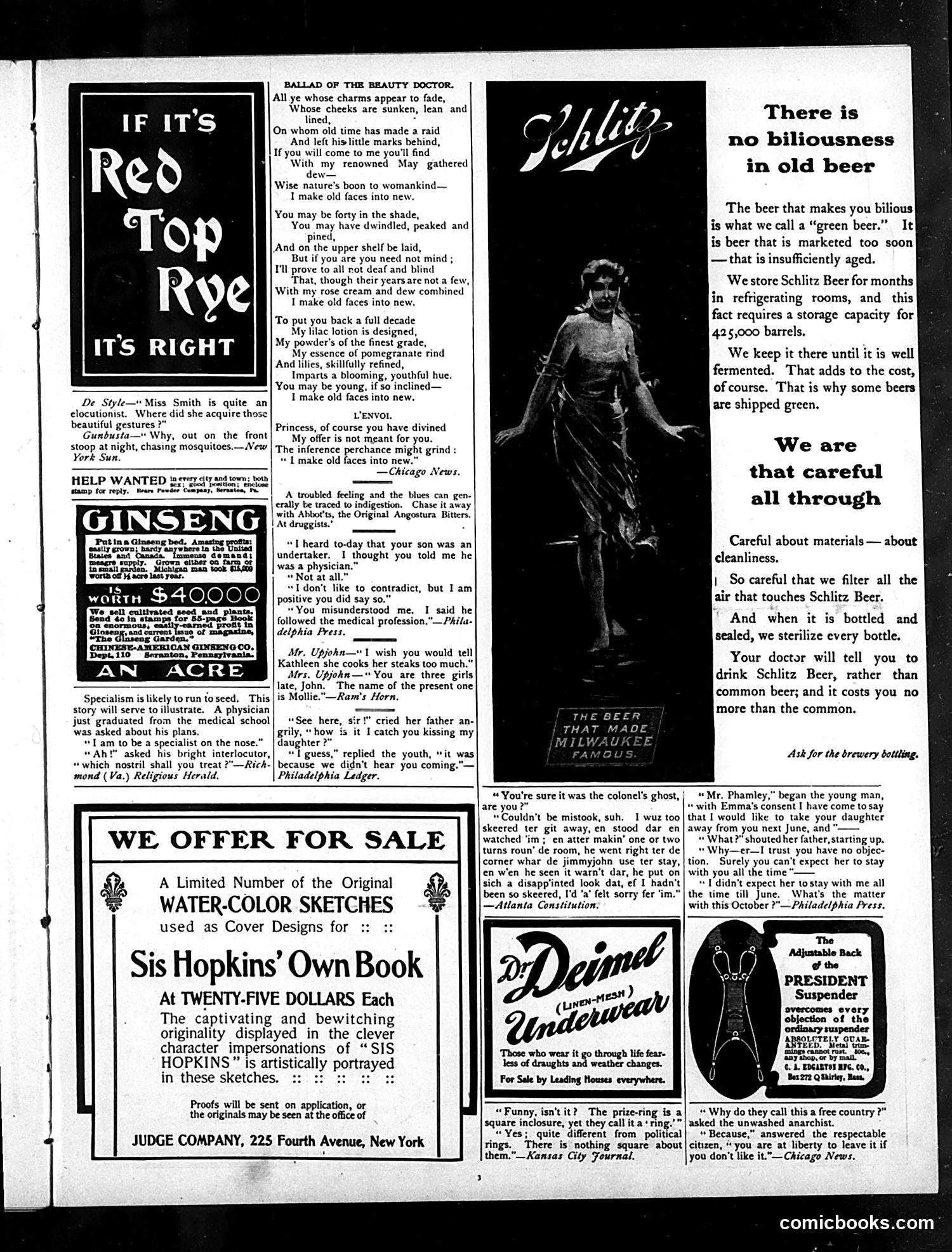
This page consists primarily of **advertisements and filler content** rather than political cartoons. The main satirical elements are brief jokes scattered throughout: The "Beauty Doctor" ballad mocks cosmetic procedures and anti-aging treatments—a recurring target of satire, presenting a quack doctor promising to make "old faces into new" through dubious creams and potions. Small jokes ridicule medical specialists (a doctor claiming to specialize in treating one nostril) and social pretension (confusing an undertaker with a physician). The dominant content is **commercial**: ads for ginseng, Ginseng beds, Abbor's Bitters, and notably, **Schlitz Beer**, which emphasizes careful aging and sterilization to avoid "green beer" that causes biliousness. There's also an offer to sell original watercolor sketches from "Sis Hopkins' Own Book." The page reflects early 20th-century concerns: cosmetic fraud, medical quackery, and product quality assurance in emerging industries like beer brewing.
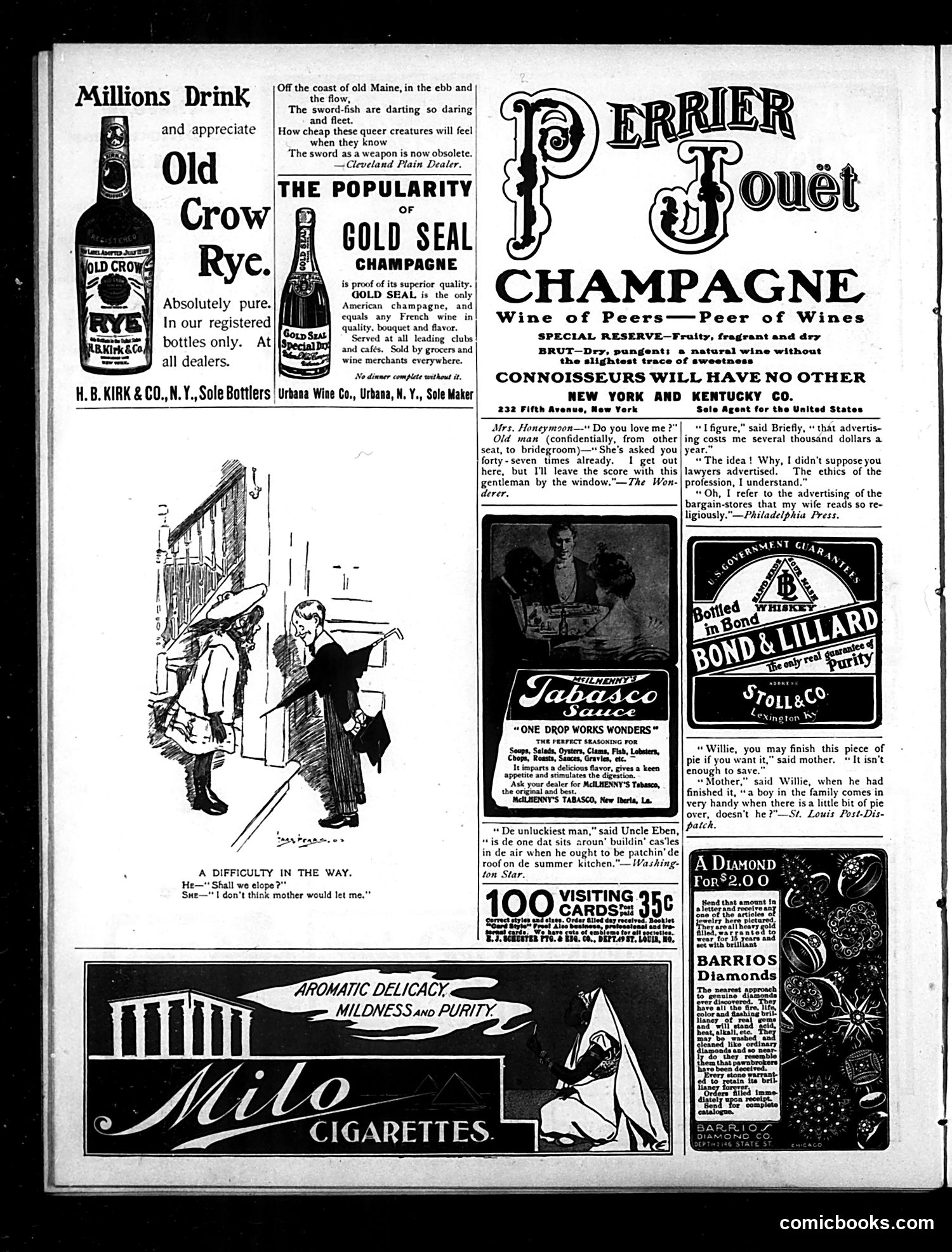
This page is primarily **advertising with accompanying humor content**, typical of Judge magazine format. ## Main Cartoon "A Difficulty in the Way" depicts a couple discussing elopement; the woman refuses because her mother won't permit it. This satirizes Victorian-era parental authority over adult children—even grown women required maternal approval for major life decisions. ## Humor Pieces Several brief jokes mock contemporary marriage and social dynamics: - A newlywed's elderly relative counts how many times the bride has asked "do you love me?"—suggesting women's neediness - A lawyer's wife spends thousands on bargain-store ads—mocking women's frivolous shopping habits - A boy proves useful in families by finishing leftover pie—gentle domestic humor ## Advertisements The page features liquor (Old Crow Rye, champagne, Tabasco), cigarettes (Milo), and visiting cards—typical luxury goods marketed to wealthy readers. **Overall context**: This reflects early 20th-century gender stereotypes where women were portrayed as dependent, emotionally demanding, and overly interested in shopping and domestic matters.
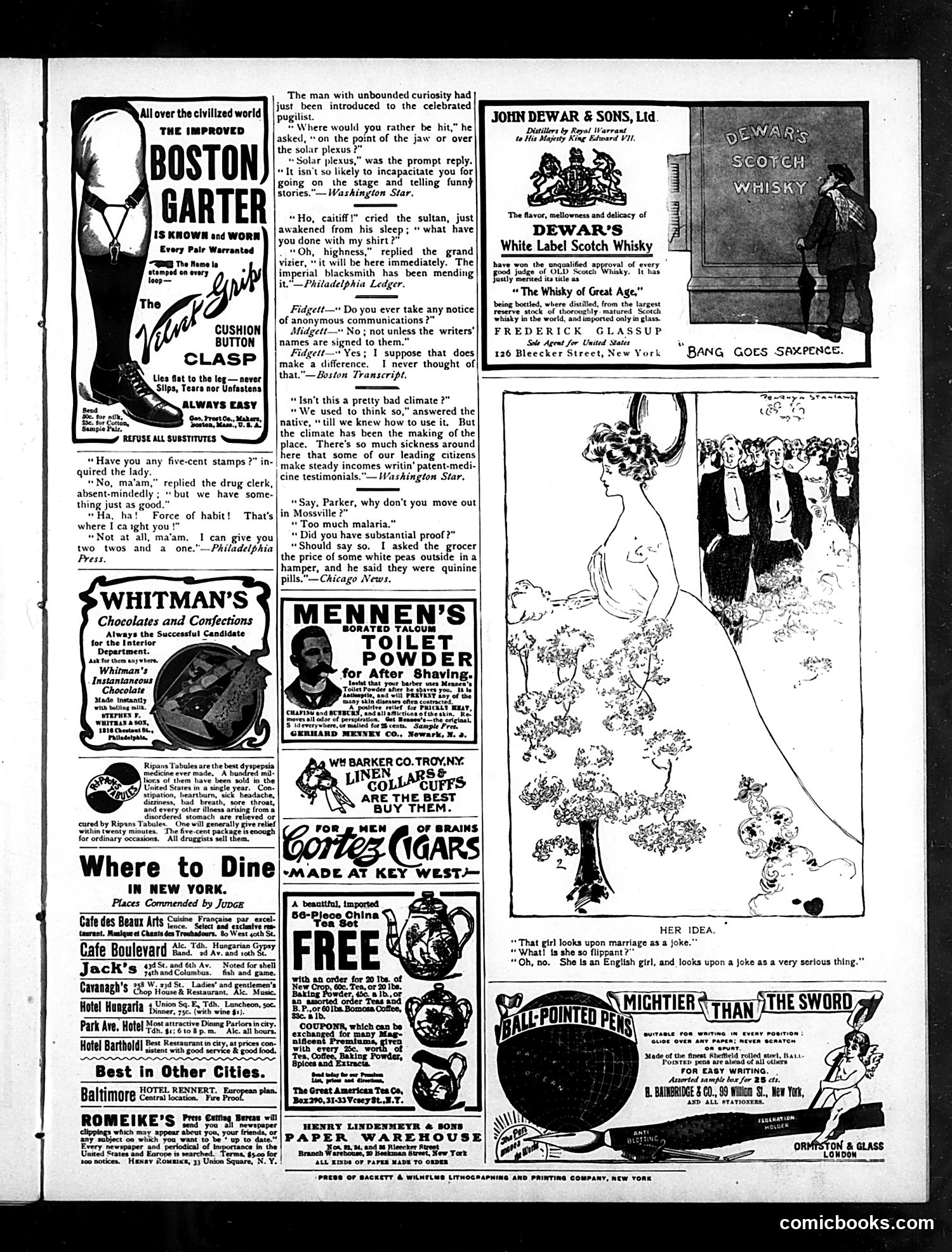
This page is primarily **advertisements and humor columns**, typical of Judge magazine's format. The main cartoon ("Her Idea") depicts a woman's head in profile with an elaborate hat, accompanied by dialogue about marriage as a "joke." The satire targets early-1900s attitudes about women's views on matrimony—suggesting women treated marriage casually or cynically, which would have been considered shocking commentary on gender attitudes of the era. The **humor columns** are brief jokes reflecting period concerns: incompetent pharmacists, corrupt patent-medicine testimonials, malaria in American towns, and bureaucratic absurdity (the sultan's shirt anecdote). The **advertisements** (Dewar's Scotch, Mennen's talcum powder, tea, cigars, chocolates, garters) represent consumer goods marketed to Judge's affluent male readership. The "Where to Dine" section lists exclusive New York restaurants, reinforcing the magazine's audience as wealthy urbanites. Overall, this is a typical Judge page mixing satirical commentary on social pretension with lifestyle advertising.
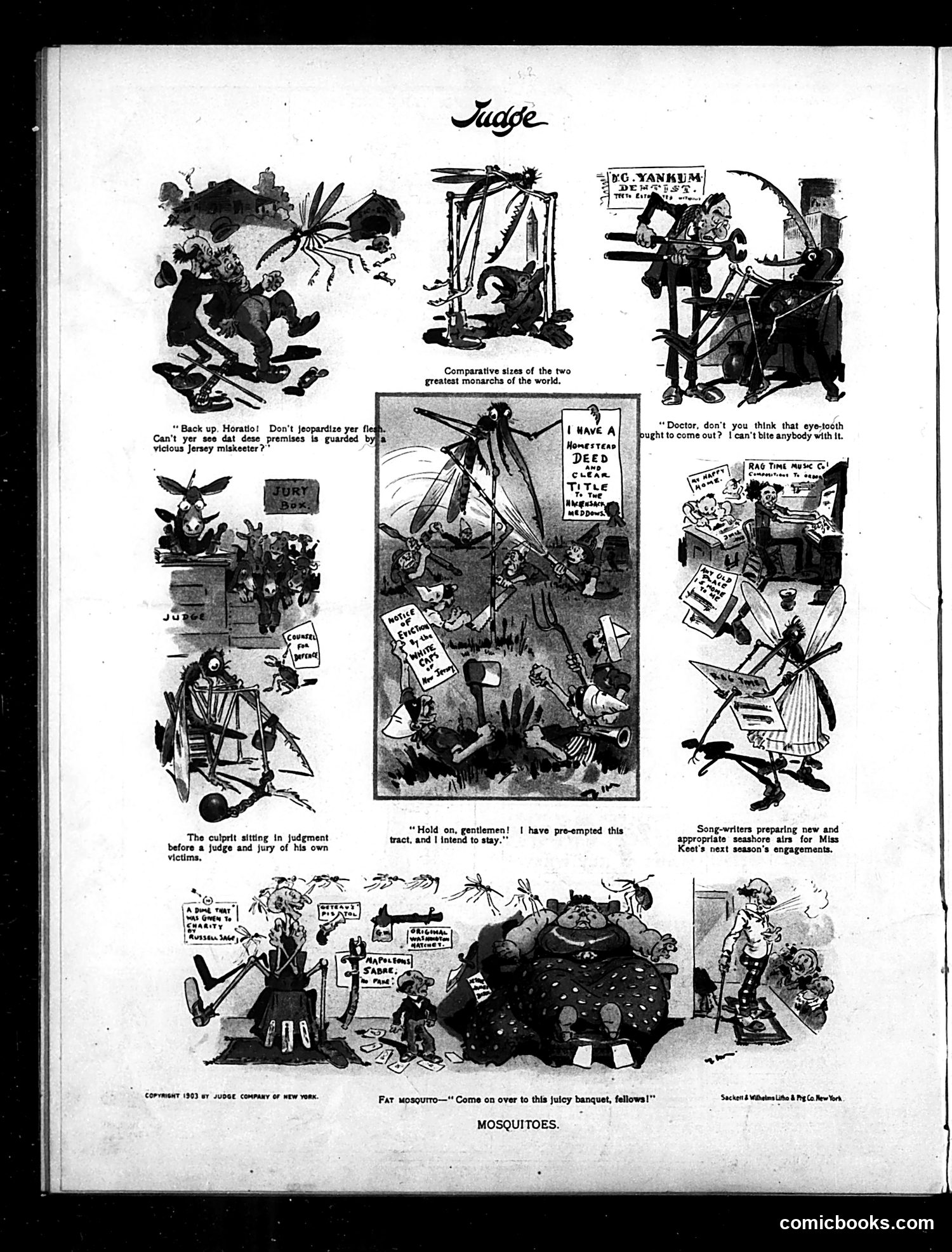
This 1903 satire page uses mosquitoes as stand-ins for satirizing various social/political figures and situations. The central conceit compares "the two greatest monarchs of the world"—apparently mosquitoes—to real-world leaders, likely referencing imperialism or monarchical power. The cartoons depict mosquitoes in human scenarios: appearing before judges, negotiating territory ("I have pre-empted this tract"), visiting doctors about dental problems, and attending theatrical engagements. The satire appears to mock pomposity and self-importance, with mosquitoes adopting grandiose or dignified human behaviors while remaining fundamentally parasitic pests. The final caption—"Come on over to this juicy banquet, fellows!"—suggests commentary on greed or exploitation, with the "banquet" likely representing something being consumed or preyed upon. Without more historical context, the specific targets remain unclear, though the tone satirizes arrogance and pretense among the powerful.