
Judge, 1903-10-17 · page 3 of 16
Judge — October 17, 1903 — page 3: what you’re looking at
What you’re looking at
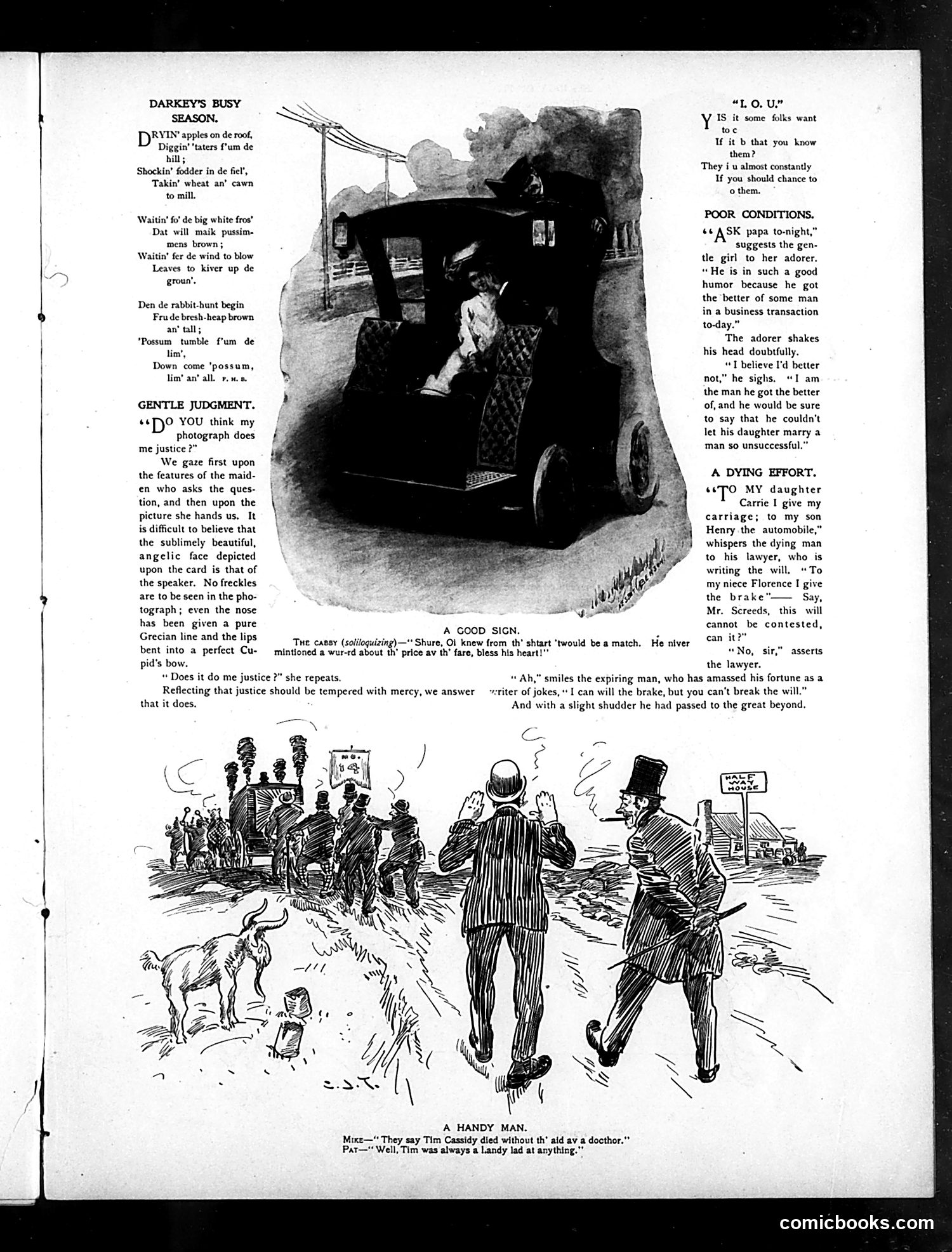
This page contains several unrelated satirical pieces typical of Judge magazine's format: **"Darkey's Busy Season"** is a dialectal poem about agricultural work, reflecting the magazine's casual use of racist terminology common to that era. **"Gentle Judgment"** discusses a photograph's artistic merit, debating whether physical beauty or character matters more in portraiture. **"A Good Sign"** shows a dying man's final act—willing his automobile and brake to others—presented as darkly humorous. **"A Loving Effort"** depicts someone leaving detailed instructions in a will. **"A Handy Man"** (bottom) contains a brief joke about someone named Tim Cassidy who was apparently useful at various tasks. The cartoons use satirical humor typical of early-20th-century American magazines, though the racial content reflects outdated, offensive language of that period.
📄 Transcribed text from this page (OCR, searchable)
Machine-transcribed from the original scan — historical spelling and the odd misread are preserved.
DARKEY’S BUSY “LO. UW” SEASON, Y IS it some folks want RYIN’ apples on de roof, ° a : Diggit’ tates Tum 4 it b that you know hill; them? Shockin’ fodder in de fiel', Takin’ wheat an’ cawn to mill. They i u almost constantly If you should chance to © them. Waitin’ fo' de big white fros’ Dat will maik pussim- mens brown; Waitin’ fer de wind to blow Leaves to kiver up de groun’, POOR CONDITIONS. ++ ASK papa to-night,” suggests the gen- tle girl to her adorer. “He is in such a good humor because he got the ‘better of some man in a business transaction Den de rabbit-hunt begin Frude bresh-heap brown an’ tall; to-day.” "Possum tumble f'um de The adorer shakes lim’, his head doubttully. “I believe I'd better not,” he sighs. “I am the man he got the better of, and he would be sure to say that he couldn't let his daughter marry a man so unsuccessful.” Down come 'possum, Tim’ an’ all. roa, GENTLE JUDGMENT. +6 PO YOU think my photograph does me justice 2" We gaze first upon the features of the maid- en who asks the ques- tion, and then upon the picture she hands us. It is difficult to believe that the sublimely beautiful, angelic face depicted upon the card is that of the speaker. No freckles are to be seen in the pho- A DYING EFFORT. “TO MY daughter Carrie I give my carriage; to my son Henry the automobile,” whispers the dying man to his lawyer, who is writing the will, “To my niece Florence I give the brake"—— Say, tograph; even the nose Mr. Screeds, this will has been given a pure A ebep iets cannot be contested, Grecian line and the lips Tue cansy (soliloquizing)—"* Shure, Ol knew from th’ shtart ‘twould bea match. He niver CAP it?” bent into a perfect Cu- — mintioned a wur-rd about th’ price av th’ fare, bless his heart!"” “No, sir,” asserts pid’s bow. “Does it do me justice 2” she repeats. Reflecting that justice should be tempered with mercy, we answer that it does. the lawyer. " Ah,” smiles the expiring man, who has amassed his fortune as a vctiter of jokes, I can will the brake, but you can’t break the will.” And with a slight shudder he had passed to the great beyond. is } A HANDY MAN. Mixe—“ They say Tim Cassidy died without th’ aid av a docthor."" Pat—" Well, Tim was always a Landy lad at anything.” comicbooks.com