
A complete issue · 16 pages · 1903
Judge — October 3, 1903
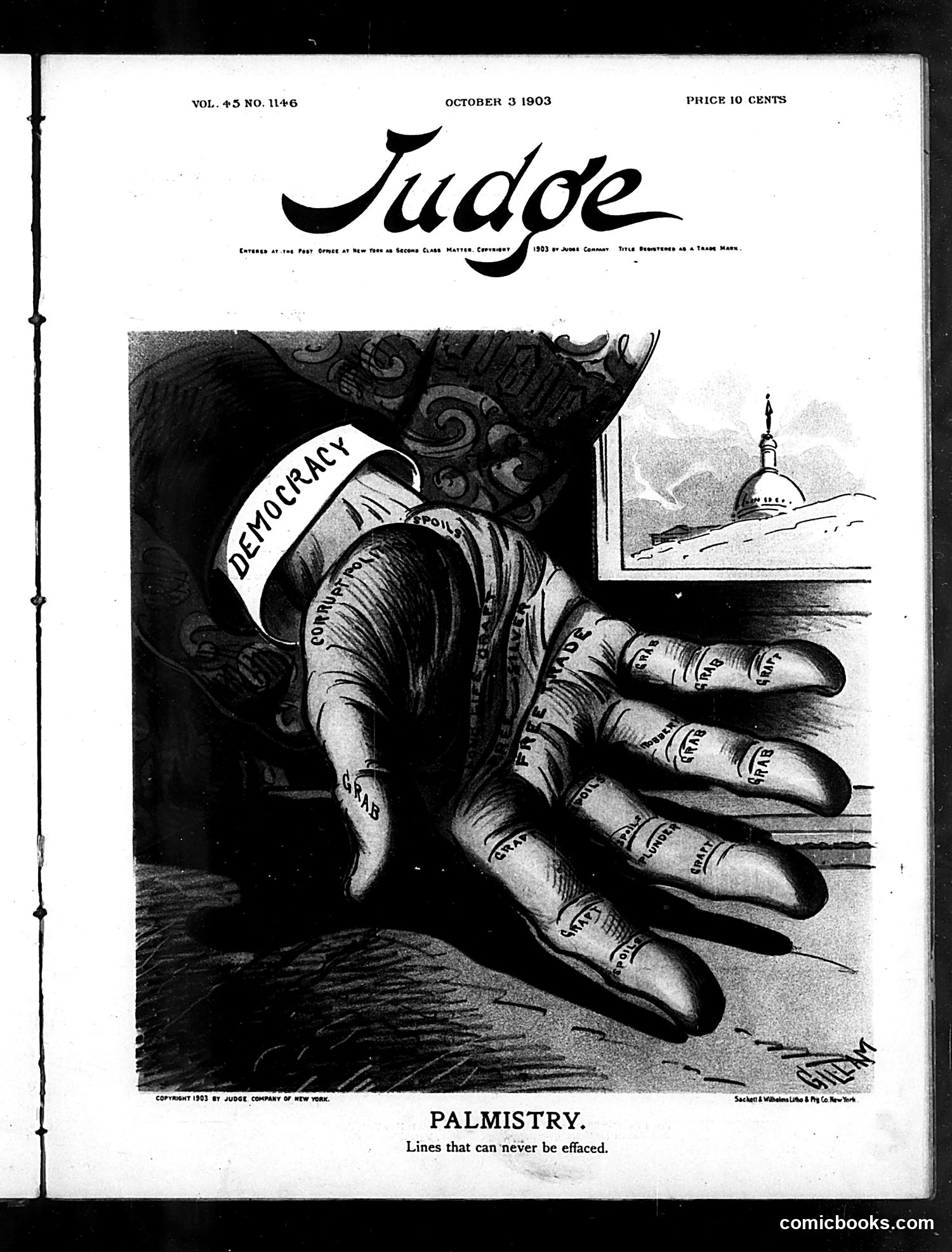
This political cartoon depicts a hand labeled "Democracy" with fingers marked as different political figures or factions. The palm appears to show lines being read by a fortune teller, referencing the subtitle "Lines that can never be effaced." The satirical message critiques American democracy circa 1903, suggesting that certain political divisions or corruptions are permanent and ineradicable—literally written into democracy's "fate" like lines on a palm. The Capitol building visible in the background reinforces the political subject matter. The artist appears to be suggesting that certain structural problems within American democratic governance cannot be removed or reformed away, presenting a pessimistic commentary on the political landscape of the early 20th century. The exact identities of the individual fingers remain unclear without additional context.
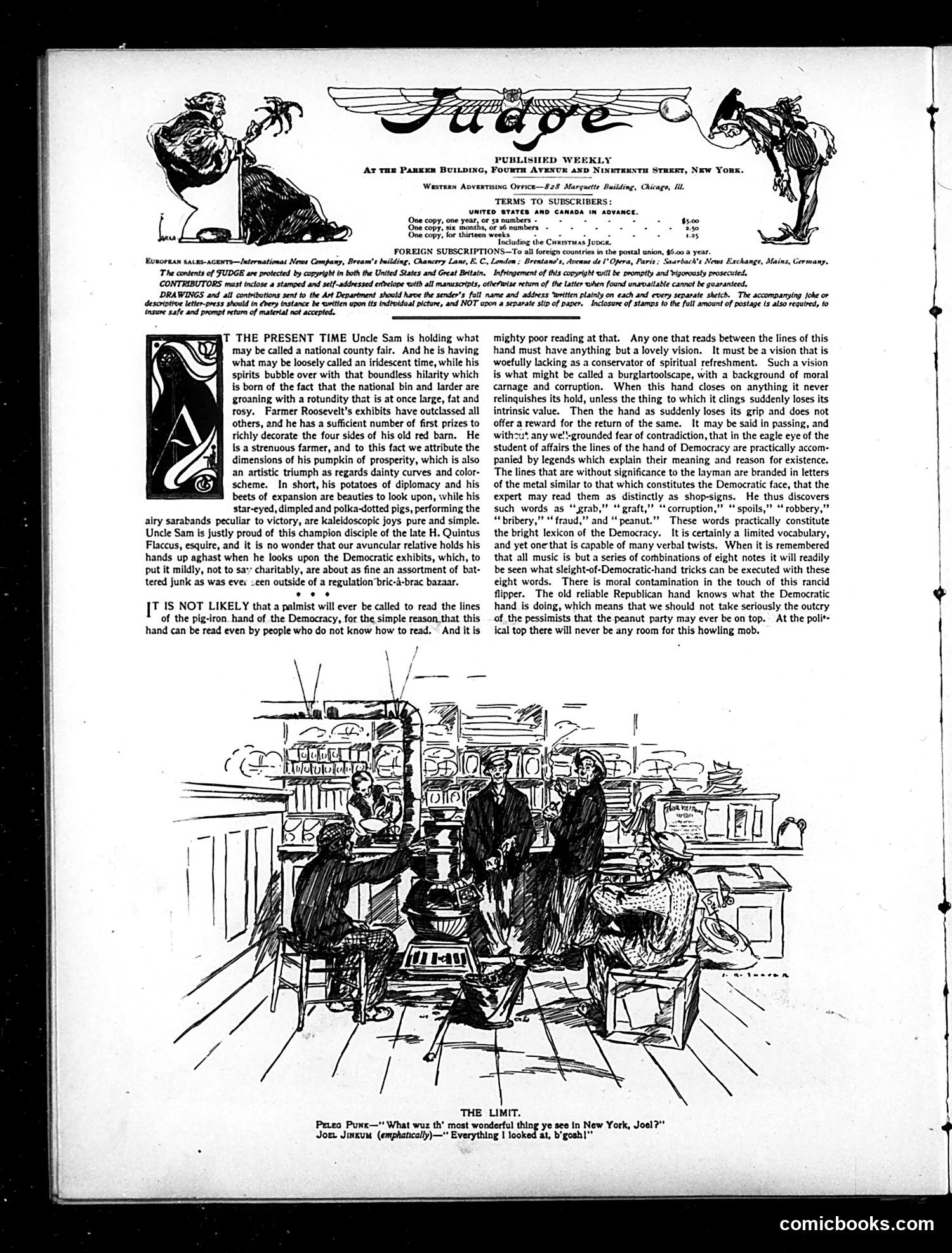
This page contains political satire attacking the Democratic Party. The main article, titled "THE PRESENT TIME," uses extended metaphor comparing Uncle Sam's management of the country to a farmer managing his estate. The writer argues Democrats employ deceptive rhetoric—describing their language as containing words like "grab," "graft," "corruption," and "robbery"—claiming these reveal the party's true nature beneath respectable speech. The cartoon "THE LIMIT" below depicts what appears to be a steamship or train scene. The caption references "Pelo Punk" asking Joel Jimson about "the most wonderful thing ye see in New York," with Jimson responding "Everything I looked at, b'gosh!"—suggesting satirical amazement at urban spectacle or corruption. The exact historical context and figures remain unclear without additional dating information.
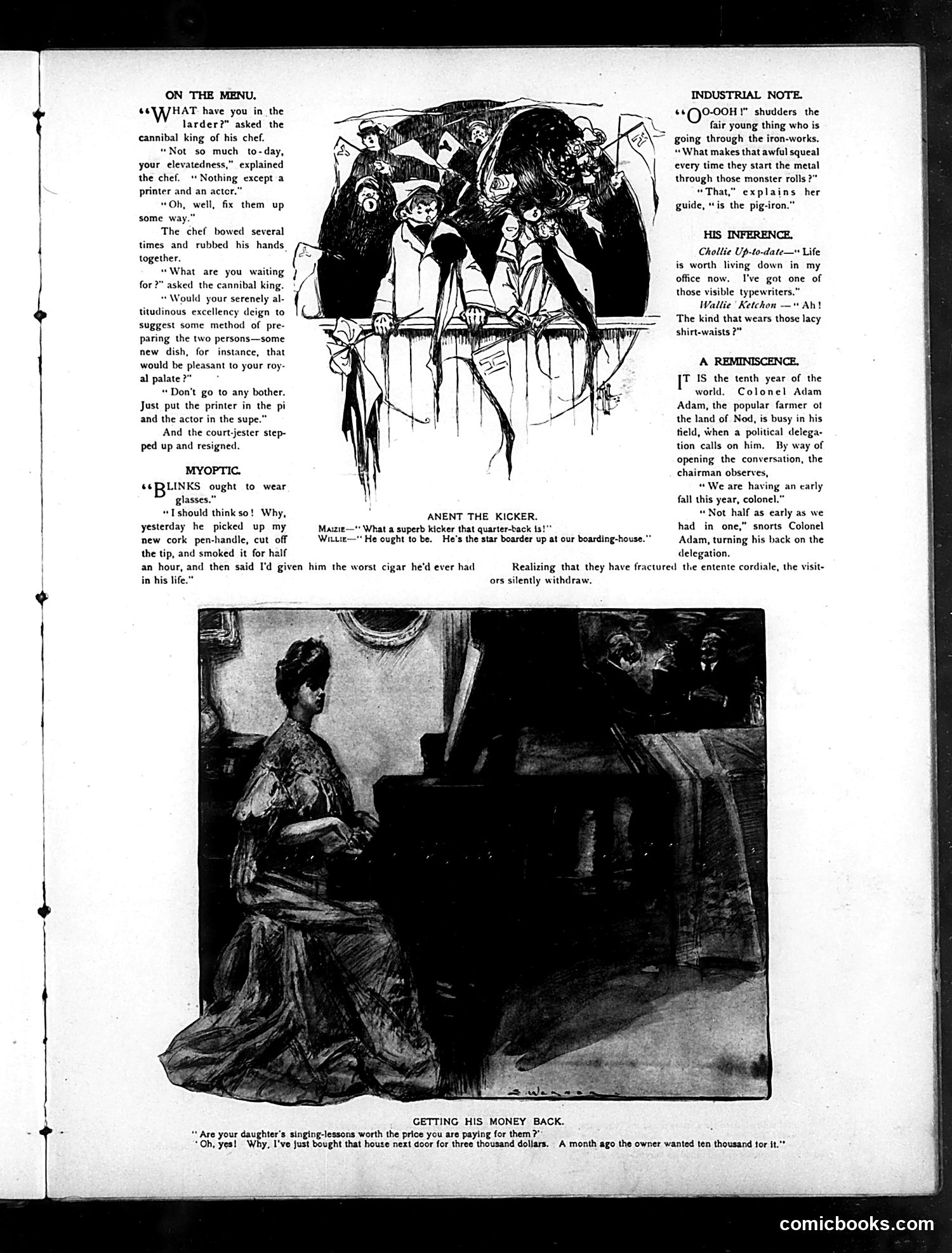
This page contains several brief humor columns and two illustrations satirizing early 20th-century American social issues. **"On the Menu"** mocks haute cuisine pretension—a chef refuses to cook anything except "a pointer and an actor," suggesting fine dining's absurd snobbery. **"Myopia"** jokes about poor eyesight, with a character noting someone wore glasses after a minor injury. **"Anent the Kicker"** references a "star boarder" at a boarding house—likely satirizing the common arrangement where lodgers became household fixtures. The lower illustration, **"Getting His Money Back,"** depicts a woman at a piano, captioned about expensive singing lessons. It satirizes parents' wasteful spending on their daughters' accomplishments—a recurring middle-class anxiety in this era about conspicuous consumption and questionable educational investments.
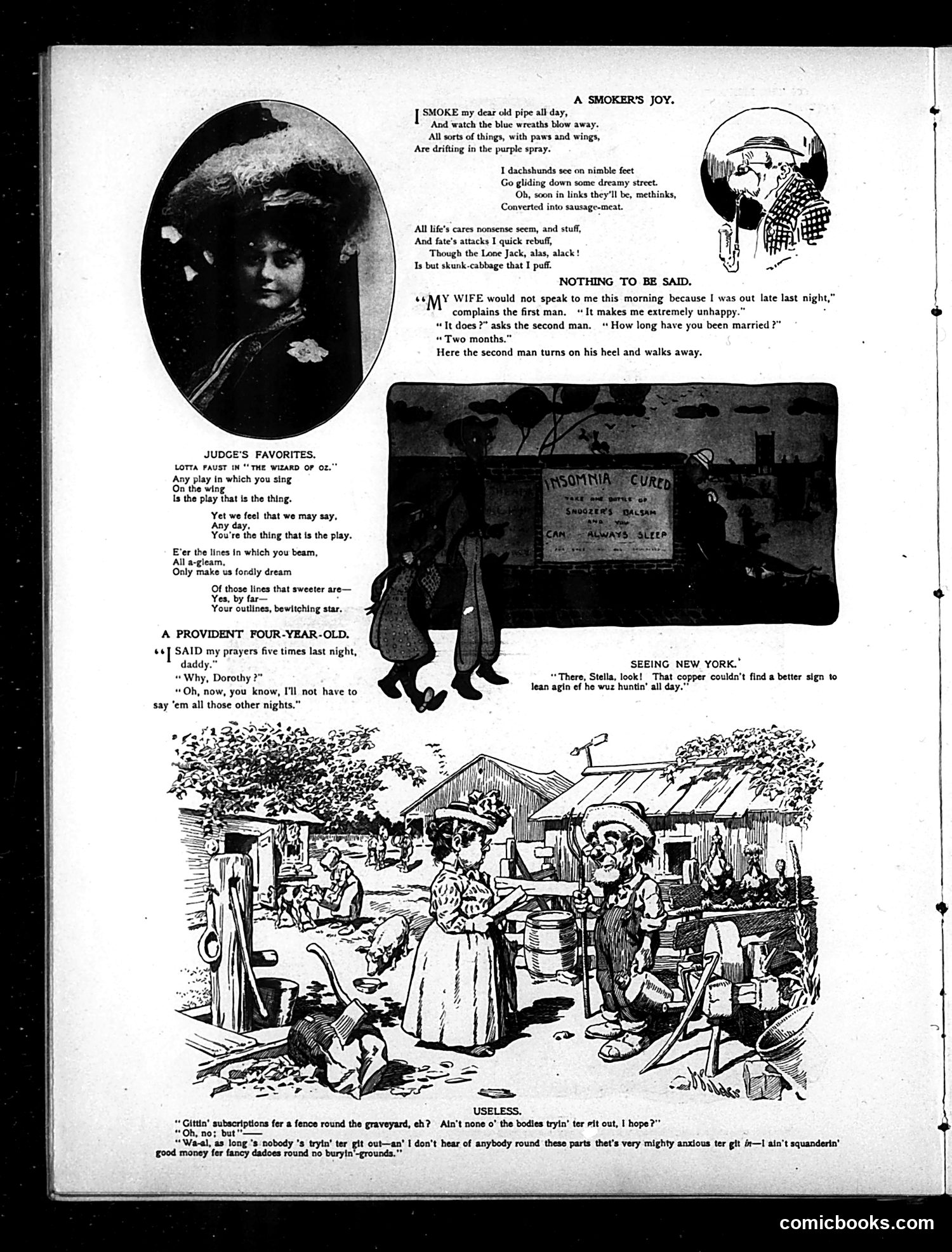
This page contains several humor pieces typical of early Judge magazine: **"A Smoker's Joy"** celebrates tobacco's pleasures through romantic imagery and verse. **"Nothing to Be Said"** presents a joke about a newlywed couple's marital discord—the husband stayed out late, making his wife unhappy after only two months of marriage. The humor relies on the audience finding domestic tension amusing. **"Judge's Favorites"** quotes an actress (Lotta Faust) from a theatrical production about performance. **"A Provident Four-Year-Old"** shows a child's pragmatic prayer, avoiding religious obligations. **"Seeing New York"** appears to reference urban sightseeing, with commentary about copper and hunting. **"Useless"** depicts a rural/country scene with dialect humor about fencing graveyards and burying grounds. The content reflects period attitudes toward marriage, religion, and rural/urban divides.
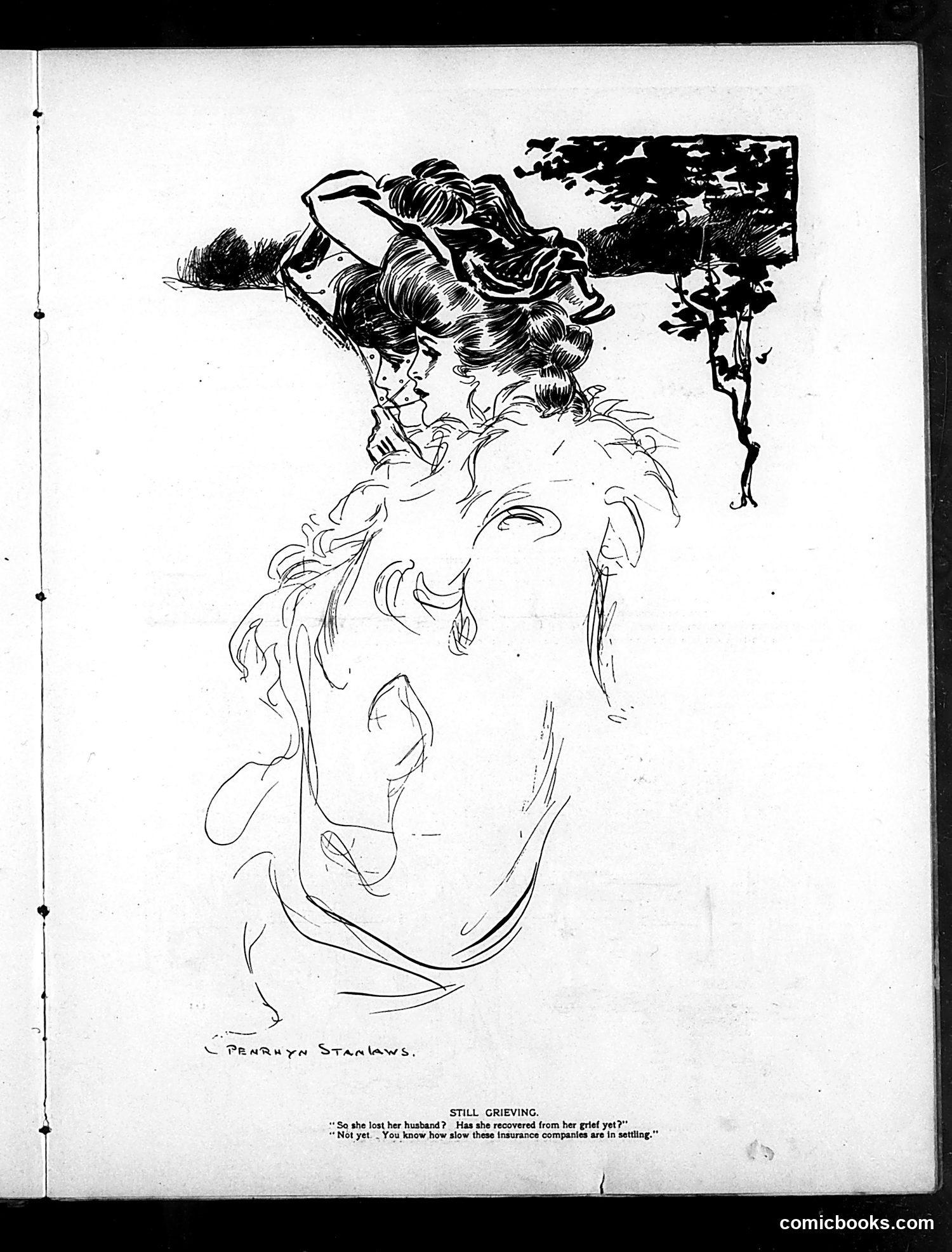
This cartoon by Penrhyn Stanlaws satirizes widow's greed and insurance company delays circa early 20th century. The drawing shows an elegantly dressed woman in mourning attire, her pose suggesting theatrical grief. The caption's joke hinges on a cynical twist: when asked if the widow has "recovered" from her husband's death, the response reveals her real concern isn't emotional loss but insurance settlement delays. The satire mocks both the widow's mercenary priorities (suggesting her "grief" is financial rather than genuine) and insurance companies' notoriously slow payout processes. The cartoon reflects contemporary frustrations with insurance bureaucracy while employing misogynistic humor about women's supposed materialism and insincere mourning displays.
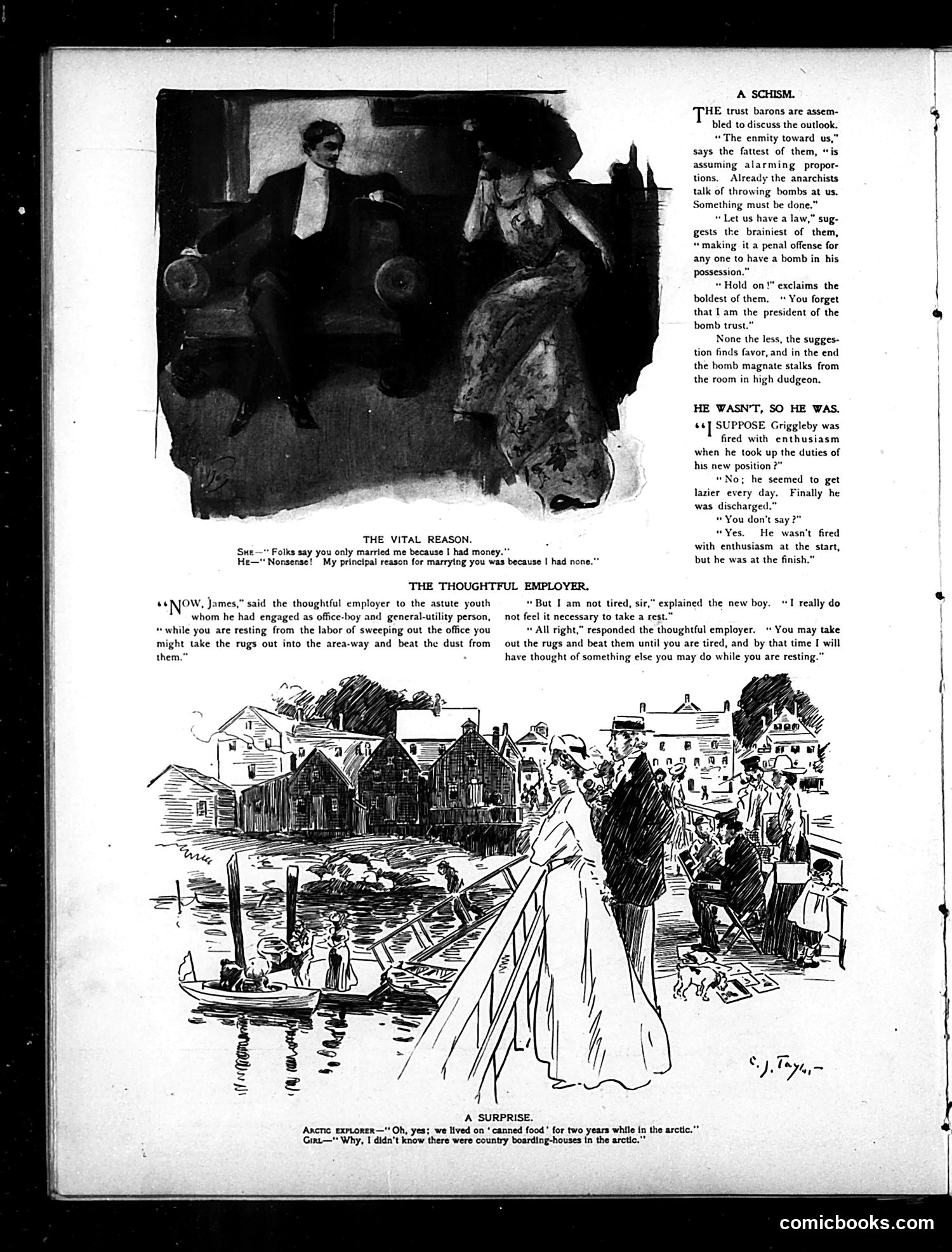
This page contains three satirical pieces satirizing American society: **"A Schism"** mocks industrial monopolies (trusts). Trust barons meet to discuss threats—anarchist bombings and public hostility. They propose criminalizing bomb possession, but one baron objects: he *owns* the bomb trust. The satire targets the absurdity of monopolists controlling industries while claiming victimhood, and the inherent conflict between profit motives and public safety. **"The Vital Reason" and "He Wasn't, So He Was"** are brief domestic jokes about marriage and employment—standard humor unrelated to trusts. **"The Thoughtful Employer"** satirizes exploitative labor practices. A boss tells his new office boy to rest, then immediately assigns him physically exhausting work (beating rugs), planning to assign more during subsequent "rests." It critiques the false benevolence of employers who claim concern for workers while maximizing their labor. The page reflects Progressive Era anxieties about unchecked corporate power and worker exploitation.
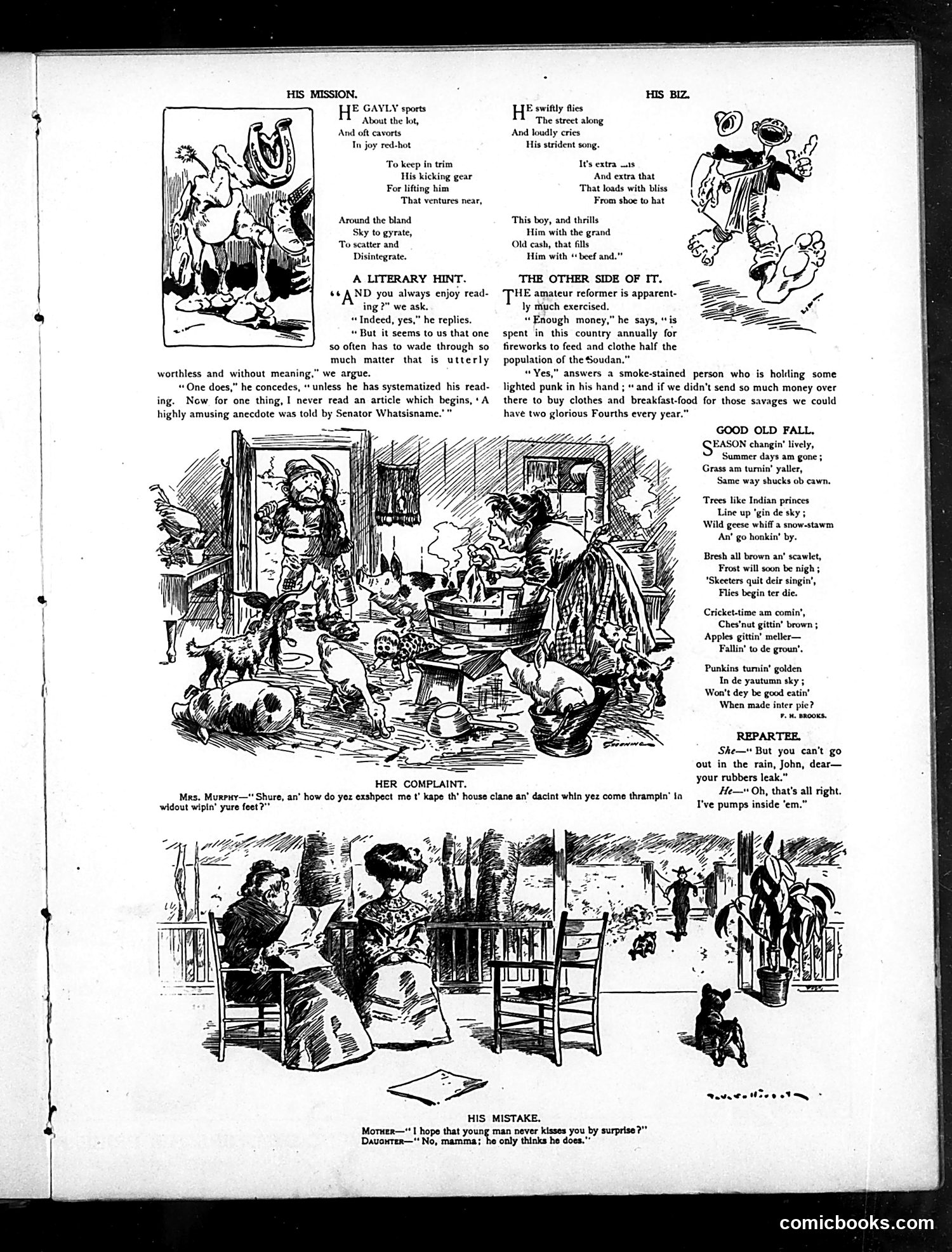
This page contains **humorous light verse and comic vignettes** rather than political cartoons. The content includes: **"His Mission" and "His Biz"**: Playful poems about an energetic boy's antics—kicking, gyrating, scattering things—contrasted with swift urban movement. **"A Literary Hint"**: A joke about tedious magazine articles, where a reader admits systematically skipping opening phrases like "A highly amusing anecdote was told by Senator Whatsisname"—mocking Senator-based filler content common in publications. **"The Other Side of It"**: Social satire on charitable reformers. A reformer laments spending on fireworks while people starve; a pragmatist replies they could celebrate Independence Day twice yearly if that money weren't spent on foreign aid to "savages." **"Good Old Fall"**: Dialect verse celebrating autumn using vernacular African American speech patterns (common in period publications, reflecting contemporary stereotypes). **"Her Complaint," "Repartee," "His Mistake"**: Brief domestic humor jokes about household management, rain gear, and courtship deception. The page is primarily **entertainment content**—light satire, not serious political commentary.
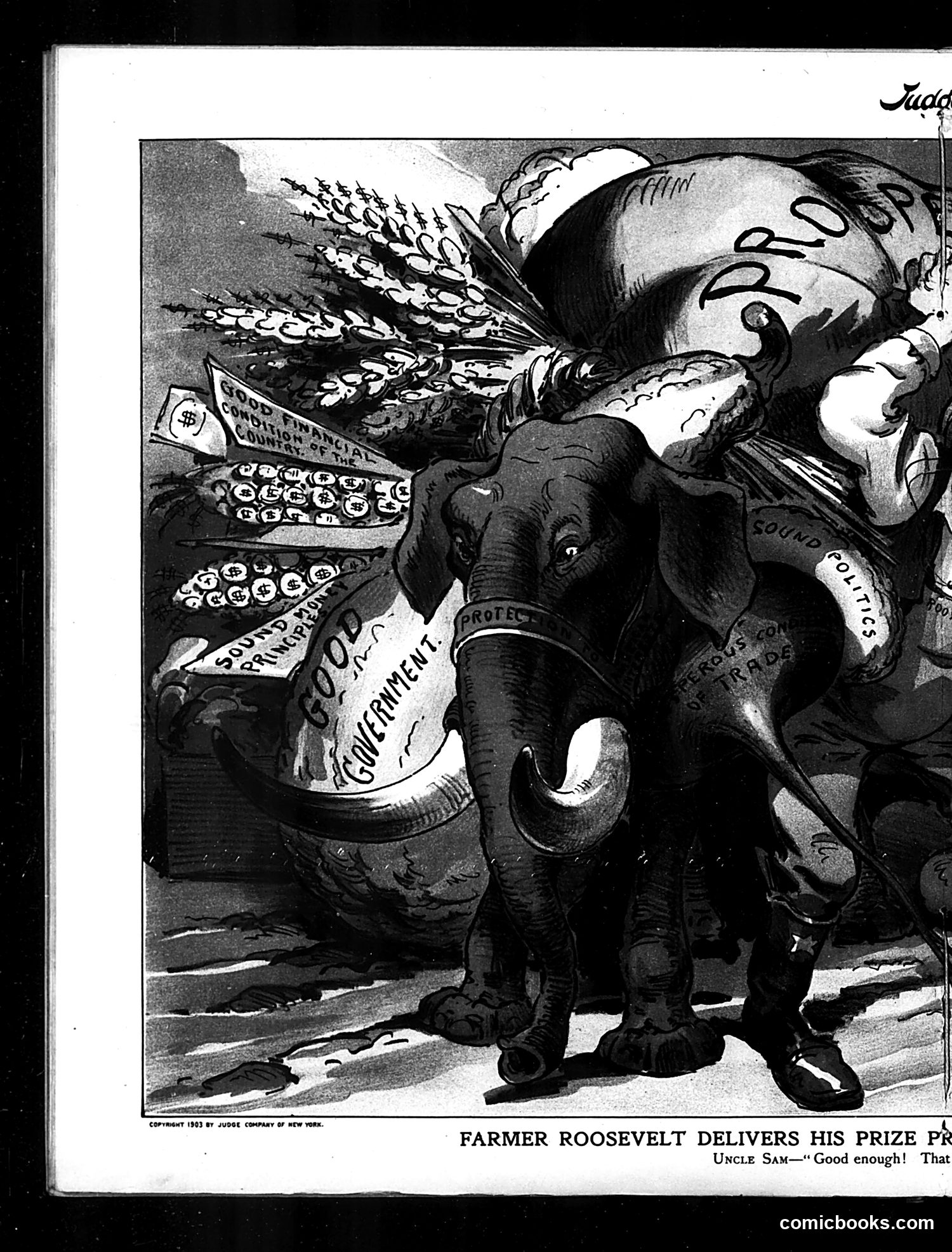
This is a satirical cartoon titled "Farmer Roosevelt Delivers His Prize Produce," depicting Uncle Sam (representing the U.S. government) examining goods delivered by a figure labeled "Farmer Roosevelt." The elephant carries various bundles marked "Government Protects" and "Sound Politics," alongside agricultural products like wheat. The satire criticizes Roosevelt's agricultural and protective policies, suggesting they bundle together government intervention with farming support. The elephant—traditionally representing the Republican Party—may indicate criticism from a Republican perspective. Uncle Sam's response ("Good enough!") appears ironic, questioning whether these government protections genuinely benefit farmers or merely serve political interests. The cartoon satirizes the relationship between government agricultural policy and political rhetoric during the Roosevelt era.
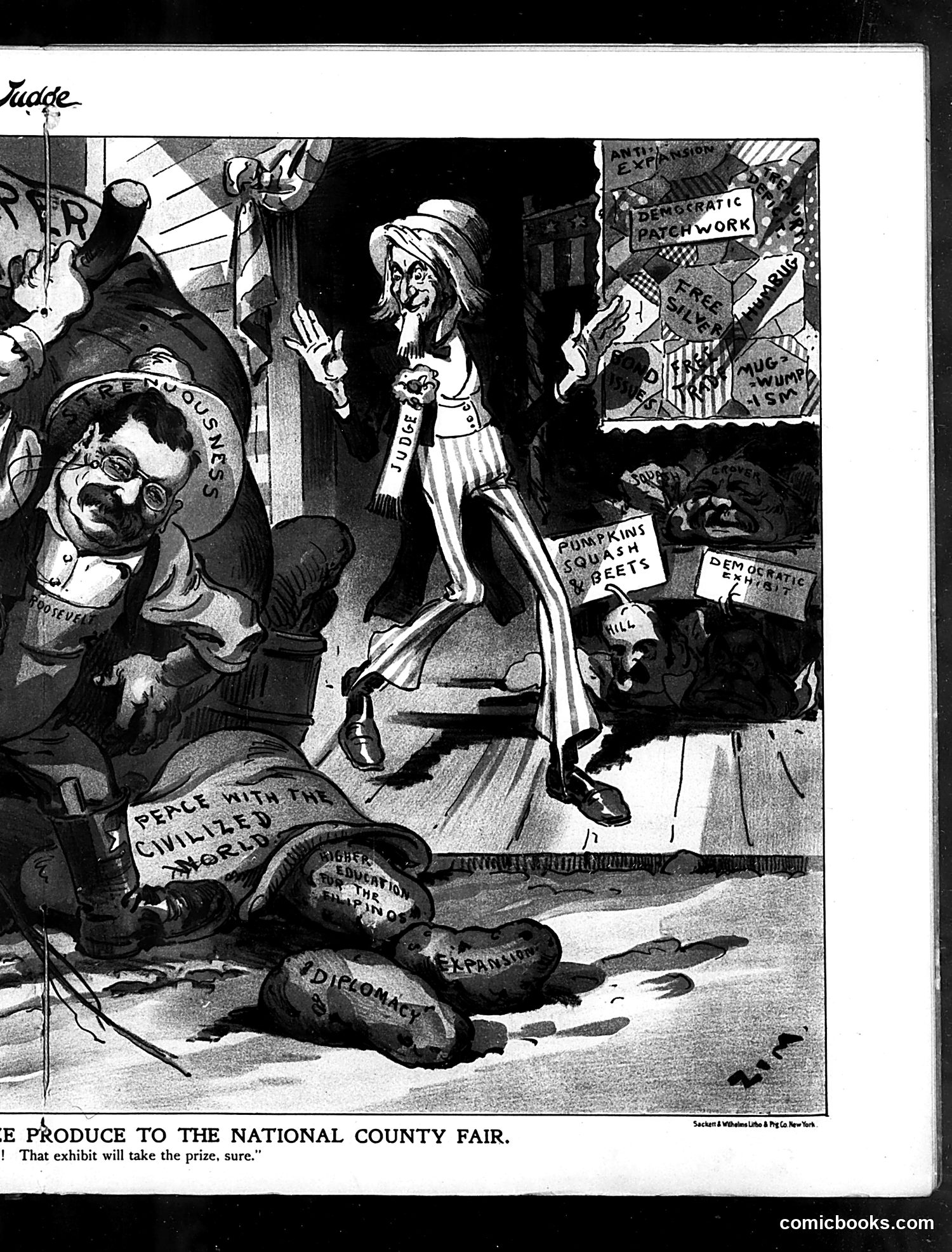
This satirical cartoon depicts a woman (likely representing the Democratic Party or progressive politics) presenting various "produce" to a county fair—actually deformed vegetables labeled with political concepts: "Peace with the Civilized World," "Higher Education," "Expansion," and "Diplomacy." The caricatured figures on the left appear to represent political opponents or critics (possibly Republicans), watching skeptically. The cartoon mocks Democratic policy initiatives as misshapen or defective "produce," suggesting they won't withstand scrutiny or competition. The inset panel references "Democratic Patchwork" and other partisan labels. The satire ridicules Democratic governance and foreign policy as inadequate or poorly constructed, using the county fair metaphor to suggest these initiatives deserve mockery rather than praise.
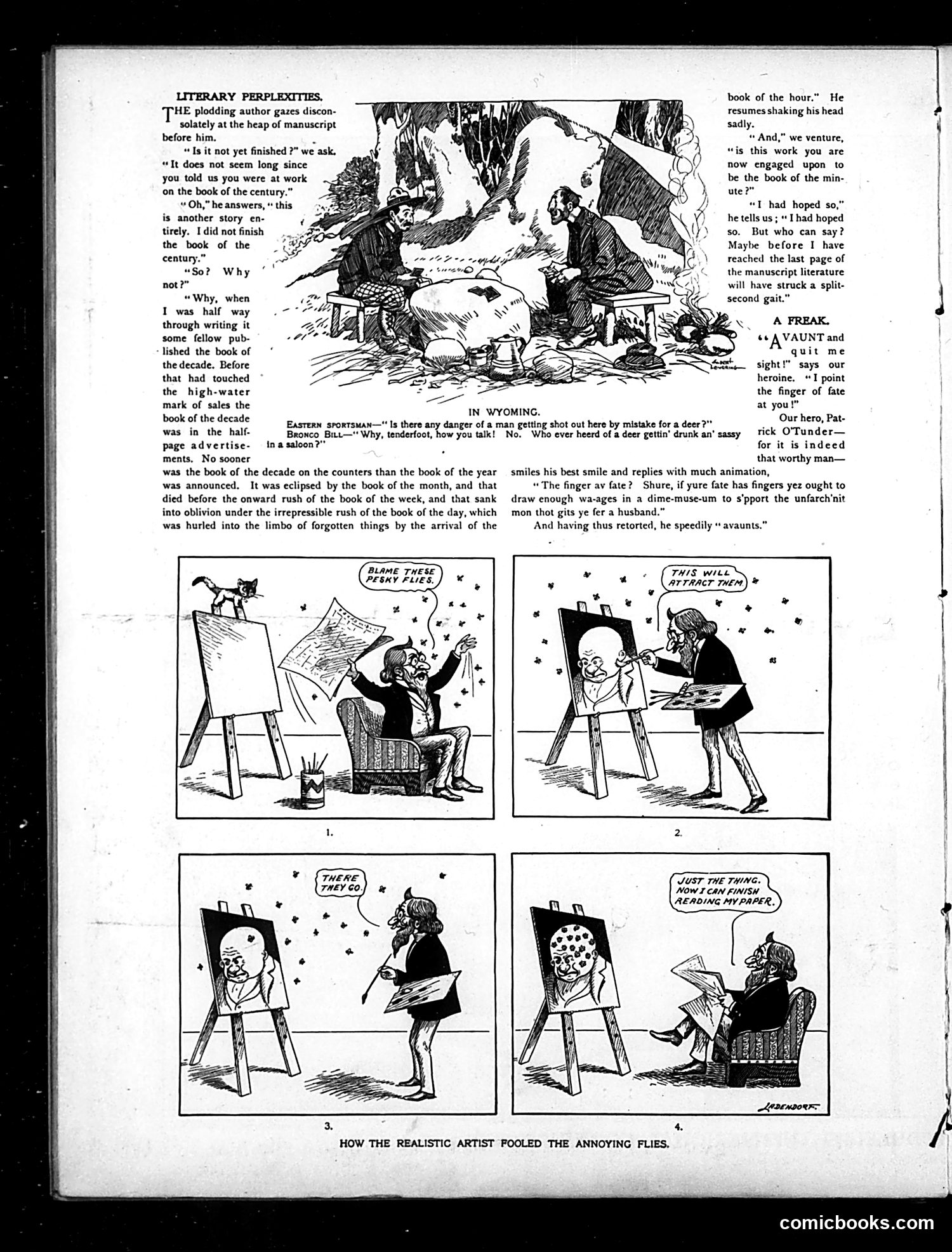
The page contains two distinct pieces of satire: **"Literary Perplexities"** mocks the publishing industry's obsession with marketing categories. An author complains he couldn't finish his "book of the century" because publishers kept releasing newer, supposedly superior books—the "book of the decade," then "book of the year," "book of the month," "book of the week," "book of the day," and finally "book of the hour." The joke satirizes how commercial publishing constantly chases trends and creates artificial urgency, making any serious literary work obsolete before completion. **The four-panel cartoon** shows an artist painting flies onto his canvas to deter actual flies from landing on his work—they mistake the painted flies for real ones. The humor is visual and straightforward: clever practical deception. **"In Wyoming"** is a brief frontier joke about mistaking drunk deer for hunting targets, playing on the lawlessness of the Old West. **"A Freak"** features Irish dialect humor (common in period humor) where a suitor dismissively deflates his lover's dramatic "finger of fate" declaration.
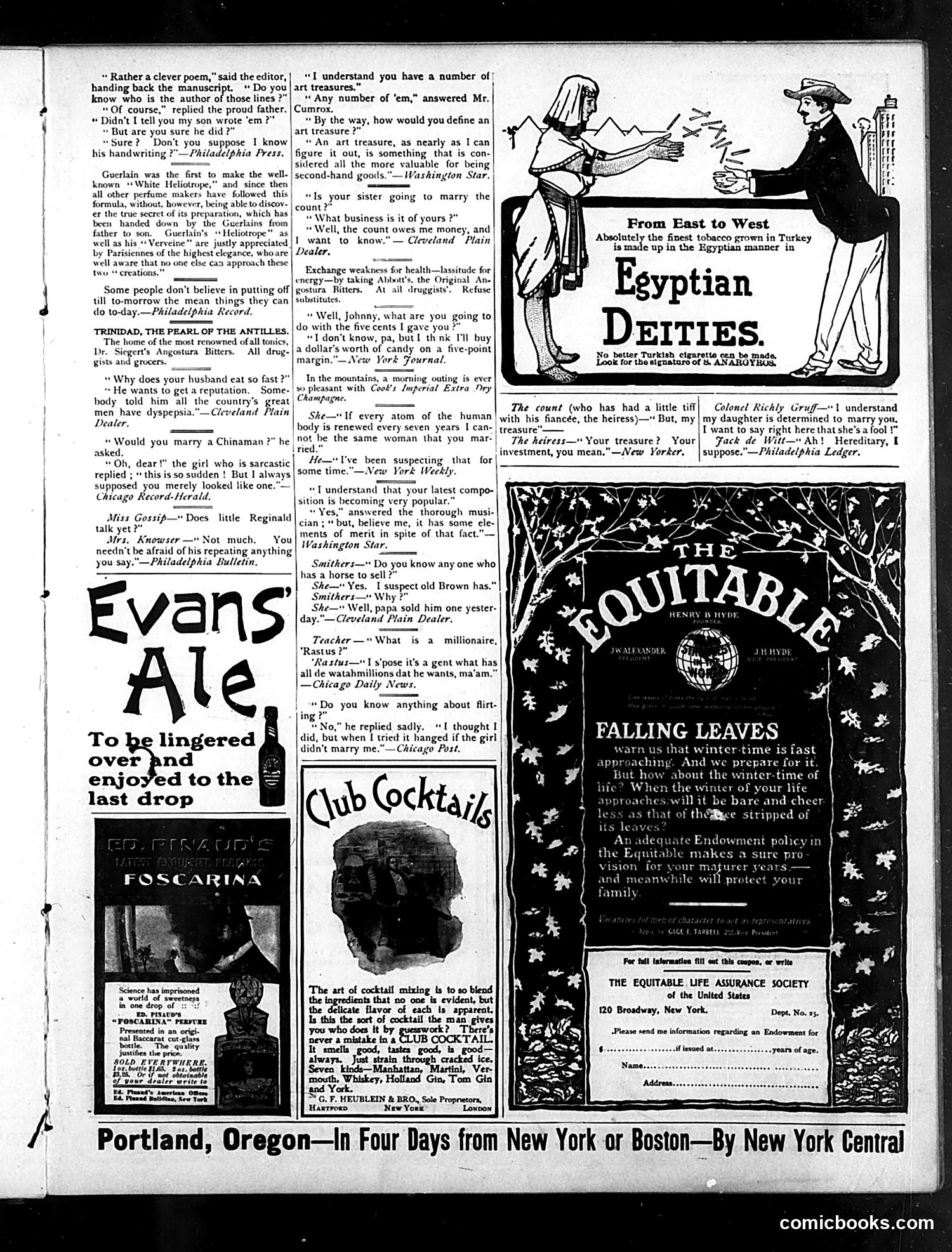
This page is primarily **humor and advertising**, not political cartooning. It comprises short jokes with punchlines about domestic life, courtship, and social pretension, interspersed with product ads (perfume, bitters, cigarettes, life insurance). The visible cartoons include an illustration of a count or gentleman negotiating—likely depicting class anxiety about wealth and marriage. One joke mocks nouveau-riche taste: a man considers second-hand items "art treasures" because being old increases their value. Another satirizes modern youth: a boy plans to buy five dollars' worth of candy with five cents "on margin"—mocking contemporary financial speculation (perhaps referencing the speculative economy before financial crashes). The humor is light, relying on gender stereotypes, financial pretension, and the gap between aspirations and reality. The magazine's satire targets middlebrow American anxieties rather than specific politicians or events.
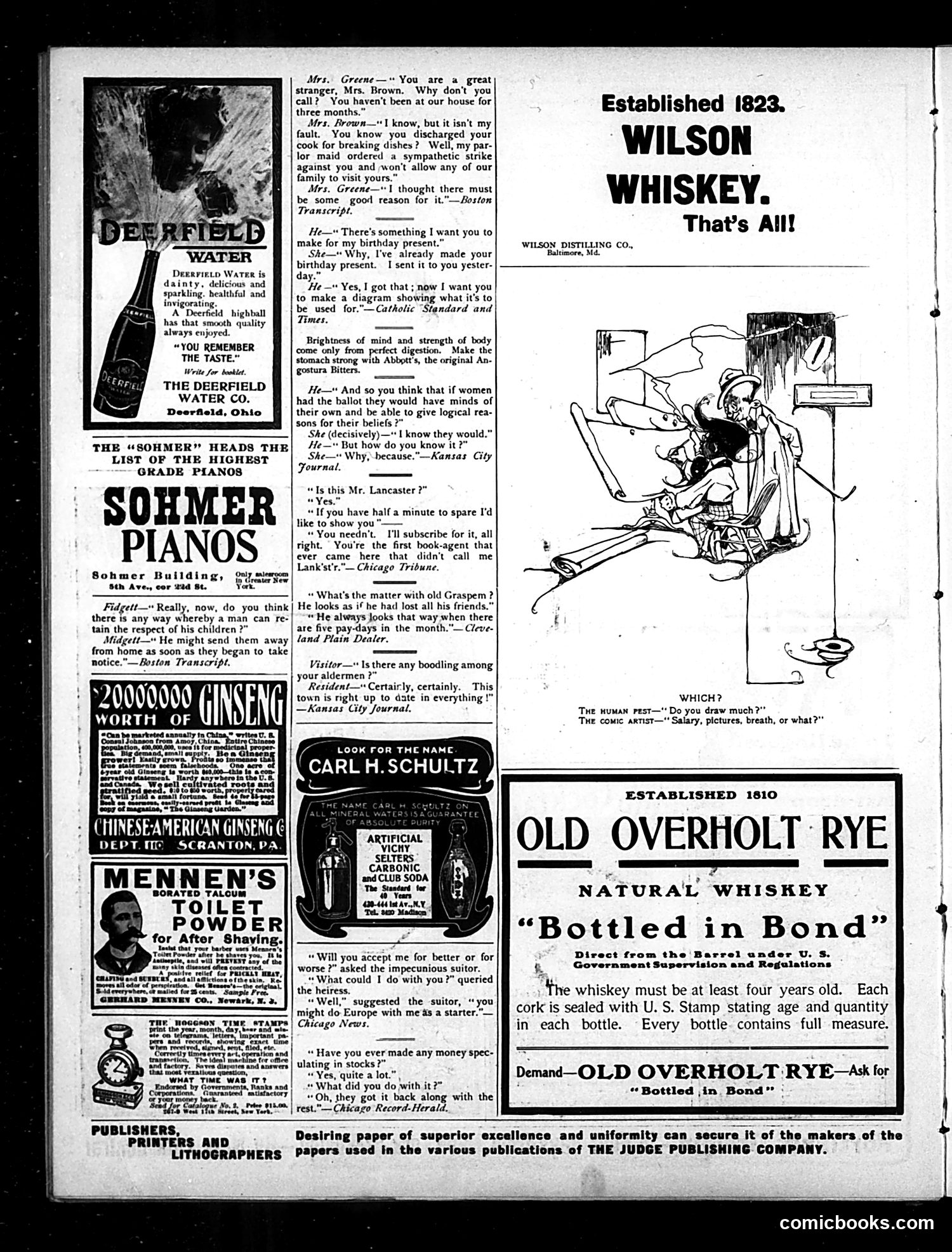
This page is primarily **advertising** interspersed with brief humorous dialogue snippets typical of Judge magazine's format. ## The Cartoons/Jokes: The small cartoons and jokes are generic social humor of the era: - A domestic dispute about a cook's sympathetic strike (labor organizing reference) - Marital banter about birthday gifts and women's suffrage - A "book agent" joke playing on mispronunciation of a name - Financial/stock speculation humor The one titled illustration shows a figure (identified as "WHICH?") asking a comic artist whether he draws for salary, pictures, breath, or "what"—a joke about artistic income and viability. ## Advertisements: The bulk consists of product ads: Deerfield Water, Sohmer Pianos, ginseng tonics, toilet powder, and prominently **whiskey advertisements** (Wilson Whiskey, Old Overholt Rye) emphasizing government bonds and age guarantees—likely responding to Prohibition-era concerns about authenticity and legality. The humor is **topical but not deeply political**—mostly workplace, marriage, and commerce-based observations typical of early 1900s magazines.
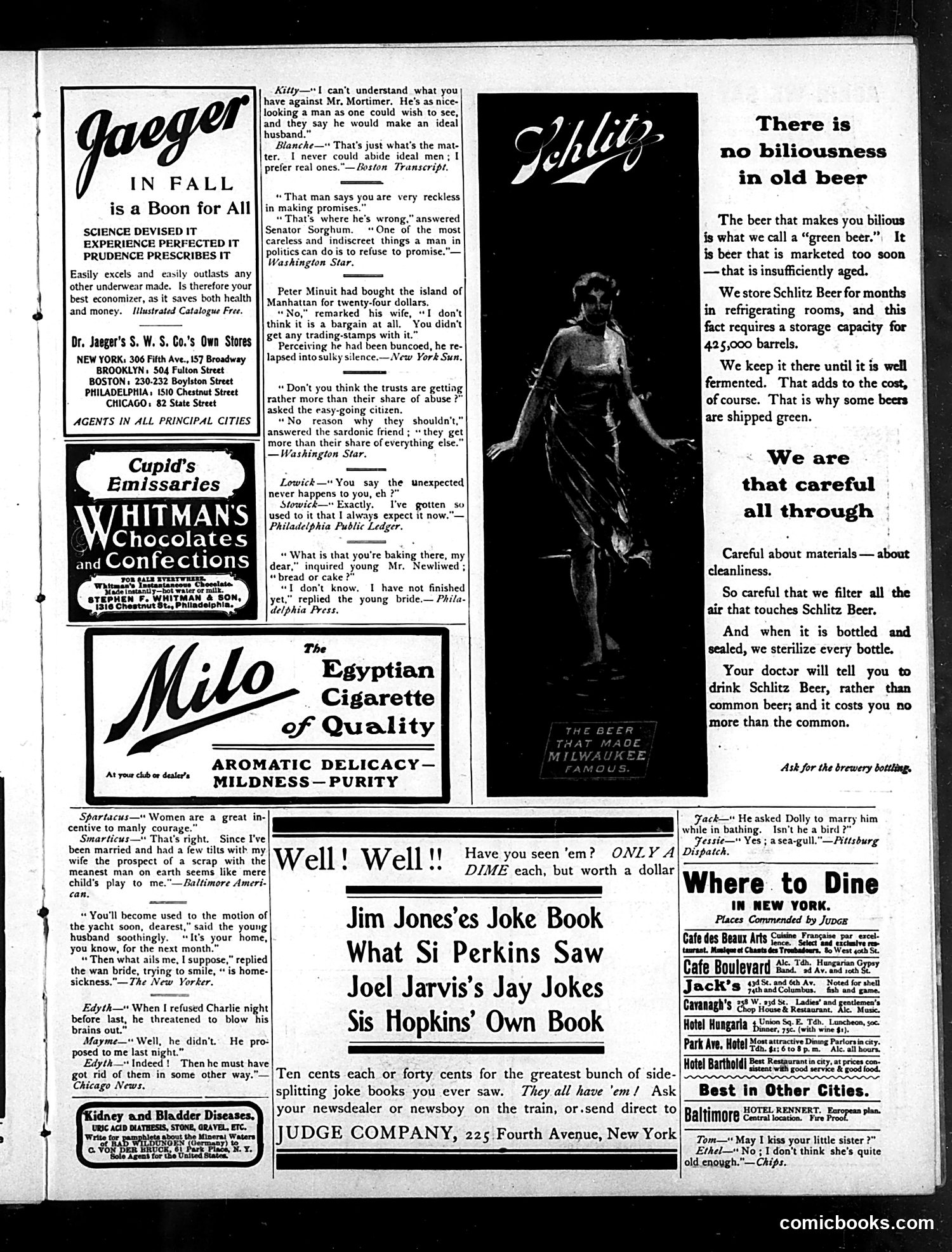
This page is primarily **advertising and humor columns**, not political cartoons. It contains several brief, unrelated jokes typical of early 1900s Judge magazine, plus product advertisements. The humor relies on dated conventions: jokes about newlyweds, marital discord, and romantic mishaps. Notable items include a quip about Peter Minuit's purchase of Manhattan (historical reference), and a Senator Sorghum character making cynical observations about political promises. The large **Schlitz Beer advertisement** occupies significant space, emphasizing the beer's careful aging and cleanliness—addressing contemporary concerns about "green beer" (insufficiently aged, causing illness). This was a legitimate selling point when food safety was uncertain. Other ads promote Jaeger underwear, Whitman's chocolates, and Milo cigarettes—typical consumer goods from the era. The page contains **no identifiable political satire or caricatures** of specific public figures. It's essentially a snapshot of 1900s American consumer culture and domestic humor.
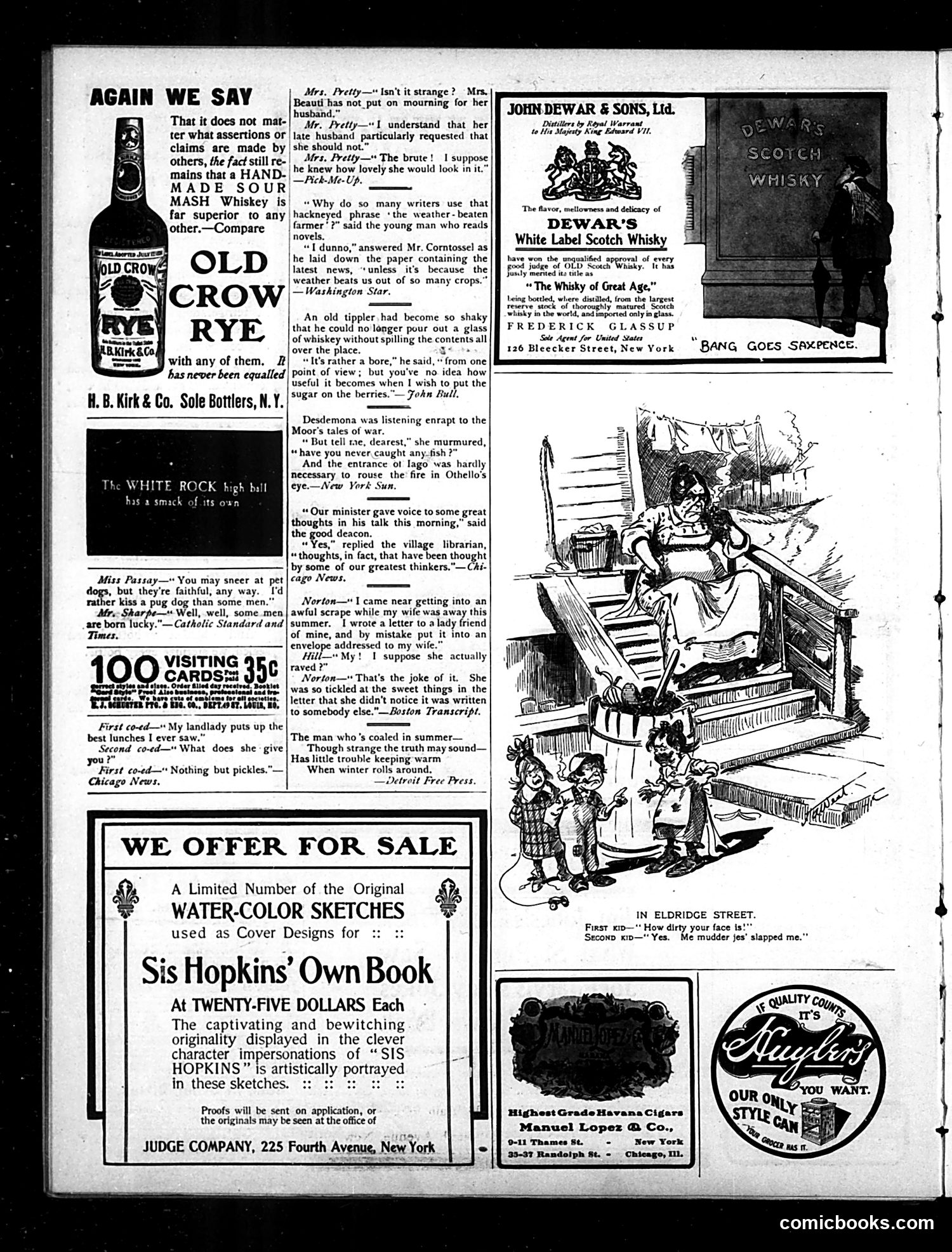
This page from *Judge* magazine contains primarily **advertisements and humorous anecdotes** rather than political cartoons. The content includes: - **Whiskey ads** (Old Crow Rye, Dewar's Scotch, White Rock) dominating the layout—typical of early 20th-century magazines - **Short comic dialogues** poking fun at everyday life: a woman mourning fashionably, a farmer's weather troubles, a drunk man's spilled whiskey, a faithless suitor compared unfavorably to a pug dog - **One illustrated cartoon** ("Bang Goes Saxpence") showing children in Eldridge Street, likely depicting lower-class urban life with mild social commentary - **An offer to sell original water-color sketches** from the "Sis Hopkins" character (a recurring *Judge* feature) The humor is gentle domestic satire—marital mishaps, literary clichés, class observations—typical of *Judge's* lighthearted editorial voice. No major political figures or events appear referenced on this particular page.
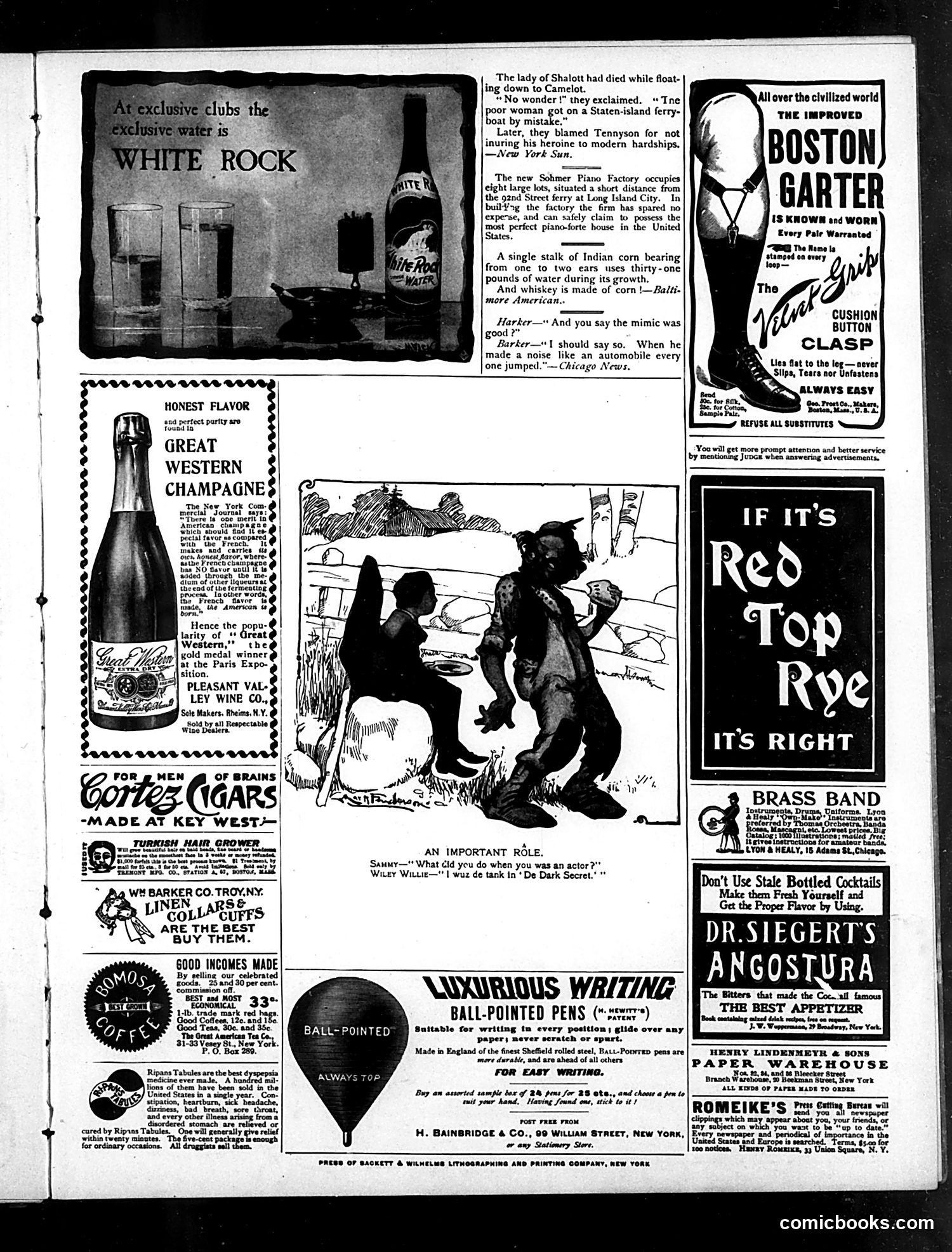
This is primarily an **advertising page** with minimal editorial content. The few text items are short humorous quips typical of Judge's style: **The cartoons/jokes:** - A reference to Tennyson's "Lady of Shalott," joking that she died because she mistakenly boarded a Staten Island ferry instead of traveling to Camelot—satirizing the discomforts of modern New York transportation. - A brief exchange mocking automobile novelty acts and audience reactions. - A pun: Indian corn uses 31 pounds of water to grow, and whiskey is made from corn—implying whiskey contains water. **The advertisements** dominate, promoting luxury goods of the era: White Rock water, Great Western Champagne, ball-pointed pens, cigars, piano factories, and various personal goods. These ads reflect the magazine's affluent readership. The page lacks significant political content or complex satire—it's a typical turn-of-the-century society magazine balancing light humor with commercial messaging.
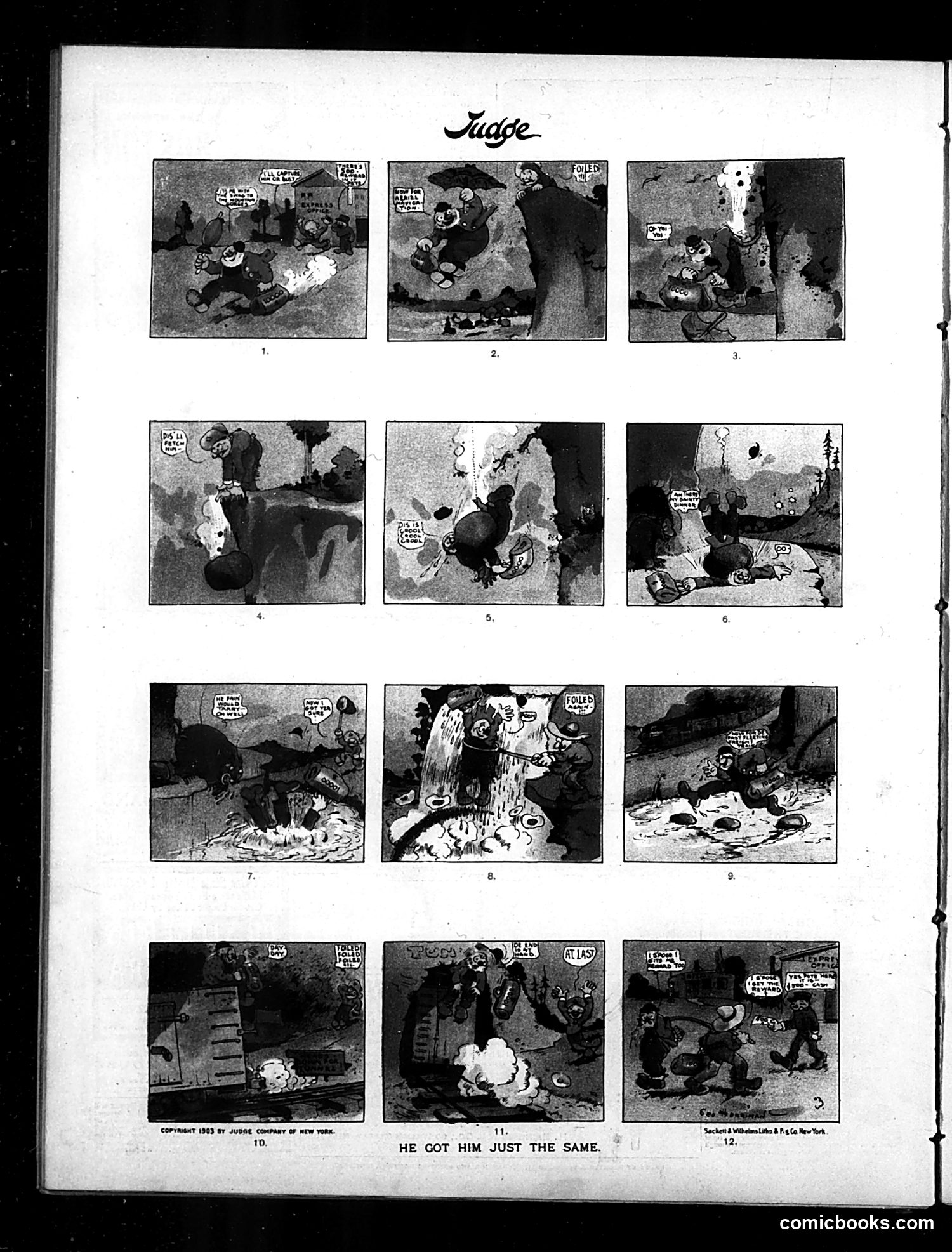
This 1903 comic strip titled "HE GOT HIM JUST THE SAME" appears to depict a chase or conflict sequence involving anthropomorphic animals (likely mice or rats). The narrative follows characters through various outdoor scenes—trees, water, explosions—suggesting physical comedy and slapstick action typical of early 20th-century humor magazines. Without clearer visual identification of specific character types or readable dialogue bubbles, the exact satirical target remains unclear. The phrase "he got him just the same" suggests the protagonist ultimately achieves their goal despite obstacles. The style reflects Judge magazine's typical blend of visual gags and social commentary, though this particular page's specific political or social reference point cannot be definitively determined from the available image quality.