
A complete issue · 16 pages · 1903
Judge — September 12, 1903
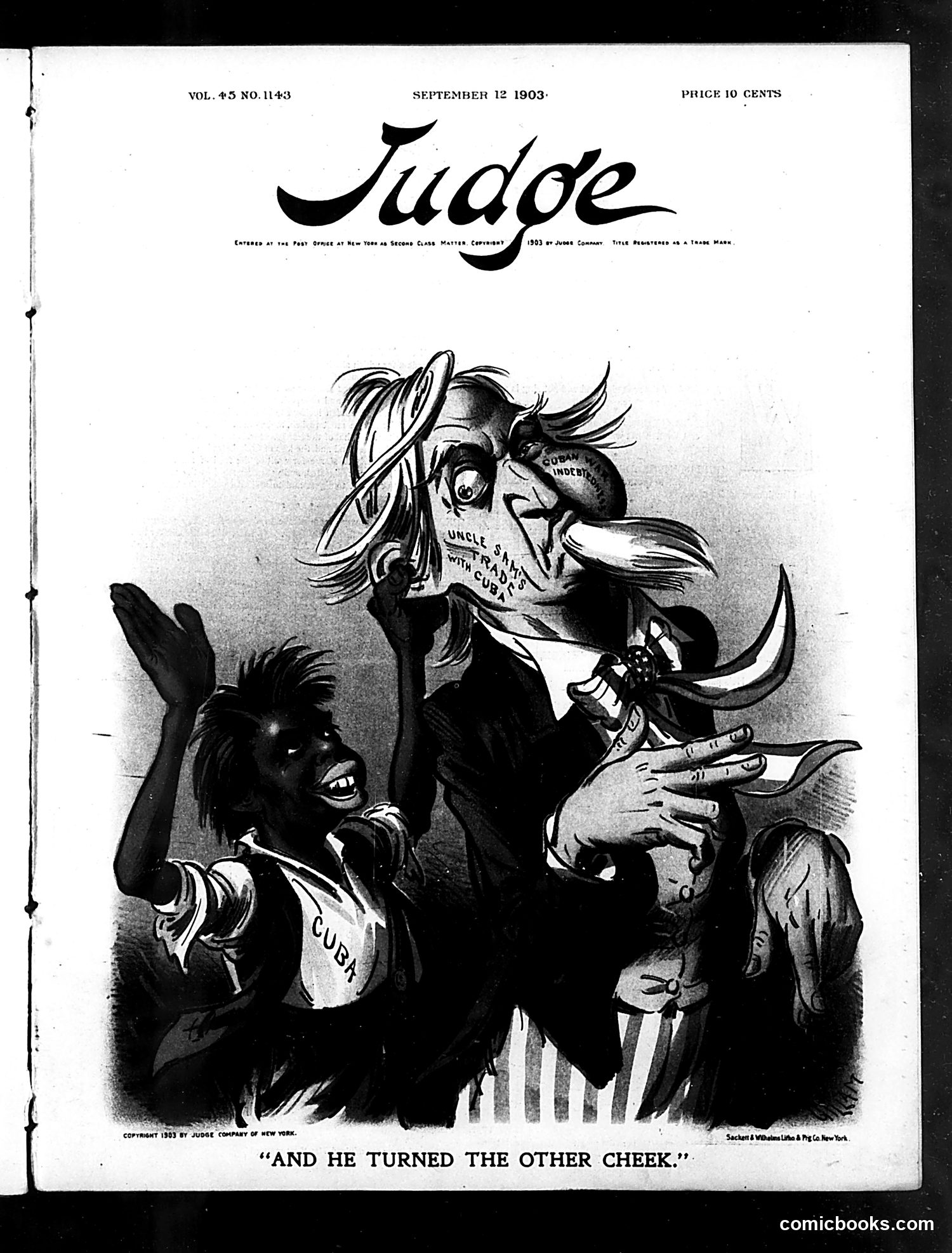
This cartoon satirizes American foreign policy toward Cuba following the Spanish-American War. The central figure wearing "Uncle Sam" attire represents the United States. The two caricatured figures labeled "Cuba" appear to be receiving rough treatment—one is being struck while the other gestures in protest. The caption "And He Turned the Other Cheek" ironically inverts Christian pacifism, suggesting Uncle Sam is aggressively dominating Cuba rather than showing restraint. The cartoon criticizes American imperialism and interventionist policies in Cuba, implying the U.S. is using military/political force against a weaker nation despite rhetoric about liberation. This reflects contemporary debates about whether American occupation of Cuba represented genuine support for independence or exploitation.
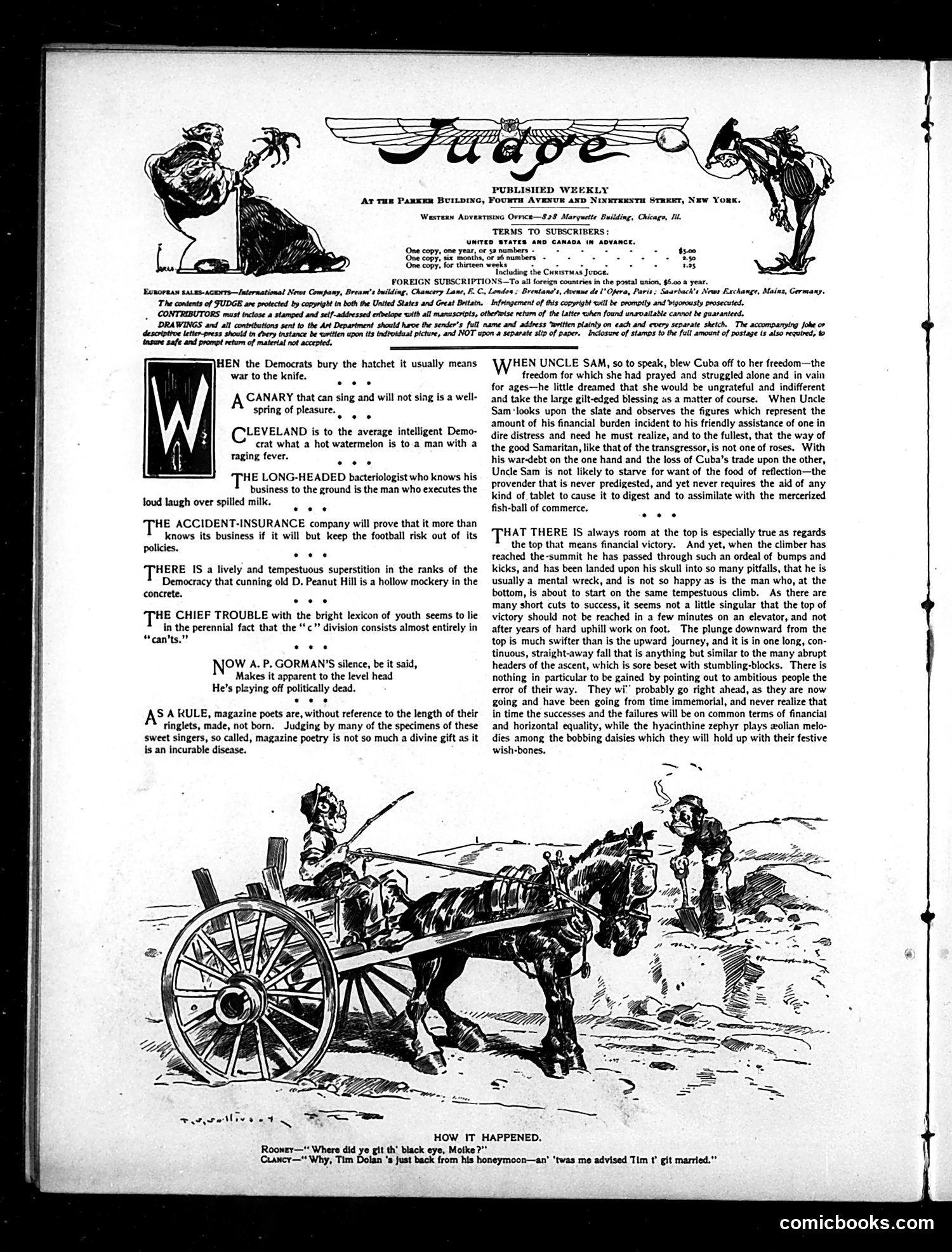
This page contains **political commentary and satire rather than narrative comics**. The left column features short, biting observations about American politics and society: - Mockery of Democrats burying "the hatchet" (making peace) - Criticism of Cleveland as average and uninspiring - Jokes about Democratic backsliding and accident insurance company risks - Commentary on a "superstition" regarding Penman Hill The right column offers lengthier satirical essays on financial topics and Democratic political failures. The bottom illustration shows a **rural scene with a horse-drawn cart**, captioned "How It Happened"—a brief joke about marriage and infidelity. Overall, this is **editorial satire targeting Democratic politics and American social foibles**, typical of Judge's Republican-leaning satirical approach. The specific political references (likely 1880s-era) are unclear without additional historical context.
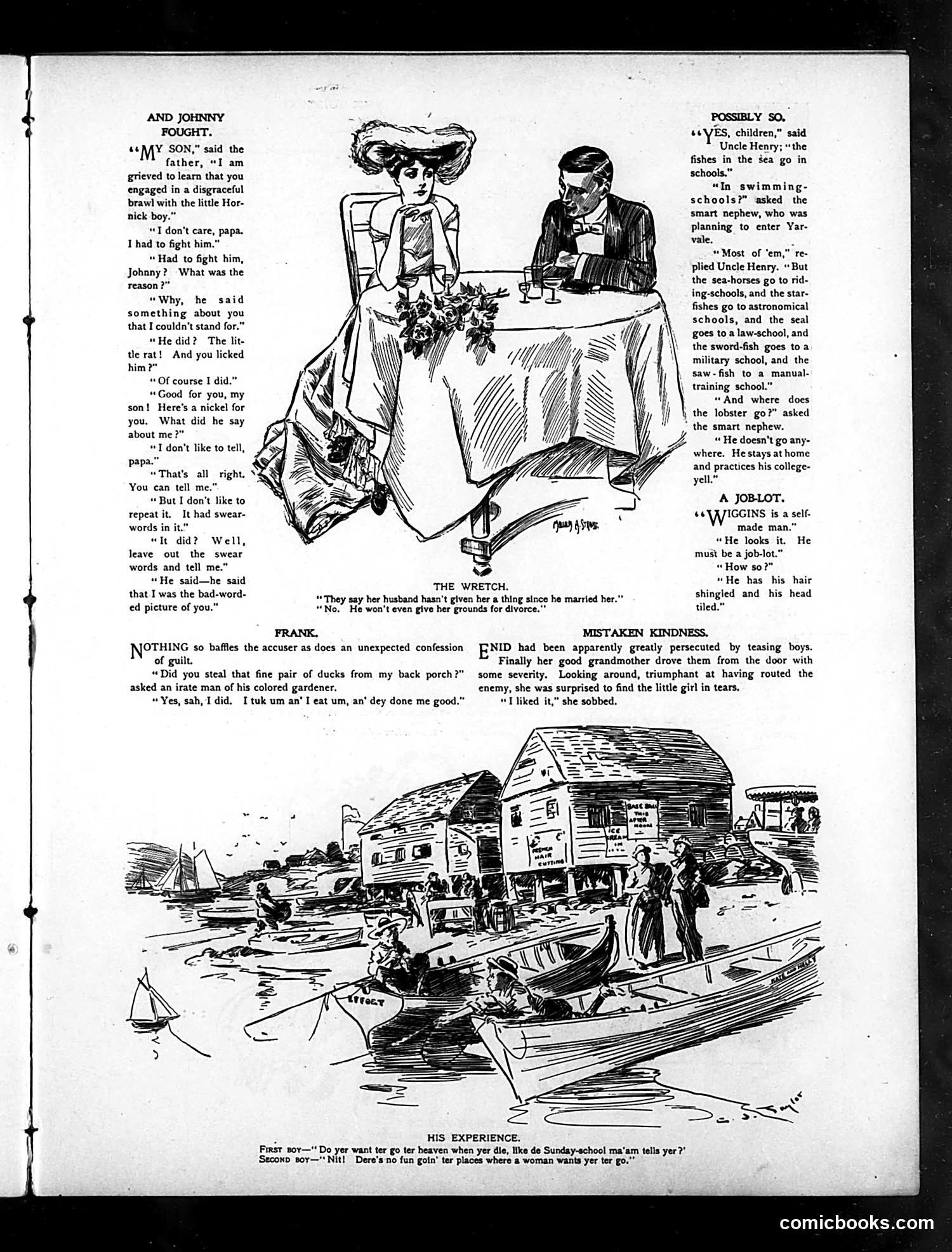
This page contains three separate humorous pieces typical of early 20th-century satirical magazine content: 1. **"And Johnny Fought"**: A dialogue between father and son about a fight, where the boy admits using "bad words" in combat—the humor lies in the father's relief that cursing rather than actual violence was the method. 2. **"A Joblot"**: Brief joke about a self-made man named Wiggins who never goes anywhere, practices his college yell at home instead—mocking the pretentiousness of self-made businessmen of the era. 3. **"Mistaken Kindness"** and **"His Experience"**: A coastal scene showing a girl persecuted by teasing boys; the illustrated scene depicts waterfront life with boats and buildings, accompanied by a dialogue joke about heavenly reward versus women's practical concerns. The humor reflects period attitudes toward masculinity, class, and gender relations.
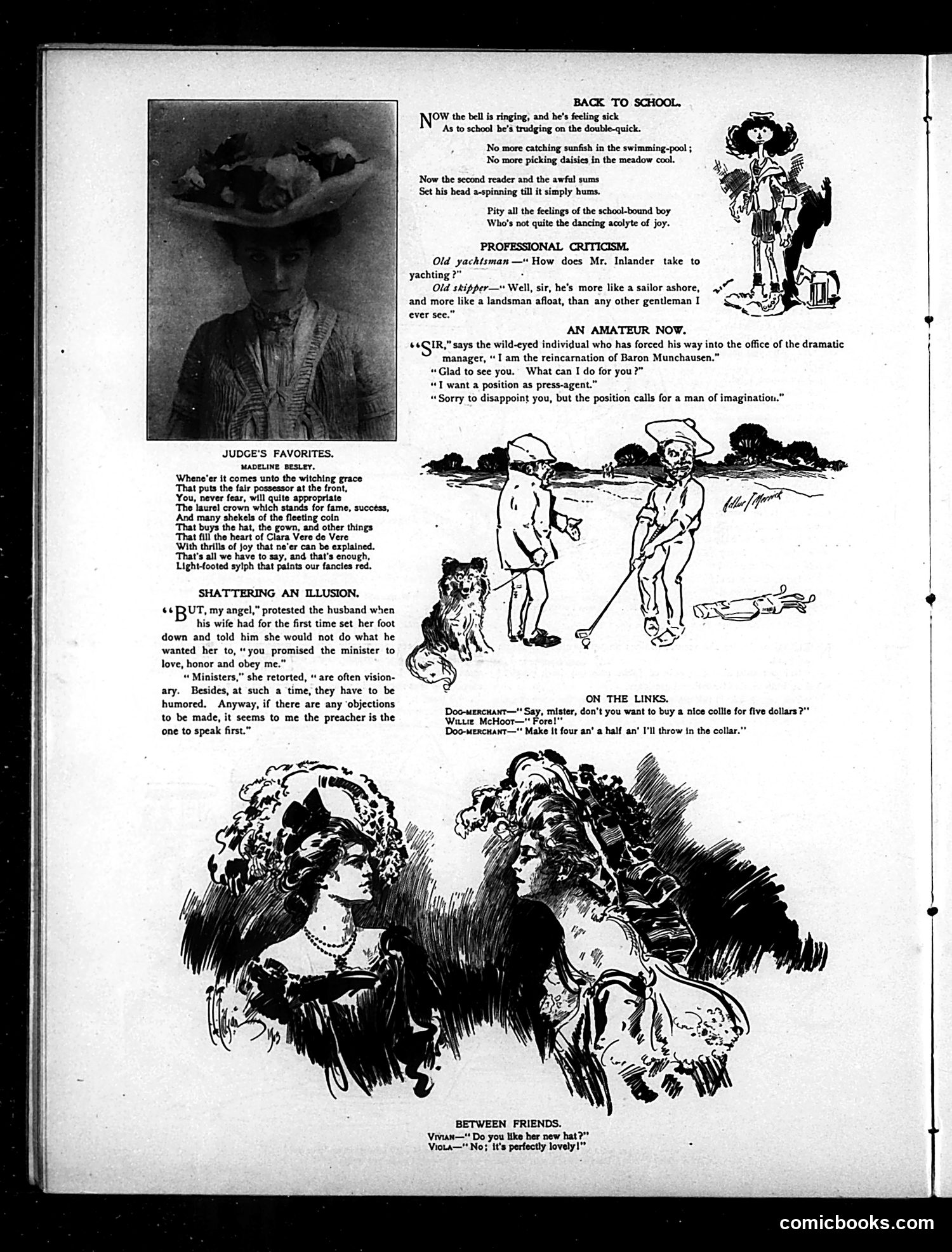
This page contains several separate satirical pieces rather than unified political commentary: **"Back to School"** mocks the misery of returning students—the "school-bound boy" losing his carefree summer joy. **"Judge's Favorites"** is a poem by Madeline Bridget celebrating feminine grace and beauty. **"Shattering an Illusion"** jokes about a husband's disappointment when his wife reveals she promised the minister to "love, honor and obey"—satirizing both marital expectations and ministerial authority. **"On the Links"** depicts a golf scene with working-class humor about a caddy negotiating fees. **"Between Friends"** shows two women discussing a new hat. The page is primarily **light humor and social satire** aimed at upper-middle-class readers, with no evident political commentary. The illustrations suggest early 20th-century publication.
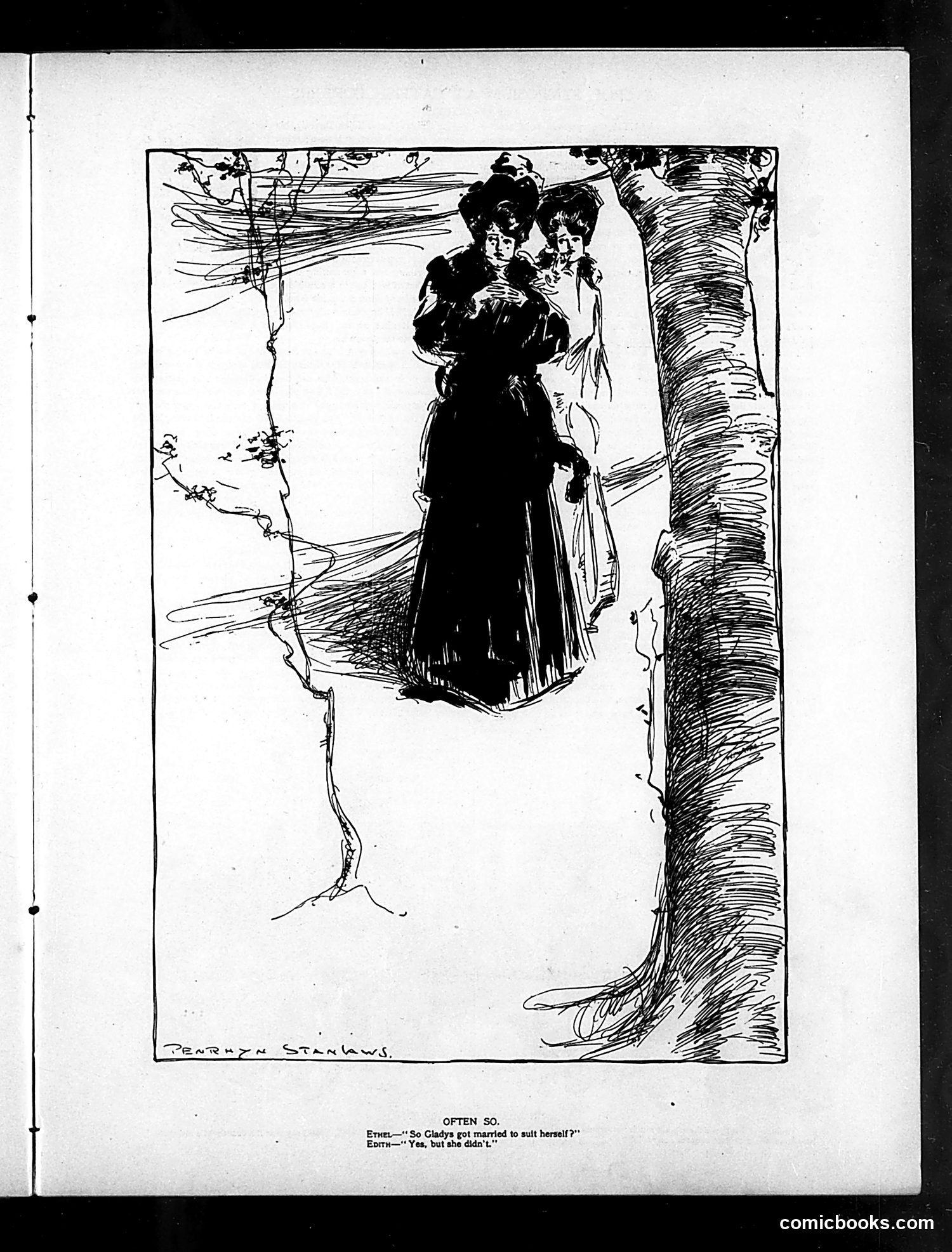
This illustration by Penrhyn Stanlaws depicts a woman in dark clothing standing beneath a large tree, with two figures visible in the background. The caption reads: "Ethel—'So Clarice got married to suit herself?' Ethel—'Yes, but she didn't.'" The satire targets **marriage and women's autonomy**. The joke suggests that despite Clarice's intention to marry for personal choice rather than social pressure, the outcome disappointed her—implying marriage itself thwarted her self-determination. This reflects early 20th-century commentary on marriage as an institution that constrains women, even when they enter it voluntarily. The somewhat melancholic setting and Clarice's apparent solitude reinforce the disillusionment theme. The cartoon critiques the gap between women's romantic expectations and marital reality.
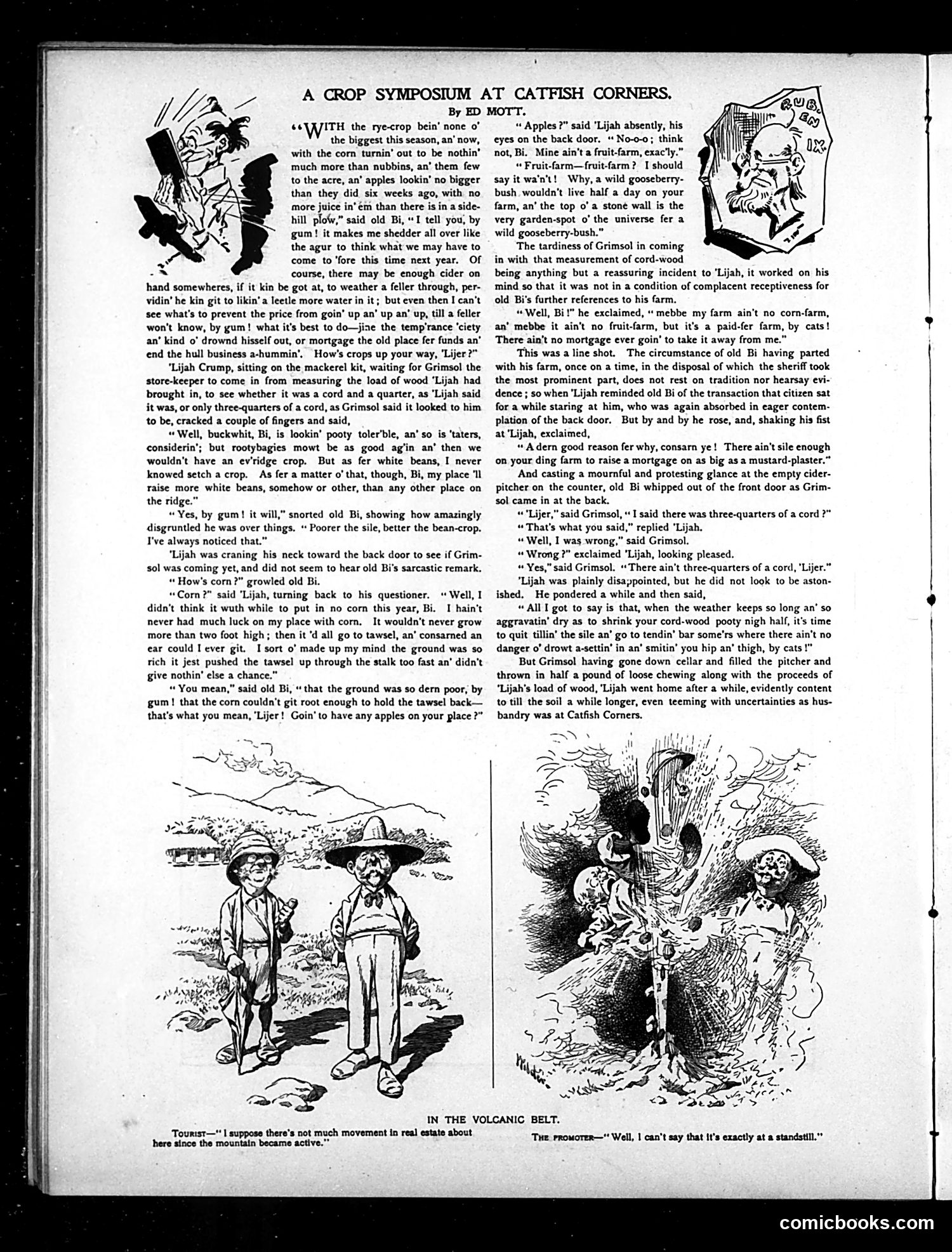
This is a rural comedy sketch titled "A Crop Symposium at Catfish Corners" by Ed Mott, featuring two farmers discussing poor harvests. The characters—old Bi and 'Lijah Crump—engage in exaggerated dialectal banter about failed crops (rye, corn, apples, beans), trading insults about whose land is worse. The satire targets rural financial anxiety: farmers worry about crop failures forcing them into debt and mortgages, or driving them to drink. The humor derives from their competitive complaining and mutual skepticism—old Bi mockingly suggests 'Lijah's poor corn yields stem from overly rich soil (obviously false), while 'Lijah defends his unprofitable farm by boasting it's debt-free. The lower illustrations show rural characters in what appears to be volcanic terrain, continuing the comedic rustic theme. This reflects *Judge* magazine's tradition of gentle mockery of American rural life and agricultural struggles during economic uncertainty.
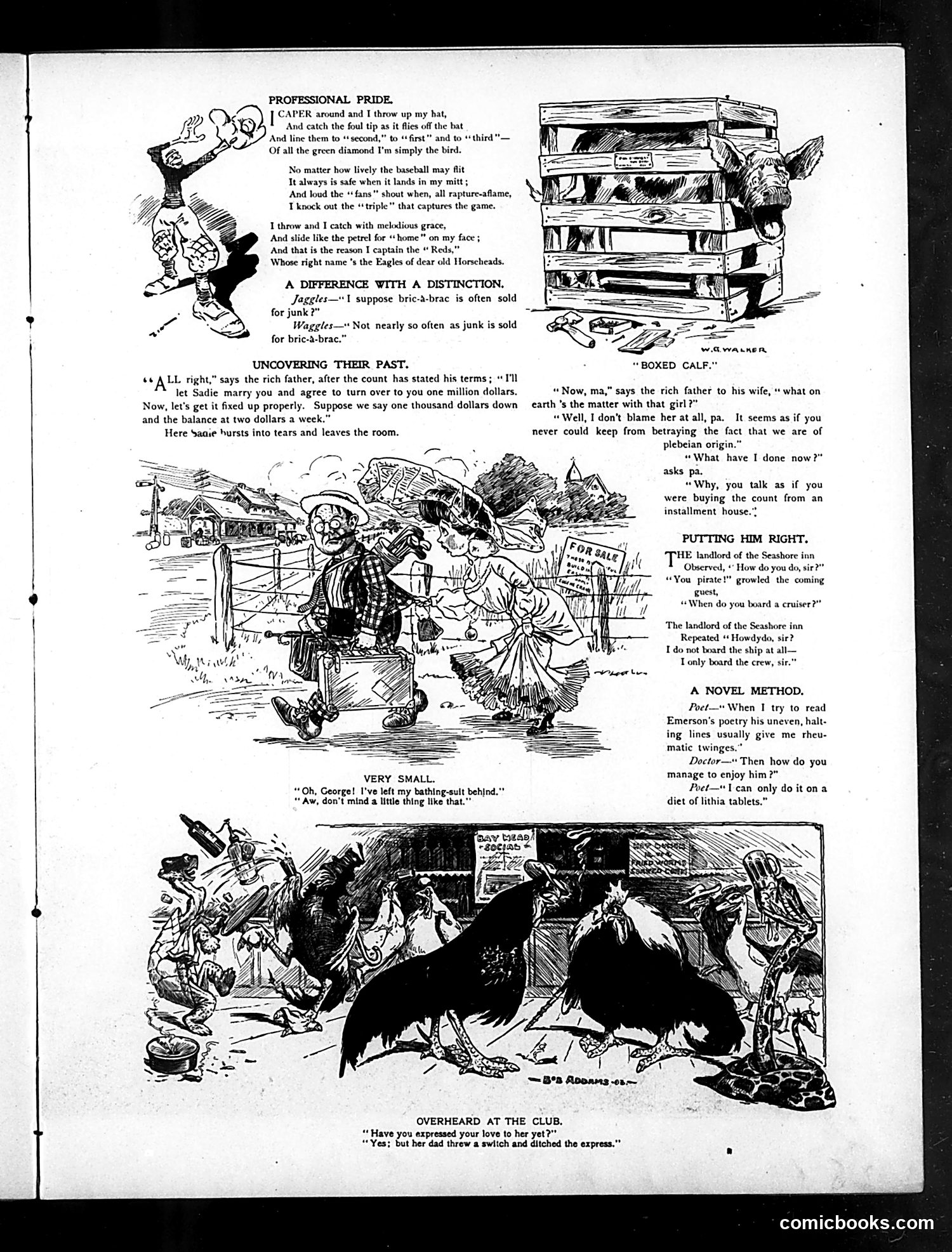
This page contains several unrelated satirical cartoons and jokes typical of early 20th-century American humor: **"Professional Pride"** mocks a baseball player's arrogance, boasting about his skills while playing for a team ironically named the "Eagles of dear old Horseheads" (suggesting a minor or amateur league). **"Uncovering Their Past"** satirizes class anxiety: a wealthy father agrees to his daughter's marriage to a count, but offers only modest weekly payments ($2/week). The daughter's dismay suggests the father has inadvertently revealed their nouveau-riche status through his stingy negotiating—he talks like someone buying from an "installment house" rather than old money. **"Boxed Calf"** and "Very Small"** are brief domestic humor jokes about wives and marriage. **"Overheard at the Club"** plays on the phrase "ditched the express"—a man tried declaring his love but the woman's father literally switched train tracks, preventing the proposal. **"Putting Him Right"** contrasts boarding a ship with boarding crew members (a pun). **"A Novel Method"** jokes that Emerson's poetry causes rheumatism, curable only through lithia tablets—mock-medicinal humor.
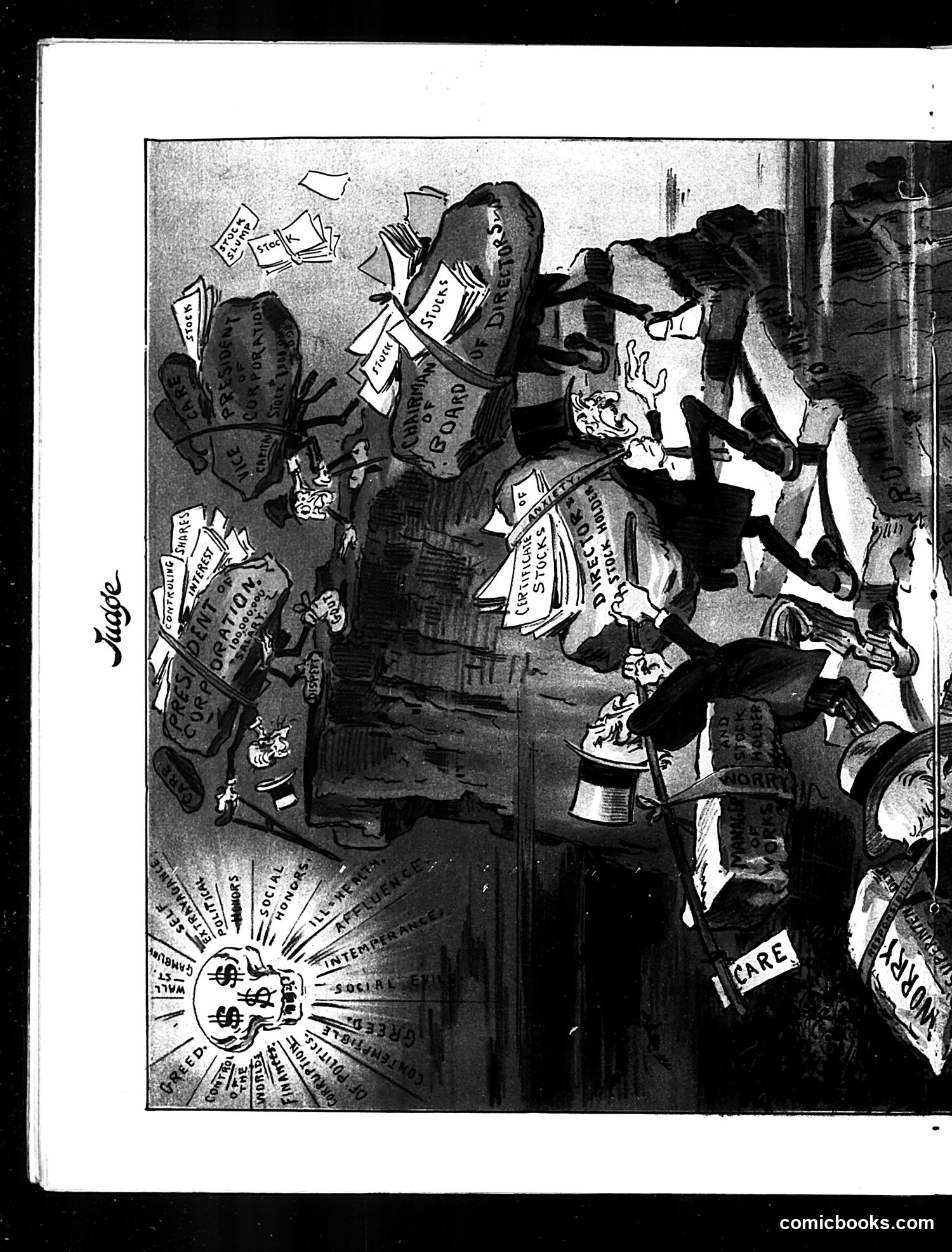
This is a satirical cartoon from *Judge* magazine depicting a figure (likely a politician or industrialist) being overwhelmed by labeled bags and containers. The visible text references include "CARE," "STOCKS," and various financial/business-related labels scattered throughout the composition. The cartoon appears to satirize wealth accumulation or corporate greed, showing a character struggling under the weight of money, stocks, and commercial goods. The chaotic arrangement of labeled items suggests critique of materialism or financial excess during an era of American capitalism. Without a visible date or clearer text identification, the specific target remains somewhat unclear, but the visual metaphor—someone literally burdened by their own wealth and commercial dealings—is a common *Judge* motif criticizing wealthy industrialists or corrupt businessmen of the early 20th century.
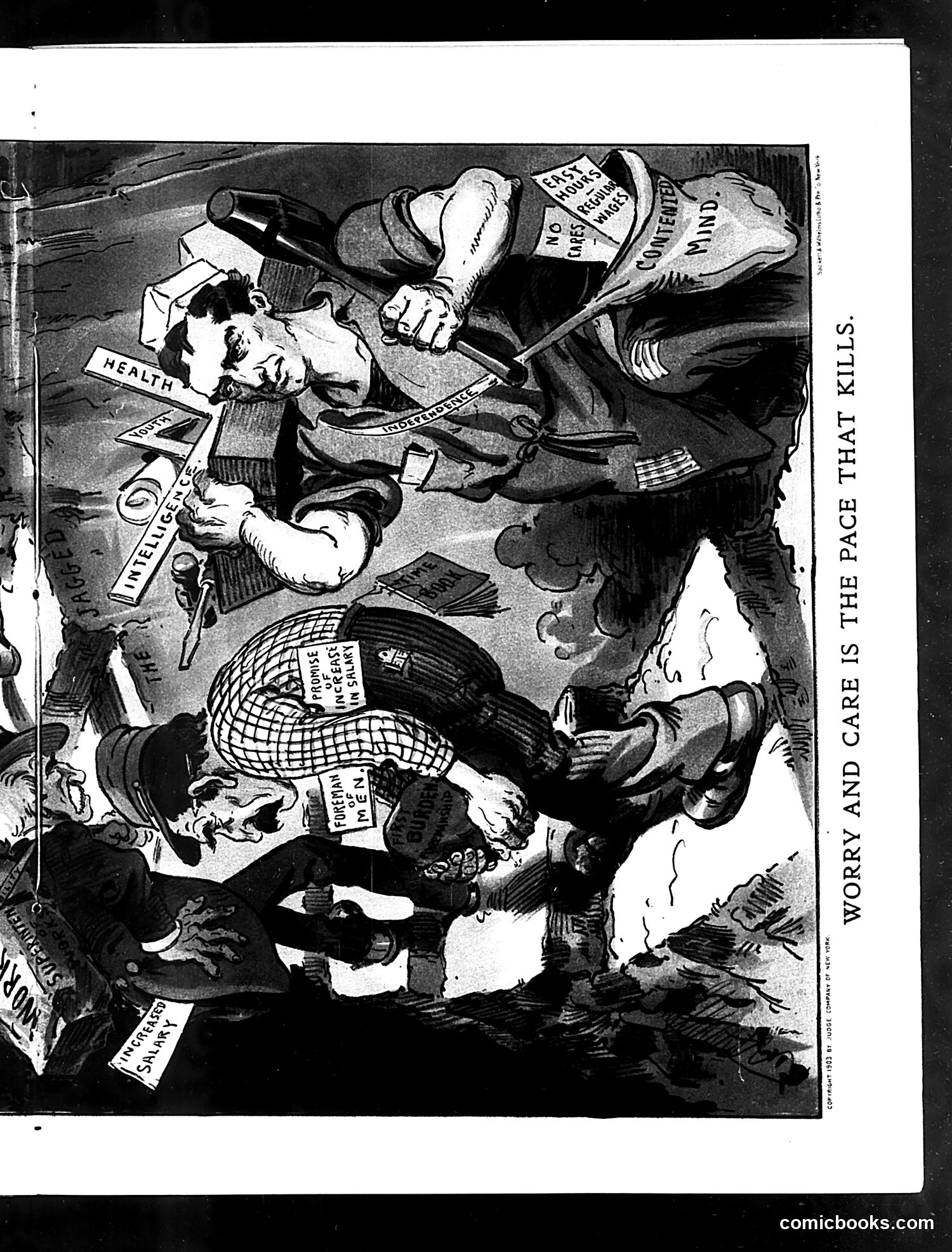
This appears to be a satirical cartoon titled "WORRY AND CARE IS THE PACE THAT KILLS" (visible on the right margin). The image depicts multiple figures labeled with various social concerns—visible labels include "HEALTH," "BUSINESS," and what appears to be references to financial or social worries. The cartoon illustrates people being overwhelmed or crushed by different anxieties and pressures of modern life. This is characteristic of early-to-mid 20th century *Judge* magazine satire, which often critiqued the stressful pace of contemporary American life. The style and composition suggest commentary on how multiple societal pressures simultaneously burden individuals. Without clearer date information or more legible labels, I cannot identify specific historical events referenced, but the theme addresses universal anxieties about work, health, and survival during uncertain economic times.
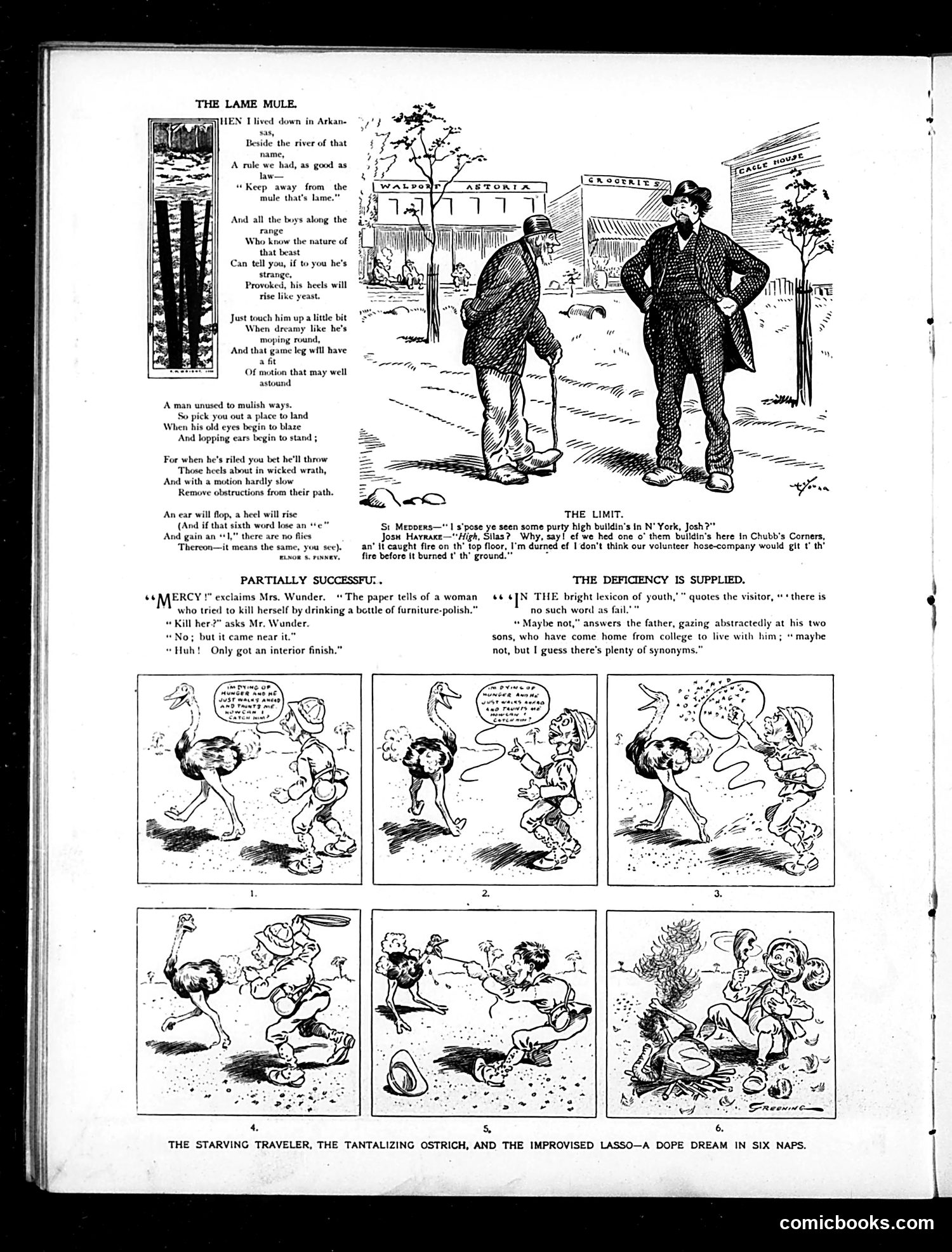
This page contains several unrelated satirical pieces typical of Judge magazine's humor: **"The Lame Mule"** is a tall tale poem about an Arkansas mule that kicks violently when provoked—a frontier humor trope about unpredictable animal behavior and the need for caution around dangerous creatures. **"The Limit"** mocks rural townspeople's incompetence: two country men claim their volunteer fire company is so slow that a burning building would burn to the ground before they arrived—satirizing small-town inefficiency. **"The Deficiency Is Supplied"** jokes about college-educated sons who fail at life: a father notes that while "youth's lexicon" contains no word for "fail," his sons have demonstrated plenty of *synonyms*—poking fun at educated but unsuccessful young men returning home. The six-panel cartoon depicts a starving traveler's dream involving an ostrich and a lasso, labeled a "dope dream"—likely referencing opium or drug use creating surreal, comedic visions. These pieces showcase Judge's mix of frontier nostalgia, small-town mockery, and generational humor.
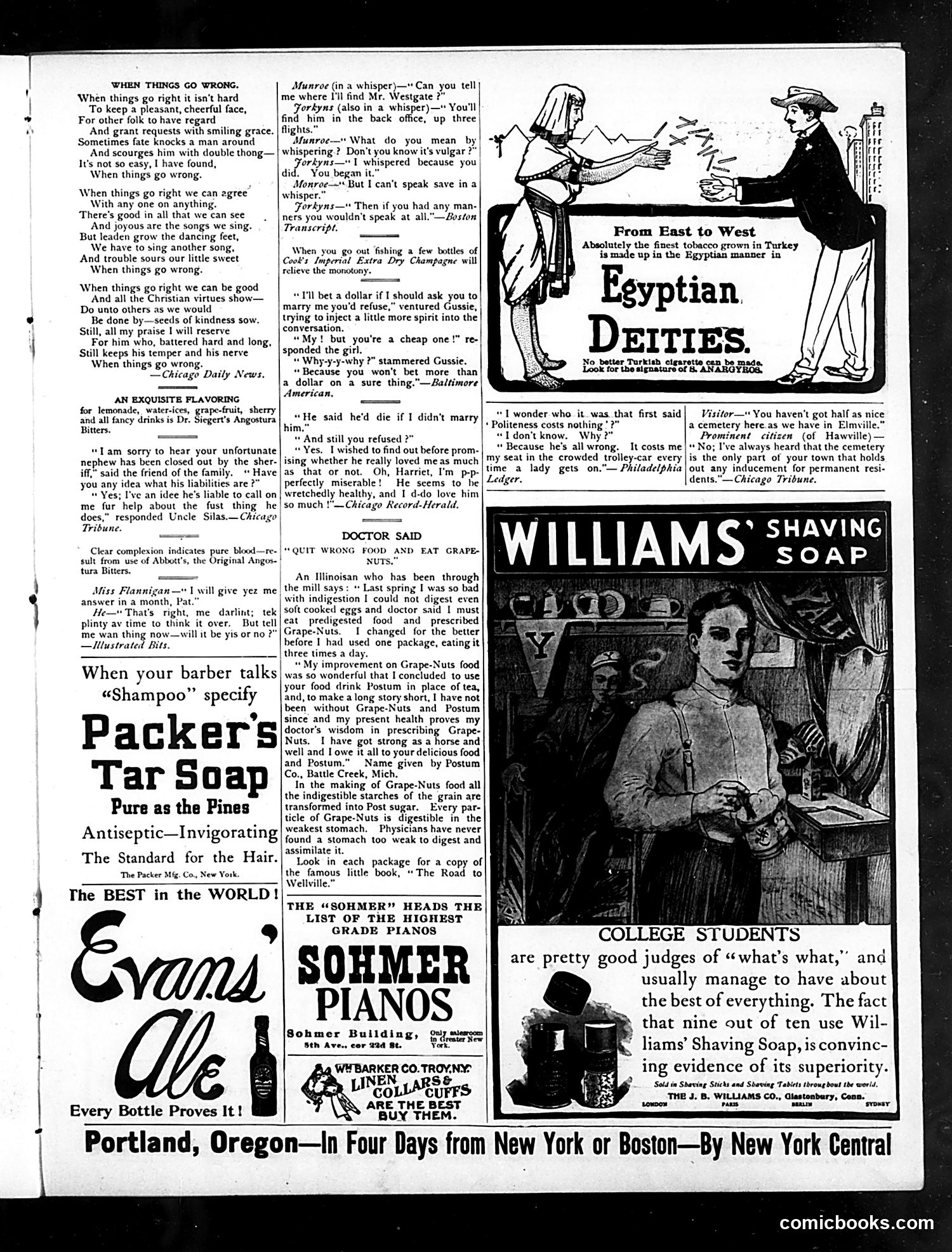
This page is primarily **advertising and humor columns** rather than political satire. The content includes: **Humorous dialogues** about everyday situations—a man asking directions in whispers, a woman rejecting a marriage proposal because the suitor won't bet enough money on his love, an uncle expecting his nephew to ask for financial help after bankruptcy. These are gentle social comedies poking fun at human nature and courtship customs. **The poem "When Things Go Wrong"** discusses maintaining composure during hardship—a Victorian moral lesson about character. **Advertisements dominate**: Williams' Shaving Soap, Packer's Tar Soap, Evans Ale, Sohmer Pianos, and testimonials for Grape-Nuts cereal and Postum drink (a caffeine-free coffee substitute). The "Egyptian Deities" tobacco ad features stereotypical orientalist imagery typical of early 1900s marketing. **No significant political commentary** is present. This is a commercial publication showcasing period humor and consumer goods aimed at middle-class readers.
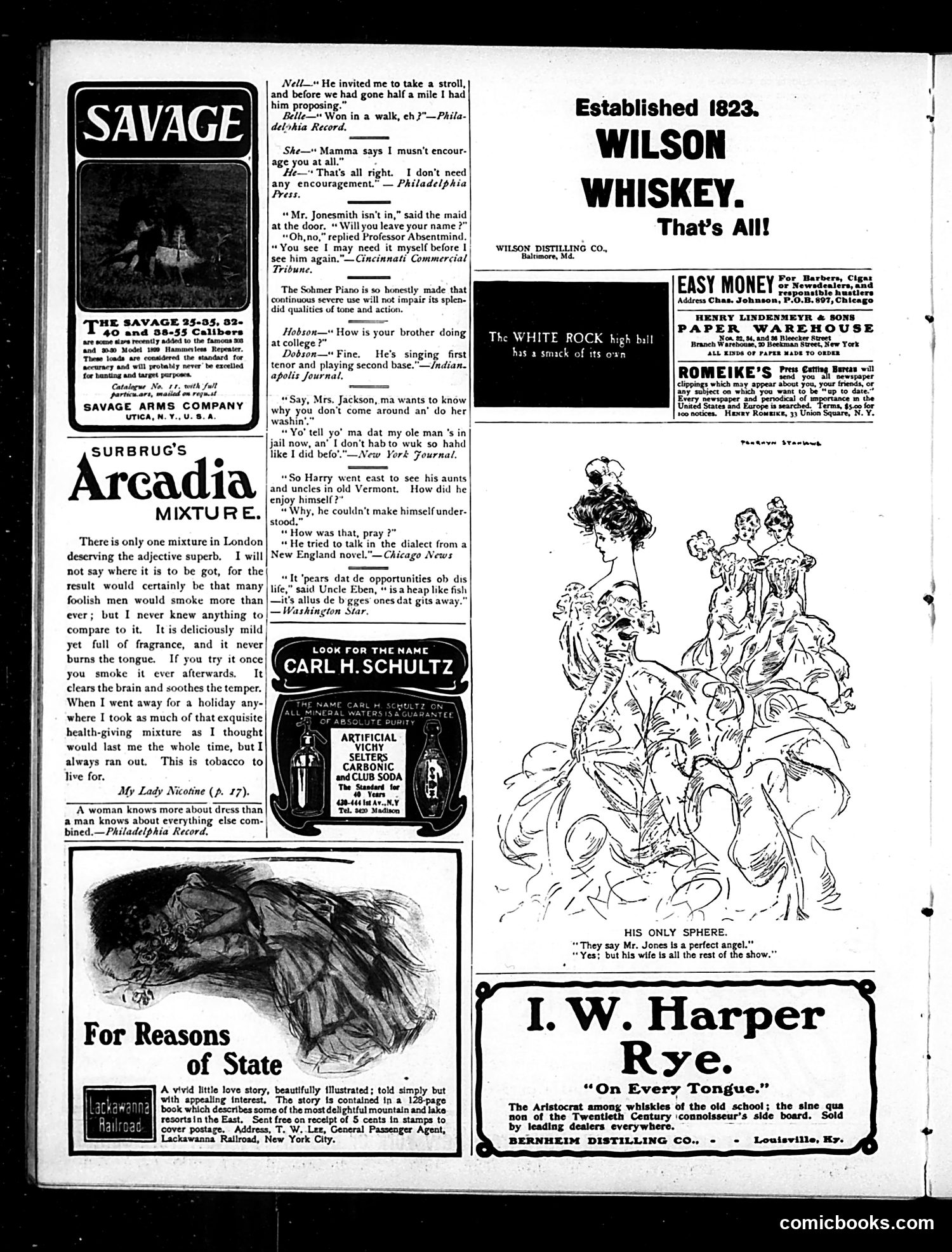
This page is primarily **advertising**, with minimal editorial content. The few jokes scattered throughout are typical period humor about courtship, domestic life, and racial stereotypes common to early 1900s publications. The main cartoon, "His Only Sphere," depicts a domestic scene with a woman as the focal point while a man appears peripheral—the caption's joke being that while the husband may seem perfect, his wife "is all the rest of the show," suggesting women dominate household life. This reflects contemporary tensions about gender roles and domestic authority. The page otherwise consists of product advertisements: whiskey (Wilson, I.W. Harper Rye), tobacco (Surbrugg's Arcadia), piano (Sohmer), artificial beverages, and other commercial goods typical of the era. The "Jonesmith" anecdote about an absent-minded professor is standard absurdist humor with no political content. Overall, this represents **Judge functioning primarily as a vehicle for advertising revenue** rather than sustained satirical commentary.
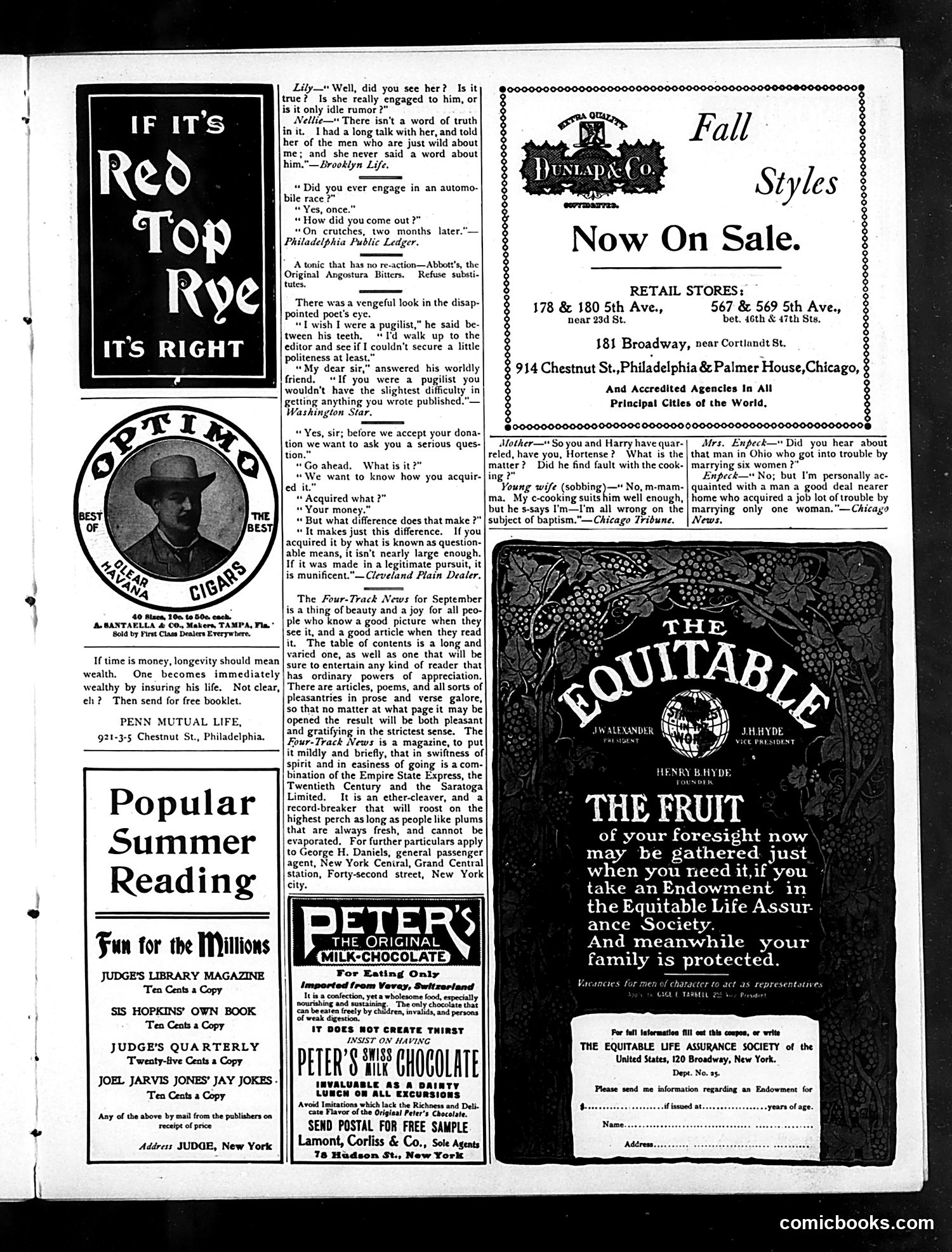
This page is primarily **advertising and light humor** rather than political commentary. The content includes: **Humorous Anecdotes:** Brief comedic stories about everyday situations—a woman's jealous lie about suitors, an automobile accident, a rejected poet wanting to fight an editor, and a charity donor questioned about his money's legitimacy. These are gentle social satires on vanity, automotive dangers, editorial indifference, and wealth hypocrisy. **Advertisements:** Multiple product ads (Red Top Rye whiskey, Dunlap & Co. clothing, Peter's Milk Chocolate, Penn Mutual Life Insurance) and notices for Judge's own publications and competitor magazines (Four-Track News). **No Identifiable Political Figures:** There are no caricatures of specific politicians or public figures visible. The humor targets universal human foibles rather than current events. The page reflects early-20th-century magazine culture: advertising-heavy, focused on consumer goods, with light satirical commentary on modern life (automobiles, urban courtship, publishing).
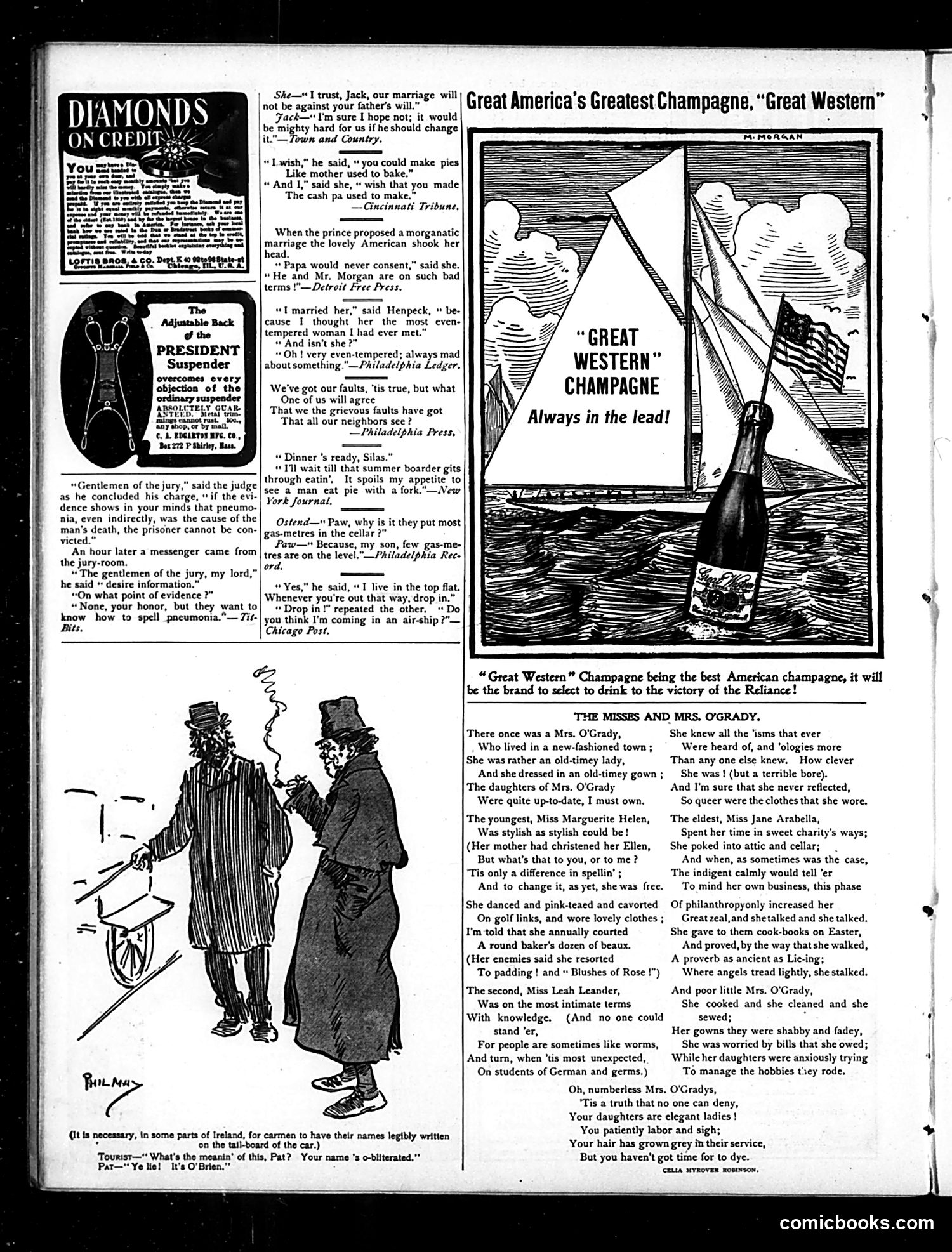
This page contains several unrelated humor pieces typical of Judge magazine's format: **Main Cartoons & Jokes:** The page features short comic vignettes satirizing everyday situations—a judge's jury unable to spell "pneumonia," marital quips about money and cooking, and a morganatic marriage joke. A diagram-less illustration shows two Irishmen discussing a cart with an "O'Brien" nameplate (the caption explains Irish carmen needed legible names). **Advertisement:** A "Diamonds on Credit" ad from Loftis Bros. appears prominently. **Central Content:** A "Great Western" Champagne advertisement occupies the right side, positioning it as "America's Greatest Champagne," likely referencing the yacht Reliance (contemporary America's Cup competition). **Poem:** "The Misses and Mrs. O'Grady" is a satirical narrative poem mocking social pretension—contrasting an old-fashioned mother with her fashionable, affected daughters. It critiques both their materialism and superficial "modernism." The page reflects Judge's satirical approach: gentle mockery of class aspiration, gender relations, and social change in early 20th-century America.
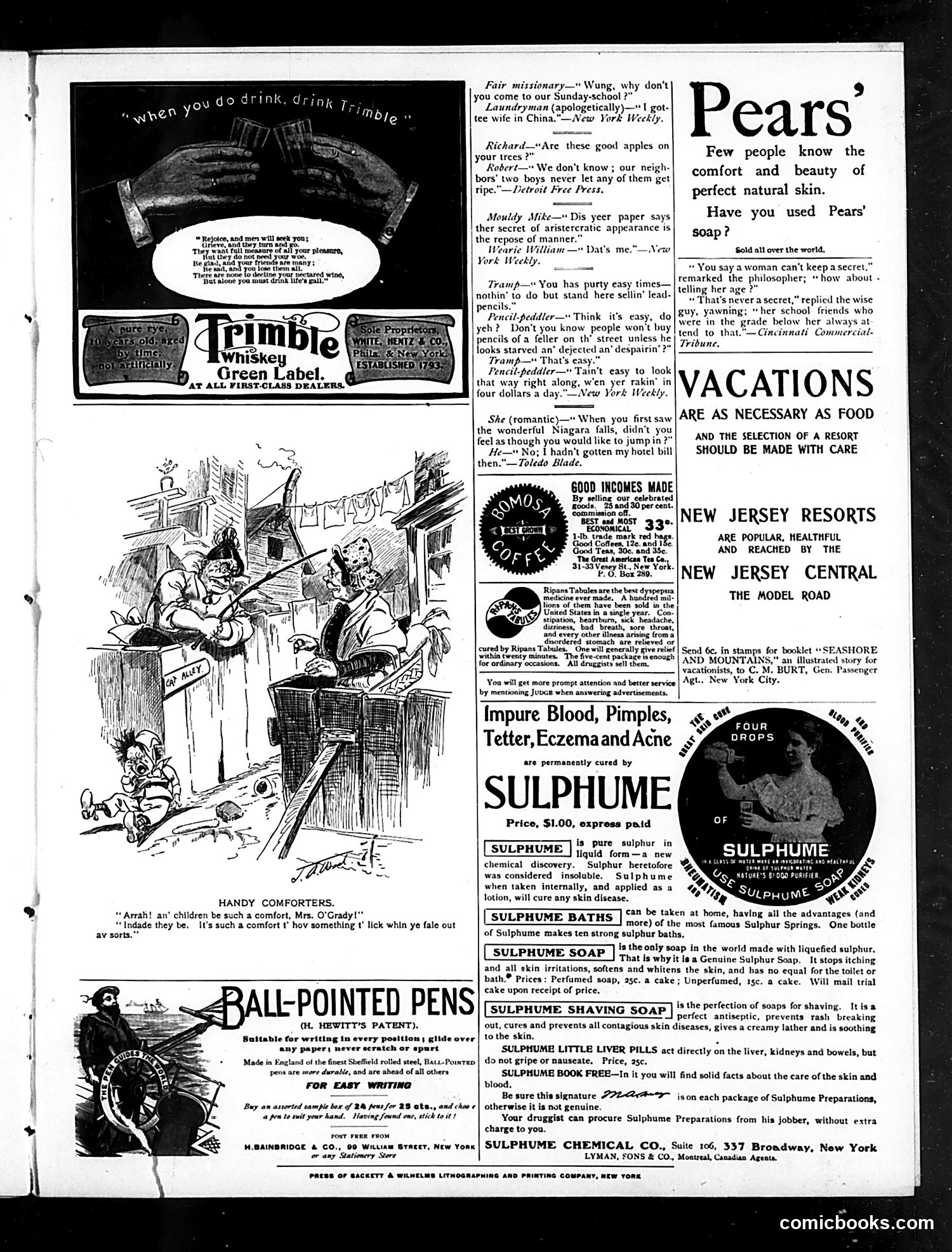
This page is primarily **advertising**, with a few minor satirical cartoons interspersed. The main cartoon ("Handy Comforters") depicts an Irish immigrant woman and child in stereotypical dialect, joking that children are comforting when one "feels out of sorts"—a dark humor reference to corporal punishment as stress relief. Other brief jokes mock social types: a laundryman's absence due to a wife in China; neighbors' boys stealing apples; street pencil-vendors appearing desperate; a man regretting Niagara Falls before paying his hotel bill. The **bulk of the page** comprises period product advertisements: Trimble Whiskey, Pears' Soap, Ball-Pointed Pens, and notably extensive ads for **Sulphume**, a patent medicine claiming to cure blood impurities, skin diseases, and acne through liquid sulfur—reflecting the era's unregulated medical claims. The ads also promote New Jersey resorts and vacations, typical of Judge's commercial content. The stereotypical Irish and working-class humor reflects common early-20th-century casual prejudices in American satirical publications.
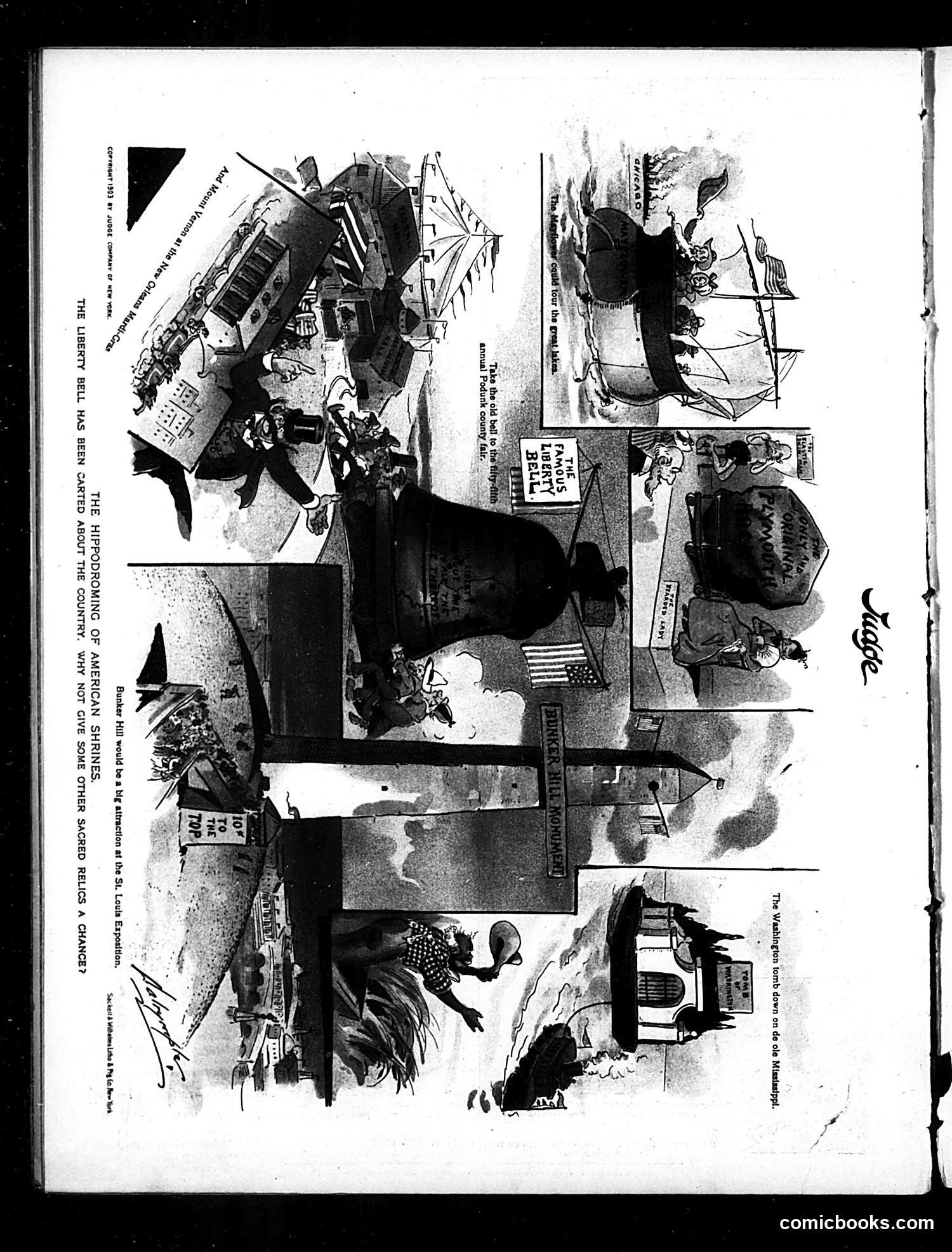
This page satirizes the traveling of iconic American monuments and relics for public exhibitions. The headline criticizes how the Liberty Bell was transported around the country, suggesting other national shrines should receive similar touring opportunities—presented mockingly. The cartoons depict absurd scenarios: Washington's tomb relocated to the Mississippi River, Bunker Hill monument moved to the St. Louis Exposition. The satire targets what Judge viewed as the commercialization and trivialization of sacred American historical sites through constant relocation for exhibition purposes. The joke critiques both the practice of treating revered landmarks as traveling attractions and the implied logic that if one important relic can be moved, why not all of them? It's social commentary on American cultural priorities and the commodification of national heritage.