
Judge, 1903-09-12 · page 6 of 16
Judge — September 12, 1903 — page 6: what you’re looking at
What you’re looking at
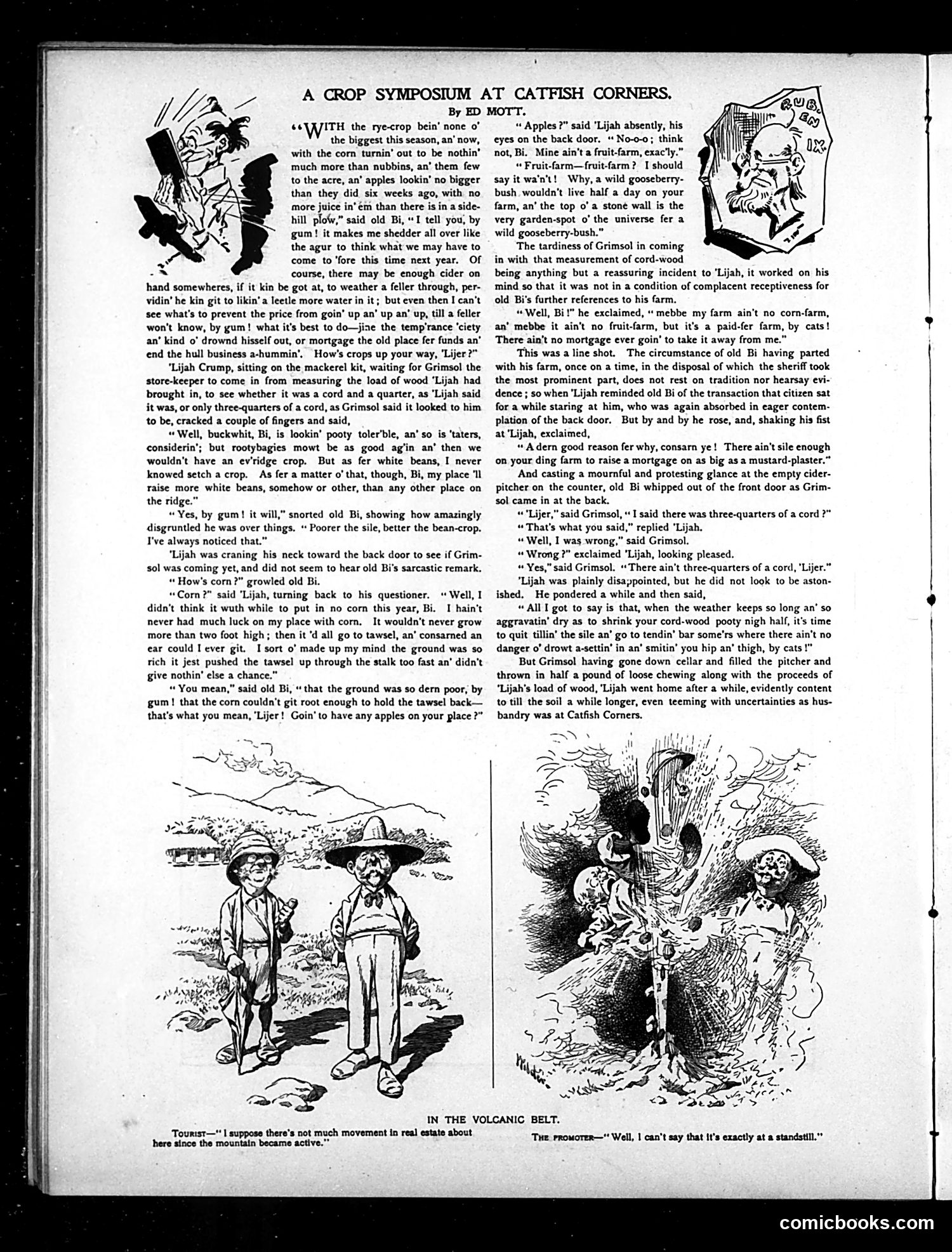
This is a rural comedy sketch titled "A Crop Symposium at Catfish Corners" by Ed Mott, featuring two farmers discussing poor harvests. The characters—old Bi and 'Lijah Crump—engage in exaggerated dialectal banter about failed crops (rye, corn, apples, beans), trading insults about whose land is worse. The satire targets rural financial anxiety: farmers worry about crop failures forcing them into debt and mortgages, or driving them to drink. The humor derives from their competitive complaining and mutual skepticism—old Bi mockingly suggests 'Lijah's poor corn yields stem from overly rich soil (obviously false), while 'Lijah defends his unprofitable farm by boasting it's debt-free. The lower illustrations show rural characters in what appears to be volcanic terrain, continuing the comedic rustic theme. This reflects *Judge* magazine's tradition of gentle mockery of American rural life and agricultural struggles during economic uncertainty.
📄 Transcribed text from this page (OCR, searchable)
Machine-transcribed from the original scan — historical spelling and the odd misread are preserved.
SCYYITH the rye-crop bein’ none o° the biggest this season, an’ now, with the corn turnin’ out to be nothin’ much more than nubbins, an’ them few to the acre, an’ apples lookin’ no bigger than they did six weeks ago, with no more juice in’ém than there is in a side- hill plow,” said old Bi, “I tell you, by gum! it makes me shedder all over like the agur to think what we may have to come to ‘fore this time next year. Of course, there may be enough cider on it kin be got at, to weather a feller through, per- vidin’ he kin git to likin’a leetle more water in it; but even then I can’t see what's to prevent the price from goin’ up an’ up an’ up, till a feller won't know, by gum! what it’s best to do—jine the temp'rance ‘ciety an’ kind 0° drownd hisself out, or mortgage the old place fer funds an’ end the hull business a-hummin’, How's crops up your way, ‘Lijer?” ‘Lijah Crump, sitting on the mackerel kit, waiting for Grimsol the store-keeper to come in from measuring the load of wood ‘ brought in, to see whether it was a cord and a quarter, as ‘Lijah said it was, or only three-quarters of a cord, as Grimsol said it looked to him to be, cracked a couple of fingers and said, “Well, buckwhit, Bi, is lookin’ pooty toler’ble, an’ so is ‘taters, considerin’; but rootybagies mowt be as good ag’in an’ then we wouldn't have an ev'ridge crop. But as fer white beans, I never knowed setch a crop. As fer a matter o' that, though, Bi, my place ‘Il raise more white beans, somehow or other, than any other place on the ridge.” “Yes, by gum! it will,” snorted old Bi, showing how amazingly disgruntled he was over things. “ Poorer the sile, better the bean-crop. T've always noticed that.” ‘Lijah was craning his neck toward the back door to see if Grim- sol was coming yet, and did not seem to hear old Bi’s sarcastic remark. « How's corn?” growled old Bi. “Corn?” said 'Lijah, turning back to his questioner. “ Well, I didn’t think it wuth while to put in no corn this year, Bi. I hain’t never had much luck on my place with corn, It wouldn't never grow more than two foot high; then it ‘d all go to tawsel, an’ consarned an ear could I ever git. I sort o' made up my mind the ground was so rich it jest pushed the tawsel up through the stalk too fast an’ didn’t give nothin’ else a chance.” “ You mean,” said old Bi, “that the ground was so dern poor, by gum! that the corn couldn't git root enough to hold the tawsel back— that’s what you mean, ‘Lijer! Goin’ to have any apples on your place ?” Tourist—"' 1 here since the mountain became active." there's not much movement in real estate about A CROP SYMPOSIUM AT CATFISH CORNERS, By ED MOTT. “ Apples 2” said ‘Lijah absently, his eyes on the back door. *No-o-0; think not, Bi. Mine ain't a fruit-farm, exac’ly.” Fruit-farm—fruit-farm? I should say it wa'n't! Why, a wild gooseberry- bush wouldn't live half a day on your farm, an’ the top o’ a stoné wall is the very garden-spot o' the universe fer a wild gooseberry-bush.” The tardiness of Grimsol in coming in with that measurement of cord-wood being anything but a reassuring incident to ‘Lijah, it worked on his mind so that it was not in a condition of complacent receptiveness for old Bi’s further references to his farm. «Well, Bi!” he exclaimed, * mebbe my farm ain't no corn-farm, an’ mebbe it ain't no fruit-farm, but it's a paid-fer farm, by cats! There ain't no mortgage ever goin’ to take it away from me.” This was a line shot. The circumstance of old Bi having parted with his farm, once on a time, in the disposal of which the sheriff took the most prominent part, does not rest on tradition nor hearsay evi- dence ; so when ‘Lijah reminded old Bi of the transaction that citizen sat for a while staring at him, who was again absorbed in eager contem- plation of the back door. But by and by he rose, and, shaking his fist at 'Lijah, exclaimed, “ Adern good reason fer why, consarn ye! There ain't sile enough on your ding farm to raise a mortgage on as big as a mustard-plaster.” And casting a mournful and protesting glance at the empty cider- pitcher on the counter, old Bi whipped out of the front door as Grim- ‘sol came in at the back. “'Lijer,” said Grimsol, «I said there was three-quarters of a cord ?” “ That's what you said,” rep! "Lijah. “ Well, I was wrong,” said Grimsol. “ Wrong 2” exclaimed ‘Lijah, looking pleased. “ Yes,” said Grimsol. “There ain't three-quarters of a cord, 'Lijer.” *Lijah was plainly disappointed, but he did not look to be aston- ished. He pondered a while and then said, “ All I got to say is that, when the weather keeps so long an’ so aggravatin’ dry as to shrink your cord-wood pooty nigh half, it's time to quit tillin’ the sile an’ go to tendin’ bar some’rs where there ain't no danger o” drowt a-settin’ in an’ smitin’ you hip an’ thigh, by cats!" But Grimsol having gone down cellar and filled the pitcher and thrown in half a pound of loose chewing along with the proceeds of ‘Lijah’s load of wood, ‘Lijah went home after a while, evidently content to till the soil a while longer, even teeming with uncertainties as hus- bandry was at Catfish Corners. IN THE VOLCANIC BELT. ‘Tue rromorer—" Well, | can’t say that it's exactly at a standstill."" comicbooks.com