
Judge, 1903-09-12 · page 14 of 16
Judge — September 12, 1903 — page 14: what you’re looking at
What you’re looking at
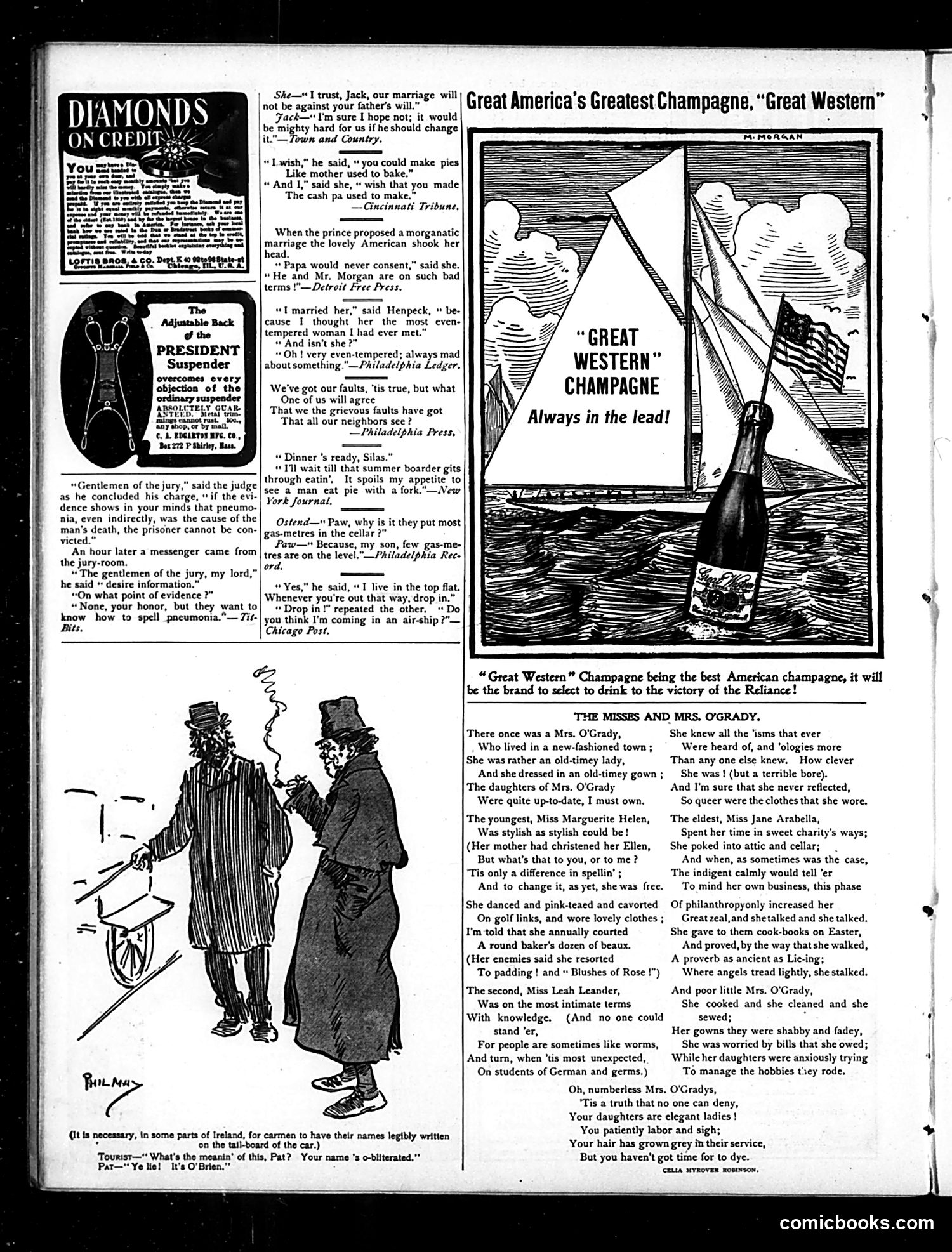
This page contains several unrelated humor pieces typical of Judge magazine's format: **Main Cartoons & Jokes:** The page features short comic vignettes satirizing everyday situations—a judge's jury unable to spell "pneumonia," marital quips about money and cooking, and a morganatic marriage joke. A diagram-less illustration shows two Irishmen discussing a cart with an "O'Brien" nameplate (the caption explains Irish carmen needed legible names). **Advertisement:** A "Diamonds on Credit" ad from Loftis Bros. appears prominently. **Central Content:** A "Great Western" Champagne advertisement occupies the right side, positioning it as "America's Greatest Champagne," likely referencing the yacht Reliance (contemporary America's Cup competition). **Poem:** "The Misses and Mrs. O'Grady" is a satirical narrative poem mocking social pretension—contrasting an old-fashioned mother with her fashionable, affected daughters. It critiques both their materialism and superficial "modernism." The page reflects Judge's satirical approach: gentle mockery of class aspiration, gender relations, and social change in early 20th-century America.
📄 Transcribed text from this page (OCR, searchable)
Machine-transcribed from the original scan — historical spelling and the odd misread are preserved.
¢. A. EDGARTOS BIG. C0., Bex 272 P Shirley, Mass. “Gentlemen of the jury,” said the judge as he concluded his charge, “if the evi- dence shows in your minds that pneumo- nia, even indirectly, was the cause of the man’s death, the prisoner cannot be con- victed.” ‘An hour later a messenger came from the jury-room. “The gentlemen of the jury, my lord,” he said “ desire information.” ‘On what point of evidence ?” None, your honor, but they want to know how to spell pneumonia.“— 7it- Bits, She— trust, Jack, our marriage will not be against your father’s will ‘Fack—" I'm sure I hope not; it would be mighty hard for us ifhe should change | it."— Town and Country. “ Lwish,” he said, “you could make pies Like mother used to bake.” « And I,” said she, “ wish that you made The cash pa used to make.” —Gincinnati Tribune, When the prince proposed a morganatic marriage the lovely American shook her head. “Papa would never consent,” said she. “He and Mr. Morgan are on such bad terms !"—Detroit Free Press. “Tmarried her,” said Henpeck, * be+ cause I thought’ her the most’ even tempered woman I had ever met.” * And isn’t she ?" “Oh ! very even-tempered; always mad about something."—Philadelphia Ledger. We've got our faults, ‘tis true, but what One of us will agree That we the grievous faults have got That all our neighbors see? —Philadelphia Press, “ Dinner 's ready, Silas.” “Tl wait till that summer boarder gits through eatin’, It spoils my appetite to see a man eat pie with a fork."—New York Journal. Ostend— Paw, why is it they put most gas-metres in the cellar?” Paw—" Because, my son, few gas-me- tres areon the level.” —PAiladelphia Rece ord. “ Yes," he said, “I live in the top flat. WESTERN” CHAMPAGNE Always in the lead! Whenever you're out that way, drop in.” “Drop in!" repeated the other. “Do you think I'm coming in an air-ship ?"— Chicago Post. (It is necessary, in some parts of Ireland, for carmen to have their names legibly written ’ on the tail-board of the car.) ‘Tourist—" What's the meanin’ of this, Pat? Your name 's o-bliterated."”” Pat—“Ye lie! It's O'Brien.”” “Great Western” Champagne being the best American champagne, it will be the brand to select to drink to the victory of the Reliance! ‘THE MISSES AND MRS. O/GRADY. There once was a Mrs. O'Grady, Who lived in a new-fashioned town ; She was rather an old-timey lady, And she dressed in an old-timey gown ; ‘The daughters of Mrs. O'Grady Were quite up-to-date, I must own. ‘The youngest, Miss Marguerite Helen, Was stylish as stylish could be! (Her mother had christened her Ellen, But what's that to you, or to me? ‘Tis only a difference in spellin’ ; And to change it, as yet, she was free. She danced and pink-teaed and cavorted On golf links, and wore lovely clothes ; I'm told that she annually courted A round baker's dozen of beaux. (Her enemies said she resorted To padding ! and «+ Blushes of Rose !") The second, Miss Leah Leander, Was on the most intimate terms With knowledge. (And no one could stand ‘er, For people are sometimes like worms, And turn, when ‘tis most unexpected, On students of German and germs.) Oh, numberless Mrs. She knew all the ‘isms that ever Were heard of, and ‘ologies more Than any one else knew. How clever She was ! (but a terrible bore). And I'm sure that she never reflected, So queer were the clothes that she wore. The eldest, Miss Jane Arabella, Spent her time in sweet charity's ways; She poked into attic and cellar; And when, as sometimes was the case, The indigent calmly would tell ‘er To mind her own business, this phase Of philanthropyonly increased her Great zeal,and shetalked and she talked. She gave to them cook-books on Easter, And proved, by the way that she walked, A proverb as ancient as Lie-ing; Where angels tread lightly, she stalked. And poor little Mrs. O'Grady, She cooked and she cleaned and she sewed; : Her gowns they were shabby and fadey, She was worried by bills that she owed; While her daughters were anxiously trying To manage the hobbies tey rode. OGradys, ‘Tis a truth that no one can deny, Your daughters are elegant ladies ! You patiently labor and sigh; Your hair has grown grey in their service, But you haven't got time for to dye. (CELIA MYROVER ROBINSON. comicbooks.com