
A complete issue · 16 pages · 1903
Judge — August 8, 1903
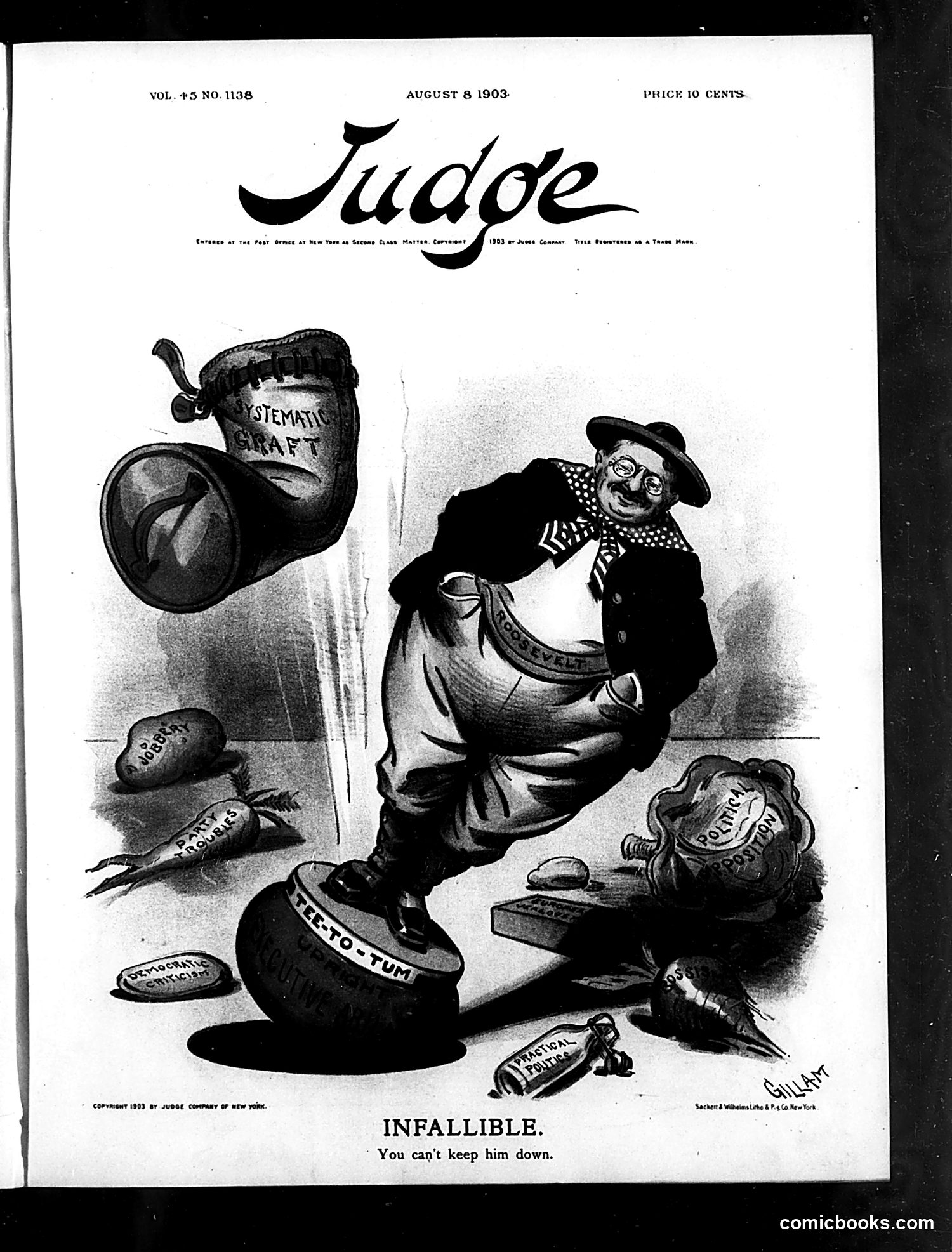
This August 1903 Judge cartoon depicts a resilient figure bouncing back repeatedly despite efforts to suppress him. The central character, drawn with exaggerated features characteristic of early 20th-century political caricature, springs upward with determination while various obstacles—labeled items suggesting systematic attempts to constrain or discredit him—litter the ground below. The title "Infallible" and subtitle "You can't keep him down" suggest this celebrates someone's political resilience or comeback. Without clearer labeling visible in the image, the specific political figure or situation remains unclear, though the cartoon likely references a contemporary politician or public figure who had weathered recent scandal or opposition. The bouncing motion conveys unstoppable momentum and persistent influence.
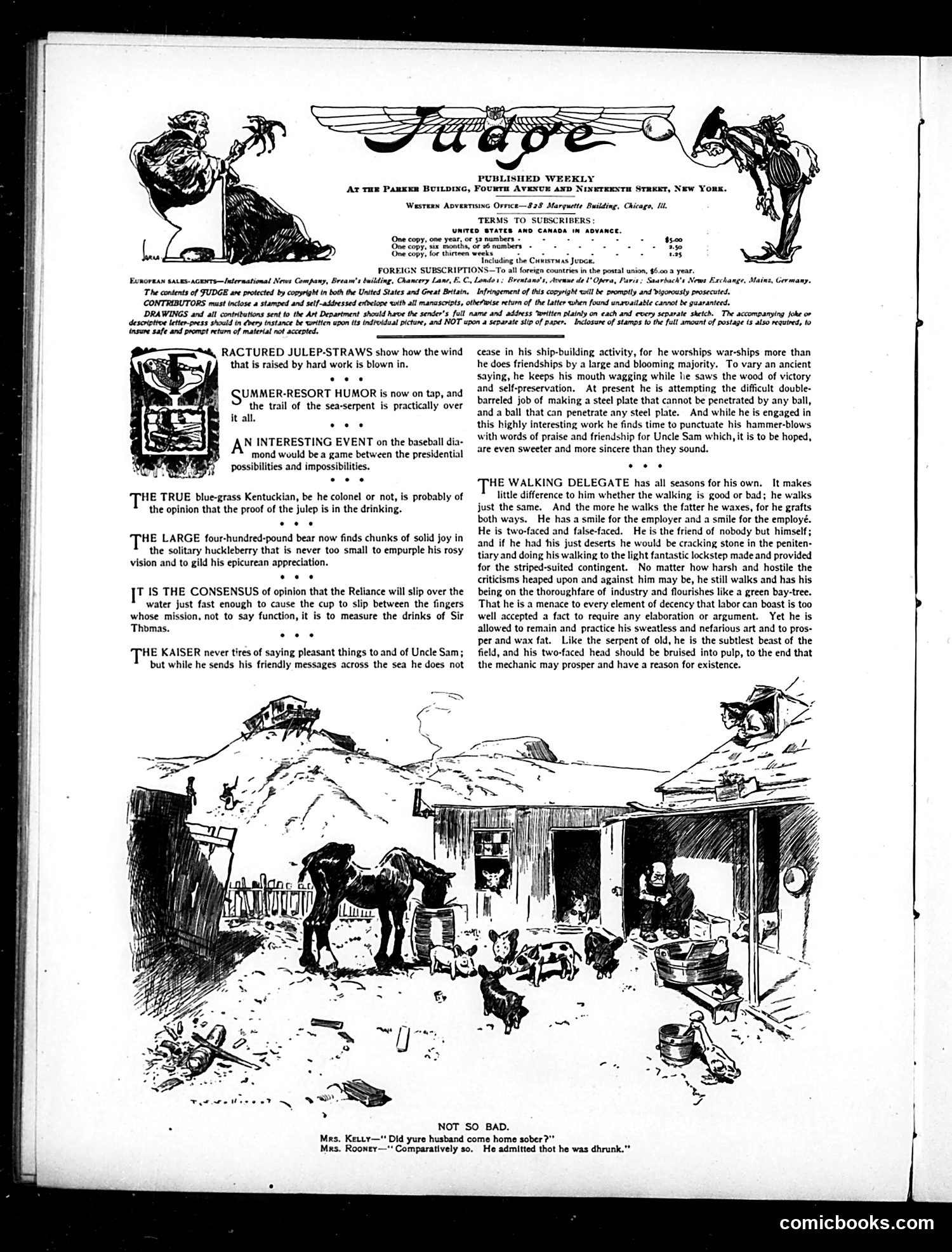
This page contains brief satirical commentary and humor pieces typical of *Judge* magazine's format. The main cartoon titled "NOT SO BAD" depicts a domestic scene where a woman (Mrs. Kelly) comments that her husband came home "sober," while Mrs. Rooney counters he was "comparatively so" and "admitted that he was drunk." The joke plays on the low bar for male behavior—admitting drunkenness is treated as a modest improvement. The text pieces above satirize contemporary figures and issues: references to presidential possibilities, a "blue-grass Kentuckian," a four-hundred-pound bear, the Kaiser, and the Reliance (likely a ship). The humor relies on wordplay and social observation rather than identifying specific current events, making full context difficult without additional historical research.
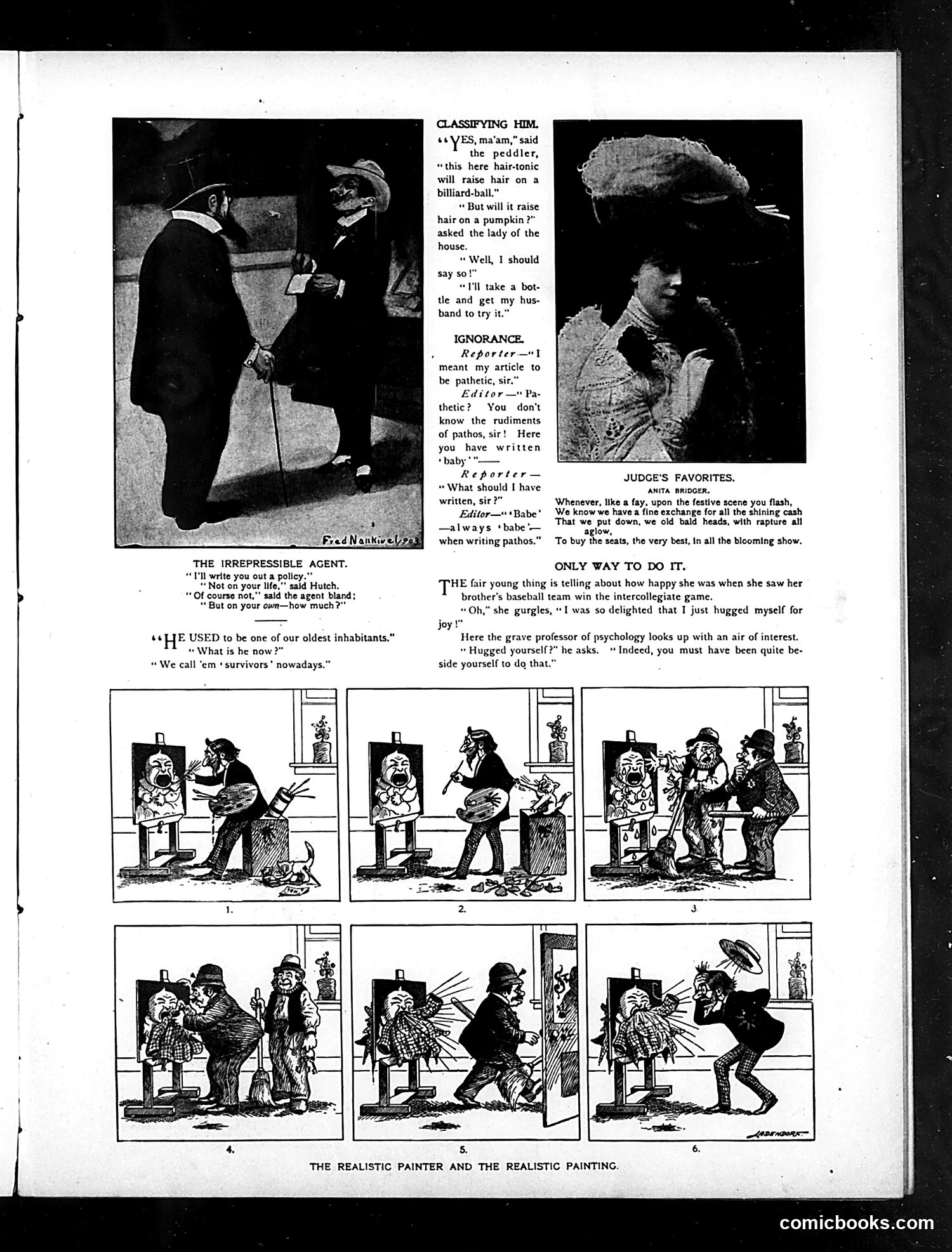
This page contains several brief satirical pieces typical of early 20th-century humor magazines: **"The Irrepressible Agent"** mocks a persistent salesman pestering someone about hair-raising products. **"Classifying Him"** jokes about a peddler's sonic hairbrush—a woman doubts it will work on a pumpkin, leading to absurdist comedy. **"Judge's Favorites"** praises Anita ahead's theatrical performance. **"Only Way to Do It"** humorously illustrates a psychology professor's skepticism about genuine enthusiasm. **"The Realistic Painter and the Realistic Painting"** (the six-panel comic strip) appears to satirize artistic pretension. A painter creates increasingly grotesque work while an audience reacts with confusion, suggesting mockery of avant-garde or "modern" art movements that prioritized abstraction over recognizable subjects—a common Judge theme.
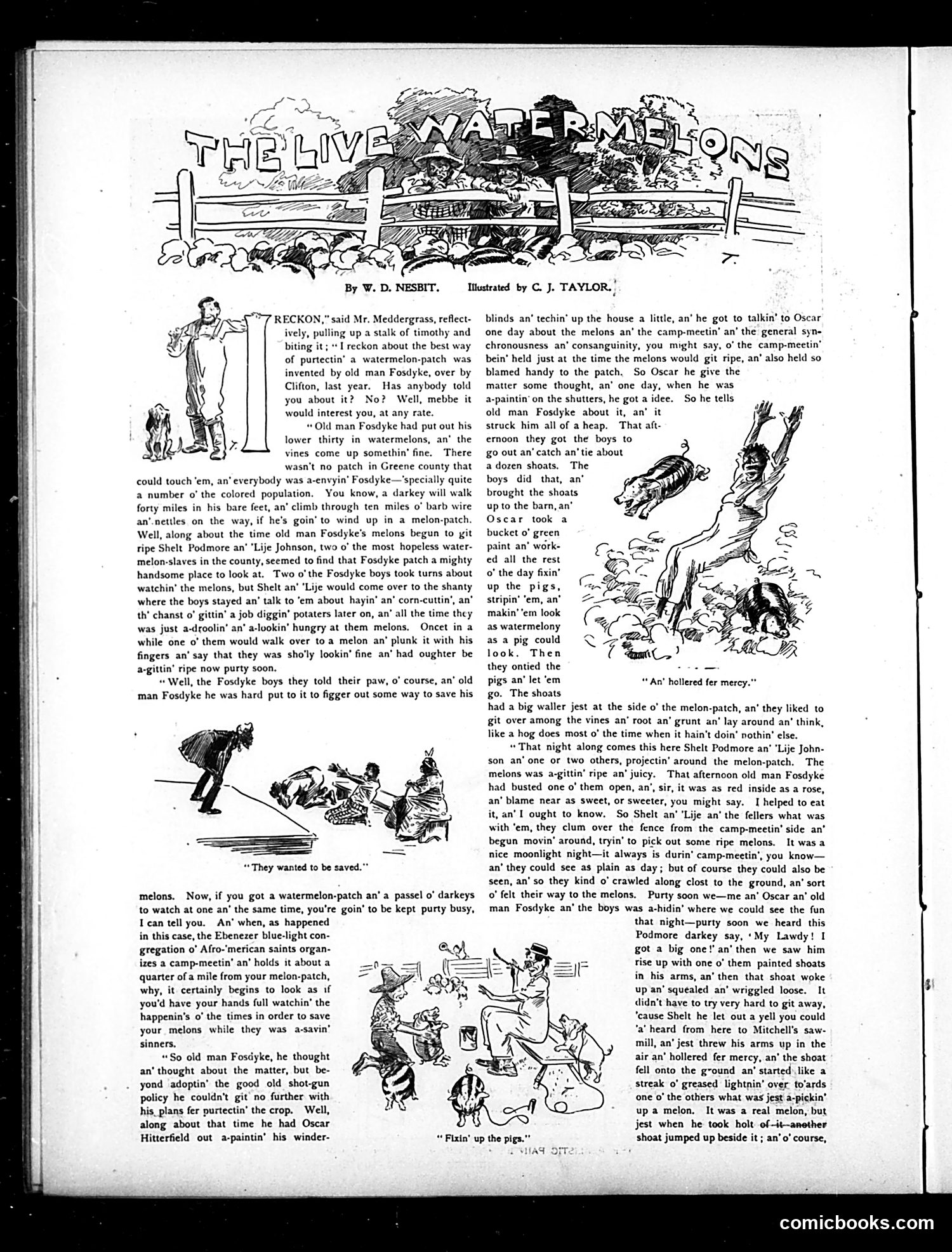
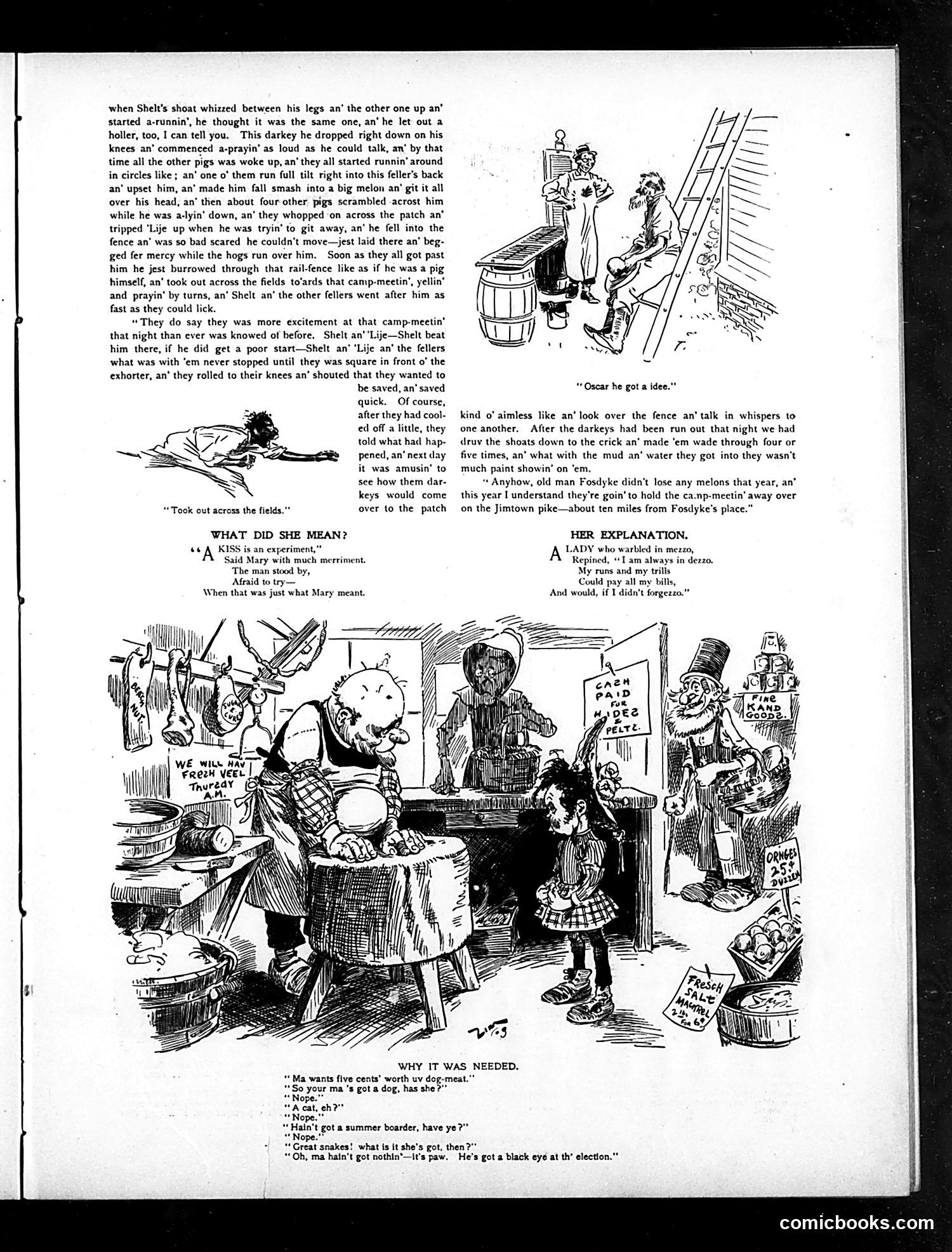
This is a humorous rural story, not political satire. It depicts a camp-meeting scene where boys steal watermelons from a patch. The narrative describes old man Fosdyke's unsuccessful attempts to protect his melon crop using increasingly elaborate schemes—including painted shoats (young pigs) and other deterrents—all thwarted by clever boys who repeatedly raid the patch at night. The illustrations show physical comedy: boys being chased, falling, and escaping with melons. The title likely refers to the watermelons' vitality or the lively chaos surrounding them. This represents turn-of-the-century rural Americana humor, common in Judge magazine, featuring typical characters (country folk, mischievous boys) in slapstick situations with no apparent political or social commentary.
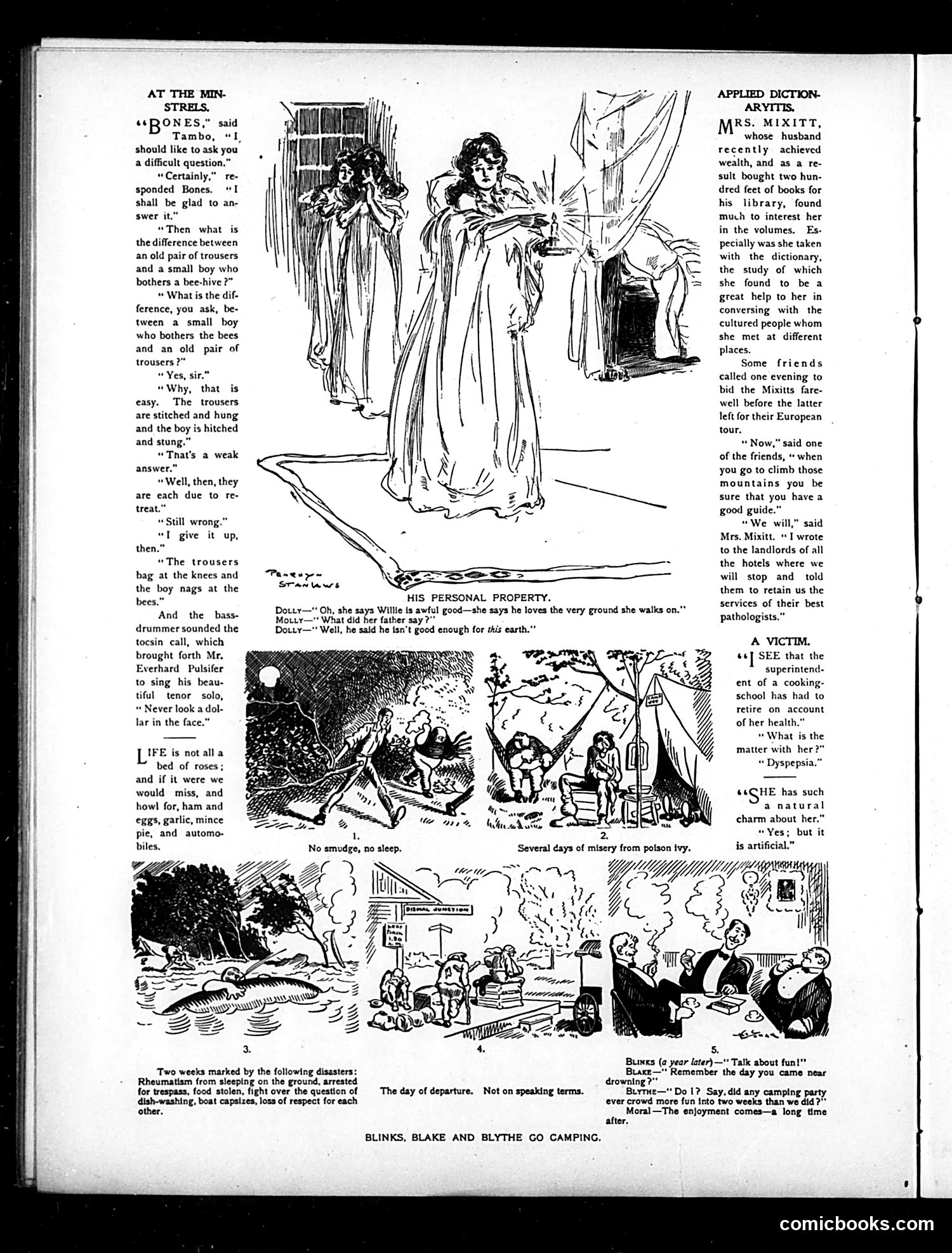
This page contains three separate satirical pieces from Judge magazine: 1. **"At the Minestrones"** (top left): A minstrel-show style joke between characters Tambo and Bones about the difference between old trousers and a boy bothering a beehive. The humor relies on wordplay ("stitched and hung" vs. "hitched and stung") typical of 19th-century vaudeville comedy. 2. **"His Personal Property"** (center): A brief domestic joke where a girl claims her boyfriend "loves the very ground she walks on," but her father sarcastically replies he "isn't good enough for this earth"—mocking flowery romantic language. 3. **"Blinks, Blake and Blythe Go Camping"** (bottom): A multi-panel comic strip chronicling a disastrous camping trip involving rheumatism, theft, fighting, and a capsized boat, ending with the characters ironically claiming they had fun. The page reflects late Victorian/Edwardian humor emphasizing wordplay, domestic situations, and physical comedy.
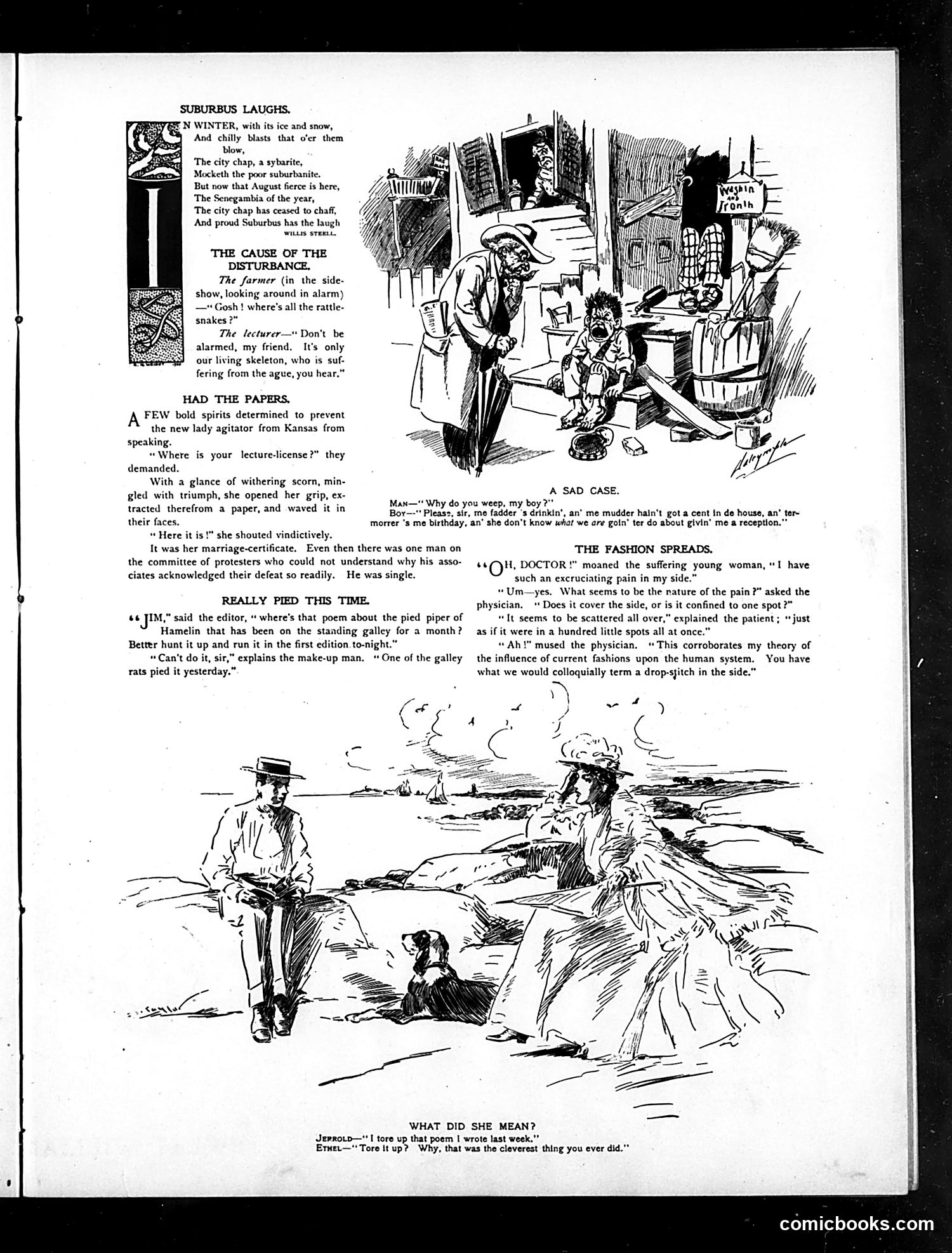
This page contains several short humorous pieces mocking contemporary social issues: **The main cartoon** satirizes the contrast between city and suburban living. In summer's heat, the urban "sybarite" (comfort-seeker) who mocked suburban life now envies their cooler escape, reversing the social hierarchy. **"Had the Papers"** ridicules women's rights activism. A female Kansas "agitator" seeking lecture permission produces her marriage certificate as vindictive "proof" of authority—sarcastically suggesting marriage is her only legitimate credential. The joke mocks both the protesters attempting censorship and the absurdity of requiring marital status for speaking rights. **"The Fashion Spreads"** critiques the era's tight corsetry. A woman's scattered side pain is diagnosed as a "drop-stitch"—a fashion-induced ailment caused by restrictive garments. The doctor blames current fashion trends for actual physical harm. Other brief jokes address pied type in printing, child poverty, and failed poetry writing—typical period humor targeting workplace mishaps and social conditions.
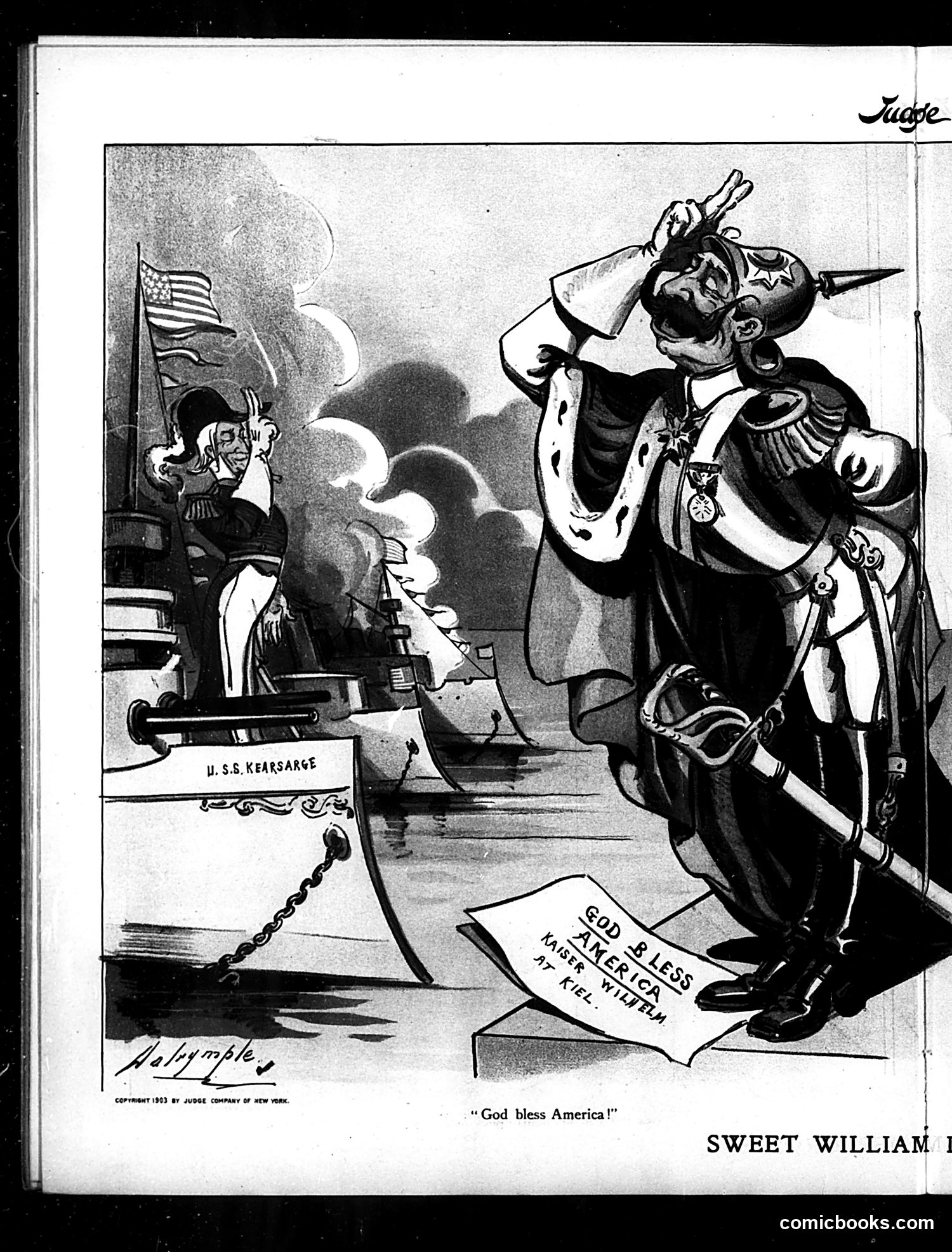
This 1903 Judge magazine cartoon depicts a caricatured foreign military figure (appearing to be German, given the Prussian-style uniform and spiked helmet) aboard the U.S.S. Kearsarge, looking through a telescope while saying "God bless America!" The satire likely critiques foreign militarism or espionage directed at the United States. The ironic invocation of "God bless America" from an apparent adversary suggests mockery of false patriotic declarations or hypocritical intentions. The reference to the Kearsarge—a real American naval vessel—grounds this in contemporary naval power concerns. The cartoon's title "Sweet William" appears to be wordplay, though the specific target remains unclear from the image alone. The overall message warns against trusting external military powers' stated goodwill toward America.
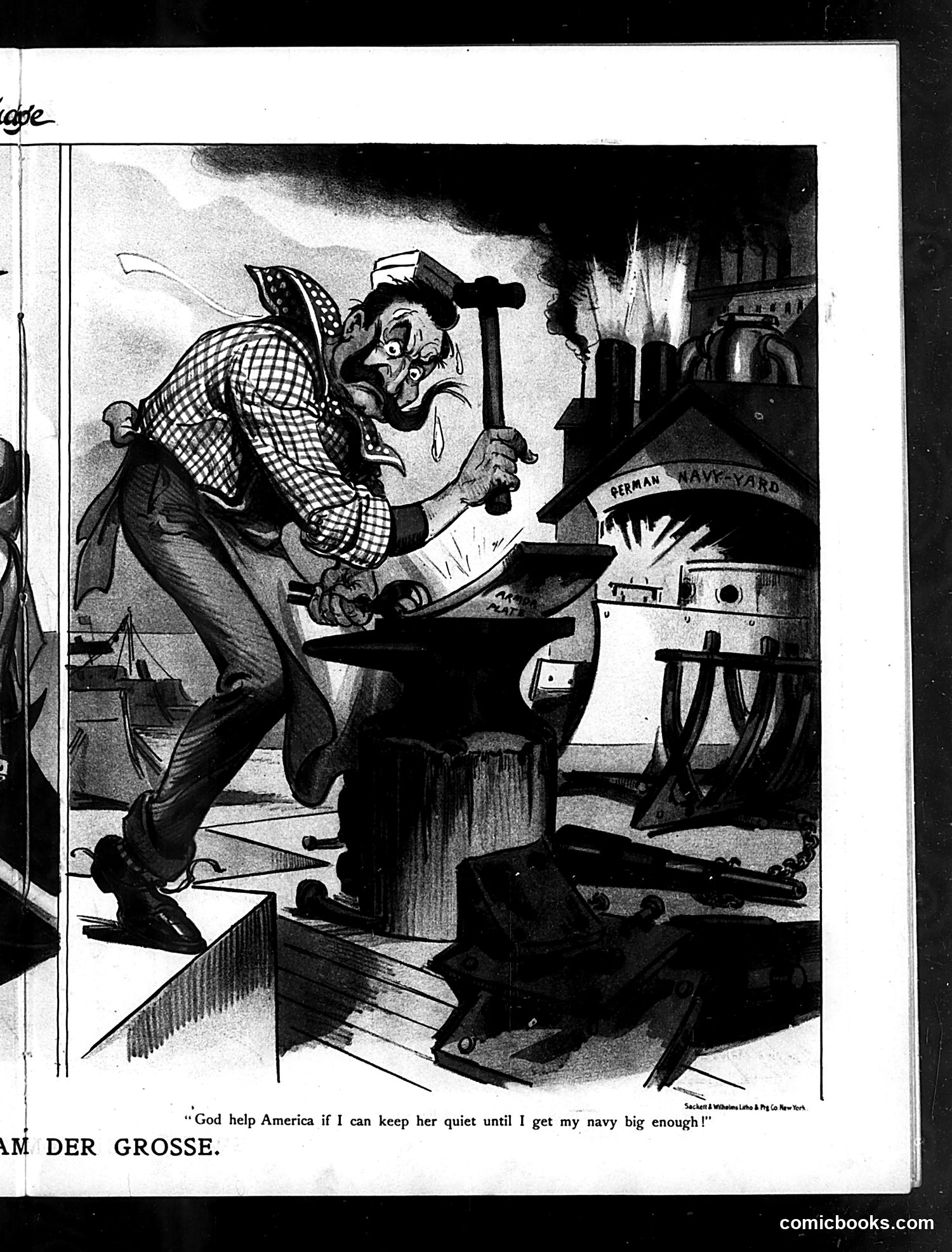
This political cartoon depicts a caricatured German figure (labeled "GERMAN NAVY-YARD") at an anvil, hammering away industriously. The grotesque facial features and exaggerated physique employ ethnic stereotyping common to early 20th-century American satire. The caption reads: "God help America if I can keep her quiet until I get my navy big enough!" **Context:** This appears to reference pre-WWI anxieties about German naval expansion under Kaiser Wilhelm II. Germany's aggressive Dreadnought battleship program alarmed the United States and Britain. The cartoon warns American readers about German military buildup, suggesting the Germans are working to strengthen their navy while keeping America diplomatically passive or "quiet." The anvil and hammer symbolize industrial military production. The "Der Grosse" (German for "The Great") in the title likely refers to Kaiser Wilhelm II's imperial ambitions.
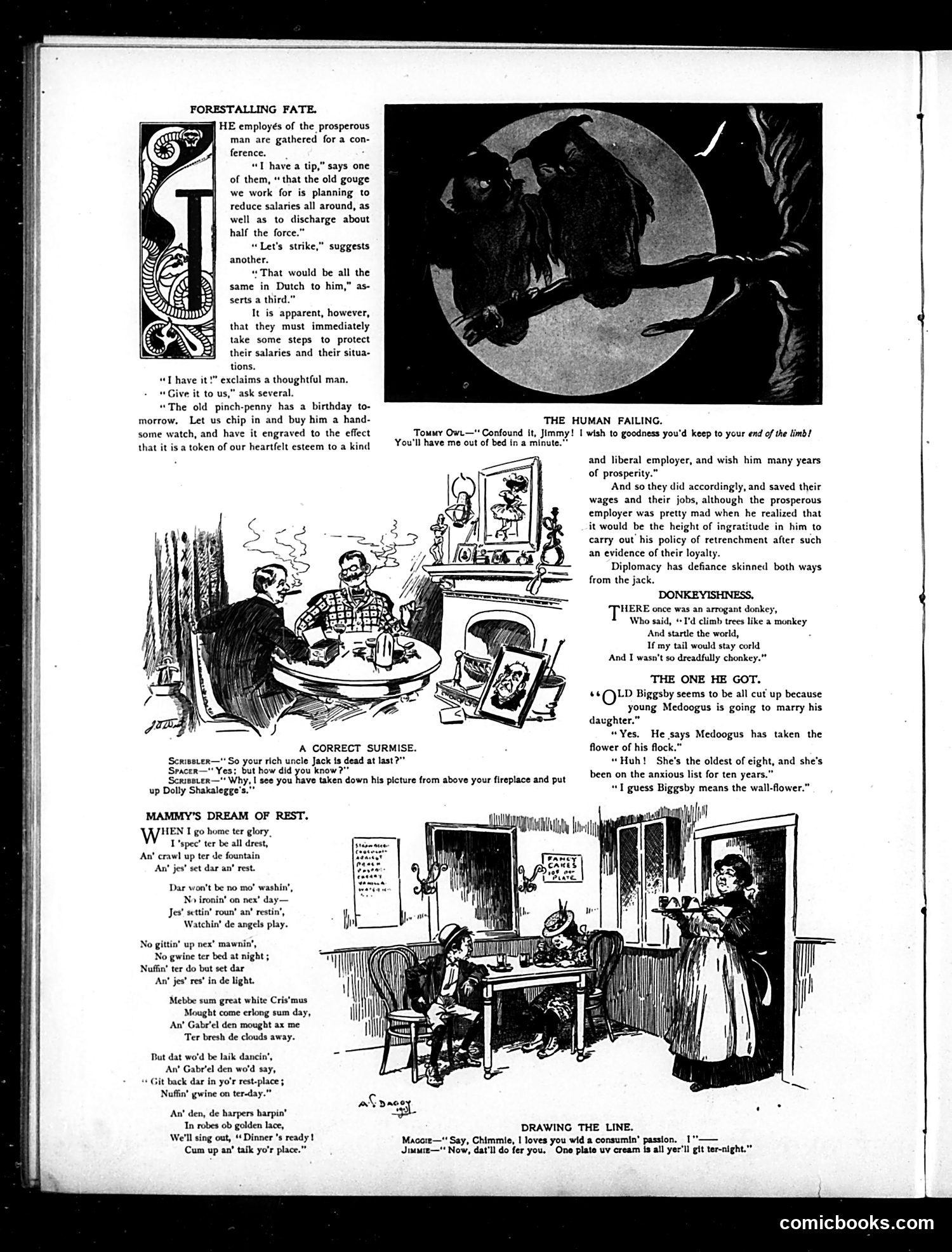
This page from *Judge* satirizes working-class labor relations and social dynamics of the era. **"Forestalling Fate"** (main story): Employees learn their stingy boss plans salary cuts and layoffs. Rather than strike, a clever worker suggests they buy him an expensive engraved watch as a birthday gift, flattering him as a "kind and liberal employer." The satire: workers manipulate their boss through false gratitude to protect their jobs—diplomacy defeats defiance. The employer, recognizing the gift's ironic timing with his retrenchment plans, realizes he *must* abandon cost-cutting or appear ungrateful. **Supporting cartoons** mock various follies: "Donkeyishness" ridicules arrogant pretension; "The One He Got" jokes about an unattractive daughter being the "flower" of the family; "Mammy's Dream of Rest" presents a domestic worker's fantasy of heavenly leisure. **"Drawing the Line"** depicts a young couple where the woman sets romantic boundaries—accepting passionate declarations but rationing dessert. The overall theme: cunning, compromise, and self-interest govern social relationships across class lines.
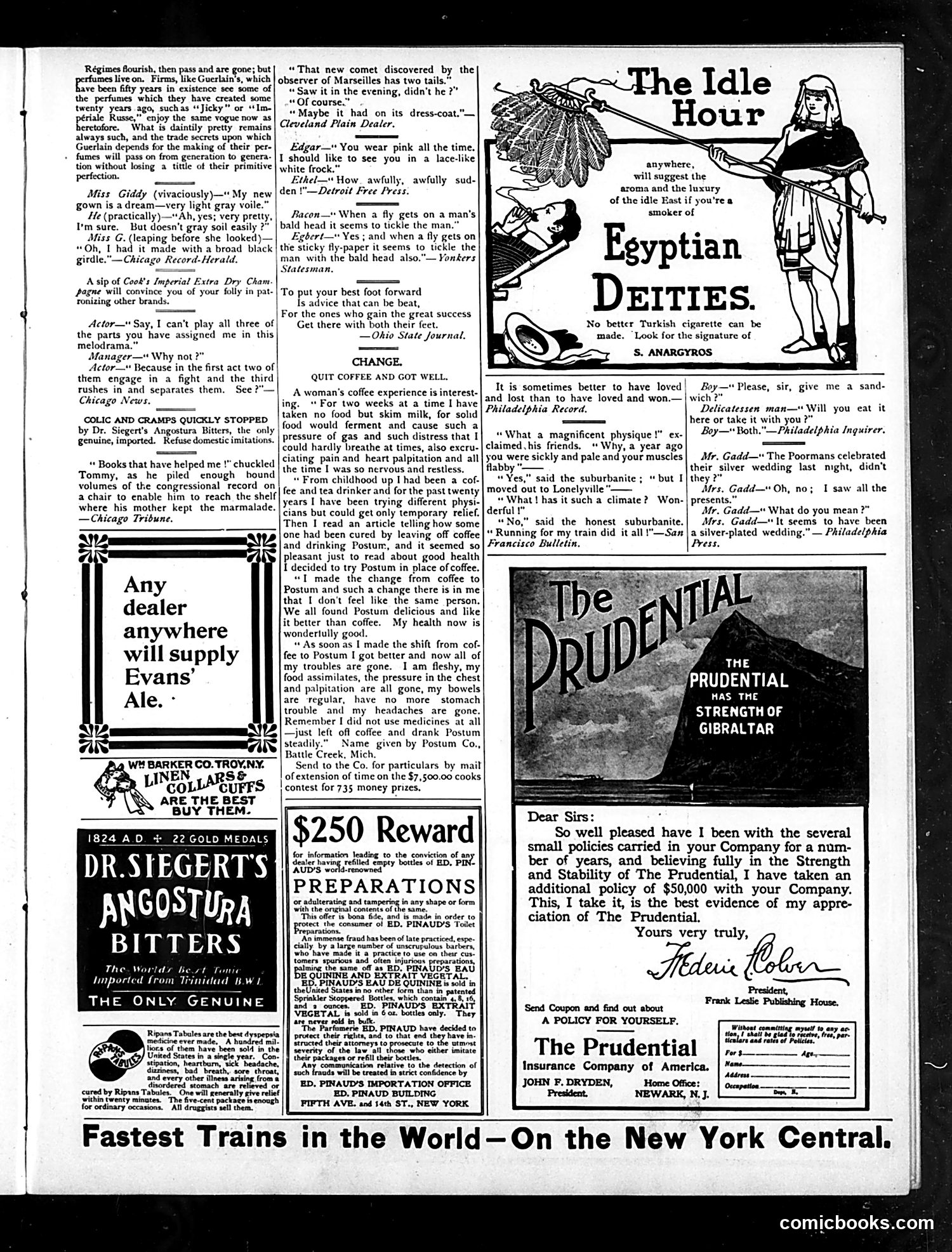
This page is primarily **advertisements and humor columns** rather than political cartoons. The content includes: **Main Features:** - "The Idle Hour" section: Brief jokes and witty exchanges (about comets, fashion, flies, etc.)—typical light satirical humor - Multiple product advertisements: perfumes (Guerlain), beverages (Evans' Ale, Cook's Champagne), and patent medicines (Dr. Siegert's Angostura Bitters) - A testimonial about switching from coffee to Postum cereal drink for health benefits - A Prudential Insurance advertisement with a letter from a satisfied customer **Notable Elements:** The "Egyptian Deities" cigarette ad features an orientalist illustration typical of early 20th-century marketing. The congressional record joke mocks politicians' verbose writings as useful only for reaching shelves—a common critique of legislative excess. **Context for Modern Readers:** This reflects Judge's format as a humor magazine funded by advertising. The content assumes readers' familiarity with domestic comedy (fashion mishaps, theatrical life) and patent medicine culture. There are no significant political cartoons visible on this particular page.
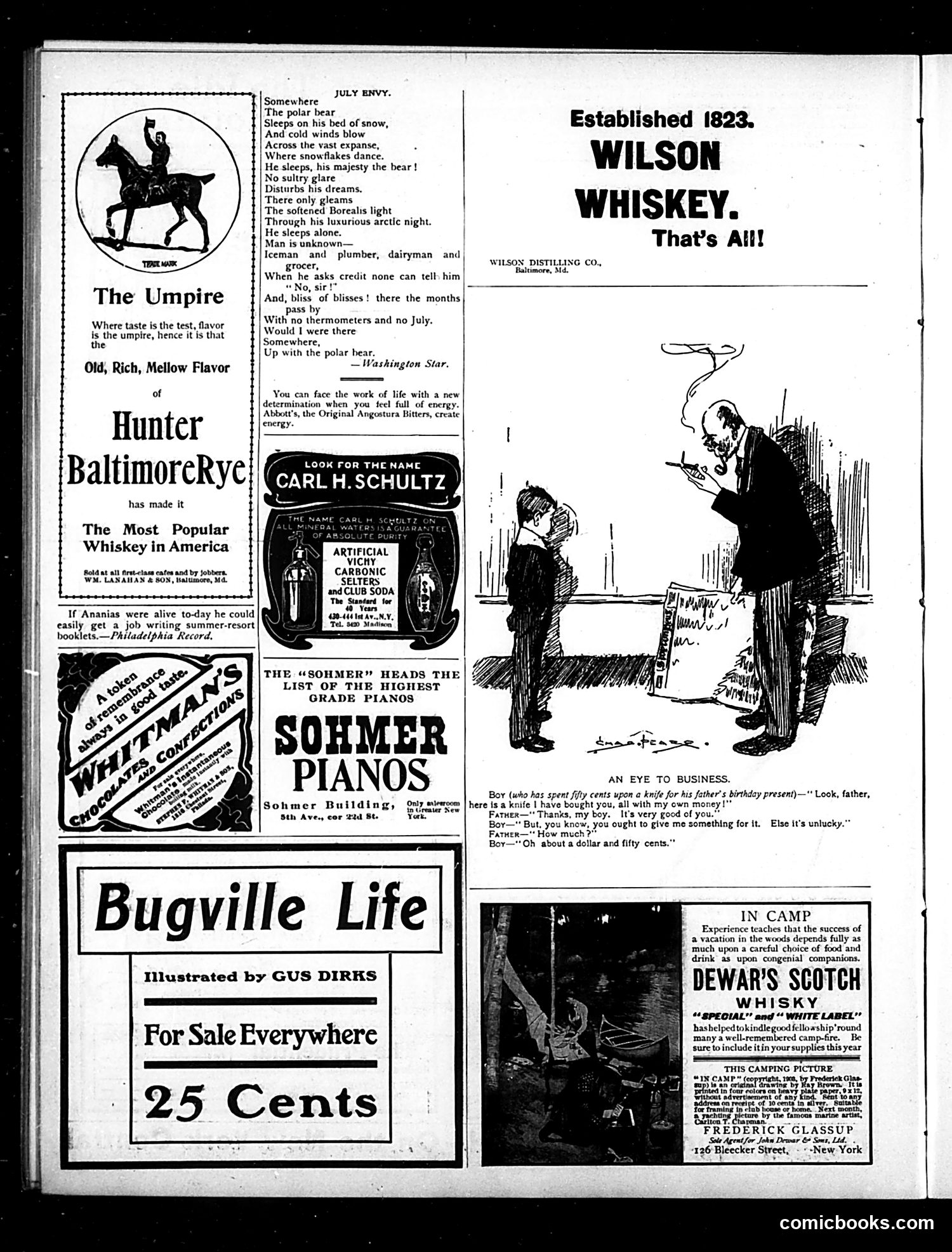
This page mixes advertising with light satirical content typical of Judge magazine. **"An Eye to Business"** (the main cartoon) depicts a father and son negotiating over a birthday gift. The boy bought his father a knife for fifty cents—his entire allowance—then immediately demands a dollar and fifty cents compensation "or it's unlucky." The satire targets childhood logic and petty commercialism: the boy treats gift-giving as a transaction requiring profit rather than genuine generosity. It's gentle humor about children's mercenary thinking. **"July Envy"** (a poem) expresses summer heat exhaustion through envying a polar bear sleeping peacefully in arctic snow, free from thermometers and July temperatures. The satirical point: modern man is enslaved by summer weather and social obligations while animals escape into blissful hibernation. The rest is period advertising for whiskey, pianos, and other products—standard Judge content where ads subsidized publication.
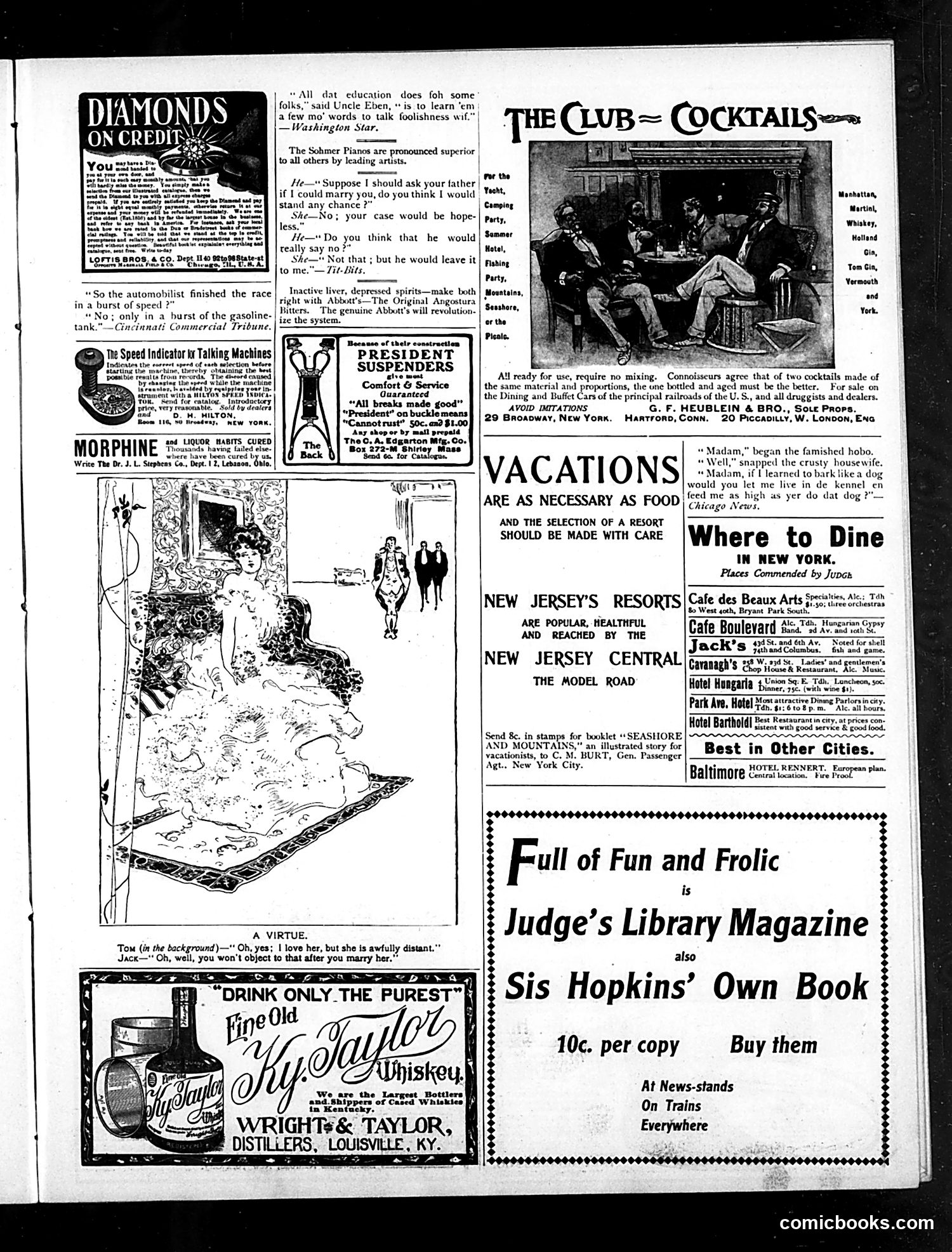
This page is primarily **advertising and lifestyle content** rather than political satire, typical of Judge magazine's format. The main cartoon, titled "A Virtue," depicts a domestic humor scenario: a man (Jack) tells his friend (Tom) he loves a woman but finds her "awfully distant." Jack responds that Tom won't object to her distance "after you marry her"—a joke about wives becoming cold or withdrawn after marriage. This reflects early-20th-century anxieties about matrimony and changing female behavior post-wedding. The page is dominated by ads for vacation resorts, dining establishments in New York, cocktails, whiskey, and patent medicines (morphine, Abbott's Bitters)—reflecting 1910s consumer culture and the pre-Prohibition cocktail era. A brief quoted joke from Uncle Eben (an African American dialect character, common in period humor) mocks education's inability to prevent foolishness—typical of era's racial caricature humor. Overall, this is a commercial page showcasing turn-of-the-century American leisure, dining, and medicinal products rather than political commentary.
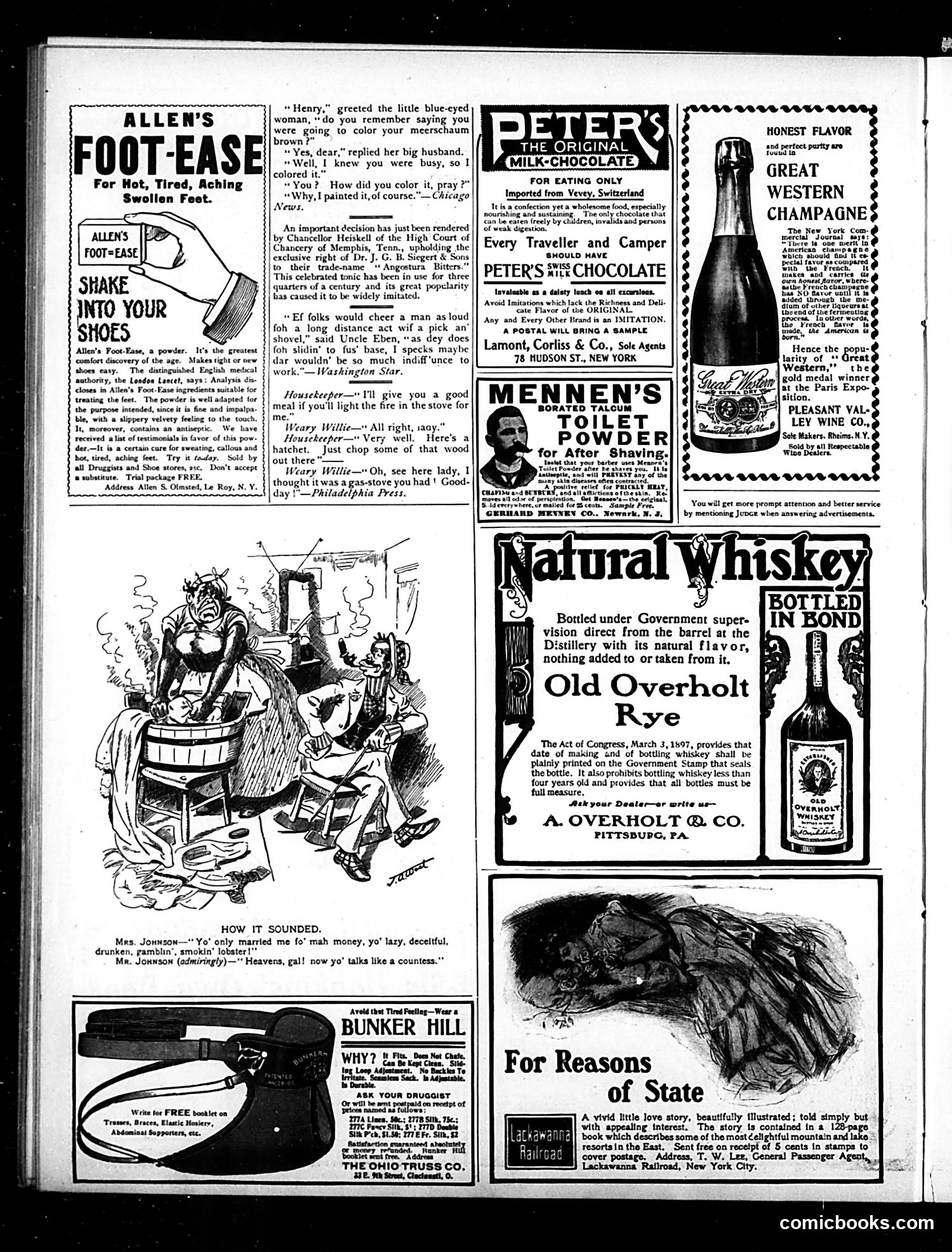
This page is primarily **advertising** with several brief humorous anecdotes interspersed. The main cartoon—"How It Sounded"—depicts a domestic scene where a wife insults her husband with a string of derogatory terms (calling him lazy, deceitful, drunken, gambling, smoking). The husband responds with admiration, saying she "talks like a countess." The satire mocks racial stereotypes and class pretensions: it appears to represent African American characters whose crude speech, when strung together elaborately, supposedly resembles upper-class refinement. This reflects period prejudices about race, speech, and social hierarchy. Other brief jokes reference domestic life and class distinctions: a wife painting her husband's pipe without permission; a hobo's confusion about a wood-burning stove; Uncle Eben's commentary on work ethic. The remaining content is product advertising (foot powder, chocolate, whiskey, wine, medical devices) typical of Judge's era, offering no political or social commentary beyond marketing claims.
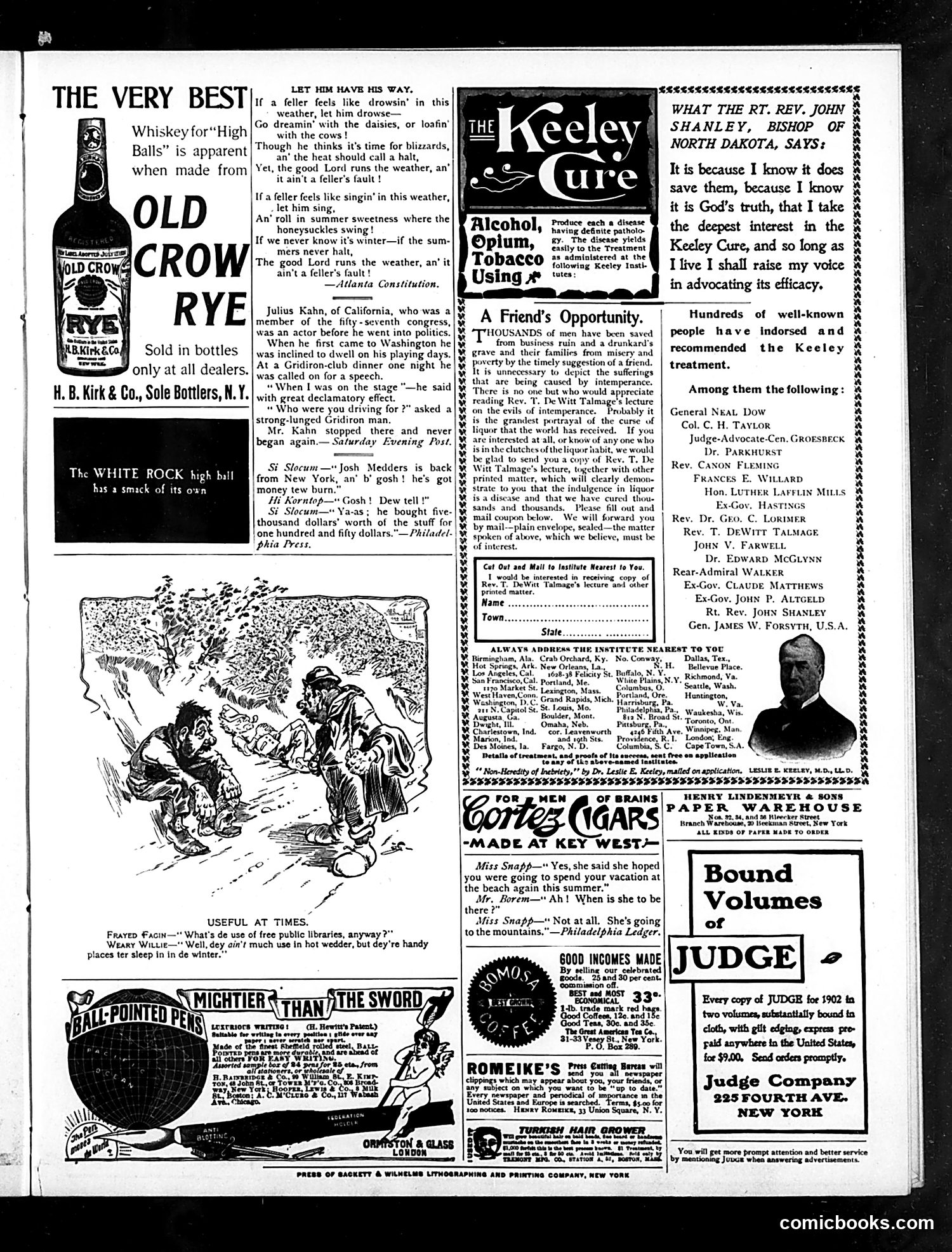
This page is primarily **advertising content with minimal editorial cartoons**. The satirical elements are modest: **The main cartoons:** 1. A small sketch showing two vagrants in conversation, captioned with a joke about using libraries as free sleeping places in winter—social commentary on homelessness and poverty. 2. A humorous dialogue between rural characters "Si Slocum" and "Hi Korntop" about a man buying expensive goods on credit. **The rest is advertising:** - Old Crow Rye whiskey - White Rock beverages - Keeley Institute (alcohol/drug treatment) - Cortes Cigars - Judge magazine bound volumes - Other miscellaneous products **Historical context:** The Keeley Cure was a famous (and controversial) late-19th/early-20th-century treatment for alcoholism, supported here by religious leaders. The endorsements reflect period attitudes toward addiction as treatable. The page contains far more commercial material than satire—typical of Judge magazine's revenue model.
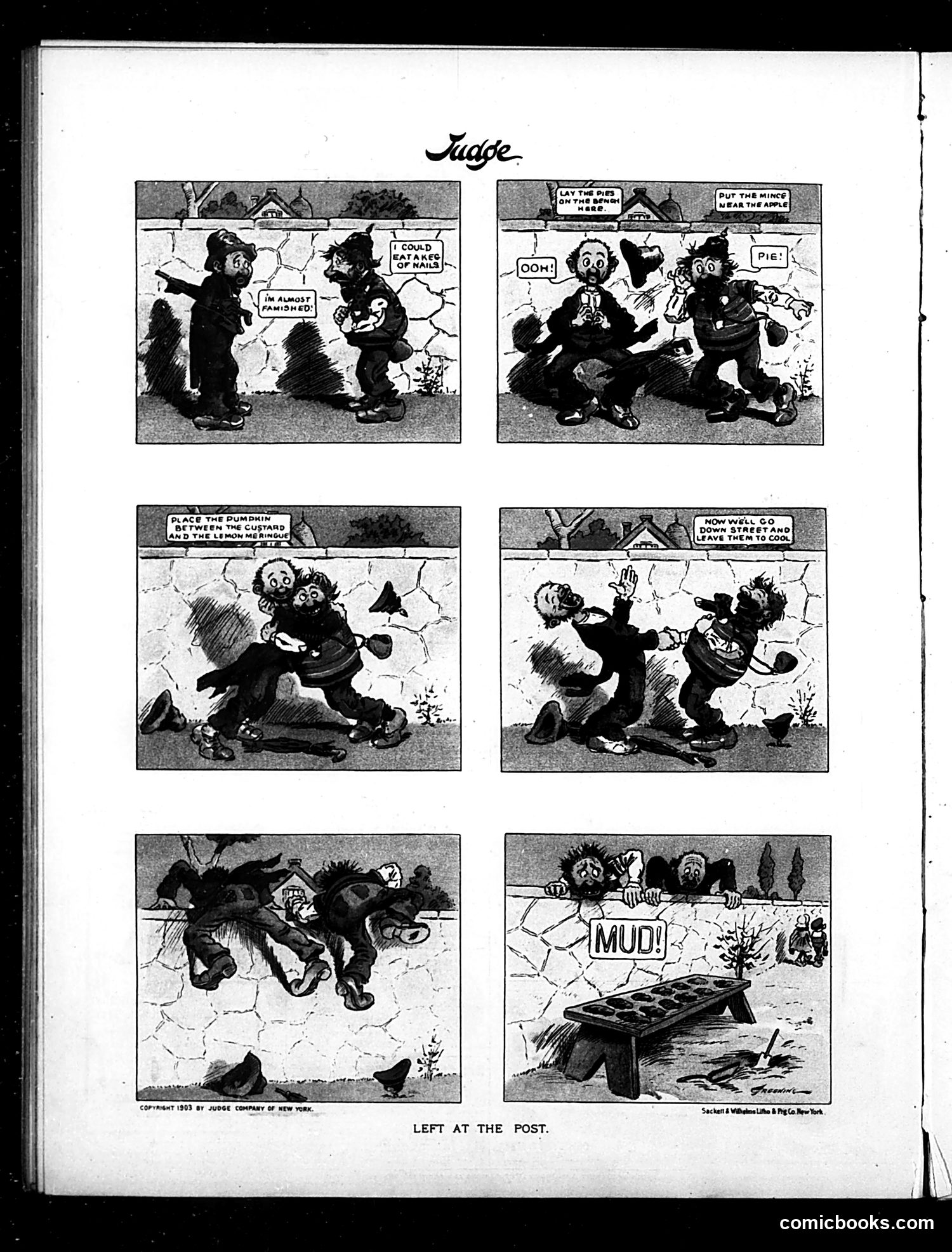
This six-panel comic depicts anthropomorphic animal characters (appearing to be dogs or similar creatures) in a domestic cooking scenario. The narrative shows them preparing a meal: one character mentions being "almost finished," another exclaims over the food ("Ooh! Pie!"), and they're instructed to "place the pumpkin, the oysters, the custard and the lemon-meringue" to cool. The final panel reveals the punchline: the characters have abandoned their cooling pies in a mud puddle, apparently unable to resist playing in mud instead of waiting patiently. The humor is straightforward slapstick—a contrast between civilized cooking preparation and animals' natural inclination toward messy play. The title "Left at the Post" suggests abandoning a task before completion. This appears to be gentle, family-oriented humor typical of Judge magazine's lighter content.