
A complete issue · 16 pages · 1903
Judge — June 20, 1903
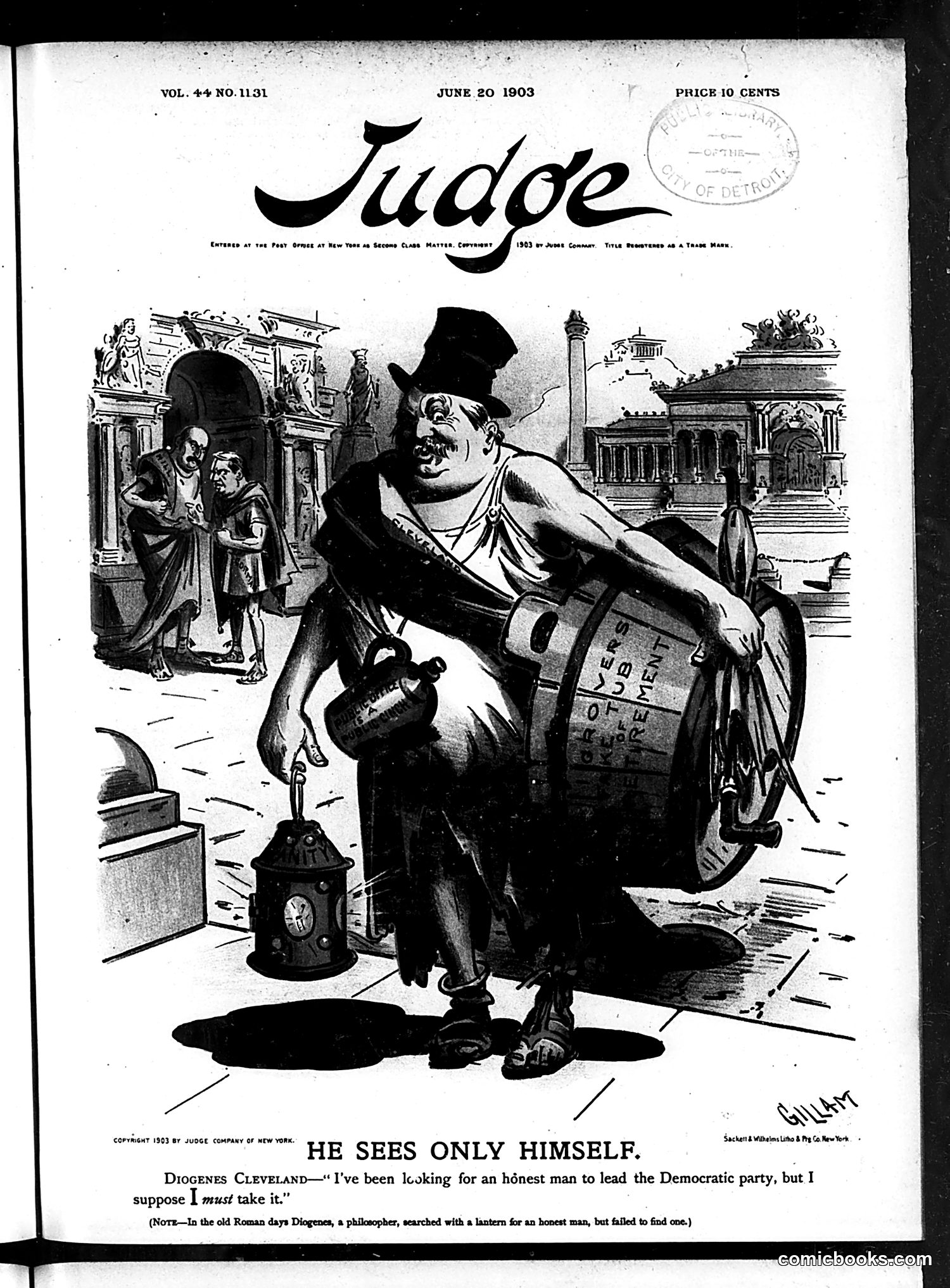
This June 1903 *Judge* cartoon satirizes Diogenes Cleveland's search for an honest Democratic Party leader. The central figure, a caricatured man holding a mirror and lantern (referencing the famous Greek philosopher Diogenes who searched for an honest man), represents Cleveland's futile quest. The satire suggests that Cleveland—likely former President Grover Cleveland—cannot find a suitable Democratic candidate because he only sees himself reflected back. The joke critiques Cleveland's narcissism or political inflexibility: he's unwilling to accept anyone but himself as party leader, making his search inherently pointless. The classical architectural setting in the background reinforces the Diogenes allusion, emphasizing the timeless nature of seeking integrity in politics.
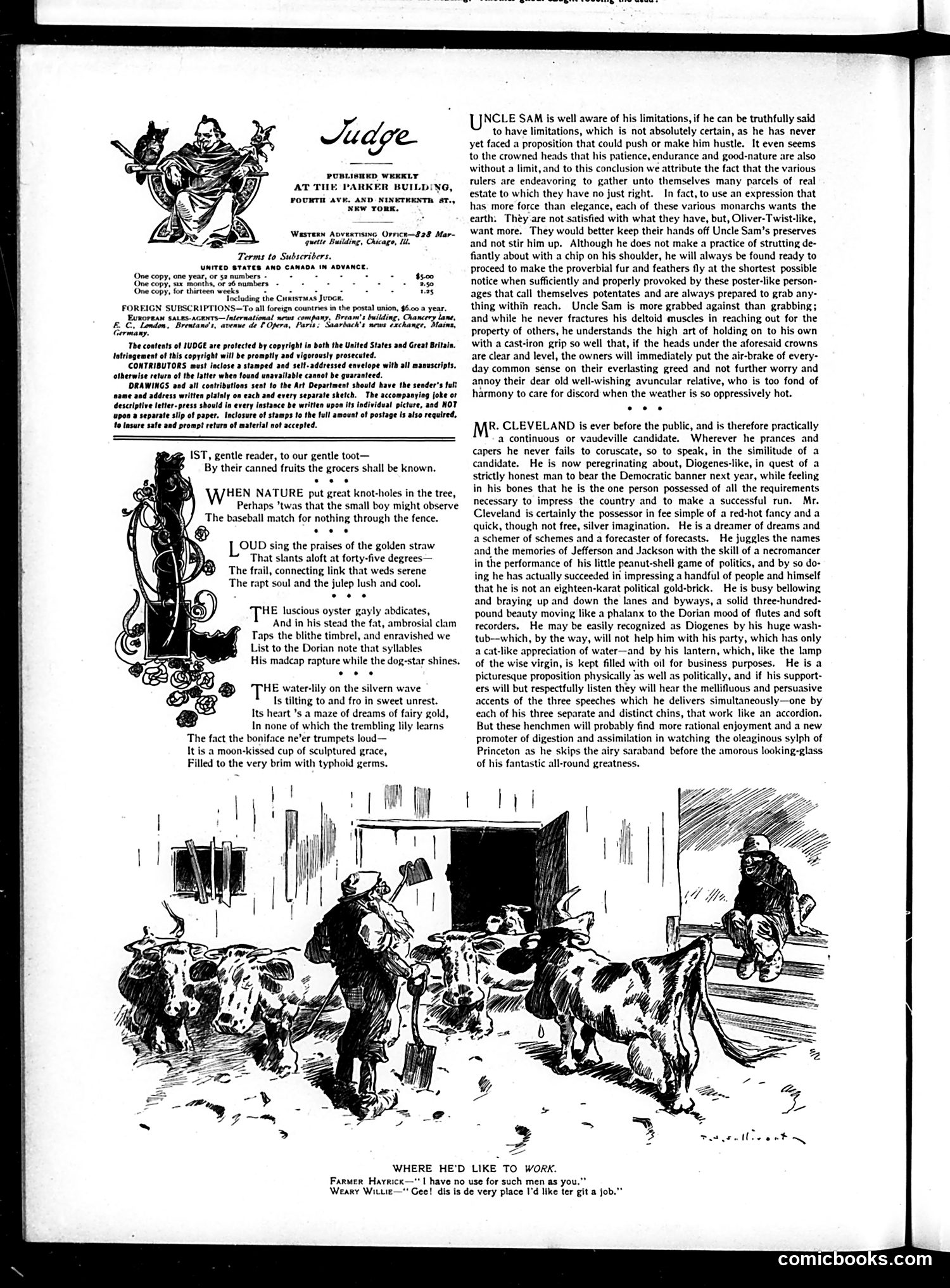
This page contains two main sections: **Upper Section - "Judge" Editorial Commentary:** Two unsigned essays critique political figures. The first discusses Uncle Sam's restraint despite pressure from various factions to intervene. The second attacks Mr. Cleveland, portraying him as a scheming, opportunistic politician who poses as honest while manipulating Democratic politics. The text sarcastically calls him "the possessor in fee simple of a red-hot toad and a quick...silver imaginings." **Lower Section - "Where He'd Like to Work" Cartoon:** A farmer (labeled "Hayrick") rejects a scruffy, disheveled man (likely representing Cleveland or a political charlatan) as unsuitable for farm work, saying "I have no use for such men as you." The cartoon suggests such politicians belong nowhere useful—it's a visual punchline mocking Cleveland's fitness for public office through this employment rejection scenario.
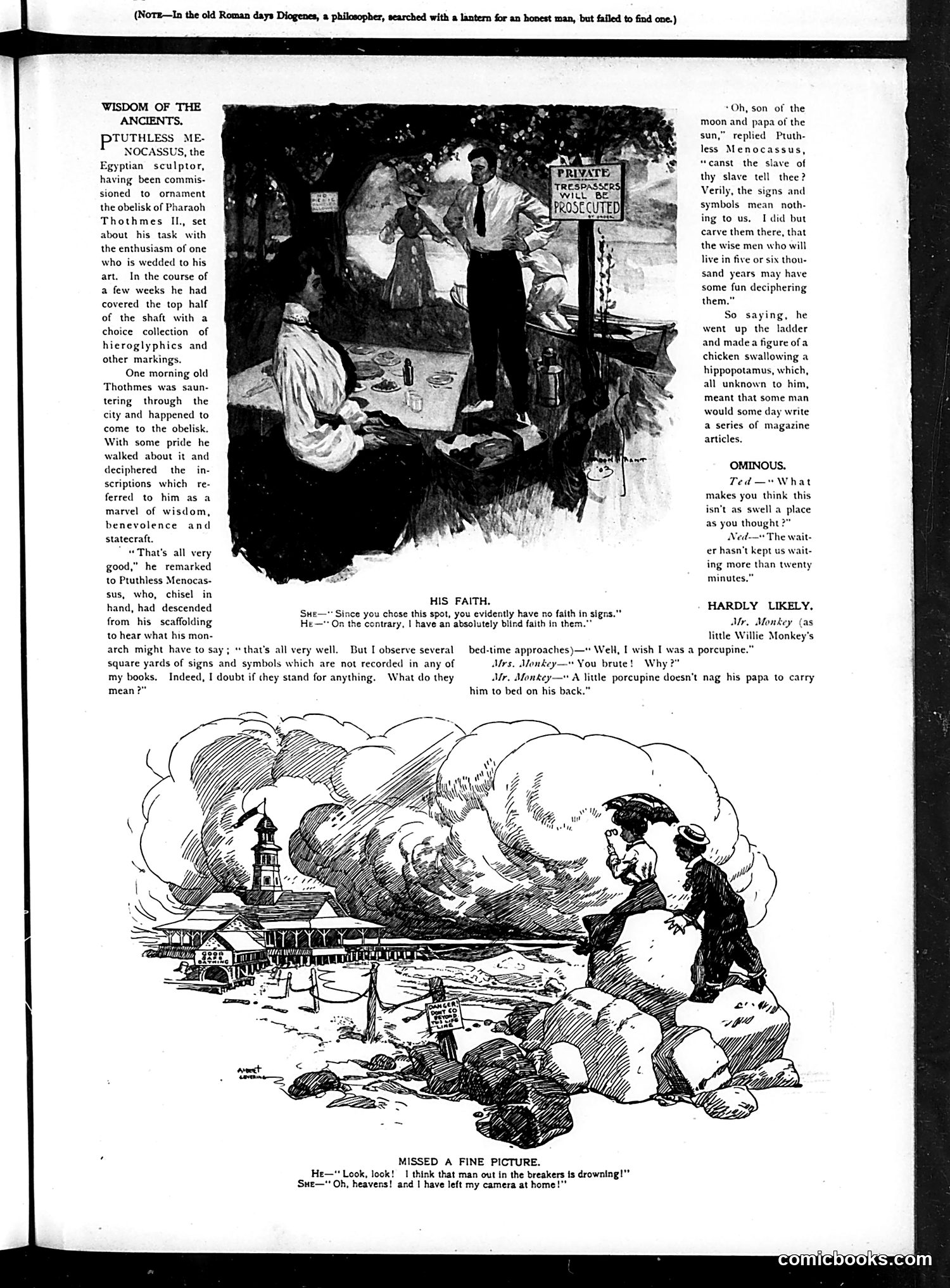
This page contains three separate humorous pieces typical of early 20th-century satirical magazines: 1. **"Wisdom of the Ancients"** (top): A story mocking scholarly pretension. A philosopher discovers hieroglyphic symbols in an Egyptian obelisk and confidently interprets them as profound wisdom, only to learn they're meaningless markings that skeptics doubt have any significance. 2. **"His Faith"** (middle): A domestic joke about a husband's blind faith in his wife's cooking abilities, despite her obvious incompetence. 3. **"Missed a Fine Picture"** (bottom): A cartoon where a woman expresses regret about leaving her camera at home while witnessing a dramatic maritime rescue scene. These pieces target intellectual pomposity, marital dynamics, and everyday modern anxieties—common Judge magazine themes.
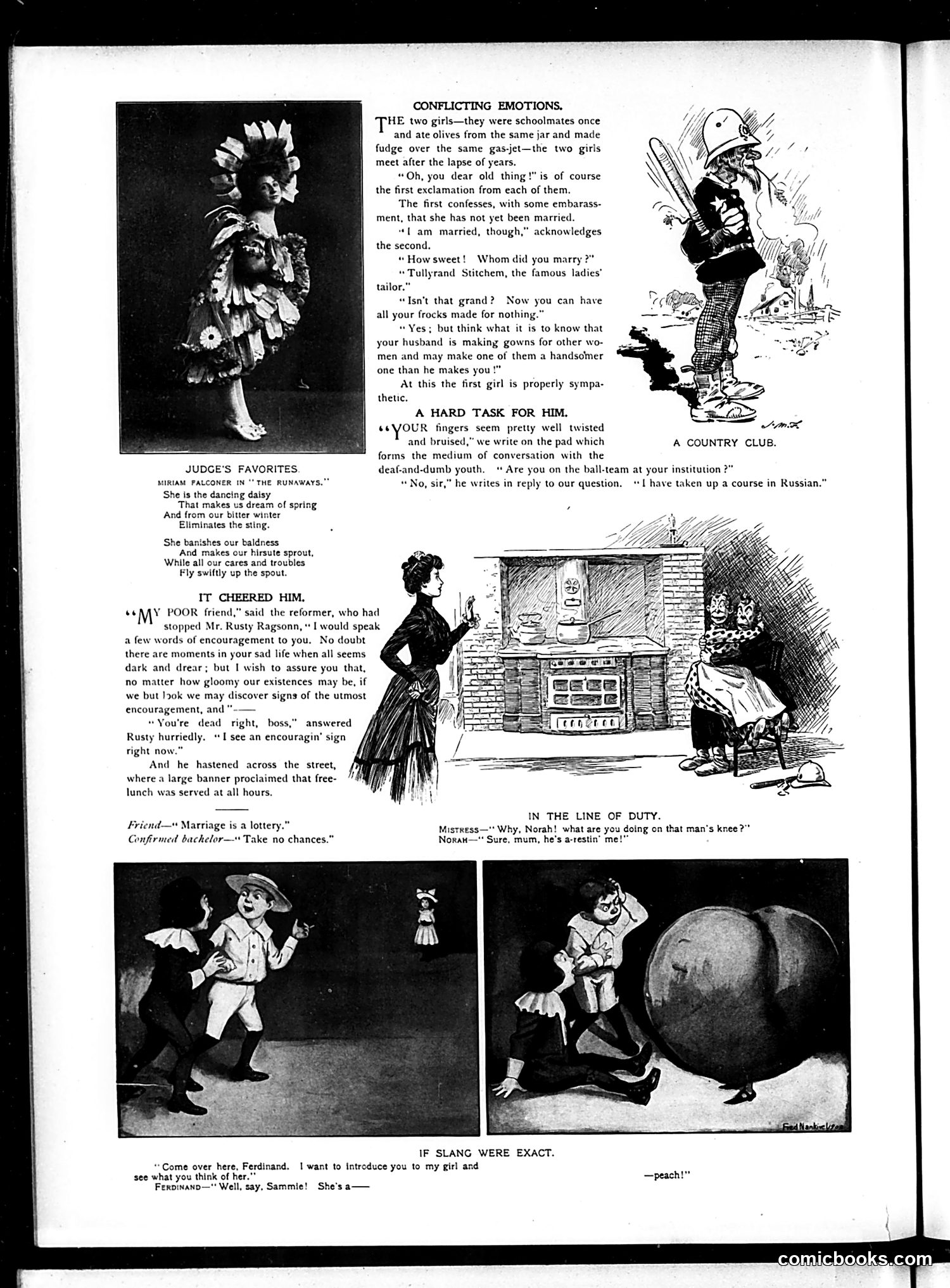
This page contains several unrelated humorous pieces typical of Judge magazine's satirical format: **"Conflicting Emotions"** depicts two former schoolmates reuniting—one unmarried, one married to "Tullyrand Stitchem, the famous ladies' tailor." The joke plays on social anxiety: the married woman worries her husband makes gowns for other women, implying infidelity concerns. **"A Hard Task for Him"** mocks a young man taking up Russian language courses, suggesting intellectual pretension. **"It Cheered Him"** satirizes a man's encouragement upon hearing of free-lunch service at a bar—commenting on working-class priorities. The remaining cartoons ("A Country Club," "In the Line of Duty," "If Slang Were Exact") appear to be domestic humor sketches without clear political content. The page emphasizes social commentary through everyday situations rather than specific current events.
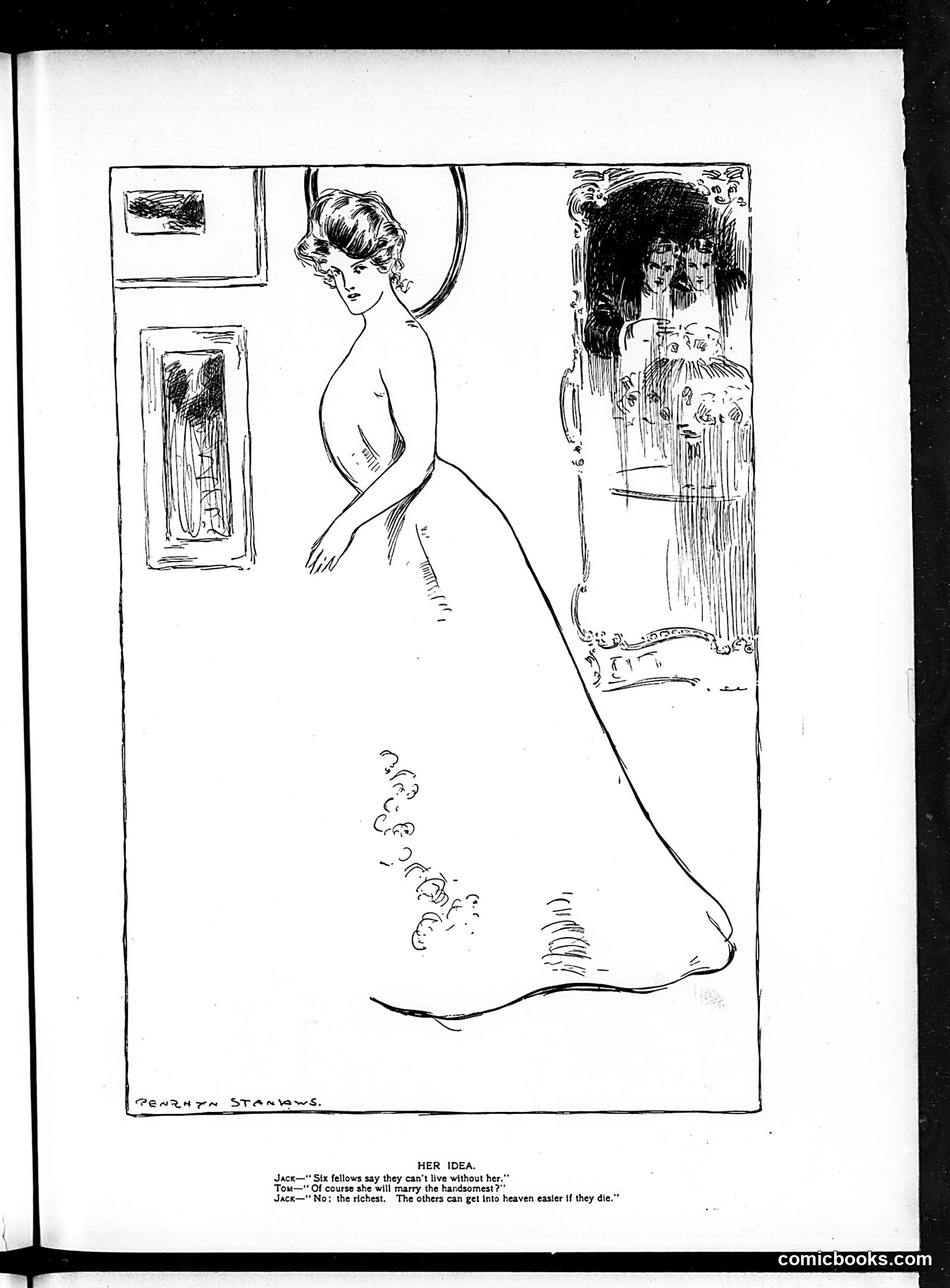
This early 20th-century cartoon satirizes competing male attitudes about women and marriage. The illustration shows a woman in profile, and the dialogue presents three contrasting views: **Jack** claims men cannot live without women. **Joe** counters that of course women will marry "the handsomest"—suggesting men compete on appearance. **Jack** responds with dark humor: "Not the richest. The others can gain to heaven easier if they die"—implying that wealthy men face moral judgment, while poorer men get easier passage to heaven. The satire mocks shallow masculine reasoning about courtship, mixing vanity, materialism, and mock-religious justification. The title "Her Idea" suggests the woman's perspective on these foolish male rationalizations remains absent or unknowable—typical of period humor that centered male discourse while marginalizing female voice.
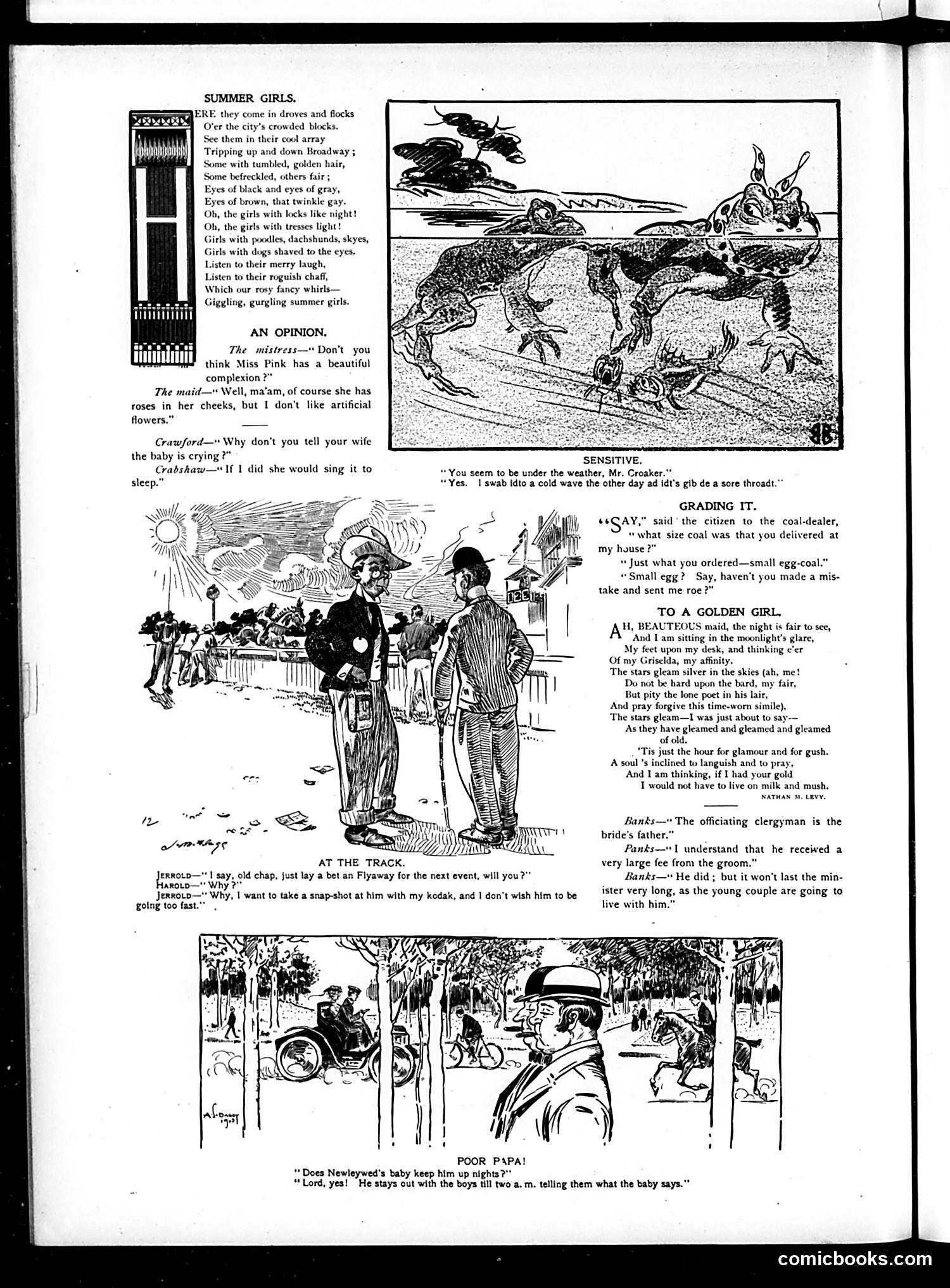
This page from Judge (American satirical magazine, likely early 1900s) contains multiple short humorous pieces mocking social conventions: **"Summer Girls"** poem celebrates fashionable young women parading through Broadway—flirtatious, well-dressed, with popular dogs and affectations of the era. **"An Opinion"** jokes about servants' candor: a maid dismisses her employer's friend's complexion as artificially rouged. **"At the Track"** satirizes photography hobbyists interfering with horse racing. **"Poor Papa"** ridicules new fathers as social nuisances, staying out late bragging about their babies. **"Grading It"** plays on coal-delivery confusion (egg-coal vs. fish roe). **"To a Golden Girl"** parodies romantic poetry while revealing mercenary motives—the poet wants the woman's money, not love. **"Banks"** jokes that a clergyman-father receiving a wedding fee won't keep it long since the couple will burden him with living expenses. These are typical Judge fare: gentle mockery of contemporary urban life, relationships, and middle-class pretensions.
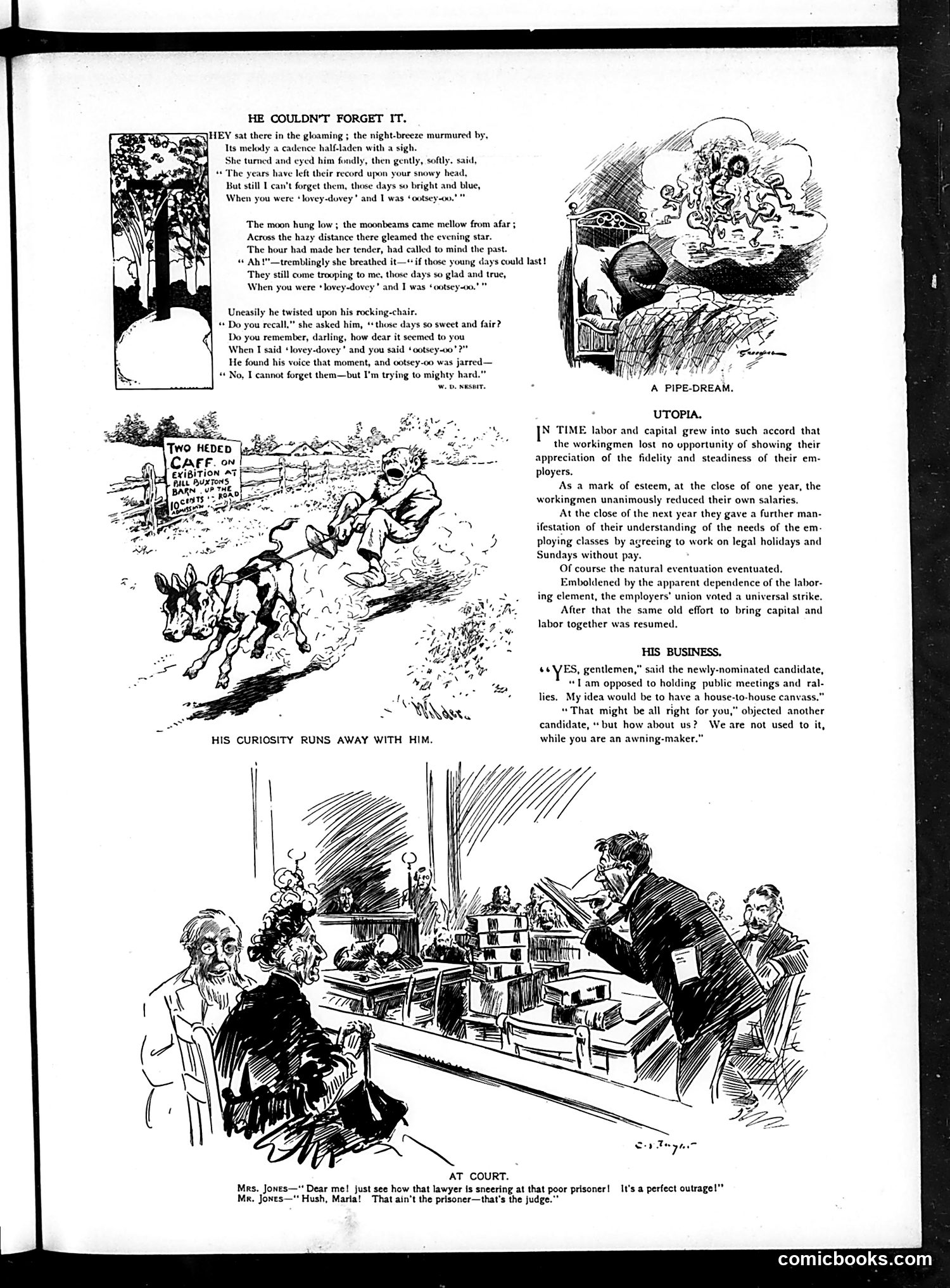
This page contains three satirical pieces: **"He Couldn't Forget It"**: A romantic poem mocking sentimental nostalgia. A couple reminisces about their courtship ("lovey-dovey" and "ootsey-oo"), but the husband admits he's "trying to mighty hard" to forget—satirizing how couples often struggle to sustain early romantic feelings. **"Utopia"**: Dark social commentary on labor-capital relations. Workers voluntarily reduce wages and work unpaid holidays to show "appreciation" for employers. When employers then strike anyway, the cycle resumes—mocking the supposed harmony between labor and capital as illusory and exploitative. **"His Business"**: A candidate for public office claims he opposes rallies and prefers house-to-house canvassing. Another candidate objects this won't work for them because they're "not used to it"—implying political candidates lack the work ethic of an awning-maker, satirizing politicians as disconnected from ordinary labor. **"At Court"**: A final joke: Mrs. Jones mistakes the judge's sneering expression for a prisoner's behavior, satirizing judicial demeanor and courtroom decorum.
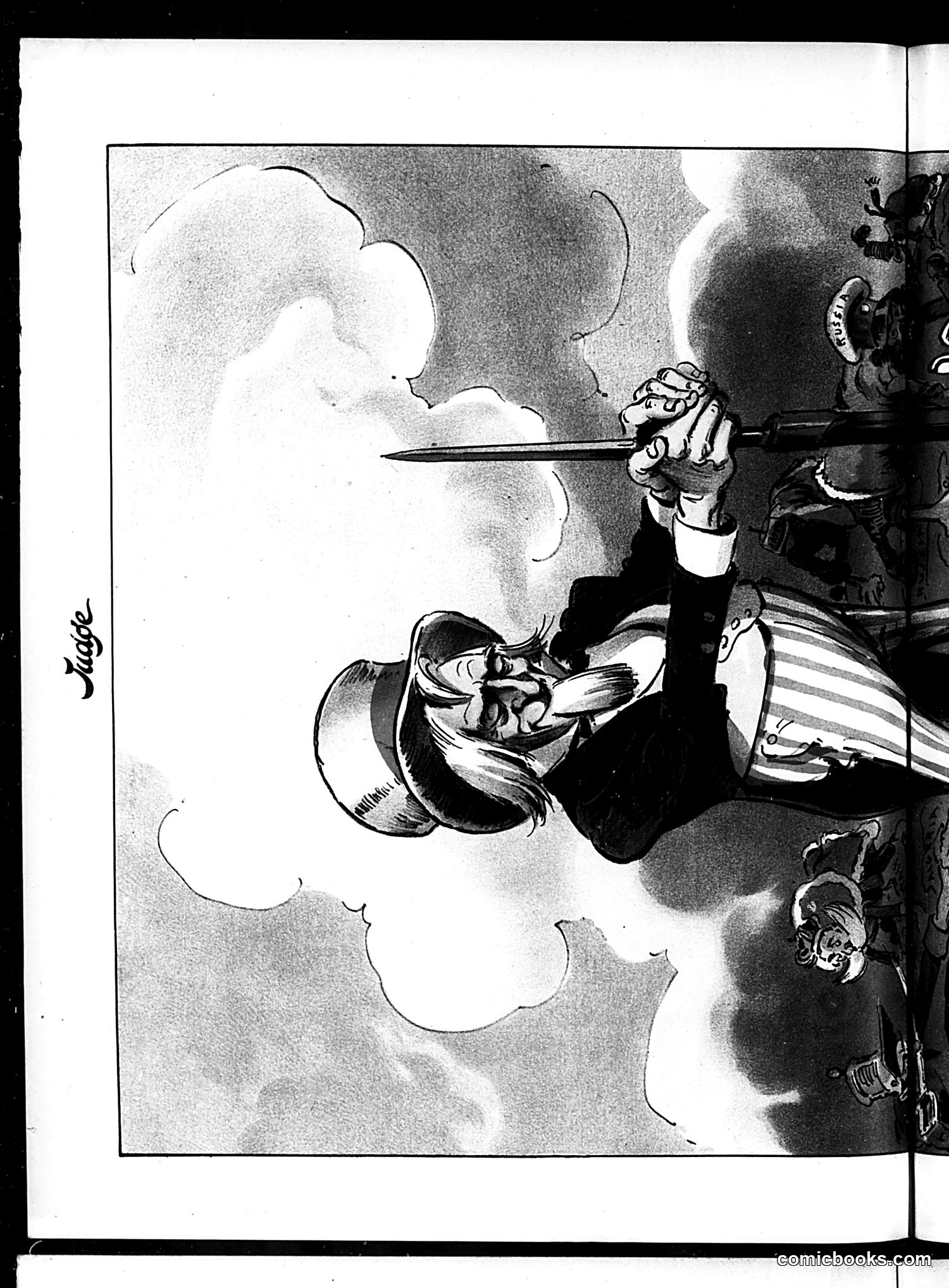
This appears to be a political cartoon from *Judge* magazine satirizing military or political leadership. The central figure, depicted as a pompous military or political official holding a sword/pointer, is shown addressing or commanding others visible in the lower right. The exaggerated facial features and theatrical pose suggest mockery of authoritarian pretension or incompetence. The large cloud-like shapes dominate the composition, possibly representing smoke, confusion, or obfuscation—suggesting the official is obscuring truth or creating chaos. The striped uniform and formal dress indicate high rank, but the cartoon's tone implies criticism of this figure's actual capability or judgment. Without clearer context about the specific historical moment, I cannot definitively identify the individual being caricatured or the exact political event referenced.
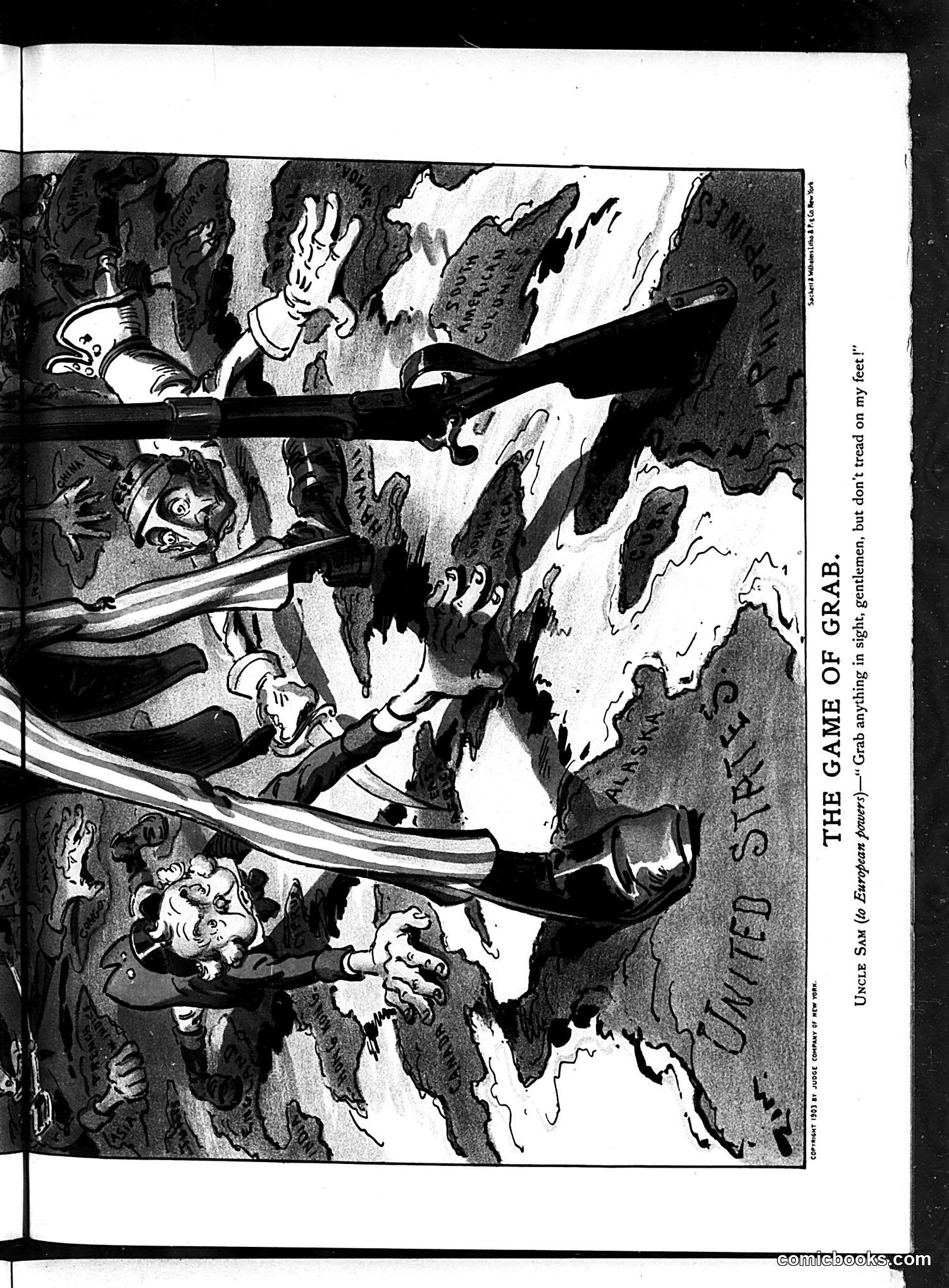
The OCR text is severely corrupted and unreadable, making it impossible to extract the caption or title with confidence. From the **image alone**: This appears to be a political cartoon showing multiple caricatured figures engaged in what looks like a physical struggle or "grabbing" scene over a map of the United States. The style and rendering suggest early-to-mid 20th century American political satire. The figures appear to be in conflict over American territory or resources. Without legible text identifying the specific figures, political moment, or satirical point, I cannot reliably explain what this cartoon means to a modern reader. The subject appears to involve **competing interests over American control or resources**, but the specific historical context—whether referencing a particular political crisis, corporate conflict, or policy debate—remains unclear from the image alone.
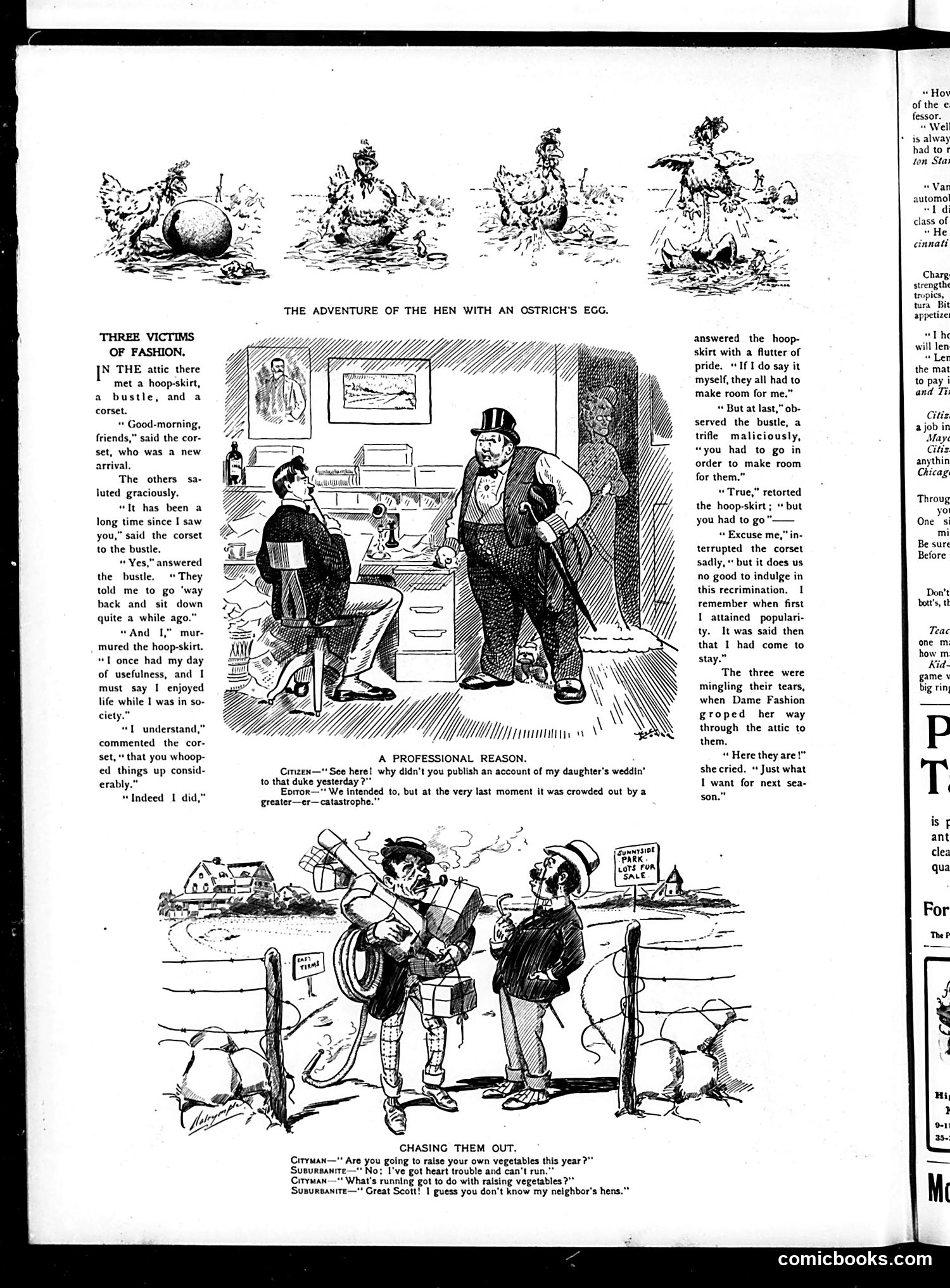
This page satirizes women's fashion through personified garments debating their obsolescence. A **hoop-skirt, bustle, and corset** meet in an attic, each lamenting how fashion has discarded them for newer styles. The corset, newly arrived, represents the current trend; the hoop-skirt and bustle are outdated predecessors. Their dialogue—with the bustle cattily noting the hoop-skirt "had to go in order to make room"—mocks how fashion cycles relentlessly replace itself. The punchline arrives when **Dame Fashion** (personified) retrieves all three from storage, declaring "Just what I want for next season"—suggesting fashion trends are cyclical and arbitrary, not based on logic or genuine improvement. The accompanying cartoons joke about city life and suburban gardening, unrelated to the main piece. The satire targets fashion's superficiality and the social pressure on women to constantly adapt their appearance to arbitrary standards.
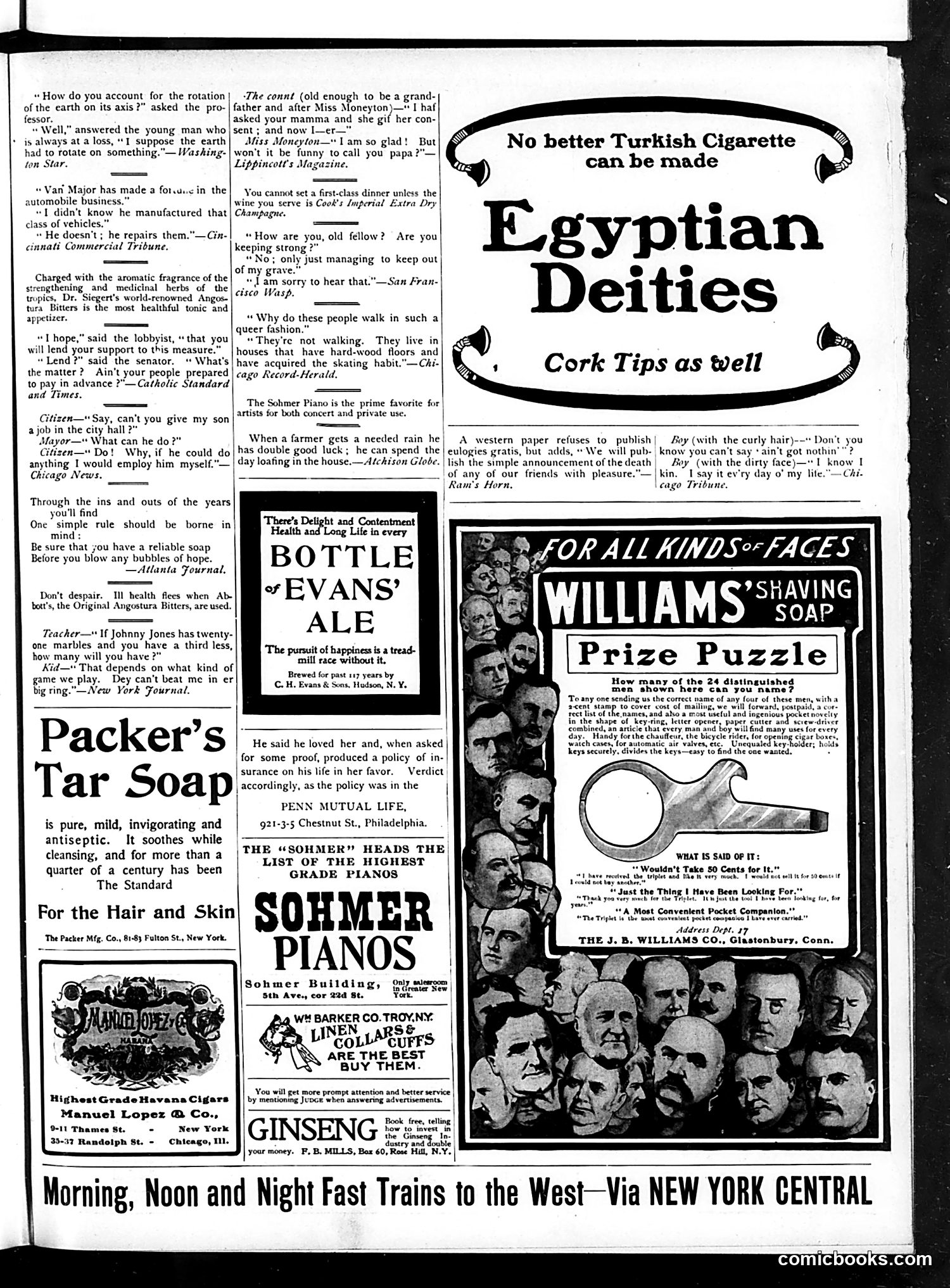
This page is primarily **advertising**, not political satire. It's a typical early 20th-century Judge magazine page mixing short humorous anecdotes with commercial advertisements. The small jokes scattered throughout are mild workplace and domestic humor—a student deflecting a physics question, a lobbyist bribing a senator, a kid avoiding a math problem by talking about marbles games. These reflect common contemporary gripes: bureaucratic corruption, education, and childhood mischief. The dominant content is ads for **products marketed to gentlemen and households**: soaps (Packer's Tar, Williams'), pianos (Sohmer), cigars (Manuel Lopez, Egyptian Dieities), ale, champagne, ginseng, cuff links, and trains. The ads emphasize quality, tradition ("brewed 117 years"), and respectability—typical marketing appeals for Judge's middle-class male readership. There are **no identifiable political figures or events** on this page. The satire is generic and timeless rather than topical.
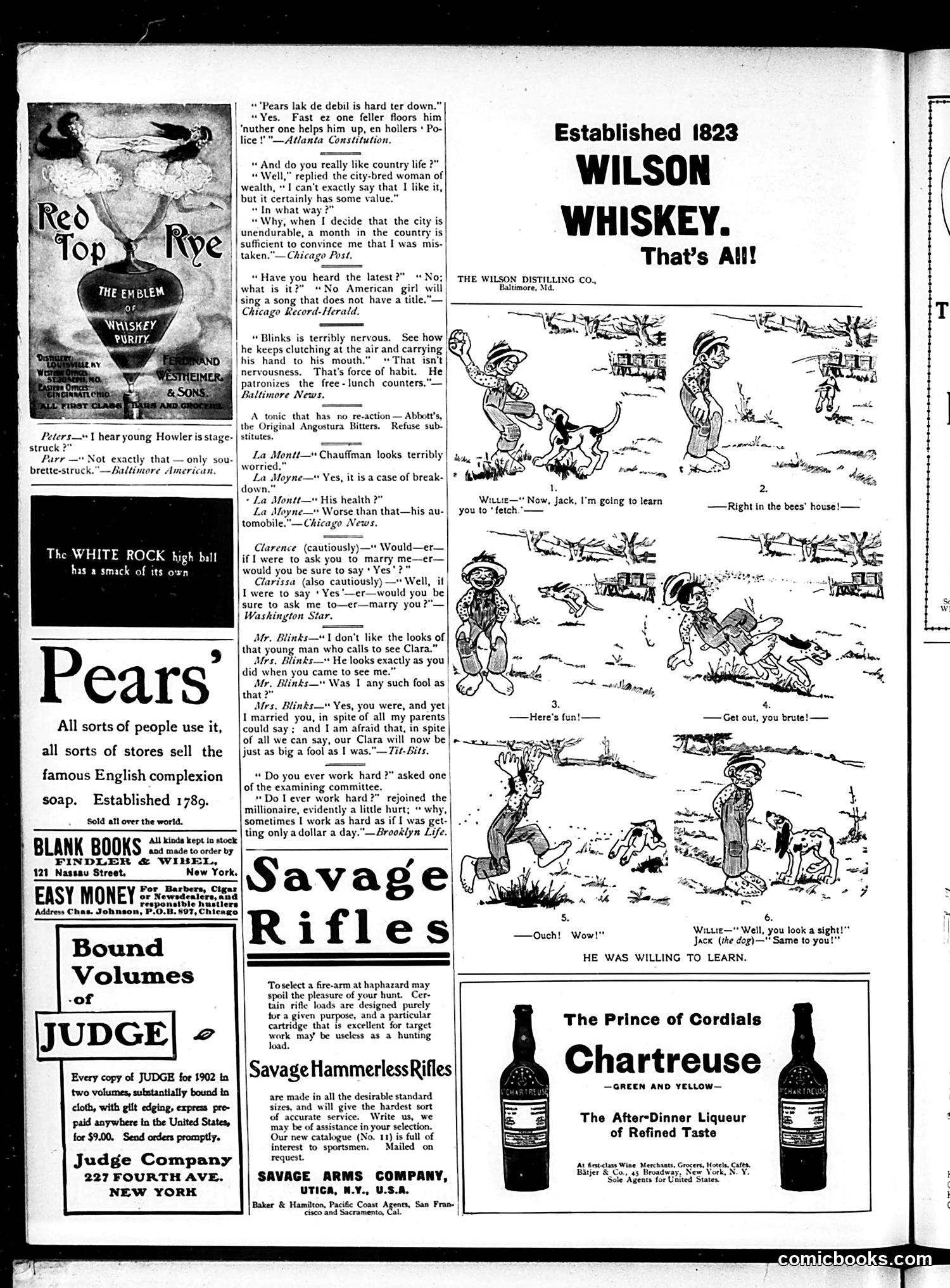
This page mixes advertisements with brief jokes and one illustrated comic titled "He Was Willing to Learn." The main cartoon shows a domestic scene where a woman (Willie) attempts to teach her dog to fetch—a task the dog resists, jumping and yelping. The humor relies on the innocent double meaning: the woman is earnestly training the dog while the dog's protests ("Ouch! Wow!") suggest resistance to learning basic obedience. The surrounding text consists of short jokes from newspapers about everyday life—relationships, nervous habits, automobiles, courtship. A notable example uses dialect ("Pears lak de debil is hard ter down") reflecting attitudes typical of the era. The page is primarily **advertising**: Wilson Whiskey, Savage Rifles, Chartreuse liqueur, Pears complexion soap, and Judge Company's bound volumes. This was typical of Judge magazine's revenue model during this period (early 1900s).
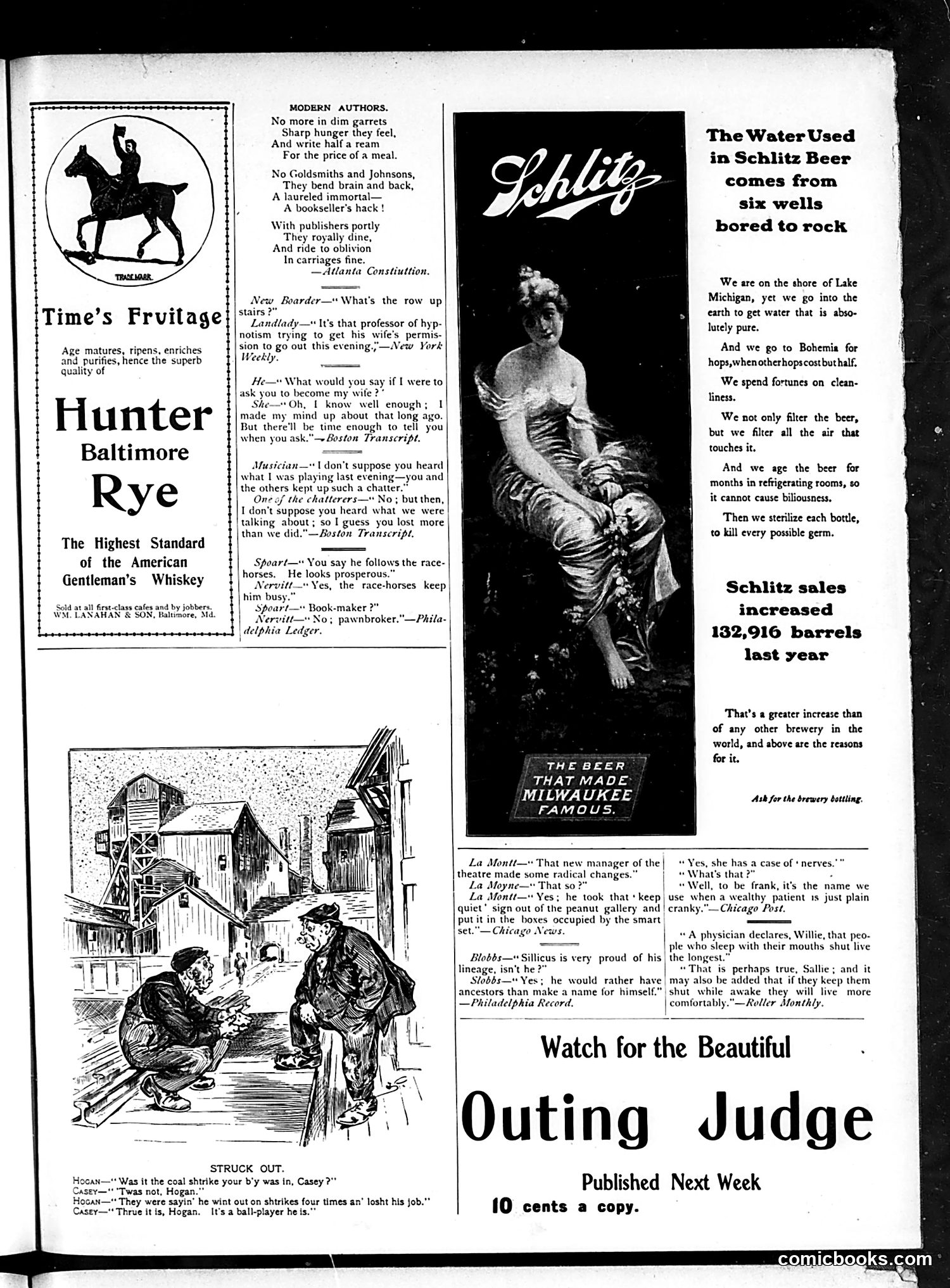
This page from the satirical magazine *Judge* contains several short joke items mocking contemporary social trends: **"Modern Authors"** satirizes commercialized writing—contrasting romanticized "starving artist" stereotypes (Goldsmith, Johnson) with contemporary authors who dine royally with wealthy publishers and ride "to oblivion / In carriages fine." The joke: modern writers have sold out, prioritizing commercial success over artistic integrity. **"Struck Out"** plays on Irish-American dialect humor (common in the era), where Casey's son isn't a coal-strike participant but a baseball player who's been "struck out" multiple times—a pun on labor strikes versus sports. The remaining items are brief domestic/professional humor snippets typical of *Judge*'s format. **Advertisements** dominate the page: Hunter Baltimore Rye whiskey, emphasizing "highest standard"; and Schlitz beer, claiming purity through deep well-water and hygiene practices—reflecting early 20th-century marketing around "scientific" cleanliness. The page is primarily **advertising-driven light humor**, representative of *Judge*'s blend of satire and commercial promotion.
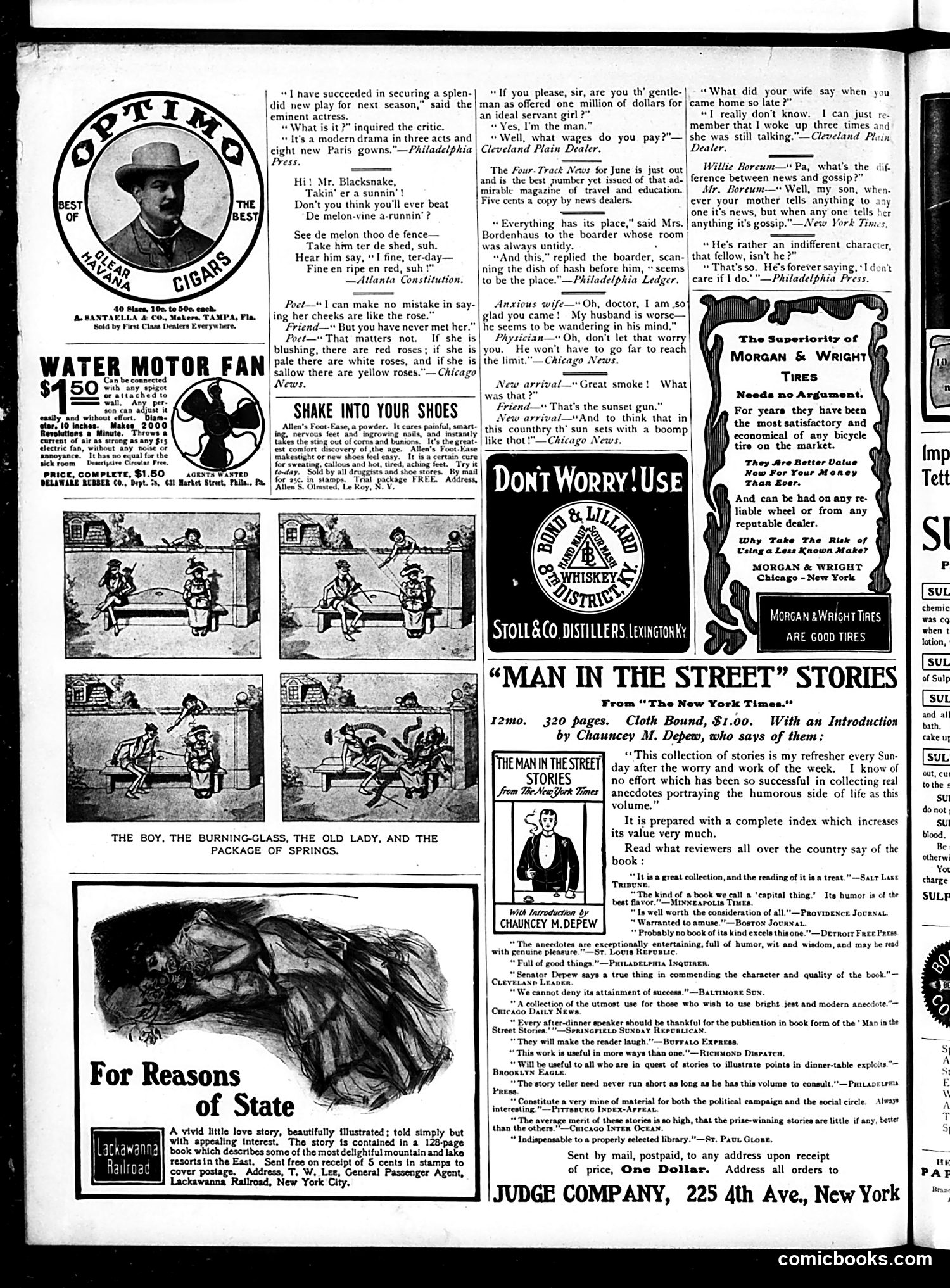
This page is primarily **advertising and light humor**, typical of Judge magazine's format. The content includes: **Comic Elements:** - Short jokes about marriage, servants, and social behavior (wives talking too much, husbands wandering mentally, etc.) - A dialect poem about a blacksnake and melon vine (reflecting period racial stereotypes) - Wordplay about poets describing roses and a boarder's comment about hash serving as food's "proper place" **Advertisements:** - Water motor fans, foot powder, bicycle tires, and whiskey dominate the page - A prominent book advertisement for "Man in the Street Stories" from Judge's New York Times collection **The Satire:** The opening joke about an actress's "new play" with "eight new Paris gowns" satirizes shallow theatrical productions prioritizing fashion over substance—a common Judge target mocking pretentious entertainment. The page reflects Gilded Age concerns: idle wealthy people, servant problems, marital discord, and consumer goods marketing. Most humor relies on period-specific social anxieties now largely unfamiliar to modern readers.
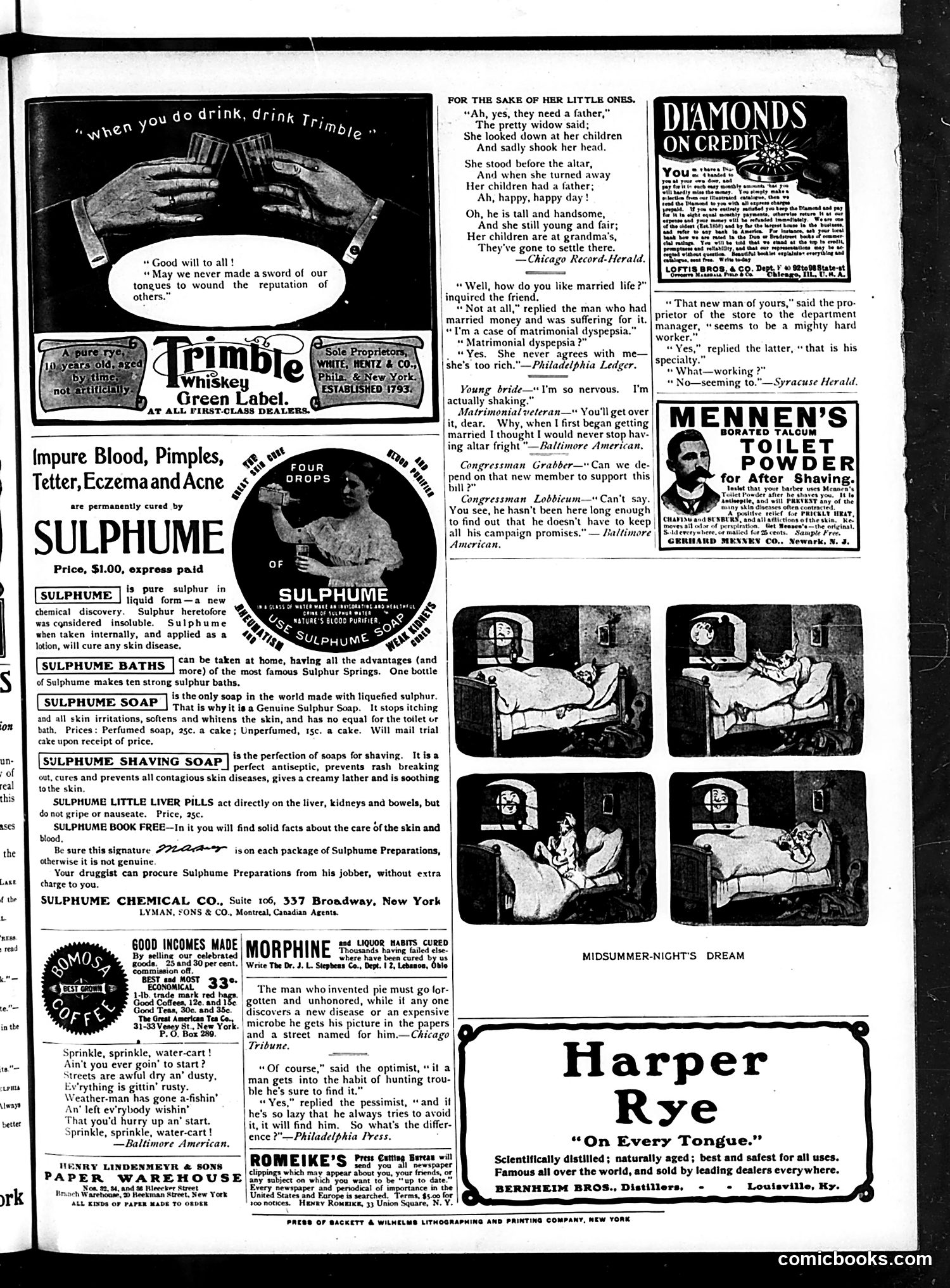
This is primarily an **advertising page** with minimal editorial content. The few satirical pieces are brief: **"Midsummer-Night's Dream"** (photo strip): A visual joke about a man's dream sequence, though the specific narrative is unclear from the OCR'd text. **Short aphorisms**: Include observations on optimism/pessimism and the absurdity that inventors of diseases gain fame while the inventor of pie is forgotten—mild social commentary on what society values. **"For the Sake of Her Little Ones"**: A sentimental poem about a widow remarrying for her children's sake, only to abandon them to grandma's care—likely satirizing the gap between noble intentions and actual behavior. The page is dominated by **patent medicine advertisements** (Sulphume, Morphine, Romoke's) typical of early 1900s Judge magazine. These ads are now historically notable as examples of unregulated medical claims that would later be prohibited. No specific political figures or events are referenced.
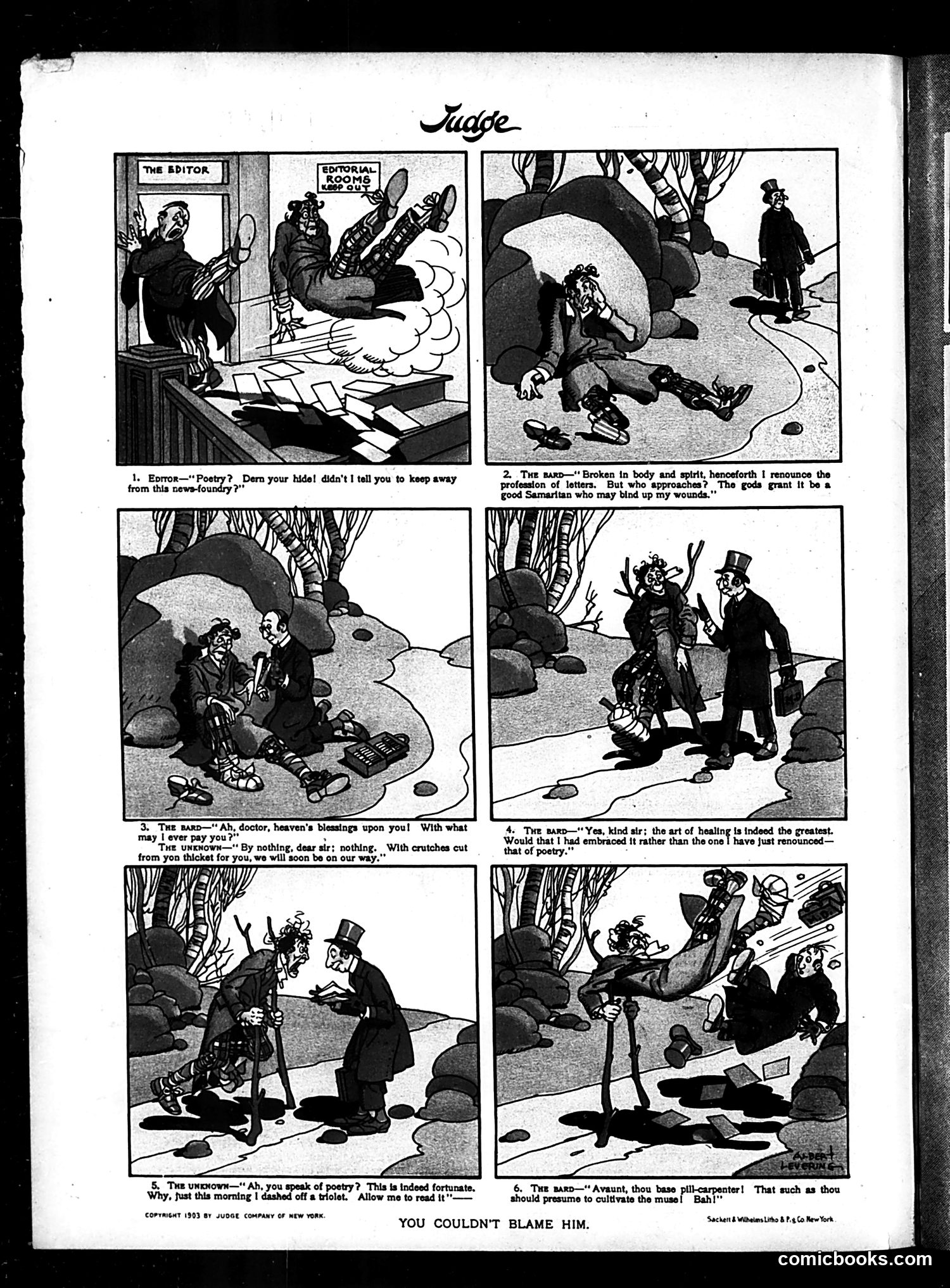
This six-panel comic from Judge magazine (1903) mocks a poet's hypocrisy. The story follows a vain writer ("the Bard") who is robbed and beaten by a vagabond. Near death, he renounces poetry, praising the practical skill of healing. A well-dressed stranger appears, offering aid with makeshift crutches. The Bard celebrates this "good Samaritan," only to discover the helper is a pill-seller (patent medicine hawker)—a profession the Bard considers beneath him. He furiously rejects the assistance, calling the man a "base pill-carpenter." The satire targets literary snobs who romanticize poverty and suffering while simultaneously looking down on working-class professions. The Bard's sudden contempt for the pill-seller—despite moments earlier praising any healer—reveals the hypocrisy of bohemian attitudes. The title's punch: "You couldn't blame him" suggests readers should sympathize with the insulted merchant, not the ungrateful poet.