
Judge, 1903-06-20 · page 7 of 16
Judge — June 20, 1903 — page 7: what you’re looking at
What you’re looking at
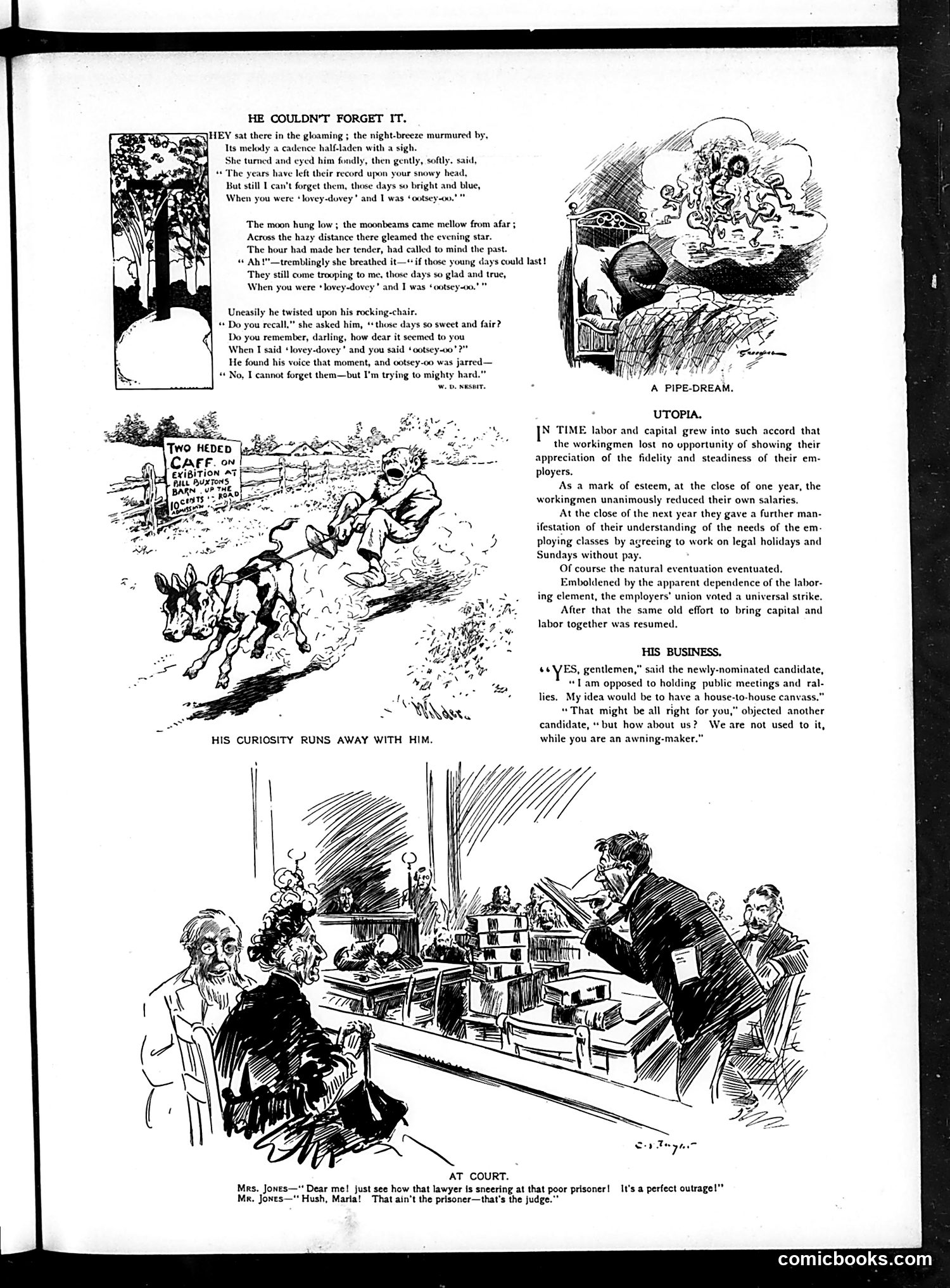
This page contains three satirical pieces: **"He Couldn't Forget It"**: A romantic poem mocking sentimental nostalgia. A couple reminisces about their courtship ("lovey-dovey" and "ootsey-oo"), but the husband admits he's "trying to mighty hard" to forget—satirizing how couples often struggle to sustain early romantic feelings. **"Utopia"**: Dark social commentary on labor-capital relations. Workers voluntarily reduce wages and work unpaid holidays to show "appreciation" for employers. When employers then strike anyway, the cycle resumes—mocking the supposed harmony between labor and capital as illusory and exploitative. **"His Business"**: A candidate for public office claims he opposes rallies and prefers house-to-house canvassing. Another candidate objects this won't work for them because they're "not used to it"—implying political candidates lack the work ethic of an awning-maker, satirizing politicians as disconnected from ordinary labor. **"At Court"**: A final joke: Mrs. Jones mistakes the judge's sneering expression for a prisoner's behavior, satirizing judicial demeanor and courtroom decorum.
📄 Transcribed text from this page (OCR, searchable)
Machine-transcribed from the original scan — historical spelling and the odd misread are preserved.
HE COULDN'T FORGET IT. HEY sat there in the gloaming ; the night-breeze murmured by, Its melody a cadence half-laden with a sigh. She turned and eyed him fondly, then gently, softly. said, + ‘The years have left their record upon your snowy head, But still I can’t forget them, those days so bright and blue, When you were ‘lovey-dovey? and I was ‘ootsey-o0.! ‘The moon hung low; the moonbeams came mellow from afar j Across the hazy distance there gleamed the evening star. ‘The hour had made her tender, had called to mind the past. « Ah!""—tremblingly she breathed it—* if those young days could last! They still come trooping to me, those days so glad and true, When you were *lovey-dovey ’ and I was ‘ootsey-00. Uneasily he twisted upon his rocking-chair. « Do you recall,” she asked him, “those days so sweet and fair? Do you remember, darling, how dear it seemed to you When I said ‘lovey-dovey’ and you said ‘ootsey-00' ?"" He found his voice that moment, and ootsey-oo was jarred— “No, I cannot forget them—but I'm trying to mighty hard. UTOPIA. N TIME labor and capital grew into such accord that the workingmen lost no upportunity of showing their appreciation of the fidelity and steadiness of their em- ployers. As a mark of esteem, at the close of one year, the workingmen unanimously reduced their own salaries. At the close of the next year they gave a further man- ifestation of their understanding of the needs of the em- ploying classes by agreeing to work on legal holidays and Sundays without pay. Of course the natural eventuation eventuated. Emboldened by the apparent dependence of the labor- ing clement, the employers’ union voted a universal strike. After that the same old effort to bring capital and labor together was resumed. HIS BUSINESS. 46 VES, gentlemen,” said the newly-nominated candidate, “Lam opposed to holding public meetings and ral- lies. My idea would be to have a house-to-house canvass.” That might be all right for you,” objected another candidate, “but how about us? We are not used to it, while you are an awning-maker.” AT COURT. Mrs. Jones—“ Dear me! just see how that lawyer Is sneering at that poor prisoner! It's a perfect outrage!” Mr. Jones—" Hush, Marla! That ain't the prisoner—that's the judge."" comicbooks.com