
A complete issue · 18 pages · 1903
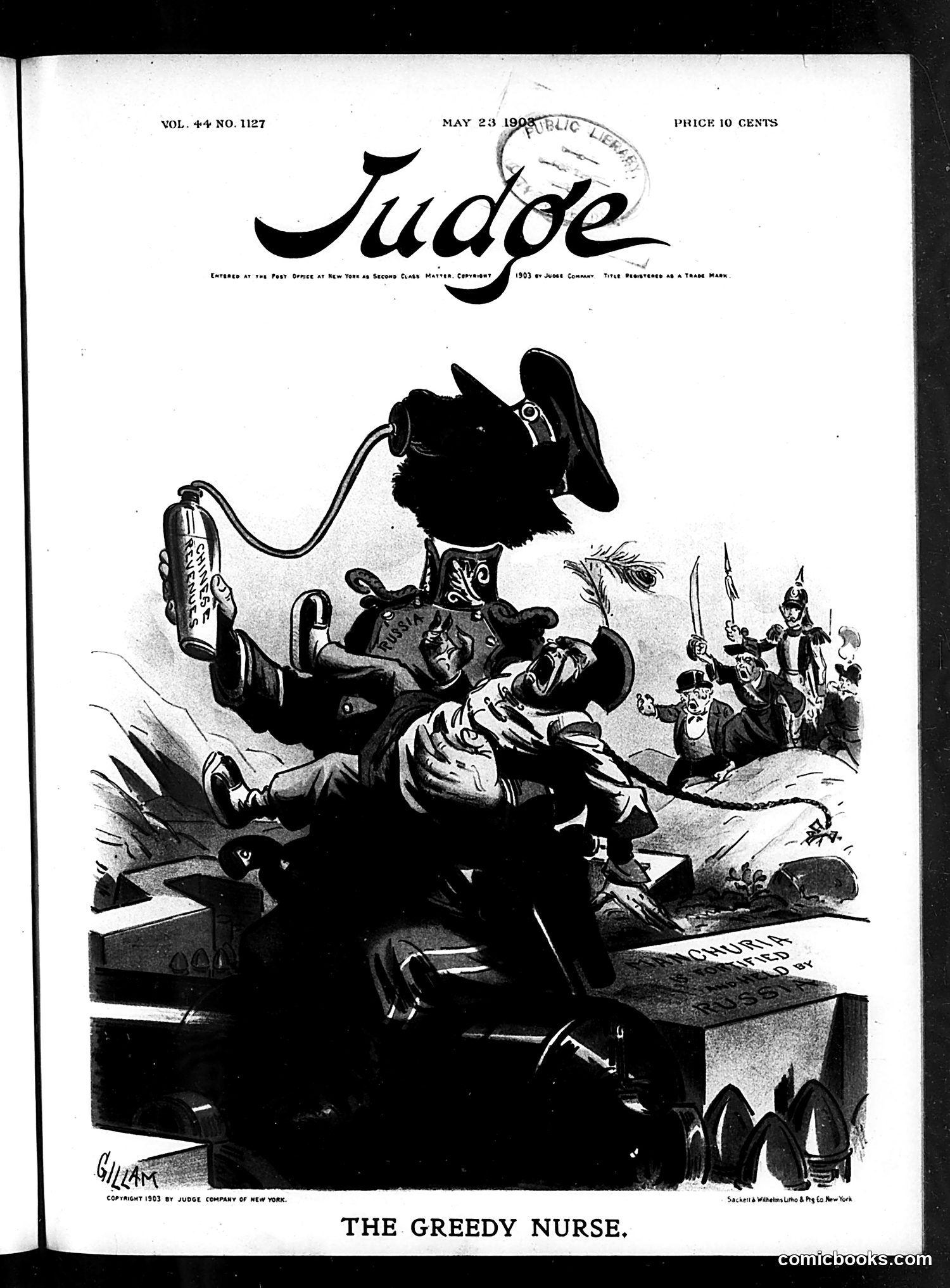
Judge — May 23, 1903
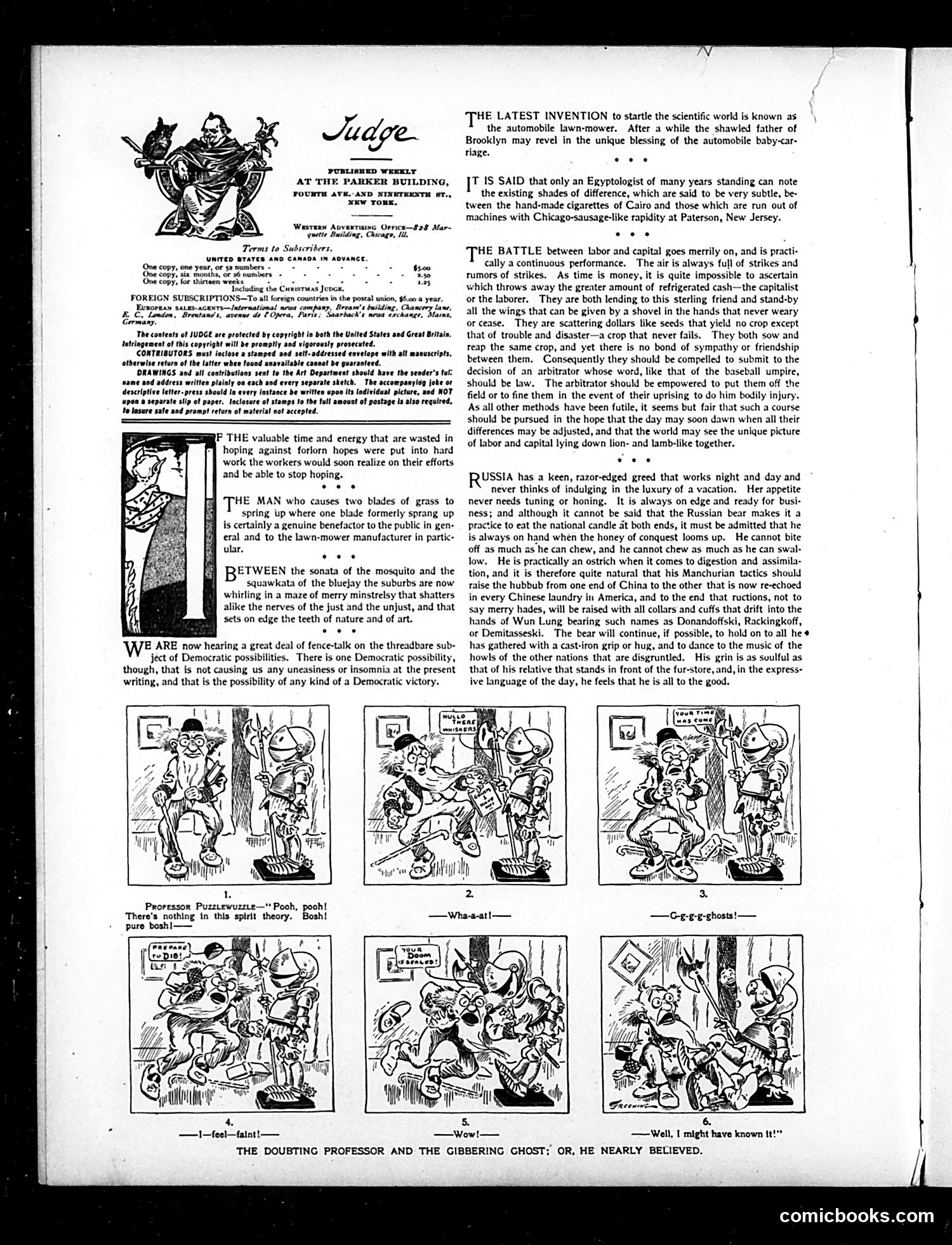
This Judge magazine page contains several satirical articles and a comic strip titled "The Doubting Professor and the Gibbering Ghost; or, He Nearly Believed." **The Articles:** The editorials discuss contemporary issues including labor disputes ("The Battle in Kansas"), Russian politics and character stereotypes, and Egyptian cigarette manufacturing. These reflect early 20th-century American concerns about labor unrest, international affairs, and industrial competition. **The Comic Strip:** The six-panel narrative shows a professor encountering what appears to be a ghost, with escalating supernatural chaos. The humor relies on visual slapstick and the professor's skepticism gradually being overwhelmed by increasingly absurd ghostly phenomena, culminating in his admission "Well, I might have known it!"—a common Judge comedic formula combining rationalist doubt with irrational supernatural consequences.
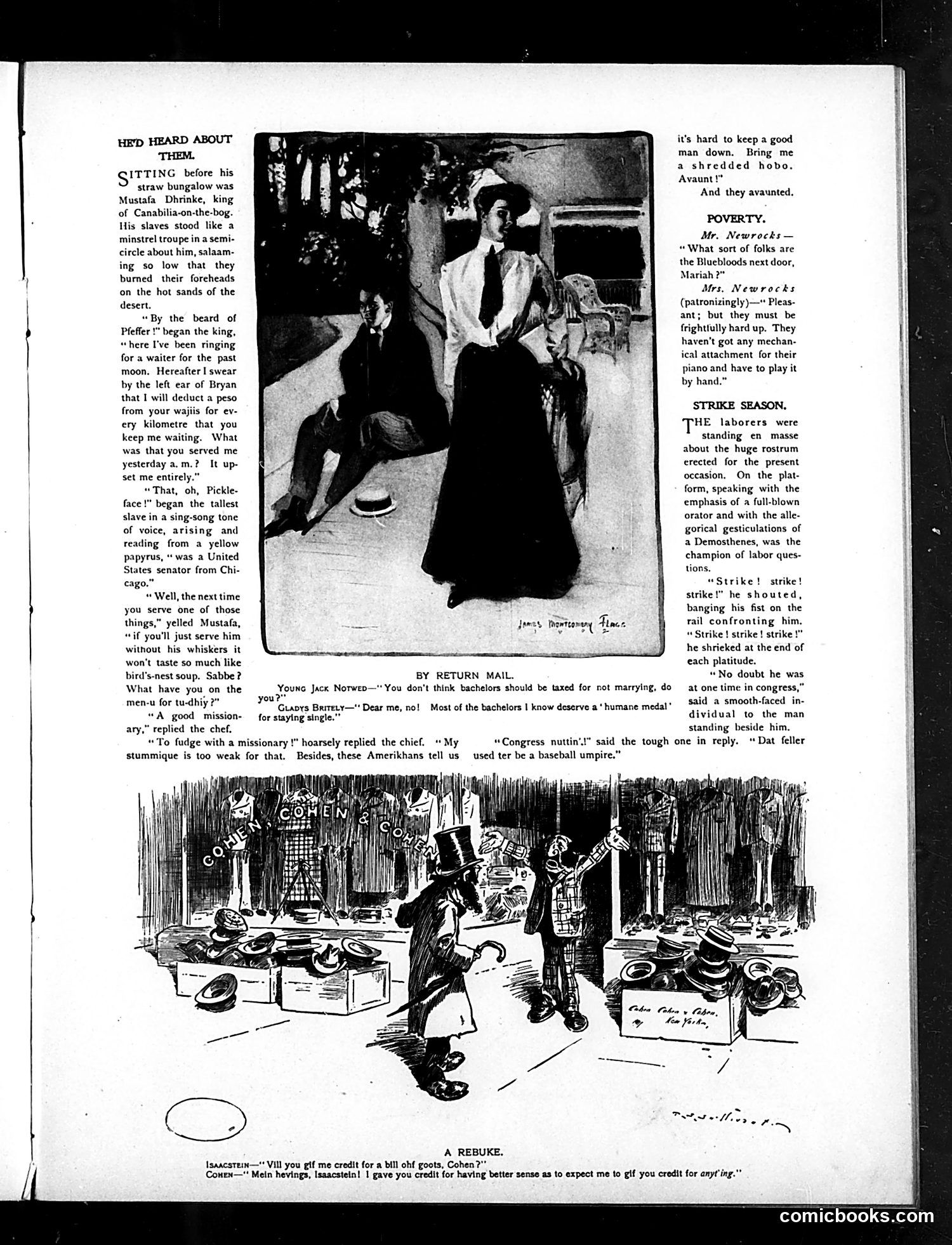
This page contains three satirical pieces: 1. **"Heard About Them"**: A story mocking an Oriental potentate (King Mustafa Dhrinke of Casablanca) and his absurd demands of slaves, parodying exoticized depictions of non-Western rulers. 2. **"By Return Mail"**: A comic exchange about bachelor eligibility for marriage, with jokes about congressmen and baseball umpires—likely satirizing contemporary political figures' suitability as husbands. 3. **"Strike Season"** (upper right): Depicts labor unrest with workers demanding strikes and a smooth-talking politician dismissing their grievances, suggesting satire of both labor activism and political deflection during what appears to be early 20th-century industrial conflict. 4. **"A Rebuke"** (bottom): A brief comedic exchange about credit and goats, likely satirizing business or social pretensions. The overall tone mocks various contemporary institutions: imperialism, politics, labor relations, and social climbing.
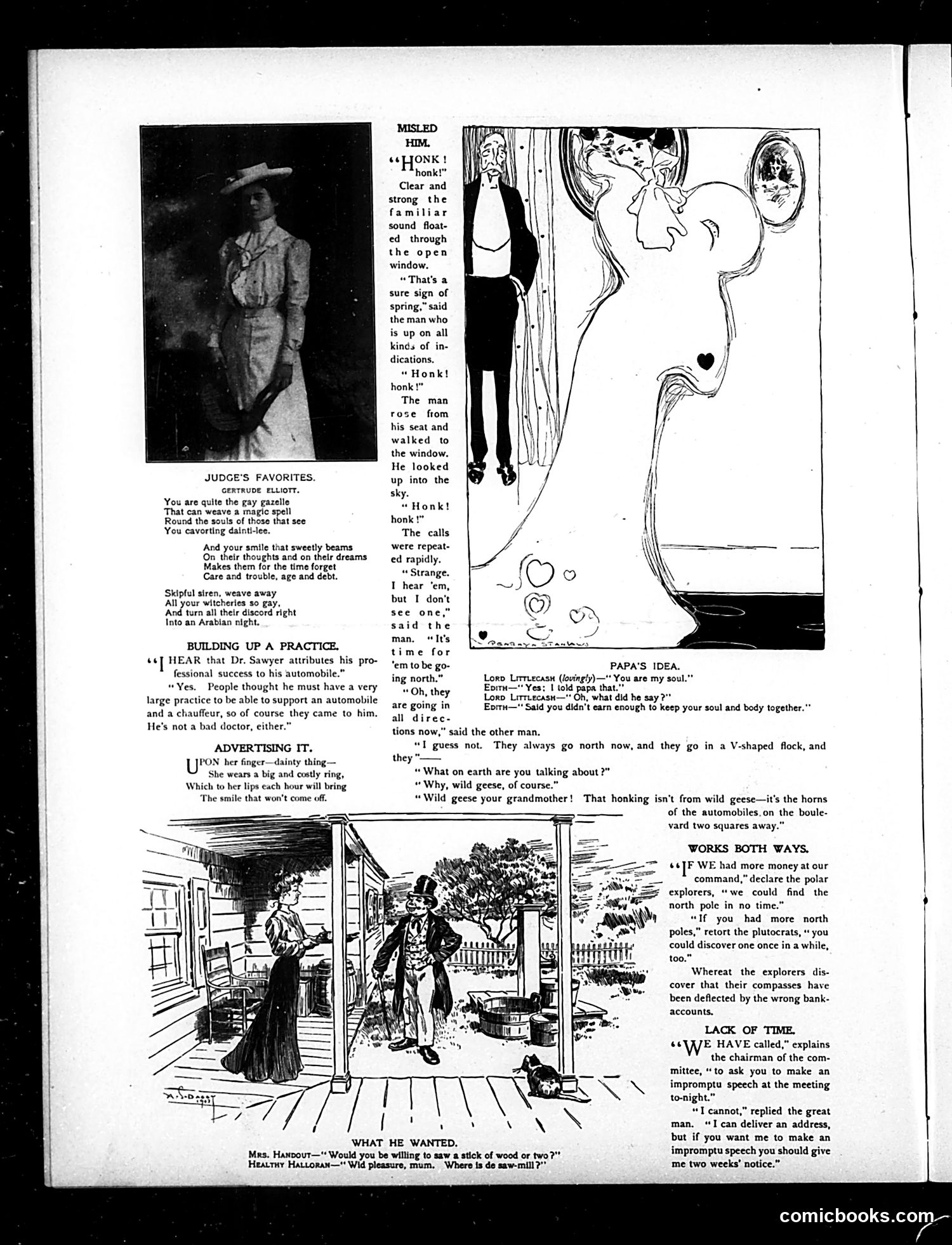
This page contains several unrelated humorous sketches and poems typical of Judge's satirical format: **"Misled Him"** depicts a woman at a window; the joke concerns a man hearing a goose honk and mistaking it for an automobile horn, suggesting early 1900s unfamiliarity with cars. **"Papa's Idea"** is a brief dialogue between Lord Littlecash and Edna about keeping one's soul and body together—likely mocking wealthy aristocratic pretension. **"Advertising It"** and other pieces are short comedic verses about ringwear and similar domestic topics. **"What He Wanted"** and **"Works Both Ways"** are illustrated sketches with visual gags about practical matters. The overall page appears to be general-interest humor rather than political satire, reflecting Judge's mix of social observation and light comedic content from the early 20th century.
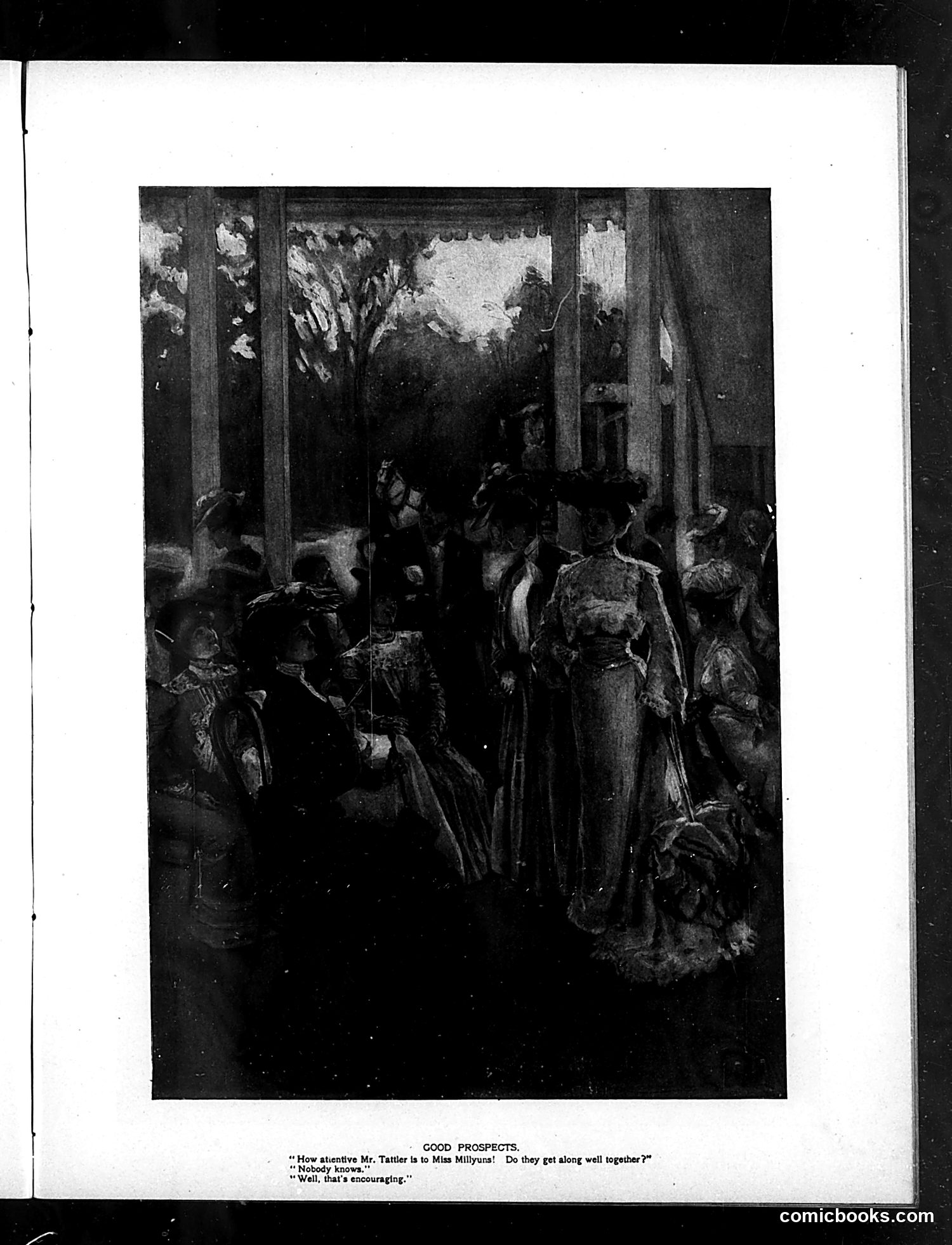
This social cartoon satirizes courtship dynamics among the wealthy. The scene depicts Mr. Tattler (a gossip or society figure) attending closely to "Miss Millyuns" (a woman of considerable fortune), surrounded by observers in what appears to be a formal social gathering. The joke hinges on the gap between appearance and reality: while Tattler appears attentive and interested in Miss Millyuns, nobody actually knows if they "get along well together." The final comment—"Well, that's encouraging"—is ironic. The humor targets how wealthy bachelors cultivate romantic prospects based purely on money rather than genuine compatibility, and how society watches these calculated romantic maneuvers while remaining ignorant of actual feelings or relationship substance.
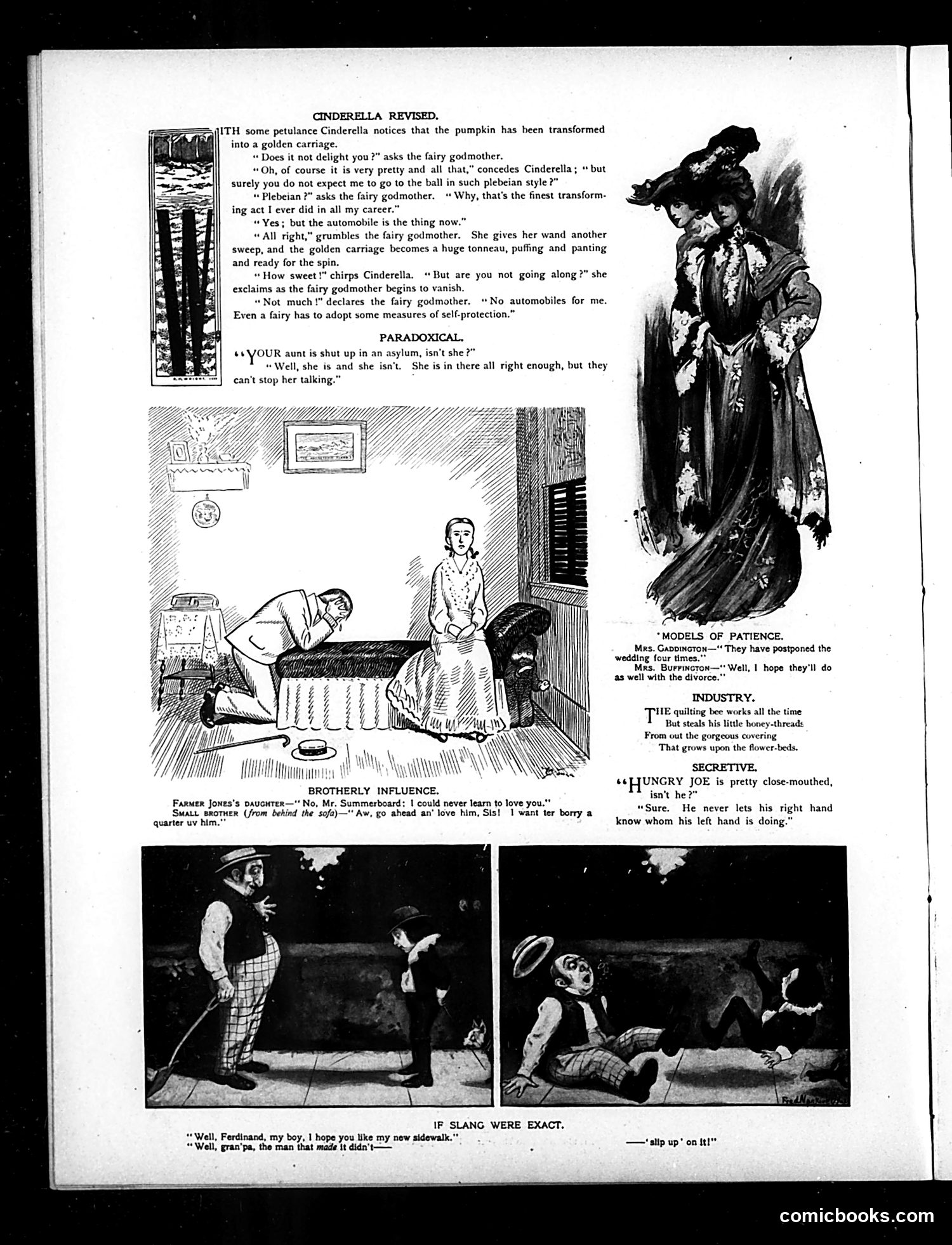
This page contains several short satirical pieces mocking early 20th-century American society: **"Cinderella Revised"** updates the fairy tale to mock modern materialism. Cinderella rejects the magical golden carriage as "plebeian," demanding an automobile instead—the height of contemporary luxury. The fairy godmother's refusal to ride in one, citing "self-protection," satirizes both the dangers of early automobiles and the absurdity of the wealthy embracing dangerous new technology. **"Paradoxical"** jokes about an aunt institutionalized yet unable to stop talking—a commentary on female chattiness. **"Brotherly Influence"** depicts a young man encouraging his sister to accept a suitor for selfish reasons (wanting to borrow money from him). **"Models of Patience"** cynically jokes that postponing weddings repeatedly suggests similar success with divorces. **"If Slang Were Exact"** puns on the phrase "slip up," showing a man who literally slipped on a new sidewalk. The humor derives from taking colloquial language literally. These pieces reflect period anxieties about automobiles, marriage, materialism, and changing social dynamics.
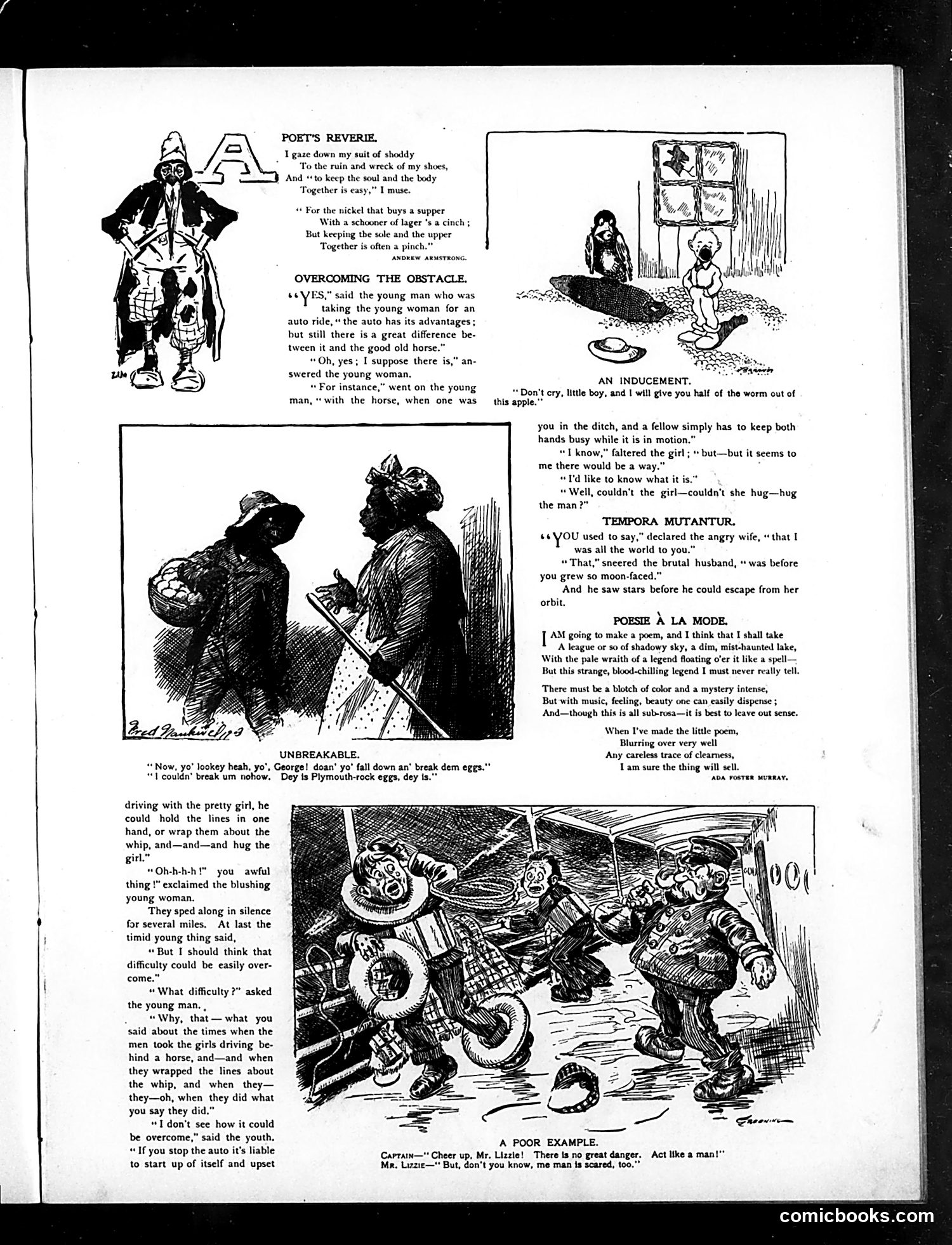
This page contains several humorous sketches satirizing early 20th-century American social conventions and relationships: **"Poet's Reverie"** mocks pretentious poetry about poverty, using puns on "sole/soul" and "upper" (shoe parts vs. existential concerns). **"Overcoming the Obstacle"** depicts a flirtation where a young man explains automobiles' advantages over horses for courting—particularly that one can keep both hands busy. The girl's suggestive response about hugging implies physical intimacy. **"Tempora Mutantur"** presents a husband insulting his wife's appearance after previously romanticizing her, satirizing marriage's disillusionment. **"Poesie à la Mode"** parodies pretentious modern poetry that prioritizes obscurity and mystery over clarity or genuine meaning—"best to leave out sense." **"A Poor Example"** depicts Irish immigrants (suggested by dialect), with "Mr. Lizzie" apparently being a henpecked husband frightened during an automobile ride while his wife demands he "act like a man." The overall theme mocks romantic idealization, marital reality, and artistic pretension of the era.
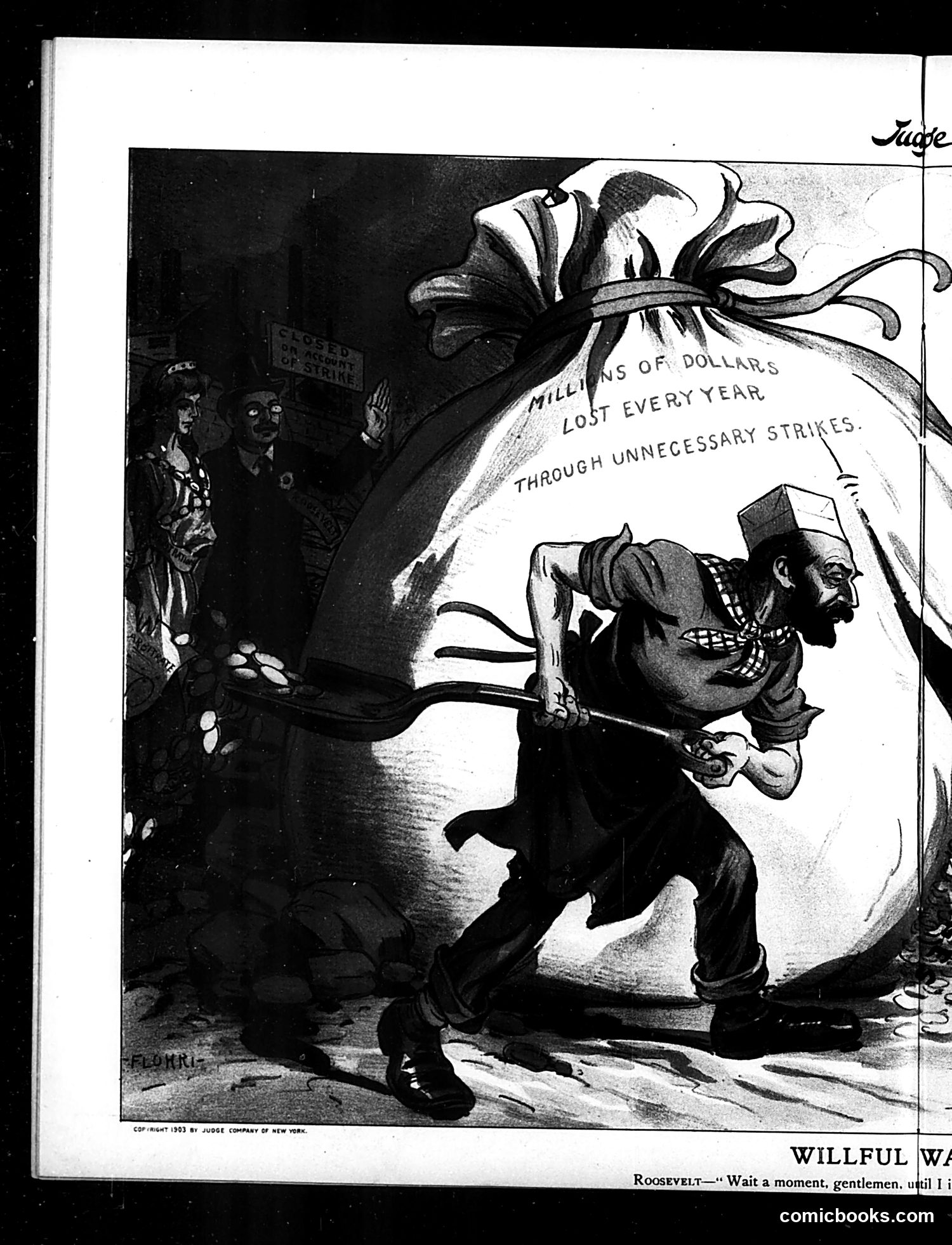
This is a satirical cartoon from *Judge* magazine criticizing labor strikes. The central figure appears to be a caricatured laborer or union representative, depicted as a grotesque character carrying a large bag labeled "MILLIONS OF DOLLARS LOST EVERY YEAR THROUGH UNNECESSARY STRIKES." The caption references Roosevelt, likely Theodore Roosevelt (president 1901-1909), saying "Wait a moment, gentlemen," suggesting he's attempting to intervene or mediate the strike situation. The cartoon's message is anti-strike: it argues that unnecessary labor actions waste enormous sums of money. The exaggerated caricature of the worker implies the cartoonist views strikers as unreasonable or greedy. The visual weight of the "millions of dollars" burden emphasizes the cartoon's claim about economic damage from labor disputes—a common anti-labor argument of the era.
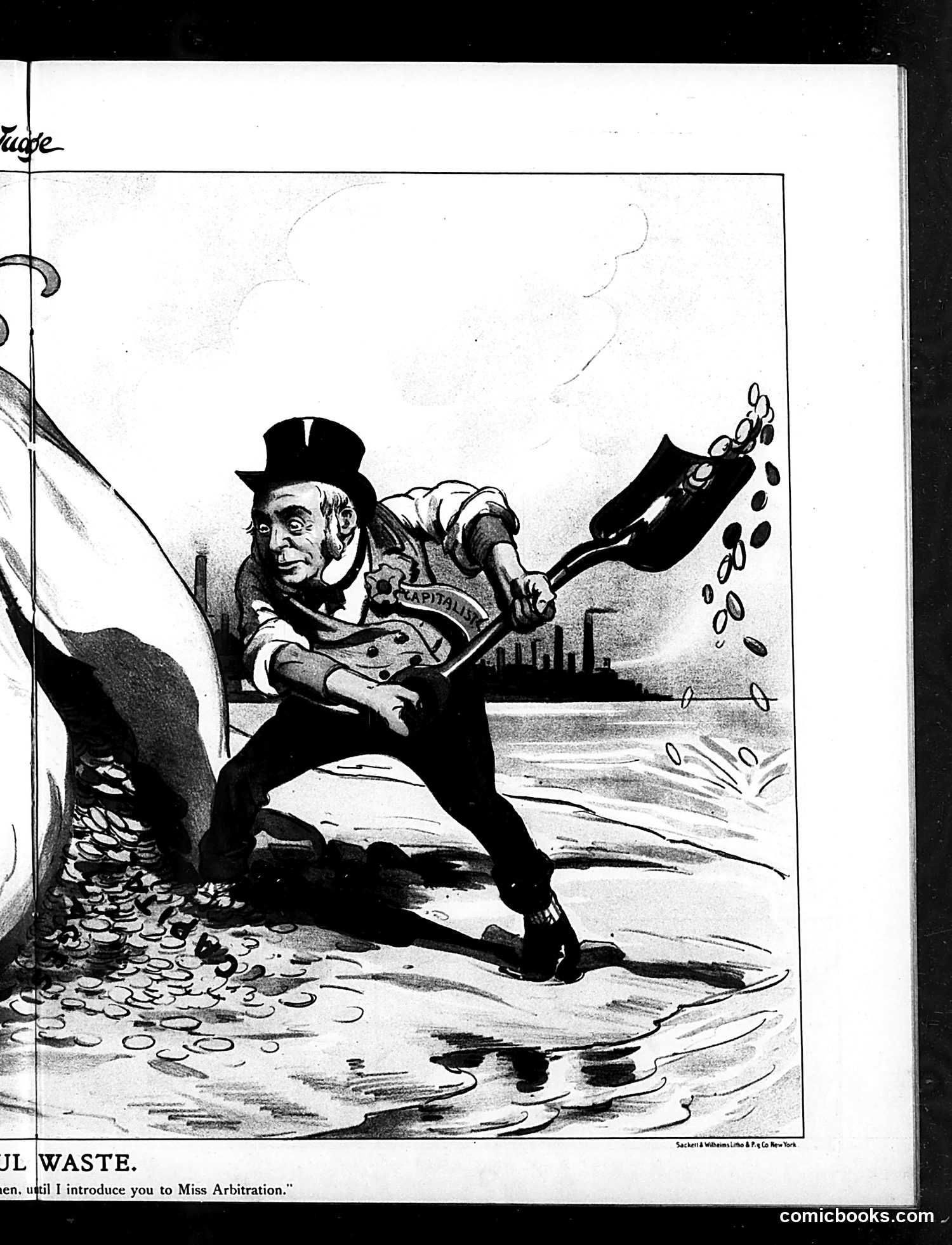
This Judge magazine cartoon satirizes governmental waste and mismanagement. A ship's captain (labeled "CAPTAIN") throws money overboard while coins spill from a bag beside him. The industrial cityscape in the background represents the nation's economy. The title "WASTE" emphasizes the cartoon's critique of fiscal irresponsibility. The caption fragment "...men, until I introduce you to Miss Arbitration" suggests the full joke involves introducing someone to arbitration as a solution to wasteful spending—likely mocking either ineffective government oversight or failed labor arbitration processes. The cartoon uses the captain as a metaphor for government leadership squandering public funds, a common Judge theme criticizing political corruption and bureaucratic incompetence during the early-to-mid 20th century.
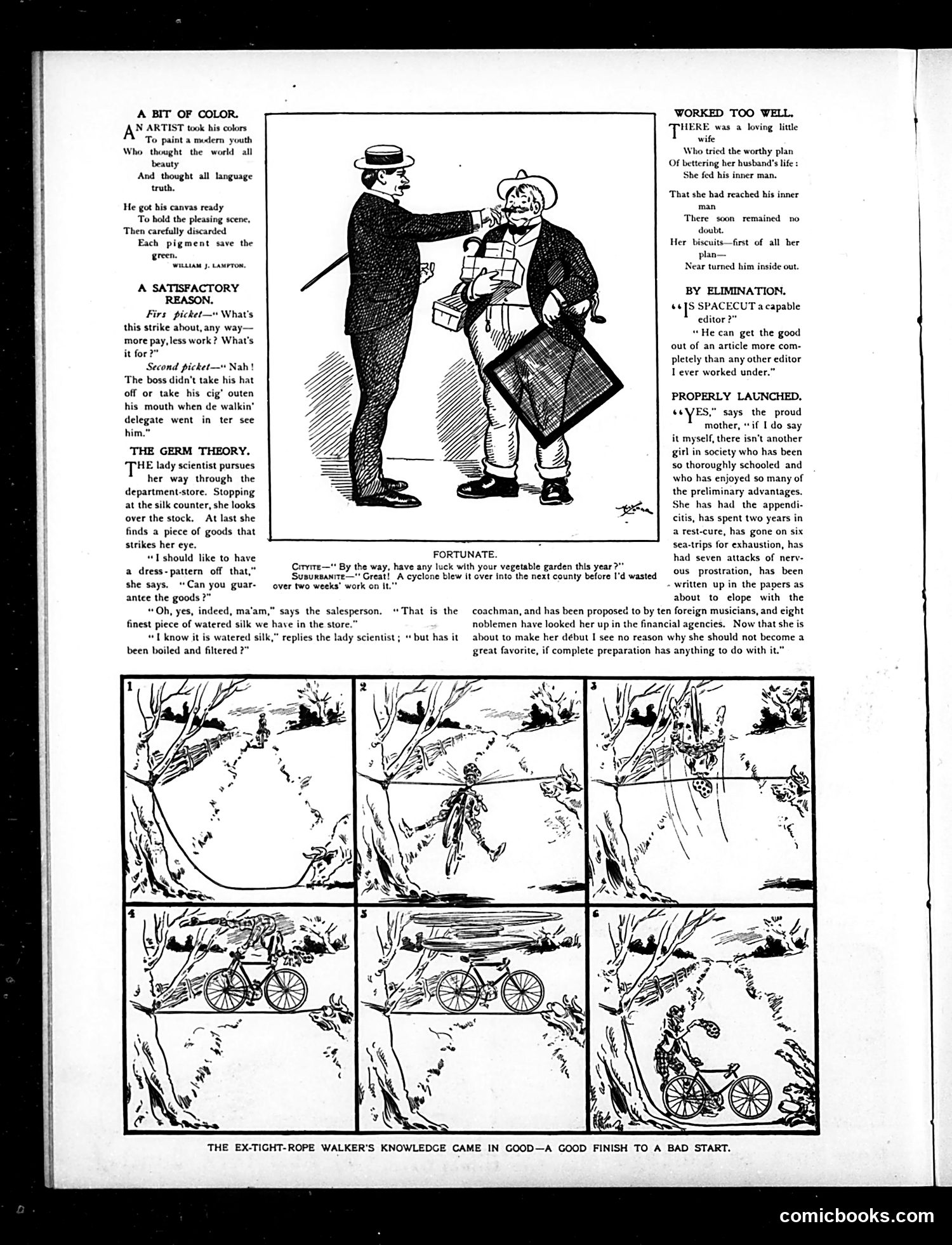
This page contains several brief comedic pieces typical of early 20th-century satirical magazines: **"A Bit of Color"** mocks naive idealism—an artist painting a modern youth uses only green pigment, suggesting the subject sees the world through rose-tinted (or in this case, green) glasses, believing everything beautiful and truthful. **"A Satisfactory Reason"** satirizes labor disputes, showing strikers whose grievance isn't wages or hours but disrespect—the boss didn't remove his hat during negotiations, a violation of workplace dignity. **"The Germ Theory"** jokes about scientific pretension: a woman applies germ-theory logic to silk, demanding proof it's been "boiled and filtered," missing the salesman's obvious point. **"Worked Too Well"** is domestic humor: a wife's efforts to improve her husband through good cooking backfire when her heavy biscuits cause digestive distress. The multi-panel comic at bottom shows a tightrope walker crashing spectacularly on a bicycle—demonstrating that his former skill doesn't transfer to new situations. These represent Judge's typical gentle satire of American social conventions and human folly.
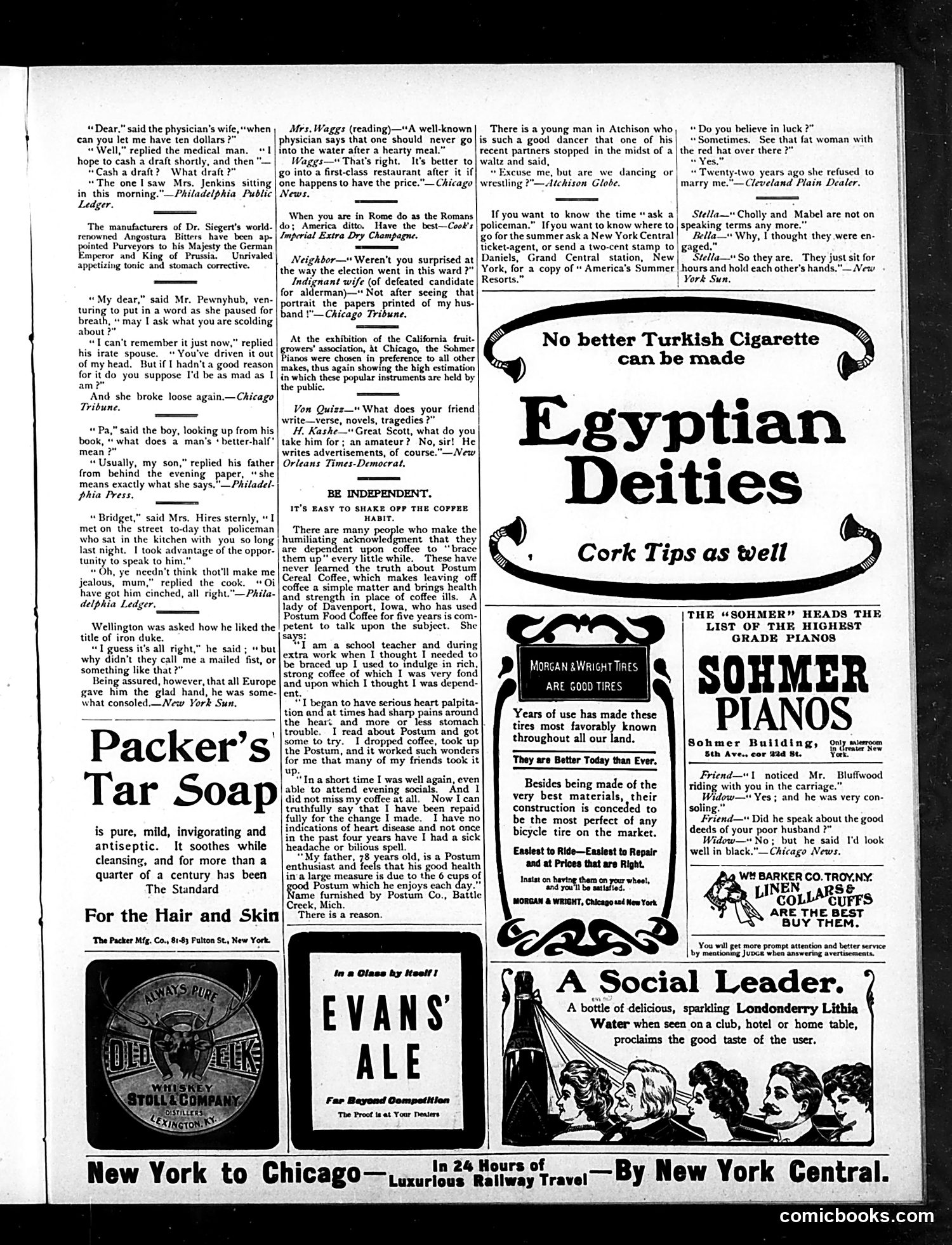
This page is primarily **advertising and humor filler**, typical of Judge magazine's format. The content consists mostly of short jokes and product advertisements rather than political cartoons. The jokes reflect early 20th-century domestic humor: a doctor's wife nagging for money, a husband trying to interject in an argument, a maid's romantic confidence, and wordplay about Wellington's military titles. These are gentle, domestic comedies with no particular political edge. The advertisements promote products like Packer's Tar Soap, Evans' Ale, Morgan & Wright Tires, Sohmer Pianos, Londonderry Lithia Water, and the New York Central Railway. Notably, one ad claims Dr. Siegert's Angostura Bitters received a royal warrant from the German Emperor—a detail that would carry different weight depending on publication date (likely pre-1917, before American anti-German sentiment intensified). **No significant political cartoons or satirical commentary appears on this page.** It's a commercial/entertainment page typical of Judge's business model.
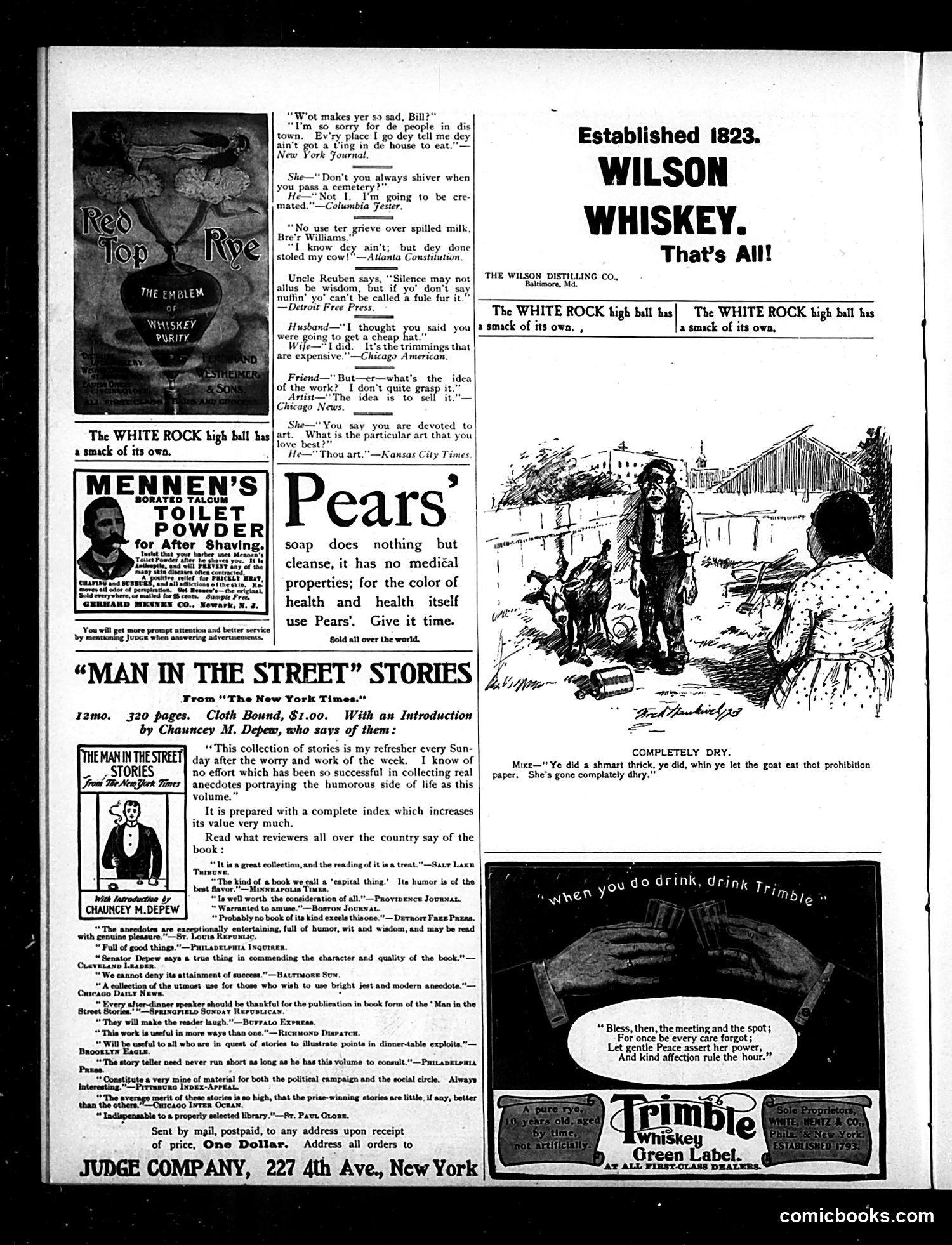
This page is primarily **advertising and promotional content** with minimal political satire. The dominant features are: **Main Advertisements:** - Wilson Whiskey (top right) - established 1823, Baltimore distillery - Trimble Whiskey (bottom right) - green label brand - Pears' Soap - emphasizing cleansing properties - Mennen's Borated Talcum Powder - for after-shaving - "Man in the Street" Stories book - collection of humorous anecdotes with introduction by Chauncey M. Depew **Satirical Content:** The page includes several brief quoted jokes mocking working-class speech and rural/urban poverty ("ain't got a t'ing in de house to eat," dialect-heavy dialogue). These appear designed as filler between advertisements. **White Rock Whiskey References:** Repeated mentions suggest this was a competing brand with advertising elsewhere in the magazine. The page exemplifies Judge's dual function: satirical humor magazine paired with commercial advertising to fund publication.
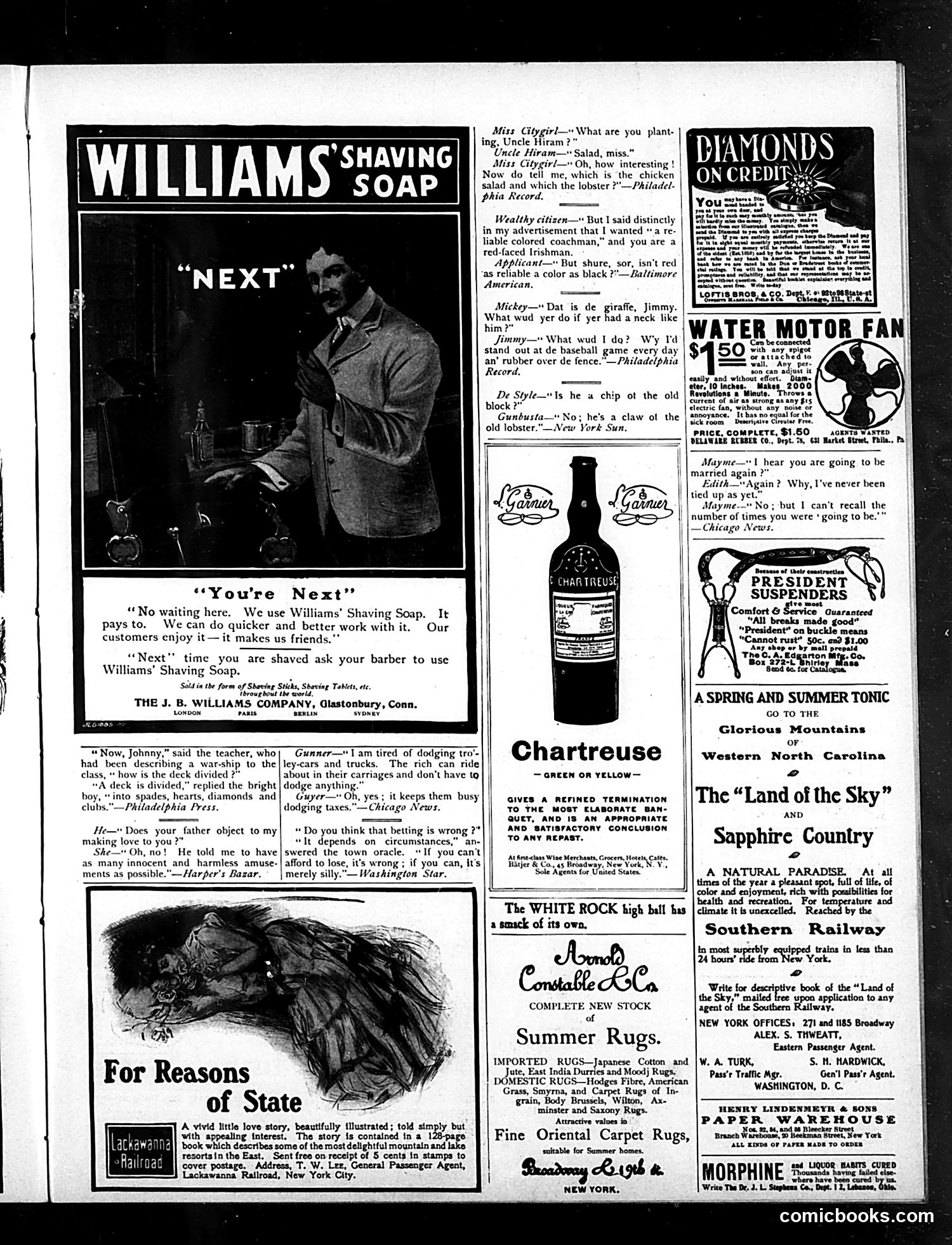
This page is primarily **advertising**, interspersed with brief joke items typical of early 20th-century humor magazines. The main content includes: **Top Left:** A Williams' Shaving Soap ad featuring the slogan "You're Next"—a barber shop setting joke about efficiency. **Throughout:** Short, ethnic humor jokes common to the era: a city girl ignorant of farm produce, an Irishman applying for work, and children making puns about giraffes and lobsters. These reflect period attitudes toward rural/urban divides and ethnic stereotypes. **Notable ads:** Chartreuse liqueur, a water motor fan ($1.50), diamonds on credit, President suspenders, and vacation destinations (Western North Carolina's "Land of the Sky"). **Bottom Left:** "For Reasons of State"—a Lackawanna Railroad promotional booklet ad, unrelated to actual satire. There is **no significant political cartoon** on this page. It represents typical Judge content: light domestic humor, product advertisements, and travel promotions aimed at affluent readers.
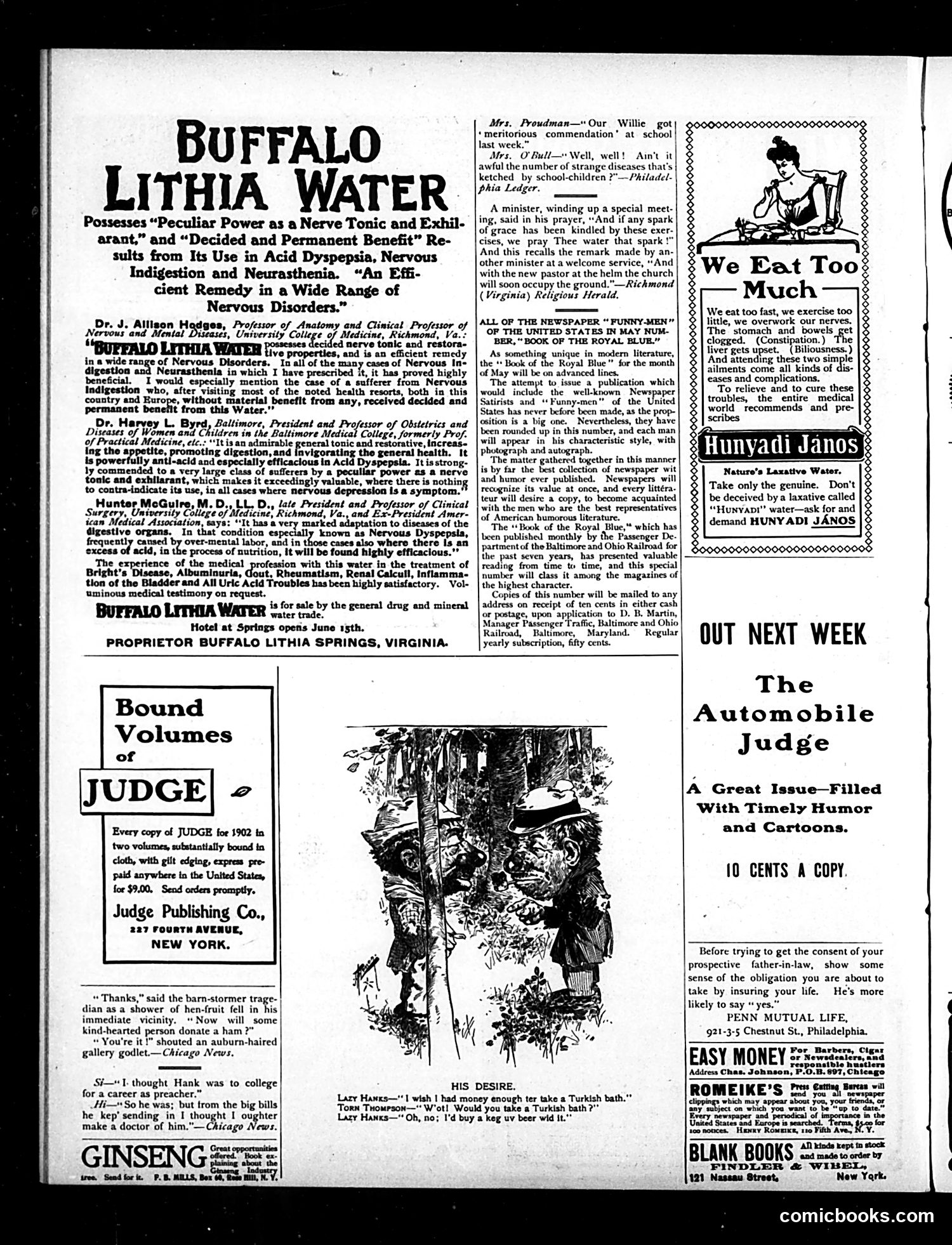
This page is primarily **advertising and filler content** from Judge magazine, circa 1902. The dominant feature is a large advertisement for Buffalo Lithia Water, a patent medicine claiming to cure nervous disorders, dyspepsia, and neurasthenia (a Victorian-era diagnosis for exhaustion/anxiety). The ad includes endorsements from doctors using pseudoscientific language typical of the era—before FDA regulations. The page includes minor humor items: brief jokes about a child's "meritorious commendation" being confused with catching diseases at school, and a minister's prayer about "watering a spark of grace." There is **no political cartoon** on this page. The illustration labeled "His Desire" shows two figures discussing Turkish baths—simple comedic commentary on leisure preferences, not satire. Additional ads promote Judge's bound volumes, "The Automobile Judge" (upcoming issue), and other period products. This is a typical magazine interior page mixing advertisements with light humor content.
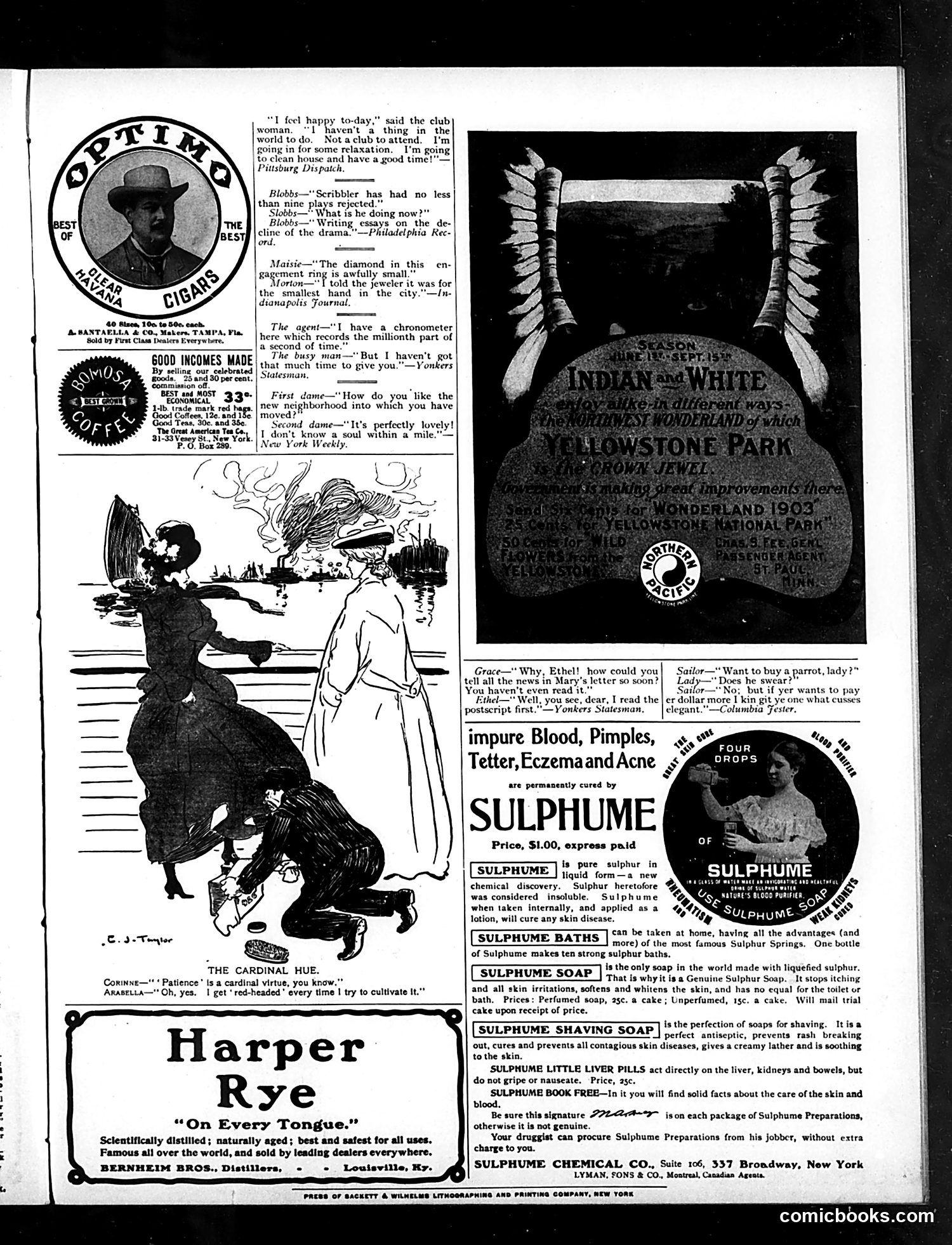
This page mixes brief satirical jokes with period advertisements. The main cartoon, "The Cardinal Hue," depicts two women discussing "patience" as a virtue—one admits she becomes "red-headed" (angry) trying to cultivate it, a play on the expression about redheads having tempers. Other jokes mock contemporary social types: a clubwoman relieved to do housework instead of attending clubs; a failed playwright writing about drama's decline; couples discussing small engagement diamonds and neighborhood snobbery; and a sailor hawking a parrot that swears (for extra cost). The substantial advertising dominates, promoting Sulphume, a patent medicine claiming to cure skin conditions through "liquefied sulphur." The remedy appears in multiple forms: internal liquid, baths, soap, and liver pills—typical of dubious early-1900s medical products making expansive healing claims without regulation. The page reflects Judge's satirical focus on urban social pretension and consumer culture alongside aggressive marketing of unproven remedies.
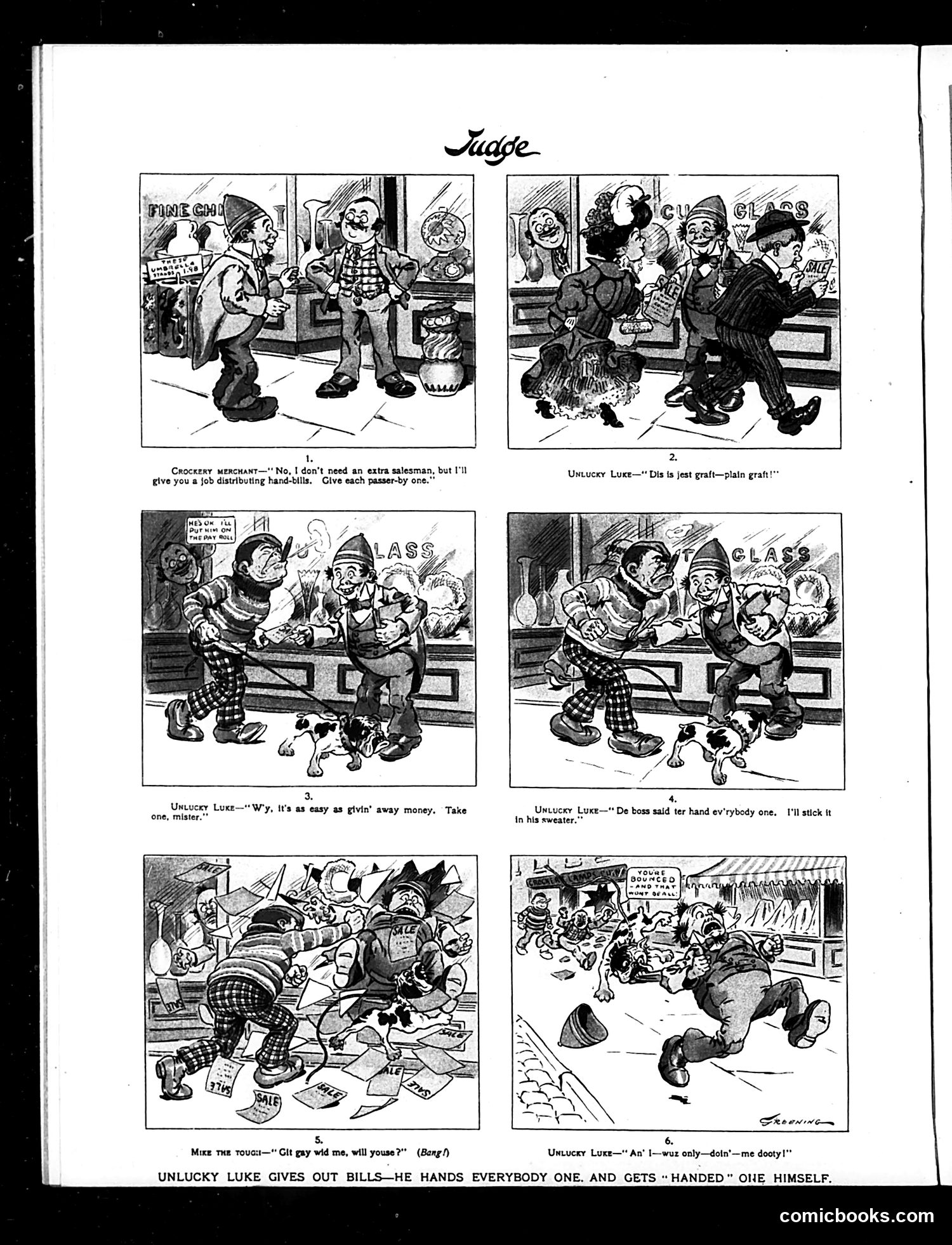
This is a six-panel slapstick comedy strip featuring a character called "Unlucky Luke" (depicted with stereotypical dialect spelling suggesting a working-class or immigrant background). The plot: Luke gets hired to distribute advertising handbills for a grocery merchant. He interprets "give each passer-by one" literally and indiscriminately, handing them to everyone including a well-dressed man ("Miss the Touch") who punches him in retaliation. The final panels show Luke getting beaten by various people angered at receiving unwanted bills, culminating in him being chased away. The joke relies on physical comedy and Luke's misunderstanding of his task—he takes instructions too literally. The title's pun ("handed everybody one...gets 'handed' one himself") plays on "handed" meaning both distributed and struck. The dialect and character design reflect early 20th-century working-class humor stereotypes common in Judge magazine.
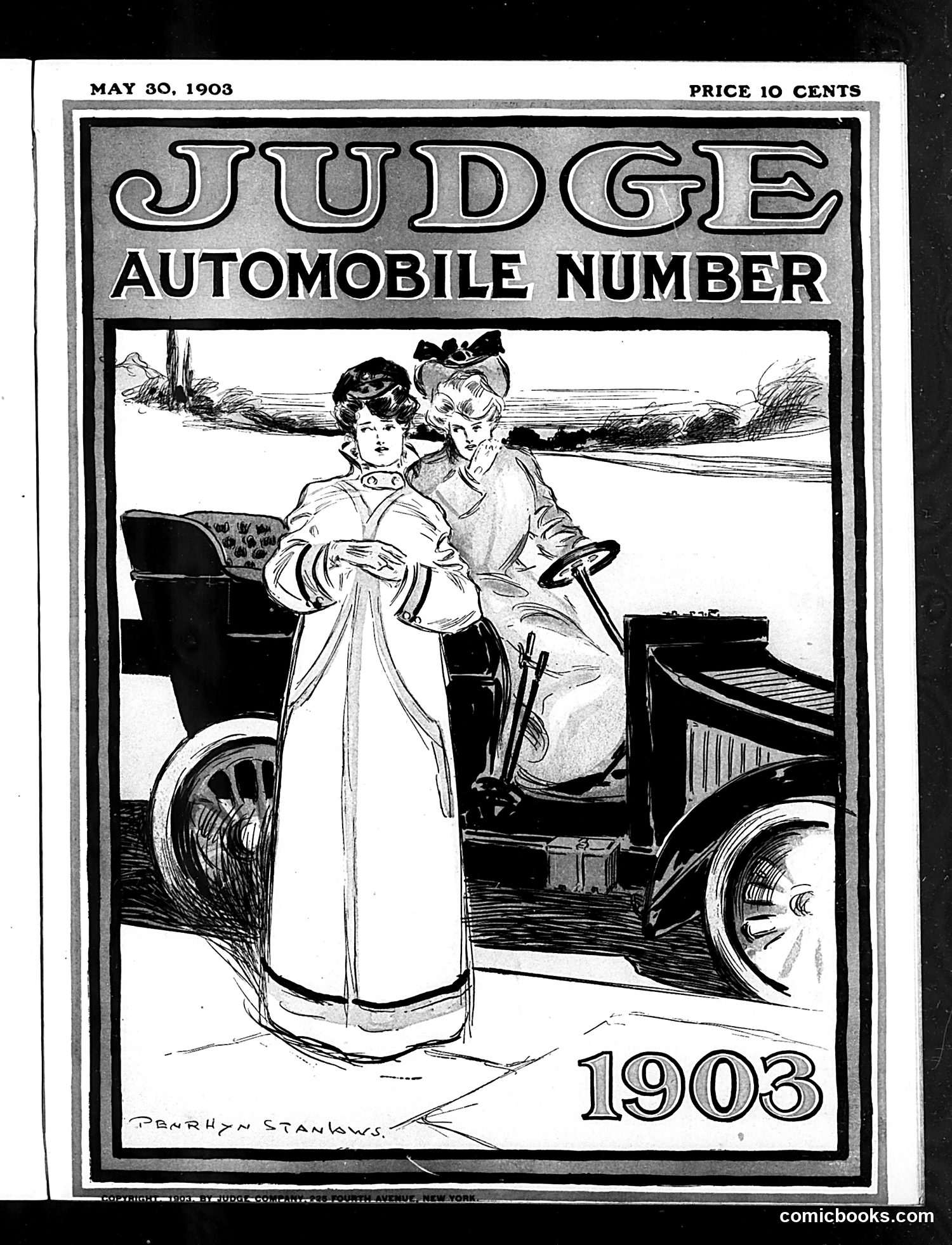
This is the cover of Judge's "Automobile Number" issue, priced at 10 cents. The illustration by Barron Stanaws depicts two elegantly dressed women in Edwardian attire posing with early 1900s automobiles—one woman standing in front, another seated in the vehicle behind her. The satire likely comments on automobiles as luxury status symbols accessible primarily to wealthy women of the era. The elaborate clothing, refined poses, and prominent display of the vehicles suggest Judge is satirizing the automobile's role in high society and conspicuous consumption among the upper class. The "Automobile Number" designation indicates this issue focuses on the nascent automobile industry, which was becoming culturally significant in 1903 as a marker of wealth and modernity.
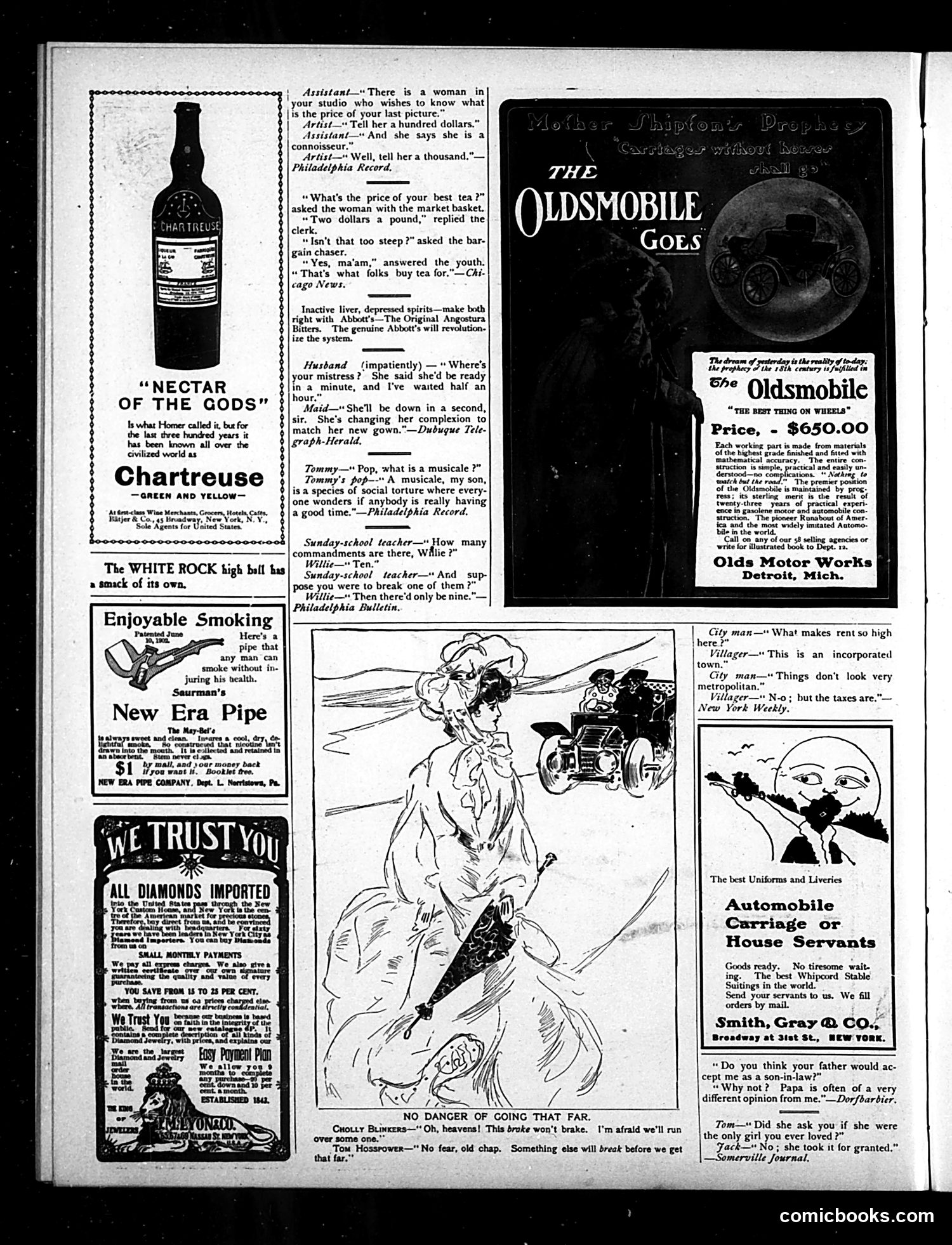
This is primarily an **advertising page** with scattered humor items (jokes and comic anecdotes). **Main Content:** The page features ads for luxury goods (Chartreuse liqueur, White Rock beverages, a New Era Pipe, diamonds, and notably an **Oldsmobile automobile** priced at $650—a significant sum in this era). **The Central Cartoon:** A large illustration depicts a woman in flowing dress riding in an early automobile being chased by what appears to be a horse or mythical creature, with the caption "NO DANGER OF GOING THAT FAR." This satirizes early automobile anxiety—the joke plays on fears that cars will break down before reaching dangerous speeds, so there's "no danger" of actually going far. **Humor Items:** Short jokes mock social pretension (an artist inflating painting prices for "connoisseurs"), bargain-hunting, musical recitals, and relationship dynamics—typical period humor about class, consumption, and gender roles. The page reflects early 1900s concerns about emerging automobile technology and consumer culture.