
A complete issue · 16 pages · 1903
Judge — May 16, 1903
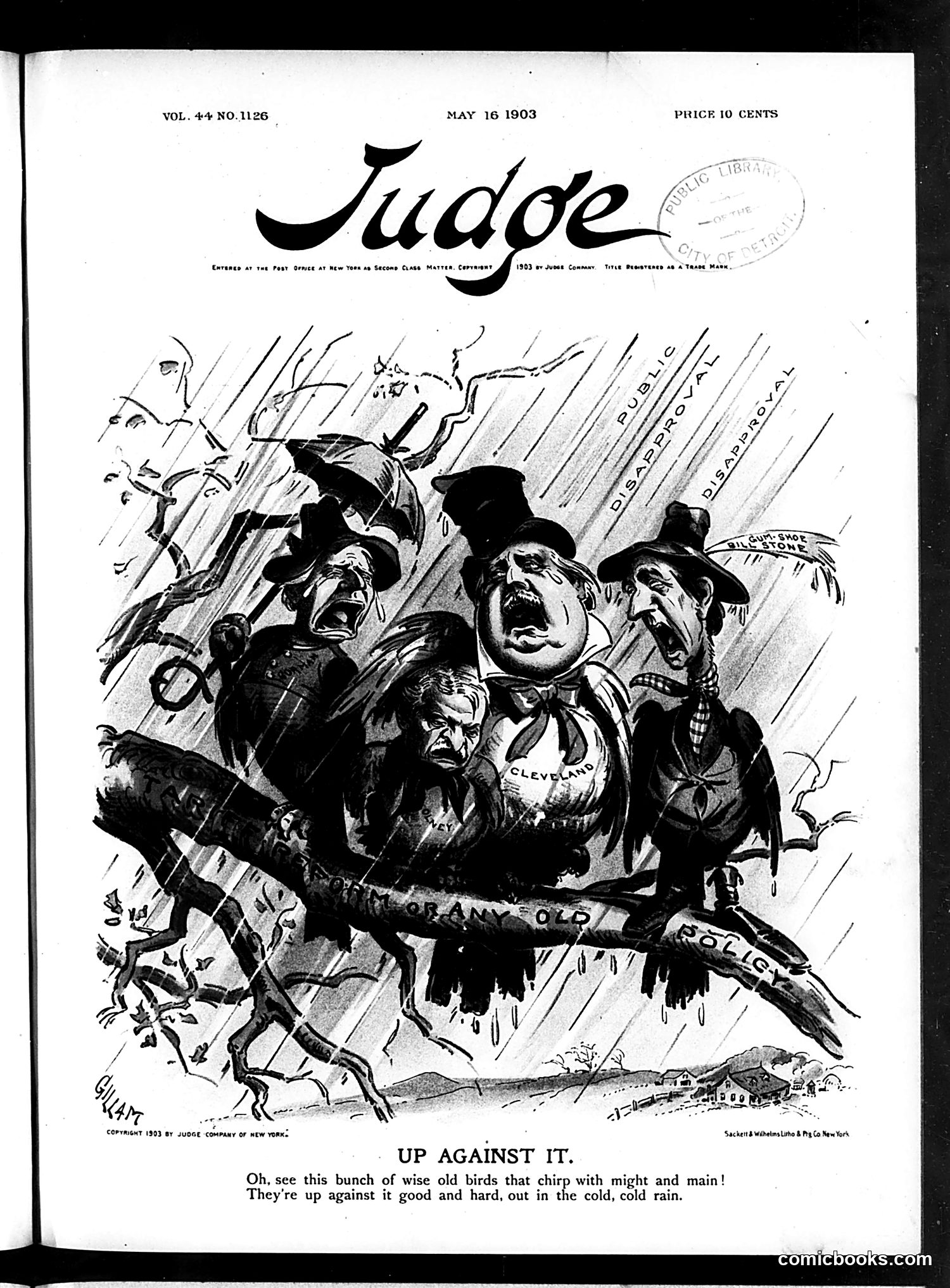
This cartoon depicts four caricatured political figures—identifiable by top hats and formal dress—clinging to a branch during heavy rain, labeled "HARD TIMES OLD POLICY" and "POLICY." One figure wears a "CLEVELAND" label. They're positioned precariously above stormy weather, with text describing them as "wise old birds that chirp with might and main" who remain "up against it good and hard, out in the cold, cold rain." The satire criticizes Democratic leadership—particularly President Grover Cleveland and associated politicians—for stubbornly maintaining outdated economic policies despite financial hardship. The "hard times" reference likely alludes to the 1890s economic depression. The cartoon mocks their persistence in failing strategies rather than adapting to changed circumstances.
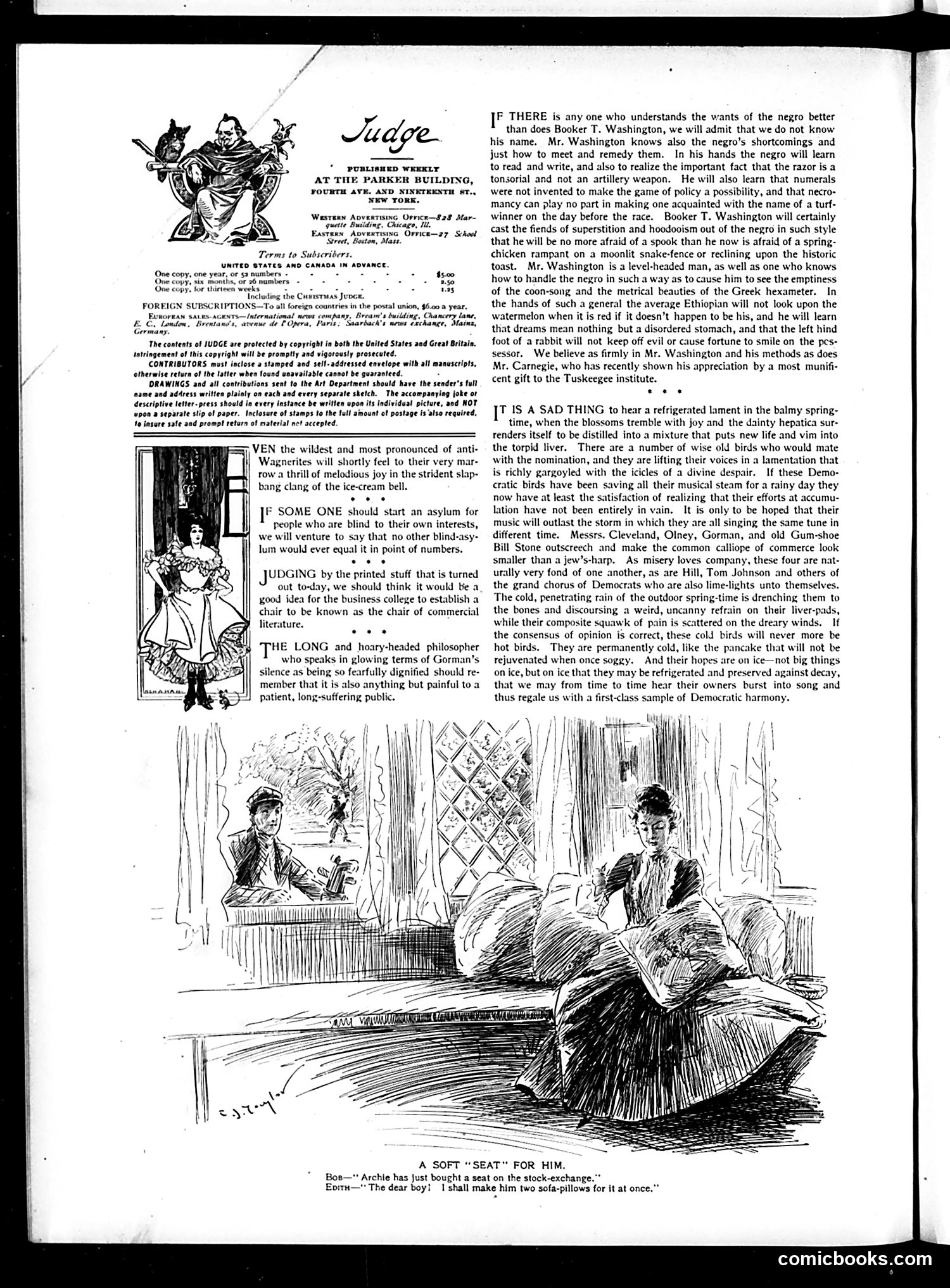
This page contains editorial commentary on race relations and social reform. The top text discusses Booker T. Washington, the prominent African American educator, praising his practical approach to addressing racial issues and superstition within Black communities. The author credits Washington with promoting rational thinking over folklore and superstition. The lower sections contain unrelated satirical commentary about asylum reform, business education, and bird migration. At the bottom is a cartoon captioned "A Soft 'Seat' for Him," depicting what appears to be a domestic scene with a humorous double entendre about purchasing a seat at the stock exchange. The cartoon's exact satirical target—whether financial speculation, gender relations, or market dynamics—is unclear from the image alone.
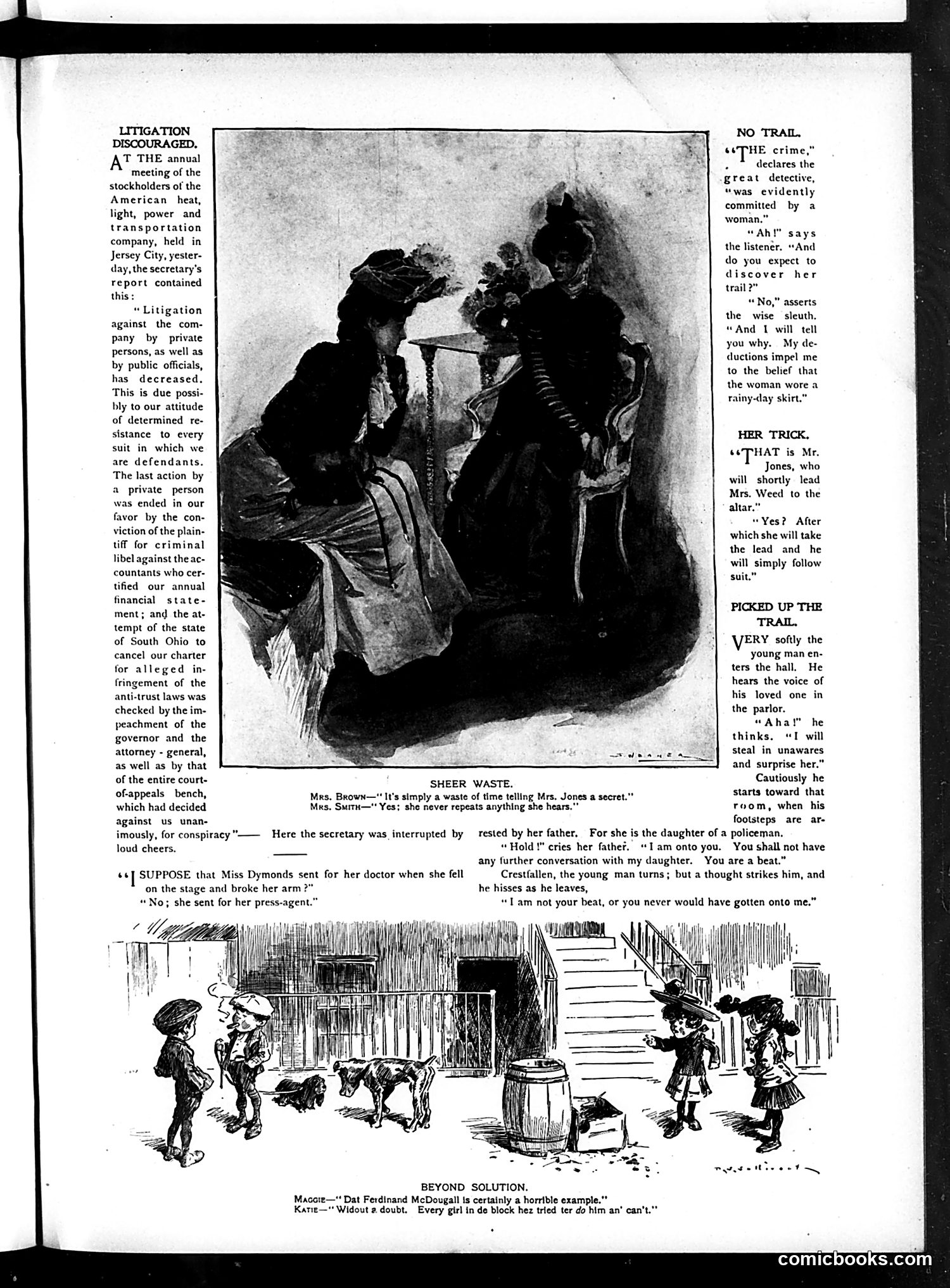
This page satirizes corporate litigation strategies. The main article "LITIGATION DISCOURAGED" critiques how American Heat, Light, and Power Company uses legal tactics to intimidate private citizens and public officials from filing suits—specifically referencing a successful libel case against accountants over financial statements. The accompanying illustration "SHEER WASTE" depicts a domestic scene where Mrs. Brown shares gossip with Mrs. Jones, mocking the company's aggressive legal posture. The lower cartoon "BEYOND SOLUTION" shows children discussing Ferdinand McDougal as "a horrible example," suggesting social shame from litigation. The satire targets corporate power abuse: using lawsuits to suppress criticism rather than address legitimate grievances, silencing opponents through legal intimidation rather than merit-based defense.
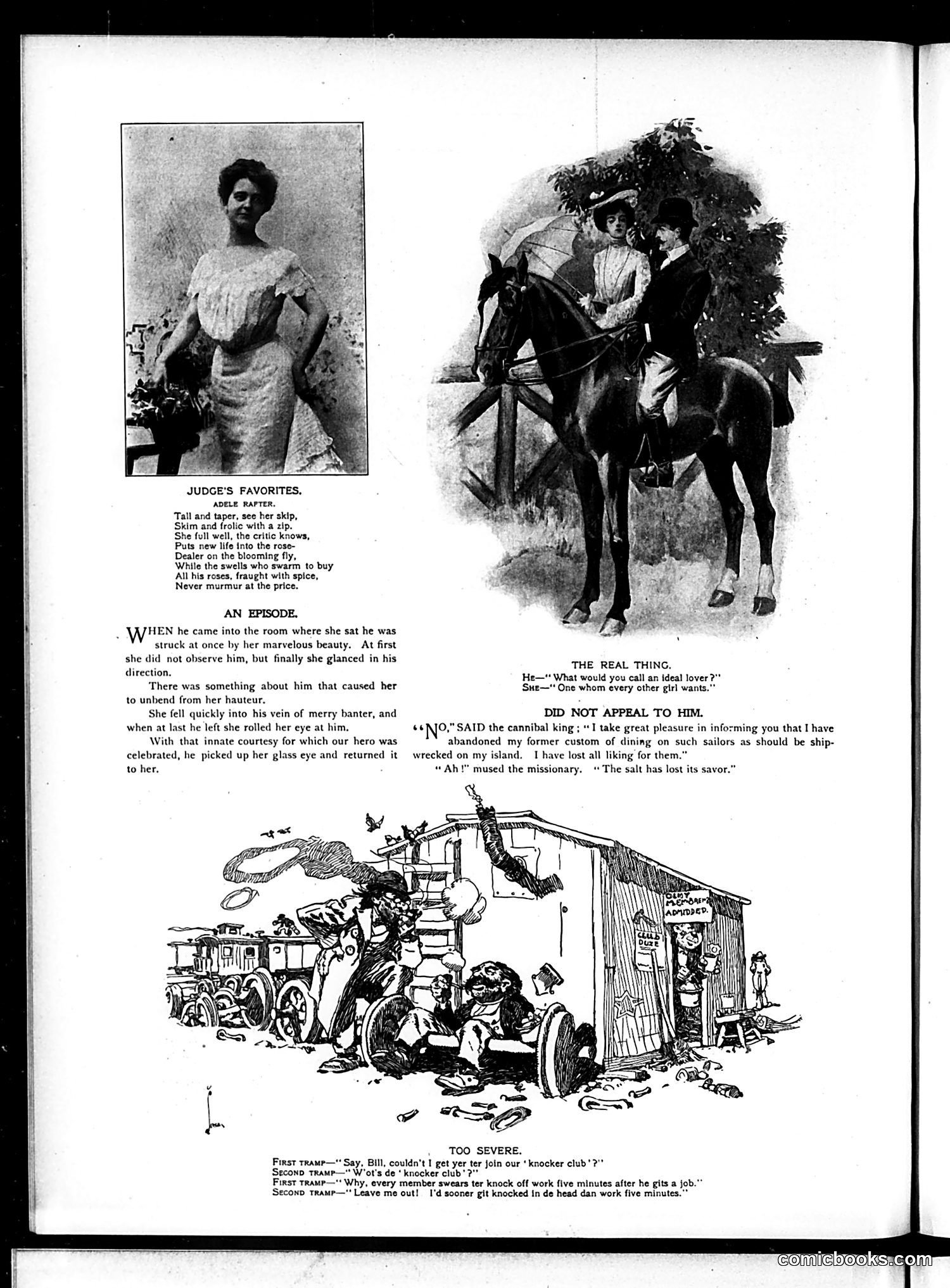
This page contains three satirical pieces typical of early 20th-century Judge magazine: **"Judge's Favorites"** (top left) is a portrait poem celebrating an idealized woman—tall, graceful, fashionable—who embodies aesthetic perfection while remaining modest about her beauty. **"An Episode"** and **"The Real Thing"** (center) present a romantic narrative where a man is struck by a woman's beauty, then disillusioned when she lacks deeper qualities he values—a commentary on the gap between physical attraction and genuine compatibility. **"Too Severe"** (bottom) is a workplace humor strip depicting factory workers ("tramps") discussing a brutal "knocker club" where members are penalized for taking breaks—satirizing harsh industrial labor conditions and worker exploitation of the era. The page blends romantic satire with social commentary on labor practices.
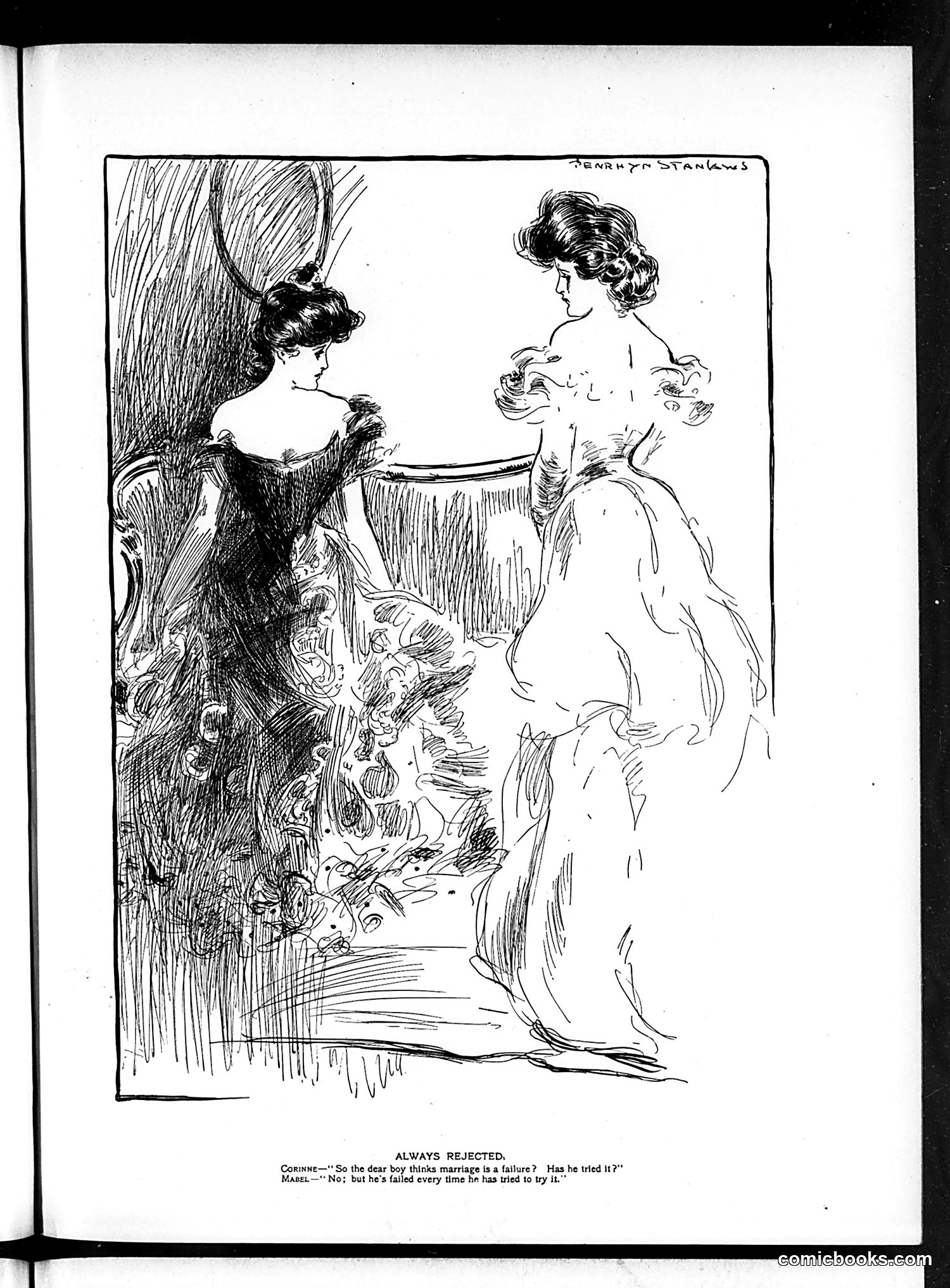
This appears to be a society or romantic cartoon titled "Always Rejected," drawn by artist Penrhyn Stanlaws. The sketch shows two fashionably dressed women in what appears to be an elegant interior setting with draped curtains and decorative furnishings. The dialogue reveals the joke: Corinne asks Mabel if a "dear boy" thinks marriage is a failure, and whether he's tried it. Mabel responds that he hasn't tried marriage itself, but has failed repeatedly at *proposing* to get married. The humor lies in the romantic disappointment—a man who keeps proposing but being rejected each time. It's typical early-20th-century Judge magazine humor about courtship, playing on the conventional trope of persistent male suitors facing female rejection. The artwork exemplifies the magazine's sophisticated, fashion-conscious aesthetic of that era.
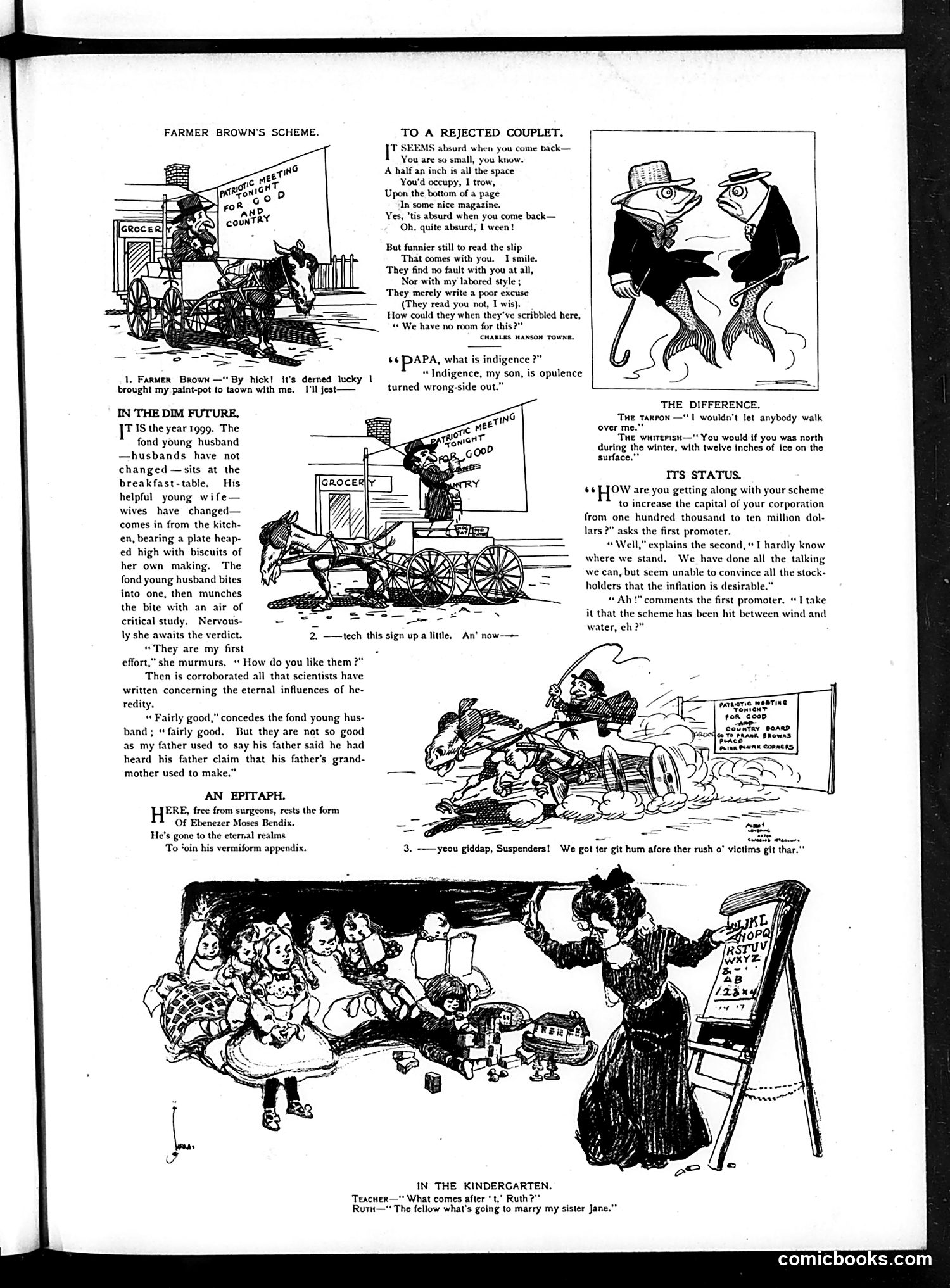
This page contains multiple satirical pieces typical of early 20th-century humor: **"Farmer Brown's Scheme"** mocks agricultural modernization through a farmer proudly bringing his paint-pot to town, suggesting rural folks' confusion about progress. **"To a Rejected Couplet"** satirizes magazine rejection slips—editors claim "no room" while their own scribbled excuses take up space, mocking editorial hypocrisy. **"In the Dim Future"** imagines 1999 with unchanged gender dynamics: husbands still unappreciative at breakfast despite wives' domestic efforts, critiquing the stagnation of marital relations. **"Its Status"** ridicules corporate stock-inflation schemes, where promoters can't convince investors despite elaborate talk about doubling capital. **"An Epitaph"** is a dark joke about appendicitis removal. **"In the Kindergarten"** delivers a crude marriage joke through a child's innocent answer about what follows the letter 'L.' The overall tone reflects Judge's satirical commentary on contemporary marriage, rural life, business schemes, and publishing conventions.
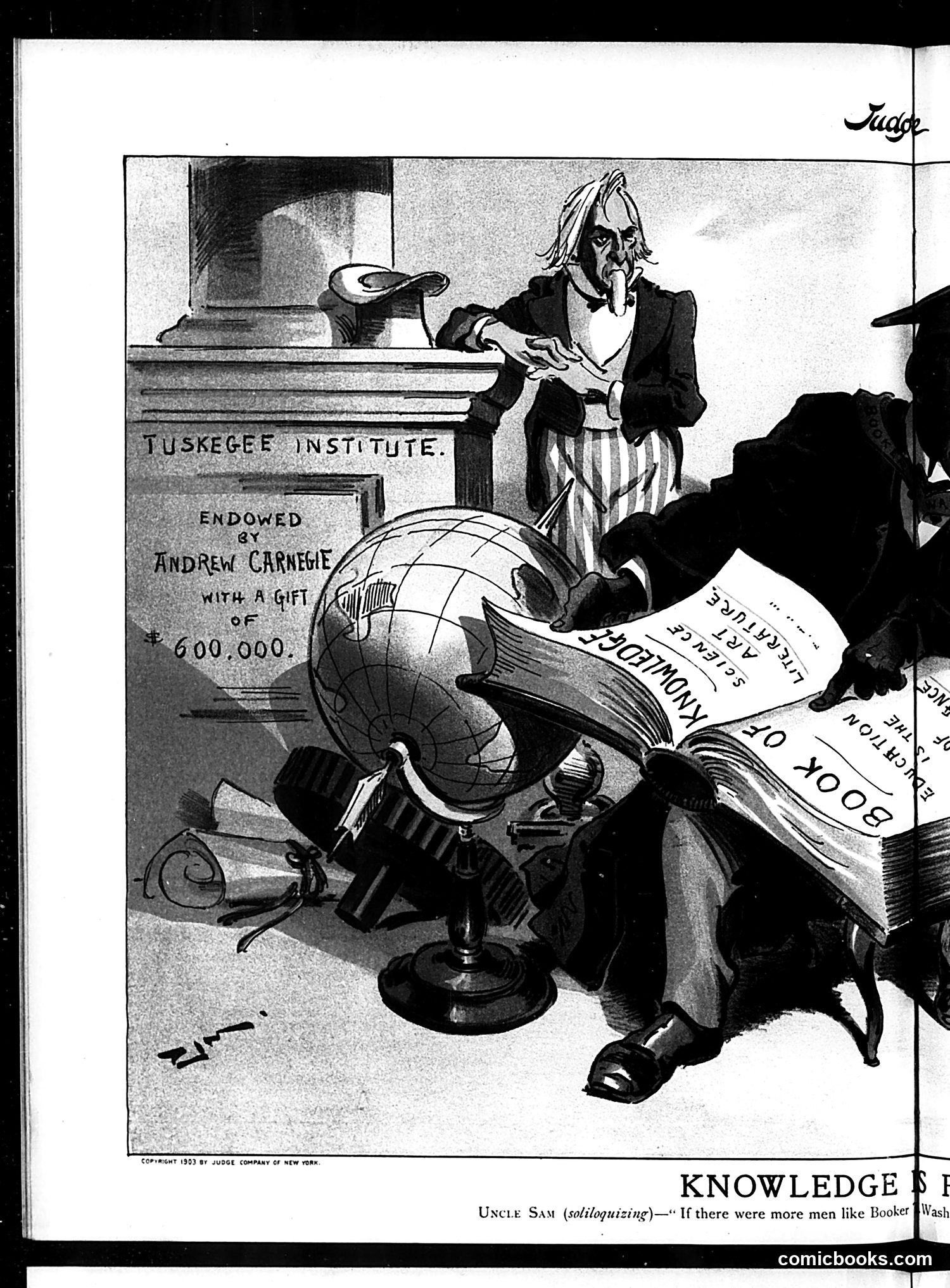
This Judge magazine cartoon depicts **Uncle Sam** (representing the U.S. government) standing beside the **Tuskegee Institute**, which was "endowed by Andrew Carnegie with a gift of $600,000." The cartoon shows Uncle Sam examining a globe and an open book labeled "SCOTHORN" (likely "Booker T. Washington"), with the caption suggesting: "If there were more men like Booker Washington..." The satire appears to **praise Booker T. Washington**, the prominent African American educator who founded Tuskegee Institute in Alabama. The cartoon celebrates both Washington's educational work and Carnegie's philanthropic support for Black education. This likely dates from the early 1900s, when Carnegie's major educational gifts were controversial but increasingly respected. The implication is that Washington's practical, industrial education approach was beneficial to American development.
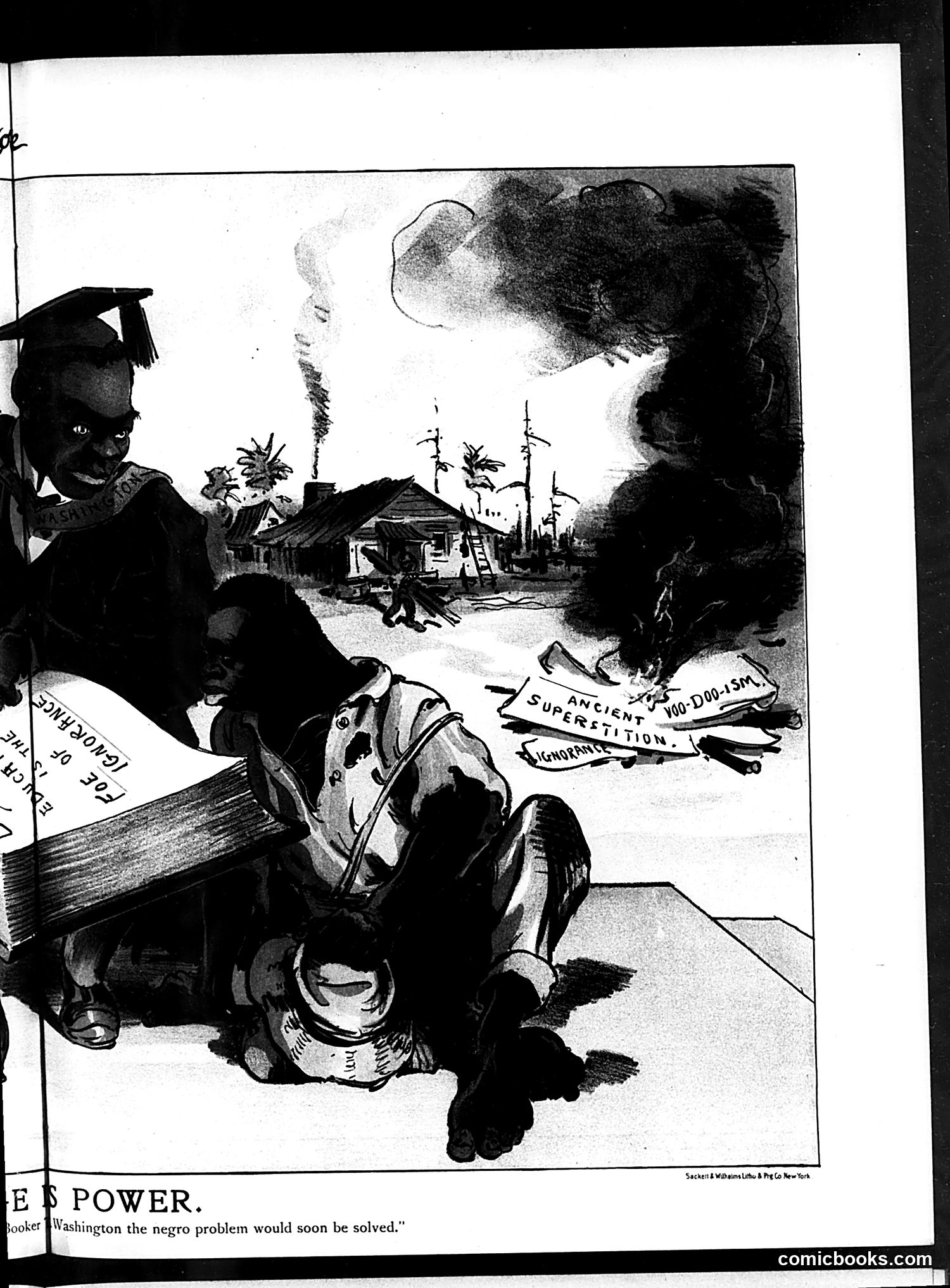
This Judge magazine cartoon satirizes Booker T. Washington's optimistic claims about solving racial problems in America. The image shows two caricatured figures (one wearing academic regalia on the left) flanking a rural Southern scene with modest buildings and vegetation labeled "Ancient Superstition" and "Ignorance." The satire appears to mock Washington's confidence that education and accommodation alone could resolve deep-rooted systemic racism. The grotesque caricatures and the juxtaposition of Washington's rhetoric against the persistent symbols of ignorance and superstition suggest Judge's skepticism—that Washington's proposed solutions were inadequate against entrenched Southern prejudice and social structures. The cartoon reflects late-19th/early-20th-century debates about approaches to racial progress in America.
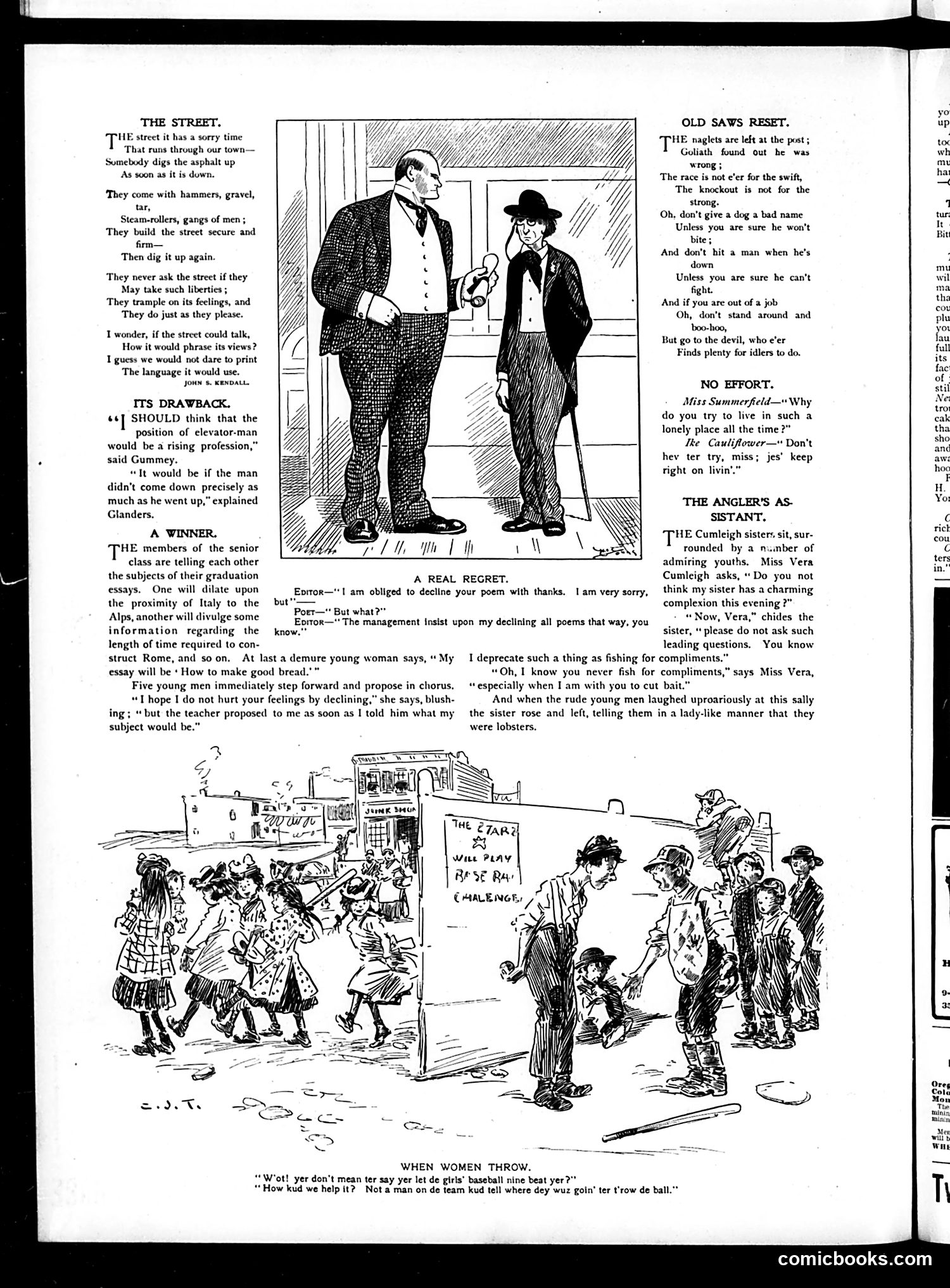
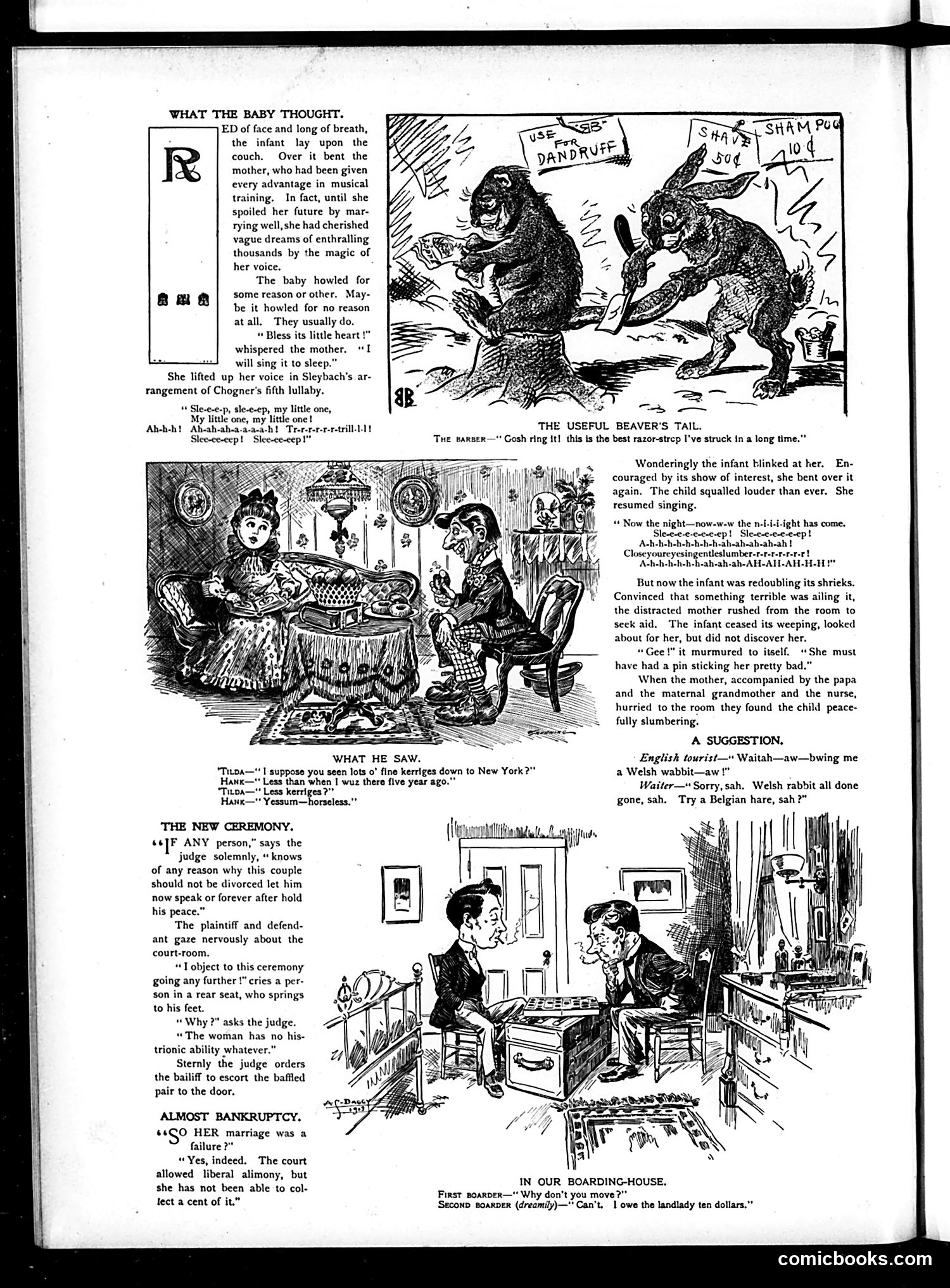
This page contains several satirical pieces typical of early 20th-century American humor: **"The Street"** and **"Its Drawback"** are light social commentary—one mocking the constant disruption of street repairs, the other a pun on elevator operators going up and down. **"A Winner"** satirizes academia: senior class essays on trivial topics (Italy's proximity to Alps, Rome's construction time) are absurdly pretentious, while a practical essay on bread-making immediately attracts marriage proposals from five young men, mocking both academic vanity and men's superficial priorities. **"A Real Regret"** jokes about editorial rejection of poems as policy rather than merit. **"When Women Throw"** depicts women's baseball players as so incompetent at throwing that men cannot predict where the ball will go—playing on contemporary stereotypes about female athletic ability. The remaining pieces are brief jokes about rural characters and courtship dynamics, reflecting period humor conventions about class and gender.
This page from *Judge* contains primarily **brief humor pieces and advertisements** rather than political cartoons. The content reflects early 20th-century American satirical comedy: **Key humor pieces:** - A joke about wives and saloon closures: a woman opposes prohibition because her husband only craves drinks he can't easily obtain—satire on the temperance/prohibition debate - Humor about a wealthy man naming his daughters after Pullman train cars—mocking nouveau riche pretension - A senator's quip that fame cannot be "cashed at the bank"—cynicism about political ambition **Advertisements dominate** (Prudential Insurance, Club Cocktails, Evans' Cigars, Sohmer Piano), reflecting the magazine's commercial nature. The satire targets **Victorian-era social issues**: marital dynamics, class pretension, and political hypocrisy. Most jokes rely on wordplay and domestic scenarios rather than visual caricature or specific political figures.
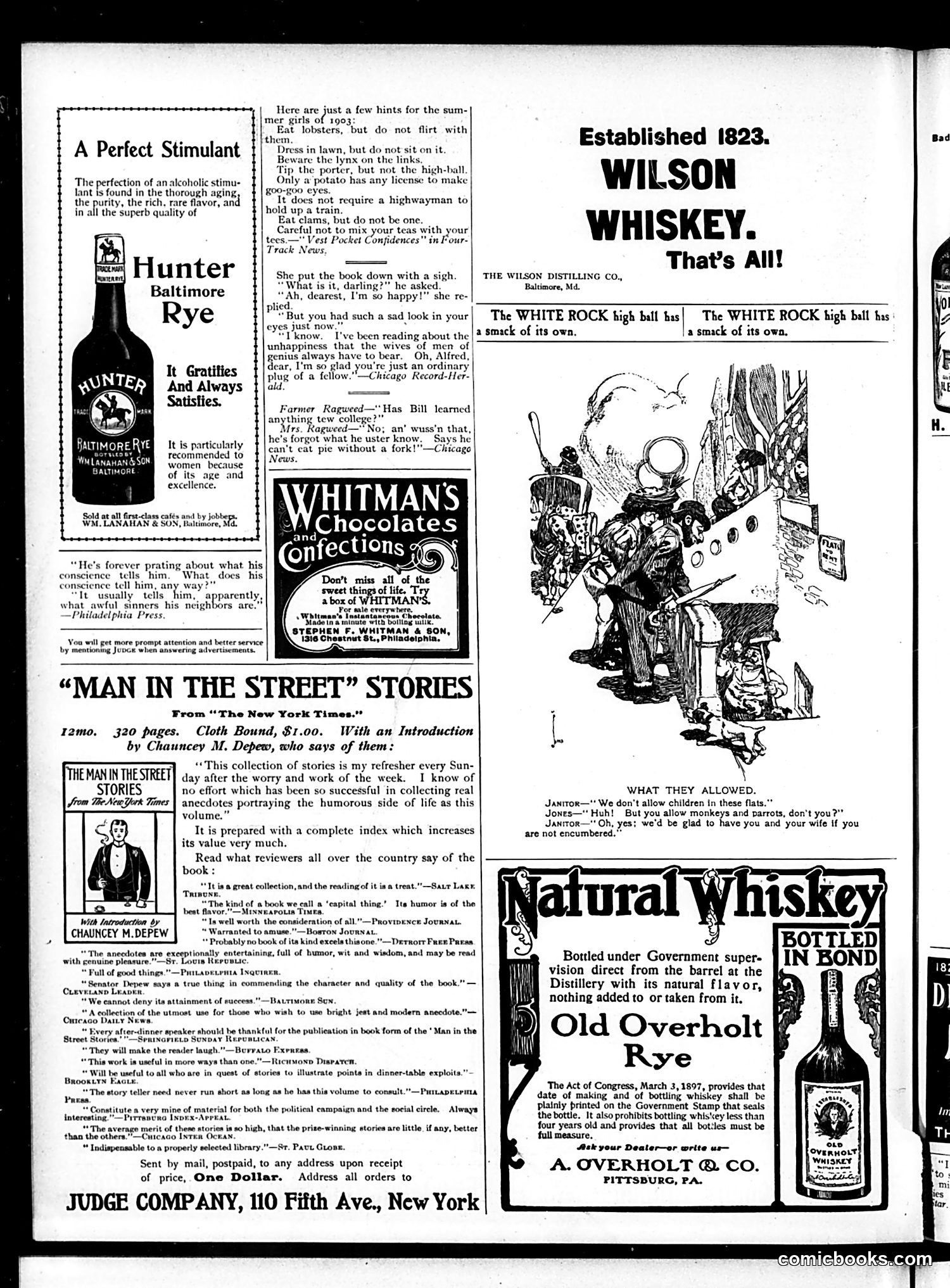
This page is primarily **advertising** for whiskey and other products, interspersed with light humor content typical of *Judge* magazine. ## Key Elements: **Main Cartoons/Jokes:** - A dialogue about a woman reading unhappily—the punchline being her husband is relieved she's sad because he's "just an ordinary plug of a fellow" (ordinary man), not a genius whose wife would suffer - A farmer's anecdote about a college student who's forgotten practical skills and won't eat pie without a fork—mocking pretentious education - A landlord refusing to rent to a man with children but accepting monkeys and parrots—satirizing arbitrary rental discrimination **Advertisements:** The page features whiskey ads (Hunter Baltimore Rye, Wilson Whiskey, Natural Old Overholt Rye) and confectionery ads, reflecting early-1900s *Judge* revenue model. **Context:** The humor is gentle domestic/social satire—poking fun at intellectuals, modernization, and class pretension—typical of the era's middlebrow comedy. The advertisements reflect that alcohol advertising was legal and commonplace in American magazines.
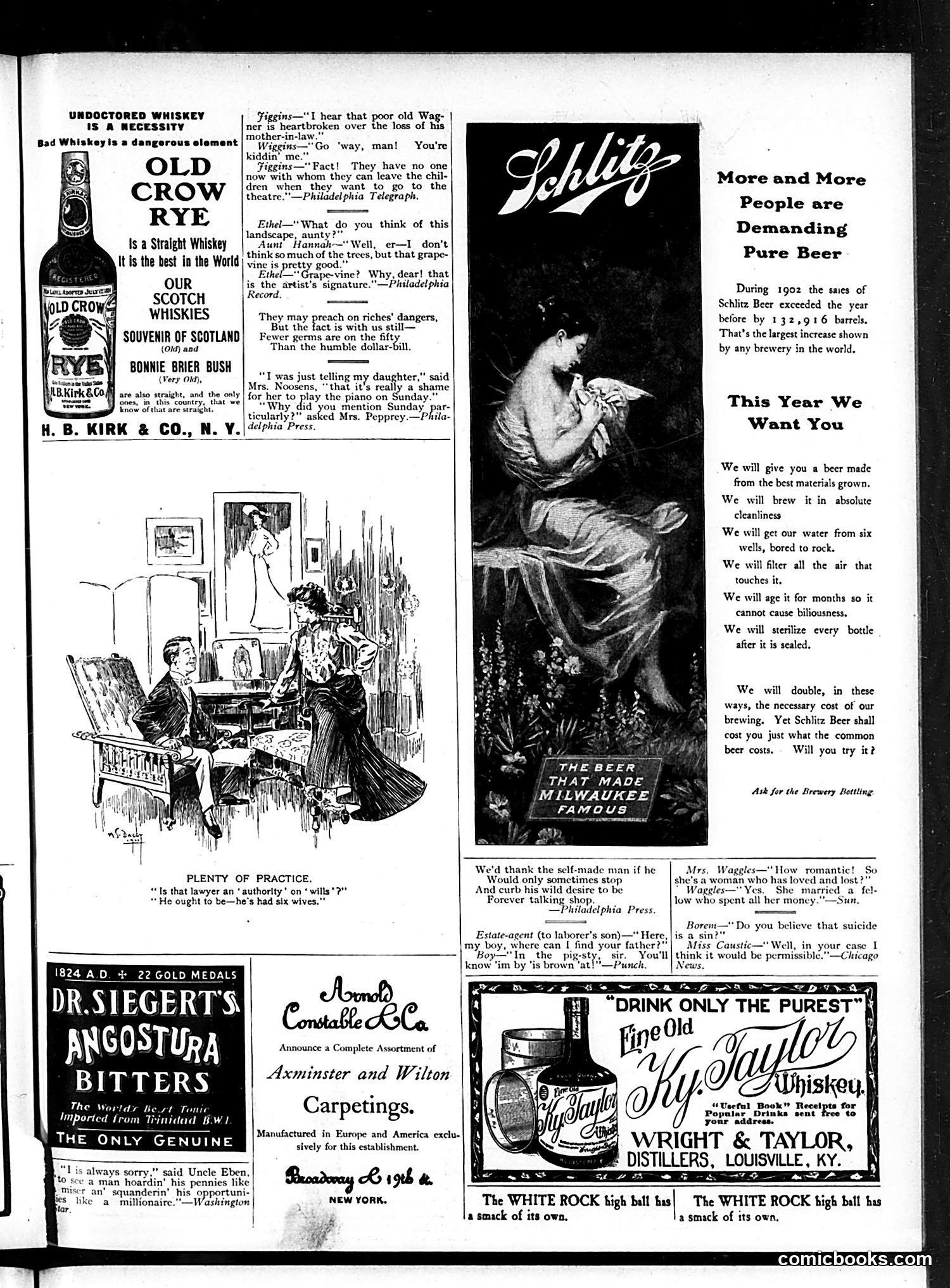
This page is primarily **advertising**, dominated by liquor and consumer product ads typical of early 1900s Judge magazine. The satirical content is minimal. The few short humor pieces are standard domestic comedy: - A joke about a man losing his mother-in-law (punching-bag figure of the era) - A aunt critiquing a landscape painting, mistaking the artist's signature for a grapevine (mild absurdist humor) - A lawyer's six marriages as proof of legal expertise in wills (wordplay on "wills") The large **Schlitz Beer advertisement** boasts of outselling competitors in 1902, claiming superior brewing methods and purity—notable given this preceded pure food regulation concerns of the era. The cartoons and ads reflect **pre-Prohibition attitudes** toward alcohol as a legitimate consumer good, with whiskey, beer, and bitters presented as everyday products. There is no political satire visible on this page—it's purely commercial and light domestic humor typical of Judge's formula.
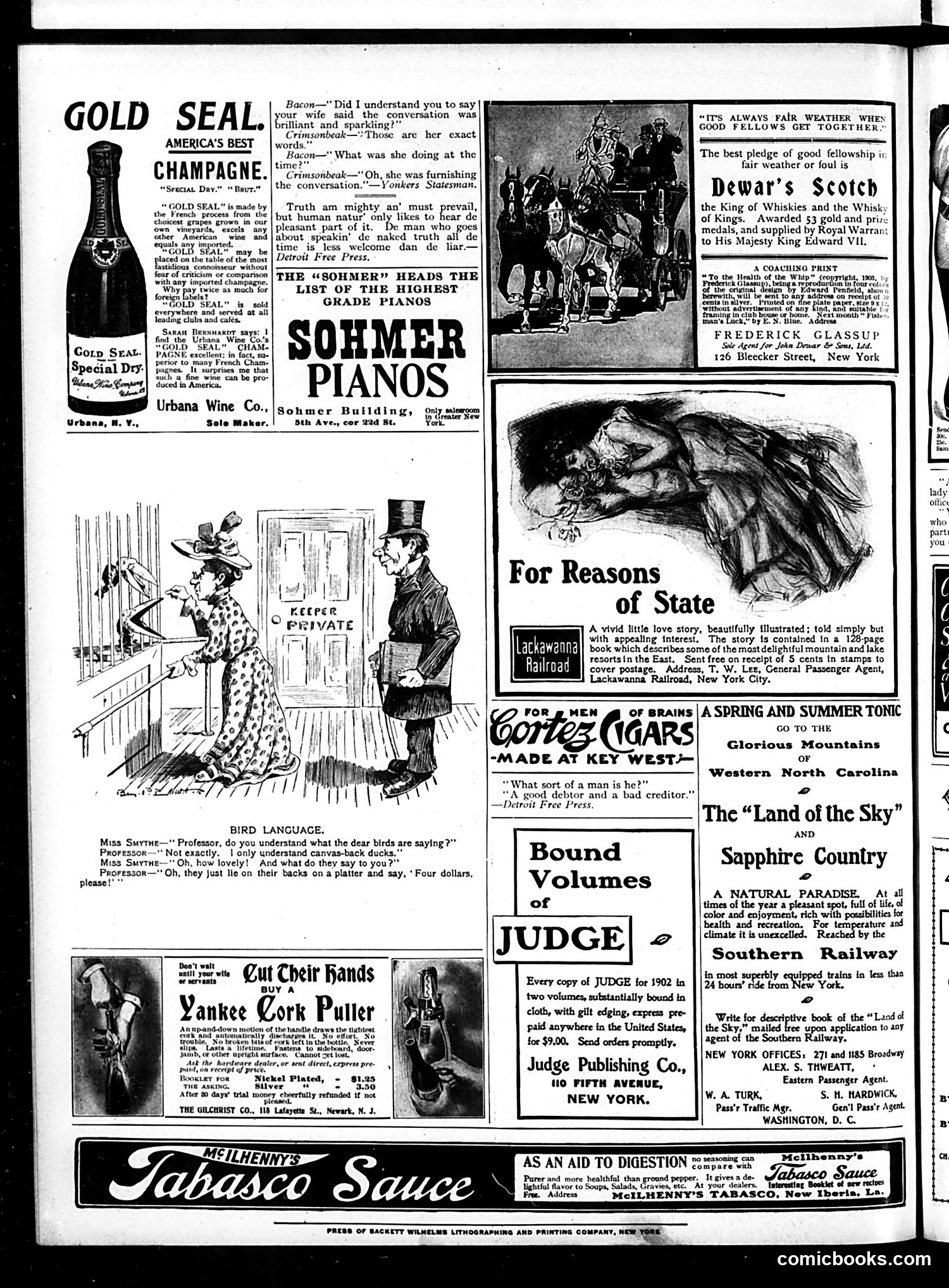
This page is **primarily advertising** with several small satirical cartoons interspersed. ## Notable Content: **"Bird Language" cartoon**: A professor tells students that when ducks lie on their backs on a platter, they say "Four dollars, please." This is a simple joke about the price of roasted duck, playing on the contrast between the children's innocent animal interest and the culinary reality. **"Bacon and Crimsonbeak" exchange**: A man boasts that his wife's conversation is "brilliant and sparkling," but he's actually just describing her arguing—she's creating the "conversation" solo while he listens. The joke mocks couples where one spouse dominates. **Remaining content**: The page is dominated by product advertisements—Gold Seal champagne, Sohmer pianos, Yankee cork pullers, Dewar's Scotch, and railroad/vacation advertisements. All reflect luxury goods marketed to affluent readers. The cartoons serve primarily as filler between ads rather than major satirical commentary.
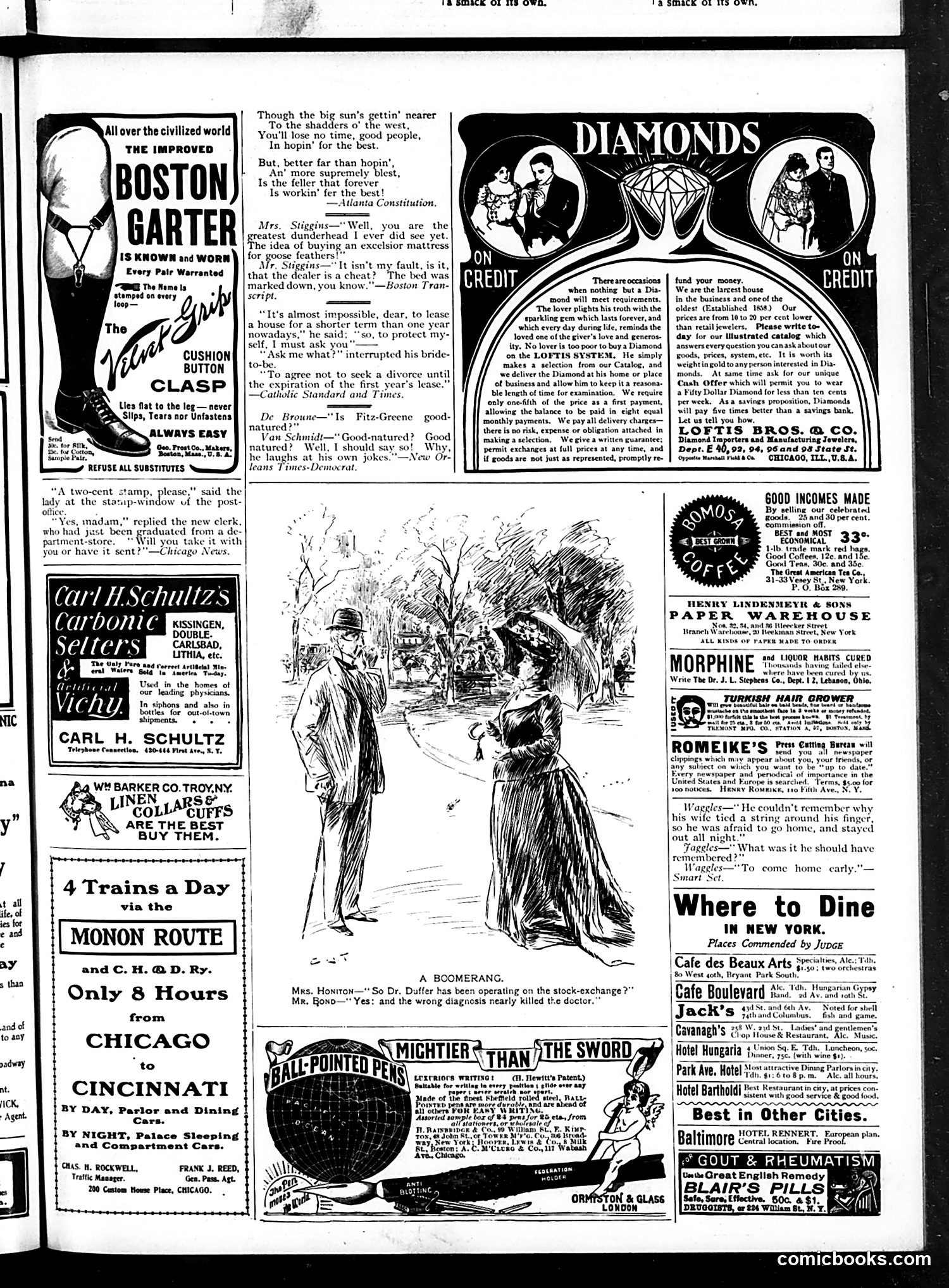
This page from *Judge* (a major American satirical weekly) contains primarily **advertisements and humorous short jokes** rather than political cartoons. The central illustration shows a street scene with two figures—likely depicting a romantic or social encounter typical of the era's humor. The caption references a stock-exchange mishap and medical error, suggesting satirical commentary on professional incompetence. The page's humor relies on domestic comedy: a wife angry about her husband buying an inferior mattress; marital disagreements about home and punctuality; a husband forgetting an important detail (unclear what) and avoiding his wife. These reflect early-20th-century middle-class anxieties about marriage and household management. The dominant content is **commercial advertising** for diamonds (Loftis Bros.), Boston garters, carbonic seltzer, train travel, and various patent medicines—typical of *Judge*'s business model. The ads employ exaggerated claims common to the period. No specific political figures or dated events are identifiable on this page. It represents the magazine's standard mix of gentle domestic satire and commercial promotion.
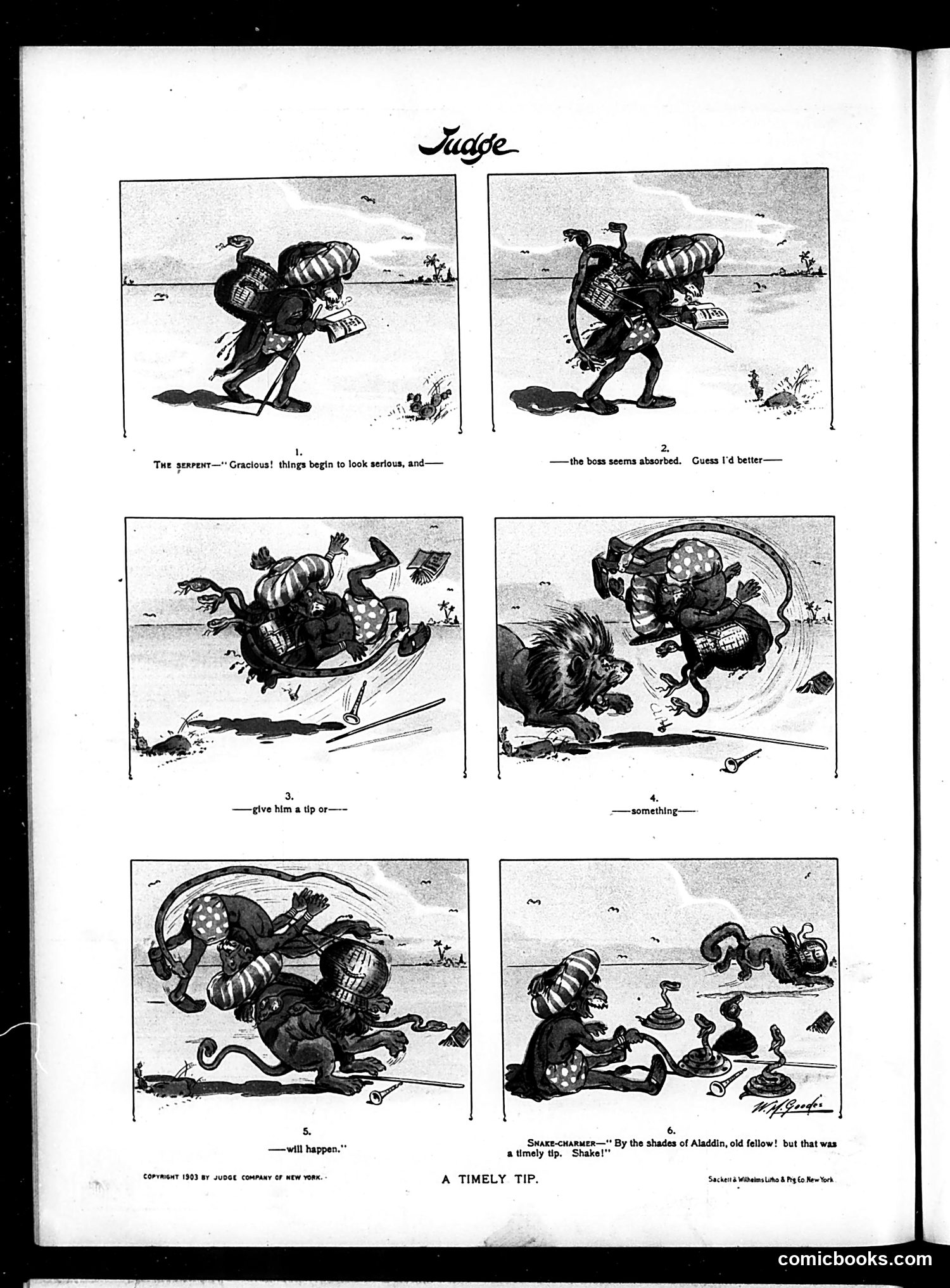
This six-panel comic strip depicts two characters—apparently a servant and a boss or master—in increasingly chaotic situations. The narrative suggests the servant is warning his employer of impending danger ("things begin to look serious"). The humor escalates through physical comedy: the characters tumble, spin, and collide with various objects scattered about. The final panel's reference to "the shades of Aladdin" and "Shake!" indicates a magical or supernatural theme, likely playing on the popular Aladdin story for comedic effect. The title "A Timely Tip" suggests the servant's warning ultimately saves his employer from disaster. The satire appears to mock class hierarchy—the servant's lowly status contrasts with his crucial role in preventing catastrophe, inverting typical power dynamics for comic effect. The visual style and copyright date (1903) confirm this is early 20th-century American humor.