
A complete issue · 16 pages · 1903
Judge — May 9, 1903
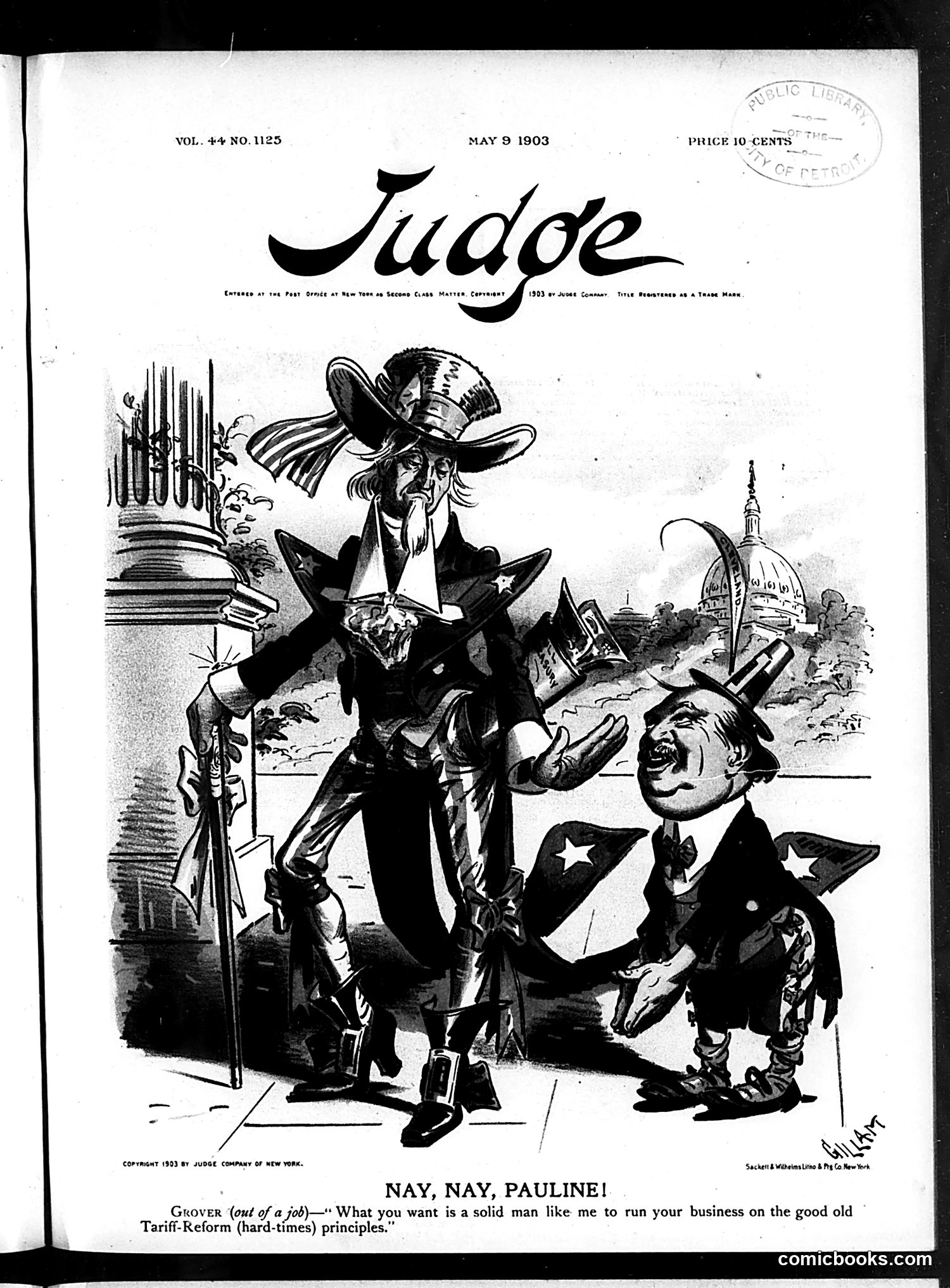
This political cartoon depicts Uncle Sam (tall figure in starred top hat) confronting what appears to be a shorter, caricatured German figure wearing a spiked military helmet. The caption quotes Grover Cleveland, a former president, advocating "Tariff-Reform (hard-times) principles" and a "solid man" to manage American business. The satire likely comments on protectionist trade policy debates of the era. The German figure's presence suggests tension over international trade or immigration policy—common anxieties in early 1900s America. The theatrical "Nay, Nay, Pauline!" title (referencing a melodrama) emphasizes the dramatic, overwrought nature of these political disputes. The cartoon mocks what it presents as theatrical posturing in tariff debates.
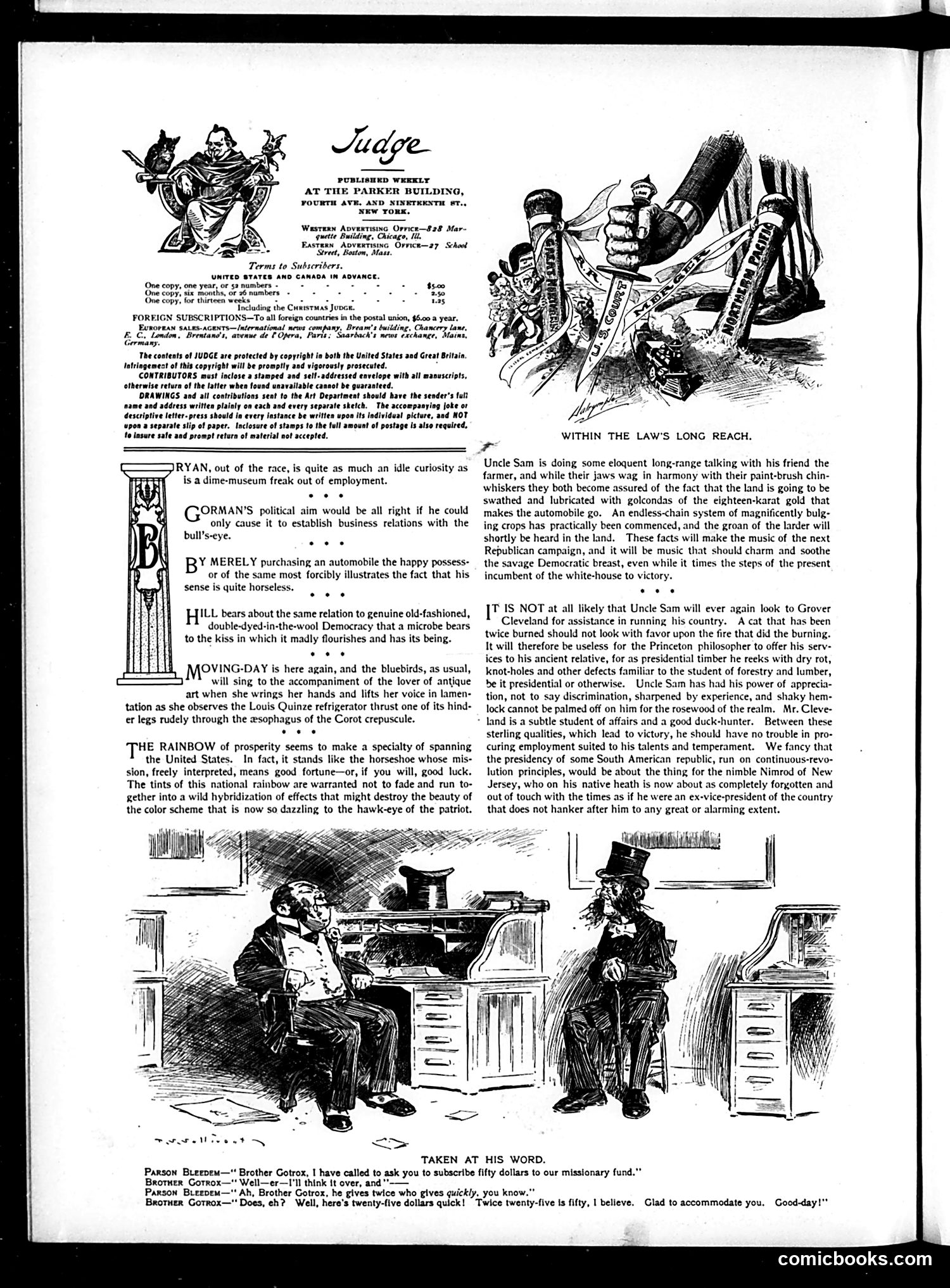
This page contains political commentary and a cartoon titled "Taken at His Word." The text discusses various political figures and issues, including references to Grover Cleveland, Democratic politics, and South American republics. The main cartoon depicts two men in an office setting—one seated at a desk, another standing. The caption suggests a conversation about charitable donations: "Parson Bleeden" asks "Brother Cotgax" to subscribe fifty dollars to a missionary fund. Cotgax, appearing skeptical, eventually agrees to contribute twenty-five dollars "twice," implying he'll give the same amount twice rather than truly doubling his generosity—a joke about stingy, insincere charity masked by wordplay. The satire targets hypocrisy in religious charity and wealth.
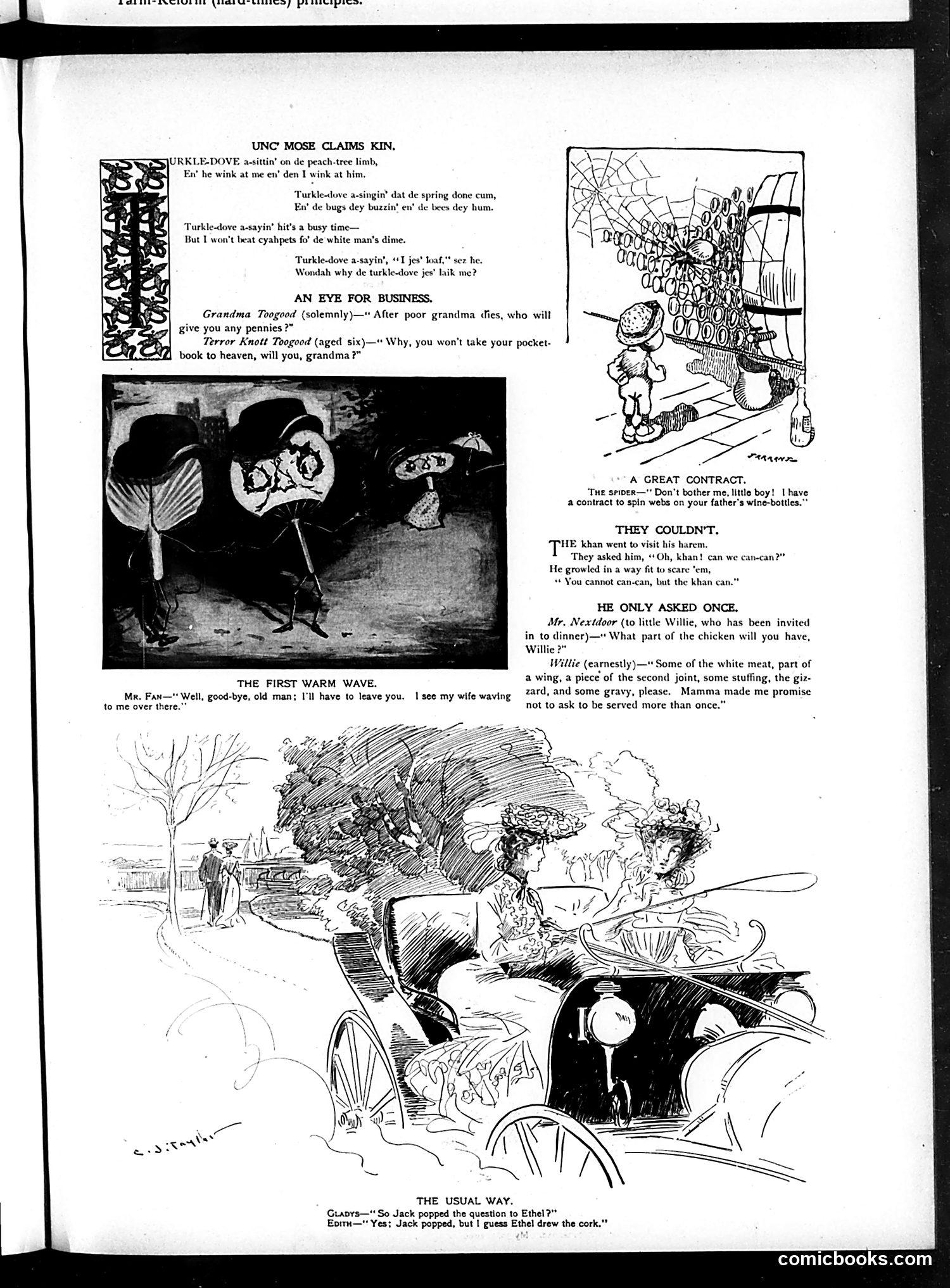
This page contains several short humorous sketches rather than political cartoons. The content includes: **"Unc' Mose Claims Kin"** — A dialect-heavy joke about a turkey-dove's mating call, using African American vernacular typical of early 20th-century American humor (now considered offensive). **"An Eye for Business"** — A brief exchange between grandmother and grandchild about poverty and inheritance. **"The First Warm Wave"** — A cartoon showing a man saying goodbye to his wife, with the caption suggesting infidelity (he's seeing another woman). **"The Usual Way"** — A joke about a couple named Jack and Ethel, with wordplay about "popping the question" (marriage proposal) versus drawing a cork (opening wine). The page is primarily entertainment humor rather than political satire, reflecting period comedy standards.
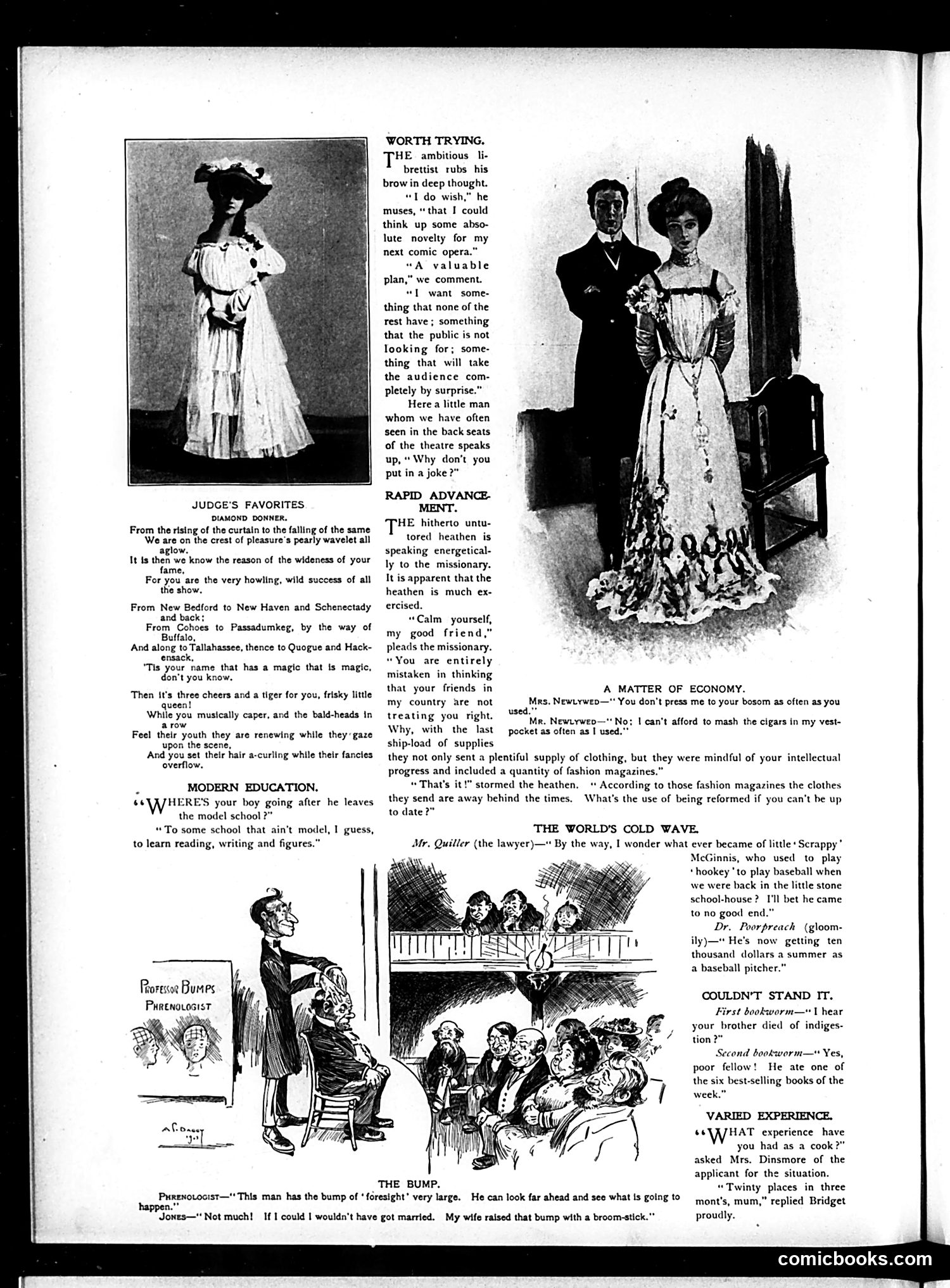
This page contains several satirical vignettes typical of early 20th-century Judge magazine humor: **"Judge's Favorites"** mocks theatrical productions, apparently critiquing popular shows with absurdist poetry about traveling performers. **"Modern Education"** jokes about a boy attending school merely to learn "reading, writing and figures" — satirizing educational priorities of the era. **"The Bump"** features a phrenologist (pseudoscientific head-reader) claiming to predict a man's future through facial bumps. The joke: the man says his wife gave him the "bump" with a broomstick, mocking both phrenology and marital discord. **"The World's Cold Wave"** contains brief comedic exchanges about a former baseball player ("Scrappy" McGinnis) now earning baseball-pitcher wages. The remaining items are short humorous anecdotes about economy, education, and marriage — typical Judge content satirizing contemporary social conventions and pseudoscience.
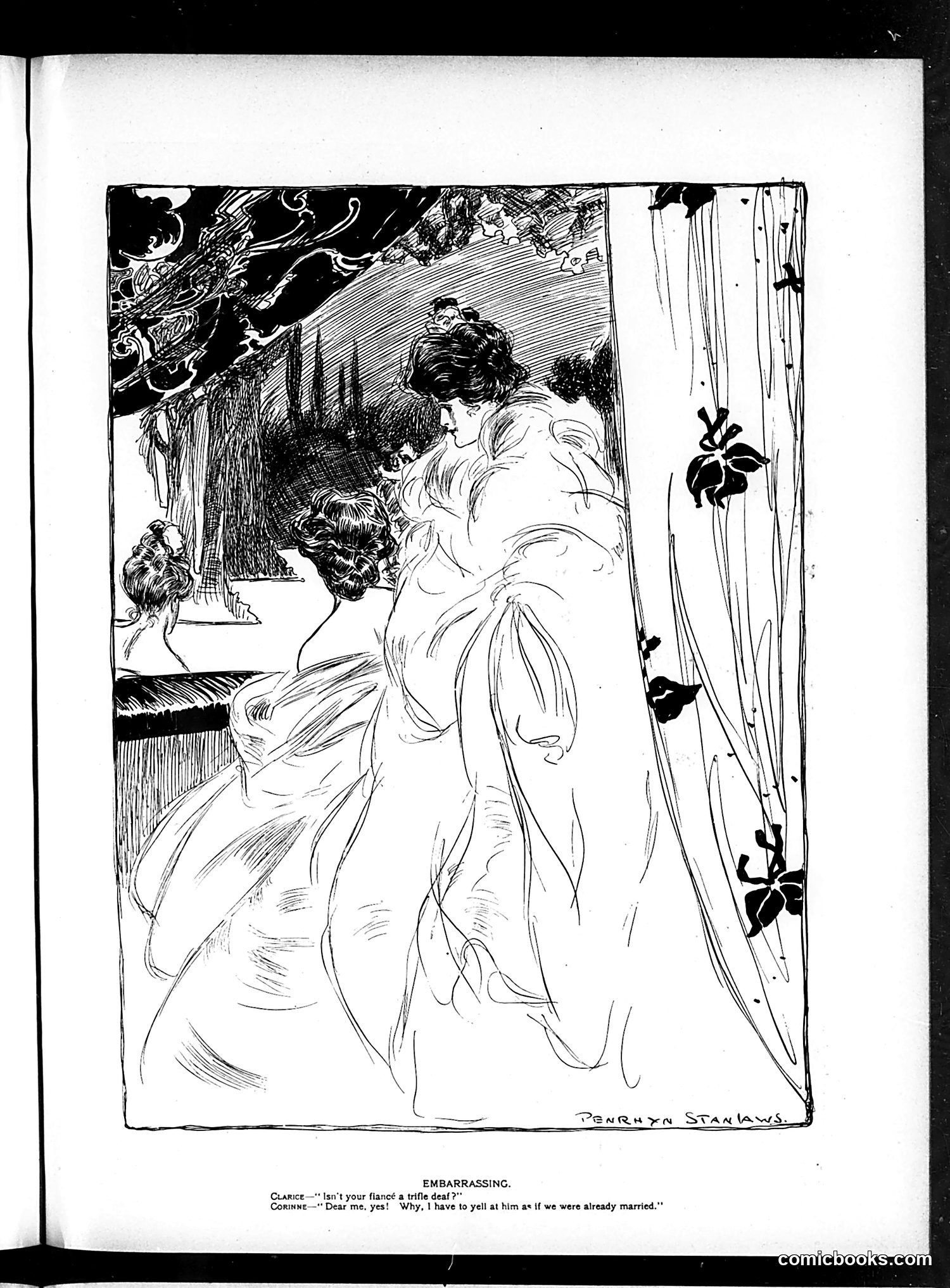
This is a humorous cartoon about courtship and marriage from *Judge* magazine. The joke plays on a common stereotype about married couples: that wives must speak loudly to be heard by their husbands, implying husbands deliberately ignore their wives. The scene shows two women (Clarice and Corinne) in an interior setting. Clarice notices that Corinne's fiancé appears deaf. Corinne's response suggests that she already must shout at him—a behavior she associates with being married, not engaged. The humor lies in the implication that marital dynamics (where wives feel unheard) have prematurely arrived in their engagement. This reflects early 20th-century gender and marital satire, mocking both male inattentiveness and wives' frustration with it.
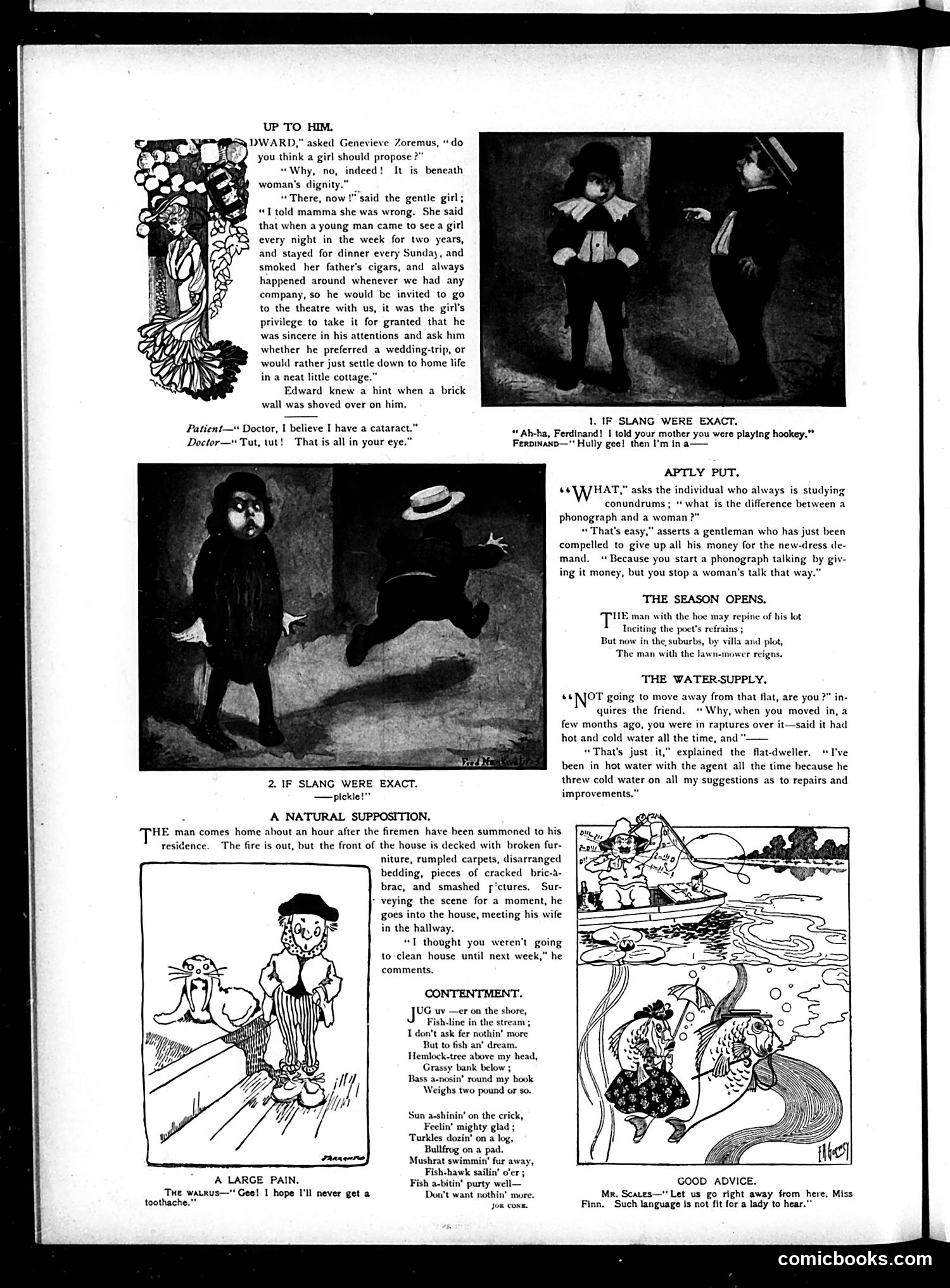
This early 20th-century satirical page uses humor to mock contemporary social conventions and gender dynamics: **"Up to Him"**: A young woman cleverly pressures her reluctant suitor Edward into proposing by cataloging two years of his attentive behavior (nightly visits, Sunday dinners, smoking his cigars, theater invitations). The joke: she's outlined such overwhelming evidence of commitment that he cannot reasonably refuse—the "brick wall" alludes to being trapped. **Gender satire throughout**: Multiple jokes target the emerging "New Woman" and traditional courtship expectations. "Aptly Put" compares women to phonographs, joking that money starts both talking but only stops women—mocking both female chattiness and female financial demands. **"Natural Supposition"**: A fire damages the home; the husband assumes his wife used the chaos as an excuse to finally do housecleaning—satirizing the era's tension between domestic duty and marital conflict. The remaining cartoons are lighter domestic and nature humor, with "Good Advice" suggesting dialect humor was standard entertainment (and considered offensive by modern standards). Overall, the page reflects early 1900s anxieties about changing gender roles and courtship norms.
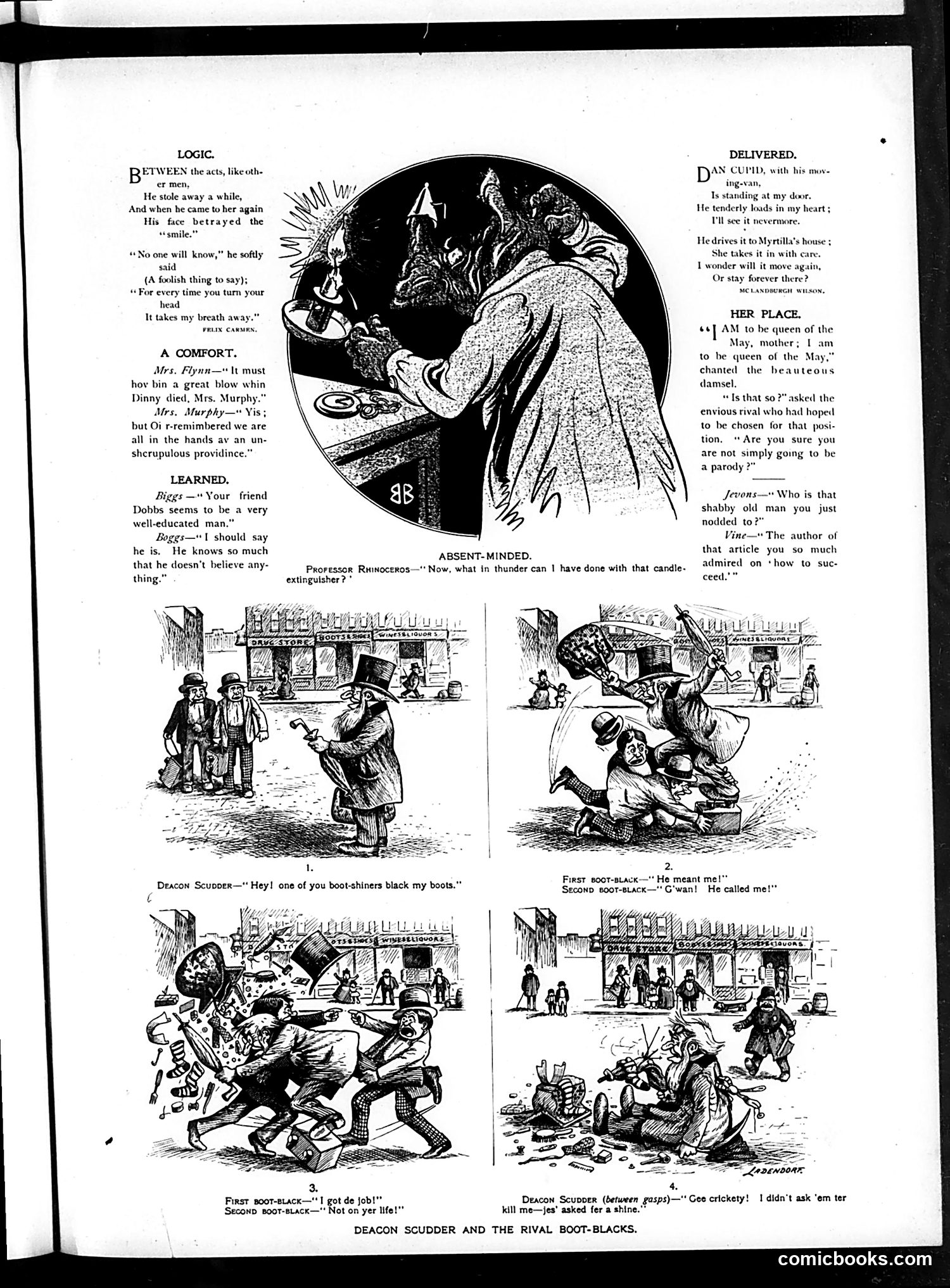
This page contains several short satirical pieces typical of early 20th-century American humor magazines: **"Logic"** and **"Delivered"** are sentimental poems mocking romantic clichés—the first about a man's forced smile, the second about a heartbroken woman watching her lover move her possessions to another woman's house. **"A Comfort"** satirizes Irish immigrant dialect humor (common in the era), with Mrs. Murphy accepting her husband's death through fatalistic acceptance of "providence." **"Learned"** and **"Absent-Minded"** are brief joke exchanges about education and forgetfulness. **"Deacon Scudder and the Rival Boot-Blacks"** (the main comic strip) depicts a Black man being violently attacked by rival shoe-shiners. The humor relies on racist caricature and physical comedy stereotyping Black workers. This reflects the period's casual racial mockery in mainstream publications. The "deacon" character requests only a shoe shine, not violence—the joke being the disproportionate response. The overall page mixes sentimental verse, ethnic humor, and lowbrow slapstick reflecting Judge's satirical but deeply prejudiced editorial voice.
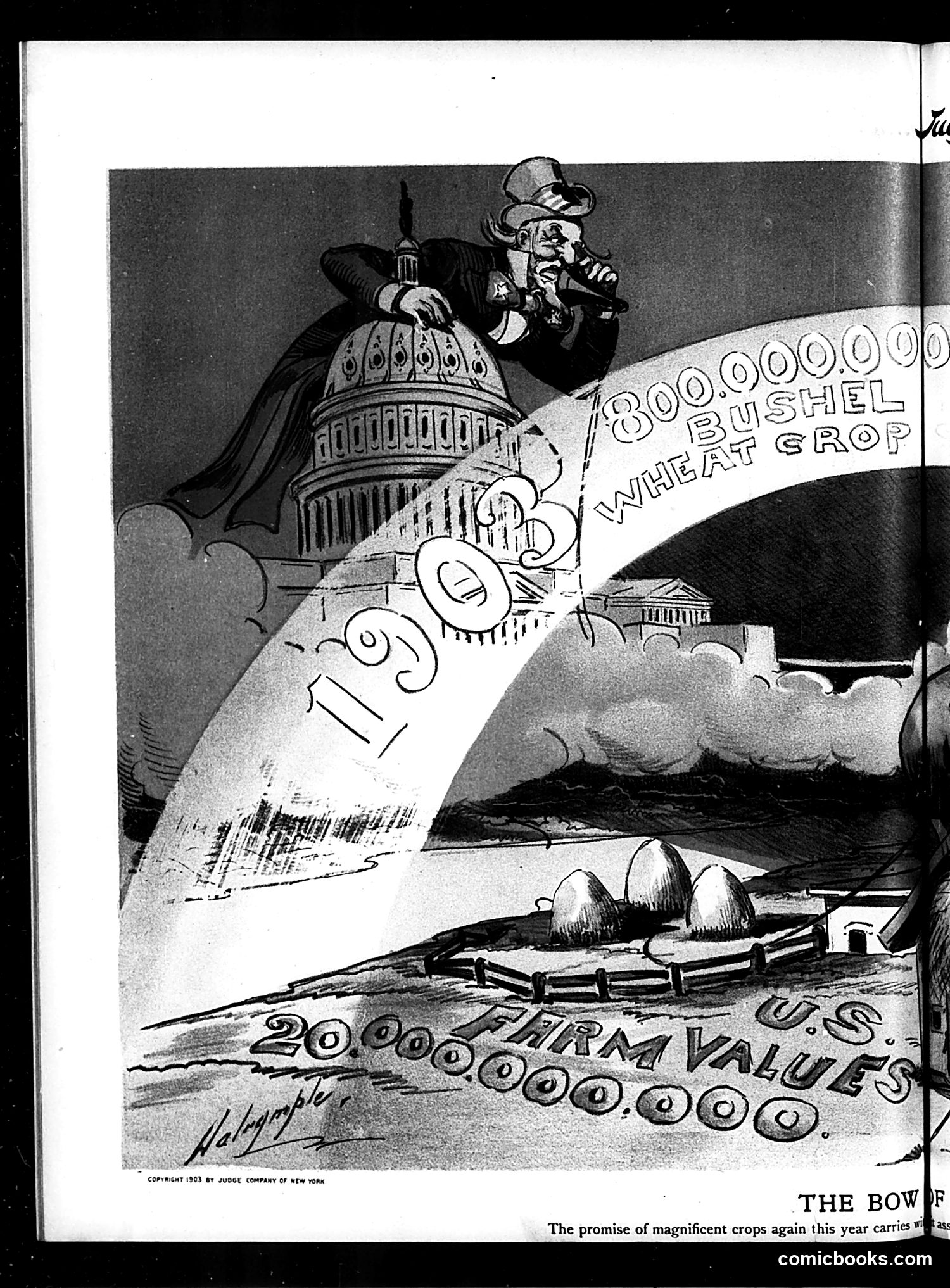
This appears to be a political cartoon satirizing American agricultural promises and federal policies, likely from the early 20th century. A caricatured figure (possibly a politician or government official) emerges from the Capitol building, wielding what resembles a cornucopia or "bow of plenty." The cartoon contrasts promised abundance with harsh reality: a scroll promises "800,000 bushel wheat crop" and "$20,000 farm values," yet the foreground shows barren ground with only three eggs and damaged fencing—suggesting actual agricultural conditions were dire. The satire mocks the gap between government rhetoric about economic prosperity and farmers' actual hardship. The figure's exaggerated expression and gestures emphasize the disconnect between optimistic political promises and ground-level economic reality affecting American farmers.
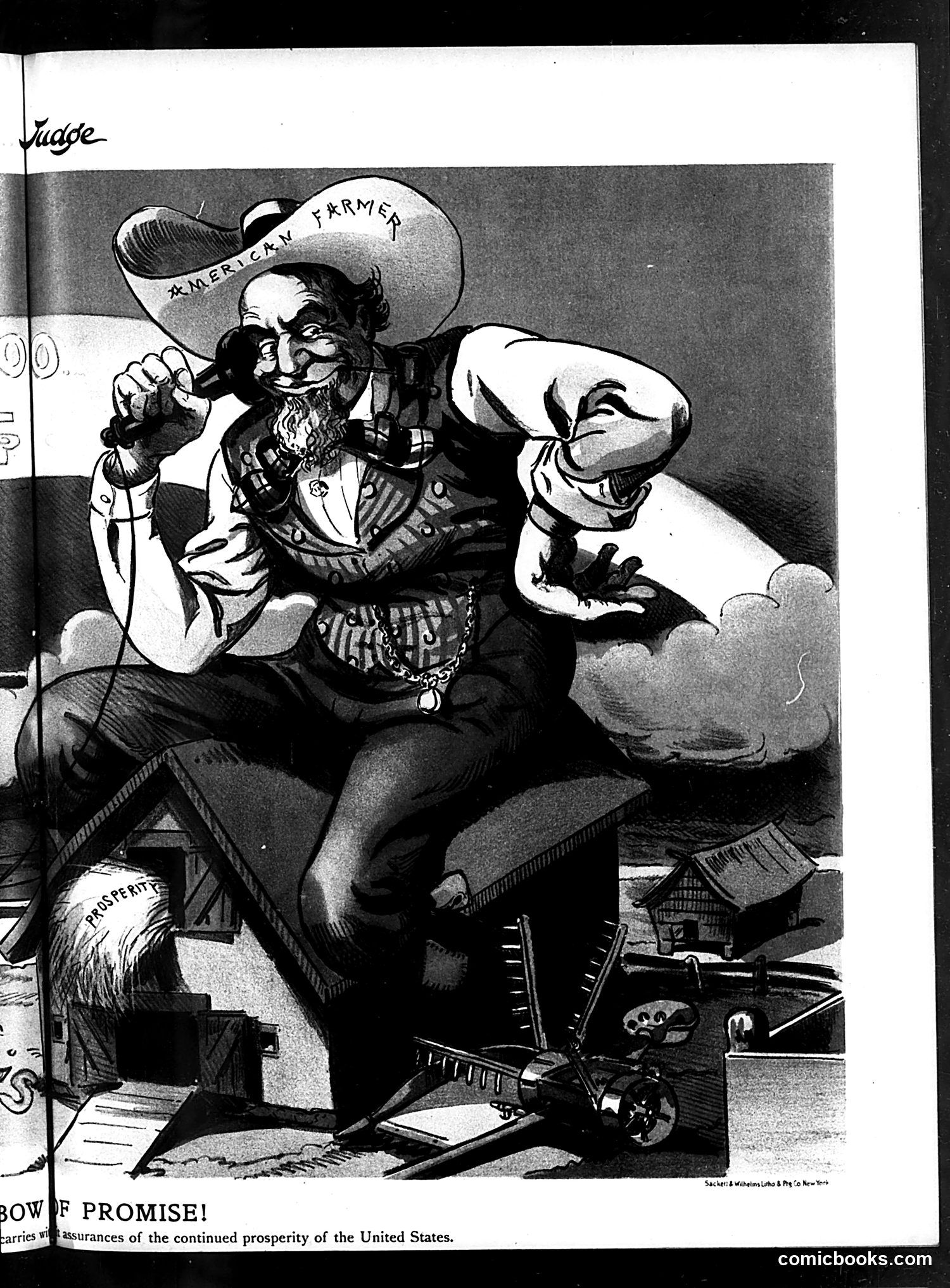
This Judge magazine cartoon depicts an "American Farmer" character sitting confidently atop agricultural and industrial symbols (visible farming equipment below). His exaggerated, caricatured features and traditional farmer attire with a wide-brimmed hat labeled "American Farmer" suggest this represents American agricultural prosperity and optimism. The caption "Bow of Promise" with text referencing "assurances of the continued prosperity of the United States" indicates the cartoon celebrates American economic confidence—likely during a period of agricultural or general economic expansion. The farmer's assured, relaxed posture symbolizes faith in sustained American wealth and agricultural success. The satirical style is typical of Judge magazine's approach to contemporary economic and political issues, using symbolic figures to comment on national prosperity narratives of the era.
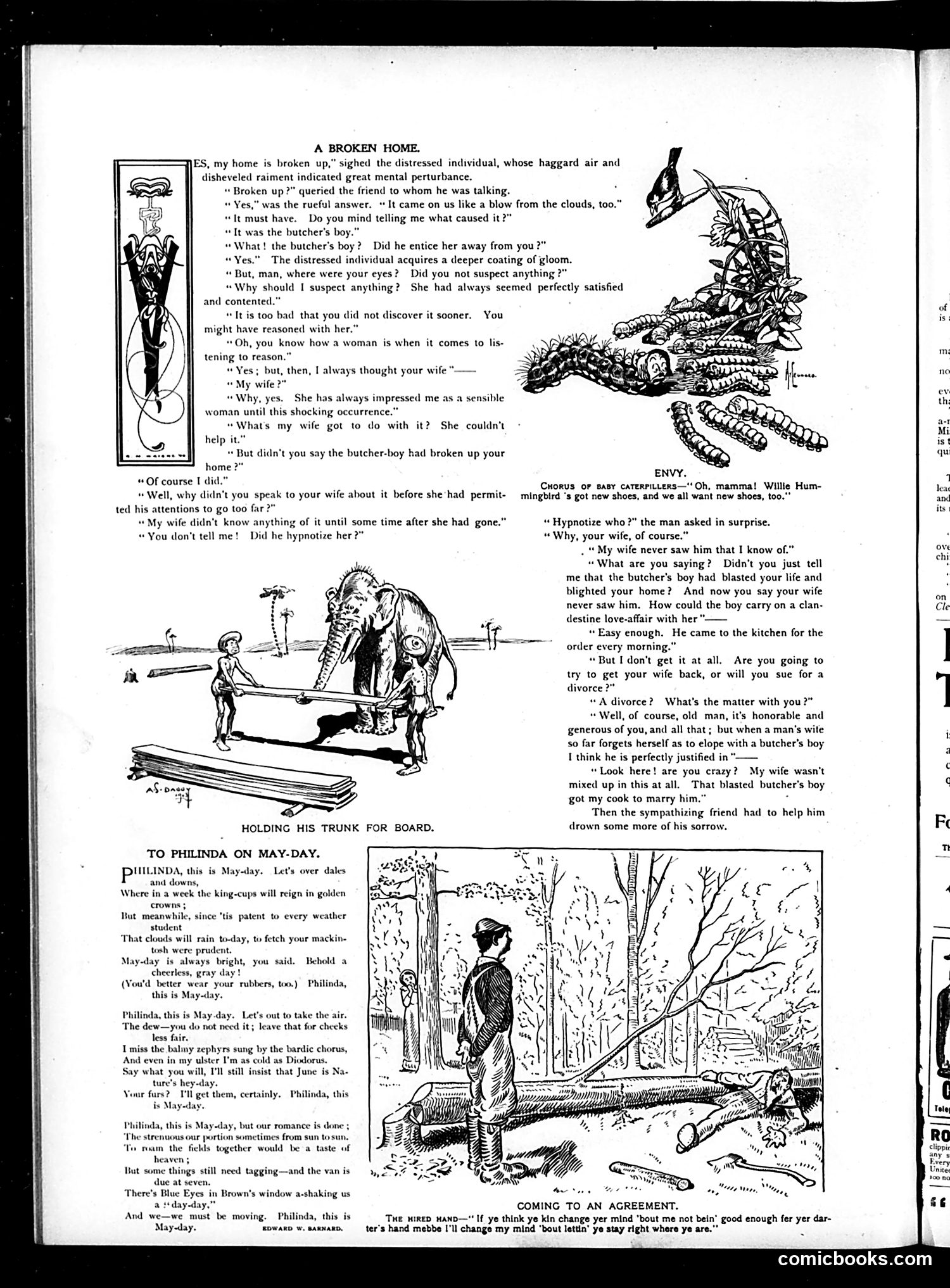
**"A Broken Home"** is a comedic dialogue about marital miscommunication. A distressed man tells his friend his home is "broken up," implying his wife eloped with the butcher's boy. Through questioning, the friend expresses shock—until the punchline reveals the man's *cook* (not his wife) ran off to marry the butcher's boy. The satire mocks both the man's poor communication with his wife and the friend's assumptions about social scandal. The humor derives from the class distinction: the concern shifts from infidelity to household staff, deflating the dramatic opening. **"To Philinda on May-Day"** is a romantic poem about disappointing May weather—the speaker wanted an idyllic spring outing but faces rain, cold, and practical concerns (rubbers, furs, errands). The satire gently mocks romanticized notions of nature and May-day traditions when reality intrudes. Both pieces reflect early-20th-century middle-class anxieties about propriety, relationships, and the gap between expectation and reality.
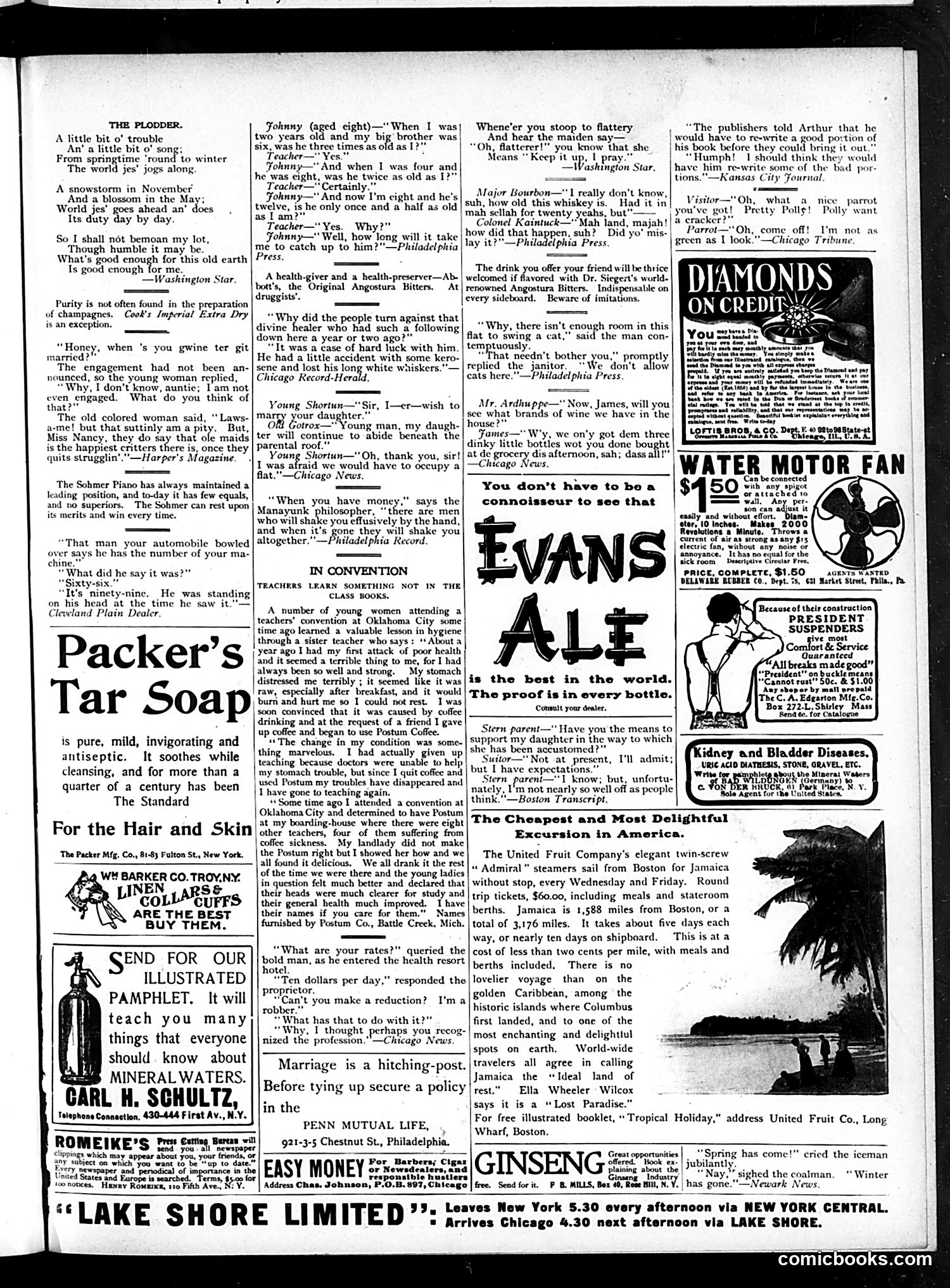
This is primarily a **miscellaneous editorial and advertising page** from Judge magazine, containing several unrelated jokes, poems, and advertisements rather than unified political cartoons. The main content includes: - **"The Plodder"**: A sentimental poem about accepting life's ups and downs with dignity - **Reader jokes**: Including a child's logic puzzle about relative ages, and workplace/social humor (the automobile accident joke, the divine healer losing credibility after a kerocene accident) - **Postum Coffee testimonial**: A teacher's health conversion story promoting Postum as a stomach cure, implying coffee causes digestive problems—a common health claim of the era The **advertisements** promote period products: Packer's Tar Soap, Sohmer pianos, Postum Coffee, and various patent medicines. There's **no overt political satire** visible. The humor is domestic and mild. The Postum ad reflects early 1900s concerns about coffee's health effects, now recognized as largely unfounded marketing.
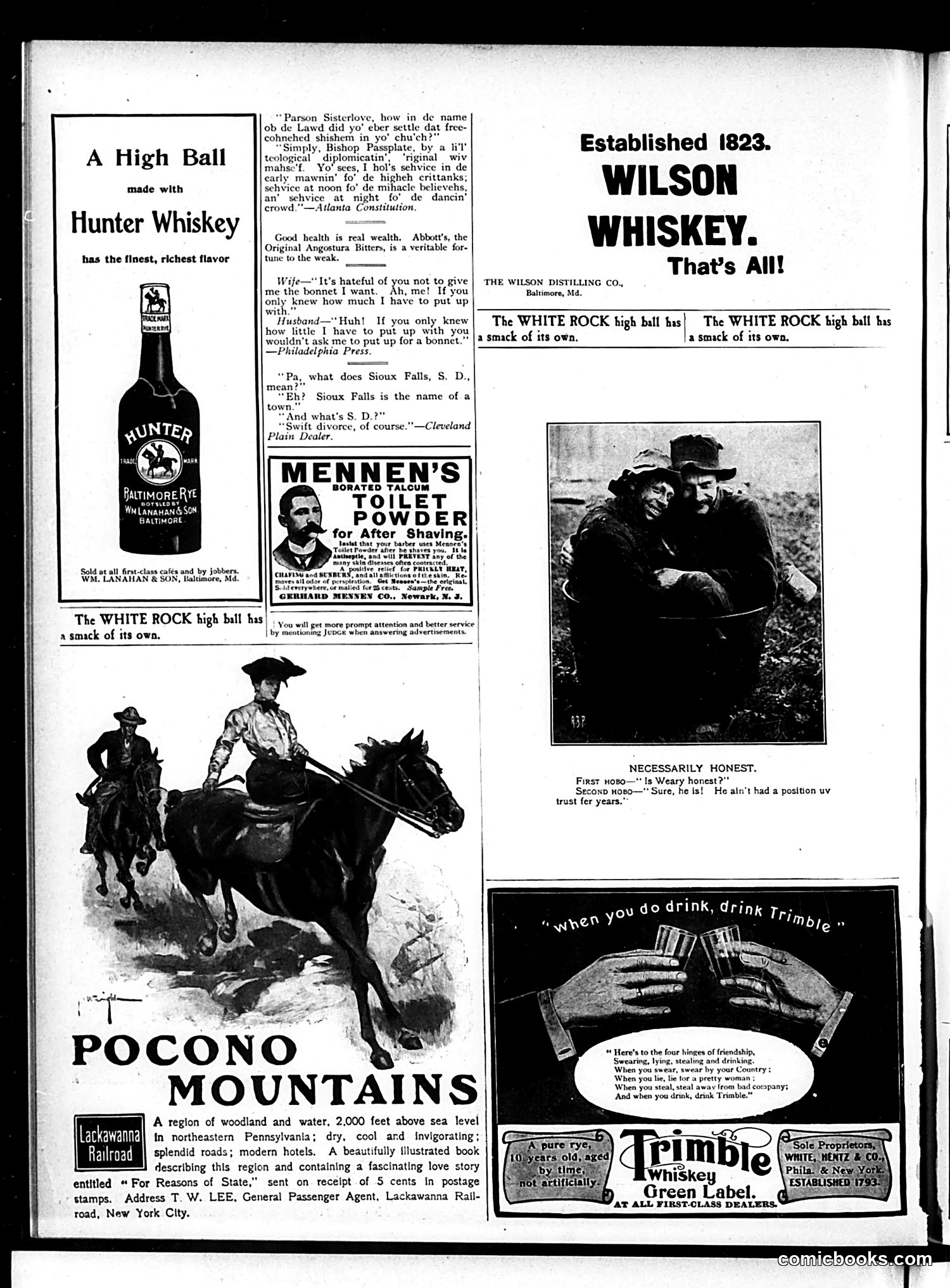
This page is primarily **advertising**, with several small joke items interspersed. The main content consists of period whiskey and product advertisements (Hunter Whiskey, Wilson Whiskey, Trimble Whiskey, Mennen's Powder). The satirical content includes brief dialogue jokes typical of Judge: 1. **"Parson Sisterlove"** excerpt mocks Black dialect and suggests a preacher holds multiple services—early morning for the wealthy, noon for believers in miracles, and night for the dancing crowd—satirizing religious hypocrisy and class divisions. 2. **Marriage jokes** about a wife demanding a bonnet and a husband's exasperation reflect period domestic comedies. 3. **"Sioux Falls" joke** references the town's reputation for swift divorces—a genuine phenomenon where people went for easy legal dissolution of marriage. 4. **"Weary honest"** gag implies someone without a job hasn't had opportunity to betray trust. The Pocono Mountains advertisement promotes tourism. Overall, this reflects early 20th-century American advertising culture and period humor styles.
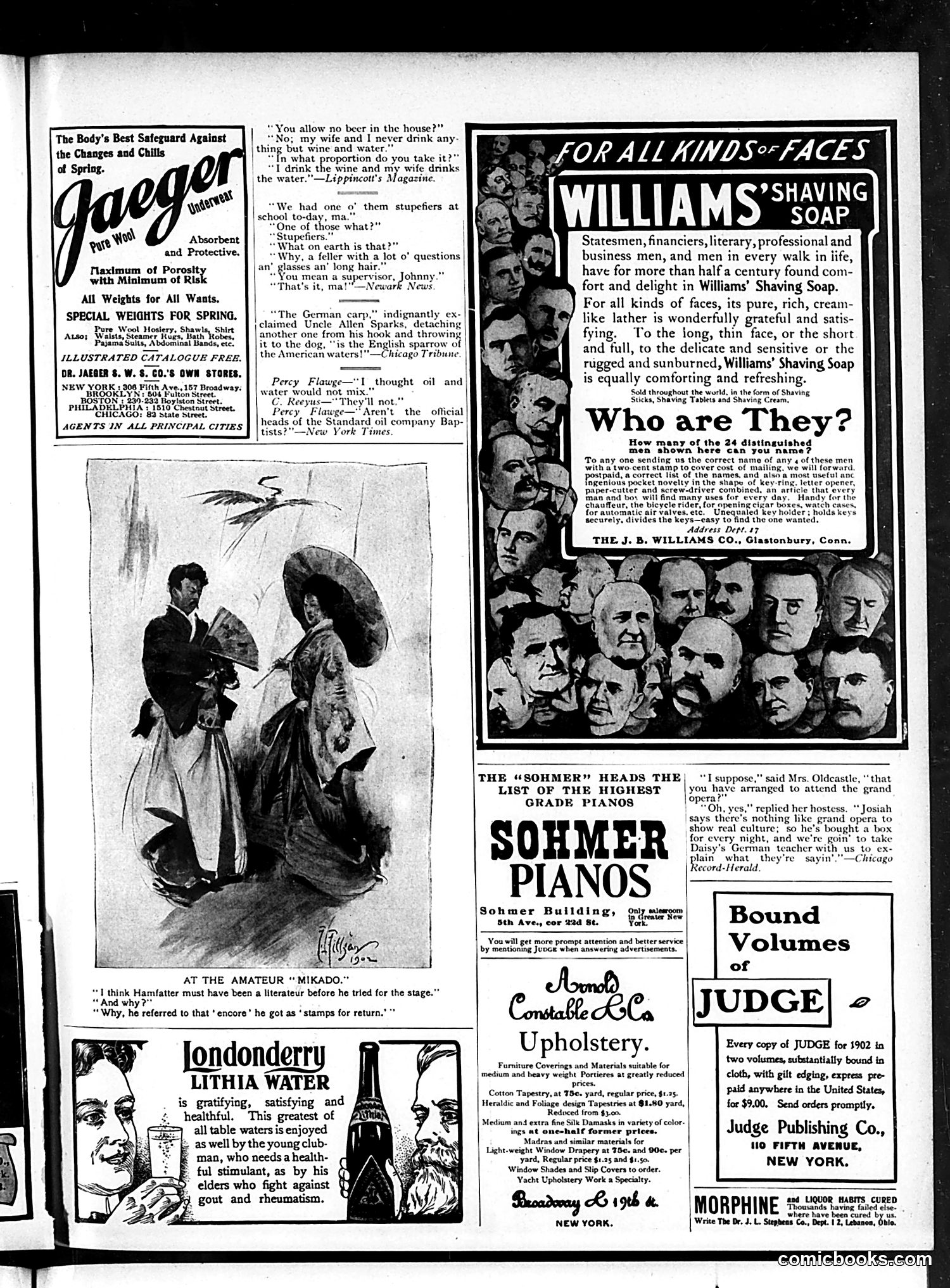
This page is primarily **advertisements interspersed with brief satirical jokes**, typical of Judge magazine's format. The humor centers on social observations about drinking habits and pretension. One joke mocks a man who claims his household drinks only "wine and water"—the punchline reveals his wife drinks just the water while he takes the wine, exposing marital dynamics humorously. Another brief exchange satirizes pseudo-intellectual affectation: a man with "a lot o' questions and glasses and long hair" asks what "earth" is, mocking affected intellectuals or bohemians pretending to profound ignorance. A third joke plays on the absurdity of German vs. American animals—a man angry about catching "German carp" insists the English sparrow is worse, illustrating pointless nationalist pet-peeves. The "Hamfatter" reference (bottom left) mockingly suggests amateur theatrical performers might have been failed writers—"hamfatter" being period slang for a poor or mediocre actor. The advertisements for Sohmer Pianos, Williams' Shaving Soap, and other luxury goods reflect Judge's upper-middle-class readership and advertising base.
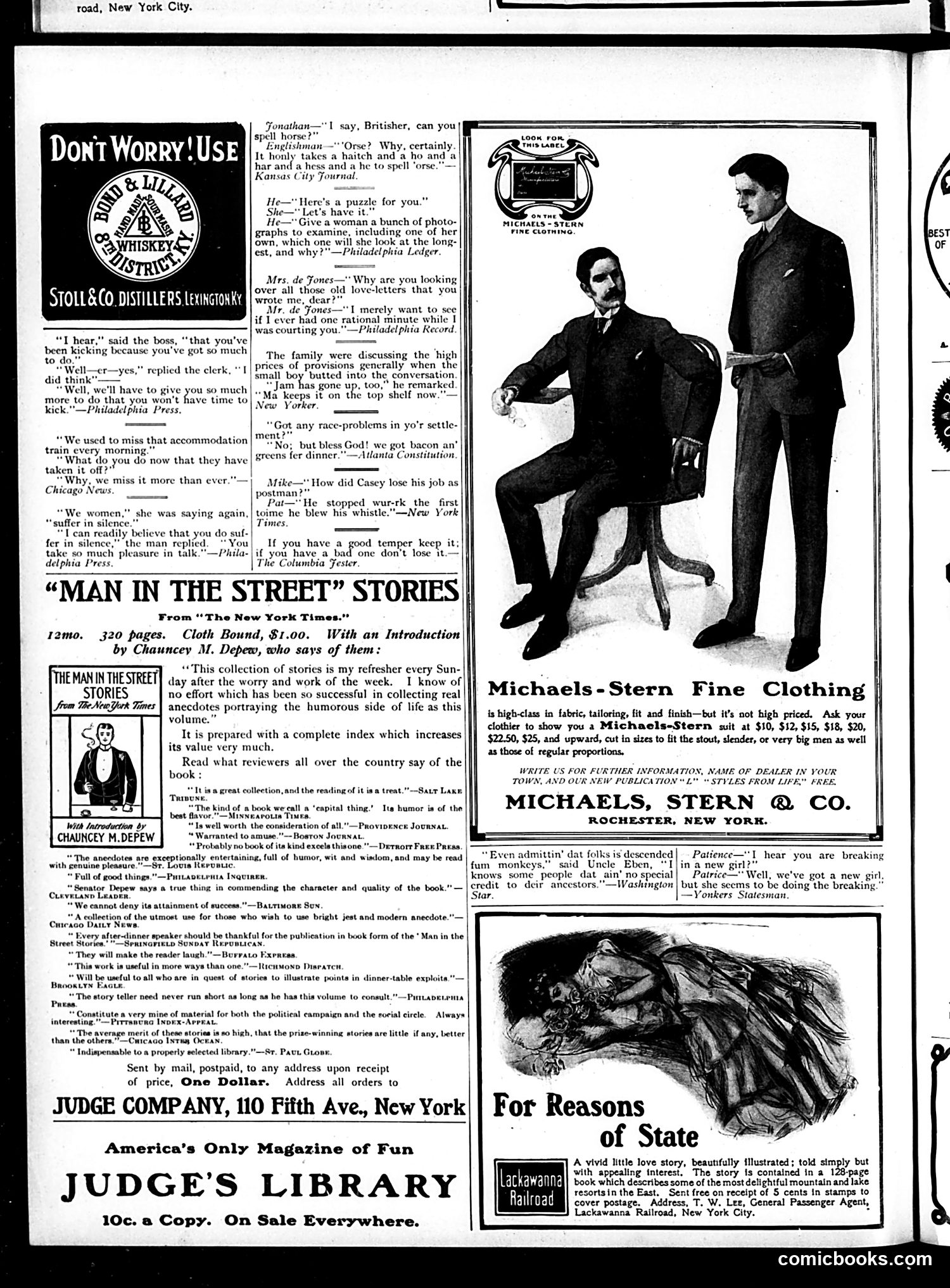
This page is primarily **advertising** for a humor book collection titled "Man in the Street Stories" from *The New York Times*, with an introduction by politician **Chauncey M. Depew**. The book costs $1.00 and collects anecdotes meant to entertain. The small comic snippets scattered throughout are brief jokes exploiting **dialectal humor** (particularly British vs. American English spelling) and gender stereotypes common to the era. One jokes about how a Britisher spells "horse" as "'orse"—mocking British pronunciation. Others feature domestic situations: a wife hoarding love letters, a boy commenting on expensive jam, complaints about women "suffering in silence." These aren't political cartoons but rather **mild observational humor typical of early 20th-century American magazines**, relying on accent jokes and marriage comedy that modern readers would likely find dated rather than clever.
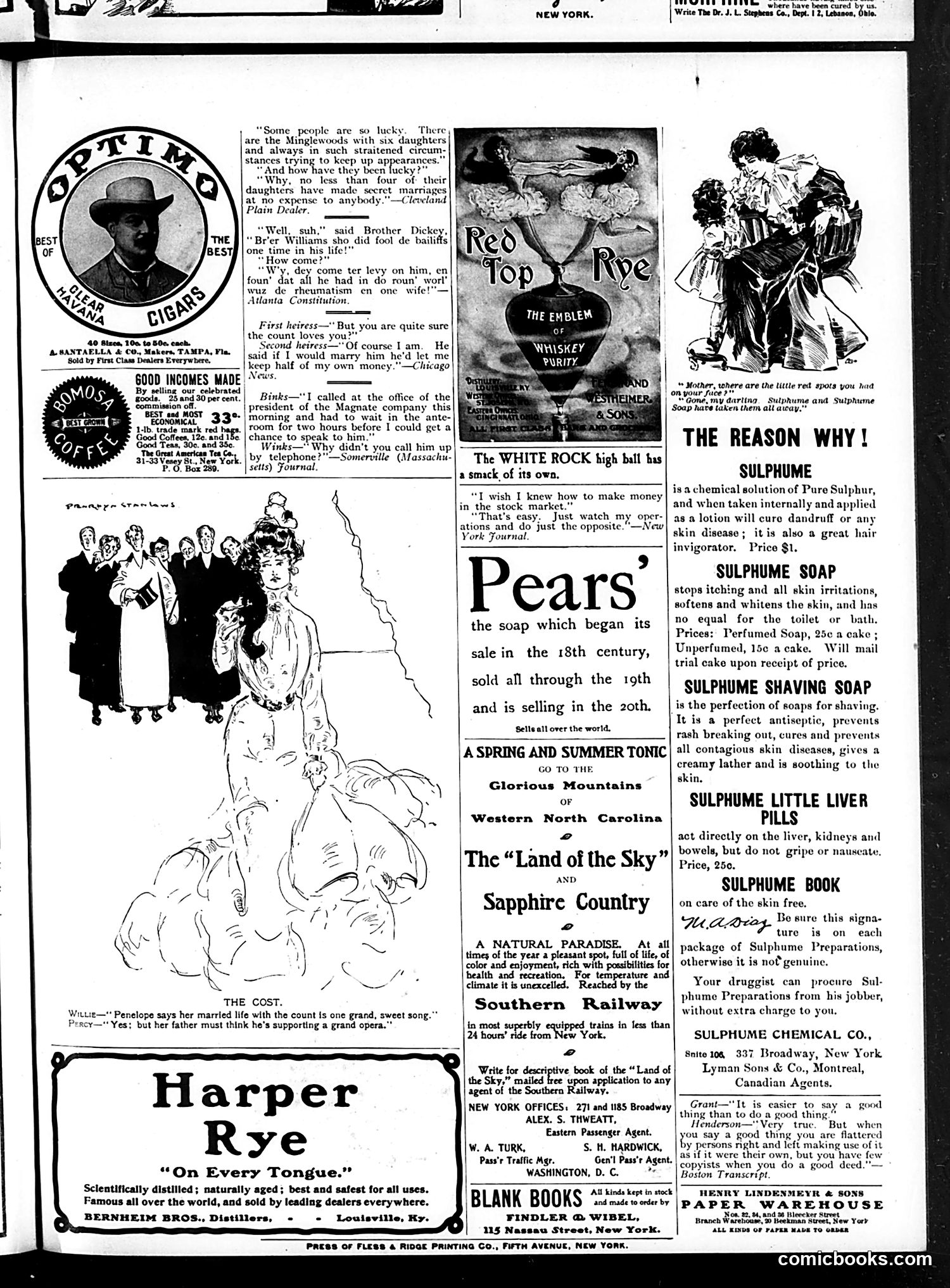
This page is primarily **advertising and humor snippets** rather than political satire. The content includes: **Humor sections** (top-left): Brief jokes about marriage and finances—daughters making secret marriages to avoid expense, a man's only asset being rheumatism, and an heiress marrying for the right to keep half her own money. These mock marital economics and women's financial dependence in early 20th-century society. **Movie/entertainment ads**: "Red Top Rye" whiskey and "Harper Rye" liquor advertisements. **Sulphume product ads** (right side): Extensive advertising for a sulfur-based patent medicine claiming to cure dandruff, skin diseases, and other ailments—typical of the era's often-fraudulent health product marketing. **Other ads**: Pears soap, blank books, and Southern Railway tourism promoting North Carolina's mountains. **The cartoon** (lower-left): Shows a couple in formal dress, satirizing marriage economics—the father must support the count "like a grand opera," suggesting the husband is a financial burden. The page reflects early 1900s consumer culture and marriage anxieties rather than political commentary.
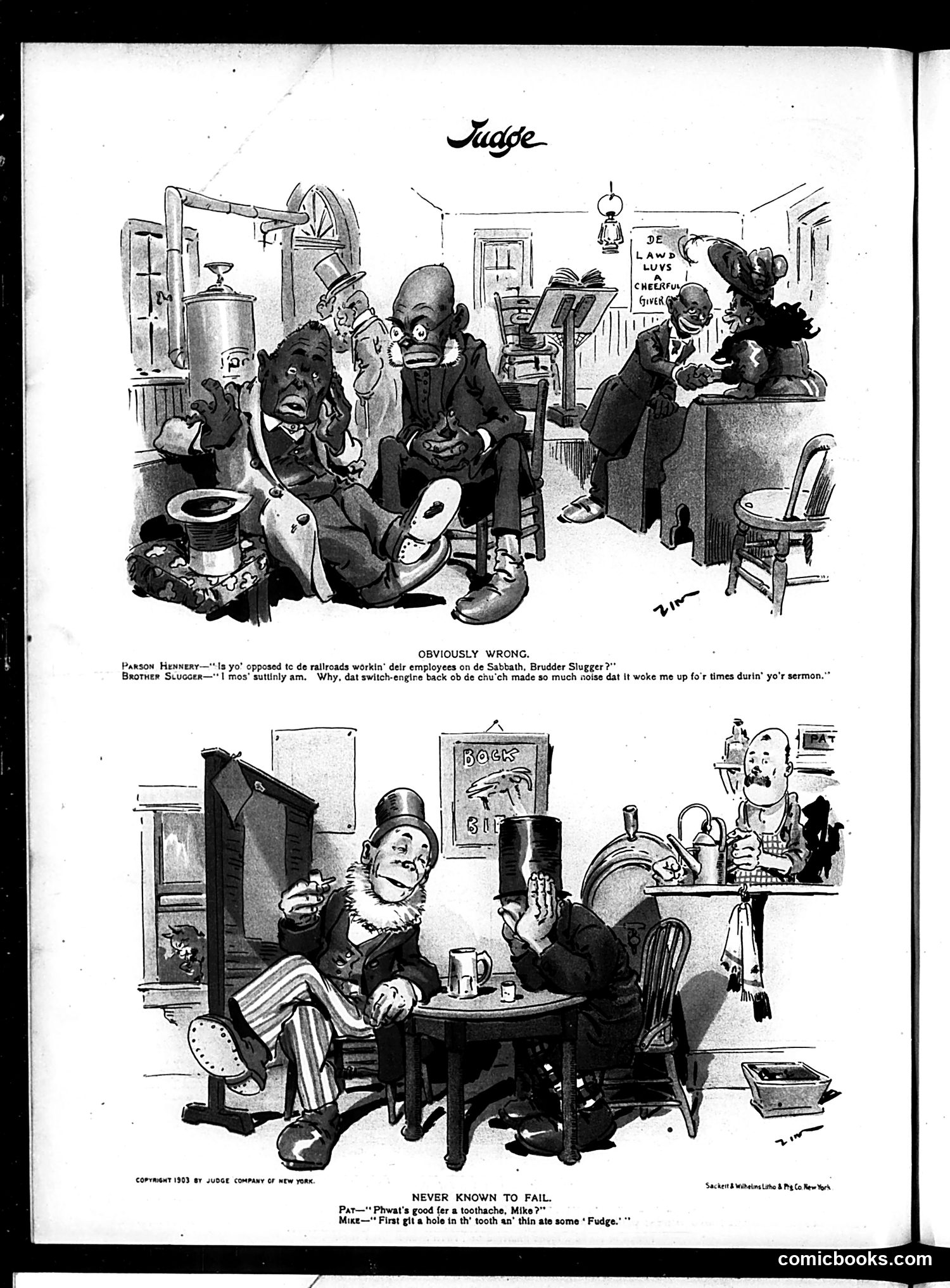
This 1920s page contains two separate cartoons using racial caricature stereotypes prevalent in that era's satirical humor. **Top cartoon ("Obviously Wrong"):** Two Black ministers debate railroad labor on Sundays. The satire targets religious hypocrisy—one claims moral objection to Sabbath work, but his actual complaint is that the noise disturbed his own sleep during his sermon, not genuine religious principle. The joke exposes self-serving piety. **Bottom cartoon ("Never Known to Fail"):** Two figures discuss a folk remedy for toothache: extracting the tooth and eating fudge instead. The satire mocks absurd "cure-all" remedies and folk medicine logic—replacing a problem with something equally problematic. Both cartoons use exaggerated dialect and caricature to create humor through perceived foolishness of their subjects, reflecting Judge's approach to satire through crude stereotyping.