
Judge, 1903-05-09 · page 10 of 16
Judge — May 9, 1903 — page 10: what you’re looking at
What you’re looking at
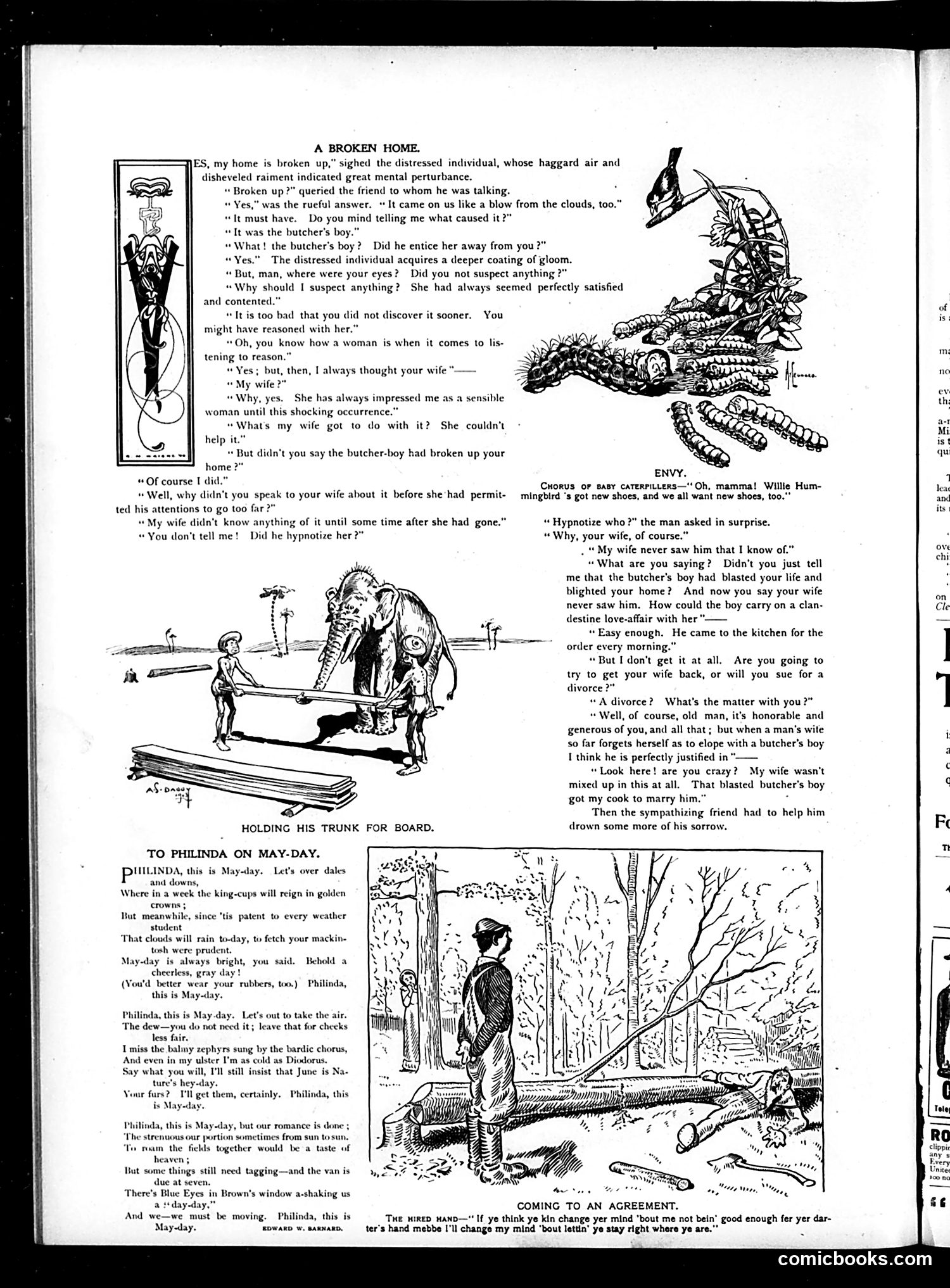
**"A Broken Home"** is a comedic dialogue about marital miscommunication. A distressed man tells his friend his home is "broken up," implying his wife eloped with the butcher's boy. Through questioning, the friend expresses shock—until the punchline reveals the man's *cook* (not his wife) ran off to marry the butcher's boy. The satire mocks both the man's poor communication with his wife and the friend's assumptions about social scandal. The humor derives from the class distinction: the concern shifts from infidelity to household staff, deflating the dramatic opening. **"To Philinda on May-Day"** is a romantic poem about disappointing May weather—the speaker wanted an idyllic spring outing but faces rain, cold, and practical concerns (rubbers, furs, errands). The satire gently mocks romanticized notions of nature and May-day traditions when reality intrudes. Both pieces reflect early-20th-century middle-class anxieties about propriety, relationships, and the gap between expectation and reality.
📄 Transcribed text from this page (OCR, searchable)
Machine-transcribed from the original scan — historical spelling and the odd misread are preserved.
A BROKEN HOME. ES, my home is broken up,” sighed the distressed individual, whose haggard air and disheveled raiment indicated great mental perturbance. “Broken up?" queried the friend to whom he was talking. "Yes," was the rueful answer. «It came on us like a blow from the clouds, too.” “It must have. Do you mind telling me what caused it?” “It was the butcher's boy.” “What! the butcher's boy? Did he entice her away from you 2" “Yes.” The distressed individual acquires a deeper coating of gloom. “But, man, where were your eyes? Did you not suspect anything 2" “Why should I suspect anything? She had always seemed perfectly satisfied and contented.” “It is too bad that you did not discover it sooner. You might have reasoned with her. “Oh, you know how a woman is when it comes to lis- tening to reason.” "Yes; but, then, I always thought your wife “My wife?" “Why, yes. She has always impressed me as a sensible woman until this shocking occurrence.” “What's my wife got to do with it? She couldn't help it.” % But didn't you say the butcher-boy had broken up your home ?" Of course T did.” . ; . Cwonus oF easy carenritiens—"'Oh, mamma! Willie Hum- Well, why didn’t you speak to your wife about it before she’had permit- mingbird 's got new shoes, and we all want new shoes, too." ted his attentions to go too far?” fy wife didn’t know anything of it until some time after she had gone.” “« Hypnotize who 2” the man asked in surprise. You don't tell me! Did he hypnotize her 2" “Why, your wife, of course.” _ My wife never saw him that I know of.” “What are you saying? Didn't you just tell me that the butcher's boy had blasted your life and blighted your home? And now you say your wife never saw him. How could the boy carry on a clan- destine love-affair with her "— “ Easy enough. He came to the kitchen for the order every morning.” “But I don't get it at all, Are you going to try to get your wife back, or will you sue for a divorce 2” “A divorce? What's the matter with you 2” “Well, of course, old man, it’s honorable and generous of you, and all that; but when a man’s wite so far forgets herself as to elope with a butcher's boy I think he is perfectly justified in" “Look here! are you crazy? My wife wasn't mixed up in this at all. That blasted butcher's boy got my cook to marry him.” 2 Then the sympathizing friend had to help him HOLDING HIS TRUNK FOR BOARD. drown some more of TO PHILINDA ON MAY-DAY. ILINDA, this is May-day, Let's over dales and downs, Where in a week the king-cups will reign in golden crowns; But meanwhile, since ‘tis patent to every weather student ‘That clouds will rain to-day, to fetch your mackin= tosh were prudent. May-day is always bright, you said. Behold a cheerless, gray day! (You'd better wear your rubbers, too.) Philinda, this is May-day. Philinda, this is May-day. Let's out to take the air. The dew—you do not need it; leave that for cheeks less fair. I miss the balmy zephyrs sung by the bardic chorus, And even in my ulster I'm as cold as Diodorus. Say what you will, I'll still insist that June is Na- ture’s hey-day. Your furs? I'll get them, certainly, Philinda, this is May-day. Vhilinda, this is May-day, but our romance is done ; “The strenuous our portion sometimes from sun tosun, ‘Tw ruain the ficlls together would be a taste of heaven But some things still need tagging—and the van is due at seven. typpceve aan ‘There's Blue Eyes in Brown's window a-shaking us ens as Bt ay a tday-da COMING TO AN AGREEMENT. And we—we must be moving. Philinda, this is Tue MIRED HAND—"‘ If ye think ye kin change yer mind "bout me not bein’ good enough fer yer dar- May-day. kowarp w. sarxanD. — ter's hand mebbe I'll change my mind ‘bout lettin’ ye stay right where ye are."” Y comicbooks.com