
A complete issue · 16 pages · 1903
Judge — April 25, 1903
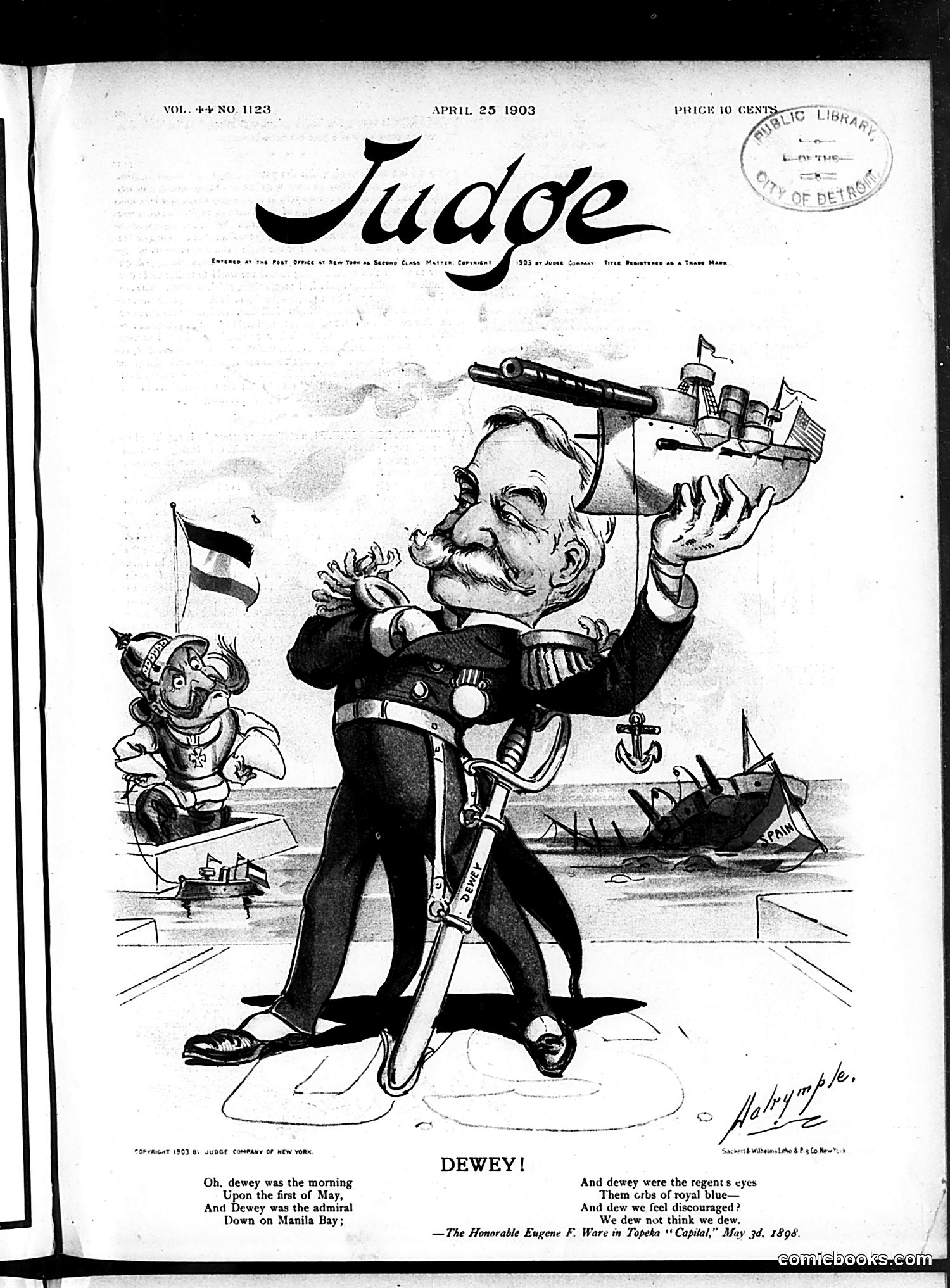
This cartoon satirizes Admiral George Dewey following the Spanish-American War. The caricatured figure in naval uniform holds a telescope and a warship, depicted as an exaggerated military hero. The poem references Dewey's famous May 1898 victory at Manila Bay during the Philippines campaign ("Down on Manila Bay"). The satire mocks Dewey's subsequent political ambitions and inflated public reputation. The poem's tone ("And dewey were the regent's eyes / Them orbs of royal blaze") ironically celebrates his celebrity status. The small figure on the left appears to be a political rival or critic. Judge uses this to critique how military victory had transformed Dewey into a potential presidential candidate, suggesting the public's uncritical hero-worship was excessive and problematic for democratic governance.
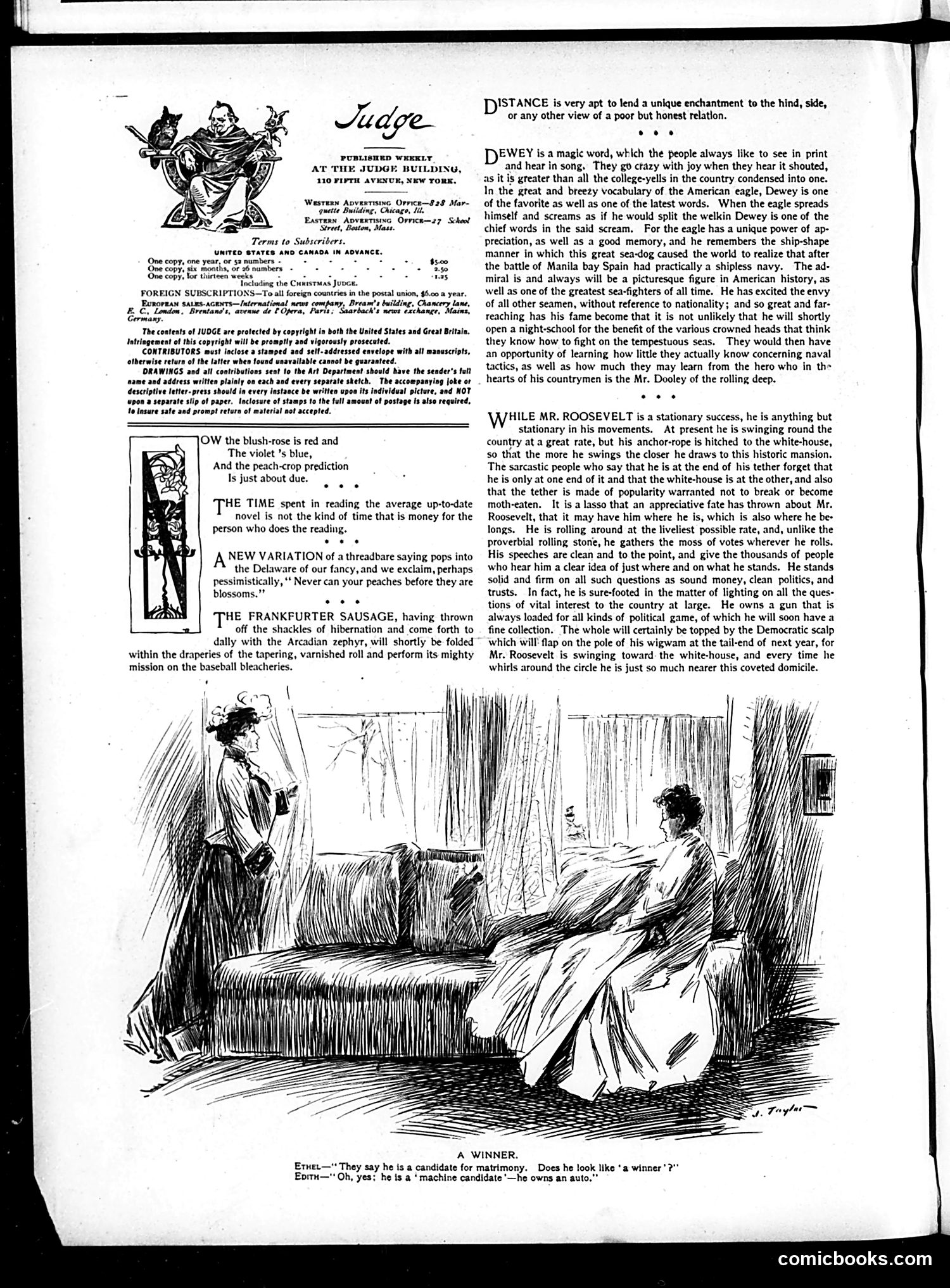
The page contains several satirical pieces. The main cartoon, titled "A Winner," depicts two women discussing a male "candidate for matrimony." One woman asks if he "looks like a 'winner,'" and the other responds that yes, he's a "'machine candidate'—he owns an auto." The satire mocks the early 20th-century marriage market, where automobile ownership became a status symbol and qualification for matrimony. The term "machine candidate" puns on political terminology while suggesting that a man's wealth (specifically, car ownership) matters more than personal character when evaluating marriage prospects. The accompanying text discusses Theodore Roosevelt's political activities and popularity, praising his steady character and political engagement. However, the cartoon's focus is purely on the materialism of marriage-minded women seeking wealthy suitors.
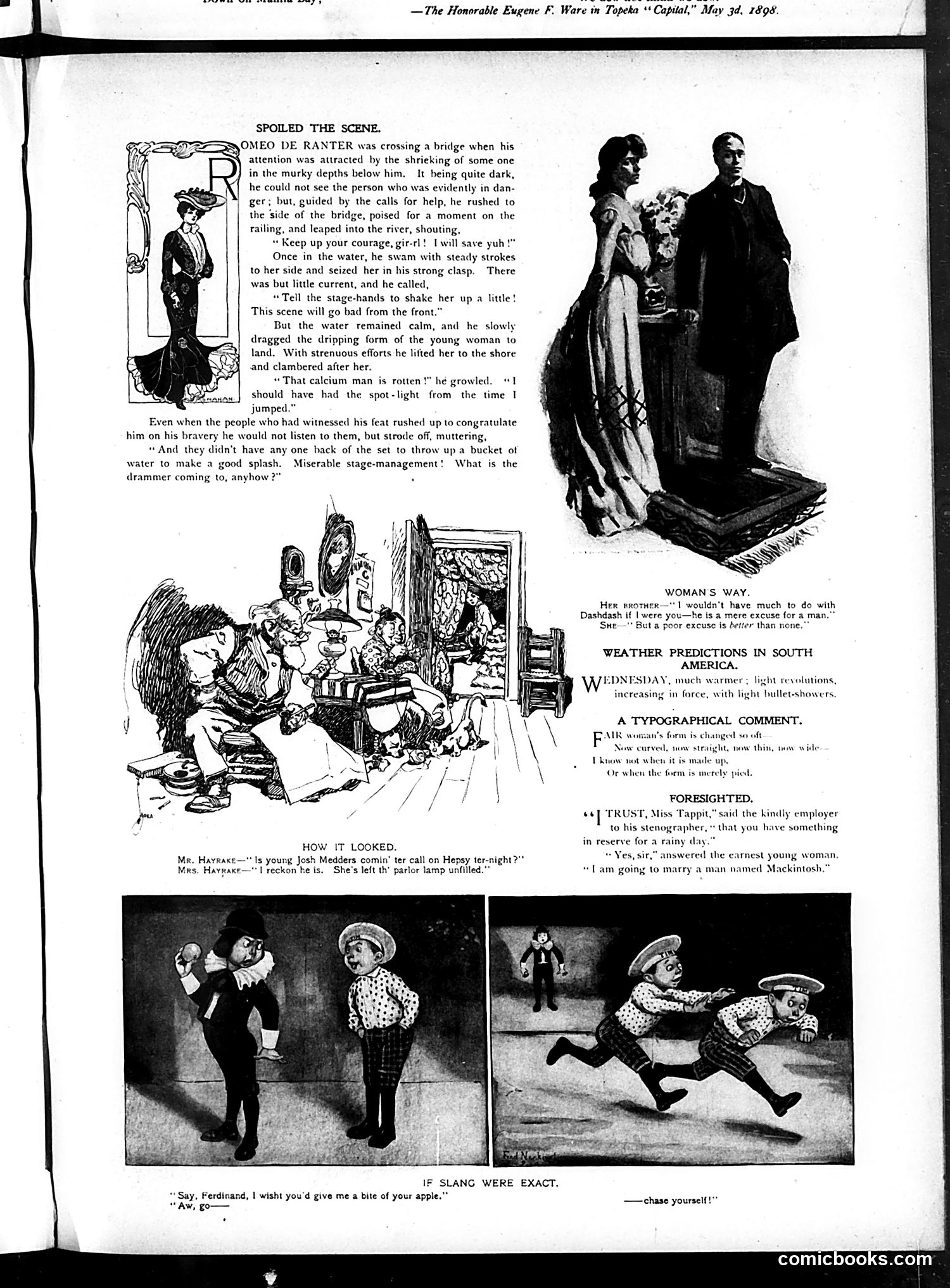
This page contains several theatrical satirical sketches rather than political cartoons. The main story, "Spoiled the Scene," mocks theatrical incompetence—specifically a stage manager's failure to provide proper effects (water, spotlight) during a dramatic river rescue scene, undermining the actors' performance. The other sections appear to be humorous vignettes: "Woman's Way" jokes about gender relations; "Weather Predictions" and "A Typographical Comment" are brief humor pieces; "Foresighted" presents a comedic dialogue about marriage plans; and "If Slang Were Exact" shows physical comedy based on slang expressions being taken literally. The sketches target theatrical bungling and everyday absurdities rather than specific political figures or events. The humor relies on visual gags and wordplay typical of late-19th-century comic magazines.
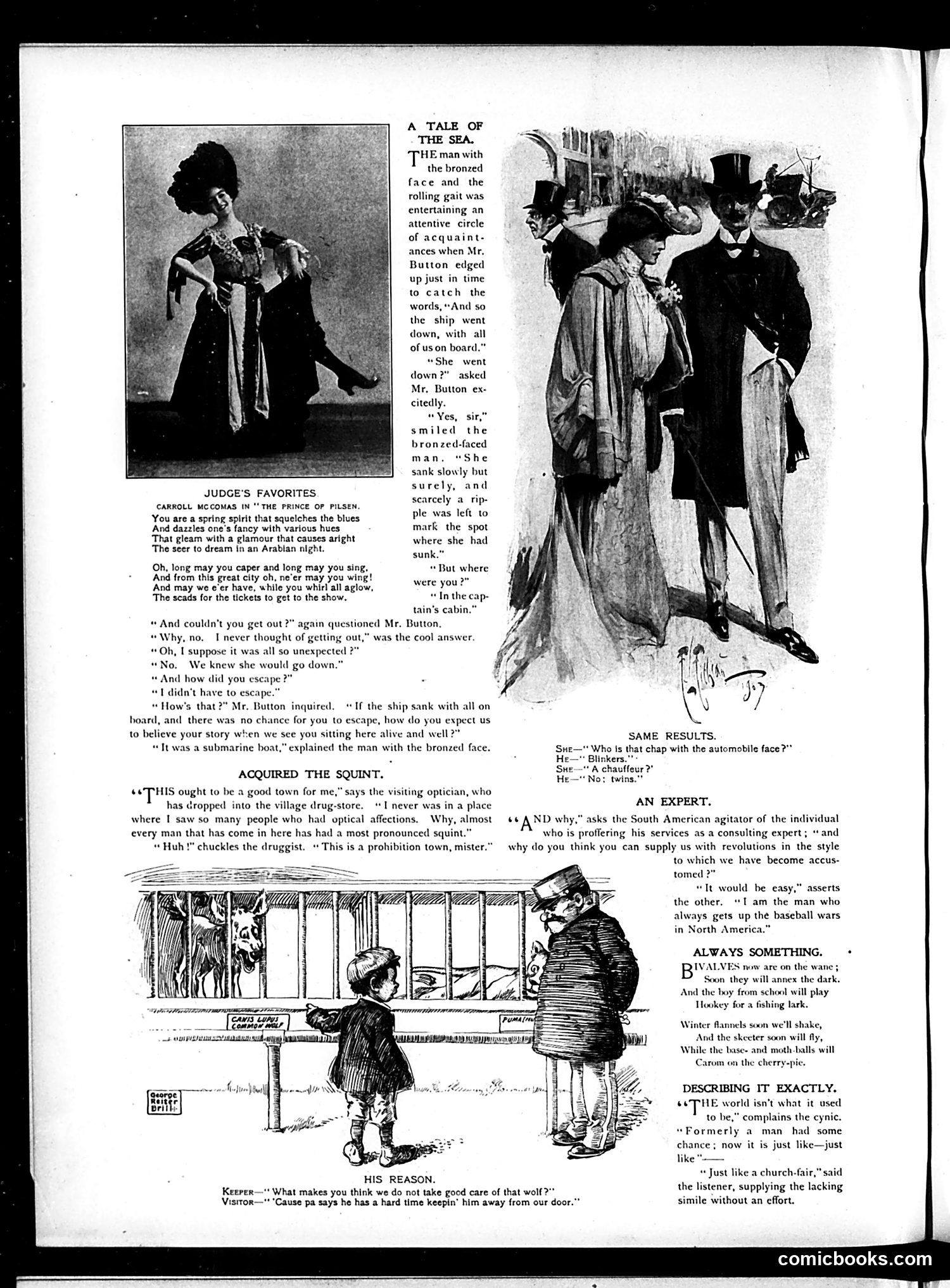
This page contains humor pieces and verse rather than political cartoons. "A Tale of the Sea" depicts a shipwreck dialogue where Mr. Button, a man with a "bronzed face," recounts how a woman sank with the ship. The satire questions his credibility—when asked where he was during the disaster, he claims the captain's cabin, prompting skepticism about how he survived if the ship went down with all aboard. "Acquired the Squint" mocks small-town life through an optician's observation about optical problems being common in a particular village, with a humorous punchline about it being a "prohibition town." The remaining sections contain light comic verses and brief humorous anecdotes about everyday situations, typical of Judge's general-interest humor content.
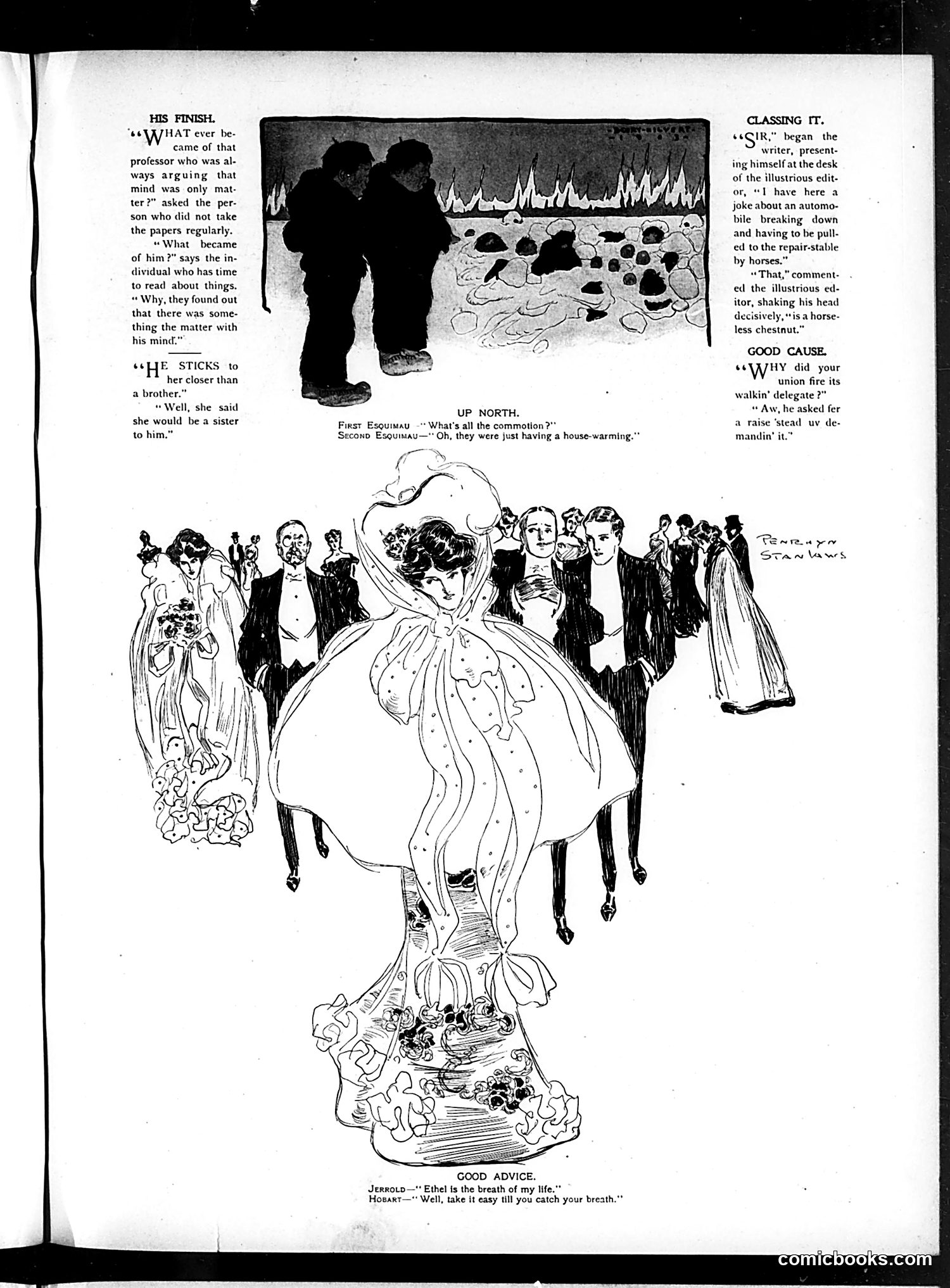
This page from *Judge* contains several short humorous pieces typical of early 20th-century American satire: **"His Finish"** mocks materialist philosophy—a professor who argued mind was merely matter turned out to have something mentally wrong with him, an ironic comeuppance. **"Up North"** plays on the term "house-warming" (a celebratory gathering when moving), suggesting northerners misunderstood it as literally warming a house during winter. **"Classing It"** satirizes editorial pretension: a writer pitches a joke about an automobile breakdown being towed by horses, but the editor dismissively calls it a "horseless chestnut"—a pun conflating "horseless carriage" (automobiles) with "chestnut" (a stale joke). **"Good Advice"** contains wordplay on "breath of my life" taken literally. **"Good Cause"** jokes about labor union tactics—the delegate was fired for politely *asking* for a raise rather than *demanding* it aggressively, suggesting unions expected confrontational approaches. All rely on wordplay and contemporary references (early automobiles, labor disputes).
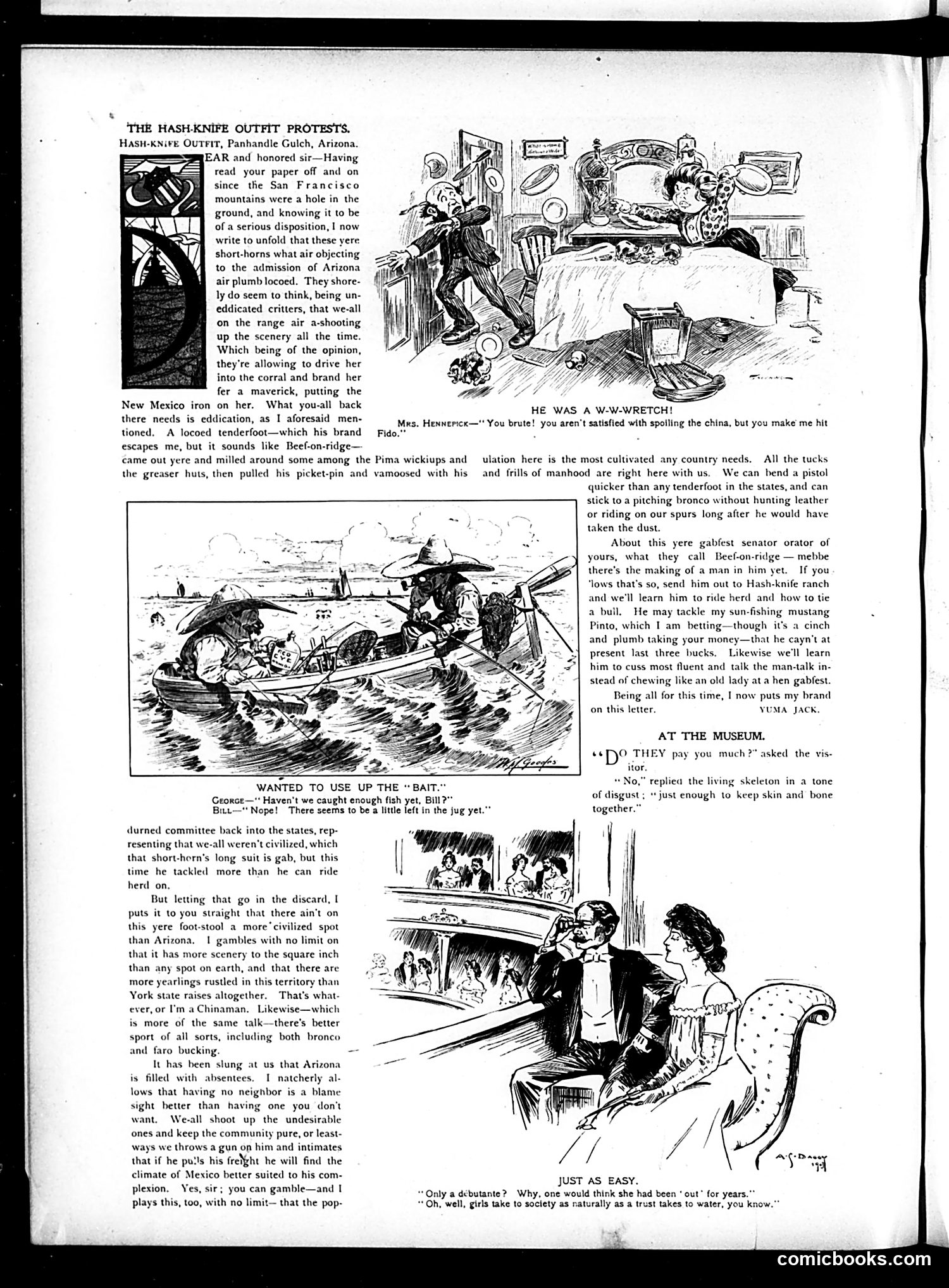
This page satirizes Arizona's push for statehood through a fictional letter from "Yuma Jack" of the Hash-Knife Outfit. The piece mocks Arizona's reputation for lawlessness while paradoxically defending it as civilized. **The satire works on multiple levels:** Yuma Jack writes in exaggerated frontier dialect, claiming Arizona needs "eddication" while simultaneously boasting about shooting, gambling, and violently driving out undesirables. The irony is that his defense of Arizona's civilization actually proves the opposite—he describes a violent, anarchic territory where problems are solved with guns. **Key targets:** The "short-horns" opposing statehood, and implicitly Arizona's actual boosters who used similar crude arguments. The cartoon of a domestic quarrel ("He Was a W-W-Wretch!") and museum jokes about a living skeleton provide comedic filler typical of Judge. **Historical context:** This likely dates from early-1900s statehood debates when Arizona was criticized as too wild and uncivilized for admission to the Union. The satire suggests Arizona's defenders undermined their own case through their behavior and rhetoric.
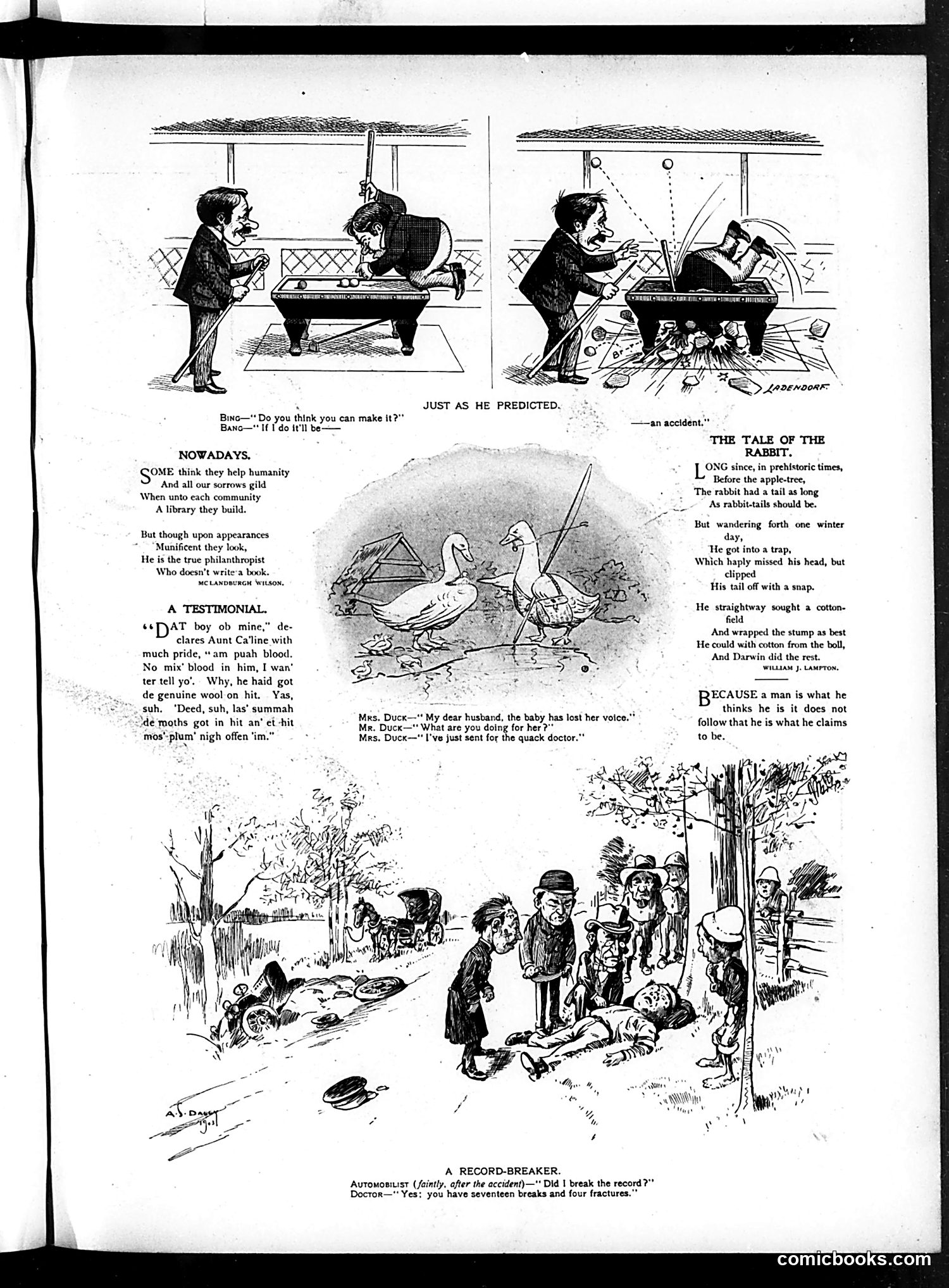
This page collects several satirical pieces typical of early 20th-century American humor: **Top comics**: A billiards player predicts an accident, then causes one—mocking overconfidence. **"Nowadays"**: Mocks wealthy philanthropists who build libraries for publicity while ignoring genuine charitable work. The real philanthropist, the poem suggests, is someone who *doesn't* write a book about their generosity. **"A Testimonial"**: Racist dialect humor (common for the era) about an African American woman bragging about her son's "pure blood," only to reveal moths ate his hair—mocking both racist pseudoscience and empty boasting. **"The Tale of the Rabbit"**: Satirizes Darwin's evolution theory by claiming a rabbit's lost tail, wrapped in cotton, evolved into natural cotton traits—absurdist mockery of evolutionary science. **"A Record-Breaker"**: Dark humor about a car accident victim asking if he broke a speed record; the doctor responds with numerous broken bones instead. The page reflects period attitudes: skepticism toward new science, racial prejudice, and class commentary on wealth.
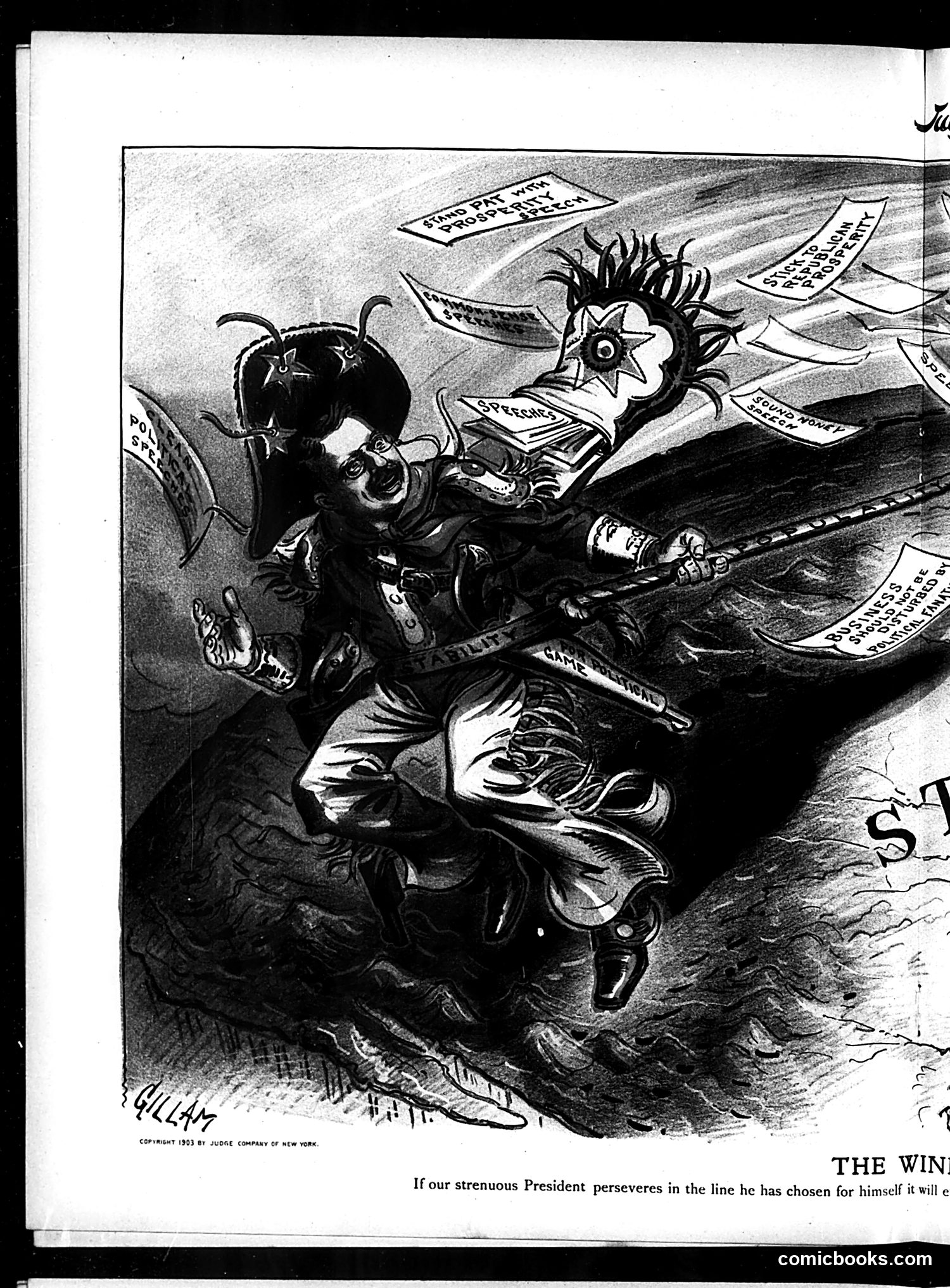
This 1903 Judge magazine cartoon depicts a caricatured figure (likely President Theodore Roosevelt, referenced as "our strenuous President") juggling multiple objects labeled with various policies or initiatives. The figure has exaggerated features characteristic of political caricature and appears frenetic and energetic. The satire critiques Roosevelt's aggressive, multifaceted approach to governance—his simultaneous pursuit of numerous ambitious projects and policies. The caption's incomplete text suggests commentary on the sustainability of his "strenuous" agenda. The scattered papers and objects surrounding the figure represent competing demands and initiatives, implying Roosevelt is overextended or attempting too much at once. This reflects contemporary criticism of his presidency's scope and intensity, mocking his characteristic energy and reformist activism while questioning whether maintaining such a pace was feasible or advisable.
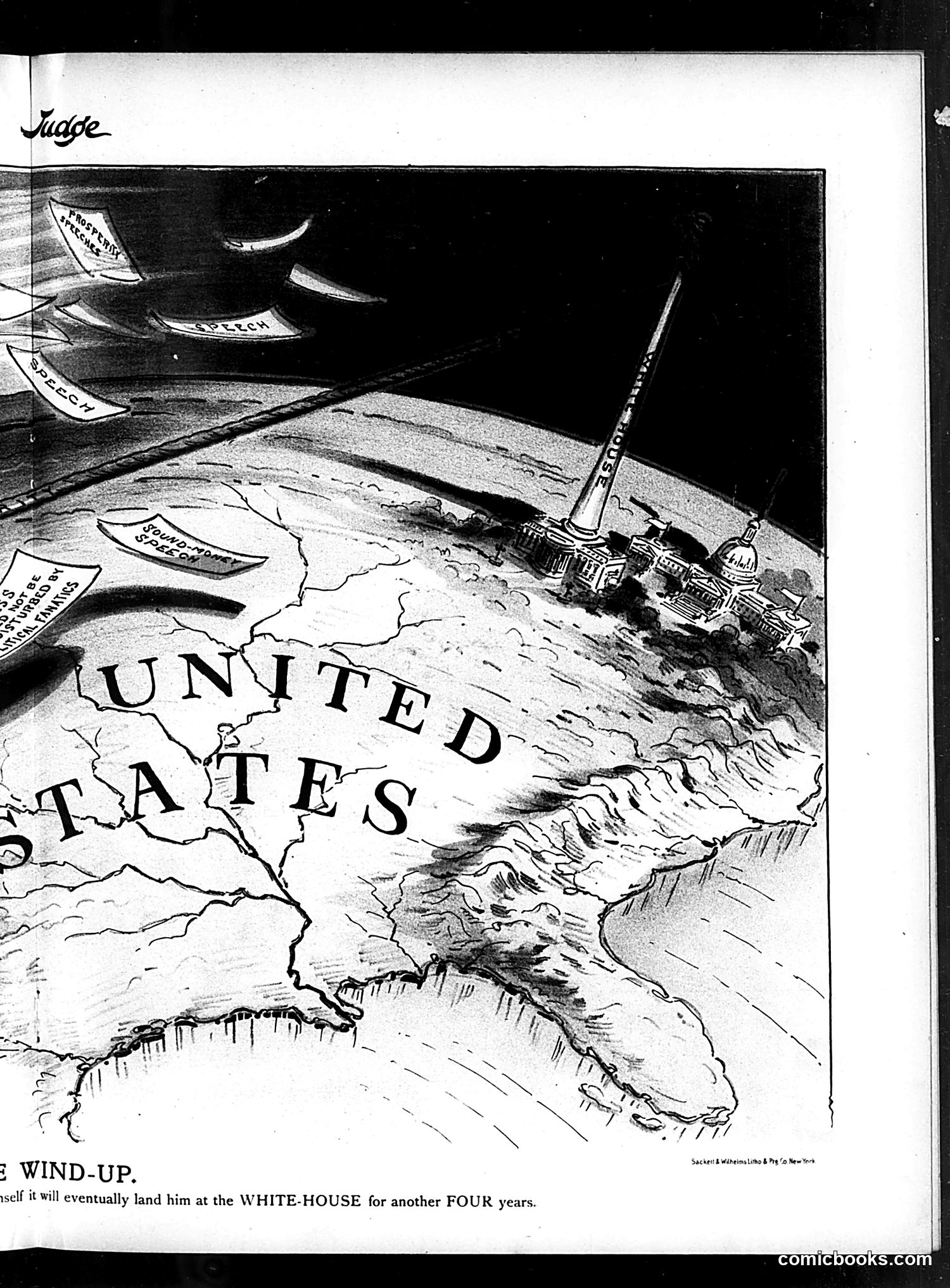
This political cartoon depicts a compass or navigation instrument positioned over a map of the United States, appearing to point toward the White House. The caption references landing "at the WHITE-HOUSE for another FOUR years," suggesting this cartoon advocates for a political figure's re-election to a second presidential term. The navigation metaphor—with the compass as a "wind-up" mechanism—implies the subject is being guided or directed toward electoral victory. Various labeled objects in the upper left appear to represent different political forces or influences. Without a visible date or clearer identifying details, I cannot definitively name which president or election this references, though the "four years" language indicates a re-election campaign. The Judge magazine context suggests this is pro-administration satire from the late 19th or early 20th century.
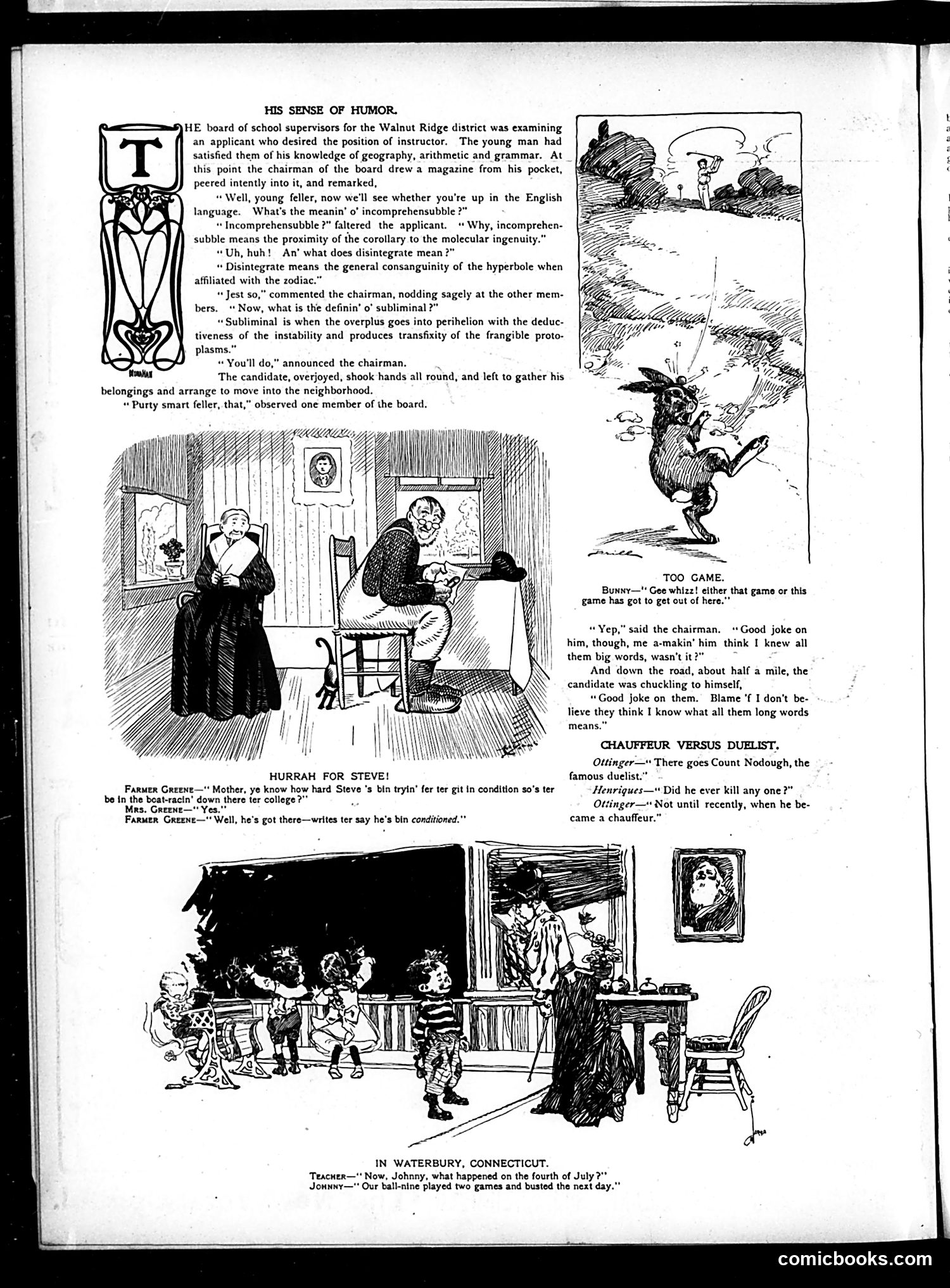
This page contains three separate humorous sketches satirizing rural/small-town American life and social pretension. **"His Sense of Humor"** mocks both rural school board ignorance and the applicant's empty verbosity. The chairman tests the candidate with deliberately nonsensical definitions ("incomprehensubble" isn't a real word). The applicant responds with plausible-sounding but meaningless jargon. Both parties are fooling each other—the chairman pretends to understand complex language he doesn't, and the applicant spouts gibberish confidently. The joke reveals mutual deception in rural education. **"Too Game"** shows a rabbit evading a fox, illustrating the phrase "too game" (stubborn/competitive). **"Chauffeur Versus Duelist"** is a brief wordplay: a famous duelist named Count Nodough has killed no one until becoming a chauffeur—suggesting automobile accidents are deadlier than duels, a commentary on the dangers of early automobiles. **"In Waterbury, Connecticut"** uses a child's malapropism: "conditioned" (athletic conditioning) becomes "conditioned" (academically failed), creating innocent humor through linguistic confusion.
This page is primarily advertisements with one visible cartoon at the top. The cartoon depicts a domestic prank: Mr. Funniman instructs Mrs. Candor to tell her husband their expected guests have cancelled, while Funniman and his wife hide behind curtains to surprise him. When Mr. Candor arrives and hears the disappointing news, he responds with apparent relief ("Thank heavens!"), which humiliates Mrs. Candor—the joke being that her husband is pleased their guests *won't* be coming. The satire targets domestic disharmony and social hypocrisy: the supposed "surprise" backfires because it accidentally reveals the husband's true feelings. Rather than portraying marital bliss, it exposes underlying resentment toward social obligations. This reflects period anxieties about marriages of convenience and the gap between polite society and private sentiment—common themes in *Judge* magazine's satirical commentary on American manners.
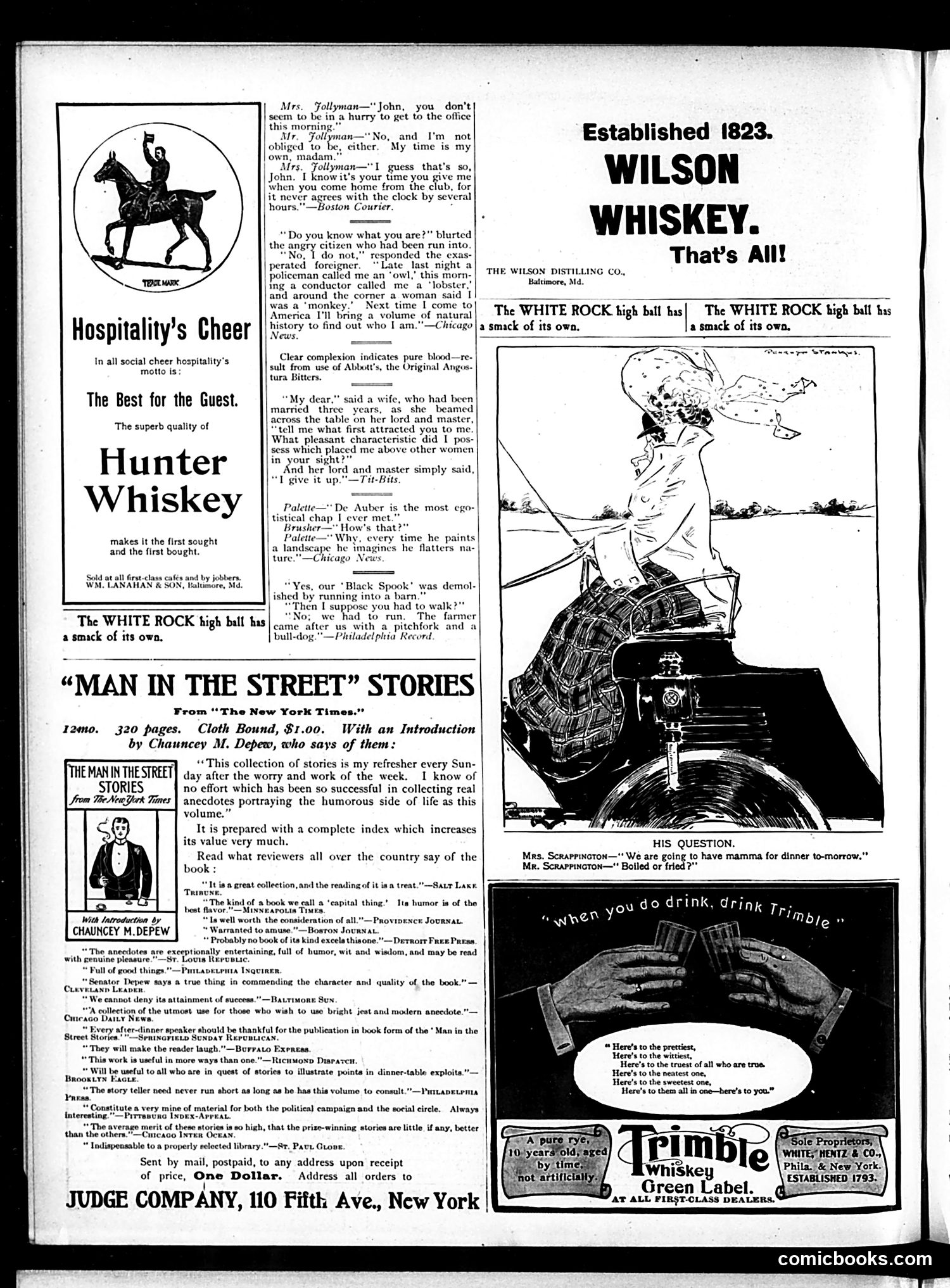
This page mixes social humor with advertising. The "Man in the Street" stories are brief comedic anecdotes reflecting early-1900s attitudes: a wife complains her husband's "club time" doesn't match the clock (suggesting he's out late), a foreigner is insulted with animal names ("owl," "lobster," "monk"), and a husband gives up trying to explain what attracted him to his wife. The cartoons mock vanity (a painter who thinks landscapes improve through his ego) and marital dynamics where wives probe husbands' affections. The page is dominated by whiskey advertisements—Wilson Whiskey, Hunter Whiskey, and Trimble Whiskey—using the "White Rock high ball" slogan repeatedly. These ads reflect pre-Prohibition America (before 1920) when alcohol advertising was mainstream in magazines. The Chauncey M. Depew book advertisement positions his story collection as suitable for dinner-table entertainment, the intended audience for Judge magazine itself.
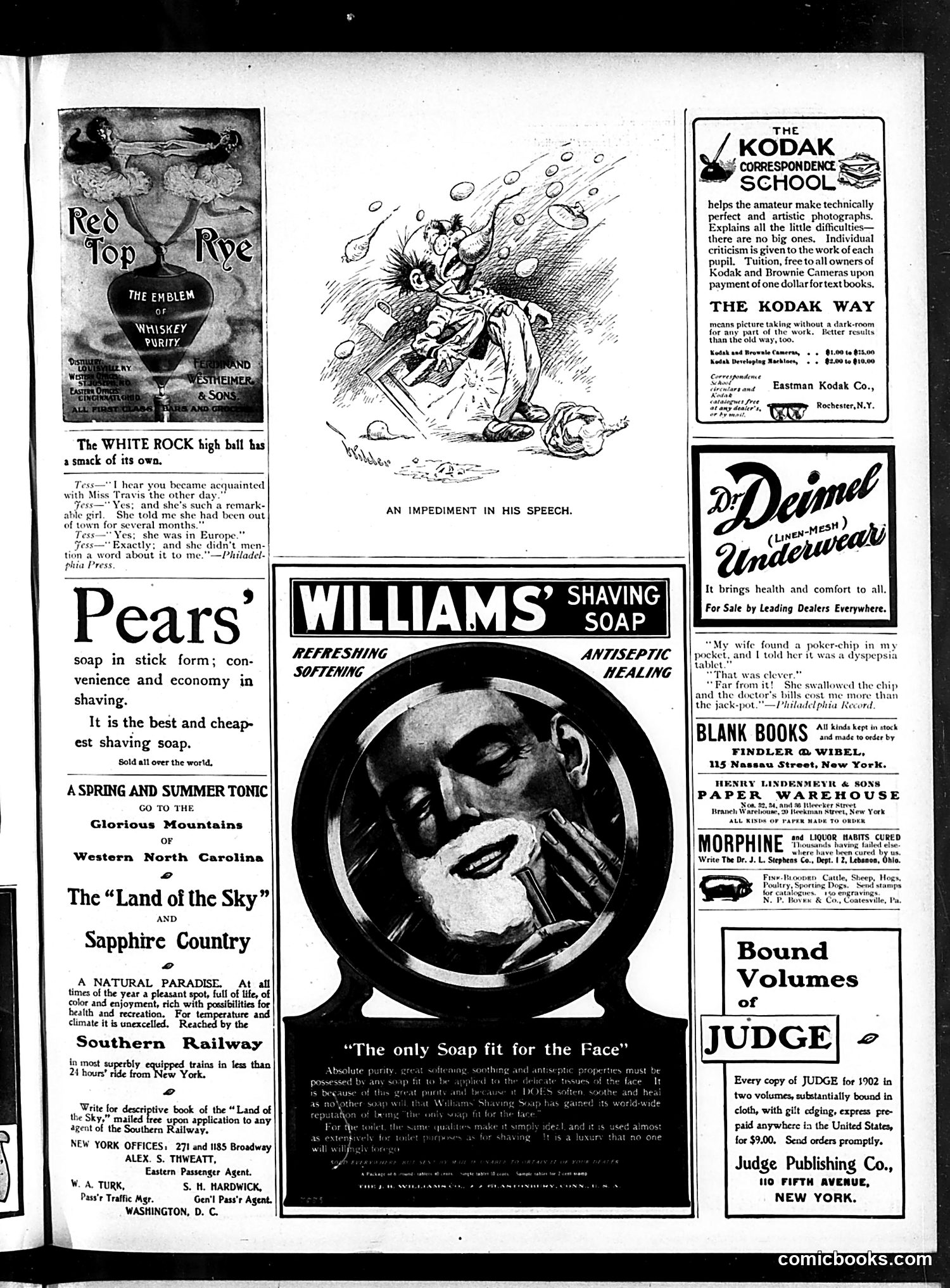
This page is primarily **advertising**, with one central cartoon titled "An Impediment in His Speech." The cartoon depicts a man being pelted with objects (appearing to be stones or debris) while attempting to speak—a visual gag illustrating the phrase "impediment in his speech" literally rather than as a figurative speech impediment. The page contains period advertisements for consumer products (Pears' soap, Williams' Shaving Soap, Kodak cameras, Deimel Underwear) and services (Southern Railway, Judge Publishing Company). A small joke at top involves a woman who traveled to Europe without mentioning it to her acquaintance—mild social commentary on discretion or gossip. **The satire is minimal on this page**; it functions primarily as a vehicle for advertising revenue, which was typical of Judge magazine's business model. The cartoon's humor is straightforward visual wordplay rather than political or social satire.
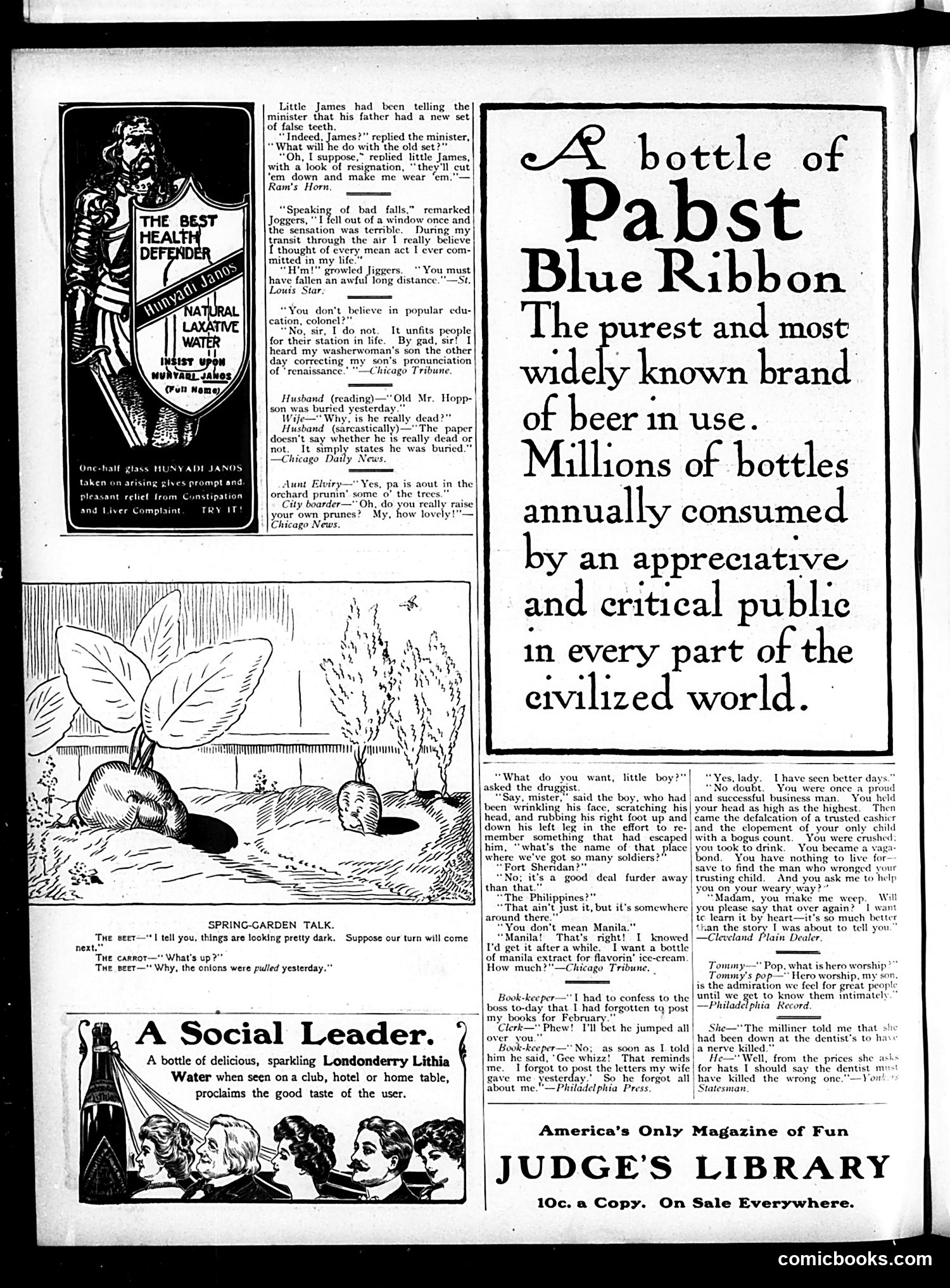
This page from *Judge* (a major American satirical weekly) is primarily **advertising and humor content**, not political cartooning. The main advertisements are for **Pabst Blue Ribbon beer** and **Hunyadi Janos** (a laxative). The beer ad emphasizes the brand's global popularity and quality. The humor consists of short jokes and comic dialogues typical of the era: - A child's innocent misunderstanding about false teeth - A man's fall from a window triggering moral reflection - Class anxiety about education "unfitting" working people for their station - A husband's sardonic interpretation of a burial notice - A vegetable garden dialogue with anthropomorphized plants **"Spring-Garden Talk"** features vegetables discussing approaching harvest as potential doom—a light pun on human anxieties. The content reflects **early 20th-century American values**: class consciousness, gender roles, and genteel humor. There's no identifiable political satire—this represents *Judge's* entertainment function rather than its occasional hard-hitting social commentary.
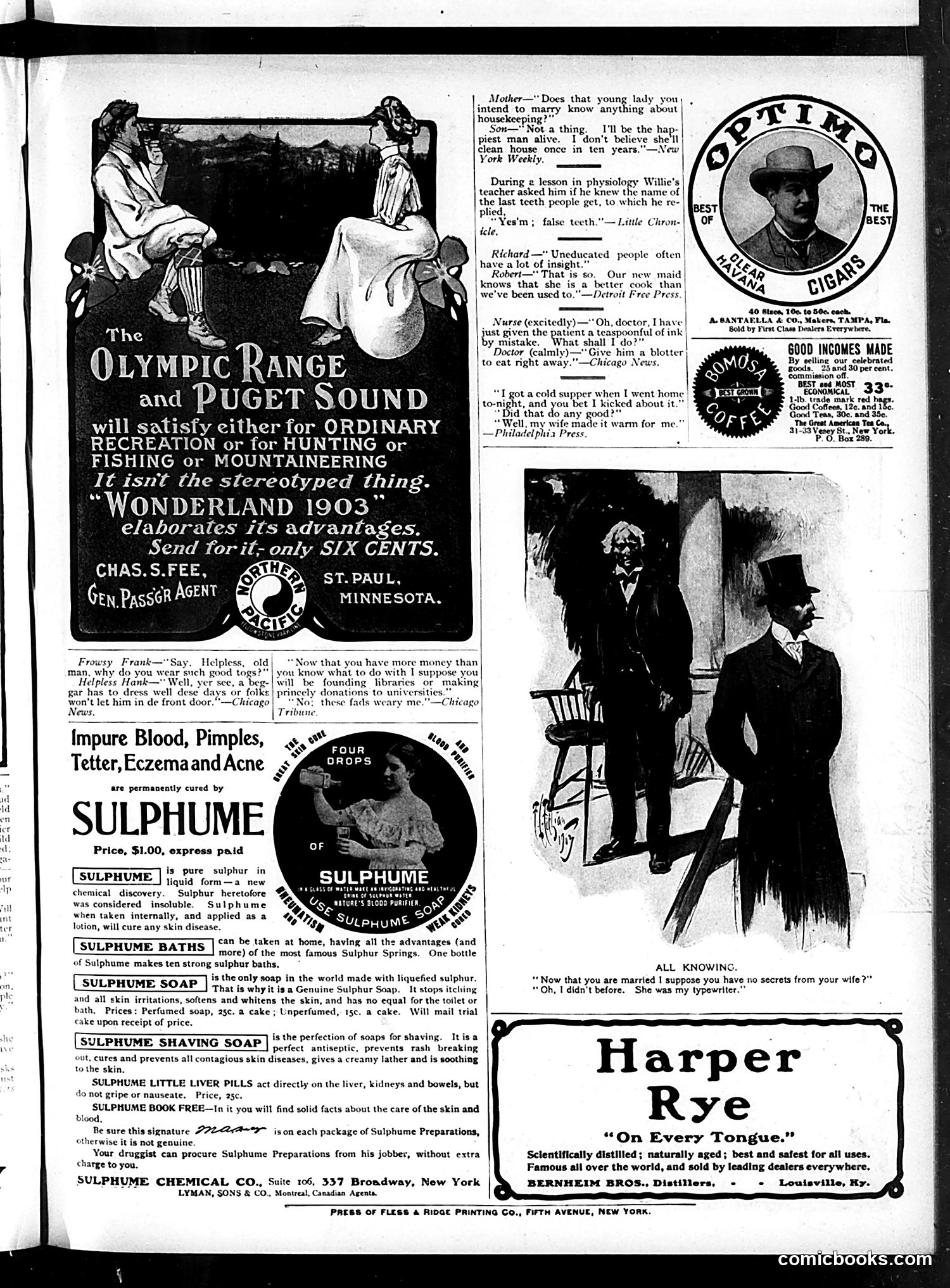
This page from *Judge* magazine is primarily **advertising**, not political satire. The dominant content features commercial advertisements for patent medicines and consumer goods typical of early 1900s publications. The small comic vignettes scattered throughout are **domestic humor** rather than political commentary—jokes about marriage, housekeeping, and family life. One recurring theme mocks "uneducated" wealthy people's pretensions: a newly rich man's maid is praised for being a better cook than what "we've been used to," while another figure worries that founding libraries might seem like a "fad." The page's main illustrated cartoon (upper left) advertises the Olympic Range and Puget Sound as vacation destinations, promoting a travel guide called "Wonderland 1903." The heavy advertising emphasizes **patent medicine culture**—"Sulphume" claims to cure skin diseases, blood impurities, and various ailments through sulphur preparations. This reflects the largely unregulated medicine industry of the era, before FDA oversight. No significant political figures or events are referenced on this page.
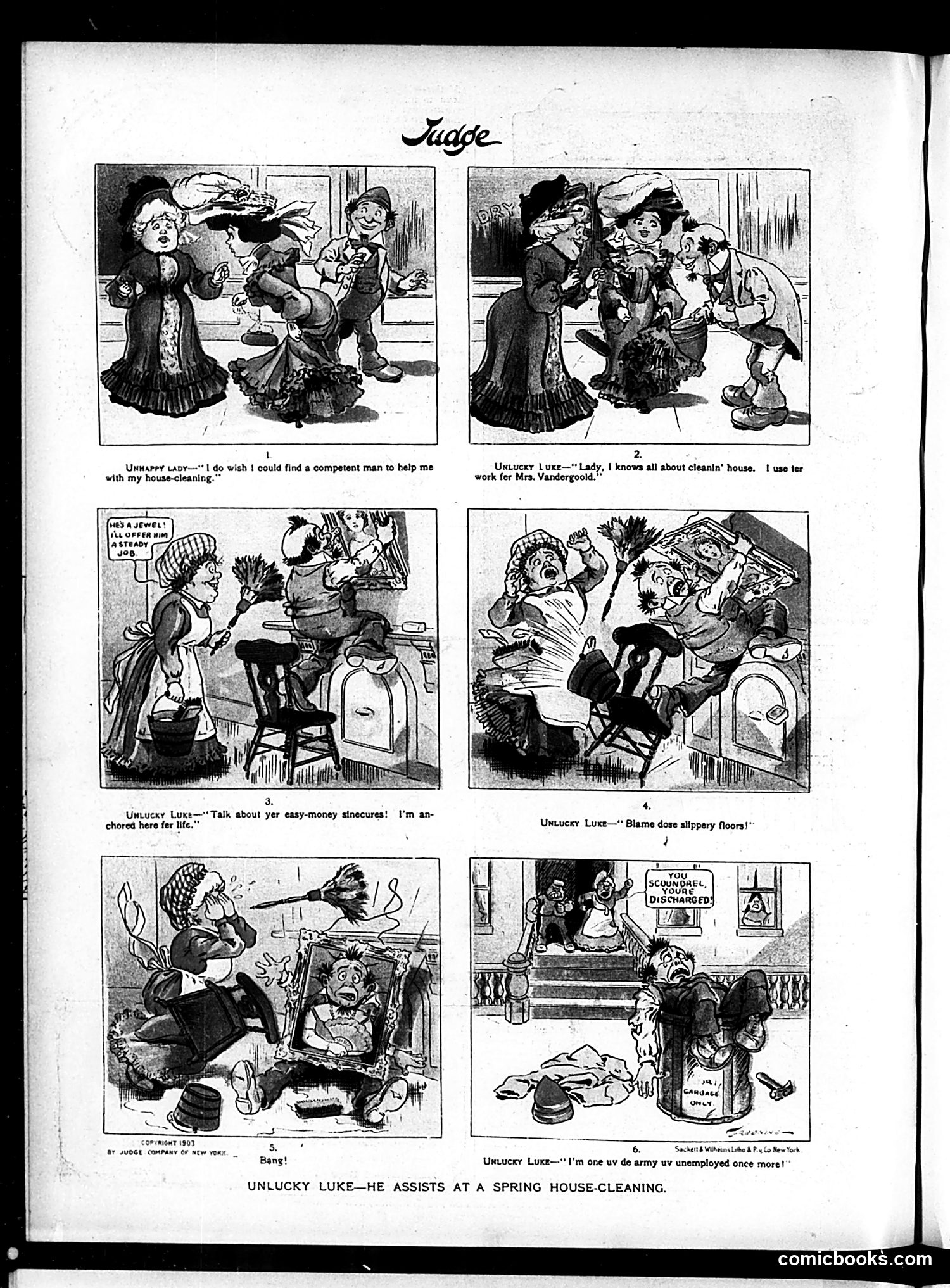
This comic strip satirizes the hiring of incompetent help for domestic labor. The titled character "Unlucky Luke" is a working-class man claiming expertise in housekeeping (he worked for the wealthy Vandergould family). Each panel shows his catastrophic failures: breaking items, creating chaos, causing accidents with slippery floors, and generally destroying the employer's home rather than cleaning it. The satire targets the desperation of wealthy employers needing affordable domestic workers and the unreliability of such labor. Luke's dialect ("uv," "yer") marks him as lower-class, and the joke hinges on the gap between his claimed qualifications and his actual incompetence. The final panel suggests he's part of an army of unemployed workers—likely referencing post-war or Depression-era unemployment—thrust into jobs they're unprepared for, creating mutual misery for employer and employee alike.