
A complete issue · 20 pages · 1903
Judge — April 18, 1903
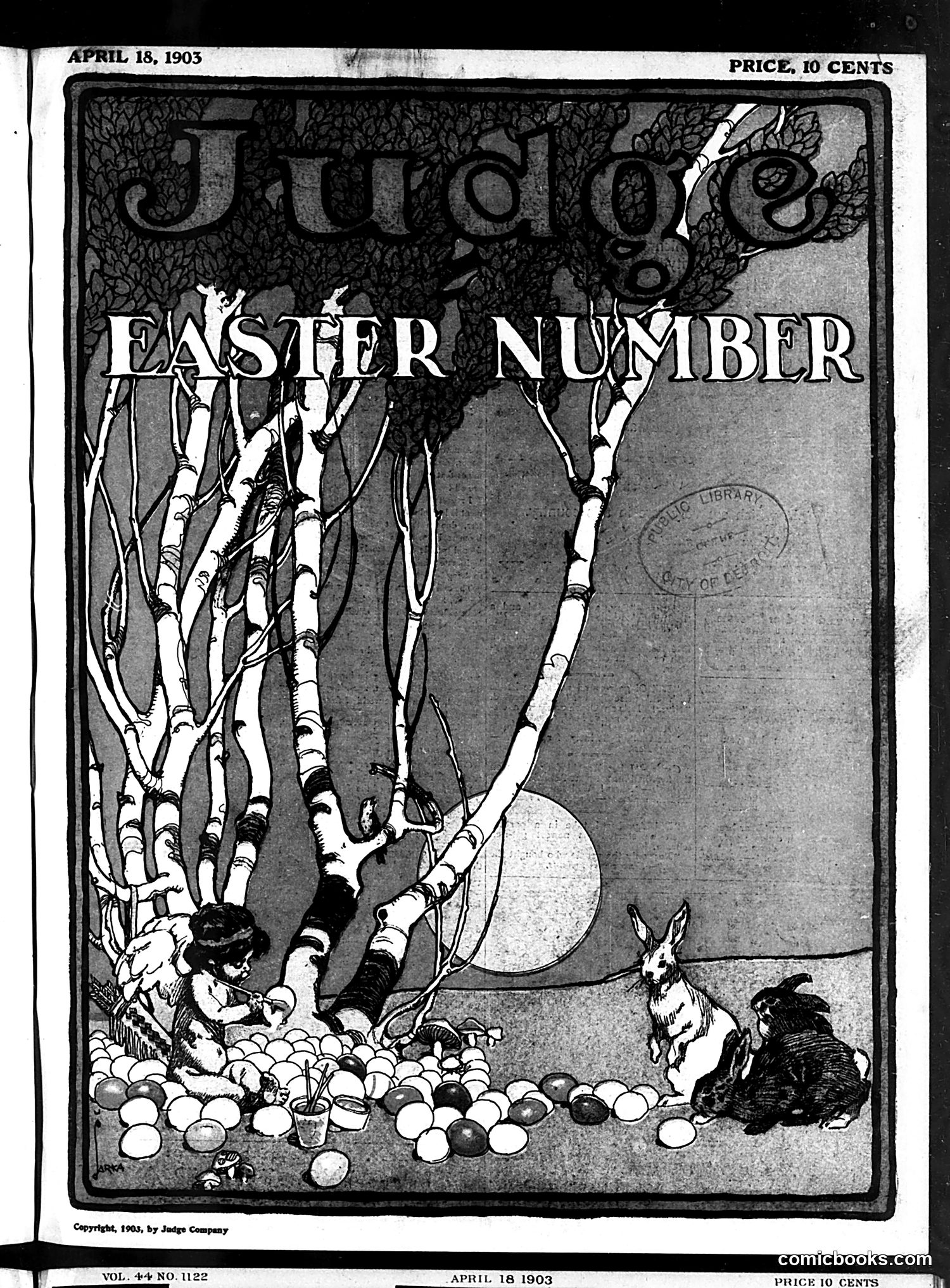
This is Judge magazine's Easter-themed cover from April 18, 1903. The illustration depicts an Easter scene with anthropomorphized rabbits and eggs beneath bare trees with white-wrapped branches (possibly representing birch trees or winter imagery transitioning to spring). The central composition shows rabbits among scattered Easter eggs of varying sizes and colors, arranged in a pastoral setting with a large moon visible in the background. The artwork employs Art Nouveau styling typical of early 1900s magazine covers. Without additional text or captions visible on this page, the specific satirical message is unclear. However, as an "Easter Number" special issue, the content likely combined seasonal holiday themes with Judge's typical satirical commentary on contemporary American politics or society—though the particular targets remain indeterminate from the image alone.
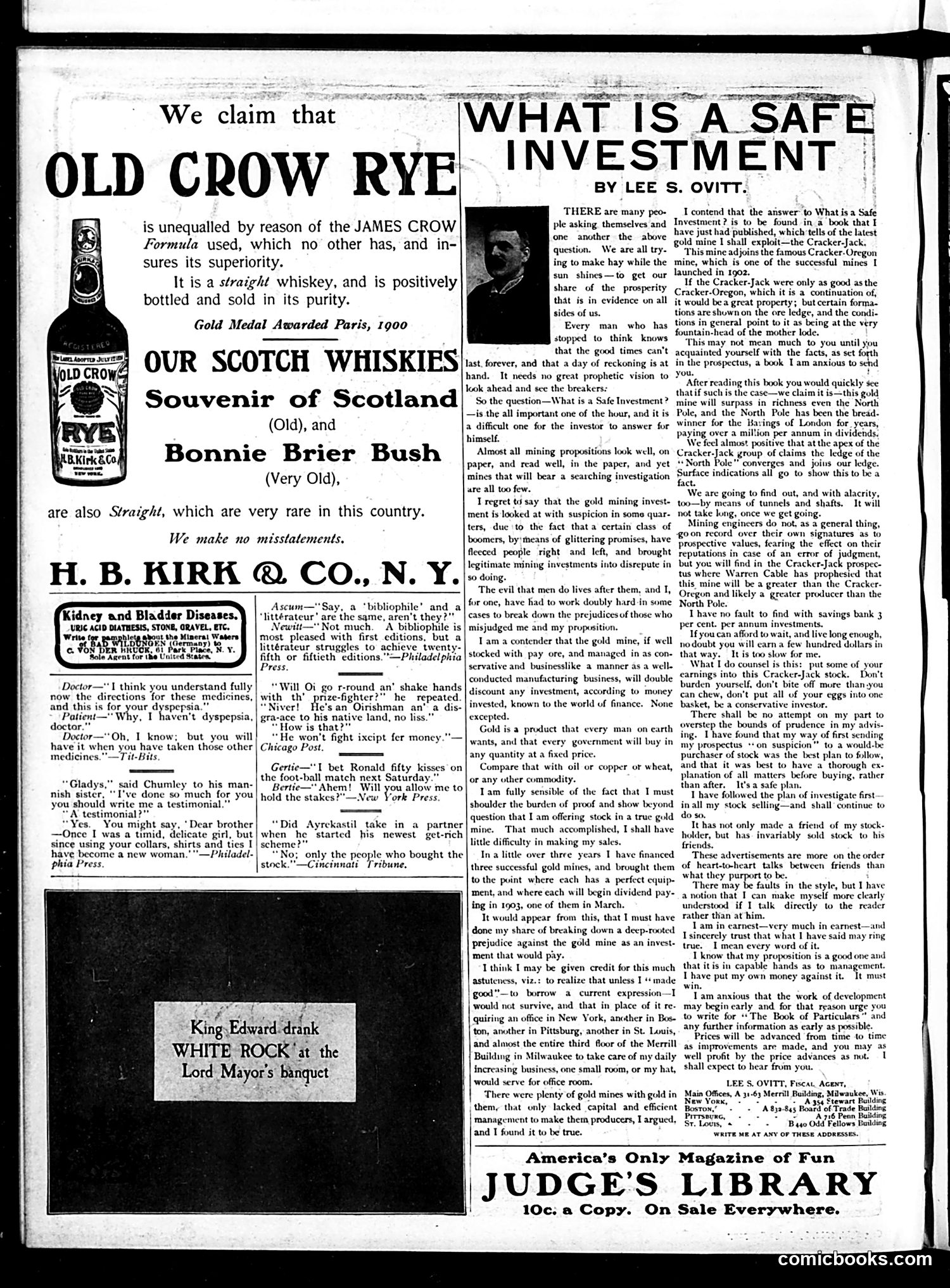
This page is **primarily advertising** rather than editorial satire. The left side advertises **Old Crow Rye whiskey** and other Scottish whiskies, claiming superiority and referencing a "Gold Medal Awarded Paris, 1900." Below are humorous medical dialogue snippets (doctor-patient exchanges) that appear to be stock filler content common to Judge magazine. The right side features **"What is a Safe Investment"** by Lee S. Ovitt, a serious article about gold mining investments that warns readers against fraudulent mining schemes and poorly-managed operations. It discusses how to identify legitimate versus dubious mining ventures. The bottom advertises **Judge's Library**, described as "America's Only Magazine of Fun." There is a small illustration showing King Edward drinking "White Rock" at the Lord Mayor's banquet, likely a product endorsement. The page contains **no significant political cartoons or satire** — it's essentially a mix of advertising and practical investment advice.
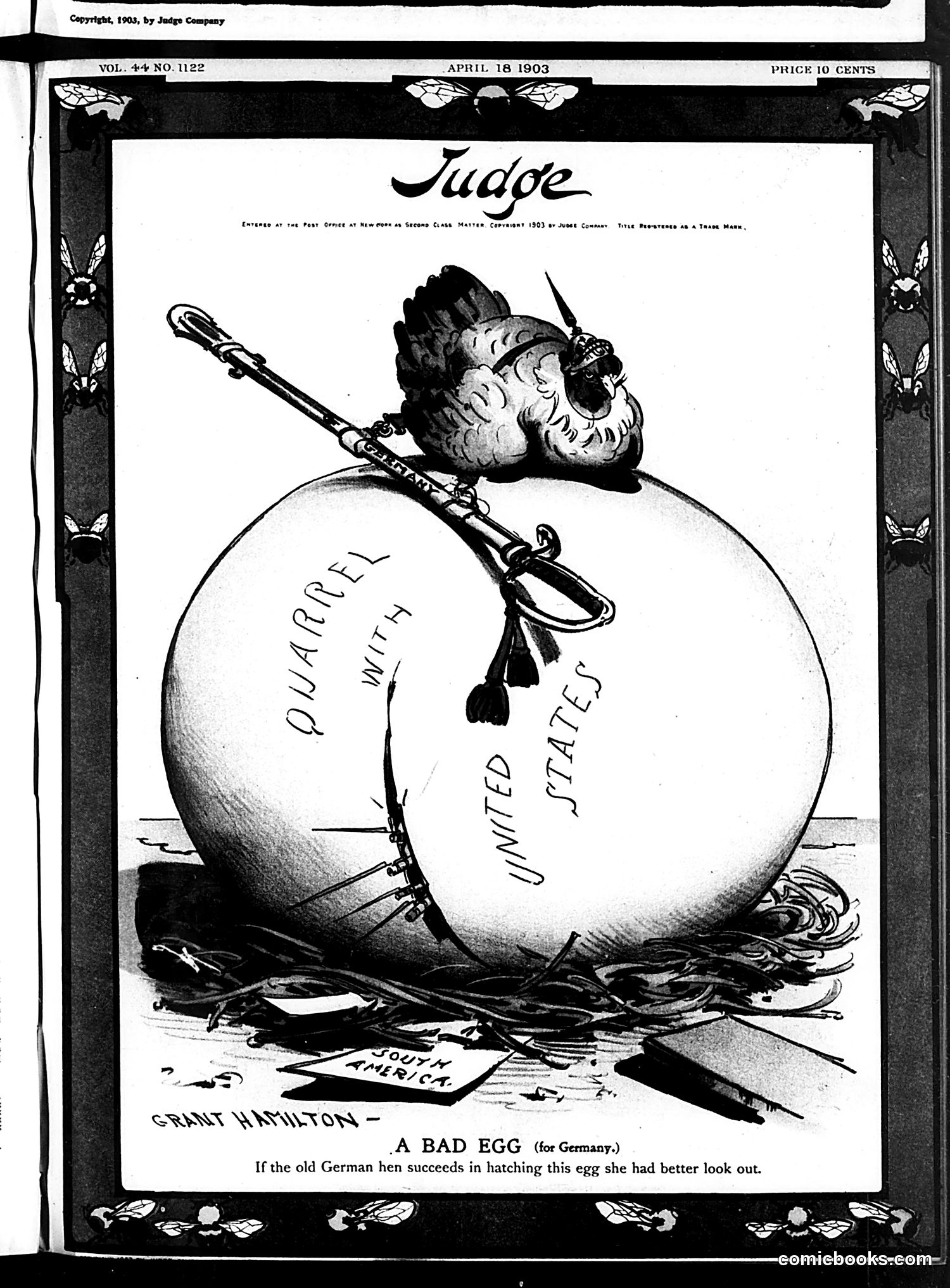
**Artist:** Grant Hamilton **Date:** April 18, 1903 **Subject:** This is anti-German political satire. The cartoon depicts a large egg labeled "QUARREL WITH UNITED STATES" being sat upon by a figure with exaggerated German features (including a spiked Prussian helmet). The egg rests on broken pieces labeled "SOUTH AMERICA," referencing German-American disputes over influence in that region. **Meaning:** The cartoon warns Germany that if it continues pursuing quarrels with the United States over South American interests, it will produce disastrous results—a "bad egg." The caption's pun reinforces this: hatching this conflict would be foolish for Germany. The satire reflects early 20th-century American anxieties about German imperial ambitions in the Western Hemisphere.
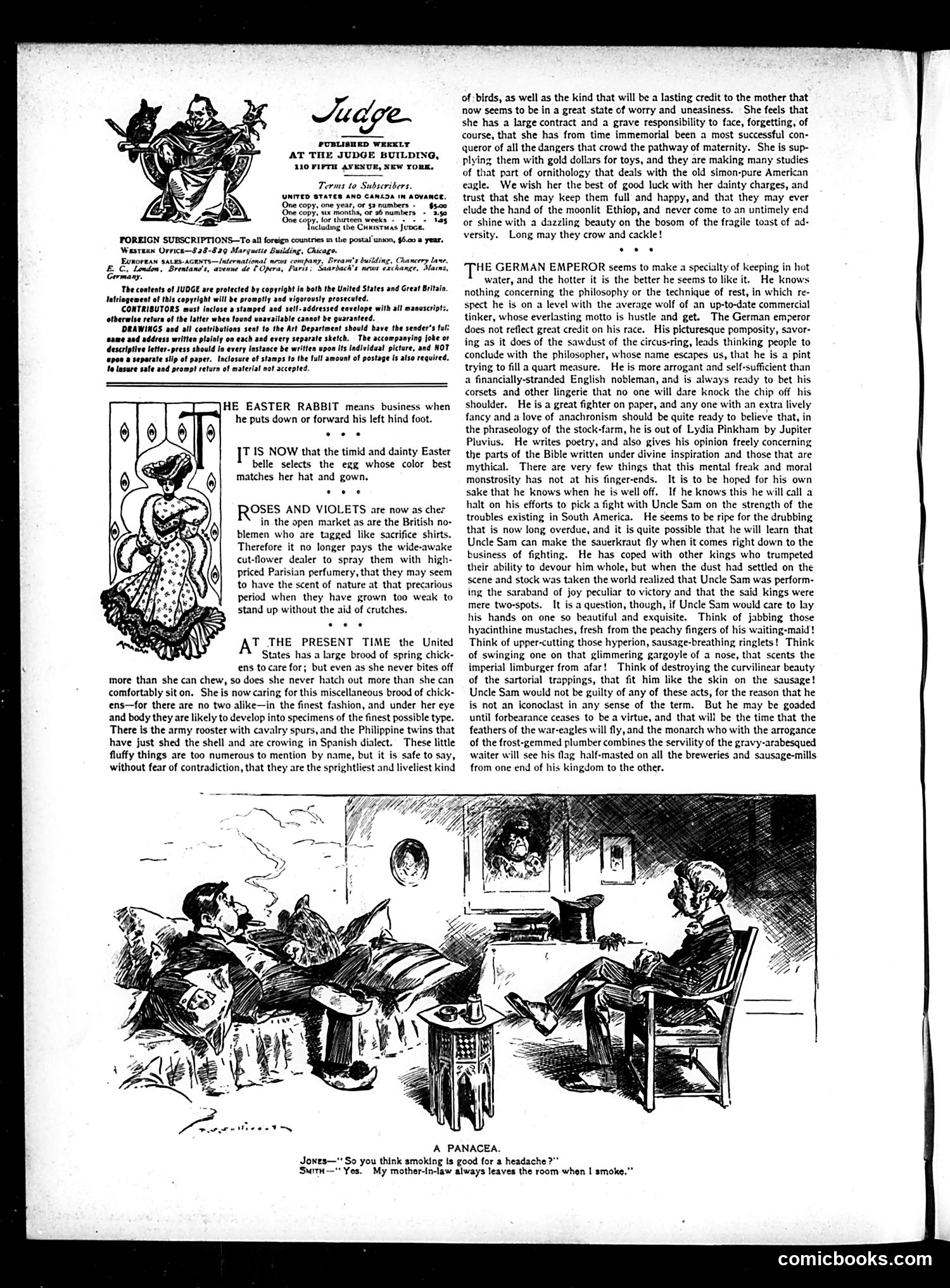
This page contains editorial commentary and a single cartoon titled "Panacea." **The Cartoon:** Two men sit in a comfortable room. One asks if the other thinks smoking is good for a headache. The response: "Yes. My mother-in-law always leaves the room when I smoke." **The Joke:** This is a domestic humor piece playing on the common irritation of unwanted in-laws. The "panacea" (cure-all) isn't actually the smoke helping the headache—it's that smoking drives away the annoying mother-in-law, providing relief from her presence rather than from the headache itself. It's a joke about family dynamics and marital tensions, specifically regarding overbearing mothers-in-law, a perennial source of American domestic comedy.
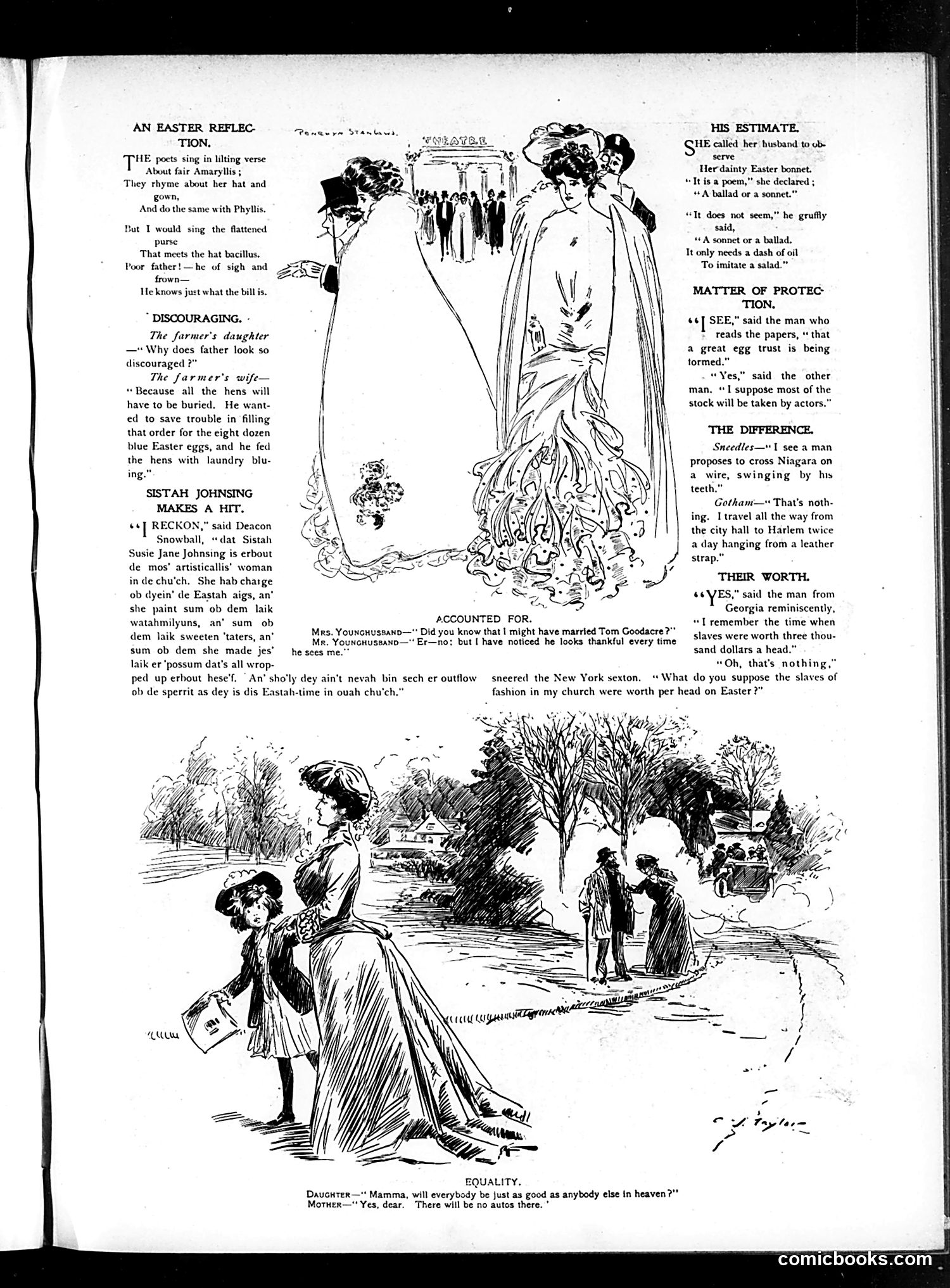
This page contains multiple Easter-themed satirical pieces typical of early 20th-century American humor. **Main Cartoons:** 1. **"An Easter Reflection"** – A poem mocking fathers' financial burden from Easter expenses (new hats, eggs, celebrations). 2. **"Discouraging"** – A farmer feeds hens laundry bluing to produce blue Easter eggs, killing them instead—satirizing misguided economy. 3. **"Sistah Johnsing Makes a Hit"** – A dialect-heavy piece featuring a Black church member decorating Easter eggs. This represents period racism through exaggerated speech patterns, though the "hit" suggests she's competent despite stereotyping. 4. **"Equality"** – Class commentary: A child asks if everyone equals in heaven; mother replies "yes"—except there won't be automobiles. This satirizes automobile-ownership as a status symbol dividing the wealthy from others. 5. **Various short jokes** about egg trusts, Niagara stunts, and slavery's monetary value—the last reflecting post-Civil War discussions about enslaved people as economic commodities. The page reflects early 1900s concerns: consumerism, Easter commercialism, class divisions, and lingering racial attitudes.
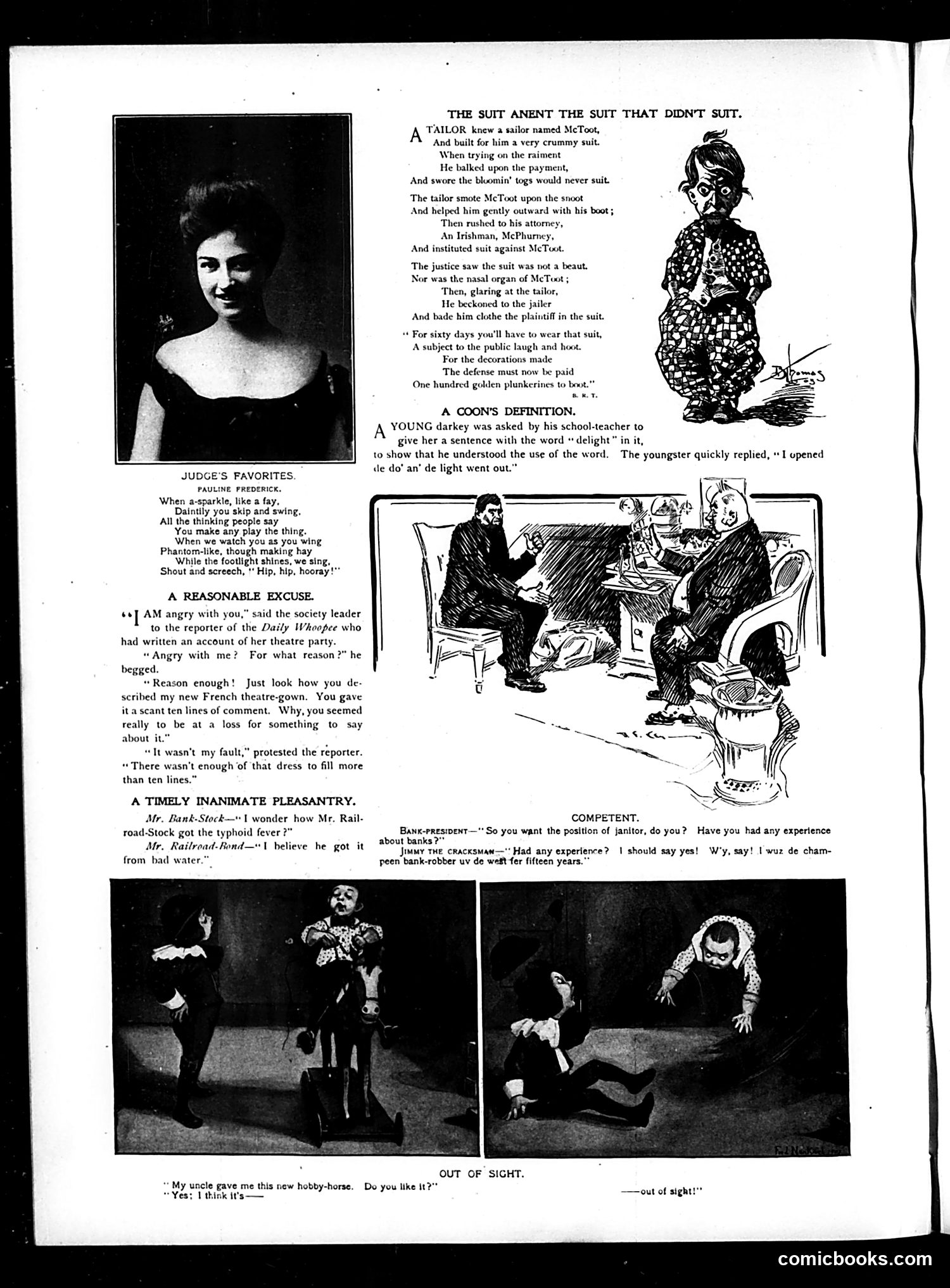
This page contains multiple satirical pieces typical of early Judge magazine: **"The Suit Anent the Suit"** is a humorous poem about a tailor-sailor dispute. A tailor named McToot builds a poor suit for a sailor, who refuses payment. The tailor sues through his Irish attorney McPhurney. The judge, finding both the suit and the defendant's appearance equally disreputable, punishes the tailor by forcing him to wear his own awful suit for sixty days as public mockery. **"A Coon's Definition"** uses a racial caricature (standard for the era) making a dialect-based pun about "delight"—the child mishears it as "de light," making a joke about electricity. Other pieces include light social satire about a society woman upset a reporter gave insufficient column space to her dress, and workplace humor involving financial figures and a bank robber applying as janitor. The page emphasizes wordplay, puns, and gentle social mockery rather than serious political commentary.
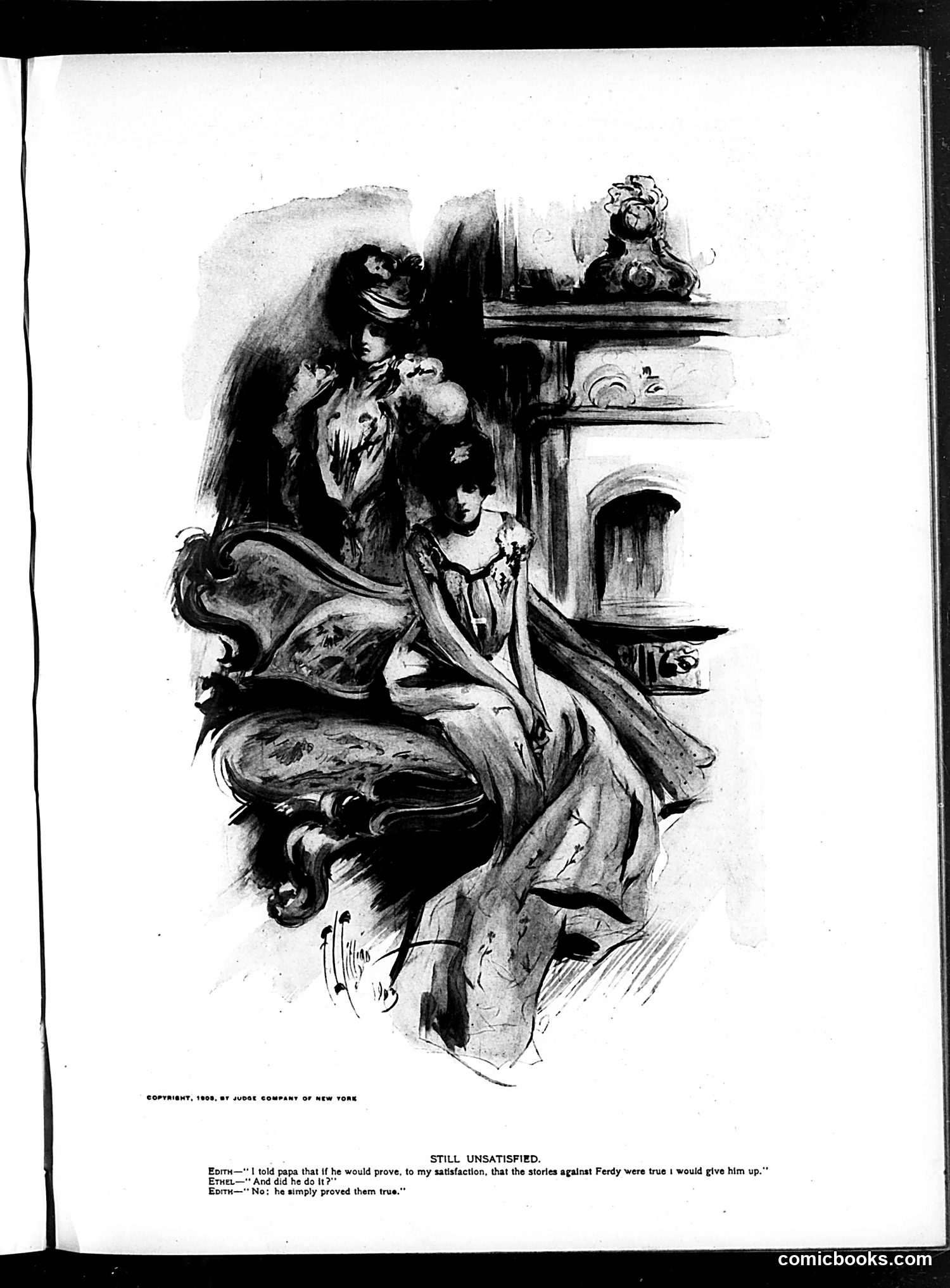
This 1908 Judge cartoon depicts a domestic dispute between a father (Ernet) and daughter (Edith) over a suitor named Ferdy. The father attempts to convince his daughter that damaging stories about Ferdy are true, hoping she'll break off the relationship. However, the daughter's logic trap backfires: the father successfully proves the allegations, but rather than satisfying her condition to end the romance, she remains committed to Ferdy despite the confirmed misconduct. The satire mocks both stubborn parental authority and romantic infatuation that transcends reason or reputation. The illustration shows the emotional intensity of their conversation, with the figures rendered in expressive ink work characteristic of Judge's style. The joke's humor derives from the daughter's illogical persistence in defending an indefensible partner.
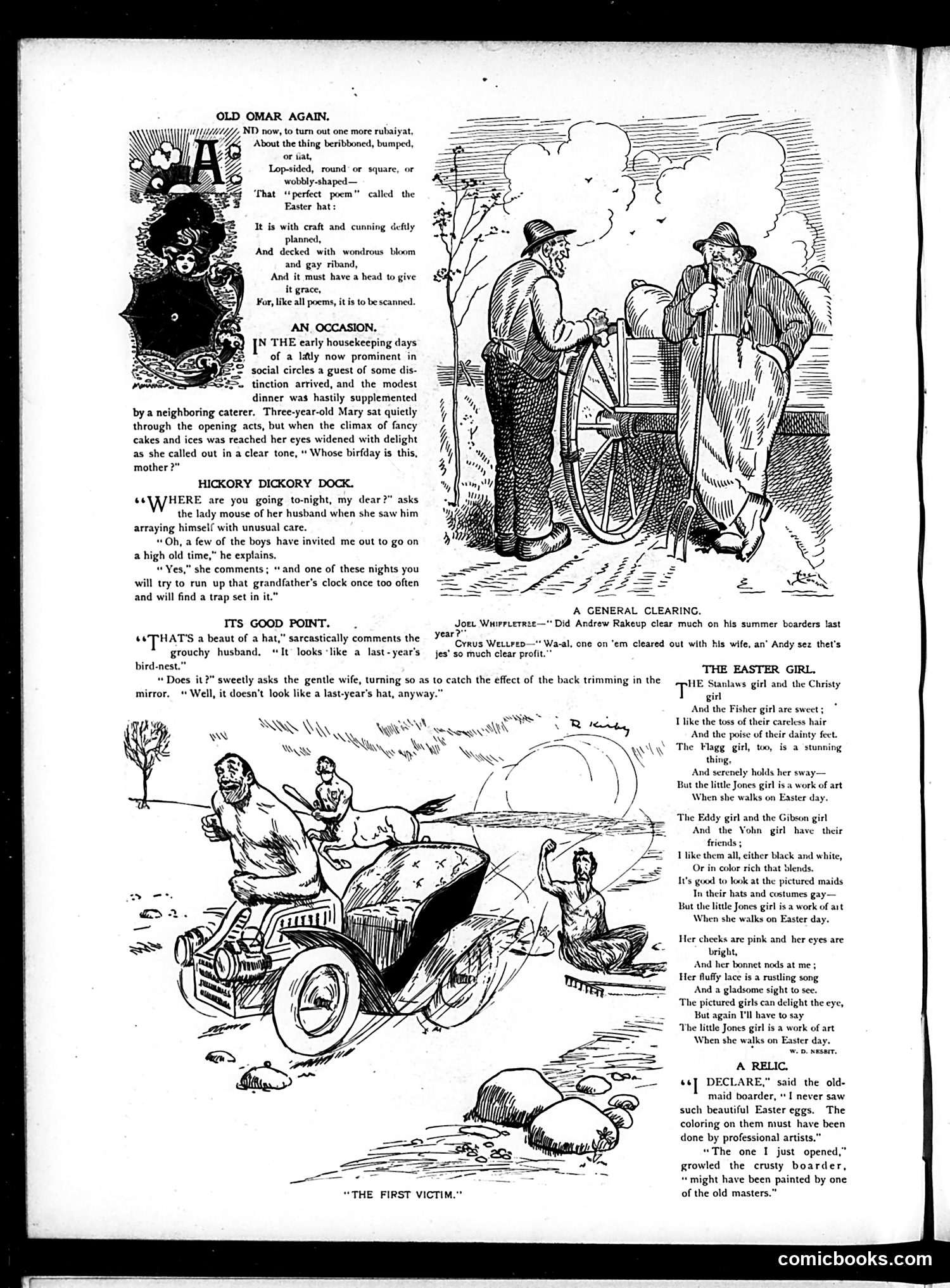
This page contains multiple Easter-themed satirical pieces typical of Judge's humor circa early 1900s. **"Old Omar Again"** parodies Omar Khayyam's poetry form (rubaiyat) to mock elaborate Easter bonnets—fashionable women's hats decorated with ribbons and flowers. The satire suggests these hats are overwrought "poems" requiring a head to display them properly. **"A General Clearing"** features rural characters discussing a boarder who "cleared out" with his wife, with dark humor about this being profitable. **"The Easter Girl"** compares popular illustrated "Gibson Girl" type images (famous idealized female figures of the era) to an unnamed "little Jones girl," suggesting real life surpasses commercial illustrations. **"A Relic"** jokes about old Easter eggs, with a landlady praising their artistry while a curmudgeonly boarder sarcastically suggests they might be "painted by one of the old masters"—implying they're actually poorly decorated or deteriorated. The page reflects Edwardian-era concerns: fashion excess, rural simplicity, commercialized beauty standards, and boarding-house life humor.
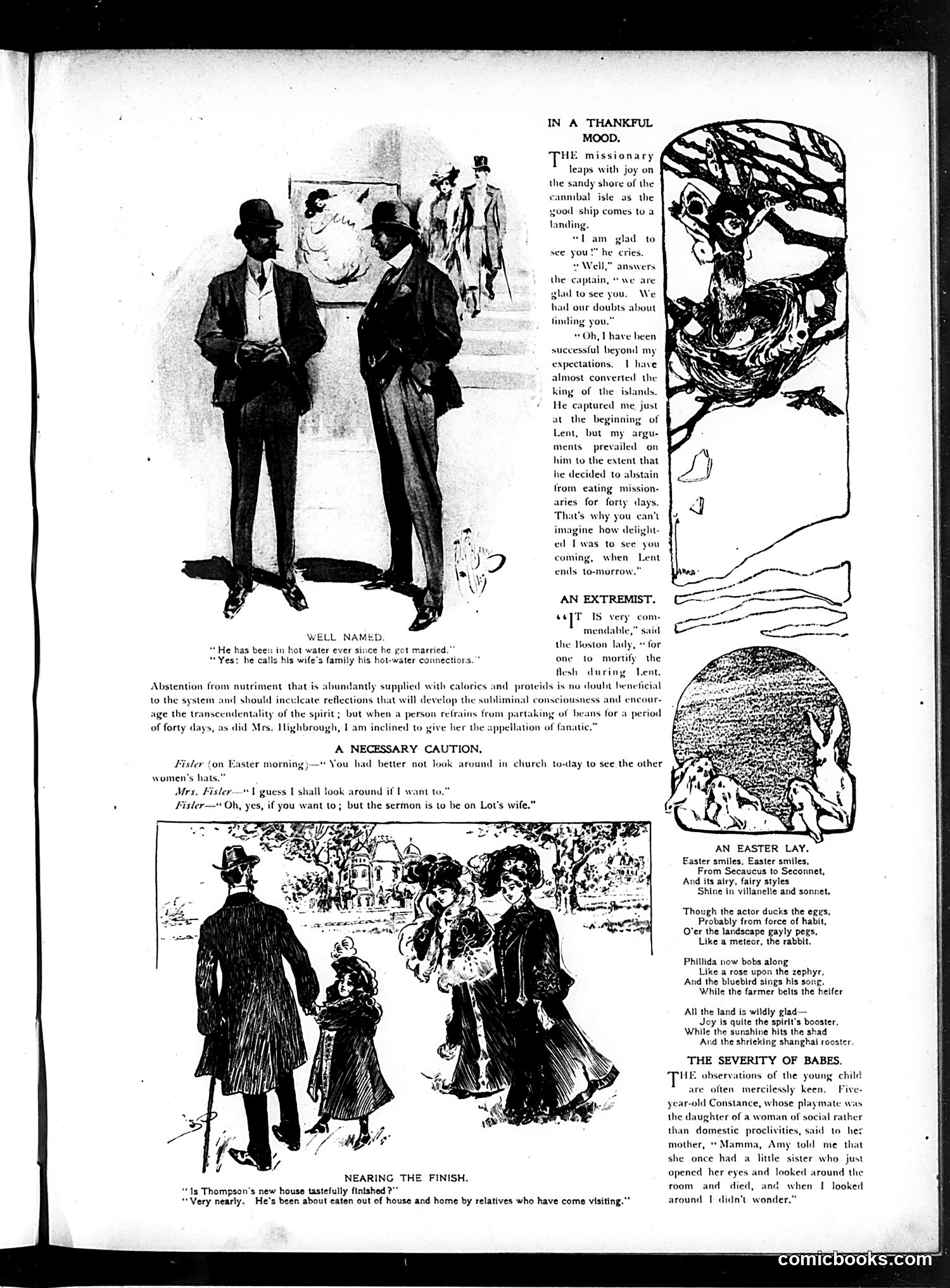
This page contains multiple satirical pieces typical of early 20th-century American humor: **Main cartoons:** - "In a Thankful Mood" mocks missionary work by depicting a missionary grateful that a cannibal king agreed to fast from eating missionaries during Lent—suggesting missionaries are naive and ineffectual. - "Well Named" jokes that a man called "Highbrough" has been in "hot water" since marriage because his wife's family are "hot-water connectors" (a plumbing pun). - "A Necessary Caution" references the Biblical story of Lot's wife (who turned to salt looking back), using it to warn women not to observe other women's Easter hats in church. **Other pieces** include Easter-themed verse and a brief anecdote mocking a child's blunt observation about a neighbor's infant mortality. The satire targets missionary pretensions, marital discord, competitive female fashion culture, and Victorian sentimentality—common Judge themes emphasizing human folly and social hypocrisy through exaggeration and wordplay.
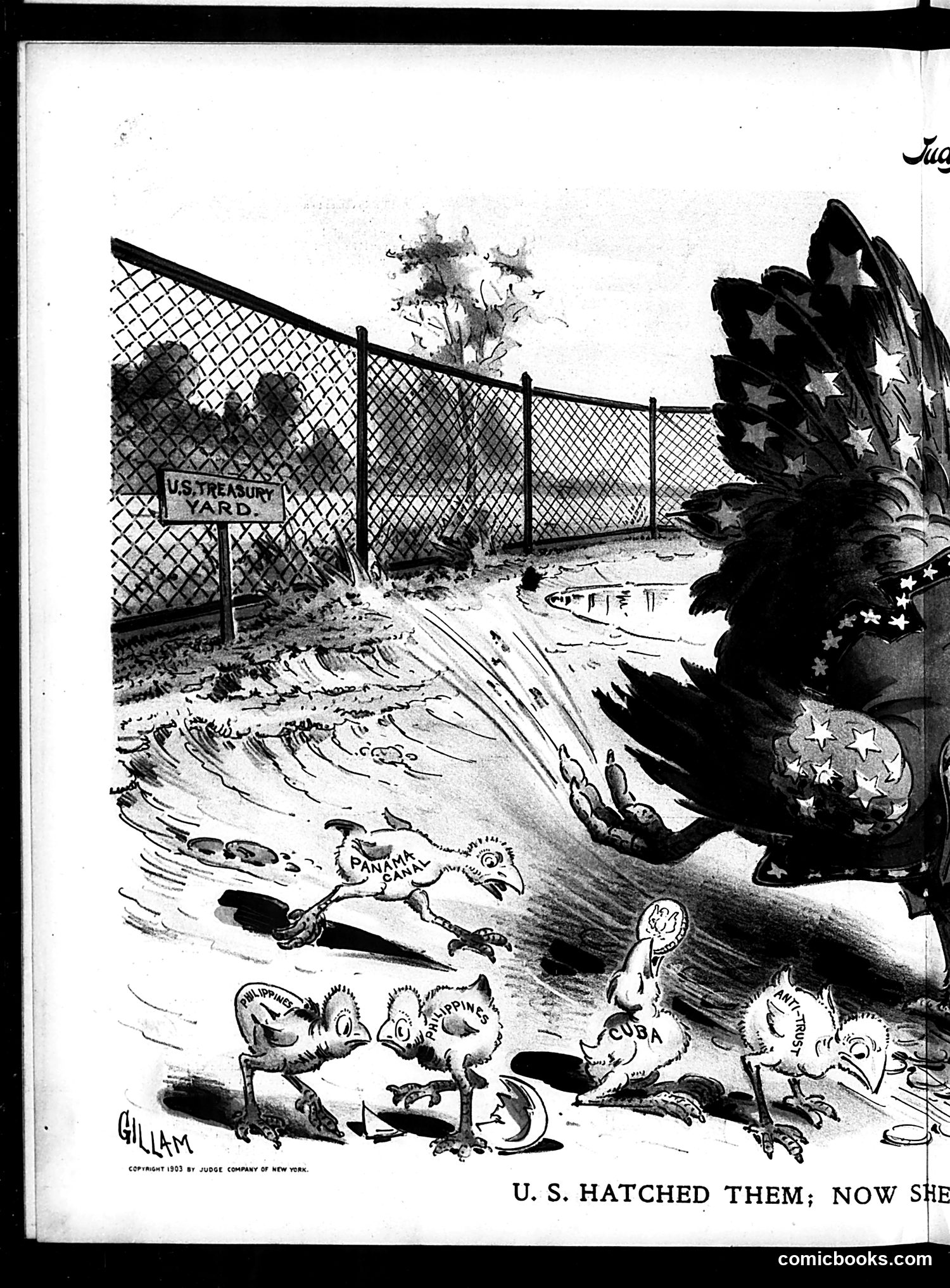
This 1903 Judge cartoon by Gillam satirizes American foreign policy through allegorical imagery. Uncle Sam (depicted as an eagle on the right, decorated with stars) has "hatched" several chick-like creatures labeled with various nations or territories—appearing to include Panama, Cuba, and others. They're contained behind a "U.S. Treasury Yard" fence. The satire critiques American imperial expansion and interventionism in the early 20th century, particularly following the Spanish-American War. The "hatching" metaphor suggests the U.S. created or took control of these territories. The Treasury Yard fence implies these possessions are now the government's financial burden or responsibility to maintain and guard. The cartoon mocks the consequences of America's growing colonial ambitions during the Theodore Roosevelt era.
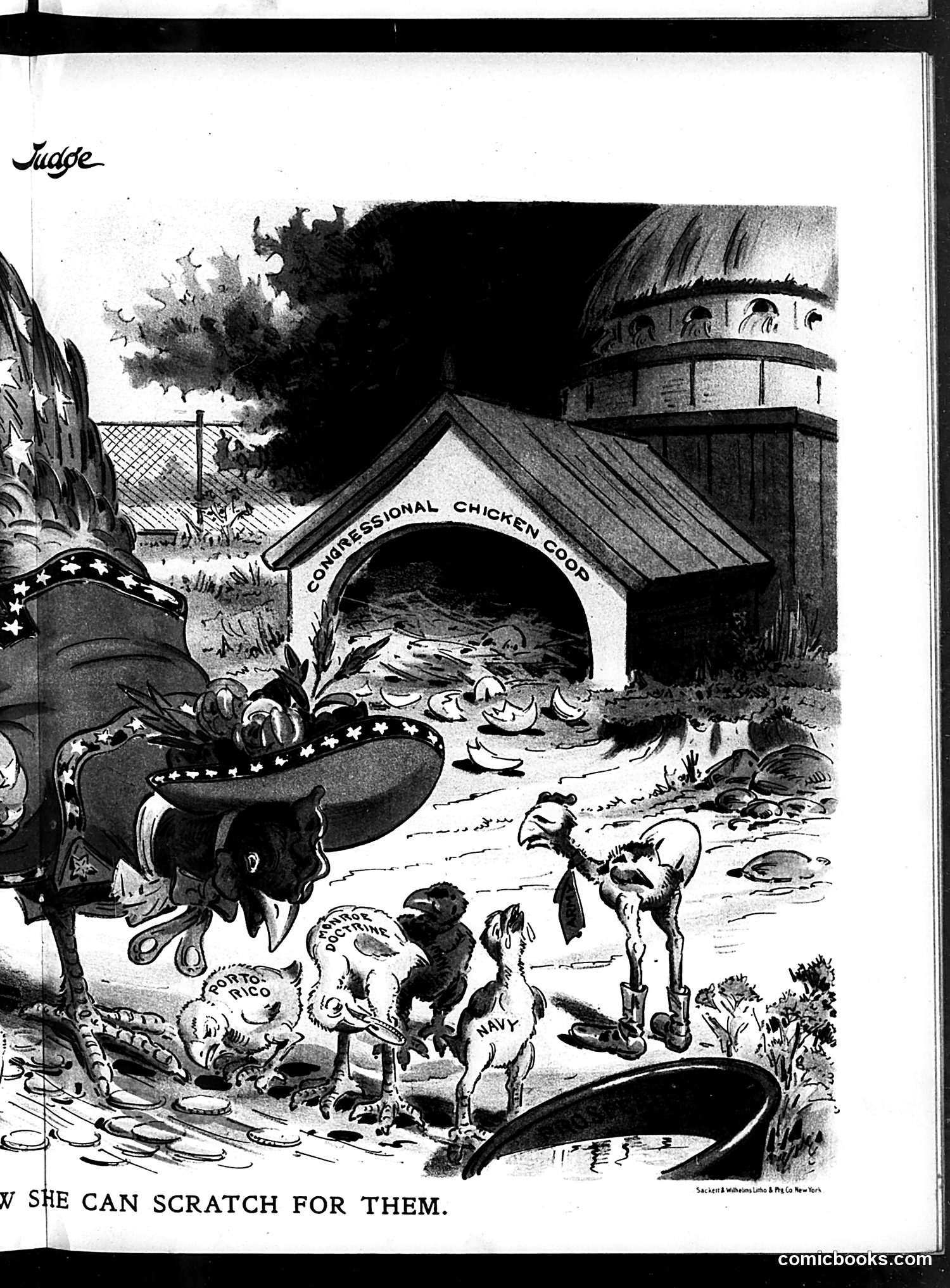
This Judge magazine cartoon satirizes American political figures through animal caricatures. A rooster labeled "CONGRESSIONAL" and other birds labeled with political positions (appears to include "PORTO RICO" and "NAVY") scratch around a "CONGRESSIONAL CHICKEN COOP." A large figure on the left—wearing a star-spangled sombrero, suggesting Uncle Sam or an American expansionist—oversees the scene. The caption reads "...SHE CAN SCRATCH FOR THEM," implying the female figure (likely representing America or Congress) must provide resources or sustenance to these political interests. This likely critiques early 20th-century American imperialism and the allocation of congressional funds to military and colonial ventures, with the birds representing competing political interests fighting over resources the nation must supply.
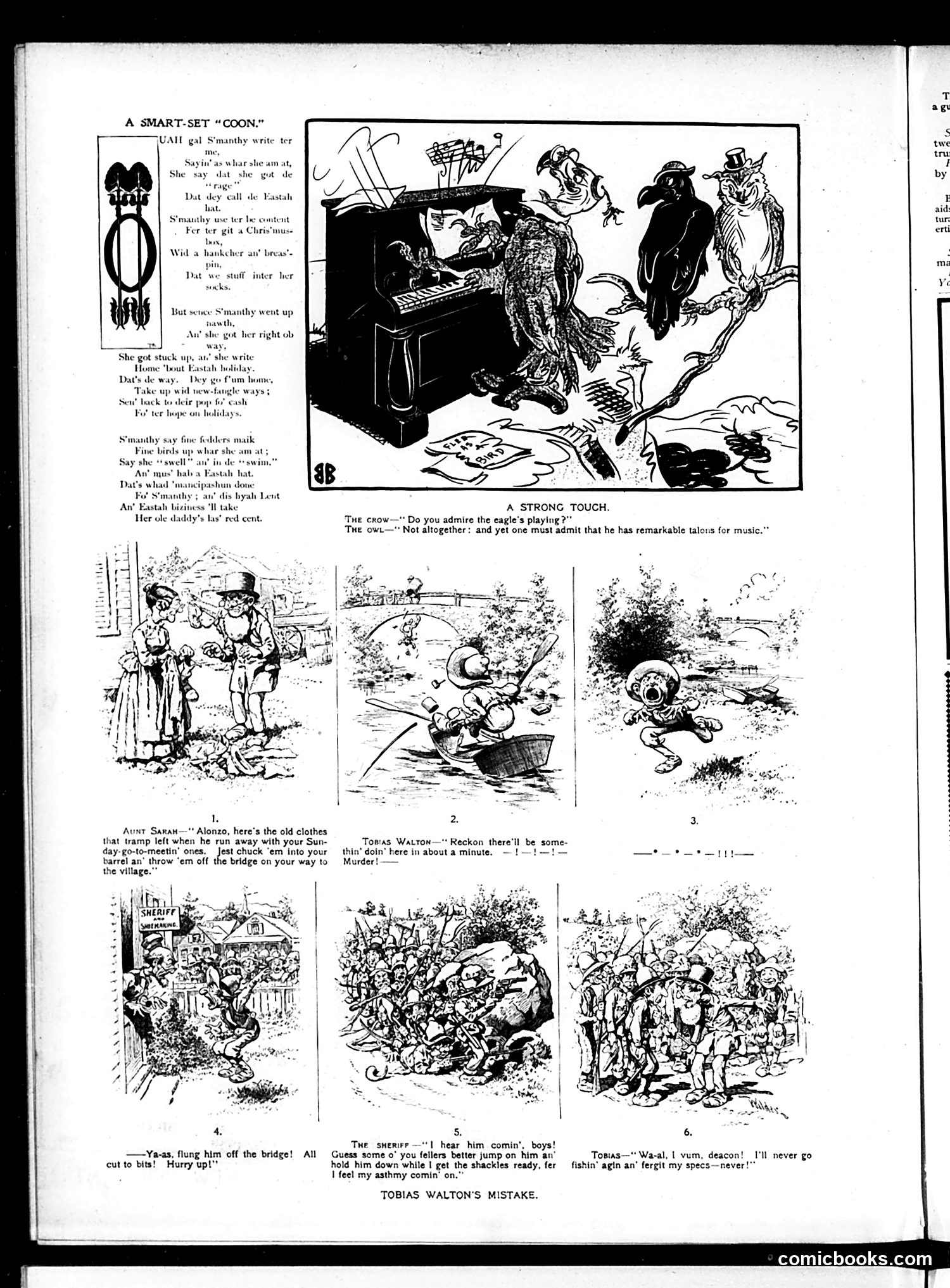
This Judge magazine page contains racist caricatures typical of late 19th/early 20th-century American satire. **"A Smart-Set 'Coon'"** (top left) uses offensive dialect and stereotypes, mocking an African American woman named "S'manthy" for adopting fashionable clothing and urban mannerisms while her family pressures her for money. **"A Strong Touch"** (top right) shows an eagle playing piano while crows observe—a likely political allegory, though the specific figures are unclear without additional context. **"Tobias Walton's Mistake"** (bottom series) depicts a lynching scenario presented as comedic. Rural white characters discuss apprehending and presumably executing a Black man, treating violence as entertainment. The dialogue treats this as humorous. The page reflects Judge's editorial stance: mocking both African Americans for social aspiration and rural/working-class whites. The lynching sequence is presented without moral judgment, reflecting the magazine's era's casual acceptance of racial violence.
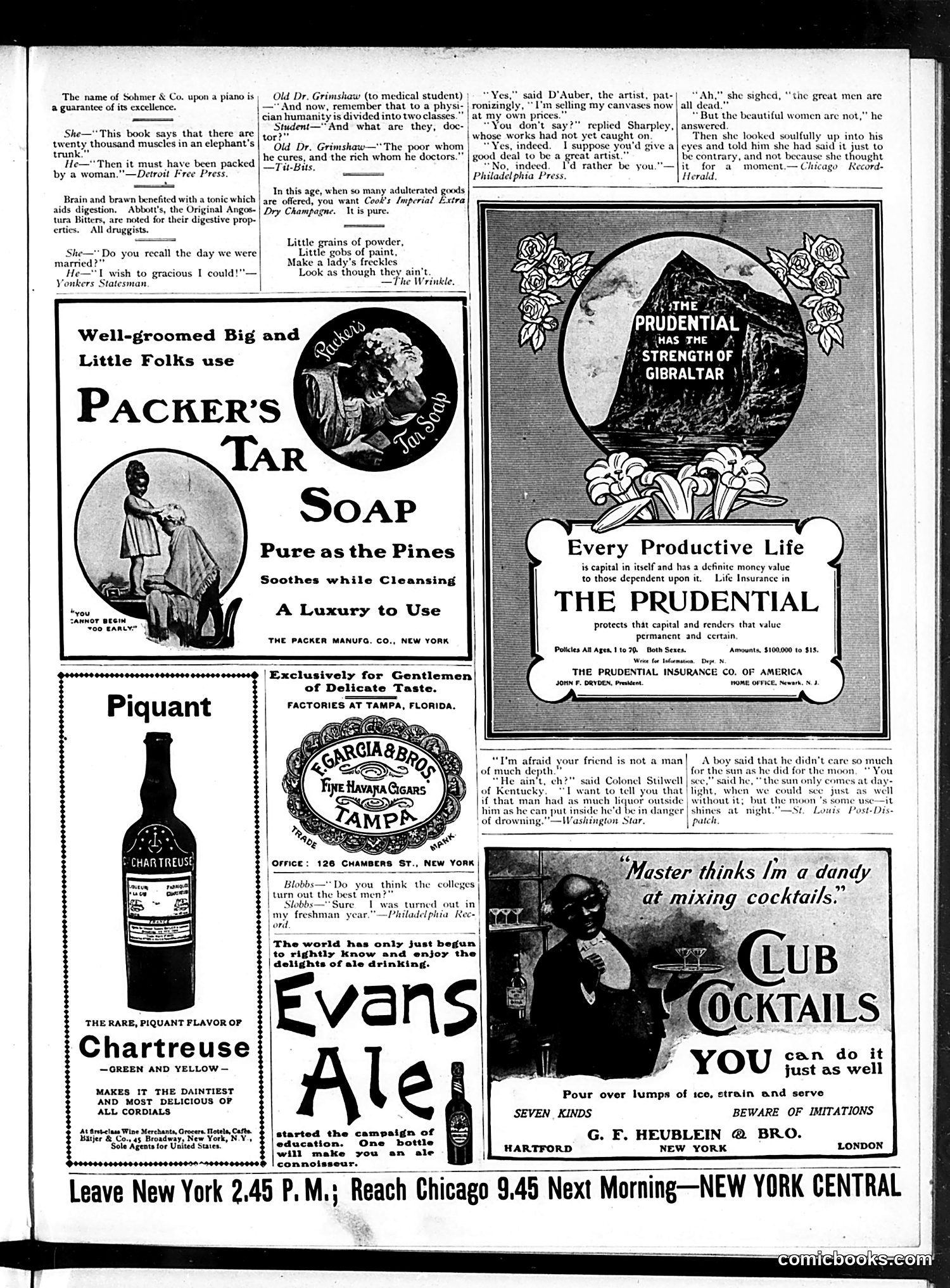
This page is primarily **advertising**, typical of early 20th-century magazines. The editorial content consists of brief humor items and jokes rather than political cartoons. The few jokes present reflect period concerns: one mocks women's physical strength (a piano packed "by a woman"), another jokes about medical education and treating the poor versus the rich, and a third satirizes artistic pretension (an artist valuing wealth over artistic achievement). A final item humorously contrasts a man's shallow character with the moon's nighttime utility. The bulk of the page showcases luxury consumer products—soap, cigars, ale, champagne, cordials, and insurance—typical of *Judge*'s affluent readership. The Prudential Insurance ad uses metaphors about "productive life" and "capital," reflecting Progressive Era concerns about financial security. The advertising and humor together convey the magazine's audience: wealthy, educated readers interested in refined goods and gentle social commentary rather than hard-hitting political satire.
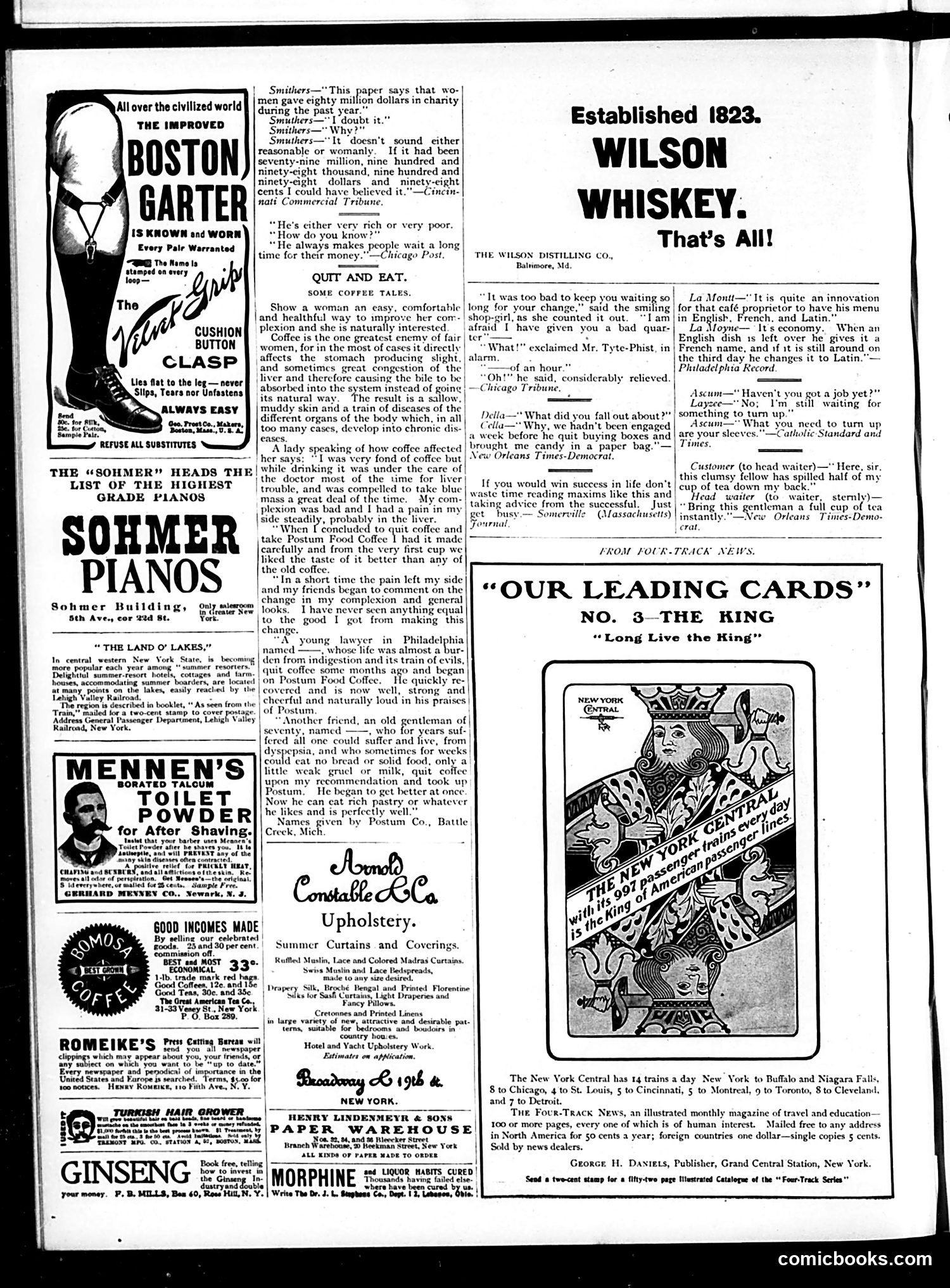
This page is primarily **advertising and filler content**, typical of Judge magazine's format. The main satirical content is a brief joke at the top: **The Satire:** Two men (Smithers and Smuthers) discuss women's charity donations. One claims women gave eighty million dollars to charity; the other expresses skepticism, sarcastically saying he'd believe it only if the amount were oddly precise (seventy-nine million, nine hundred ninety-eight thousand, etc.). **The Point:** This mocks both women's charitable giving as potentially exaggerated claims AND the obsessive precision some people use to sound credible—implying that round numbers like "eighty million" sound suspiciously inflated or invented. The rest of the page consists of contemporary advertisements (Boston Garter, Sohmer Pianos, Postum Coffee, etc.) and unrelated anecdotes about coffee's health effects. These ads provide historical context about early 1900s consumer products and marketing but contain no political or social satire themselves.
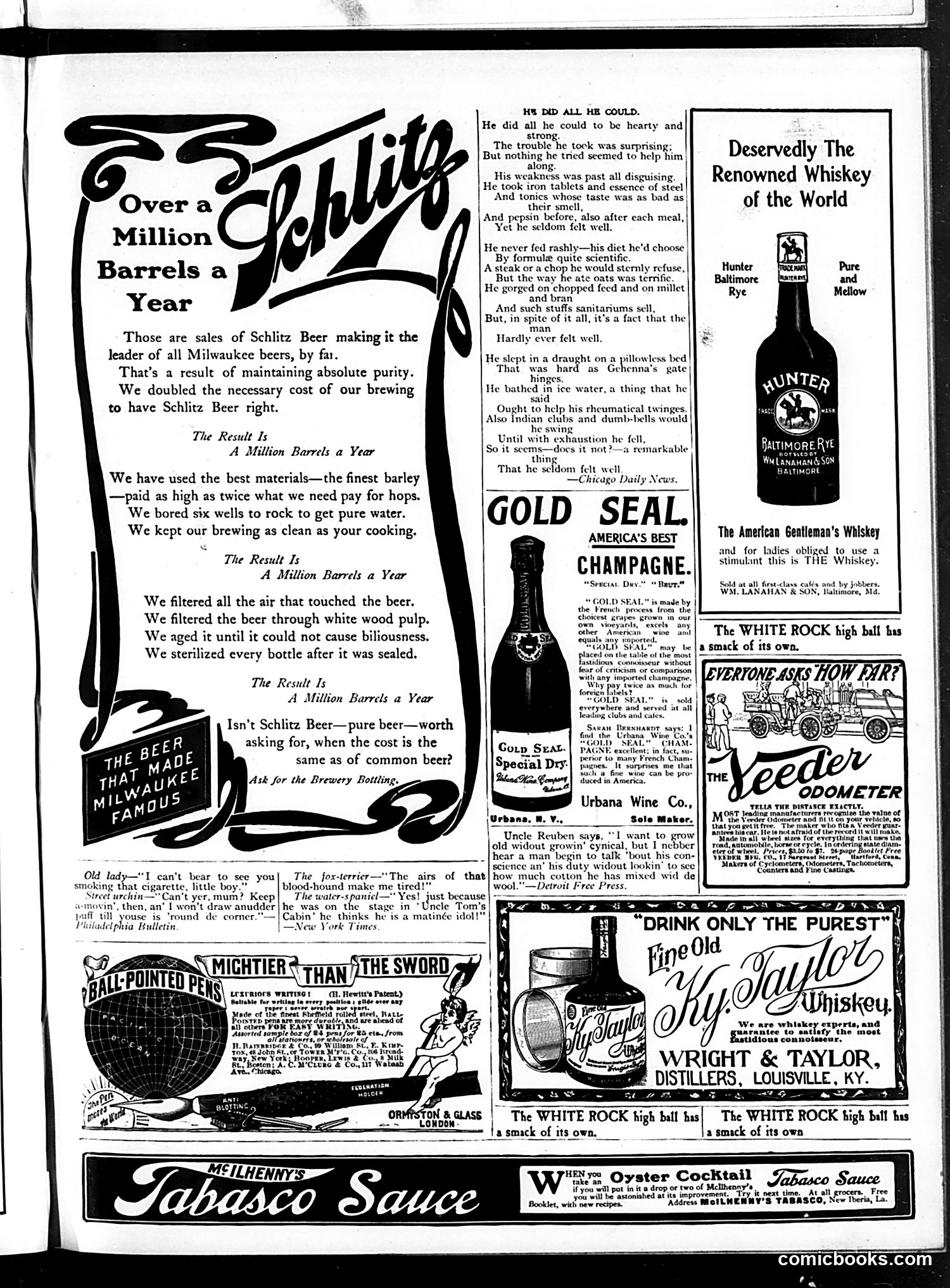
This is primarily a **advertisements page** from Judge magazine, not a political cartoon. The page contains several product ads typical of the early 1900s: **Main Content:** - Large Schlitz Beer advertisement emphasizing purity through detailed brewing processes - Multiple whiskey ads (Hunter Baltimore Rye, Sky Taylor, Gold Seal Champagne) - The Veeder Odometer advertisement for measuring vehicle distance **Satirical Elements:** A short poem titled "HB DID ALL HE COULD" mocks health-obsessed individuals who rigidly follow pseudo-scientific wellness advice (special diets, cold baths, exercise equipment) yet remain perpetually unwell. This satirizes the early 1900s "health fad" culture—similar to modern wellness trends. **Historical Context:** The ads reflect Prohibition-era concerns about alcohol purity and quality, while the health poem targets the widespread belief in "scientific" remedies that were largely ineffective. The page is **not primarily satirical commentary** but rather advertising revenue material with light humor inserted.
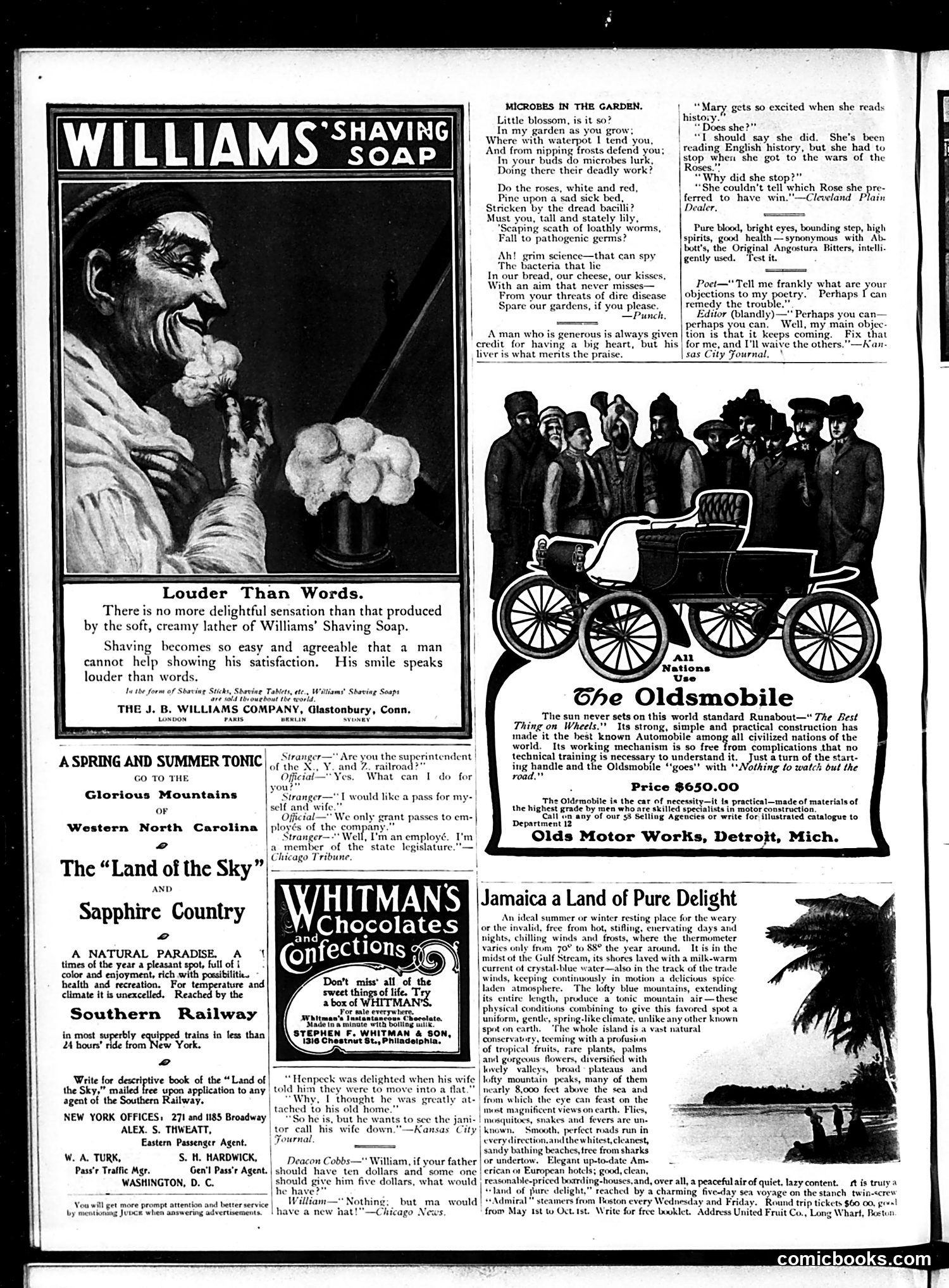
This page is primarily **advertising**, with the main content being product pitches for Williams' Shaving Soap, Whitman's Chocolates, an Oldsmobile automobile, and travel destinations. The small satirical section titled "Microbes in the Garden" is a humorous poem (from *Punch*) about the Victorian obsession with germ theory—the newly popular scientific understanding that bacteria cause disease. The joke reflects contemporary anxieties: even gardens contain invisible threats. This references the late 19th/early 20th-century "germ panic" that gripped the public as microscopic organisms were discovered. The other brief satirical items are standard *Judge* magazine humor—wordplay about a woman getting too invested in English history (particularly the Wars of the Roses), and a poet's complaint that his portrait keeps following him around. The page's satirical value is minimal; it's essentially a magazine issue showcasing period advertisements alongside light, uncontroversial comedic filler.
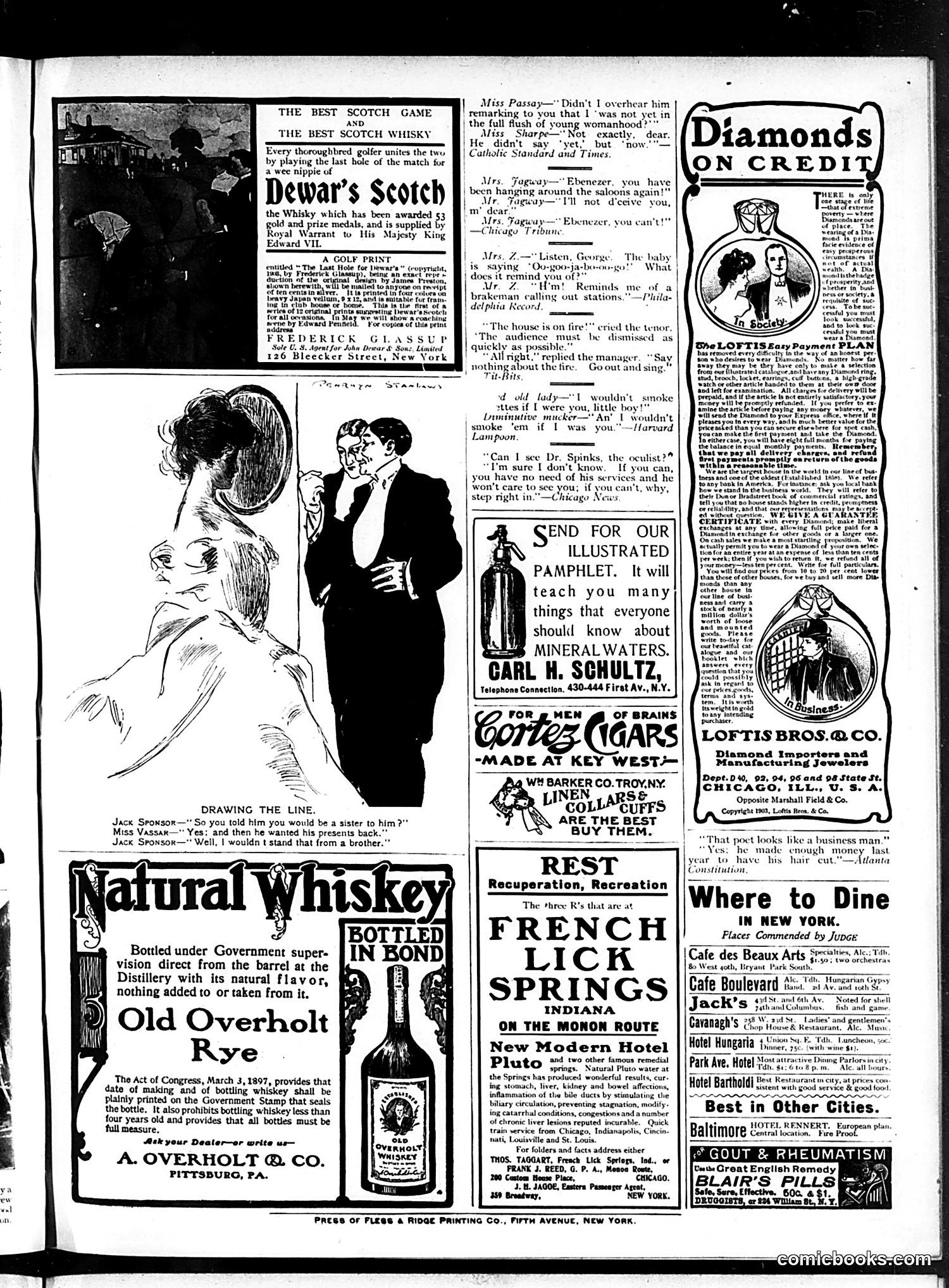
The cartoon mocks the courtship conventions of the Vassar College girl (upper-class women's college) through the exchange between Jack Sponsor and Miss Vassar. **The Joke:** Miss Vassar agreed to be merely a "sister" to her suitor—a chaste, familial relationship—but then expected him to continue lavishing expensive gifts on her anyway. Jack finds this hypocritical: if she wants sisterly distance, she should forfeit the gifts; if she wants gifts, she should allow romance. **The Satire:** Judge ridicules the calculated romanticism of wealthy young women who negotiated courtship carefully, drawing false "lines" to maintain propriety while enjoying material benefits. The cartoonist suggests Miss Vassar wants the advantages of both platonic friendship (respectability) and romantic pursuit (gifts)—having it both ways. **Historical Context:** This reflects early 1900s anxiety about "New Women" negotiating social rules, particularly wealthy educated women at prestigious institutions like Vassar.
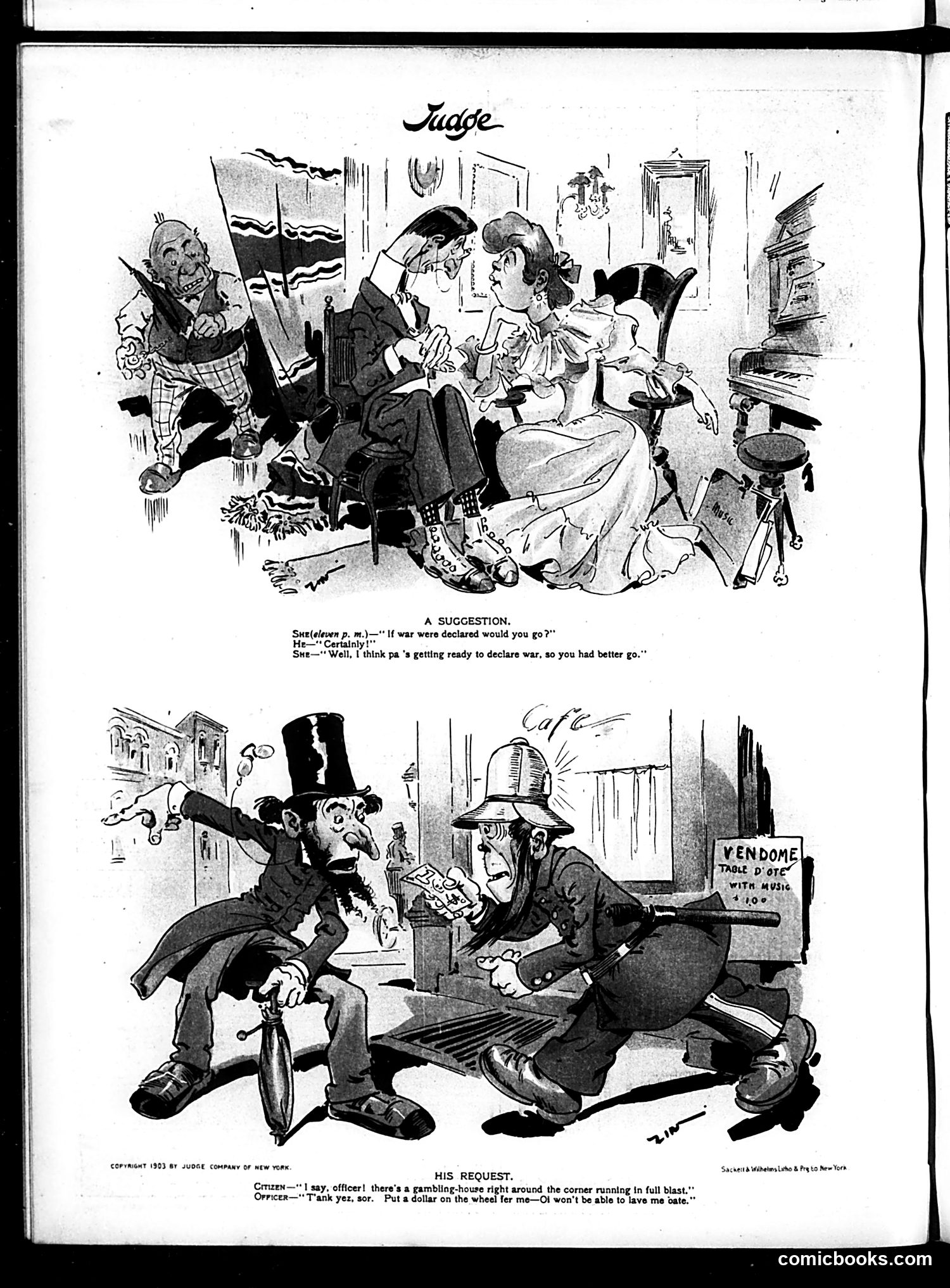
**Top Cartoon ("A Suggestion"):** A young woman threatens her suitor by suggesting her father might declare war—implying the man should leave if conflict begins. This satirizes how women used patriotic duty to rid themselves of unwanted suitors, a common social pressure during pre-war periods (likely referencing World War I tensions). **Bottom Cartoon ("His Request"):** A citizen reports a gambling operation to a corrupt police officer, who immediately asks the citizen to place a bet for him. This satirizes police corruption and collusion with illegal gambling—a widespread urban problem in early 20th-century America where officers profited from vice rather than enforcing laws. The Irish dialect suggests anti-Irish immigrant stereotyping typical of the era. Both cartoons mock social hypocrisy and institutional failures through humor.
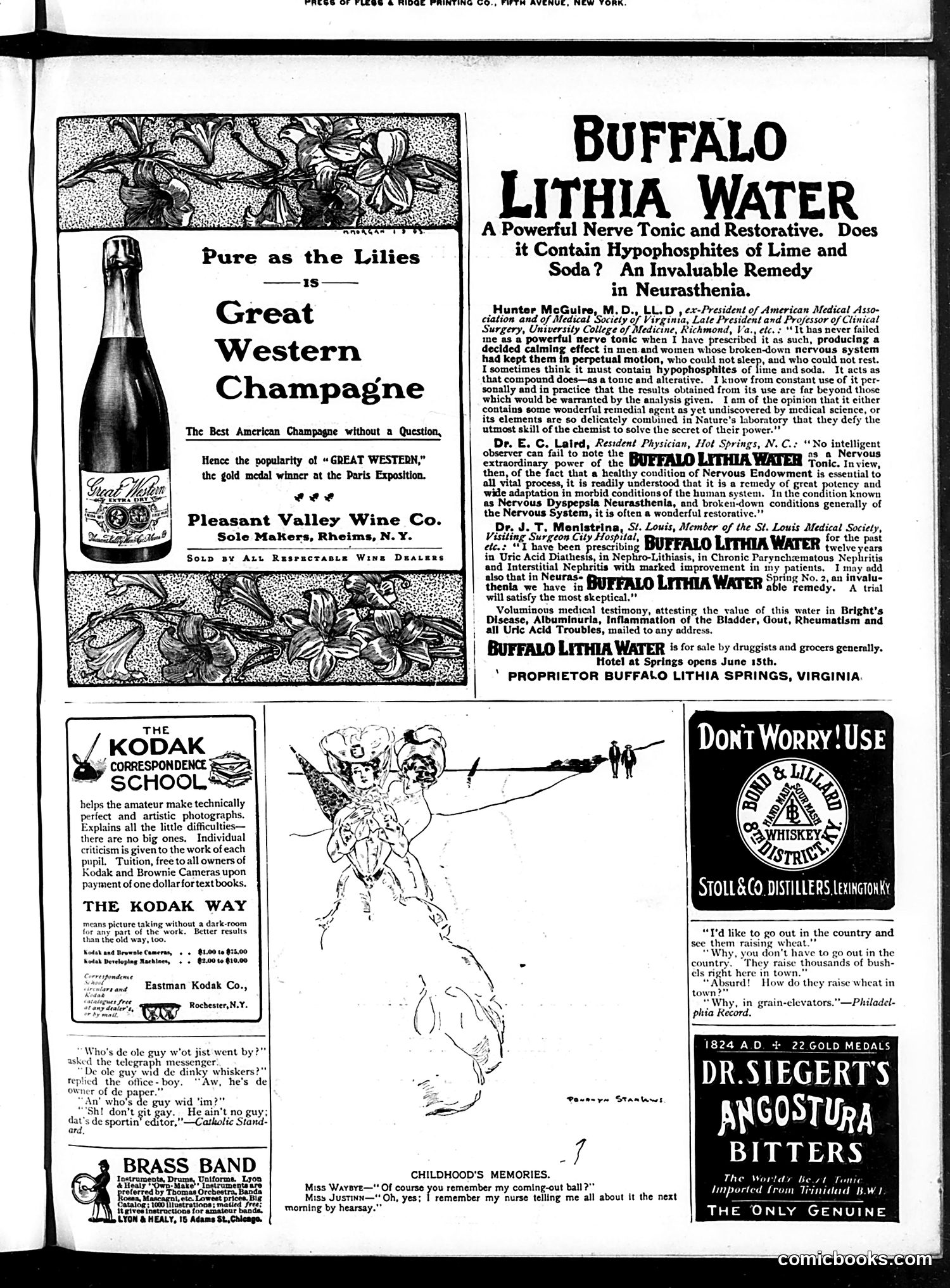
This page is primarily **advertisements**, not political satire. The main content consists of product endorsements: **Buffalo Lithia Water** dominates the right side—a medicinal water marketed as a "nerve tonic" for neurasthenia (a then-common diagnosis for nervous exhaustion). Testimonials from doctors claim it treats everything from kidney disease to rheumatism, though the mechanism remains mysteriously vague. This reflects the era's patent medicine culture, where dubious health claims went largely unregulated. **Great Western Champagne** (left) advertises as "the best American Champagne" and Paris Exposition gold medal winner. **Secondary ads** include the Kodak Correspondence School, Dr. Siegert's Angostura Bitters, and a Brass Band advertisement. **The cartoon** at bottom center (by "Cesare Sobesko") shows a whimsical figure and appears unrelated to the ads—likely filler or a separate humor piece. The page reveals early 20th-century advertising practices: unsubstantiated medical claims, appeals to medical authority, and vague pseudo-scientific language.
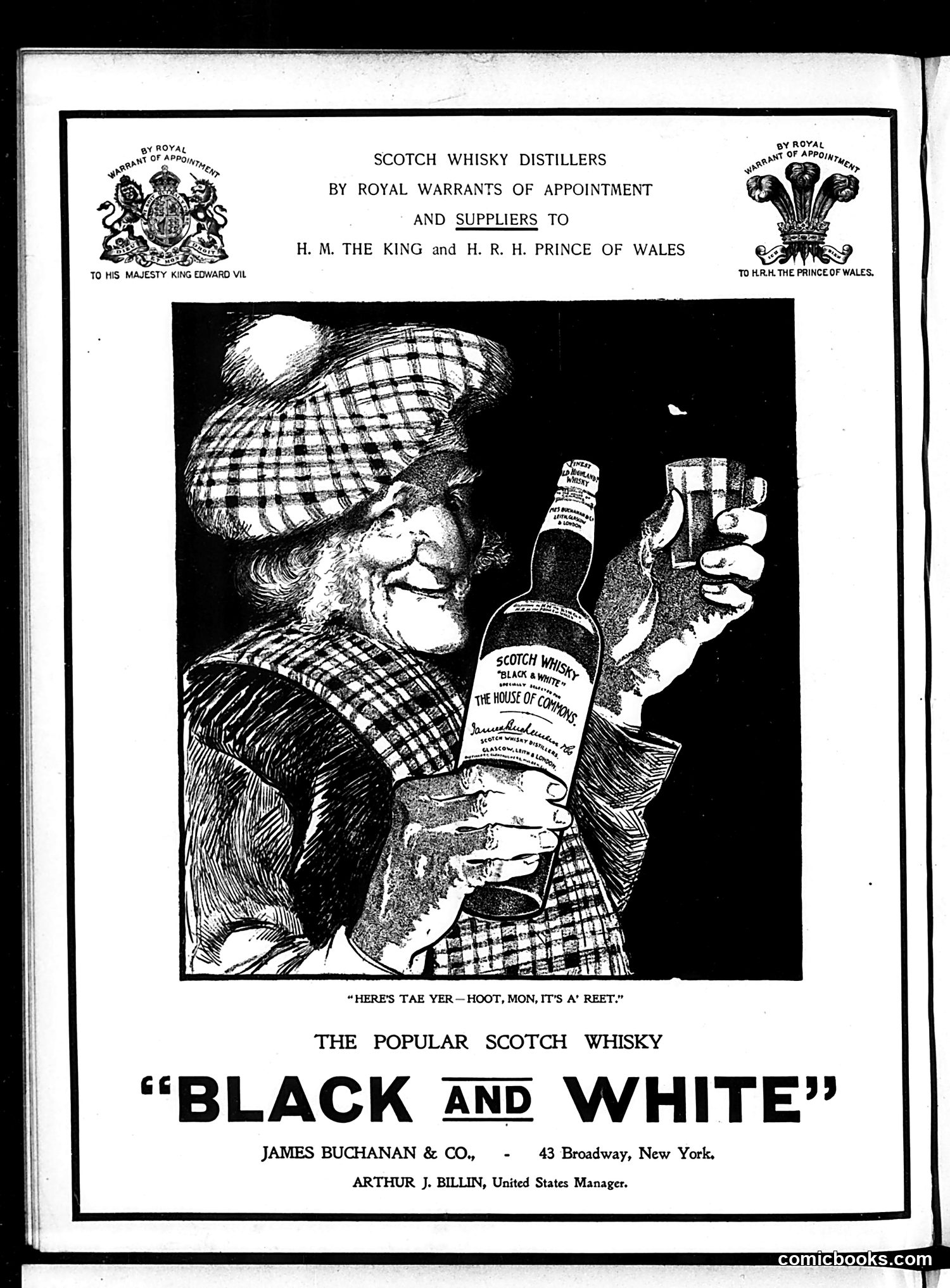
This is primarily **advertising content**, not editorial satire. The page promotes "Black and White" Scotch whisky by James Buchanan & Co. The illustration depicts a **stereotypical Scottish Highlander**—identifiable by the tartan plaid cap and clothing—holding a bottle and glass. The exaggerated facial features and dialect phrase ("Here's tae yer—hoot, mon, it's a' reet") represent the **"stage Scot" caricature** common in early 20th-century advertising, relying on Scottish accent and appearance as marketing shorthand for authenticity and tradition. The royal warrants displayed at the top (claiming appointment to the King and Prince of Wales) lend prestige and legitimacy to the product. The "satire" here, if any, is gentle and self-aware—playing on familiar Scottish stereotypes for commercial appeal rather than mocking a political figure or social movement. This reflects advertising conventions of the era, when ethnic and regional stereotyping was standard marketing practice.