
Judge, 1903-04-18 · page 6 of 20
Judge — April 18, 1903 — page 6: what you’re looking at
What you’re looking at
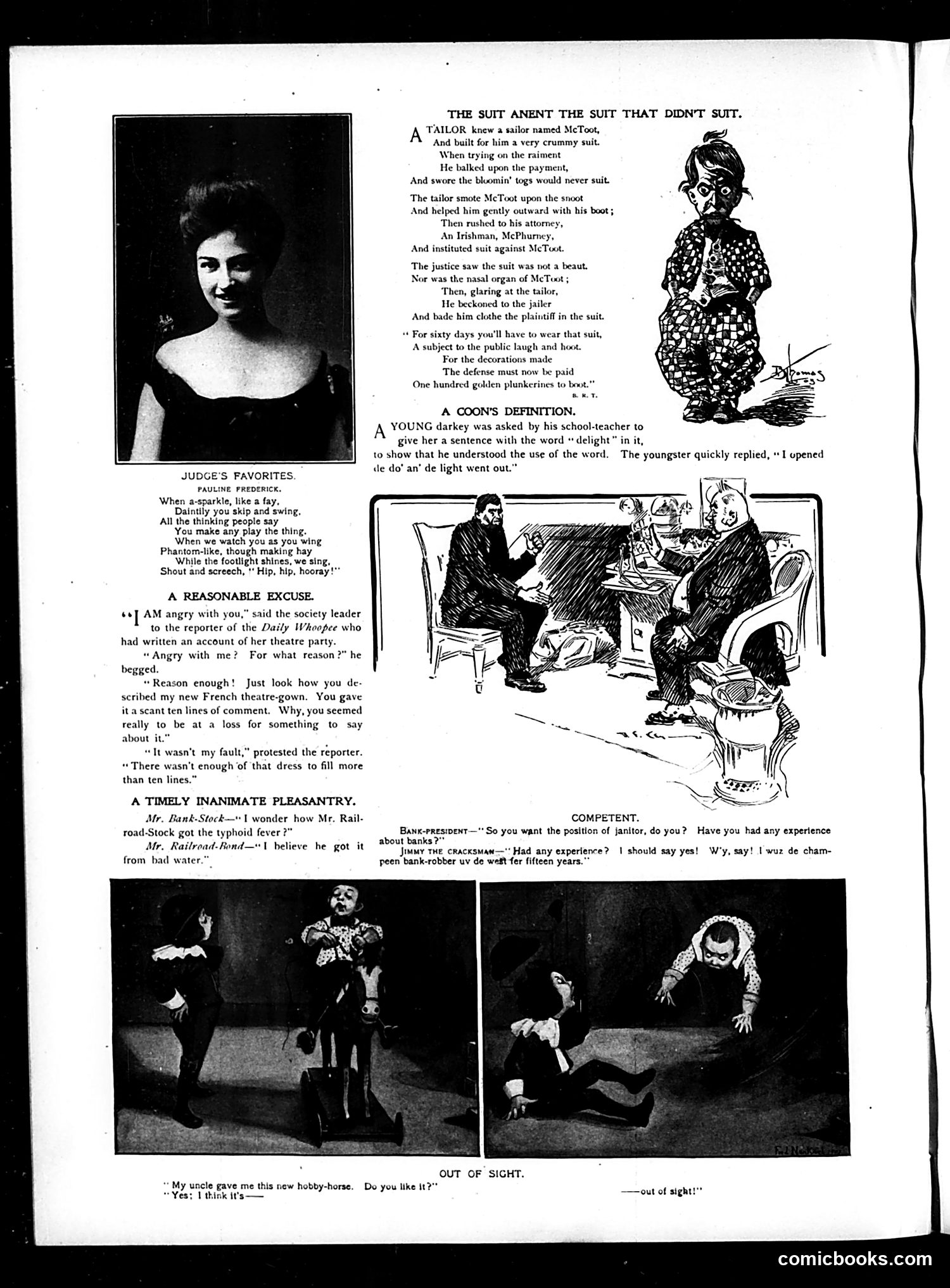
This page contains multiple satirical pieces typical of early Judge magazine: **"The Suit Anent the Suit"** is a humorous poem about a tailor-sailor dispute. A tailor named McToot builds a poor suit for a sailor, who refuses payment. The tailor sues through his Irish attorney McPhurney. The judge, finding both the suit and the defendant's appearance equally disreputable, punishes the tailor by forcing him to wear his own awful suit for sixty days as public mockery. **"A Coon's Definition"** uses a racial caricature (standard for the era) making a dialect-based pun about "delight"—the child mishears it as "de light," making a joke about electricity. Other pieces include light social satire about a society woman upset a reporter gave insufficient column space to her dress, and workplace humor involving financial figures and a bank robber applying as janitor. The page emphasizes wordplay, puns, and gentle social mockery rather than serious political commentary.
📄 Transcribed text from this page (OCR, searchable)
Machine-transcribed from the original scan — historical spelling and the odd misread are preserved.
‘THE SUIT ANENT THE SUIT THAT DIDN'T SUIT. A TAILOR knew a sailor named MeToot, And built for him a very crummy suit. When trying on the raiment He balked upon the payment, And swore the bluomin’ togs would never suit. The tailor smote MeToot upon the snoot And helped him gently outward w: Then rushed to his attorney, An Irishman, McPhurney, And instituted suit against MeToot. The justice saw the suit was not a beaut. Nor was the nasal organ of McToot ; ‘Then, glaring at the tailor, He beckoned to the jailer And bade him clothe the plaintiff in the suit. “ For sixty days you'll have to wear that suit, A subject to the public laugh and hoot. For the decorations made The defense must now be paid One hundred golden plunkerines to boot.” ae A COON’S DEFINITION. A YOUNG darkey was asked by his school-teacher to give her a sentence with the word “delight” in it, to show that he understood the use of the word. The youngster quickly replied, le do an’ de light went out.” JUDGE'S FAVORITES. PAULINE. FREDERICK, When a-sparkle, like a fay, Daintily you skip and swing, All the thinking people say You make any play the thing. When we watch you as you wing Phantom-like, though making hay While the footlight shines, we sing, Shout and screech, ** Hip, hip, hooray !** A REASONABLE EXCUSE. te] AM angry with you,” said the society leader to the reporter of the Daily Whoopee who had written an account of her theatre party. “Angry with me? For what reason?” he begged. Reason enough! Just look how you de- scribed my new French theatre-gown. You gave ita scant ten lines of comment. Why, you seemed really to be at a loss for something to say about it.” “It wasn't my fault,” protested the reporter. « There wasn't enough of that dress to fill more than ten lines.” A TIMELY INANIMATE PLEASANTRY. Mr. Bank-Stock—" | wonder how Mr. Rail- COMPETENT. road-Stock got the typhoid fever ?” Bank-presioent—"* So you want the position of janitor, do you? Mr. Railroad-Rond—"\ believe he got it out banks? Jimmy THE cRacksman—"'Had any experience? | should say yes! Wry, say! I wuz de cham- peen bank-robber uv de weit fer fifteen years.”” Have you had any experience from bad water.” OUT OF SIGHT. “ My uncle gave me this new hobby-horse. Do you like it?” + “Yes: [think it's — 7 oes —out of sight! comicbooks.com