
A complete issue · 16 pages · 1903
Judge — March 21, 1903
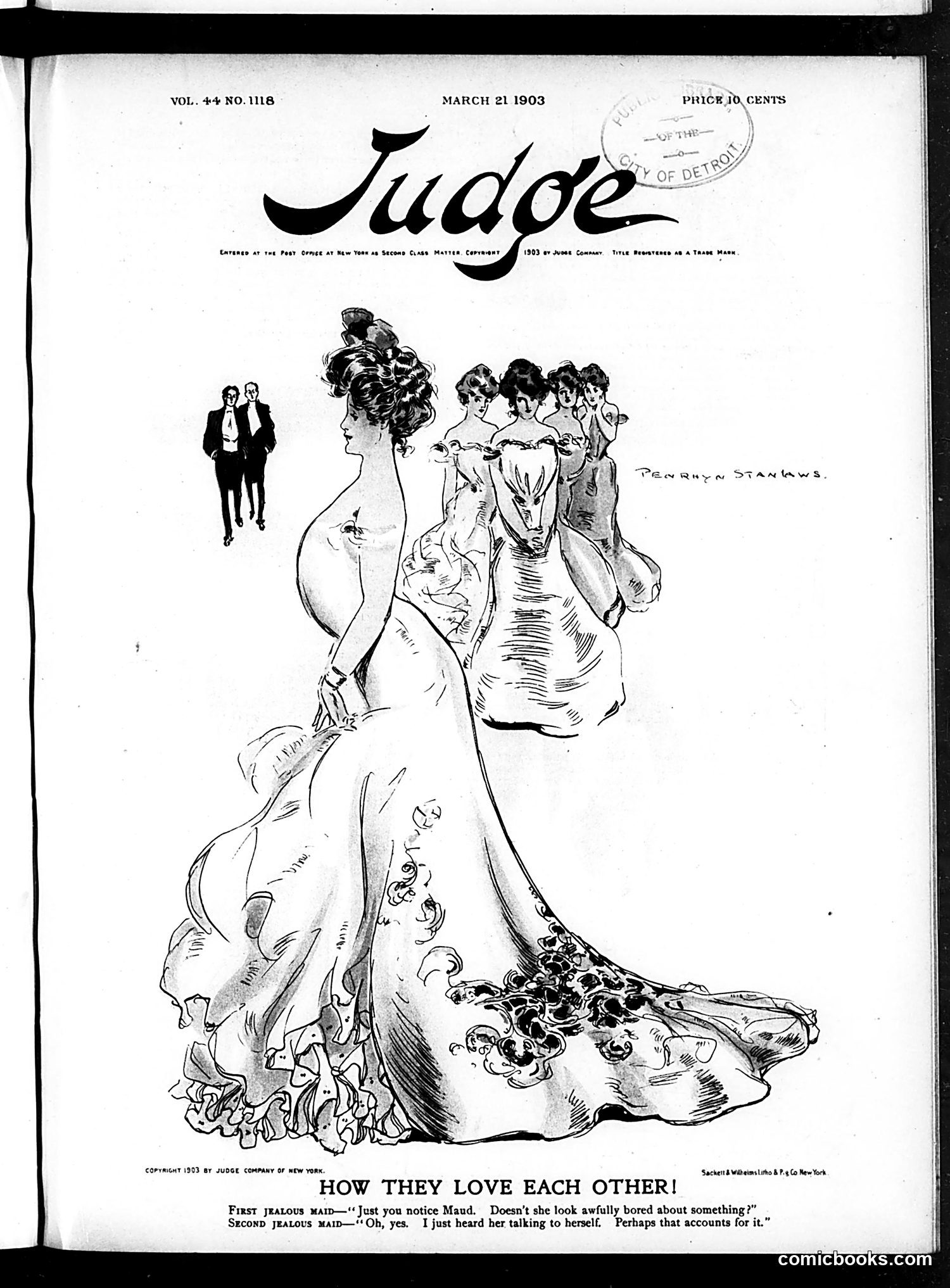
This satirical illustration titled "How They Love Each Other!" mocks female jealousy and cattiness. The central figure is an elegantly dressed woman whose elaborate train transforms into caricatured faces—representing other women—depicted in exaggerated, unflattering expressions. The caption presents a dialogue between "First Jealous Maid" and "Second Jealous Maid," with one woman claiming another appears "awfully bored," while the second suggests this boredom stems from listening to herself talk. The satire targets early 1900s social conventions and stereotypes about women's vanity, gossip, and mutual disdain masked by polite society. The grotesque transformation of the train into competing female faces visualizes the underlying hostility beneath women's social interactions. The two gentlemen in the background appear as detached observers to this feminine drama.
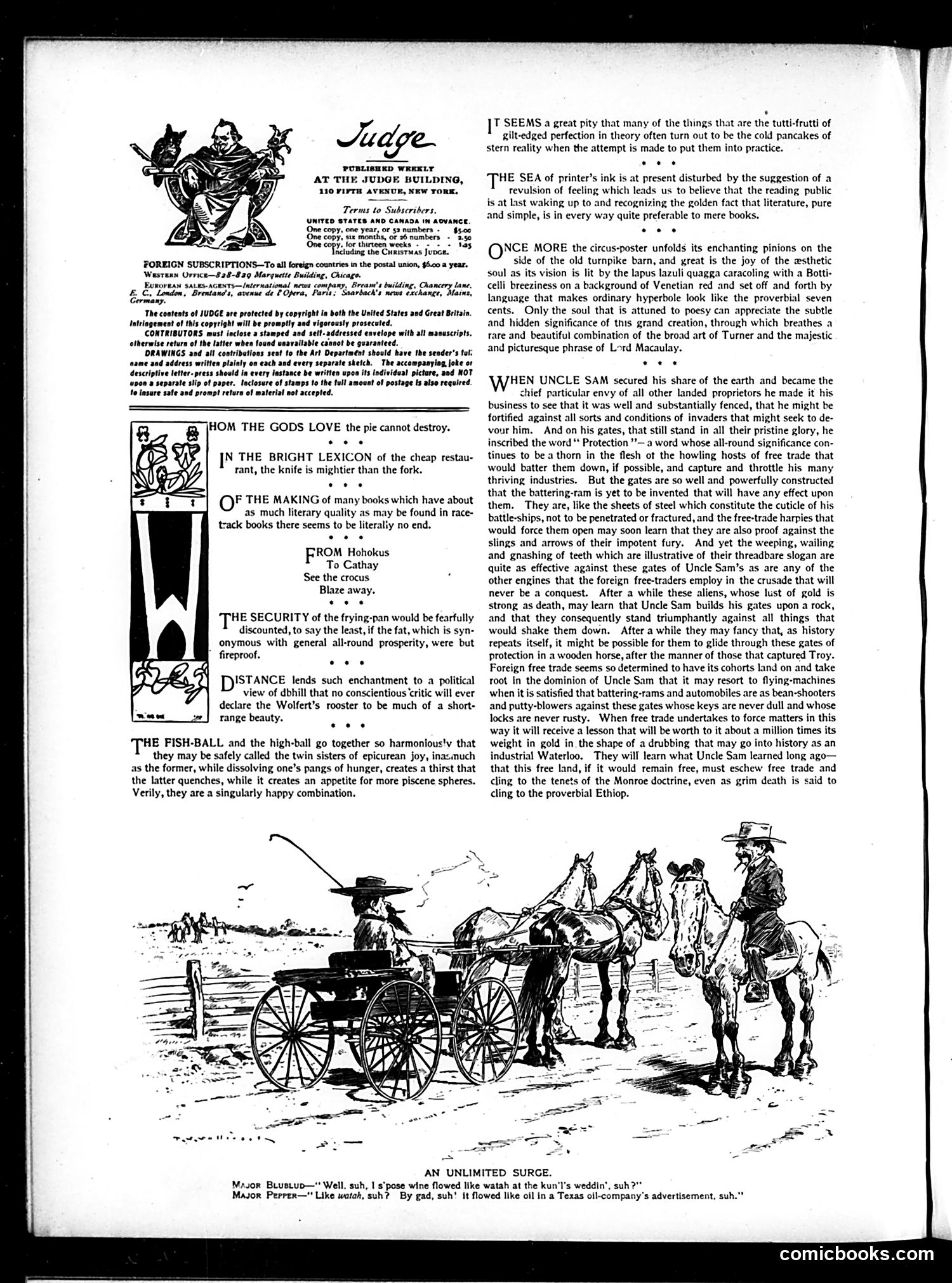
This page contains editorial commentary and a cartoon titled "An Unlimited Surge." The main illustration depicts two men on horseback observing a farmer with a horse-drawn wagon, suggesting agricultural/rural American themes. The editorial pieces discuss literary quality in cheap books, protective tariffs, and free trade policy. One section references "Uncle Sam" and his "gates," likely alluding to trade protectionism debates of the era. The cartoon's caption—Major Bluebug and Major Pepper's dialogue about oil flowing "like watah at the kunts wedding" and comparing it to a Texas oil company's advertisement—suggests satire about the oil boom and extravagant advertising claims. The overall thrust appears to mock both free-trade advocates and exaggerated commercial promotion, though the specific historical moment remains unclear without dating information.
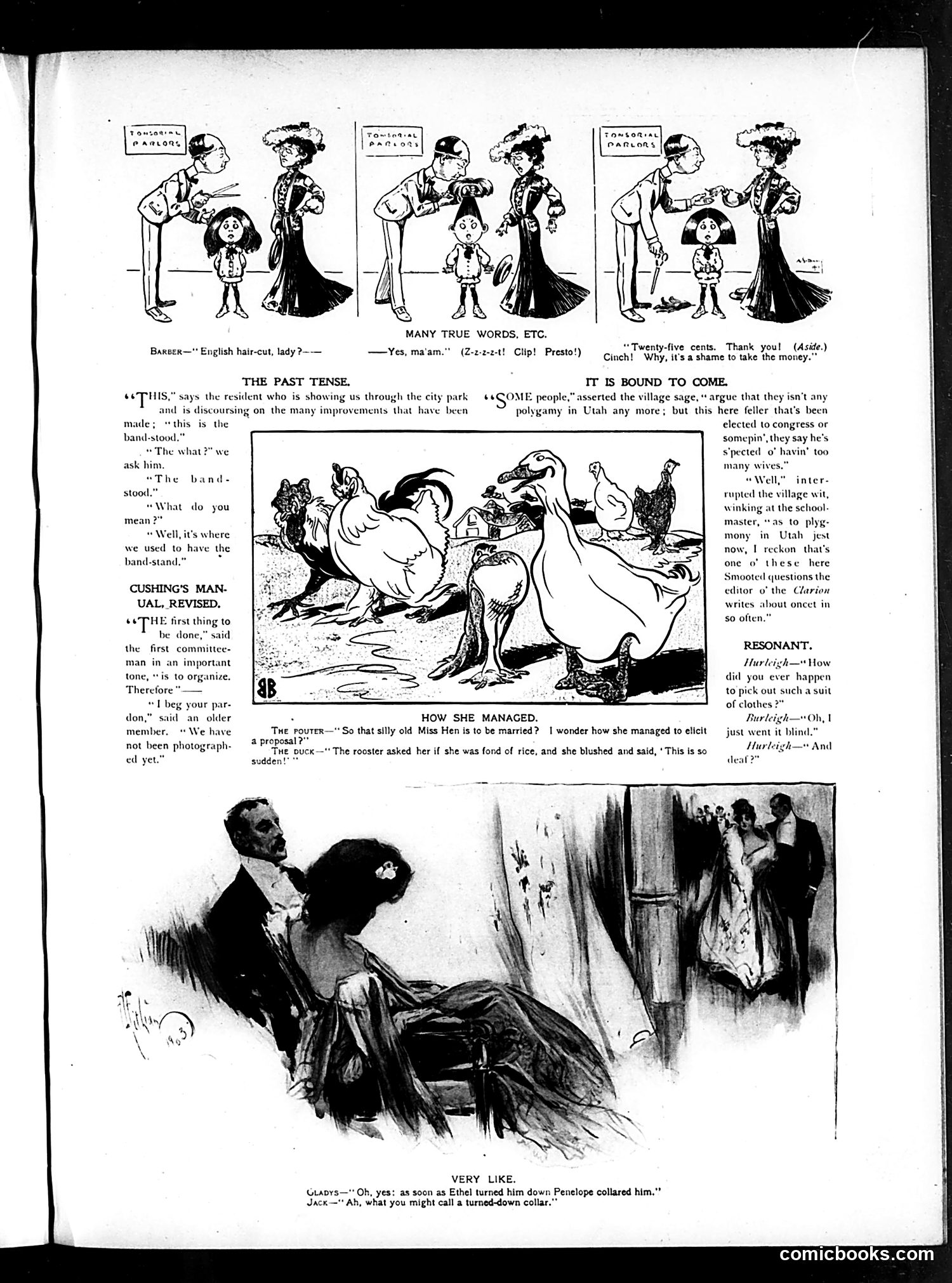
This page contains several satirical sketches and humorous anecdotes typical of early 20th-century Judge magazine. **Top section ("Tailor's Parlors")**: Three nearly identical panels show a barber offering an "English hair-cut" to a woman, then claiming it costs "twenty-five cents." The joke appears to satirize either inflated pricing or confusion about services. **Middle sections** feature anecdotes mocking various social situations: a resident praising city improvements, arguments about polygamy in Utah, and editorial commentary. The Utah reference suggests contemporary debate about Mormon polygamy. **"How She Managed"**: A cartoon about Miss Hen marrying by cleverly using rice and blushing. **Bottom cartoon ("Very Like")**: A domestic scene where a woman calls a man a "turned-down collar"—likely Victorian-era slang for something unflattering. The overall tone reflects period-appropriate humor about relationships, class pretension, and social manners.
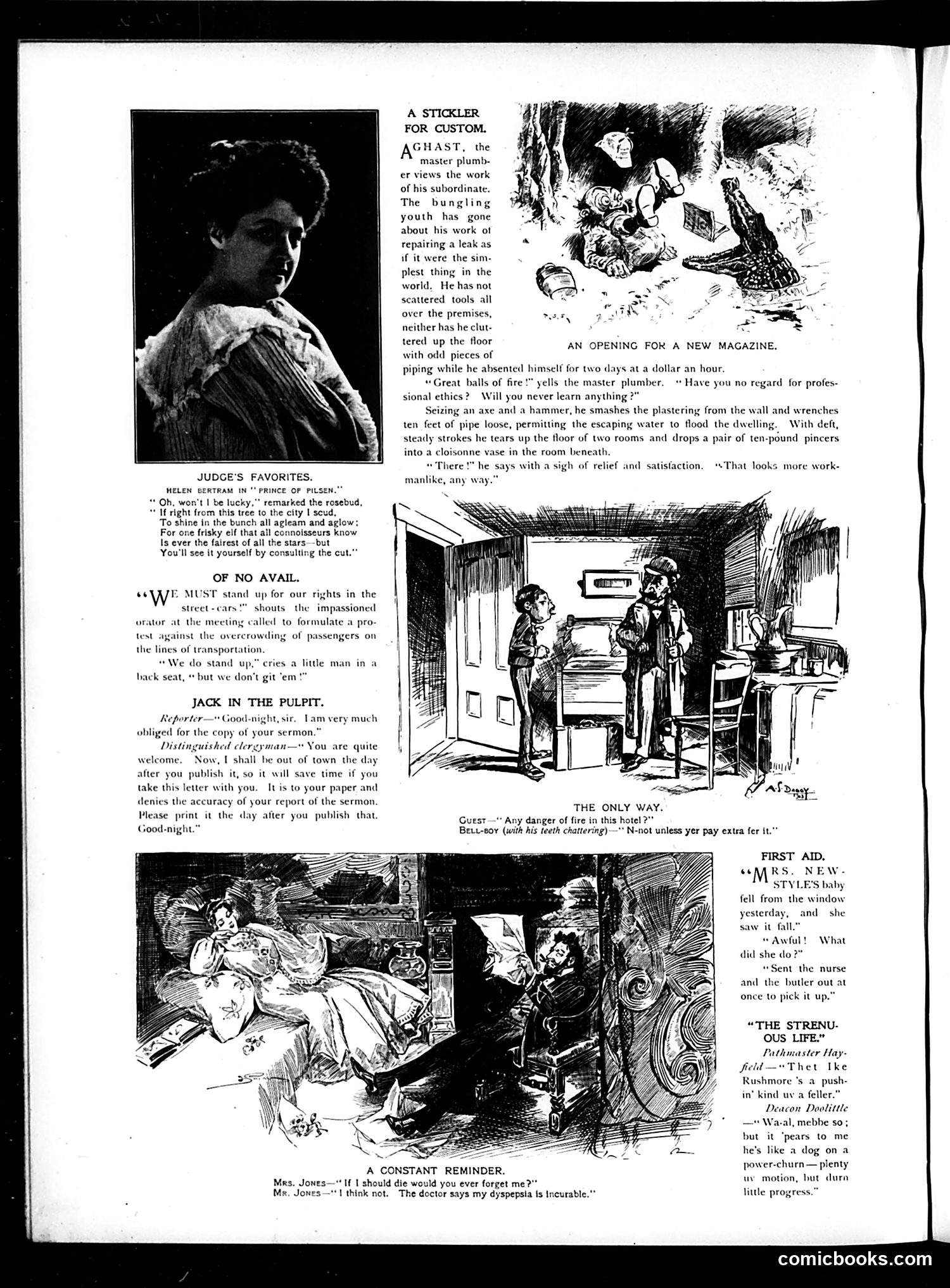
This page contains several short humorous pieces and illustrations typical of early-20th-century Judge magazine: **"A Stickler for Custom"** depicts a master plumber criticizing his young apprentice for completing work too efficiently and neatly—lacking the traditional messiness associated with plumbers. The joke satirizes how established tradespeople maintain poor standards as a point of professional pride. **"Jack in the Pulpit"** and **"Of No Avail"** are brief anecdotal humor pieces about clergy and public discourse, poking fun at clerical authority and political rhetoric. The remaining items—"First Aid," "The Strenuous Life," and "A Constant Reminder"—are short domestic humor vignettes about everyday situations (accidents, marriage dynamics, family life). The page primarily offers light social satire rather than political commentary.
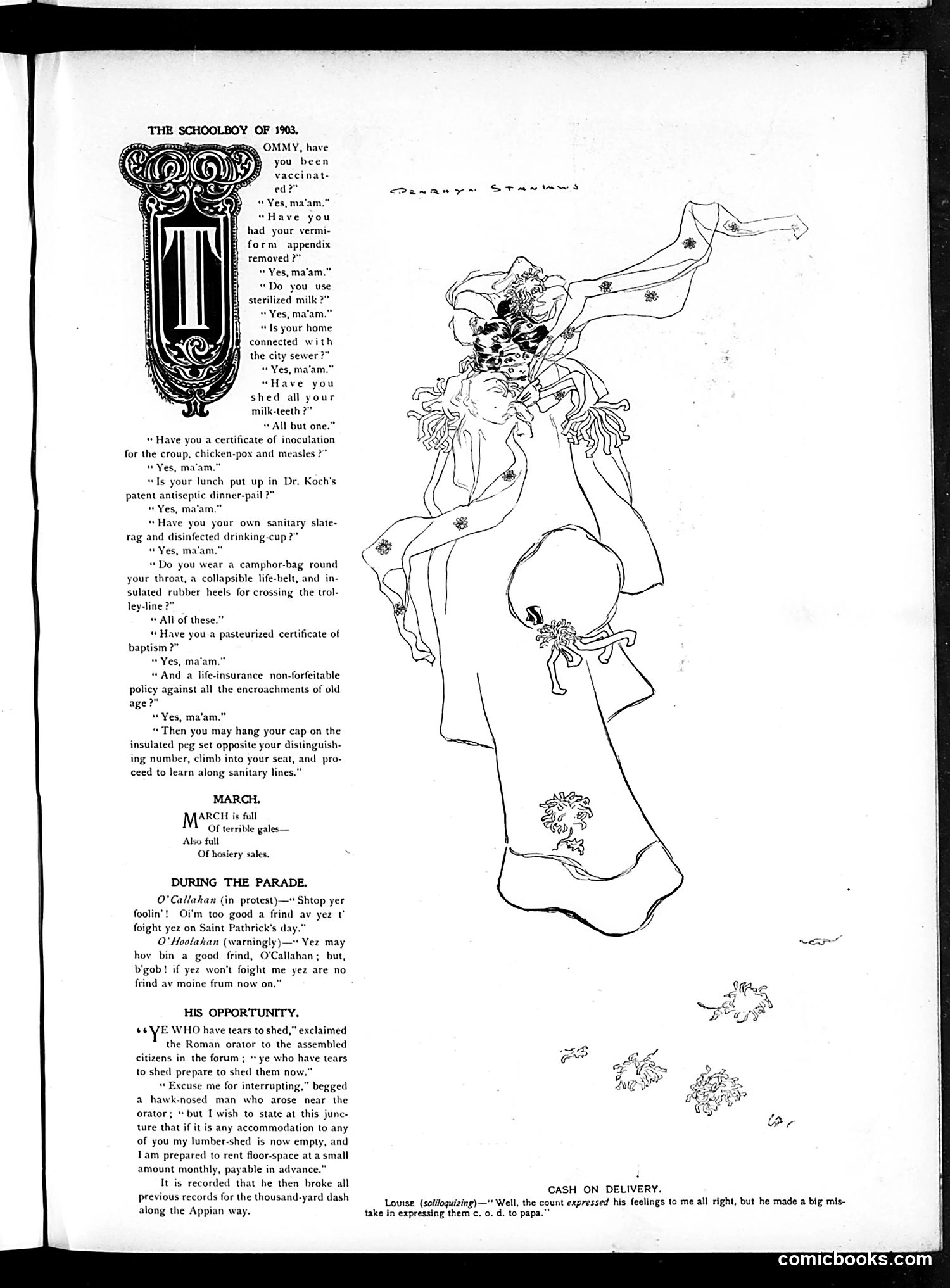
This page satirizes early 1900s **medical and hygiene mania**—the obsessive adoption of newly scientific health practices. The main cartoon shows a schoolmaster interrogating a boy with absurd questions: Has he been vaccinated? Had his appendix removed? Does he use sterilized milk? Wear a camphor-bag? Own disinfected drinking cups? The joke targets how contemporary society had become *obsessed* with the latest medical recommendations, many based on germ theory and antiseptic principles then revolutionizing medicine. The accumulation of ridiculous requirements—even a "pasteurized certificate of baptism"—mocks this excess. The page includes unrelated filler (March weather joke, Irish dialect dialogue about St. Patrick's Day, a Roman orator anecdote about a lumber-shed salesman, and a romantic joke about a count's proposal). These were typical of Judge magazine's miscellaneous satirical content. The satire reflects genuine 1903 anxieties: modern science was transforming daily life faster than society could rationally process.
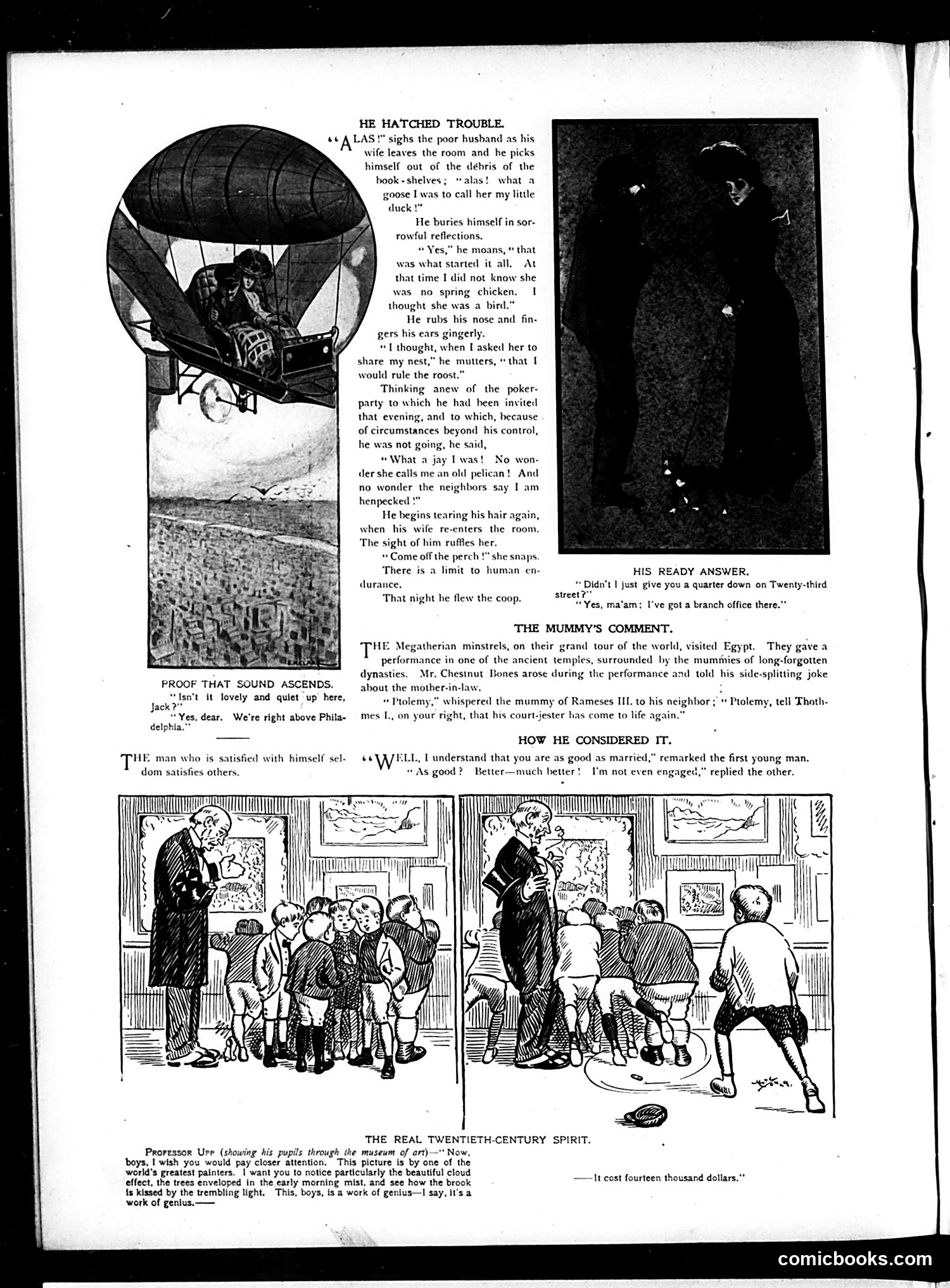
This page collects multiple satirical vignettes mocking domestic life and social pretension: **"He Hatched Trouble"** uses avian metaphors (duck, bird, roost, coop, pelican, henpecked) to ridicule a husband whose poor word choice—calling his wife his "little duck"—offends her by implying she's not young. The escalating marital conflict culminates in him abandoning home, satirizing both masculine insensitivity and female vanity. **"His Ready Answer"** jokes about urban poverty: a man making repeated small payments suggests financial desperation masked by false sophistication ("branch office"). **"The Mummy's Comment"** references minstrel shows (likely blackface performers), with an ancient Egyptian mummy finding their humor so stale it belongs in a tomb—satirizing both the act's dated nature and cultural disrespect. **"The Real Twentieth-Century Spirit"** concludes the page, mocking art appreciation: a professor's eloquent description of a painting's genius suddenly reduces to its monetary value ($14,000), exposing shallow materialism masquerading as cultural refinement. The consistent theme: appearance versus reality in modern American life.
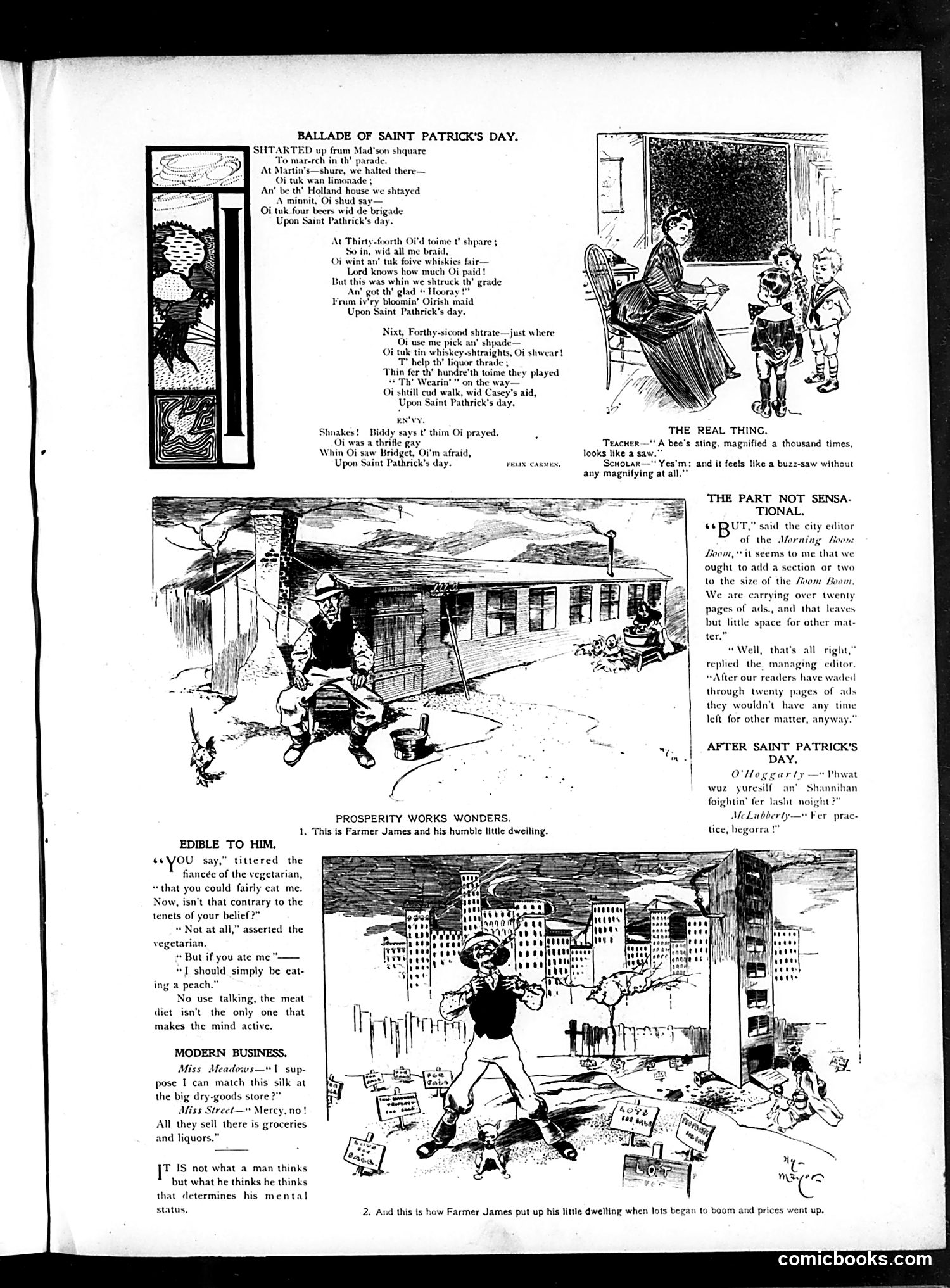
This page contains multiple satirical pieces targeting Irish-American stereotypes and early 20th-century urban life. **"Ballade of Saint Patrick's Day"** mocks Irish immigrants through exaggerated dialect and drinking culture, depicting a narrator's St. Patrick's Day involving excessive whiskey consumption and references to Irish names (Biddy, Bridget, Shanahan). **"Prosperity Works Wonders"** contrasts Farmer James's humble dwelling with how he reconstructs it after real estate booms and prices rise—satirizing get-rich-quick schemes during property speculation. **The editorial exchange** jokes about a newspaper cramming twenty pages of advertisements, leaving little actual content—critiquing commercialism in publishing. **"Modern Business"** sarcastically notes that department stores now primarily sell groceries and liquor rather than traditional dry goods, reflecting Prohibition-era economic shifts. The page overall satirizes Irish-American working-class culture, urban commercial greed, and journalistic compromise—common Judge targets of the era.
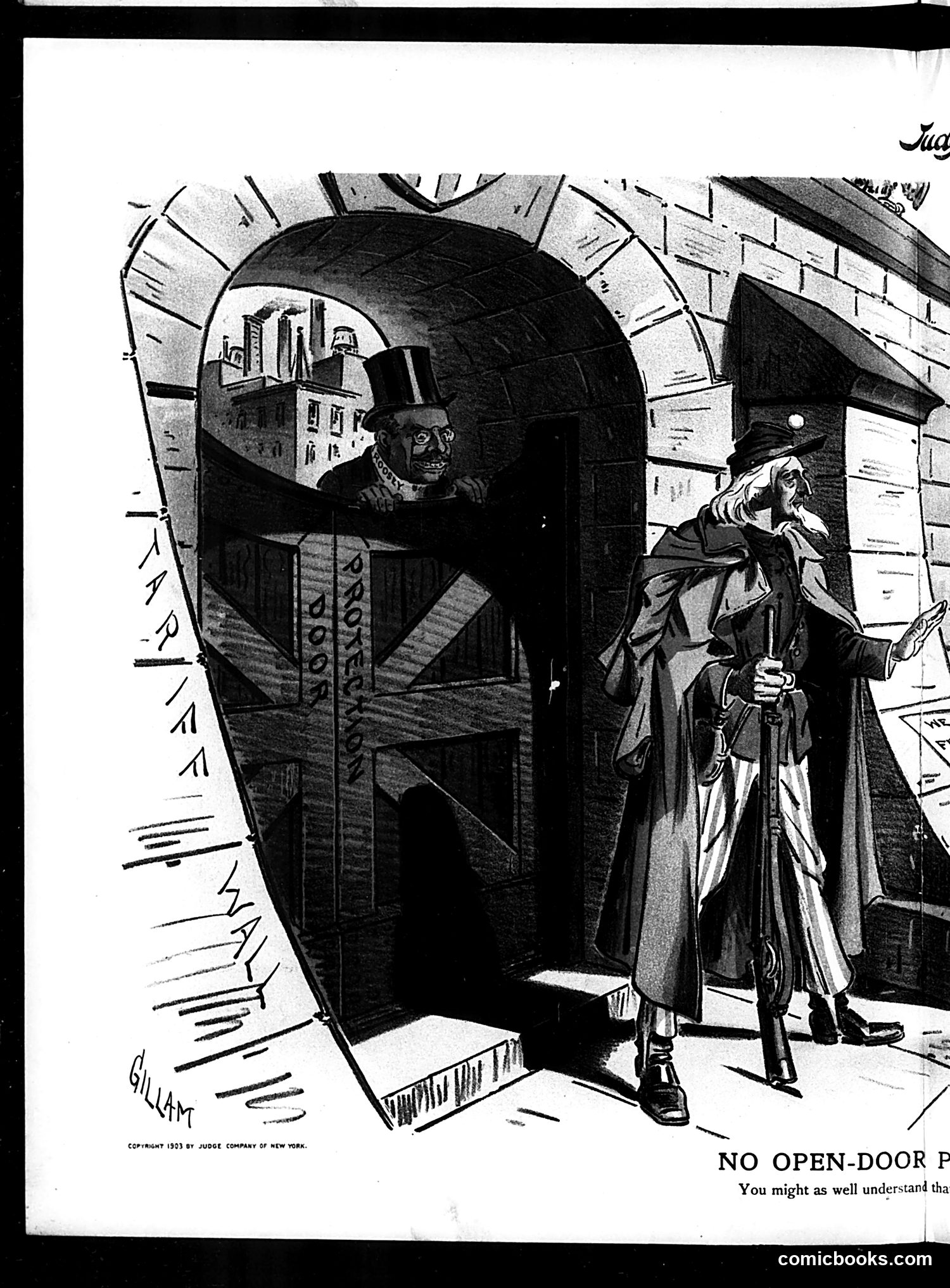
This Judge magazine cartoon depicts an "open-door policy" critique. A well-dressed figure in a top hat (appearing to represent a political or business authority) stands in a large arched doorway, while a disheveled, poor man with a walking stick approaches from outside. The title "NO OPEN-DOOR P[OLICY]" suggests satire about promises of opportunity or access that aren't actually fulfilled. The contrast between the affluent gatekeeper and the impoverished supplicant illustrates hypocrisy: those in power claim to maintain "open doors" to opportunity, yet effectively bar entrance to the disadvantaged. This likely references early 20th-century political rhetoric about equality and opportunity that failed to materialize for working-class or immigrant populations. The artist is signed Gillam.
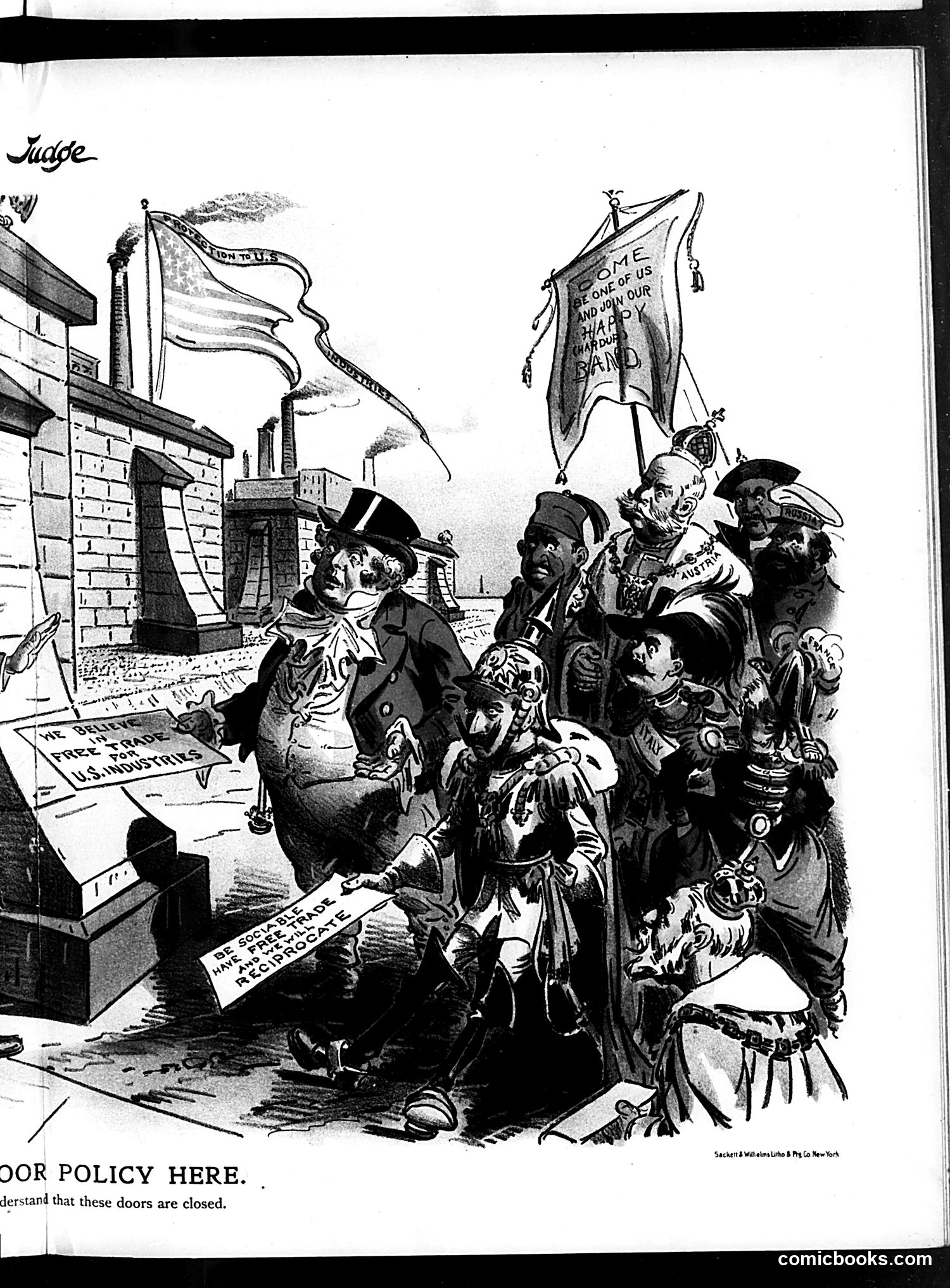
This political cartoon depicts foreign figures attempting to enter the U.S., which is guarded by American interests. The fortified building on the left represents American protectionism, with a sign reading "WE BELIEVE IN FREE TRADE FOR U.S. INDUSTRIES" visible on the ground. The figures outside—appearing to represent various foreign nations or traders—carry banners, including one reading "COME AND JOIN OUR HAPPY BAND," suggesting they're seeking access to American markets. The satire mocks American hypocrisy: the nation promotes "free trade" rhetoric while maintaining closed-door immigration and trade policies. The caption "DOOR POLICY HERE" emphasizes this exclusionary stance. This likely reflects late 19th or early 20th-century debates over protectionism versus free trade, targeting political leaders who advocated free trade in principle while supporting restrictive tariffs in practice.
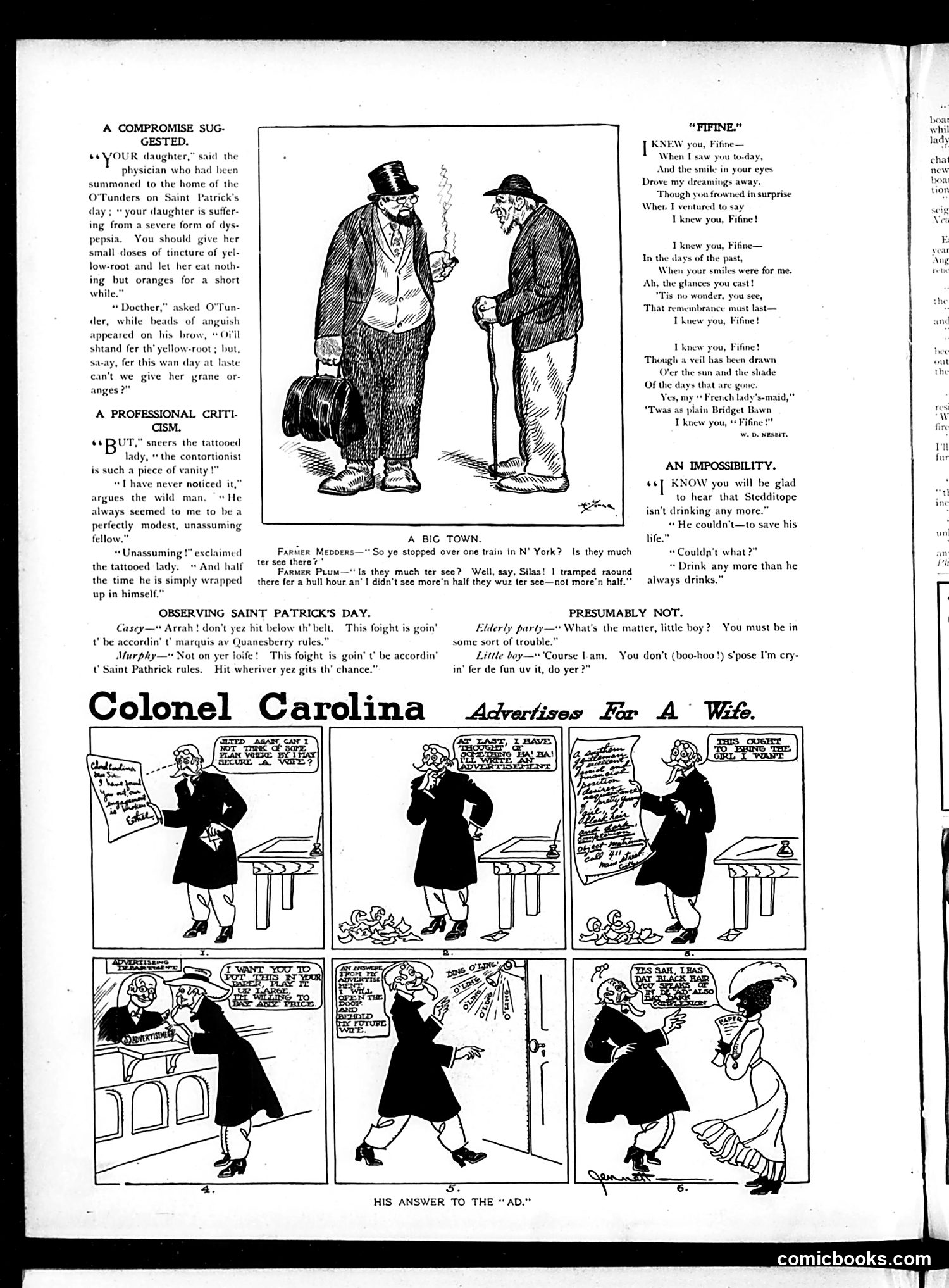
This page contains multiple short satirical pieces typical of early 20th-century American humor: **"Fifine"** is a sentimental poem about nostalgic romance, likely unrelated to the cartoons. **"A Compromise Suggested"** depicts an Irish immigrant (O'Tunder, identified by dialect) haggling with a doctor over treatment for his daughter's dyspepsia—the joke being his preference for cheap oranges over prescribed medicine. **"A Professional Criticism"** mocks the hypocrisy of a tattooed circus performer criticizing a contortionist's vanity. **"An Impossibility"** is a brief joke: a man can't stop drinking because he "always drinks"—implying chronic alcoholism makes abstinence impossible. **"A Big Town"** shows rural farmers amazed by New York City's size. **"Saint Patrick's Day"** and **"Presumably Not"** are brief Irish-dialect humor pieces. **"Colonel Carolina Advertises for a Wife"** is a six-panel comic strip showing a woman placing and responding to personal advertisements, depicted as increasingly desperate. The humor relies on ethnic stereotypes (Irish and rural accents), class commentary, and domestic/romantic satire typical of the era.
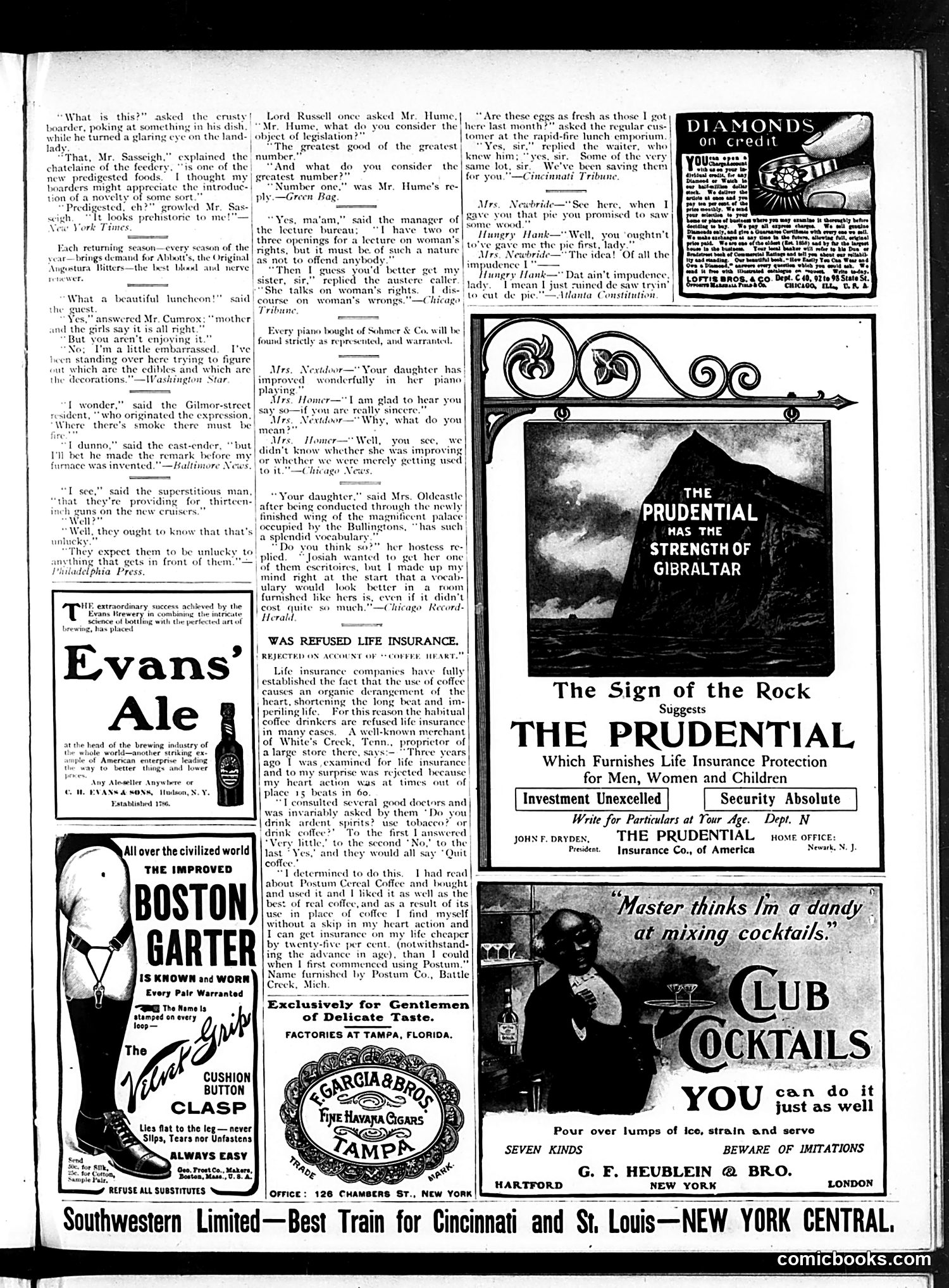
This page from Judge magazine contains primarily **humorous domestic vignettes and advertisements** rather than political cartoons. The satirical content consists of brief jokes about: 1. **"Predigested foods"** — A landlady serves mysterious processed food to a skeptical boarder who finds it unappetizing, mocking the early 20th-century trend of "scientific" convenience foods. 2. **Piano lessons and social pretense** — Neighbors discuss a daughter's piano improvement, with ambiguity about whether she's actually improving or everyone's "getting used to it," satirizing middle-class aspirations and polite deception. 3. **Coffee and life insurance** — A merchant was rejected for life insurance due to caffeine's supposed heart damage, then switched to Postum (a coffee substitute) and was accepted—essentially an advertisement disguised as a testimonial. The page is dominated by product advertisements (Evans' Ale, Boston Garter, Postum, Prudential Insurance, Club Cocktails) typical of Judge's revenue model. The humor targets genteel domesticity and emerging consumer culture rather than political figures or events.
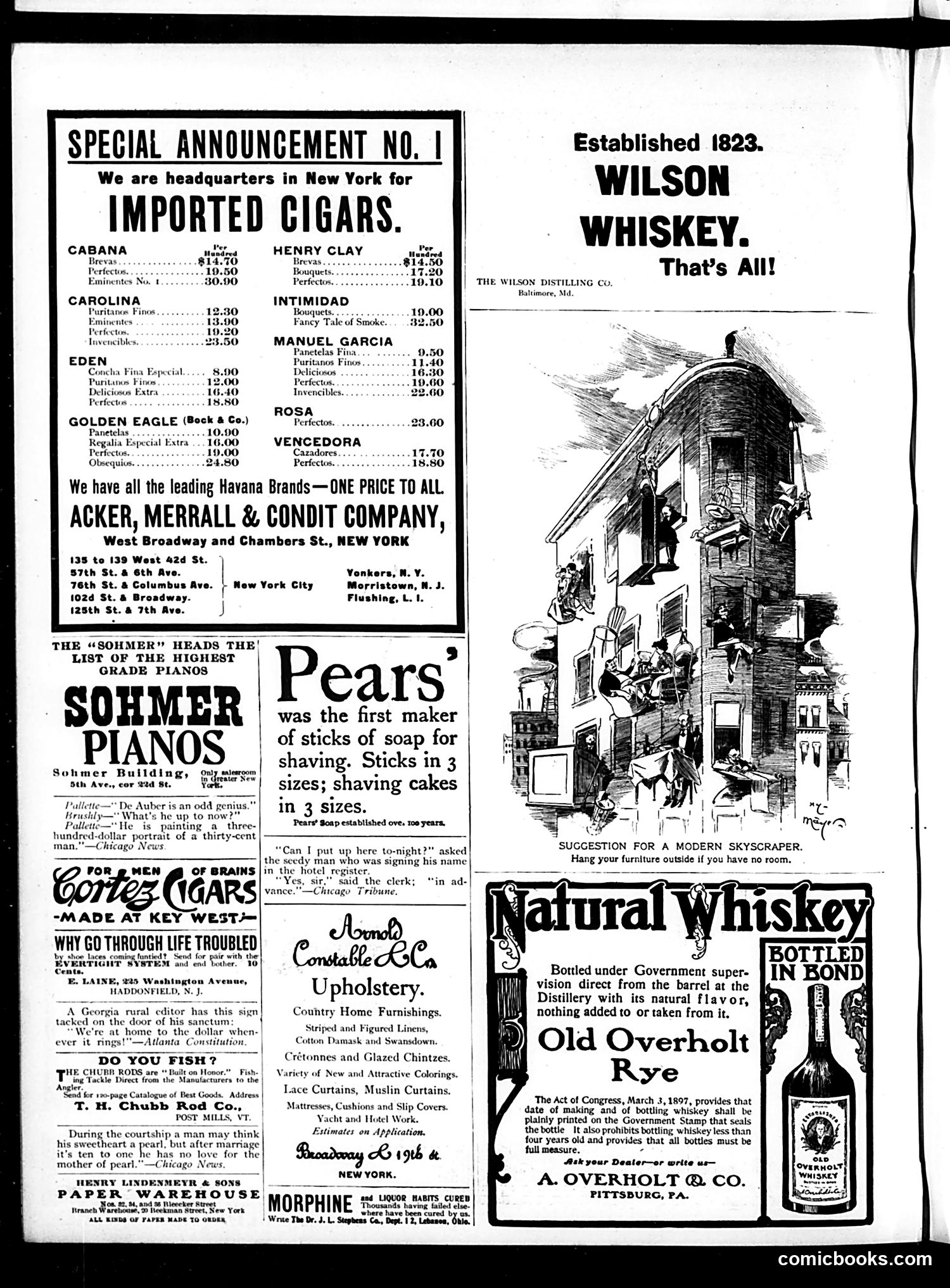
This is primarily an **advertising page** with minimal editorial content. The page features numerous commercial advertisements for cigars, whiskey, pianos, soap, and other products typical of early 20th-century Judge magazine. The one notable cartoon is titled **"Suggestion for a Modern Skyscraper"** — a small illustration showing furniture hanging from the exterior of a tall building. The joke satirizes **overcrowded urban housing**, suggesting that New Yorkers with inadequate indoor space should simply hang their furniture outside the windows. This reflects genuine concerns about tenement overcrowding in rapidly industrializing cities. The page's humor otherwise comes from product testimonials, like the Sohmer Piano ad quoting Chicago papers calling the Asher "an old genius" at painting, and the Georgia editor joke about dollars being "at home" in the office. The Wilson Whiskey and Old Overholt Rye ads emphasize government supervision and natural production — selling points for consumers concerned about product authenticity during the Prohibition era's approach.
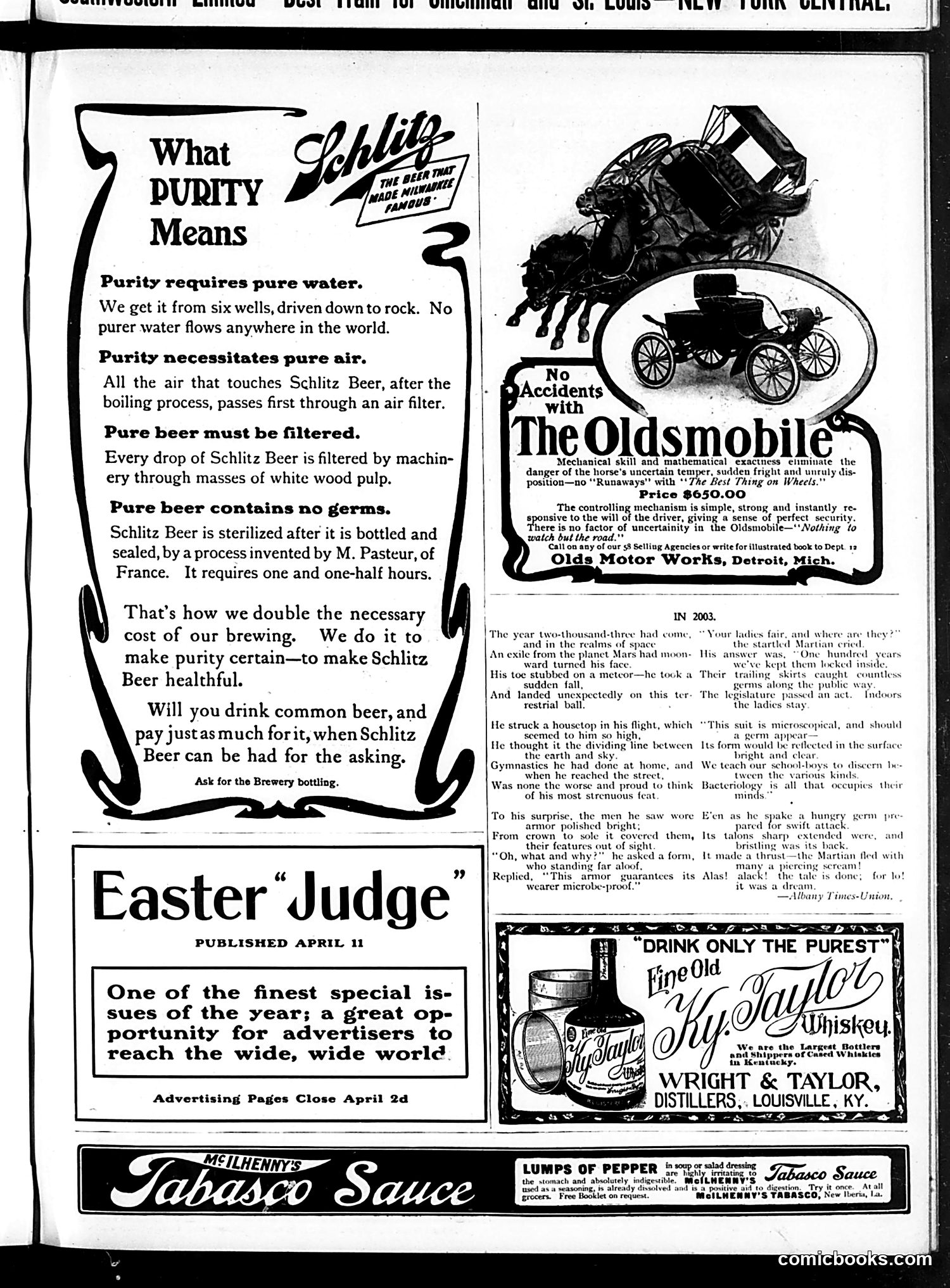
This is primarily an **advertising page** from Judge magazine (published April 11, dated "Easter Judge"), with minimal editorial content. The main advertisements are: 1. **Schlitz Beer** — A lengthy ad emphasizing "purity" through multiple purification methods (filtered water, air filtration, pasteurization). This reflects early 20th-century anxieties about contamination and germ theory, positioning the beer as scientifically safe. 2. **Oldsmobile automobile** — Advertises mechanical reliability and safety features, claiming "no accidents" and eliminating unpredictable horse behavior. 3. **Old Shy Taylor Whiskey** and **Tabasco Sauce** — Brief ads promoting these products. A small fictional story ("In 2003") appears to be a sci-fi satire about a Martian visitor encountering futuristic humans in armor, likely commentary on technological progress or social change, though the text is fragmentary. The page reflects turn-of-the-century consumer culture emphasizing scientific advancement, purity, and safety as selling points.
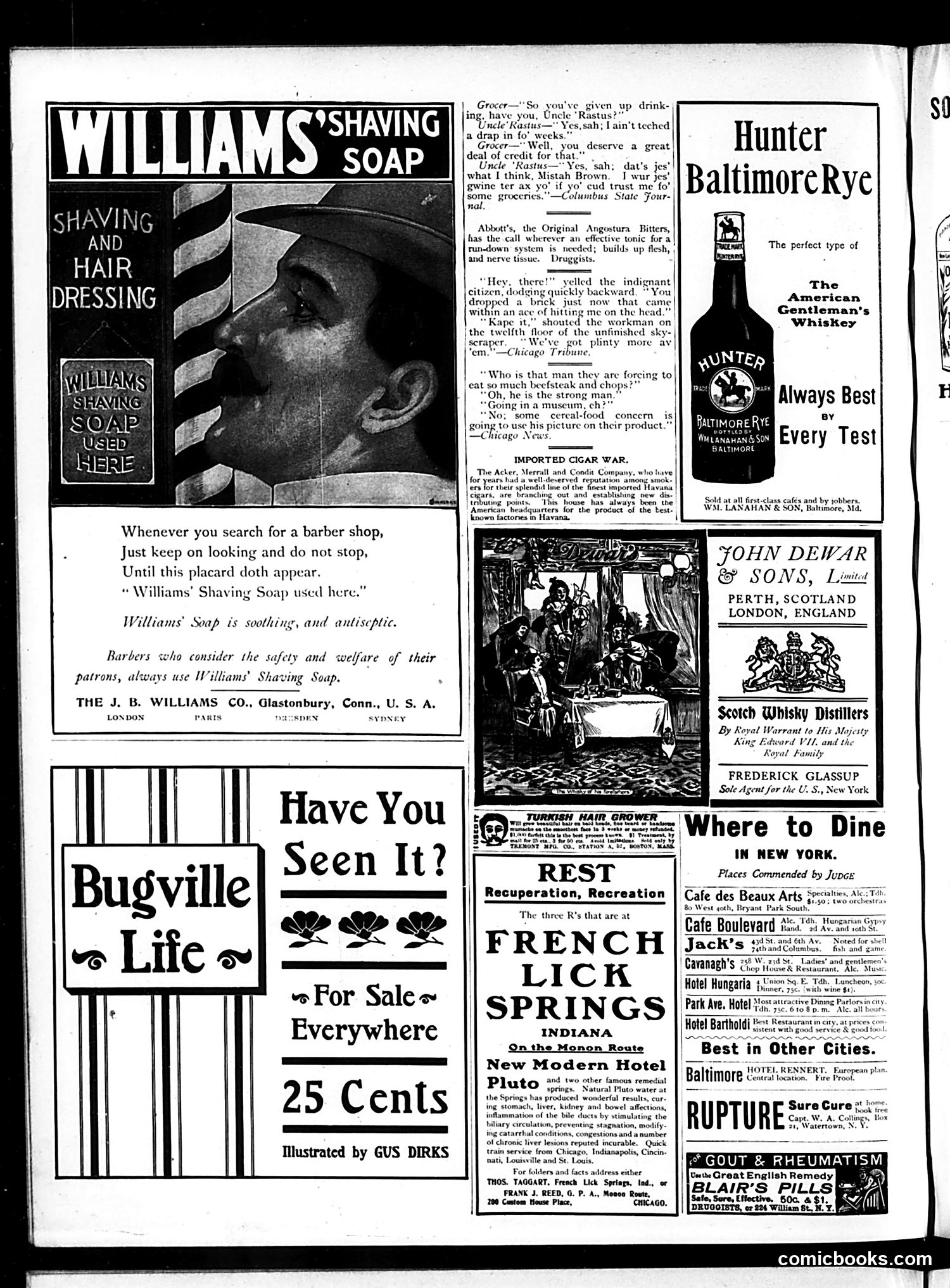
This page is **primarily advertising**, not political satire. It contains multiple product advertisements typical of early 20th-century magazines: Williams' Shaving Soap, Hunter Baltimore Rye whiskey, John Dewar Scotch whisky, and various hotels and health resorts. The small dialogue snippets scattered throughout appear to be generic humor anecdotes rather than political commentary—jokes about grocery credit, construction accidents, and beefsteak consumption that serve mainly to fill space between ads. The one substantial non-advertising content is **"Bugville Life,"** a serialized comic illustrated by Gus Dirks, advertised as "For Sale Everywhere, 25 Cents." This appears to be a separate publication being promoted. **The page reflects Judge's business model**: satirical editorial content subsidized by lucrative advertising from luxury goods (spirits, grooming products, upscale dining) targeting affluent male readers. There is **no identifiable political satire or social commentary** visible here—it's a commercial product catalog masquerading as editorial content.
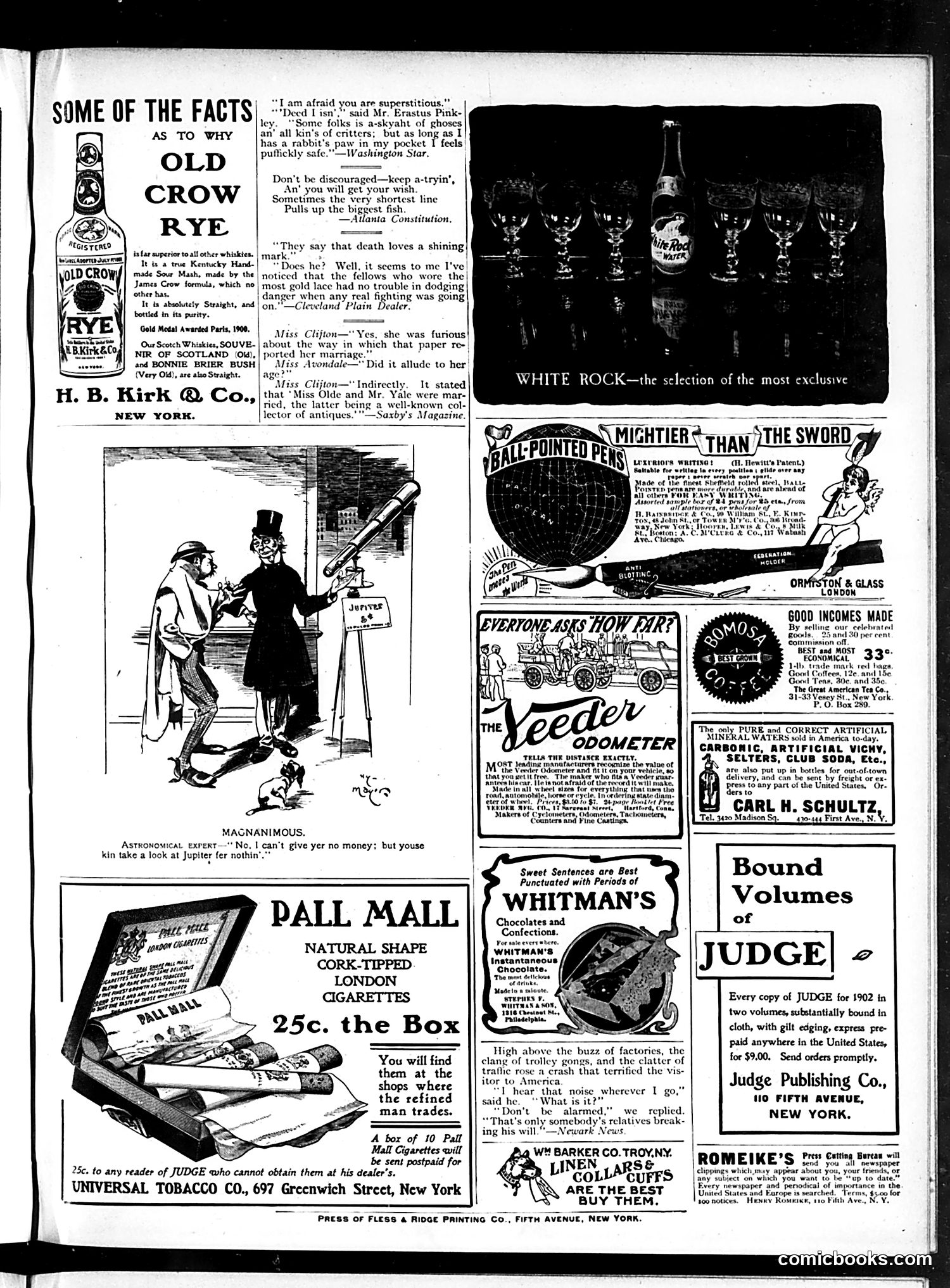
This page is primarily **advertising and product promotion** for Judge magazine's 1902 edition, with minimal political content. The one cartoon present, "MAGNANIMOUS," depicts an **astronomical expert turning away a poor person**, offering to let him look at Jupiter for free instead of providing money. The joke targets false generosity—the expert pretends magnanimity while actually refusing help. Otherwise, the page showcases period advertisements for **whiskey, cigarettes, chocolates, and other consumer goods**. A brief humorous exchange mocks a woman's vanity when a newspaper calls her wedding subject "Miss Olde and Mr. Yale were married"—implying she's old and he's a collector of antiques. Modern readers would note the casual classism (the poor man asking for money), gender stereotypes (women's vanity), and turn-of-the-century consumer culture. The page reflects Judge's mix of satirical humor and commercial sponsorship rather than serious political commentary.
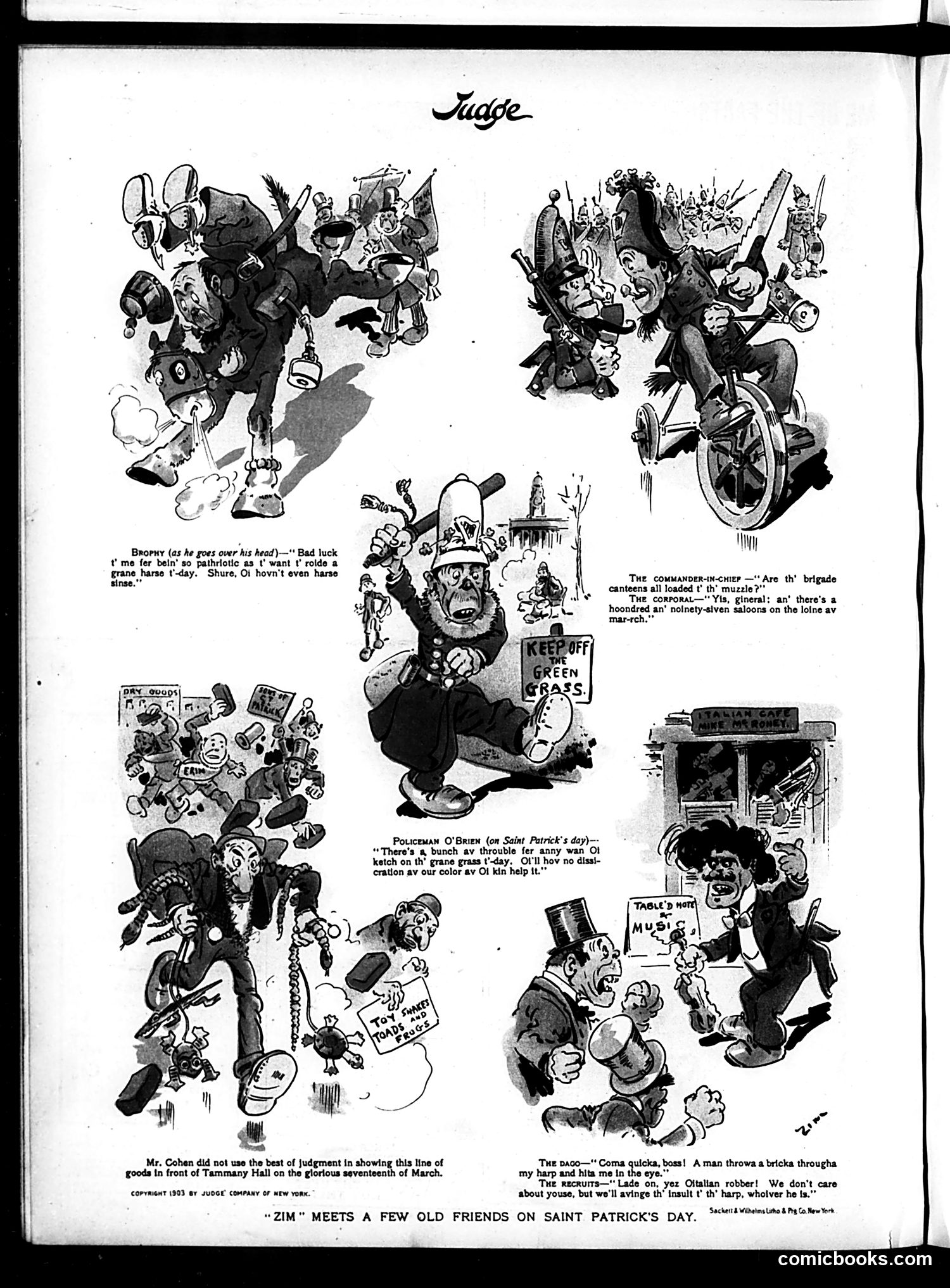
This 1903 satirical page mocks Irish-American and immigrant stereotypes on Saint Patrick's Day. The cartoons use exaggerated dialect and caricature to ridicule various groups: **Key figures/jokes:** - "Bronny" complains about being too patriotic to ride a "rane harse" (rain horse) — mocking Irish immigrants' speech patterns - A "Commander-in-Chief" references saloons along a parade route, suggesting Irish drinking stereotypes - Policeman O'Brien threatens to arrest anyone on the grass, satirizing Irish-American police - References to Cohen at Tammany Hall (Irish-dominated political machine) and Italian immigrants ("Oitallan robber") **The satire:** Judge uses exaggerated accents and situations to demean Irish, Italian, and Jewish immigrants, portraying them as drunk, violent, and politically corrupt. The humor relies on period ethnic prejudice—now offensive—treating immigrant communities as objects of ridicule rather than legitimate Americans.