
A complete issue · 16 pages · 1903
Judge — February 14, 1903
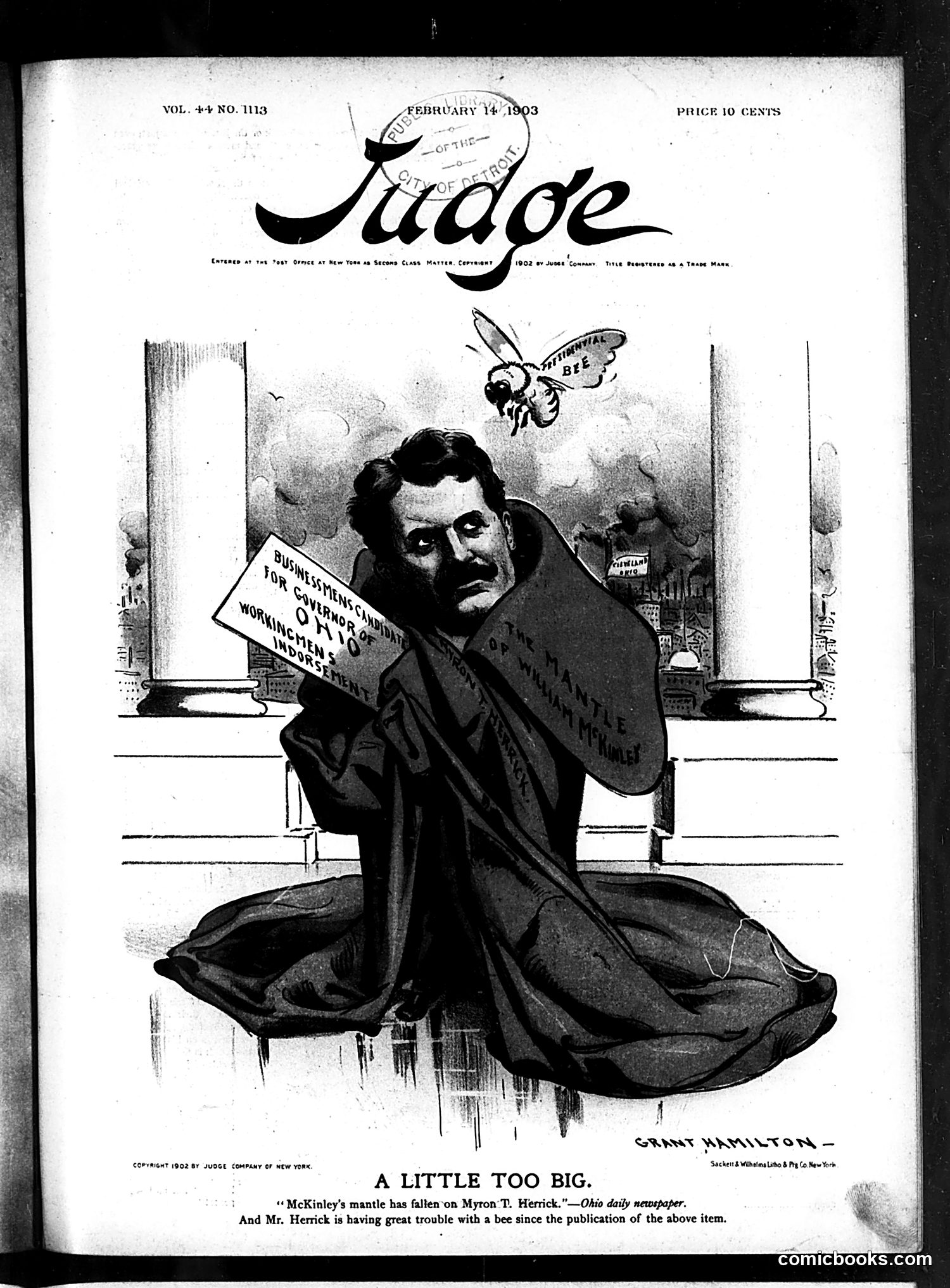
This political cartoon by Grant Hamilton depicts a man labeled as representing McKinley's "mantle" (his political legacy or administration) that has "fallen on Myron T. Herrick." The figure clutches a document reading "Business Men's Campaign Against Working Women and Child Labor," suggesting Herrick opposed labor protections. The cartoon's title, "A Little Too Big," mocks Herrick as unfit to inherit McKinley's political authority—the oversized mantle literally dwarfs him. A bee labeled "Industrial Bee" stings him, creating additional trouble. The satire criticizes Herrick (likely a political successor or appointee) as inadequate for his position and hostile to progressive labor reforms, suggesting his anti-labor stance makes him an unsuitable heir to McKinley's legacy.
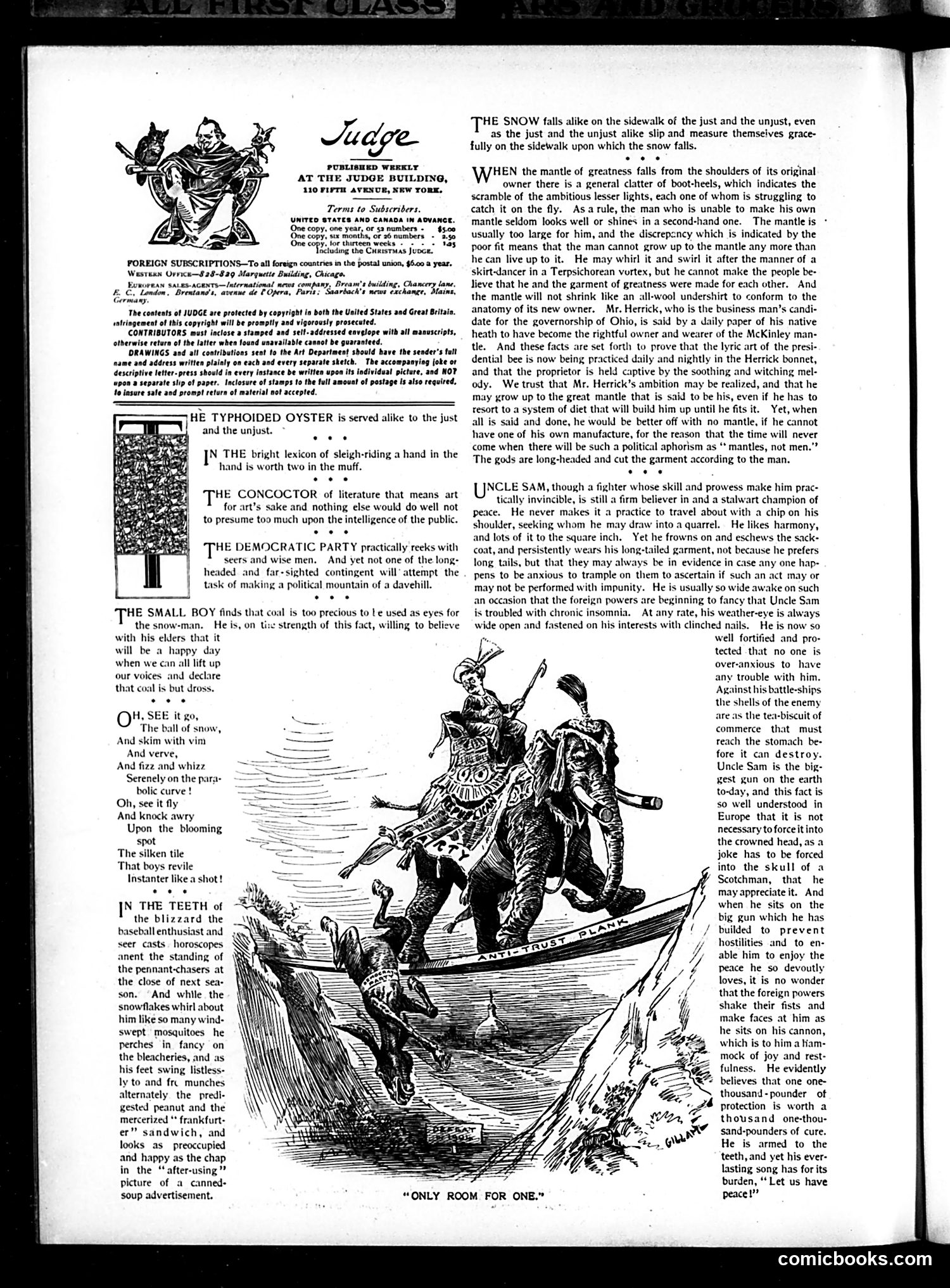
The central cartoon, titled "Only Room for One," depicts an elephant and donkey in a small boat—standard symbols for the Republican and Democratic parties respectively. The image satirizes political competition, suggesting the two major parties struggle for dominance in limited political space. The surrounding text includes commentary on various political figures and social observations, including references to "Uncle Sam" as a fighter and protector, and critiques of the Democratic Party as "practically reeks with yes-men." Without a visible date or specific event reference in the OCR text, the exact historical moment remains unclear, though the content suggests commentary on early 20th-century American party politics and political personalities of that era.
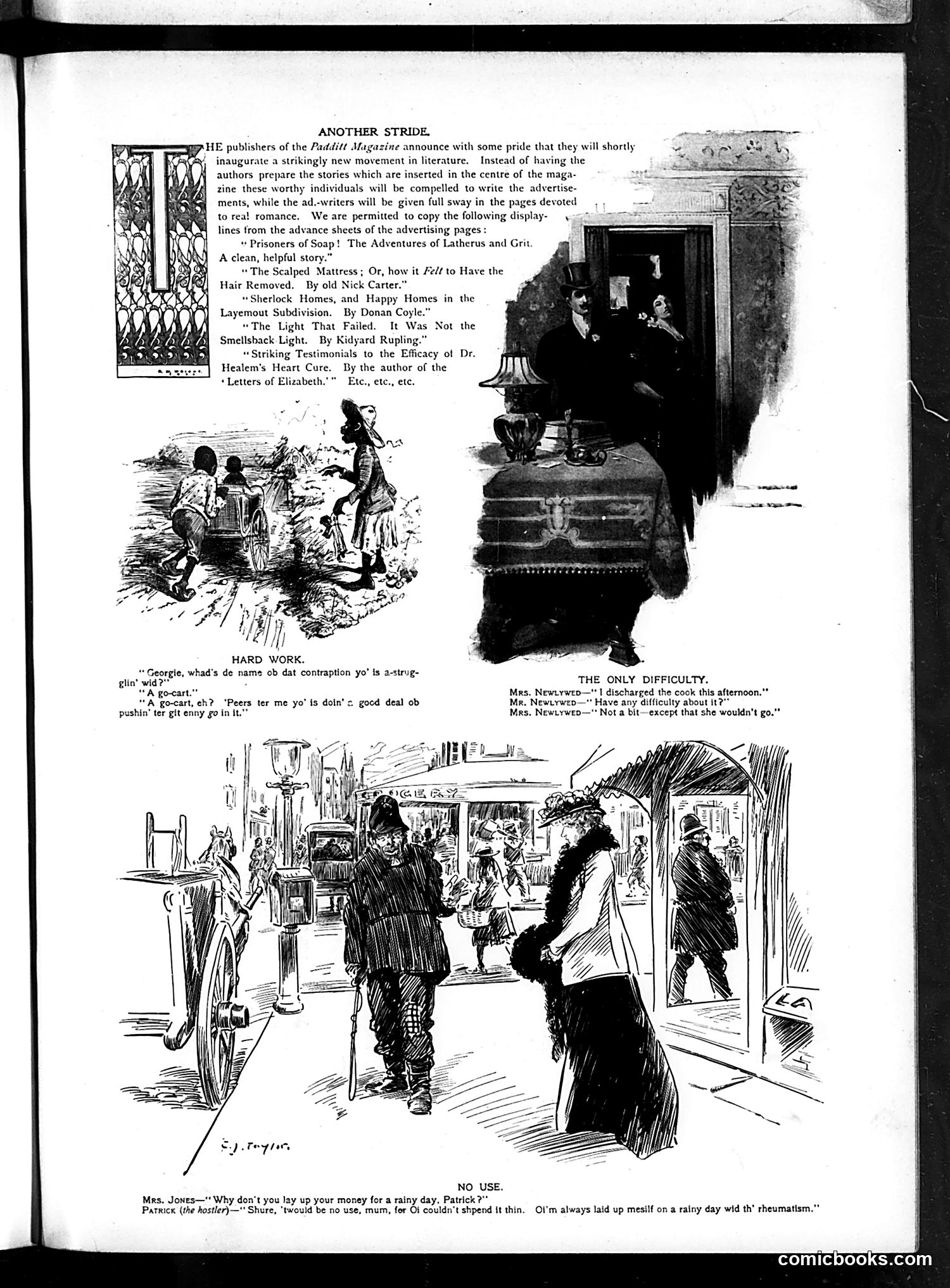
This page primarily showcases **upcoming advertiser-sponsored fiction** for the Padsitt Magazine, listing stories by popular authors like Donan Coyle and Rudyard Kipling. Below the advertisements are three **cartoon vignettes with social humor**: 1. **"Hard Work"** depicts working-class characters in dialect, establishing a comedic scene about labor. 2. **"The Only Difficulty"** shows Mrs. Newlywed discussing dismissing a cook—a domestic servant management joke targeting middle-class households. 3. **"No Use"** features Mrs. Jones and Patrick (the housekeeper) discussing why he won't save money for rainy days. Patrick claims poverty makes saving impossible, attributing his spending to rheumatism—a satirical jab at working-class financial struggles and rationalization. These cartoons reflect early 1900s class distinctions and domestic service dynamics common to Judge's audience.
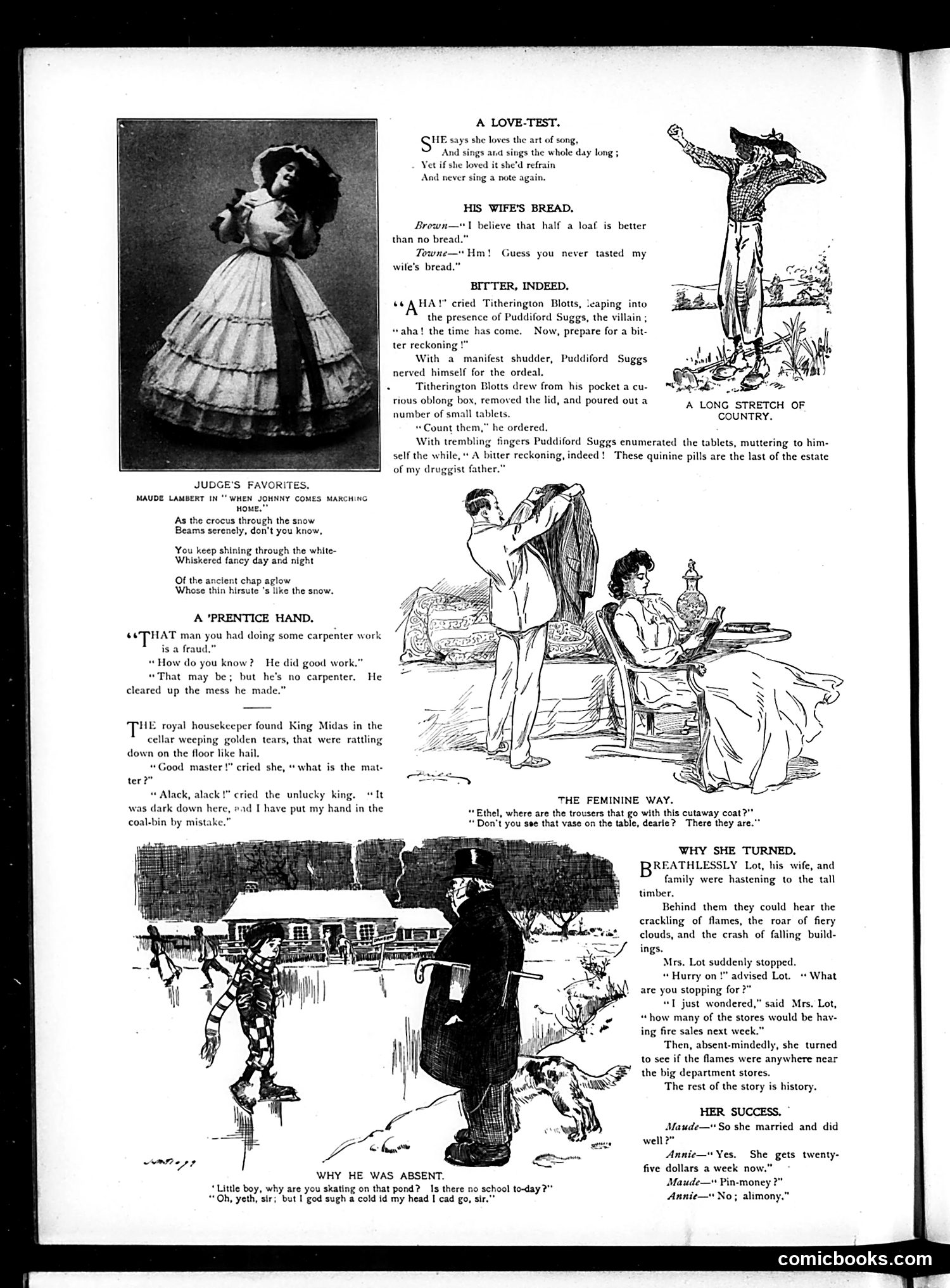
This page contains multiple short humorous sketches and poems rather than political cartoons. The content includes: **"A Love-Test"** and **"His Wife's Bread"**: Domestic humor about marriage and cooking. **"Bitter, Indeed"**: A sketch about Puddleford Suggs taking quinine pills—general comedic narrative without political reference. **"An Apprentice Hand"** and **"The Feminine Way"**: Domestic/gender-based humor about household matters and clothing. **"Why She Turned"** and **"Why He Was Absent"**: Social satire about everyday behavior—a woman distracted by store fires; a child's school excuse. **"Her Success"**: Brief dialogue joke about marriage and money. The page is primarily entertainment-focused rather than political satire. The drawings illustrate domestic and social situations typical of late 19th/early 20th-century American life, with humor targeting universal human foibles rather than specific political figures or events.
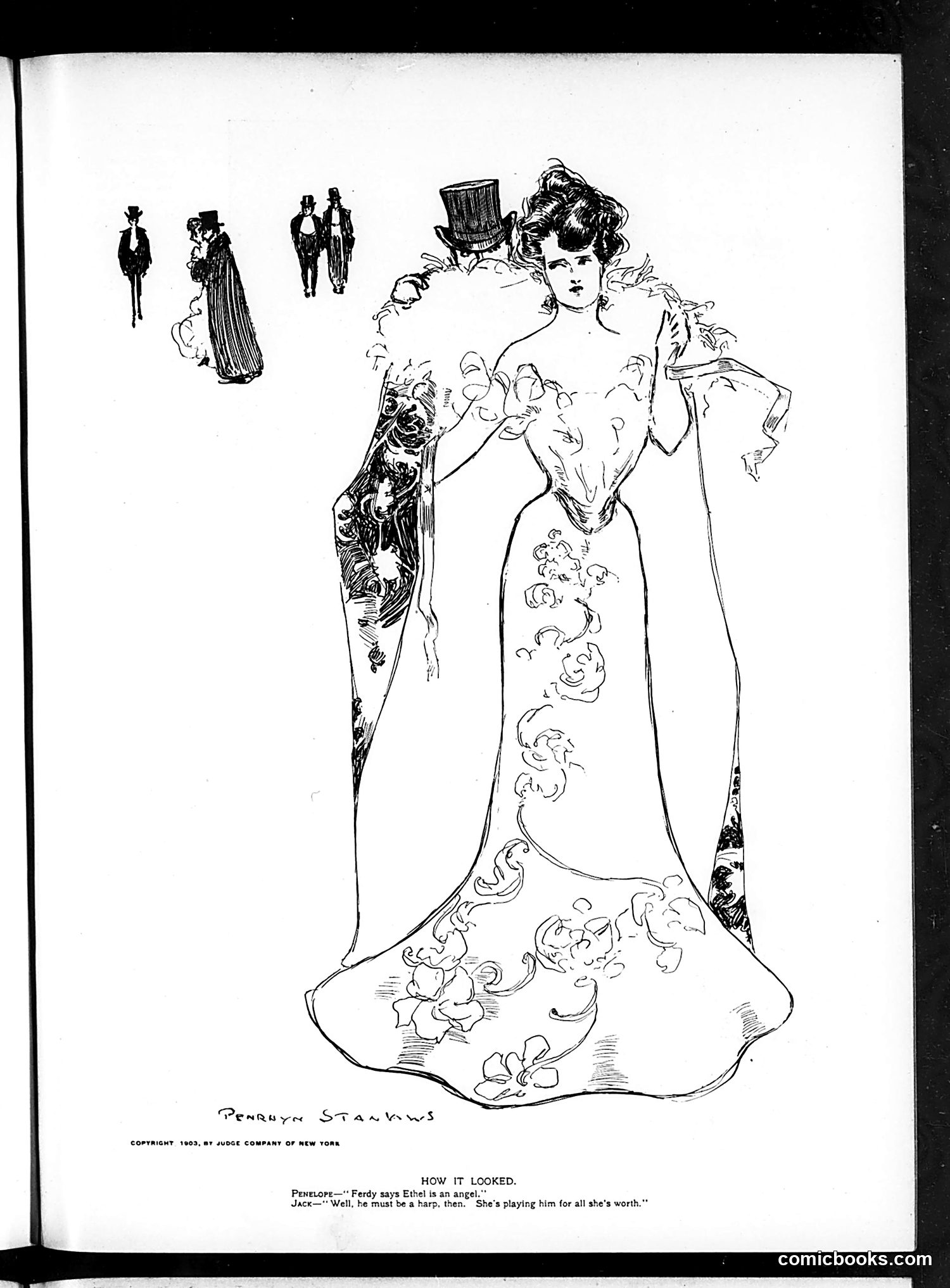
This is a fashion illustration satirizing a woman named Ethel, who appears to be playing a romantic suitor named "Ferdy" (Ferdinand). The joke relies on a pun: if Ferdy claims Ethel is "an angel," then he must be "a harp"—since angels play harps. The caption suggests she's manipulating him ("playing him for all she's worth"), implying gold-digging or social climbing. The small figures in the background appear to be fashionable society members observing her elaborate gown with its ornate, flowing design. The satire targets vanity and material ambition among wealthy women of the Gilded Age, mocking both the woman's pretensions and the man's gullibility. This reflects early 1900s attitudes about female scheming in marriage markets.
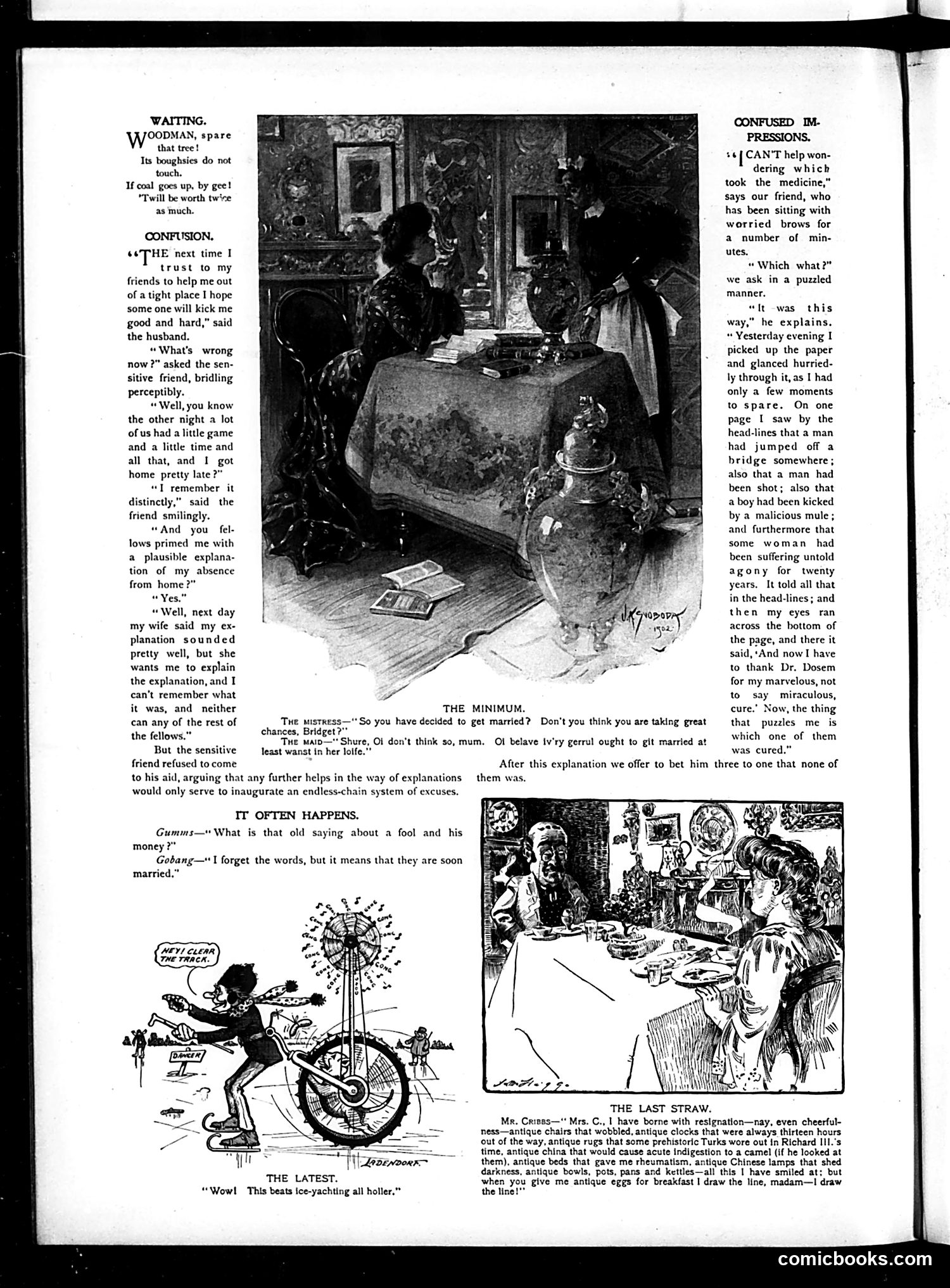
This page contains several satirical vignettes typical of early 20th-century American humor: **Main cartoons:** 1. **"The Minimum"** – An Irish servant girl (Bridget, identified by dialect) and her mistress discuss marriage. The joke mocks working-class Irish immigrants' attitudes toward matrimony as inevitable rather than romantic. 2. **"The Latest"** – A man on a wheeled contraption labeled "ICE-YACHT" satirizes absurd recreational trends among the wealthy. 3. **"The Last Straw"** – A husband complains he's tolerated his wife's obsession with antiques (wobbling chairs, broken clocks, indigestible china) but draws the line at "antique eggs" for breakfast—mocking the era's craze for collecting old things regardless of functionality. 4. **"It Often Happens"** – A brief joke equating marriage with financial foolishness, playing on the proverb "a fool and his money are soon parted." The overall theme satirizes marital frustration, immigrant stereotypes, and wealthy Americans' consumer habits.
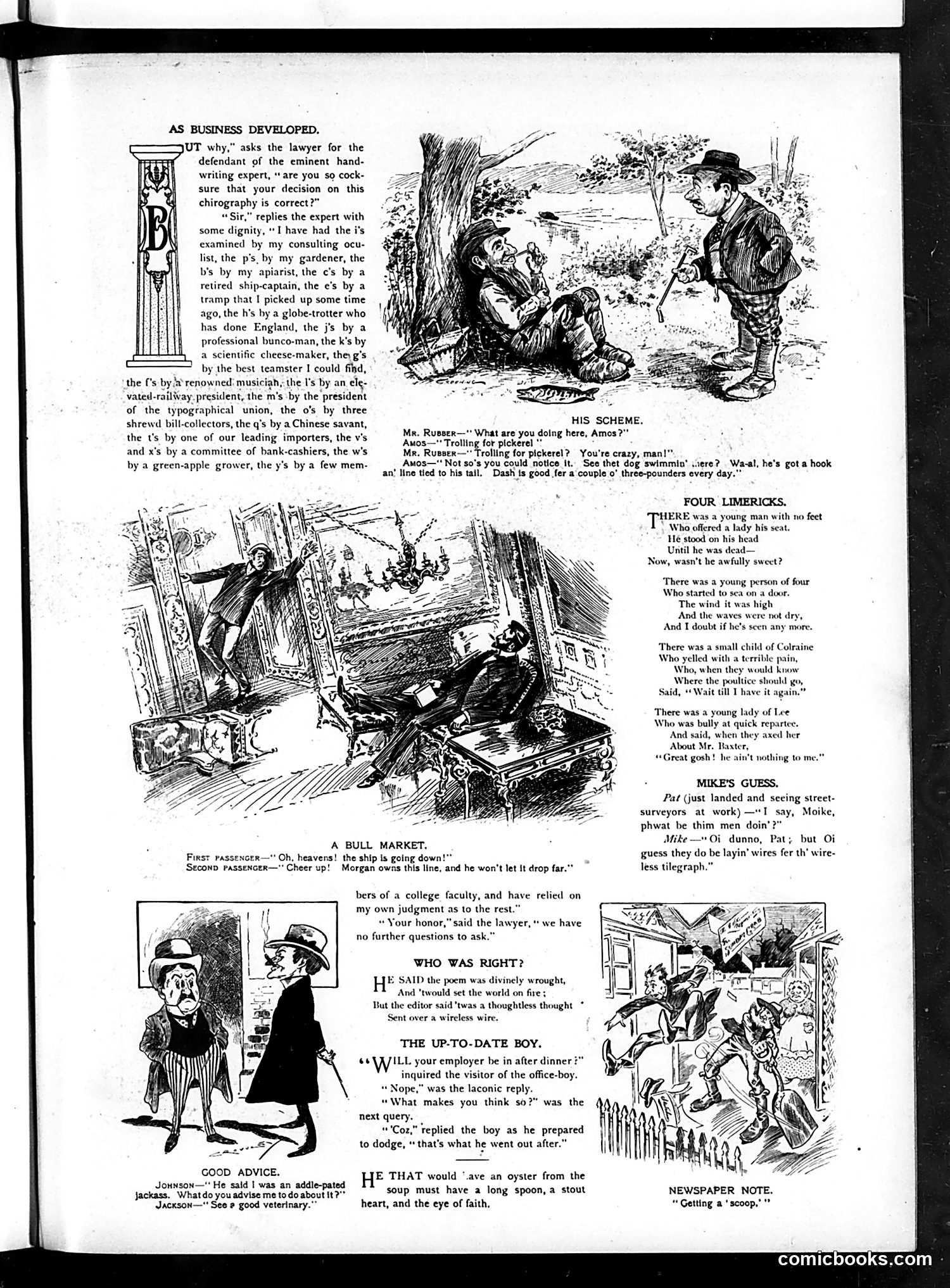
This satirical page from Judge magazine (early 20th century) contains several humor pieces mocking contemporary society: **"As Business Developed"** ridicules expert testimony by showing a handwriting expert whose analysis supposedly relied on consulting absurd people—a globe-trotter, a bunco-man, a cheese-maker—for examining different letters. It satirizes the pretentiousness of "expert" witnesses in legal cases. **"His Scheme"** depicts Irish immigrant dialect humor (common in period comedy) showing a man "trolling for pickerel" by tying a hook to his dog's tail—mocking rural naïveté. **"A Bull Market"** references J.P. Morgan, the powerful financier, joking that because he owns a shipping line, the ship won't sink badly during a crash—commentary on Morgan's financial dominance and the 1907 banking crisis era. **Other pieces** include limericks, office-boy jokes, and a quip about "wireless telegraph" technology (the wireless telegraph was new, making the joke about laying wires absurd). The page reflects Judge's satirical targets: legal pomposity, wealth/finance, immigration, and modern technology anxiety.
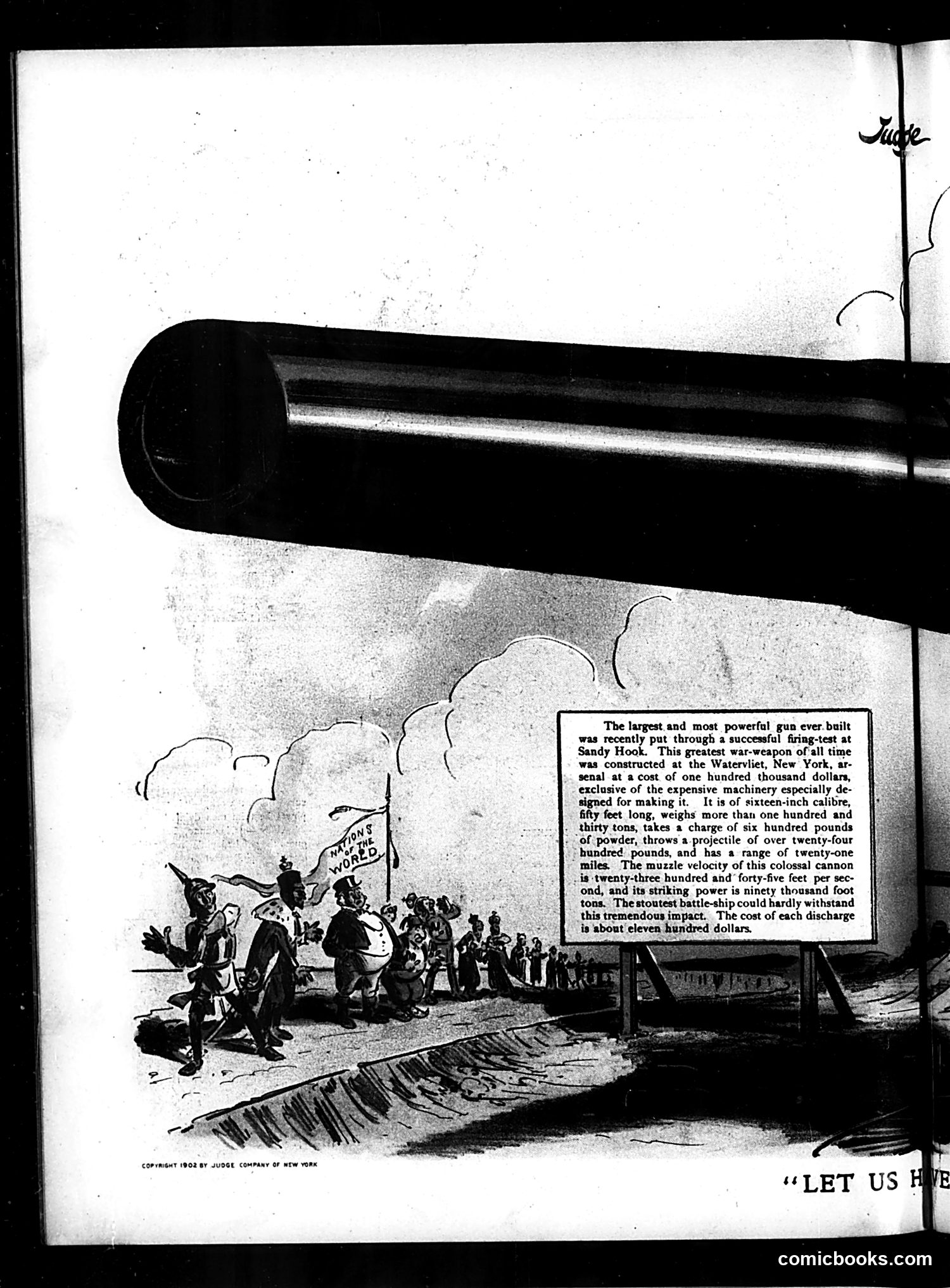
This satirical illustration critiques American military spending and imperial ambitions in the early 1900s. The cartoon depicts a massive cannon being tested at Sandy Hook arsenal—a real 16-inch gun developed circa 1902. The figures below appear to represent ordinary citizens or soldiers dwarfed by the enormous weapon. The text's detailed specifications emphasize the gun's staggering cost ($100,000 construction plus expensive machinery) and operational expense ($1,100 per discharge). The satire likely mocks the era's arms race and the fiscal priorities of American military expansion, particularly during the Spanish-American War aftermath when the U.S. was asserting naval dominance. By juxtaposing tiny human figures against this colossal instrument of war, the cartoon suggests the disproportionate resources devoted to military hardware versus human needs—a common Progressive-era critique of American militarism and government spending.
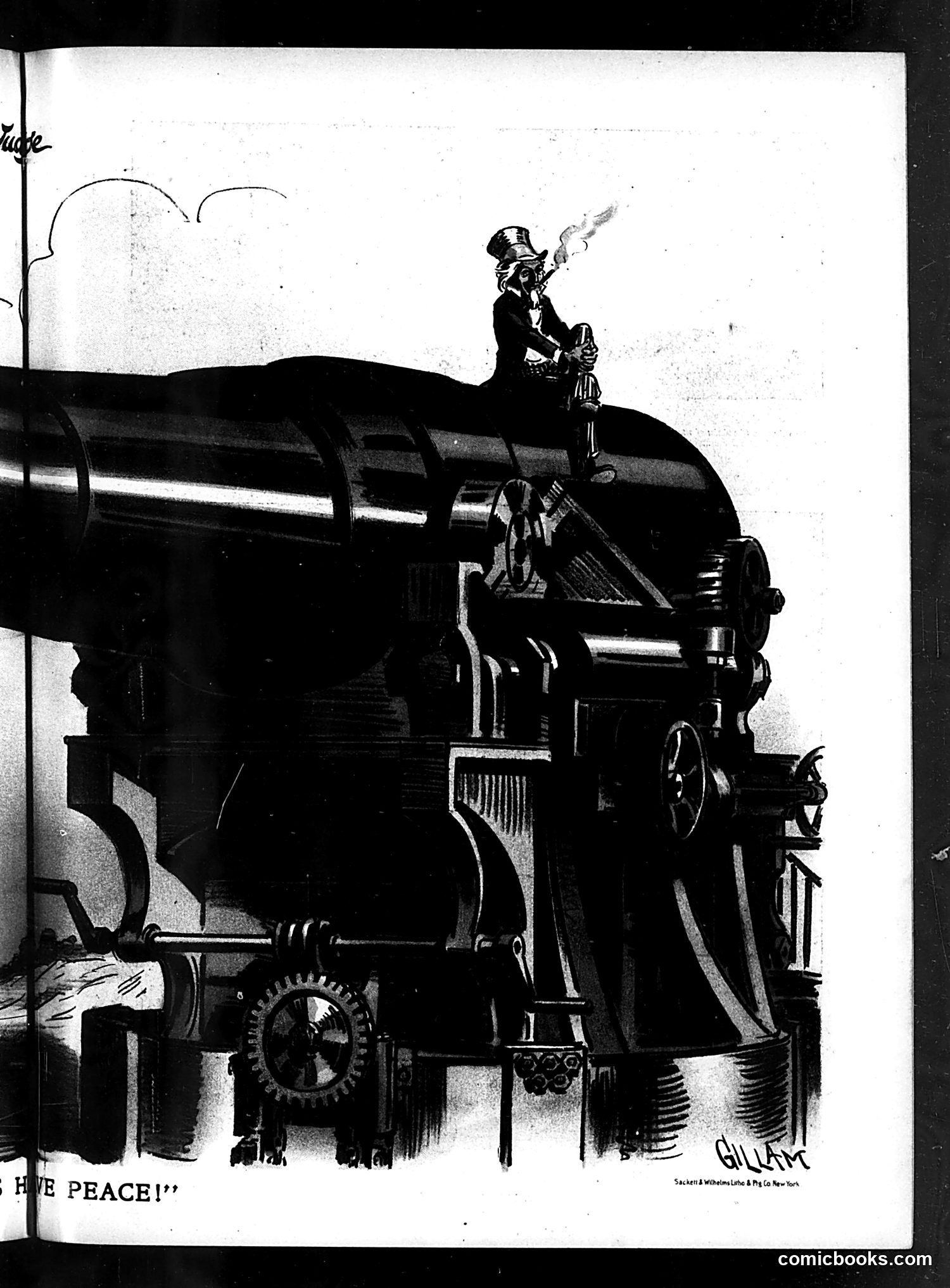
This Clifford Gould cartoon depicts **Uncle Sam** (identifiable by his top hat and formal attire) standing atop a massive cannon, pointing forward while declaring "GIVE PEACE!" The phrase appears cut off at bottom left. The satire critiques American military posturing—specifically, the contradiction of advocating for peace while simultaneously wielding overwhelming military force. The cannon's prominent size emphasizes this irony: the demand for peace comes backed by destructive weaponry rather than diplomacy. Given Judge magazine's typical content, this likely addresses early 20th-century foreign policy debates about American interventionism versus isolationism. The cartoon suggests that America's calls for peace lack credibility when delivered "at gunpoint," presenting a cynical view of geopolitical rhetoric during a period of global tension.
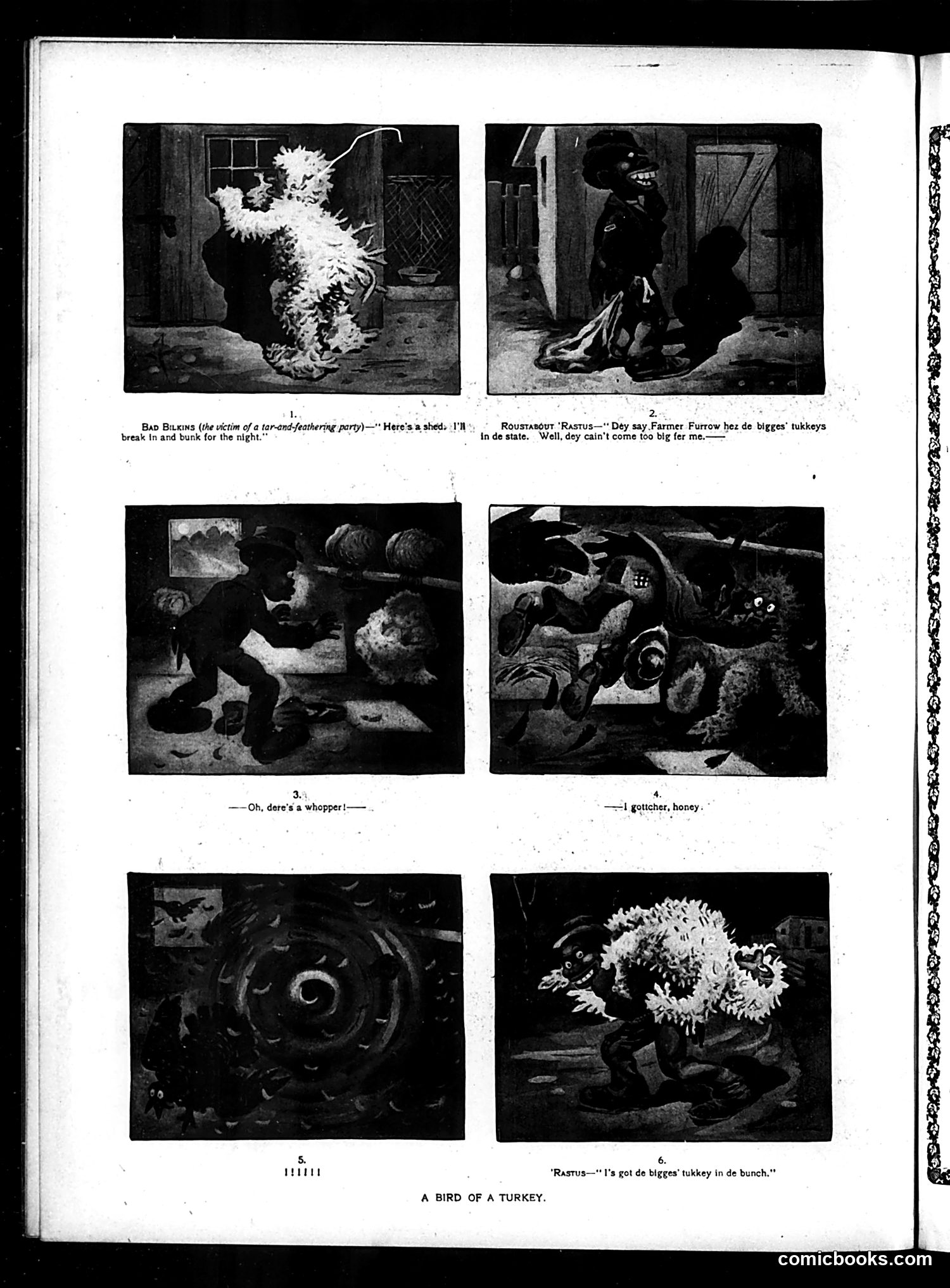
This is a six-panel comic strip featuring racial caricatures typical of early 20th-century American humor. The narrative involves "Bad Bilkins" (a tar-and-feathered victim) seeking shelter, and "Rastus" (a stereotypical Black character), who boasts about stealing the largest turkey in the state from Farmer Furrow. The "joke" relies on racist stereotypes portraying Black people as chicken/turkey thieves—a harmful trope used to justify discrimination. Panel 5 shows what appears to be a large circular object (possibly a wagon wheel the character has mistaken for a turkey), leading to the punchline about possessing an outsized bird. The satire reflects period attitudes treating petty theft and foolishness as inherent racial characteristics. The dialect spelling and caricatured imagery are consistent with Judge magazine's offensive approach to racial humor during this era.
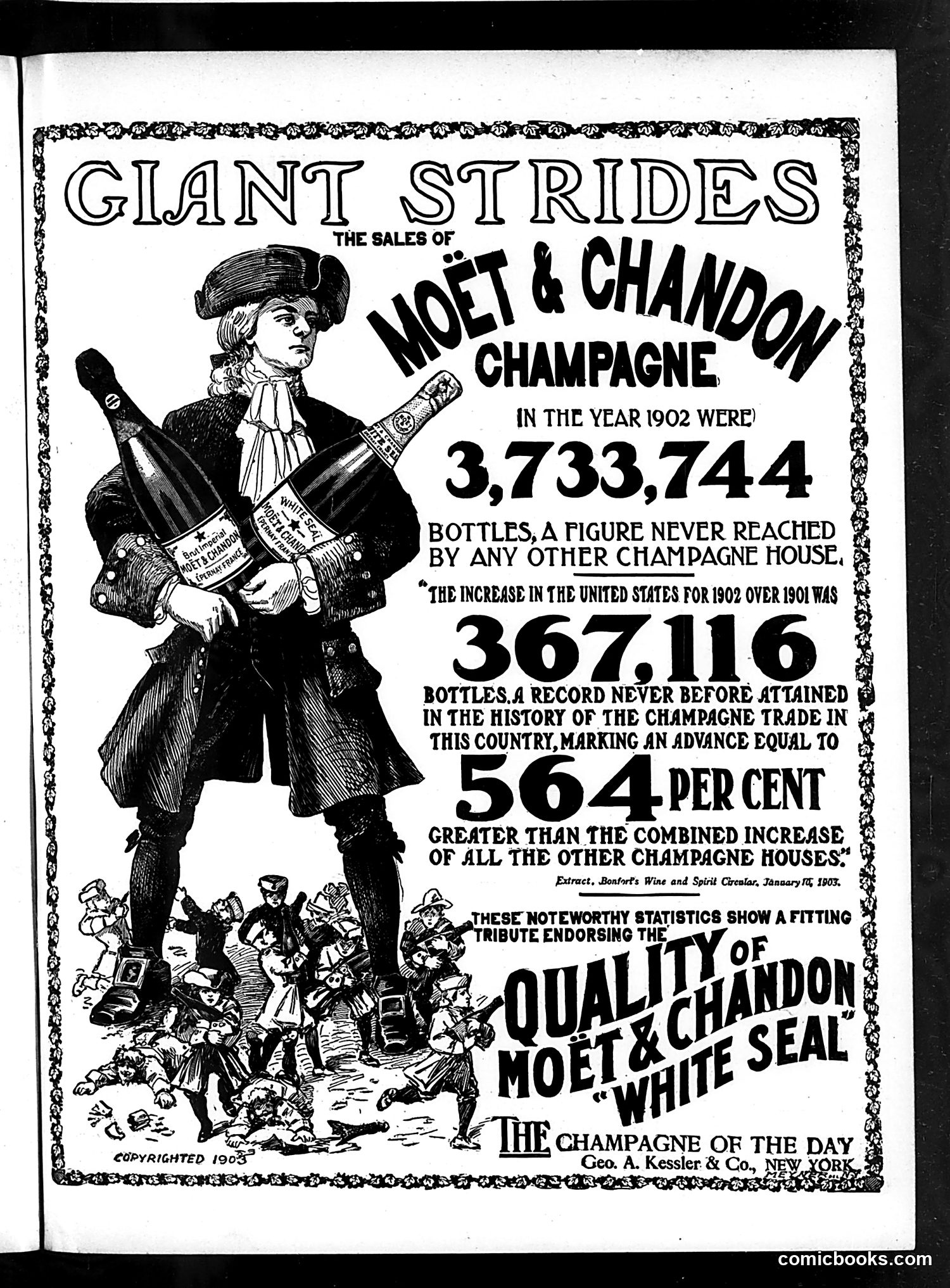
This is primarily a **champagne advertisement**, not political satire. It promotes Moët & Chandon's "White Seal" champagne using sales statistics as its main argument. The visual features a **18th-century French aristocrat** (likely representing Dom Pérignon or French champagne heritage generally) holding bottles, flanked by celebratory cherubs at the bottom. The advertisement emphasizes that Moët & Chandon sold 3.7 million bottles in 1902—"a figure never reached by any other champagne house"—with a 564% increase over competitors' combined growth. For modern readers: this represents early-1900s **advertising strategy using quantifiable metrics** to establish market dominance and prestige. The classical imagery evokes Old World French sophistication, while the statistical claims appeal to American consumers' desire for validated quality and success. It appeared in *Judge*, a satirical magazine, likely as paid advertising rather than editorial content.
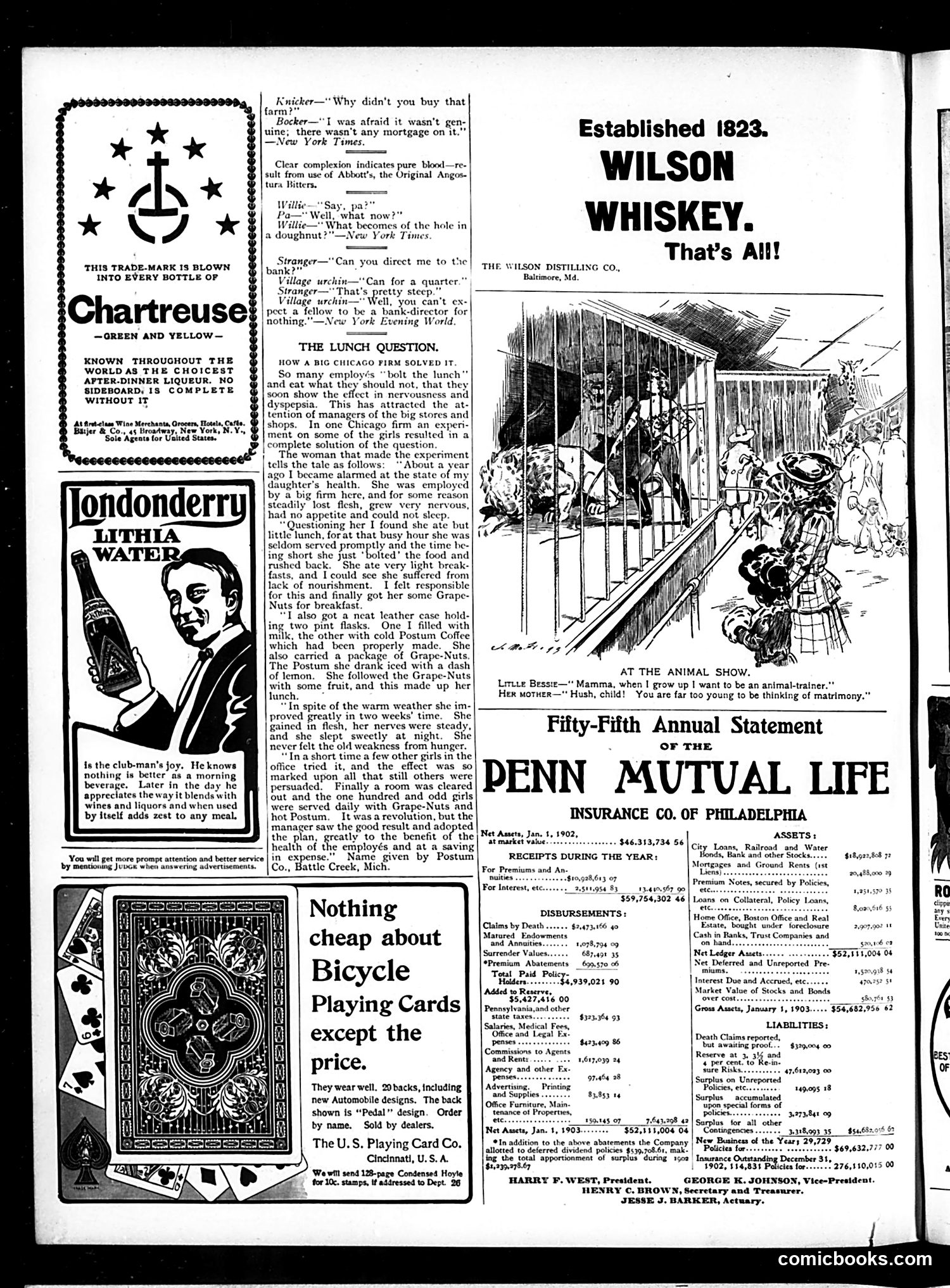
This page is primarily **advertisements and filler content** typical of Judge magazine, with minimal political satire. The small jokes scattered throughout are light social humor: a Knicker/Bocker exchange mocking Americans' obsession with mortgages (suggesting debt was culturally normalized); a child's joke about doughnut holes; and a village boy overcharging a stranger for bank directions—gentle, apolitical humor about rural shrewdness. The page features ads for liqueurs (Chartreuse, Londonderry Lithia Water), Wilson Whiskey, and playing cards. Most substantially, there's a **Postum/Grape-Nuts advertisement disguised as a testimonial article** about a Chicago firm solving employee nutrition problems by providing workers with these breakfast products and cold Postum coffee during lunch breaks—essentially corporate wellness presented as solved by the advertiser's products. There is **no identifiable political satire or caricature** on this page. It represents Judge functioning as a commercial advertising vehicle rather than primarily as political commentary.
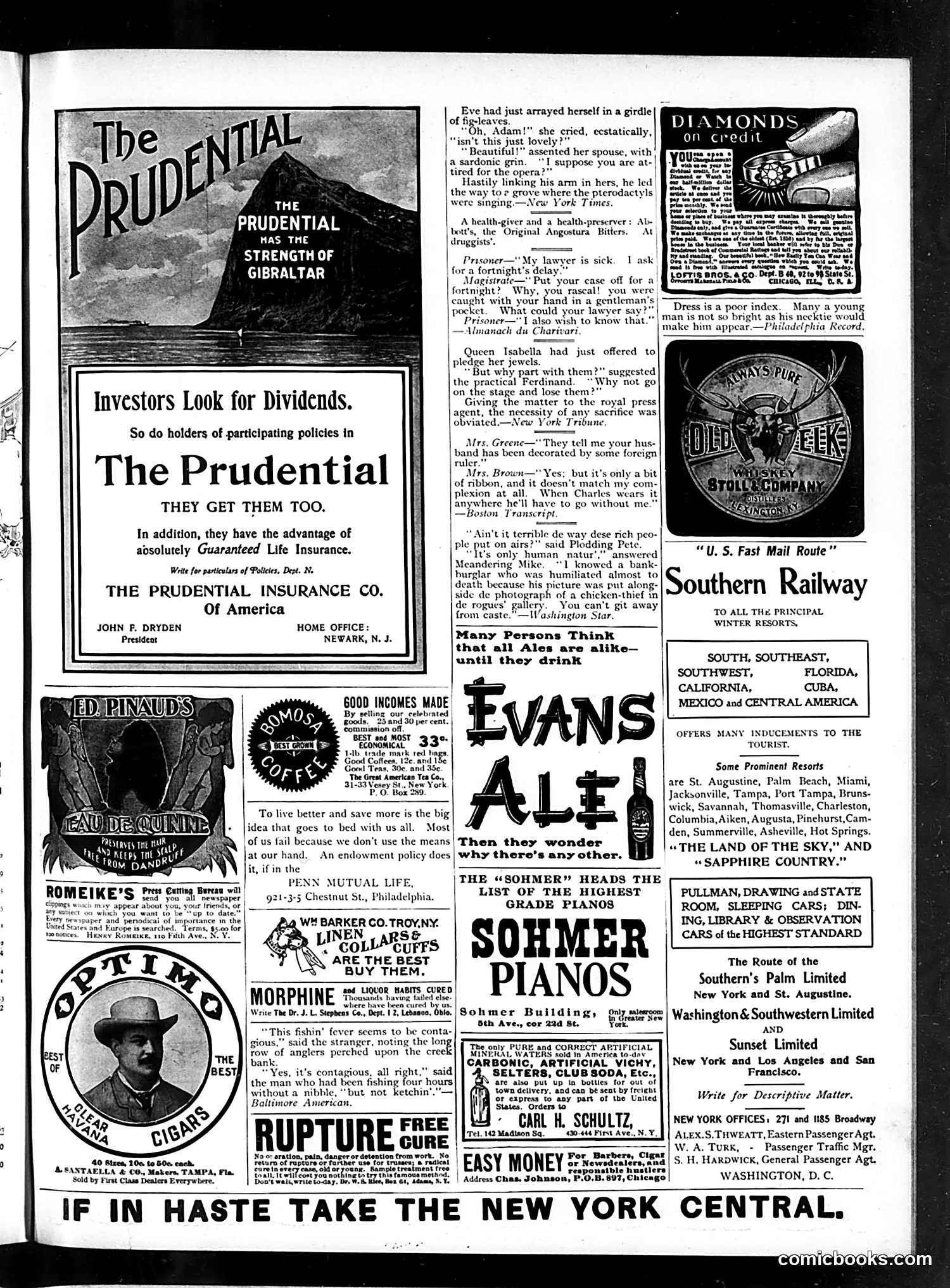
This is primarily an **advertising page** from Judge magazine, not a political cartoon. The dominant content is commercial advertisements for insurance, pianos, coffee, cigars, and other products typical of early 20th-century publications. However, the page includes several **short humorous anecdotes** in the margins, typical of Judge's satirical style: - A joke about a woman dressing for the opera in a "girdle" (corset), with her husband's sardonic response - A magistrate questioning why a prisoner needs a lawyer's delay when caught red-handed stealing - Queen Isabella pledging jewels, with Ferdinand cynically suggesting she become an actress instead - Class commentary about wealthy people putting on airs versus a burglar's humiliation at being grouped with common thieves These jokes target **vanity, hypocrisy, and class pretension**—Judge's typical subjects. The recurring theme: human folly transcends social status, from opera-goers to royalty to vagrants. The page demonstrates how Judge interspersed satirical content within commercial advertising.
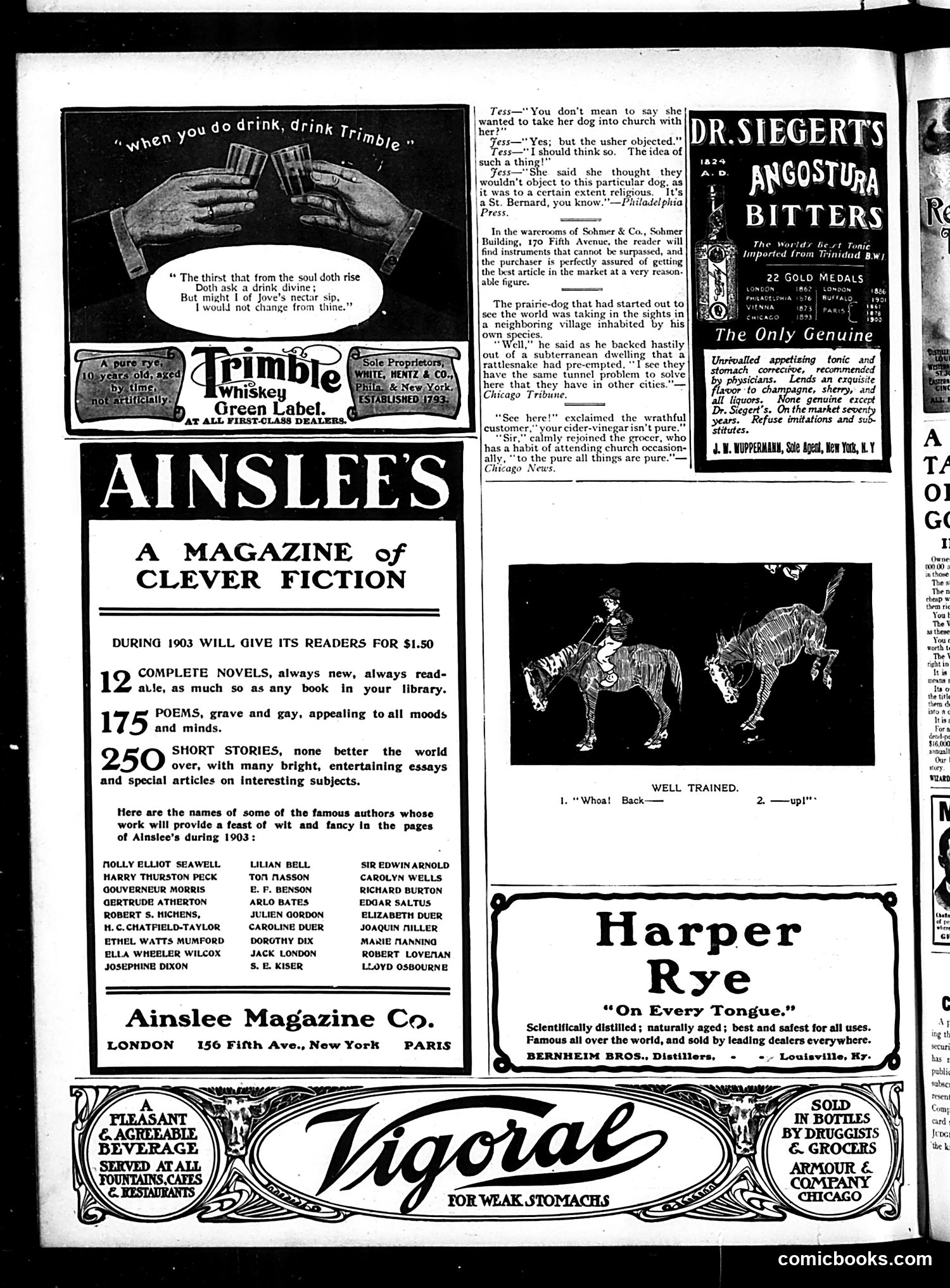
This page is primarily **advertising and magazine promotion** rather than political satire. The main content includes: **Advertisements:** - Trimble Whiskey (top left) with a Shakespeare quote about drinking - Dr. Siegert's Angostura Bitters (imported tonic) - Harper Rye whiskey - Vigoral (stomach remedy) - Ainslee's Magazine promotion (center) **Humor Content:** Two brief jokes appear: one about a woman wanting to bring her St. Bernard dog to church (playing on the breed's religious associations), and another about a grocer defending impure cider-vinegar by claiming "to the pure all things are pure" (a biblical reference). The cartoon "Well Trained" (center-right) shows two dogs—a play on obedience training. **Historical Context:** This reflects early 1900s advertising norms when magazines relied heavily on patent medicines and alcohol ads. The content is commercial rather than satirical—typical for Judge's advertising sections during this era.
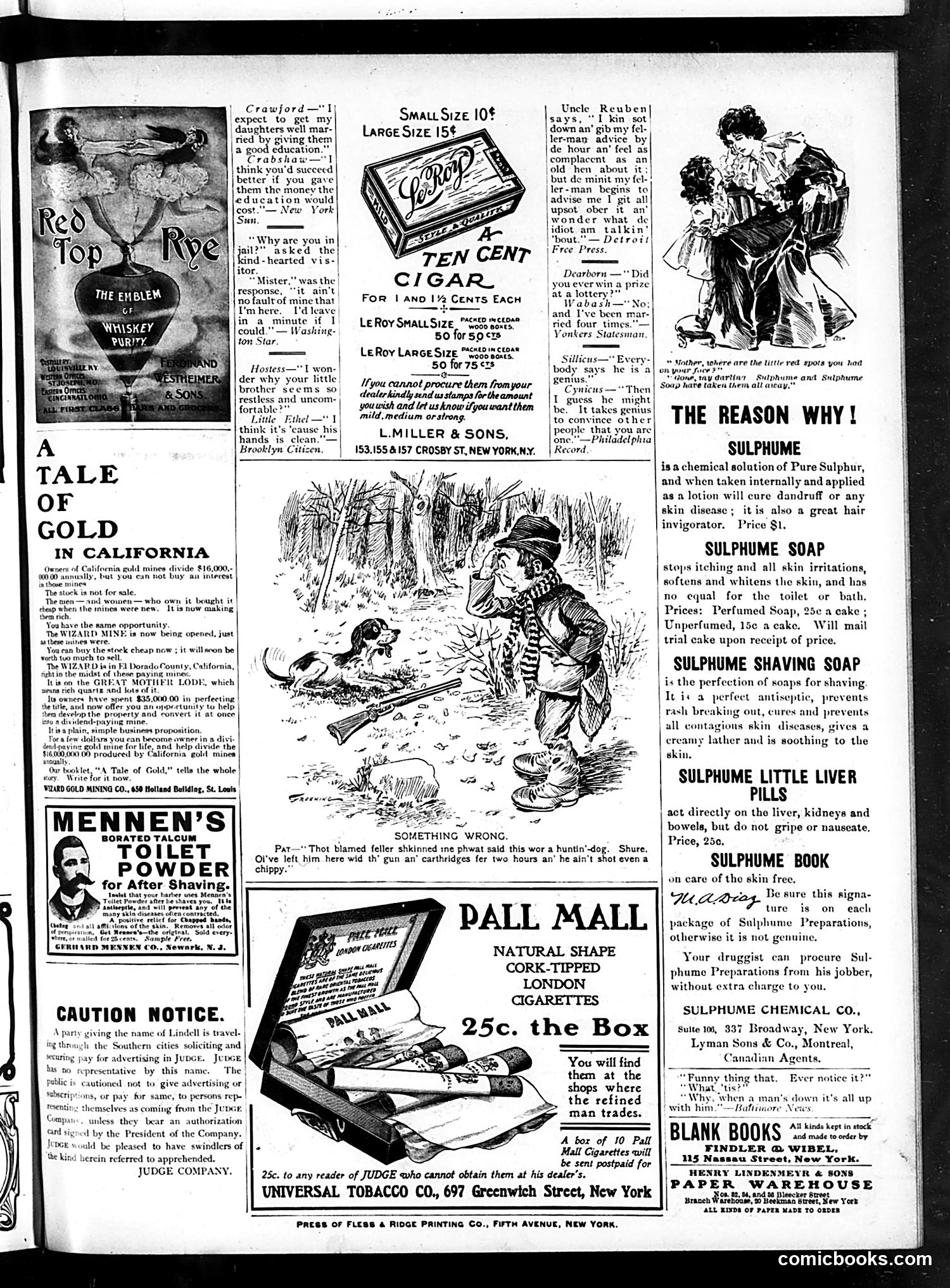
This page is predominantly **advertising**, with minimal editorial content. The few small cartoon/joke items are brief humor fillers typical of Judge magazine's format. The editorial cartoons present simple domestic humor: - **"Crawford" and "Crabshaw"** exchange jokes about educating daughters for marriage - **"Uncle Reuben"** complains that while he enjoys giving advice, he dislikes receiving it - **"Pat"** relates a hunting story about a deceived dog purchase - **"Dearborn"** makes a cynical joke about lottery losses and failed marriages These are generic, non-political humor sketches with no social satire or significant historical reference. The page is filled with period **patent medicine and consumer goods advertising**: Sulphume (a sulphur-based cure-all for skin conditions and dandruff), Mennen's talcum powder, Pall Mall cigarettes, and a gold-mining stock scheme ("Wizard Mine"). These ads reflect early 1900s commercial culture and unregulated pharmaceutical marketing before FDA standards. No identifiable political figures or satirical commentary appears on this page.
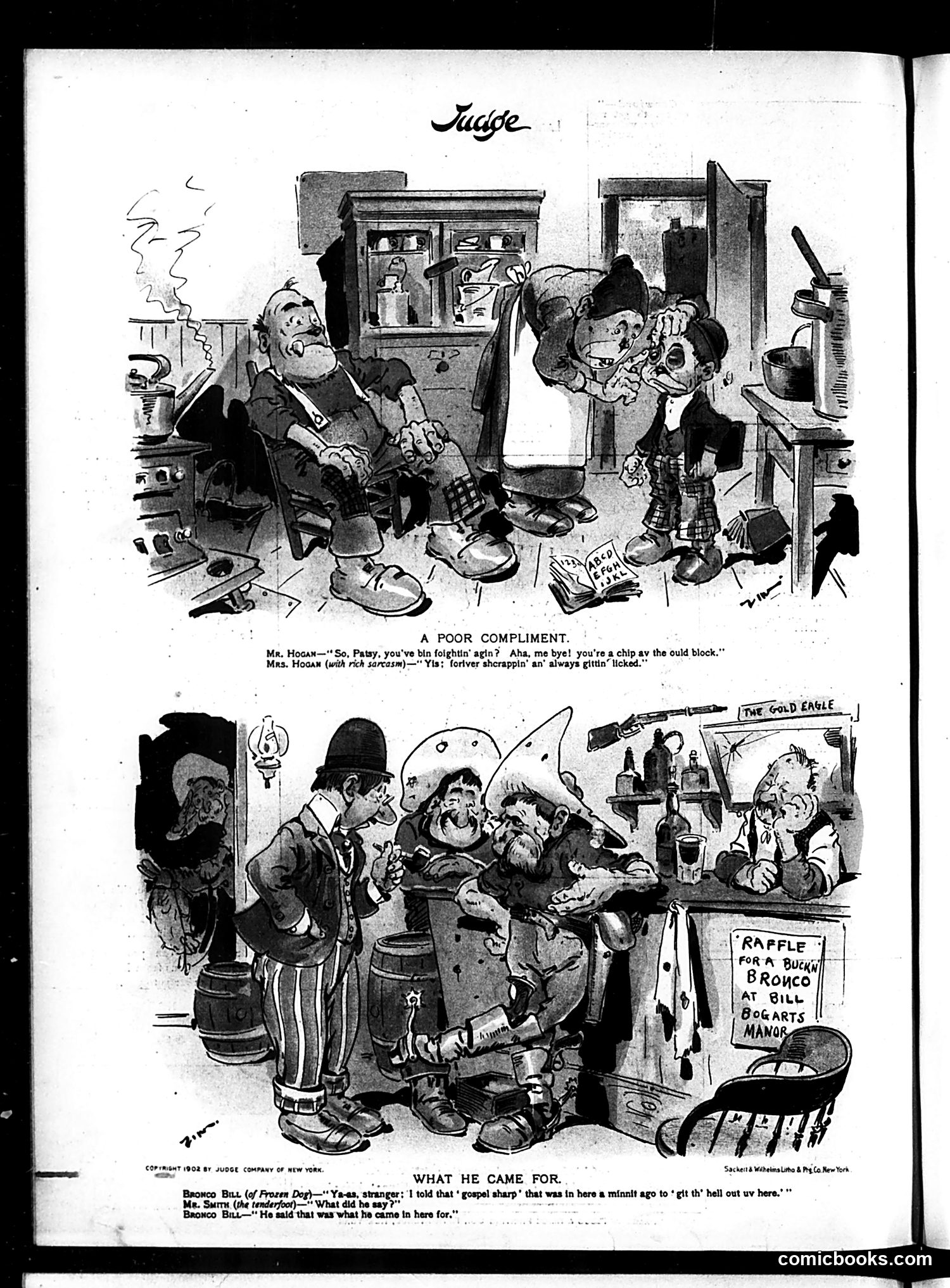
**"A Poor Compliment"** depicts an Irish immigrant father (Mr. Hogan) praising his son for fighting, calling him "a chip av the ould block" (a chip off the old block). The mother responds sarcastically that yes, the boy is just like his father—always fighting and always losing. The joke mocks Irish-American working-class masculinity and violence, playing on ethnic stereotypes common to the era. **"What He Came For"** shows a Western saloon scene. A "gospel sharp" (evangelist/preacher) is ejected from a bar in Frozen Dog. When a tenderfoot (inexperienced Easterner) asks what the preacher said upon being told to leave, "Bronco Bill" replies he said "that was what he came in here for"—meaning the preacher actually *wanted* to be thrown out, perhaps to claim martyrdom or justify his mission. The cartoon satirizes both frontier roughness and religious hypocrisy.