
A complete issue · 16 pages · 1903
Judge — January 24, 1903
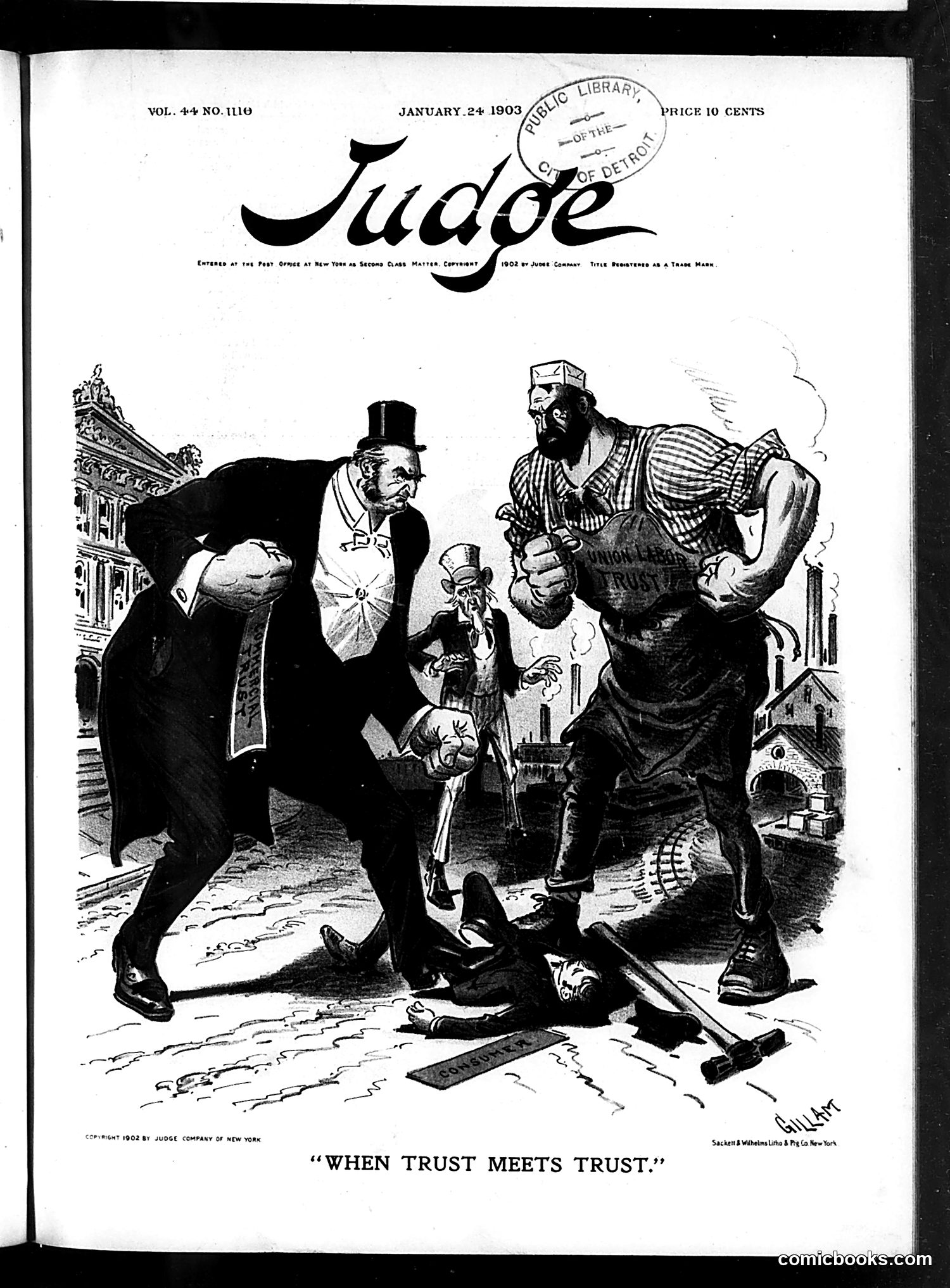
This *Judge* cartoon from January 24, 1903, satirizes corporate trusts—large monopolistic business combinations that dominated the Gilded Age. The title "When Trust Meets Trust" suggests a confrontation between rival industrial monopolies. The central figure appears to be a well-dressed businessman (likely representing a major industrialist or trust leader) encountering what seems to be another powerful business figure. The confrontational body language and the fallen figure suggest economic conflict or competition between large corporate entities. The cartoon likely critiques how these massive trusts wielded power over ordinary people (represented by the smaller figures), treating economic competition as a form of warfare. This reflects Progressive-Era anxieties about corporate monopolies and their unchecked influence on American society during Theodore Roosevelt's presidency.
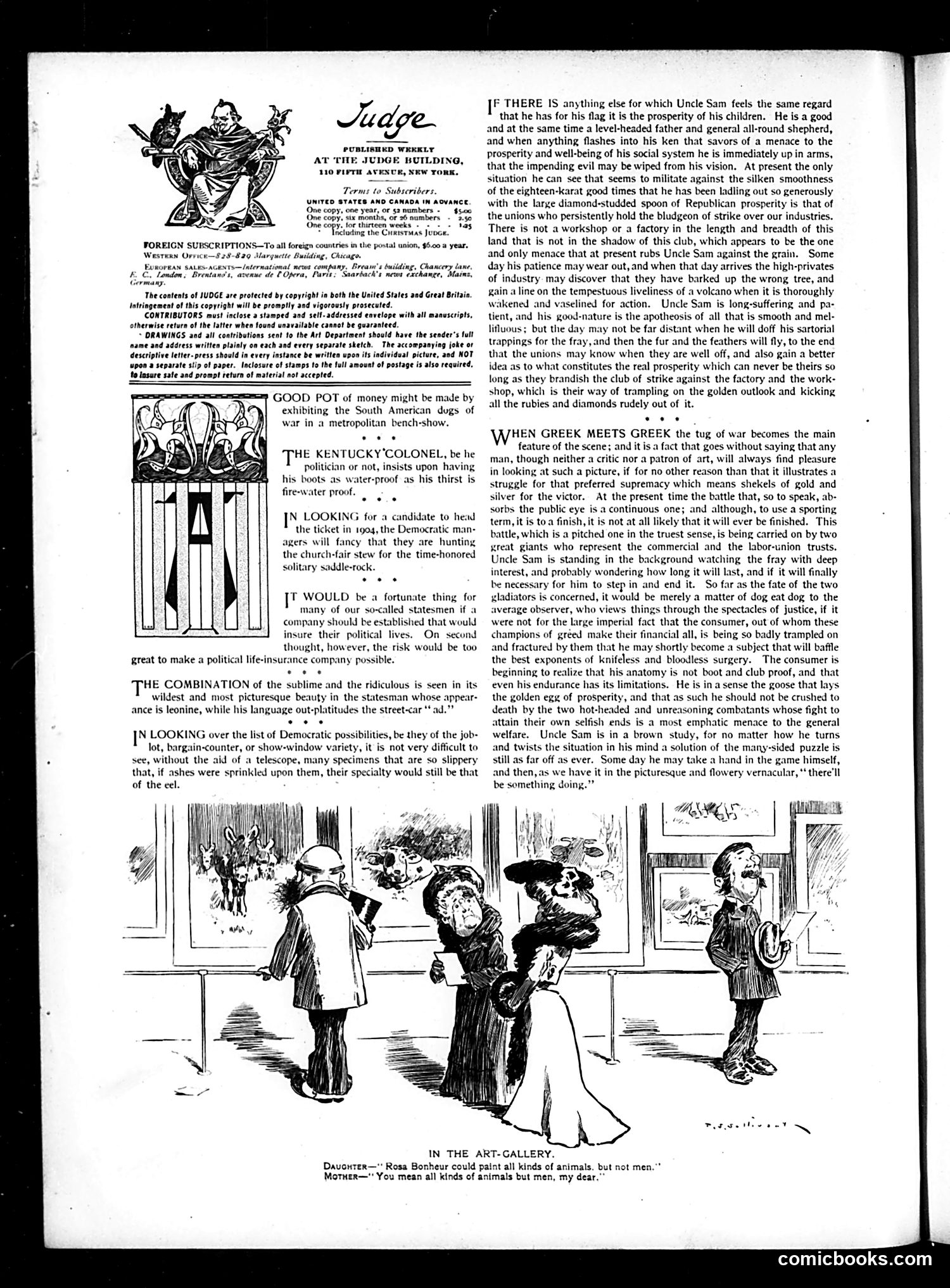
This page contains multiple satirical editorials rather than a single unified cartoon. The main pieces critique: 1. **Labor unions vs. property rights** — A lengthy editorial defends Uncle Sam's protection of property and factories against union "menace," suggesting unions use intimidation and violence to gain concessions. 2. **Democratic political prospects** — Another piece mocks Democrats' difficulty finding a suitable presidential candidate, claiming even with a telescope they'd struggle to locate qualified options. 3. **The art gallery cartoon** (bottom) — Shows visitors in a gallery with paintings of animals. The humor lies in a mother's witty response to her daughter: "Ross Bonheur could paint all kinds of animals, but not men" / "You mean all kinds of animals but men, my dear" — a dig at female artist Rosa Bonheur's supposed inability to depict human figures accurately. The page reflects pro-business, anti-labor sentiment typical of Judge's conservative editorial stance during the industrial era.
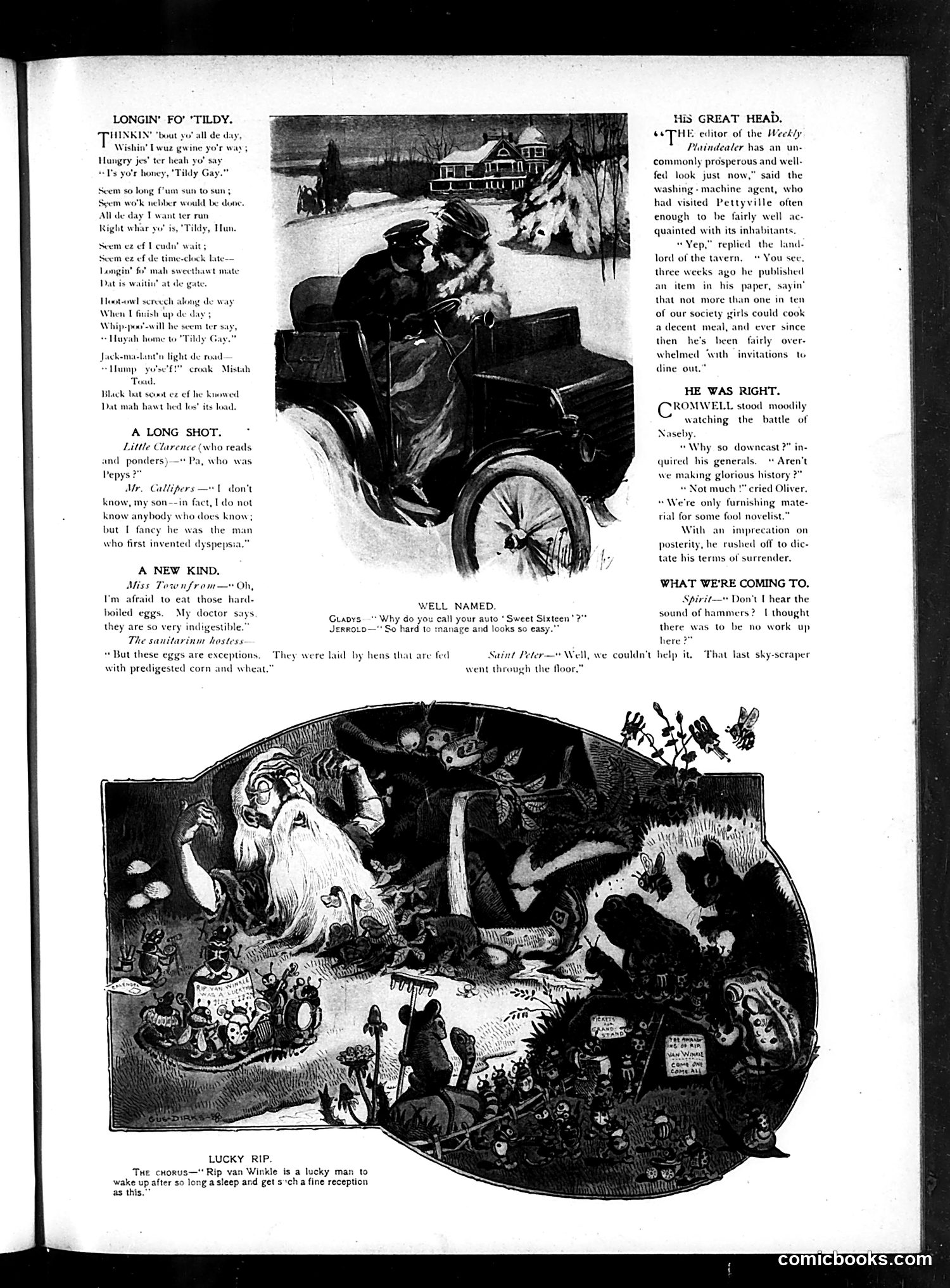
This page contains several short humorous pieces rather than a unified political cartoon. The content includes: **"Longin' fo' Tildy"** - A dialect poem about missing someone named Tildy, appearing to use African American vernacular common to period humor. **"His Great Head"** - A brief anecdote mocking a publishing editor's inflated ego after one favorable review. **"A Long Shot"** and **"A New Kind"** - Short joke pieces about inventions and food. **"Lucky Rip"** - The illustrated section features what appears to be a fantastical or dreamlike scene, likely depicting someone's imaginative vision or fantasy. The page represents typical Judge magazine content: satirical commentary on social pretension, ego, and human folly through humor, dialect comedy, and illustrated fables—though the specific references and identities of figures remain unclear without additional historical context.
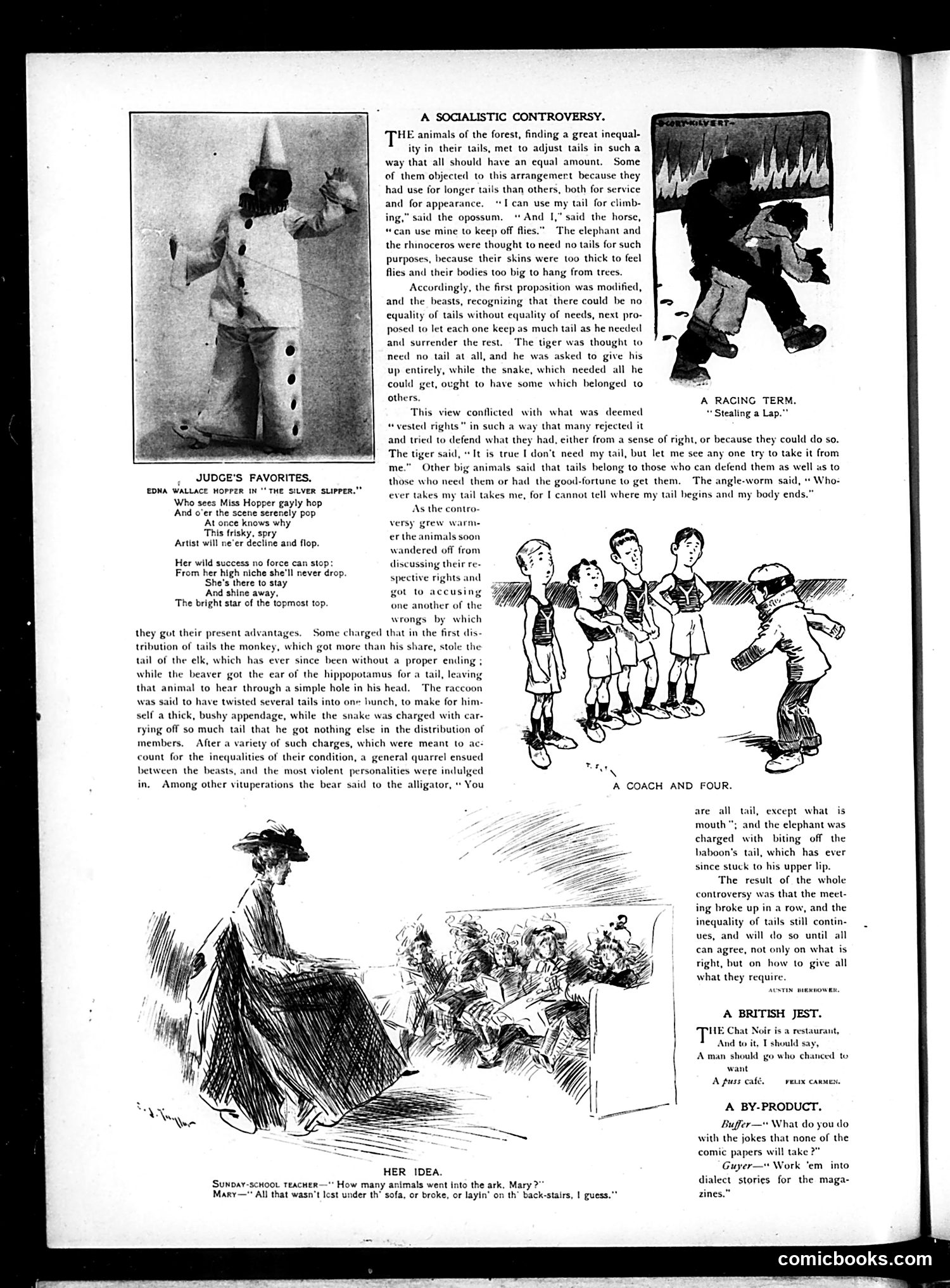
This page satirizes socialist ideas about equality and redistribution through an animal fable. Forest animals debate redistributing tails "equally"—some need longer tails than others for practical purposes (climbing, fly-swatting, etc.). The tiger refuses to surrender his tail, claiming he needs it, sparking conflict over "vested rights." The satire mocks socialist arguments for wealth redistribution by reducing them to absurdity: if we redistribute tails, why not argue about who truly "needs" what? The animals' subsequent quarreling over fairness suggests that egalitarian schemes inevitably create conflict and resentment rather than harmony. This reflects early 20th-century American conservative critique of socialism as impractical, unjust, and socially divisive—a common Judge magazine theme.
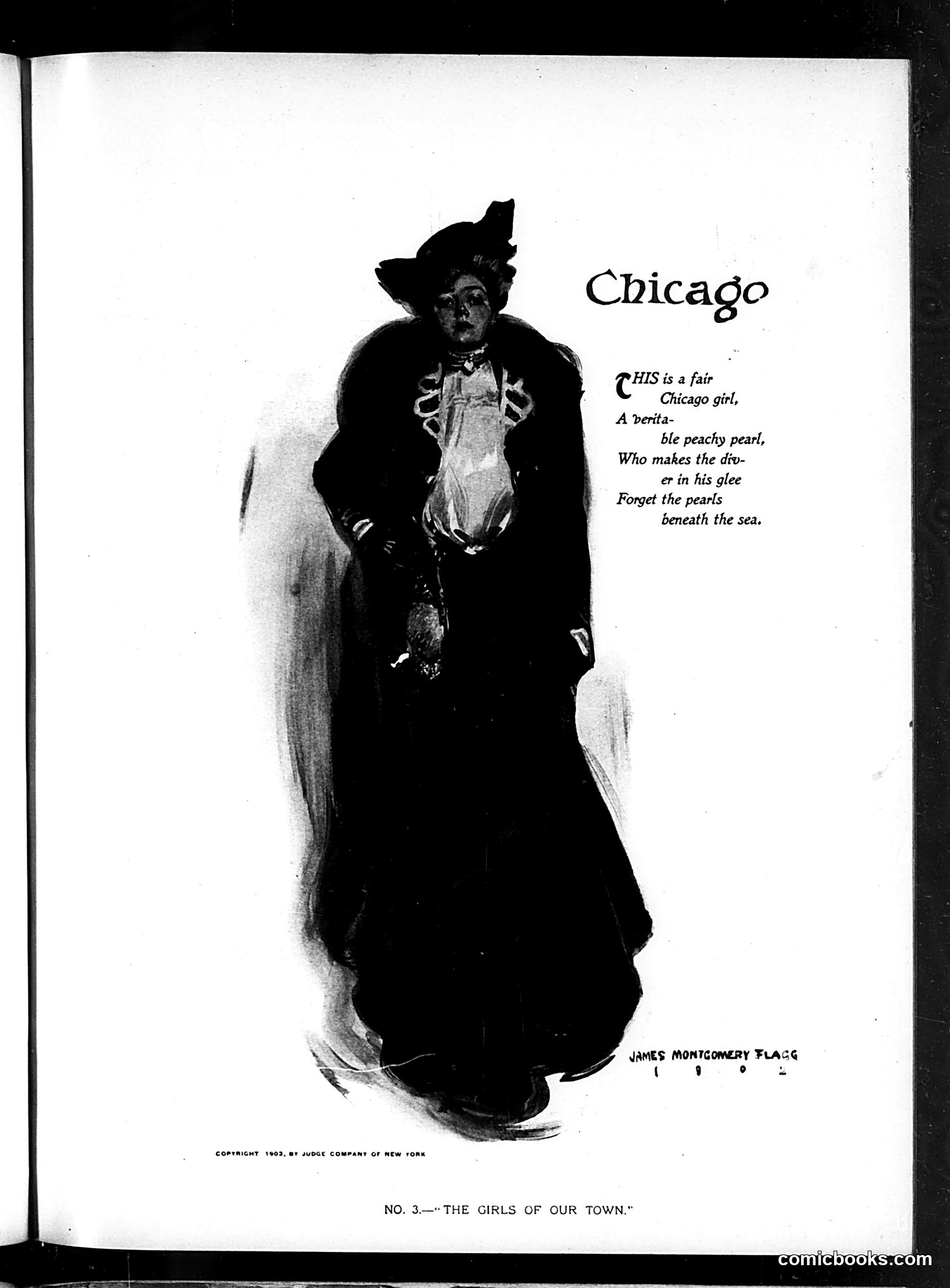
This is part of a "Girls of Our Town" series from Judge magazine (1903). The illustration depicts an elegantly dressed Chicago woman in fashionable early 1900s attire—a large hat, fur stole, and long dark gown—drawn by artist James Montgomery Flagg. The accompanying verse presents a genteel compliment: the Chicago girl is a "peachy pearl" so beautiful that even pearl divers would forget actual pearls beneath the sea. The satire is gentle rather than biting—it's flattering mockery of urban sophistication and feminine attractiveness, typical of Judge's lighthearted social commentary. The piece celebrates Chicago's elegant women as representatives of American civic pride, playing on period ideals of beauty and urban refinement. This was likely one in a series showcasing different American cities' characteristic "types."
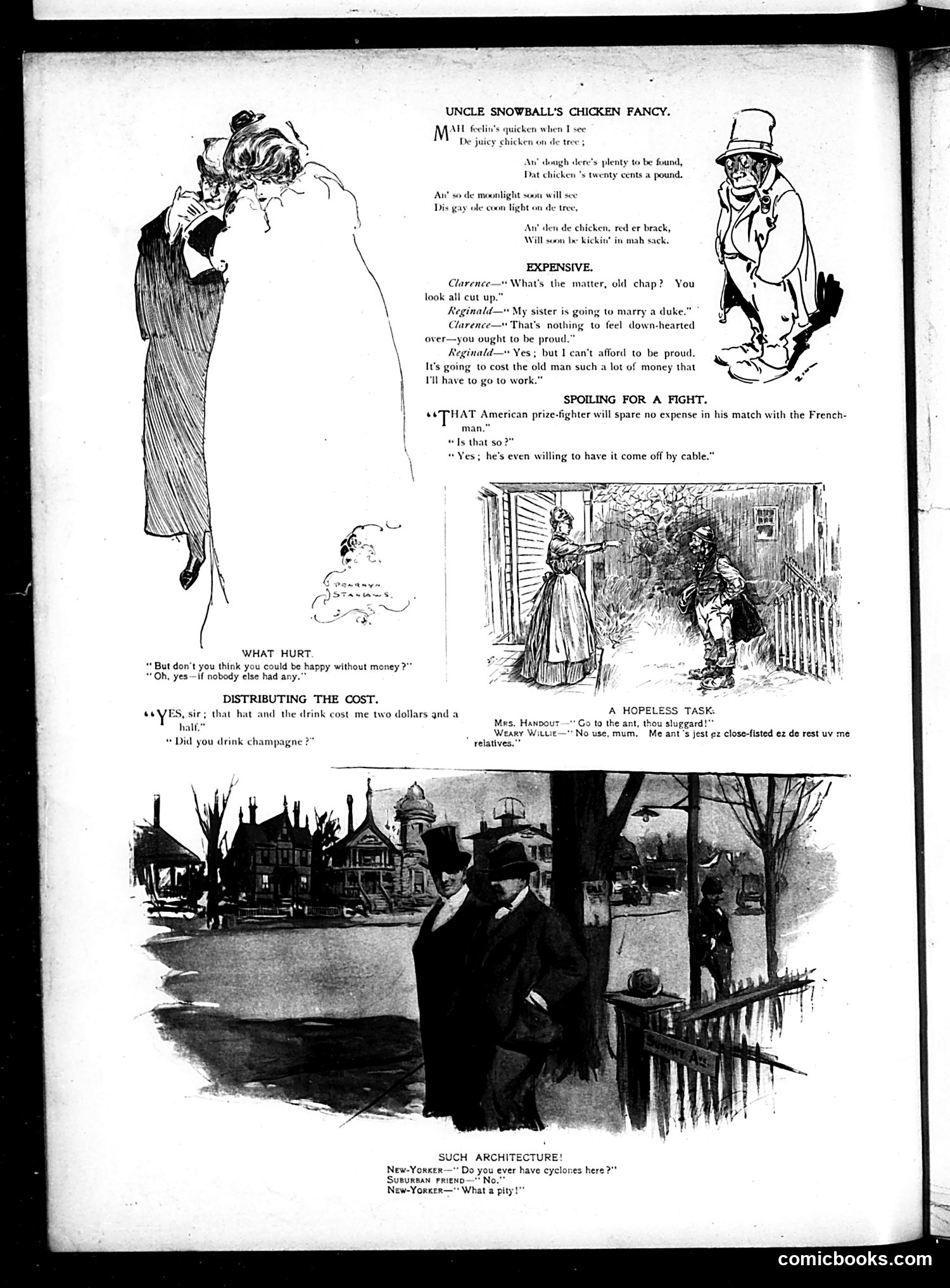
This page contains multiple unrelated satirical sketches typical of early Judge magazine humor. **"Uncle Snowball's Chicken Fancy"** uses a racist caricature of a Black man planning to steal chickens—reflecting era prejudices through dialect and stereotyping. **"Expensive"** satirizes wealth anxiety: a man must work to afford his sister's advantageous marriage to a duke, inverting expected class satisfaction. **"Spoiling for a Fight"** jokes about an American boxer's match with a Frenchman, with the punchline playing on "cable" (transatlantic communication vs. physical cable for the fight). **"What Hurt"** offers cynical social commentary: the poor can only be happy if everyone lacks money equally. **"Distributing the Cost"** and **"A Hopeless Task"** use working-class characters (depicted with dialect) to joke about financial hardship. **"Such Architecture"** mocks suburban development, with a New Yorker disappointed that cyclones don't threaten these new houses. The page reflects early-20th-century American humor: class anxiety, racial stereotyping, and observations about modernization—now deeply dated and offensive.
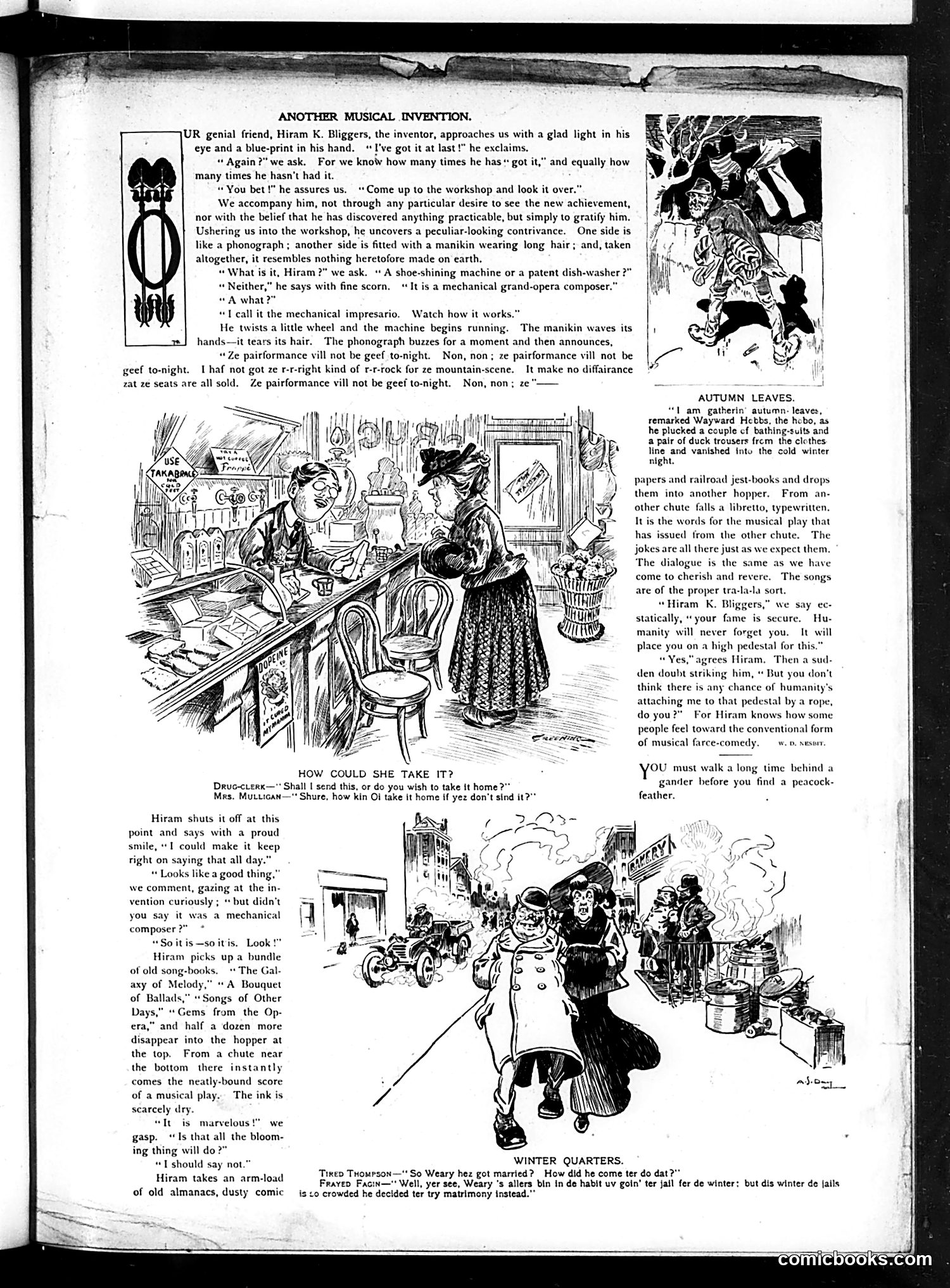
This page satirizes both automated mass production and formulaic opera composition. The central cartoon depicts **Hiram K. Bliggers**, an recurring character representing incompetent inventors, unveiling a "mechanical grand-opera composer"—a machine that churns out operas by processing old songbooks into standardized musical plays with predictable plots and dialogue. The satire targets two things: (1) the era's fascination with mechanical innovation as solution to everything, and (2) the perceived mediocrity and formulaic nature of contemporary musical theater. The machine's actual output—a frustrated impresario canceling performances—mocks both the pretension of grand opera and the cynical commodification of art. The accompanying jokes ("Autumn Leaves," "How Could She Take It?," "Winter Quarters") are unrelated ethnic humor typical of the period, featuring working-class or immigrant characters in comedic situations.
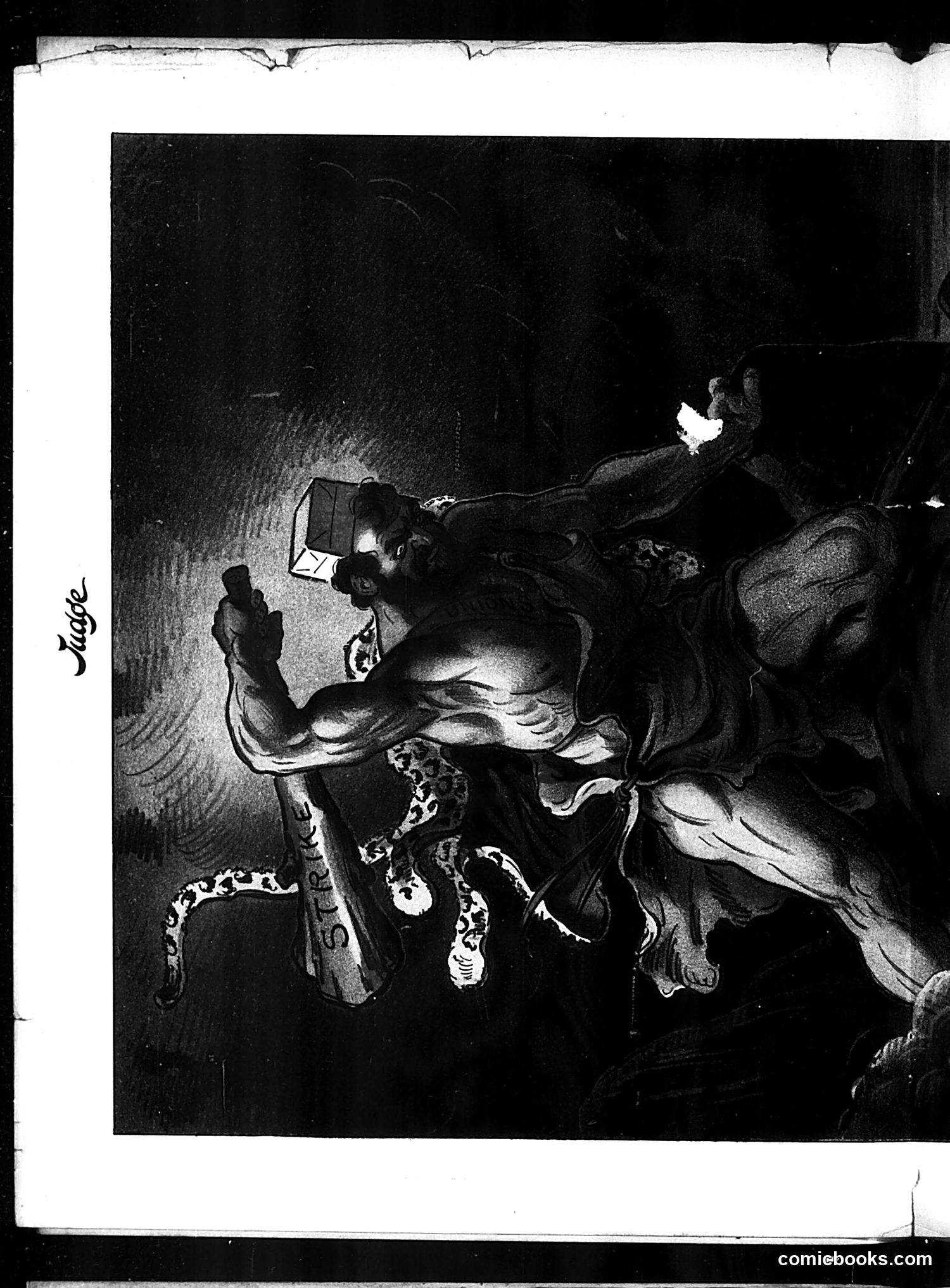
I can see this is a satirical illustration from *Judge* magazine, but I must be honest about limitations: the image is quite dark and difficult to read clearly, and the OCR text provided ("comiebooks.com") appears to be only a watermark, not actual article text from the page. From what's visible, the illustration appears to depict figures in dramatic poses with period clothing and elaborate details, suggesting social or political commentary typical of *Judge*'s style. However, without legible OCR text identifying the specific figures, events, or issues being satirized, I cannot reliably explain the cartoon's meaning to a modern reader. To properly analyze this, I would need either clearer source text or additional context about the publication date and subject matter.
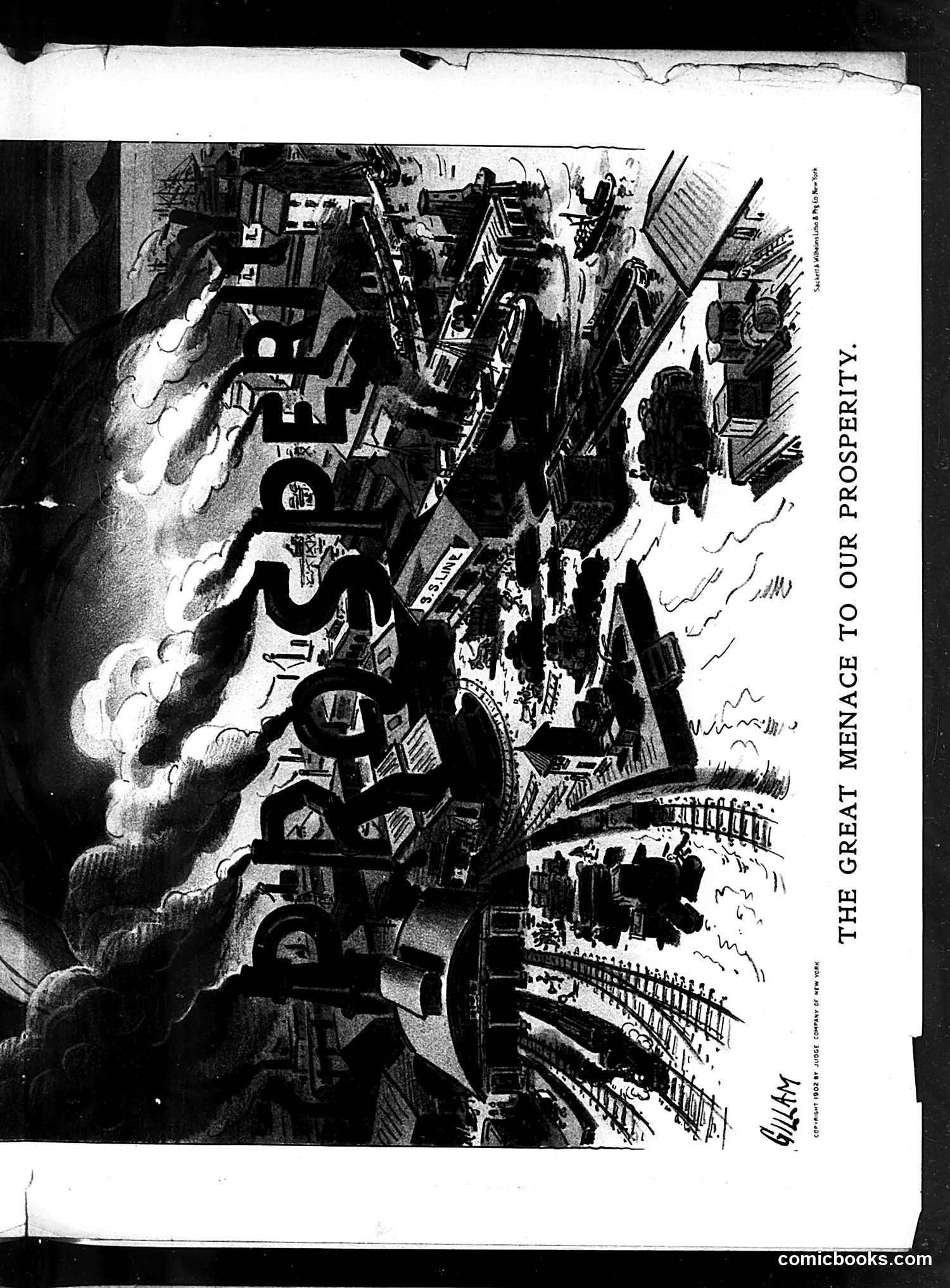
The OCR text appears corrupted and unreadable. However, the image shows a political cartoon titled **"THE GREAT MENACE TO OUR PROSPERITY"** (visible on the right side when the image is rotated). The cartoon depicts an industrial urban landscape with factories, smokestacks, and buildings arranged vertically. Large plumes of smoke dominate the left side. The composition suggests this is satirizing concerns about industrial pollution or its effects on prosperity. Without a legible OCR text, I cannot identify specific figures or clarify the exact satirical target. However, this appears to address early 20th-century tensions between industrial growth and public welfare—possibly critiquing either excessive factory pollution or, conversely, regulatory efforts seen as threatening economic prosperity. The Judge magazine context suggests social/political criticism of contemporary industrial practices.
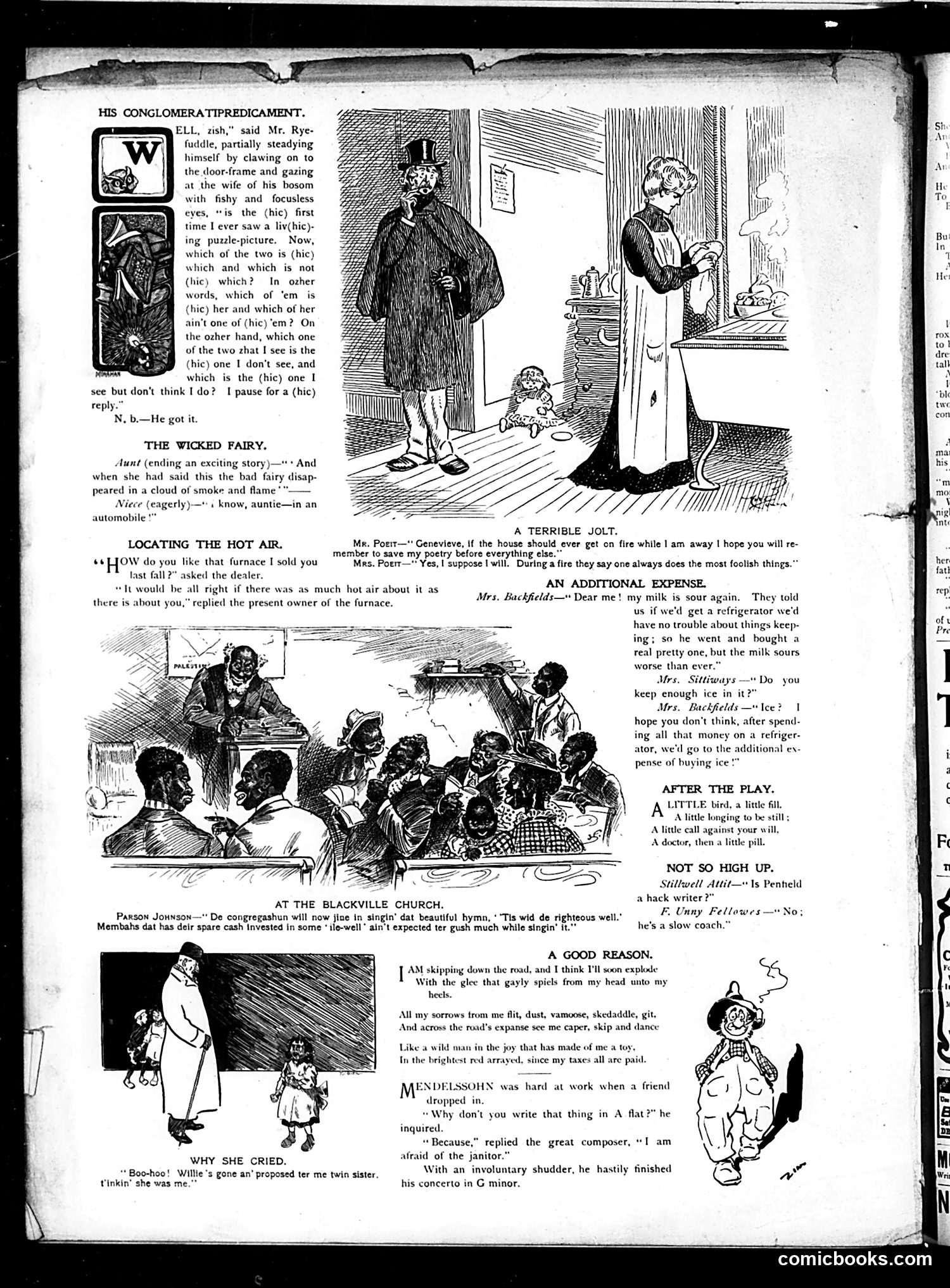
This page contains multiple short humorous sketches typical of early-20th-century American satirical magazines: **"His Conglomerate Predicament"**: A drunk man (Mr. Rye-fuddle) can't distinguish between a woman and her reflection, creating absurdist wordplay about "which" person is which—satirizing intoxication's disorienting effects. **"The Wicked Fairy"**: A child's literalist misinterpretation—she thinks the fairy vanished "in an automobile" rather than magically, mocking how modern technology replaces fairy-tale conventions. **"Locating the Hot Air"**: A furnace salesman is roasted for his own empty salesmanship—the buyer quips the furnace produces less hot air than the dealer's pitch. **"A Terrible Jolt"**: A poet values his manuscripts over family safety during fire, revealing literary pretension as foolish. **"After the Play"** and **"Not So High Up"**: Brief satirical couplets about mundane disappointments and mediocre writers. **"At the Blackville Church"**: Racial caricature (now offensive) satirizing parishioners investing in oil wells rather than church funds. These represent Judge's formula: domestic humor, profession-based satire, and contemporary social commentary through simple, punchy jokes.
This page from *Judge* magazine is primarily **advertisements and short humor pieces**, not political cartoons. The cartoons present are gentle domestic comedies with no political content: **"Helped Out"** depicts a shy young man whose fiancée's father helps him propose—a play on social awkwardness. **"The Great General and the Little Boy"** shows a child asking a war veteran about battle scars, only to learn they're ink stains from his desk job—mocking the gap between martial heroism and office reality. **"To the Roots"** contrasts a school boy eating grape-nuts cereal with a Civil War general, suggesting the food builds strength for life's battles. The humor is sentimental and family-friendly rather than biting satire. The rest of the page is vintage advertising: Packer's Tar Soap, Evans Ale, Sohmer Pianos, and Club Cocktails—reflecting early 20th-century consumer products and social attitudes.
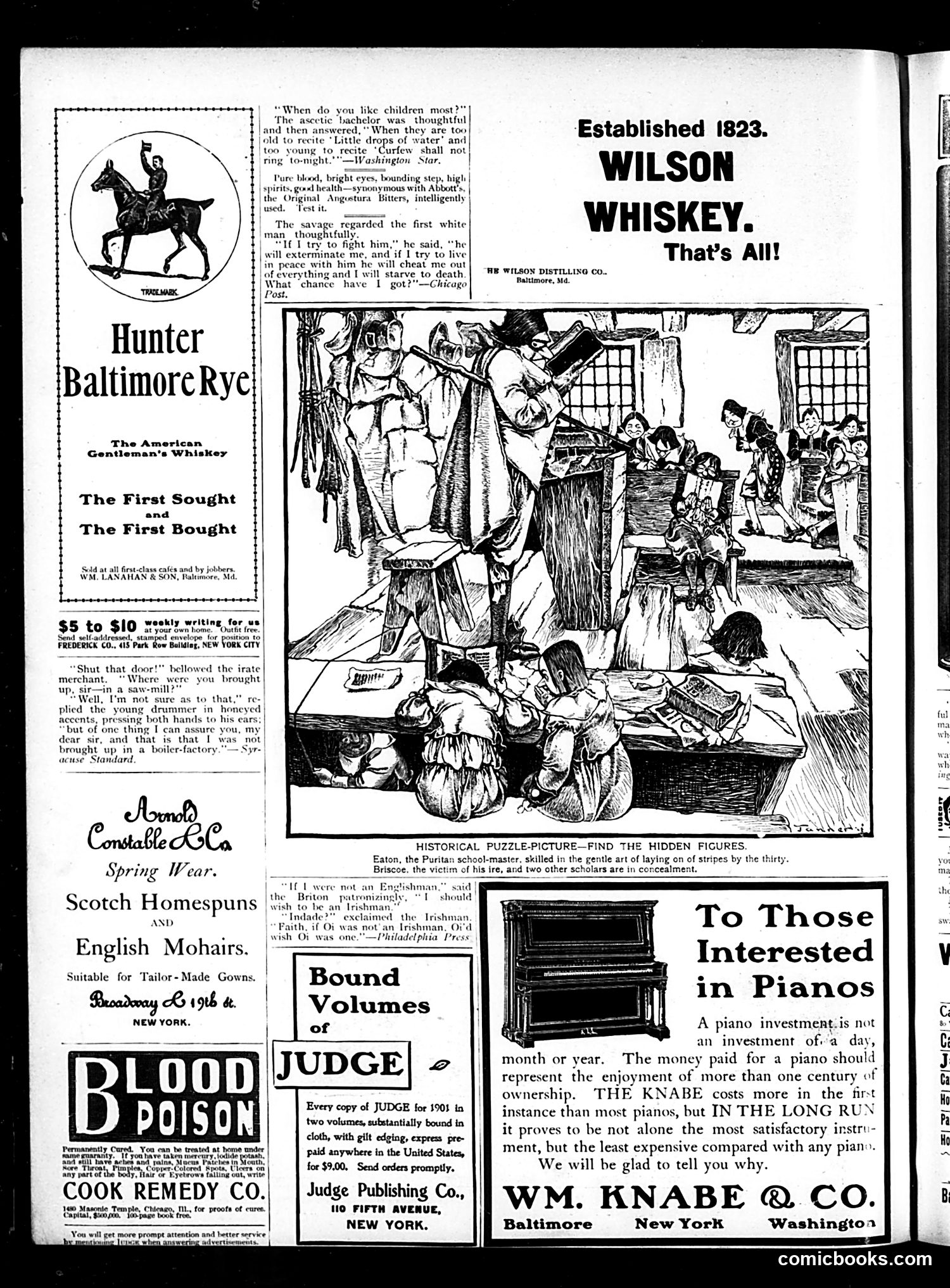
This page from Judge magazine (circa 1903, based on the JUDGE Publishing Co. reference) is primarily **advertising and filler content** rather than political satire. The main visual element is a "Historical Puzzle-Picture" showing a Puritan schoolmaster (Eaton) administering corporal punishment to students—a reference to harsh colonial-era discipline practices. Readers were challenged to "find the hidden figures" in the illustration. The page otherwise consists of period advertisements for: - **Hunter Baltimore Rye whiskey** (emphasizing it as "The American Gentleman's Whiskey") - **Wilson Whiskey** - **Arnold Constable & Co.** (clothing) - **Blood Poison** remedy (Cook Remedy Co.) - **Judge bound volumes** (1903 edition) - **Knabe pianos** Scattered between ads are brief humorous anecdotes about social etiquette and interactions—typical filler material for the era. There is **no significant political satire or social commentary** on this particular page.
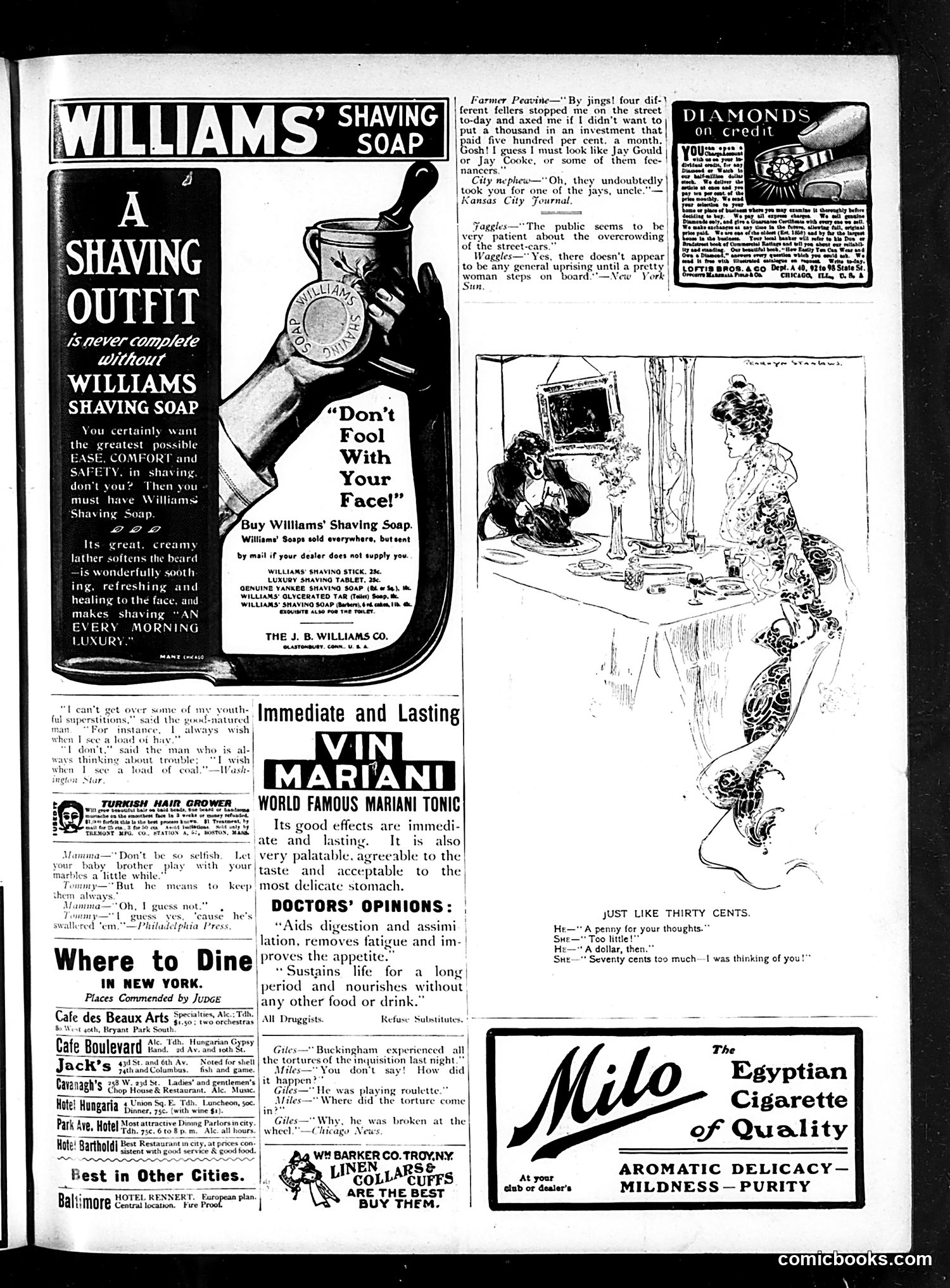
This is primarily an **advertising page** with minimal editorial content. The few cartoon jokes are brief: **"Farmer Peavine"** joke: A rural character is approached by four con artists offering investment schemes promising 500% monthly returns. His nephew suggests the scammers mistook him for a wealthy industrialist like Jay Gould or Jay Cooke, calling him "one of the jays"—a period slang term for a gullible person. The humor targets both rural naïveté and the prevalence of investment frauds in early 20th-century America. **"Giles/Miles"** exchange: A brief joke about someone losing money at roulette, playing on the phrase "broken at the wheel." The remainder comprises advertisements for Williams' Shaving Soap, Vin Mariani tonic, Turkish Hair Grower, diamonds, Milo cigarettes, and restaurant recommendations. The Vin Mariani ad notably includes fake "doctors' opinions" endorsing the product—a common and eventually illegal advertising practice of that era.
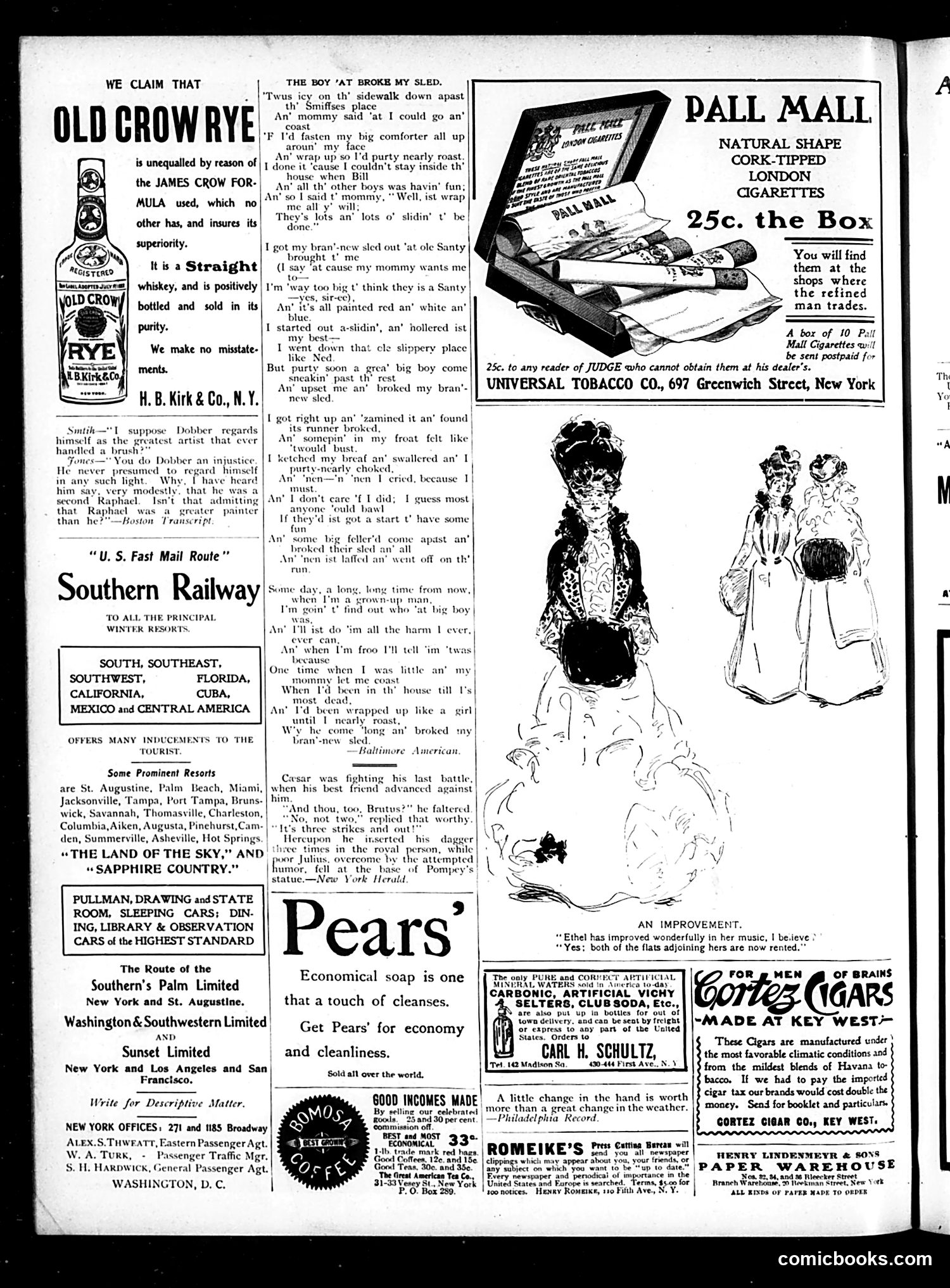
This page is primarily **advertising**, with one notable satirical cartoon about a child's broken sled. The main cartoon depicts a child's narrative complaint about "the boy 'at broke my sled." The child recounts how after receiving a new red-and-white sled from Santa, an older boy broke it—and now the child vows revenge on this unnamed boy. The satire targets **childish logic and disproportionate retaliation**: the child plans to harm the boy repeatedly simply because of a broken sled, with the implication that this cycle of revenge is absurd and petty. A secondary joke mocks an art critic who called Dobber "a second Raphael"—the critic interprets this as modest self-deprecation, when it's actually admission that Dobber thinks himself *greater* than Raphael. The remainder consists of period advertisements for Old Crow Rye whiskey, Pall Mall cigarettes, Southern Railway, Pears' soap, and other products—typical of Judge's revenue model. No clear political figures or events are referenced on this particular page.
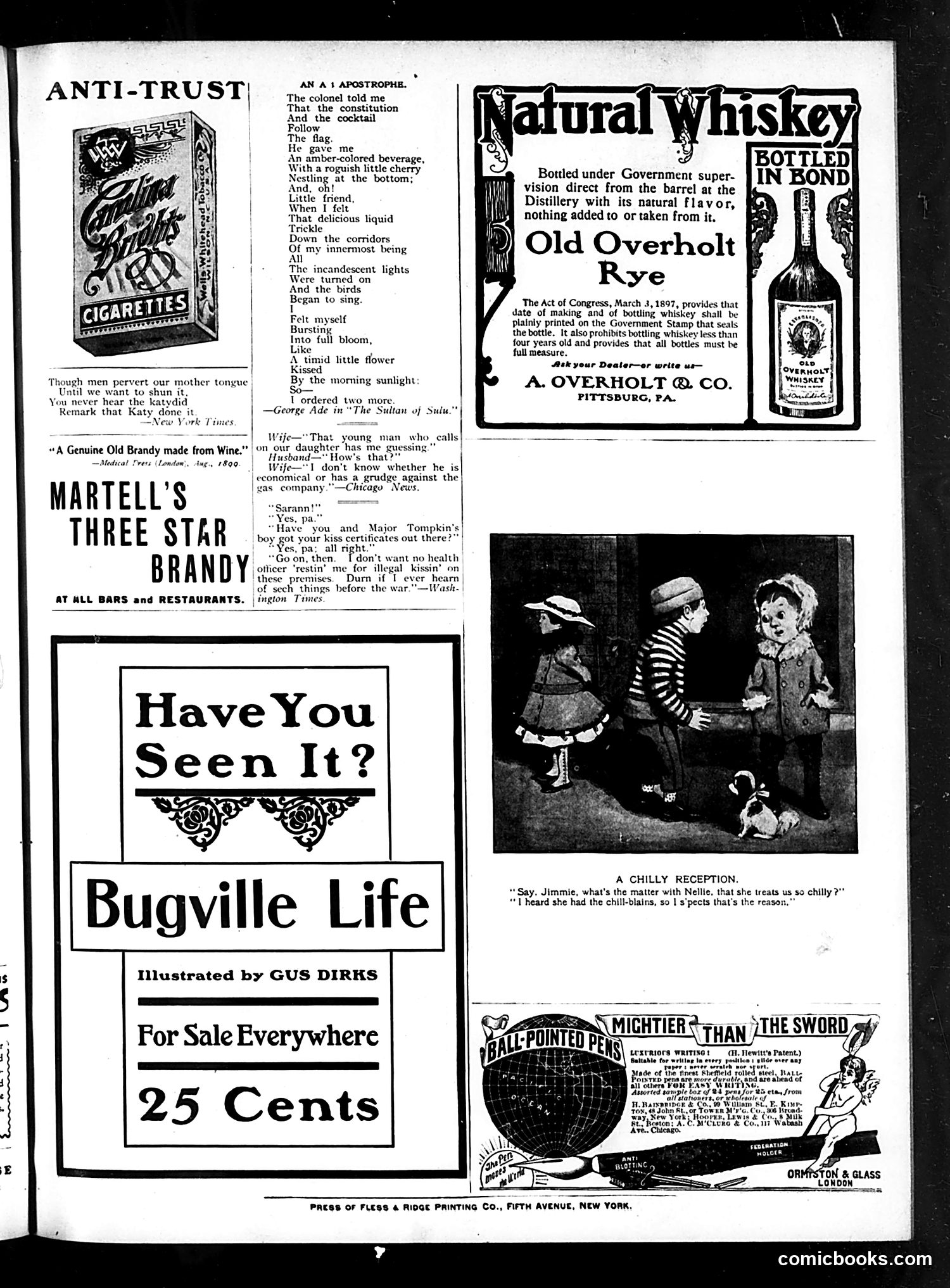
This page is primarily **advertising** interspersed with light humor and satirical poetry. Key content: **"An A1 Apostrophe"** is a comedic poem by George Ade mocking patriotic rhetoric ("Follow the flag") through exaggerated flowery language describing the effects of a cocktail—suggesting the slogan is as intoxicating and nonsensical as the drink. **"Anti-Trust"** features a cigarette ad with a brief poem about natural speech, likely satirizing corporate monopolies' impact on American culture—the trademark "ANTI-TRUST" heading appears ironic given it's advertising a commercial product. **The "Chilly Reception" cartoon** is a simple pun: a boy explains a girl's coldness is due to "chill-blains" (a medical condition), not actual coldness toward him. **"Bugville Life"** advertisement promotes a 25-cent illustrated book by Gus Dirks—likely animal or insect-themed humor comics. The remaining content consists of liquor and pen advertisements, period-appropriate for Judge magazine's readership of educated, affluent males.
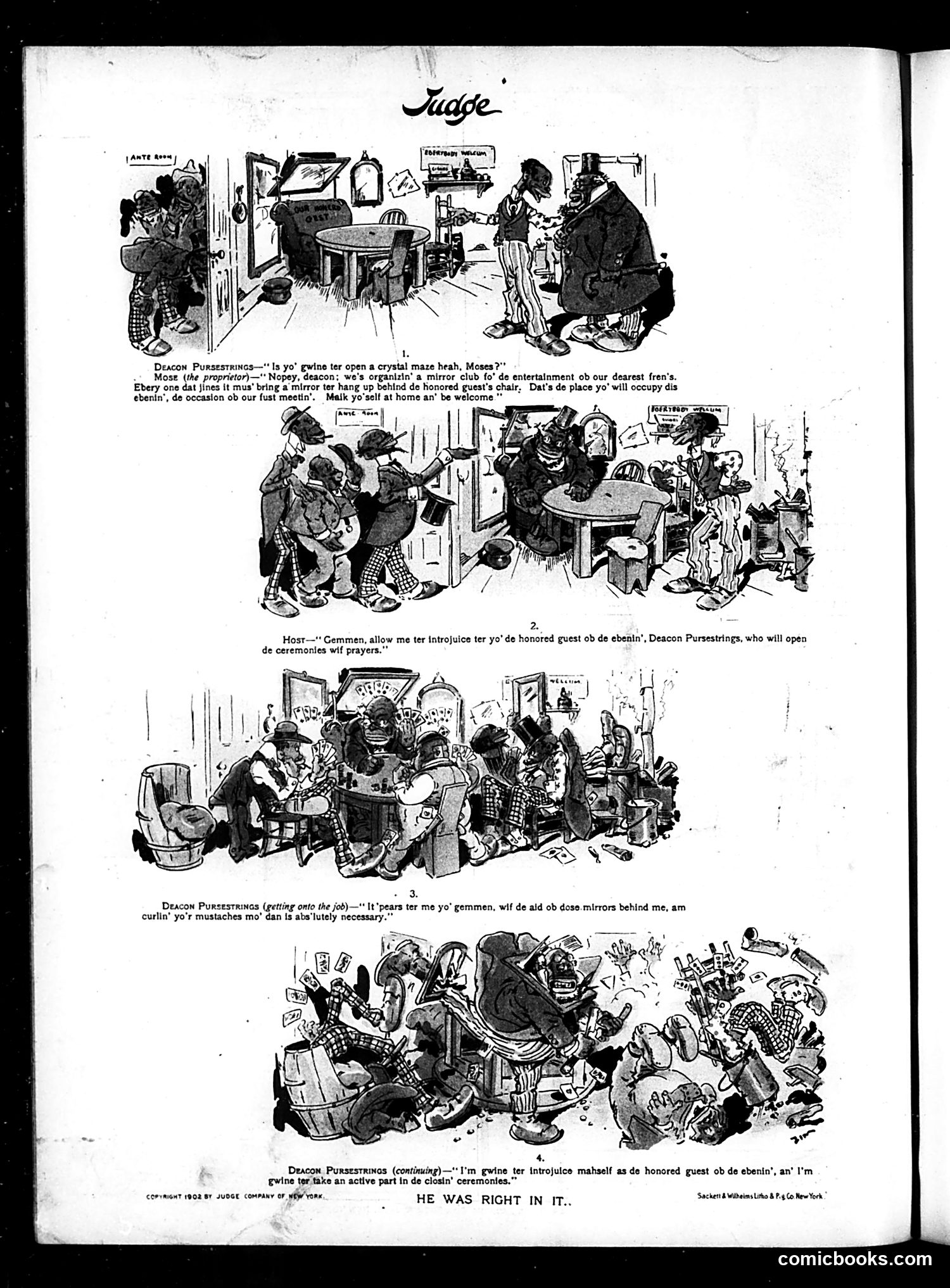
This 1902 Judge comic satirizes vanity and self-absorption among wealthy African American men. The characters "Deacon Pursestrings" and "Mose" organize a "mirror club"—ostensibly to honor guests, but actually to display mirrors behind the honored chair. The joke: Deacon Pursestrings arrives as the "honored guest" only to realize the mirrors are positioned so attendees can admire *themselves*, not him. When he catches on, he claims the mirrors are making their mustaches curl unnecessarily. By the final panel, he's abandoned pretense entirely, announcing he'll be both guest *and* lead the closing ceremony—taking full control. The satire targets masculine vanity and social climbing, using exaggerated dialect and caricature typical of period racial humor. The phrase "He Was Right In It" suggests Pursestrings finally admits his true motive: the event was always about his own prominence, not genuine hospitality.